|
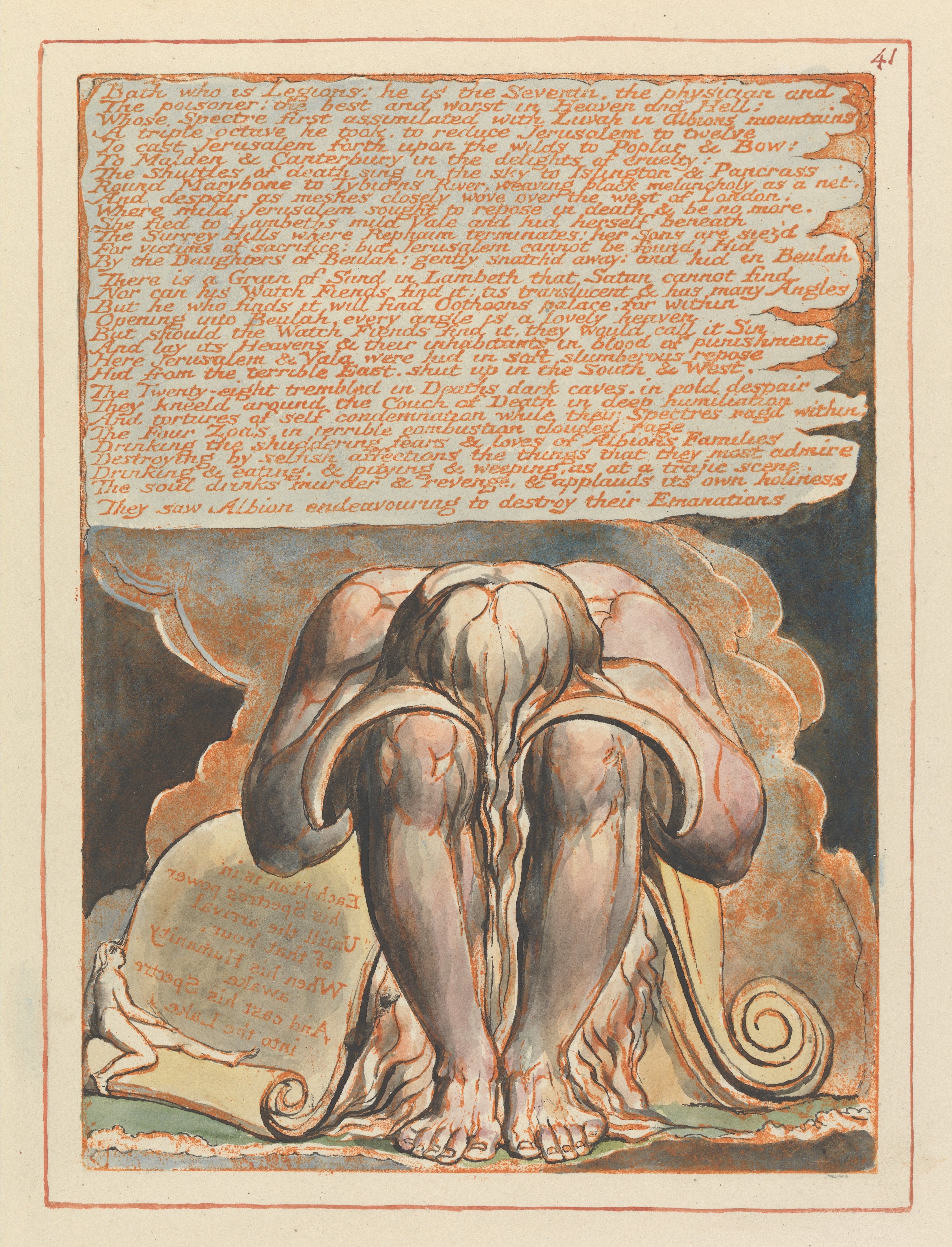
| Blake Archive British Museum Illustrations to Young's Night Thoughts Object 26 |
Turning to the third lament of Enion which occurs near the end or Night III of the Four Zoas, we read
words from 'the cold waters of despair.' One way that Blake expressed
the situation in which Enion found herself was through the symbol of
Atlantis, a lost continent which had been described by Plato. To Blake
the deluge in which Tharmas and Enion were submerged could be
represented by the mighty flood which wiped out a continent.
In Fearful Symmetry Northrop Frye gives us implications of what Atlantis symbolized to Blake:
"The fall of Albion included a deluge in which the center of Atlantis was overwhelmed and only fragments of the British Isles were left. The settlement of America by the English and revolt of America against the dead hand of English tyranny is therefore the dawn of a new age in which Atlantis begins to appear above the waves. In the meantime England still exists in the spiritual world as Atlantis, and Blake's engraved poems are on its mountains." (Page 126)
When we think of the instinctual aspect of our minds as the Id, the part that initially incorporates the desire to maintain life itself, we get an intimation of the function of Tharmas and Enion. If Tharmas holds the desire for life to be expressed, and Enion the ability to express that desire, their integration into a unit is necessary to their existence. Tharmas without Enion is a chaotic flood which submerges Atlantis. It is as if the disorganized unconscious was threatening to withhold all psychic energy from other portions of the mind. Enion was the first to experience this loss by traveling farther and farther into nonexistence and finding it harder and harder to return.
If ordinary consciousness is lost when someone becomes mentally ill, the unconscious may gain control. Tharmas and Enion are what dominates the unconscious. For Enion to be completely lost to Tharmas would cut off any avenue to restoring order and consciousness. If Tharmas can remember Enion, she may draw him into a connection with the means of healing which the conscious mind may supply.
In Fearful Symmetry Northrop Frye gives us implications of what Atlantis symbolized to Blake:
"The fall of Albion included a deluge in which the center of Atlantis was overwhelmed and only fragments of the British Isles were left. The settlement of America by the English and revolt of America against the dead hand of English tyranny is therefore the dawn of a new age in which Atlantis begins to appear above the waves. In the meantime England still exists in the spiritual world as Atlantis, and Blake's engraved poems are on its mountains." (Page 126)
Enion's Third Lament
Four Zoas, Page 44, Night III, (E 330)
"These are the words of Enion heard from the cold waves of despair

O Tharmas I had lost thee. & when I hoped I had found thee
O Tharmas do not thou destroy me quite but let
A little shadow. but a little showery form of Enion
Be near thee loved Terror. let me still remain & then do thou
Thy righteous doom upon me. only let me hear thy voice
Driven by thy rage I wander like a cloud into the deep
Where never yet Existence came, there losing all my life
I back return weaker & weaker, consume me not away
In thy great wrath. tho I have sinned. tho I have rebelld
Make me not like the things forgotten as they had not been
Make not the thing that loveth thee. a tear wiped away"
Enion's
lament in Night III expresses the further disintegration of the
unified psyche. Together Tharmas and Enion were the most basic
building block of the psyche. When Enion become too distant
from Tharmas to hear his voice or know that he sustained her
existence she asked only to be remembered. When we think of the instinctual aspect of our minds as the Id, the part that initially incorporates the desire to maintain life itself, we get an intimation of the function of Tharmas and Enion. If Tharmas holds the desire for life to be expressed, and Enion the ability to express that desire, their integration into a unit is necessary to their existence. Tharmas without Enion is a chaotic flood which submerges Atlantis. It is as if the disorganized unconscious was threatening to withhold all psychic energy from other portions of the mind. Enion was the first to experience this loss by traveling farther and farther into nonexistence and finding it harder and harder to return.
If ordinary consciousness is lost when someone becomes mentally ill, the unconscious may gain control. Tharmas and Enion are what dominates the unconscious. For Enion to be completely lost to Tharmas would cut off any avenue to restoring order and consciousness. If Tharmas can remember Enion, she may draw him into a connection with the means of healing which the conscious mind may supply.
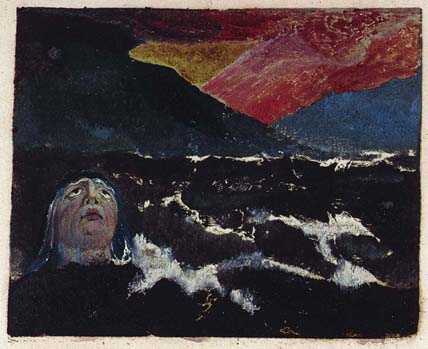 |
| Blake Archive British Museum Small Book of Designs Copy A, Plate 8 |