Sunday, May 16, 2010

JERUSALEM SPEAKS

Jerusalem, PLATE 54 (E 203)
"In Great Eternity, every particular Form gives
forth or Emanates

Its own peculiar Light, & the Form is the Divine
Vision

And the Light is his Garment This is Jerusalem
in every Man"


Forgiveness
In his poem Jerusalem, Blake uses his character Jerusalem as the carrier of the Light Within. I read the following words as Jerusalem's testimony of faith.

Jerusalem, Plate 60, (E 211)
"But the Divine Lamb stood beside Jerusalem. oft she saw
The lineaments Divine & oft the Voice heard, & oft she said:

O Lord & Saviour, have the Gods of the Heathen pierced thee?
Or hast thou been pierced in the House of thy Friends?
Art thou alive! & livest thou for-evermore? or art thou
Not: but a delusive shadow, a thought that liveth not.
Babel mocks saying, there is no God nor Son of God
That thou O Human Imagination, O Divine Body art all
A delusion. but I know thee O Lord when thou arisest upon
My weary eyes even in this dungeon & this iron mill.
The Stars of Albion cruel rise; thou bindest to sweet influences:
For thou also sufferest with me altho I behold thee not;
And altho I sin & blaspheme thy holy name, thou pitiest me;
Because thou knowest I am deluded by the turning mills.
And by these visions of pity & love because of Albions death.

Thus spake Jerusalem, & thus the Divine Voice replied.

Mild Shade of Man, pitiest thou these Visions of terror & woe!
Give forth thy pity & love. fear not! lo I am with thee always.
Only believe in me that I have power to raise from death
Thy Brother who Sleepeth in Albion: fear not trembling Shade"
_________
Here is my paraphrase of the above passage:
Jerusalem can feel and see and hear the presence of Christ. She asks if those who have confessed loyalty to Christ are not the ones who are hurting him. She see that those within the church don't acknowledge the living Christ and the nature of Eternity. Eternal things are being called shadow and delusion and lifeless. God and Christ are denied as unreal. Jerusalem has an inner knowledge of Christ even when outer circumstances are harsh and deadening. She knows that Christ is with her in her suffering even if she fails to recognize him. Jerusalem knows that the illusory world deceives her and obscures her vision because of its brokenness from Eternity.

Jerusalem hears the reply of Christ affirming the love and pity she has for the broken shadowy inhabitants of her world. Christ assures Jerusalem that he will not depart from her. She should continue to affirm his presence and the true spiritual nature of Eternity which is being restored to its unity.

In making this paraphrase I came to realize that this passage can be seen as a critique of deism which had become the respected form of Christianity in Blake's day. Blake often referred to it as natural religion in contrast to revealed religion. There was no place for vision or mystical experience in deism. Blake's religious experience was that of a God who is present to man as an internal reality. Blake's God is not accessed through reason or external proofs; his God is manifest in lives of faith, love, forgiveness and brotherhood.
_____________
Gospel of Matthew
28:8 - Then the women went away quickly from the tomb, their hearts filled with awe and great joy, and ran to give the news to his disciples.
28:9-10 - But quite suddenly , Jesus stood before them in their path, and said, "Peace be with you!" And they went forward to meet him and, clasping his feet, worshipped him. Then Jesus said to them, "Do not be afraid. Go now and tell my brothers to go into Galilee and they shall see me there"

Saturday, May 15, 2010

Gates of Paradise Picture 11 Again

Creative and welcome criticism of the first "Picture 11" led to much further thought of the image, especially of its import in Blake's development.

1. The young Blake was actually a flaming liberal (like most such he was eventually mugged). At 23 he was present in the crowd at the Newgate riots, like quite a few liberal minded Englishmen who could be called "American patriots".

Blake wrote America celebrating the independence of the colonies. (Some of his finest poetry can be seen at Plate 8 of this poem.) When the French Revolution broke out in the nineties, he wore a red cap (of Liberty) (he was "mugged" by the outbreak of the Reign of Terror); at that point "Red Orc" had lost some of its attraction for the poet. He wrote a little poem called The Grey Monk describing a new attitude:
"The hand of Vengeance found the bed
To which the Purple Tyrant fled;
The iron hand crush'd the Tyrant's head
And became a Tyrant in his stead."

Back in 1779, when he was 22 Blake had become part of the Royal Academy, but he expressed great distaste for the 'head knocker' there, Sir Joshua Reynolds. He wrote numerous expressions of depreciation in his Annotations to Reynold's Discourses , (Erdman 635-62)

You may recall that in the Four Zoas Blake defined these functions of the psyche:
Tharmas -- the physical or (as in Jung) sensation
Urizen -- obviously related to reason
Luvah -- feeling, emotion
Los (Urthona in Eternity) -- Imagination (Intuition)

It appears to me that the old man in Aged Ignorance was a prototype of Urizen while the youth in the picture is the prototype of Orc/Luvah. Urizen is generally pictured as an old man surrounded by his books - the lawgiver, the demiruge who created this mess - while Orc is a symbol of bloody revolution.

Unfallen Urizen was the Prince of Light, but on Night 9 of the Four Zoas, page 119-20 (Erdman 388-9) the Eternal Man (Albion) lifts "his Eyes (from slumber) and cries (to Urizen) with heavenly voice.......O Prince of Light.....
"Come forth from slumbers of thy cold abstraction come forth
Arise to Eternal births shake off thy cold repose
Schoolmaster of souls great opposer of change......
Arise O stony form of death O dragon of the Deeps", etc.
The paragon of conservatism! (Blake had no truck with schoolmasters!)

Before the next function (feeling) was Luvah, he was Red Orc , the flame of violent revolution. As Blake's mind progressed he became Luvah ("clothed in robes of blood"). Ultimately he became Jesus, the crown and climax of Blake's system; no one ever had such an odyssey finding his way to the Lord.

Friday, May 14, 2010

PUT ON INTELLECT

Because Urizen (who is associated with reason) plays the villain in so much of Blake's poetry, some may have drawn the conclusion that Blake is anti-intellectual. In fact Blake values the intellect highly. The problem with Urizen was that he abstracted reason from human values. Urizen (reason) attempting to dominate Los (imagination) and Luvah (emotion) is cut off from the possibility of creative activity. Urizen's ideas become fixed in books of laws which limit and regulate the freedoms which are meant to be expressed and enjoyed. Blake's Urizen is unable himself to create and unwilling for others to create through their imaginative and emotional lives.

On the contrary intellectual activities are meant to be the primary activities of humanity as they are in Eternity. Blake spoke frequently about the value he placed on intellect as is demonstrated by the following quotes:

Jerusalem, Plate 91, (E 251)
"I never made friends but by spiritual gifts;
By severe contentions of friendship & the burning fire of
thought."

Jerusalem, Plate 34, (E 180)
"Albion! Our wars are wars of life, & wounds of love,
With intellectual spears, & long winged arrows of thought:"

Jerusalem, Plate 68, (E 222)
"Once Man was occupied in intellectual pleasures & energies
But now my soul is harrowd with grief & fear & love & desire
And now I hate & now I love & Intellect is no more:
There is no time for any thing but the torments of love & desire"

Jerusalem, Plate 77, (E 231)
"What were
all their spiritual gifts? What is the Divine Spirit? is the Holy
Ghost any other than an Intellectual Fountain? What is the
Harvest of the Gospel & its Labours? What is that Talent which it
is a curse to hide? What are the Treasures of Heaven which we are
to lay up for ourselves, are they any other than Mental Studies &
Performances? What are all the Gifts. of the Gospel, are they not
all Mental Gifts?
...
O ye Religious discountenance every one among
you who shall pretend to despise Art & Science! I call upon you
in the Name of Jesus! What is the Life of Man but Art & Science?"

Jerusalem, Plate 91, (E 251)
"Go, tell them that the Worship of God, is honouring his gifts
In other men: & loving the greatest men best, each according
To his Genius: which is the Holy Ghost in Man; there is no other
God, than that God who is the intellectual fountain of Humanity;"

Four Zoas, Page 21, (E 313)
"Terrific ragd the Eternal Wheels of intellect terrific ragd
The living creatures of the wheels in the Wars of Eternal life"

Four Zoas, Page 139, (E 407)
"Where is the Spectre of Prophecy where the delusive Phantom
Departed & Urthona rises from the ruinous walls
In all his ancient strength to form the golden armour of science
For intellectual War The war of swords departed now
The dark Religions are departed & sweet Science reigns"

Vision of Last Judgment, Page 70, (E 554)
" Imaginative Art &
Science & all Intellectual Gifts all the Gifts of the Holy Ghost
are [despisd] lookd upon as of no use & only Contention
remains to Man then the Last Judgment begins & its Vision is seen
by the [Imaginative Eye] of Every one according to the
situation he holds"

Vision of Last Judgment, Page 87, (E 564)
"The Treasures of
Heaven are not Negations of Passion but Realities of Intellect
from which All the Passions Emanate in their Eternal
Glory The Fool shall not enter into Heaven let him be ever so
Holy. Holiness is not The Price of Enterance into Heaven Those
who are cast out Are All Those who having no Passions of their
own because No Intellect."

Jerusalem, Page 91, (E 252)
"I care not whether a Man is Good or Evil; all that I care
Is whether he is a Wise Man or a Fool. Go! put off Holiness
And put on Intellect:"

Thursday, May 13, 2010

Quit Your Meanness

Sam Jones was the South's most famous preacher in the late nineteenth century. Jones preached one sermon that Dad really liked and put in his sermon notebook; it was called "Quit your Meanness".

St. Paul used more elegant language: "work out your own salvation with fear and trembling for it is God which worketh in you both to will and to do of his good pleasure" (Philippians 2:12-13). That verse, prominent in my memory for many years, acquired new poignancy the other day as I was contemplating Blake's Selfhood: annihilate it!

The Selfhood goes in the circular file, but neither Blake nor you and I could do that overnight; oh no! We had to work it out with fear and trembling. The Spectre is the Selfhood, and Blake wrote:
"My spectre around me night and day
Like a wild beast guards my way;"
from the poem that has been discussed so often in this blog.

Blake had to discover his preconceived notions, his pet peeves, his resentments of everyone from Bacon, Newton, and Locke to Hayley. Once he discovered them and confessed his error, that aspect of his Selfhood was annihilated, and the Last Judgment fell upon him. In Plate 98, near the end of Jerusalem and of his poetry he joined Bacon and Newton and Locke with those he had always loved, Shakespeare, Milton, and Chaucer. It was the testimony of a happy man.

C.S.Lewis, near the end of his greatest story, Till We Have Faces, shared his Vision of that Eternal 'Moment'. Lewis had issues with Blake because of his own orthodoxy but my vision of him is that Blake's poetry and George MacDonalds's spirit had done their work in the end, enabling Lewis to envision the graduation to Eternity of "turk and jew":
"And all must love the human form,
In heathen, turk or jew.
Where Mercy, Love & Pity dwell,
There God is dwelling too"
Blake has said that "every death is an improvement in the state of the departed."

He must have substantially completed the long drawn procedure of confessing his sins and experiencing forgiveness during mortal life because he died a very happy man.

Wednesday, May 12, 2010

GOOGLE BOOKS

If you have an interest in reading the early books about William Blake as well as what is being written about him in our own day, you will find a tremendous resource in Google books. Many of the out of copyright Blake books have been digitized by Google. Unlike the copyright books which Google makes available, these books are published in their entirety without deletions. Furthermore they are available as text files as well as image files so that passages can be copied and saved for your own individual use or to share with others.

You may find that early works about Blake's writing offers critical information and analysis which you are less likely to find in current books. The early writers were closer to Blake's times. They were frequently giving their full attention to understanding the content of his work. Current works sometimes assume the basic mastery of Blake's content and focus on 'minute details' of literary criticism. So have a look at these out of print, out of copyright volumes which are at your fingertips.

Here is a sample passage from the introduction to The prophetic books of William Blake: Milton by William Blake, Eric Robert Dalrymple Maclagan, Archibald G Russell:


"The substance of the poem [Milton] is almost entirely autobiographical. Blake himself tells us, in one of his letters, that it is descriptive of ' the spiritual acts ' of his ' three years' slumber on the banks of ocean.' Both the characters and the action have their counterparts in the drama which had been enacted at Felpham. The disguise is often a close one: but we are told that it is a ' sublime allegory,' and ' allegory addressed to the intellectual powers, while it is altogether hidden from the corporeal understanding,' is Blake's 'definition of the most sublime poetry.' The writing was 'from immediate dictation, twelve or sometimes twenty or thirty lines at a time, without premeditation, and even against' his ' will.' ' Thus,' he writes, ' the time it has taken in writing was rendered non-existent, and an immense poem exists ... all produced without labour or study.' The purpose of the book is clearly stated on p[late]. 36, 11. 21-25 [E 137]:
'. . When Los join'd with me he took me in his fiery whirlwind:
My vegetated portion was hurried from Lambeth's shades:
He set me down in Felpham's vale and prepar'd a beautiful
Cottage for me, that in three years I might write all these visions,
To display Nature's cruel holiness: the deceits of natural religion.'"

Tuesday, May 11, 2010

Gates of Paradise Picture 11

The title here is Aged Ignorance and what Digby called the couplet(?) was 
" In Aged Ignorance profound,
Holy and cold, I clipp'd the wings
Of all sublunary things,":

pdimagearchive
Gates of Paradise
Plate 11
Aged Ignorance! What a piquant and meaningful name for so many things; it immediately calls to mind a white haired old codger sitting on a bench outside the country store spitting tobacco juice and pooh-pooh-ing anything new that anyone has been foolish enough to mention. (Not that country stores have a corner on aged ignorance; actually it's endemic; let everyone survey his own mind critically.)

Digby says on page 43): "This refers to the tendency to try to explain everything in life by the known." How about the man in the middle of the 19th century who lamented because he felt that everything possible had already been invented.

Wieman referred to it as the created good, at the expense of the creative event. There are many ways to express this fundamental truth of the human psyche; one of them is conservative vs liberal (generic, not necessarily political).

With those three lines and small image Blake can make us aware of this fundamental truth of the human psyche. We live in Plato's Cave, with "chains of the mind locked up", unable to move away from our prejudices, and only when we become aware of our deplorable condition do we have a chance to turn and look for the light. As AA can tell you, you have to hit bottom first.

In an earlier post (called Clipped) the matter was discussed in terms of the generation gap; some kids leave home at the earliest opportunity, and there may be good reasons for that decision.

Monday, May 10, 2010

DIVINE BODY

Earthbound Imagination, From the British Museum's Night Thoughts

The word imagination occupies a special place in Blake's vocabulary. He uses the word to speak of existence in the spiritual world which is the only true existence. Our awareness of this reality is through imagination. Jesus himself, as the Divine Body, is the Human Imagination. The world of mortality which appears without, is but a shadow of the inner world of imagination.

We will live in the world of imagination, Eternity, when we leave these vegetated bodies. However we have access to this world now if we will open ourselves to vision through contemplation, poetry, painting and music.
__________
Milton, Plate 32, (E 132)

"Calling the Human Imagination: which is the Divine Vision &
Fruition
In which Man liveth eternally: madness & blasphemy, against
Its own Qualities, which are Servants of Humanity, not Gods"
__________
Jerusalem, Plate 5, (E 147)

"To open the Eternal Worlds, to open the immortal Eyes
Of Man inwards into the Worlds of Thought: into Eternity
Ever expanding in the Bosom of God. the Human Imagination"
__________
Jerusalem, Plate 5, (E 148)

"Abstract Philosophy warring in enmity against Imagination
(Which is the Divine Body of the Lord Jesus. blessed for ever)."
__________
Jerusalem, Plate 71, (E 225)

"For all are Men in Eternity. Rivers Mountains Cities Villages,
All are Human & when you enter into their Bosoms you walk
In Heavens & Earths; as in your own Bosom you bear your Heaven
And Earth, & all you behold, tho it appears Without it is Within
In your Imagination of which this World of Mortality is but a
Shadow."
__________
Jerusalem, Plate 77, (E 231)

"I know of no other
Christianity and of no other Gospel than the liberty both of body
& mind to exercise the Divine Arts of Imagination.
Imagination the real & eternal World of which this Vegetable
Universe is but a faint shadow & in which we shall live in our
Eternal or Imaginative Bodies, when these Vegetable Mortal Bodies
are no more."
__________
Vision of the Last Judgment, (E 555)

"This world of Imagination is the World of Eternity it is the
Divine bosom into which we shall all go after the death of
the Vegetated body This World is Infinite & Eternal
whereas the world of Generation or Vegetation is Finite
& [for a small moment] Temporal There Exist in that Eternal
World the Permanent Realities of Every Thing which we
see are reflected in this Vegetable Glass of Nature All
Things are comprehended in their Eternal Forms in the
Divine body of the Saviour the True Vine of Eternity
The Human Imagination who appeard to Me as Coming to
Judgment. among his Saints & throwing off the Temporal
that the Eternal might be Establishd."
__________
Vision of the Last Judgment, (E 560)

"If the Spectator could Enter into these Images in his
Imagination approaching them on the Fiery Chariot of his
Contemplative Thought if he could Enter into Noahs Rainbow
or into his bosom or could make a Friend & Companion of
one of these Images of wonder which always intreats him to
leave mortal things as he must know then would he arise
from his Grave then would he meet the Lord in the Air & then
he would be happy"
____________________________________________
Percival, in William Blake's Circle of Destiny, (page 8) explains how we experience imagination inwardly and outwardly:
"At the center is imagination, "the human existence itself," the one reality. It is divine - not ourselves; and it is of course eternal. It may be thought of as inner, active and masculine. As it manifests itself outwardly, in the world of self and phenomena, it is temporal, passive, rational and feminine. But since the outward is only a manifestation of the inward , the antinomy is not truly a duality; the two are one. To use a traditional figure they constitute a tree of life, firmly rooted in the inward, active masculine, bearing its fruits in the outward, passive feminine."

Blake says of himself: "Inspiration & Vision was then & now is & I hope will always Remain my Element my Eternal Dwelling place." Annotations to Reynolds, (E 660)
 
Heavenly imagination From the British Museum's Night Thoughts

Sunday, May 09, 2010

Gates of Paradise Picture 10

I haven't found this picture in the Library of Congress Collection, but you may look at it in the Blake Archive, and this may be a good substitute:
(Thomas Cole from Wikipedia Commons; click on it twice for a big experience.) Anybody past 35 is likely to be aware of this stage of life. In my own experience it marked the beginning of the fundamental change of my life (you might say from me to God). It's also the turning point in the lives of many members of Alcoholic Anonymous and many other "Anonymous" groups.

It's the moment when a person perceives that he's in trouble and needs help. Until that moment you are the "the master of your fate, the captain of your soul". Like the poor unfortunate in the picture the Sea of Time and Space has gotten the best of you, and you're crying for help.

Blake understood this feeling when he wrote
Children's Gates of Paradise (in 1793), but the decisive help for him came some years later (in 1800).

There is only one line ("10. In Time's Ocean falling, drown'd;") in Of the Gates, but the picture here is certainly worth a thousand words.

Saturday, May 08, 2010

GENESIS IV

Illustrations to Genesis
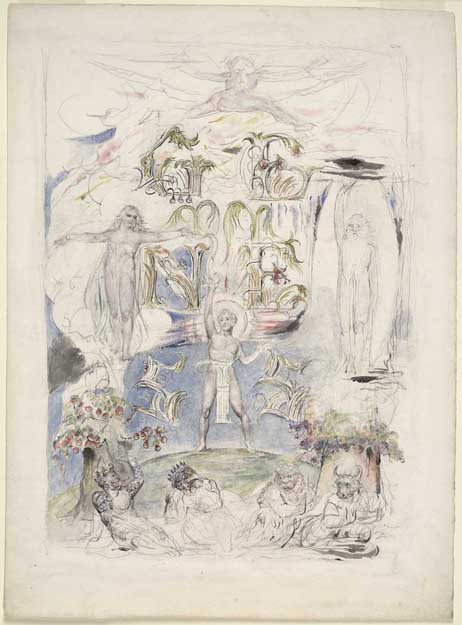
Second Title Page

This Genesis Illustration is from the Huntington Library, San Mario, California. You can read more about it in The Traveller in the Evening: Last Works of William Blake by Morton D. Paley

Blake was working on illustrations to the book of Genesis during the last two years of his life; remaining are eight incomplete pages. It seems that near the end of his life Blake was making an effort to bring together graphically the characters in his own myth and the players in the Biblical story. 

Damon in A Blake Dictionary (page 151) had a go at describing what Blake's imagination has produced: "In the more elaborate sketch, the Father and son appear according to tradition, while the Holy Ghost is a nude youth. On the left is Christ with arms extended in the cruciform position, but he is not suffering. From his left hand a scroll descends, which reaches to the uplifted right hand of the Holy Ghost. On the right counterbalancing the Son, is the Father, who stands on a black cloud and points upward to another; behind his glory, black flames are just peeping out." 

 "In a row beneath sit the Four Zoas, represented as the four beasts. On the far left is Luvah, as Orc turning into the Serpent. Crowned with gems, snake-tongued, laughing, he uplifts his left hand toward the apple tree above him. He is the only active Zoa; the other three apparently have their hands folded in prayer. The second is Urthona-Los as a eagle with a crown; he inclines toward Luvah-Orc but turns his head away. Urizen as a lion draws away from the eagle. Last is Tharmas as a horned ox; above him is the fruit-laden tree of life." 

Although I am glad to have the the commentary of Damon, I see some of the images differently. The running man at the top of the picture I take to be Urthona-Los as the Holy Spirit. The central figure whom Damon identifies as the Holy Ghost, I take to be Adam-Urizen (in his unfallen state). As Adam he is the first born of humanity, as Urizen the 'first born son of light.' (Four Zoas (E 108)). Jesus, identified as the Son, is seen in terms of the Zoas as Luvah, since the Lamb of God was clothed in Luvah's Robes of Blood. Damon says of Tharmas: "As an aspect of Deity, he is the first Person of the Trinity, the ever pitying Father, but also the good shepherd." So we have all four Zoas represented in the upper image as well as in the lower. 

It is unfortunate that we don't have a really clear or completed image of the picture because Blake was trying to pack so much information into one picture, summing up much of what his imaginative powers had discerned through a lifetime of thought, work and vision.

Song of Los, Plate 3, (E 67) 
"Adam stood in the garden of Eden: 
And Noah on the mountains of Ararat; 
They saw Urizen give his Laws to the Nations 
By the hands of the children of Los."

Friday, May 07, 2010

The Trees: of Life and Mystery

Here's a poem from Songs of Experience:

"I was angry with my friend:
I told my wrath, my wrath did end.
I was angry with my foe:
I told it not, my wrath did grow.

And I water'd it in fears,
Night & morning with my tears;
And I sunned it with smiles,
And with soft deceitful wiles.

And it grew both day and night,
Till it bore an apple bright;
And my foe beheld it shine,
And he knew that it was mine,

And into my garden stole
When the night had veil'd the pole:
In the morning glad I see
My foe outstretch'd beneath the tree."

You could say all sorts of things about this poem: an immediate allusion to the first garden.  Three characters here, or perhaps four: I am two people: that of God in me confesses my feelings, there's an implied forgiveness; there's an unspoken tree of life.  The other "i" is my selfhood, that of Satan in me; I dissemble, like the hypocrite I am; I brood over being wronged, and fantasize getting even with that s.o.b.  That's the way the devilish tree came about.

In fact Blake explained it baldly in another of the Songs of Experience, call The Human Abstract:

Pity would be no more
If we did not make somebody Poor;
And Mercy no more could be
If all were as happy as we.

And mutual fear brings peace,
Till the selfish loves increase:
Then Cruelty knits a snare,
And spreads his baits with care.

He sits down with holy fears,
And waters the ground with tears;
Then Humility takes its root
Underneath his foot.

Soon spreads the dismal shade
Of Mystery over his head;
And the Catterpiller and Fly
Feed on the Mystery.

And it bears the fruit of Deceit,
Ruddy and sweet to eat;
And the Raven his nest has made
In its thickest shade.

The Gods of the earth and sea
Sought thro' Nature to find this Tree;
But their search was all in vain:
There grows one in the Human Brain.

A Poison Tree
The Tree of Mystery
The Tree of the Knowledge of Good and Evil.  All too often what we take to be good is taken by another to be evil, or vice versa.

Thursday, May 06, 2010

GENESIS III

While working with the passage in the Four Zoas (go to page number E370) which was the basis for my two posts on Genesis, I became more aware of the way Blake speaks at various levels and about multiple realities simultaneously. In shifting the context and the characters as the narrative develops, Blake encourages us to think at different levels of abstraction, and at different levels of spiritual consciousness. I became aware that in talking of Los and Enitharmon, Blake was speaking at the level of creation of the 'Divine Family' which we may consider the archetypes. When we think of the processes in terms of Adam and Eve, the first parents, we are thinking about the origin of the human race, a biological process in which spirits became embodied. The creative process which William and Catherine engaged in, creating art, was the mental/spiritual process of creating images, imagining or creating ideas to represent unseen realities. There may be another level implied as well. If wrath and pity are the original materials with which the human mind has to work, we are seeing the psyche being created as the Zoas, the 'functions' through which it will be expressed.

New York Public Library
Milton
Plate 32

To help us visualize his world and its occupants, Blake gave us this diagram of his Four Zoas, Satan, Adam, the Egg (of Consciousness ?), the Earth (surrounding Adam) and the Fiery Circle.

This table helps me visualize the various levels of creation.

Los and Enitharmon---create the divine family---archetypes.
Adam and Eve---create the human race---embodiments
William and Catherine---create art---images
Wrath and Pity---create psyche---Zoas

Wednesday, May 05, 2010

Gates of Paradise Picture 9

This Plate is inscribed "I want! I want!" In the script for 'Gates' we have this couplet:
"On the shadows of the Moon
Climbing thro Nights highest noon."
From the Rosenwald Collection or the Rare Books Collection of the Library of Congress we have this picture:


It concerns "endless pursuit of desire" (Digby page 42). Blake had something else to say about that in There is No Natural Religion (Erdman page 2):
"More! More! is the cry of a mistaken soul, less than All cannot satisfy Man". As a young man Blake felt that nothing could trump desire, but he soon learned that he desired sustained creativity more than sensual excess.
The young man in the picture obviously had not learned that lesson. In Blake the moon symbolizes sense based materiality, as the sun does spiritual creativity.

Another picture that I dearly love is found in the National Gallery, by a luminist painter named Thomas Cole (Click twice; then to come back, do an alt left arrow):
This from Wikipedia/commons; it is the second of the Four stages of life, where the young man dreams of the air castles in the sky. The third page has him in late middle age going down the rapids and feverishly trying to avoid upset. The last one is the old man out into the pacific sea looking forward and upward to the angels. It seems to conform closely to Blake's myth.
Digby called our attention to another picture about refusing the sensual. It had become no problem for Jesus who had set his heart on something better.

This picture was one of Blake's illustrations to John Milton's Paradise Regained, which I found in Wikipedia Commons
So all three of these pictures display facets of a spiritual response for the young man crying for the moon. In spite of this obvious guidance it is too easy to concern ourselves with material possessions rather than the spiritual riches available to us.

Tuesday, May 04, 2010

GENESIS II

Continuation of Genesis

In spite of Enitharmon's fears, Los and Enitharmon will create habitations for the Spectres of the dead.

Four Zoas, Night VII, Page 98, (E 370)

"Enitharmon spread her beaming locks upon the wind & said
O Lovely terrible Los wonder of Eternity O Los my defence &
guide
Thy works are all my joy. & in thy fires my soul delights
If mild they burn in just proportion & in secret night
And silence build their day in shadow of soft clouds & dews
Then I can sigh forth on the winds of Golgonooza piteous forms
That vanish again into my bosom but if thou my Los
Wilt in sweet moderated fury. fabricate forms sublime
Such as the piteous spectres may assimilate themselves into
They shall be ransoms for our Souls that we may live

So Enitharmon spoke & Los his hands divine inspired began
To modulate his fires studious the loud roaring flames
He vanquishd with the strength of Art bending their iron points
And drawing them forth delighted upon the winds of Golgonooza
From out the ranks of Urizens war & from the fiery lake
Of Orc bending down as the binder of the Sheaves follows
The reaper in both arms embracing the furious raging flames
Los drew them forth out of the deeps planting his right foot firm
Upon the Iron crag of Urizen thence springing up aloft
Into the heavens of Enitharmon in a mighty circle

And first he drew a line upon the walls of shining heaven
And Enitharmon tincturd it with beams of blushing love
It remaind permanent a lovely form inspird divinely human
Dividing into just proportions Los unwearied labourd
The immortal lines upon the heavens till with sighs of love
Sweet Enitharmon mild Entrancd breathd forth upon the wind
The spectrous dead Weeping the Spectres viewd the immortal works
Of Los Assimilating to those forms Embodied & Lovely
In youth & beauty in the arms of Enitharmon mild reposing

First Rintrah & then Palamabron drawn from out the ranks of war
In infant innocence reposd on Enitharmons bosom
Orc was comforted in the deeps his soul revivd in them
As the Eldest brother is the fathers image So Orc became
As Los a father to his brethren & he joyd in the dark lake
Tho bound with chains of Jealousy & in scales of iron & brass

But Los loved them & refusd to Sacrifice their infant limbs
And Enitharmons smiles & tears prevaild over self protection
They rather chose to meet Eternal death than to destroy
The offspring of their Care & Pity Urthonas spectre was comforted
But Tharmas most rejoicd in hope of Enions return
For he beheld new Female forms born forth upon the air
Who wove soft silken veils of covering in sweet rapturd trance
Mortal & not as Enitharmon without a covering veil

First his immortal spirit drew Urizen[s] Shadow away
>From out the ranks of war separating him in sunder
Leaving his Spectrous form which could not be drawn away
Then he divided Thiriel the Eldest of Urizens sons
Urizen became Rintrah Thiriel became Palamabron
Thus dividing the powers of Every Warrior
Startled was Los he found his Enemy Urizen now
In his hands. he wonderd that he felt love & not hate
His whole soul loved him he beheld him an infant
Lovely breathd from Enitharmon he trembled within himself"

End of The Seventh Night
__________________________________________
In spite of Enitharmon's fear of the longterm consequences of the sin of eating the fruit, she focuses her attention on Los in his best light as her defense and guide, and as a creative producer. She recognizes that she and Los (as space and time) have different gifts. She wants him to work with her but sees that his unmoderated fury would blow her away. She is reacting as her own pity to his wrath.

As space without time, Enitharmon can produce forms but they have no extensions in time, disappearing as soon as they are formed. The two of them together could produce lasting forms which could be occupied by the Spectres of the dead. They begin by Los drawing a line upon the walls of shining heaven and 'Enitharmon tincturd it with beams of blushing love.' These activities remind us of the art which William and Catherine cooperated in producing. They are both delighted with their offspring which they see as infant innocence whom they love.

Unexpected benefits result from these activities. The sons of Los (Rintrah, Palamabron, and Orc) are drawn into the orbit of Los's creative benevolence. The Spectre of Urthona, Tharmas and Urizen himself become part of a circle of love which has been created.

Repeating the last phrase from the quote:
"His whole soul loved him he beheld him an infant
Lovely breathd from Enitharmon he trembled within himself"

A transformation has taken place. By giving bodies to those in need of them, Los and Enitharmon have changed the way they see the world. They have become Adam and Eve, the first parents. They have become William and Catherine whose imaginations can build Golgonooza. They have begun the process of reassembling the fractured psyche with themselves; Los and Enitharmon, as the first two pieces which have been fit together.
Huntington Museum
Illustrations to Paradise Lost
Illustration 10

'So Judged He Man'
Click on Picture for detail, CTRL key and (-) key will reduce size after enlarged.

Blake called generation a mercy. This passage suggests that it has been undertaken willingly and with joy.

Monday, May 03, 2010

Gates to Paradise Picture 8


This one is juicy. I immediately thought of a young man defying his father; then I thought of Absalom, the archetype of such an impulse.

But Blake had some very different ideas; here's the textual material associated with this picture:
"8. In Vain-glory hatcht and nurst,
By double Spectres, self-accurst.

.My Son! my Son! thou treatest me
But as I have instructed thee.


Digby (39-41) agrees that the picture (inscribed My Son! My Son!) is about authority, but the Father here is less about your blood father than the internal father (I think Jung referred to it as the superego; many fellow men never rise above that level; as Castaneda put it "our fellow men, the black magicians".

Blake called this the Spectre (Selfhood) (Satan) standing over Blake and you and me. It's the third part of the human being; it abides in everyone to lead us astray into pure materialism and the denial that there's anything else.

The second couplet says
"My Son! my Son! thou treatest me
But as I have instructed thee."

The sorrowful father admits that the son has come by his vanity and arrogance honestly (from the father!) The Absalom story must have meant a lot to Blake.

Digby also suggested another picture (at Plate Six of Jerusalem) which shows the (flying?) Spectre standing over Los. Notice the chain coming up from the lower right hand; it appears again above Los and obvious belonging to the bat like figure (the Spectre, Selfhood, Satan). Flying though he may be the Spectre is locked up in the chains of the mind; he's the one in Plato's cave faithfully watching the shadows and oblivious to the sunlight outside. Is that a true image of you and me?

Sunday, May 02, 2010

GENESIS

The following passage is related to the Biblical fall reported in Genesis. But Blake has different ideas about what was going on. Los and Enitharmon are taking the roles of Adam and Eve in eating the 'ruddy fruit.'

Four Zoas, Night VII, Page 97, (E 368)

"But Los stood on the Limit of Translucence weeping & trembling
Filled with doubts in self accusation beheld the fruit
Of Urizens Mysterious tree For Enitharmon thus spake

When In the Deeps beneath I gatherd of this ruddy fruit
It was by that I knew that I had Sinnd & then I knew
That without a ransom I could not be savd from Eternal death
That Life lives upon Death & by devouring appetite
All things subsist on one another thenceforth in Despair
I spend my glowing time but thou art strong & mighty
To bear this Self conviction take then Eat thou also of
The fruit & give me proof of life Eternal or I die

Then Los plucked the fruit & Eat & sat down in Despair
And must have given himself to death Eternal But
Urthonas spectre in part mingling with him comforted him
Being a medium between him & Enitharmon But This Union
Was not to be Effected without Cares & Sorrows & Troubles
Of six thousand Years of self denial and of bitter Contrition t

Urthonas Spectre terrified beheld the Spectres of the Dead
Each Male formd without a counterpart without a concentering
vision
The Spectre of Urthona wept before Los Saying I am the cause
That this dire state commences I began the dreadful state
Of Separation & on my dark head the curse & punishment
Must fall unless a way be found to Ransom & Redeem

But I have thee my [Counterpart Vegetating] miraculous
These Spectres have no [Counter(parts)] therefore they
ravin
Without the food of life Let us Create them Coun[terparts]
For without a Created body the Spectre is Eternal Death

Los trembling answerd Now I feel the weight of stern repentance
Tremble not so my Enitharmon at the awful gates
Of thy poor broken Heart I see thee like a shadow withering
As on the outside of Existence but look! behold! take comfort!
Turn inwardly thine Eyes & there behold the Lamb of God
Clothed in Luvahs robes of blood descending to redeem
O Spectre of Urthona take comfort O Enitharmon
Couldst thou but cease from terror & trembling & affright
When I appear before thee in forgiveness of ancient injuries
Why shouldst thou remember & be afraid. I surely have died in
pain
Often enough to convince thy jealousy & fear & terror
Come hither be patient let us converse together because
I also tremble at myself & at all my former life

Enitharmon answerd I behold the Lamb of God descending
To Meet these Spectres of the Dead I therefore fear that he
Will give us to Eternal Death fit punishment for such
Hideous offenders Uttermost extinction in eternal pain
An ever dying life of stifling & obstruction shut out
Of existence to be a sign & terror to all who behold
Lest any should in futurity do as we have done in heaven
Such is our state nor will the Son of God redeem us but destroy

PAGE 98 [90]
So Enitharmon spoke trembling & in torrents of tears"

Clothing Adam and Eve


Enitharmon and Los have played the parts of Eve and Adam and have partaken of the fruit of the tree of knowledge of good an evil. They have become aware that they have sinned, have repented and feel that they are deserving of Eternal Death unless they are ransomed. The Spectres of the Dead 'wandering fragments of spirit ... which have not yet been incarnated' (Damon), in order to escape Eternal Death need created bodies.
Seeing a disheartening situation the Spectre of Urthona recognizes his share of responsibility and supplies the will missing from Los as a division of Urthona.
Los feels the weight of stern repentance. Through his awareness, Los is able to pity Enitharmon who is in a state of fear and trembling. Los advises Enitharmon to look inward and behold the 'Lamb of God Clothed in Luvahs robes of blood descending to redeem'. Los tries to convince Enitharmon to give up her fears because she has been forgiven. She is convinced and sees the Lamb of God herself but she still fears that they will be destroyed and not redeemed.

The story will continue in my next post but feel free to read ahead!

Friday, April 30, 2010

LARK / ANGEL

Vision of Last Judgment (E 565)
"Mental Things are alone Real what is Calld Corporeal Nobody Knows
of its Dwelling Place is in Fallacy & its Existence an
Imposture Where is the Existence Out of Mind or Thought Where is
it but in the Mind of a Fool."

Milton, Plate 36 (E 135)
"Thus are the Messengers dispatchd till they reach the Earth again
In the East Gate of Golgonooza, & the Twenty-eighth bright
Lark. met the Female Ololon descending into my Garden
Thus it appears to Mortal eyes & those of the Ulro Heavens
But not thus to Immortals, the Lark is a mighty, Angel.

For Ololon step'd into the Polypus within the Mundane Shell
They could not step into Vegetable Worlds without becoming
The enemies of Humanity except in a Female Form
And as One Female, Ololon and all its mighty Hosts
Appear'd: a Virgin of twelve years nor time nor space was
To the perception of the Virgin Ololon but as the
Flash of lightning but more quick the Virgin in my Garden
Before my Cottage stood for the Satanic Space is delusion"

Blake always asks us to go at least one step farther. If we reach the point where we can see the Lark as the messenger of Los, he wants us to see the Angelic presence in the Lark. And to see that the Lark is a delusion as is everything in our mind created world. He would that we may see as 'the flash of lightening.'

I think that he means that we have access to the phenomenal world through our mental images. Our senses provide input from the exterior, but mental processing creates the image we form. If we think that what we sense is reality we are delusional.

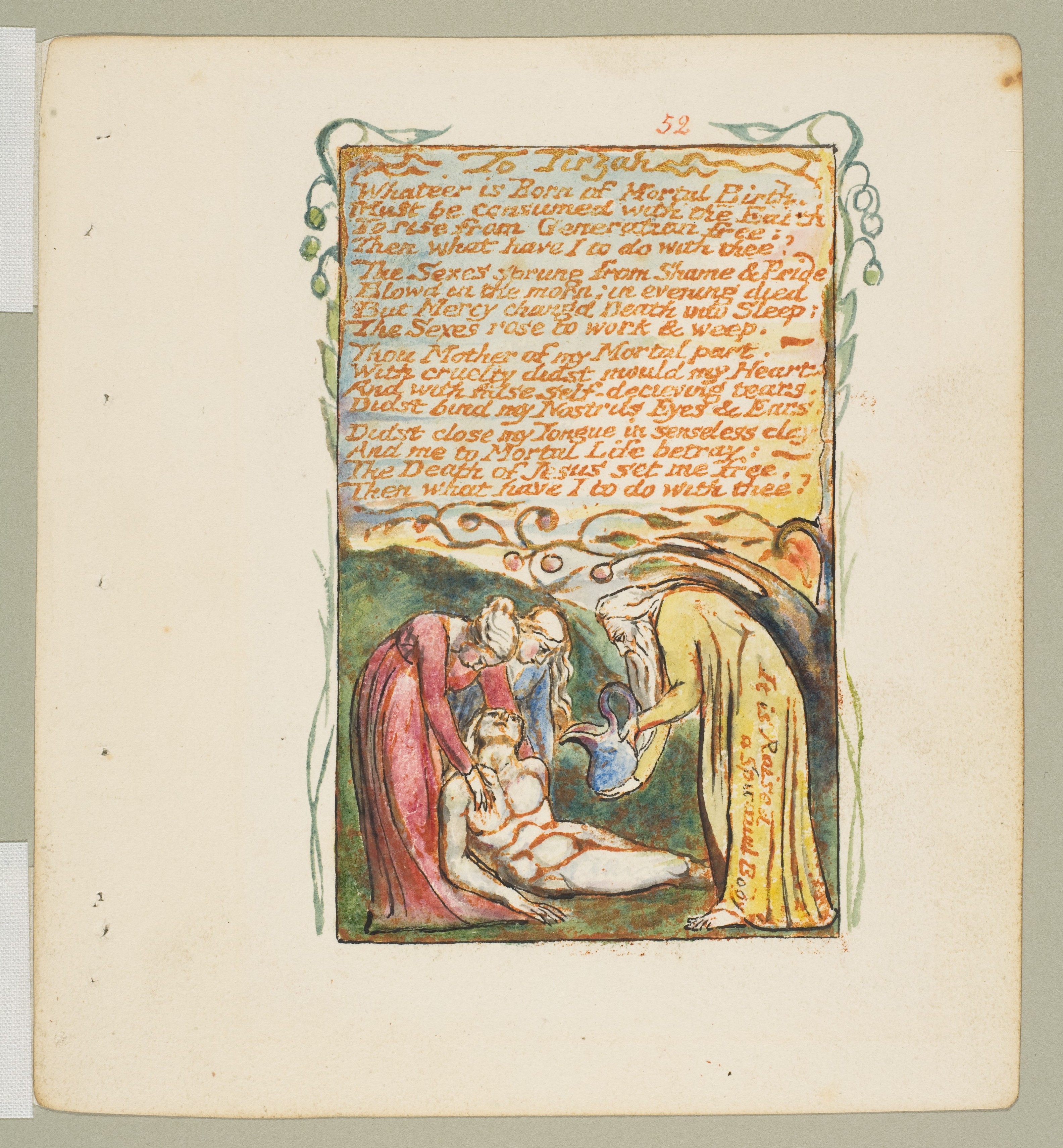
Concerning Blake's poem 'To Tirzah' from Songs of Experience, Damon (William Blake: His Philosophy and Symbols, Page 281) writes:

"Blake undoubtedly wrote this poem when trying to interpret the unfilial remark of the child Jesus in the Temple: 'Woman, what have I to do with thee?' (John ii. 4). Blake's conclusion was that Jesus was interrupted in his consideration of spiritual matters by the intrusion of her who bound him to the corporeal world. This is the case with every man. For the mortal body is of the earth, and will return to it, a temporary delusion; the true body is the spiritual body: a distinction made by Paul (I Cor. xv. 44) which is quoted by Blake in the marginal decorations to this poem)."


Metropolitan Museum
Songs of Experience
To Tirzah

If Blake sees all life in this world as a temporary delusion, the Lark too is part of this delusion. The Angel is from Eternity, so has another level of existence, but is only a carrier of the message.

Although Blake believed that 'every thing that lives is Holy', the holiness comes from the Eternal nature not from the temporal or perishable nature.

The point is that Blake's sentence "The Lark is a Mighty Angel", points beyond the Lark to the Angel, its identity in Eternity. But that isn't the end of the chain of reference. The answer to every question is another question. We are finite, we cannot grasp the Infinite. But we can continue to approach. If we stop at the Lark or the Angel we miss what lies beyond.


Thursday, April 29, 2010

Gates of Paradise Picture 7


The inscription reads: What are these? 

Alas! the Female Martyr 

Yale Center for British Art
Gates of Paradise
Plate 7

Is She also the Divine Image

Pretty tricky text! In this picture like many others single vision will tell us virtually nothing about Blake's thoughts and intentions here.

Here is the text which Blake associated with this picture:
"7. One dies! Alas! the Living and Dead!
One is slain! and One is fled!"

(The inscription on the picture, shown above, tells us more.)

The picture shows three figures: the large young man emanating joy, and two smaller ones: one dead and the other fleeing into the skies. All three are attributes of Blake (and you and me!).

Summarizing Digby (37-39) the picture shows our attitude toward the "grains of sand", the "Wild Flower" the "golden wings" of the last post. Digby cited another poem:
"He who binds to himself a joy
Doth the winged life destroy.
He who kisses the joy as it flies,
Lives in eternity's sunrise."

I can cite the same idea from my own experience with Henry Wieman's Source of Human Good : Wieman, a naturalistic theologian (a school to which I belong!) pointed out two basic realities: the creative good and the creative event. You should be able to judge 'which was which' in the picture above.

Quoting Digby (37): "This is the art of life to which so few have found the secret. Either we miss what the moment offers, and it flies away forever; or, by trying to bend it to our will and purpose, we destroy it."

Choosing the Creative Event we may go through life enjoying it (called Living Eternally); or we may allow the Selfhood to rob us of it.

But there is a "deeper problem" (p.38) expressed in the inscription: " What are these? Alas! the Female Martyr
Is She also the Divine Image?"

The Divine Image represents the union of the two contraries: the answer to the above question is YES: the female (emanation) gives herself willing, and the male likewise, exemplified in Milton's return from Paradise "to redeem the female shade" (plate 36) while "the happy female joy is only actualized in self-sacrifice (Digby 38). For this principle Jerusalem Plate 96 is well worth reading carefully. It is the Moment of redemption, salvation, of union of the two into one and collectively the Brotherhood, for which Jesus prayed in John 17. Here is the text of Plate 96 :

"[Jesus said to Albion] if God dieth not for Man & giveth not himself Eternally for Man Man could not exist. for Man is Love: As God is Love: every kindness to another is a little Death In the Divine Image nor can Man exist but by Brotherhood".

Wednesday, April 28, 2010

GRAIN OF SAND

Auguries of Innocence

"To see a World in a Grain of Sand
And a Heaven in a Wild Flower
Hold Infinity in the palm of your hand
And Eternity in an hour"

'Thy golden wings are my delight'

Eternity as we have said before is not distant in time or space; it can be experienced whenever we are able to be open and receptive to it. The tiniest, most humble things may act as the catalyst for opening or cleansing the doors of perception.

We as humans are made to receive Eternity, because God is within us. And yet we are barred from entering the gates which are provided. Blake tells us that the 'dread Og and Anak guard the gates.'

Anak, says Damon in A Blake Dictionary is one of an Old Testament race of giants. He is one of four - Anak, Og, Sihon and Satan - who are designated to 'oppose Man's progress towards Eternity.' Og and Anak are the guards of the gates which open into Golgonooza (the city of Imagination). 'They are also responsible for the looms, mills, prisons and workhouses which prevent man from leading a spiritual life.'

On the level of the psyche there are blockages (Og and Anak) which lock us out of the ability to perceive things as they are. These barriers are different for each person. By looking within and facing the 'giants' these gates may be opened.

Blake also names the 'manacles' which bind man in the outward world, the oppressive institutions (Og and Anak) which destroy bodies and deaden minds. In this world limits are set which constrict the downtrodden from seeing that 'world in a grain of sand' or 'heaven in a wild flower'.

Milton, Plate 20, (E 114)
"Seest thou the little winged fly, smaller than a grain of sand?
It has a heart like thee; a brain open to heaven & hell,
Withinside wondrous & expansive; its gates are not clos'd,
I hope thine are not: hence it clothes itself in rich array;
Hence thou art cloth'd with human beauty O thou mortal man.
Seek not thy heavenly father then beyond the skies:
There Chaos dwells & ancient Night & Og & Anak old:
For every human heart has gates of brass & bars of adamant,
Which few dare unbar because dread Og & Anak guard the gates
Terrific! and each mortal brain is walld and moated round
Within: and Og & Anak watch here; here is the Seat
Of Satan in its Webs; for in brain and heart and loins
Gates open behind Satans Seat to the City of Golgonooza
Which is the spiritual fourfold London, in the loins of Albion"

____________

Tuesday, April 27, 2010

Gates of Paradise Picture 6

Wikipedia Commons
Gates of Paradise
Plate 6


It isn't very easy to see the relationship between this picture and the accompanying text.

"6. I rent the Veil where the Dead dwell:
When weary Man enters his Cave,
He meets his Saviour in the grave.
Some find a Female Garment there,
And some a Male, woven with care;
Lest the Sexual Garments sweet
Should grow a devouring Winding-sheet."


Man! this one is deep. I can only (reading Digby 30-37) make an attempt to explicate it here.  

With "where the Dead dwell" means those of us who assume the mortal state. Blake also sometimes used the term Eternal Death, as Milton's "And Milton said, I go to Eternal Death!" (Milton plate 14 line 14; E108). And then at the beginning of Jerusalem: "Of the Sleep of Ulro! and of the passage through Eternal Death! and of the awakening to Eternal Life."

"The Redeemer is not only a God on High, but a seed hidden in the earth, in man himself" (Digby 34). Blake's God was above all imminent: "Seek not thy heavenly father then, beyond the skies" (Jerusalem plate 23, line 40).
"When weary Man enters his Cave": weary eternals do R and R in Beulah, then fall asleep (like Albion did) and enter the (platonic?) cave of mortal life.

The veil of course is what hides us from Eternity (and what hides the Eternals from mortal life). Christians including Blake believe of course that the Saviour is with us here always.

"Some find a Female Garment there,
And some a Male, woven with care;"


Blake doesn't mean two individuals, but the masculine and feminine dimension of each of us, in Jungian psychology the Eternal Youth, a "symbol of creative possibility" and the anima.

"Lest the Sexual Garments sweet
Should grow a devouring Winding-sheet", which is to say that without the Saviour's creative influence we simply sink deeper and "deeper into confusion and disillusion" (Digby 37).


Blake used garment to designate our physical bodies and everything else of a purely material nature.

Monday, April 26, 2010

IS THIS HEAVEN?

We've posted on each of Blake's four major cities: London, Galgoonoza, Babylon and Jerusalem but there is more to be said. London was Blake's outward experience, with all its errors and contradictions; Golgonooza, the city within London (which through imagination may correct errors through vision, forgiveness and spiritual gifts), was created to provide an escape from the merely physical; Babylon was the expression of the soulless, self-centered, mercenary city which grows when man fails to develop his inner riches; and Jerusalem was the spiritual city, the potential for the inner and outer realization of Eternal values.

Although we have already posted four time on subjects related to Golgonooza, more needs to be said.

Blake speaks frequently of Golgonooza:

Milton, PLATE 6, (E 99)
"From Golgonooza the spiritual Four-fold London eternal
In immense labours & sorrows, ever building, ever falling,
Thro Albions four Forests which overspread all the Earth,"
__________
Milton, Plate 17,(E 111)
"For travellers from Eternity. pass outward to Satans seat,
But travellers to Eternity. pass inward to Golgonooza."
__________
Milton, Plate 20, (E 113)
"for in brain and heart and loins
Gates open behind Satans Seat to the City of Golgonooza
Which is the spiritual fourfold London, in the loins of Albion"
__________
Milton, Plate 24, E( 119)
"I the Fourth Zoa am also set
The Watchman of Eternity, the Three are not! & I am preserved
Still my four mighty ones are left to me in Golgonooza
Still Rintrah fierce, and Palamabron mild & piteous
Theotormon filld with care, Bromion loving Science"

You O my Sons still guard round Los. O wander not & leave me
__________
Milton, Plate 24, (E 120)
"But Golgonooza is namd Art & Manufacture by mortal men."
__________
Milton, Plate 29, (E 128)
"Then Los conducts the Spirits to be Vegetated, into
Great Golgonooza, free from the four iron pillars of Satans
Throne
(Temperance, Prudence, justice, Fortitude, the four pillars of
tyranny)
That Satans Watch-Fiends, touch them not before they Vegetate."
__________
Milton, Plate 35, (E 135)
"So spake Ololon in reminiscence astonishd, but they
Could not behold Golgonooza without passing the Polypus
A wondrous journey not passable by Immortal feet, & none
But the Divine Saviour can pass it without annihilation.
For Golgonooza cannot be seen till having passd the Polypus
It is viewed on all sides round by a Four-fold Vision
Or till you become Mortal & Vegetable in Sexuality
Then you behold its mighty Spires & Domes of ivory & gold"
__________
Jerusalem, Plate 10, (E 153)
"Therefore Los stands in London building Golgonooza
Compelling his Spectre to labours mighty; trembling in fear
The Spectre weeps, but Los unmovd by tears or threats remains

I must Create a System, or be enslav'd by another Mans
I will not Reason & Compare: my business is to Create"
__________
Jerusalem, Plate 12, (E 156)
"Go on, builders in hope: tho Jerusalem wanders far away,
Without the gate of Los: among the dark Satanic wheels.

Fourfold the Sons of Los in their divisions: and fourfold,
The great City of Golgonooza: fourfold toward the north
And toward the south fourfold, & fourfold toward the east & west
Each within other toward the four points: that toward
Eden, and that toward the World of Generation,
And that toward Beulah, and that toward Ulro:
Ulro is the space of the terrible starry wheels of Albions sons:
But that toward Eden is walled up, till time of renovation:
Yet it is perfect in its building, ornaments & perfection.

And the Four Points are thus beheld in Great Eternity
West, the Circumference: South, the Zenith: North,
The Nadir: East, the Center, unapproachable for ever."
__________
Jerusalem, Plate 14, (E 157)
"Around Golgonooza lies the land of death eternal; a Land
Of pain and misery and despair and ever brooding melancholy:"
__________
Jerusalem, Page 87, (E 368)
"Los performd Wonders of labour
They Builded Golgonooza Los labouring builded pillars high
And Domes terrific in the nether heavens for beneath
Was opend new heavens & a new Earth beneath & within
Threefold within the brain within the heart within the loins
A Threefold Atmosphere Sublime continuous from Urthonas world
But yet having a Limit Twofold named Satan & Adam"
__________
Jerusalem, Page 100, (E 372)
"And upon Enitharmon & the Divine Countenance shone
In Golgonooza Looking down the Daughters of Beulah saw
With joy the bright Light & in it a Human form
And knew he was the Saviour Even Jesus & they worshipped

Astonishd Comforted Delighted in notes of Rapturous Extacy
All Beulah stood astonishd Looking down to Eternal Death
They saw the Saviour beyond the Pit of death & destruction
For whether they lookd upward they saw the Divine Vision
Or whether they lookd downward still they saw the Divine Vision
Surrounding them on all sides beyond sin & death & hell"
__________
Four Zoas, Page 103, (E 376)
"In Golgonoozas Furnaces among the Anvils of time & space
Thus forming a Vast family wondrous in beauty & love
And they appeard a Universal female form created
From those who were dead in Ulro from the in Spectres of the dead"
__________

In Golgoonooza: City of Imagination, Kathleen Raine sees Golgonooza as an attempt to make visible the archetypal city of Eternity by those who remember Eternal things. Lovers of wisdom, poets, painters, architects - those with imagination - are the agents (Los and his sons) for building Golgonooza. Within London the the spiritual Four-fold eternal city is to take form as multiple pathways or gates into Great Eternity.

Kathleen Raine: "Jerusalem can never, in the very nature of time and change be fully realized on earth , yet Jerusalem has in Golgoonoza, her refugees, her 'secret chambers' in the houses of London's inhabitants, and among these Blake's own house in 'lovely Lambeth', where he and Catherine lived in the early years of their
marriage, where a vine grew unpruned in their small garden."

Image from the British Museum
____________
Milton, Plate 1, (E 95)
"I will not cease from Mental Fight,
Nor shall my Sword sleep in my hand:
Till we have built Jerusalem,
In Englands green & pleasant Land."

Footnote: Field of Dreams; "Is this heaven?", "No, it's Iowa".