Wednesday, November 10, 2010

BLAKE'S PSYCHE


In 1946 W. P. Witcutt published a little book named Blake a psychological study. In his introduction he states: "It is only in recent years that the problems of mythology and symbolism have been attacked scientifically, by the psychologists of the school of Jung, and the instrument of the Jungian psychology can provide a key to understanding Blake." He proceeds to present the psychology of Blake himself and of Blake's writing in Jungian thought forms.

He describes Blake as an intuitive introvert. Witcutt quotes from Jung : "Introverted intuition perceives all the background of consciousness with almost the same distinctness as extroverted sensation senses outer objects. For intuition, therefore, the unconscious images attain to the dignity of things or objects."
"Introverted intuition apprehends the images which arise from the a priori, i.e., the inherited foundations of the unconscious mind." (Jung, Psychological Types) Page 24

Continuing with quotes from Witcutt:
Page 24
"The intuitive introvert perceives, waking, what others only dream.' ...To the Intuitive poet Nature is a screen drawn across the face of reality; of value in that it provides symbols for his exuberant imagination to use."

Page 33
"Blake's Four Zoas are not, then, peculiar to himself. They form a theme running through all literature though only Blake presents them as it were in the crude mythological form.
One function of the four is always dominant, with whom the ego or conscious self identifies itself; the other three are repressed into the unconscious, some more and some less. With Blake the dominant function was obviously intuition; in Blakean mythology this function is symbolized by the daemon Los."

Page 44
"Jung opposes thought to feeling and intuition to sensation. A man of dominant thought represses feeling to the lowest place in his unconscious mind, and the intuitive does the same for sensation. Thought and feeling, and intuition and sensation therefore stand at opposite poles from one another."

Page 35
"The thinking function in Blake's Mythology is personified in the figure Urizen, 'the Eternal Mind,' 'the Prince of Light,' the possessor of 'the steeds of Urizen, once swifter than light, which symbolize thoughts, and of 'the mountains of Urizen, once of silver, where the sons of Wisdom dwelt.' ...He is Zeus, the God of the soul, the lawgiver."

Page 26
"The reasoning faculty was not Blake's strong point. He tells us himself that he repressed it. We cannot have it all ways, and the intuitive is not a reasoner. His value lies in the poetry - an everlasting of the English race - and in the light it sheds upon the inner structure of the soul. He is not a philosopher, but a guide to the inner world of symbols."

Page 114
"Thought was not Blake's dominant function, but in all probability it was his secondary or auxiliary function. The auxiliary function, Jung tells us, partakes of the outward conscious attitude of the dominant function; that is to say, in Blake's case it was introverted. It is the nature of introverted thought to be original; not to derive from the thought of other men - or from facts - but from the array of unconscious images."
................................................................................Europe, Plate 2
Page 123
"What to thought appears as an abstract concept appears to intuition as a symbol; thus Blake personifies thought itself as the kingly figure of Urizen. Thought processes are not the real object of poetry... High poetry is of two kinds, imaginative (or intuitive), and the poetry derived from the things of the senses, derived from the function of sensation; that is, derived from the two 'irrational' functions of intuition and sensation, irrational 'because their commissions and omissions are based not upon reasoned judgment but upon the absolute intensity of perception.'" ( quote from Jung, Psychological Types)

I have selected quotes from throughout Witcutt to show how he treats Blake as a person and how he treats the myth Blake created - both as stemming from the psychological profile of Blake's mind. Running through the passages are the concepts of intuition and reason which seemed to dominate Blake's self-perception and the subject matter of his writing.

Witcutt has taken the system of Blake and the system of Jung and examined them in such a way that each enlightens our understanding of the other. You may not agree with the system which Witcutt creates, but you may find that considering it stimulates your thought about your own system.

Annotations to Wordsworth's Poems (E 665)
"One Power alone makes a Poet: Imagination, the Divine Vision."

Jerusalem
, Plate 77, (E 231)
"Imagination the real & eternal World of which this Vegetable
Universe is but a faint shadow & in which we shall live in our
Eternal or Imaginative Bodies, when these Vegetable Mortal Bodies
are no more."

Tuesday, November 09, 2010

Satan and the Spectre

Years ago, sitting in a young adult group in a Methodist church I listened to the pastor trying to convince us that Satan was a real person; a young rebel maintained that people had created Satan just like they created God. In regard to Satan the 'young rebel' was right. 

 Satan is the God of this World; Satan and his world will pass away, but we may (will!) be translated to the Eternal Realm from which we came; such is Blake's theology. 

-------------------------------------------- 

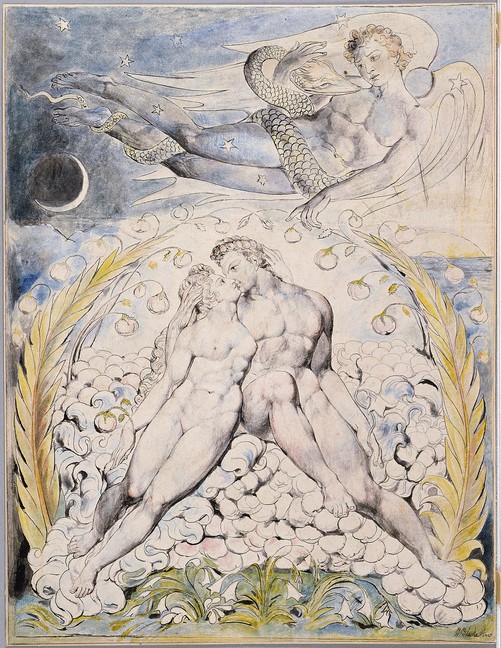
To all intents and purposes John Milton's epic, Paradise Lost has become a part of the Bible; most Bible students have their concept of Satan and his doings from Milton. Blake was deeply influenced by the prophet he considered his predecessor; he produced a series of pictures illustrating the work: (Are these apples or some other fruit)? Adam and Eve are in the lower plane, Satan up in the air. We see Adam and Eve comfortably ensconced in the garden. Satan seems equally comfortable on a cloud with his pet snake. In the story in Genesis 3 Satan is not named, but from that time the Serpent and Satan have been seen as two names for the same entity. 

One of Blake's last works, Illustrations to the Book of Job, has several representations of Satan; here's one: Satan has just been given permission by God (Job 2) to work his will on Job, but he can't take his life. (You may find here in this blog the whole series of pictures of Blake's Illustrations to the Book of Job. They are scattered through the posts of this blog between June 8 and July 25, 2010.) 

When writing of a personal Satan Blake usually used the term, Spectre. In general Satan is the ruler of the (material) world; the Spectre is the ruler of you and me whenever we give in to a temptation to be less (spiritually) than we can be. Once again in the system Blake created Satan and the Spectre are to be annihilated, but people go on to Eden (or perhaps a boot camp for it).

Monday, November 08, 2010

MYSTICAL MARRIAGE

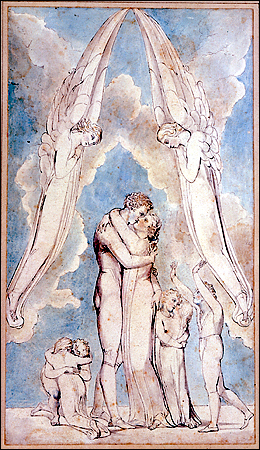
From Robert Blair's The Grave
The Meeting of the Family in Heaven


Both Blake and Jung involved themselves in the study of alchemy as a source of symbols for the regeneration of the primordial wholeness of the psyche. The union, reunion, or marriage of the contraries represented by male and female appears in the work of Jung and Blake as it does in alchemy, as the means to resolve the divisions in the psyche.


Here are two passages concerning Jung's use of the symbol of marriage:

From Man and His Symbols, Edited by Carl Jung
"Man's knowledge (logos) encounters women's relatedness (Eros) and their union is represented as that symbolic ritual of a sacred marriage..." Page 126

From Cambridge Companion to Jung, (Page 96, chapter by David L. Hart)
"That the work of wholeness is involved in alchemical symbolism is shown by the constant conjunction of opposites in its imagery: the marriage of sun and moon, of fire and water, of king and queen. This last conjunction forms the basis of Jung's study of the inner processes of the transference, that mysterious and unique relationship that undergirds the work of individuation as it proceeds in analysis. The transference, for Jung, is not a one-sided affair, nor is it merely the projection of parental images from the client onto the analyst. It is not even all that combined with the analyst's projections onto the client. It is, rather, a truly symbolic event in which both persons are changed, and inner 'marriage' leading, as one would expect, to a new, third being, comprising both individuals and yet transcending them."

Blake's use of the symbol of marriage is treated here in Northrup Frye's Fearful Symmetry:
"In eternity all the homes of the soul, the body, the palace, the city and the garden are one; and the eternal community of men is also the real presence of a divine body, whose blood is the new wine created from the water of nature." (Page 351)
"This enlightenment destroys the 'female will' for Milton and enables him to attain his emanation Ololon. We have spoken before of the ambiguity of the word 'consummation' in referring to the two chief aspects of the Last Judgment, the burning world and the sacred marriage. In Milton, too, the sacred marriage follows the vision of the absorption of nature into a fiery city." (Page 354)
"In the second part of Milton, Ololon appears in the world as a twelve-year-old girl, a child with a child's untouchable beauty, not yet a bride of a sacred marriage but a breastless 'little sister' like the one in the Song of Songs. She is respectfully referred to as the 'Virgin Ololon' for several pages; but as the physical world burns up before Milton's eyes, all images of a separated female will cease to mean anything, her virginity splits away from her and runs shrieking into chaos, as the bride Ololon, purified of the stain of virginity, stands before the poet in his final consummation." (Page 355)

Milton, Plate 40 [46], (E143)
"Then trembled the Virgin Ololon & replyd in clouds of despair

Is this our Femin[in]e Portion the Six-fold Miltonic Female
Terribly this Portion trembles before thee O awful Man
Altho' our Human Power can sustain the severe contentions
Of Friendship, our Sexual cannot: but flies into the Ulro.
Hence arose all our terrors in Eternity! & now remembrance
Returns upon us! are we Contraries O Milton, Thou & I
O Immortal! how were we led to War the Wars of Death
Is this the Void Outside of Existence, which if enterd into
Plate 42 [49]
Becomes a Womb? & is this the Death Couch of Albion
Thou goest to Eternal Death & all must go with thee

So saying, the Virgin divided Six-fold & with a shriek
Dolorous that ran thro all Creation a Double Six-fold Wonder!
Away from Ololon she divided & fled into the depths
Of Miltons Shadow as a Dove upon the stormy Sea.

Then as a Moony Ark Ololon descended to Felphams Vale
In clouds of blood, in streams of gore, with dreadful thunderings
Into the Fires of Intellect that rejoic'd in Felphams Vale
Around the Starry Eight: with one accord the Starry Eight became
One Man Jesus the Saviour. wonderful! round his limbs
The Clouds of Ololon folded as a Garment dipped in blood
Written within & without in woven letters: & the Writing
Is the Divine Revelation in the Litteral expression:
A Garment of War, I heard it namd the Woof of Six Thousand Years

And I beheld the Twenty-four Cities of Albion
Arise upon their Thrones to Judge the Nations of the Earth
And the Immortal Four in whom the Twenty-four appear Four-fold
Arose around Albions body: Jesus wept & walked forth
From Felphams Vale clothed in Clouds of blood, to enter into
Albions Bosom, the bosom of death & the Four surrounded him
In the Column of Fire in Felphams Vale; then to their mouths the Four
Applied their Four Trumpets & them sounded to the Four winds

Terror struck in the Vale I stood at that immortal sound
My bones trembled. I fell outstretchd upon the path
A moment, & my Soul returnd into its mortal state
To Resurrection & Judgment in the Vegetable Body
And my sweet Shadow of Delight stood trembling by my side

Immediately the Lark mounted with a loud trill from Felphams Vale
And the Wild Thyme from Wimbletons green & impurpled Hills
And Los & Enitharmon rose over the Hills of Surrey
Their clouds roll over London with a south wind, soft Oothoon
Pants in the Vales of Lambeth weeping oer her Human Harvest
Los listens to the Cry of the Poor Man: his Cloud
Over London in volume terrific, low bended in anger.

Rintrah & Palamabron view the Human Harvest beneath
Their Wine-presses & Barns stand open; the Ovens are prepar'd
The Waggons ready: terrific Lions & Tygers sport & play
All Animals upon the Earth, are prepard in all their strength
Plate 43 [50]
To go forth to the Great Harvest & Vintage of the Nations"


S. Foster Damon clarifies it all in A Blake Dictionary, Page 308:
"But then the sixfold Emanation divides from Ololon and like the repentant wife seeks refuge in Milton's bosom. Then 'as a Moony Ark Ololon descended ... into the Fires of Intellect': love and wisdom are combined. The Starry Eight become Jesus; Ololon's clouds are his wedding garment; and Jesus becomes one with mankind. The mystical union has been achieved, and Blake falls fainting on his garden path." (Milton, Plate 42)

Sunday, November 07, 2010

The 27 Churches


In Milton Plate 37 you may read:
"And these the names of the Twenty-seven Heavens & their Churches Adam, Seth, Enos, Cainan, Mahalaleel, Jared, Enoch, Methuselah, Lamech: these are Giants mighty Hermaphroditic
Noah, Shem, Arphaxad, Cainan the second, Salah, Heber, Peleg, Reu, Serug, Nahor, Terah, these are the Female-Males

A Male within a Female hid as in an Ark & Curtains, Abraham, Moses, Solomon, Paul, Constantine, Charlemaine Luther, these seven are the Male-Females, the Dragon Forms
Religion hid in War, a Dragon red & hidden Harlot"

You may find more detail on the twenty-seven Churches at Jerusalem Plate 75:
"And these the names of the Twenty-seven Heavens & their Churches Adam, Seth, Enos, Cainan, Mahalaleel, Jared, Enoch, .....
Noah, Shem, Arphaxad, Cainan the Second, Salah, Heber, Peleg, Reu, Serug, Nahor, Terah:
....
(these are the pagan gods of Asia):
Abraham, Moses, Solomon, Paul, Constantine, Charlemaine, Luther. (these are the course of judaism and Christianity) ....these Seven are the Male Females: the Dragon Forms
The Female hid within a Male: thus Rahab is reveald Mystery Babylon the Great: the Abomination of Desolation Religion hid in War: a Dragon red, & hidden Harlot
But Jesus breaking thro' the Central Zones of Death & Hell Opens Eternity in Time & Space; triumphant in Mercy"

The twenty-seven Churches are encapsulated in the Whore of Babylon and her seven-headed beast (the double organization of Church and State):

"Thus are the Heavens formd by Los within the Mundane Shell
And where Luther ends Adam begins again in Eternal Circle To awake the Prisoners of Death, to bring Albion again With Luvah into light eternal, in his eternal day."

So what in the world can all this mean? I can't explain it completely, but here's a try: look especially at this line:
"And where Luther ends Adam begins again in Eternal Circle".

He's talking of course about the Circle of Destiny.

Blake has given these names to various ages or cultures found in the pre-biblical period, the two testaments, and the 2000 years after; Blake perceived a period of 6000 years in all (very much like some fundamental Christians who think the world was created in 4004 B.C).

Damon in A Blake Dictionary (pp 34-35) casts much light on the twenty seven churches: they all exist in Ulro.

Saturday, November 06, 2010

BLAKE & INDIVIDUATION

Image from Book of Urizen 'Eternity shutter'd when they saw Man begatting his likeness On his own divided image." 

The process of individuation was developed by Carl Jung to make the unconscious known to the conscious mind in order to reveal the whole person. It has been called a process of self-actualization.  

Claire Dunne, who wrote Carl Jung, Wounded Healer of the Soul, explains individuation thus: "Individuation is the experience of a natural law, an inner self-regulating process by which man becomes a whole human being acknowledging and living the total range of himself. In the process the ego is ultimately faced with something larger than itself, a force that it yields to and serves. The human being thus recognizes itself as both material and spiritual, conscious and unconscious." (Page 61) 

She quotes Jung in this statement on Page 62: 

"Individuation does not only mean that man has become truly human as distinct from animal, but that he is to become partially divine as well. That means practically that he becomes adult, responsible for his existence, knowing that he does not only depend on God but that God also depends on man." (L2, P316, letter to Elined Kotschnig) 

 Jung's process of individuation involves the willingness to recognize components of the unconscious, to look at how they relate to the conscious mind and integrate then into a whole which is larger than the ego's domain. Blake describes the recognition of multiple internal forces which must be acknowledged and assimilated into a functioning whole. Both men are preoccupied with the process of taking apart the buried influences which direct and control the outer man and reassembling them consciously into a true man in touch with the Totality beyond the individual. 

The dividing, subduing, and restoring is repeated in Blake uncountable times; here's one example: 

Jerusalem, PLATE 17, (E 161) 

His Spectre divides & Los in fury compells it to divide:
To labour in the fire, in the water, in the earth, in the air,
To follow the Daughters of Albion as the hound follows the scent
Of the wild inhabitant of the forest, to drive them from his own:
To make a way for the Children of Los to come from the Furnaces  
But Los himself against Albions Sons his fury bends, for he
Dare not approach the Daughters openly lest he be consumed
In the fires of their beauty & perfection & be Vegetated beneath
Their Looms, in a Generation of death & resurrection to forgetfulness
They wooe Los continually to subdue his strength: he continually 
Shews them his Spectre: sending him abroad over the four points of heaven
In the fierce desires of beauty & in the tortures of repulse! He is
The Spectre of the Living pursuing the Emanations of the Dead.
Shuddring they flee: they hide in the Druid Temples in cold chastity:
Subdued by the Spectre of the Living & terrified by undisguisd desire.   

For Los said: Tho my Spectre is divided: as I am a Living Man
I must compell him to obey me wholly: that Enitharmon may not
Be lost: & lest he should devour Enitharmon: Ah me!
Piteous image of my soft desires & loves: O Enitharmon!
I will compell my Spectre to obey: I will restore to thee thy Children. 
No one bruises or starves himself to make himself fit for labour!      


Friday, November 05, 2010

How Blake Read the Gospel

All his life Blake read the Bible, loved it, and engaged in dialogue with its immortal authors. Virtually every line of his poetry and every picture he painted had direct reference to some biblical idea that Blake had meditated upon.

In vivid contrast many of the orthodox don't read the Bible at all; they just wave it! Little wonder they dislike Blake. His early ironic description of his work as the Bible of Hell certainly helped to confirm their prejudice.

_____________________________________________

"Thou read'st black where I read white."
( Everlasting Gospel.

There are essentially two ways to read the Bible; Blake referred to them as black and white. What did he mean? We might look at Urizen's Book of Brass as the black book. It's a book of rules, a book of law. It tells people what to do, and more poignantly, what not to do.

Even today ordinary people see the Bible in this way, which helps to explain why hardly anyone reads it today. The few who do read it dutifully and dully. Such a reading constrains consciousness; it makes the reader obedient and unimaginative. The faithful few who feel that they should read their Bible often approach it in a child like way bordering on the childish. Reading the black book inhibits the imagination, deadens the mind and prevents spiritual development. At its worst it has led to many instances of religious persecution and mass murder.

But Blake read it white. The white book is not a book of rules, but a book of visions, a book of wonders. It provokes thought, causes the imagination to soar. Blake must have learned to read at about the age of four, when he had his first vision-- the frightful face at the window. Perhaps we've all been frightened by the Bible in one way or another; most people have had a sufficiently negative experience to leave it strictly alone. But little William overcame his fright and kept reading, and the next vision we hear of was more positive--a tree full of angels.

All the evidence suggests that for the next sixty five years Blake's Bible reading and his visions went hand in hand; his art is the record of it all. Whoever becomes really interested in Blake's visions will find himself reading the Bible because that's where most of them begin. In spite of this his secular critics have looked all over the world for his sources.

One of the greatest things that Blake has to offer the reader is that he makes you see and read the Bible in a new and better way. Not for nothing did the youthful circle of admirers of Blake's last years refer to him as the Interpreter.

The black book has most often been read as law, as history, in a restricted, literal interpretation. If the priest can get people to see it this way, and only this way, then he has secure control over his flock of sheep. In contrast Blake suggests that it's symbolic. Although written in categories of time and space, the temporal dimension is only instrumental; it points to the Beyond, the Eternal, the Real.

Too often people reading 'black' concern themselves with foolish questions such as "Did it really happen? Was Jonah really swallowed by the whale, or rather by the big fish?" But in Blake's vision that isn't the important thing. The important thing is "What does it mean?" The reader of the black book gets himself tied up in knots about the veracity or historicity of Jonah and his aquatic friend.

Blake shows you the Jonah in your psyche and helps you get some grasp of what the turbulent sea means to you personally. It's experiential, exciting! it puts you in touch with reality!, which is not material at all but spiritual. Literal or symbolic is black or white, and probably the two minds will never meet. At this point I simply urge you to join Blake and read white:

    "Why is the Bible more Entertaining & Instructive than any other book? Is it not because [it is] addressed to the Imagination which is Spiritual Sensation, and but mediately to the Understanding or Reason?"
    (Letter To Trusler; Erdman 702-3)

    All of the above is taken from Chapter Six of the Blake Primer.

Thursday, November 04, 2010

BLAKE & UNCONSCIOUS

Robert Blair's The Grave
The conscious mind is generally thought to be under the control of the Ego although the Ego's control is far from complete. Aspects of the Unconscious mind may influence perception and behavior more than the Ego does. Blake often speaks of the personified aspects on the Unconscious as they act within the human mind. In these passages we have the six women in John Milton's actual earthly life playing roles in Blake's poem Milton. Blake sees that the six females had 'represented and contained' mental constructs of Milton's psyche. Now they are to play multiple roles in Blake's poem. Their Human Imaginative essences remain in 'their eternal spheres'; their bodies are separated from the Divine Vision in dark Ulro where Milton also wandered.

The drama of the struggle is played out in the unconscious.

Milton, PLATE I7 [19], (E 110)
"In those three females whom his Wives, & those three whom his Daughters
Had represented and containd, that they might be resum'd
By giving up of Selfhood: & they distant view'd his journey
In their eternal spheres, now Human, tho' their Bodies remain clos'd
In the dark Ulro till the Judgment: also Milton knew: they and
Himself was Human, tho' now wandering thro Death's Vale
In conflict with those Female forms, which in blood & jealousy
Surrounded him, dividing & uniting without end or number.

He saw the Cruelties of Ulro, and he wrote them down
In iron tablets: and his Wives & Daughters names were these
Rahab and Tirzah, & Milcah & Malah & Noah & Hoglah,
They sat rangd round him as the rocks of Horeb round the land
Of Canaan: and they wrote in thunder smoke and fire
His dictate; and his body was the Rock Sinai; that body,
Which was on earth born to corruption: & the six Females
Are Hor & Peor & Bashan & Abarim & Lebanon & Hermon
Seven rocky masses terrible in the Desarts of Midian.

But Miltons Human Shadow continu'd journeying above
The rocky masses of The Mundane Shell; in the Lands
Of Edom & Aram & Moab & Midian & Amalek."

Milton, PLATE 21 [23] (E 115)
And down descended into Udan-Adan; it was night:
And Satan sat sleeping upon his Couch in Udan-Adan:
His Spectre slept, his Shadow woke; when one sleeps th'other wakes"

Milton, Plate 21 [23] (E 116)
"This World beneath, unseen before: this refuge from the wars
Of Great Eternity! unnatural refuge! unknown by us till now!
Or are these the pangs of repentance? let us enter into them

Then the Divine Family said. Six Thousand Years are now
Accomplish'd in this World of Sorrow; Miltons Angel knew
The Universal Dictate; and you also feel this Dictate.
And now you know this World of Sorrow, and feel Pity. Obey
The Dictate! Watch over this World, and with your brooding wings,
Renew it to Eternal Life: Lo! I am with you alway
But you cannot renew Milton he goes to Eternal Death

So spake the Family Divine as One Man even Jesus
Uniting in One with Ololon & the appearance of One Man
Jesus the Saviour appeard coming in the Clouds of Ololon!

Tho driven away with the Seven Starry Ones into the Ulro
Yet the Divine Vision remains Every-where For-ever. Amen."


Claire Dunn in her book Carl Jung: Wounded Healer of the Soul, quotes Jung in in Memories, Dreams, Reflections saying:

"The aim of both of these dreams is to effect a reversal of the relationship between ego-consciousness and the unconscious, and to represent the unconscious as the generator of the empirical personality. This reversal suggests that in the opinion of the 'other side,' our unconscious existence is the real one and our conscious world a kind of illusion, an apparent reality constructed for a specific purpose, like a dream which seems a reality as long as we are in it. It is clear that this state of affairs resembles very closely the Oriental concept of Maya." ( Page 205)

Wednesday, November 03, 2010

More on Blake's War

The earlier post concerned Blake's attitude toward War and his statements re it. Here I want to point out some of the biblical terms so familiar to Blake that he used them repeatedly.

Here is the complete 'wrestling' verse that was quoted partially at the beginning of the former post:
"For we wrestle not against flesh and blood, but against principalities, against powers, against the rulers of the darkness of this world, against spiritual wickedness in high places" (KJV) (if you're wondering about 'principalities' and 'powers', look at any one of Walter Wink's books; he elaborates the two words thoroughly.)

In the Preface to Milton (a hymn which came to be called Jerusalem) he undoubtedly had Ephesians 6:13-15 in mind. Here are the salient passages:

"Bring me my Bow of burning gold:
Bring me my Arrows of desire:
Bring me my Spear: O clouds unfold!
Bring me my Chariot of fire!
I will not cease from Mental Fight,

Nor shall my Sword sleep in my hand:
Till we have built Jerusalem,
In Englands green & pleasant Land.
(Erdman 95-96)
__________________________________

The harvest (the plow, the sickle, the winepress) are vivid images in Blake and in the Bible, usually meaning much the same thing:

From Revelation 14:
[15] And another angel came out of the temple, crying with a loud voice to him that sat on the cloud, Thrust in thy sickle, and reap: for the time is come for thee to reap; for the harvest of the earth is ripe.
[16] And he that sat on the cloud thrust in his sickle on the earth; and the earth was reaped.
[17] And another angel came out of the temple which is in heaven, he also having a sharp sickle.
[18] And another angel came out from the altar, which had power over fire; and cried with a loud cry to him that had the sharp sickle, saying, Thrust in thy sharp sickle, and gather the clusters of the vine of the earth; for her grapes are fully ripe.
[19] And the angel thrust in his sickle into the earth, and gathered the vine of the earth, and cast it into the great winepress of the wrath of God.
[20] And the winepress was trodden without the city, and blood came out of the winepress, even unto the horse bridles, by the space of a thousand and six hundred furlongs.

Now look at Milton, Plate 25 [27]:

"Loud shout the Sons of Luvah, at the Wine-presses as Los
descended
With Rintrah & Palamabron in his fires of resistless fury.

The Wine-press on the Rhine groans loud, but all its central
beams
Act more terrific in the central Cities of the Nations
Where Human Thought is crushd beneath the iron hand of Power.
There Los puts all into the Press, the Opressor & the Opressed
Together, ripe for the Harvest & Vintage & ready for the Loom.

They sang at the Vintage. This is the Last Vintage! & Seed
Shall no more be sown upon Earth, till all the Vintage is over
And all gatherd in, till the Plow has passd over the Nations
And the Harrow & heavy thundering Roller upon the mountains

And loud the Souls howl round the Porches of Golgonooza
Crying O God deliver us to the Heavens or to the Earths,
That we may preach righteousness & punish the sinner with death
But Los refused, till all the Vintage of Earth was gatherd in."
_______________________________________

Now focus on the valley:
Joel 3:12-15 (King James Version)
[12] Let the heathen be wakened, and come up to the valley of Jehoshaphat: for there will I sit to judge all the heathen round about.
Joel 14:
[13] Put ye in the sickle, for the harvest is ripe: come, get you down; for the press is full, the fats overflow; for their wickedness is great.
[14] Multitudes, multitudes in the valley of decision: for the day of the LORD is near in the valley of decision.
[15] The sun and the moon shall be darkened, and the stars shall withdraw their shining.

And this from Blake:

14Multitudes, multitudes in the valley of decision: for the day of the LORD is near in the valley of decision.

"Great is the cry of the Hounds of Nimrod along the Valley
Of Vision, they scent the odor of War in the Valley of Vision.
All Love is lost! terror succeeds & Hatred instead of Love"
(Jerusalem 22:9 Erdman 267)

Here is a web site on the Valley of Decision.

Tuesday, November 02, 2010

BLAKE & ARCHETYPES

ARCHETYPE (ANALYTICAL PSYCHOLOGY)

"The scientific hypothesis of the archetype was proposed by Jung as an innate formal element that structures the psyche at its most basic levels. In itself psychoid and therefore anchored in reality beyond the psyche (in "spirit" or nous, the non-biological mind), the archetype is responsible for coordinating and organizing the psyche's homeostatic balance and its programs for development and maturation. Essentially there is one master archetype, the self, which defines the skeletal form of human wholeness. The archetype itself is not available directly to experience—only its images and created patterns can become manifest ..."

In 1946 W.P. Witcutt wrote a little book called Blake a psychological study, which makes this statement on Page 17:

"There is in the unconscious mind a substratum of images which are fundamentally the same for all men, no matter what the period or race. Jung has called the collectivity of them the 'collective unconscious,' and the images themselves the archetypes of the unconscious, or the primordial images."

The following two passages evoke the archetypes as Blake was aware of them. Although Blake did not use the word 'archetype' he understood the concept. In the first quote we read of the permanence of the images which are beyond time and space. The outward manifestations vanish from sight but the 'destind lineaments' which underlie them remain. Jung's archetypes are not lost either but surface in the human mind through dreams which bring forth unconscious content.

Milton, PLATE 22 [24], (E117)
"I am that Shadowy Prophet who Six Thousand Years ago
Fell from my station in the Eternal bosom. Six Thousand Years
Are finishd. I return! both Time & Space obey my will.
I in Six Thousand Years walk up and down: for not one Moment
Of Time is lost, nor one Event of Space unpermanent
But all remain: every fabric of Six Thousand Years
Remains permanent: tho' on the Earth where Satan
Fell, and was cut off all things vanish & are seen no more
They vanish not from me & mine, we guard them first & last
The generations of men run on in the tide of Time
But leave their destind lineaments permanent for ever & ever."

The second passage more dramatically presents Blake's understanding of the psychic patterns which exist outside of our conscious awareness and influence the way we perceive events in the outer world. How very like Jung's archetypes are the 'Sculptures of Los's Halls' whose 'combinations wrought with wondrous Art [portray] All that can happen to Man.' To complete the passage Blake adds the archetypal events of the Old and New Testaments which are repeated in humanity as each individual man travels his 'pilgrimage of seventy years.'

Jerusalem, Plate 16, (E 161)
"All things acted on Earth are seen in the bright Sculptures of
Los's Halls & every Age renews its powers from these Works
With every pathetic story possible to happen from Hate or
Wayward Love & every sorrow & distress is carved here
Every Affinity of Parents Marriages & Friendships are here
In all their various combinations wrought with wondrous Art
All that can happen to Man in his pilgrimage of seventy years
Such is the Divine Written Law of Horeb & Sinai:
And such the Holy Gospel of Mount Olivet & Calvary:"

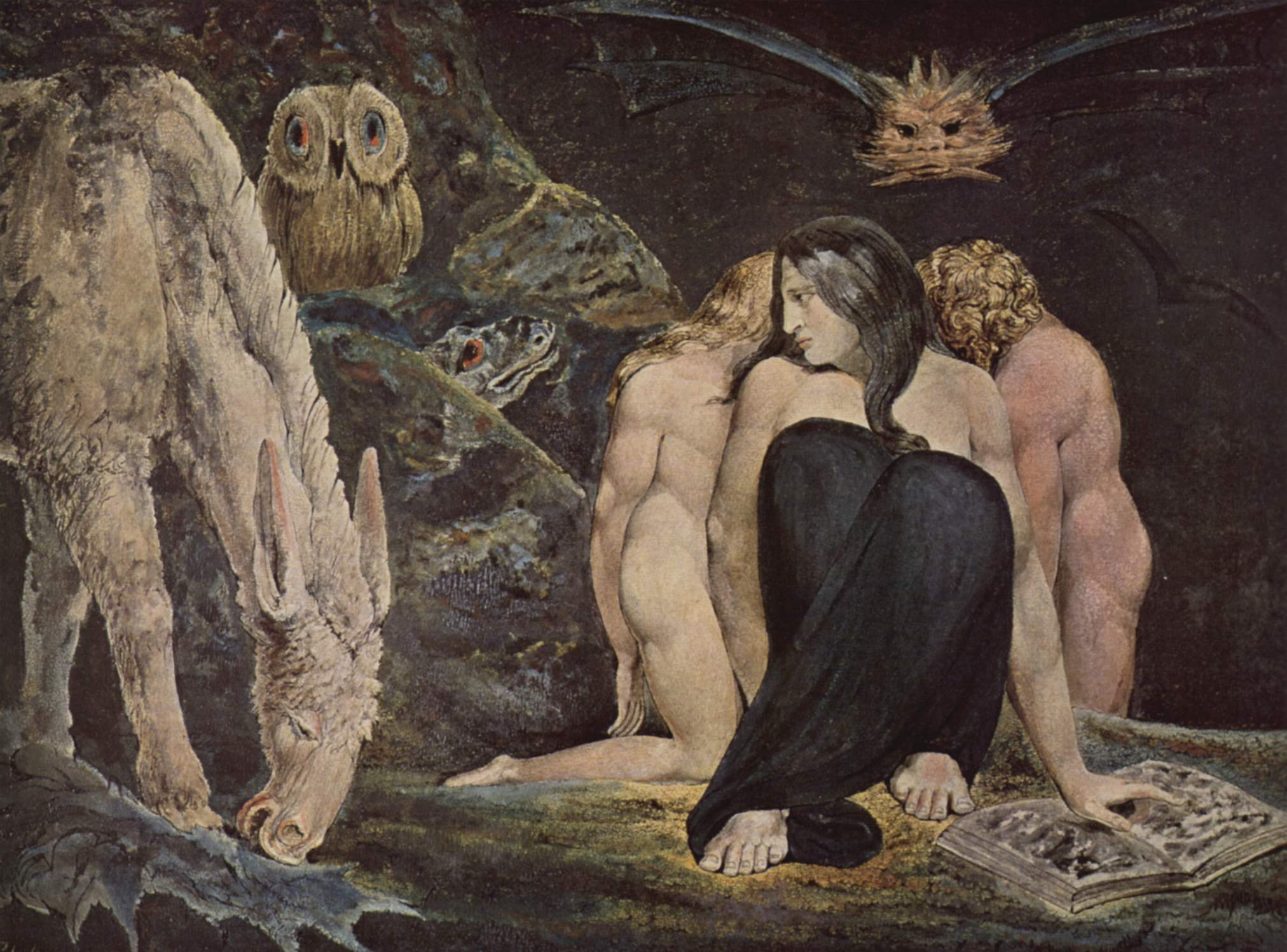
One of Blake's pictures which I find particularly archetypal is called 'Hecate or The Night of Enitharmon's Joy', c. 1795.

Monday, November 01, 2010

The Immortal Man

"When at last I did descry the Immortal Man who cannot die, through evening shades I haste away to close the labors of my Day" (from Gates of Paradise).

It appears (to me at least) that no man has ever been more transparent in his life and works than William Blake. It seems that few of his many brilliant interpreters have come close to an overriding perception of Blake as a person; the one who may have come closest is Middleton Murry although his knowledge of Blake's work seemed relatively superficial.

Blake wandered through the Sea of Time and Space for forty years. To get along in this world was a sorry business for a man of his gifts of Intellect and Moral Fiber. He had a beautiful sunny side (evidenced by his Songs of Innocence), soon and often overridden by his caustic disappropation of the Culture he had to live in.

Life consists of contraries ("Without Contraries is no progression" MHH 3; E34). One of Blake's primary Contraries (and perhaps that of all Men of God) was the choice between following the Divine Vision-- or the 'Main Chance'.

In his letter 51 (Erdman 576) to William Hayley (2004) he told him (and us) that for ('exactly') twenty years he had followed the second one. Until at last [he] "descried the Immortal Man...."

That vision set him free from the tyranny of 'the Main Chance' and gave him some years of Creativity, which ended with a song on his lips. (Look at the last paragraph of Chap1.htm.)

Sunday, October 31, 2010

MILTON'S TRACK

New York Public Library
Milton
Plate 36

On Plate 36 of Milton, Blake presents a diagram of Milton's descent into the world from Eternity. So we are able to see the globes of the four universes as they are positioned and overlap, the location of the earth and of Los' mundane egg. We see Adam at the center of the earth and Satan within the sphere of Urizen. We see the fiery chaos within the egg and flames outside of the Four Universes. Milton's track leads him past Satan to Adam.

In The Illuminated Blake (Page 252), Erdman describes the picture:
"Milton's track enters the universes at the intersection of the
eastern globe of Luvah and the southern globe of Urizen and carries
him into the Egg, close to the center of Satan's realm of fire and into
the earth circle - the drawing of this circle is obscured by paint in D
- that fits the smaller end of the egg, with its center marked "Adam." Note that the earth, often overlooked in discussions of this diagram, is wholly within the realm of Urthona (Los), wholly outside of the realm of Urizen, and only fractionally within those of Tharmas and Luvah. (But though Urthona is earth-owner, his realm is not confined to earth. In [copy] D where the spheres are differentiated, his contains most of the blue sky.)"

Here are some of the word pictures from Blake describing the world and Milton's descent into it:

Milton, Plate 19 [21], (E 112)
"All fell towards the Center in dire ruin, sinking down.
And in the South remains a burning fire; in the East a void.
In the West, a world of raging waters; in the North a solid,
Unfathomable! without end. But in the midst of these,
Is built eternally the Universe of Los and Enitharmon:
Towards which Milton went
, but Urizen oppos'd his path."

Milton, PLATE 34 [38], (E134)
"Around this Polypus Los continual builds the Mundane Shell
Four Universes round the Universe of Los remain Chaotic
Four intersecting Globes, & the Egg form'd World of Los
In midst; stretching from Zenith to Nadir, in midst of Chaos.
One of these Ruind Universes is to the North named Urthona
One to the South this was the glorious World of Urizen
One to the East, of Luvah: One to the West; of Tharmas.
But when Luvah assumed the World of Urizen in the South
All fell towards the Center sinking downward in dire Ruin

Here in these Chaoses the Sons of Ololon took their abode
In Chasms of the Mundane Shell which open on all sides round
Southward & by the East within the Breach of Miltons descent
To watch the time, pitying & gentle to awaken Urizen
They stood in a dark land of death of fiery corroding waters
Where lie in evil death the Four Immortals pale and cold
And the Eternal Man even Albion upon the Rock of Ages[.]
Seeing Miltons Shadow, some Daughters of Beulah trembling
Returnd, but Ololon remaind before the Gates of the Dead"

Milton, Plate 21 [23], (E 116)
"But saw them not, for the blue Mundane Shell inclosd them in.
And they lamented that they had in wrath & fury & fire
Driven Milton into the Ulro; for now they knew too late
That it was Milton the Awakener: they had not heard the Bard,
Whose song calld Milton to the attempt; and Los heard these
laments.
He heard them call in prayer all the Divine Family;
And he beheld the Cloud of Milton stretching over Europe.

But all the Family Divine collected as Four Suns
In the Four Points of heaven East, West & North & South
Enlarging and enlarging till their Disks approachd each other
;
And when they touch'd closed together Southward in One Sun
Over Ololon: and as One Man, who weeps over his brother,
In a dark tomb, so all the Family Divine. wept over Ololon.

Saying, Milton goes to Eternal Death! so saying, they groan'd in
spirit
And were troubled! and again the Divine Family groaned in spirit!

And Ololon said, Let us descend also, and let us give
Ourselves to death in Ulro among the Transgressors."

Milton, PLATE 21 [23] (E 115)
"also all men on Earth,
And all in Heaven, saw in the nether regions of the Imagination
In Ulro beneath Beulah, the vast breach of Miltons descent."

If you are curious about the text on the plate with the diagram, you will find it here:
Milton, Plate 33 [36], (E 132)
"And the Divine Voice was heard in the Songs of Beulah Saying     

When I first Married you, I gave you all my whole Soul
I thought that you would love my loves & joy in my delights
Seeking for pleasures in my pleasures O Daughter of Babylon
Then thou wast lovely, mild & gentle. now thou art terrible      
In jealousy & unlovely in my sight, because thou hast cruelly
Cut off my loves in fury till I have no love left for thee
Thy love depends on him thou lovest & on his dear loves
Depend thy pleasures which thou hast cut off by jealousy
Therefore I shew my jealousy  & set  before you Death.     
Behold Milton descended to Redeem the Female Shade

From Death Eternal; such your lot, to be continually Redeem'd
By death & misery of those you love & by Annihilation
When the Sixfold Female percieves that Milton annihilates
Himself: that seeing all his loves by her cut off: he leaves     
Her also: intirely abstracting himself from Female loves
She shall relent in fear of death: She shall begin to give
Her maidens to her husband: delighting in his delight
And then & then alone begins the happy Female joy
As it is done in Beulah, & thou O Virgin Babylon Mother of Whoredoms
Shalt bring Jerusalem in thine arms in the night watches; and
No longer turning her a wandering Harlot in the streets
Shalt give her into the arms of God your Lord & Husband.

Such are the Songs of Beulah in the Lamentations of Ololon"

Saturday, October 30, 2010

Blake's Everlasting Gospel

Here's what he thought of the Establishment Gospel:

Using the Blake Concordance I found only two occurrences of the word, idol; it led me to two plates (
60 and 61) in Jerusalem. Together they represent a central tenet of Blake's gospel; it concerns forgiveness:
Jerusalem, Plate 60:

"The clouds of Albions Druid Temples rage in the eastern heaven
While Los sat terrified beholding Albions Spectre who is Luvah
Spreading in bloody veins in torments over Europe & Asia;
Not yet formed but a wretched torment unformed & abyssal
In flaming fire; within the Furnaces the Divine Vision appeard

On Albions hills: often walking from the Furnaces in clouds
And flames among the Druid Temples & the Starry Wheels
Gatherd Jerusalems Children in his arms & bore them like
A Shepherd in the night of Albion which overspread all the Earth

I gave thee liberty and life O lovely Jerusalem
And thou hast bound me down upon the Stems of Vegetation
I gave thee Sheep-walks upon the Spanish Mountains Jerusalem
I gave thee Priams City and the Isles of Grecia lovely!
I gave thee Hand & Scofield & the Counties of Albion:
They spread forth like a lovely root into the Garden of God:
They were as Adam before me: united into One Man,
They stood in innocence & their skiey tent reachd over Asia
To Nimrods Tower to Ham & Canaan walking with Mizraim
Upon the Egyptian Nile, with solemn songs to Grecia
And sweet Hesperia even to Great Chaldea & Tesshina
Following thee as a Shepherd by the Four Rivers of Eden
Why wilt thou rend thyself apart, Jerusalem?
And build this Babylon & sacrifice in secret Groves,
Among the Gods of Asia: among the fountains of pitch & nitre
Therefore thy Mountains are become barren Jerusalem!
Thy Valleys, Plains of burning sand. thy Rivers: waters of death
Thy Villages die of the Famine and thy Cities
Beg bread from house to house, lovely Jerusalem
Why wilt thou deface thy beauty & the beauty of thy little-ones
To please thy Idols, in the pretended chastities of Uncircumcision[?]
Thy Sons are lovelier than Egypt or Assyria; wherefore
Dost thou blacken their beauty by a Secluded place of rest.
And a peculiar Tabernacle, to cut the integuments of beauty
Into veils of tears and sorrows O lovely Jerusalem!
They have perswaded thee to this, therefore their end shall come
And I will lead thee thro the Wilderness in shadow of my cloud
And in my love I will lead thee, lovely Shadow of Sleeping
Albion.

This is the Song of the Lamb, sung by Slaves in evening time.

But Jerusalem faintly saw him, closd in the Dungeons of Babylon
Her Form was held by Beulahs Daughters. but all within unseen
She sat at the Mills, her hair unbound her feet naked
Cut with the flints: her tears run down, her reason grows like
The Wheel of Hand. incessant turning day & night without rest
Insane she raves upon the winds hoarse, inarticulate:
All night Vala hears. she triumphs in pride of holiness
To see Jerusalem deface her lineaments with bitter blows
Of despair. while the Satanic Holiness triumphd in Vala
In a Religion of Chastity & Uncircumcised Selfishness
Both of the Head & Heart & Loins, closd up in Moral Pride.

But the Divine Lamb stood beside Jerusalem. oft she saw
The lineaments Divine & oft the Voice heard, & oft she said:
O Lord & Saviour, have the Gods of the Heathen pierced thee?
Or hast thou been pierced in the House of thy Friends?
Art thou alive! & livest thou for-evermore? or art thou
Not: but a delusive shadow, a thought that liveth not.
Babel mocks saying, there is no God nor Son of God
That thou O Human Imagination, O Divine Body art all
A delusion. but I know thee O Lord when thou arisest upon
My weary eyes even in this dungeon & this iron mill.
The Stars of Albion cruel rise; thou bindest to sweet influences:
For thou also sufferest with me altho I behold thee not;
And altho I sin & blaspheme thy holy name, thou pitiest me;
Because thou knowest I am deluded by the turning mills.
And by these visions of pity & love because of Albions death.

Thus spake Jerusalem, & thus the Divine Voice replied.
Mild Shade of Man, pitiest thou these Visions of terror & woe!
Give forth thy pity & love. fear not! lo I am with thee always.
Only believe in me that I have power to raise from death
Thy Brother who Sleepeth in Albion: fear not trembling Shade"

Jerusalem, Plate 61:
"Behold : in the Visions of Elohim
Jehovah, behold Joseph & Mary
And be comforted O Jerusalem
in the Visions of Jehovah Elohim
She looked & saw Joseph the Carpenter in Nazareth & Mary
His espoused Wife. And Mary said,
if thou put me away from thee
Dost thou not murder me?
Joseph spoke in anger & fury.
Should I Marry a Harlot or an Adulteress?
Mary answerd, Art thou more pure
Than thy Maker who forgiveth Sins & calls again Her that is Lost
Tho She hates. he calls her again in love. I love my dear Joseph
But he driveth me away from his presence. yet I hear the voice of God
In the voice of my Husband. tho he is angry for a moment,
he will not Utterly cast me away.
if I were pure, never could I taste the sweets
Of the Forgive[ne]ss of Sins! if I were holy! I never could behold the tears Of love!
of him who loves me in the midst of his anger in furnace of fire.
Ah my Mary: said Joseph: weeping over & embracing her closely in His arms:
Doth he forgive Jerusalem & not exact Purity from her who is
Polluted. I heard his voice in my sleep O his Angel in my dream:
Saying, Doth Jehovah Forgive a Debt only on condition that it shall Be Payed?
Doth he Forgive Pollution only on conditions of Purity
That Debt is not Forgiven! That Pollution is not Forgiven
Such is the Forgiveness of the Gods, the Moral Virtues of the
Heathen, whose tender Mercies are Cruelty. But Jehovahs
Salvation Is without Money & without Price,
the Continual Forgiveness of Sins
In the Perpetual Mutual Sacrifice in Great Eternity! for behold!
There is none that liveth & Sinneth not! And this is the Covenant
Of Jehovah: If you Forgive one-another, so shall Jehovah Forgive You:
That He Himself may Dwell among You.
Fear not then to take To thee Mary thy Wife,
or she is with Child by the Holy Ghost

Then Mary burst forth into a Song! she flowed like a River of
Many Streams in the arms of Joseph & gave forth her tears of joy
Like many waters, and Emanating into gardens & palaces upon
Euphrates & to forests & floods & animals wild & tame from
Gihon to Hiddekel, & to corn fields & villages & inhabitants
Upon Pison & Arnon & Jordan."

Here's what he thought of the establishment gospel:
"Priests in black gowns were walking their rounds,
And binding with briers my joys and desires" (from The Garden
of Love); Erdman 26)


And how like the famous Spectre:

"Seven of my sweet loves thy knife
Has bereaved of their life
Their marble tombs I built with tears
And with cold & shuddering fears

Seven more loves weep night & day
Round the tombs where my loves layt
And seven more loves attend each night
Around my couch with torches bright"

Blake worked with the Everlasting Gospel (Erdman 518-24) for years trying to explain how his gospel differed from the Establishment one; what came forth is (certainly not lucid), ambiguous, tortured English; the Spirit simply doesn't lend itself to our words. Here are the last few lines:
"The Vision of Christ that thou dost see
Is my Visions Greatest Enemy
Thine has a great hook nose like thine
Mine has a snub nose like to mine
Thine is the Friend of All Mankind
Mine speaks in parables to the Blind
Thine loves the same world that mine hates
Thy Heaven doors are my Hell Gates
Socrates taught what Melitus Loathd as a Nations bitterest Curse
And Caiphas was in his own Mind
A benefactor of Manking
Both read the Bible day & night

But thou readst black where I read white"

Reading it 'white' is what all true Blakeans strive to do.

Friday, October 29, 2010

BLAKE'S MIND

    Illustrations to Paradise Regained
Morning Chasing Away the Phantoms 

I think that Blake's IQ was off the charts. His mind was capable of maximum development in multiple fields of endeavor. Obviously his senses were acutely capable of receiving and processing more data than most of us can handle. He was sensitive to ethical and philosophical issues as well as religious and aesthetic ones. His sexual responses were so acute that he recognized them as an avenue to the Divine. Intellectually he could have gone in any direction he chose. 

Judging from the issues he treats in his mature writing, he felt that his intellect might overbalance the development of his other gifts to the detriment of expressing his total being. 

Perhaps Blake's early unfinished prose satire, An Island in the Moon, with its frivolous, clever approach, represents a succumbing to the temptation to allow the intellect to have free rein to dominate and go in directions that his identity would not choose, and which would quash the development of imagination and desire. 

In his student days, Blake scholar Joseph Viscomi adapted the satire for a production which was presented at Cornell University. Read the manuscript of Island in the Moon online or learn more about it on Wikisource.  

Blake did not pursue the avenue of writing, thinking or entertainment displayed in An Island in the Moon. His fans believe that he went on to other and better things.   

Sensation, reason, and emotion are all subject to being overvalued, distorted and corrupted. Blake's desire to 'cleanse the doors of perception' represented the efforts he put into removing the impediments from expressing the Identity. Through attempting continually to annihilate the Selfhood, Blake tried to avoid allowing the fallen sensation and intellect to mar or replace the Eternal intellect and sensation which he trusted and valued. 

 Vision of the Last Judgment, (E 554) 

 "The Last Judgment when all those are Cast away who trouble
Religion with Questions concerning Good & Evil or Eating of the
Tree of those Knowledges or Reasonings which hinder the Vision of
God turning all into a Consuming fire <When> Imaginative Art &
Science & all Intellectual Gifts all the Gifts of the Holy Ghost
are [despisd] lookd upon as of no use & only Contention
remains to Man then the Last Judgment begins & its Vision is seen
by the [Imaginative Eye] of Every one according to the
situation he holds"
 

Thursday, October 28, 2010

Blake's Symbolic Thought and Language

The Perennial Philosophy was about as good a description of Blake's thought as we can find. Not trained and conditioned to the Enlightenment philosophy of radical materialism, he used for it his favorite metaphor, Bacon, Newton, and Locke.

Blake was steeped with the wisdom of the ages; that was in poor repute to cultured people of his day. At its apogee the radical materialists became logical positivists; they considered statements of anything not measureable in height or weight to be meaningless; they frowned on emotion and considered it enthusiasm (a pejorative).

The cultured people of that day tended to be primarily deistical and purely materialistic: God created the world and wound it up like a clock and thereafter had no interest in what went on in this planet.

Blake had his problems with God, but he knew that the word indicated something other than that; he despised the Deists. In Plate 52 at the beginning of his Chapter Three of Jerusalem (To the Deists) he told them what's what. Read it, and get a fuller grasp of Blake's faith.

The traditional symbols make up the stuff of poetry; 18th century English poetry by and large can be seen as peurile. Blake initiated the Romantic movement in poetry leading to the Romantic poets and artists; they were rich in the symbolism of tradition.

You may trace the deterioration of 18th Century English poetic thought through Shakespeare, Spencer, and Milton to William Hayley. At that low ebb Blake and the other Romantics intervened to bring about another renaissance.

Society was utterly commercial, especially in things like marriage (the first 50 pages of Dickens' Our Mutual Friend show to what lengths they went even in his day.)

Blake revolted emphatically against materialistic attitudes to the disgust of the materialists who made up his age. So he spent his creative life in obscurity, his brilliance largely unrecognized. (There are others like that, the general consequence of caring more for art than money.)

He was excluded because his thought forms were too radical; his language lacked the comfortable familiarity of the conventional majority. More than that he was too deep: completely beyond comprehension to the positivists, and just too dense for everyone. They called him mad!

Until today! Blake is coming alive in the 21st Century.

Wednesday, October 27, 2010

TRUST II


MARY AT HER DISTAFF WATCHED OVER BY TWO ANGELS
from Milton's Paradise Regained

What may one trust (see post TRUST):

In contrast to things which Blake thought that we could not trust, there were things in which he placed implicit trust. These were the manifestations of the Spirit which increased in his consciousness as he traveled his journey.
_________________________________________________
The Eternal Realities

Jerusalem, Plate 34 [38], (E 180)
"We live as One Man; for contracting our infinite senses
We behold multitude; or expanding: we behold as one,
As One Man all the Universal Family; and that One Man
We call Jesus the Christ: and he in us, and we in him,
Live in perfect harmony in Eden the land of life,
"

Jerusalem, Plate 71, (E 225)
"For all are Men in Eternity. Rivers Mountains Cities Villages,
All are Human & when you enter into their Bosoms you walk
In Heavens & Earths; as in your own Bosom you bear your Heaven
And Earth, & all you behold, tho it appears Without it is Within
In your Imagination of which this World of Mortality is but a
Shadow."

___________________________________________
The Imagination

Milton, Plate 32 [35], (E 132)
"Judge then of thy Own Self: thy Eternal Lineaments explore
What is Eternal & what Changeable? & what Annihilable!
The Imagination is not a State: it is the Human Existence itself
Affection or Love becomes a State, when divided from Imagination
The Memory is a State always, & the Reason is a State
Created to be Annihilated & a new Ratio Created "

Jerusalem, Plate 77, (E 231)
"I know of no other
Christianity and of no other Gospel than the liberty both of body
& mind to exercise the Divine Arts of Imagination.
Imagination the real & eternal World of which this Vegetable
Universe is but a faint shadow & in which we shall live in our
Eternal or Imaginative Bodies, when these Vegetable Mortal Bodies
are no more."
_________________________________________________
The Identity in oneself and in others


Vision of the Last Judgment, Page 80, (E 556)
"These States Exist now Man Passes on but States remain for Ever he passes thro them like a traveller who may as well suppose that the places he has passed thro exist no more as a Man may suppose that the States he has passd thro exist no more Every Thing is Eternal In Eternity one Thing never Changes into another Thing Each Identity is Eternal"

Jerusalem, Plate 38 [43], (E 185)
"Swelld & bloated General Forms, repugnant to the Divine-
Humanity, who is the Only General and Universal Form
To which all Lineaments tend & seek with love & sympathy
All broad & general principles belong to benevolence
Who protects minute particulars, every one in their own identity."

Jerusalem, Plate 55, (E 205)
"The Infinite alone resides in Definite & Determinate Identity
Establishment of Truth depends on destruction of Falshood
continually"
________________________________________________
Our own ability to discern God's presence within Humanity

Milton, Plate 30 [33], (E 129)
"Lo the Eternal Great Humanity
To whom be Glory & Dominion Evermore Amen
Walks among all his awful Family seen in every face
As the breath of the Almighty. such are the words of man to man
In the great Wars of Eternity, in fury of Poetic Inspiration,
To build the Universe stupendous: Mental forms Creating "

Milton, Plate 20 [22], (E 114)
"It has a heart like thee; a brain open to heaven & hell,
Wthinside wondrous & expansive; its gates are not clos'd,
I hope thine are not: hence it clothes itself in rich array;
Hence thou art cloth'd with human beauty O thou mortal man.
Seek not thy heavenly father then beyond the skies:"

If we reject or destroy the verities on which we have relied without a means of replacing them, we are left with a void to fill. If we do not have Truth to fill the emptiness, fear and falsehood will invade the empty space. Blake offered alternatives to those who came to reject their reliance on sense data, rationalization, following authority and accepting systems of deception.

Reliance on sense data is to be replaced with awareness of the Eternal Realities.
Reliance on the reasoning mind is to be replaced by the ability to use the Imagination.
Reliance on established authority is to be replaced by the ability to discern God's presence in humanity
The reliance on systems created by others is to be replaced by the ability to recognize the Identity in oneself and others.

In vision Blake was able to see the new world which could replace this fallen existence:

Vision of the Last Judgment, (E 555)
"There Exist in that Eternal
World the Permanent Realities of Every Thing which we
see are reflected in this Vegetable Glass of Nature All
Things are comprehended in their Eternal Forms in the
Divine body of the Saviour the True Vine of Eternity
The Human Imagination who appeard to Me as Coming to
Judgment. among his Saints & throwing off the Temporal
that the Eternal might be Establishd."