Friday, December 10, 2010

SIN & FORGIVENESS

Wikipedia Commons
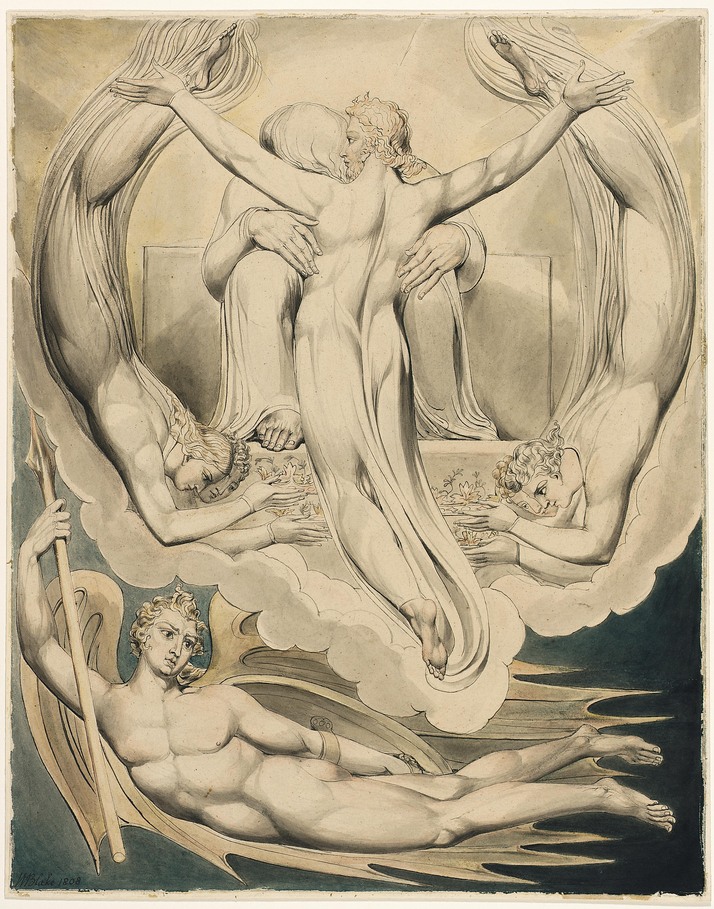
Illustrations to Paradise Lost
Christ as Redeemer of Men

Listen to Blake and the Bible commenting on Jesus, Sin, Error, Forgiveness, Satan and Judgment. These quotes from the two sources allow us to compare New Testament concepts and how similar ideas appear in Blake's work:

1)Jesus not the accuser (Satan) is our judge.

1John.2

[1] My little children, these things write I unto you, that ye sin not. And if any man sin, we have an advocate with the Father, Jesus Christ the righteous:

Vision of the Last Judgment, (E 565)
"Forgiveness of Sin is only at the Judgment Seat of Jesus the
Saviour where the Accuser is cast out. not because he Sins but
because he torments the Just & makes them do what he condemns as
Sin & what he knows is opposite to their own Identity"

2) The accuser has no power over us.

Rev.12
[10] And I heard a loud voice saying in heaven, Now is come salvation, and strength, and the kingdom of our God, and the power of his Christ: for the accuser of our brethren is cast down, which accused them before our God day and night.

Vision of the Last Judgment,(E 564)
"Christ comes
as he came at first to deliver those who were bound under the
Knave not to deliver the Knave He Comes to Deliver Man the
[Forgiven] not Satan the Accuser we do not
find any where that Satan is Accused of Sin he is only accused of
Unbelief & thereby drawing Man into Sin that he may accuse him.
Such is the Last Judgment a Deliverance from Satans Accusation
Satan thinks that Sin is displeasing to God he ought to know that
Nothing is displeasing to God but Unbelief & Eating of the Tree
of Knowledge of Good & Evil"

3) The light of Truth leads us to the new creation.

Acts.26
[18] To open their eyes, and to turn them from darkness to light, and from the power of Satan unto God, that they may receive forgiveness of sins, and inheritance among them which are sanctified by faith that is in me. [PAUL]

Vision of the Last Judgment, (E 565)
"I will not Flatter them Error is
Created Truth is Eternal [,] Error or Creation will be Burned Up &
then & not till then Truth or Eternity will appear It is Burnt up
the Moment Men cease to behold it I assert for My self that I do
not behold the Outward Creation & that to me it is hindrance &
not Action it is as the Dirt upon my feet No part of Me."

4) Forgiveness of sins is God's will.

Matt.9
[2] And, behold, they brought to him a man sick of the palsy, lying on a bed: and Jesus seeing their faith said unto the sick of the palsy; Son, be of good cheer; thy sins be forgiven thee.
[5] For whether is easier, to say, Thy sins be forgiven thee; or to say, Arise, and walk?
[6] But that ye may know that the Son of man hath power on earth to forgive sins, (then saith he to the sick of the palsy,) Arise, take up thy bed, and go unto thine house.

Jerusalem,
Plate 20, (E 165)

"Jerusalem answer'd with soft tears over the valleys.

O Vala what is Sin? that thou shudderest and weepest
At sight of thy once lov'd Jerusalem! What is Sin but a little
Error & fault that is soon forgiven; but mercy is not a Sin
Nor pity nor love nor kind forgiveness! O! if I have Sinned
Forgive & pity me! O! unfold thy Veil in mercy & love!
Slay not my little ones, beloved Virgin daughter of Babylon
Slay not my infant loves & graces, beautiful daughter of Moab"

5) The religion of Jesus practices mercy not vengeance.

Matt.23
[23] Woe unto you, scribes and Pharisees, hypocrites! for ye pay tithe of mint and anise and cummin, and have omitted the weightier matters of the law, judgment, mercy, and faith: these ought ye to have done, and not to leave the other undone.

Jerusalem, Plate 52, (E 201)
"Man must & will have Some Religion; if he has not the Religion
of Jesus, he will have the Religion of Satan, & will erect the
Synagogue of Satan. calling the Prince of this World, God; and
destroying all who do not worship Satan under the Name of God.
Will any one say: Where are those who worship Satan under the
Name of God! Where are they? Listen! Every Religion that Preaches
Vengeance for Sins the Religion of the Enemy & Avenger; and not
the Forgiver of Sin, and their God is Satan, Named by the Divine
Name Your Religion O Deists: Deism, is the Worship of the God
of this World by the means of what you call Natural Religion and
Natural Philosophy, and of Natural Morality or
Self-Righteousness, the Selfish Virtues of the Natural Heart.
This was the Religion of the Pharisees who murderd Jesus. Deism
is the same & ends in the same."

6) Practicing Forgiveness builds the Kingdom of God

Matthew 18
[21] Then came Peter to him, and said, Lord, how oft shall my brother sin against me, and I forgive him? till seven times?
[22] Jesus saith unto him, I say not unto thee, Until seven times: but, Until seventy times seven.

Jerusalem, Plate 77, (E 232)
"And remember: He who despises & mocks a Mental Gift in another;
calling it pride & selfishness & sin; mocks Jesus the giver of
every Mental Gift, which always appear to the ignorance-loving
Hypocrite, as Sins. but that which is a Sin in the sight of cruel
Man, is not so in the sight of our kind God.
Let every Christian as much as in him lies engage himself
openly & publicly before all the World in some Mental pursuit for
the Building up of Jerusalem "

The influence that the Bible had on shaping the mind of Blake led him to become a religious poet. He used the Christian metaphors in unique ways but always with the goal of opening the minds of men to the 'perception of the Infinite'.


Thursday, December 09, 2010

Blake's God

    that they may be one, even as we are one: I in them
    and thou in me, that they may be made perfect in one.
    (John 17)
The theologues of the forties and fifties learned from Paul Tillich that everyone has an ultimate concern, his God. People in Alcoholics Anonymous have told some of their theologically confused members that, lacking any better God, they may worship a 'pot on the mantle', anything at all to break that devotion to the bottle which is actually the worship of a lower form of the self. To remain sober one must believe in a Higher Power of some sort.

The important thing is that one's Higher Power be not a projection of some lower form of self; that's idolatry. The person seriously interested in ultimate reality engages in a life long search for the most real image he can discover, the image of his God. A person's best image of God nurtures his spirit as he goes through life.

The Bible contains a multiplicity of images of God. For example we read about the finger of God (verse 18), the nostrils of God (verse 8), even the backside of God (verse 23). All his life Blake maintained a high level of respect for the Bible as Vision. Nevertheless he refused to worship other men's visions of God:

"I (you!) must create a system, or be enslaved by another man's" (Jerusalem, 10.21; E153).

He's saying that we have a choice: to adhere to the conventions (whatever conventions may be for us) or to create our own values from our own experience. Blake did this for a lifetime, creating his own myth of meaning, and with his creative works he expressed it over and over again.

The only thing Blake really trusted was his own immediate direct vision, and he possessed his soul in varying degrees of patience until that vision clarified (and you may be sure that it was criticized, corrected and amended over and over again. The Felpham Moment marks the decisive clarification of Blake's vision of God. Even then the Father remained for Blake a symbol of subjection to the other man's vision, of spiritual tyranny. His own vision came to center upon Jesus:

"the Son O how unlike the Father First God Almighty comes with a Thump on the Head Then Jesus Christ comes with a balm to heal it" (Vision of the Last Judgment; Erdman 565)
Blake depreciated the God of Law
and Wrath in order to exalt the God of Forgiveness. He believed that the far off, elusive, mysterious, transcendental image of God freezes man into spiritual immobility. He wanted to liberate men's minds from this imposture and put them in touch with the true source of creativity:
    "Seek not thy heavenly father then beyond the skies,
    There Chaos dwells & ancient Night & Og & Anak old." (Milton 20:33-34)

    "I am not a God afar off, I am a brother and friend;
    Within your bosoms I reside, and you reside in me:
    Lo! we are One, forgiving all Evil, Not seeking recompense.
    Ye are my members...."
    (Jerusalem 4:18-21)

The prophetic poems which Blake wrote prior to 1800 concern his efforts to know, describe and deal with the old, jealous, wrathful, creator image; he finally dismissed it as a "shadow from his wearied intellect" (FZ3-40.3). The later, major prophecies, Milton and Jerusalem, also contain this theme, happily outweighed by the new vision.

Prior to the Felpham Moment Blake had worshipped his own visionary endowment, his Pot on the Mantle; he called it the Poetic Genius and later the Imagination.

The evolving figure of Los building Golgonooza (line 39) personified what we might call a pre-Christian God. When grace fell upon Blake, he came to see the true embodiment of God in Jesus.(See Letter.)

Following John and Paul quite literally Blake believed that all things belong to Jesus. He is in them (us) and they (we) are in him. All his life Blake had kept a firm grip on the oneness of humanity and its identity with God. At the Moment of Grace he came to see all as One Man and his own forgiven and accepted place in that Man's bosom. In the poem the Man refers to the All as "My Fold" and names the awakened Blake as his herald: "Thou Ram horn'd with gold".

Blake sent this poem to the one faithful Christian he knew who had befriended and loved him. The circumstances leave no doubt as to the identity of the One Man. The poem poetically expresses Blake's faith as it relates to God, Man and the relationship between the two. It expresses what the Christian faith has to say about the relationship as well as it can be expressed verbally. It also expresses with vivid eloquence the child like nature of the entrance to the kingdom of God. Blake here celebrates and confesses it.

To interpret Blake's experience we could use any number of hackneyed phrases representing the various dialects of the language of Zion; suffice it to say that for most of them as for Blake this is the main event, the center of the Moment of Grace. At this point Jesus became and forever afterward remained the One and the ever present Reality which Blake had formerly known as the Infinite or Eternal. For Blake Jesus was a Man, the Reality of Life, and most ultimately the All. In all three instances Blake strictly followed Johannine and Pauline strains of the New Testament.


Wednesday, December 08, 2010

EVIDENT TO THE CHILD

___________________________Image from Songs of Innocence,
___________________________Little Black Boy

Blake with his unusually high intelligence can be assumed to have to have learned to read very early in his life. Very likely the Bible was among his preferred reading material. He seems to have been attracted to the Old Testament prophets such as Isaiah, Ezekiel, Jeremiah, Amos whose influence is seen in his poetry.
It is interesting to think of Blake as a young child reading the Bible without instruction or supervision, as interacting in his own unique, superintelligent way. He got into some scholarship later and also absorbed the general understanding from his culture. Nevertheless his interaction and interpretation continued to be direct and unusual.

Annotations to Berkeley, (E 664)
"Jesus supposes every Thing to be Evident to the Child & to
the Poor & Unlearned Such is the Gospel
The Whole Bible is filld with Imaginations & Visions from
End to End & not with Moral virtues that is the baseness of Plato
& the Greeks & all Warriors The Moral Virtues are continual
Accusers of Sin & promote Eternal Wars & Domineering over others"

Annotations to Berkeley, (E 664)
"Man is All Imagination God is Man & exists in us & we in him"

Jonathan Roberts and Christopher Rowland contributed a chapter to the Blackwell Companion to the Bible in English Literature in which they present their views on Blake's use of the Bible (Page 376):
"This emphasis on the importance of individuals (and their social contexts) in interpreting the Bible means that Blake is particularly concerned with replacing a literalist hermeneutic with one that considers the Bible to be a stimulus to the imagination. This means above all engaging readers in the interpretation of the text, rather than demanding they accept it as in object above and beyond them. To this end Blake provides a consistent polemic against the preoccupation with the literal sense of the text, and against a reverence for the text that comes at the expense of what an imaginative and life-affirming encounter with the Bible might offer. These two tasks required a thoroughgoing assault on the ways in which the Bible had been constructed and reduced to a focus on the sacrificial death of Jesus and a religion of moral virtue. Blake would have no truck, for example, with the view that humans are inherently sinful: that God must be appeased by a sacrifice (of Christ); and that God - having made that sacrifice - then expects humanity to behave morally in order to stay in relationship with him (i.e. by keeping his commandments). Such an outlook, Blake thought, led to a denial of aspects of the human person and the subjection of some human beings to others."

Blake seemed to continue to read the Bible as he had as a child - with an open mind. He didn't look back to what the words had meant when they were written exclusively, but to what they meant in the immediate present to his own imaginative ability. His conversations with Ezekiel and Isaiah may have begun long before he wrote The Marriage of Heaven and Hell and continued long after.

Tuesday, December 07, 2010

Blake's Giants

Damon in pages 155-57 has an exhaustive display of
Blake Giants. Here are few things I found especially
noteworthy. Blake (like most ordinary Christians
today) did not think well of the O.T, theologically
speaking. However he found it rich in ideas and
meanings, and he had no hesitation about drawing on
them in his own creations. There are two kinds of
giants in the Bible:

1. Antediluvian (pre Flood)

Genesis 6:
[1] And it came to pass, when men began to multiply on
the face of the earth, and daughters were born unto
them. [2] That the sons of God saw the daughters of
men that they were fair; and they took them wives of
all which they chose.

[3] And the LORD said, My spirit shall not always
strive with man, for that he also is flesh: yet his
days shall be an hundred and twenty years. [4] There
were giants in the earth in those days; and also after
that, when the sons of God came in unto the daughters
of men, and they bare children to them, the same became
mighty men which were of old, men of renown.

The Book of Enoch, which Blake had undoubtedly read,
has material about these giants. (If you want to
research Enoch, try chapter 7; good luck).

One of Blake's first mentions of the Giants comes in
Plate 16 (lines 2-8) of the Marriage of Heaven and
Hell:

"02 The Giants who formed this world into its
03 sensual existence and now seem to live in it
04 in chains, are in truth. the causes of its life
05 & the sources of all activity, but the chains
06 are, the cunning of weak and tame minds. which
07 have power to resist energy, according to the pro-
08 -verb, the weak in courage is strong in cunning."

And in Plate 17, Lines 8-10 we read that "Messiah or
Satan or Tempter was formerly thought to be one of the
Antediluvians who are our Energies".

"The giants symbolize the great primeval powers within
us, although mostly hidden within our bodies..., also
the great thinkers, those individuals who have overcome
these [fleshy] limitations and realized their powers."
(Damon 155) (No doubt Blake at times thought of himself
in that category.)

Blake saw these antediluvians as people rather than
states: they could not be annihililated, but he put
them at the bottom of the Sea of Time and Space.

2. The Postdeluvian Giants included the giant Albion,
"sunk in the deadly sleep of materialism" (Damon 156)

I've copied 4 lines from Jerusalem plate 38: "hear the
Giants of Albion cry at night
We smell the blood of the English! we delight in their
blood on our Altars! The living & the dead shall be
ground in our rumbling Mills 51 For bread of the Sons
of Albion;"

Shades of Jack and the Beanstalk!

And from Jerusalem Plate 49:
07 Come & mourn over Albion the White Cliff of the Atlantic
08 The Mountain of Giants; all the Giants of Albion are become
09 Weak! witherd! darkend! & Jerusalem is cast forth from Albion.
10 They deny that they ever knew Jerusalem, or ever dwelt in Shiloh

The subject deserves more study. Damon made a good beginning, but there's still a lot of work to do. However you may readily perceive that Blake took the Giant symbol and used it to portray much of the fallenness which describes our materialistic world.

Monday, December 06, 2010

CRYSTAL CABINET I

Blake's illustration to Milton's Comus commissioned by Thomas Butts dated 1815


Thomas Butts was a principal patron of William Blake during the leanest of times in his life. It is hard to conceive of how Blake could have continued his imaginative work without the financial support which sales to Butts provided. Mary Butts, the great-granddaughter of Thomas Butts had the childhood experience of growing up under the influence of William Blake whose pictures adorned the walls of a room in her home. In her autobiography The Crystal Cabinet: My Childhood at Salterns, she applies the metaphor of Blake's poem to understanding her adolescent years. Her book was first published in 1937, shortly before her death, over objections from her fractious family. It was reissued in 1988 including material which had formerly been deleted.

Joel Hawkes of the University of Bristol wrote an article on Mary Butts's book which he called Inside The Crystal Cabinet: Truth, Lies and Vision in Mary Butts’s Autobiography of Place. On page 3 of the article we read:
"The title The Crystal Cabinet is borrowed from William Blake’s poem of the same name. In understanding Butts’s interpretation of Blake’s poem, and of Blake’s art more generally, one begins to see how Butts searches for truth and for vision through the creation of place within her writing. Salterns, as a place, is a means to this vision. Butts had grown up at Salterns – a large 21 acre estate near Poole – surrounded by Blake’s work. Butts’s great grandfather, Thomas Butts, was patron to William Blake, and in Mary’s childhood, in a room known as the ‘Blake room’, there hung a large number of Blake’s paintings, now found at the Tate Britain (Butts 1988, p.13). The house was also reportedly filled with other works of art, particularly those of the Pre-Raphaelites – the Rossettis were friends of her father’s (p.142). Butts, with good reason, writes that her early life was ‘saturated’ with art (1988, p.31)."

Hawkes' article on page 5 comments on the poem which Butts used to create a framework for her autobiography:

"Blake’s ‘The Crystal Cabinet’ explores the movement from Beulah to Generation. In the poem, a young man is taken away from the ‘Wild’, where he tells us he was ‘dancing merrily’ – a place of innocence. He is caught by a maiden, taken into the cabinet, and locked up with a ‘golden Key’ (1972, p.429, ll. 1-4). In the cabinet he sees another England, another London and Thames (ll. 9-12). They are like the one he knows, but different. A sexual and imaginative development takes place with the maiden, and during his experience the youth strives to ‘seize the inmost form’ of this event (l. 21). Doing so, he bursts the cabinet, becoming a ‘Weeping Babe’ – born into our world of experience (l. 24). The youth of the poem is moving from one realm to another through sexual and imaginative experience. It is a passage, indeed a rite of passage, from innocence to experience – one that unites the two opposites. It may seem like a fall in the tradition of Adam and Eve, but for Blake one must move from the innocence of the earthly paradise of Beulah into Generation, in order to progress spiritually. To not allow oneself this sexual and imaginative route, leads one only to Ulro, where Thel in Blake’s Book of Thel falls. With no imaginative and sexual experience one becomes half dead, a ghost in ‘a schizoid second infancy or idiocy’ (Bloom 1971, p.57)."

Blake's Crystal Cabinet is open to interpretation, at which many have tried their hand. We will have a further look at in later posts.

Sunday, December 05, 2010

The Main Chance and Beyond

"Behold I stand at the door and knock" (Revelation 3:20)

What happened to our hero when he visited the
Truchsessian Gallery?

A DECISION was made; something had been 'knock, knock, knocking at him for twenty years, a still small voice that he had ignored. Not enough time! too busy getting ahead! Blake wanted to be a Shakespeare and a Michaelangelo! to get ahead! to be one of the big boys! to achieve fame and fortune in the world!

But it wasn't in the cards. Filled with ambition, with the 'lust of the world', he had closed off the higher ground. For twenty years! And in his mind he had achieved nothing; they still had bread and beans for supper.

The DECISION was to give up the main chance. He relaxed, and Heaven flooded in. For twenty years the door had been closed! he opened it. The Bread of Life came in.

Then we got Milton, Jerusalem, The Gates of Paradise, The Vision of the Last Judgment, and finally the Book of Job. Masterpieces! the equivalent of Shakespeare. And he painted, etched, colored, drew magnificent pictures.

There were two things involved in this process (at least two)
1. The decision; he made it (you and I may make it).
2. God (Heavenly Visions) came in immediately!

That's the story of Blake's life (of our lives).

Saturday, December 04, 2010

SEEK LOVE

Seldom do we find Blake making a simple direct statement which we immediately understand. These few lines seem to be such a statement. The love found in the light of day is the love in the time of innocence - undeveloped consciousness. In the darkness of the night is found the love of experience which has been tested by suffering and had learned compassion. The gift of love is more likely to be received and given among those who have encountered not only light but darkness.  

Pickering Manuscript, William Bond, (E 497) 
"I thought Love livd in the hot sun Shine 
But O he lives in the Moony light 
I thought to find Love in the heat of day 
But sweet Love is the Comforter of Night
 
Seek Love in the Pity of others Woe 
In the gentle relief of anothers care 
In the darkness of night & the winters snow 
In the naked & outcast Seek Love there" 

 The journey from innocence to experience draws us from the unadulterated light into the shadows or darkness. Blake wrote The Book of Thel from the perspective of an innocent who looked ahead to the journey of acquiring experience and declined to take the next step.  

Thel, PLATE 1, (E 3) 
"The daughters of Mne Seraphim led round their sunny flocks. 
All but the youngest; she in paleness sought the secret air.
To fade away like morning beauty from her mortal day:
Down by the river of Adona her soft voice is heard:
And thus her gentle lamentation falls like morning dew.          

O life of this our spring! why fades the lotus of the water?
Why fade these children of the spring? born but to smile & fall.
Ah! Thel is like a watry bow. and like a parting cloud.
Like a reflection in a glass. like shadows in the water.
Like dreams of infants. like a smile upon an infants face,       
Like the doves voice, like transient day, like music in the air;
Ah! gentle may I lay me down, and gentle rest my head.          
And gentle sleep the sleep of death. and gentle hear the voice 
Of him that walketh in the garden in the evening time."

To experience life implies becoming acquainted with death; entering the field of time inevitably exposes one to the experience of change; pain is introduced as a pedagogue to guide development. Thel avoided these threatening things by remaining in a state of innocence instead of transitioning into an adult who knew from experience the meaning of sacrifice, brotherhood, redemption and compassion. Blake proposes that participating in the experience of division, and living in an imperfect world is the way to completeness, to the realization of the infinite and to Eternity. Thel choose the 'sleep of death' rather than the sleep of life. 

 ____________________________

 Picture from Song of Los, Plate 6

Friday, December 03, 2010

Blake's Kingdom

Jesus directed his followers to pray "thy kingdom come".

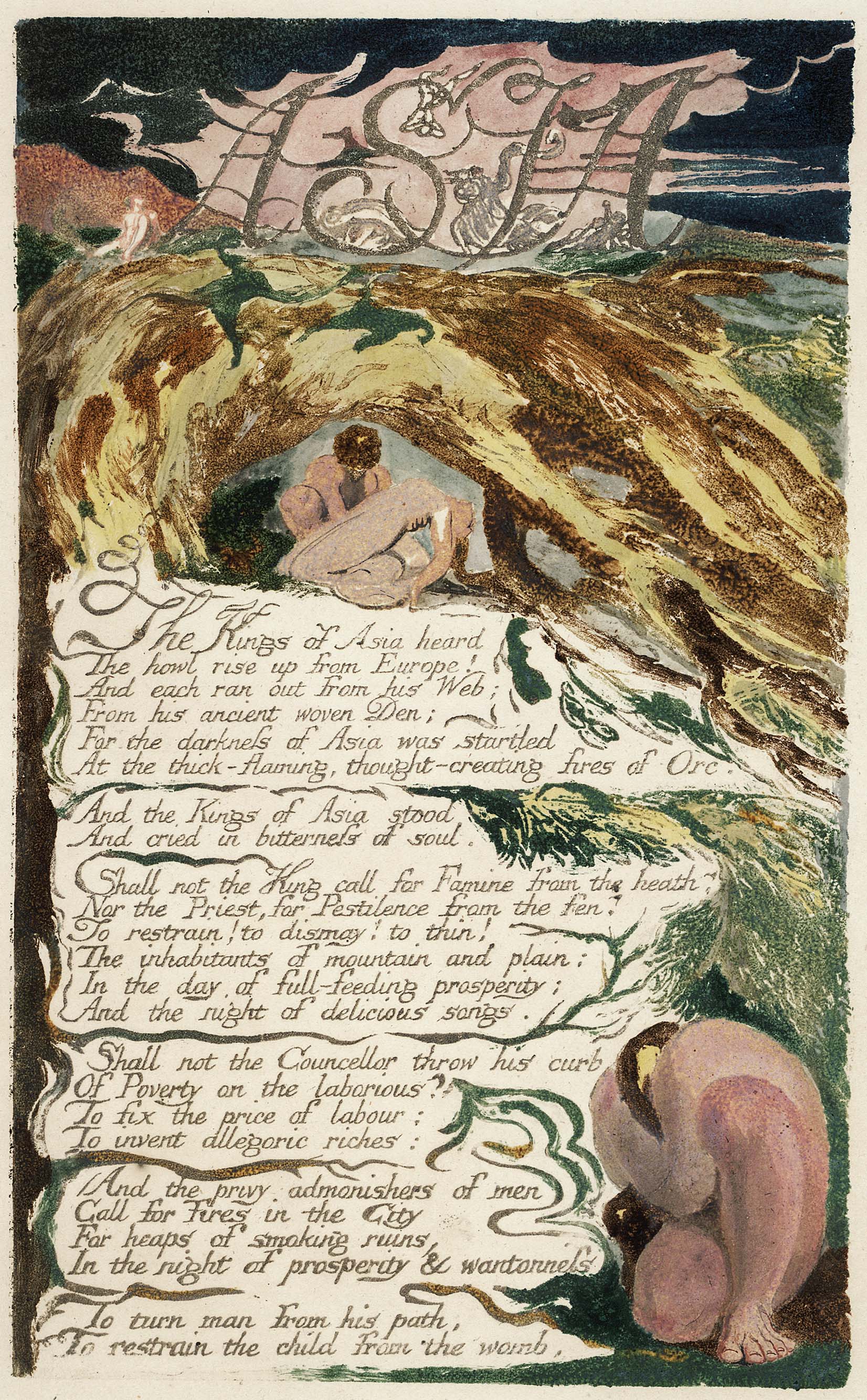
In general Blake had negative feelings about kingdoms. In America he emphatically affirmed the American Revolt against King George.

Some of his pictures suggest rather vividly that his monarch was sitting in the place reserved for God:

"revealed in his dragon form as a spectre bat"
the vestige of a Gothic cathedral hangs over his head; he's the pope of his state church. The two angel queens are said to be the queens of France and England (from Erdman, The Illuminated Blake 169).

Blake supported the French Revolution until it proved to be blood-thirsty.

He had a hard time with the Lord's Prayer because his Old Testament feelings about a kingly God resembled too much the oppressive and tyrannical kingdoms of history.

In a comment to his Annotations to Bacon (Erdman page 629) he wrote:
"The Kingdom of Heaven is the direct Negation of Earthly domination."

And in Milton (plate 31; Erdman 130):
"These are the Gods of the Kingdoms of the Earth: in contrarious and cruel opposition: Element against Element, opposed in War Not Mental, as the Wars of Eternity but a Corporeal Strife"

Blake wrote many other diatribes complaining about earthly kings and kingdoms, and near the End of Jerusalem (Plate 98; Erdman 258) he wrote:
"Where are the Kingdoms of the World and all their glory that grew on Desolation".

Finally in his comments on Dr. Thornton's discussion of the Lord's Prayer (Erdman 669) he wrote "for thine is the Kingdom and the Power and the Glory and not Caesars or Satans Amen."

Blake understood that the chasm between God's Kingdom and the Kingdoms of the World is just as big as the chasm between Heaven and Hell.

Thursday, December 02, 2010

BLAKE & WORD OF GOD

Jonathan Roberts and Christopher Rowland contributed a chapter to the Blackwell Companion to the Bible in English Literature in which they present their views on Blake's use of the Bible. On page 375-76 they write:

"Blake was influenced by a view of the Bible which has a long history in Christianity and may have been a part of the radical religious underground of which he was an inheritor. In this view the Word of God is not a book but a person: Christ ( see John 1:14. "And the Word was made flesh and dwelt among us" and Hebrews 1:1-2. God...Hath in these last days spoken unto us by his Son"). In short, the Bible bears witness to the Word of God (that is Christ), but is not in itself the Word of God. Blake manifests this view when he writes:

'The Bible or Word of God, [when read] exclusive of conscience or the Word of God Universal, is that Abomination which like the Jewish ceremonies is for ever removed & henceforth every man may converse with God & be a King & Priest in his own house.' (Erdman, 1990, p.614) [Annotations to Bishop Watson]

"Here Blake exalts 'the Word of God Universal' (Christ, or conscience) over the 'Peculiar Word of God' (the Bible as the exclusive mode of divine communication). This distinction between the two 'Words' (Christ and the Bible) means that an individual inspired by the former (through conscience, the Divine Spirit within) may contest and criticize the latter."
End of Quote

Rowland and Roberts are right that this view has a long history and is apparent in Blake's writing. This view of placing the Living Word (acting through the Holy Spirit) above the Written Word (recorded in books) opens up the possibility of continuing revelation which Blake wholeheartedly affirmed. Placing complete and final trust in the recorded Word limits further revelation of Divine Truth. This obstacle to the possibility of the evolution of spiritual consciousness through the work of Imagination is removed through placing trust in the Living word of Christ. Rowland and Roberts were conveying their view that Blake most trusted the word that came to him in thought, and Vision and the expressions of the Imagination.

Wednesday, December 01, 2010

Blake's Last Judgment II

From the Britannica:
The "Second Coming, also called Second Advent, or Parousia, in Christianity is the future return of Christ in glory, when it is understood that he will set up his kingdom, judge his enemies, and reward the faithful, living and dead. Early Christians believed the Advent to be imminent (see millennium), and most Christian theologians since then have believed that the visible appearance of Jesus may occur at any moment and that Christians should be ever ready for it. There is evidence for the Second Coming in the Gospels (Matthew 24,25; Mark 13; Luke 21:5–26; John 14:25–29), in the Book of Revelations, ...."

Other Christians, Quakers for instance, perceive it as an internal event in Friends' minds, the moment when 'that of God in one' becomes conscious and overwhelming.

An early description of it comes in America, PLATE 6:
"The morning comes, the night decays, the watchmen leave their stations;
The grave is burst, the spices shed, the linen wrapped up;
The bones of death, the cov'ring clay, the sinews shrunk & dry'd.
Reviving shake, inspiring move, breathing! awakening!
Spring like redeemed captives when their bonds & bars are burst;

Let the slave grinding at the mill, run out into the field:
Let him look up into the heavens & laugh in the bright air;
Let the inchained soul shut up in darkness and in sighing,
Whose face has never seen a smile in thirty weary years;
Rise and look out, his chains are loose, his dungeon doors are
open. And let his wife and children return from the opressors scourge;
They look behind at every step & believe it is a dream singing.
The Sun has left his blackness, & has found a fresher morning
And the fair Moon rejoices in the clear & cloudless night;
For Empire is no more, and now the Lion & Wolf shall cease."

This of course owes much to Ezekiel, but to me it comes through in terms of deliverance from economic oppression.

Blake describes the Last Judgment at considerable length in The Four Zoas. Wikipedia explains that there were two versions of 4Z, before and after 1800. In all he wrote 'Vala' (later called 'The Four Zoas') over a period of ten years. Blake was a different person after his rebirth in 1800. One might say he had experienced the internal expression of the last judgment.

In Night 9 of The Four Zoas Blake picked up where he had left in America repeating the last two lines:

"
The Sun has left his blackness & has found a fresher morning
And the mild moon rejoices in the clear & cloudless night
And Man walks forth from midst of the fires the evil is all consumd

His eyes behold the Angelic spheres arising night and day
The stars consumd like a lamp blown out & in their stead behold
The Expanding Eyes of Man behold the depths of wondrous worlds
One Earth one sea beneath nor Erring Globes wander but Stars
Of fire rise up nightly from the Ocean & one Sun
Each morning like a New born Man issues with songs & Joy
Calling the Plowman to his Labour & the Shepherd to his rest
He walks upon the Eternal Mountains raising his heavenly voice
Conversing with the Animal forms of wisdom night & day
That risen from the Sea of fire renewd walk oer the Earth

For Tharmas brought his flocks upon the hills & in the Vales
.......
They raise their faces from the Earth conversing with the Man
How is it we have walkd thro fires & yet are not consumd
How is it that all things are changd even as in ancient times

(This line in 'Vision of the Last Judgment' (on Erdman 562)
illustrates and perhaps helps to understand what Blake meant
immediately above:
"whenever any Individual Rejects Error &
Embraces Truth a Last Judgment passes upon that
Individual"
)
The Sun arises from his dewy bed & the fresh airs
Play in his smiling beams giving the seeds of life to grow
And the fresh Earth beams forth ten thousand thousand springs of
life ..........
The war of swords departed now
The dark Religions are departed & sweet Science reigns
End of The Dream (Erdman 406-07)"

The Last Judgment was a large painting where Blake depicted an enormous number of figures rotating under Christ on his throne.Wikipedia has a good description of this work, created in 1808.

This picture with a great deal of explanation from this google doc can tell most people more than they may want to know.

If you're interested in the history of interpretations of the Last Judgment, you might check this wikipedia article.


Tuesday, November 30, 2010

MORAL VIRTUE & RAHAB


Jerusalem, Plate 75 (color image from Blake Archive)

The consequences of practicing a religion of Moral Virtue are personified in Rahab. The codification of the law elevates the law above the individuals it is meant to serve. The law, elevated to the ultimate status becomes an idol which replaces God. The law which was meant to bring man to God, instead emphasizes obedience which is an external operation. Inspiration which takes place internally from the spirit is the contrary of law. Blake came to believe that the Old Testament revelation was a necessary step in the evolution of spiritual consciousness. However it brought about a State of Error which must be transcended by the incarnation through which man has direct internal connection with spiritual reality.

In A Blake Dictionary, Damon gives us details about the character Rahab:
[she] "symbolizes the false church of this world, the opponent of Jerusalem, and the crucifier of Jesus (FZ viii:406)"..."Rahab is Natural Religion. She is 'Vala drawn down into a Vegetated Body' (FZ,viii:280) "... "She is the system of Moral Virtue (J 39:10). She imputes Sin and Righteousness to individuals (J70:18), although Los tells her to distinguish between States and the Individual in them (FZviii:379)."..."Rahab, as Natural Religion, is the seductive harlot."..."Rahab as the Female Will seeks dominion by means of sex".

In Damon's description Rahab may not seem very appealing but her power lies in her seductive beauty. Both the orderliness of the law and the intricacies of nature offer the same seductive appeal. Blake associates Rahab's attractiveness with the threefold character by which Blake meant the materialized body - Head, Heart, and Loins. The fourth element of man was absent - Urthona, the unifying principle, the intuition or imagination. The Chariot without its driver was less than human which is Fourfold not threefold.

Jerusalem, Plate 70, (E 224)
"Imputing Sin & Righteousness to Individuals; Rahab
Sat deep within him hid: his Feminine Power unreveal'd
Brooding Abstract Philosophy. to destroy Imagination, the Divine-
-Humanity A Three-fold Wonder: feminine: most beautiful: Three-fold
Each within other. On her white marble & even Neck, her Heart
Inorb'd and bonified: with locks of shadowing modesty, shining
Over her beautiful Female features, soft flourishing in beauty
Beams mild, all love and all perfection, that when the lips
Recieve a kiss from Gods or Men, a threefold kiss returns
>From the pressd loveliness: so her whole immortal form three-fold
Three-fold embrace returns: consuming lives of Gods & Men
In fires of beauty melting them as gold & silver in the furnace
Her Brain enlabyrinths the whole heaven of her bosom & loins
To put in act what her Heart wills; O who can withstand her power
Her name is Vala in Eternity: in Time her name is Rahab

The Starry Heavens all were fled from the mighty limbs of Albion
PLATE 71
And above Albions Land was seen the Heavenly Canaan
As the Substance is to the Shadow: and above Albions Twelve Sons
Were seen Jerusalems Sons: and all the Twelve Tribes spreading
Over Albion. As the Soul is to the Body, so Jerusalems Sons,
Are to the Sons of Albion: and Jerusalem is Albions Emanation

What is Above is Within, for every-thing in Eternity is translucent:
The Circumference is Within: Without, is formed the Selfish Center
And the Circumference still expands going forward to Eternity.
And the Center has Eternal States! these States we now explore."

Jerusalem, Plate 98, (E 257)
"A Sun of blood red wrath surrounding heaven on all sides around
Glorious incompreh[en]sible by Mortal Man & each Chariot was Sexual Threefold
And every Man stood Fourfold, each Four Faces had. One to the West
One toward the East One to the South One to the North. the Horses Fourfold
And the dim Chaos brightend beneath, above, around! Eyed as the Peacock
According to the Human Nerves of Sensation, the Four Rivers of the Water of Life"

Four Zoas, Page 85, (E 368)
"If we unite in one[,] another better world will be
Opend within your heart & loins & wondrous brain
Threefold as it was in Eternity & this the fourth Universe
Will be Renewd by the three & consummated in Mental fires
But if thou dost refuse Another body will be prepared"

Monday, November 29, 2010

"On Earth as in Heaven"

We may see Heaven and Earth, Heaven and Hell, Male and Female, Sun and Earth, Good and Evil or any number of contraries.

"Without Contraries is no Progression" (MHH). Life begins with these contraries, but ends with a Unity. ("Everything that lives is holy"; end of MHH).

Blake's culture and our culture as well are patriarchal and have been in the Western World for a great many centuries. But go back earlier, and you may find a matriarchal one. That was the contribution of Sukie Colegrave, a Chinese-British woman of the second half of the 20th Century. Her book was entitled Uniting Heaven and Earth. Anthropology suggests that matriarchal cultures generally precede patriarchal ones.

The Perennial Philosphy points to the Sun as God (or Zeus) and the Earth as materiality, and to an Earth Goddess (There's a tremendous variety of Greek ones).

Jesus pointed to our loving Father in Heaven beginning the Lord's Prayer, and prayed that His will might be done on Earth. Charles Williams, a sort of Blakean writer wrote He Came Down from Heaven. (An autodidact like Blake, Williams' writing shows an uncanny relationship to Blake; one might call him a 20th century Blake!)

Blake's life was a continuous endeavor to raise Heaven on Earth. His wife complained about it, although as a faithful wife she supported him whole heartedly. He was called by one writer a Stranger from Paradise.

Sunday, November 28, 2010

LOS'S PLEA

Near the beginning of Jerusalem Albion became enthralled with Vala who was fallen and material. Albion fell further and further from his true nature as the embodiment of humanity into his Selfhood.

When Albion was overcome by guilt and projected his self-hatred outward, manifestations appeared which threatened his continued existence. Los assumed the role of Albion's true self, his integrated self or identity and began the work of restoring Albion's psyche. Los knew the cost which would be assessed to him. He also knew that only through the appearance of the Lamb of God within Albion, could he be regenerated.

So Los makes this plea:

Jerusalem, Plate 82, (E 241)
"Los saw & was comforted at his Furnaces uttering thus his voice.

I know I am Urthona keeper of the Gates of Heaven,
And that I can at will expatiate in the Gardens of bliss;
But pangs of love draw me down to my loins which are
Become a fountain of veiny pipes: O Albion! my brother!

PLATE 83
Corruptibility appears upon thy limbs, and never more
Can I arise and leave thy side, but labour here incessant
Till thy awaking! yet alas I shall forget Eternity!
Against the Patriarchal pomp and cruelty, labouring incessant
I shall become an Infant horror. Enion! Tharmas! friends
Absorb me not in such dire grief: O Albion, my brother!
Jerusalem hungers in the desart! affection to her children!
The scorn'd and contemnd youthful girl, where shall she fly?
Sussex shuts up her Villages. Hants, Devon & Wilts
Surrounded with masses of stone in orderd forms, determine then
A form for Vala and a form for Luvah, here on the Thames
Where the Victim nightly howls beneath the Druids knife:
A Form of Vegetation, nail them down on the stems of Mystery:
O when shall the Saxon return with the English his redeemed
brother!
O when shall the Lamb of God descend among the Reprobate!"
 
Yale Center for British Art
Jerusalem 
Plate 19 

Los knew that becoming the intimate friend and caregiver for Albion he would have to leave the clean, secure protected envelope of his home and be among the dirty, diseased and degenerate. Albion sleeps on his couch upon the rock while Los struggles through the ugly stages of development which precede awakening.

The seamy side of life where one may be rejected, taken advantage of, deceived and plotted against is not pleasant to endure. Those who assume the burden of bearing such alienation for the sake of others are close to the Lord.

At the end of Jerusalem when Albion is repentant, it is Jesus who stands with forgiveness and healing beside Albion, but Los is present too, totally involved in the conversation between God and Man.

Jerusalem, Plate 96, (E 255)
"Then Jesus appeared standing by Albion as the Good Shepherd
By the lost Sheep that he hath found & Albion knew that it
Was the Lord the Universal Humanity, & Albion saw his Form
A Man. & they conversed as Man with Man, in Ages of Eternity
And the Divine Appearance was the likeness & similitude of Los"
====================================================

"Blake considers the poet to be a crucial agent in the union of humankind with Christ. Indeed, the poet is the prophet who can foresee the apocalypse and salvation and who acts as a guide to lead the universal human to the Divine Vision."

Quote from ENOTES: Jerusalem: The emanation of the Giant Albion, William Blake - Introduction.


Saturday, November 27, 2010

Blake's Gospel

This is a reprise of Blake's Everlasting Gospel.
Jerusalem, plates 60 and 61 each contain the word, idol, but together they represent a central tenet of Blake's gospel; it concerns forgiveness:

From Jerusalem, Plate 60:
"Los sat terrified beholding Albions Spectre .....
within the Furnaces the Divine Vision appeard In Albions hills: often walking from the Furnaces in clouds

(Blake was obviously thinking of the critical chapter 3 of Daniel, where 'one like the son of Man' walks with Daniel's three friends in the furnace, and seemingly unhurt.)

And flames among the Druid Temples & the Starry Wheels
the Divine Vision gatherd Jerusalems Children in his arms & bore them like a shepherd in the night of Albion which overspread all the Earth
I gave thee liberty and life O lovely Jerusalem
And thou hast bound me down upon the Stems of Vegetation
.........Why wilt thou rend thyself apart, Jerusalem?
And build this Babylon & sacrifice in secret Groves, .......
(and on and on Blake goes, sounding like nothing so much as Jeremiah or Isaiah calling to account the erring children of Israel, but then comes the promise:)
I will lead thee thro the Wilderness in shadow of my cloud
And in my love I will lead thee, lovely Shadow of Sleeping
Albion .
(Blake refers to Jerusalem as the lovely Shadow of Sleeping Albion.)

This is the Song of the Lamb, sung by Slaves in evening time:
Jerusalem faintly saw him, closd in the Dungeons of Babylon
..............
But the Divine Lamb stood beside Jerusalem. oft she saw
The lineaments Divine & oft the Voice heard, & oft she said:
O Lord & Saviour, have the Gods of the Heathen pierced thee?
Or hast thou been pierced in the House of thy Friends?
Art thou alive! & livest thou for-evermore? or art thou
Not: but a delusive shadow, a thought that liveth not.
Babel mocks saying, there is no God nor Son of God
That thou O Human Imagination, O Divine Body art all
A delusion. but I know thee O Lord when thou arisest upon
My weary eyes even in this dungeon & this iron mill.....
altho I sin & blaspheme thy holy name, thou pitiest me;
Because thou knowest I am deluded by the turning mills.

Thus spake Jerusalem, & thus the Divine Voice replied.
Mild Shade of Man, pitiest thou these Visions of terror & woe!
Give forth thy pity & love. fear not! lo I am with thee always.
Only believe in me that I have power to raise from death
Thy Brother who Sleepeth in Albion: fear not trembling Shade"
(This last paragraph is filled with the words of Jesus:
"I am with thee always", "only believe in me" , Jesus raised their
brother, Lazarus from death; he also told Mary her brother was
sleeping. Blake has broken into the N.T, gospel, but for him the whole thing focused on forgiveness.

So much for Plate 60; now onward to 61:)
Jerusalem, Plate 61:
"Behold : in the Visions of Elohim Jehovah,
behold Joseph & Mary And be comforted O Jerusalem
in the Visions of Jehovah Elohim
She looked & saw Joseph the Carpenter in Nazareth & Mary
His espoused Wife. And Mary said,
if thou put me away from thee
Dost thou not murder me?"
(Mary of course was thought by the
Romans-- and by many, even until today to have been a harlot.)
Joseph spoke in anger & fury.
Should I Marry a Harlot or an Adulteress?
Mary answerd, Art thou more pure
Than thy Maker who forgiveth Sins & calls again Her that is Lost
Tho She hates. he calls her again in love. I love my dear Joseph
But he driveth me away from his presence. yet I hear the voice of God
In the voice of my Husband. tho he is angry for a moment,
he will not Utterly cast me away.
if I were pure, never could I taste the sweets
Of the Forgive[ne]ss of Sins! if I were holy! I never could behold the tears Of love!
of him who loves me in the midst of his anger in furnace of fire.
Ah my Mary: said Joseph: weeping over & embracing her closely in His arms:
Doth he forgive Jerusalem & not exact Purity from her who is
Polluted. I heard his voice in my sleep O his Angel in my dream:
Saying, Doth Jehovah Forgive a Debt only on condition that it shall Be Payed?
Doth he Forgive Pollution only on conditions of Purity
That Debt is not Forgiven! That Pollution is not Forgiven
Such is the Forgiveness of the Gods, the Moral Virtues of the
Heathen, whose tender Mercies are Cruelty. But Jehovahs
Salvation Is without Money & without Price,
the Continual Forgiveness of Sins
In the Perpetual Mutual Sacrifice in Great Eternity! for behold!
There is none that liveth & Sinneth not! And this is the Covenant
Of Jehovah: If you Forgive one-another, so shall Jehovah Forgive You:
That He Himself may Dwell among You.
Fear not then to take To thee Mary thy Wife,
for she is with Child by the Holy Ghost

Then Mary burst forth into a Song! she flowed like a River of
Many Streams in the arms of Joseph & gave forth her tears of joy
Like many waters, and Emanating into gardens & palaces upon
Euphrates & to forests & floods & animals wild & tame from
Gihon to Hiddekel, & to corn fields & villages & inhabitants
Upon Pison & Arnon & Jordan."

In contrast here's what he thought of the establishment gospel:
"Priests in black gowns were walking their rounds,
And binding with briers my joys and desires" (from The Garden
of Love; Erdman 26)

And how like the famous Spectre:
"Seven of my sweet loves
thy knife Has bereaved of their life
Their marble tombs I built with tears
And with cold & shuddering fears
Seven more loves weep night & day
Round the tombs where my loves lay
And seven more loves attend each night
Around my couch with torches bright"

Blake worked with the Everlasting Gospel (Erdman 518-24) for years trying to explain how his gospel differed from the Establishment one; what came forth is (certainly not lucid), ambiguous, tortured English; the Spirit simply doesn't lend itself to our words. Here are the last few lines of The Everlasting Gospel:
"The Vision of Christ that thou dost see
Is my Visions Greatest Enemy
Thine has a great hook nose like thine
Mine has a snub nose like to mine
Thine is the Friend of All Mankind
Mine speaks in parables to the Blind
Thine loves the same world that mine hates
Thy Heaven doors are my Hell Gates
.......
And Caiphas was in his own Mind
A benefactor of Mankind
Both read the Bible day & night
But thou readst black where I read white"

Reading it 'white' is what all true Blakeans strive to do.