A Memorable Fancy.
Fitzwilliam Museum
Marriage of Heaven and Hell
Plate 12
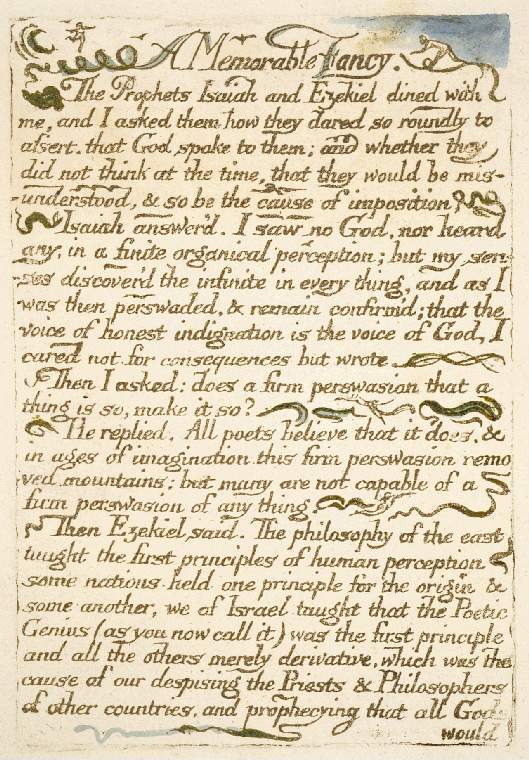
 The Prophets Isaiah and Ezekiel dined with me, and I asked
them how they dared so roundly to assert. that God spake to them;
and  whether they did not think at the time, that they would be
misunderstood, & so be the cause of imposition.
   Isaiah answer'd. I saw no God. nor heard any, in a finite
organical perception; but my senses discover'd the infinite in
every thing, and as  I was then perswaded. & remain confirm'd;
that the voice of honest indignation is the voice of God, I cared
not for consequences but  wrote.
   Then I asked: does a firm perswasion that a thing is so, make
it so?
   He replied.  All poets believe that it does, & in ages of
imagination
this firm perswasion removed mountains; but many are not capable
of a firm perswasion of any thing."The words he wrote here might be considered additions to Isaiah and Ezekiel, although I haven't found whatever places Blake may have used as a 'source'.
Fitzwilliam Museum
Marriage of Heaven and Hell
Plate 13
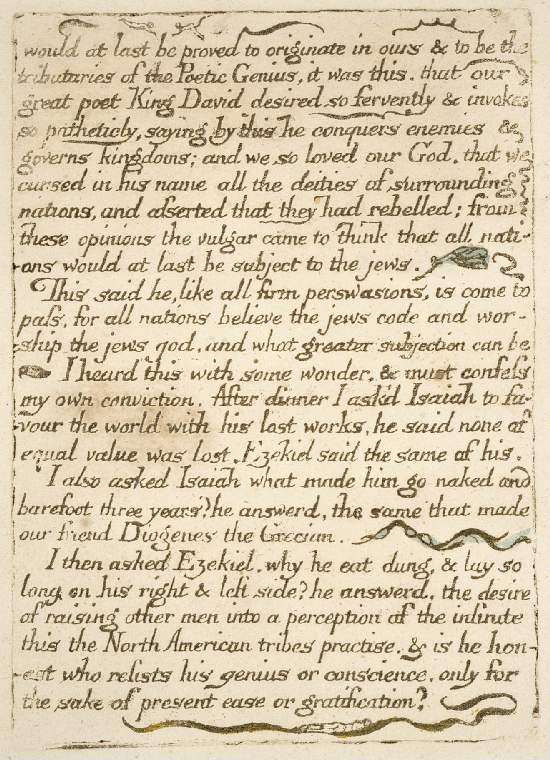
"at last be proved to originate in ours & to be the tributaries of the Poetic Genius; it was this that our great poet King David desired so fervently & invokes so pathetic'ly, saying by this he conquers enemies & governs kingdoms; and we so loved our God. that we cursed in his name all the deities of surrounding nations, and asserted that they had rebelled; from these opinions the vulgar came to think that all nations would at last be subject to the jews.'
'This' said he, 'like all firm perswasions, is come to pass; for all nations believe the jews' code and worship the jews' god, and what greater subjection can be?'
I heard this with some wonder, & must confess my own conviction. After dinner I ask'd Isaiah to favour the world with his lost works; he said none of equal value was lost. Ezekiel said the same of his.
I also asked Isaiah what made him go naked and barefoot three years? he answer'd, 'the same that made our friend Diogenes the Grecian.'
I then asked Ezekiel why he eat dung, & lay so long on his right & left side? he answer'd, 'the desire of raising other men into a perception of the infinite; this the North American tribes practise, & is he honest who resists his genius or conscience. only for the sake of present ease or gratification?'
Here we can find 'sources': Isaiah wrote that God had told him to go naked and barefoot in Chapter 20.
Re Ezekiel laying on his right and left side so long, look at Ezekiel 4:4-6.
Singer discussed these Plates in pages 113-24 of The Unholy Bible:
She seemed to suggest that Blake's mind moved out of commonplace material events, out of the world so to speak, and that he learned to clothe his 'transcendent' thoughts in terms of biblical figures, especially the prophets.
Marriage of Heaven and Hell may have been Blake's first attempt to express to others these feelings.
A Memorable Fancy begins with Blake's statement that the Prophets Isaiah and Ezekiel dined with him, which is evocative of Revelation 3:2:
"Behold, I stand at the door, and knock: if any man hear my voice, and open the door, I will come in to him, and will sup with him, and he with me."
Blake's Ezekiel wrote, "the Poetic Genius (as you now call it) was the first principle". See also All Religions are One (Erdman 1)

No comments:
Post a Comment