Showing posts with label Mental Traveller. Show all posts

Thursday, May 14, 2026

BLAKE'S MENTAL TRAVELLER


National Gallery of Art
Christian with the Shield of Faith,
Taking Leave of His Companions

These are the posts from 2010 concerning Blake's poem  The Mental Traveller.

MENTAL TRAVELLER 1-3

https://ramhornd.blogspot.com/2010/09/mental-traveller-1-3.html

https://ramhornd.blogspot.com/2010/09/mental-traveller-4-6.html

https://ramhornd.blogspot.com/2010/09/mental-traveller-7-9.html

https://ramhornd.blogspot.com/2010/09/mental-traveller-10-12.html

https://ramhornd.blogspot.com/2010/09/mental-traveller-13-15.html

https://ramhornd.blogspot.com/2010/09/mental-traveller-16-18.html

https://ramhornd.blogspot.com/2010/09/mental-traveller-19-21.html

https://ramhornd.blogspot.com/2010/09/mental-traveller-21-24.html

https://ramhornd.blogspot.com/2010/09/mental-traveller-25-26.html

https://ramhornd.blogspot.com/2010/09/mental-traveller-conclusion.html


READING MENTAL TRAVELLER

Pickering Manuscript
The Mental Traveller

In about 1804 Blake gathered together ten poems he had written but not published.  He made fair copies which he saved in a booklet. Among the poems was The Mental Traveller, an enigmatic poem in twenty six verses. Pickering acquired the manuscript in 1865. The following year he published Songs of Innocence and Experience, and Other Poems, edited by R. H. Shepherd and including the ten poems in his manuscript. Three years later Edwin John Ellis and William Butler Yeats included The Mental Traveller in The Works of William Blake: Poetic, Symbolic and CriticalThe original manuscript in Blake's hand now resides in The Morgan Library and Museum.

Yeats confessed that "When Edwin J. Ellis and I had finished out big book on the philosophy of William Blake, I felt that we had no understanding of this poem."

Songs and Ballads, (E 483)
"The Mental Traveller          
I traveld thro' a Land of Men
A Land of Men & Women too
And heard & saw such dreadful things
As cold Earth wanderers never knew

For there the Babe is born in joy   
That was begotten in dire woe
   
Just as we Reap in joy the fruit
Which we in bitter tears did sow

And if the Babe is born a Boy
He's given to a Woman Old      
Who nails him down upon a rock
Catches his Shrieks in Cups of gold

She binds iron thorns around his head
She pierces both his hands & feet
She cuts his heart out at his side   
To make it feel both cold & heat

Her fingers number every Nerve
just as a Miser counts his gold
She lives upon his shrieks & cries
And She grows young as he grows old   

Till he becomes a bleeding youth
And she becomes a Virgin bright
Then he rends up his Manacles
And binds her down for his delight

He plants himself in all her Nerves   
Just as a Husbandman his mould
And She becomes his dwelling place
And Garden fruitful Seventy fold

An aged Shadow soon he fades
Wandring round an Earthly Cot  
Full filled all with gems & gold
Which he by industry had got

And these are the gems of the Human Soul
The rubies & pearls of a lovesick eye
The countless gold of the akeing heart  
The martyrs groan & the lovers sigh

They are his meat they are his drink
He feeds the Beggar & the Poor
And the way faring Traveller
For ever open is his door       

His grief is their eternal joy
They make the roofs & walls to ring
Till from the fire on the hearth
A little Female Babe does spring

And she is all of solid fire     
And gems & gold that none his hand
Dares stretch to touch her Baby form
Or wrap her in his swaddling-band

But She comes to the Man she loves
If young or old or rich or poor    
They soon drive out the aged Host
A Begger at anothers door

He wanders weeping far away
Untill some other take him in
Oft blind & age-bent sore distrest   
Untill he can a Maiden win

And to Allay his freezing Age
The Poor Man takes her in his arms
The Cottage fades before his Sight
The Garden & its lovely Charms    

The Guests are scatterd thro' the land
For the Eye altering alters all
The Senses roll themselves in fear
And the flat Earth becomes a Ball

The Stars Sun Moon all shrink away  
A desart vast without a bound
And nothing left to eat or drink
And a dark desart all around

The honey of her Infant lips
The bread & wine of her sweet smile  
The wild game of her roving Eye
Does him to Infancy beguile

For as he eats & drinks he grows
Younger & younger every day
And on the desart wild they both    
Wander in terror & dismay

Like the wild Stag she flees away
Her fear plants many a thicket wild
While he pursues her night & day
By various arts of Love beguild    

By various arts of Love & Hate
Till the wide desart planted oer
With Labyrinths of wayward Love
Where roams the Lion Wolf & Boar   

Till he becomes a wayward Babe     
And she a weeping Woman Old        
Then many a Lover wanders here       
The Sun & Stars are nearer rolld

The trees bring forth sweet Extacy
To all who in the desart roam     
Till many a City there is Built
And many a pleasant Shepherds home

But when they find the frowning Babe
Terror strikes thro the region wide
They cry the Babe the Babe is Born    
And flee away on Every side                   

For who dare touch the frowning form
His arm is witherd to its root
Lions Boars Wolves all howling flee
And every Tree does shed its fruit    

And none can touch that frowning form
Except it be a Woman Old
She nails him down upon the Rock
And all is done as I have told"
Links to earlier posts which attempt to clarify some of what Blake was saying in his poem will be presented in the next post.

Tuesday, December 14, 2010

NATIVITY V

Nativity I, II, III and IV

Last December I posted four time on the nativity using Blake's illustrations to Milton's On the Morning of Christ's Nativity. The fifth illustration of the series "The Flight of Molock" faithfully presents these lines from Milton's ode:

XXIII
And sullen Moloch fled,
Hath left in shadows dread
His burning Idol all of blackest hue;
In vain with Cymbals' ring
They call the grisly king,
In dismal dance about the furnace blue,Moloch, the second of Blake's Seven Eyes of God, called the executioner, required child sacrifice. Blake presents the theme of sacrificing children by showing the infant Jesus emerging from a 'fiery furnace.' Daniel tells of three men who emerged from such a furnace unscathed having met in the furnace a fourth who appeared as the 'Son of God.'

On plate 31 (E 177) of Jerusalem Blake tells us that:

"And the appearance of a Man was seen in the Furnaces;
Saving those who have sinned from the punishment of the Law,
(In pity of the punisher whose state is eternal death,)
And keeping them from Sin by the mild counsels of his love."

Two women (cf.1st Kings 3:16ff) are touching the child emerging from the furnace. One appears to be Jerusalem, the other Vala or Rahab. Both turn away from the child as they reach out to touch him. In The Mental Traveller we read of a babe whom none could touch:

The Mental Traveller, (E 484)
"Till from the fire on the hearth
A little Female Babe does spring

And she is all of solid fire
And gems & gold that none his hand
Dares stretch to touch her Baby form
Or wrap her in his swaddling-band"

Blake and Milton have supplemented the picture of the child who was laid in the manger as provided by Luke.

Sunday, September 26, 2010

MENTAL TRAVELLER CONCLUSION

The End is the Beginning.

In his chapter, The Aim of Blake's Prophecies, included in Blake's Sublime Allegory, Jerome J McCann, makes this statement:
"...as in Blake, these poems are precisely designed to foster ambivalent perspectives...Poems like these are silent forms teasing us into and out of our own thoughts...
Thus, the extreme diversity of opinion among critics of Blake about the meaning of particular poems or passages of poems is perhaps the most eloquent testimony we have to the success of his work. Interpretations of the meanings of Blake's poems are necessarily legion, since his poetry was written to break in upon the centers of individual life and call their meanings into the open. Like Jesus, Blake came to send not peace but a sword. His work is a sign of contention."
 

These are some observations I want to remember from studying the poem:
1) Spirit and matter are complementary
2) One grows young when the other grows old
3) The one growing young feeds on the one growing old
4) Transition points occur where the one growing young becomes a babe
5) Matter and spirit want to supplant (or suppress) one another
6) The system needs both, when they engage in struggle neither prospers
.

Here are two passages from Blake which may describe what happens after The Mental Traveller ends:

Four Zoas, Book One, Page 5, (E 302)
"Tharmas groand among his Clouds
Weeping, then bending from his Clouds he stoopd his innocent head
And stretching out his holy hand in the vast Deep sublime
Turnd round the circle of Destiny with tears & bitter sighs
And said. Return O Wanderer when the Day of Clouds is oer

So saying he sunk down into the sea a pale white corse
In torment he sunk down & flowd among her filmy Woof
His Spectre issuing from his feet in flames of fire
In gnawing pain drawn out by her lovd fingers every nerve
She counted. every vein & lacteal threading them among
Her woof of terror. Terrified & drinking tears of woe
Shuddring she wove--nine days & nights Sleepless her food was tears
Wondring she saw her woof begin to animate. & not
As Garments woven subservient to her hands but having a will
Of its own perverse & wayward Enion lovd & wept

Nine days she labourd at her work. & nine dark sleepless nights
But on the tenth trembling morn the Circle of Destiny Complete
Round rolld the Sea Englobing in a watry Globe self balancd"

Or this better may describe what happens next:

Milton, Plate 32 [35], (E 132)

"but Individual Identities never change nor cease:
You cannot go to Eternal Death in that which can never Die.
Satan & Adam are States Created into Twenty-seven Churches
And thou O Milton art a State about to be Created
Called Eternal Annihilation that none but the Living shall
Dare to enter: & they shall enter triumphant over Death
And Hell & the Grave! States that are not, but ah! Seem to be.

Judge then of thy Own Self: thy Eternal Lineaments explore
What is Eternal & what Changeable? & what Annihilable!"

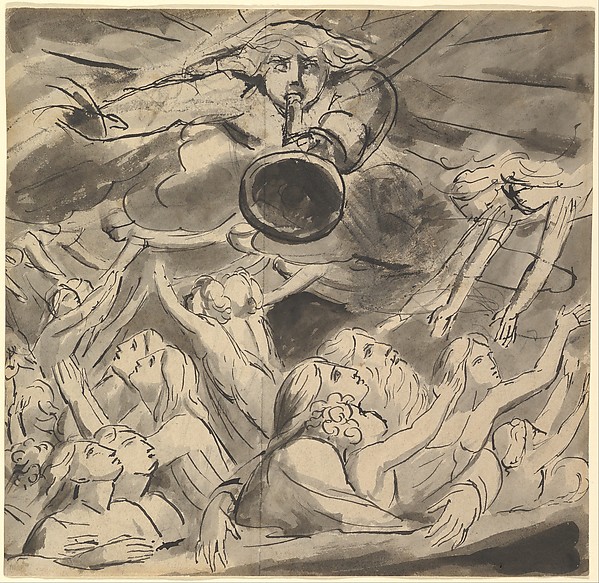
Metropolitan Museum
    Last Trumpet
"resurrection of believing souls at the last day"

You have been a mental traveller if you have followed the phases of development in The Mental Traveller. You have seen growth and decline, cyclical patterns, increase and decrease. You may have felt hope and futility. Blake put these things in his poem for you to find. You have been given a chance to think about what is permanent and what is transitory. You may have asked if we have the power to interrupt patterns which are fed by invisible forces. The poem is yours to claim as your own and respond to out of your own identity.


Letters, to Revd Dr Trusler, (E 702)
"The wisest of the Ancients considerd what is not too Explicit as the fittest for Instruction because it rouzes the faculties to act."


From Blake and the Bible:
Biblical Exegesis in the Work of William Blake, by Christopher Rowland:
"Blake wishes to do all he can to resist the idea that there is an authoritative interpretation offered by authoritative interpreters. His texts are there for all to use and for the stimulation of the imagination."


Friday, September 24, 2010

MENTAL TRAVELLER 25-26

The Mental Traveller

25)
"For who dare touch the frowning form
His arm is withered to its root,
Lions, boars, wolves, all howling flee
And every tree does shed its fruit;"


Perhaps Blake had touched the frowning form often enough to know the suffering it brought him. All the evidence from the Old Testament indicates that a respectful distance should be maintained from divine manifestations. Even looking upon the pagan gods and goddesses often had dire consequences. The woman with the issue of blood didn't touch Jesus; she touched the hem of his garment. Some things are too hot to handle.

Four Zoas, Page 113 [109], (E 384)
"Behold the time approaches fast that thou shalt be as a thing
Forgotten when one speaks of thee he will not be believd
When the man gently fades away in his immortality
When the mortal disappears in improved knowledge cast away
The former things so shall the Mortal gently fade away
And so become invisible to those who still remain
Listen I will tell thee what is done in the caverns of the grave"

Raine refers us of "King Jeroboam, whose arm was paralyzed when he attempted to seize a man of God who prophesied the birth of a new king who would pull down the old alters." She also says: "for Blake suggested that event [the last Judgment] in an image from the Book of Revelations which tells how at the end the stars will fall from heaven 'even as a fig tree casteth her untimely figs.'"

Revelations 6:12,13
"And I beheld when he had opened the sixth seal, and, lo, there was a great earthquake; and the sun became black as sackcloth of hair, and the moon became as blood;
And the stars of heaven fell unto the earth, even as a fig tree casteth her untimely figs, when she is shaken of a mighty wind."

Back in verse 21 we read:
"With labyrinths of wayward love,
Where roams the lion, wolf and boar,"
When these wild creatures flee, the world of generation is ending.

26)
"And none can touch that frowning form,
Except it be a woman old;
She nails him down upon the rock,
And all is done as I have told."


The babe, the energy from outside of the system, too unknown and unpredictable to be readily tamed, falls into the hands of the aged, decadent materialism which knows the techniques for defusing explosive situations. But her technique, repression, is a temporary measure which begins the cycle again.

This passage from Percival explains why nailing the babe down on the rock initiates the repetition of the cycle.

Percival, William Blake's Circle of Destiny:
"Under the ethics of freedom and forgiveness, such as Blake believed had once obtained, the emotions corrected their excesses and mistakes in a natural and healthy way. But with the failure of love and forgiveness, and the consequent emergence of good and evil, the emotional life is divided against itself. The portion considered evil undergoes repression, but reappears as the demon Orc, the anarchist, the antichrist. The creative principle also shares in the general degradation. For the fires of the imagination require the fuel of experience - sense experience, emotional experience, and intellectual experience. When a portion of this sustenance is denied, the imagination to that extent is impoverished. The fourth principle, the body, also suffers from Urizen's condemnation of desire. For the struggle of good and evil within the mind results in warfare of body and soul. In this warfare the body suffers under metaphysical contempt and physical asceticism. Thus the attempt to suppress desire breeds more evil than it cures. It is, in fact, a phase of the original sin itself." (page 284)

Blake didn't believe that the cycle must endlessly repeat. He wanted to break the cycle by altering the parameters. His vision is an echo of Jesus' vision in its pristine, unadulterated form.

Here is more from Percival:
"To an age in which the older conceptions of God are becoming increasingly difficult to entertain, but in which the need for God is as great as ever, Blake offers a conception which is beyond the reach of science to destroy. This God is simply the Christ within the human breast. He is not a God afar off, remote and inaccessible; nor is he a pale abstraction offering little help or solace to human needs. He is alive and human within the breast, intimately and convincingly there. He is the vision, the imagination, the capacity to think nobly of oneself and one's fellow men, the capacity to forgive their mistakes and weaknesses, the determination, in spite of all, to build the New Jerusalem." (page 285)

As he ends this poem Blake makes again the plea that we, his readers, continue where he left off. In the last verse he takes us back to the beginning of the poem where we can start again with the same script or we can rewrite the script. But it is not the poem we are writing, it is the next chapter in the history of mankind. I wondered why he wrote 26 verses to Mental Traveller when 27 is the magic number. Then I realized that we are the Twenty-seventh Church. We are to decide if we start again with Adam or take a different path.
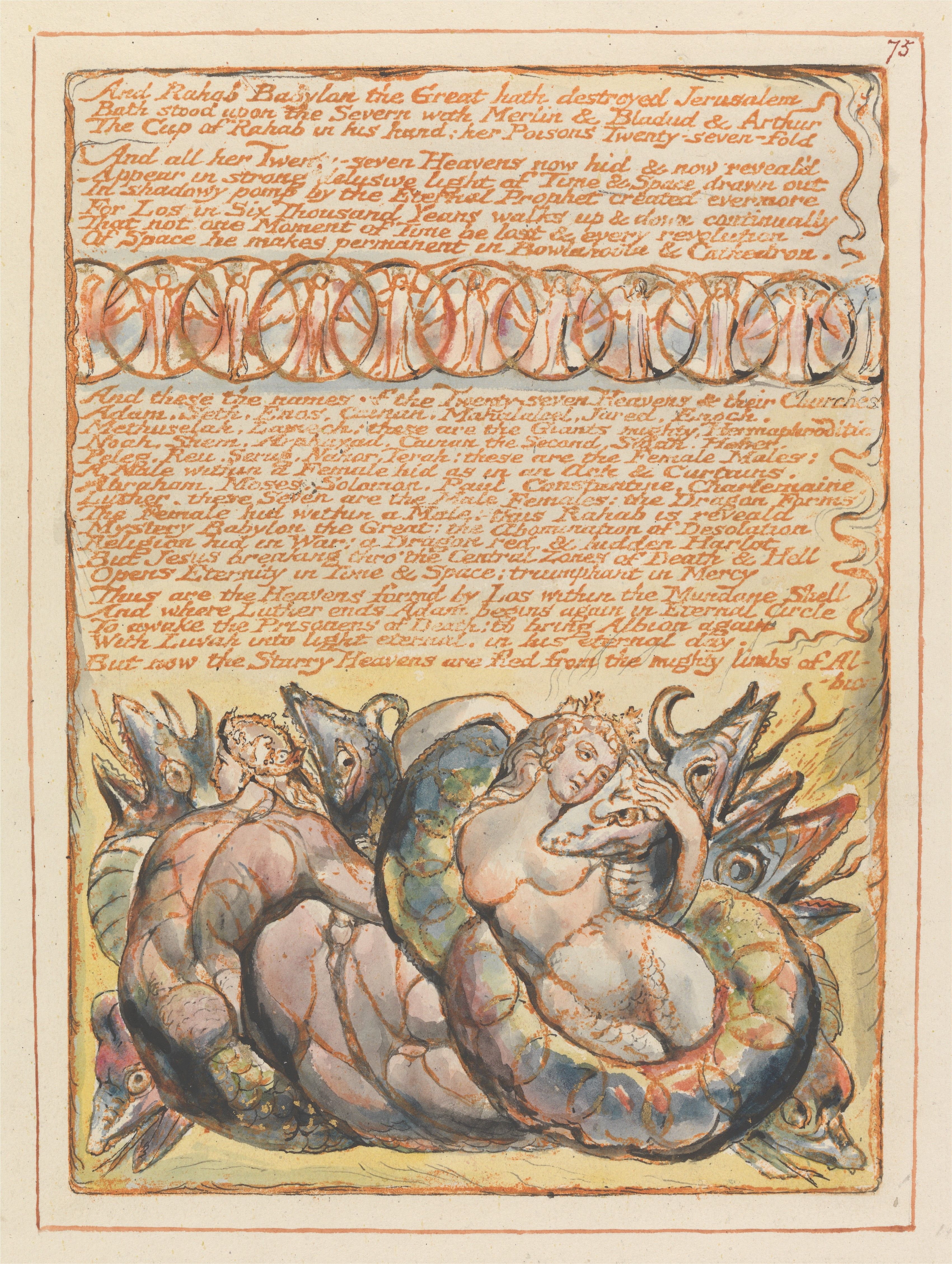
Yale Center for British Art
Jerusalem 
Plate 75
Jerusalem, Plate 75, (E 231)
"Thus are the Heavens formd by Los within the Mundane Shell
And where Luther ends Adam begins again in Eternal Circle
To awake the Prisoners of Death; to bring Albion again
With Luvah into light eternal, in his eternal day.
"


Jerusalem, Plate 23, (E 168)
"Jerusalem then stretchd her hand toward the Moon & spoke

Why should Punishment Weave the Veil with Iron Wheels of War
When Forgiveness might it Weave with Wings of Cherubim" 

Wednesday, September 22, 2010

MENTAL TRAVELLER 22-24

The Mental Traveller

In the last Mental Traveller post, we left our masculine and feminine figures as a couple caught in dissension, but in verse 22 we find her aged into an old woman and him 'reverse aged' into a babe. This is the fourth influx of energy into the poem - the male babe (born in joy), the youth released from manacles, the female babe (who sprang from the fire), and now the 'wayward babe'. Unexpected bursts of energy from new paradigms of thought appear when old organizations are spent and have reached their limits of usefulness. In the furnaces of Los, thought forms which have been shown to be in error are subjected to the cleansing fire in order to become part of the purified whole. This releases the energy, which changes the direction of the action.

22)
"Till he becomes a wayward babe
And she a weeping woman old.
Then many a lover wanders here,
The sun and stars are nearer rolled,"

Blake Archive
Book of Urizen
Copy G, Plate 2

The pendulums have swung to the extreme, and movements are reversed.

This is a period of calm, the babe (potential for burst of energy), though wayward is not strong enough (or ready) to wreck havoc. The 'weeping woman old' is still his companion but reminds us of the hopeless, lamenting Enion. Imagination exists here but in a disorganized, aimless fashion. The movement, however, is toward the Eternal rather than away from it.

The strength of the new system is exposing the weakness (error) of the old. Jesus, by allowing the religious and political systems to perform their functions is revealing their powerlessness in the spiritual realm. He is exposing their error that it may be annihilated.

Milton Percival in William Blake's Circle of Destiny gives us this insight: "But, though the rational mind fears the fiery form of Orc, the imaginative mind knows that it is not evil, but rather an indictment of evil, a revelation of the mistaken character of the authority which has brought it into being. Orc is the personification of a deathless phenomenon, the spirit of revolution that arises when energy is repressed."

Milton, Plate 29 [31], (E 127)
"And Satan is the Spectre of Orc & Orc is the generate Luvah"

23)
"The trees bring forth sweet ecstasy
To all who in the desert roam,
Till many a city there is built,
And many a pleasant shepherd’s home."

This verse is presented from the viewpoint of Eternity. Progress is being made, eternal values (human) are returning. Golgonooza is taking form with its sweet and pleasant delights of love and brotherhood, and imagination and productivity.

Jesus has made progress in fulfilling his earthly role. He has drawn together a brotherhood which has an inkling of what has been going on. He has woken sleepers to an alternative consciousness. He has exposed the barrenness of the desert landscape. He has planted the seeds of hope in the hearts and minds of common folk.

24)
"But when they find the frowning babe
Terror strikes through the region wide;
They cry, ‘The Babe! the Babe is born!’
And flee away on every side."


If the last verse was from the perspective of Eternity, this one is from the perspective of Ulro. The changes which are appearing are to be feared, not embraced. Why should the babe strike terror? Because he announces the sweeping away of the society which has benefited those in power, and has been accepted as the 'best we can expect' by the hoi polloi.

Matthew 3:12
"Whose fan is in his hand, and he will throughly purge his floor, and gather his wheat into the garner; but he will burn up the chaff with unquenchable fire."

Marriage of Heaven and Hell, Plate 25,26,27 (E 45)
A Song of Liberty
"7. In her trembling hands she took the new, born terror howling;
8. On those infinite mountains of light now barr'd out by the
atlantic sea, the new born fire stood before the starry king!
9. Flag'd with grey brow'd snows and thunderous visages the
jealous wings wav'd over the deep.
10. The speary hand burned aloft, unbuckled was the shield,
forth went the hand of jealousy among the flaming hair, and
hurl'd the new born wonder thro' the starry night".

The fear of change - especially the reordering of the status quo - is present at every level of experience: psychological, political, social, personal status, economic, spiritual or even geographic location. Not to say that fear is the only reaction to change, but to the wanderer who is roaming without the protection of a home of his own, the sudden appearance of a packet of energy like a whirlwind, volcano or earthquake is likely to provoke terror.

The terror is followed by the spreading of alarm to inflame the mob into an irrational fleeing from what may be opportunity and not threat.

Birth is symbolic of the most traumatic of changes. In birth the new has been introduced and separated from the milieu which produced it. Furthermore birth is only a beginning, the babe will grow as it unfolds a life of its own. Should Herod have feared the babe in the manger? He knew he should and he reacted in the way the world reacts to that which could destroy it. Our own culture is constantly finding babes and reacting in alarm to what they represent.

The man's reverse aging (growing younger) resulted in the fourth outbreak of energy. This time we see a broader reaction to it. Eternity rejoices in renewed productive imagination. The system which is in power reacts in fear and retrenchment.


Monday, September 20, 2010

MENTAL TRAVELLER 19-21

The Mental Traveller

Yale Center for British Art
Book of Urizen
Copy C, Plate 17
19)
"For as he eats and drinks he grows
Younger and younger every day;

And on the desert wild they both
Wander in terror and dismay."

This a state of equilibrium when the contraries are equally powerful. Neither party can gain control, so they contend in a fruitless struggle that produces nothing but fear and failure and apprehension. But it is he who has the potential for gaining the upper hand because he eats and drinks and grows as he progresses from age to youth.

If we want to follow the life of Jesus through this period in the poem, we go from his struggle in the Garden of Gethsemane to the events of the passion. The system in which Jesus lived would furnish the dynamics through which he must pass to be reborn as the resurrected Christ.

Matthew, 17th Chapter

Four Zoas, Page 34, (E 324)
"Now my left hand I stretch to earth beneath
And strike the terrible string
I wake sweet joy in dens of sorrow & I plant a smile
In forests of affliction
And wake the bubbling springs of life in regions of dark death"

20)
"Like the wild stag she flees away;
Her fear plants many a thicket wild,
While he pursues her night and day,
By various arts of love beguiled."

Materiality is on the decline and so feels threatened by the younger, stronger spirituality. She uses her powers of deceit, jealousy, pretense, shifting appearances and false promises to keep him in pursuit of the very thing which can destroy him.

It is not in these lines alone that Blake reveals the man's dilemma, but in the tales of Enitharmon, Enion, Ahania, and Vala.

Even in the time of Jesus the institutions of religion were permeated by material interests. Perhaps Jesus would have preferred to reform the institutions instead of replacing them; he certainly attempted other methods before he resorted to direct confrontation.

Four Zoas, Page 34, (E 324)
"The joy of woman is the Death of her most best beloved
Who dies for Love of her
In torments of fierce jealousy & pangs of adoration.
The Lovers night bears on my song
And the nine Spheres rejoice beneath my powerful controll"

21)
"By various arts of love and hate,
Till the wide desert planted o’er

With labyrinths of wayward love,
Where roams the lion, wolf and boar,"


A principle theme in Blake's poetry is that of 'female love'. This is a sick expression of love in which the female seeks to dominate the male. Blake uses this syndrome to talk about the unhealthy relationship between reason and emotion, between spirit and matter and between the inner and the outer. If there were not a conflict between men and women, their relationship would not work as a metaphor for other conflict. By exposing the manipulation, jealousy, vengeance, and alienation in sexual relationships, Blake symbolizes a range of dysfunctional pairings. This section of The Mental Traveller is central to the poem because this issue is central to Blake's system of thought.

Milton O. Percival speaks of Blake's sexual symbolism in this way: "In its widest sense, then, Blake's sexual symbolism sets forth the whole problem of duality. Like the Spectre and the Emanation, whose relationship it portrays, it applies to a duality in both the physical and ethical worlds. The struggle of spirit and matter, of good and evil, of mind and emotion, are all set forth in sexual terms. In a narrower range the symbolism stresses the ethical struggle, because without a fall, the spirit would never have warred with the flesh, the inner and outer worlds would have remained at peace." (William Blake's Circle of Destiny, page 109)

There is great economy of words in these four line of verse 21 but Blake implies much more: 

"By various arts of love and hate."
Songs 32, The CLOD & the PEBBLE, (E 19)
"Love seeketh only Self to please,
To bind another to Its delight:
Joys in anothers loss of ease,
And builds a Hell in Heavens despite."

"Till the wide desert planted o’er"
Four Zoas, Page 35, (E 325)
"I have planted a false oath in the earth, it has brought forth a poison tree
I have chosen the serpent for a councellor & the dog
For a schoolmaster to my children
I have blotted out from light & living the dove & nightingale"

"With labyrinths of wayward love,"
Four Zoas, Page 4, (E 301)
"Lost! Lost! Lost! are my Emanations Enion O Enion
We are become a Victim to the Living We hide in secret
I have hidden Jerusalem in Silent Contrition O Pity Me
I will build thee a Labyrinth also O pity me O Enion"

"Where roams the lion, wolf and boar,"
The Marrriage of Heaven and Hell, Plate 2, (E 30)
"Till the villain left the paths of ease,
To walk in perilous paths, and drive
The just man into barren climes.

Now the sneaking serpent walks
In mild humility.
And the just man rages in the wilds
Where lions roam.
"

These verses 19-21, find the masculine and the feminine in an unproductive struggle in which they tear one another down rather than building one another up. In creating a breach between themselves, they drive both toward the brink of mutual destruction in the abyss of non-entity.


Saturday, September 18, 2010

MENTAL TRAVELLER 16-18

The Mental Traveller

16)
"The guests are scattered through the land
(For the eye altering, alters all);
The senses roll themselves in fear,
And the flat earth becomes a ball,"

The materialistic perspective which took over the psyche in the last verse, changes the appearance of everything. Eternity is forgotten. The surroundings become unfamiliar. The diminished senses are contracted leading to diminished faith and a decreased sense of security in a known world.

His dwelling place has moved, the world is less friendly.

Milton, Plate 29 [31], (E 127)
"The Sky is an immortal tent built by the Sons of Los
And every Space that a Man views around his dwelling-place:
Standing on his own roof, or in his garden on a mount
Of twenty-five cubits in height, such space is his Universe;
And on its verge the Sun rises & sets. the Clouds bow
To meet the flat Earth & the Sea in such an orderd Space:
The Starry heavens reach no further but here bend and set
On all sides & the two Poles turn on their valves of gold:
And if he move his dwelling-place, his heavens also move.
Wher'eer he goes & all his neighbourhood bewail his loss:
Such are the Spaces called Earth & such its dimension:
As to that false appearance which appears to the reasoner,
As of a Globe rolling thro Voidness, it is a delusion of Ulro"

17)
"The stars, sun, moon, all shrink away—
A desert vast without a bound,
And nothing left to eat or drink
And a dark desert all around."

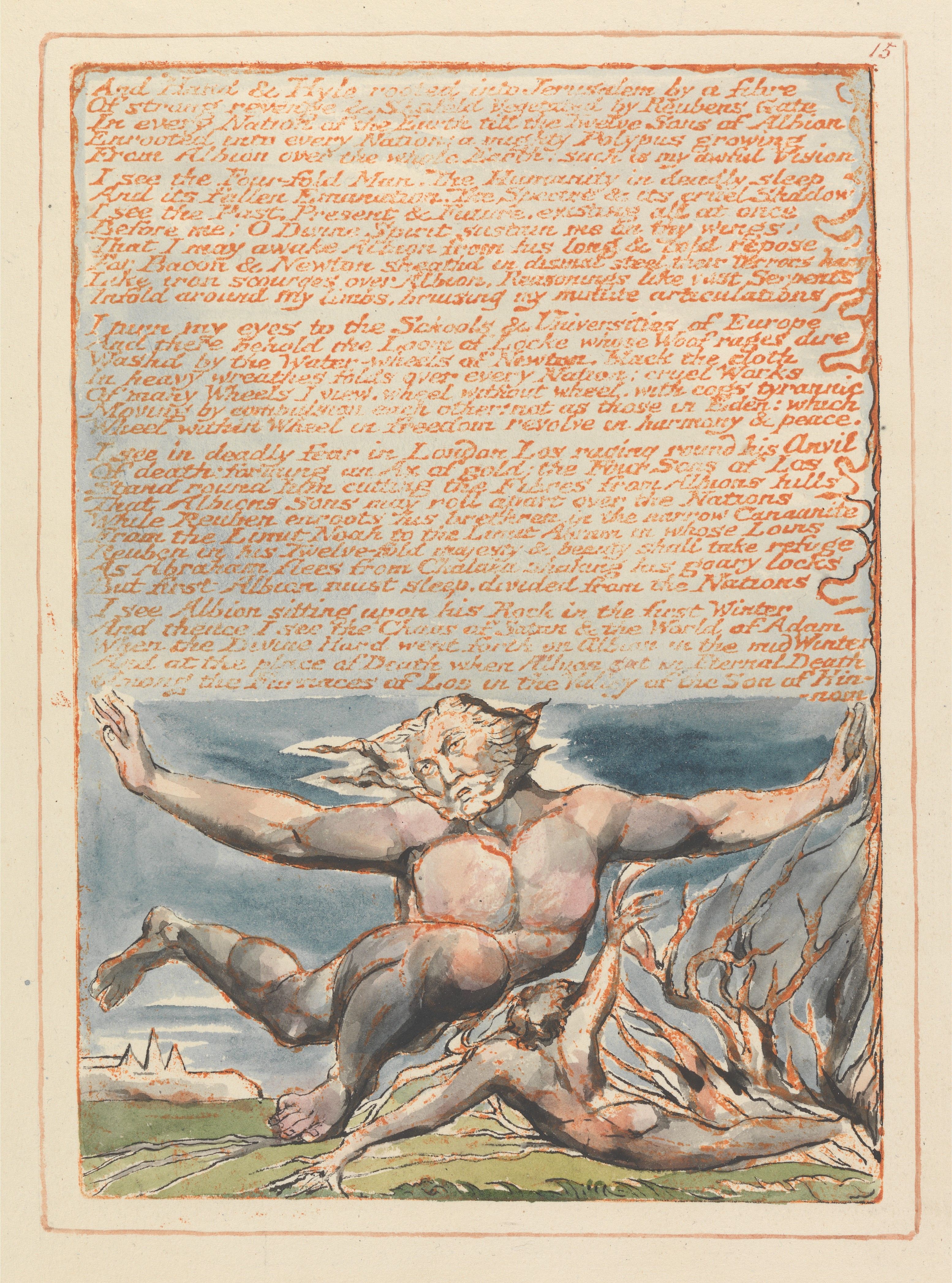
Yale Center for British Art
Jerusalem

Plate 15
This sounds something like sinking into psychosis where all reference points are lost and the psyche becomes disconnected from any meaningful exterior activity or reality. This sounds like Urlo.

stars = reason
sun = intuition, imagination
moon = emotion, love
desert = vacant, infertile
dark = enclosed, isolated
nothing to eat or drink = hunger and thirst, famine


If this verse were talking about Jesus, he would be in the Garden of Gethsemane. (Verse 36 and following.)


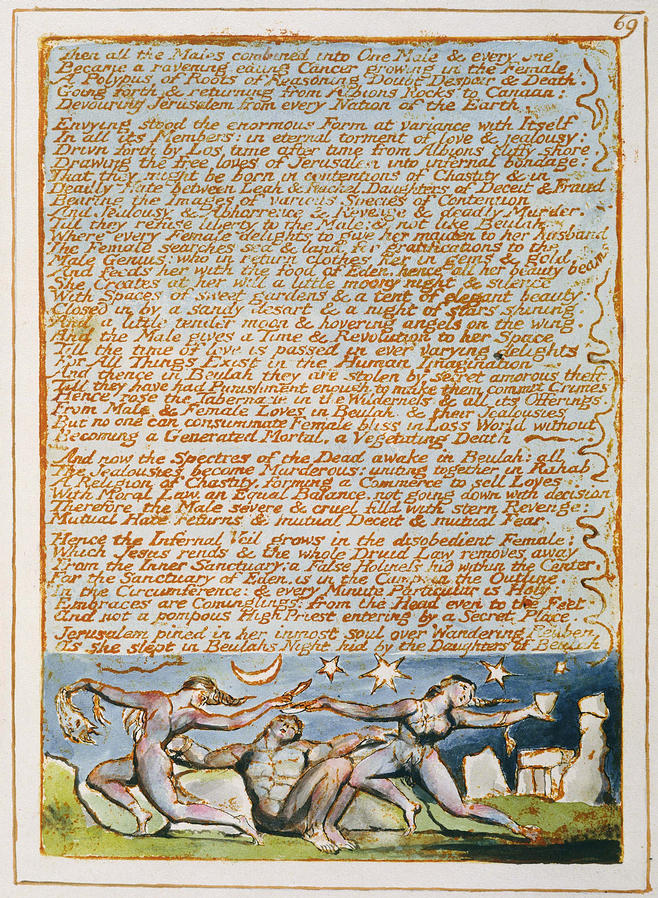
Jerusalem, Plate 69, (E 223)
"Then all the Males combined into One Male & every one
Became a ravening eating Cancer growing in the Female
A Polypus of Roots of Reasoning Doubt Despair & Death.
Going forth & returning from Albions Rocks to Canaan:
Devouring Jerusalem from every Nation of the Earth."

18)
"The honey of her infant lips,
The bread and wine of her sweet smile,
The wild game of her roving eye
Does him to infancy beguile."


We 'bottomed out' in the last passage. Now the direction will change. The male begins to feed on what the female has to offer. Honey, bread, wine and wild game provide a varied diet. He is still the old man so the direction of his growth is toward youth. When the female (material) was old, she fed on the male (spiritual), now the situation is reversed and she feeds him.

It makes me think of 'Teach Your Children Well'.

A tricky aspect of this poem is the reversal process. If the woman or man is old she/he is growing younger. We saw this in Verse 6 where the babe had become a youth and the old woman had become a virgin. We see it again in this verse; the old man is led into becoming young by the 'her infant lips.' This imagery works best if it is applied to civilizations as having material and spiritual dimensions which are a pendulum swinging in opposite directions. Each goes to the extreme of youth (minimum) and age (maximum) and returns to the midpoint where material and spiritual are equal.

These three verses are the bottom of the cycle for the male (spiritual); he has gone to the extreme of age and the pendulum has reversed its swing. In Verse 16 things are still falling apart; in Verse 17 nothing is left; in Verse 18 movement begins in the opposite direction.

Here are two movies which deal with the repetition or reversal of time:
Groundhog Day, and The Curious Case of Benjamin Button.


Thursday, September 16, 2010

MENTAL TRAVELLER 13-15


The Mental Traveller

13)
"But she comes to the man she loves,
If young or old, or rich or poor;
They soon drive out the aged host,
A beggar at another’s door."

This young lady will not remain on her own; neither will she put her fate in someone else's hands. The fiery life which is within her will be bestowed upon the male of her choice. The host who made possible her explosion into life must go elsewhere to seek a companion.

A gift of great importance from the feminine to the masculine is providing matter so that the intellect may be materialized in creative endeavor. The female reserves the right of refusal in bestowing the body through which mind may be expressed. Love determines the choice, not outer characteristics such as wealth or age.

Time and space (the measure of matter) are the father and mother of change. Change replaces the old with the new; they cannot coexist. Although the man who fed the beggar becomes a beggar himself, he can seek sustenance elsewhere.

14)
"He wanders weeping far away
Until some other take him in;
Oft blind and age-bent, sore distressed,
Until he can a maiden win."

We return to the wandering metaphor which was introduced in the first verse with, " As cold earth wanderers never knew."

The wandering, weeping and distance are part of the aging syndrome - loss of purpose, sadness and disconnection. If this aged entity is a civilization (as Raine indicates he may be) he may hope to be incorporated into a newborn or a younger civilization which may find the remnants of the depleted civilization of value. How many times has the mature Greek culture been 'taken in' by a culture in its formative stage?

If he is a mature psyche, the products of his experience may be passed on the innocents who are beginning the process of development.

Oedipus, with his daughter Antigone, wandered in his aged blindness seeking to pass on the lessons of his bitter experience. Edward Edinger has this to say about the aged Oedipus, "After his long wanderings, Oedipus came at last to a sacred spot close to Athens. He was now a sage and holy man, a precious sacred entity....The life of Oedipus, as it is revealed in these two plays, parallels the alchemical process. Like the prima materia with which the alchemists began their work. Oedipus is subjected to fiery ordeals and sufferings until he is transformed into a holy object that benefits all who touch him. Here is the theophany which redeems the suffering of the first play."

Oedipus at Colonus (written when Sophocles was 90)
Translated by C. John Holcombe, page 41

15)
"And to allay his freezing age
The poor man takes her in his arms:
The cottage fades before his sight,
The garden and its lovely charms;"

The depleted spirituality has reached the point at which it is solidified into ritualistic, formalistic and legalistic behavior. Blake uses rigidity in relationship to Urizen's mind, which is also ritualistic and legalistic. The man resorts to embracing materialism. He had maintained his own separate identity until he 'embraced' the maiden whom Blake uses to symbolize materiality. This is the cause of his losing sight of eternity.

With this his intellect (cottage) and emotion (garden) lose their vitality and are withdrawn from his sight (perception.) The cottage in which we all tend to dwell is the intellect - our minds; sensation provides us with raw unprocessed data. Sense based, literalistic thinking is the residue with which the man is now left.

Contemplation, (E 442)
"I answered, 'Heavenly
goddess! I am wrapped in mortality, my flesh is a prison, my
bones the bars of death, Misery builds over our cottage roofs,
and Discontent runs like a brook.'"

We soon leave the young lady who arrived with such fanfare as we go back to following the man who had grown old and been pushed out of his home. Spirituality which had aged and become depleted has been pushed from its position of respect and value. A new movement focused on mastering the workings of matter has entered.

Tuesday, September 14, 2010

MENTAL TRAVELLER 10-12

The Mental Traveller

This poem is from the Pickering Manuscript and probably dates from 1801-1804.

There are four previous posts on The Mental Traveller.

10)
"They are his meat, they are his drink:
He feeds the beggar and the poor
And the wayfaring traveller;
For ever open is his door."

Letter 12, (E 709)
"To my dear Friend Mrs Anna Flaxman
...The Bread of sweet Thought & the Wine of Delight
Feeds the Village of Felpham by day & by night
And at his own door the blessd Hermit does stand
Dispensing Unceasing to all the whole Land"
W. BLAKE

It is better to give than to receive. Even in old age the gathered riches can feed those who are less rich. But notice that the 'traveller' comes to the open door also. Who is this traveller? He is the man who is pursuing his own spiritual development, who has started out on the journey with the intention of seeking truth or wisdom or virtue, or vision, or consciousness. He is anxious to find the wisdom of the sage whose own life is fading.

Because the old man is giving, his strength is not depleted but renewed.

Yale Center for British Art
Book of Urizen
Plate 19, Copy C
11)
"His grief is their eternal joy,
They make the roofs and walls to ring—
Till from the fire on the hearth
A little female babe does spring!"


We started with the woman old but we didn't follow her beyond the point where the boy reached maturity. Now we have the reappearance of the female in the form of a babe. Her arrival is in the midst of joy in Eternity and joy within. She explodes like a phoenix from the fire.

The male babe was born in joy; this female child springs onto the scene unconnected to any parents. In Blake's mythology the emanations are not born but they separate from their male counterparts. Like many Greek gods and goddesses the female babe arrives on the scene in an unorthodox way. This is a reminder that what the poem speaks of are mental events (not of this world) whether on the psychological, spiritual or historical level. The meaning has to be uncovered; it will not be found on the surface.

The appearance of the female babe is a point of crisis: threat or opportunity. Will she become Vala or Jerusalem?

A way to put a positive spin on this verse is as follows:
His grief is suffering which he willingly endures for the sake of others. Their eternal joy is what they experience as they apply his teaching and benefit eternally. The enclosing structure is filled with music and laughter. Conditions are met for a further stage of development. The babe that is produced from the fire (the way forward), is unlike the man in whose home she is produced.

12)
"And she is all of solid fire
And gems and gold, that none his hand
Dares stretch to touch her baby form,
Or wrap her in his swaddling-band."

The image of the solid fire brings to my mind the hot coals in a fire or a furnace. Within the coals is stored heat of combustion which will be radiated as cooling takes place. George McDonald (The Princess and Curdie and The Princess and the Goblin ) had a character who was asked to place his hands in such a bed of glowing embers and who received gifts by doing so.

But none will dare to reach out and touch this child or wrap her as the Christ child was wrapped. This development in the psyche will not be easy to assimilate. In Gates of Paradise, the process of spiritual development is begun by the infant who is wrapped in the swaddling-bands of a chrysalis.

There are at least two words in this verse which suggest the material nature of this babe: 'solid' and 'form'. This verse could represent either the separation into spirit and substance, or the possibility of the integration of the two into one.

Milton Percival in his Circle of Destiny quoted Franz Hartman as follows (p. 91): "Woman as such represents the will (including love and desire), and man as such represents intellect (including the imagination). Woman represents substance; man represents spirit. Man imagines; woman executes. Man creates images; woman renders them substantial."

The rational processing of man (Urizen) and the body (Tharmas) which is the vehicle for expression, are in constant tension. Tharmas may be something of a gatekeeper for allowing ideas to become materialized.

A period of calm, of integration, of assimilation has been interrupted by the unexpected appearance of new entity rising from the flames of energy, desire and illumination. There was a release of energy in the birth of the babe; another in the unbinding of the youth; and a third here in the springing forth of this glowing golden feminine form.

Sunday, September 12, 2010

MENTAL TRAVELLER 7-9

The Mental Traveller

7)
"He plants himself in all her nerves
Just as a husbandman his mould,
And she bcomes his dwelling-place

And garden, frutiful seventyfold."


Note: judging from the context, 'mould' is the rich, loose workable soil which farmers are fond of.

Much to the surprise of the old woman (parhaps Vala), the boy (perhaps now Los) is able to use what she has unintentionally provided to him. His delight is to create a productive garden in which he can multiply the seed which he has received in order to produce a harvest of abundant fruit.

The boy is not separate from the medium through which he gains expression; he dwells in it as it dwells in him.

Annotations to Lavater,
(E 599)
"Whoso dwelleth in love dwelleth in God &
God in him. & such an one cannot judge of any but in love."

John 6: 56 "He that eateth my flesh, and drinketh my blood, dwelleth in me, and I in him."

Going back to the civilization metaphor, the young spiritual ideas can feed on the substance which has been produced by the older weakening material civilization. Think of the houses we live in, the buildings we occupy, the roads we drive on, the books we read as being a legacy from the civilization which may be replaced by a more vigorous one.

The phrase, "
plants himself in all her nerves", if a metaphor for an event in a culture, may be seen as merely descriptive or as something more sinister. The culture which is being invaded by alien ideas is likely to see it as 'wrong'. Western and Muslim cultures are presently struggling against invasions from the ideas of the contrary culture and neither likes it.

8)
"An aged shadow soon he fades,
Wandering round an earthly cot,
Full filled all with gems and gold
Which he by industry had got."


Our male child has grown through adolescence, and maturity and reached old age. He passed his zenith and is now on the decline. But his garden was planted and his crop harvested. His expansive purposeful traveling is now reduced to wandering and resting. But he is not destitute; his efforts have produced the things he values.

As the spiritual side of a civilization matures it produces arts and ideas. The cultural treasures accumulate. Think of the accumulation of treasures from the burst of intellectual and imaginative thought of Athens; or think of the manuscripts and music produced in the monasteries of the middle ages. These are the 'gems and gold' of the spirit.

Jerusalem, Plate 12, (E 154)
"What are those golden builders doing?...
Becoming a building of pity and compassion? Lo!
The stones are pity, and the bricks, well wrought affections:
Enameld with love & kindness, & the tiles engraven gold
Labour of merciful hands: the beams & rafters are forgiveness:
The mortar & cement of the work, tears of honesty: the nails,
And the screws & iron braces, are well wrought blandishments,
And well contrived words, firm fixing, never forgotten,
Always comforting the remembrance: the floors, humility,
The cielings, devotion: the hearths, thanksgiving:
Prepare the furniture O Lambeth in thy pitying looms!
The curtains, woven tears & sighs, wrought into lovely forms
For comfort. there the secret furniture of Jerusalems chamber
Is wrought: Lambeth! the Bride the Lambs Wife loveth thee:
Thou art one with her & knowest not of self in thy supreme joy.
Go on, builders in hope: tho Jerusalem wanders far away,
Without the gate of Los: among the dark Satanic wheels."


The Christ Child Riding on a Lamb
9)
"And these are the gems of the human soul:
The rubies and pearls of a lovesick eye,
The countless gold of an aching heart,
The martyr’s groan, and the lover’s sigh."


The gold and gems of the human soul are not acquired through power and success but through understanding, suffering, sacrifice and love. These are the lasting things of which Jesus spoke and of which Paul spoke in Corinthians and Philippians. 

Matthew 6:

19 "Lay not up for yourselves treasures upon earth, where moth and rust doth corrupt, and where thieves break through and steal
20 But lay up for yourselves treasures in heaven, where neither moth nor rust doth corrupt, and where thieves do not break through nor steal:"

1 Corinthians 13:

13 "And now abideth faith, hope, charity, these three; but the greatest of these is charity."

Philippians 4:

8 "Finally, brethren, whatsoever things are true, whatsoever things are honest, whatsoever things are just, whatsoever things are pure, whatsoever things are lovely, whatsoever things are of good report; if there be any virtue, and if there be any praise, think on these things."

Blake presented to us the idea of building Golgonooza a safe haven from the satanic activities of the fallen world. In Golgoonooza: City of Imagination, Kathleen Raine sees Golgonooza as an attempt to make visible the archetypal city of Eternity by those who remember Eternal things. Lovers of wisdom, poets, painters, architects - those with imagination - are the agents (Los and his sons) for building Golgonooza. Within London the the spiritual Four-fold eternal city is to take form as multiple pathways or gates into Great Eternity.

Verses 7-9 epitomize the productive aspects of the spiritual culture. Cooperation with the material rather than competition with it, allowed the accumulation of spiritual treasure even though the civilization created by a burst or spiritual insight was aging.


Friday, September 10, 2010

MENTAL TRAVELLER 4-6

Text for Blake's The Mental Traveller


This post is a continuation of comments on Mental Traveller 1-3.

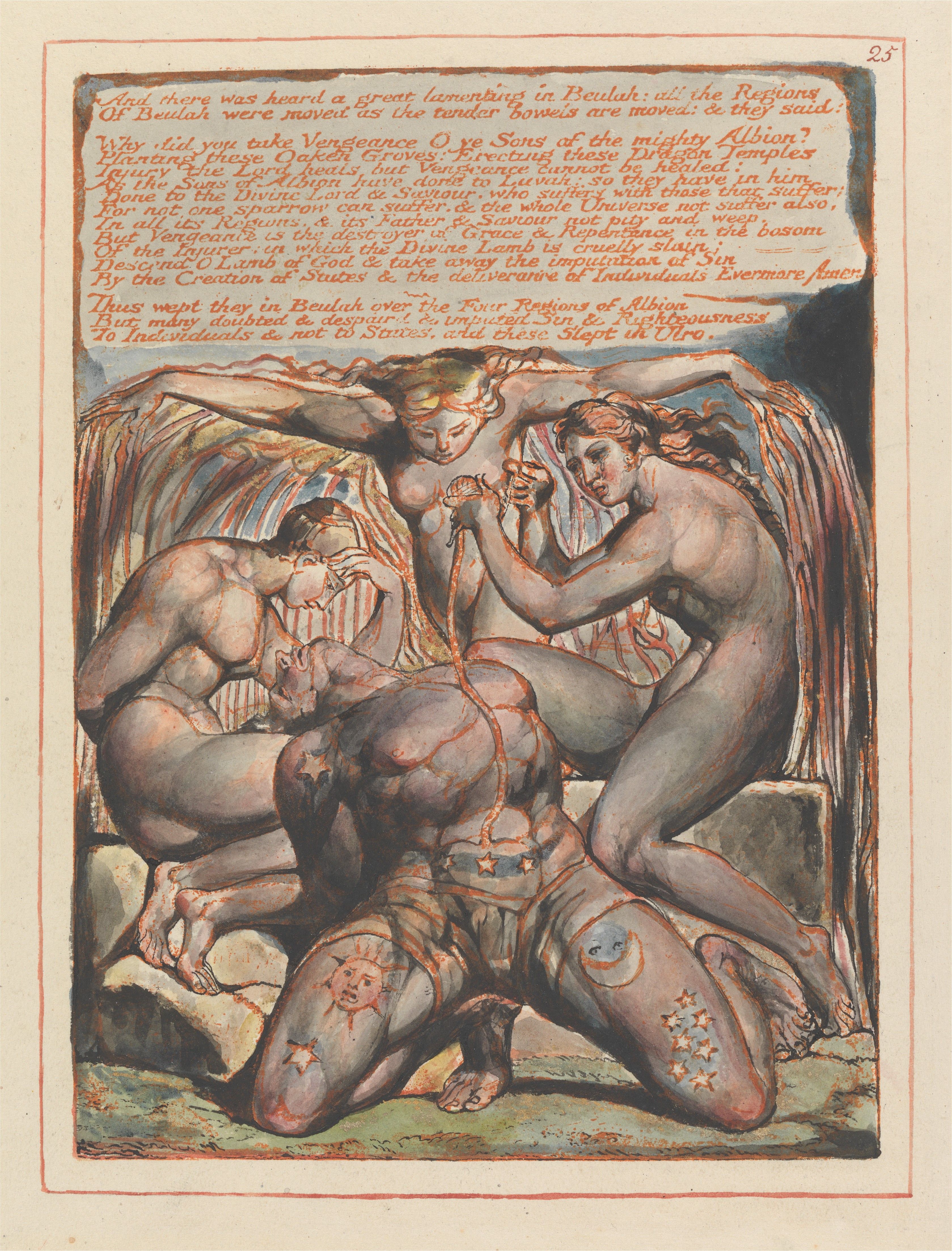
Yale Center for British Art
Jerusalem
Plate 25
4)"She binds iron thorns around his head,
And pierces both his hands and feet,
And cuts his heart out of his side
To make it feel both cold & heat."


The image Blake creates is not limited to the situation he directly describes. He insists that we think of Jesus, Albion, Orc and Prometheus as well. In Jesus we see the crucifixion, and the lamb which is sacrificed to the demanding God. In Orc we see spirit of revolution which is ready to explode into conflagration. In Prometheus we see the thief of fire who suffered for his gift to humanity.

Blake uses symbols and images to suggest more than he says in words. The words suggest crucifixion to some. The word 'binds' suggests to me the situation when Los and Enitharmon bound Orc to the rock because of Los' jealousy. It is an easy jump from Orc to Prometheus and from there to the broader story of Prometheus stealing fire, being bound to a rock, suffering from heat and cold, having his liver eaten by the eagle, and being associated with Pandora.

It is with great difficulty that the old woman who is past her time of strength and influence can subdue the vigorous boy. In her weakness she asserts all the powers she has acquired through the ages.

For a time the energies that the boy represents can be suppressed through forceful measures. As long as her strength endures, the old woman keeps each of his abilities under her control.

5)
"Her fingers number every nerve
Just as a miser counts his gold;
She lives upon his shrieks and cries—
And she grows young as he grows old,"

Recently I was reading about the Mental Traveller in Raine's Blake and Antiquity. She includes it in a section called The Myth of the Great Year. She sees an alternation between the spirit and the material as an age is born and matures and dies.

What I picked up from Raine focused on the image of spiritual development and material development as being opposed movements, each of which follows the same path as the human body from birth and infancy through maturity to aging and death. However the culture that is old in spirit is young in material and visa versa. Each aspect nourishes the other and is nourished by the other, but they compete for resources and power and for 'air time'.

In these four lines of the poem, the aging civilization (conservative and materialistic) had depleted her own sources of energy. The babe is potential energy which she aims to tap into in order to replenish her own diminished supply of ideas and initiatives. Spiritual life in its infant stage may make a lot of noise and be disturbing in its exuberance. The old culture may be able to apply this to her own ends. (She may even be able to use it to start wars, or to get the other party elected.)

The infusion of energy enhances the old organization, but it diminishes the freshness and vitality of the new.

6)
"Till he becomes a bleeding youth
And she becomes a virgin bright;
Then he rends up his manacles
And pins her down for his delight."

The bleeding could be the red of torture, of passion, of fire, of wine, of war, or of
sacrifice.

To continue the civilization metaphor a point has been reached where the old and young each have something to give and something to receive. When a balance is reached, the male representing spiritual interests asserts itself and becomes dominant. This exchange of positions is no healthier than the previous one because  the oppression and suffering which has taken place has left wounds and scars. (The child who grows up abused may not be healed by achieving his freedom.)

These three verses develop the idea of force and struggle. There is not any agreement between this male and female. Each uses whatever force is available to him/her to dominate the other. This demonstrates the paradigm that the use of force perpetuates itself and that force cannot be overcome by force. Other strategi
es can undermine the force in power.