The Two Women
When Blake began to work on his epic myth, he intended
to focus upon the wicked career of Vala, but as time went by, he
became more interested in the Zoas,
which no doubt helped to relieve the anti-feminine bent of his
metaphysics. Vala temporarily sank to the level of a minor character,
and Blake laid most
of the guilt for man's sorry state upon Urizen. The Moment of Grace
brought another significant change: Vala fumed into two
females, Rahab and Jerusalem, both of whom issue from Enitharmon.
When Blake gave Rahab the alternate name of Babylon, he came into
conformance with the basic symbology of the Bible. Throughout
the scripture we read about these two women/cities. Jerusalem is
at least potentially the city of God, while Babylon always represents
the seat of the God of this World. In his last epic Blake's
Vala has become virtually interchangeable with Babylon.
We have already noted the biblical sources of Blake's
two symbolic women in the 12th and 17th chapters of Revelation. In the first of these John sees a woman
"clothed with the sun and the moon under her feet". In the second
he described "the great whore that sitteth upon many waters".
These two women in the Bible aptly prefigure Blake's Jerusalem
and Vala, and a careful study of the two chapters will help the
reader to shape in his own mind the identity of Blake's two characters.
John and Blake both drew their paired women from earlier
sources. Frye calls them "royal metaphors" for the twin totalities of good and evil, of redemption and damnation that fill the
pages of the Bible. The Tower of Babel, the first city of sin,
led to the confusion of tongues. Following God's command Abraham,
the father of the Hebrews, left Ur, a few miles from Babylon and
eventually settled in the Promised Land. The first Captivity occurred in Egypt, which later biblical literature often treats as
synonymous with Babylon. The second Captivity took place at
Babylon. A later captivity was to Rome, which John the Apocalyptist called Babylon: in Revelation he celebrated the burning of
the Whore of Babylon.
Meanwhile Melchizidek, King of Salem and priest of the
Most High God, had blessed Abraham. Some centuries later David
established Jerusalem as his capital. The Song of Solomon is a
poem and love song about a king and his bride. This theme became
a primary symbol of the relation between Jerusalem, representing
the Chosen People, and God. The prophets constantly referred to
Jerusalem as a woman, married to God, but too often faithless,
whoring after other gods. Hosea's stories about the love of the
betrayed husband for his faithless wife, Gomer, poetically express the highest level of the Hebrew consciousness of God. On
occasion the prophets became so enraged that they identified Jerusalem with Babylon. For example John spoke of "the great city
which spiritually is called Sodom and Egypt, where also our Lord
was crucified".
This biblical background prepares us to cope with the
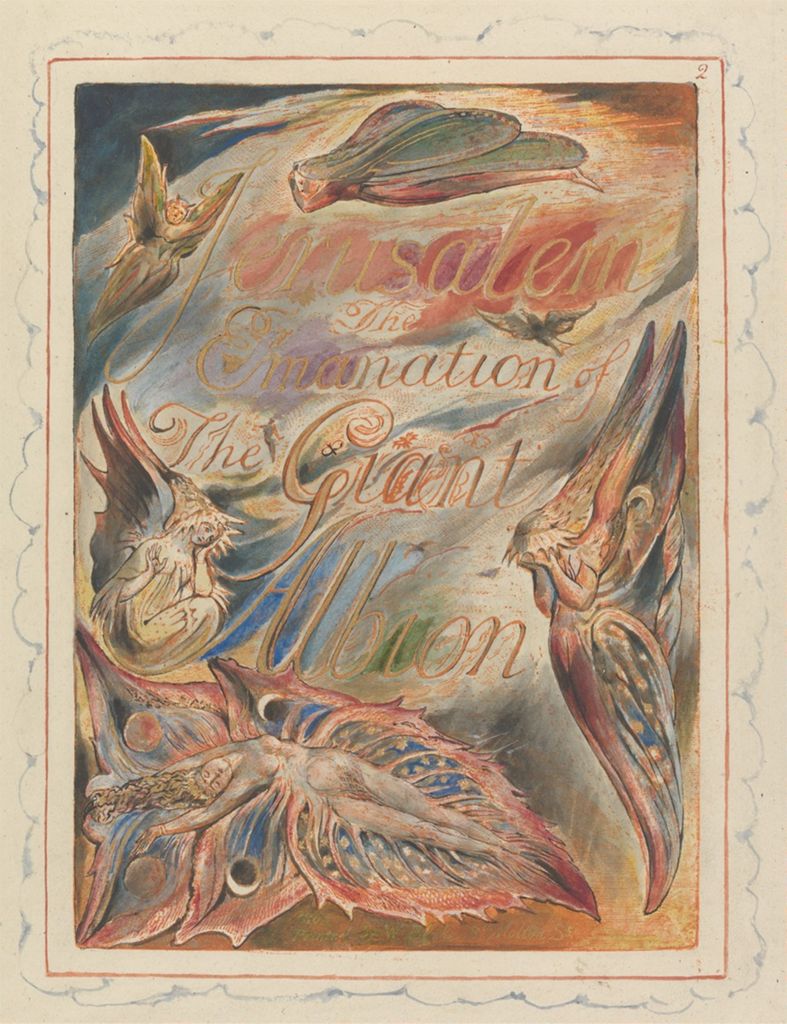
woman found in Blake's poem, Jerusalem . As we have seen, in
the poetry of the first half of Blake's life the woman is sinister.
She represents the material; the material is unworthy, reprehensible, satanic. This is the typical Gnostic position and to a
lesser extent the Neo-platonic position. Blake stated it very
explicitly and with his usual hyperbole in 'Visions of the Last Judgment' (E 565) (See also the image): "I assert for My Self that I do not behold the outward
Creation & that to me it is hindrance and not Action; it is as the
Dirt upon my feet. No part of Me."
He wrote that as late as 1810.
Nevertheless after the
Moment of Grace Blake's perspective on
matter (and Woman!) softened. At first there had been only the
sinister woman, but now the Woman of Grace appeared as well.
In the poem, Jerusalem,
we find a discourse and a conflict between these two women. Vala speaks for the kingdom of
Satan, and Jerusalem speaks for the kingdom of Heaven. Their
interaction dominates the poem and must fascinate anyone interested in
those two subjects. The epic is a straightforward conflict between light
and darkness as Blake understood those two
realities. Vala wins most of the battles, but we always know who
must win the war.
Blake describes reality imaginatively and dramatically
in terms of ultimate value; this is basically an expression of
faith. If one believes in the higher values: in spirit, in truth,
in justice and love, then one imagines these things ultimately
victorious. Blake did, and he concluded the passage from VLJ
quoted above: "What, it will be Question'd, 'When the Sun rises,
do you not see a round disk of fire somewhat like a Guinea?' 0
no, no, I see an Innumerable company of the Heavenly host crying
'Holy, holy, Holy is the Lord God Almighty.'" In Blake's final
epic Vala represents the guinea sun and Jerusalem the "innumerable company of the Heavenly host". Needless to say those who
see only the guinea sun will not be attracted to the poem.
vi
'Jerusalem'
At the very beginning of Blake's poem,
Jerusalem, he makes us
fully aware that the new woman represents something entirely
other than the disreputable matter of earlier writing. She is
just the opposite; she is Spirit or rather the manifestation of
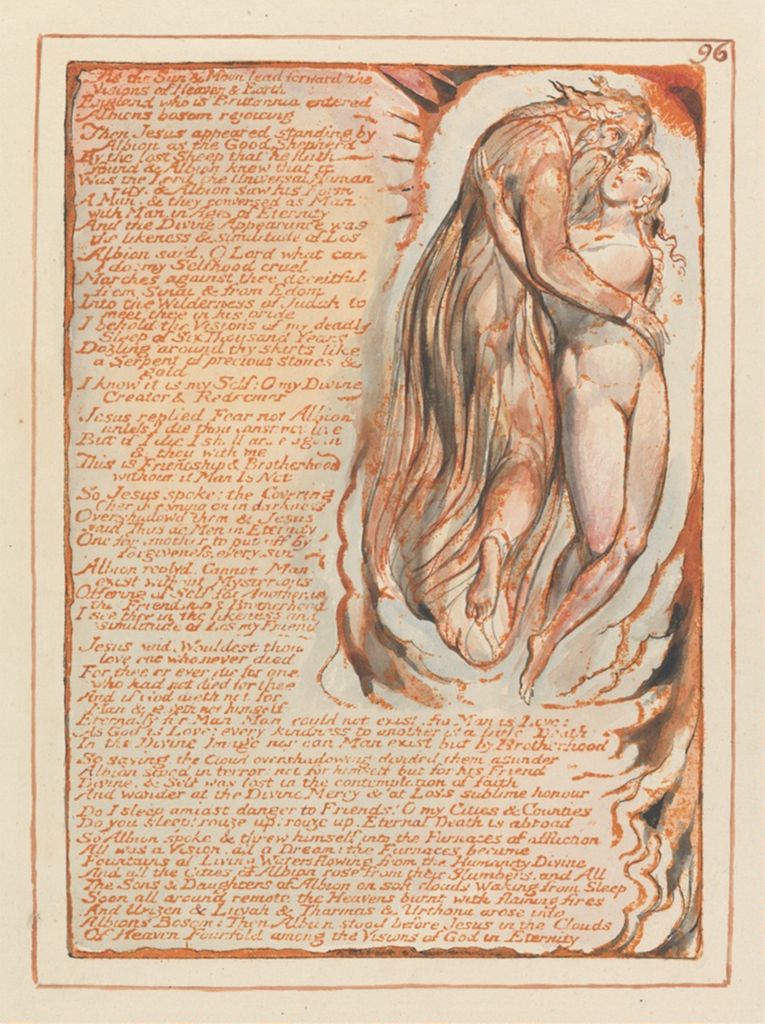
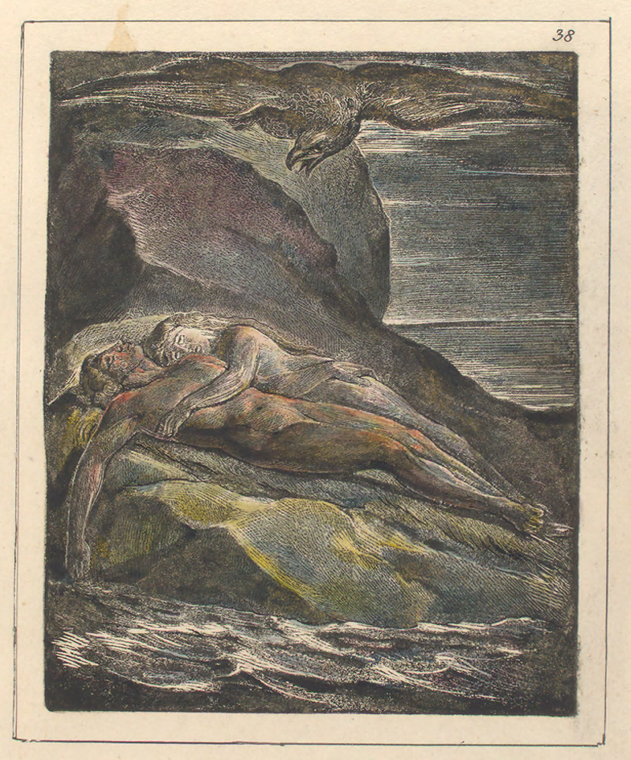
Spirit in this world. The Saviour confronts the sleeping Albion
and identifies his disease, "where hast thou hidden thy Emanation, lovely Jerusalem". But the "perturbed Man" denies Christ
and denies Jerusalem: "Jerusalem is not! her daughters are indefinite: By demonstration man alone can live, and not by faith."
A few lines further the poet announces that
Jerusalem is scatter'd abroad like a cloud of smoke thro' nonentity.
Moab & Ammon & Amalek & Canaan & Egypt & Aram
Receive her little ones for sacrifices and the delights of
cruelty.
The place names represent the six heathen nations or
the powers of evil that surround the Chosen People. The import
of all this in another biblical phrase is that "He who departs
from evil makes himself a prey".
Very shortly we meet the Daughters of Albion; they represent the feminine dimension of the materialistic impulses of
Man: "Names anciently remember'd, but now contemn'd as fictions.
Although in every bosom they controll our Vegetative powers".
Eventually a redemptive moment occurs when, Los having subdued
and integrated his Spectre, his Sons and Daughters "come forth
from the Furnaces". Erin, like America a symbol of redemption,
addresses Jerusalem:
Vala is but thy Shadow, 0 thou loveliest among women!
A shadow animated by thy tears, 0 mournful Jerusalem!
Why wilt thou give to her a Body whose life is but a Shade?
Her joy and love, a shade, a shade of sweet repose:
But animated and vegetated she is a devouring Worm.
What shall we do for thee, 0 lovely mild Jerusalem?
Cast, Cast ye Jerusalem forth! The Shadow of delusions!
The Harlot daughter! Mother of pity and dishonourable forgiveness!
Our Father Albion's sin and shame! But father now no more,
Nor sons, nor hateful peace & love, nor soft complacencies,
With transgressors meeting in brotherhood around the table
Or in the porch or garden. No more the sinful delights
Of age and youth, and boy and girl, and animal and herb,
And river and mountain, and city & village, and house and family,
Beneath the Oak and Palm, beneath the Vine and fig tree,
In Self-denial!--But War and deadly contention Between
Father and Son, and light and love! All bold asperities
Of Haters met in deadly strife, rending the house & garden
The unforgiving porches, the tables of enmity, and beds
And chambers of trembling & suspicion, hatreds of age & youth,
And boy & girl, & animal & herb, & river & mountain,
And city & village, and house & family, That the Perfect
May live in glory, redeem'd by Sacrifice of the Lamb
And of his children before sinful Jerusalem. To build
Babylon the City of Vala, the Goddess Virgin-Mother.
She is our Mother! Nature! Jerusalem is our Harlot-Sister
Return'd with Children of pollution to defile our House
With Sin and Shame. Cast, Cast her into the Potter's field!
Her little ones She must slay upon our Altars, and her aged
Parents must be carried into captivity: to redeem her Soul,
To be for a Shame & a Curse, and to be our Slaves for ever.
In an extended passage too long to quote here Blake
gives a colloquy with the fainting, confused Albion and the two
females competing for his heart. It's actually a recreation of
the earlier colloquy in VDA, and infinitely richer and fuller. Albion wavers exactly like Theotormon; Vala, like
Bromion, is implacably blind, and Jerusalem has the eloquence of
the earlier heroine. In this scene, like the earlier one, Blake
describes the eternal battle between faith and worldliness.
Look also at the passage on Plates 32-34 and remember
that Albion, Vala and Los each speaks from his own viewpoint. To
understand Blake's vision the reader must imaginatively enter the
psychic state of each of the three characters. Los most often
speaks from the poet's true standpoint, and the following lines
put his position about as plainly as it can be put:
What may Man be? who can tell! but what may Woman be
To have power over Man from Cradle to corruptible Grave?
There is a Throne in every Man, it is the Throne of God:
This, Woman has claim'd as her own, and Man is no more!
Albion is the Tabernacle of Vala and her Temple,
And not the Tabernacle and Temple of the Most High.
0 Albion, why wilt thou Create a Female Will?
[A few lines along he adds further meaning to his
term:]
Is this the Female Will, 0 ye lovely Daughters of Albion, To
Converse concerning Weight & Distance in the Wilds of Newton
& Locke?
[As the epic progresses, Blake continues to define the
two women:]
Man is adjoin'd to Man by his Emanative portion
Who is Jerusalem in every individual Man, and her
Shadow is Vala, builded by the Reasoning power in Man.
As the third chapter of Jerusalem begins, Blake
describes Jerusalem for us once more:
In Great Eternity every particular Form gives forth or Emanates
Its own peculiar Light, and the Form is the Divine Vision
And the Light is his Garment. This is Jerusalem in every Man,
A Tent & Tabernacle of Mutual Forgiveness, Male and Female Clothings.
And Jerusalem is called Liberty among the Children of Albion.
Blake's ethics of sexual love, his symbolism, and his
Christian faith all fit together and reach a climax in a sketch
virtually guaranteed to astound and provoke the reader (and no
doubt dismay and disgust some). This passage, Plates 61 and 62,
is called "Visions of Elohim Jehovah". Here once again forgiveness is the key, and to Blake forgiveness was everything. Vala,
the soul of materialism, knows nothing of forgiveness. Jerusalem's liberty is expressed most fully in forgiveness. In this
passage Mary, the mother of Jesus, merges with the other Mary,
who was forgiven because "she loved much".
"Visions of Elohim Jehovah" could only have been written by a poet who despised the social value placed upon virginity.
In an earlier work he had called it "pale religious letchery that
wishes but acts not". Blake hated the ideal of chastity, which
meant to him a virtuous withholding of woman's body as an exercise
of power over the deprived male, and he struck directly at the
archetype of the chaste woman. "Visions of Elohim Jehovah" is
not a theological statement, but an imaginative vision about
meaning and value. The love of Blake will always be confined
to people who discriminate between those two things and whose
theological perspective is neither glassy eyed nor otherwise rigid.
Blake's Mary has perfect trust in the forgiveness of
sin, and her relationship with Joseph becomes a type for the relationship of Jerusalem with Jesus:
Jerusalem fainted over the Cross and Sepulcher. She heard the
voice:
"Wilt thou make Rome thy Patriarch Druid & the Kings of Europe
his
"horsemen? Man in the Resurrection changes his Sexual Garments
at will.
"Every harlot was once a Virgin: every Criminal an Infant Love.
"Repose on me till the Morning of the Grave. I am thy Life."
Jerusalem replied: "I am an outcast: Albion is dead:
"I am left to the trampling foot is. the spurning heel:
"A Harlot I am call'd: I am sold from street to street:
"I am defaced with blows in with the dirt of the Prison,
"And wilt thou become my Husband, 0 my Lord & Saviour?"
[As Jerusalem progressively gains our sympathy, Vala moves
farther and farther in the opposite direction:]
Then All the Daughters of Albion became One before Los, even
Vala
And she put forth her hand upon the Looms in dreadful howlings
Till she vegetated into a hungry Stomach in a devouring Tongue.
Her Hand is a Court of Justice: her Feet two Armies in Battle:
Storms & Pestilence in her Locks, and in her Loins Earthquake
And Fire & the Ruin of Cities & Nations and Families and Tongues.
The allegoric drama of good and evil in terms of the two
females continues and intensifies throughout the epic poem until
the final awakening of Albion, when sexes disappear. The first
indication of this is in the dialogue of Los and Enitharmon:
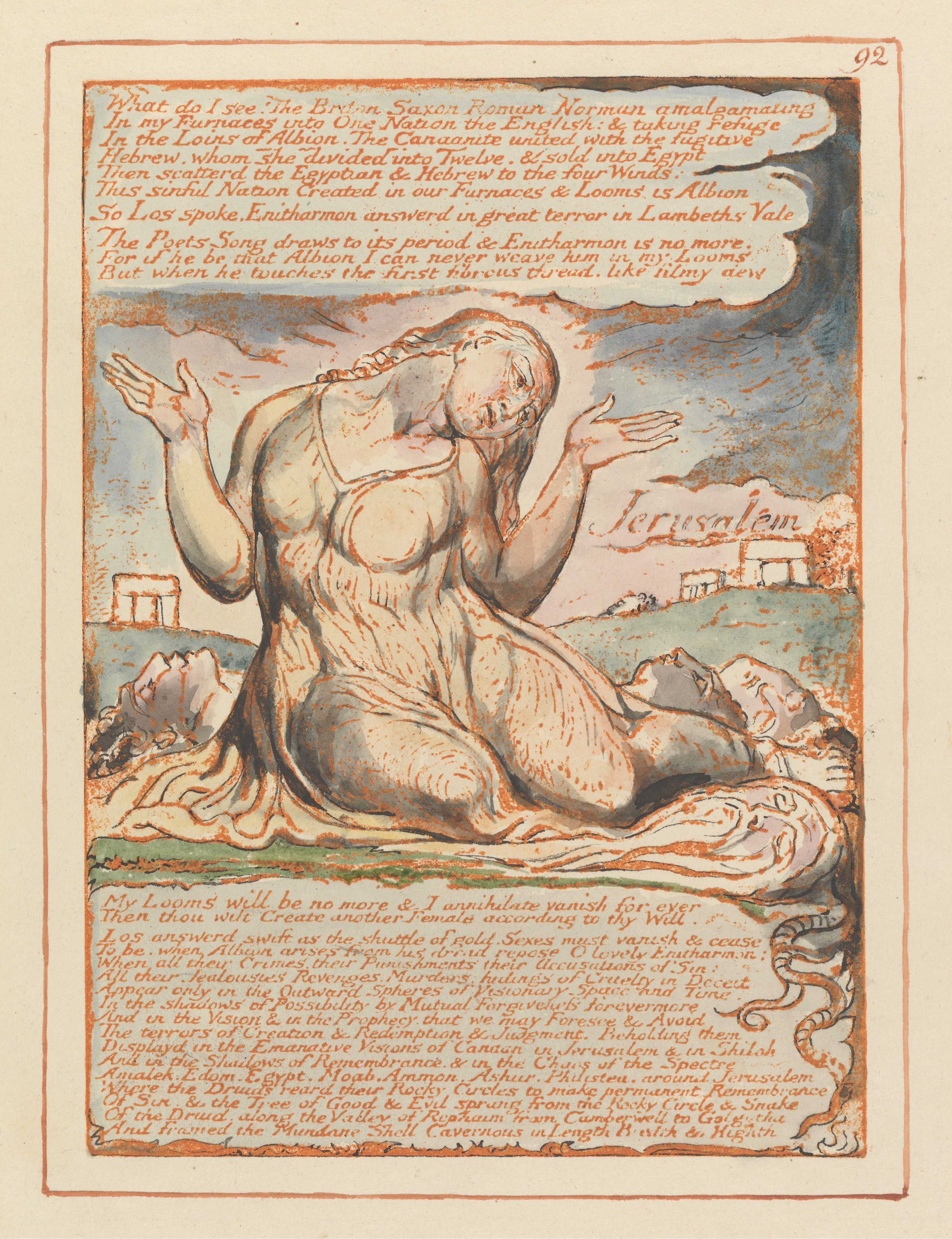
Enitharmon answer'd in great terror in Lambeth's Vale:
"The Poet's Song draws to its period, and Enitharmon is no more;
For if he be that Albion, I can never weave him in my Looms,
But when he touches the first fibrous thread, like filmy dew
My Looms will be no more and I annihilate vanish for ever.
Then thou wilt Create another Female according to thy Will."
Los answer"d swift as the shuttle of gold: "Sexes must vanish &
cease
To be when Albion arises from his dread repose, 0 lovely Enitharmon:
When all their Crimes, their Punishments, their Accusations of Sin,
brAll their Jealousies, Revenges, Murders, hidings of Cruelty in Deceit
Appear only in the Outward Spheres of Visionary Space and Time,
In the shadows of Possibility, by Mutual Forgiveness for evermore,
And in the Vision and in the Prophecy, that we may Foresee & Avoid
The terrors of Creation & Redemption & Judgment....
Soon comes the last mention of the woman of the world. She
is connected with her sexual counterpart and described in the very
specific terms which John used in Revelation 17:
If Bacon, Newton, Locke
Deny a Conscience in Man & the Communion of Saints & Angels,
Contemning the Divine Vision & Fruition, Worshiping the Deus
Of the Heathen, the God of This World, & the Goddess Nature,
Mystery, Babylon the Great, The Druid Dragon hidden Harlot,
Is it not that Signal of the Morning which was told us in the
Beginning?
[Now Blake attempts to visualize the true place of sex
in Eternity:]
Awake, Awake, Jerusalem! 0 lovely Emanation of Albion,
Awake and overspread all Nations as in Ancient Time;
For lo! the Night of Death is past and the Eternal Day
Appears upon our Hills. Awake, Jerusalem and come away!
...Then Albion stretch'd his hand into Infinitude
And took his Bow....
And the bow is a Male and Female, and the Quiver of the Arrows of
Love
And the Children of this Bow, a bow of Mercy & Loving-kindness
laying
Open the hidden Heart in Wars of mutual Benevolence, Wars of
Love;
And the Hand of Man grasps firm between the Male and Female Loves.
And he Clothed himself in Bow and Arrows, in awful state, Fourfold
And after the final chorus of the multiple aspects of Man,
Blake tells us that he "heard the Name of their Emanation: they
are named Jerusalem." And so ends Jerusalem.
 |
| Yale Center for British ArtJerusalemPlate 92 |


.jpg)