Showing posts with label Psychology. Show all posts

Monday, February 10, 2025

INTUITIVE INTROVERT

First posted  Feb 2016

W. P. Witcutt in 1946 wrote a book titled 
Wikimedia Commons
Europe
Plate 4
Blake: A Psychological Study
. Whatever Witcutt may have lacked in objectivity, he made up for in devotion to his personal insights. As a student of Jungean psycholoy he attempted to fit Blake's thought into the framework of Jung's system with varying degrees of success.

In trying to explain how Blake arrived at the images which peopled his poetry, Witcutt identified Blake as an intuitive introvert: intuitive as the dominant function in Blake's psyche, and introvert as the orientation to which he turned for meaning. On Page 23 we read:

"The introvert, on the contrary, is turned inward towards the inner world of his own soul. His thoughts are rationalizations of the symbols of the unconscious, not spun from the common experiences of others or from the outside world; his feelings and sensations (if either of these is his dominant function) spring from the same source; and if he is intuitive, he sees the archetypes of the unconscious clearly and vividly in his mind's eye. To the intuitive introvert the world of the imagination is far more vivid than the world of outer reality.
...
In an illuminating example, Blake tells how introverted intuition works:

Vision of Last Judgment, (E 565)
"I assert for My self that I do
not behold the Outward Creation & that to me it is hindrance &
not Action it is as the Dirt upon my feet No part of Me. What it
will be Questiond When the Sun rises  do  you  not  see  a  round 
Disk of fire somewhat like a Guinea O no no I see an Innumerable
company of the Heavenly host crying Holy Holy Holy is the Lord
God Almighty I question not my Corporeal or Vegetative Eye any
more than I would Question a Window concerning a Sight I look
thro it & not with it."  
Contrasting Blake's approach of presenting his work to that of one with dominate thinking function, Witcutt on Page 82 wrote:

"The man of dominant thought would write out these psychological events in his own abstract terminology; but to the intuitive introvert such as Blake or Shelley they appear as the conflicts of awesome figures. The commentators on Blake have usually been men of dominant thought; and from them one gains the impression that Blake first thought out these matters as they would have done, in abstract terminology of 'law' or 'desire' and so forth; and then (because he was writing in poetry) turned the abstractions into symbolic poetic figures. That is not in the least how one of Blake's temperament works. The figures first of all appeared in his imaginative vision just like a vivid dream, and enacted their dreamlike conflicts, made their speeches. It was afterwards that he puzzled, wondering, over what could be the meaning of their symbolic actions; and gave them names. His first instinct was to draw what he had seen; thus it is that Blake's poetry is really a commentary on his engravings."

The focus of Witcutt's book was on the internal dynamics of the psyche and on what the images Blake created told him, and tell us about integrating one's divided factions. On Page 124 Witcutt identified Blake's characters with dream-symbols:

"The intuitive introvert is the symbolist par excellence. He lives in a dream-world where symbols have in waking life as much vitality and meaning as to ordinary men in dreams. Like the madman he lives in a continual waking dream, but unlike the madman he knows the dream-symbols for the product of the imagination and can use them for the delight of others. To him the symbols appear as unrelated to anything else; they live their own lives as unearthly semi-divine figures seen in the minds eye...It is something never seen on earth."

Vision of Last Judgment, (E 560)
"If the Spectator could Enter into these Images in his
Imagination approaching them on the Fiery Chariot of his
Contemplative Thought if he could Enter into Noahs Rainbow or
into his bosom or could make a Friend & Companion of one of these
Images of wonder which always intreats him to leave mortal things
as he must know then would he arise from his Grave then would he
meet the Lord in the Air & then he would be happy   General
Knowledge is Remote Knowledge it is in Particulars that Wisdom
consists & Happiness too. 
Milton, Plate 2, (E 96)  
"Three Classes are Created by the Hammer of Los, & Woven 
PLATE 3,                                                 
By Enitharmons Looms when Albion was slain upon his Mountains
And in his Tent, thro envy of Living Form, even of the Divine Vision
And of the sports of Wisdom in the Human Imagination
Which is the Divine Body of the Lord Jesus, blessed for ever.
Mark well my words. they are of your eternal salvation:      

Urizen lay in darkness & solitude, in chains of the mind lock'd up
Los siezd his Hammer & Tongs; he labourd at his resolute Anvil
Among indefinite Druid rocks & snows of doubt & reasoning.
Refusing all Definite Form, the Abstract Horror roofd. stony hard. 
And a first Age passed over & a State of dismal woe:"


Saturday, August 10, 2024

BLAKE & DREAMS 2

THE PILGRIMS PROGRESS
FROM THIS WORLD
TO THAT WHICH IS TO COME
DELIVERED 
UNDER THE SIMILITUDE
OF A DREAM
By John Bunyan's with an introduction by John T. Winterich
Illustrated with Water-colors by WILLIAM BLAKE  

 Pilgrim's Dream

"As I walked through the wilderness of this world, I came upon a certain place, where there was a den—and I laid down in that place to sleep. And as I slept, I dreamed a dream. I dreamed, and, behold—I saw a man clothed with rags, standing with his face turned away from his own house, with a Book in his hand, and a great burden upon his back. I looked, and saw him open the Book, and read therein; and as he read, he wept and trembled! And not being able to contain himself any longer—he broke out with a lamentable cry, saying, 'What shall I do?'"

Blake portrays three level in his image:

The dream which is a vehicle through which the dreamer may gain access to levels of consciousness below his ego consciousness.

Sleeping which is a necessary condition which allows the brain to be activated in such a way that unconscious content surfaces.

The unconscious which may release supressed material as well as well as activate protections which prevent damage.

Blake knew that listening to one's dreams was a way of getting in touch with the aspects of the psyche which are not ordinarily accessable. When Blake illustrated Pilgrim's Progress which was written as a sequence of episodes in Bunyan's dream, he reached into his unconscious to make known what may have been opaque in Bunyan's allegory. Bunyan did not focus on the dream state itself but in Blake's first illustration he revealed that the dreamer is subject to levels of consciousness different from those of waking experience. 

The sleeping pilgrim is not reconstructing memories but reliving incidents in his life which fit into a pattern through which a pilgrim travels. In the upper level of the picture Blake faintly represents the episodes through the pilgrim will travel in Bunyan's dream. The dreamer who lies asleep bears no resemblemce to the  pilgrim who will undertake the journey. Beneath the dreamer lies a sleeping lion. Blake used a lion as a symbol for the love and protection which is afforded to the innocent lamb who is vulnerable to the wrath of the wolf who would do him harm.

    
Milton, PLATE 15 [17], (E 109)
"As when a man dreams, he reflects not that his body sleeps,
Else he would wake; so seem'd he entering his Shadow: but
With him the Spirits of the Seven Angels of the Presence
Entering; they gave him still perceptions of his Sleeping Body;
Which now arose and walk'd with them in Eden, as an Eighth   
Image Divine tho' darken'd; and tho walking as one walks
In sleep; and the Seven comforted and supported him.

Like as a Polypus that vegetates beneath the deep!
They saw his Shadow vegetated underneath the Couch
Of death: for when he enterd into his Shadow: Himself:           
His real and immortal Self: was as appeard to those
Who dwell in immortality, as One sleeping on a couch
Of gold; and those in immortality gave forth their Emanations
Like Females of sweet beauty, to guard round him & to feed
His lips with food of Eden in his cold and dim repose!           

But to himself he seemd a wanderer lost in dreary night.
Onwards his Shadow kept its course among the Spectres; call'd
Satan, but swift as lightning passing them, startled the shades
Of Hell beheld him in a trail of light as of a comet
That travels into Chaos: so Milton went guarded within." 
Songs and ballads, (E 486)     
"The Land of Dreams

Awake awake my little Boy
Thou wast thy Mothers only joy
Why dost thou weep in thy gentle sleep
Awake thy Father does thee keep

O what Land is the Land of Dreams     
What are its Mountains & what are its Streams
O Father I saw my Mother there
Among the Lillies by waters fair

Among the Lambs clothed in white
She walkd with her Thomas in sweet delight   
I wept for joy like a dove I mourn
O when shall I again return

Dear Child I also by pleasant Streams
Have wanderd all Night in the Land of Dreams
But tho calm & warm the Waters wide  
I could not get to the other side

Father O Father what do we here
In this Land of unbelief & fear
The Land of Dreams is better far
Above the light of the Morning Star"   


In Dark Figures in the Desired Country, Gerda Norvig makes this statement about the healing powers which are called forth when one engages in the process of individuation:
"Blake seems to be giving here graphic expression to a common psychological rule that goes beyond Bunyan's: the rule that active differentiation of the contents of the dark side of the self precedes spiritual assistance, but also literally creates a space for the healing powers of the psyche to move into as they well up from archetypal dimensions recognized as existing deep in the background of our mental landscape." (Page 148)

Damon, A Blake Dictionary

"The Lion is commonly known as the protector of the Lamb...the Lion's warth is particulrly directed against the wolves who prey upon the flocks.
...
The Lion is spiritual wrath, inspired by pity...while the Tyger's blind warth is purely emotional." (Page 242)


Wednesday, August 07, 2024

BLAKE & DREAMS 1

Illustrations to Young's Night Thoughts

Copy of image in British Museum

“The dream is the small hidden door in the deepest and most intimate sanctum of the soul, which opens to that primeval cosmic night that was soul long before there was conscious ego and will be soul far beyond what a conscious ego could ever reach.” Carl Jung

The quote is from "The Meaning of Psychology for Modern Man" (1933) an essay by Carl Jung that was published in 1933 as the second part of his series “On Psychology.”

Pictured is the threefold materialized body - moving from the feet to the head we see:

Horses - body - energies -  Tharmas
Marriage of Heaven and Hell, Plate 4, (E 34) 
"2. Energy is the only life and is from the Body and Reason is
the bound or outward circumference of Energy.
3 Energy is Eternal Delight
Hunter -  loins - passions - (daughter of) Urizen
Ahania, Plate 2, (E 84)
"6: But the strong arm that sent it, remember'd
The sounding beam; laughing it tore through
That beaten mass: keeping its direction
The cold loins of Urizen dividing.

7: Dire shriek'd his invisible Lust                           
Deep groan'd Urizen! stretching his awful hand
Ahania (so name his parted soul)
He siez'd on his mountains of jealousy.
He groand anguishd & called her Sin,
Woman - heart - emotions - Luvah 
Four Zoas, Night VII ,Page 84, (E 359)
"This thou well rememberest listen I will tell
What thou forgettest. They in us & we in them alternate Livd  
Drinking the joys of Universal Manhood. One dread morn
Listen O vision of Delight One dread morn of goary blood
The manhood was divided for the gentle passions making way   
Thro the infinite labyrinths of the heart & thro the nostrils issuing
In odorous stupefaction stood before the Eyes of Man   
A female bright."
Owl - head - mind - Urthona

Jerusalem, Plate 82, (E 240)

"then they saw the Furna[c]es opend, & in tears
Began to give their souls away in the Furna[c]es of affliction.
Los saw & was comforted at his Furnaces uttering thus his voice. 

I know I am Urthona keeper of the Gates of Heaven,
And that I can at will expatiate in the Gardens of bliss;
But pangs of love draw me down to my loins which are
Become a fountain of veiny pipes: O Albion! my brother!
Plate 83
Corruptibility appears upon thy limbs, and never more  
Can I arise and leave thy side, but labour here incessant
Till thy awaking! yet alas I shall forget Eternity!"  

We are accustomed to thinking of the material outer world as having some independent existence. This is the exterior world mediated through consciousness. But the world of dreams is an internal world coming to us from the unconscious which exists within our psyches exclusively. The images which came to Blake existed first in his mind. He brought them from his unconscious and expressed them in symbolic language when they reached his conscious mind. 

We may recieve material which resides in our unconscious through dreaming but often it never reaches our consciousness. Blake had the uncanny ability to bring into the light material which primarily resides in the collective unconscious which we know primarily through archetypes. Blake's poetry and visual images can become an avenue through which we become acquainted with material which is hidden from us in our own unconscious minds. If we believe, as Blake did, that the world of thought is the real world, we have a key to that interior world through studying Blake.

Vision of Last Judgment, (E 565)

"Mental Things are alone Real what is Calld Corporeal Nobody Knows
of its Dwelling Place <it> is in Fallacy & its Existence an
Imposture  Where is the Existence Out of Mind or Thought Where is
it but in the Mind of a Fool." 

Thursday, July 18, 2024

SELF-KNOWLWDGE

Wikipedia Commons
Malevolence

In the following two passages we see how Blake applied to his associates the growing understanding of the motivating forces which were within himself . He saw in their behaviour that they were dominated by forces were within themselves, but unknown to those who possessed them. Blake increased his understanding of himself by observing in Hayley and Reynolds things which they did not know about themselves but were expressed overtly.

Blake confessed that he didn't know what he was getting into when he moved to Felpham at Hayley's invitation. He anticipated better circumstances because he was attempting to leave a stressful situation in London. Blake soon found that Hayley's motivations were not directed by the spirit but by purely material concerns. He intended to move Blake away from writing visionary poetry as he felt led to do, and into activities designed for monetary gain.

Blake felt that Hayley's rejection of the leadership of the spirit worked against his gaining understanding of the 'natural hidden' forces which were working against him.

In th case of Reynolds, Blake recognized that he was using his position as president of the Royal Academy to attempt to destroy the reputations of the very artists whom Blake most admired.

To Blake the praise that Reynolds gave to Rafael and Michelangelo could be recognized as attempts to to poison admiration of their skills as a means of revenge against their vision and artistic ability. The praise that he afforded them was not for what they valued in art but for what they abhorred. The harm that Reynolds did was to the public and to the students who accepted his evaluation. If it was behavior of which he was unconscious, he was allowing his lack of self-knowledge to determine his relationship to others. Whether unintentionally or maliciously he allowed his own failure to resolve his inner conflicts to do harm.

Letters, To Butts, (E 723)

"When I came down here I was more sanguine than I am at present but it was because I was ignorant of many things which have since occurred & chiefly the unhealthiness of the place Yet I do not repent of coming, on a thousand accounts. & Mr H I doubt not will do ultimately all that both he & I wish that is to lift me out of difficulty. but this is no easy matter to a man who having Spiritual Enemies of such formidable magnitude cannot expect to want natural hidden ones"

Annotations to Reynolds, (E 642)

  "I consider Reynolds's Discourses to the Royal Academy as the
Simulations of the Hypocrite who Smiles particularly where he
means to Betray.  His Praise of Rafael is like the Hysteric Smile
of Revenge   His Softness & Candour. the hidden trap. & the
poisoned feast, He praises Michael Angelo for Qualities which
Michael Angelo Abhorrd; & He blames Rafael for the only Qualities
which Rafael Valued,  Whether Reynolds. knew what he was doing.
is nothing to me; the Mischief is just the same, whether a Man
does it Ignorantly or Knowingly:"

Sunday, February 05, 2023

ZOAS IN PSYCHE

Yale Center for British Art
Jerusalem
Plate 36, Detail

 In 2020 there were 7 posts on the topic of READING WITCUTT. Blake: a Psychological Study is a small book written by William Purcell Witcutt in 1946. In his Introduction Witcutt calls Blake's work 'a veritable jungle of symbols.' Witcutt proposes to 'provide a plan of the maze' encountered when studying Blake's Prophetic Books. An understanding of mythology, symbolism and psychology are the keys he supplies to unlocking Blake's dense poetry. 

We had the good fortune to come across this book in the Arlington County Library in 1978. This was the beginning of Larry's interest in Blake. The linking of Blake with Jung made a profound impact on Larry and redirected his studies in the direction of Blake.

Perhaps Witcutt's book is flawed in some ways, but there seems to have been few other scholars who pursued the connections between Jungian psychology and Blake's poetry as thoroughly. As Witcutt explores Blake's characters, they seen to be active and recognizable in our own psyches, expanding our consciousness. Blake and Witcutt pursued their own paths as their own consciousness expanded. Would that we could do likewise.

Letters, To  Thomas Butts, (E713)

     "In his beams of bright gold
     Like dross purgd away
     All my mire & my clay
     Soft consumd in delight
     In his bosom sun bright
     I remaind.  Soft he smild
     And I heard his voice Mild
     Saying This is My Fold
     O thou Ram hornd with gold
     Who awakest from sleep
     On the sides of the Deep
     On the Mountains around
     The roarings resound
     Of the lion & wolf
     The loud sea & deep gulf
     These are guards of My Fold
     O thou Ram hornd with gold
     And the voice faded mild
     I remaind as a Child
     All I ever had known
     Before me bright Shone
     I saw you & your wife
     By the fountains of Life
     Such the Vision to me
     Appeard on the Sea"

 Links to posts in 2022.

READING WITCUTT

READING WITCUTT 2

READING WITCUTT  3

READING WITCUTT  4

READING WITCUTT  5

READING WITCUTT  6

READING WITCUTT  7


Monday, December 19, 2022

THE NATIVITY

First posted December 2011

Matthew 1
[18] Now the birth of Jesus Christ was on this wise: When as his mother Mary was espoused to Joseph, before they came together, she was found with child of the Holy Ghost.
[19] Then Joseph her husband, being a just man, and not willing to make her a publick example, was minded to put her away privily.
[20] But while he thought on these things, behold, the angel of the Lord appeared unto him in a dream, saying, Joseph, thou son of David, fear not to take unto thee Mary thy wife: for that which is conceived in her is of the Holy Ghost.
[21] And she shall bring forth a son, and thou shalt call his name JESUS: for he shall save his people from their sins.

Luke 2
[3] And all went to be taxed, every one into his own city.
[4] And Joseph also went up from Galilee, out of the city of Nazareth, into Judaea, unto the city of David, which is called Bethlehem; (because he was of the house and lineage of David:)
[5] To be taxed with Mary his espoused wife, being great with child.
[6] And so it was, that, while they were there, the days were accomplished that she should be delivered.
[7] And she brought forth her firstborn son, and wrapped him in swaddling clothes, and laid him in a manger; because there was no room for them in the inn.

Wikipedia Commons
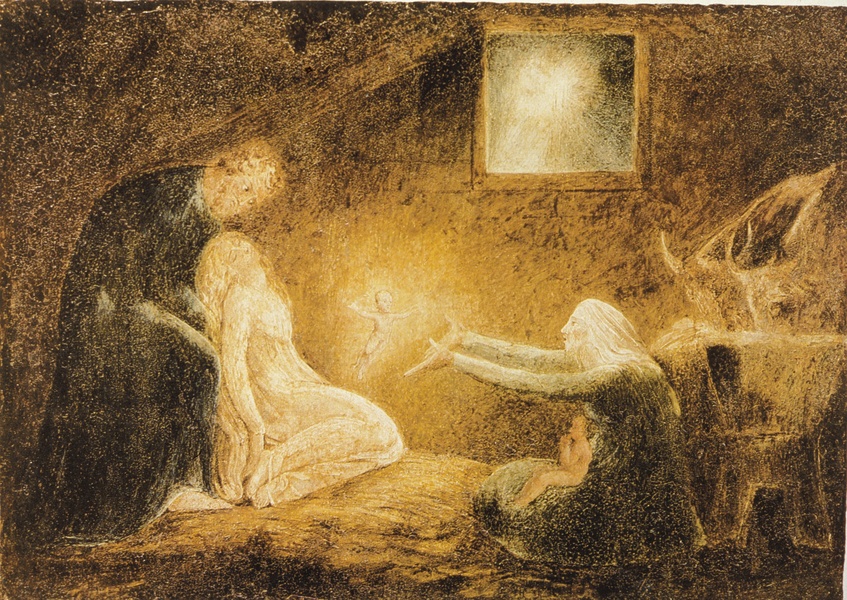
The Nativity

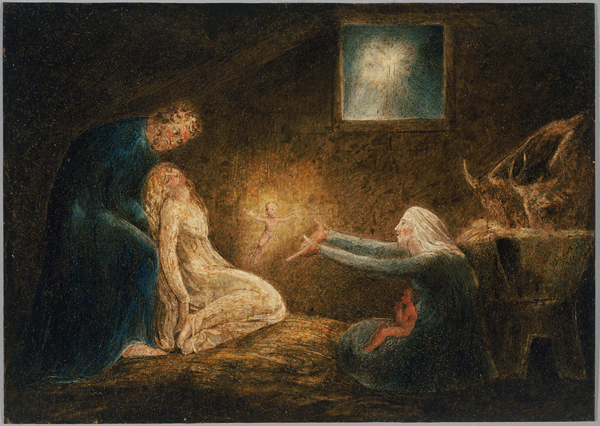
Blake's tempera image of the Nativity was painted on copper in 1799 for Thomas Butts and belongs to the Philadelphia Museum. An enlargement of the image can be viewed in the Blake Archive.

Most striking in this image is the portrayal of the infant Jesus. The child is seen as a spiritual rather than a physical being. He is not subject to the force of gravity for he is suspended in the air. There is no need for additional light in the stable for he is the source of light which radiates to his surroundings. He has left his father and mother and is moving toward Elizabeth who holds her promised son, the infant John, on he lap. Blake's first illustration to Milton's On the Morning of Christ's Nativity is an expansion of this picture but the all important soaring Christ Child appears in both. In another post he is identified with the weeping babe


Thursday, October 07, 2021

LARGE COLOR PRINTS 7

First posted Feb 2014

 Daniel 4
[29] At the end of twelve months he was walking on the roof of the royal palace of Babylon,
[30] and the king said, "Is not this great Babylon, which I have built by my mighty power as a royal residence and for the glory of my majesty?"
[31] While the words were still in the king's mouth, there fell a voice from heaven, "O King Nebuchadnez'zar, to you it is spoken: The kingdom has departed from you,
[32] and you shall be driven from among men, and your dwelling shall be with the beasts of the field; and you shall be made to eat grass like an ox; and seven times shall pass over you, until you have learned that the Most High rules the kingdom of men and gives it to whom he will."
[33] Immediately the word was fulfilled upon Nebuchadnez'zar. He was driven from among men, and ate grass like an ox, and his body was wet with the dew of heaven till his hair grew as long as eagles' feathers, and his nails were like birds' claws.
[34] At the end of the days I, Nebuchadnez'zar, lifted my eyes to heaven, and my reason returned to me, and I blessed the Most High, and praised and honored him who lives for ever; for his dominion is an everlasting dominion, and his kingdom endures from generation to generation;


Nebuchadnezzar stood at the pinnacle of success and power as the ruler of an empire. He attributed to his own strength and wisdom all that belonged to him. But he was unaware of things in his life to which he had not given attention. There were unclaimed aspects of his psyche which needed to be acknowledged. When we read the quote from the Book of Daniel we realize that when his conscious mind laid claim to all of his achievements, another part of his mind, his unconscious, drove him into a dark and terrifying place. That surface patina of ego-consciousness was overwhelmed by the behavior of a beast of the field. His condition became that of one suffering from what we now call mental illness.

Wikipedia Commons
Large Color Prints
Nebuchadnezzar

Blake's image of Nebuchadnezzar shows him deprived of human characteristics. In the sequence of the Large Color Prints which we have been following this represents a further descent from man's state in Eden. He had lost the ability to perceive the Divine Image and therefore appears as less than human. Blake used the term Ulro for the level of existence at which all memory of Eternity had been eradicated.  

Notice in the passage from Daniel that after seven times passed over Nebuchadnezzar three things happened: he lifted his eyes to heaven, his reason returned, and he blessed the Most High. Lifting his eyes to heaven is recognition of God as the source of all things. His reason returns when he has learned to process and put into order the content of both the conscious and unconscious levels of his mind. He reorders his life since he now knows what comes from himself and what comes from God and he is grateful.

Four Zoas, Night IX, Page 135, (E 403)
"Attempting to be more than Man We become less said Luvah
As he arose from the bright feast drunk with the wine of ages
His crown of thorns fell from his head he hung his living Lyre
Behind the seat of the Eternal Man & took his way
Sounding the Song of Los descending to the Vineyards bright      
His sons arising from the feast with golden baskets follow
A fiery train as when the Sun sings in the ripe vineyards
Then Luvah stood before the wine press all his fiery sons
Brought up the loaded Waggons with shoutings ramping tygers play
In the jingling traces furious lions sound the song of joy       
To the golden wheels circling upon the pavement of heaven & all
The Villages of Luvah ring the golden tiles of the villages
Reply to violins & tabors to the pipe flute lyre & cymbal
Then fell the Legions of Mystery in maddning confusion
Down Down thro the immense with outcry fury & despair            
Into the wine presses of Luvah howling fell the Clusters
Of human families thro the deep. the wine presses were filld
The blood of life flowd plentiful Odors of life arose
All round the heavenly arches & the Odors rose singing this song
Page 136 
O terrible wine presses of Luvah O caverns of the Grave
How lovely the delights of those risen again from death
O trembling joy excess of joy is like Excess of grief

So sang the Human Odors round the wine presses of Luvah"


When man associates the contents of his conscious mind with good, and of the unconscious mind with evil he is in danger of an eruption of his buried or shadow side. The rejected content may surface as uncontrolled outbursts, moods of depression, or feelings of worthlessness. But when he retrieves from his shadow side discarded remnants from a totality which needs both darkness and light to define its outlines, he may indeed feel he is 'risen again from death.'
 
The following quote is from Meeting the Shadow, The Hidden Power of the Dark Side of Human Nature by Connie Zweig and Jeremiah Abrams:

"British Jungian analyst and astrologer Liz Greene points to the paradoxical nature of the shadow as both the container of darkness and the beacon pointing toward the light: “It is the suffering, crippled side of the personality which is both the dark shadow that won't change and also the redeemer that transforms one's life and alters one's values. The redeemer can get hidden treasure or win the princess or slay the dragon because he's marked in some way –he's abnormal. The shadow is both the awful thing that needs redemption, and suffering redeemer who can provide it."


Sunday, June 20, 2021

GROVE


Blake's Illustrations to Dante
Homer and the Ancient Poets


First Posed Feb 2015 

Songs of Innocence, Songs 9 and 10, (E 9)
Little Black Boy

"....And we are put on earth a little space,
That we may learn to bear the beams of love
And these black bodies and this sunburnt face
Is but a cloud, and like a shady grove.

For when our souls have learn'd the heat to bear,
The cloud will vanish, we shall hear His voice,
Saying, 'Come out from the grove, my love and care
And round my golden tent like lambs rejoice...',"
  
Jerusalem, Plate 38, (E 184)

 "If we are wrathful Albion will destroy Jerusalem with rooty Groves
If we are merciful, ourselves must suffer destruction on his Oaks:
Why should we enter into our Spectres. to behold our own corruptions
O God of Albion descend! deliver Jerusalem from the Oaken Groves!"
 
Jerusalem, Plate 6, (E 217)
"For a Spectre has no Emanation but what he imbibes from decieving
A Victim! Then he becomes her Priest & she his Tabernacle.
And his Oak Grove. till the Victim rend the woven Veil."
  (See also Matthew 27:51)

Jerusalem, Plate 25, (E 170)
"Why did you take Vengeance O ye Sons of the mighty Albion?

Planting these Oaken Groves: Erecting these Dragon Temples
Injury the Lord heals but Vengeance cannot be healed:            
As the Sons of Albion have done to Luvah: so they have in him
Done to the Divine Lord & Saviour, who suffers with those that suffer:
For not one sparrow can suffer, & the whole Universe not suffer also,
In all its Regions, & its Father & Saviour not pity and weep.
But Vengeance is the destroyer of Grace & Repentance in the bosom
Of the Injurer: in which the Divine Lamb is cruelly slain:
Descend O Lamb of God & take away the imputation of Sin
By the Creation of States & the deliverance of Individuals Evermore Amen"
Blake's Notebook, My Spectre, (E 476)
"Till I turn from Female love
And root up the Infernal Grove,
I shall never worthy be
To step into Eternity.
 
Let us agree to give up love,
And root up the Infernal Grove;
Then shall we return and see
The worlds of happy Eternity."

Notice that the 'love' in the last verse is the 'female love' of the earlier one. This 'love' in Blake's poetry is nothing like godly love; in fact it's just the opposite; it's love of fallen materiality- love of things, like Money, Golf, or Whiskey, or your Stomach; see (See Philippians 3:19)

So what did Blake mean with his groves. Damon said it's a "symbol of error"; I say it's a symbol of the 'fallen material world' where the Druid Priests built their Temples and Altars.

Blake used thousands of words to describe his primary myth: Creation, Fall, Redemption, Return, and many many pictures to portray it, and many, many capsules of two lines that state it. He wanted us to get it.

"Planting these Oaken Groves: 
Erecting these Dragon Temples" (Erdman 170)

"Patriarchal Pillars & Oak Groves over the whole Earth..." (Erdman 171)

"And build this Babylon & sacrifice in secret groves" (E 210)

Psychologically grove may mean our habitual ways of processing experience, the obstructions we place to acting according to the light we possess, the projections which disguise our inner landscapes, our failure to turn to intuitive abilities to seek understanding; any inner structures which prevent us entering the place prepared for us. Blake's grove includes all our prejudices, our hates and fears, our unwillingness or inability to love. 

Blake's calls upon us to leave the oaken groves, to rend the woven veil.

Wednesday, February 17, 2021

CAVERNS OF THE GRAVE II

First posted August 2011.

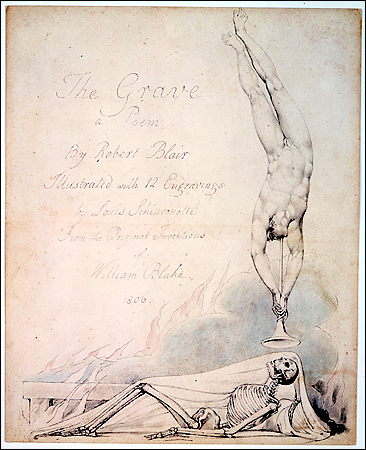
One of the most deflating episodes of Blake's life involved the publication of Robert Blaire's The Grave for which Cromek had engaged him to make illustrations. Blake produced the drawings for the book at little cost to Cromek who awarded the lucrative engraving of the plates to Schiavonetti instead of to Blake. Both anger and depression were among the reactions Blake experienced as the result of the loss of badly needed financial support, and the rejection of his work by a man he considered to be a friend. The book was published with Blake's images executed in the more refined and popular style of Schiavonetti. For the book Blake produced a poem in which he dedicated his illustrations to the Queen.  

Songs and Ballads, (E 480) 

[Dedication to Blake's Illustrations to Blair's Grave, printed 1808] 

 "TO THE QUEEN 

The Door of Death is made of Gold,
That Mortal Eyes cannot behold;
But, when the Mortal Eyes are clos'd,
And cold and pale the Limbs repos'd,
The Soul awakes; and, wond'ring, sees
In her mild Hand the golden Keys:
The Grave is Heaven's golden Gate,
And rich and poor around it wait;
O Shepherdess of England's Fold,
Behold this Gate of Pearl and Gold!                 

  To dedicate to England's Queen 
The Visions that my Soul has seen,
And, by Her kind permission, bring 
What I have borne on solemn Wing,
From the vast regions of the Grave,
Before Her Throne my Wings I wave;
Bowing before my Sov'reign's Feet,
"The Grave produc'd these Blossoms sweet
"In mild repose from Earthly strife;
"The Blossoms of Eternal Life!"           

                        [Signed] WILLIAM BLAKE 

There is more than a polite dedication to the Queen in Blake's poem. He is likely saying something also about his personal experience in the disappointment of not being able to display his own engraving skills in a book which may reach a broad public. The 'door of death' is the pain and discouragement he felt in the rejection. The 'Grave' is the opportunity to see into his own psyche as a result of being forced to endure the death of his hopes. The Grave has become 'heaven's gate' to him because through it there are 'Visions that my Soul has seen'. To the Queen as the 'Shepherdess of England's Fold,' he presents the product of his experience of the Grave: 'repose from Earthly strife' through experience of the Eternal dimension.  

In Blake's notebook is an unnamed poem in which he states that what he revealed to the Queen was his experience of the 'Caverns of the Grave'. For the Countess of Egremont he was designing an image of the Last Judgment for which he would also supply an explanation. Blake acknowledges that the way the world reacts to his art does not affect it. His designs are in response to the vision of the Eternal which has guided his work from the beginning. The depths of the 'Caverns of the Grave' and the heights of the 'Great Atlantic Mountains' are seen form his 'Golden House'.  

Songs and Ballads, (E 480) 

[From Blake's Notebook]

"The Caverns of the Grave Ive seen  
And these I shewd to Englands Queen
But now the Caves of Hell I view   
Who shall I dare to shew them to
What mighty Soul in Beautys form   
Shall dauntless View the Infernal Storm 
Egremonts Countess can controll         
The flames of Hell that round me roll   
If she refuse I still go on
Till the Heavens & Earth are gone            
Still admird by Noble minds             
Followd by Envy on the winds
Reengravd Time after Time
Ever in their Youthful prime
My Designs unchangd remain              
Time may rage but rage in vain
For above Times troubled Fountains
On the Great Atlantic Mountains
In my Golden House on high
There they Shine Eternally"                                   


Sunday, December 20, 2020

READING WITCUTT 7

Wikimedia Commons 
The Vision of the Last Judgment
Petworth House, The National Trust

(For detail of image, right click on picture, select open in a new window, click on image, close window to return) 

This post wraps up Larry's reaction to Blake: A psychological Study by W. P. Witcutt. Reading Witcutt was a consciousness expanding experience which opened his mind to the intuitive understanding of the contents of the psyche. It acted as a gate into the vast inner unconscious world which is open to the intuition and closed to thought, emotion and sensation.

Final on Witcutt Page 123 - appendix

What to thought is an abstract concept appears to intuition as a symbol; thus Blake personifies thought as the kingly figure of Unizen...

The intuitive introvert is the symbolist par excellence. He lives in a dream world where symbols have in waking life as much vitality as an ordinary man sees in dreams...To him the symbol appears as unrelated to anything else; they live their own lives as unearthly semi-divine figures see in the mind's eye.

Larry - 5-28-78

Jung is interesting; Blake is exciting. They addressed the same problems, Jung under cover of 'science'; Blake as a poet and artist. Blake thus more free and creative. Jung tried to bring all of his intuitions under the hegemony of reason. Poetry is the highest form of truth. In Answer to Job and Memories, Dreams and Reflections Jung almost broke out of the straight jacket his chosen role had placed upon him. He had deep yearnings as a prophet, but never quite took the leap of faith into radical responsiveness to Intuition. Instead he founded a school.

The meaning of life is the struggle for consciousness. We struggle against unconsciousness but not against the Unconscious: it is as large an infinity. We struggle for a relationship with the Unconscious, for dialogue between ego and Self, the psychological corollary of prayer. We struggle to love - with heart, mind, soul and strength - Luvah, Urizen, Los and Tharmas.

Deuteronomy 6
[5] And thou shalt love the LORD thy God with all thine heart, and with all thy soul, and with all thy might.
[6] And these words, which I command thee this day, shall be in thine heart: 

Luke 10
[27] And he answering said, Thou shalt love the Lord thy God with all thy heart, and with all thy soul, and with all thy strength, and with all thy mind; and thy neighbour as thyself.

Witcutt Page 18

The great value of Blake's poetry is that it provides a kind of outline of the unconscious mind. Blake explored this strange region more thoroughly than any before or since, and what is, more he knew what he was doing.

 "I rest not from my great task!
To open the Eternal Worlds, to open the immortal Eyes
Of Man inwards into the Worlds of Thought: into Eternity" (Jerusalem 5)

And the point is that the things he discovered in the inner worlds, the godlike figures and the symbols, were not peculiar to himself. They are to be found - altered in inessentials - in the inner world of every man. For the inner world is for each of us the same. [Jung gave it a name: 'The Collective Unconscious.']


Four Zoas, Night VII, Page 84, (E 360)
"Thou knowest that the Spectre is in Every Man insane brutish 
Deformd that I am thus a ravening devouring lust continually
Craving & devouring but my Eyes are always upon thee O lovely
Delusion & I cannot crave for any thing but thee not so     
The spectres of the Dead for I am as the Spectre of the Living   
For till these terrors planted round the Gates of Eternal life
Are driven away & annihilated we never can repass the Gates"

Milton, Plate 14 [15], (E 108)
"And Milton said, I go to Eternal Death! The Nations still
Follow after the detestable Gods of Priam; in pomp 
Of warlike selfhood, contradicting and blaspheming.
When will the Resurrection come; to deliver the sleeping body
From corruptibility: O when Lord Jesus wilt thou come?
Tarry no longer; for my soul lies at the gates of death. 
I will arise and look forth for the morning of the grave.       
I will go down to the sepulcher to see if morning breaks!
I will go down to self annihilation and eternal death,
Lest the Last Judgment come & find me unannihilate
And I be siez'd & giv'n into the hands of my own Selfhood"

Milton, Plate 38 [43], (E 139)
"In the Eastern porch of Satans Universe Milton stood & said

Satan! my Spectre! I know my power thee to annihilate
And be a greater in thy place, & be thy Tabernacle               
A covering for thee to do thy will, till one greater comes
And smites me as I smote thee & becomes my covering.
Such are the Laws of thy false Heavns! but Laws of Eternity
Are not such: know thou: I come to Self Annihilation
Such are the Laws of Eternity that each shall mutually     
Annihilate himself for others good, as I for thee[.]
Thy purpose & the purpose of thy Priests & of thy Churches
Is to impress on men the fear of death; to teach
Trembling & fear, terror, constriction; abject selfishness
Mine is to teach Men to despise death & to go on            
In fearless majesty annihilating Self,"


Thursday, December 17, 2020

READING WITCUTT 6

Jerusalem The Emanation of the Giant Albion
Detail of Plate 92

The struggle to accomplish a unified psyche in which each portion of the whole man is expressed in in its proper relationship to the others will be realized through Reintegration. What Jung calls Individuation is accomplished when the Zoas, the Emanations, the Spectres are valued and accepted as contributing to the Eternal Man who will be alive and awake and rejoicing as all participate in 'Universal Iove & Brotherhood.'

Jerusalem, Plate 61, (E 212)
"Doth Jehovah Forgive a Debt only on condition that it shall
Be Payed? Doth he Forgive Pollution only on conditions of Purity
That Debt is not Forgiven! That Pollution is not Forgiven
Such is the Forgiveness of the Gods, the Moral Virtues of the    
Heathen, whose tender Mercies are Cruelty. But Jehovahs Salvation
Is without Money & without Price, in the Continual Forgiveness of Sins
In the Perpetual Mutual Sacrifice in Great Eternity! for behold!
There is none that liveth & Sinneth not! And this is the Covenant
Of Jehovah: If you Forgive one-another, so shall Jehovah Forgive You:    
That He Himself may Dwell among You."

Witcutt Page 93 - Reintegration

A complete human personality should contain consciously, all the functions in their proper hierarchy, thought, love, imagination, and the powers of sensing. The incomplete (though norma) personality stresses one and represses the others, often so far into the unconscious that it forgets all about them and is incapable of consciously using them. The Anima is the symbolic representation of these repressed functions.

Thus Blake, perfectly correctly from the psychological point, says to the Anima:

"Thou art the soft reflected Image of the Sleeping Man" (Jerusalem 85)

and tells us that:

"Man divided from his Emanation is a dark Spectre                 
His Emanation is an ever-weeping melancholy Shadow" (Jerusalem 53)

The Anima in Blake's case is Jerusalem, the heroine of his last and greatest epic. Jerusalem and Vala are connected figures. They both represent love, but whereas Vala is selfish natural love, Jerusalem is spiritual, unselfish love.

"Vala produc'd the Bodies, Jerusalem gave the souls." (Jerusalem 18)

"Vala would never have sought & loved Albion If she had not sought to destroy Jerusalem; such is that false And Generating Love: a pretence of love to destroy love:" (Jerusalem 17) 
... 
Vala is Nature "She is our Mother! Nature!" and in gazing on her 
Albion feels himself encompassed by the cycle of birth and death. ...
In repressing Vala, Albion has also repressed his capacity for love of any kind.  
...
In order to achieve reintegration the two halves of the soul must be reunited; the Anima must be readmitted to consciousness...In the Seventh Night of  Four Zoas Los has lost his Emanation Enitharmon, and his Spectre has some advice to give him on this point.
"Thou never canst embrace sweet Enitharmon terrible Demon. Till
Thou art united with thy Spectre...
be assurd I am thy real Self  
Tho thus divided from thee & the Slave of Every passion
Of thy fierce Soul Unbar the Gates of Memory look upon me
Not as another but as thy real Self I am thy Spectre" (Four Zoas VII) 

Blake recognizes his Spectre as himself, and this disarms it. For he who recognizes his shadow only in another is thoroughly under its power. 

...

This is the formula by which the elder Blake sought to reconcile Christianity with his earlier rejection of the Moral Law. He would not depart from his earlier position; instead he sought a reconciling formula in the doctrine of forgiveness of sins.

"Albion replyd. Cannot Man exist without Mysterious          
Offering of Self for Another, is this Friendship & Brotherhood
I see thee in the likeness & similitude of Los my Friend

Jesus said. Wouldest thou love one who never died
For thee or ever die for one who had not died for thee
And if God dieth not for Man & giveth not himself           
Eternally for Man Man could not exist. for Man is Love:
As God is Love: every kindness to another is a little Death
In the Divine Image nor can Man exist but by Brotherhood" (Jerusalem 96)
...

At this the Four Zoas return into their proper places, subordinate to Albion, the Self.


Four Zoas, Night I, Page 21, (E 311)
"The Eternal Man wept in the holy tent Our Brother in Eternity Even Albion whom thou lovest wept in pain his family Slept round on hills & valleys in the regions of his love But Urizen awoke & Luvah woke & thus conferrd" Four Zoas, Night IV, Page 51, (E 334) "Tharmas before Los stood & thus the Voice of Tharmas rolld Now all comes into the power of Tharmas. Urizen is falln And Luvah hidden in the Elemental forms of Life & Death Urthona is My Son O Los thou art Urthona & Tharmas Is God. The Eternal Man is seald never to be deliverd I roll my floods over his body my billows & waves pass over him The Sea encompasses him & monsters of the deep are his companions Dreamer of furious oceans cold sleeper of weeds & shells Thy Eternal form shall never renew my uncertain prevails against thee"
Four Zoas, Night VIII,  Page 134, (E 385)
"That Man should Labour & sorrow & learn & forget & return
To the dark valley whence he came to begin his labours anew
In pain he sighs  in pain he labours in his universe
Screaming in birds over the deep & howling in the Wolf
Over the slain & moaning in the cattle & in the winds
And weeping over Orc & Urizen in clouds & flaming fires 
And in the cries of birth & in the groans of death his voice 
Is heard throughout the Universe whereever a grass grows
Or a leaf buds   The Eternal Man is seen is heard   is felt
And all his Sorrows till he reassumes his ancient bliss"

Four Zoas, Night IX, PAGE 133, (E 401)
"The Eternal Man arose he welcomd them to the Feast
The feast was spread in the bright South & the Eternal Man
Sat at the feast rejoicing & the wine of Eternity
Was servd round by the flames of Luvah all day & all the night"


Monday, December 14, 2020

READING WITCUTT 5

America
Plate 3

Blake, of course, used the names of his Four Zoas to portray the interactions of the functions, and he was describing events which took place in Eden, Beulah, Generation and Ulro to narrate scenarios. As an intuitive introvert Blake experienced visionary images within his mind which he transferred to the words and pictures of his Illuminated Books. Witcutt's book encourages us to focus on the interactions which we see and read about in Blake works as taking place in our own minds and happening in the world which is more familiar to us. 

Witcutt Page 69

After the disintegration of the Self there follows conflict among the Zoas. The functions, displaced from their true positions, are now in conflict with each other.

"And the Four Zoa's clouded rage... 
In opposition deadly, and their Wheels in poisonous 
And deadly stupor turn'd against each other..."(Jerusalem 74)

"They saw their Wheels rising up poisonous against Albion
Urizen, cold & scientific: Luvah, pitying & weeping
Tharmas, indolent & sullen: Urthona, doubting & despairing
Victims to one another & dreadfully plotting against each other" (Jerusalem 43)

Witcutt Page 70-71

The Conflict between Intuition and Thought

The eighteenth century, the age into which Blake was born, called itself the Age of Reason. It was an unpropitious time for an intutive....

(Blake) repressed passion as well as thought, Luvah as well as Urizen. And he did this by means of a third function, imagination of intuition. Those who possess dominant intution are comparatively rare; so it is not everyone who can do this!

"a Boy is born of the dark Ocean 
Whom Urizen doth serve... 
that Prophetic boy 
Must grow up to command his Prince" (Four Zoas III)

Witcutt Page 73

The Conflict between Thought and Feeling  

See Reading Witcutt 4
https://woeandjoy.blogspot.com/2020/12/reading-witcutt-4.html

Witcutt Page 82

The Conflict between Intuition and Feeling

This conflict is played out in the fractured relationship between Los representing Intuition and his son Orc representing Feeling.

"But when they came to the dark rock & to the spectrous cave 
Lo the young limbs had strucken root into the rock & strong 
Fibres had from the Chain of Jealousy inwove themselves 
In a swift vegetation round the rock & round the 
Cave And over the immortal limbs of the terrible fiery boy 
In vain they strove now to unchain. In vain with bitter tears 
To melt the chain of Jealousy. not Enitharmons death 
Nor the Consummation of Los could ever melt the chain 
Nor unroot the infernal fibres from their rocky bed  
Nor all Urthonas strength nor all the power of Luvahs Bulls 
Tho they each morning drag the unwilling Sun out of the deep 
Could uproot the infernal chain. for it had taken root" ( Four Zoas V)  

Witcutt Page 86  

The Conflict between Intuition and Sensation

Tharmas is the most repressed and unconscious of the Zoas, and his actions are correspondingly hard to understand.

"Now thou dost know what tis to strive against the God of waters 
 So saying Tharmas on his furious chariots of the Deep 
Departed far into the Unknown & left a wondrous void 
Round Los. afar his waters bore on all sides round. with noise 
Of wheels & horses hoofs & Trumpets Horns & Clarions" (Four Zoas IV)

Witcutt Page 89  

The Conflict between Thought and Sensation

So in the right state of affairs, Urizen supplies Tharmas with light, and Tharmas Urizen with food. This is perfectly correct symbolism. Thought enlightens sensation, and sensation provides thought with the matter to brood upon.

"The Body of Man is given to me I seek in vain to destroy 
For still it surges forth in fish & monsters of the deeps 
And in these monstrous forms I Live in an Eternal woe 
And thou O Urizen art falln never to be deliverd 
Withhold thy light from me for ever & I will withhold 
From thee thy food so shall we cease to be & all our sorrows 
End & the Eternal Man no more renew beneath our power" (Four Zoas VI)

Witcutt Page 90  

The Conflict between Feeling and Sensation

These are the two most repressed functions, and their conflict takes place in the lowest depths of the unconscious. Los (the Ego) is quite unaware of it.

"Luvah slew Tharmas the Angel of the Tongue ...
Los knew not yet what was done: he thought it was all in Vision 
In Visions of the Dreams of Beulah among the Daughters of Albion Therefore the Murder was put apart in the Looking-Glass of Enitharmon." (Jerusalem Plate 63)
 
Witcutt Page 91
 
Blake is the poet of the inner world of man, and peculiarly of these symbolic representations of the four functions which he calls the Four Zoas.