Showing posts with label Europe. Show all posts

Friday, August 29, 2025

AMERICA/EUROPE

 This is a lecture by Professor Edwin G Wilson to students at Wake Forest University:

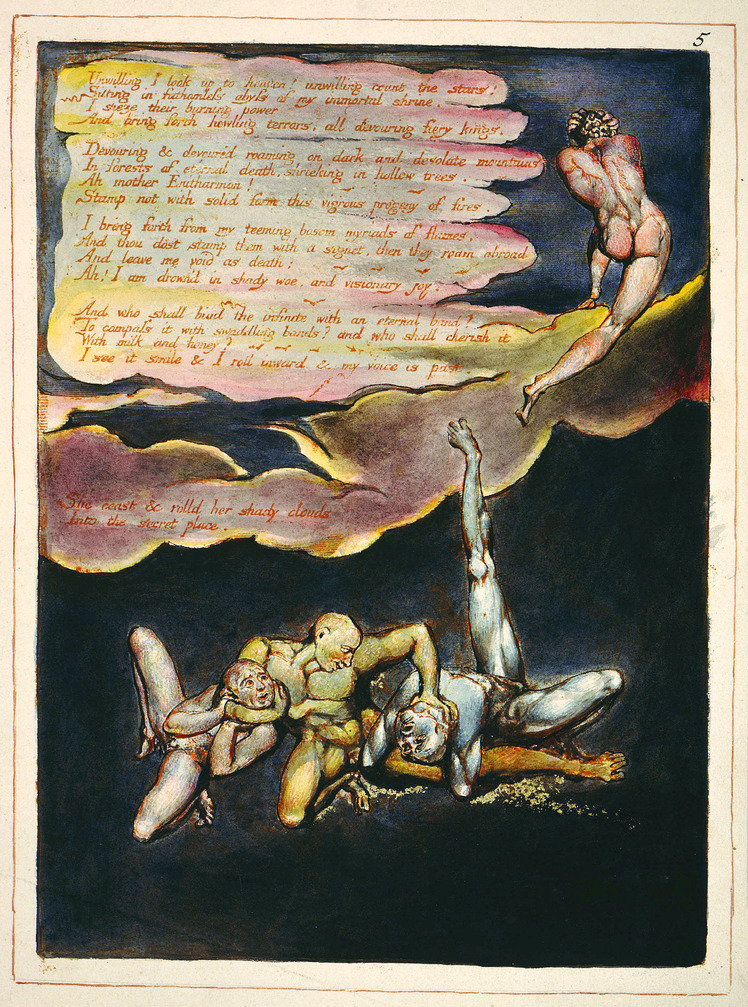
You can follow pictures from Blake's America and Europe thru looking at the books at the Internet Archive as you listen to the lecture.

America - Internet Archive  

Europe - Internet Archive

In 2015 Yale Center for British Art presented an Exihibition titled Critique of Reason: Romantic Art,1760-1860. Included in the Exihibition were several of Blake's works.

The following quote is from the Yale Center for British Art, Gallery label for the Critique of Reason: Romantic Art,1760 -1860.

"At the height of the political and social upheaval of the French Revolution, William Blake printed his first full-scale prophetic book, America. A Prophecy. Rather than recounting the horrors that reverberated from France throughout Europe, his illustrated poem reflects on the revolutionary spirit in the American colonies, which had ended in American independence a decade earlier. Blake and many other radicals in the 1790s viewed the American Revolution as the beginning of a global process of liberating nations from superstition and despotism. Although America. A Prophecy is rooted in recent events, the text and accompanying plates do not offer a historical chronology but rather transform history into a mythical narrative of universal relevance."

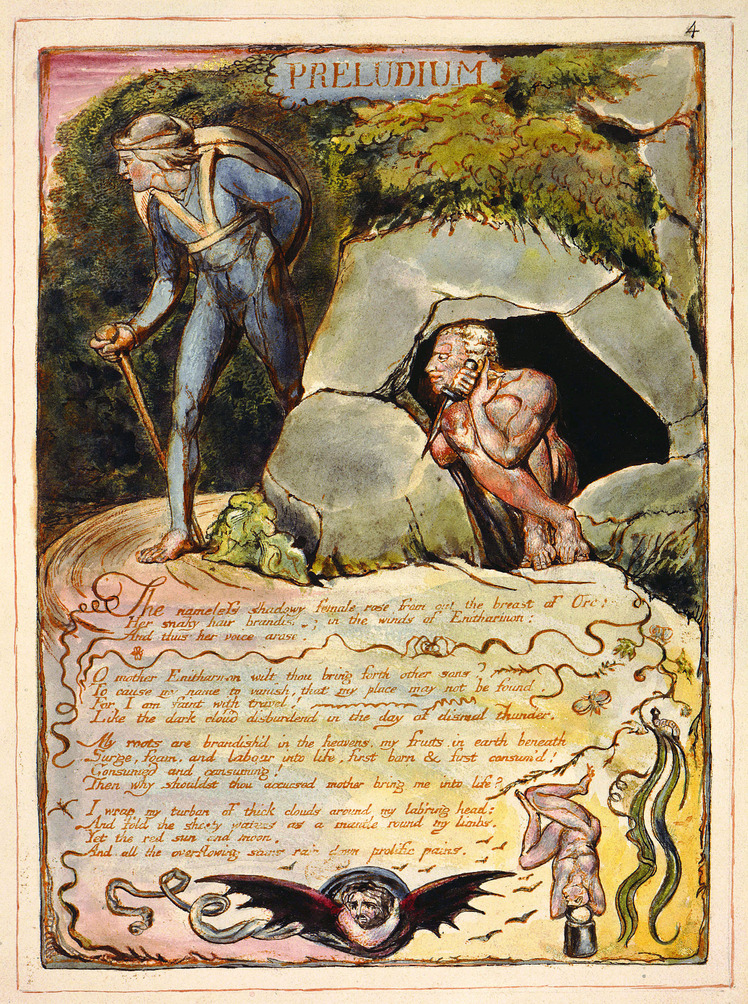
I think I was most impressed by Professor Wilson's description of Orc since my association of Orc has been as Los and Enithirmon's jealous son as shown in this picture.

Yale Center for British Art
Book of Urizen
Plate 18

However I need to think of Orc more as the Energy, Freedom, Youth, and Desire motivating the Rebel.


Yale Center for British Art
America
Plate 10

Sunday, September 04, 2022

RED ORC

New York Public Library
Europe
Plate 14

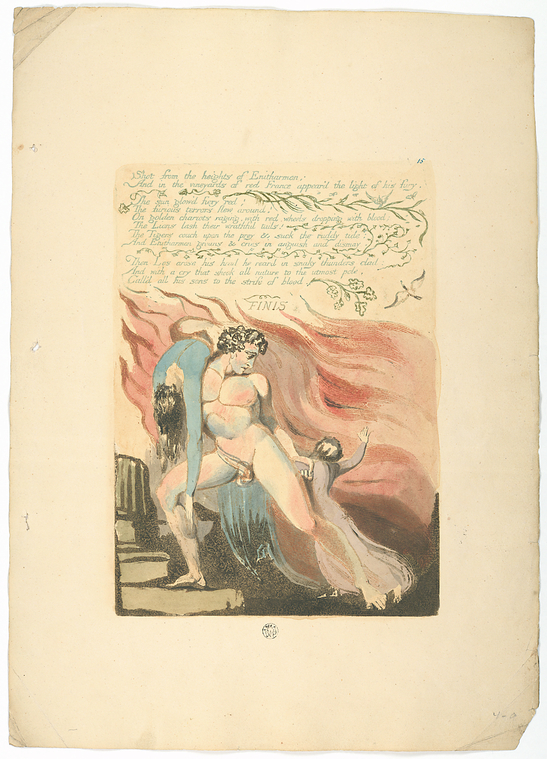
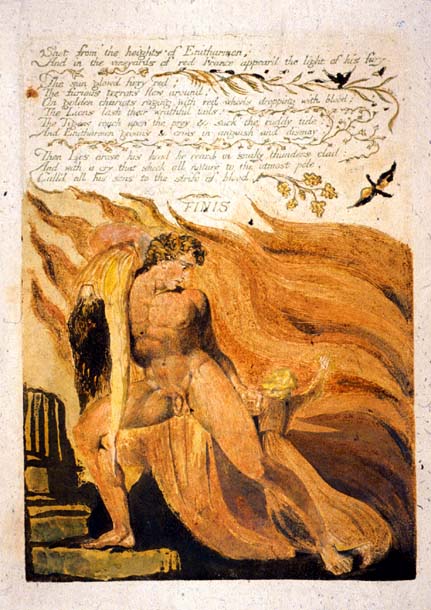
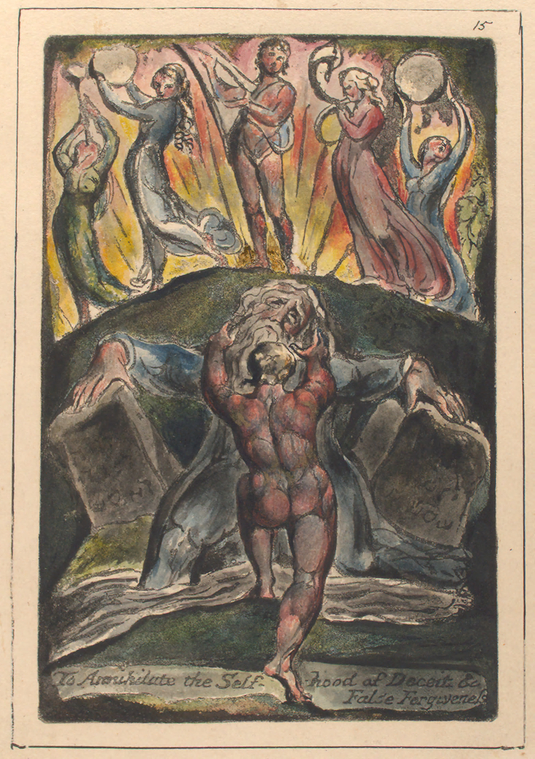
This is the final plate of Europe showing the flames of Orc behind Los who is rescuing his daughters from the conflagration.

Milton Percival, on page 210 of William Blake's Circle of Destiny states:

"A cold and selfish world, without the principal of change, is the goal of Urizen's endeavor.

The fire force which prevents this eventuality is personified in Orc...Under the repression of a religion of rationalism, such as the unregenerate Los creates, the emotions become a dark and tormenting fire with both the will and the power to destroy the forces that harass them. Luvah appears in the fiery form of Orc. With his birth the Generative world begins - the Generative world out of which regeneration is to come...Every time a religion, a philosophy, or a created form of any sort is demolished, human passion, as symbolized by Orc, provides the destructive power...

As the principle of revolt in the fallen world, Orc is the 'evil' of the orthodox, struggling with the passivity and the negation which they impose...In him is all the anguish of self-righteous man in a struggle with his own self-righteousness. His is the torment of a man who believes himself a sinner and his God the principle of wrath against which he revolts, only to see himself in his revolt as a blasphemer against his God. He is that something in man which endures the torment, the cause of which he cannot define because it is hidden deep within himself."


Europe, Plate 14, (E 66)

"Arise and please the horrent fiend with your melodious songs.
Still all your thunders golden hoofd, & bind your horses black.
Orc! smile upon my children!
Smile son of my afflictions.                                     
Arise O Orc and give our mountains joy of thy red light.

She ceas'd, for All were forth at sport beneath the solemn moon 
Waking the stars of Urizen with their immortal songs,
That nature felt thro' all her pores the enormous revelry,
Till morning ope'd the eastern gate.                             
Then every one fled to his station, & Enitharmon wept.

But terrible Orc, when he beheld the morning in the east,
Plate 15
Shot from the heights of Enitharmon;                
And in the vineyards of red France appear'd the light of his  fury.

The sun glow'd fiery red!
The furious terrors flew around!
On golden chariots raging, with red wheels dropping with blood;  
The Lions lash their wrathful tails!
The Tigers couch upon the prey & suck the ruddy tide:
And Enitharmon groans & cries in anguish and dismay.

Then Los arose his head he reard in snaky thunders clad:
And with a cry that shook all nature to the utmost pole,         
Call'd all his sons to the strife of blood.
                 FINIS"

Thursday, April 01, 2021

BLAKE & STRINGS 4

New York Public Library
Milton
Plate 15
 

I think that the idea that is conveyed by the concept of the Music of the Spheres is of the universe functioning as a single unit whose individual notes together produce a symphony. The plucking of a single string produces a single note. Striking the strings of the 'sphery harp' initiates the production of a diversity of notes which result in both harmony and dissonance.

The music played on the sphery harp is complex. It draws together all emotions, sensations, thoughts and intimations. It is not timid or reticent: what needs to be expressed is expressed, even if it is unpleasant.

Blake points to the Music of the Spheres as he brings into his field of attention the characters who populate his myth. Blake begins Jerusalem with the promise of a song which constantly calls him to announce the awaking to Eternal Life. Europe is prefaced by a song with offers a glimpse through the windows of our senses. It is reason, however who awakes the 'thunders of the deep' by striking the 'elemental strings.' In the Four Zoas it is Enitharmon who joins the orchestra by striking the strings. By bringing control under the dominion of woman, the way for the birth of her 'Fiery Son' Orc is opened. 'The horrid trumpets of the deep bellowd with bitter blasts' as Orc made his entrance. 'Discord began then yells & cries shook the wide firmament.' 

Jerusalem, Plate 4, (E146)

"Of the Sleep of Ulro! and of the passage through
Eternal Death! and of the awaking to Eternal Life.

This theme calls me in sleep night after night, & ev'ry morn
Awakes me at sun-rise, then I see the Saviour over me
Spreading his beams of love, & dictating the words of this mild song.  

Awake! awake O sleeper of the land of shadows, wake! expand!"
Europe, Plate iii, (E 60)
"Five windows light the cavern'd Man; thro' one he breathes the air;
Thro' one, hears music of the spheres; thro' one, the eternal vine
Flourishes, that he may recieve the grapes; thro' one can look.
And see small portions of the eternal world that ever groweth;
Thro' one, himself pass out what time he please, but he will not;
For stolen joys are sweet, & bread eaten in secret pleasant.

 So sang a Fairy mocking as he sat on a streak'd Tulip," 

Europe, Plate 3, (E 61)
"Again the night is come                           
That strong Urthona takes his rest,                              
And Urizen unloos'd from chains                                  
Glows like a meteor in the distant north
Stretch forth your hands and strike the elemental strings!
Awake the thunders of the deep.
Plate 4                                          
The shrill winds wake                                            
Till all the sons of Urizen look out and envy Los:
Sieze all the spirits of life and bind
Their warbling joys to our loud strings                          

Bind all the nourishing sweets of earth                          
To give us bliss, that we may drink the sparkling wine of Los
And let us laugh at war,
Despising toil and care,
Because the days and nights of joy, in lucky hours renew."

Four Zoas, Night II, Page 34, (E 323) 
"Night passd & Enitharmon eer the dawn returnd in bliss           
She sang Oer Los reviving him to Life his groans were terrible
But thus she sang. I sieze the sphery harp I strike the strings

At the first Sound the Golden sun arises from the Deep
And shakes his awful hair
The Eccho wakes the moon to unbind her silver locks              
The golden sun bears on my song
And nine bright spheres of harmony rise round the fiery King

The joy of woman is the Death of her most best beloved
Who dies for Love of her
In torments of fierce jealousy & pangs of adoration.             
The Lovers night bears on my song
And the nine Spheres rejoice beneath my powerful controll

They sing unceasing to the notes of my immortal hand
The solemn silent moon
Reverberates the living harmony upon my limbs                   
The birds & beasts rejoice & play
And every one seeks for his mate to prove his inmost joy"

Four Zoas, Night II, Page 34, (E 324)
"Arise you little glancing wings & sing your infant joy
Arise & drink your bliss
For every thing that lives is holy for the source of life        
Descends to be a weeping babe
For the Earthworm renews the moisture of the sandy plain

Now my left hand I stretch to earth beneath
And strike the terrible string
I wake sweet joy in dens of sorrow & I plant a smile             
In forests of affliction
And wake the bubbling springs of life in regions of dark death

O I am weary lay thine hand upon me or I faint
I faint beneath these beams of thine
For thou hast touchd my five senses & they answerd thee          
Now I am nothing & I sink
And on the bed of silence sleep till thou awakest me

Thus sang the Lovely one in Rapturous delusive trance
Los heard reviving he siezd her in his arms delusive hopes  
Kindling She led him into Shadows & thence fled outstretchd      
Upon the immense like a bright rainbow weeping & smiling & fading"

Four Zoas, Night V, Page 57, (E339)
"He stood trembling & Enitharmon clung around his knees
Their senses unexpansive in one stedfast bulk remain
The night blew cold & Enitharmon shriekd on the dismal wind      
Page 58 
Her pale hands cling around her husband & over her weak head
Shadows of Eternal death sit in the leaden air

But the soft pipe the flute the viol organ harp & cymbal
And the sweet sound of silver voices calm the weary couch
Of Enitharmon but her groans drown the immortal harps           
Loud & more loud the living music floats upon the air
Faint & more faint the daylight wanes. The wheels of turning darkness
Began in solemn revolutions. Earth convulsd with rending pangs
Rockd to & fro & cried sore at the groans of Enitharmon   
Still the faint harps & silver voices calm the weary couch      
But from the caves of deepest night ascending in clouds of mist
The winter spread his wide black wings across from pole to pole
Grim frost beneath & terrible snow linkd in a marriage chain
Began a dismal dance. The winds around on pointed rocks
Settled like bats innumerable ready to fly abroad            
The groans of Enitharmon shake the skies the labring Earth
Till from her heart rending his way a terrible Child sprang forth
In thunder smoke & sullen flames & howlings & fury & blood

Soon as his burning Eyes were opend on the Abyss
The horrid trumpets of the deep bellowd with bitter blasts      
The Enormous Demons woke & howld around the new born king   
Crying Luvah King of Love thou art the King of rage & death
Urizen cast deep darkness round him raging Luvah pourd    
The spears of Urizen from Chariots round the Eternal tent
Discord began then yells & cries shook the wide firmament" 

The Music of the Spheres has captured the interest of scientists as well as poets. Some have set themselves the task of organizing and amplifying the potential sounds of the universe to make them visible and audible to our senses.

Thursday, April 30, 2020

NIGHTMARE OF HISTORY

Glasgow Library
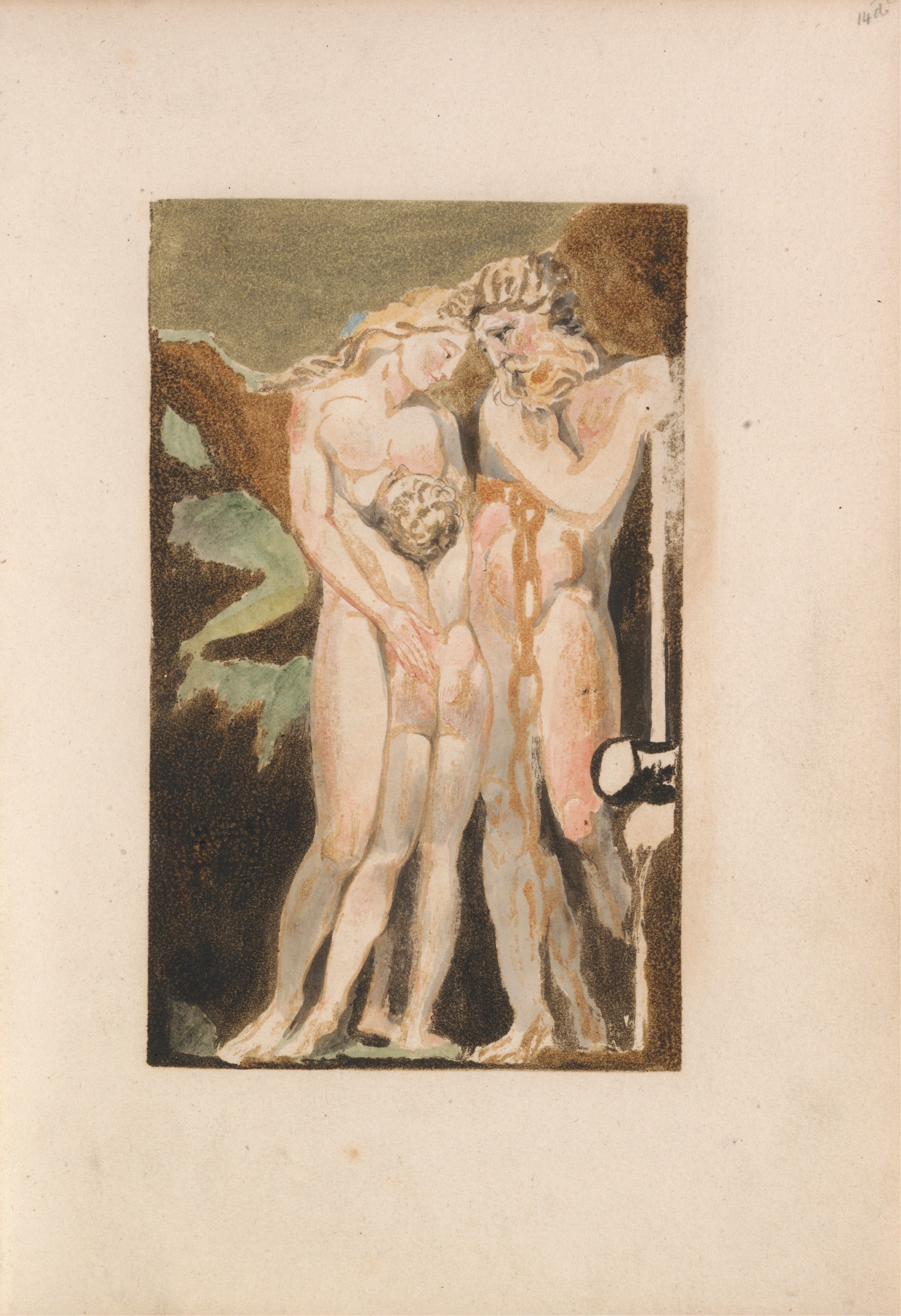
Europe
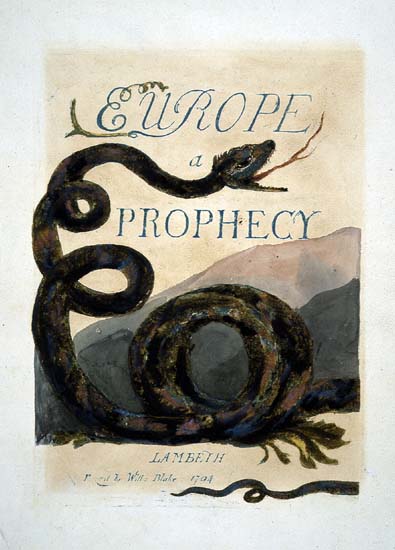
Title Plate

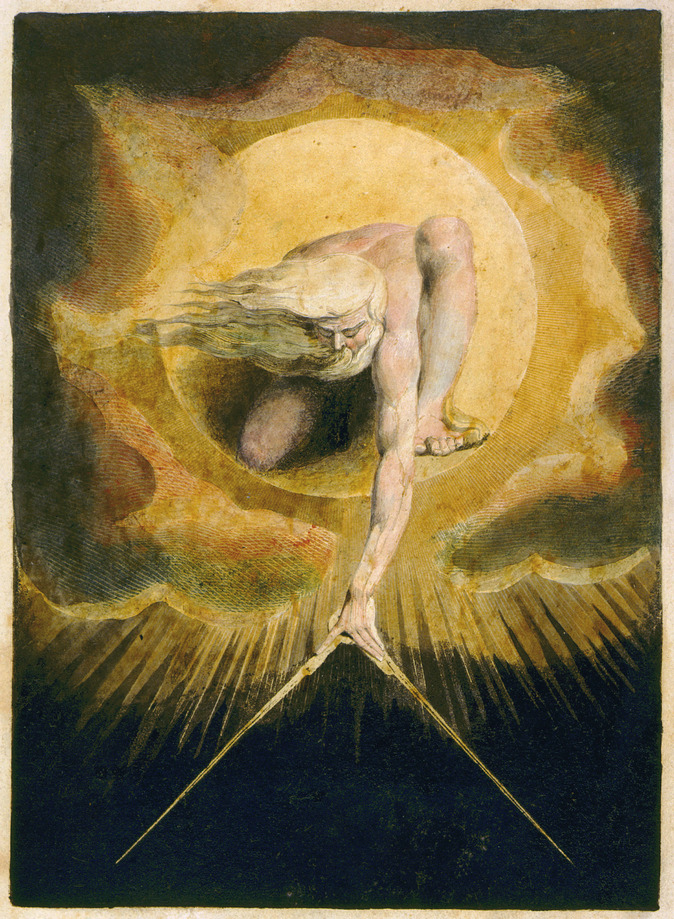
In illustrating Europe, A Prophecy Blake deviated from the text in several instances. He choose to focus attention on disasters which may befall mankind either as a result of his own decisions or because of circumstances beyond his control. In A Blake Dictionary, Damon names the full page illustrations Famine and Plague, and the Frontispiece illustration Ancient of Days showing the limits being set for man's activity. He mentions also images showing Treachery, Cruelty, War, Blighted Harvest and Imprisonment.

The narrative of the book places the historical events of Blake's own times into the structure of Blake's myth, but the illustrations show calamities which may plague mankind in any time or place. We see that man is a victim as a consequence of living in uncaring nature within a political structure which is imposed upon him. 
 
Famine
Fear 
Power
Plague 
Pestilence
Fire 
Treachery 
Limitation 
Cycles of Revolution 
Mildew, Blighted Harvest
Imprisonment 
Cruelty
War


In his own city, London, around the time when this poem was being written Blake observed food shortages, military conscription, imprisonment for sedition, loyalty oaths, restrictions on assembly, and failures of Parliament and King to protect the citizens. In the previous century London had experienced the Black Plague and devastating Great Fire of London. Blake used the illustrations to emphasize the precarious situation in which mankind exists. 

From Blake's Apocalypse by Harold Bloom,
"In this unresolved intensity the most audacious poem Blake had yet written arrives at the the most inconclusive of his conclusions. The nightmare of history has been vividly exposed, but no cure for bad dreams has been suggested." (Page 161)

.

Thursday, August 23, 2018

ETERNITY'S SUN RISE

Wikimedia Commons
Europe
Plate 11
Appearances are deceiving. Beneath the surface is the reality which determines the import of what appears to be. For this reason we are responsible for knowing how to act in whatever circumstance is presented. We learn to act in accordance not with the appearance but with the underlying reality. The Angel perceives one reality and responds accordingly. To the Devil the situation appears opposite because his mind processes what he sees differently.

Blake could see from the perspective of both that of the Angel and the Devil and so avoided being trapped in either the Night or the Day. In his mind he discerned the fluctuations which brought together the knowledge which came from his unconscious and his conscious mind. He knew that Reason, Emotion, Sensation and Imagination contributed to understanding.

In the poem Joy & Woe Blake indicated that both perspectives are valid if they are rightly known and integrated into one fabric.
Songs and Ballads, from Notebook, (E 470)
         "Eternity

He who binds to himself a joy           
Does the winged life destroy
But he who kisses the joy as it flies    
Lives in eternity's sun rise            
               *                        
I heard an Angel singing
When the day was springing                                      
Mercy Pity Peace                        
Is the worlds release

Thus he sung all day                         
Over the new mown hay
Till the sun went down
And haycocks looked brown

I heard a Devil curse
Over the heath & the furze                
Mercy could be no more
If there was nobody poor

And pity no more could be
If all were as happy as we
At his curse the sun went down          
And the heavens gave a frown

Down pourd the heavy rain               
Over the new reapd grain
And Miseries increase                   
Is Mercy Pity Peace               
               *
Silent Silent Night
Quench the holy light
Of thy torches bright

For possessd of Day
Thousand spirits stray         
That sweet joys betray

Why should joys be sweet
Used with deceit
Nor with sorrows meet

But an honest joy               
Does itself destroy
For a harlot coy"

Auguries on Innocence, (E 491)
"It is right it should be so 
Man was made for Joy & Woe
And when this we rightly know
Thro the World we safely go
Joy & Woe are woven fine
A Clothing for the soul divine 
Under every grief & pine
Runs a joy with silken twine
The Babe is more than swadling Bands
Throughout all these Human Lands"
. 

Thursday, June 29, 2017

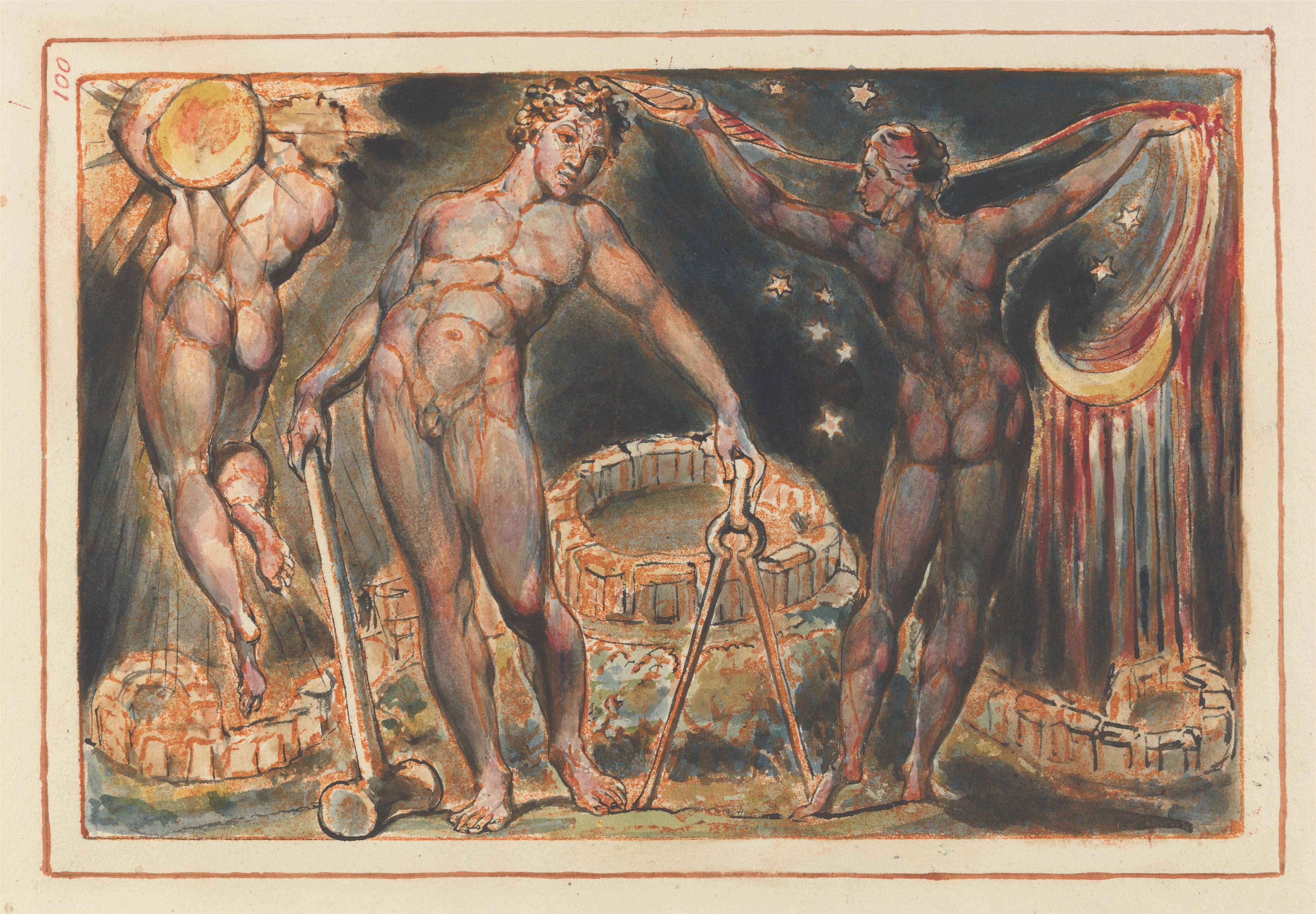
FOUR COMPASS IMAGES

Wikipedia Commons
Library of Congress
Europe
Frontispiece
Blog post - Europe

The New Art Gallery Walsall, West Midlands of England
The Garman Ryan Collection
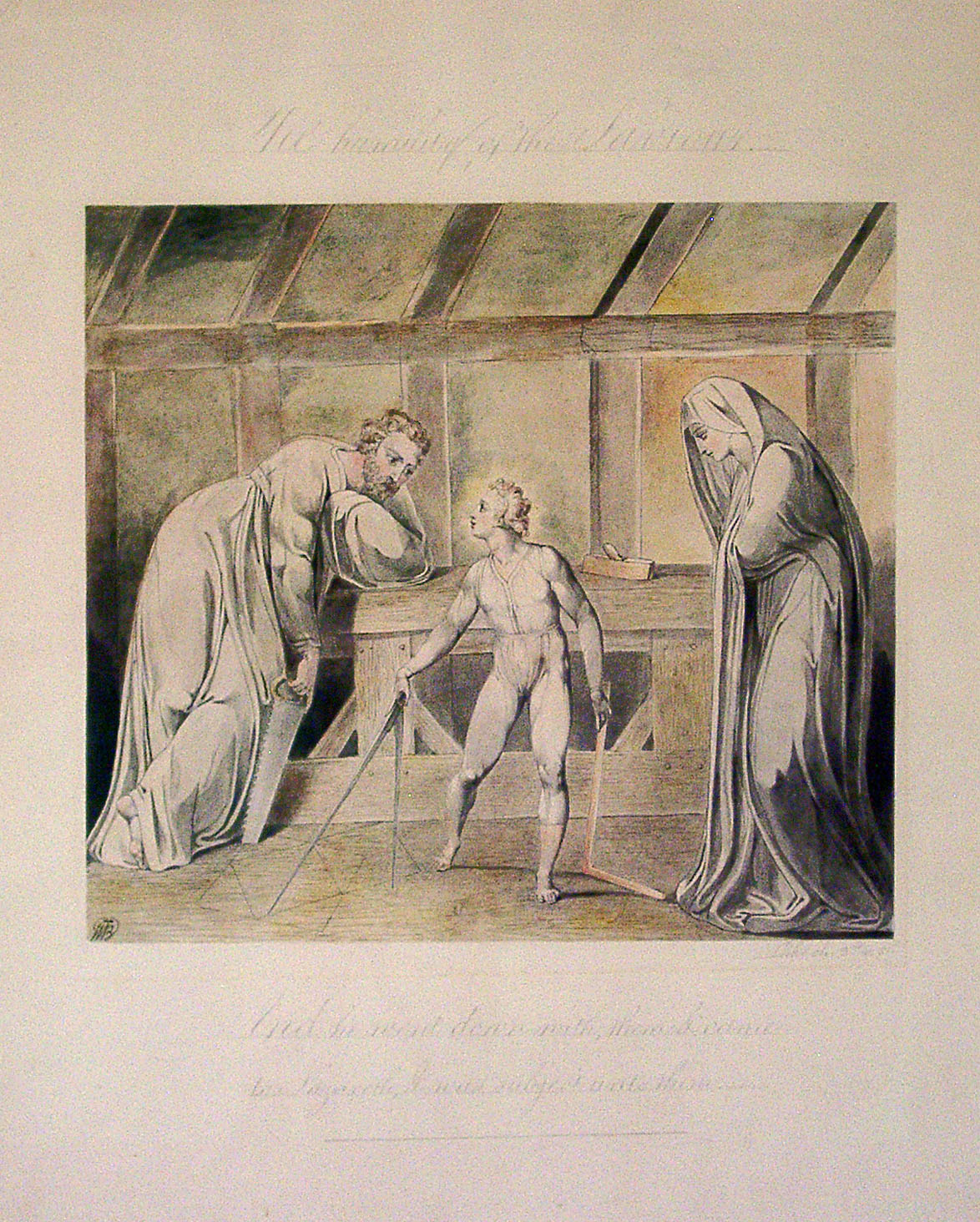
Christ in the Carpenters Shop
The Humility of the Savior
Blog post - Carpenter's Shop

Wikipedia Commons
Large Color Printed Drawings
Newton
Blog post - Newton
 
Yale Center for British Art
Jerusalem
Plate 100
 Blog post - Jerusalem Finale


Image - INFANT JESUS WITH COMPASS

 
Post - There Is No Natural Religion


Tuesday, November 18, 2014

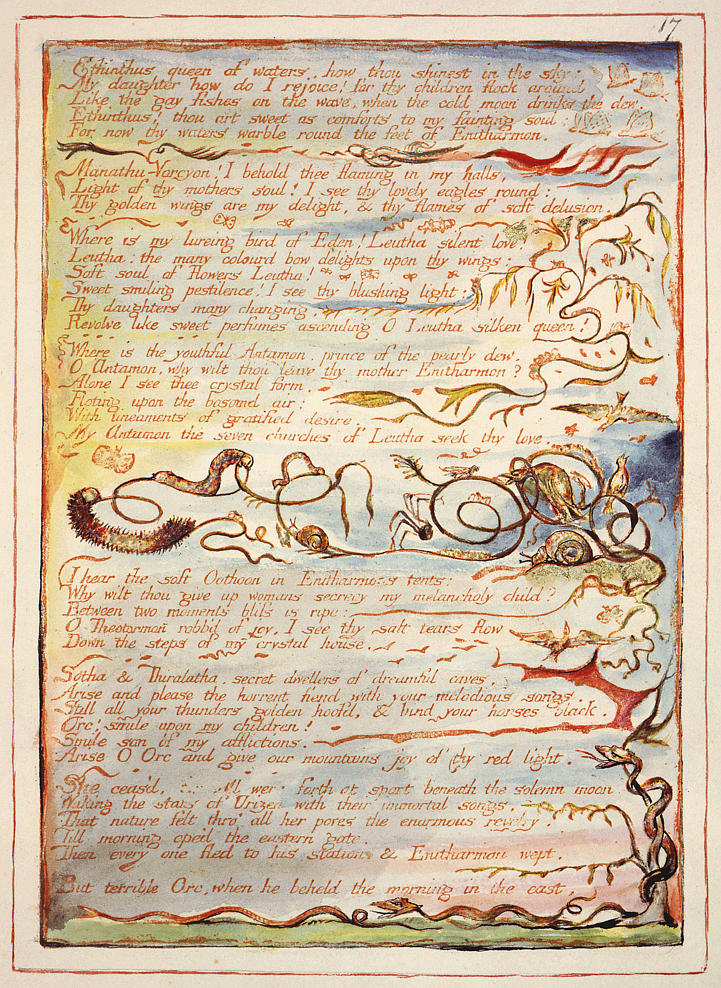
EUROPE PLATE 17

British Museum
Europe
Plate 17, Copy D
Blake lived in turbulent times. No one who had been involved in the storming by a mob of the Newgate Prison would be likely to forget the fury of the uncontrollable violence. Perhaps this is what occupied Blake's mind as he engraved the words and image on Plate 17 of Europe. It had been 14 years since the young Blake had been swept up in the rioting which went on for six days and resulted in property damage, release of prisoners, shootings and hangings of rioters. The results as well as the causes of the Gordon Riots were ambiguous. Blake intimates the same ambiguity as he brings Europe to a conclusion.

Considering the turmoil in England and on the continent of Europe in 1794 and in the previous years since Blake's birth in 1757, cries of 'anguish and dismay' could be expected to continue. Would the agony of war and disintegration continue or would it be resolved in a new birth of consciousness? The final note of Europe is the arrival of the visionary Los to play an active, assertive role in reordering a chaotic situation. Signs of apprehension and sings of hope intermingle as Blake seeks solutions to the tumult in the cauldron of his mind or his outer world.

Europe, Plate 15, (E 66)
"Shot from the heights of Enitharmon;         
And in the vineyards of red France appear'd the light of his fury.

The sun glow'd fiery red!
The furious terrors flew around!
On golden chariots raging, with red wheels dropping with blood;  
The Lions lash their wrathful tails!
The Tigers couch upon the prey & suck the ruddy tide:
And Enitharmon groans & cries in anguish and dismay.

Then Los arose his head he reard in snaky thunders clad:
And with a cry that shook all nature to the utmost pole,         
Call'd all his sons to the strife of blood.
                 FINIS"
Harold Bloom in Blake's Apocalypse commenting on Plates 57 and 58 of Jerusalem makes a statement apropos to understanding Europe:
 
"The struggle is continuous, and always indecisive, but throughout this dark war for the future the daughters of Los remain at their wheels of life, generating the substance of the human." (Page 407)
 
The inscription written by Cumberland above this picture is the word "Fire". Below the image is a passage from Sir Richard Blackmore's Prince Arthur as quoted in Edward Bysshe's The Art of English Poetry:

"Th'impetuous flames with lawless powr advance,
On ruddy wings the bright destruction flies,
follow'd with ruin and distressful cries,
The flaky Plague spreads swiftly with the wind
And gastly desolation howls behind."

Blake's use of the symbol Fire in his poetry can be pursued in these posts:

Four Elements

The Element Fire
 

Alchemy

Consumed by Fire

Fires of Orc

Sunday, November 16, 2014

EUROPE PLATE 16

Enitharmon had awakened from her sleep and been empowered by the dominance of
Fitzwilliam Museum
Europe
Copy K, Plate 17
Newton's thought which was replacing traditional religious interpretations and inhibitions. The form that Enitharmon's new freedom took was a degrading of sexual activity under her doctrine of chastity.

There are four couples named on this plate each of which, Damon in A Blake Dictionary tells us, is a further repression of the ideal sexual experience which is: "Cominglings: from the Head even to the Feet; And not a pompous High Priest entering by a Secret Place."


These are the are the four couples:

Ethinthus
& Manathu-Vorcyon
Leutha & Antamon
Oothoon & Theotormon
Sotha & Thiralatha.

 
Damon's understanding (Page 124) is that Blake is saying that when sex is not seen as holy, it first becomes a purely physical experience, then becomes identified as sinful, following that men and women are frustrated by abstinence. The final stage is preoccupation with the erotic dream and transferal of sexual energy to the aggression of war.

This plate presents the Night of Enitharmon's Joy to the extreme; it is she who "felt thro' all her pores the enormous revelry." But she wept at morning's light when Orc made his presence known.
Europe, PLATE 14, (E 65)
"Ethinthus queen of waters, how thou shinest in the sky:
My daughter how do I rejoice! for thy children flock around
Like the gay fishes on the wave, when the cold moon drinks the dew.
Ethinthus! thou art sweet as comforts to my fainting soul:
For now thy waters warble round the feet of Enitharmon.          

Manathu-Vorcyon! I behold thee flaming in my halls,
Light of thy mothers soul! I see thy lovely eagles round;
Thy golden wings are my delight, & thy flames of soft delusion.

Where is my lureing bird of Eden! Leutha silent love!
Leutha, the many colourd bow delights upon thy wings:            
Soft soul of flowers Leutha!
Sweet smiling pestilence! I see thy blushing light:
Thy daughters many changing,
Revolve like sweet perfumes ascending O Leutha silken queen!

Where is the youthful Antamon. prince of the pearly dew,
O Antamon, why wilt thou leave thy mother Enitharmon?
Alone I see thee crystal form,
Floting upon the bosomd air:
With lineaments of gratified desire.
My Antamon the seven churches of Leutha seek thy love.  

I hear the soft Oothoon in Enitharmons tents:
Why wilt thou give up womans secrecy my melancholy child?
Between two moments bliss is ripe:
O Theotormon robb'd of joy, I see thy salt tears flow
Down the steps of my crystal house.                              

Sotha & Thiralatha, secret dwellers of dreamful caves,
Arise and please the horrent fiend with your melodious songs.
Still all your thunders golden hoofd, & bind your horses black.
Orc! smile upon my children!
Smile son of my afflictions.                                     
Arise O Orc and give our mountains joy of thy red light.

She ceas'd, for All were forth at sport beneath the solemn moon 
Waking the stars of Urizen with their immortal songs,
That nature felt thro' all her pores the enormous revelry,
Till morning ope'd the eastern gate.                             
Then every one fled to his station, & Enitharmon wept.

But terrible Orc, when he beheld the morning in the east,"

Jerusalem, Plate 69, (E 223)
"Mutual Hate returns & mutual Deceit & mutual Fear.

Hence the Infernal Veil grows in the disobedient Female:
Which Jesus rends & the whole Druid Law removes away
From the Inner Sanctuary: a False Holiness hid within the Center,
For the Sanctuary of Eden. is in the Camp: in the Outline,
In the Circumference: & every Minute Particular is Holy:
Embraces are Cominglings: from the Head even to the Feet;
And not a pompous High Priest entering by a Secret Place."  
You may be curious about the illustration on this plate with its proliferation of growing, blooming, crawling and flying forms of life. This too is an aspect of Enitharmon who, as mother nature, has innumerable children including the three serpents at the bottom of the page.

Friday, November 14, 2014

EUROPE PLATE 15

British Museum
Europe
Plate 15, Copy D
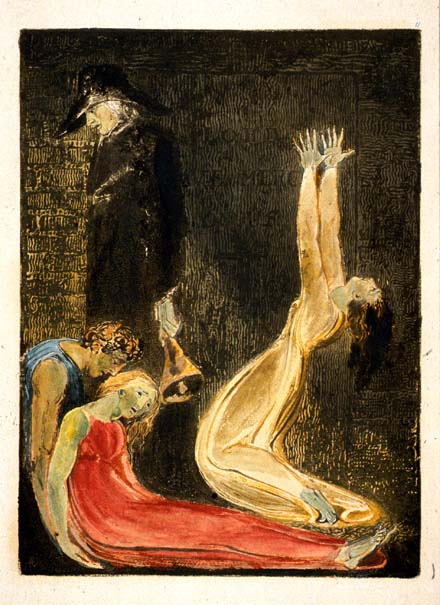
The theme of imprisonment on Plate 14 of Europe is continued on Plate 15. The inscription by Cumberland above the image is the word 'Imprisonment'. Below the picture is a quote from a play by William Shakespeare and John Fletcher: The Two Noble Kinsmen, which is a retelling of The Knight's Tale from Chaucer's Canterbury Tales.  Imprisoned together, the two main characters are in conversation about their plight.
 
"This is all our world __ we shall nothing know
Nothing hear, but the Clock that tells our woes,
The vine shall grow, but we shall never see it,
Summer shall come, and with her all delights,
But dead cold winter still inhabit here."


 In the image we see a shackled prisoner appearing to be warding off some impending threat, and a scaly jailer hurriedly mounting the staircase. The image may portray pictorially the idea that the punisher becomes a victim of punishment. The doom which threatens the prisoner awaits the jailer as well.  

The text of Plate 15 portrays events of climax. The Trump of Doom is blown not by revolutionary or reactionary forces but by Newton who introduces the new age of empirical science. Enitharmon's dream is over. She calls forth her daughter Ethinthus whom Damon calls 'the mortal flesh.'  She degrades sexual experience to mere physicality, as is appropriate for the new materialistic philosophy of Bacon and Newton.  

Europe, Plate 13, (E 65)
"The red limb'd Angel siez'd, in horror and torment;
The Trump of the last doom; but he could not blow the iron tube!
Thrice he assay'd presumptuous to awake the dead to Judgment.

A mighty Spirit leap'd from the land of Albion,
Nam'd Newton; he siez'd the Trump, & blow'd the enormous blast!  
Yellow as leaves of Autumn the myriads of Angelic hosts,
Fell thro' the wintry skies seeking their graves;
Rattling their hollow bones in howling and lamentation.

    Then Enitharmon woke, nor knew that she had slept
And eighteen hundred years were fled                             
As if they had not been
She calld her sons & daughters
To the sports of night,
Within her crystal house;
And thus her song proceeds.                                      

Arise Ethinthus! tho' the earth-worm call;
Let him call in vain;
Till the night of holy shadows
And human solitude is past!"

Here is a longer quote from the play cited by Cumberland in the inscription:

The Two Noble Kinsmen, ACT 2. SC. 2
William Shakespeare and John Fletcher

PALAMON
"Like proud Seas under us: our good Swords now
(Better the red-eyd god of war nev'r wore)
Ravishd our sides, like age must run to rust,
And decke the Temples of those gods that hate us:
These hands shall never draw'em out like lightning,
To blast whole Armies more.
ARCITE.
No, Palamon,
Those hopes are Prisoners with us; here we are
And here the graces of our youthes must wither
Like a too-timely Spring; here age must finde us,
And, which is heaviest, Palamon, unmarried;
The sweete embraces of a loving wife,
Loden with kisses, armd with thousand Cupids
Shall never claspe our neckes, no issue know us,
No figures of our selves shall we ev'r see,
To glad our age, and like young Eagles teach 'em
Boldly to gaze against bright armes, and say:
'Remember what your fathers were, and conquer.'
The faire-eyd Maides, shall weepe our Banishments,
And in their Songs, curse ever-blinded fortune,
Till shee for shame see what a wrong she has done
To youth and nature.  This is all our world;
We shall know nothing here but one another,
Heare nothing but the Clocke that tels our woes.
The Vine shall grow, but we shall never see it:
Sommer shall come, and with her all delights;
But dead-cold winter must inhabite here still."

Wednesday, November 12, 2014

EUROPE PLATE 14

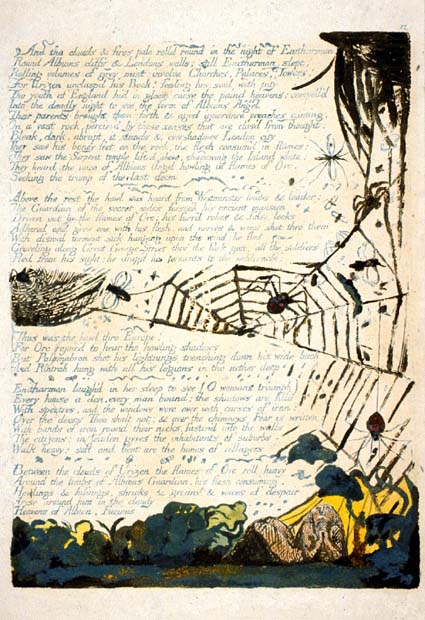
Perhaps we should take our first clue as to the meaning of Plate 14 of Europe from the inscriptions. What Blake intends to describe can be symbolized by being imprisoned in a dungeon. The images on the of webs and spiders, insects flying and crawling everywhere, give the impression of a dark, damp dungeon. Doubly trapped is the woman enclosed in a net asking for help from above.
Above the image is the word "Dungeon." Below the image Cumberland has written lines from Dryden's opera libretto King Arthur. The passage can be found in Bysshe's The art of English Poetry.

"Them to a Dungeons depth I sent, fast bound,
Where stow'd with snakes and adders now they lodge,
The rats brush oer their faces with their tails,
And croaking Paddocks [frogs or toads] crawl upon thier limbs.
                                                       Dryden."
With the help of David Erdman's Blake: Prophet Against Empire, the imagery of Plate 14 becomes clearer. Much of this information is found in Chapter 9, Seeking the Trump of Doom, particularly pages 212-218.

On Plate 14 Blake has used historical data to provide the framework for his commentary on the human condition. A proclamation was issued by England's George III in cooperation with his prime minister William Pitt in 1792 against 'divers wicked and seditious writings.' Pitt was able to force the Chancellor Thurlow from his position because of his mild criticism of this proclamation. 

Blake both concealed and revealed his reaction to the Proclamation on Plate 14 of Europe. Erdman tells us that when Blake wrote the following lines he was referring to the dismissal of Chancellor Thurlow by Pitt from his position which included Keeper of the Seal and Guardian of the King's Conscience.
"Above the rest the howl was heard from Westminster louder & louder:
The Guardian of the secret codes forsook his ancient mansion,"  

Blake also is referring to Thurlow when he mentions 'furr'd robes
      & false locks' which were removed before 'he fled Groveling
      along Great George Street thro' the Park gate.'

Erdman tells us that, "Historians agree with Blake that this Proclamation began England's 'black era of reaction and coercion'" (Page 216). The Proclamation was issued a second time in 1794 linking it to a formal calling out of the militia . Blake's allusion to these circumstances is contained in these words:

"The youth of England hid in gloom curse the paind heavens; compell'd         
Into the deadly night to see the form of Albions Angel
Their parents brought them forth & aged ignorance preaches canting,
On a vast rock, perciev'd by those senses that are clos'd from thought:"
Blake considered that the combination of suppression of speech, and the dedication of troops and weaponry to an undeclared war, represented the intention of the government to restrict liberty and confine England in an unpleasant dungeon not of her choosing.     

The restrictions and deprivations which the people endured were reflected back upon the government which decreed them. The king was caught between the false rationality of Urizen's fearfulness and the demand for change from fiery Orc. His refuge was retreat into the despair of his own periodic mental illness.
Europe, Plate 12, (E 64)
"And the clouds & fires pale rolld round in the night of Enitharmon
Round Albions cliffs & Londons walls; still Enitharmon slept!
Rolling volumes of grey mist involve Churches, Palaces, Towers:
For Urizen unclaspd his Book: feeding his soul with pity
The youth of England hid in gloom curse the paind heavens; compell'd         
Into the deadly night to see the form of Albions Angel
Their parents brought them forth & aged ignorance preaches canting,
On a vast rock, perciev'd by those senses that are clos'd from thought:
Bleak, dark, abrupt, it stands & overshadows London city
They saw his boney feet on the rock, the flesh consum'd in flames:        
They saw the Serpent temple lifted above, shadowing the Island white:
They heard the voice of Albions Angel howling in flames of Orc,
Seeking the trump of the last doom

Above the rest the howl was heard from Westminster louder & louder:
The Guardian of the secret codes forsook his ancient mansion,    
Driven out by the flames of Orc; his furr'd robes & false locks
Adhered and grew one with his flesh, and nerves & veins shot thro' them
With dismal torment sick hanging upon the wind: he fled
Groveling along Great George Street thro' the Park gate; all the soldiers
Fled from his sight; he drag'd his torments to the wilderness.   

Thus was the howl thro Europe!
For Orc rejoic'd to hear the howling shadows
But Palamabron shot his lightnings trenching down his wide back
And Rintrah hung with all his legions in the nether deep

Enitharmon laugh'd in her sleep to see (O womans triumph)        
Every house a den, every man bound; the shadows are filld
With spectres, and the windows wove over with curses of iron:
Over the doors Thou shalt not; & over the chimneys Fear is written:
With bands of iron round their necks fasten'd into the walls
The citizens: in leaden gyves the inhabitants of suburbs         
Walk heavy: soft and bent are the bones of villagers

Between the clouds of Urizen the flames of Orc roll heavy
Around the limbs of Albions Guardian, his flesh consuming.
Howlings & hissings, shrieks & groans, & voices of despair
Arise around him in the cloudy   
Heavens of Albion, Furious"
Blake returnd to the incident of Thurlow's dismissal in Milton:

Milton, Plate 8, (E 102)
"Michael contended against Satan in the rolling thunder
Thulloh the friend of Satan also reprovd him; faint their reproof.

But Rintrah who is of the reprobate: of those form'd to destruction
In indignation. for Satans soft dissimulation of friendship!  
Flam'd above all the plowed furrows, angry red and furious,
Till Michael sat down in the furrow weary  dissolv'd in tears
Satan who drave the team beside him, stood angry & red
He smote Thulloh & slew him, & he stood terrible over Michael
Urging him to arise: he wept! Enitharmon saw his tears         
But Los hid Thulloh from her sight, lest she should die of grief
She wept: she trembled! she kissed Satan; she wept over Michael
She form'd a Space for Satan & Michael & for the poor infected[.]
Trembling she wept over the Space, & clos'd it with a tender Moon

Los secret buried Thulloh, weeping disconsolate over the moony Space     

But Palamabron called down a Great Solemn Assembly,
That he who will not defend Truth, may be compelled to
Defend a Lie, that he may be snared & caught & taken"

Monday, November 10, 2014

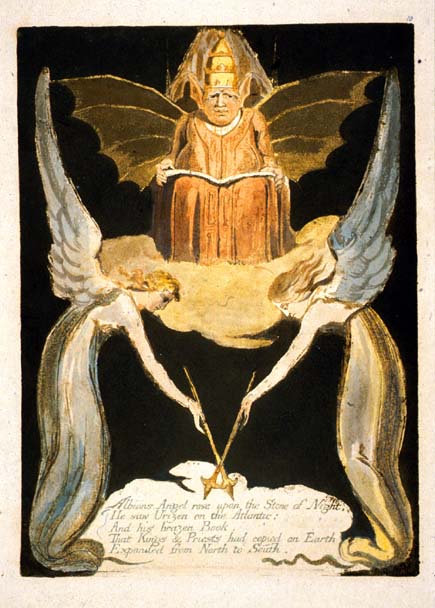
EUROPE PLATE 13

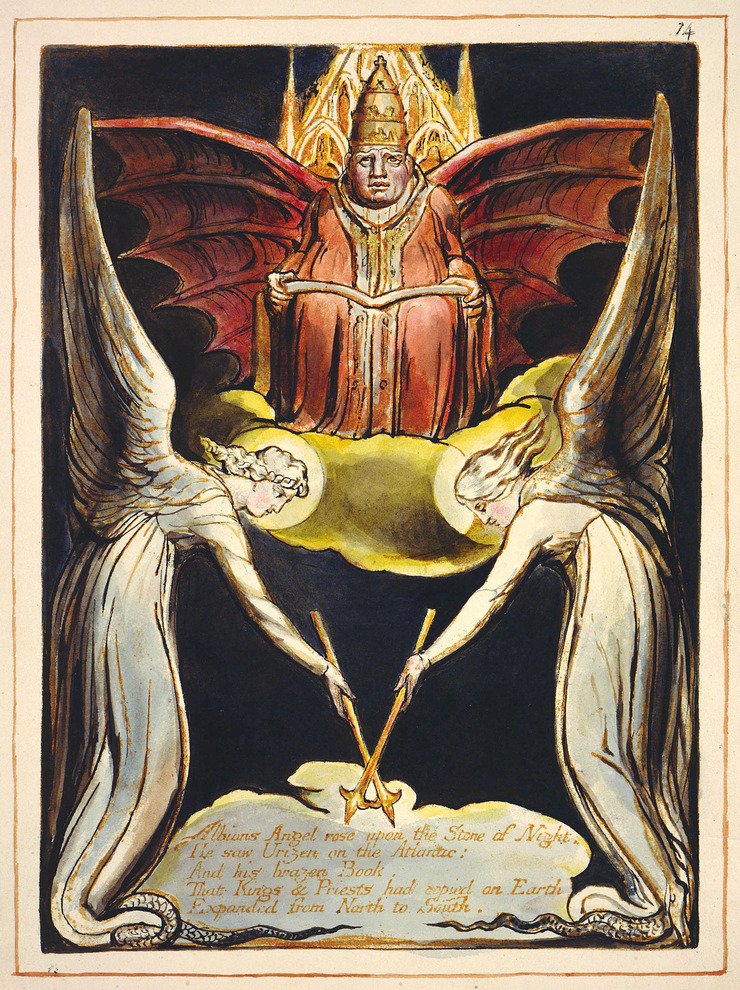
The inscription added by Cumberland reads:

"Papal [or Pagan], Superstition"

British Museum
Europe
Plate 13, Copy D
The image on Plate 13 of Copy D of Europe may strike you as amusing, shocking or mystifying. The figure on the throne bears the likeness of George III who was head of both church and state during his reign (1760-1820). Blake has created a parody of the leader to show the failures of the state and religion to meet the needs of the people whom it was their charge to protect and guide. The king has accepted the false assumptions of the prevailing culture which resisted the possibility of developing an honest, just, creative and inclusive society. The false reasoning of Urizen's book of accusation, judgement and punishment was replicated and executed unmercifully. Man suffered under the influence of the rigid, unforgiving, self-righteous attitudes epitomized in the hardness and darkness of the Stone of Night.    
 
Apparently the two winged figures are not what they masquerade as. In Copy K in the Fitzwilliam Museum their serpent forms emerge from the bottom of their gowns. It is most obvious in Copy K, too, that the wings of the 'angelic' beings (the Elect) support the flawed ruler of church and state, and that he rises out of the cloud of their thought.

Europe, Plate 11, (E 64)
"Albions Angel rose upon the Stone of Night.                  
He saw Urizen on the Atlantic;
And his brazen Book,
That Kings & Priests had copied on Earth
Expanded from North to South." 
Blake has much more to say about the damage done by the unholy alliance between church and state, the flavor of which can be found in these passages:  

Song of Los, Plate 6, (E 68)
"The Kings of Asia heard
The howl rise up from Europe!
And each ran out from his Web;
From his ancient woven Den;
For the darkness of Asia was startled                  
At the thick-flaming, thought-creating fires of Orc.

And the Kings of Asia stood
And cried in bitterness of soul.

Shall not the King call for Famine from the heath?
Nor the Priest, for Pestilence from the fen?            
To restrain! to dismay! to thin!
The inhabitants of mountain and plain;
In the day, of full-feeding prosperity;
And the night of delicious songs.

Shall not the Councellor throw his curb               
Of Poverty on the laborious?
To fix the price of labour;
To invent allegoric riches:

And the privy admonishers of men
Call for fires in the City                           
For heaps of smoking ruins,
In the night of prosperity & wantonness
To turn man from his path,
To restrain the child from the womb,"
Annotations to Watson, (E 615)
  "The Bible or Peculiar Word of God, Exclusive of Conscience
or the Word of God Universal, is that Abomination which like the
Jewish ceremonies is for ever removed & henceforth every man may
converse with God & be a King & Priest in his own house" 

Annotations to Bacon, (E 620) 
"Is it True or is it False that the Wisdom of this World is
Foolishness with God
     This is Certain   If what Bacon says Is True what Christ
says Is False   If Caesar is Right Christ is Wrong both in
Politics & Religion since they will divide them in Two"

Marriage of Heaven & Hell, Plate 25, (E 45)
" Let the Priests of the Raven of dawn, no longer in deadly
black, with hoarse note curse the sons of joy.  Nor his accepted
brethren whom, tyrant, he calls free; lay the bound or build the
roof.  Nor pale religious letchery call that virginity, that
wishes but acts not!
  For every thing that lives is Holy"

Saturday, November 08, 2014

EUROPE PLATE 12


British Museum
Europe 
Plate 12, Copy D
In losing sight of the infinite, mankind follows the serpent out of paradise into a world which is finite and temporal. The unbounded becomes circumscribed by limits. Although everything has been altered there is no memory of another state of being. Our challenge is to find an exit from the prison of our own minds which is represented by the serpent which encloses the infinite in the finite.

If the serpent is seen as the trap which operates internally, the Stone of Night may be seen as solidified external world which traps man in a natural world which he struggles futilely to control. In the Night of man's journey through time he encounters many stones: the stone tablets, the stone sealing Jesus's tomb, Albion's couch of death, the cornerstone which secures the foundation, the stone altar of sacrifice, and the stone of stumbling, among others.

As the Covering Cherub consolidates all the error which originates in the serpent, the Stone of Night consolidates the obstructions which result from the closing of the man's ability to use his organs of Spiritual Perception.

Annotations to Berkley, (E 664)
"The Natural Body is an Obstruction to the Soul or Spiritual Body"
Europe, Plate 10, (E 63) 
"In thoughts perturb'd, they rose from the bright ruins silent following     
The fiery King, who sought his ancient temple serpent-form'd
That stretches out its shady length along the Island white.
Round him roll'd his clouds of war; silent the Angel went,
Along the infinite shores of Thames to golden Verulam.           
There stand the venerable porches that high-towering rear
Their oak-surrounded pillars, form'd of massy stones, uncut
With tool; stones precious; such eternal in the heavens,
Of colours twelve, few known on earth, give light in the opake,
Plac'd in the order of the stars, when the five senses whelm'd   
In deluge o'er the earth-born man; then turn'd the fluxile eyes
Into two stationary orbs, concentrating all things.
The ever-varying spiral ascents to the heavens of heavens
Were bended downward; and the nostrils golden gates shut
Turn'd outward, barr'd and petrify'd against the infinite.       

Thought chang'd the infinite to a serpent; that which pitieth:   
To a devouring flame; and man fled from its face and hid
In forests of night; then all the eternal forests were divided
Into earths rolling in circles of space, that like an ocean rush'd
And overwhelmed all except this finite wall of flesh.            
Then was the serpent temple form'd, image of infinite
Shut up in finite revolutions, and man became an Angel;
Heaven a mighty circle turning; God a tyrant crown'd.

Now arriv'd the ancient Guardian at the southern porch,
That planted thick with trees of blackest leaf, & in a vale

Obscure, inclos'd the Stone of Night; oblique it stood, o'erhung
With purple flowers and berries red; image of that sweet south,
Once open to the heavens and elevated on the human neck,
Now overgrown with hair and coverd with a stony roof,
Downward 'tis sunk beneath th' attractive north, that round the feet        
A raging whirlpool draws the dizzy enquirer to his grave:"
Harold Bloom's Blake's Apocalypse enlightens us on implications of the fall of man as delineated on Plate 12 of Europe.  

"If man falls, then his four principal relationships fall with him. These relationships are to his world, to his body, to other men, and to his own past and future. The thought of fallen man alters his space and time even as it has confined his apprehensions and marred his sense of brotherhood with other men. Unfallen, according to Blake, we are our bodies, fallen we have them, and finally we are possessed and imprisoned by them. The world is human until we fall, but then becomes the hostile 'forest of the night' in which the Bard of Experience encountered his Tyger. The pre-reflective time of Eternity, like the pre-reflective space of Infinity, becomes the Druid Serpent of fallen nature. Reflection turns the Prolific, 'that which pitieth' in unfallen human brotherhood, into the devouring flame of Angelic charity, the pity dependent on making someone poorer and less happy than ourselves. The final result is the phenomenal perspective that leads to Deism; man in a 'finite wall of flesh' rolling on a little earth 'in circles of Space,' and doomed to be 'shut up in finite revolutions,' this last word being used ironically, for Blake already understands the cyclic nature of political revolutions. The final consequence is the culmination of error; we are left with Angels (in the Marriage of Heaven and Hell sense), with Heaven as a recurrent circle of destiny, and with God as Urizen." (Page 156)  

These passages from the Book of Urizen and from Milton further explain implications of the fall:

Book of Urizen, Plate 4, (E 92)
"6: The Immortal revolving; indignant
First in wrath threw his limbs, like the babe
New born into our world: wrath subsided
And contemplative thoughts first arose                          
Then aloft his head rear'd in the Abyss
And his downward-borne fall. chang'd oblique

7: Many ages of groans: till there grew
Branchy forms. organizing the Human
Into finite inflexible organs.                                   

8: Till in process from falling he bore
Sidelong on the purple air, wafting
The weak breeze in efforts oerwearied

9: Incessant the falling Mind labour'd
Organizing itself: till the Vacuum                               
Became element, pliant to rise,
Or to fall, or to swim, or to fly:
With ease searching the dire vacuity"

Milton, Plate 10 [11], (E 104)
"The nature of a Female Space is this: it shrinks the Organs
Of Life till they become Finite & Itself seems Infinite.

And Satan vibrated in the immensity of the Space! Limited
To those without but Infinite to those within: it fell down and
Became Canaan: closing Los from Eternity in Albions Cliffs     
A mighty Fiend against the Divine Humanity mustring to War"

Thursday, November 06, 2014

EUROPE PLATE 11


British Museum
Europe
Plate 11, Copy D
Cumberland's inscription on Plate 11 of Europe, Copy D:
"Mildews blighting ears of Corn."
 
The dream world is not the real world. Our minds create the dream world out scraps of experiences, memories, emotions, and unresolved agendas. Enitharmon's world, although it may seem real to her, is constructed of such fragments to create an illusion. Blake's point is that there is a real world which is other the Enitharmon's dream.

To Blake the events of history occupy this shadowy world of illusion from which he would like to disassociate himself as he indicates in these exerts from his statement known as the Public Address: 

Public Address, (E 579) 
"PAGE 18 
I am really sorry to see my Countrymen trouble themselves about Politics. If Men were Wise the Most arbitrary Princes could not hurt them If they are not Wise the Freest Government is compelld to be a Tyranny. Princes appear to me to be Fools Houses of Commons & Houses of Lords appear to me to be fools they seem to me to be something Else besides Human Life" 
Public Address, (E 580)
"PAGE 20
     The wretched state of the Arts in this Country & in Europe
originating in the Wretched State of Political Science which is
the Science of Sciences Demands a firm & determinate conduct on
the part of Artists to Resist the Contemptible Counter Arts
Established by Such contemptible
Politicians as Louis XIV & originally set on foot
by Venetian Picture traders Music traders & Rhime traders to the
destruction of all true art as it is this Day.  To recover Art
has been the business of my life to the Florentine Original & if
possible to go beyond that Original  this I thought the only
pursuit worthy of a Man."

The blight pictured on Plate 11 of copy D of Europe, is set into motion by fairies blowing into serpentine trumpets. We are reminded by Erdman in The Illuminated Blake, that the scale of the picture is determined by the grains of wheat or barley. The suggestion is that contributing to the woes of man, are elemental forces in nature which begin chains of actions which lead to disasters.
 
Blake's irony on this plate is that he pictures fairies spreading blight, and writes of the politics of war in 18th century England. It is the readers job to determine a connection between the two. What we see will be determined by our Perceptive Organs.
Jerusalem, Plate 30 [34], (E 177)
"Los rolled, his Eyes into two narrow circles, then sent him
Over Jordan; all terrified fled: they became what they beheld.

If Perceptive Organs vary: Objects of Perception seem to vary:  
If the Perceptive Organs close: their Objects seem to close also:" 
Europe, Plate 9, (E 63)
"Enitharmon slept,                                                
Eighteen hundred years: Man was a Dream!
The night of Nature and their harps unstrung:
She slept in middle of her nightly song,
Eighteen hundred years, a female dream!
             _______________________________ 

Shadows of men in fleeting bands upon the winds:  
Divide the heavens of Europe:
Till Albions Angel smitten with his own plagues fled with his bands
The cloud bears hard on Albions shore:                           
Fill'd with immortal demons of futurity:
In council gather the smitten Angels of Albion
The cloud bears hard upon the council house; down rushing
On the heads of Albions Angels.

One hour they lay buried beneath the ruins of that hall;
But as the stars rise from the salt lake they arise in pain,     
In troubled mists o'erclouded by the terrors of strugling times."

Tuesday, November 04, 2014

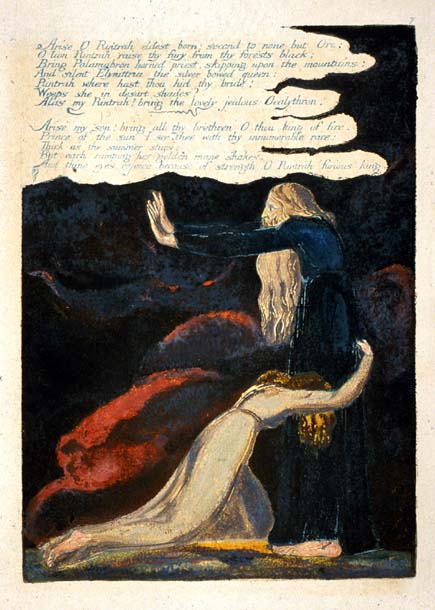
EUROPE PLATE 10

British Museum
Europe
Plate 10, Copy D
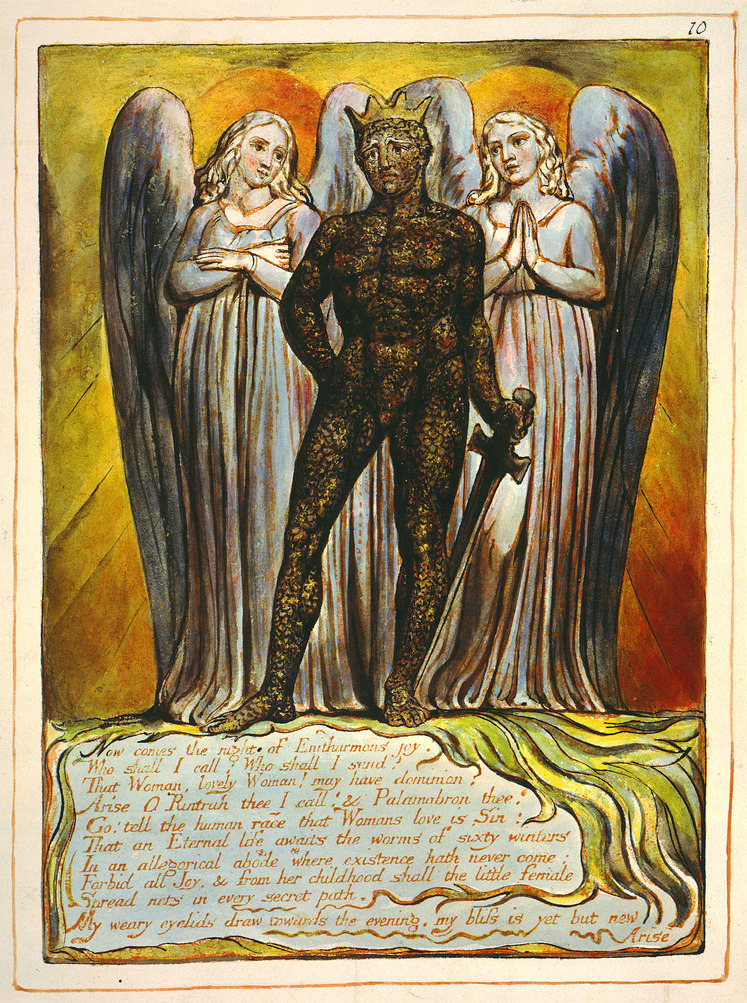
Orc, as revolution, can be analyzed into four segments: Palamabron (pity for the victims), Rintrah (just wrath), Bromion (impulse) and Theotormon (conformity). The violent destructiveness of revolution would fall into the province of Rintrah.


The text of Plate 10 of Europe addresses the role that Rintrah is asked to play as revolution develops in response the multiple infractions of the interests of the populace. Rintrah can assemble his forces to present a formidable army of destruction. The inscription added by Cumberland emphasizes the unintended consequences of allowing war to erupt.


The positive change which may be brought about by revolution is resisted by those interested in preserving the status quo. The picture presents the desire to prevent the outbreak of violence by those under threat, and by the forces of order which are committed to preserving the rule of law. The bearded man may represent any of various characters who resist change but one of them is Urizen, the perpetual conservative.   

Europe, Plate 8, (E 62) 
"Arise O Rintrah eldest born: second to none but Orc:
O lion Rintrah raise thy fury from thy forests black:
Bring Palamabron horned priest, skipping upon the mountains:
And silent Elynittria the silver bowed queen:
Rintrah where hast thou hid thy bride!                           
Weeps she in desart shades?
Alas my Rintrah! bring the lovely jealous Ocalythron.

Arise my son! bring all thy brethren O thou king of fire.
Prince of the sun I see thee with thy innumerable race:
Thick as the summer stars:                                       
But each ramping his golden mane shakes,
And thine eyes rejoice because of strength O Rintrah furious king."

Cumberland's inscription is quoted from Edward Bysshe, The Art of English Poetry. The passage is from Virgil's The Aeneid translated by John Dryden.

"Thus Deluges descending on the Plains
Sweep o'er the yellow year &c,
                                                    Dryden."


The Aeneid of Virgil: Book II
[Aeneas observing Troy]
"Fear broke my slumbers; I no longer stay,
But mount the terrace, thence the town survey,
And hearken what the frightful sounds convey.
Thus, when a flood of fire by wind is borne,
Crackling it rolls, and mows the standing corn;
Or deluges, descending on the plains,
Sweep o'er the yellow year, destroy the pains
Of lab'ring oxen and the peasant's gains;
Unroot the forest oaks, and bear away
Flocks, folds, and trees, and undistinguish'd prey:
The shepherd climbs the cliff, and sees from far
The wasteful ravage of the wat'ry war.