Showing posts with label Hughes' Jerusalem. Show all posts

Saturday, November 15, 2014

Hughes' Jerusalem 6


The title of this Plate is "Los Conquers the Spectre" Unlike the last Section Hughes has relatively little to say in his commentary here. Here is part of Blake's section, found in Plate 10 of Jerusalem: PLATE 10 ---- And this is the manner of the Sons of Albion in their strength They take the Two Contraries which are calld Qualities, with which Every Substance is clothed, they name them Good & Evil From them they make an Abstract, which is a Negation Not only of the Substance from which it is derived A murderer of its own Body: but also a murderer Of every Divine Member: it is the Reasoning Power An Abstract objecting power, that Negatives every thing
This is the Spectre of Man: the Holy Reasoning Power And in its Holiness is closed the Abomination of Desolation Therefore Los stands in London building Golgonooza Compelling his Spectre to labours mighty; trembling in fear The Spectre weeps, but Los unmovd by tears or threats remains I must Create a System, or be enslav'd by another Mans I will not Reason & Compare: my business is to Create --------- So Los, in fury & strength: in indignation & burning wrath Shuddring the Spectre howls. his howlings terrify the night Driven to desperation by Los's terrors & threatning fears ------- Los cries, Obey my voice & never deviate from my will And I will be merciful to thee: be thou invisible to all To whom I make thee invisible, but chief to my own Children ------- The Spectre answer'd. Art thou not ashamd of those thy Sins That thou callest thy Children? lo the Law of God commands That they be offered upon his Altar: O cruelty & torment For thine are also mine! I have kept silent hitherto, Concerning my chief delight: but thou hast broken silence Now I will speak my mind! Where is my lovely Enitharmon O thou my enemy, where is my Great Sin? She is also thine
I said: Now is my grief at worst: incapable of being Surpassed: but every moment it accumulates more & more It continues accumulating to eternity! the joys of God advance For he is Righteous: he is not a Being of Pity & Compassion He cannot feel Distress: he feeds on Sacrifice & Offering: Delighting in cries & tears & clothed in Holiness & solitude But my griefs advance also, for ever & ever without end O that I could cease to be! Despair! I am Despair -------- So spoke the Spectre shuddring, & dark tears ran down his shadowy face Which Los wiped off, but comfort none could give! or beam of hope Yet ceasd he not from labouring at the roarings of his Forge With iron & brass Building Golgonooza in great contendings Till his Sons & Daughters came forth from the Furnaces At the sublime Labours for Los. compelld the invisible Spectre
PLATE 11
To labours mighty, with vast strength, with his mighty chains, (Erdman 152-3)
***************************************************************
In his commentary Hughes has a few things to say:

Re 'The Joys of God':
Hughes tells us Blake is not talking about the true God but "the
falsely-imagined God made by the Spectre in his own image," the God
of the people who demand that "a criminal" be punished. The true
God is the one of people like the Amish who forgave and prayed for
the man who 'mowed down' about 20 school children.

Re Building Golgonooza:
It's built by the children of Los, the spiritual fourfold London.
It isn't quite the same as the City of God, though some seem to think so.
Golgonooza is like 'building the kingdom' aspired to by former
church people; the 'kingdom' is not the same as heaven, though we
are to pray for it.


Thursday, November 13, 2014

Hughes' Jerusalem 5


                                                 II 


"The Temptation of Los and his Contentions with his Spectre"
This Title appears on page 53 of the Jerusalem text  and page 164 of the Commentary.


In this image, Plate 6 of Jerusalem we see Los at his furnace staring up at his Spectre.
(Los is Sol spelled backward. The Sun provides physical energy; Los spiritual energy.)
" Twas outward a Sun: inward Los in his might" in a letter to Butts; (E722)
(Hughes page 164)
                                                                 Here is the text:
PLATE 6
"His spectre driv'n by the Starry Wheels of Albions sons, black and 
Opake divided from his back; he labours and he mourns!
For as his Emanation divided, his Spectre also divided 
In terror of those starry wheels: and the Spectre stood over Los 
Howling in pain: a blackning Shadow, blackning dark & opake 
Cursing the terrible Los: bitterly cursing him for his friendship 
To Albion, suggesting murderous thoughts against Albion. 
Los rag'd and stamp'd the earth in his might & terrible wrath! 
He stood and stampd the earth! then he threw down his hammer in rage & 
In fury: then he sat down and wept, terrified! Then arose 
And chaunted his song, labouring with the tongs and hammer: 
But still the Spectre divided, and still his pain increas'd!
148

In pain the Spectre divided: in pain of hunger and thirst:" 

From Hughes' Commentary p.164:

Our prophets and poets keep the spark of divine energy. He mentioned the mythical Prometheus, who, like Los worked with fire.

Los repesents all of us; each goes through the same temptations and failures of Los,  to 
overcome our Spectre who drives us to live in 'this world' instead of becoming open to the Eternal. We may go to church faithfully every Sunday, but that's entirely different from openness to God.

Blake had an "especially stern and inner struggle" with the 'main chance' which crippled him from true intuition and creativity....
until he went to Felpham!!

On Hughes page 165 he quotes this letter to Butts as follows:
"And now let me finish with assuring you that Tho I have been
very unhappy I am so no longer I am again Emerged into the light of Day I still & shall to Eternity Embrace Christianity and Adore him who is the Express image of God but I have traveld thro Perils & Darkness not unlike a Champion I have Conquerd and shall still Go on Conquering Nothing can withstand the fury of my Course among the Stars of God & in the Abysses of the Accuser"

The 'accuser' in this case is the same as the Spectre.

Tuesday, November 11, 2014

Hughes' Jerusalem 4


Early Plate of Jerusalem
Here is another one:

Plate 4 of Jerusalem
I haven't found a discussion in Hughes of the first two Plates -without text. On page 163 is a '1' with this heading (actually about Plate 4):

"Albion Rejects the Call of the Divine Humanity and 'Chaos is Come Again"

(On page 51 the same heading appears - at the beginning of Blake's text.)

The 'Call of Jesus' comes to the fallen Albion, but is rejected in a host of ways: "unbelief, rationalism, selfishness, possessiveness, and jealousy". He has fallen asleep to Ulro.  His emanation (actually Jerusalem)  has left him  because he jealously tried  to keep her.

Put in another way Albion refused to use his imagination and became spiritually blind.

Hughes attempts to describe the shape of 'this world': pure materialism with every man against Man; every man for himself and interested in things rather than faith or love.

Sunday, November 09, 2014

Hughes' Jerusalem 3

Hughes' Commentary is on page 162:

Writing Jerusalem Blake didn't believe that it stemmed from his imagination; he thought instead that he was simply taking dictation from the Source; he used a variety of styles.

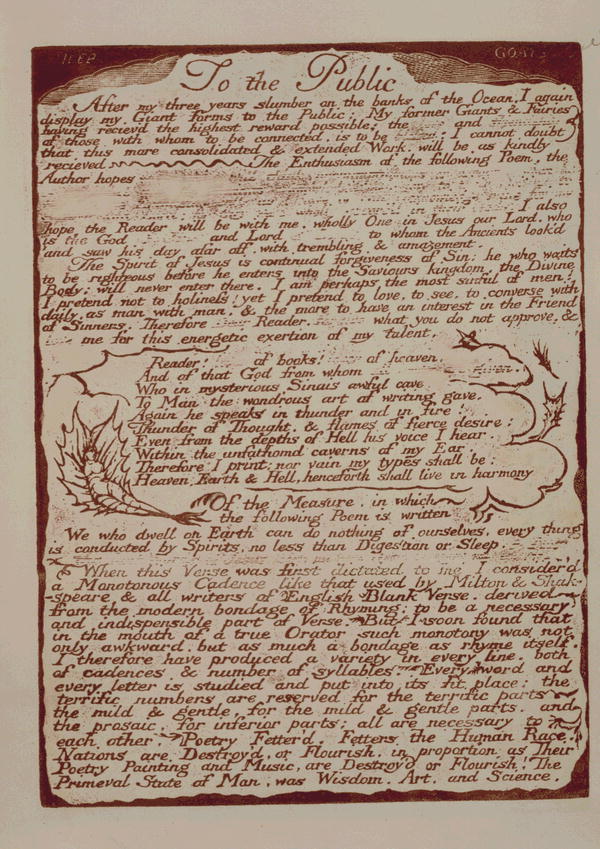
On Plate 3 of Jerusalem Blake wrote:
"When this Verse was first dictated to me I consider'd a Monotonous Cadence like that used by Milton & Shakspeare & all writers of English Blank Verse, derived from the modern bondage of Rhyming; to be a necessary and indispensible part of Verse. But I soon found that in the mouth of a true Orator such monotony was not only awkward, but as much a bondage as rhyme itself. I therefore have produced a variety in every line, both of cadences & number of syllables. Every word and every letter is studied and put into its fit place: the terrific numbers are reserved for the terrific parts—the mild & gentle, for the mild & gentle parts, and the prosaic, for inferior parts: all are necessary to each other Poetry Fetter'd, Fetters the Human Race! Nations are Destroy'd, or Flourish, in proportion as Their Poetry Painting and Music, are Destroy'd or Flourish! The Primeval State of Man, was Wisdom, Art, and Science."

Blake thought he was a prophet with an urgent message to the world.

In his Book of Milton he wrote:"Terrific among the Sons of Albion in chorus solemn & loud
A Bard broke forth! all sat attentive to the awful man.Mark well my words! they are of your eternal salvation."

In one of the Illustrations of Jerusalem (Plate 41) is

Plate 41 of Jerusalem


The scroll beside the fearful giant contains these famous words:
"EACH Man is in his Spectre’s power
Until the arrival of that hour,
When his Humanity awake,
And cast his Spectre into the Lake."

Wednesday, November 05, 2014

Hughes' Jerusalem 2

We are reading Hughes' Jerusalem.

Look at page 21:
According to Blake man lives in four worlds: Eden, Beulah, Generation, and Ulro.
We all start in Eden (Heaven, 'before life'); since our true life is Eternal, living before
and after 'this world' (In the Bible there are 44 occurrences of 'this world'; one useful
occurrence might be at John 15:19.)

Beulah comes when the Eternals tire of the "severe contentions of friendship" (Erdman
143), they are able to take a 'vacation' from Eternity to a place of rest; eventually they may
go  back to Eden or down to 'this world'.
(On Milton Plate 41: "Altho' our Human Power can sustain the severe contentions
Of Friendship, our Sexual cannot: but flies into the Ulro.")

We examine Eden both before and after 'this world'.  The period between makes up most
of Blake's poetry.  Babies just entering the world Blake called 'innocent'.  Songs of 
Innocence is one of his early works; it came out in 1789; later Songs of Innocence and
Experience was in 1794.

In Blake's vernacular these two concepts may be seen to represent before and after the Fall.

The four worlds correspond to the four zoas (fourness is ubiqutous for Blake).

Urthona may be seen to relate to Eden, since he  doesn't appear in 'this world'; in 'this world'
he will be represented by Los.

Urizen is usually down at Ulro: Blake had a strong impulse toward Urizen, which he disliked
and tried to overcome. Opposing Urizen is Luvah. (The two names suggest the two functions
of Reason and Feeling).

The fourth zoa is Tharmas, the earliest zoa who represents sensation.

the Four Zoas (UrthonaUrizenLuvah and Tharmas), were created by the fall of Albion. In the
Book of Milton Blake drew an impressive picture of the Four Zoas:
New York Public Library
Milton
Plate 32

Monday, November 03, 2014

Hughes' Jersalem 1

A simplified version of Blake's Jerusalem by William R. Hughes was published in 1964.
Hughes tells us that his tutor of Blake was Greville MacDonald, writer of The Sanity of William Blake and son of George MacDonald.

wikipedia
Greville MacDonald
From Page 20:
Hughes suggested that "In moments of illumination Blake attained fullness of vision and  saw four worlds but he knew that only one was eternal; the other three were built of mingled shadow and faith; their eyes were not yet opened and healed by the touch of the divine mercy."

Then he found this key in Jerusalem:
 "to open the immortal Eyes
Of man inwards, into the worlds of Thought, into Eternity
Ever expanding into the Bosom of God--the Human Imagination"

From this Hughes (and I) conclude that Blake meant that we all have 'immortal Eyes', like baby chicks with eyes not yet open.

Hughes continues: "Blake had been entrusted with a mighty visual imagination and with a poetic ability in the use of words, and both must be dedicated unreservedly to this great task. And so he labored year after to write Jerusalem for us."

After that work he turned away from words and began painting pictures.