Showing posts with label Rintrah. Show all posts

Friday, December 13, 2019

Reprobate

First posted Saturday, August 30, 2014
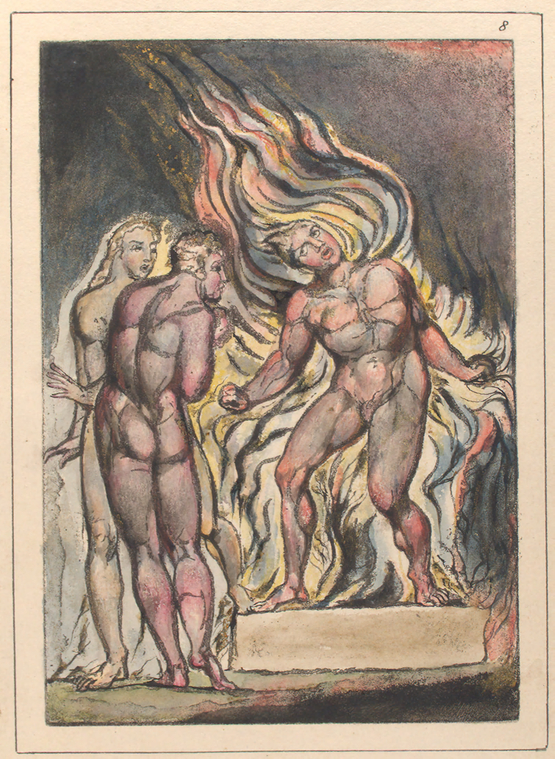
New York Public Library
Milton
Plate 8

'Reprobate' appears 7 times in Milton and once in Jerusalem. When Blake wrote Milton he had a developed new concept of the sorts of people.

The conventional understanding of the classes of men: 
1. The Elect are best known and admired class; they more or less run things in the materialistic culture in which we, like Blake, live. The Elect live in the top rung of society. 
2. The redeemed are middle class people who obey the Elect, but with some reservations. They are conventional people who lack 'their own system' of values and more or less follow the herd of the materialistic majority of the population.
3. The reprobates are thought of as lower class of people, very much like Jesus was thought of by the privileged class.

In this post we will attempt to show what Blake meant  by these classes.

From an earlier post:
"Orthodox religion designated three positions which man may have in relation to God. The Elect were those were accepted by God because they were obedient to his Laws. The Redeemed were those who may be saved if they repented of their wrongdoing and believed. The Transgressors had broken the Law and were condemned to eternal punishment. 

Blake redefined the three types. The Elect to him were the conventional law-abiders like the pharisees who prevented the entry of the spirit. The Redeemed were oppressed by the Elect because they were led by the spirit and not the law. The Transgressors or Reprobate were willing to break the law or move outside of the orthodox structure for the sake of the oppressed." 
  

In this way Blake's category of the Elect was linked to Satan, the Redeemed was linked to Palamabron, and the Reprobate to Rintrah. 

(Following in the train of The Marriage of Heaven and Hell which reversed Angels and Devils, the three classes are a general reversal of ordinary ideas.)

Milton, Plate 13: (E 107)
"The Elect shall meet the Redeem'd. on Albions rocks they shall meet
Astonish'd at the Transgressor, in him beholding the Saviour."

Jerusalem, Plate 83, (E 241) 
"O Albion, my brother!
Jerusalem hungers in the desart! affection to her children!
The scorn'd and contemnd youthful girl, where shall she fly?
Sussex shuts up her Villages. Hants, Devon & Wilts
Surrounded with masses of stone in orderd forms, determine then
A form for Vala and a form for Luvah, here on the Thames
Where the Victim nightly howls beneath the Druids knife:
A Form of Vegetation, nail them down on the stems of Mystery:
O when shall the Saxon return with the English his redeemed brother!
O when shall the Lamb of God descend among the Reprobate!"


Milton, Plate 8, (E 102)
"But Rintrah who is of the reprobate: of those form'd to destruction                                       
Milton, Plate 11 [12], (E 105)
"the Class of Satan shall be calld the Elect, & those
Of Rintrah. the Reprobate, & those of Palamabron the Redeem'd
For he is redeem'd from Satans Law, the wrath falling on Rintrah"

Milton, Plate 13 [14], (E 107)
"He died as a Reprobate. he was Punish'd as a transgressor! 
Glory! Glory! Glory! to the Holy Lamb of God 
I touch the heavens as an instrument to glorify the Lord! 
And the Elect shall say to the Redeemd. We behold it is of Divine 
Mercy alone! of Free Gift and Election that we live.
Our Virtues & Cruel Goodnesses, have deserv'd Eternal Death."
_____________________________
John 1
[14] And the Word was made flesh, and dwelt among us, (and we beheld his glory, the glory as of the only begotten of the Father,) full of grace and truth.

First John 2
[1] My little children, these things write I unto you, that ye sin not. And if any man sin, we have an advocate with the Father, Jesus Christ the righteous:
[2] And he is the propitiation for our sins: and not for ours only, but also for the sins of the whole world.

Monday, October 02, 2017

CAIN FLEEING

Wikimedia Commons
Cain Fleeing from the Wrath of God
Gen.4
[1] And Adam knew Eve his wife; and she conceived, and bare Cain, and said, I have gotten a man from the LORD.
[2] And she again bare his brother Abel. And Abel was a keeper of sheep, but Cain was a tiller of the ground.
[3] And in process of time it came to pass, that Cain brought of the fruit of the ground an offering unto the LORD.
[4] And Abel, he also brought of the firstlings of his flock and of the fat thereof. And the LORD had respect unto Abel and to his offering:
[5] But unto Cain and to his offering he had not respect. And Cain was very wroth, and his countenance fell.
[6] And the LORD said unto Cain, Why art thou wroth? and why is thy countenance fallen?
[7] If thou doest well, shalt thou not be accepted? and if thou doest not well, sin lieth at the door. And unto thee shall be his desire, and thou shalt rule over him.
[8] And Cain talked with Abel his brother: and it came to pass, when they were in the field, that Cain rose up against Abel his brother, and slew him.
[9] And the LORD said unto Cain, Where is Abel thy brother? And he said, I know not: Am I my brother's keeper?
[10] And he said, What hast thou done? the voice of thy brother's blood crieth unto me from the ground.
[11] And now art thou cursed from the earth, which hath opened her mouth to receive thy brother's blood from thy hand;
[12] When thou tillest the ground, it shall not henceforth yield unto thee her strength; a fugitive and a vagabond shalt thou be in the earth.
[13] And Cain said unto the LORD, My punishment is greater than I can bear.
[14] Behold, thou hast driven me out this day from the face of the earth; and from thy face shall I be hid; and I shall be a fugitive and a vagabond in the earth; and it shall come to pass, that every one that findeth me shall slay me.
 
 
Cain and Abel fit into the categories of wrath and pity, or of the Reprobate and the Redeemed, of the rebel and the conformist. Blake represented them as Rintrah and Palamabron. Rintrah was perpetually outside of 'acceptable' behavior, that is the conventions of society. Palamabron was too timid to break out of the patterns expected of him.

The contentions between the two brothers were stirred up by the third brother Satan who was given leave to change the relationships and duties within the family structure.

Blake presented characters and situations for us to consider as external facts, but it is up to us to discern the inner realities. The account of Cain and Abel, too, is presented as a story about people who lived when civilization was beginning. But they also represent internal realities which are active within our psyches. We have within ourselves Cain and Abel, Rintrah and Palamabron. Within us too are the Lord and Satan contending over our perceptions and our behaviors.
Europe, Plate 8, (E 61)
"Arise O Rintrah eldest born: second to none but Orc:
O lion Rintrah raise thy fury from thy forests black:
Bring Palamabron horned priest, skipping upon the mountains:
And silent Elynittria the silver bowed queen:
Rintrah where hast thou hid thy bride!                           
Weeps she in desart shades?
Alas my Rintrah! bring the lovely jealous Ocalythron.

Arise my son! bring all thy brethren O thou king of fire.
Prince of the sun I see thee with thy innumerable race:
Thick as the summer stars:                                       
But each ramping his golden mane shakes,
And thine eyes rejoice because of strength O Rintrah furious king." 
Milton, Plate 7, (E 99)
"The first, The Elect from before the foundation of the World:  
The second, The Redeem'd. The Third, The Reprobate & form'd
To destruction from the mothers womb: follow with me my plow!  

Of the first class was Satan: with incomparable mildness;
His primitive tyrannical attempts on Los: with most endearing love    
He soft intreated Los to give to him Palamabrons station;
For Palamabron returnd with labour wearied every evening
Palamabron oft refus'd; and as often Satan offer'd
His service till by repeated offers and repeated intreaties
Los gave to him the Harrow of the Almighty; alas blamable      
Palamabron. fear'd to be angry lest Satan should accuse him of
Ingratitude, & Los believe the accusation thro Satans extreme
Mildness. Satan labour'd all day. it was a thousand years
In the evening returning terrified overlabourd & astonish'd
Embrac'd soft with a brothers tears Palamabron, who also wept  

Mark well my words! they are of your eternal salvation

Next morning Palamabron rose: the horses of the Harrow
Were maddend with tormenting fury, & the servants of the Harrow
The Gnomes, accus'd Satan, with indignation fury and fire.
Then Palamabron reddening like the Moon in an eclipse,        
Spoke saying, You know Satans mildness and his self-imposition,
Seeming a brother, being a tyrant, even thinking himself a brother
While he is murdering the just; prophetic I behold

His future course thro' darkness and despair to eternal death
But we must not be tyrants also! he hath assum'd my place      
For one whole day, under pretence of pity and love to me:
My horses hath he maddend! and my fellow servants injur'd:
How should he[,] he[,] know the duties of another? O foolish forbearance
Would I had told Los, all my heart! but patience O my friends.
All may be well: silent remain, while I call Los and Satan." 
Milton, Plate 8, (E 101)
"Mean while wept Satan before Los, accusing Palamabron;
Himself exculpating with mildest speech. for himself believ'd
That he had not opress'd nor injur'd the refractory servants." 
MIlton, Plate 14 [15], (E 108)
"I in my Selfhood am that Satan: I am that Evil One!
He is my Spectre! in my obedience to loose him from my Hells
To claim the Hells, my Furnaces, I go to Eternal Death."

.

Monday, September 18, 2017

Three Classes

First published Monday, February 22, 2010

New York Public Library 
Milton 
Plate 8
Palamabron, Rintrah and Satan


From Milton, Plate 25, (E 121):
"The Elect is one Class: You 

Shall bind them separate: they cannot Believe in Eternal Life 
Except by Miracle & a New Birth. The other two Classes;
The Reprobate who never cease to Believe, and the Redeemed, 

Who live in doubts & fears, perpetually tormented by the Elect"

Blake in his characteristic way, uses familiar words in unfamiliar ways. He takes three words from religion: Elect, Redeemed and Reprobate, and redefines them to make us reconsider how God relates to man and how man's psyche functions.
 
The Elect whom we think of as the chosen who have won God's approval become those who "cannot Believe in Eternal Life Except by Miracle & a New Birth".

The Reprobate whom we think of as failures and outcasts become those "who never cease to Believe."

The Redeemed whom we think of as knowing that they have been forgiven for their sins become those "Who live in doubts & fears perpetually tormented by the Elect."

From Ellie:
When I try to connect the Three Classes of Men with aspects of the psyche, this is what I see.The Elect wants to preserve the status quo. The Elect can be equated with the Ego which has charge of the personality, negotiating among the Id, the Superego and the reality principle. The Ego is the boss and decides how to express the personality. (The self-appointed Top Dog.)

The Reprobate are the outsiders, the aspects of the personality which are unrecognized or unacceptable.
The Reprobate is parallel to the Shadow in Jung which contains whatever the Ego has rejected and denies expression to. The Shadow contains undiscovered but valuable material.

The expanding or awakening consciousness which is the true human,
sometimes referred to as the Identity by Blake, or the Self by Jung, is the Redeemed. The Self connects the Ego, the Shadow and the collective unconscious. The Identity connects Albion, the wholeness of the individual with Eternal wholeness. The process of developing the Self or the Identity is a long struggle of gradually bringing to light hidden material and realigning internal and external relationships.

The psychological approach to studying Blake asks us to look within for
congruence between Blake's ideas and the dynamics of our psyches. Blake's myths and images can reveal to us aspects of ourselves; our self-understanding can enrich our reading of Blake.

-----------------------------------------------------
From Larry: 
In Marriage of Heaven and Hell we met two classes: angels and devils. Blake ironically names free spirits as devils and good dutiful church goers (and other establishment types) as angels.

Los and his 'emanation', Enitharmon "bore an enormous race" (not only mankind, but every other created thing as well). But in particular Enitharmon's progeny consists of three classes:

From Milton Plate 7:
The first the Elect from the foundation of the World, symbolized here by Satan.
The second, the Redeem'd, symbolized by Palamabron.
The third, the Reprobate, symbolized by Rintrah.

The Bard's Song begins Blake's description of how these three classes of men relate.

To Rintrah (the just man) was assigned the plow.

To Palamabron, a kind and gentle boy (not a strong minded one), was assigned the harrow.

Satan (Selfhood) was assigned to the mills.

Rintrah and Palamabron are contraries; Satan is a negation.

In the Bard's Song those were the three assignments of Enitharmon's three sons.

A post could be written about the plow (See Damon 329); the plow of Rintrah might be the heated words of the prophet that denounces and breaks up the corrupt establishment. (It might be several other things as well.)

The harrow follows the plow; for Blake it was a metaphor for redemptive poetry.

The Mill symbolizes Reason - conservative: reducing the creative to the commonplace. But it may have been related in Blake's mind with the insidious mills brought about by the Industrial Revolution which impoverished so many people.

Los of course was the father of these three boys, a farmer-- the World being his field. He had expressly forbidden Satan from using the harrow. But Satan wheedled his amicable brother Palamabron into letting him use the harrow.

This led to disaster (the kind of disaster we have all lived under most of our lives).

All this was part of the tale told by the Bard at an Eternal gathering. The Bard's Song induced Milton to forsake heaven and return to the Earth to correct the errors of his mortal life. Milton's adventures in the World with Los and Blake is the subject of Blake's Milton.

There is much more to the Bard's Song, but this will give you a beginning. Learn the Bard's Song, and you will find it much easier to enjoy Milton, the first of Blake's two major works.

Wednesday, June 23, 2010

WRATH & PITY

Wrath and Pity were two central facets of Blake's theology, and both words meant to him something very different from the common connotations. Re his reading of them we may exhibit one or the others of these two contraries, the critical faculty and the affirmative one.

Wrath and pity are two aspects of prophetic activity. Wrath personified by Rintrah is the energetic destructive phase. Palamabron epitomizes the gentler constructive expressions.These are the threat and promise of the Old Testament prophets. To make a difference in a world embroiled in exploitation and oppression and tyranny, the first impulse is to express anger and attempt to break down the instruments of oppression. The extreme example is to participate in riot and revolution, but there are milder forms of subversion and non-cooperation all aimed at destroying the structure that perpetuates a system of masters and slaves.

Wrath is motivated by anger at seeing injustice, pity is motivated by compassion at seeing suffering. Pity seeks to comfort and heal, to alleviate the pain of those wounded by the system. Wrath and Pity are contraries not enemies. Their activities supplement each other in fostering change but their functions are incompatible if exercised simultaneously. In a world distorted by misapprehension, wrath may fall on the oppressed and pity on the oppressor.

Wrath and pity can also be viewed in terms of punishment and forgiveness. In comparing Old and New Testament theology, wrath characterizes an aspect of the an Old Testament God who expects obedience to the law and punishes infractions. Jesus teaches in the New Testament that our relationship with the God of mercy, pity, peace and love may be renewed by forgiveness.

Wrath and pity both have creative and destructive aspects. Pity becomes destructive in the hand of Vala who uses the passive emotions as a weapon of control in her outward, feminine, material agenda.

This section from Percival explains how the feminine emotions can be used to build up or tear down; the active masculine could be used to build up as in exposing abuse or to tear down as in promoting war.

Milton O Percival, William Blake's Circle of Destiny, Page 45:
"...Blake has several sets of composite characters. Foremost among them are the Daughters of Beulah and the Daughters of Albion. They are man's feminine powers in two antithetical attitudes. In the Daughters of Beulah we have these powers devoted to the well-being of man; in the Daughters of Albion we have them, in obedience to reason, weaving the "natural" world of spiritual depravity. The one is Jerusalem seen in multiple, the other is Vala-Rahab. The Daughters of Beulah are said to guard the body of Albion during his mortal sleep on the rock of Ages; the Daughters of Albion, to bind down his perceptive powers and submit him to the corporeal illusion. The Daughters of Beulah personify a mercy and pity that is spontaneous and genuine; the Daughters of Albion, a spiritual hate masquerading as mercy and pity in the cruel and spurious forms of the moral law. The Daughters of Beulah, who by their selflessness keep man's senses open, prepare the conditions for a visionary life and are called Daughters of Inspiration. The Daughters of Albion, who in their selfishness bind down man's immortal senses, are called Daughters of Memory."

These passages will give a flavor of Blake's use of wrath and pity in Jerusalem.

Jerusalem, PLATE 88, (E 247)
"The blow of his Hammer is Justice. the swing of his Hammer:
Mercy.
The force of Los's Hammer is eternal Forgiveness;"

Jerusalem, PLATE 65, (E 216)
"To decide Two Worlds with a great decision: a World of Mercy, and
A World of justice: the World of Mercy for Salvation
To cast Luvah into the Wrath, and Albion into the Pity
In the Two Contraries of Humanity & in the Four Regions."

Jerusalem, Plate 77, (E 232)
"But Jesus is the bright Preacher of Life
Creating Nature from this fiery Law,
By self-denial & forgiveness of Sin."

Jerusalem, Plate 79, (E 236)
"For in our battles we the Slain men view with pity and love:
We soon revive them in the secret of our tabernacles
But I Vala, Luvahs daughter, keep his body embalmd in moral laws
With spices of sweet odours of lovely jealous stupefaction:
Within my bosom, lest he arise to life & slay my Luvah
Pity me then O Lamb of God! O Jesus pity me!
Come into Luvahs Tents, and seek not to revive the Dead!"

Jerusalem, Plate 80, (E 237)
"The Spindle turnd in blood & fire: loud sound the trumpets
Of war: the cymbals play loud before the Captains
With Cambel & Gwendolen in dance and solemn song
The Cloud of Rahab vibrating with the Daughters of Albion
Los saw terrified, melted with pity & divided in wrath
He sent them over the narrow seas in pity and love
Among the Four Forests of Albion which overspread all the Earth
They go forth & return swift as a flash of lightning.
Among the tribes of warriors: among the Stones of power!
Against Jerusalem they rage thro all the Nations of Europe
Thro Italy & Grecia, to Lebanon & Persia & India.
The dungeons burst & the Prisoners set free."

Monday, February 22, 2010

Three Classes of Men II

From Milton, Plate 25, (E 121):
"The Elect is one Class: You Shall bind them separate: they cannot Believe in Eternal Life Except by Miracle & a New Birth. The other two Classes;
The Reprobate who never cease to Believe, and the Redeemed, Who live in doubts & fears, perpetually tormented by the Elect".

Blake in his characteristic way, uses familiar words in unfamiliar ways. He takes three words from religion: Elect, Redeemed and Reprobate, and redefines them to make us reconsider how God relates to man and how man's psyche functions.

The Elect whom we think of as the chosen who have won God's approval become those who
"cannot Believe in Eternal Life
Except by Miracle & a New Birth".

The Reprobate whom we think of as failures and outcasts become those "who never cease to Believe."

The Redeemed whom we think of as knowing that they have been forgiven for their sins become those "Who live in doubts & fears perpetually tormented by the Elect."

From Ellie:
"When I try to connect the Three Classes of Men with aspects of the psyche, this is what I see.

The Elect wants to preserve the status quo. The Elect can be equated with the Ego which has charge of the personality, negotiating among the Id, the Superego and the reality principle. The Ego is the boss and decides how to express the personality. (The self-appointed Top Dog.)

The Reprobate are the outsiders, the aspects of the personality which are unrecognized or unacceptable.
The Reprobate is parallel to the Shadow in Jung which contains whatever the Ego has rejected and denies expression to. The Shadow contains undiscovered but valuable material.

The expanding or awakening consciousness which is the true human,
sometimes referred to as the Identity by Blake, or the Self by Jung, is the Redeemed. The Self connects the Ego, the Shadow and the collective unconscious. The Identity connects Albion, the wholeness of the individual, with Eternal wholeness. The process of developing the Self or the Identity is a long struggle of gradually bringing to light hidden material and realigning internal and external relationships.

The psychological approach to studying Blake asks us to look within for
congruence between Blake's ideas and the dynamics of our psyches. Blake's myths and images can reveal to us aspects of ourselves; our self-understanding can enrich our reading of Blake."
-----------------------------------------------------
From Larry:
Here's the earlier post:
In MHH we met two classes: angels and devils.
Blake ironically names free spirits as devils and
good dutifull church goers (and other
establishment types) as angels.

Los and his 'emanation', Enitharmon "bore an enormous race" (not only mankind, but every other created thing as well). But in particular Enitharmon's progeny consists of three classes:

From Milton Plate 7 :
The first the Elect from the foundation of the World, symbolized here by Satan.
The second, the Redeem'd, symbolized by Palamabron.
The third, The Reprobate, symbolized by Rintrah.

The Bard's Song begins Blake's description of how
these three classes of men relate.

To Rintrah (the just man) was assigned the plow.

To Palamabron, a kind and gentle boy (not a strong
minded one), was assigned the harrow.

Satan (Selfhood) was assigned to the mills.

Rintrah and Palamabron are contraries; Satan is a
negation.

In the Bard's Song those were the three
assignments of Enitharmon's three sons.

A post could be written about the plow (See Damon
329); the plow of Rintrah might be the heated
words of the prophet that denounces and breaks up
the corrupt establishment. (It might be several
other things as well.)

The harrow follows the plow; for Blake it was a
metaphor for redemptive poetry.

The Mill symbolizes Reason-- conservative, reducing the creative to the commonplace. But it may have been born in Blake's mind from the insidious mills brought about by the Industrial Revolution which impoverished so many people.

Los of course was the father of these three boys,
a farmer-- the World being his field. He had
expressly forbidden Satan from using the harrow.
But Satan wheedled his amicable brother,
Palamabron into letting him use the harrow.

This led to disaster (the kind of disaster we have
all lived under most of our lives).

A simpler (and probably better) explanation of the Bard's Song can be found at The Farrm at Felpham, but you may have to join the Yahoo William Blake group to gain access to it.

All this was part of the tale told by the Bard at
an Eternal gathering. The Bard's Song induced
Milton to forsake heaven and return to the Earth
to correct the errors of his mortal life. Milton's
adventures in the World with Los and Blake is the
subject of Blake's Milton.

There is much more to the Bard's Song, but this
will give you a beginning. Learn the Bard's Song,
and you will find it much easier to enjoy Milton,
the first of Blake's two major works.

Wednesday, January 27, 2010

Left the Paths of Ease

You'll find this as a link at the end of the last post. The following re the meek man... is taken from an April 11, 2009 post to the Yahoo Group WmBlake:

Marriage of Heaven and Hell, Plate 2, (E 32)

Blake writes in a language that few people today know, so maybe we need an interpreter. I happen to be reading The Unholy Bible, by June Singer. It's largely an (Jungian) interpretation of MHH. Here are some of her interpretations:

"Rintrah is the personification of rage against the status quo" (and an apt description of the young Blake). Revolution was in the air, and Blake writes about a change (very timely!). The meek man is Joe Six Pack; he hasn't learned to read; his social, political, moral consciousness is minimal, and his exploitation by the 'villain' (let's say bankers) has driven Joe out into the wilderness, but "he's sick and tired, and he's not gonna take it any more." Times will be hard for everybody now.

The meek man and the villain: man is not one, but two. He's "Adam and the serpent, Jacob and Esau, outraged honesty and sneaking hypocrisy".

Speaking of Revolution: France was being bathed in blood, and America had already thrown off the sneaking villain.

So much for the political dimension (Erdman's Blake Prophet Against Empire has more). Psychologically the meek man is the good unconscious church goer; the villain is the Voltarian priest (the first priest was the first villain who met the first fool.) The meek man must some day wake up and gain a critical dimension.

Well I've just scratched the surface. This is poetry; poetry is
never (or at least rarely) about the literal; it's about the
intellectual, the spiritual. The Bible is poetry: beginning to end; not about material events; about spiritual events; events in your consciousness. Blake taught me how to read the Bible. One of his greatest gifts to me.

What does Blake (or the Bible) mean? That depends on you- and me.

Justin said: Justin has left a new comment on your post "Left the Paths of Ease":

This is a strange pronouncement: "poetry is
never (or at least rarely) about the literal; it's about the
intellectual, the spiritual." It's even stranger if you replace poetry with the more general literature: "Literature is never about the literal." But I think it's true somehow. Poetry is the contortion of the literal into the spiritual.

Wednesday, October 28, 2009

Three Classes of Men

and the Bard's Song (First Attempt)

In MHH we met two classes: angels and devils.
Blake ironically names free spirits as devils and
good dutifull church goers (and other
establishment types) as angels.

Los and his 'emanation', Enitharmon "bore an enormous race" (not only mankind, but
every other created thing as well). But
in particular Enitharmon's progeny consists of three classes:

Milton Plate 7 :
The first the Elect from the foundation of the World, symbolized here by Satan.
The second, the Redeem'd, symbolized by Palamabron.
The third, The Reprobate, symbolized by Rintrah.

The Bard's Song begins Blake's description of how
these three classes of men relate.

To Rintrah (the just man) was assigned the plow.

To Palamabron, a kind and gentle boy (not a strong
minded one), was assigned the harrow.

Satan (Selfhood) was assigned to the
mills.

Rintrah and Palamabron are contraries; Satan is a
negation.

In the Bard's Song those were the three
assignments of Enitharmon's three sons.

A post could be written about the plow (See Damon
329); the plow of Rintrah might be the heated
words of the prophet that denounces and breaks up
the corrupt establishment. (It might be several
other things as well.)

The harrow follows the plow; for Blake it was a
metaphor for redemptive poetry.

The Mill symbolizes Reason-- conservative,
reducing the creative to the commonplace.

Los of course was the father of these three boys,
a farmer-- the World being his field. He had
expressly forbidden Satan from using the harrow.
But Satan wheedled his amicable brother,
Palamabron into letting him use the harrow.

This led to disaster (the kind of disaster we have
all lived under most of our lives).

A simpler (and probably better) explanation of the Bard's Song can be found at The Farrm at
Felpham, but you may have to join the Yahoo
William Blake group to gain access to it.

All this was part of the tale told by the Bard at
an Eternal gathering. The Bard's Song induced
Milton to forsake heaven and return to the Earth
to correct the errors of his mortal life. Milton's
adventures in the World with Los and Blake is the
subject of Blake's Milton.

There is much more to the Bard's Song, but this
will give you a beginning. Learn the Bard's Song,
and you will find it much easier to enjoy Milton,
the first of Blake's two major works.

Tuesday, October 27, 2009

BLAKE & PROJECTION

Psychological processes are evident as we read Blake's myths.
I found this part of the tale an example of projection being
described.

A decisive incident concerning a disagreement between Satan and Palamabron over the horses of the harrow, can be seen as Satan projecting his own desires and failures onto Palamabron. ( M7.1; E100) When Satan states his case he is very convincing because he believes what he says is true.

Projection is invisible to the person doing it. Although Satan presents a mild demeanor, Palamabron knows that what Satan says speaks more about his own behavior than about Palamabron's.

To show that Satan is involved in self-deceit, Blake says of Satan: "Seeming a brother, being a tyrant, even thinking himself a brother While he is murdering the just",

The salient line ( M7.34; E101) which demonstrates projection is stated thus:

"Satan wept,
And mildly cursing Palamabron, him accus'd of crimes
Himself had wrought."

Los, who is given the role of hearing the case in a council, is not able to get Satan to withdraw his projections, so the status quo is maintained and the consequences are catastrophic.

M7.41; E101|
"So Los said, Henceforth Palamabron, let each his own station
Keep: nor in pity false, nor in officious brotherhood, where
None needs, be active. Mean time Palamabrons horses.
Rag'd with thick flames redundant, & the Harrow maddend with fury.
Trembling Palamabron stood, the strongest of Demons trembled:
Curbing his living creatures; many of the strongest Gnomes,
they bit in their wild fury, who also maddend like wildest beasts"

Palmabron, who represents a gentler side of Los, doesn't act our himself but his horses and Gnomes are infuriated, perhaps because the are the ones who suffered under Satan's control.

The Gnomes Directing Another Harrow

M8.1; E101|
"Mean while wept Satan before Los, accusing Palamabron;
Himself exculpating with mildest speech. for himself believ'd
That he had not opress'd nor injur'd the refractory servants."

The conflict continued with the activating of Rintrah, or wrath,
until Satan kills Thulloh who appears to be a bystander.
Satan's rage and declaration of himself as God follows. This
opens up the abyss and rearranges the structure of the
world. Satan sinks down into Death which leads to a new
chapter in in the drama of the fall.

The self-deception which leads to projection can be said to have led to the eventual fall from the wholeness of Eternity.

Read the text for the full incident in Milton at the Blake Archive; hit NEXT to continue to next plate.

Wednesday, October 07, 2009

Who is Rintrah?


Yale Center for British Art
Europe
                                      Plate 8 

In Blake's poetry Rintrah is mentioned 48 times, first
in MHH, then in Europe, the Four Zoas, Milton, and
Jerusalem. He obviously had a special meaning to
Blake, but shades and nuances of the meaning occurred
throughout.

1, At the beginning (and end) of MHH Rintrah roared;
perhaps in his mind at that moment Rintrah represented
the angry young man who would write the revolutionary
material just ahead.

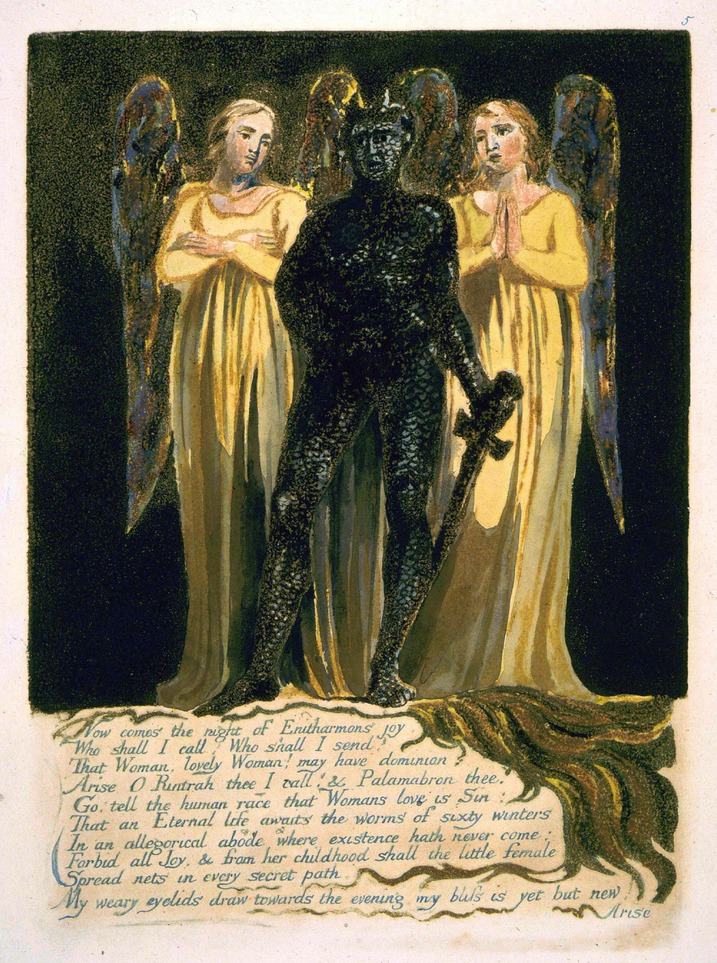
2. In plates 5 and 8 of Europe Rintrah is pictured as a
mailed knight of the queens of England and France,
daughters of Enitharmon, who entice Rintrah into the
hideous war between the two countries.

3. Rintrah's identity is best seen in the Four Zoas:

"And these are the Sons of Los & Enitharmon. Rintrah Palamabron
Theotormon Bromion Antamon Ananton Ozoth Ohana
Sotha Mydon Ellayol Natho Gon Harhath Satan
Har Ochim Ijim Adam Reuben Simeon Levi Judah Dan Naphtali
Gad Asher Issachar Zebulun Joseph Benjamin David Solomon
Paul Constantine Charlemaine Luther Milton"
(FZ8-107.6 Erdman 380)

4. At the beginning of Milton (Plates 3-7) we have The
Bard's Song. Rintrah has a prominent place here.
Enitharmon - The Shadowy Female - has brought forth all
Los's Family: Orc, Rintrah, Palamabron, and finally
Satan. We see these last three in Plate 10. Satan is the fiery 
one; Rintrah is next, and behind Rintrah is his peaceable 
brother, Palamabron.

(Elsewhere Blake referred to Satan as a state, not an
individual. He is the 'state of Error'.)
.