Showing posts with label Moses. Show all posts

Saturday, June 13, 2026

Law

Posted July 2023

National Galleries Scotland
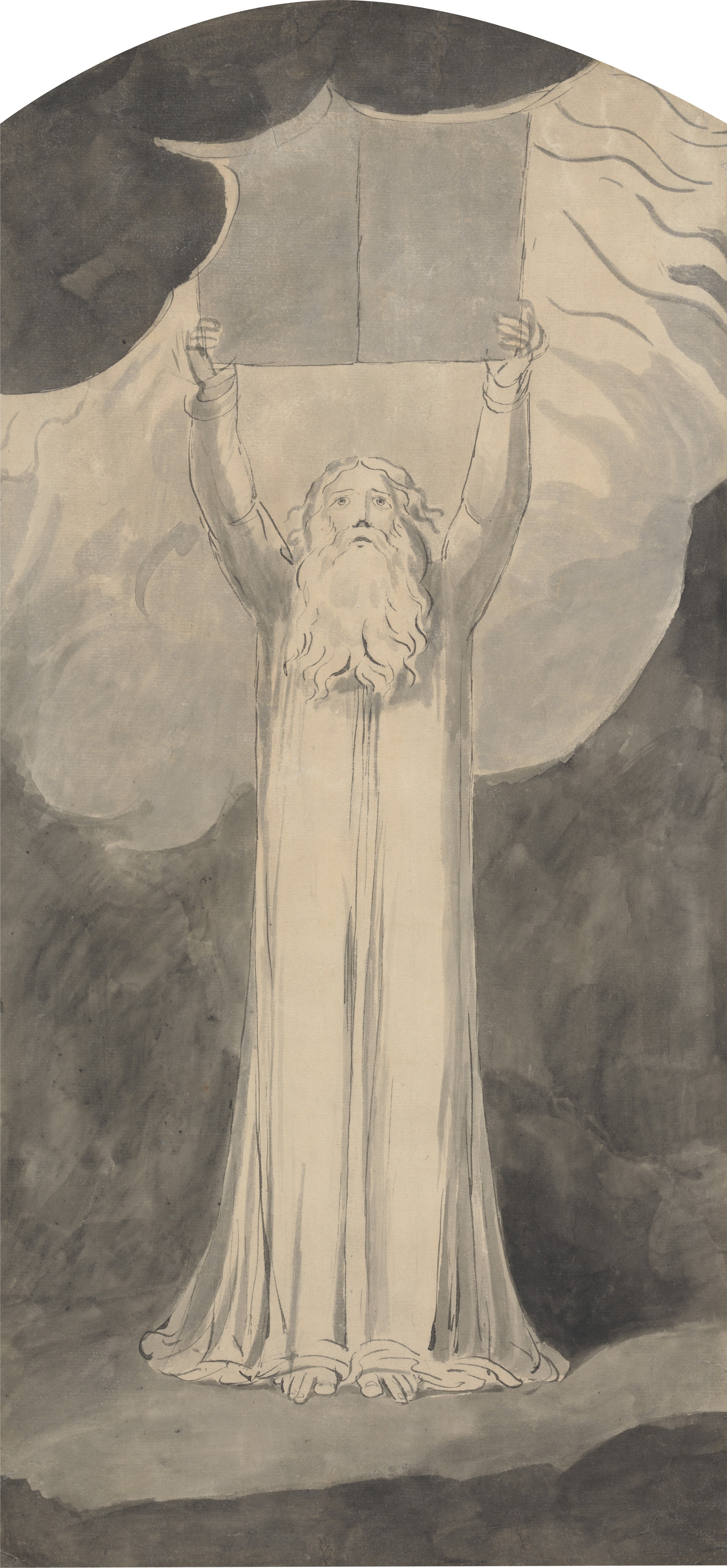
God Writing upon the Tables of the Covenant


From Larry's Blake Primer Chap 5:

All his life Blake had an implacable hatred of law, which he equated with coercion or hindering of others; to him that was the only sin. Consequently Blake's Jesus was a thorough going antinomian. Perhaps his most extreme expression of this occurs in Marriage of Heaven and Hell, written before his conversion:

"If Jesus Christ is the greatest man, you ought to
love him in the greatest degree; now hear how he has
given his sanction to the law of the ten
commandments: did he not mock at the sabbath, and so
mock the sabbath's God? murder those who were
murder'd because of him? turn away the law from the
woman taken in adultery? steal the labor of others
to support him? bear false witness when he omitted
making a defence before Pilate? covet when he pray'd
for his disciples, and when he bid them shake off
the dust of their feet against such as refused to
lodge them? I tell you, no virtue can exist without
breaking these ten commandments. Jesus was all
virtue, and acted from impulse, not from rules."

That's the proud, tongue in cheek, announcement of a young man not yet marked by the suffering of life. As he matured, his language became more moderate, but his attitude remained substantially the same. Blake hates the law, and his Jesus forgives the lawbreaker. The letter kills, but the Spirit gives life.

Law is an expression of authority. Life presents to us two kinds of authority: spiritual authority or God and political authority, his worldly shadow. Blake consumed his early years in rebellion against the shadow. Then at age 43 he met God and was able to submit to and affirm the true authority.

Some means of coercion characterizes all forms of political authority; ecclesiastical authority is no exception. Blake temperamentally renounced all forms of political authority; he felt that they were satanic, based on coercion and fear and earthly power. Political authority is the authority of this world, and he had no use for it.

In contrast spiritual authority as Blake experienced it is the exercise of the purest form of love with an absence of any sort of constraint. The release from constraint by the active good will calls forth the Divine Image from the dark sepulcher or cave of corporeal life. Blake had uniquely experienced this spiritual authority as a child; he rediscovered it in the experience which he understood as Self-annihilation or Forgiveness.

Henceforth for him this was the basic and intimate character and quality of Jesus. This was the good news. In Milton the old antinomian made his commitment to the law of self giving love, referring to it as the "Universal Dictate". A free Blakean translation of John 3:16 with a touch of Philippians 2 added might read: God so forgave the world that he annihilated his transcendent Deity and united himself through a corporeal sepulcher with sinful, materialistic man to lift us up to Eternity. Here is the ultimate of spiritual authority, and those who meet Jesus begin to exercise it in the way that he did.

Although Blake did not often use the conventional Christian symbolism of the cross, after his conversion he did believe from the depths that by dying for one another we live eternally:

"Jesus said. Wouldest thou love one who never died
For thee, or ever die for one who had not died for thee?
And if God dieth not for Man and giveth not himself
Eternally for Man, Man could not exist; for Man is Love
As God is Love; every kindness to another is a little Death
In the Divine Image, nor can Man exist but by Brotherhood."
(Jerusalem, Page 96, E 256) 

Freedom from materialism and from the law are the philosophic and moral coloring which Blake gave to his portrait of Jesus the One. In this way he accommodated his new vision of God to his existing value structure.

John, Chapter 3

[16] For God so loved the world, that he gave his only begotten Son, that whosoever believeth in him should not perish, but have everlasting life.
[17] For God sent not his Son into the world to condemn the world; but that the world through him might be saved.


Phillipians, Chapter 2 

[5] Let this mind be in you, which was also in Christ Jesus:
[6] Who, being in the form of God, thought it not robbery to be equal with God:
[7] But made himself of no reputation, and took upon him the form of a servant, and was made in the likeness of men:
[8] And being found in fashion as a man, he humbled himself, and became obedient unto death, even the death of the cross.


Thursday, July 13, 2023

LAW

National Galleries Scotland
God Writing upon the Tables of the Covenant

From Larry's Blake Primer Chap 5:

All his life Blake had an implacable hatred of law, which he equated with coercion or hindering of others; to him that was the only sin. Consequently Blake's Jesus was a thorough going antinomian. Perhaps his most extreme expression of this occurs in Marriage of Heaven and Hell, written before his conversion:

"If Jesus Christ is the greatest man, you ought to
love him in the greatest degree; now hear how he has
given his sanction to the law of the ten
commandments: did he not mock at the sabbath, and so
mock the sabbath's God? murder those who were
murder'd because of him? turn away the law from the
woman taken in adultery? steal the labor of others
to support him? bear false witness when he omitted
making a defence before Pilate? covet when he pray'd
for his disciples, and when he bid them shake off
the dust of their feet against such as refused to
lodge them? I tell you, no virtue can exist without
breaking these ten commandments. Jesus was all
virtue, and acted from impulse, not from rules."

That's the proud, tongue in cheek, announcement of a young man not yet marked by the suffering of life. As he matured, his language became more moderate, but his attitude remained substantially the same. Blake hates the law, and his Jesus forgives the lawbreaker. The letter kills, but the Spirit gives life.

Law is an expression of authority. Life presents to us two kinds of authority: spiritual authority or God and political authority, his worldly shadow. Blake consumed his early years in rebellion against the shadow. Then at age 43 he met God and was able to submit to and affirm the true authority.

Some means of coercion characterizes all forms of political authority; ecclesiastical authority is no exception. Blake temperamentally renounced all forms of political authority; he felt that they were satanic, based on coercion and fear and earthly power. Political authority is the authority of this world, and he had no use for it.

In contrast spiritual authority as Blake experienced it is the exercise of the purest form of love with an absence of any sort of constraint. The release from constraint by the active good will calls forth the Divine Image from the dark sepulcher or cave of corporeal life. Blake had uniquely experienced this spiritual authority as a child; he rediscovered it in the experience which he understood as Self-annihilation or Forgiveness.

Henceforth for him this was the basic and intimate character and quality of Jesus. This was the good news. In Milton the old antinomian made his commitment to the law of self giving love, referring to it as the "Universal Dictate". A free Blakean translation of John 3.16 with a touch of Philippians 2 added might read: God so forgave the world that he annihilated his transcendent Deity and united himself through a corporeal sepulcher with sinful, materialistic man to lift us up to Eternity. Here is the ultimate of spiritual authority, and those who meet Jesus begin to exercise it in the way that he did.

Although Blake did not often use the conventional Christian symbolism of the cross, after his conversion he did believe from the depths that by dying for one another we live eternally:

"Jesus said. Wouldest thou love one who never died
For thee, or ever die for one who had not died for thee?
And if God dieth not for Man and giveth not himself
Eternally for Man, Man could not exist; for Man is Love
As God is Love; every kindness to another is a little Death
In the Divine Image, nor can Man exist but by Brotherhood."
(Jerusalem, Page 96, E 256) 

Freedom from materialism and from the law are the philosophic and moral coloring which Blake gave to his portrait of Jesus the One. In this way he accommodated his new vision of God to his existing value structure.


Thursday, October 06, 2022

BURNING BUSH

Victoria & Albert Museum
Moses and the Burning Bush

The shepherd Moses has led his flock out of the desert to Horab the mountain of God. In Blake's picture Moses turns his face to his right side. He holds a scroll in his right hand. Beside his right side is a ram. His attention is focused on the bush which burns and is not consumed. The right side of the picture is bright while the left side of the picture is darkened by an overhanging tree of the type which Blake used to represent error. Blake saw two sides to Moses.

Moses listens as the voice of God addresses him from the burning bush calling him by name. Moses is receptive to God's call and responds, "Here am I." 

The voice of God tells Moses that he is to go to the Pharaoh in order to deliver his people "out of the hand of the Egyptians, and to bring them up out of that land unto a good land." Moses continues the conversation with God. His reluctance is overcome when God assures him that he will be with him.

Exodus 3:12
And he said, Certainly I will be with thee; and this shall be a token unto thee, that I have sent thee: When thou hast brought forth the people out of Egypt, ye shall serve God upon this mountain.

Although Blake considered Moses a great prophet and an instrument of God, in Blake's estimation Moses entered into error on two accounts. First in promulgating the ten commands which intended to impose standards of morality. Blake says "Moses beheld upon Mount Sinai forms of dark delusion" (Song of Los, E 67). In Blake's opinion Jesus who was "all virtue,and acted from impulse, not from rules", violated in spirit every one of the ten Commandments. It was not the failure to follow the Law that offended Blake but the attempt to uniformly impose an absolute morality which perverted the "fiery joy" of life "to ten commands"(America, E 54). 

Marriage of Heaven and Hell, Plate 22, (E 43) 
"if Jesus Christ is the
greatest man, you ought to love him in the greatest degree; now
hear how he has given his sanction to the law of ten
commandments: did he not mock at the sabbath, and so mock the
sabbaths God? murder those who were murderd because of him? turn
away the law from the woman taken in adultery? steal the labor of
others to support him? bear false witness when he omitted making
a defence before Pilate? covet when he pray'd for his disciples,
and when he bid them shake off the dust of their feet against
such as refused to lodge them? I tell you, no virtue can exist
without breaking these ten commandments: Jesus was all virtue,
and acted from impulse: not from rules."

The second great error of Moses was massacring the nations who occupied Canaan before the Israelites arrived. "God never makes one man murder another nor one nation...To Extirpate a nation by means of another nation is as wicked as to destroy an individual. (Annotations to Watson, E 641) 

Exodus 3
[1] Now Moses kept the flock of Jethro his father in law, the priest of Midian: and he led the flock to the backside of the desert, and came to the mountain of God, even to Horeb.
[2] And the angel of the LORD appeared unto him in a flame of fire out of the midst of a bush: and he looked, and, behold, the bush burned with fire, and the bush was not consumed.
[3] And Moses said, I will now turn aside, and see this great sight, why the bush is not burnt.
[4] And when the LORD saw that he turned aside to see, God called unto him out of the midst of the bush, and said, Moses, Moses. And he said, Here am I.
[5] And he said, Draw not nigh hither: put off thy shoes from off thy feet, for the place whereon thou standest is holy ground.
[6] Moreover he said, I am the God of thy father, the God of Abraham, the God of Isaac, and the God of Jacob. And Moses hid his face; for he was afraid to look upon God.
[7] And the LORD said, I have surely seen the affliction of my people which are in Egypt, and have heard their cry by reason of their taskmasters; for I know their sorrows;
[8] And I am come down to deliver them out of the hand of the Egyptians, and to bring them up out of that land unto a good land and a large, unto a land flowing with milk and honey; unto the place of the Canaanites, and the Hittites, and the Amorites, and the Perizzites, and the Hivites, and the Jebusites.
[9] Now therefore, behold, the cry of the children of Israel is come unto me: and I have also seen the oppression wherewith the Egyptians oppress them.
[10] Come now therefore, and I will send thee unto Pharaoh, that thou mayest bring forth my people the children of Israel out of Egypt.
[11] And Moses said unto God, Who am I, that I should go unto Pharaoh, and that I should bring forth the children of Israel out of Egypt?
[12] And he said, Certainly I will be with thee; and this shall be a token unto thee, that I have sent thee: When thou hast brought forth the people out of Egypt, ye shall serve God upon this mountain.
[13] And Moses said unto God, Behold, when I come unto the children of Israel, and shall say unto them, The God of your fathers hath sent me unto you; and they shall say to me, What is his name? what shall I say unto them?
[14] And God said unto Moses, I AM THAT I AM: and he said, Thus shalt thou say unto the children of Israel, I AM hath sent me unto you.
[15] And God said moreover unto Moses, Thus shalt thou say unto the children of Israel, The LORD God of your fathers, the God of Abraham, the God of Isaac, and the God of Jacob, hath sent me unto you: this is my name for ever, and this is my memorial unto all generations. 
 
Letters, To Trusler, (E 702)
"The wisest of the Ancients considerd what is not too Explicit as the fittest for Instruction because it rouzes the faculties to act. I name Moses Solomon Esop Homer Plato"
Annotations to Watson, (E 617) 
"Of what consequence is it whether Moses wrote the Pentateuch
or no.  If Paine trifles in some of his objections it is folly to
confute him so seriously in them & leave his more material ones
unanswered  Public Records as If Public Records were True 
     *Impossible for the facts are such as none but the actor
could tell, if it is True Moses & none but he could write it
unless we allow it to be Poetry & that poetry inspired 
     [P 16] If historical facts can be written by inspiration
Miltons Paradise Lost is as true as Genesis. or Exodus. but the
Evidence is nothing for how can he who writes what he has neither
seen nor heard of. be an Evidence of The Truth of his history"
Annotations to Watson,(E 618) 
"I cannot concieve the Divinity of the <books in the> Bible
to consist either in who they were written by or at what time or
in the historical evidence which may be all false in the eyes of
one man & true in the eyes of another but in the Sentiments &
Examples which whether true or Parabolic are Equally useful as
Examples given to us of the perverseness of some & its consequent
evil & the honesty of others & its consequent good  This sense of
the Bible is equally true to all & equally plain to all. none can
doubt the impression which he recieves from a book of Examples. 
If he is good he will abhor wickedness in David or Abraham if he
is wicked he will make their wickedness an excuse for his & so he
would do by any other book."
Thanks to A Blake Dictionary by S. Foster Damon, page 286.
 

Monday, February 19, 2018

WATER & STONE 2


Philadelphia Museum of Art
Moses striking the Rock
Biblical stories of water being provided to satisfy thirst are found in the Old and New Testaments. Blake painted a picture for Thomas Butts to illustrate Chapter 20 in Numbers in which the Israelites pled with Moses to provide water to save them from perishing in the desert.  When Moses struck the rock with his rod rock water gushed forth. The children of Israel had forgotten that they were in the wilderness because they had escaped from slavery in Egypt and were seeking a new home. They regretted that commodities were scarce and turned to Moses for a remedy. Moses presented their complaint to God who instructed Moses to strike the rock in the presence of the people. The rock gushed forth water to supply the needs.

In the esoteric tradition water is frequently a symbol of transition. In order to achieve a higher level of consciousness one must first have an inkling that such an order of development may be possible. Before one is prepared to enter a new life one goes through a process of discarding the remnants of the old life. One must bring his empty bucket to the well in the hope that there will be water and that there will be a way to access it.

Jerusalem, Plate 60, (E 210)
"I gave thee liberty and life O lovely Jerusalem                
And thou hast bound me down upon the Stems of Vegetation
I gave thee Sheep-walks upon the Spanish Mountains Jerusalem
I gave thee Priams City and the Isles of Grecia lovely!
I gave thee Hand & Scofield & the Counties of Albion:
They spread forth like a lovely root into the Garden of God:     
They were as Adam before me: united into One Man,
They stood in innocence & their skiey tent reachd over Asia
To Nimrods Tower to Ham & Canaan walking with Mizraim
Upon the Egyptian Nile, with solemn songs to Grecia
And sweet Hesperia even to Great Chaldea & Tesshina              
Following thee as a Shepherd by the Four Rivers of Eden
Why wilt thou rend thyself apart, Jerusalem?
And build this Babylon & sacrifice in secret Groves,
Among the Gods of Asia: among the fountains of pitch & nitre
Therefore thy Mountains are become barren Jerusalem!             
Thy Valleys, Plains of burning sand. thy Rivers: waters of death
Thy Villages die of the Famine and thy Cities
Beg bread from house to house, lovely Jerusalem
Why wilt thou deface thy beauty & the beauty of thy little-ones
To please thy Idols, in the pretended chastities of Uncircumcision    
Thy Sons are lovelier than Egypt or Assyria; wherefore
Dost thou blacken their beauty by a Secluded place of rest.
And a peculiar Tabernacle, to cut the integuments of beauty
Into veils of tears and sorrows O lovely Jerusalem!
They have perswaded thee to this, therefore their end shall come 
And I will lead thee thro the Wilderness in shadow of my cloud
And in my love I will lead thee, lovely Shadow of Sleeping Albion.

This is the Song of the Lamb, sung by Slaves in evening time."

Numbers 20
[1] Then came the children of Israel, even the whole congregation, into the desert of Zin in the first month: and the people abode in Kadesh; and Miriam died there, and was buried there.
[2] And there was no water for the congregation: and they gathered themselves together against Moses and against Aaron.
[3] And the people chode with Moses, and spake, saying, Would God that we had died when our brethren died before the LORD!
[4] And why have ye brought up the congregation of the LORD into this wilderness, that we and our cattle should die there?
[5] And wherefore have ye made us to come up out of Egypt, to bring us in unto this evil place? it is no place of seed, or of figs, or of vines, or of pomegranates; neither is there any water to drink.
[6] And Moses and Aaron went from the presence of the assembly unto the door of the tabernacle of the congregation, and they fell upon their faces: and the glory of the LORD appeared unto them.
[7] And the LORD spake unto Moses, saying,
[8] Take the rod, and gather thou the assembly together, thou, and Aaron thy brother, and speak ye unto the rock before their eyes; and it shall give forth his water, and thou shalt bring forth to them water out of the rock: so thou shalt give the congregation and their beasts drink.
[9] And Moses took the rod from before the LORD, as he commanded him.
[10] And Moses and Aaron gathered the congregation together before the rock, and he said unto them, Hear now, ye rebels; must we fetch you water out of this rock?
[11] And Moses lifted up his hand, and with his rod he smote the rock twice: and the water came out abundantly, and the congregation drank, and their beasts also.
[12] And the LORD spake unto Moses and Aaron, Because ye believed me not, to sanctify me in the eyes of the children of Israel, therefore ye shall not bring this congregation into the land which I have given them.

John 4
[6] Now Jacob's well was there. Jesus therefore, being wearied with his journey, sat thus on the well: and it was about the sixth hour.
[7] There cometh a woman of Samaria to draw water: Jesus saith unto her, Give me to drink.
[8] (For his disciples were gone away unto the city to buy meat.)
[9] Then saith the woman of Samaria unto him, How is it that thou, being a Jew, askest drink of me, which am a woman of Samaria? for the Jews have no dealings with the Samaritans.
[10] Jesus answered and said unto her, If thou knewest the gift of God, and who it is that saith to thee, Give me to drink; thou wouldest have asked of him, and he would have given thee living water.
[11] The woman saith unto him, Sir, thou hast nothing to draw with, and the well is deep: from whence then hast thou that living water?
[12] Art thou greater than our father Jacob, which gave us the well, and drank thereof himself, and his children, and his cattle?
[13] Jesus answered and said unto her, Whosoever drinketh of this water shall thirst again:
[14] But whosoever drinketh of the water that I shall give him shall never thirst; but the water that I shall give him shall be in him a well of water springing up into everlasting life.
[15] The woman saith unto him, Sir, give me this water, that I thirst not, neither come hither to draw.
...
[24] God is a Spirit: and they that worship him must worship him in spirit and in truth.

.

Friday, August 18, 2017

BURIAL OF MOSES

First posted on Dec. 3, 2011.

Deuteronomy 32
[48] And the LORD spake unto Moses that selfsame day, saying,
[49] Get thee up into this mountain Abarim, unto mount Nebo, which is in the land of Moab, that is over against Jericho; and behold the land of Canaan, which I give unto the children of Israel for a possession:
[50] And die in the mount whither thou goest up, and be gathered unto thy people; as Aaron thy brother died in mount Hor, and was gathered unto his people:
[51] Because ye trespassed against me among the children of Israel at the waters of Meribah-Kadesh, in the wilderness of Zin; because ye sanctified me not in the midst of the children of Israel.
[52] Yet thou shalt see the land before thee; but thou shalt not go thither unto the land which I give the children of Israel.

Representing a stage in the psychic/spiritual development of mankind, Moses gains dominance and then fades as he is replaced by the next stage. The death of Moses represents a transition in psychic/spiritual development. Moses brought release from bondage to Druiadic thought, he introduced a covenant with God based on a code of conduct, he brought his people to the verge of the Promised Land. The land of Promise, however, turned out to be not Eden (the realization of Eternity) but Canaan (a degraded materialism.)

Jude
[9] Yet Michael the archangel, when contending with the devil
he disputed about the body of Moses, durst not bring against him a
railing accusation, but said, The Lord rebuke thee.


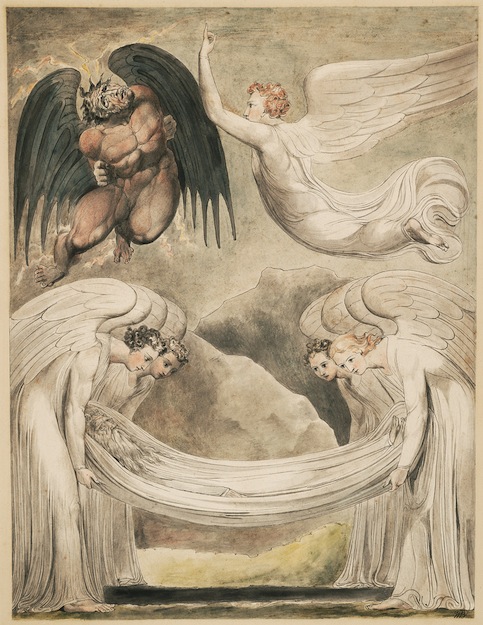
Michael and Satan struggled not over Moses but over the body of Moses. The body of work which remained from the life of Moses became the material from which further prophecy would evolve. Michael would direct Moses' work toward the realization which would take place through Jesus; Satan would direct his work toward another bondage of struggle for religious repression, political dominance, and isolation from individual consciousness of the God within.

The struggle between wrath and pity was not resolved in Moses or through Moses. Blake used the Bard's Song in Milton to exemplify the struggle between wrath and pity which remained to be solved by prophetic vision. The soul of man was/is divided by pity (which tolerates weakness) thereby being incompatible with wrath (which is moved to destroy failure.) The contraries take many forms. The work in Los' furnaces is the repeated resolution of the dichotomies as they appear in multiple forms as an individual travels through states or as societies travel through the Eyes of God.

Blake means for us to get an impression of struggle between Michael and Satan in this passage from the Bard's Song in Milton. Various qualities and behaviors appear in each character but nevertheless we can see wrath and pity contending, being split apart and being sent back to fight another round.

Milton, Plate 8, (E 102)
"They Plow'd in tears! incessant pourd Jehovahs rain, & Molechs
Thick fires contending with the rain, thunder'd above rolling
Terrible over their heads; Satan wept over Palamabron
Theotormon & Bromion contended on the side of Satan
Pitying his youth and beauty; trembling at eternal death:
Michael contended against Satan in the rolling thunder
Thulloh the friend of Satan also reprovd him; faint their
reproof.

But Rintrah who is of the reprobate: of those form'd to destruction
In indignation. for Satans soft dissimulation of friendship!
Flam'd above all the plowed furrows, angry red and furious,
Till
Michael sat down in the furrow weary dissolv'd in tears
Satan who drave the team beside him, stood angry & red
He smote Thulloh & slew him, & he stood terrible over Michael
Urging him to arise: he wept! Enitharmon saw his tears
But Los hid Thulloh from her sight, lest she should die of grief
She wept: she trembled! she kissed Satan; she wept over Michael
She form'd a Space for Satan & Michael & for the poor infected.
Trembling she wept over the Space, & clos'd it with a tender Moon

Los secret buried Thulloh, weeping disconsolate over the moony Space" 


Fogg Art Museum, Harvard University
The Devil Rebuked (The Burial of Moses) 
c. 1805
Complete text of Plate 8 of Milton from the Blake Archive.
 

Image in the Blake Archive (click to enlarge for detail)

Here is more on the difficult transition to higher consciousness represented by the struggle between Michael and Satan from Fearful Symmetry by Northrop Frye:
Page 366
"Canaan, therefore, is Egypt all over again, and the crossing of the Jordan is entry into Egypt or Ulro, the mundane shell or cave of the mind. The Jordan is in the Bible more or less what the Styx or Lethe is in Classical Mythology. The fact that Moses never entered Canaan thus has a twofold significance. His death outside the Promised Land means that what he represents, the spirit of the Hebrew law or vision of Jehovah, was not good enough; but his death outside of the fallen Canaan means that he was redeemed and not rejected by Jesus, which is why he appears with Elijah on the Mount of Transfiguration."
Page 391
"The Biblical symbolism in which the crisis of vision is presented centers on the figure of Moses. Moses is the Hebrew historical cycle which began as Orc in Egypt, attained its vision of Jehovah, and ran its natural course. When Moses comes within sight of the Promised Land he represents Hebrew culture at a crisis corresponding to that of Deism. This is later referred to as a dispute between Michael, the guardian angel of Israel, and Satan over Moses' body. Satan was trying to drag him into the fallen Canaan; Michael was trying to take him to the real Promised Land, the Eden where Elijah, according to the old tradition, also awaits the apocalypse. Both sides won, and separated Hebrew civilization into the literal law of the Pharisees and the letter of the law spiritualized by Jesus."

Blake characterized the periods through man travels in his evolution as the Eyes of God.

Monday, December 05, 2011

LAW OF MOSES

To finish a series of posts on Blake's pictures related to Moses, we look at an image not of Moses but of the result of enforcing the law which Moses received from Jehovah. The son of the Israelitish woman is being stoned to death by the righteous men executing punishment for the commission of blasphemy.

Image from Wikipedia commons
Original in Tate Collection

Leviticus 24
[10] And the son of an Israelitish woman, whose father was an Egyptian, went out among the children of Israel: and this son of the Israelitish woman and a man of Israel strove together in the camp;
[11] And the Israelitish woman's son blasphemed the name of the LORD, and cursed. And they brought him unto Moses: (and his mother's name was Shelomith, the daughter of Dibri, of the tribe of Dan:)

[ 23] And Moses spake to the children of Israel, that they should bring forth him that had cursed out of the camp, and stone him with stones. And the children of Israel did as the LORD commanded Moses.

Feelings of a need for vengeance arise from the need for self protection. In fear and insecurity an individual may desire to eradicate the threat before one is attacked. The desire for personal vengeance is projected onto one's God whose image reflects the levels of psychic development one has attained. One's personal need for vengeance is reinforced by the idea that this behavior is approved and encouraged by God.

The stoning of the blasphemer is an example of the religion of Moses. The forgiveness of the woman taken in adultery who under the law deserved stoning, is the contrary example of the religion of Jesus. The practice of the religion of Jesus leaves no room for vengeance. Anything short of forgiveness, brotherhood and love is the religion of Satan because it involves becoming '
Satans' holy Trinity The Accuser The Judge & The Executioner.'

Jerusalem, Plate 52, (E 201)
"Man must & will have Some Religion; if he has not the Religion
of Jesus, he will have the Religion of Satan, & will erect the
Synagogue of Satan. calling the Prince of this World, God; and
destroying all who do not worship Satan under the Name of God.
Will any one say: Where are those who worship Satan under the
Name of God! Where are they? Listen! Every Religion that Preaches
Vengeance for Sins the Religion of the Enemy & Avenger; and not
the Forgiver of Sin, and their God is Satan, Named by the Divine
Name Your Religion O Deists: Deism, is the Worship of the God
of this World by the means of what you call Natural Religion and
Natural Philosophy, and of Natural Morality or
Self-Righteousness, the Selfish Virtues of the Natural Heart."

Jerusalem
, Plate 25, (E 170)
"Why did you take Vengeance O ye Sons of the mighty Albion?
Planting these Oaken Groves: Erecting these Dragon Temples
Injury the Lord heals but Vengeance cannot be healed:
As the Sons of Albion have done to Luvah: so they have in him
Done to the Divine Lord & Saviour, who suffers with those that suffer:
For not one sparrow can suffer, & the whole Universe not suffer also,
In all its Regions, & its Father & Saviour not pity and weep.
But Vengeance is the destroyer of Grace & Repentance in the bosom

Of the Injurer: in which the Divine Lamb is cruelly slain:"

Ghost of Abel, (E 272)
"Abel-- Are these the Sacrifices of Eternity O Jehovah, a Broken Spirit
And a Contrite Heart. O I cannot Forgive! the Accuser hath
Enterd into Me as into his House & I loathe thy Tabernacles
As thou hast said so is it come to pass: My desire is unto Cain
And He doth rule over Me: therefore My Soul in fumes of Blood
Cries for Vengeance: Sacrifice on Sacrifice Blood on Blood"

Ghost of Abel, (E 272)
"The Elohim of the Heathen Swore Vengeance for Sin! Then Thou stoodst
Forth O Elohim Jehovah! in the midst of the darkness of the Oath! All Clothed
In Thy Covenant of the Forgiveness of Sins: Death O Holy! Is this Brotherhood
The Elohim saw their Oath Eternal Fire; they rolled apart trembling over The
Mercy Seat: each in his station fixt in the Firmament by Peace Brotherhood and Love."

Thursday, December 01, 2011

MOSES & GOLDEN CALF

Moses Indignant at the Golden Calf
circa 1799-1800
Tate Collection
Blake Archive
Exodus 32

[1] And when the people saw that Moses delayed to come down out of the mount, the people gathered themselves together unto Aaron, and said unto him, Up, make us gods, which shall go before us; for as for this Moses, the man that brought us up out of the land of Egypt, we wot not what is become of him.

15] And Moses turned, and went down from the mount, and the two tables of the testimony were in his hand: the tables were written on both their sides; on the one side and on the other were they written.
[16] And the tables were the work of God, and the writing was the writing of God, graven upon the tables.

[19] And it came to pass, as soon as he came nigh unto the camp, that he saw the calf, and the dancing: and Moses' anger waxed hot, and he cast the tables out of his hands, and brake them beneath the mount.
[20] And he took the calf which they had made, and burnt it in the fire, and ground it to powder, and strawed it upon the
water, and made the children of Israel drink of it.

[26] Then Moses stood in the gate of the camp, and said, Who is on the LORD's side? let him come unto me. And all the sons of Levi gathered themselves together unto him.
[27] And he said unto them, Thus saith the LORD God of Israel, Put every man his sword by his side, and go in and out from gate to gate throughout the camp, and slay every man his brother, and every man his companion, and every man his neighbour.
[28] And the children of Levi did according to the word of Moses: and there fell of the people that day about three thousand men.

Blake understood that the stage of psychological development of the time of Moses was earlier than is ours. The emphasis on assimilating a code of moral behavior is representative of the stage of developing a superego in the order of psychic evolution. Moses represented the period of cultural development when external and internal controls on the impulsive behaviors of the id had not yet been firmly established. The expressions of wrath by God and those acting for God, which were acceptable at the time of the Exodus, appear abhorrent to the mentality of Jesus.

The vision that men have of God reflects their own consciousness. Blake's fascination with the accounts of events in the Old Testament resulted from the insight into the evolution of awareness of the cosmic relationship of God and man which they provide.

Annotations to Watson, E 617
Watson 'every fact recorded in them may be true'
WB "Impossible for the facts are such as none but the actor
could tell, if it is True Moses & none but he could write it
unless we allow it to be Poetry & that poetry inspired
[P 16] If historical facts can be written by inspiration
Miltons Paradise Lost is as true as Genesis. or Exodus. but the
Evidence is nothing for how can he who writes what he has neither
seen nor heard of. be an Evidence of The Truth of his history
...
I cannot concieve the Divinity of the Bible
to consist either in who they were written by or at what time or
in the historical evidence which may be all false in the eyes of
one man & true in the eyes of another but in the Sentiments &
Examples which whether true or Parabolic are Equally useful as
Examples given to us of the perverseness of some & its consequent
evil & the honesty of others & its consequent good This sense of
the Bible is equally true to all & equally plain to all. none can
doubt the impression which he recieves from a book of Examples.
If he is good he will abhor wickedness in David or Abraham if he
is wicked he will make their wickedness an excuse for his & so he
would do by any other book"

From Fearful Symmetry, Northrup Frye:
Page 346
"Blake's poem [Milton] attempts to recreate the central vision of life, based on the Bible, which made Milton a great Christian poet...Blake is therefore, trying to do for Milton what the prophets and Jesus did for Moses: isolate what is poetic and imaginative, and annihilate what is legal and historical."

From Chapter Six of the Blake Primer, Larry Clayton:
"Although when we read without blinders, we can see their consciousness of God changing before our eyes. Note Abraham bargaining with God for the survival of his nephew in Sodom and Moses simply defying God if he refuses to forgive the worshippers of the golden calf. In the spirit of these two revealing passages Blake in his own recreation of the biblical story dramatically portrayed an evolving God consciousness, which the black book simply cannot permit. It was Blake's willingness to let the old die that made him notably ready for the new birth. The dark night of the soul had intensified until it became the Sickness unto Death."


Blog post titled Natural Religion.

Tuesday, November 29, 2011

GOD, MOSES & BLAKE

Blake has produced a powerful image of God communicating in the form of the tablets of the law, with man in the form of Moses. Moses is bowed in humility below the feet of God occupying a separate enclosed space where he is protected from the full impact of God's presence. The account of Moses receiving the law is repeated several times in the Bible with details which emphasize various aspects. The accounts may focus on the tablets of the law themselves, but just as important is the experience of Moses in encountering God through the images of fire, cloud, symbolic periods of time, thunderings, lightnings and the noise of the trumpet. Blake incorporates many of these symbols in his picture plus many faces of humans or angels surrounding the events.

Exodus 20
[18] And all the people saw the thunderings, and the lightnings, and the noise of the trumpet, and the mountain smoking: and when the people saw it, they removed, and stood afar off.
[19] And they said unto Moses, Speak thou with us, and we will hear: but let not God speak with us, lest we die.
[20] And Moses said unto the people, Fear not: for God is come to prove you, and that his fear may be before your faces, that ye sin not.
[21] And the people stood afar off, and Moses drew near unto the thick darkness where God was.
[22] And the LORD said unto Moses, Thus thou shalt say unto the children of Israel, Ye have seen that I have talked with you from heaven.

Exodus 24
[12] And the LORD said unto Moses, Come up to me into the mount, and be there: and I will give thee tables of stone, and a law, and commandments which I have written; that thou mayest teach them.
[13] And Moses rose up, and his minister Joshua: and Moses went up into the mount of God.
[14] And he said unto the elders, Tarry ye here for us, until we come again unto you: and, behold, Aaron and Hur are with you: if any man have any matters to do, let him come unto them.
[15] And Moses went up into the mount, and a cloud covered the mount.
[16] And the glory of the LORD abode upon mount Sinai, and the cloud covered it six days: and the seventh day he called unto Moses out of the midst of the cloud.
[17] And the sight of the glory of the LORD was like devouring fire on the top of the mount in the eyes of the children of Israel.
[18] And Moses went into the midst of the cloud, and gat him up into the mount: and Moses was in the mount forty days and forty nights.
Exodus 32
[15] And Moses turned, and went down from the mount, and the two tables of the testimony were in his hand: the tables were written on both their sides; on the one side and on the other were they written.
[16] And the tables were the work of God, and the writing was the writing of God, graven upon the tables.


God Writing upon the Tables of the Covenant
National Galleries of Scotland


It is not the person Moses or the written law which Blake held in high regard, it is the fact that God works in and through men. Blake saw that Moses encountered God on the mountaintop and came away with an image of God which would further the psychological and spiritual development of man.


Marriage of Heaven & Hell, Plate 23, (E 43)
"if Jesus Christ is the
greatest man, you ought to love him in the greatest degree; now
hear how he has given his sanction to the law of ten
commandments: did he not mock at the sabbath, and so mock the
sabbaths God? murder those who were murderd because of him? turn
away the law from the woman taken in adultery? steal the labor of
others to support him? bear false witness when he omitted making
a defence before Pilate? covet when he pray'd for his disciples,
and when he bid them shake off the dust of their feet against
such as refused to lodge them? I tell you, no virtue can exist
without breaking these ten commandments: Jesus was all virtue,
and acted from impulse: not from rules."

Vision of the Last Judgment, (E 556)
"beneath the falling figure of Cain is Moses casting his tables of
stone into the Deeps. it ought to be understood that the Persons
Moses & Abraham are not here meant but the States Signified by
those Names the Individuals being representatives or Visions of
those States as they were reveald to Mortal Man in the Series of
Divine Revelations. as they are written in the Bible these
various States I have seen in my Imagination when distant they
appear as One Man but as you approach they appear
Multitudes of Nations."

Jerusalem, Plate 73, (E 228)
"And all the Kings & Nobles of the Earth & all their Glories
These are Created by Rahab & Tirzah in Ulro: but around
These, to preserve them from Eternal Death Los Creates
Adam Noah Abraham Moses Samuel David Ezekiel
Dissipating the rocky forms of Death, by his thunderous Hammer
As the Pilgrim passes while the Country permanent remains
So Men pass on: but States remain permanent for ever"

Sunday, November 27, 2011

HIDING OF MOSES

Exodus
Chapter1
[13] And the Egyptians made the children of Israel to serve with rigour:
[14] And they made their lives bitter with hard bondage, in morter, and in brick, and in all manner of service in the field: all their service, wherein they made them serve, was with rigour.
[15] And the king of Egypt spake to the Hebrew midwives, of which the name of the one was Shiphrah, and the name of the other Puah:
[16] And he said, When ye do the office of a midwife to the Hebrew women, and see them upon the stools; if it be a son, then ye shall kill him: but if it be a daughter, then she shall live.
Chapter 2
[1] And there went a man of the house of Levi, and took to wife a daughter of Levi.
[2] And the woman conceived, and bare a son: and when she saw him that he was a goodly child, she hid him three months.
[3] And when she could not longer hide him, she took for him an ark of bulrushes, and daubed it with slime and with pitch, and put the child therein; and she laid it in the flags by the river's brink.
[4] And his sister stood afar off, to wit what would be done to him.
 

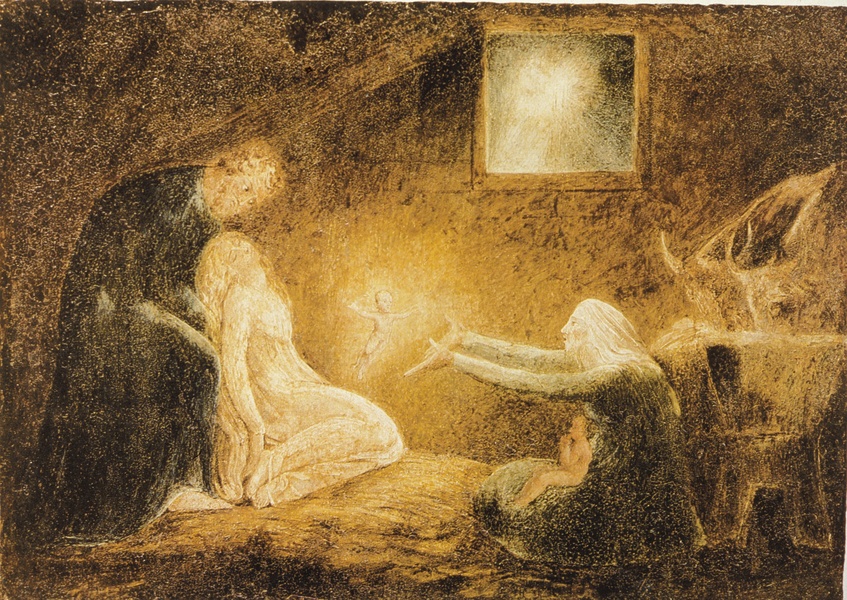
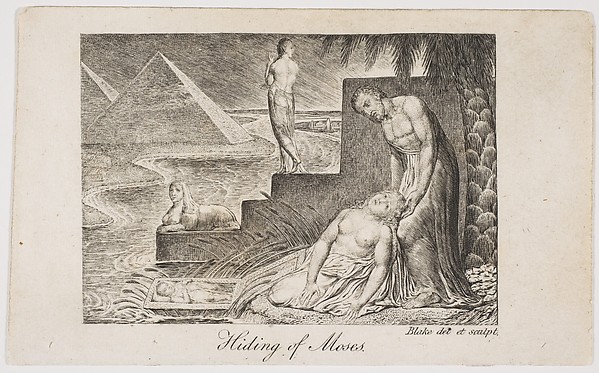
The infant set afloat on the Nile or the Hiding of Moses in the Tate Collection is not available for publication but here is a link to it.

Blake's picture of the infant Moses set afloat on the Nile calls our attention first to the fact that the scene took place in Egypt, the land to which the Israelites voluntarily moved to escape famine in their homeland. When their benefactor was no longer in power they became slave labor for the Egyptians. To control increase in the Israelite population the Pharaoh ordered that the male infants be killed. In order to avoid having her son killed, Moses' mother hid him in a floating basket on the edge of the Nile. In this scene the mother is leaving the infant to an unknown fate. The child is rescued by a daughter of Pharaoh and grows up in an Egyptian household.

The anxiety of the mother and father is evident in the picture. Realistically, they feared that the child would not survive. However the fears of the parents were not realized. The role that Moses played in the history of his people is well known. He secured their release from slavery, led them through the wilderness, presented them with a covenant from God and received the commandments from God which were to define and shape the people of Israel.

Images which Blake created of the infant Jesus and his parents closely resemble Moses and his parents. Blake was emphasizing that the role of Jesus in the New Testament and of Moses in the Old Testament are parallel. Both had their lives threatened by the authorities as infants, both emerged from the land of Egypt to introduce new teachings to their people. Both offered freedom to enslaved people: those enslaved in Egypt, and those enslaved to the 'law of sin and death'.

Notice the similarity in this illustration to Milton's On the Morning of Christ's Nativity.

This tempera painting of the nativity which Blake produced for Thomas Butts is available on wikipedia. The original is in the Philadelphia Museum of Art.


The culmination of the spiritual development which was traced through the events of the Old Testament and hinged on the character of Moses, came to fruition in Jesus. Blake in his characteristic way ties together disparate events: in this case through visual rather than verbal images. 
Metropolitan Museum of Art
Engraving of Hiding of Moses
1825

Friday, November 25, 2011

MOSES PICTURES

All Religions Are One
Title Page


Blake produced about eight images from the life of Moses. They were not produced as a set; they are in various media and they are is multiple locations now. Several are not available for publication on the internet but all can be viewed through links.


The infant set afloat on the Nile
Tate Collection

Pharaoh's daughter finding Moses

found on internet


Moses encounters the burning bush
Victoria & Albert Museum

He receives commandments from God
National Galleries of Scotland

Moses and the tablets of the law
Yale Center for British Art, Paul Mellon Collection

Moses raging at the golden calf
Tate Collection

Moses producing water from the rock
Lutheran Church of America, Glen Foerd at Torresdale, Philadelphia
Scroll down for thumbnail image

He erects the brazen serpent
Museum of Fine Arts Boston

Satan contends for body of Moses
Fogg Art Museum, Harvard University

Thursday, November 17, 2011

FINDING OF MOSES

The Compassion of Pharoah's Daughter
The Finding of Moses
from Victoria & Albert Museum


Songs & Ballads, (E 491)
"Auguries of Innocence

The Babe is more than swadling Bands
Throughout all these Human Lands
Tools were made & Born were hands
Every Farmer Understands
Every Tear from Every Eye
Becomes a Babe in Eternity
This is caught by Females bright
And returnd to its own delight"


Exod.2
[1] And there went a man of the house of Levi, and took to wife a daughter of Levi.
[2] And the woman conceived, and bare a son: and when she saw him that he was a goodly child, she hid him three months.
[3] And when she could not longer hide him, she took for him an ark of bulrushes, and daubed it with slime and with pitch, and put the child therein; and she laid it in the flags by the river's brink.
[4] And his sister stood afar off, to wit what would be done to him.
[5] And the daughter of Pharaoh came down to wash herself at the river; and her maidens walked along by the river's side; and when she saw the ark among the flags, she sent her maid to fetch it.
6] And when she had opened it, she saw the child: and, behold, the babe wept. And she had compassion on him, and said, This is one of the Hebrews' children.
[7] Then said his sister to Pharaoh's daughter, Shall I go and call to thee a nurse of the Hebrew women, that she may nurse the child for thee?
[8] And Pharaoh's daughter said to her, Go. And the maid went and called the child's mother.
[9] And Pharaoh's daughter said unto her, Take this child away, and nurse it for me, and I will give thee thy wages. And the woman took the child, and nursed it.
[10] And the child grew, and she brought him unto Pharaoh's daughter, and he became her son. And she called his name Moses: and she said, Because I drew him out of the water.

In the light of Blake's system of thought the babe in the picture of the finding of Moses means more than a simple illustration of an event. The appearance of the babe signals a transition to altered circumstances. The babe Moses became a seminal figure in the development of the culture of the Israelites. The sojourn and slavery on the Israelites in Egypt was brought to an end through the instrument of Moses. But the child was to absorb much from the culture of Egypt by being raised by the daughter of Pharoah.

Blake's poem The Mental Traveller can be seen to be related to the situation which Moses exemplified. He was taken in by the Egyptian culture, grew strong, overcame the ties which held him, and led his people to a new freedom. Blake sees the transformations which must occur in individual and societies in the symbol of the birth of the vigorous, insistent babe.


Songs & Ballads, (E 483)
"The Mental Traveller

I traveld thro' a Land of Men
A Land of Men & Women too
And heard & saw such dreadful things
As cold Earth wanderers never knew

For there the Babe is born in joy
That was begotten in dire woe
Just as we Reap in joy the fruit
Which we in bitter tears did sow

And if the Babe is born a Boy
He's given to a Woman Old
Who nails him down upon a rock
Catches his Shrieks in Cups of gold"

Sunday, November 13, 2011

FIERY SERPENTS

Numbers 21
[5] And the people spake against God, and against Moses, Wherefore have ye brought us up out of Egypt to die in the wilderness? for there is no bread, neither is there any water; and our soul loatheth this light bread.
[6] And the LORD sent fiery serpents among the people, and they bit the people; and much people of Israel died.
[7] Therefore the people came to Moses, and said, We have sinned, for we have spoken against the LORD, and against thee; pray unto the LORD, that he take away the serpents from us. And Moses prayed for the people.
[8] And the LORD said unto Moses, Make thee a fiery serpent, and set it upon a pole: and it shall come to pass, that every one that is bitten, when he looketh upon it, shall live.
[9] And Moses made a serpent of brass, and put it upon a pole, and it came to pass, that if a serpent had bitten any man, when he beheld the serpent of brass, he lived.
[10] And the children of Israel set forward, and pitched in Oboth.

                                                                                                                                                  The pole on which Blake pictures the fiery serpent erected by Moses is in the
Wikimedia Commons
Moses & the Brazen Serpent
shape of a cross. The serpent draped around the shoulders of Moses appears to be lifeless as are two other serpents on the right side of the picture. The two figures falling headfirst are encircled by serpents, a common symbol Blake uses for Satan or for Zoas being split from their unity. Several figures are in the position of penitent prayer.

The image of the serpent wrapped around a pole became the symbol of healing. Christ to whom we look for healing was raised upon the pole of the cross himself.

Although Blake considered Moses to be an inspired prophet he disagreed with Moses' accounts of God as vengeful. That God would send the fiery serpents on the people of Israel because they complained of their hardships, does not agree with the picture of the loving, forgiving God of the New Testament. A benevolent God could lead the people into finding a way to deal with a disease they encountered without having sent the disease as punishment.

Is this passage from Blake we find the right/left symbolism he used, and 'Satan wound round by the Serpent & falling headlong', in association with Moses and the Tables of Stone.

DESCRIPTIONS OF THE LAST JUDGMENT, (E 552)
" To Ozias Humphry Esqre

The right hand of the Design is appropriated to the
Resurrection of the Just the left hand of the Design is
appropriated to the Resurrection & Fall of the Wicked
Immediately before the Throne of Christ is Adam & Eve
kneeling in humiliation as representatives of the whole Human
Race Abraham & Moses kneel on each side beneath them from the
cloud on which Eve kneels [ & beneath Moses & from the Tables
of Stone which utter lightnings] is seen Satan wound round
by the Serpent & falling headlong the Pharisees appear on the
left hand pleading their own righteousness before the Throne of
Christ"

The fiery serpent in contemporary news is available in these articles: CNN, Carter Center, Health Media.

Friday, November 11, 2011

BLAKE, MOSES & LAW


Moses receiving law

1880
Yale Center for British Art, Paul Mellon Collection


To Blake the law resulted from the fall of man. It was given as a temporary measure by Urizen to exercise control over desire in the absence of the Eternal Vision. What Murry calls the 'disastrous separation of Desire and Reason' causes true reason to become false reason (Urizen) which holds desire in chains. "But in the symbolic figure of Orc 'desire is not weak enough to be restrained', and does not sink into the shadow of Desire. It is not indeed pure Desire, because of the fatal separation has occurred. But it is desire with enough memory of its former state of grace to be in rebellion against the bondage of false reason."

Quote is from John Middleton Murry's William Blake, Page 86.

Here is some of what Blake wrote about Moses and about the law.


Song of Los, Plate 3, (E 67)
"Moses beheld upon Mount Sinai forms of dark delusion"

The Everlasting Gospel, PAGES 48-52, (E 521)
"Jesus was sitting in
Moses Chair
They brought the trembling Woman There

Moses
commands she be stoned to Death
What was the sound of Jesus breath
He laid his hand on
Moses Law
The Ancient Heavens in Silent Awe
Writ with Curses from Pole to Pole
All away began to roll"

Annotations to Watson, (E 618)
"All Penal Laws court Transgression & therefore are cruelty & Murder
The laws of the Jews were (both ceremonial & real) the
basest & most oppressive of human codes. & being like all other
codes given under pretence of divine command were what Christ
pronouncd them The Abomination that maketh desolate. i.e State
Religion which is the Source of all Cruelty"

America, Plate 8, (E 54)
"The terror answerd: I am Orc, wreath'd round the accursed tree:
The times are ended; shadows pass the morning gins to break;
The fiery joy, that Urizen perverted to ten commands,
What night he led the starry hosts thro' the wide wilderness:
That stony law I stamp to dust: and scatter religion abroad
To the four winds as a torn book, & none shall gather the leaves;
But they shall rot on desart sands, & consume in bottomless deeps;
To make the desarts blossom, & the deeps shrink to their fountains,
And to renew the fiery joy, and burst the stony roof."

Blake is entirely Biblical in his understanding that the law of sin and death, the law of commandments and retribution, is transcended through living in Jesus whom he calls the Imagination.

Rom.8
[1] There is therefore now no condemnation to them which are in Christ Jesus, who walk not after the flesh, but after the Spirit.
[2] For the law of the Spirit of life in Christ Jesus hath made me free from the law of sin and death.