Showing posts with label Milton. Show all posts

Sunday, December 28, 2025

NATIVITY ODE 6

Repost from December 2009 

Wikipedia Commons
On the Morning of Christ's Nativity
Object 6, Butts Set
The Night of Peace

Generation to Blake was a gift from God to prevent the part of Eternity that separated from the whole, from falling into nonentity. Each birth is a reenactment of that mercy which gives a new opportunity for a return to the wholeness of Eternity.

The entry of the immortal spirit into the physical world, is what the images of nativity attempt to portray. Incorporation of the spiritual in the physical is a movement that sets off a process of evolving awareness of incarnation: the unity of body and spirit.

In Blake's words, the Nativity is concerned with the 'mortal birth.' Blake's primary interest was in the birth to immortality. Blake added TO TIRZAH to Songs of Experience in later copies of Songs as his affirmation of the raising of the spiritual body. But just as 'generation is the image of regeneration', birth is the image of rebirth, and the child is the image of the new man.

Here is a passage from Jung in which consciousness itself is the child which is born daily, or moment by moment out of the inner depths.

"Consciousness does not create itself-it wells up from unknown depths. In childhood it awakens gradually, and all through life it wakes each morning out of the depths of sleep from an unconscious condition. It is like a child that is born daily out of the primordial womb of the unconscious. . . . It is not only influenced by the unconscious but continually emerges out of it in the form of numberless spontaneous ideas and sudden flashes of thought." ["The Psychology of Eastern Meditation," CW 11, par. 935.]

The consciousness that Blake tried to convey was that of being a part of the one body; and being open to a direct connection to the world which is unseen but always present: Eternity.

Songs of Innocence and Experience, Song 52 (E30)
TO TIRZAH
"Whate'er is Born of Mortal Birth,
Must be consumed with the Earth
To rise from Generation free;
Then what have I to do with thee?

The Sexes sprung from Shame & Pride
Blow'd in the morn: in evening died
But Mercy changd Death into Sleep;
The Sexes rose to work & weep.

Thou Mother of my Mortal part.
With cruelty didst mould my Heart.
And with false self-decieving tears,
Didst bind my Nostrils Eyes & Ears.

Didst close my Tongue in senseless clay
And me to Mortal Life betray:
The Death of Jesus set me free,
Then what have I to do with thee?"

[text on illustration: It is Raised a Spiritual Body]

Jerusalem, Plate 7 (E149)
"And the Religion of Generation which was meant for the destruction
Of Jerusalem, become her covering, till the time of the End.
O holy Generation! [Image] of regeneration!
O point of mutual forgiveness between Enemies!

Birthplace of the Lamb of God incomprehensible!" 

V

But peacefull was the night
Wherin the Prince of light
His raign of peace upon the earth began:
The Windes, with wonder whist,

XXVII

But see the Virgin blest,
Hath laid her Babe to rest.
Time is our tedious Song should here have ending,
Heav'ns youngest-teemed Star 
Hath fixt her polisht Car,
Her sleeping Lord with Handmaid Lamp attending.
And all about the Courtly Stable,
Bright-harnest Angels sit in order serviceable.

Smoothly the waters kist,
Whispering new joyes to the milde Ocean,
Who now hath quite forgot to rave,
While Birds of Calm sit brooding on the charmed wave.


Saturday, December 27, 2025

NATIVITY ODE 5

 Repost from December 2010

In December 2009 I posted four times on the nativity using Blake's illustrations to Milton's On the Morning of Christ's Nativity. The fifth illustration of the series "The Flight of Molock" faithfully presents these lines from Milton's ode:

XXIII
And sullen Moloch fled,
Hath left in shadows dread
His burning Idol all of blackest hue;
In vain with Cymbals' ring
They call the grisly king,
In dismal dance about the furnace blue,

Wikipedia Commons
On the Morning of Christ's Nativity
Object 5, Butts Set
The Flight of Moloch

Moloch, the second of Blake's Seven Eyes of God, called the executioner, required child sacrifice. Blake presents the theme of sacrificing children by showing the infant Jesus emerging from a 'fiery furnace.' Daniel tells of three men who emerged from such a furnace unscathed having met in the furnace a fourth who appeared as the 'Son of God.'

On plate 31 (E 177) of Jerusalem Blake tells us that:

"And the appearance of a Man was seen in the Furnaces;
Saving those who have sinned from the punishment of the Law,
(In pity of the punisher whose state is eternal death,)
And keeping them from Sin by the mild counsels of his love."

Two women (cf.1st Kings 3:16ff) are touching the child emerging from the furnace. One appears to be Jerusalem, the other Vala or Rahab. Both turn away from the child as they reach out to touch him. In The Mental Traveller we read of a babe whom none could touch:

The Mental Traveller, (E 484)
"Till from the fire on the hearth
A little Female Babe does spring

And she is all of solid fire
And gems & gold that none his hand
Dares stretch to touch her Baby form
Or wrap her in his swaddling-band"

Blake and Milton have added to the picture of the child who was laid in the manger as provided by Luke. They have called attention to earlier visions of God which will be replaced by the vision brought by the life, death and resurrection of Jesus.


Monday, December 22, 2025

NATIVITY ODE 4

Repost from December 2009

Wikipedia Commons
Illustration to Milton's Nativity Ode 
Object 4, Thomas Set
The Overthrow of Apollo and the Pagan Gods

It was in 1629 when John Milton was 21 years old that he wrote the first of his poems in English. His earlier poems were written in Latin or Greek. The first and last sections of On the Morning of Christ's Nativity  deal with the birth of the Christ Child and the longer middle section gives accounts of the expulsion of pagan gods. This represents a movement in Milton's interest, and in the subject matter of his study and reading. His academic career had emphasized classical literature although he was well acquainted with the Bible. Reaching the age of maturity, he turned away from pagan religious figures which had been objects of devotionion in earlier civilizations, and toward describing the life of Christ, 

Blake made two sets of six illustration for On the Morning of Christ's Nativity In 1809 he was comissioned to make a set for Rev. Joseph Thomas; between 1811 and 1820 he completed a set for his most loyal patron, Thomas Butts.

Blake in his characteristic way, saw the birth of Christ as part of the larger picture, as did Milton. The Bible, John Milton, the history of religion, cosmology, and his own myth; each play a role in Blake's response to Jesus' birthday.

"On the Morning of Christ's Nativity"

The Blake Archive provides this in its introduction to "On the Morning of Christ's Nativity:"
"Blake's interest in the 'Nativity Ode' began some years before his execution of these water colors. His illuminated book, Europe a Prophecy (1794), clearly shows the influence of Milton's ode. By 1809, Blake may have taken a renewed interest in the poem because of his increasingly Christocentric theological views. His harsh criticism of classical civilization resonates with two of the 'Nativity' designs, 'The Old Dragon' and 'The Overthrow of Apollo and the Pagan Gods' (objects 3 and 4). Modern critics have been hard pressed to find Blake dissenting from Milton's own iconography and perspectives in the ode."

Milton, Nativity Ode
XIX.
The Oracles are dumm,
No voice or hideous humm
Runs through the arched roof in words deceiving.
Apollo from his shrine
Can no more divine,
With hollow shreik the steep of Delphos leaving.

No nightly trance, or breathed spell,
Inspires the pale-ey'd Priest from the prophetic cell.
...
The brutish gods of Nile as fast, 
Isis and Orus, and the Dog Anubis hast.
XXIV 
Nor is Osiris seen 
In Memphian Grove, or Green, 
Trampling the unshowr'd 
Grasse with lowings loud: 
Nor can he be at rest 
Within his sacred chest, 
Naught but profoundest 
Hell can be his shroud: 
In vain with Timbrel'd Anthems dark 
The sable-stoled Sorcerers bear his worshipt Ark. 

Europe a Prohecy,  Plate 2, (E61)
"Ah! I am drown'd in shady woe, and visionary joy.

And who shall bind the infinite with an eternal band?
To compass it with swaddling bands? and who shall cherish it
With milk and honey?
I see it smile & I roll inward & my voice is past.

She ceast & rolld her shady clouds
Into the secret place.
Plate 3
A PROPHECY
The deep of winter came;
What time the secret child,
Descended thro' the orient gates of the eternal day:
War ceas'd, & all the troops like shadows fled to their abodes."
Jerusalem, Plate 55, (E 205)
"Then far the greatest number were about to make a Separation     
And they Elected Seven, calld the Seven Eyes of God;
Lucifer, Molech, Elohim, Shaddai, Pahad, Jehovah, Jesus.
They namd the Eighth. he came not, he hid in Albions Forests"
Jerusalem, Plate 37 [41], (E 137)
"And these their Names & their Places within the Mundane Shell
In Tyre & Sidon I saw Baal & Ashtaroth. In Moab Chemosh          
In Ammon, Molech: loud his Furnaces rage among the Wheels
Of Og, & pealing loud the cries of the Victims of Fire!
And pale his Priestesses infolded in Veils of Pestilence, border'd
With War; Woven in Looms of Tyre & Sidon by beautiful Ashtaroth.
In Palestine Dagon, Sea Monster! worshipd o'er the Sea.      
Thammuz in Lebanon & Rimmon in Damascus curtaind
Osiris: Isis: Orus: in Egypt: dark their Tabernacles on Nile
Floating with solemn songs, & on the  Lakes of Egypt nightly
With pomp, even till morning break & Osiris appear in the sky
But Belial of Sodom & Gomorrha, obscure Demon of Bribes
And secret Assasinations, not worshipd nor adord; but 
With the finger on the lips & the back turnd to the light
And Saturn Jove & Rhea of the Isles of the Sea remote
These Twelve Gods. are the Twelve Spectre Sons of the Druid Albion "

Thursday, December 18, 2025

NATIVITY ODE 3

Wikipedia Commons
Illustration to Milton's Nativity Ode 
Object 3, Butts Set
The Old Dragon

Seven Headed Dragon

Revelation 12

[1] And there appeared a great wonder in heaven; a woman clothed with the sun, and the moon under her feet, and upon her head a crown of twelve stars:
[2] And she being with child cried, travailing in birth, and pained to be delivered.
[3] And there appeared another wonder in heaven; and behold a great red dragon, having seven heads and ten horns, and seven crowns upon his heads.
[4] And his tail drew the third part of the stars of heaven, and did cast them to the earth: and the dragon stood before the woman which was ready to be delivered, for to devour her child as soon as it was born.
[5] And she brought forth a man child, who was to rule all nations with a rod of iron: and her child was caught up unto God, and to his throne.
[6] And the woman fled into the wilderness, where she hath a place prepared of God, that they should feed her there a thousand two hundred and threescore days.
[7] And there was war in heaven: Michael and his angels fought against the dragon; and the dragon fought and his angels,
[8] And prevailed not;
neither was their place found any more in heaven.
[9] And the great dragon was cast out, that old serpent, called the Devil, and Satan, which deceiveth the whole world: he was cast out into the earth, and his angels were cast out with him.
[10] And I heard a loud voice saying in heaven, Now is come salvation, and strength, and the kingdom of our God, and the power of his Christ: for the accuser of our brethren is cast down, which accused them before our God day and night.

Milton and Blake affirm the tale told by John of Patmos in the Book of Revelation. The birth of the Christ child initiated the coming of salvation, however the opposition to God's initative would continue until God makes 'all things new'. The Dragon as a form of Satan was followed by a third of the angels out of heaven. The defeat of the forces of Satan by Michael and his angels forced them into the earth but did not destroy them. 

John's account of the struggle continued until the new Jerusalem came down from God out of heaven. Only those whose names are 'written in the Lamb's book of life' would enter therein.

Revelation Chapter 21

[22] And I saw no temple therein: for the Lord God Almighty and the Lamb are the temple of it.
[23] And the city had no need of the sun, neither of the moon, to shine in it: for the glory of God did lighten it, and the Lamb is the light thereof.
[24] And the nations of them which are saved shall walk in the light of it: and the kings of the earth do bring their glory and honour into it.
[25] And the gates of it shall not be shut at all by day: for there shall be no night there.
[26] And they shall bring the glory and honour of the nations into it.
[27] And there shall in no wise enter into it any thing that defileth, neither whatsoever worketh abomination, or maketh a lie: but they which are written in the Lamb's book of life.

On the Morning of Christ's Nativity, XVIII

"And then at last our bliss
Full and perfect is,
   But now begins; for from this happy day
Th'old Dragon under ground,
In straiter limits bound,
Not half so far casts his usurped sway,
And wroth to see his Kingdom fail,
Swings the scaly Horror of his folded tail."

Four Zoas, Page 120, (E 390)

"I will cast thee out              
If thou repentest not & leave thee as a rotten branch to be burnd
With Mystery the Harlot & with Satan for Ever & Ever
Error can never be redeemd in all Eternity
But Sin Even Rahab is redeemd in blood & fury & jealousy
That line of blood that stretchd across the windows of the morning 
Redeemd from Errors power. Wake thou dragon of the Deeps
Page 121 
Urizen wept in the dark deep anxious his Scaly form
To reassume the human & he wept in the dark deep

Saying O that I had never drank the wine nor eat the bread 
Of dark mortality nor cast my view into futurity"


Wednesday, December 17, 2025

NATIVITY ODE 2

Repost from December 2009

GOSPEL OF LUKE
2:8-12 - There were some shepherds living in the same part of the country, keeping guard throughout the night over their flocks in the open fields. Suddenly an angel of the Lord stood by their side, the splendour of the Lord blazed around them, and they were terror-stricken. But the angel said to them, 'Do not be afraid! Listen, I bring you glorious news of great joy which is for all the people. This very day, in David's town, a Saviour has been born for you. He is Christ, the Lord. Let this prove it to you: you will find a baby, wrapped up and lying in a manger.'

2:13-14 - And in a flash there appeared with the angel a vast host of the armies of Heaven, praising God, saying, 'Glory to God in the highest Heaven! Peace upon earth among men of goodwill! 
Wikipedia Commons
Illustrations to Milton's Nativity Ode
Object 2
The Annunciation to the Shepherds

Since the first image we form of ourselves is that of a body, we may formulate the idea that at some point the spirit enters the body and begins to express itself through the body. But as Blake explains here, it is the bodies which are made for the spirits which pre-exist.

As Albion represents the Universal Man, Jerusalem represents the Universal Woman: the 'vast family wondrous in beauty and love.' Albion is fourfold, Jerusalem is unified: the expression of the Divine Vision within the Universal Man. In this passage, Blake presents the idea that redemption begins when 'the Lamb of God' becomes visible within the Unified Spiritual Body which is Jerusalem. The song of the angels, sung when the birth of Jesus was announced to the shepherds, is echoed in Blake's verses at this point.


Four Zoas: Night the Eighth, Page 103 (E376)

"Enitharmon wove in tears Singing Songs of Lamentations
And pitying comfort as she sighd forth on the wind the spectres
And wove them bodies calling them her belovd sons and daughters

Employing the daughters in her looms & Los employd the Sons
In Golgonoozas Furnaces among the Anvils of time & space
Thus forming a Vast family wondrous in beauty & love
And they appeard a Universal female form created
From those who were dead in Ulro from the Spectres of the dead

PAGE 104 (FIRST PORTION)
And Enitharmon namd the Female Jerusalem the holy
Wondring
 she saw the Lamb of God within Jerusalems Veil
The divine Vision seen within the inmost deep recess
Of fair Jerusalems bosom in a gently beaming fire


Then sang the Sons of Eden round the Lamb of God & said
Glory Glory Glory to the holy Lamb of God
Who now beginneth to put off the dark Satanic body

Now we behold redemption Now we know that life Eternal
Depends alone upon the Universal hand & not in us
"

GOSPEL OF LUKE
2:25-32 - In Jerusalem was a man by the name of Simeon. He was an upright man, devoted to the service of God, living in expectation of the 'salvation of Israel'. His heart was open to the Holy Spirit, and it had been revealed to him that he would not die before he saw the Lord's Christ. He had been led by the Spirit to go into the Temple, and when Jesus' parents brought the child in to have done to him what the Law required, he took him up in his arms, blessed God, and said - 'At last, Lord, you can dismiss your servant in peace, as you promised! For with my own eyes I have seen your salvation which you have made ready for every people - a light to show truth to the Gentiles and bring glory to your people Israel.


Monday, December 15, 2025

NATIVITY ODE 1


First posted December 2009

For "On the Morning of Christ's Nativity" by John Milton, Blake made two sets of six watercolor illustrations. There is much to observe. Blake's pictures like Milton's poetry did not focus only on the supplanting of Apollo and heathen gods. The first and last pictures, like the beginning and ending of Milton's poem present a more conventional portrait of the birth of the child based on accounts in the Gospels of Luke and Matthew.


Huntington Collection
Illustrations to Milton's Nativity Ode
Object 1, Butt's Set
Descent of Peace

Blake of course, added distinctive features to his illustrations. In her book Blake's Vision of the Poetry of Milton, Bette Charlene Werner, on page 119 and following, points out some things that speak of Blake's own philosophy. Quoting from her book:

> "With the angelic figure of Peace and the recumbent form of Nature the artist suggests the union of heaven and earth in the Word made flesh.
> the Huntington version of the design emphasizes the divinity, not only of Christ, but also by implication of man.
> The Child is pictured springing forth in unfettered freedom. The figure suggests at once the "Heav'n-born-childe" of Milton's ode and the preexistent soul whose material birth Blake describes in "Infant Sorrow" (E27, SoE48):
"My mother groand! my father wept.
Into the dangerous world I lept."
The Blessed Infant, ablaze with the radiance of spiritual existence, is the light that puts the inferior flame of the sun to shame.
> According to Blake "everything that lives is holy for the source of life / Descends to be a weeping babe." (E323) That understanding may explain his portrayal of Nature here, not as one whose ugliness requires a covering, but as a figure whose naked beauty is still apparent beneath the translucent covering of snow. The veiled form of Nature in this illustration is, like the Vala of Blake's own mythology, an embodiment of the vale of tears and the veil of materiality.
> Like Milton, Blake sees in the Incarnation not only the humility of Christ, emptying himself of his Godhead, but the glorification of man. He identifies Jesus, the Divine Humanity, with Imagination and insists: "Man is All Imagination God is Man & exists in us & we in him." (E664) This understanding makes the Nativity not only the fulfillment of God's becoming man, but a promise of salvation through the spiritual union of all men in in the One Man who is Jesus, the Savior."
End of Quotes

Milton's On the Morning of Christ's Nativity

Friday, November 14, 2025

MILTON & QUAKERS

Reposted from July 2019.

The Quaker movement began during the English Civil Wars. John Milton was a young man when George Fox began preaching his message of radical dissent from established religion. Milton became an official of the Commonwealth and the Cromwell government which offered hope for religious freedom but were not able to deliver it. When the monarchy was restored and Milton returned to his quiet life of scholarship he developed an association with Quakers. Although this was a period of Quaker persecution under acts of Parliament which prohibited their meeting and preaching, Milton had friends among the Quakers.

Milton's doctor was a friend of the Quaker Isaac Pennington, who was acquainted with a young Quaker who wanted to study Latin. Pennington arranged with Dr Paget for Thomas Ellwood to read in Latin to the blind Milton. Although Ellwood had some knowledge of Latin, he first received instruction on pronunciation since he was unaware of proper Latin pronunciation. Milton discerned when Ellwood needed help with understanding what he was reading and gave him assistance. A trusting relationship developed as evidenced by Ellwood arranging for a place in a Quaker community for Milton and his family to live when the plague made it unsafe for them to stay in London.

Ellwood continued to be a welcome visitor to Milton's home after the Latin lessons had ceased. On a visit to Milton's home in 1665 Ellwood was shown a manuscript of Paradise Lost which he was allowed to take home and read. When he returned the manuscript to Milton, after some discussion, he inquired of Milton what he may have to say about 'Paradise Found'. From this conversation, Milton later told Ellwood, came the sequel to Paradise Lost: Paradise Regained.

British Museum
John Milton & Thomas Ellwood
Sketch by James Barry,
a friend of William Blake
Ellwood was entrusted with a portion of the papers of Milton at his death. Miltons republican-letters : or a collection of such as were written by command of the late Commonwealth of England from the year 1648 to the year 1659 was published in 1682. The book includes this statement: 'originally writ by the learned John Milton, secretary to those times ; and now translated into English by a wel-wisher of England's honour'.

As a tribute to his teacher and friend, Ellwood wrote an epitaph. Ellwood however turned his interest away from Milton to the publication, in 1694, of George Fox's Journal. The task of editing Fox's Journal rested partly on Milton's encouragement and careful training of Ellwood when he was embarking on a serious path of learning.

From The History of Thomas Ellwood Written by Himself:
'He, on the other hand, perceiving with what earnest desire
I pursued learning, gave me not only all the encouragement but all
the help he could; for, having a curious ear, he understood by my
tone when I understood what I read and when I did not; and
accordingly would stop me, examine me, and open the most difficult
passages to me.'

Blake was of the opinion that we are all capable of performing miracles because astonishing and comforting things are performed, not by us, but through us. Perhaps Milton, Ellwood and Fox could each see his work as miracle.

Annotations to Watson, (E 616)
"Jesus could not do miracles where unbelief hinderd hence we
must conclude that the man who holds miracles to be ceased puts
it out of his own power to ever witness one The manner of a
miracle being performd is in modern times considerd as an
arbitrary command of the
agent upon the patient but this is an impossibility not a miracle
neither did Jesus ever do such a miracle. Is it a greater
miracle to feed five thousand men with five loaves than to
overthrow all the armies of Europe with a small pamphlet
.
look over the events of your own life & if you do not find that
you have both done such miracles & lived by such you do not see
as I do True I cannot do a miracle thro experiment & to
domineer over & prove to others my superior power as neither
could Christ But I can & do work such as both astonish &
comfort me & mine
"


Monday, May 05, 2025

REASON & EMOTION

For some reason this post from July 2010 has gotten more than a thousand hits in the past.

Blake Archive
Marriage of Heaven and Hell
Plate 5

Erdman, in The Illuminated Blake
says: "Phaeton-like, down hurdle a naked man and sword and a horse with saddle cloth and broken chariot wheel...The man's spread hands are braced to hit the ground, but it is already in flames. Reason must have forgotten to let the horse do the pulling; a sword is not a bridle. But Energy must have restraint. Between them they have let the sun fall, connoting universal ruin."

The Marriage of Heaven and Hell was written in 1791 when Blake was a young man; he might be called an angry young man.

Marriage of Heaven and Hell, Plate 5, (E 34)
"Those who restrain desire, do so because theirs
is weak enough to be restrained; and the restrainer or
reason usurps its place & governs the unwilling.
And being restraind it by degrees becomes passive
till it is only the shadow of desire.
The history of this is written in Paradise Lost. & the
Governor or Reason is call'd Messiah.
And the original Archangel or possessor of the com-
mand of the heavenly host, is calld the Devil or Satan
and his children are call'd Sin & Death
But in the Book of Job Miltons Messiah is call'd
Satan. For this history has been adopted by both parties
It indeed appear'd to Reason as if Desire was
cast out. but the Devils account is, that the Messiah
fell. & formed a heaven of what he stole from the Abyss
This is shewn in the Gospel, where he prays to the
Father to send the comforter or Desire that Reason
may have Ideas to build on, the Jehovah of the Bible
being no other than he, who dwells in flaming fire.
Know that after Christs death, he became Jehovah.
But in Milton; the Father is Destiny, the Son, a
Ratio of the five senses. & the Holy-ghost, Vacuum!
Note. The reason Milton wrote in fetters when
he wrote of Angels & God, and at liberty when of
Devils & Hell, is because he was a true Poet and
of the Devils party without knowing it"

Blake was continually striving to free his imagination from constraints. The internal constraints of which he was most aware (excluding the selfhood) were misguided reason and emotion. In Plate 5 of Marriage of Heaven and Hell he expressed the concern that reason would succeed in restraining the emotions to the point that the imagination was bound. Emotion or desire is the source of energy which is required for the creative process.

As a poet, Blake identified with Milton whose Paradise Lost was of consuming interest to Blake. In this Plate Blake dealt with the poet's work (his own and Milton's), Biblical characters who becomes fictional characters for both the poets, and the abstract ideas of reason and emotion.

Blake became so interested in correcting the misconceptions of his friend (his spiritual, intellectual but not corporeal friend), that he addressed the issue in his poem Milton. Since Milton died 83 years before Blake was born, this was a friendship on the level of Eternity; time was not of the essence.

The crux of Milton's error in Blake's system is stated concisely as:
"But in Milton; the Father is Destiny, the Son, a Ratio of the
five senses. & the Holy-ghost, Vacuum!"

In Blake the Father is the Divine Humanity, in whose Image man is created; the Son is the Divine Vision, God in Man, the Incarnation; and the Holy Spirit is the Divine Body, the Human Imagination, the activity of expressing the Divine.

Or other terms used by Blake:
Father = Urizen = reason
Son = Luvah = emotions
Holy Spirit = Los = intuition or imagination
Unified man = Tharmas = body

Saturday, September 07, 2024

BLAKE & DREAMS 4

First published Oct 2012

MILTON IL PENSEROSO V

In his manuscript notes accompanying his watercolors Blake singles out these verses from Milton for his fifth illustration to Il Penseroso: 

Descriptions of Illustrations to Milton's L'Allegro and Il Penseroso (E 684)


"There in close covert by some Brook 
Where no profaner Eye may look 
With such concert as they keep 
Entice the dewy featherd Sleep 
And let some strange mysterous 
Dream Wave on his Wings in airy stream 
Of liveliest Portraiture displayd 
On my Sleeping eyelids laid 
And as I wake sweet Music breathe 
Above; about: or underneath: 
Sent by some Spirit to Mortals good 
Or the unseen Genius of the Wood" 

Blake wrote: 
"Milton sleeping on a Bank. Sleep descending with a Strange Mysterious Dream upon his Wings of Scrolls & Nets & Webs unfolded by Spirits in the Air & in the Brook around Milton are Six Spirits or Fairies hovering on the air with Instruments of Music" 

The wing of sleep dips into the water of materiality to bring images to Milton's dreaming self. Milton sleeps in what appears to be a grave; his hands cover his genitals warding off sexual involvement. 

The upper part of the picture is dominated by a circular rainbow in the center of which are the four fallen Zoas. The angel who brings the dream to Milton bears the Seven Eyes of God on his wings.

This illustration attempts to show a process of integration taking place. The dreaming man is receiving images from his unconscious which may resolve the conflicts which divide his psyche. He has the protection of the numinous forces to provide assistance in assimilating the experiences which have created entanglements in 'Scrolls & Nets & Webs'. He is surrounded in his sleep by 'his Sixfold Emanation' as 'Six Spirits or Fairies hovering on the air with Instruments of Music.'

The symbolic meaning of this illustration is closely related the conclusion of Blake's Milton and can be contrasted with the Epilogue to Gates of Paradise.
Milton, Plate 2, (E 96)
"Say first! what mov'd Milton, who walkd about in Eternity
One hundred years, pondring the intricate mazes of Providence
Unhappy tho in heav'n, he obey'd, he murmur'd not. he was silent
Viewing his Sixfold Emanation scatter'd thro' the deep In torment!" 
 
Milton, Plate 33 [36], (E 132)
"Behold Milton descended to Redeem the Female Shade
From Death Eternal; such your lot, to be continually Redeem'd
By death & misery of those you love & by Annihilation
When the Sixfold Female percieves that Milton annihilates
Himself: that seeing all his loves by her cut off: he leaves     
Her also: intirely abstracting himself from Female loves
She shall relent in fear of death: She shall begin to give
Her maidens to her husband: delighting in his delight
And then & then alone begins the happy Female joy"
 
Milton, Plate 40 [46], (E 141)
"Before Ololon Milton stood & percievd the Eternal Form
Of that mild Vision; wondrous were their acts by me unknown
Except remotely; and I heard Ololon say to Milton

I see thee strive upon the Brooks of Arnon."
 
Milton, Plate 41 [48], (E 143)
"Then trembled the Virgin Ololon & replyd in clouds of despair

Is this our Femin[in]e Portion the Six-fold Miltonic Female      
Terribly this Portion trembles before thee O awful Man
Altho' our Human Power can sustain the severe contentions
Of Friendship, our Sexual cannot: but flies into the Ulro.
Hence arose all our terrors in Eternity! & now remembrance
Returns upon us! are we Contraries O Milton, Thou & I            
O Immortal! how were we led to War the Wars of Death
Is this the Void Outside of Existence, which if enterd into

Plate 42 [49]       
Becomes a Womb? & is this the Death Couch of Albion
Thou goest to Eternal Death & all must go with thee

So saying, the Virgin divided Six-fold & with a shriek
Dolorous that ran thro all Creation a Double Six-fold Wonder! 
Away from Ololon she divided & fled into the depths              
Of Miltons Shadow as a Dove upon the stormy Sea.

Then as a Moony Ark Ololon descended to Felphams Vale
In clouds of blood, in streams of gore, with dreadful thunderings
Into the Fires of Intellect that rejoic'd in Felphams Vale
Around the Starry Eight: with one accord the Starry Eight became 
One Man Jesus the Saviour. wonderful! round his limbs
The Clouds of Ololon folded as a Garment dipped in blood
Written within & without in woven letters: & the Writing
Is the Divine Revelation in the Litteral expression:
A Garment of War, I heard it namd the Woof of Six Thousand Years 

And I beheld the Twenty-four Cities of Albion
Arise upon their Thrones to Judge the Nations of the Earth
And the Immortal Four in whom the Twenty-four appear Four-fold
Arose around Albions body: Jesus wept & walked forth
From Felphams Vale clothed in Clouds of blood, to enter into     
Albions Bosom, the bosom of death & the Four surrounded him
In the Column of Fire in Felphams Vale; then to their mouths the Four
Applied their Four Trumpets & them sounded to the Four winds" 
~~~~~~~~~~~~~~~~~~~~~~~~~~~~~~~~~~~~~~~~~~~~~~~~~~~~~~~~~~ 
We went to the tennis court early this morning as usual but found something unusual: a moth clinging to the fence behind the court. Since I remembered from long ago that this was a particularly beautiful species of moth, I went for a closer look. I remembered the color - a pale luminous green, and the form - graceful wings with extended tails, but I had forgotten another feature - small well articulated 'eyes' on the wings. Since I had been looking at the wings of sleep covered with the Eyes of God, I was astonished to find eyes on the wings of a Luna moth. The name of the moth connects it with the moon, the feminine and Beulah. So Milton's Mysterious Dream is not far removed from the commonplace of ordinary life.

Friday, June 21, 2024

OPPOSITES

On page 379 of The Master and His Emissary, Iain McGilchrist cites his evidence that Blake wrote and illustrated under the influence of the right hemisphere of his brain. McGilchrist used one of Blake's earliest illuminated works There is No Natural Religion, to demonstrate that Blake had a firm grasp on the workings of the right hemisphere as determined by exploration on the functioning of the human brain by neuroscientists. Blake intuitively knew the characteristics which were later attributed to right brain activity.

THERE is NO NATURAL RELIGION, b, VII, (E 3)
  "VII The desire of Man being Infinite the possession is Infinite
& himself Infinite
     Conclusion,   If it were not for the Poetic or Prophetic
character. the Philosophic & Experimental would soon be at the
ratio of all things & stand still, unable to do other than repeat
the same dull round over again
     Application.   He who sees the Infinite in all things sees
God.  He who sees the Ratio only sees himself only.

Therefore God becomes as we are, that we may be as he is" 

McGilchrist wrote:

 "The very titles of Blake's major work's Songs of Innocence and Experience and The Marriage of Heaven and Hell, allude to the reality that, in the lived world of the right hemisphere, opposites are not 'in opposition'. Blake's visionary poetry nontheless dramatises in various forms a battle between two powerful forces that adopt different guises: the single-minded, limiting, measuring, mechanical power of what Blake called Ratio, the God of Newton, and the myriad-minded, liberating power of creative imagination, the God of Milton. This opposition persists despite the right hemispheres unification of opposites, for the same reason that a tolerant society cannot secure the co-operation of the intolerant who would undermine it, and may ultimately find itself in the paradoxical situation of having to be intolerant of them.

Blake .. voices, without being aware of it, the brain's struggle to ward off domination by the left hemisphere. For instance, in THERE is NO NATURAL RELIGION he writes:

[Blue text provided by McGilchrist.] 

THERE is NO NATURAL RELIGION, VII, (E 3)

"Conclusion, If it were not for the Poetic or Prophetic
character. the Philosophic & Experimental would soon be at the
ratio of all things & stand still, unable to do other than repeat
the same dull round over again [to reach outside the known one needs the right
hemisphere: the left hemisphere can only repeat the known].

Application. He who sees the Infinite [looks outward to the ever becoming with
the right hemisphere
] in all things sees God. He who sees the Ratio only [looks at the self-defined world brought into being by the left hemisphere] sees himself only. [the left hemisphere is self-reflective].

Therefore God becomes as we are, that we may be as he is [through the right hemispere gives us access to imagination/metaphor, the bridge whereby the divine reaches us, and liberates us from ourselves].

Blake, too, saw himself as inspired by a return to a great figure of the pre-Augustan era, not so much in his case Shakespeare or Michelangelo (though he was undoubtedly indebted to both), but to the spirit of Milton, which, with charecteristic specificity and a wonderful refusal to be nonplussed, he believed had entered his body through the instep of his left foot:

'Then first I saw him in the Zenith as a falling star,
Descending perpendicular, swift as the swallow or swift;
And on my left foot falling on the tarsus, enterd there ...'
Milton, Plate 15 [17], (E 110)

- thereby gaining literally direct access to the right hemisphere. And so thunderstruct was he by the experience that fortunately he illustrated the event."


Wikipedia Commons
Huntington Art Gallery
Milton
Plate 29, Copy B 


Thursday, August 24, 2023

BLAKE & PLATO

First posted 2011

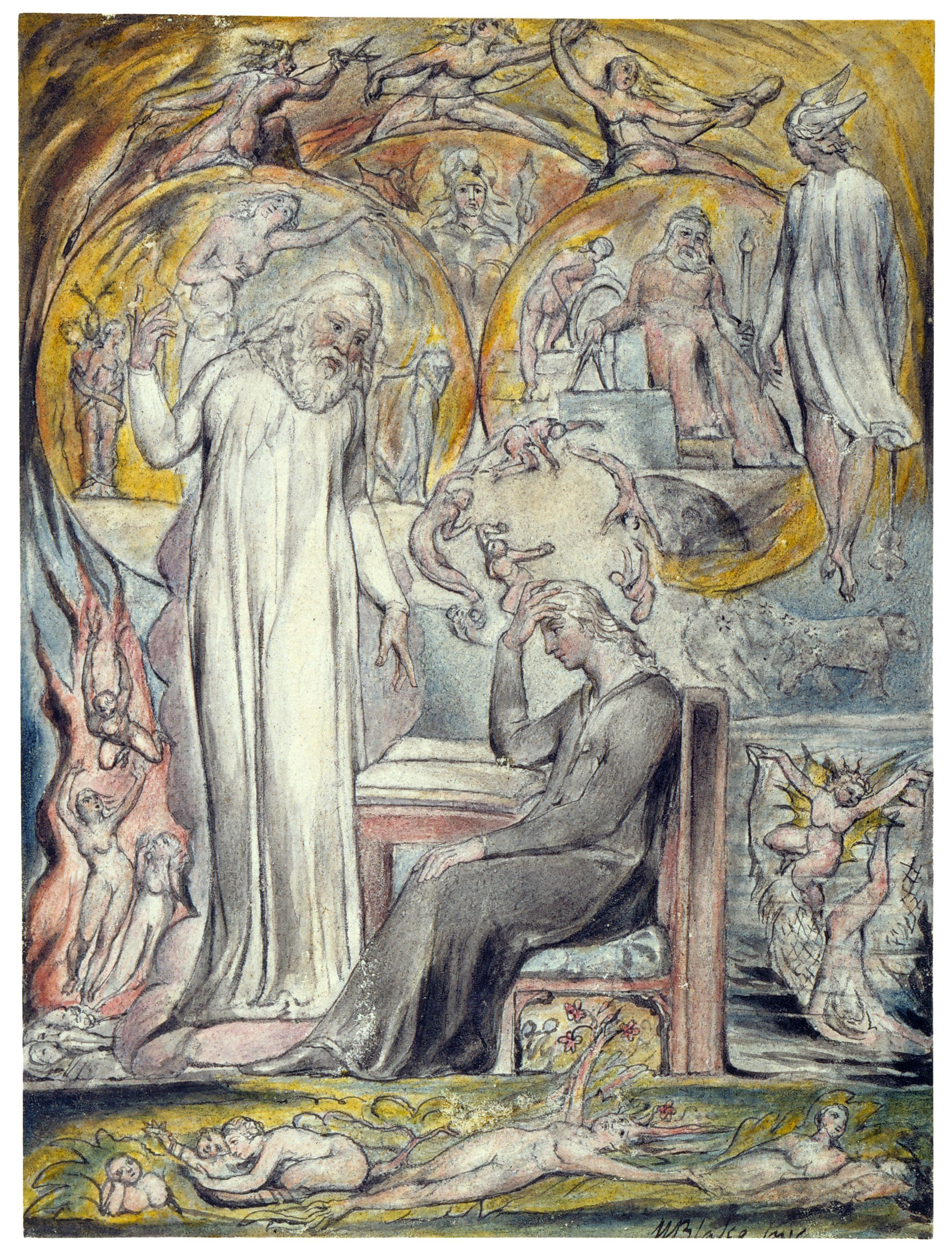
Commentary on Blake's six illustrations to Milton's Il Penseroso is found in Bette Charlene Werner's book Blake's vision of the poetry of Milton: illustrations to six poems. Blake 'invented', (he signed images WBlake inv), the third illustration The Spirit of Plato as a means of presenting a number of Plato's ideas as Milton contemplated them.

Il Penseroso

"Or let my lamp, at midnight hour,
Be seen in some high lonely tower,
Where I may oft outwatch the Bear,
With thrice great Hermes, or unsphere
The spirit of Plato, to unfold
What worlds or what vast regions hold
The immortal mind that hath forsook
Her mansion in this fleshly nook;
And of those demons that are found
In fire, air, flood, or underground,"
(lines 85-95)

In the picture we see how Plato divided the soul between the three worlds of Venus, Jupiter, Mars - senses, reason and energy. The Great Bear is the constellation around which the constellations revolve; it never sets - symbolizing an ever circling round.

Blake added a few lines of descriptive material to each of his illustrations to Il Penseroso.
Blake's description: "The Spirit of Plato unfolds his Worlds to Milton in Contemplation. The three destinies sit on the Circles of Plato's Heavens weaving their Thread of Mortal Life; these Heavens are Venus Jupiter and Mars. Hermes flies before as attending on the Heaven of Jupiter, the Great Bear is seen in the Sky beneath Hermes & The Spirits of Fire, Air, Water & Earth Surround Milton's Chair."

In this the third illustration to Il Penseroso illustrating lines 85-95 of Milton's poem, Blake goes to pains to include the import of the lines of the poem but adds details to indicate the ideas of Plato to which he objected.

Damon enumerates the points at which Plato's thought differed from Blake's:
"Thus it is that although Plato banished poets from his Republic, made God a geometrician, preached morality, was a fatalist when he accepted the Three Fates, debased love to homosexuality, admitted war to his ideal state, and considered Art an imitation of Nature (hence second rate), Blake was indebted to him." Blake knew that there was much to be admired in Plato's thought although he said that "What Jesus came to remove was the Heathen or Platonic Philosophy, which blinds the eye to Imagination, The real Man." (E 664 ). Blake portrays the Greek learned and wise among the saved in the Last Judgment.

The prominence in the illustration of Hermes perhaps in his role of as the guide for souls in the underworld, may be Blake's assertion that both Plato and Milton are still in need of guidance in matters of the soul. None of the Platonic images contemplated by Milton seems to show the positive outcome for Man's plight for which Blake is working.

Blake's ambivalence to Plato and Greek thought can be seen in these 2 short passages:

Songs and Ballads,(E 479)
"Twas the Greeks love of war
Turnd Love into a Boy
And Woman into a Statue of Stone
And away fled every joy"

Letter to Trusler, (E 702)
"The wisest of the Ancients considerd what is not
too Explicit as the fittest for Instruction because it rouzes the
faculties to act. I name Moses Solomon Esop Homer Plato"

Saturday, February 25, 2023

SWEET & LOVELY

 Wikipedia Commons
Song of Los 
Plate 5

Blake could have written nature poetry, like Wordsworth's, I Wandered Lonely as a Cloud, and occasionally he did. But like his character Enion he found it impossible to neglect the contrary nature of our world which is dark and dirty. 

 Milton, Plate 31 [34], (E 131)

"Thou percievest the Flowers put forth their precious Odours!
And none can tell how from so small a center comes such sweets
Forgetting that within that Center Eternity expands
Its ever during doors, that Og & Anak fiercely guard.
First eer the morning breaks joy opens in the flowery bosoms     
Joy even to tears, which the Sun rising dries; first the Wild Thyme
And Meadow-sweet downy & soft waving among the reeds.
Light springing on the air lead the sweet Dance: they wake
The Honeysuckle sleeping on the Oak: the flaunting beauty
Revels along upon the wind; the White-thorn lovely May           
Opens her many lovely eyes: listening the Rose still sleeps   
None dare to wake her. soon she bursts her crimson curtaind bed
And comes forth in the majesty of beauty; every Flower:
The Pink, the Jessamine, the Wall-flower, the Carnation
The Jonquil, the mild Lilly opes her heavens! every Tree,        
And Flower & Herb soon fill the air with an innumerable Dance
Yet all in order sweet & lovely, Men are sick with Love!
Such is a Vision of the lamentation of Beulah over Ololon"
Four Zoas, Night II , Page 35, (E 325)

"What is the price of Experience do men buy it for a song
Or wisdom for a dance in the street? No it is bought with the price
Of all that a man hath his house his wife his children
Wisdom is sold in the desolate market where none come to buy
And in the witherd field where the farmer plows for bread in vain

It is an easy thing to triumph in the summers sun
And in the vintage & to sing on the waggon loaded with corn
It is an easy thing to talk of patience to the afflicted
To speak the laws of prudence to the houseless wanderer

PAGE 36
To listen to the hungry ravens cry in wintry season
When the red blood is filld with wine & with the marrow of lambs

It is an easy thing to laugh at wrathful elements
To hear the dog howl at the wintry door, the ox in the slaughter house moan
To see a god on every wind & a blessing on every blast           
To hear sounds of love in the thunder storm that destroys our enemies house
To rejoice in the blight that covers his field, & the sickness that cuts off his children
While our olive & vine sing & laugh round our door & our children bring fruits & flowers

Then the groan & the dolor are quite forgotten & the slave grinding at the mill
And the captive in chains & the poor in the prison, & the soldier in the field
When the shatterd bone hath laid him groaning among the happier dead

It is an easy thing to rejoice in the tents of prosperity
Thus could I sing & thus rejoice, but it is not so with me
!"