Showing posts with label God. Show all posts

Thursday, March 19, 2026

HUMAN FORM

Blake Archive
Morgan Library and Museum
Jerusalem
Plate 99

 Genesis 1

[26] And God said, Let us make man in our image, after our likeness: and let them have dominion over the fish of the sea, and over the fowl of the air, and over the cattle, and over all the earth, and over every creeping thing that creepeth upon the earth.
[27So God created man in his own image, in the image of God created he him; male and female created he them.

Since man is created in the image of God he/she has the potential for being as God is - an Eternal expression of Life in all of its dimensions. By placing his Image within man God gave Life Eternal to humanity.
Blake uses the term Divine Humanity to identify God - to identiy man he uses the term Human Form Divine. Both share the same nature. Blake wants man to realize that God has entered his creation and dwells within each individual, calling each to hear his voice and act his will. 

Blake realized that although each is created in God's image, each also has an individual will and individual characteristics. Blake looked within himself and within other people and saw internal divisions which separated humans from following God's will. Blake wrote in order to understand and to share the wisdom he acquired by following the truth he discerned. Blake's gift to us is to gain from him tools to preceive the working of the spirit within that we might give expression to that divine image planted within. 

Four Zoas, Night IX, Page 126, (E 395)

"Luvah & Vala henceforth you are Servants obey & live
You shall forget your former state return O Love in peace
Into your place the place of seed not in the brain or heart
If Gods combine against Man Setting their Dominion above
The Human form Divine. Thrown down from their high Station
In the Eternal heavens of Human Imagination: buried beneath
In dark Oblivion with incessant pangs ages on ages
In Enmity & war first weakend then in stern repentance
They must renew their brightness & their disorganizd functions
Again reorganize till they resume the image of the human
Cooperating in the bliss of Man obeying his Will
Servants to the infinite & Eternal of the Human form" Luvah & Vala descended & enterd the Gates of Dark Urthona
And walkd from the hands of Urizen in the shadows of Valas Garden
Where the impressions of Despair & Hope for ever vegetate
In flowers in fruits in fishes birds & beasts & clouds & waters
The land of doubts & shadows sweet delusions unformd hopes
They saw no more the terrible confusion of the wracking universe
They heard not saw not felt not all the terrible confusion"

Auguries of Innocence, (E 492)
"Every Night & every Morn
Some to Misery are Born 
Every Morn & every Night
Auguries of Innocence, (E 492)
Some are Born to sweet delight
Some are Born to Endless Night
We are led to Believe a Lie 
When we see not Thro the Eye 

Which was Born in a Night to perish in a Night
When the Soul Slept in Beams of Light
God Appears & God is Light
To those poor Souls who dwell in Night 
But does a Human Form Display
To those who Dwell in Realms of day"

Milton, Plate 33 [35], (E 131)

 (And thus the Seven Angels instructed him (Milton) & thus they converse.

We are not Individuals but States: Combinations of Individuals   
We were Angels of the Divine Presence: & were Druids in Annandale
Compelld to combine into Form by Satan, the Spectre of Albion,
Who made himself a God &, destroyed the Human Form Divine.
But the Divine Humanity & Mercy gave us a Human Form      [Hebrew text]
                                                                                                  as multitudes
Because we were combind in Freedom & holy Brotherhood     Vox Populi 
While those combind by Satans Tyranny first in the blood of War
And Sacrifice &, next, in Chains of imprisonment: are Shapeless Rocks
Retaining only Satans Mathematic Holiness, Length: Bredth & Highth
Calling the Human Imagination: which is the Divine Vision & Fruition
In which Man liveth eternally: madness & blasphemy, against      
Its own Qualities, which are Servants of Humanity, not Gods or Lords[.]
Distinguish therefore States from Individuals in those States.
States Change: but Individual Identities never change nor cease:
You cannot go to Eternal Death in that which can never Die.
Satan & Adam are States Created into Twenty-seven Churches       
And thou O Milton art a State about to be Created
Called Eternal Annihilation that none but the Living shall
Dare to enter: & they shall enter triumphant over Death
And Hell & the Grave! States that are not, but ah! Seem to be.
Judge then of thy Own Self: thy Eternal Lineaments explore       
What is Eternal & what Changeable? & what Annihilable!

The Imagination is not a State: it is the Human Existence itself
Affection or Love becomes a State, when divided from Imagination
The Memory is a State always, & the Reason is a State
Created to be Annihilated & a new Ratio Created                  
Whatever can be Created can be Annihilated Forms cannot
The Oak is cut down by the Ax, the Lamb falls by the Knife
But their Forms Eternal Exist, For-ever. Amen Hallelujah

Thus they converse with the Dead watching round the Couch of Death.
For God himself enters Death's Door always with those that enter 
And lays down in the Grave with them, in Visions of Eternity
Till they awake & see Jesus & the Linen Clothes lying
That the Females had Woven for them, & the Gates of their Fathers House"
 Letters, To Butts, (E 712)
     "I each particle gazed
     Astonishd Amazed
     For each was a Man
     Human formd.  Swift I ran
     For they beckond to me
     Remote by the Sea
     Saying.  Each grain of Sand
     Every Stone on the Land
     Each rock & each hill
     Each fountain & rill
     Each herb & each tree
     Mountain hill Earth & Sea
     Cloud Meteor & Star
     Are Men Seen Afar"
Milton, Plate 19 [21], (E 112)
"Urizen emerged from his Rocky Form & from his Snows,
And he also darkend his brows: freezing dark rocks between
The footsteps. and infixing deep the feet in marble beds:
That Milton labourd with his journey, & his feet bled sore
Upon the clay now chang'd to marble; also Urizen rose,
And met him on the shores of Arnon; & by the streams of the brooks    

Silent they met, and silent strove among the streams, of Arnon
Even to Mahanaim, when with cold hand Urizen stoop'd down
And took up water from the river Jordan: pouring on
To Miltons brain the icy fluid from his broad cold palm.
But Milton took of the red clay of Succoth, moulding it with care
Between his palms: and filling up the furrows of many years
Beginning at the feet of Urizen, and on the bones
Creating new flesh on the Demon cold, and building him,
As with new clay a Human form in the Valley of Beth Peor."

Four Zoas, Night VIII, Page 100 (FIRST PORTION), (E 372) 
"From out the War of Urizen & Tharmas recieving them
Into his hands. Then Enitharmon erected Looms in Lubans Gate
And calld the Looms Cathedron in these Looms She wove the Spectres
Bodies of Vegetation Singing lulling Cadences to drive away
Despair from the poor wandering spectres and Los loved them
With a parental love for the Divine hand was upon him
And upon Enitharmon & the Divine Countenance shone
In Golgonooza Looking down the Daughters of Beulah saw
With joy the bright Light & in it a Human form 
And knew he was the Saviour Even Jesus & they worshipped
Astonishd Comforted Delighted in notes of Rapturous Extacy 
All Beulah stood astonishd Looking down to Eternal Death
They saw the Saviour beyond the Pit of death & destruction
For whether they lookd upward they saw the Divine Vision
Or whether they lookd downward still they saw the Divine Vision
Surrounding them on all sides beyond sin & death & hell"

Jerusalem, Plate 99, (E 258) 
"All Human Forms identified even Tree Metal Earth & Stone. all
Human Forms identified, living going forth & returning wearied
Into the Planetary lives of Years Months Days & Hours reposing
And then Awaking into his Bosom in the Life of Immortality.

And I heard the Name of their Emanations they are named Jerusalem

                                    The End of The Song
                                          of Jerusalem" 

Friday, May 09, 2025

Life of Forgiveness

Yale Center for British Art
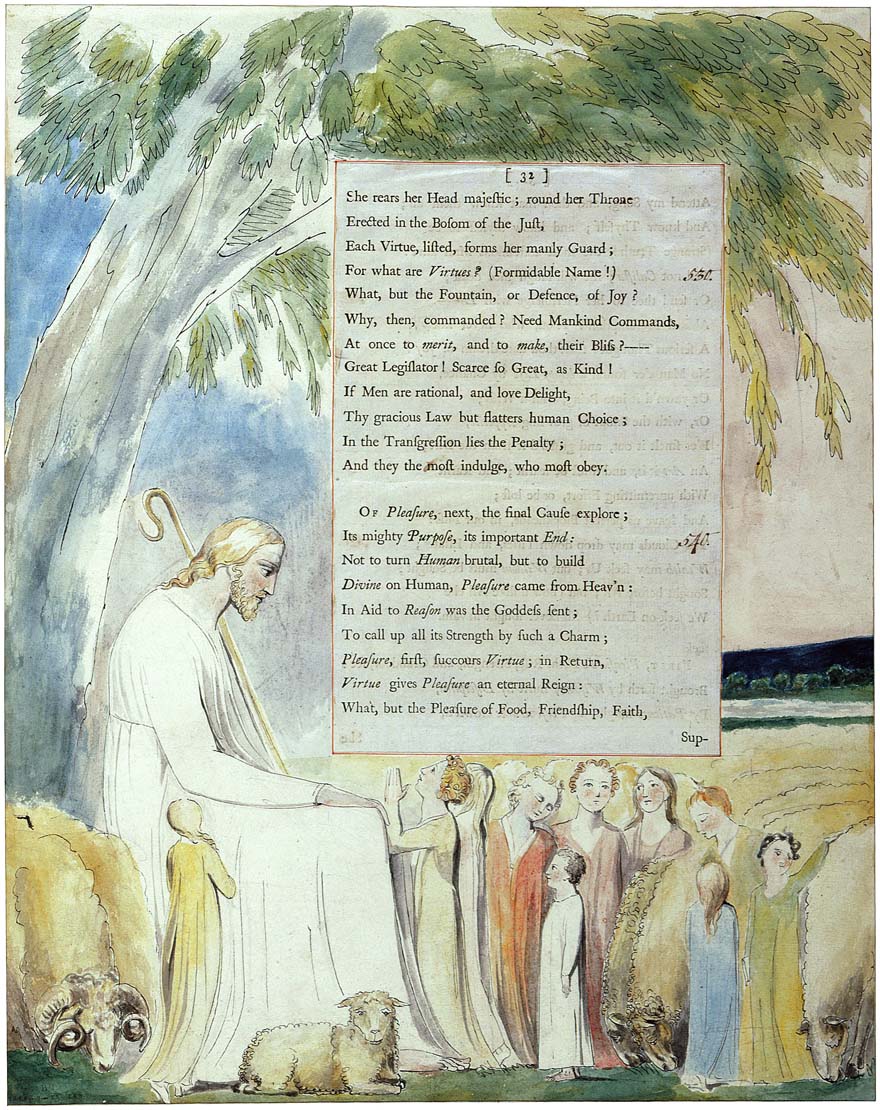
Edward Young's Night Thoughts
Night IV, page 12, Object 121

Larry Clayton's Blake Primer - God

iv


But the fourth feature of Jesus came into Blake's consciousness as a new experience. It came from Beyond. That is to say it was not an inward expression of Blake's psyche; it came like the Son of God who had joined the three friends in Nebuchadnezzar's furnace. It wasn't something he thought of; it was something that happened to him.

It was the experience of forgiveness and self-annihilation, which are two sides of the same coin. No one forgives until he has found the grace to annihilate at least momentarily the law bound accusing spectre which is his Selfhood. And this is only possible as an act of the Imagination, which is eternal, which is Christ. Whenever you successfully annihilate your old self to the point of truly forgiving another, the eternal Christ is alive and at work in your soul. In fact it is he who does it. He is in you, and you are in him; that's eternal life.

Reduced to its barest essential that's what Jesus finally came to mean for Blake. The only unique thing about the man of Nazareth was that he taught forgiveness of one's enemies. In this sense he incarnated God. God is love, is forgiveness. "If Morality was Christianity, Socrates was the Saviour." Unlike Socrates Jesus was a man in whom God dwelt through his vision and his acts of forgiveness.

The significance of the resurrection lies in the coming to life of Forgiveness: Jesus, in you and me. In this way we defeat death.

The Everlasting Gospel, (E 874)

"Nine widely scattered entries in Blake's Notebook (in the British Library) and three sections in a separate scrap of paper (in the Rosenbach Foundation library) have long been recognized as parts of a single but unfinished (or perhaps only unedited) poem."

Textural notes for Everlasting Gospel; (E 875)

"There is not one Moral Virtue that Jesus Inculcated but Plato & Cicero did Inculcate before him what then did Christ Inculcate. Forgiveness of Sins This alone is the Gospel & this is the Life & Immortality brought to light by Jesus. Even the Covenant of Jehovah, which is This If you forgive one another your Trespasses so shall Jehovah forgive you That he himself may dwell among you but if you Avenge you Murder the Divine Image & he cannot dwell among you because you Murder him he arises Again & you deny that he is Arisen & are blind to Spirit PAGE 2 What can this Gospel of Jesus be What Life Immortality What was it that he brought to Light That Plato & Cicero did not write

The Heathen Deities wrote them all These Moral Virtues great & small What is the Accusation of Sin But Moral Virtues deadly Gin"

PAGE 3 It was when Jesus said to Me Thy Sins are all forgiven thee The Christian trumpets loud proclaim Thro all the World in Jesus name Mutual forgiveness of each Vice And oped the Gates of Paradise The Moral Virtues in Great fear Formed the Cross & Nails & Spear And the Accuser standing by Cried out Crucify Crucify Our Moral Virtues neer can be Nor Warlike pomp & Majesty For Moral Virtues all begin In the Accusations of Sin"

Auguries of Innocence, (E 495)

"God appears, and God is light
To those poor souls who dwell in night,
But does a human form display
To those who dwell in realms of day."

The Divine Vision represented the radiance of the spiritual realm in its ascendance over the material. In the Christian world its primary appearance, of course, is Jesus.


Thursday, May 08, 2025

Blake's Search

First posted April 2019

Wikipedia Commons
Illustrations to Young's Night Thoughts
 Page 75

This is an extract (2) from Chapter Five (GOD) of Ram Horn'd With Gold by Larry Clayton.

A Political God 

        "The name of God is blasphemed among the Gentiles because of you" (Romans 2:24)
  
         From the beginning Blake realized the close and intimate relationship between a person's image of God and his political views. The authoritarian image in some form finds favor with establishment types, authority figures and all others who perceive their welfare as dependent upon the status quo. These people feel threatened by unrest in the social levels below their own; they look to God, their primary symbol of authority, to control it. They impose this vision of God upon society, and they use their power to control and discourage alternative visions.

       Liberal types in contrast more likely entertain an image of a benevolent God, a God of mercy whose basic activity is not to control the lower classes but to lift them up, nurture the needy, provide for the poor, and protect them from the rapacious powerful.

        Blake found both types of men among the authors of the Bible; they project the two basic images of God side by side. His simplified schema of interpretation assigned to the two types the designations of priest and prophet. The priest upholds the authority of the past, the authority of tradition. The prophet sees a burning bush and hears a new word which judges the authority and tradition of the priest and invokes a new scene, new ideas, new forms, new life.

        Rather obviously Jesus belonged to the prophetic type. He had as a fundamental aim raising our consciousness of the benevolence of God. He incarnated God, and he was supremely benevolent to all but the priestly party. They suppressed him in the flesh, and in his resurrected body they have always attempted to remake him in their image. As he warned, they have used his name to control, suppress, and even exterminate large numbers of people who would not do as they were told. Blake's real mission in life, both before and after his Moment of Grace, was to rescue the world's image of God from the preemption of the priestly party.

        The conventional understanding of God is that he will get you and put you in a dark hot place forever if you don't do exactly as you are told, by his priest of course. In 1741, sixteen years before Blake's birth, a New England divine named Jonathan Edwards wrote and delivered a sermon which he named, "Sinners in the Hands of an Angry God"; historians tell us that it scared literally thousands of people into the Christian church. A similar vision of God has haunted multitudes before and after Blake even down to the present day. Besides the superstitious fear it has aroused, this understanding of God has contributed to oceans of blood shed by well meaning Christians through the ages.

        Relating this conventional understanding to one of Blake's earliest experiences, his brief career in school yields a distinctive image of God as a Transcendental Schoolmaster. As soon as Blake reached the age of reason, he rejected such a God as radically and uniquivocally as he had rejected the flesh and blood schoolmaster . He saw such an image of God standing at the apex of a pyramid of human unhappiness, of exploitation, oppression, misery and hatred. He saw the divine right of kings and all those who derive their authority from the Crown. He saw their lackey priests extorting tithes from the people, collected by the 18th century equivalent of the IRS, and often giving little in return.

Four Zoas, Night II, Page 36, (E 325)
"It is an easy thing to laugh at wrathful elements 
To hear the dog howl at the wintry door, the ox in the slaughter house moan 
To see a god on every wind & a blessing on every blast 
To hear sounds of love in the thunder storm that destroys our enemies house 
To rejoice in the blight that covers his field, & the sickness that cuts off his children 
While our olive & vine sing & laugh round our door & our children bring fruits & flowers 
Then the groan & the dolor are quite forgotten & the slave grinding at the mill 
And the captive in chains & the poor in the prison, & the soldier in the field 
When the shatterd bone hath laid him groaning among the happier dead 
It is an easy thing to rejoice in the tents of prosperity 
Thus could I sing & thus rejoice, but it is not so with me!"

       He saw the emerging divine right of industrialists to work seven year old children fourteen hours a day at hard labor and reward them with a pittance. This image of God was most horrendously embodied in the judges and executioners who disposed of the child criminals. He saw the press gangs with royal authority to capture and drug anyone lacking upper class credentials; their poor victims woke up aboard ship in a state of virtual slavery, and following the brave Roman tradition they learned to fear their officers more than the enemy. Blake felt an intense mystic union with the suffering masses and even the suffering masters: he knew that a prison officer has to be just as sick as the men he guards.

       All these social programs were devised to teach poor devils to do what they were told, and behind them all stood the grim Transcendental Schoolmaster with the god sized birch rod. How could a self respecting person with any human sensitivity be other than an atheist! But Blake was never an atheist. Somehow he had to come to terms with God. If the above were a true representation of God, then he would rebel against God with his last breath. The young Blake identified with Milton's Satan in Paradise Lost: such a God is a sneaking serpent, and Blake would spend his life as the just man raging in the wilds. Schizophrenia might be the normal reaction to certain social conditions. 

         The August Schoolmaster exists to enforce good and to prohibit or punish evil. The trouble with good and evil is that in this fallen world they are always defined by the man with the biggest stick. He of course sees himself as the likeness of God, God's earthly representative. So the most oppressive tyrant, the most colossal mass murderer, the most authentic Caesar becomes the Son of Heaven. The list is long and gruesome, and Blake knew his history.

Visions of Daughters of Albion, Plate 4, (E 48)
"Then Oothoon waited silent all the day. and all the night,
Plate 5
But when the morn arose, her lamentation renewd,
The Daughters of Albion hear her woes, & eccho back her sighs. 
O Urizen! Creator of men! Mistaken Demon of heaven:
Thy joys are tears! thy labour vain, to form men to thine image.
How can one joy absorb another? are not different joys  
Holy, eternal, infinite! and each joy is a Love.  
Does not the great mouth laugh at a gift? & the narrow eyelids mock
At the labour that is above payment, and wilt thou take the ape
For thy councellor? or the dog, for a schoolmaster to thy children?
Does he who contemns poverty, and he who turns with abhorrence  
From usury: feel the same passion or are they moved alike?
How can the giver of gifts experience the delights of the merchant?
How the industrious citizen the pains of the husbandman.
How different far the fat fed hireling with hollow drum;
Who buys whole corn fields into wastes, and sings upon the heath:
How different their eye and ear! how different the world to them!"
        Although he wouldn't dream of worshiping such a deity, Blake had no hesitancy about calling him God; he simply refused to call him a good God. Wide reading in Oriental, Greek, and Norse mythology had led him to an acquaintance with any number of malevolent gods. In his poetry he used these pagan images to flesh out the God of Wrath whom he found in the Old Testament. For perhaps fifteen years Blake's creative energies were largely expended in a conscious and deliberate overt rebellion against the conventional image of the Old Testament God. During those years he subjected that image to a searching and unique psychological analysis; it fills the pages of the Blake reader.
.

Friday, February 02, 2024

GOD ACTS

British Museum
Illustrations to Young's Night Thoughts

Marriage of Heaven and Hell, Plate 16, (E 40) "Some will say, Is not God alone the Prolific? I answer, God
only   Acts & Is, in existing beings or Men."

Blake reserved the word Action to denote something which is coming not through man alone but through God acting through man. 

Descriptive Catalogue, (E 543)
"The stories of Arthur are the acts of Albion,
applied to a Prince of the fifth century, who conquered
Europe, and held the Empire of the world in the dark age, which
the Romans never again recovered."

When we read of the acts of Albion we are reading of Albion being a tool through
whom we may follow man's either placing himself under the guidance of God or
rejecting God and turning away.

Jerusalem, Plate 43 [29], (E 191)
"And thus the Voice Divine went forth upon the rocks of Albion    

I elected Albion for my glory; I gave to him the Nations,
Of the whole Earth. he was the Angel of my Presence: and all
The Sons of God were Albions Sons: and Jerusalem was my joy.
The Reactor hath hid himself thro envy. I behold him.
But you cannot behold him till he be reveald in his System       
Albions Reactor must have a Place prepard: Albion must Sleep
The Sleep of Death, till the Man of Sin & Repentance be reveald.
Hidden in Albions Forests he lurks: he admits of no Reply
From Albion: but hath founded his Reaction into a Law
Of Action, for Obedience to destroy the Contraries of Man.     
He hath compelld Albion to become a Punisher & hath possessd
Himself of Albions Forests & Wilds! and Jerusalem is taken!
The City of the Woods in the Forest of Ephratah is taken!
London is a stone of her ruins; Oxford is the dust of her walls!
Sussex & Kent are her scatterd garments: Ireland her holy place! 
And the murderd bodies of her little ones are Scotland and Wales
The Cities of the Nations are the smoke of her consummation
The Nations are her dust! ground by the chariot wheels
Of her lordly conquerors, her palaces levelld with the dust
I come that I may find a way for my banished ones to return      
Fear not O little Flock I come! Albion shall rise again."

Through following the acts of Albion we discern the journey that man travels as
he is guided along the path to completeness.

Descriptive Catalogue, (E 544)
"Reasons and opinions concerning acts, are not
history.  Acts themselves alone are history, and these are
neither the exclusive property of Hume, Gibbon nor Voltaire,
Echard, Rapin, Plutarch, nor Herodotus.  Tell me the Acts, O
historian, and leave me to reason upon them as I please; away
with your reasoning and your rubbish.  All that is not action is
not worth reading.  Tell me the What; I do not want you to
tell me the Why, and the How; I can find that out myself, as well
as you can, and I will not be fooled by you into opinions, that
you please to impose, to disbelieve what you think improbable or
impossible.  His opinions, who does not see spiritual agency, is
not worth any man's reading; he who rejects a fact because it is
improbable, must reject all History and retain doubts only.

Blake found that action, not opinion or explanations, provided him with an
understanding of the spirit which was being expressed in what he discerned himself.

Jerusalem, Plate 95, (E 254)
"Her voice pierc'd Albions clay cold ear. he moved upon the Rock
The Breath Divine went forth upon the morning hills, Albion mov'd

Upon the Rock, he opend his eyelids in pain; in pain he mov'd
His stony members, he saw England. Ah! shall the Dead live again

The Breath Divine went forth over the morning hills Albion rose 
In anger: the wrath of God breaking bright flaming on all sides around
His awful limbs: into the Heavens he walked clothed in flames
Loud thundring, with broad flashes of flaming lightning & pillars
Of fire, speaking the Words of Eternity in Human Forms, in direful
Revolutions of Action & Passion, thro the Four Elements on all sides  
Surrounding his awful Members. Thou seest the Sun in heavy clouds
Struggling to rise above the Mountains. in his burning hand
He takes his Bow, then chooses out his arrows of flaming gold
Murmuring the Bowstring breathes with ardor! clouds roll around the
Horns of the wide Bow, loud sounding winds sport on the mountain brows
Compelling Urizen to his Furrow; & Tharmas to his Sheepfold;
And Luvah to his Loom: Urthona he beheld mighty labouring at
His Anvil, in the Great Spectre Los unwearied labouring & weeping
Therefore the Sons of Eden praise Urthonas Spectre in songs
Because he kept the Divine Vision in time of trouble. 
When Albion began to perceive the voice of God, a cascade of action followed.
Hearing the voice pierce his 'clay cold
ear' was the key to releasing movement,
speech, emotion, and thought which together restored his fourfold Zoas.
Vision of Last Judgment, (E 565)
"I will not Flatter them Error is Created Truth is Eternal Error or Creation will be Burned Up & then & not till then Truth or Eternity will appear It is Burnt up the Moment Men cease to behold it I assert for My self that I do not behold the Outward Creation & that to me it is hindrance & not Action it is as the Dirt upon my feet No part of Me. What it will be Questiond When the Sun rises do you not see a round Disk of fire somewhat like a Guinea O no no I see an Innumerable company of the Heavenly host crying Holy Holy Holy is the Lord God Almighty I question not my Corporeal or Vegetative Eye any more than I would Question a Window concerning a Sight I look thro it & not with it."

The inner life which is the life of the spirit is Eternal. Whatever is material
and temporal passes away. What is in response to Truth is lasting and fosters
development of the spiritual life.

Annotations to Swedenborg, (E 601)
"To hinder another is not an act it is the
contrary it is a restraint on action both in ourselves & in the
person hinderd. for he who hinders another omits his own duty at
the time." 

Action results from following the guidance of the spirit. Preventing another's
spiritual development is contrary to being led oneself.

Annotations to Watson, (E 614)
"The truth & certainty of Virtue &
Honesty i.e Inspiration needs no one to prove it   it is Evident
as the Sun & Moon [What doubt is virtuous even Honest that
depends upon Examination] He who stands doubting of what he
intends whether it is Virtuous or Vicious knows not what Virtue
means. no man can do a Vicious action & think it to be Virtuous.
no man can take darkness for light. he may pretend to do so & may
pretend to be a modest Enquirer. but he is a Knave"

There is within us the ability to discern truth. The spirit itself
informs us whether what we are considering is 'Virtuous or Vicious.'
We cannot take 'darkness for light.'


Saturday, January 27, 2024

Vision of God

British Museum
Illustrations to Young's Night Thoughts

First posted June 2010

Northrup Frye with his background in both religious studies and literary criticism was uniquely qualified to clarify William Blake's writings - which he did in his earliest book Fearful Symmetry. In the first paragraph of Chapter 5, Frey delineates the relationship between the individual and mind of God. He refers to fallen man as the ego, which perceives the general. As a part of the Universal Creator, man perceives or creates as a mental form. It is in the mind of the totality of creative power that we are able to perceive the particular. If we see through that seed of truth planted within us, we perceive this world as a 'single creature' fallen and redeemed. Frey states, 'This is the vision of God (subjective genitive: the vision which God in us has).'

This is the fourfold vision of which Blake speaks in a Letter to Thomas Butts, (E 722):
"Now I a fourfold vision see
And a fourfold vision is given to me
Tis fourfold in my supreme delight
And three fold in soft Beulahs night
And twofold Always. May God us keep
From Single vision & Newtons sleep"

Blake's idea that we must see not with but through the eye, is true at the level of vision as well; we are not to see the vision, or with the vision but through the vision to the transcendent reality which provides the vision and the means of apprehending it.

Auguries of Innocence, (E 520)
"This Lifes dim Windows of the Soul
Distorts the Heavens from Pole to Pole
And leads you to Believe a Lie
When you see with not thro the Eye
That was born in a night to perish in a night
When the Soul slept in the beams of Light."


Fearful Symmetry, Page 108:
"The vision of the Last Judgment. said Blake, 'is seen by the Imaginative Eye of Every one according to the situation he holds.' And the greater the work of art, the more completely it reveals the gigantic myth which is the vision of the world as God sees it, the outlines of that vision being creation, fall redemption and apocalypse."

Wednesday, October 11, 2023

LAW & GRACE

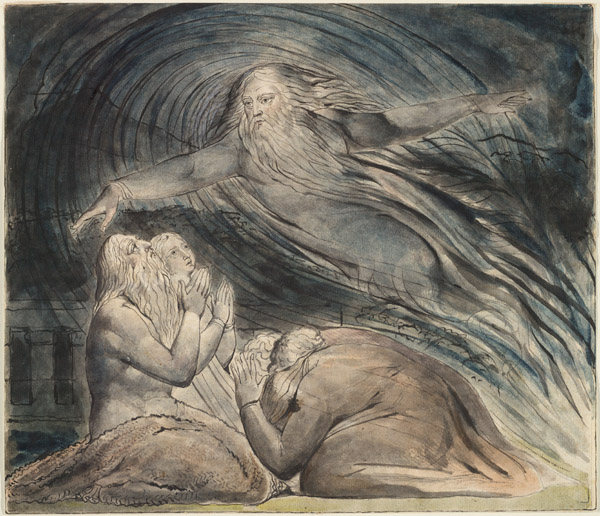
Illustrations of the Book of Job
Plate 13
"Then the Lord answered Job out of the Whirlwind"
Everlasting Gospel, Textural Notes, (E 876) 
     "It was when Jesus said to Me
     Thy Sins are all forgiven thee
     The Christian trumpets loud proclaim
     Thro all the World in Jesus name
     Mutual forgiveness of each Vice
     And oped the Gates of Paradise
     The Moral Virtues in Great fear
     Formed the Cross & Nails & Spear
     And the Accuser standing by
     Cried out Crucify Crucify
     Our Moral Virtues neer can be
     Nor Warlike pomp & Majesty
     For Moral Virtues all begin
     In the Accusations of Sin" 
Jerusalem, Plate 25, (E 170)
"And there was heard a great lamenting in Beulah: all the Regions
Of Beulah were moved as the tender bowels are moved: & they said:

Why did you take Vengeance O ye Sons of the mighty Albion?
Planting these Oaken Groves: Erecting these Dragon Temples
Injury the Lord heals but Vengeance cannot be healed:            
As the Sons of Albion have done to Luvah: so they have in him
Done to the Divine Lord & Saviour, who suffers with those that Suffer:
For not one sparrow can suffer, & the whole Universe not suffer also,
In all its Regions, & its Father & Saviour not pity and weep.
But Vengeance is the destroyer of Grace & Repentance in the bosom
Of the Injurer: in which the Divine Lamb is cruelly slain:
Descend O Lamb of God & take away the imputation of Sin
By the Creation of States & the deliverance of Individuals Evermore Amen

Thus wept they in Beulah over the Four Regions of Albion
But many doubted & despaird & imputed Sin & Righteousness       
To Individuals & not to States, and these Slept in Ulro."

Jerusalem, Plate 86, (E 245)

"And Enitharmon like a faint rainbow waved before him         
Filling with Fibres from his loins which reddend with desire
Into a Globe of blood beneath his bosom trembling in darkness
Of Albions clouds. he fed it, with his tears & bitter groans
Hiding his Spectre in invisibility from the timorous Shade
Till it became a separated cloud of beauty grace & love       
Among the darkness of his Furnaces dividing asunder till
She separated stood before him a lovely Female weeping
Even Enitharmon separated outside, & his Loins closed
And heal'd after the separation: his pains he soon forgot:
Lured by her beauty outside of himself in shadowy grief.      
Two Wills they had; Two Intellects: & not as in times of old."

Letters, To Thomas Butts, (E 728)
"I know that you see certain merits
in me which by Gods Grace shall be made fully apparent & perfect
in Eternity. in the mean time I must not bury the Talents in the
Earth but do my endeavour to live to the Glory of our Lord &
Saviour & I am also grateful to the kind hand that endeavours to
lift me out of despondency even if it lifts me too high-"
John 1 
[14] And the Word was made flesh, and dwelt among us, (and we 
beheld his glory, the glory as of the only begotten of the Father,) full
of grace and truth.
[15] John bare witness of him, and cried, saying, This was he of whom I spake, He that cometh after me is preferred before me: for he was before me.
[16] And of his fulness have all we received, and grace for grace.
[17] For the law was given by Moses, but grace and truth came by Jesus Christ.

Romans 3
[20] Therefore by the deeds of the law there shall no flesh be justified in his sight: for by the law is the knowledge of sin.
[21] But now the righteousness of God without the law is manifested, being witnessed by the law and the prophets;
[22] Even the righteousness of God which is by faith of Jesus Christ unto all and upon all them that believe: for there is no difference:
[23] For all have sinned, and come short of the glory of God;
[24] Being justified freely by his grace through the redemption that is in Christ Jesus 

2 Corinthians 12

[9] And he said unto me, My grace is sufficient for thee: for my strength is made perfect in weakness. Most gladly therefore will I rather glory in my infirmities, that the power of Christ may rest upon me.
[10] Therefore I take pleasure in infirmities, in reproaches, in necessities, in persecutions, in distresses for Christ's sake: for when I am weak, then am I strong.

Robert Essick's article titled Blake’s Job: Some Unrecorded Proofs and Their Inscriptions, appeared in the Blake: An Illustrated Quarterly in 1986.In he included the following two statements:

"Charles Eliot Norton was the first to suggest that Blake pictures Job in a fallen state of consciousness at the beginning of the series. As Norton wrote in 1875, 'Job’s prayers and burnt-offerings, in the days of his prosperity, were, after all, but the propitiatory and selfish sacrifices of the law.'”

"Blake come to realize that the 'perfect and upright' man of 'the land of Uz' (Job 1:1) was not an archetype of the prayerful student of the arts but one who had already fallen in thrall to the dead letter of the law."  

Norton's and  Essick's insights revised the understanding of Blake's intentions when illustrating the Book of Job. Blake was communicating his perception of Job's spiritual journey which revised his image of God.

The law is a meant to be a means by which one achieves virtue and acceptance. Grace is the gift that is bestowed through the generosity of the giver. Under the law inclusion is earned through obedience. Under grace inclusion is the byproduct of accepting with gratitude the gift that has been offered.

Judging from Blake's Illustrations of the Book of Job, he understood that Job originally lived under the law. Job felt that the blessings that he received were repayment for his obedience and righteousness. His understanding of God was limited by his failure to comprehend the ways of God which were beyond natural and reasonable means.

When Job had a direct encounter with the wisdom and power of God he realized that he lived by grace rather than by law. His prosperity had not been of his own doing. When he encountered the loss of his goods, and family and health, he began to see that 'all these things' were not his own but were the bounty provided by the beneficence of God's grace.

The inner change which Job underwent when he was overwhelmed by the Almighty led to a transformation of his mind and spirit. He no longer expected to understand God because the unfathomable depth of God had been revealed to him. He knew thenceforth that he lived under grace and not law.

Romans 3

[8] And not rather, (as we be slanderously reported, and as some affirm that we say,) Let us do evil, that good may come? whose damnation is just.
[9] What then? are we better than they? No, in no wise: for we have before proved both Jews and Gentiles, that they are all under sin;
[10] As it is written, There is none righteous, no, not one:
[11] There is none that understandeth, there is none that seeketh after God.
[12] They are all gone out of the way, they are together become unprofitable; there is none that doeth good, no, not one.

Job 38

[1] Then the LORD answered Job out of the whirlwind, and said,
[2] Who is this that darkeneth counsel by words without knowledge?
[3] Gird up now thy loins like a man; for I will demand of thee, and answer thou me.
[4] Where wast thou when I laid the foundations of the earth? declare, if thou hast understanding.
[5] Who hath laid the measures thereof, if thou knowest? or who hath stretched the line upon it?
[6] Whereupon are the foundations thereof fastened? or who laid the corner stone thereof;
[7] When the morning stars sang together, and all the sons of God shouted for joy?
[8] Or who shut up the sea with doors, when it brake forth, as if it had issued out of the womb?
[9] When I made the cloud the garment thereof, and thick darkness a swaddlingband for it,
[10] And brake up for it my decreed place, and set bars and doors,
[11] And said, Hitherto shalt thou come, but no further: and here shall thy proud waves be stayed?
[12] Hast thou commanded the morning since thy days; and caused the dayspring to know his place;
[13] That it might take hold of the ends of the earth, that the wicked might be shaken out of it?
[14] It is turned as clay to the seal; and they stand as a garment.
[15] And from the wicked their light is withholden, and the high arm shall be broken.
[16] Hast thou entered into the springs of the sea? or hast thou walked in the search of the depth?
[17] Have the gates of death been opened unto thee? or hast thou seen the doors of the shadow of death?
[18] Hast thou perceived the breadth of the earth? declare if thou knowest it all.
[19] Where is the way where light dwelleth? and as for darkness, where is the place thereof,
[20] That thou shouldest take it to the bound thereof, and that thou shouldest know the paths to the house thereof?
[21] Knowest thou it, because thou wast then born? or because the number of thy days is great?
[22] Hast thou entered into the treasures of the snow? or hast thou seen the treasures of the hail,
[23] Which I have reserved against the time of trouble, against the day of battle and war?
[24] By what way is the light parted, which scattereth the east wind upon the earth?
[25] Who hath divided a watercourse for the overflowing of waters, or a way for the lightning of thunder;
[26] To cause it to rain on the earth, where no man is; on the wilderness, wherein there is no man;
[27] To satisfy the desolate and waste ground; and to cause the bud of the tender herb to spring forth?
[28] Hath the rain a father? or who hath begotten the drops of dew?
[29] Out of whose womb came the ice? and the hoary frost of heaven, who hath gendered it?
[30] The waters are hid as with a stone, and the face of the deep is frozen.
[31] Canst thou bind the sweet influences of Pleiades, or loose the bands of Orion?
[32] Canst thou bring forth Mazzaroth in his season? or canst thou guide Arcturus with his sons?
[33] Knowest thou the ordinances of heaven? canst thou set the dominion thereof in the earth?
[34] Canst thou lift up thy voice to the clouds, that abundance of waters may cover thee?
[35] Canst thou send lightnings, that they may go, and say unto thee, Here we are?
[36] Who hath put wisdom in the inward parts? or who hath given understanding to the heart?
[37] Who can number the clouds in wisdom? or who can stay the bottles of heaven,
[38] When the dust groweth into hardness, and the clods cleave fast together?
[39] Wilt thou hunt the prey for the lion? or fill the appetite of the young lions,
[40] When they couch in their dens, and abide in the covert to lie in wait?
[41] Who provideth for the raven his food? when his young ones cry unto God, they wander for lack of meat.

Job 42

[1] Then Job answered the LORD, and said,
[2] I know that thou canst do every thing, and that no thought can be withholden from thee.
[3] Who is he that hideth counsel without knowledge? therefore have I uttered that I understood not; things too wonderful for me, which I knew not.
[4] Hear, I beseech thee, and I will speak: I will demand of thee, and declare thou unto me.
[5] I have heard of thee by the hearing of the ear: but now mine eye seeth thee.
[6] Wherefore I abhor myself, and repent in dust and ashes.

[7] And it was so, that after the LORD had spoken these words unto Job, the LORD said to Eliphaz the Temanite, My wrath is kindled against thee, and against thy two friends: for ye have not spoken of me the thing that is right, as my servant Job hath.

Blake's Illustrations of The Book of Job begins with achievement by strictly following tenets of the law. It ends with acknowledging that the grace of God provides all that we are and have.


Friday, July 21, 2023

God & Nature

New York Public Library
Milton
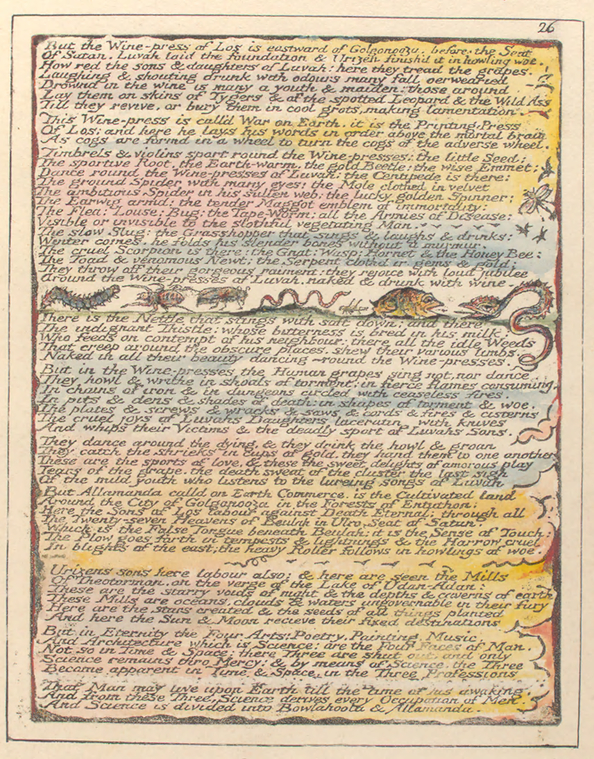
Plate 26

Larry's Notes in Google Docs

Blake's God

Some understanding of Berkeley's thought is a good preliminary to understanding the shape of Blake's mature vision of God, which came to him definitively about 1800.

You can say nothing other than the products of your mind, which means that an objective God is a complete unknown; Blake would say there's no such thing:

"Mental Things are alone Real what is Calld Corporeal Nobody Knows of its Dwelling Place it is in Fallacy & its Existence an Imposture Where is the Existence Out of Mind or Thought Where is it but in the Mind of a Fool."
(From, A Vision of The Last Judgment)

In Blakean theology Jesus is the only God; not the man named Jesus: he's only a man. No! Blake's Jesus is the indwelling spirit within the psyche - the fount of imagination and forgiveness. Jesus is one.

Thus, when the two Great Commandments meld together, the neighbor we're exhorted to love is the God within the other. So to love God with all your heart and mind and soul and strength involves loving God in all the particulars-- not just your neighbor, but his animals, insects, sticks and stones. Nature thus becomes what is groaning in travail; to love and care for it is to love God. "God only Acts & Is, in existing beings or Men" (MHH Plate 16).


Romans 8

[19] For the creation waits with eager longing for the revealing of the sons of God;
[20] for the creation was subjected to futility, not of its own will but by the will of him who subjected it in hope;
[21] because the creation itself will be set free from its bondage to decay and obtain the glorious liberty of the children of God.
[22] We know that the whole creation has been groaning in travail together until now;
[23] and not only the creation, but we ourselves, who have the first fruits of the Spirit, groan inwardly as we wait for adoption as sons, the redemption of our bodies. 

Milton, Plate 26, (E 124)

"This Wine-press is call'd War on Earth, it is the Printing-Press
Of Los; and here he lays his words in order above the mortal brain
As cogs are formd in a wheel to turn the cogs of the adverse wheel.
Timbrels & violins sport round the Wine-presses; the little Seed;
The sportive Root, the Earth-worm, the gold Beetle; the wise Emmet;
Dance round the Wine-presses of Luvah: the Centipede is there:
The ground Spider with many eyes: the Mole clothed in velvet
The ambitious Spider in his sullen web; the lucky golden Spinner;
The Earwig armd: the tender Maggot emblem of immortality:
The Flea: Louse: Bug: the Tape-Worm: all the Armies of Discase:
Visible or invisible to the slothful vegetating Man.
The slow Slug: the Grasshopper that sings & laughs & drinks:
Winter comes, he folds his slender bones without a murmur. 
The cruel Scorpion is there: the Gnat: Wasp: Hornet & the Honey Bee:
The Toad & venomous Newt; the Serpent clothd in gems & gold:
They throw off their gorgeous raiment: they rejoice with loud jubilee
Around the Wine-presses of Luvah, naked & drunk with wine.

There is the Nettle that stings with soft down; and there        
The indignant Thistle: whose bitterness is bred in his milk:
Who feeds on contempt of his neighbour: there all the idle Weeds
That creep around the obscure places, shew their various limbs.
Naked in all their beauty dancing round the Wine-presses."
Annotations to Berkeley's 'Siris',(E 663)
Berkeley: "Plato and Aristotle considered God as abstracted or
distinct from the natural  world.  But the Aegyptians considered
God and nature as making one whole, or all things together as
making one universe.
Blake: "They also considerd God as abstracted or distinct from the
Imaginative World but Jesus as also Abraham & David considerd God
as a Man in the Spiritual or Imaginative Vision
     Jesus considerd Imagination to be the Real Man & says I will
not leave you Orphanned and I will manifest myself to you   he
says also the Spiritual Body or Angel as little Children always
behold the Face of the Heavenly Father   
 Annotations to Berkeley's 'Siris', (E 664) 
Berkeley: "By experiments of sense we become acquainted with
the lower faculties of the soul; and from them, whether by a
gradual evolution or ascent, we arrive at the highest.  These
become subjects for fancy to work upon.  Reason considers and
judges of the imaginations.  And these acts of reason become new
objects to the understanding." 
Blake: "Knowledge is not by deduction but Immediate by Perception or
Sense at once Christ addresses himself to the Man not to his
Reason   Plato did not bring Life & Immortality to Light Jesus
only did this" 
Annotations to Berkeley's 'Siris' (E 664) 
Berkeley: "It is a maxim of the Platonic philosophy, that the
soul of man was originally furnished with native inbred notions,
and stands in need of sensible occasions, not absolutely for
producing them, but only for awakening, rousing or exciting, into
act what was already preexistent, dormant, and latent in the
soul."
Blake: "The Natural Body is an Obstruction to the Soul or Spiritual
Body" 
 Annotations to Berkeley's 'Siris', (E 664) 
 Berkeley: ". . . Whence, according to Themistius, . . . it may
be inferred that all beings are in the soul.  For, saith he, the
forms are the beings.  By the form every thing is what it is. 
And, he adds, it is the soul that imparteth forms to matter, . ." 
 Blake: "This is my Opinion but Forms must be apprehended by Sense or
the Eye of Imagination 
     Man is All Imagination God is Man & exists in us & we in him 
Annotations to Berkeley's 'Siris', (E 664)  
Blake: "What Jesus came to Remove was the Heathen or Platonic
Philosophy which blinds the Eye of Imagination The Real Man"   

As Damon states in his section on Nature, "But When Man fell, his senses turned outward: 'they behold what is within now seen without' (Four Zoas, E 314); and Nature appeared to be separate from Man. That is delusion: "In your bosom you bear your Heaven and Earth & all you behold; tho' it appears Without, it is Within' (Jerusalem, (E 225.)    

Jerusalem, Plate 71, (E 225) 
"For all are Men in Eternity. Rivers Mountains Cities Villages,
All are Human & when you enter into their Bosoms you walk
In Heaven & Earths; as in your own Bosom you bear your Heaven
And Earth, & all you behold, tho it appears Without it is Within
In your Imagination of which this World of Mortality is but a Shadow."
God, Man and Nature are One. They are all aspects of the complex unity of whatever is.

Thursday, July 13, 2023

LAW

National Galleries Scotland
God Writing upon the Tables of the Covenant

From Larry's Blake Primer Chap 5:

All his life Blake had an implacable hatred of law, which he equated with coercion or hindering of others; to him that was the only sin. Consequently Blake's Jesus was a thorough going antinomian. Perhaps his most extreme expression of this occurs in Marriage of Heaven and Hell, written before his conversion:

"If Jesus Christ is the greatest man, you ought to
love him in the greatest degree; now hear how he has
given his sanction to the law of the ten
commandments: did he not mock at the sabbath, and so
mock the sabbath's God? murder those who were
murder'd because of him? turn away the law from the
woman taken in adultery? steal the labor of others
to support him? bear false witness when he omitted
making a defence before Pilate? covet when he pray'd
for his disciples, and when he bid them shake off
the dust of their feet against such as refused to
lodge them? I tell you, no virtue can exist without
breaking these ten commandments. Jesus was all
virtue, and acted from impulse, not from rules."

That's the proud, tongue in cheek, announcement of a young man not yet marked by the suffering of life. As he matured, his language became more moderate, but his attitude remained substantially the same. Blake hates the law, and his Jesus forgives the lawbreaker. The letter kills, but the Spirit gives life.

Law is an expression of authority. Life presents to us two kinds of authority: spiritual authority or God and political authority, his worldly shadow. Blake consumed his early years in rebellion against the shadow. Then at age 43 he met God and was able to submit to and affirm the true authority.

Some means of coercion characterizes all forms of political authority; ecclesiastical authority is no exception. Blake temperamentally renounced all forms of political authority; he felt that they were satanic, based on coercion and fear and earthly power. Political authority is the authority of this world, and he had no use for it.

In contrast spiritual authority as Blake experienced it is the exercise of the purest form of love with an absence of any sort of constraint. The release from constraint by the active good will calls forth the Divine Image from the dark sepulcher or cave of corporeal life. Blake had uniquely experienced this spiritual authority as a child; he rediscovered it in the experience which he understood as Self-annihilation or Forgiveness.

Henceforth for him this was the basic and intimate character and quality of Jesus. This was the good news. In Milton the old antinomian made his commitment to the law of self giving love, referring to it as the "Universal Dictate". A free Blakean translation of John 3.16 with a touch of Philippians 2 added might read: God so forgave the world that he annihilated his transcendent Deity and united himself through a corporeal sepulcher with sinful, materialistic man to lift us up to Eternity. Here is the ultimate of spiritual authority, and those who meet Jesus begin to exercise it in the way that he did.

Although Blake did not often use the conventional Christian symbolism of the cross, after his conversion he did believe from the depths that by dying for one another we live eternally:

"Jesus said. Wouldest thou love one who never died
For thee, or ever die for one who had not died for thee?
And if God dieth not for Man and giveth not himself
Eternally for Man, Man could not exist; for Man is Love
As God is Love; every kindness to another is a little Death
In the Divine Image, nor can Man exist but by Brotherhood."
(Jerusalem, Page 96, E 256) 

Freedom from materialism and from the law are the philosophic and moral coloring which Blake gave to his portrait of Jesus the One. In this way he accommodated his new vision of God to his existing value structure.


Tuesday, March 07, 2023

BLAKE'S ANGELS

Cleveland Museum of Art 
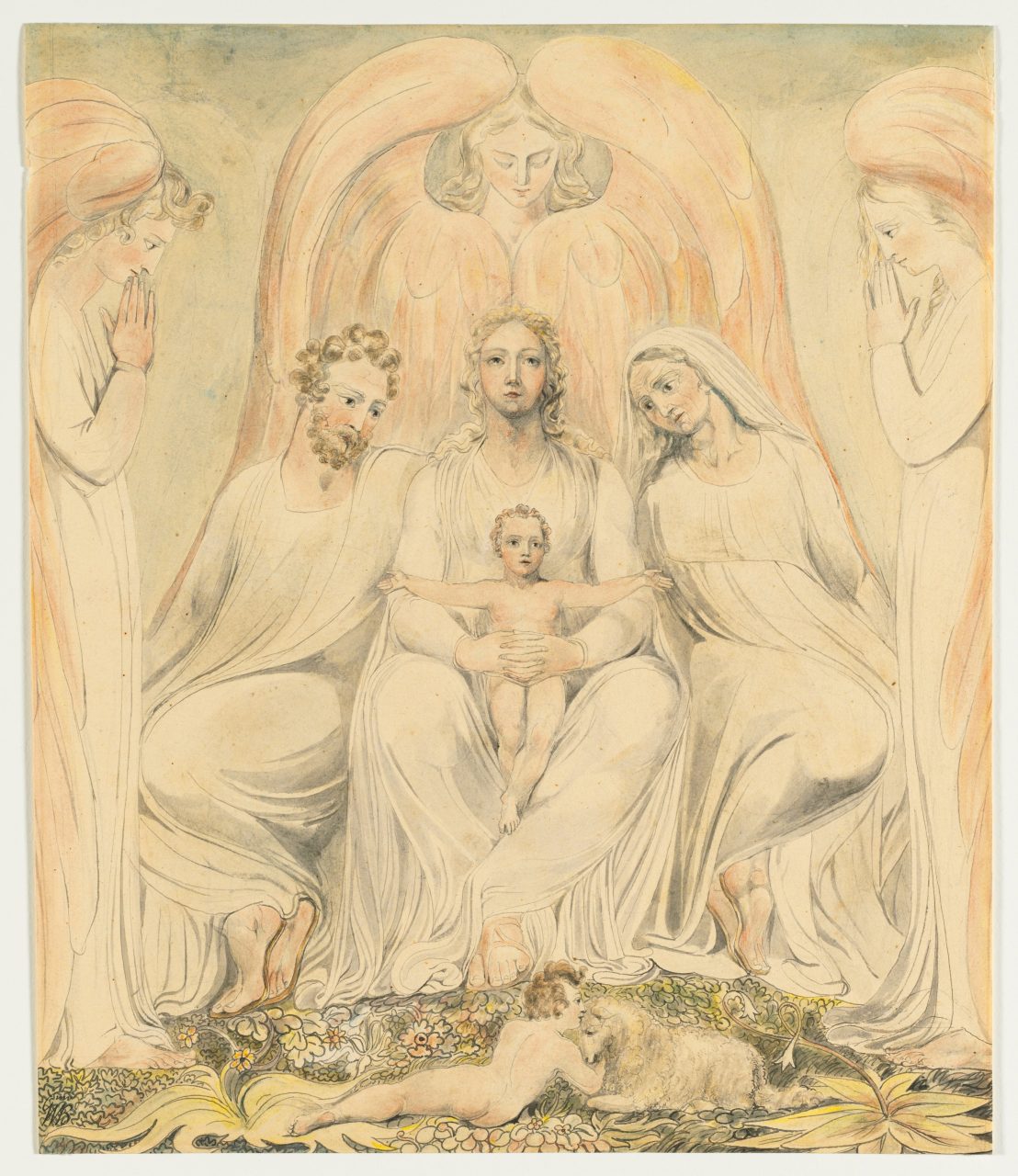
Christ in the Lap of Truth

Angels to Blake are symbols not signs. They intimate; they are not defined. They can have various functions in different circumstances. In Marriage of Heaven and Hell they project the conventional, conservative patterns of thought which constrict and confine. In the guise of Angels of Providence they protect and guide. The Angel of the Divine Presence is synonymous with the fallen Lucifer who is a sinister character.

Blake saw angels as spiritual forces who bring messages from the divine. He studied the role that they played in the Bible and knew their presence in his life. He conveyed in images the benevolence of the God who made angels instruments of the connection between the human and the divine.   

Letters, To Butts, (E 724)
"But if we fear to do the dictates of our
Angels & tremble at the Tasks set before us. if we refuse to do
Spiritual Acts. because of Natural Fears or Natural Desires!  Who
can describe the dismal torments of such a state!--I too well
remember the Threats I heard!--If you who are organized by Divine
Providence for Spiritual communion.  Refuse & bury your Talent in
the Earth even tho you should want Natural Bread. Sorrow &
Desperation pursues you thro life! & after death shame & confusion of face to
eternity"
Annotations to Lavater, (E 601) 
"Every mans leading propensity ought to be calld his
leading Virtue & his good Angel"  

Jerusalem, Plate 43 [29], (E 191)

"And thus the Voice Divine went forth upon the rocks of Albion    
I elected Albion for my glory; I gave to him the Nations,
Of the whole Earth. he was the Angel of my Presence: and all
The Sons of God were Albions Sons: and Jerusalem was my joy."
Songs and Ballads, William Bond, (E 497)

"He went not out to the Field nor Fold
He went not out to the Village nor Town           
But he came home in a black black cloud
And took to his Bed & there lay down

And an Angel of Providence at his Feet
And an Angel of Providence at his Head
And in the midst a Black Black Cloud      
And in the midst the Sick Man on his Bed

And on his Right hand was Mary Green
And on his Left hand was his Sister Jane
And their tears fell thro the black black Cloud
To drive away the sick mans pain"  
Everlasting Gospel, (E 521)
"To be Good only is to be
A Devil or else a Pharisee 
Thou Angel of the Presence Divine
That didst create this Body of Mine   
Wherefore hast thou writ these Laws
And Created Hells dark jaws
My Presence I will take from thee
A Cold Leper thou shalt be
Tho thou wast so pure & bright    
That Heaven was Impure in thy Sight
Tho thy Oath turnd Heaven Pale
Tho thy Covenant built Hells Jail
Tho thou didst all to Chaos roll
With the Serpent for its soul     
Still the breath Divine does move
And the breath Divine is Love" 
Vision of Last Judgment, (E 560) 
" The Aged Figure with Wings having a writing tablet & taking
account of the numbers who arise is That Angel of the Divine
Presence mentiond in Exodus XIVc 19v & in other Places this Angel
is frequently calld by the Name of Jehovah Elohim The I am of the
Oaks of Albion
Exodus 14
[18] And the Egyptians shall know that I am the LORD, when I have
gotten me honour upon Pharaoh, upon his chariots, and upon his 
horsemen.
[19] And the angel of God, which went before the camp of Israel, removed and went behind them; and the pillar of the cloud went from before their face, and stood behind them:
[20] And it came between the camp of the Egyptians and the camp of Israel; and it was a cloud and darkness to them, but it gave light by night to these: so that the one came not near the other all the night.
Inscriptions on Blake's Illustrations of the Book of Job, (E 687) 
[Blake's verbal variants from his source, the King James
Bible]
  II The Angel of the Divine Presence [identified in Hebrew as
"King Jehovah"] (not in the Bible) We shall awake up in thy
Likeness]  . . . With thy likeness (Psalm xvii:15)   the Sons of
God came to present themselves before the Lord & Satan came also
among them to present himself before the Lord   . . . and Satan
came also among them (Job i:6) 

Psalms 17

[13] Arise, O LORD, disappoint him, cast him down: deliver my soul from the wicked, which is thy sword:
[14] From men which are thy hand, O LORD, from men of the world, which have their portion in this life, and whose belly thou fillest with thy hid treasure: they are full of children, and leave the rest of their substance to their babes.
[15] As for me, I will behold thy face in righteousness: I shall be satisfied, when I awake, with thy likeness.

Job 1

[6] Now there was a day when the sons of God came to present themselves before the LORD, and Satan came also among them.
[7] And the LORD said unto Satan, Whence comest thou? Then Satan answered the LORD, and said, From going to and fro in the earth, and from walking up and down in it.
[8] And the LORD said unto Satan, Hast thou considered my servant Job, that there is none like him in the earth, a perfect and an upright man, one that feareth God, and escheweth evil? 

Letters, To Butts, (E 729)

"The Angel of the Divine Presence clothing Adam & Eve with Coats of Skins"

Genesis 3

[20] And Adam called his wife's name Eve; because she was the mother of all living.
[21] Unto Adam also and to his wife did the LORD God make coats of skins, and clothed them.
[22] And the LORD God said, Behold, the man is become as one of us, to know good and evil: and now, lest he put forth his hand, and take also of the tree of life, and eat, and live for ever:
[23] Therefore the LORD God sent him forth from the garden of Eden, to till the ground from whence he was taken.
[24] So he drove out the man; and he placed at the east of the garden of Eden Cherubims, and a flaming sword which turned every way, to keep the way of the tree of life.

Songs of Experience, Songs 41, (E 24) 
"The Angel  
I Dreamt a Dream! what can it mean?
And that I was a maiden Queen:
 Guarded by an Angel mild:
Witless woe, was ne'er beguil'd!

And I wept both night and day
And he wip'd my tears away
And I wept both day and night
And hid from him my hearts delight

So he took his wings and fled:
Then the morn blush'd rosy red:
I dried my tears & armed my fears,
With ten thousand shields and spears,

Soon my Angel came again;
I was arm'd, he came in vain:
For the time of youth was fled    
And grey hairs were on my head."