Showing posts with label C S Lewis. Show all posts

Thursday, August 06, 2026

The Selfhood

First posted Jan 2010

Be ye therefore perfect. (Matthew 5:48)
Matthew 5
[29] And if thy right eye offend thee, pluck it out, and cast it from thee: for it is profitable for thee that one of thy members should perish, and not that thy whole body should be cast into hell.
[30] And if thy right hand offend thee, cut if off, and cast it from thee: for it is profitable for thee that one of thy members should perish, and not that thy whole body should be cast into hell.

...
[42] Give to him that asketh thee, and from him that would borrow of thee turn not thou away.
[43] Ye have heard that it hath been said, Thou shalt love thy neighbour, and hate thine enemy.
[44] But I say unto you, Love your enemies, bless them that curse you, do good to them that hate you, and pray for them which despitefully use you, and persecute you;
[45] That ye may be the children of your Father which is in heaven: for he maketh his sun to rise on the evil and on the good, and sendeth rain on the just and on the unjust.
[46] For if ye love them which love you, what reward have ye? do not even the publicans the same?
[47] And if ye salute your brethren only, what do ye more than others? do not even the publicans so?
[48] Be ye therefore perfect, even as your Father which is in heaven is perfect.


In the Preface to The Great Divorce 
C. S. Lewis wrote:
"if we accept Heaven we shall not be able to retain even the smallest and most intimate souvenirs of Hell." We may have to give up our right hand or our right eye.

Egocentricity, Self-centeredness, Narcissism, Selfishness, Contempt for the 'neighbor', etc. etc! These are some of the attributes that Blake grouped together into the image of "The Selfhood". Blake saw these and other similar traits within himself; he saw them in others, and he saw them in the world.

For twenty years he fought injustice, greed, chicanery, deceit, exploitation; in all those things he was very much of a negative thinker. But at some point he turned: he was forgiven; he turned positive although he understood all too well that he, we, the world must annihilate the Selfhood in order to reach Eternity.

Blake also used the term 'Spectre'; it too was to be annihilated.
In the poem, Milton, we hear from the mouth of 'Milton' speaking to his Spectre:
"Such are the .......Laws of Eternity, that each shall mutually
Annihilate himself for others' good, as I for thee. . . .

In Self annihilation all that is not of God alone,
To put off Self and all I have, ever & ever . . ." (Milton, Plate 39; Erdman 139)

And "The Negation is the Spectre, the Reasoning Power in Man:
This is a false Body, an Incrustation over my Immortal
Spirit, a Selfhood which must be put off & annihilated alway. " (Milton, Plate 40; Erdman 142)
Wikipedia Commons
Jerusalem
Plate 8

Friday, December 16, 2022

FORGIVENESS OF SINS

William's book Forgiveness of Sins can be download along with He Came Down from Heaven from the site Faded Page. 

Charles Williams, a friend of C.S.Lewis, wrote a short book named The Forgiveness of Sins. In his chapter Forgiveness and Reconciliation he quoted passages from Blake to demonstrate the distinction between "the state of union to which forgiveness is a means and the opposite state." Although Williams agreed with Blake on many points, he seemed to disagree where Blake deviated from some orthodox church teachings, particularly in regard to complete absolution for the sinner.

I have added the locations where Blake's statements can be found in Erdman's The Complete Poetry and Prose of William Blake.

Charles Williams Wrote:

Jerusalem, Plate 34 [38], (E 179)

"the Eternal Vision, the Divine Similitude,
In loves and tears of brothers, sisters, sons, fathers, and friends,
Which if Man ceases to behold, he ceases to exist.
. . . Our wars are wars of life and wounds of love,
With intellectual spears and long winged arrows of thought."

We may or may not suffer from exterior things; from this
interior thing we must all suffer—or almost all. It is certainly
possible that a few holy souls may have been born already so
disposed to sanctity that their effort is natural and their growth
instinctive; they move happily into goodness, and their
regeneration seems to have been one with their generation;
but even they may have suffered more than they chose
or indeed were able to communicate. Their wounds were
hidden; their sensitiveness bled privately; they appeased
the rage of their companions in their own quietude, and no one
has done more than envy a celsitude more painful than anyone
knew. But for the rest of us, the ‘wounds of love’ mean a
sudden or a lingering death. The second death itself is indeed
but a choice in time; if we prefer it before our natural death, we
are taught that it may be salvation; if after, that it may be
eternal loss. The death of our Lord introduced that choice. He
who died in his natural life brought into our natural life the
possibility of the choice of a supernatural death and therefore
of a supernatural life; this is the life of faith.

Jerusalem, Plate 96, (E 256)

"Wouldst thou love one who never died
For thee, or ever die for one who had not died for thee?
And if God dieth not for Man, and giveth not himself
Eternally for Man, Man could not exist; for Man is Love
As God is Love; every kindness to another is a little Death
In the Divine Image, nor can Man exist but by Brotherhood."

‘Man is Love.’ I do not remember the divine epigram
elsewhere. It is this which is the original part of all our life; to
divide it into natural and supernatural is a schism inevitable to
us, but an inevitability only as a means to unite or disunite the
common, the public thing. It is in our most private hearts that
the Republic is established, but our private hearts can force
themselves out of the Republic. We can refuse the maternity of
Love, the protectorate of Grace: intolerable and too certain
concession! and then? 

Jerusalem, Plate 47, (E 196)

"Hark! and Record the terrible wonder, that the Punisher
Mingles with his Victim’s Spectre, enslaved and tormented
To him whom he has murder’d, bound in vengeance and enmity.
Shudder not, but Write, and the hand of God will assist you."

The Sinner is for ever justified? no; perhaps Blake was indeed
heretical. Certainly the Republic is ambiguous, but the
humanitarian terror of punishment will not be more than a
Precursor, a Saint John Baptist there. It is the fashion
nowadays among many Christians to sneer at
humanitarianism and liberalism (in the political sense),
and this is natural because of the undue trust that has been
reposed in them. But ‘the lights of nature and faith’, wrote
John Donne, ‘are subordinate John Baptists to Christ’;
humanitarianism is a formula of prophecy. Pity is still half a
pagan virtue; compassion a Christian. To forgive is indeed
compassion, the suffering with another. To refuse to forgive is
to refuse that other as himself or herself; it is to prefer the
spectre of him, and to prefer a spectre is to be for ever lost.
 

Jerusalem, Plate 45 [31], ( E 194)

"All things are so constructed
And builded by the Divine hand that the sinner shall always escape;
And he who takes vengeance alone is the criminal of Providence.
O Albion! If thou takest vengeance, if thou revengest thy wrongs,
Thou art for ever lost! What can I do to hinder the Sons
Of Albion from taking vengeance or how shall I them
persuade?"

To say that the sinner shall always escape is a rash definition.
Our Lord did not say so. But he did say that even the collection
of our just human debts was a very dangerous business; he did
say that we were to pray to be forgiven as—precisely as—we
forgive; he did say that the debts forgiven us reduced to
nonsense the debts owed to us. It is not therefore to read the
New Testament too rashly to see in it rather more than a
suggestion that, as far as we humanly are concerned, the sinner
will always escape. The Church may blame; it does not
condemn—at most it does but relegate the sinner to the Mercy
of God. The Republic may condemn; it must not blame
—the judge has no business to do more than pronounce
a sentence. We are not yet—perhaps in this world we shall
never be—in that ‘state’ when the judges themselves may
descend to be substitutes for the condemned and to endure in
their own persons the sentences they impose. But something
like this is already the habit of the Church, for the Church
mystically shares the vicarious sufferings of Christ. ‘The state
of the punisher is eternal death.’ In the Church this is so, for in
the Church he who takes vengeance is indeed already lost; he
is outside the Church, ‘outside which is no salvation’; he is
outside the City, where as Saint John saw, are dogs and
sorcerers and whoremongers, ‘and whoever loveth and maketh
a lie’. In the Church there is no punishment except when it is
invoked and as long as it is invoked; there is no punishment
except through and because of pardon. There indeed the holy
soul, aware at once of pardon and celestial vengeance, may
sigh: ‘Both! both!’—too far beyond our vision to be more than
momently comprehensible, and only at moments desirable. But
it has been declared that the scars of Christ, the wounds of
Love, are glorious in heaven; and the justice of God glorifies
the scars of Man who is also Love. The alternative?

Jerusalem, Plate 38 [43], (E 185)

"Instead of the Mutual Forgiveness, the Minute Particulars, I see
Pits of bitumen ever burning, artificial riches of the Canaanite
Like Lakes of liquid lead; instead of heavenly Chapels, built
By our dear Lord, I see Worlds crusted with snows and ice.
I see a Wicker Idol woven round Jerusalem’s children. I see
The Canaanite, the Amalekite, the Moabite, the Egyptian . . .
Driven on the Void in incoherent despair into Non Entity."

Blake put the same vision more positively and more simply in
one of the shorter poems:

Songs and Ballads, My Spectre, (E 476)

"Thus through all eternity
I forgive you, you forgive me:
As our dear Redeemer said:
This the Wine and this the Bread."

The orthodox Christian need not reject that quatrain. If our
Lord was indeed the very Person of forgiveness, then
certainly it is the very passion of forgiveness which is
communicated in the Eucharist; it is a mutuality between God
and man which is also expressed between man and man. To
feed on that with a grudge or a resentment present in the brain,
or still lingering in the blood below the brain, is to reject the
divine Food that is swallowed; it is not only to set schism
between the body and the soul but literally in the body itself.
All things are finally worked out in the body; all mysteries are
there manifested, even if still as mysteries. It is the only
crucible of the great experiment; its innocent, even if debased,
purity endures the most difficult transmutations of the soul.
 
...
The whole state of forgiveness must be whole; it is a state of
being into which we grow and not a series of acts which we
exercise, though (to repeat) we must exercise those acts in
faith. Say, 'Do not do;' and add, 'And then do.' The
supernatural is the birth of action in the death of action.

"O point of mutual forgiveness between enemies,
Birthplace of the Lamb of God incomprehensible!" 

End for passages from Charles Williams. 

_____________________

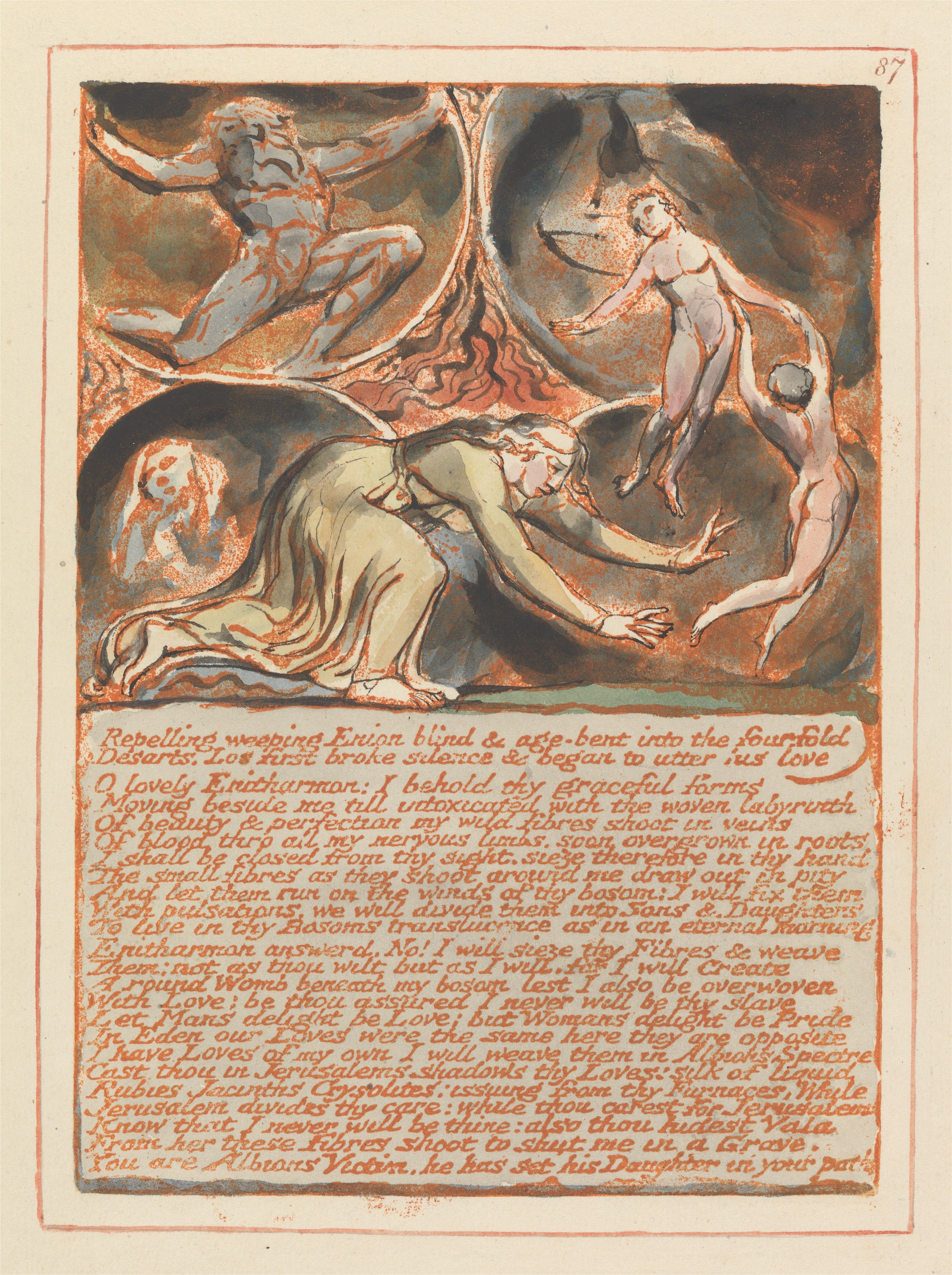
Yale Center for British Art
Jerusalem
Plate 87

Jerusalem, Plate 7, (E 150)

"O that I could abstain from wrath! O that the Lamb
Of God would look upon me and pity me in my fury.                
In anguish of regeneration! in terrors of self annihilation:
Pity must join together those whom wrath has torn in sunder,
And the Religion of Generation which was meant for the destruction
Of Jerusalem, become her covering, till the time of the End.
O holy Generation! [Image] of regeneration!  
O point of mutual forgiveness between Enemies!
Birthplace of the Lamb of God incomprehensible!
The Dead despise & scorn thee, & cast thee out as accursed:
Seeing the Lamb of God in thy gardens & thy palaces:
Where they desire to place the Abomination of Desolation." 
 

Monday, July 31, 2017

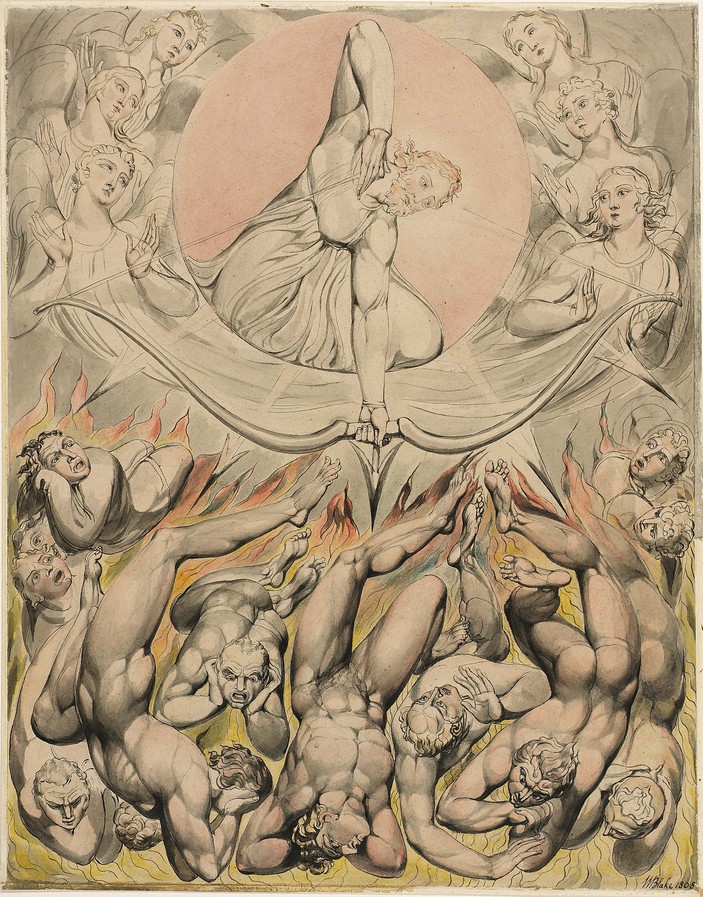
PARADISE LOST 7

Wikipedia Commons 
Illustrations to Milton's Paradise Lost 
Illustration 7
The Rout of the Rebel Angels
Genesis 1
[1] In the beginning God created the heaven and the earth.
[2] And the earth was without form, and void; and darkness was upon the face of the deep. And the Spirit of God moved upon the face of the waters.
[3] And God said, Let there be light: and there was light.
[4] And God saw the light, that it was good: and God divided the light from the darkness.

John 1
[1] In the beginning was the Word, and the Word was with God, and the Word was God.
[2] The same was in the beginning with God.
[3] All things were made by him; and without him was not any thing made that was made.
[4] In him was life; and the life was the light of men.
[5] And the light shineth in darkness; and the darkness comprehended it not.


Milton's account of the rout of the rebel angels is from a memory as told by Raphael to Adam and Eve who were not in that time or place when it occurred. This is an account of the separation of light from darkness as was the biblical statement of what occurred 'In the beginning.' The rebel angels infected heaven - the place of light - with darkness when they chose to be separate themselves from the unity. The light cast them out into hell - the place of darkness.

The rebel angels were not destroyed for their disobedience. They were sent away from the light; they were forced out of heaven. But as Adam and Eve would learn, they were still capable of engaging Men and Women in the Battle for Truth.
Paradise Lost
John Milton
Book VI 
Line 710-718
[From the account by Raphael to Adam and Eve]
"Go then, Thou Mightiest, in thy Father's might;
Ascend my chariot, guide the rapid wheels
That shake Heaven's basis, bring forth all my war,
My bow and thunder, my almighty arms
Gird on, and sword upon thy puissant thigh;
Pursue these sons of darkness, drive them out
From all Heaven's bounds into the utter deep:
There let them learn, as likes them, to despise
God, and Messiah his anointed King."

Line 844-866
 "Nor less on either side tempestuous fell
His arrows, from the fourfold-visaged Four
Distinct with eyes, and from the living wheels
Distinct alike with multitude of eyes;
One Spirit in them ruled; and every eye
Glared lightning, and shot forth pernicious fire
Among the accursed, that withered all their strength,
And of their wonted vigor left them drained,
Exhausted, spiritless, afflicted, fallen.
Yet half his strength he put not forth, but checked
His thunder in mid volley; for he meant
Not to destroy, but root them out of Heaven:
The overthrown he raised, and as a herd
Of goats or timorous flock together thronged
Drove them before him thunder-struck, pursued
With terrors, and with furies, to the bounds
And crystal wall of Heaven; which, opening wide,
Rolled inward, and a spacious gap disclosed
Into the wasteful deep: The monstrous sight
Struck them with horror backward, but far worse
Urged them behind: Headlong themselves they threw
Down from the verge of Heaven; eternal wrath
Burnt after them to the bottomless pit." 

C. S. Lewis gives us insight into Milton's character Satan by revealing the incompatibility of self-centeredness and self-deception with clarity of vision.

From Preface to Paradise Lost by C. S. Lewis:

"But I do not know whether we can distinguish his [Satan's] conscious lies from the blindness he has almost willingly imposed upon himself... for far earlier in his career he has become more a Lie than a Liar, a personified contradiction. (Page 97)
...
What we see in Satan is the horrible co-existence of a subtle and incessant intellectual ability with an incapacity to understand anything. (Page 99)
...
The point need not be laboured. Adam, though confined to a small park on a small planet, has interests which embrace 'all the choir of heaven and all the furniture of earth.' Satan has been in the Heaven of Heavens and in the abyss of hell, and surveyed all that lies between them, and in that whole immensity has found only one thing that interests Satan. It may be said that Adam's situation made it easier for him, than for Satan, to let his mind roam. But that is just the point. Satan's monomaniac concern for himself, and his supposed rights and wrongs is a necessity of the Satanic predicament. Certainly, he had no choice. He had chosen to have no choice. He had wished to 'be himself', and to be in himself and for himself, and his wish was granted. The Hell he carries with him is, in one sense, a Hell of infinite boredom...Milton makes plain the blank unintrestingness of being Satan." (Page 102)

Blake has his own way of treating the the opposition of the forces promoting the success of light or of darkness - of the Son of Man or Satan. For him the inexorable advance of truth opening the way for the power and glory of the Son of Man to reveal the apocalypse comes through recognition, repentance and forgiveness. The battle like the tears it provokes, is an intellectual thing.


Four Zoas, Night IX, Page 123, (E 392)
"The furious wind still rends around they flee in sluggish effort

They beg they intreat in vain now they Listend not to intreaty
They view the flames red rolling on thro the wide universe
From the dark jaws of death beneath & desolate shores remote
These covering Vaults of heaven & these trembling globes of Earth
One Planet calls to another & one star enquires of another  
What flames are these coming from the South what noise what dreadful rout
As of a battle in the heavens hark heard you not the trumpet
As of fierce battle while they spoke the flames come on intense roaring

They see him whom they have piercd they wail because of him  
They magnify themselves no more against Jerusalem Nor
Against her little ones the innocent accused before the Judges
Shines with immortal Glory trembling the judge springs from his throne 
Hiding his face in the dust beneath the prisoners feet & saying
Brother of Jesus what have I done intreat thy lord for me  
Perhaps I may be forgiven While he speaks the flames roll on
And after the flames appears the Cloud of the Son of Man
Descending from Jerusalem with power and great Glory" 
Songs and Ballads, The Grey Monk, (E 489)
"But vain the Sword & vain the Bow 
They never can work Wars overthrow
The Hermits Prayer & the Widows tear
Alone can free the World from fear

For a Tear is an Intellectual Thing  
And a Sigh is the Sword of an Angel King 
And the bitter groan of the Martyrs woe
Is an Arrow from the Almighties Bow"

Saturday, February 27, 2016

QUIT YOUR MEANNESS

First published by Larry on Thursday, May 13, 2010.

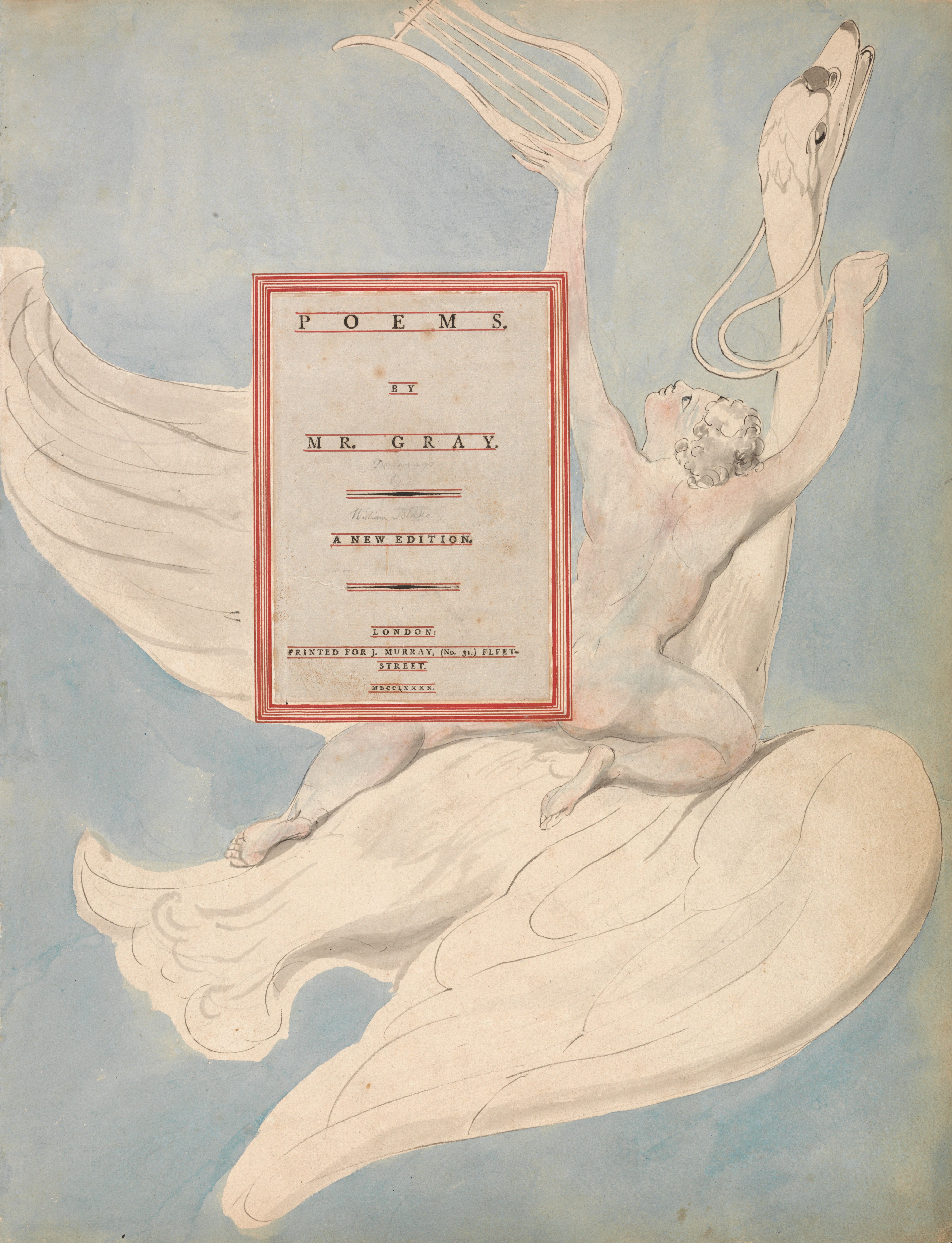
Wikimedia Commons
Illustrations to Poems of Thomas Gray
Sam Jones was the South's most famous preacher in the late nineteenth century. Jones preached one sermon that Dad really liked and put in his sermon notebook; it was called "Quit your Meanness".

St. Paul used more elegant language: "work out your own salvation with fear and trembling for it is God which worketh in you both to will and to do of his good pleasure" (Philippians 2:12-13). That verse, prominent in my memory for many years, acquired new poignancy the other day as I was contemplating Blake's Selfhood: annihilate it!

The Selfhood goes in the circular file, but neither Blake nor you and I could do that overnight; oh no! We had to work it out with fear and trembling. The Spectre is the Selfhood, and Blake wrote:

"My spectre around me night and day
Like a wild beast guards my way;"

in the poem that has been discussed so often in this blog.

Blake had to discover his preconceived notions, his pet peeves, his resentments of everyone from Bacon, Newton, and Locke to Hayley. Once he discovered them and confessed his error, that aspect of his Selfhood was annihilated, and the Last Judgment fell upon him. In Plate 98, near the end of Jerusalem and of his poetry he joined Bacon and Newton and Locke with those he had always loved, Shakespeare, Milton, and Chaucer. It was the testimony of a happy man.

C. S. Lewis, near the end of his greatest story, Till We Have Faces, shared his Vision of that Eternal 'Moment'. Lewis had issues with Blake because of his own orthodoxy. But my vision of him is that Blake's poetry and George MacDonald's spirit had done their work in the end, enabling Lewis to envision the graduation to Eternity of "turk and jew":

"And all must love the human form,
In heathen, turk or jew.
Where Mercy, Love & Pity dwell,
There God is dwelling too"

Blake has said that "every death is an improvement in the state of the departed."

He must have substantially completed the long drawn out procedure of confessing his sins and experiencing forgiveness during mortal life because he died a very happy man.
.

Thursday, January 29, 2015

RESOLVING FEARS

Illustrations to Pilgrim's Progress
Plate 18
Christian Passes the Lions
William Blake created twenty-eight illustrations for John Bunyan's Pilgrims Progress. Blake selected the passages he would illustrate in order to highlight sections of the book which lent themselves to understandings which were congruent with his own visionary perceptions.
 
Gerda Norvig, on page 127 of Dark Figures in the Desired Country, indicates the challenge Blake faced in illustrating a book whose structure was in the form of allegory rather than vision: 
"[A]ccording to Blake, images at work within any genuinely visionary structure never simply substitute as fixed vehicles for displaced and equally fixed tenors. Instead they function as complex 'identities' that literally hold their own, evolving, unfolding, and yielding only to further images rendered meaningful through interrelations and extended contextual references."

Blake's objective was to transform what was less than visionary in Bunyan's allegory to a fully imaginative production.

 
Pilgrim's Progress
John Bunyan
"Now also he remembered the story that Mistrust and Timorous told him of; how they were frighted with the sight of the lions. Then said Christian to himself again, These beasts range in the night for their prey; and if they should meet with me in the dark, how should I shift them? How should I escape being by them torn in pieces? Thus he went on his way. But while he was thus bewailing his unhappy miscarriage, he lift up his eyes, and behold there was a very stately palace before him, the name of which was Beautiful; and it stood just by the highway side.
 
110} So I saw in my dream that he made haste and went forward, that if possible he might get lodging there. Now, before he had gone far, he entered into a very narrow passage, which was about a furlong off the porter's lodge; and looking very narrowly before him as he went, he espied two lions in the way. Now, thought he, I see the dangers that Mistrust and Timorous were driven back by. (The lions were chained, but he saw not the chains.) Then he was afraid, and thought also himself to go back after them, for he thought nothing but death was before him. But the porter at the lodge, whose name is Watchful, perceiving that Christian made a halt as if he would go back, cried unto him, saying, Is thy strength so small? [Mark 8:34-37] Fear not the lions, for they are chained, and are placed there for trial of faith where it is, and for discovery of those that had none. Keep in the midst of the path, no hurt shall come unto thee.

 
"Difficulty is behind, Fear is before,
Though he's got on the hill, the lions roar;
A Christian man is never long at ease,
When one fright's gone, another doth him seize."

 
{111} Then I saw that he went on, trembling for fear of the lions, but taking good heed to the directions of the porter; he heard them roar, but they did him no harm. Then he clapped his hands, and went on till he came and stood before the gate where the porter was. Then said Christian to the porter, Sir, what house is this? And may I lodge here to-night? The porter answered, This house was built by the Lord of the hill, and he built it for the relief and security of pilgrims. The porter also asked whence he was, and whither he was going.

 
{112} CHR. I am come from the City of Destruction, and am going to Mount Zion; but because the sun is now set, I desire, if I may, to lodge here to-night."

 
Blake's picture is his commentary on Bunyan's text. The path is narrow and beside it are beasts whose power and ferocity are frightening to men. But both Blake and Bunyan acknowledge that there is nothing to fear but fear itself. The lions are pacific, and chained as well. Lions in Blake's poetry, although capable of wrath, assume the role as protectors of the flock. In Songs of Experience the Lion acts as an Angel of Death taking a child and her parents to a lovely place where there is no longer any cause for fear. In Blake's illustration the presence of the lions is more than a threat to his safety. It serves to enable Pilgrim to resolve his fears and pass safely to the palace named Beautiful.

Songs of Experience, Plate 36, (E 21)
SONGS 36
"The Little Girl Found
 
Famish'd, weeping, weak
With hollow piteous shriek

Rising from unrest,
The trembling woman prest,
With feet of weary woe;
She could no further go. 

In his arms he bore,
Her arm'd with sorrow sore;
Till before their way,
A couching lion lay.

Turning back was vain, 
Soon his heavy mane,
Bore them to the ground;
Then he stalk'd around,

Smelling to his prey.
But their fears allay,
When he licks their hands;
And silent by them stands.

They look upon his eyes
Fill'd with deep surprise:
And wondering behold,
A spirit arm'd in gold. 

On his head a crown
On his shoulders down,
Flow'd his golden hair.
Gone was all their care. 

Follow me he said,
Weep not for the maid;
In my palace deep,
Lyca lies asleep.

Then they followed, 
Where the vision led:
And saw their sleeping child,
Among tygers wild.

To this day they dwell
In a lonely dell
Nor fear the wolvish howl,
Nor the lions growl." 
 
If you are a reader of C S Lewis' Chronicles of Narnia you may be reminded in this passage from Blake's Marriage of Heaven & Hell of Lewis' portrayal of the ambiguities of the lion Aslan .

Marriage of Heaven & Hell, Plate 8, (E 36)
"Prisons are built with stones of Law, Brothels with bricks of Religion.
The pride of the peacock is the glory of God.
The lust of the goat is the bounty of God.
The wrath of the lion is the wisdom of God.
The nakedness of woman is the work of God.

Excess of sorrow laughs. Excess of joy weeps.

The roaring of lions, the howling of wolves, the raging of the
    stormy sea,    and the destructive sword. are portions of
    eternity too great for the eye of man."

Pilgrim's fears resemble those of Enitharmon who is given lines in the Four Zoas that express her fear of continuing along the path to salvation because of her awareness of past failures and disappointments.
 
Four Zoas, Night VII, Page 78, (E 369)
[Los speaks]
"Couldst thou but cease from terror & trembling & affright
When I appear before thee in forgiveness of ancient injuries
Why shouldst thou remember & be afraid. I surely have died in pain
Often enough to convince thy jealousy & fear & terror
Come hither be patient let us converse together because  
I also tremble at myself & at all my former life
Enitharmon answerd I behold the Lamb of God descending
To Meet these Spectres of the Dead I therefore fear that he
Will give us to Eternal Death fit punishment for such
Hideous offenders Uttermost extinction in eternal pain    
An ever dying life of stifling & obstruction shut out
Of existence to be a sign & terror to all who behold
Lest any should in futurity do as we have done in heaven
Such is our state nor will the Son of God redeem us but destroy" 

Monday, October 20, 2014

Christian Blakeans

First posted by Larry in October 2014
 
Of the critics, interpreters and scholars we have discussed, none to my knowledge wrote primarily as a Christian. However a few Blakeans did. Side by side with the secular stream of Blake criticism exists a smaller and less known group of writers whose interest in Blake was primarily spiritual. 

A member of the narrow band of Christian Blakeans was Kathleen Raine, who got the term from the poet, Yeats.  This survey has omitted many worthwhile Blake studies. 

Two other scholars who contributed appreciably to my own understanding were Harold Bloom, author of Blake's Apocalypse, and Bernard Blackstone, who wrote English Blake. 

George MacDonald
National Portrait Gallery, London
                                                         
Among the most notable was a Scottish minister and novelist named George MacDonald, born three years before Blake's death. MacDonald's reputation rests largely with his children's stories and two imaginative works entitled Phantastes and Lilith. MacDonald recognized Blake's visions as belonging to the mainstream of Christian thought. He translated some of them into his own fairy tales and visionary novels. The Blakean eternal pervades all of MacDonald's works; they abound with spiritual identities in many ways comparable to Blake's fantastic cast of characters. 

One can trace Blake's influence through MacDonald to the writings of his two famous disciples, C.S.Lewis and Charles Williams. Like Blake and MacDonald, Lewis and Williams conceived of the real as residing in the nonmaterial. With The Screwtape Letters Lewis gave us the most formidable literary devil since Urizen. 

Williams' metaphysical thrillers partake of the same transcendent dimension. The two men's visions broke like a new sunrise over the darkened positivistic face of English culture near the outbreak of the Second World War. Strangely enough these two Christian thinkers gave little evidence of awareness of their debt to Blake. Lewis did mention MHH in the preface of his most Blakean work, a vision of the hereafter called The Great Divorce, but he seems not to have fully realized that he had ingested Blakean values through his spiritual father, George MacDonald. 

Williams, in a little known work entitled The Forgiveness of Sins, made extended reference to Blake's vision of forgiveness as the central doctrine of Christianity. Nevertheless he categorized Blake's work as heretical. In another work Williams rated Wordsworth as the only powerful spiritual poet in English since Milton. I find it puzzling how truly Blakean the two great Oxford Christians were without acknowledging the debt. Evidently both Lewis and Williams were too threatened by Blake's anarchism, and especially by his attack on the established Church, to open themselves consciously to Blake's ideas.

The "flat sided steep" of MHH appears in Lewis' spiritual geography at The Great Divorce. 

 MacDonald  was secure enough in his own faith to feel no threat from Blake's immoderate language. He was also pure enough to find Blake pure. All four writers have in common a focus on the eternal. MacDonald learned to write about the eternal from Blake, Lewis and Williams from MacDonald. The three later men all understood art in the same sense that Blake did, what we might call art for God's sake. 

Richard Bucke, 
of the late 19th Century, like MacDonald was a solitary spiritual luminary. A psychiatrist, commited to 'Bacon, Newton & Locke' he nevertheless recognized Blake's spiritual genius. In his famous book, Cosmic Consciousness Bucke named Blake in a group of fourteen who he believed had experienced this psychic mutation. With Blake he included Buddha, Jesus, Paul, Boehme, Walt Whitman, and appropriately enough Francis Bacon. Cosmic Consciousness is a strange mixture of science and faith, which today has little credence in the citadel of either camp. Blake would probably have deplored it; however he would have enjoyed the recognition which he never received during his lifetime.richard bucke

Monday, August 05, 2013

HEAVEN & HELL

Wikimedia
Marriage of Heaven & Hell
 Plate 16, copy H

In his preface to The Great Divorce, C. S. Lewis cites Blake's The Marriage of Heaven and Hell as representing the position that the division between good and evil can be bridged. Lewis admits that he may not know what Blake's work means but he warns against "embrace[ing] the false and disastrous converse and fancy that everything is good and everywhere is Heaven."

Many would agree that Blake was attempting to shake up the system in The Marriage of Heaven and Hell but few would think that he proposed "to turn evil into good" by "mere development or adjustment or refinement." Blake is urging his readers to reconsider conventional thought: to look from the perspective of the Devil as well as the Angel. He is convinced  that the Devourer (reason) has kept the Prolific (energy) in chains long enough. Liberty can emerge from the bonds of tyranny, commandments, institutional religion, and sexual repression.

On page 69 of The Great Divorce, Lewis expresses his attitude about the permanence of heaven and hell in this passage addressed to himself by his spiritual teacher George MacDonald:
"Both processes begin even before death. The good man's past begins to change so that his forgiven sins and remembered sorrows take on the quality of Heaven; the bad man's past already conforms to his badness and is filled only with dreariness. And that is why, at the end of all things, when the sun rises here and the twilight turns to blackness down there, the Blessed will say "We have never lived  anywhere except in Heaven," and the Lost, "We were always in Hell. "And both will speak truly.'"


The difference between Lewis and Blake results from their attitudes toward universal salvation. Lewis believes that the sinner will go to hell unless he reverses his course and rejects his sin. Blake believes that 'Everything that lives is Holy' and that error will be annihilated so that all human forms may be gathered into the final harvest of Souls.
 
Jerusalem, Plate 99, (E 257)
"All Human Forms identified even Tree Metal Earth & Stone. all
Human Forms identified, living going forth & returning wearied
Into the Planetary lives of Years Months Days & Hours reposing
And then Awaking into his Bosom in the Life of Immortality.
And I heard the Name of their Emanations they are named Jerusalem"


Milton, Plate 25 [27], (E 121)
"And Los stood & cried to the Labourers of the Vintage in voice of awe.

Fellow Labourers! The Great Vintage & Harvest is now upon Earth
The whole extent of the Globe is explored: Every scatterd Atom
Of Human Intellect now is flocking to the sound of the Trumpet
All the Wisdom which was hidden in caves & dens, from ancient    
Time; is now sought out from Animal & Vegetable & Mineral

The Awakener is come. outstretchd over Europe! the Vision of God is fulfilled
The Ancient Man upon the Rock of Albion Awakes,"

Jerusalem, Plate 31 [35], (E 177)
"Then the Divine hand found the Two Limits, Satan and Adam,
In Albions bosom: for in every Human bosom those Limits stand.
And the Divine voice came from the Furnaces, as multitudes without
Number! the voices of the innumerable multitudes of Eternity.
And the appearance of a Man was seen in the Furnaces;            
Saving those who have sinned from the punishment of the Law,
(In pity of the punisher whose state is eternal death,)
And keeping them from Sin by the mild counsels of his love."

Jerusalem, Plate 45 [31], (E 194)
"What shall I do! what could I do, if I could find these Criminals
I could not dare to take vengeance; for all things are so constructed    
And builded by the Divine hand, that the sinner shall always escape,
And he who takes vengeance alone is the criminal of Providence;
If I should dare to lay my finger on a grain of sand
In way of vengeance; I punish the already punishd: O whom
Should I pity if I pity not the sinner who is gone astray!"  
    
Paul in Romans 12 advises us to:
[21] Be not overcome of evil, but overcome evil with good.

Friday, May 17, 2013

BROTHERHOOD

Wikimedia 
Painting for Blair's The Grave
Friendship
In C S Lewis' The Four Loves he makes this statement about friendship which is close to what Blake means by brotherhood:

"within those limits we possess each friend not less, but more as the number of those with whom we share him increases. In this, Friendship exhibits a glorious "nearness by resemblance" to Heaven itself where the very multitude of the blessed (which no man can number) increases the fruition which each has of God. For every soul, seeing Him in her own way, doubtless communicates that unique vision to all the rest. That, says an old author, is why the Seraphim in Isaiah's vision are crying "Holy, Holy, Holy" to one another (Isaiah vi,3). The more we thus share the Heavenly Bread between us, the more we shall all have."

The brotherhood of which Blake speaks is not the kinship of being born to the same earthly parents but of recognizing one's kinship to the heavenly family. When we join one another in brotherhood we relinquish some of our self-interest and elevate the interests of others. We affirm the 'brother and friend' within our bosoms and perceive our Souls mingling in the joy of community.


Songs of Innocence & of Experience, (E 28)
SONGS 50 
A Little BOY Lost                 

"Nought loves another as itself
Nor venerates another so.
Nor is it possible to Thought
A greater than itself to know:

And Father, how can I love you,   
Or any of my brothers more?       
I love you like the little bird   
That picks up crumbs around the door."

Jerusalem, Plate 88, (E 246)
"For Man cannot unite with Man but by their Emanations 
Which stand both Male & Female at the Gates of each Humanity
How then can I ever again be united as Man with Man
While thou my Emanation refusest my Fibres of dominion.
When Souls mingle & join thro all the Fibres of Brotherhood
Can there be any secret joy on Earth greater than this

Jerusalem, Plate 4, (E 146)
"I am not a God afar off, I am a brother and friend;
Within your bosoms I reside, and you reside in me:
Lo! we are One; forgiving all Evil; Not seeking recompense!      
Ye are my members O ye sleepers of Beulah, land of shades!"

Letters, (E 705)
"Thirteen years ago.  I lost a
brother & with his spirit I  converse daily & hourly in the
Spirit.  & See him in my remembrance in the  regions of my
Imagination.  I hear his advice & even now write from his
Dictate--Forgive me for expressing to you my Enthusiasm which I
wish all to  partake of Since it is to me a Source of Immortal
Joy even in this world by it  I am the companion of Angels"

Jesus in John 17 prays that the unity which results form dwelling in the Father and knowing that spirit of God within may be revealed to his readers.  

[21] That they all may be one; as thou, Father, art in me, and I in thee, that they also may be one in us: that the world may believe that thou hast sent me.
[22] And the glory which thou gavest me I have given them; that they may be one, even as we are one:

Saturday, August 11, 2012

TRANSFORMATION

The period in Blake's life immediately before, after and during the time he resided in Felpham, was critical to his spiritual development. Before his move from London in September 1800, he was discouraged by political conditions and by personal experiences.

Yale Center for British Art
Blake's Watercolours
for the Poems of Thomas Gray
We can follow some of the developments in Blake's life through letters he wrote to Thomas Butts from Felpham. 

In the second letter we have from Blake to Thomas Butts he enclosed a poem rejoicing in the new setting in which he found himself. He wrote of 'My first Vision of Light', of 'each particle' seen as 'a Man'. He identified himself with the 'Ram hornd with gold' awakening 'from sleep' and being introduced to the Fold by the visionary voice.
 
There is no doubt that Blake was reporting a true and immediate experience in his poem. He introduces it by saying: "verses such as Felpham produces by me tho not such as she produces by her Eldest Son." That is to say the verses are by his true identity, his imagination, and not by his reasoning powers: the Elder Brother who was conformed to this world and not to the eternal.

Blake may have identified the experience described in the poem to Butts as turning toward God and the beginning of a new life lived in God's kingdom. However there would be pitfalls and turning points to come because he would be tried by 'the Devil' as are many who are young in Christ. Jesus himself encountered Satan after he consented to baptism by John in the Jordan. For a detailed account of the attempts of 'Our Father Below' to subvert the newly committed Christian's attempts to alter his priorities and behavior, read C. S. Lewis' Screwtape Letters.

Letters, (E 713)
[To] Mr [Thomas] Butts, Great Marlborough Street
Felpham Octr 2d 1800
...
I have not got any
forwarder with the three Marys or with any other of your
commissions but hope, now I have commenced a new life of industry
to do credit to that new life by Improved Works: Recieve from me
a return of verses such as Felpham produces by me tho not
such as she produces by her Eldest Son. however such as they
are.  I cannot resist the temptation to send them to you

To my Friend Butts I write
 My first Vision of Light
 On the yellow sands sitting
 The Sun was Emitting
 His Glorious beams
 From Heavens high Streams
 Over Sea over Land
 My Eyes did Expand
 Into regions of air
 Away from all Care
 Into regions of fire
 Remote from Desire
...
 Saying.  Each grain of Sand
 Every Stone on the Land
 Each rock & each hill
 Each fountain & rill
 Each herb & each tree
 Mountain hill Earth & Sea
 Cloud Meteor & Star
 Are Men Seen Afar
 ...
 My Eyes more & more
 Like a Sea without shore
 Continue Expanding
 The Heavens commanding
 Till the jewels of Light
 Heavenly Men beaming bright
 Appeard as One Man
 Who Complacent began
 My limbs to infold
 In his beams of bright gold
 Like dross purgd away
 All my mire & my clay
 Soft consumd in delight
 In his bosom sun bright
 I remaind.  Soft he smild
 And I heard his voice Mild
 Saying This is My Fold
 O thou Ram hornd with gold
 Who awakest from sleep" 

In Blake's letters and poetry written over the next few years we can follow some of the roadblocks he encountered and some of the breakthroughs he achieved. In Milton and Jerusalem we hear echoes of his poem included in the letter to Butts.


Milton, Plate 22 [24], (E 116)
"While Los heard indistinct in fear, what time I bound my sandals
On; to walk forward thro' Eternity, Los descended to me:
And Los behind me stood; a terrible flaming Sun: just close
Behind my back; I turned round in terror, and behold.
Los stood in that fierce glowing fire; & he also stoop'd down
And bound my sandals on in Udan-Adan; trembling I stood
Exceedingly with fear & terror, standing in the Vale
Of Lambeth: but he kissed me and wishd me health.
And I became One Man with him arising in my strength:
Twas too late now to recede. Los had enterd into my soul:
His terrors now posses'd me whole! I arose in fury & strength."

Jerusalem, Plate 99, (E 257)
"All Human Forms identified even Tree Metal Earth & Stone. all
Human Forms identified, living going forth & returning wearied
Into the Planetary lives of Years Months Days & Hours reposing
And then Awaking into his Bosom in the Life of Immortality.
And I heard the Name of their Emanations they are named Jerusalem

The End of The Song
of Jerusalem"


Thursday, February 03, 2011

Blake's Joy

Count it all joy when ye fall into divers temptations; Knowing this, that the trying of your faith worketh patience. But let patience have her perfect work, that ye may be perfect and entire, wanting nothing. (James 1:2-4)

Th
e epigram says it all!

This little poem sets the natural scene:
"Man was made for Joy & Woe;
And when this we rightly know
Thro' the World we safely go.
Joy & Woe are woven fine,
A Clothing for the Soul divine;"
(From Auguries of Innocence; Erdman page 491)

We might wonder what meanings joy and woe had for Blake in the spiritual development of his life.

Blake must have been a joyous child to see a tree full of angels, but like all children he also knew woe at an early age; that is symbolized by the angry God at the window who left him screaming (I wonder how many of the small children of fundamentalist Christians have a similar experience.)

The angry God became Blake's chief source of woe and set him to writing feverishly over the years. It led to the system he created, the Myth, begun with a Fall. It led to a systematic study of human psychology with the division of the psyche into four fractions, namely Urizen, Luvah, Los, and Tharmas or in modern day parlance Thinking, Feeling, Intuition or Imagination, and Sensation.

Blake's Thinking became a bane to him; he identified Urizen with the Angry God, the Lawgiver, the Schoolmaster. He wrote thousands of words and produced a multitude of images dealing with Urizen.

He is first mentioned in 1793 in Visions of the Daughters of Albion: "O Urizen! Creator of men! mistaken Demon of heaven: Thy joys are tears! thy labour vain, to form men to thine image."(Erdman 48)

Also in 1793 Blake mentioned Urizen three times in America. (Erdman 54ff) Here's one of them:
"The fiery joy, that Urizen perverted to ten commands"; here he has identified Urizen with the God who directed Moses in the Exodus, but this Exodus was not to liberty, but from Eternity to a rule bound life .

In 1794 Blake began to describe Urizen's career with the Book of Urizen. The story is amplified in great detail. In The Four Zoas. (Put urizen in the concordance if you want to know where it occurs.)

Blake hated the dominance of Urizen over his mind, but in the course of time he dealt creatively with Urizen. After many, many scenes showing Urizen making things worse and beginning to fear for Futurity he encountered and was confronted by Los. The contest was arduous-- between imagination and what had become fear. The enmity went on and on until finally Los subdued Urizen.

Then strangely enough Los found that he no longer hated Urizen; in fact he had come to love him. (He forgave one who had sinned against him!) Urizen was in his power. With the shivering Urizen subdued by Los, Blake laid to rest the Angry God.

For Blake the thump on the head was replaced by the healing balm of the Jesus he had come to love and worship. Facing God he said:
"Throughout Eternity I forgive you; you forgive me." ([Notebook], "MySpectre"54; E477)
A powerful general statement about the consequences of grace. You is everyone of course, but Blake particularly addressed God in this statement. (We may not know it, but a host of us need to forgive God for the things that have appeared to us to be unjust.) Making that decision is infinitely liberating to the human soul.

For Blake having made it led to an immediate release of the visionary power he had lost twenty years before; like C.S.Lewis he was Surprised by Joy. He began to write and draw with power and vigor. In fact he became an evangelist. Unlike Francis of Assisi he used words by choice; words were his forte.

Milton, Jerusalem, Job (Illustrations): three of many ways of telling the old, old story.

Saturday, December 18, 2010

CRYSTAL CABINET III

Some think that The Crystal Cabinet is a veiled reference to an early or illicit sexual experience. But the sexual implications may be metaphors for the same kind of transcendent intuitive experience which C.S. Lewis evoked in his allegory Pilgrim's Regress or his autobiography Surprised by Joy.

Lewis develops the idea that man is given glimpses of a world beyond ordinary experience that keeps him seeking for the unknown object which can satisfy his desire.

In the preface to Pilgrim's Regress (1943 Edition), Lewis makes these statements about the desire he speaks of as joy:
"For this sweet Desire cuts across our ordinary distinction between wanting and having. To have it is, by definition, a want: to want it, we find is to have it."

"I know them [various objects of this Desire] to be wrong not by intelligence but by experience,"

"It appeared to me therefore that if a man diligently followed this desire, pursuing the false objects until their falsity appeared and then resolutely abandoning them, he must come out at last into the clear knowledge that the human soul was made to enjoy some object that is never fully given - in our present mode of spatio/temporal experience."

Lewis describes the longing for an unknown world or for an experience of which he had a glimpse unbidden. He wants to repeat the original feeling which came with the vision. He is disillusioned as a series of objects give temporary satisfaction but lead him to search further for the source.

Read from Book Two, Chapter V, Leah for Rachel, Page 8 of The Pilgrim's Regress: An Allegorical Apology for Christianity Reason and Romanticism:

"It seemed to him that a mist which hung at the far end of the wood had parted for a moment, and through the rift he had seen a clam sea, and in the sea an island, where the smooth turf sloped down unbroken to the bay, and out of the thickets peeped the pale, small-breasted Oreads, wise like gods, unconscious of themselves like beasts, and tall enchanters, bearded to their feet, sat in green chairs among the forests. But even while he pictured these things he knew, with one part of his mind, that they were not like the things he had seen - nay, that what had befallen him was not seeing at all."

Page 13
"He shut his eyes and set his teeth again and made a picture of the Island in his mind: but he could not keep his attention on the picture because he wanted all the time to watch some other part of his mind to see if the feeling were beginning . But no feeling began: and then, just as he was opening his eyes he heard a voice speaking to him. It was quite close at hand, and very sweet, and not at all like the old voice of the wood. When he looked round he saw what he had never expected, yet was not surprised. There on the grass beside him sat a laughing brown girl of about his own age, and she had no clothes on.
'It was me you wanted,' said the brown girl. 'I am better than your silly islands.'
And John caught her, all in haste, and committed fornication with her in the wood."

In his autobiography Surprised by Joy C. S. Lewis covers his youth leading up to his conversion to Christ. Lewis identifies the awareness of Joy as the intimation of the Spirit which he first perceived as a young child but to which he could give no name:

Page 74
"But soon (I cannot say how soon) nature ceased to be a mere reminder of the books, became herself the medium of the real joy. I do not say she ceased to be a reminder. All Joy reminds. It is a never a possession, always a desire for something longer ago or further away or still 'about to be.'"
...
"And finally, the change I had undergone introduces a new difficulty in the writing of this present book. From the first moment in the schoolroom at Chartres my secret, imaginative life began to be so important and so distinctive from my outer life that I almost have to tell two separate stories. The two lives do not influence each other at all. Where there are hungry wastes, starving for Joy, in the one, the other may be full of cheerful bustle and success; or again, where the outer life is miserable, the other may be brimming over with ecstasy. By the imaginative life I here mean only my life as concerned with Joy - including in the outer life much that would ordinarily be called imagination, as, for example, much of my reading, and all my erotic or ambitious fantasies; for these are self-regarding."

Page 169
"...I concluded that it was a mood or state within myself which might turn up in any context. To 'get it again' became my constant endeavor; while reading every poem, hearing every piece of music, going for every walk, I stood anxious sentinel at my own mind to watch whether the blessed moment was beginning and to retain it if it did. Because I was still young the whole world of beauty was opening before me, my own officious obstructions were often swept aside and, startled into self-forgetfulness, I tasted Joy again. But far more often I frightened it away by my greedy impatience to snare it, and, even when it came, instantly destroy it by introspection, and at all times vulgarized it by my false assumption about its nature.
One thing, however, I learned, which has since saved me from many confusions of mind. I came to know by experience that it was not a disguise for sexual desire. Those who think that if adolescents were all provided with suitable mistresses we should soon hear no more of 'immortal longings' are certainly wrong...Joy is not a substitute for sex; sex is often a substitute for Joy. I sometimes wonder if all pleasures are not substitutes for Joy."

In reading these passages one may see numerous parallels with Blake's concepts. First, what led me to look at C. S. Lewis' writings is the inviting nature of the maiden in the Crystal Cabinet. Then we notice the introduction of the maiden gives an enhanced ability to see, and we observe the fleeting nature of the experience. The disappointment when one cannot hold onto the experience is present in the Crystal Cabinet and in encountering joy. Finding that Lewis describes another aspect of Blake's system as well is a bonus: Lewis and Blake describe the process of following the pursuit of the mistaken object or behavior until the error is apparent. Lewis, too, uses the words 'imaginative life' echoing Blake's understanding of imagination as the true life of man.

Lewis had much more to say about the intuitive experience he called Joy than Blake's few stanzas of poetry state. But Blake's poem is just one link in a chain which one may follow throughout his work.

Picture from Blake's Water-Colours for the Poems of Thomas Gray