Showing posts with label Four Zoas Night IX. Show all posts

Wednesday, November 19, 2025

REGENERATION

June 2014

The four images which Blake painted for Thomas Butts in 1810 are not meant to be portraits, or illustrations, but symbolic representations of the stages through which men or civilizations pass as they develop toward fruition. Creation was represented as Adam, the Fall was represented as Eve, Generation was represented by Mary and her child, Regeneration was represented by Christ. The details in each picture reinforce the symbolic meaning. The four trees are the oak, the apple, the palm and the olive. The hand gestures are meant to be read as expressing attitudes characteristic of the period of development being represented.


Harvard Art Museums
Fogg Museum
Christ Blessing

The final image known as Christ Blessing symbolizes the reunification and reorientation of the psyche of man. The regenerated man will live in God, the one body in which all things 'live and move and have their being'. Conversely God will dwell in every breast, his thoughts will fill every mind, every body will express his will, and every imagination will be filled with the Divine Vision.

Four Zoas, Night IX, Page 122, (E 391)
"Then bright Ahania shall awake from death
A glorious Vision to thine Eyes a Self renewing Vision 
The spring. the summer to be thine then Sleep the wintry days
In silken garments spun by her own hands against her funeral
The winter thou shalt plow & lay thy stores into thy barns       
Expecting to recieve Ahania in the spring with joy
Immortal thou. Regenerate She & all the lovely Sex
From her shall learn obedience & prepare for a wintry grave
That spring may see them rise in tenfold joy & sweet delight
Thus shall the male & female live the life of Eternity           
Because the Lamb of God Creates himself a bride & wife
That we his Children evermore may live in Jerusalem
Which now descendeth out of heaven a City yet a Woman
Mother of myriads redeemd & born in her spiritual palaces
By a New Spiritual birth Regenerated from Death"  

Four Zoas, Night IX, Page 138, (E 406)
"The Sun has left his blackness & has found a fresher morning     
And the mild moon rejoices in the clear & cloudless night   
And Man walks forth from midst of the fires the evil is all consumd
His eyes behold the Angelic spheres arising night & day
The stars consumd like a lamp blown out & in their stead behold
The Expanding Eyes of Man behold the depths of wondrous worlds
One Earth one sea beneath nor Erring Globes wander but Stars
Of fire rise up nightly from the Ocean & one Sun
Each morning like a New born Man issues with songs & Joy
Calling the Plowman to his Labour & the Shepherd to his rest
He walks upon the Eternal Mountains raising his heavenly voice   
Conversing with the Animal forms of wisdom night & day
That risen from the Sea of fire renewd walk oer the Earth"
Acts 17
[24] The God who made the world and everything in it, being Lord of heaven and earth, does not live in shrines made by man,
[25] nor is he served by human hands, as though he needed anything, since he himself gives to all men life and breath and everything.
[26] And he made from one every nation of men to live on all the face of the earth, having determined allotted periods and the boundaries of their habitation,
[27] that they should seek God, in the hope that they might feel after him and find him. Yet he is not far from each one of us,
[28] for `In him we live and move and have our being';
as even some of your poets have said, `For we are indeed his offspring.

Sunday, March 24, 2024

Four Zoas Summary 4

Blake Archive
Four Zoas, Night ix, Page 128

Four Zoas, Night ix, Page 128, (E 397)
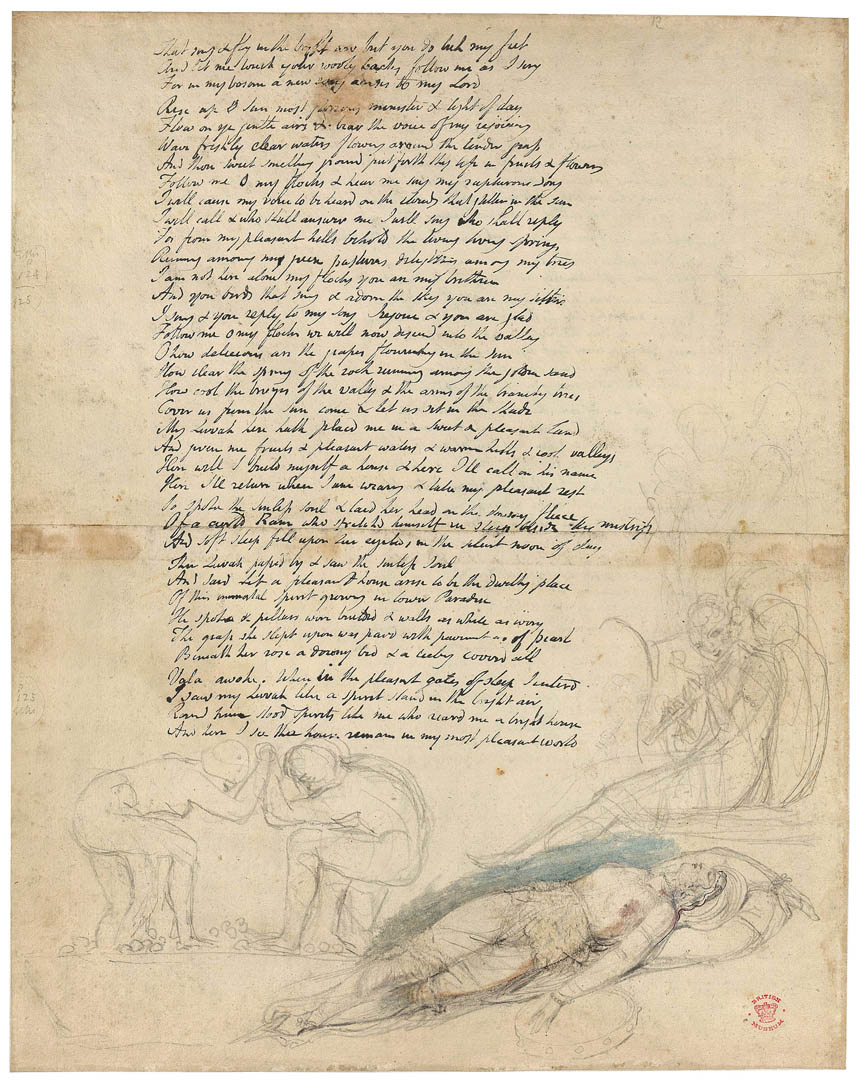
"Vala awoke. When in the pleasant gates of sleep I enterd
I saw my Luvah like a spirit stand in the bright air
Round him stood spirits like me who reard me a bright house
And here I see thee house remain in my most pleasant world"   

In the last Night Blake let all of his feelings out in a magnificent vision of apocalypse that bears comparison with the one John wrote: 

"Los his vegetable hands 
Outstretch'd; his right hand, branching out in fibrous strength, 
Siez'd the Sun; His left hand, like dark roots, cover'd the Moon, 
And tore them down, cracking the heavens across from immense to immense. 
Then fell the fires of Eternity with loud and shrill
Sound of Loud Trumpet thundering along from heaven to heaven 
A mighty sound articulate Awake ye dead & come To judgment from the four winds Awake & Come away"
(Four Zoas, Night ix, E 386)

     And on and on it goes, much too imposing to describe in this short review. But two things will be said:

     First, Blake draws on John's Apocalypse as he already has in Night viii. The strangest book in the Bible, utterly incomprehensible to the literal mind, has much to offer to the trained imagination. To read the end of 4Z with complete attention gives one a purchase on Blake's great source; Revelation begins to come alive in an exciting new way.

Second, as great as it is, Blake simply wasn't able to 'Christianize' his apocalypse as he had done the two previous Nights. Perhaps it was already too deeply stamped with his pre-Christian mind. Forgiveness is the soul, virtually the alpha and omega of Blake's Christ, but Night ix shows little or no evidence of this new spirit. Only in Jerusalem, in its last plates, do we find a thoroughly Christian apocalypse. Neither Revelation nor Night ix has much of forgiveness; what they do have is vengeance and retribution. Both writers had suffered much at the hands of the ungodly, and both looked with anticipation to the Day of Vengeance. So we must say that Night ix is a modern redoing of John's Apocalypse, while the end of Jerusalem is a Christian recreation of it.

     Blake's epic ends with the eternal man awake, his four Zoas back in union, each carrying out his appointed function in the harmonious consummation of the Age. In the last harvest Urizen reaps, Tharmas threshes, Luvah tramples out the vineyard and Urthona bakes the bread.

     Night ix contains much magnificent poetry. A few lines near the end will provide an appropriate end to this all too inadequate description of Blake's great poem:

"The Sun has left his blackness and has found a fresher morning, 
And the mild moon rejoices in the clear and cloudless night, 
And Man walks forth from the midst of the fires: the evil is all consum'd.
... He walks upon the Eternal Mountains, raising his heavenly voice, 
Conversing with the Animal forms of wisdom night and day, 
... They raise their faces from the Earth, conversing with the Man:
"How is it we have walk'd thro' fires and yet are not consum'd? 
"How is it that all things are chang'd, even as in ancient times?"
The Sun arises from his dewey bed, and the fresh airs 
Play in his smiling beams giving the seeds of life to grow, 
And the fresh Earth beams forth ten thousand thousand springs of life."
(Four Zoas, Night ix, E 406) 

    
Blake's myth is stated concisely in Blake's Four Zoas: The Design of a Dream by Brian Wilkie and Mary Lynn Johnson: 
"Albion is the whole person and mankind. His Emanation is Jerusalem, who represents the perfect freedom enjoyed by man in the unfallen state (called by Blake Eden or Eternity) where he is in harmony with himself and the world. The fallen state is a condition in which each of the four primal powers betrays what is best in himself and wars with the others." 

In The Four Zoas Blake follows the disintegration of Albion's original unity, his struggles as a divided self and the final resolution of Albion reborn as his constituent Zoas, each serving the whole. 

Monday, January 15, 2024

INTEGRATION

Wikipedia Commons
A Large Book of Designs
Albion Rose

"Albion rose from where he labourd at the Mill with Slaves
Giving himself for the Nations he danc'd the dance of
Eternal Death"

In Blake's Four Zoas: The Design of a Dream by Brian Wilkie and Mary Lynn Johnson we read of the finalization of of the poem in the last 31 lines which Blake wrote. The Four Zoas ends quickly after each of the Zoas has returned to his proper position and resumed his ordained function: Tharmas the shepherd, Urizen the Plowman, Luvah the Weaver, and Urthona the Blacksmith.

The final task is reassembling Albion in his pristine unity. All of the dividing, dissension and disintegration that went before is counter-balanced by synthesyzing the symbols which were so carefully developed in analyzing the process of dividing the Eternal Man.

Four Zoas , Night IX, (E 406)

"The Sun has left his blackness & has found a fresher morning     

And the mild moon rejoices in the clear & cloudless night  
And Man walks forth from midst of the fires  the evil is all consumd
His eyes behold the Angelic spheres arising night & day
The stars consumd like a lamp blown out & in their stead behold
The Expanding Eyes of Man behold the depths of wondrous worlds
One Earth one sea beneath nor Erring Globes wander but Stars
Of fire rise up nightly from the Ocean & one Sun
Each morning like a New born Man issues with songs & Joy
Calling the Plowman to his Labour & the Shepherd to his rest
He walks upon the Eternal Mountains raising his heavenly voice   
Conversing with the Animal forms of wisdom night & day
That risen from the Sea of fire renewd walk oer the Earth

For Tharmas brought his flocks upon the hills & in the Vales
Around the Eternal Mans bright tent the little Children play
Among the wooly flocks The hammer of Urthona sounds              
In the deep caves beneath his limbs renewd  his Lions roar
Around the Furnaces & in Evening sport upon the plains
They raise their faces from the Earth conversing with the Man

How is it we have walkd thro fires & yet are not consumd
How is it that all things are changd even as in ancient times    

PAGE 139 
The Sun arises from his dewy bed & the fresh airs
Play in his smiling beams giving the seeds of life to grow
And the fresh Earth beams forth ten thousand thousand springs of life
Urthona is arisen in his strength no longer now
Divided from Enitharmon no longer the Spectre Los                
Where is the Spectre of Prophecy where the delusive Phantom
Departed & Urthona rises from the ruinous walls
In all his ancient strength to form the golden armour of science
For intellectual War The war of swords departed now
The dark Religions are departed & sweet Science reigns           

                  End of The Dream
Only Luvah and Vala do not return to their original functioning. They are cast into the 'World of Shadows' until the 'winter is over and gone'. We may think of the unconscious as the shadow world which is unknown to consciousness. In our world of time and space Luvah and Vala function in the outer world of which we are conscious.  But although the dream is over the final restoration is not complete.  Until time and space no longer exist and have been subsumed by Eternity, the place of Luvah and Vala will remain in the shadowy unconscious where they will not disturb the unity of Albion's consciousness. 

Four Zoas, Night IX, Page 137, (E 405) 

"Luvah & Vala woke & all the sons & daughters of Luvah
Awoke they wept to one another & they reascended
To the Eternal Man in woe he cast them wailing into              
The world of shadows thro the air till winter is over & gone"
Urthona too has a place in the unconscious where his work is continued. He feeds the conscious mind with the bread of sweet thought and the wine of delight.

Four Zoas, Night IX, Page 137, (E 405)

"But the Human Wine stood wondering in all their delightful Expanses
The Elements subside the heavens rolld on with vocal harmony

Then Los who is Urthona rose in all his regenerate power

The Sea that rolld & foamd with darkness & the shadows of death  
Vomited out & gave up all the floods lift up their hands
Singing & shouting to the Man they bow their hoary heads
And murmuring in their channels flow & circle round his feet

PAGE 138 
Then Dark Urthona took the Corn out of the Stores of Urizen
He ground it in his rumbling Mills Terrible the distress
Of all the Nations of Earth ground in the Mills of Urthona
In his hand Tharmas takes the Storms. he turns the whirlwind Loose
Upon the wheels the stormy seas howl at his dread command        
And Eddying fierce rejoice in the fierce agitation of the wheels
Of Dark Urthona Thunders Earthquakes Fires Water floods
Rejoice to one another loud their voices shake the Abyss
Their dread forms tending the dire mills The grey hoar frost was there
And his pale wife the aged Snow they watch over the fires        
They build the Ovens of Urthona Nature in darkness groans
And Men are bound to sullen contemplations in the night
Restless they turn on beds of sorrow. in their inmost brain
Feeling the crushing Wheels they rise they write the bitter words
Of Stern Philosophy & knead the bread of knowledge with tears & groans
Four Zoas , Night IX, Page 138, (E 406)

"Such are the works of Dark Urthona  Tharmas sifted the corn

Urthona made the Bread of Ages & he placed it
In golden & in silver baskets in heavens of precious stone
And then took his repose in Winter in the night of Time"

Letters,To Flaxman, (E 709)

"My Friend & Thine Descend & Ascend with the Bread & the Wine The Bread of sweet Thought & the Wine of Delight Feeds the Village of Felpham by day & by night"

Songs and Ballads, (E 476)

"Then shall we return & see
The worlds of happy Eternity

& Throughout all Eternity             
I forgive you you forgive me
As our dear Redeemer said                                   
This the Wine & this the Bread"

__________________________________________________

Monday, October 17, 2022

INTERLUDE

First posted November 2018.

Yale Center for British Art
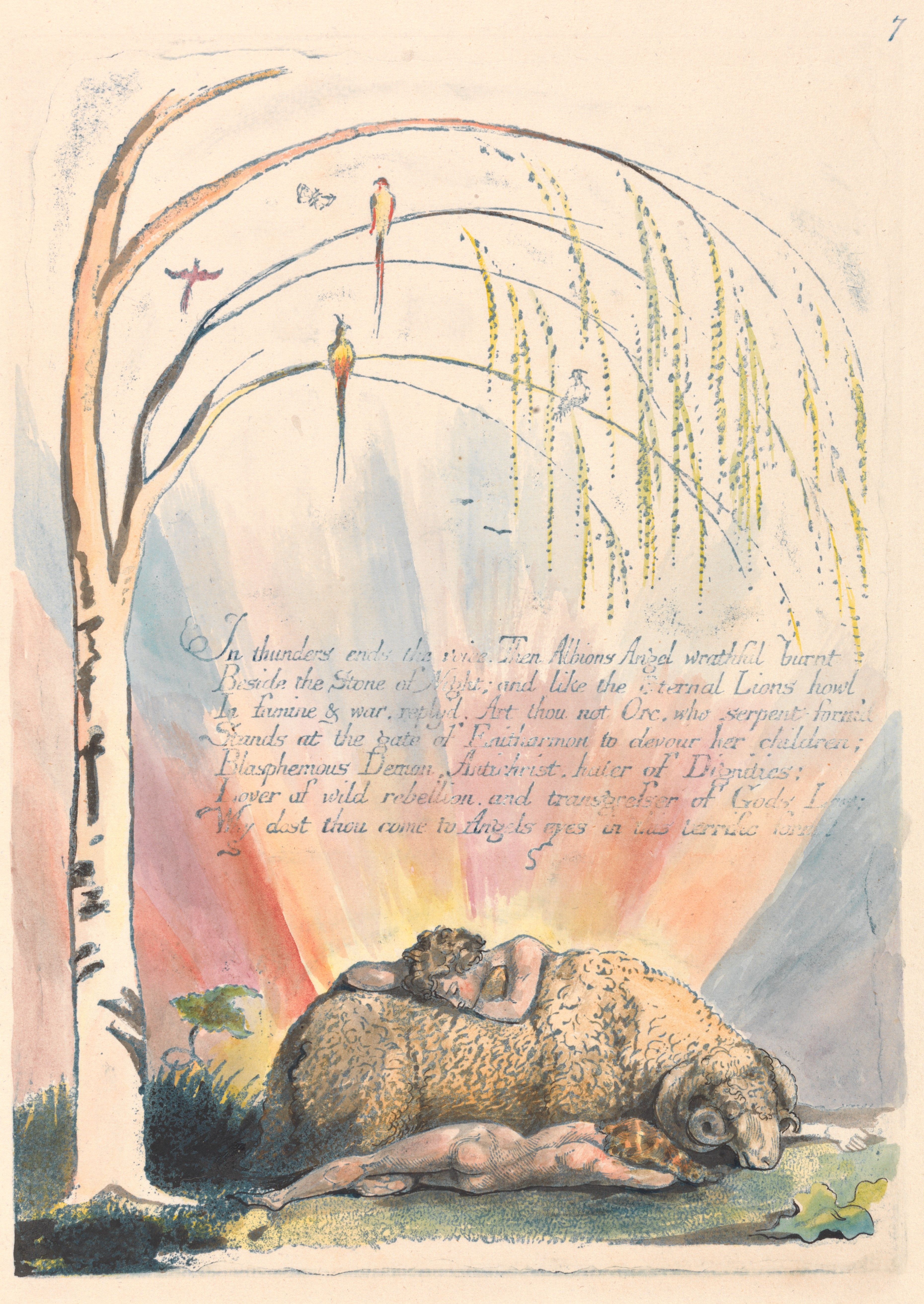
America
Plate 9

Larry wrote this in his Journal in January 1985:

"Four Zoas Night IX - reading a passage from Vala's interlude, I am charmed with the language. I realize that much of Blake's attraction to me is as an escape from the sordid world, a pleasant world like great music - with very little relationship to the rest of life. That passage, owing much to the myth of Cupid and Psyche and to the biblical Song of Solomon shows Blake as teller of tales, as bearer of the culture of the millennia. That is so foreign to our heedless, blind, 20th century consciousness. It is a form of transcendence, and an approach to the immortality for which Vala longs; a bright airy world of limitless dimensions.

Los is that prophet who walks walks up and down 6000 years allowing time and space for such moments to occur and to be made permanent in the Body and the Spirit."  

In November 2018 Ellie added:

When we read the Old Testament or Blake's Prophecies we find many disturbing passages. We may be inclined to close the book to avoid subjecting ourselves to the negative feelings engendered by reading of struggles among competing individuals or entities. Were it not for the hope of finding gems of truth and beauty embedded in the mire of confusion and dissension we may not read on.

One on Larry's favorite expressions was, "The Bible is all poetry, and poetry is the highest form of truth." Like the Bible, Blake's writing (even the prose) is poetry. It is not to be taken literally but metaphorically. It points to truth which is beyond expression. Blake's God availed himself of the opportunity to begin again repeatedly. We might follow that lead and begin again when reading gets rough.

Jerusalem, Plate 75, (E 230)
"For Los in Six Thousand Years walks up & down continually
That not one Moment of Time be lost & every revolution
Of Space he makes permanent in Bowlahoola & Cathedron."

Four Zoas, Night IX, Page 128, (E 397) 
"So spoke the Sinless Soul & laid her head on the downy fleece 
Of a curld Ram who stretchd himself in sleep beside his mistress
And soft sleep fell upon her eyelids in the silent noon of day

Then Luvah passed by & saw the sinless Soul
And said   Let a pleasant house arise to be the dwelling place
Of this immortal Spirit growing in lower Paradise 

He spoke & pillars were builded & walls as white as ivory
The grass she slept upon was pavd with pavement as of pearl
Beneath her rose a downy bed & a cieling coverd all

Vala awoke. When in the pleasant gates of sleep I enterd
I saw my Luvah like a spirit stand in the bright air 
Round him stood spirits like me who reard me a bright house
And here I see thee house remain in my most pleasant world
Page 129 
My Luvah smild I kneeled down he laid his hand on my head
And when he laid his hand upon me from the gates of sleep I came
Into this bodily house to tend my flocks in my pleasant garden

So saying she arose & walked round her beautiful house
And then from her white door she lookd to see her bleating lambs 
But her flocks were gone up from beneath the trees into the hills

I see the hand that leadeth me doth also lead my flocks
She went up to her flocks & turned oft to see her shining house
She stopd to drink of the clear spring & eat the grapes & apples

She bore the fruits in her lap she gatherd flowers for her bosom
She called to her flocks saying follow me O my flocks

They followd her to the silent valley beneath the spreading trees
And on the rivers margin she ungirded her golden girdle
She stood in the river & viewd herself within the watry glass
And her bright hair was wet with the waters She rose up from the river
And as she rose her Eyes were opend to the world of waters"
Letters, To Butts, (E 713)
     "In his beams of bright gold
     Like dross purgd away
     All my mire & my clay
     Soft consumd in delight
     In his bosom sun bright
     I remaind.  Soft he smild
     And I heard his voice Mild
     Saying This is My Fold
     O thou Ram hornd with gold
     Who awakest from sleep
     On the sides of the Deep
     On the Mountains around
     The roarings resound
     Of the lion & wolf
     The loud sea & deep gulf
     These are guards of My Fold
     O thou Ram hornd with gold
     And the voice faded mild
     I remaind as a Child
     All I ever had known
     Before me bright Shone
Song of Solomon
Chapter 2
[8] The voice of my beloved! behold, he cometh leaping upon the mountains, skipping upon the hills.
[9] My beloved is like a roe or a young hart: behold, he standeth behind our wall, he looketh forth at the windows, shewing himself through the lattice.
[10] My beloved spake, and said unto me, Rise up, my love, my fair one, and come away.
[11] For, lo, the winter is past, the rain is over and gone;
[12] The flowers appear on the earth; the time of the singing of birds is come, and the voice of the turtle is heard in our land;
[13] The fig tree putteth forth her green figs, and the vines with the tender grape give a good smell. Arise, my love, my fair one, and come away.
[14] O my dove, that art in the clefts of the rock, in the secret places of the stairs, let me see thy countenance, let me hear thy voice; for sweet is thy voice, and thy countenance is comely.
[15] Take us the foxes, the little foxes, that spoil the vines: for our vines have tender grapes.
[16] My beloved is mine, and I am his: he feedeth among the lilies.
[17] Until the day break, and the shadows flee away, turn, my beloved, and be thou like a roe or a young hart upon the mountains of Bether.


Saturday, July 23, 2022

FEAST OF THE ETERNALS

 First posted September 2009 

At the conclusion of 4Zs, Blake created this beautiful poetic image of Tharmas and Urthona, body and spirit, Man and God, as they depart the Golden feast. Divisions have been reconciled, unity has been achieved, a new age has begun, rejoicing is underway.

Four Zoas: Night the Ninth, pg 137, (E 405)

"Then Tharmas & Urthona rose from the Golden feast satiated
With Mirth & joy Urthona limping from his fall on Tharmas leand
In his right hand his hammer Tharmas held his Shepherds crook
Beset with gold gold were the ornaments formed by the sons of Urizen
Then Enion & Ahania & Vala & the wife of Dark Urthona
Rose from the feast in joy ascending to their Golden Looms
There the wingd shuttle Sang the spindle & the distaff & the Reel
Rang sweet the praise of industry. Thro all the golden rooms
Heaven rang with winged Exultation All beneath howld loud
With tenfold rout & desolation roard the Chasms beneath
Where the wide woof flowd down & where the Nations are gatherd together"

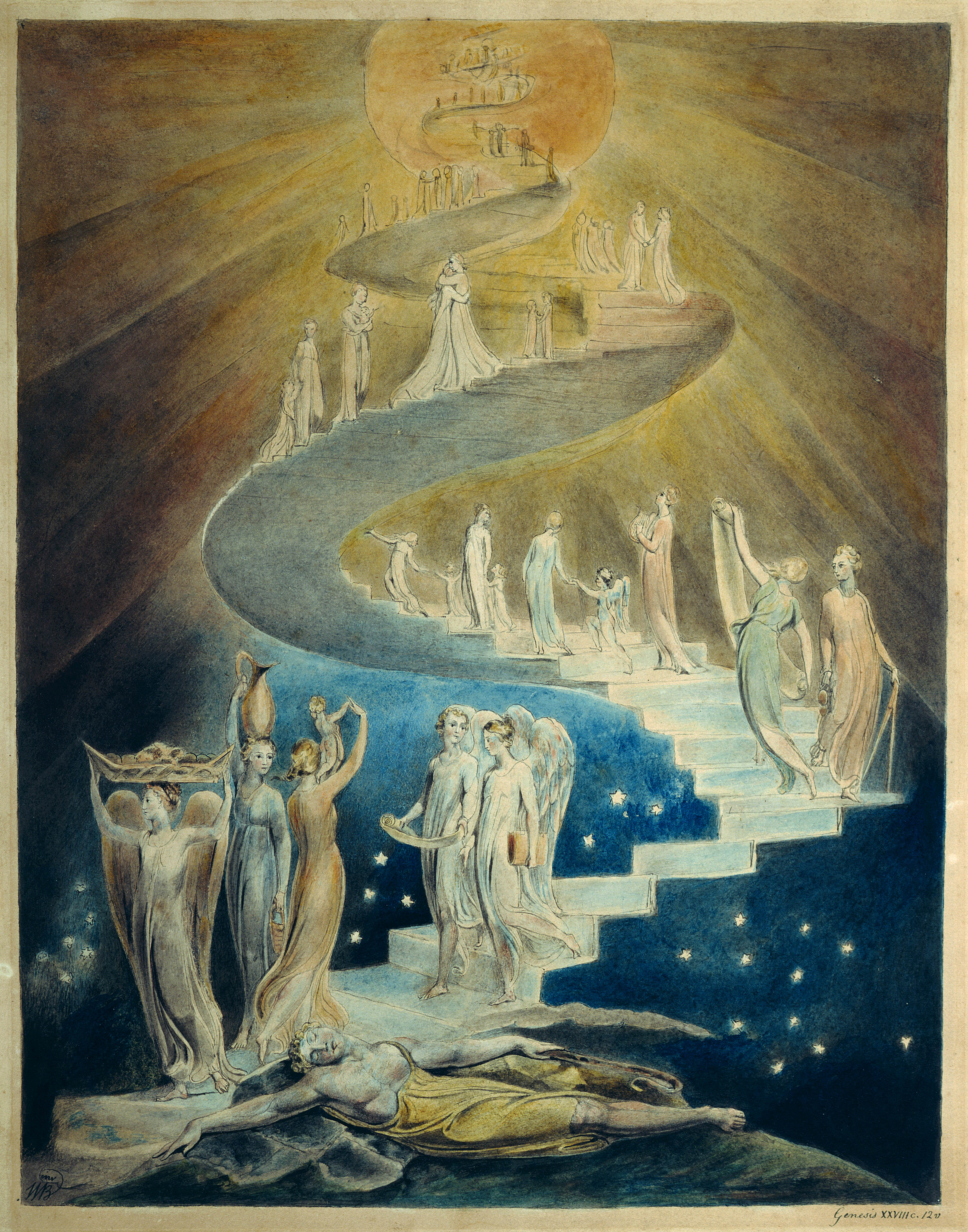
Since I haven't been able to find an image that represents the Feast of the Eternals, I'll substitute another scene of rejoycing, connecting the lower and higher levels. Note the bread, the wine, the scroll, the compass,the lyre and other of Blake's symbols. 
Wikipedia Commons
Jacob's Ladder
Genesis 28:12
 Jacob's Ladder

Here is a hymn we used to sing with the Catholic Charismatics at Georgetown University which uses a similar theme and expresses some of the same sentiments: GOD AND MAN AT TABLE ARE SAT DOWN.
God And Man At Table Are Set Down
O, welcome all you noble saints of old,
As now before your very eyes unfold
The wonders all so long ago foretold.
God and man at table are sat down.

Elders, martyrs, all are falling down;
Prophets, patriarchs are gath’ring round,
What angels longed to see now we have found.
God and man at table are sat down.

Beggers, lame, and harlots also here;
Repentant publicans are drawing near;
Wayward ones come home without a fear.
God and man at table are sat down.

When at last this earth shall pass away,
When Jesus and his bride are one to stay,
The feast of love is just begun that day.
God and man at table are sat down.

(Copyright 1972, Dawn Treader Music.)


Friday, April 16, 2021

BIOGRAPHY 4

                                   Four Zoas 
Page 5

Four Zoas, Night 1, PAGE 5, (E 302)
"In Eden,Females sleep the winter in soft silken veils 
Woven by their own hands to hide them in the darksom grave
But Males immortal live renewd by female deaths.     in soft
Delight they die & they revive in spring with music & songs
Enion said Farewell I die     I hide. from thy searching eyes    

So saying--From her bosom weaving soft in Sinewy threads
A tabernacle for Jerusalem she sat among the Rocks  
Singing her lamentation. Tharmas groand among his Clouds
Weeping, then bending from his Clouds he stoopd his innocent head 
And stretching out his holy hand in the vast Deep sublime        
Turnd round the circle of Destiny with tears & bitter sighs
And said.     Return O Wanderer when the Day of Clouds is oer

So saying he sunk down into the sea a pale white corse
In torment he sunk down & flowd among her filmy Woof  
His Spectre issuing from his feet in flames of fire
In gnawing pain drawn out by her lovd fingers every nerve 
She counted. every vein & lacteal threading them among
Her woof of terror. Terrified & drinking tears of woe
Shuddring she wove--nine days & nights Sleepless her food was tears
Wondring she saw her woof begin to animate. & not  
As Garments woven subservient to her hands but having a will
Of its own perverse & wayward Enion lovd & wept

Nine days she labourd at her work. & nine dark sleepless nights
But on the tenth trembling morn the Circle of Destiny Complete 
Round rolld the Sea Englobing in a watry Globe self balancd

A Frowning Continent appeard Where Enion in the Desart
Terrified in her own Creation      viewing her woven shadow
Sat in a dread intoxication of Repentance & Contrition 

There is from Great Eternity a mild & pleasant rest
Namd Beulah a Soft Moony Universe feminine lovely 
Pure mild & Gentle given in Mercy to those who sleep
Eternally. Created by the Lamb of God around
On all sides within & without the Universal Man
The Daughters of Beulah follow sleepers in all their Dreams
Creating Spaces lest they fall into Eternal Death                

The Circle of Destiny complete they gave to it a Space
And namd the Space Ulro & brooded over it in care & love
They said The Spectre is in every man insane & most
Deformd     Thro the three heavens descending in fury & fire
We meet it with our Songs & loving blandishments & give          
To it a form of vegetation But this Spectre of Tharmas
Is Eternal Death What shall we do O God pity & help    
So spoke they & closd the Gate of the Tongue in trembling fear 

What have I done! said Enion accursed wretch! What deed. 
Is this a deed of Love I know what I have done. I know
Too late now to repent. Love is changd to deadly Hate  
A [ll] life is blotted out & I alone remain possessd with Fears
I see the Shadow of the dead within my Soul wandering
In darkness & solitude forming Seas of Doubt & rocks of Repentance 
Already are my Eyes reverted. all that I behold                  
Within my Soul has lost its splendor & a brooding Fear
Shadows me oer & drives me outward to a world of woe
So waild she trembling before her own Created Phantasm" 

BIOGRAPHY 4 - From Chapter 1 of Larry's book Ram Horn'd With Gold.

Four Zoas
For we wrestle not against flesh and blood...
(Ephesians 6:12)
 
       The study of anyone's life from a distance of two centuries requires a lot of reading between the lines. In Blake's case we fortunately have a detailed spiritual journal reflecting the most critical years of his life. It exists in the form of an epic poem that he worked on for many years but never finished. Northrup Frye called 'The Four Zoas' "the greatest abortive masterpiece in English literature". Anyone who takes the trouble to read it three times is likely to agree with Frye; the first two readings may mystify more than enlighten.

       Once you know the man and his language, the poem takes on a fascinating personal dimension; it records the journey of a soul from darkness to light. Scholars tell us that Blake wrote, revised, cancelled, renewed, rewrote 4Z. The historical interpreters fancy that they can see the European military scene changing from line to line. But two centuries later the personal dimension, universalized into the metaphysical, is more gripping.

       In the prophetic poems between MHH and 4Z (called the Lambeth Books) we see Blake's spiritual capital running out. Even his secular critics observed the flagging of his vision and his enthusiasm during the period. He was struggling with the forces of darkness; moreover he was aware of the nature of the struggle, and he used the Ephesian epigram accordingly at the beginning of the poem.

       In 4Z Blake tells how the universal man lost Eden and fell into sleep and division and how his many selves struggled in the "torments of love and jealousy". But in the midst of these torments something happened, the selves worked through their trials, man awoke, and Eden returned. Here we have a personal adventure which is an expression of the history of mankind.

       In the first six nights we see a spiritual genius grappling with the Fall. Blake reflected in excruciating detail on the nature of fallenness. Why and how is mankind and the individual psyche so horribly messed up? The question haunts every spiritual genius and afflicts us all in varying degrees. Then in the midst of this darkness we see something strange: there are sudden glimmerings of light for a line or two, and we begin to realize that this may not be hell but purgatory. Few writers have more magnificently described the light shining among the people who walked in darkness. The really fascinating thing about 4Z is that right in the middle of it the writer suddenly changes into a new man. The exact moment is recorded in the action, and then the poem becomes a testament of faith.

Four Zoas, Night VII, Page 131, (E 400)  
"As when the wind sweeps over a Corn field the noise of souls 
Thro all the immense borne down by Clouds swagging in autumnal heat
Muttering along from heaven to heaven hoarse roll the human forms
Beneath thick clouds dreadful lightnings burst & thunders roll
Down pour the torrent Floods of heaven on all the human harvest
Then Urizen sitting at his repose on beds in the bright South 
Cried Times are Ended he Exulted he arose in joy he exulted
He pourd his light & all his Sons & daughters pourd their light
To exhale the spirits of Luvah & Vala thro the atmosphere
And Luvah & Vala saw the Light their spirits were Exhald
In all their ancient innocence the floods depart the clouds 
Dissipate or sink into the Seas of Tharmas   Luvah sat
Above in the bright heavens in peace. the Spirits of Men beneath 
Cried out to be deliverd & the Spirit of Luvah wept
Over the human harvest & over Vala the sweet wanderer"
 Milton, Plate 35 [39]  
"There is a Moment in each Day that Satan cannot find
Nor can his Watch Fiends find it, but the Industrious find
This Moment & it multiply. & when it once is found
It renovates every Moment of the Day if rightly placed" 
In 4Z Blake described the Moment of Grace in terms that closely 
resemble those of Jungian psychology: Shadow and Anima (Blake 
calls them spectre and emanation) are integrated into the Self. But without
question Blake described here a personal spiritual event of the greatest
importance. It was the moment when the divided selves found
themselves reconciled into a new being under a new Lord; it marked
a radical alteration of consciousness.

       Blake had shared with mankind a consciousness which had fallen through a decision for the world, and his senses constricted through turning his back upon the Divine Vision. Less guilty than most of us, he had not reached the level of spiritual blindness which characterizes true worldliness; nevertheless he was guilty. But in his brokenness he opened himself to unmerited grace, with the inevitable gracious consequences.

       In Night vii of 4Z Urizen, the ice man, the great opposer of change, effects the metamorphosis of fierce and fiery Orc, personification of change, into a serpent who crawls up the Tree of Mystery. An earlier prophet had written about a serpent and a tree at the dawn of history, and since that day the two figures have served as the basic symbols of the Fall. But Moses had used the same combined image to symbolize healing, and Jesus harked back to it in predicting his own impending exit from the world and its purpose.

       Knowledge of the full weight of meaning carried by serpent and tree alerts us to an impending climax in Blake's story. Back in Night i Los, the spirit of prophecy, the personification of creativity, was estranged from his emanation, Enitharmon. In Night v she gave birth to Orc, but Los chained him to earth with the Chain of Jealousy, a sort of reverse Oedipus myth. This left the creative selves a sorry shambles. But now in Night vii Enitharmon's shadow meets and unites with Los' spectre, and their issue is twofold, the Whore and the Lamb. The Whore will burn, and the Lamb will find a spotless bride.

       There's no way anyone can fully appreciate the joy of this moment without having participated deeply in the agony and travail which preceded it. This is but a way of saying that there's no way anyone can appreciate the salvation of the world without having first quenched the cup of the fallenness of the world. Long ago a book appeared entitled No Cross, No Crown, suggesting that we don't appreciate what God has done simply because we refuse the cup. Jesus accepted it on our behalf, and Blake did too in his way, as does every artist or prophet or saint who follows the narrow path.

       At the Moment of Grace the narrow path opens out into the limitless expanse of eternity. The last half of Night vii marks that moment in Blake's life and describes his own personal experience of Easter. Once it happened, he went on to what Kathleen Raine called the Christianizing of his myth. In Night viii he told the old, old story in the old, old terms, but the new creation had taken place in Night vii.

Four Zoas, Night vii, Page 95 [87], (E 368)  
"But if thou dost refuse Another body will be prepared
PAGE 86 
For me & thou annihilate evaporate & be no more
For thou art but a form & organ of life & of thyself
Art nothing being Created Continually by Mercy & Love divine

Los furious answerd. Spectre horrible thy words astound my Ear
With irresistible conviction I feel I am not one of those 
Who when convincd can still persist. tho furious.controllable
By Reasons power. Even I already feel a World within
Opening its gates & in it all the real substances
Of which these in the outward World are shadows which pass away
Come then into my Bosom & in thy shadowy arms bring with thee   
My lovely Enitharmon. I will quell my fury & teach
Peace to the Soul of dark revenge & repentance to Cruelty

So spoke Los & Embracing Enitharmon & the Spectre
Clouds would have folded round in Extacy & Love uniting"

Four Zoas, Night viii, Page 98 [90], (E 371) 
"Startled was Los he found his Enemy Urizen now 
In his hands. he wonderd that he felt love & not hate 
His whole soul loved him he beheld him an infant 
Lovely breathd from Enitharmon he trembled within himself"


Sunday, September 15, 2019

DRIVING THE PLOW

Four Zoas, Night VII, Page 79,  (E 355) 
"Urizen answerd Read my books explore my Constellations 
Enquire of my Sons & they shall teach thee how to War
Enquire of my Daughters who accursd in the dark depths
Knead bread of Sorrow by my stern command for I am God
Of all this dreadful ruin"  
Wikipedia Commons
Illustration to the Book of Job
Butts Set, Page 12
It is not the simple, easy, pleasant things which offer the greatest benefit or prove to be the most worth doing. The world could have been arranged in such a way that there was no variation, no change, no challenge. But without obstacles to be overcome, problems to be solved, unpredictability to be considered, life would indeed be a 'dull round' of repetition.  
Descriptive Catalogue, (E 543)
"Mr. B. has done, as all
the ancients did, and as all the moderns, who are worthy of fame,
given the historical fact in its poetical vigour; so as it always
happens, and not in that dull way that some Historians pretend,
who being weakly organized themselves, cannot see either miracle
or prodigy; all is to them a dull round of probabilities and
possibilities; but the history of all times and places, is
nothing else but improbabilities and impossibilities; what we 
should say, was impossible if we did not see it always before our 
eyes."
Blake puts in the hand of Urizen the plow as the instrument that keeps stirring the events which comprise the complexities of existence. Living as we do in the world of time and space, we learn from demonstration, from experiencing, from seeing the indefinite become definite. It is the reasoning mind which is assigned the task of taking the material which it encounters and defining the value in it whether it be truth or error. Without the labor of Urizen performing the work of breaking up, and turning over the soil comprised of thoughts and actions, there would be no possibility for the work of Los, imagination, to continue.  
Milton, Plate 25 [27], (E 121)
"There Los puts all into the Press, the Opressor & the Opressed
Together, ripe for the Harvest & Vintage & ready for the Loom.

They sang at the Vintage. This is the Last Vintage! & Seed
Shall no more be sown upon Earth, till all the Vintage is over
And all gatherd in, till the Plow has passd over the Nations     
And the Harrow & heavy thundering Roller upon the mountains

And loud the Souls howl round the Porches of Golgonooza
Crying O God deliver us to the Heavens or to the Earths,
That we may preach righteousness & punish the sinner with death
But Los refused, till all the Vintage of Earth was gatherd in.  

And Los stood & cried to the Labourers of the Vintage in voice of awe.

Fellow Labourers! The Great Vintage & Harvest is now upon Earth
The whole extent of the Globe is explored: Every scatterd Atom
Of Human Intellect now is flocking to the sound of the Trumpet
All the Wisdom which was hidden in caves & dens, from ancient    
Time; is now sought out from Animal & Vegetable & Mineral- 121 -

The Awakener is come. outstretchd over Europe! the Vision of God is fulfilled
The Ancient Man upon the Rock of Albion Awakes,"

Jerusalem, Plate 29 [33], (E 175)       
"Turning his back to the Divine Vision, his Spectrous
Chaos before his face appeard: an Unformed Memory.

Then spoke the Spectrous Chaos to Albion darkning cold
From the back & loins where dwell the Spectrous Dead

I am your Rational Power O Albion & that Human Form              
You call Divine, is but a Worm seventy inches long
That creeps forth in a night & is dried in the morning sun
In fortuitous concourse of memorys accumulated & lost
It plows the Earth in its own conceit, it overwhelms the Hills
Beneath its winding labyrinths, till a stone of the brook        
Stops it in midst of its pride among its hills & rivers[.] 
Battersea & Chelsea mourn, London & Canterbury tremble
Their place shall not be found as the wind passes over[.]
The ancient Cities of the Earth remove as a traveller
And shall Albions Cities remain when I pass over them            
With my deluge of forgotten remembrances over the tablet
 So spoke the Spectre to Albion. he is the Great Selfhood
Satan: Worshipd as God by the Mighty Ones of the Earth"

Jerusalem, Plate 41 [46], (E 188)
"Thou art in Error Albion, the Land of Ulro:               
One Error not remov'd, will destroy a human Soul
Repose in Beulahs night, till the Error is remov'd
Reason not on both sides. Repose upon our bosoms
Till the Plow of Jehovah, and the Harrow of Shaddai
Have passed over the Dead, to awake the Dead to Judgment.     
But Albion turn'd away refusing comfort."

Jerusalem, Plate 55, (E 205)
"Every one knows, we are One Family! One Man blessed for ever

Silence remaind & every one resumd his Human Majesty
And many conversed on these things as they labourd at the furrow
Saying: It is better to prevent misery, than to release from misery
It is better to prevent error, than to  forgive the criminal:    
Labour well the Minute Particulars, attend to the Little-ones:
And those who are in misery cannot remain so long
If we do but our duty: labour well the teeming Earth.

They Plow'd in tears, the trumpets sounded before the golden Plow
And the voices of the Living Creatures were heard in the clouds of heaven
Crying: Compell the Reasoner to Demonstrate with unhewn Demonstrations
Let the Indefinite be explored. and let every Man be judged
By his own Works, Let all Indefinites be thrown into Demonstrations
To be pounded to dust & melted in the Furnaces of Affliction:
He who would do good to another, must do it in Minute Particulars 
General Good is the plea of the scoundrel hypocrite & flatterer:
For Art & Science cannot exist but in minutely organized Particulars
And not in generalizing Demonstrations of the Rational Power.
The Infinite alone resides in Definite & Determinate Identity
Establishment of Truth depends on destruction of Falshood continually    
On Circumcision: not on Virginity, O Reasoners of Albion

So cried they at the Plow. Albions Rock frowned above
And the Great Voice of Eternity rolled above terrible in clouds
Saying Who will go forth for us! & Who shall we send before our face?"

Jerusalem, Plate 17, (E 207)
"Are not Religion & Politics the Same Thing? Brotherhood is Religion    
O Demonstrations of Reason Dividing Families in Cruelty & Pride!

But Albion fled from the Divine Vision, with the Plow of Nations enflaming
The Living Creatures maddend and Albion fell into the Furrow, and
The Plow went over him & the Living was Plowed in among the Dead
But his Spectre rose over the starry Plow. Albion fled beneath the Plow    
Till he came to the Rock of Ages. & he took his Seat upon the Rock.

Wonder siezd all in Eternity! to behold the Divine Vision. open
The Center into an Expanse, & the Center rolled out into an Expanse."

Jerusalem, Plate 62, (E 213)
"that Los in despair oft sat, & often ponderd
On Death Eternal in fierce shudders upon the mountains of Albion 
Walking: & in the vales in howlings fierce, then to his Anvils
Turning, anew began his labours, tho in terrible pains!

Plate 63
Jehovah stood among the Druids in the Valley of Annandale
When the Four Zoas of Albion, the Four Living Creatures, the Cherubim
Of Albion tremble before the Spectre, in the starry likeness of the Plow
Of Nations. And their Names are Urizen & Luvah & Tharmas & Urthona"

Four Zoas, Night VI, Page 70, (E 346)
"Writing in bitter tears & groans in books of iron & brass
The enormous wonders of the Abysses once his brightest joy

For Urizen beheld the terrors of the Abyss wandring among        
The ruind spirits once his children & the children of Luvah
Scard at the sound of their own sigh that seems to shake the immense
They wander Moping in their heart a Sun a Dreary moon
A Universe of fiery constellations in their brain
An Earth of wintry woe beneath their feet & round their loins 
Waters or winds or clouds or brooding lightnings & pestilential plagues
Beyond the bounds of their own self their senses cannot penetrate"

Four Zoas, Night IX, Page 124, (E 393)
 "The Sons of Urizen Shout Their father rose The Eternal horses
Harnessd They calld to Urizen the heavens moved at their call
The limbs of Urizen shone with ardor. He laid his ha[n]d on the Plow
Thro dismal darkness drave the Plow of ages over Cities
And all their Villages over Mountains & all their Vallies
Over the graves & caverns of the dead   Over the Planets
And over the void Spaces over Sun & moon & star & constellation

Then Urizen commanded & they brought the Seed of Men            
The trembling souls of All the Dead stood before Urizen
Weak wailing in the troubled air East west & north & south
PAGE 125 
He turnd the horses loose & laid his Plow in the northern corner
Of the wide Universal field. then Stepd forth into the immense 

Then he began to sow the seed he girded round his loins
With a bright girdle & his skirt filld with immortal souls
Howling & Wailing fly the souls from Urizens strong hand         

For from the hand of Urizen the myriads fall like stars
Into their own appointed places driven back by the winds
The naked warriors rush together down to the sea shores
They are become like wintry flocks like forests stripd of leaves
The Kings & Princes of the Earth cry with a feeble cry           
Driven on the unproducing sands & on the hardend rocks
And all the while the flames of Orc follow the ventrous feet
Of Urizen & all the while the Trump of Tharmas sounds
Weeping & wailing fly the souls from Urizens strong hand
The daughters of Urizen stand with Cups & measures of foaming wine
Immense upon the heavens with bread & delicate repasts

Then follows the golden harrow in the midst of Mental fires
To ravishing melody of flutes & harps & softest voice
The seed is harrowd in while flames heat the black mould & cause
The human harvest to begin Towards the south first sprang 
The myriads & in silent fear they look out from their graves

Then Urizen sits down to rest & all his wearied Sons
Take their repose on beds they drink they sing they view the flames
O f Orc in joy they view the human harvest springing up
A time they give to sweet repose till all the harvest is ripe"    


Tuesday, November 20, 2018

Myth in Blake 9

Blake never forgot the involvement of the Christian Church in 2000 years of bloodshed, but here, under the influence of grace, he has a more understanding view of it than he has expressed elsewhere (See Chapter Seven).

In the last Night Blake let all of his feelings out in a magnificent vision of apocalypse that bears comparison with the one John wrote:

Four Zoas, Night IX, Page 117, (E 386)
"Los his vegetable hands 
Outstretched; his right hand branching out in fibrous strength 
Seized the Sun; His left hand, like dark roots, cover'd the Moon, 
And tore them down, cracking the heavens across from immense to immense. 
Then fell the fires of Eternity with loud & shrill 
Sound of Loud Trumpet thundering along from heaven to heaven
A mighty sound articulate Awake ye dead & come 
To judgment from the four winds Awake & Come away 
Folding like scrolls of the Enormous volume of Heaven & Earth"

And on and on it goes, much too imposing to describe in this short review. But two things will be said:
First, Blake draws on John's Apocalypse as he already has in Night viii. Revelation, the strangest book in the Bible, utterly incomprehensible to the literal mind, has much to offer to the trained imagination. To read the end of Plate 42 of Jerusalem with complete attention gives one a purchase on Blake's great source; Revelation begins to come alive in an exciting new way.

Jerusalem, Plate 42, (E 190)
"Los stood before his Furnaces awaiting the fury of the Dead: 
And the Divine hand was upon him, strengthening him mightily. 
The Spectres of the Dead cry out from the deeps beneath 
Upon the hills of Albion; Oxford groans in his iron furnace 
Winchester in his den & cavern; they lament against 
Albion: they curse their human kindness & affection 
They rage like wild beasts in the forests of affliction 
In the dreams of Ulro they repent of their human kindness. 
Come up, build Babylon, Rahab is ours & all her multitudes 
With her in pomp and glory of victory. Depart 
Ye twenty-four into the deeps! let us depart to glory! 
Their Human majestic forms sit up upon their Couches 
Of death: they curb their Spectres as with iron curbs 
They enquire after Jerusalem in the regions of the dead, 
With the voices of dead men, low, scarcely articulate, 
And with tears cold on their cheeks they weary repose. 
O when shall the morning of the grave appear, and when 
Shall our salvation come? we sleep upon our watch 
We cannot awake! and our Spectres rage in the forests 
O God of Albion where art thou! pity the watchers! 
Thus mourn they. Loud the Furnaces of Los thunder upon 
The clouds of Europe & Asia, among the Serpent Temples! 
And Los drew his Seven Furnaces around Albions Altars 
And as Albion built his frozen Altars, Los built the Mundane Shell, 
In the Four Regions of Humanity East & West & North & South,
Till Norwood & Finchley & Blackheath & Hounslow, coverd the whole Earth.
This is the Net & Veil of Vala, among the Souls of the Dead."

Yale center for British Art 
Jerusalem
Plate 6

Second, as magnificent as it is, Blake simply wasn't able to 'Christianize' his apocalypse as he had done the two previous Nights. Perhaps it was already too deeply stamped with his pre-Christian mind. Forgiveness is the soul, virtually the alpha and omega of Blake's Christ, but Night ix shows little or no evidence of this new spirit. Only in Jerusalen, in its last plates, do we find a thoroughly Christian apocalypse. Neither Revelation nor Night ix has much of forgiveness; what they do have is vengeance and retribution. Both writers had suffered much at the hands of the ungodly, and both looked with anticipation to the Day of Vengeance. So we must say that Night ix is a modern redoing of John's Apocalypse, while the end of Jerusalem is a Christian recreation of it.

Blake's epic ends with the eternal man awake, his four zoas back in union, each carrying out his appointed function in the harmonious consummation of the Age. In the last harvest Urizen reaps, Tharmas threshes, Luvah tramples out the vineyard and Urthona bakes the bread.

Night ix contains much magnificent poetry. A few lines near the end will provide an appropriate end to this all too inadequate description of Blake's great poem:

Four Zoas, Night IX, Page 138, (E 406)
"The Sun has left his blackness & has found a fresher morning,
And the mild moon rejoices in the clear & cloudless night,
And Man walks forth from the midst of the fires: the evil is all consumed.
He walks upon the Eternal Mountains, raising his heavenly voice,
Conversing with the Animal forms of wisdom night & day,
...
They raise their faces from the Earth, conversing with the Man:
How is it we have walk'd thro' fires & yet are not consum'd?
How is it that all things are chang'd, even as in ancient times?

The Sun arises from his dewey bed, & the fresh airs
Play in his smiling beams giving the seeds of life to grow,
And the fresh Earth beams forth ten thousand thousand springs of life."

Christian or not, it does have the most beautiful visions!
.

Friday, November 09, 2018

INTERLUDE

Yale Center for British Art
America
Plate 9

Larry wrote this in his Journal in January 1985:

"Four Zoas Night IX - reading a passage from Vala's interlude, I am charmed with the language. I realize that much of Blake's attraction to me is as an escape from the sordid world, a pleasant world like great music - with very little relationship to the rest of life. That passage, owing much to the myth of Cupid and Psyche and to the biblical Song of Solomon shows Blake as teller of tales, as bearer of the culture of the millennia. That is so foreign to our heedless, blind, 20th century consciousness. It is a form of transcendence, and an approach to the immortality for which Vala longs; a bright airy world of limitless dimensions.

Los is that prophet who walks walks up and down 6000 years allowing time and space for such moments to occur and to be made permanent in the Body and the Spirit."  

In November 2018 Ellie added:

When we read the Old Testament or Blake's Prophecies we find many disturbing passages. We may be inclined to close the book to avoid subjecting ourselves to the negative feelings engendered by reading of struggles among competing individuals or entities. Were it not for the hope of finding gems of truth and beauty embedded in the mire of confusion and dissension we may not read on.

One on Larry's favorite expressions was, "The Bible is all poetry, and poetry is the highest form of truth." Like the Bible, Blake's writing (even the prose) is poetry. It is not to be taken literally but metaphorically. It points to truth which is beyond expression. Blake's God availed himself of the opportunity to begin again repeatedly. We might follow that lead and begin again when reading gets rough.

Jerusalem, Plate 75, (E 230)
"For Los in Six Thousand Years walks up & down continually
That not one Moment of Time be lost & every revolution
Of Space he makes permanent in Bowlahoola & Cathedron."

Four Zoas, Night IX, Page 128, (E 397) 
"So spoke the Sinless Soul & laid her head on the downy fleece 
Of a curld Ram who stretchd himself in sleep beside his mistress
And soft sleep fell upon her eyelids in the silent noon of day

Then Luvah passed by & saw the sinless Soul
And said   Let a pleasant house arise to be the dwelling place
Of this immortal Spirit growing in lower Paradise 

He spoke & pillars were builded & walls as white as ivory
The grass she slept upon was pavd with pavement as of pearl
Beneath her rose a downy bed & a cieling coverd all

Vala awoke. When in the pleasant gates of sleep I enterd
I saw my Luvah like a spirit stand in the bright air 
Round him stood spirits like me who reard me a bright house
And here I see thee house remain in my most pleasant world
Page 129 
My Luvah smild I kneeled down he laid his hand on my head
And when he laid his hand upon me from the gates of sleep I came
Into this bodily house to tend my flocks in my pleasant garden

So saying she arose & walked round her beautiful house
And then from her white door she lookd to see her bleating lambs 
But her flocks were gone up from beneath the trees into the hills

I see the hand that leadeth me doth also lead my flocks
She went up to her flocks & turned oft to see her shining house
She stopd to drink of the clear spring & eat the grapes & apples

She bore the fruits in her lap she gatherd flowers for her bosom
She called to her flocks saying follow me O my flocks

They followd her to the silent valley beneath the spreading trees
And on the rivers margin she ungirded her golden girdle
She stood in the river & viewd herself within the watry glass
And her bright hair was wet with the waters She rose up from the river
And as she rose her Eyes were opend to the world of waters"
Song of Solomon
Chapter 2
[8] The voice of my beloved! behold, he cometh leaping upon the mountains, skipping upon the hills.
[9] My beloved is like a roe or a young hart: behold, he standeth behind our wall, he looketh forth at the windows, shewing himself through the lattice.
[10] My beloved spake, and said unto me, Rise up, my love, my fair one, and come away.
[11] For, lo, the winter is past, the rain is over and gone;
[12] The flowers appear on the earth; the time of the singing of birds is come, and the voice of the turtle is heard in our land;
[13] The fig tree putteth forth her green figs, and the vines with the tender grape give a good smell. Arise, my love, my fair one, and come away.
[14] O my dove, that art in the clefts of the rock, in the secret places of the stairs, let me see thy countenance, let me hear thy voice; for sweet is thy voice, and thy countenance is comely.
[15] Take us the foxes, the little foxes, that spoil the vines: for our vines have tender grapes.
[16] My beloved is mine, and I am his: he feedeth among the lilies.
[17] Until the day break, and the shadows flee away, turn, my beloved, and be thou like a roe or a young hart upon the mountains of Bether.