Showing posts with label Larry's Blake. Show all posts

Friday, August 21, 2026

Death

First posted  March 12, 2019

Wikipedia Commons 
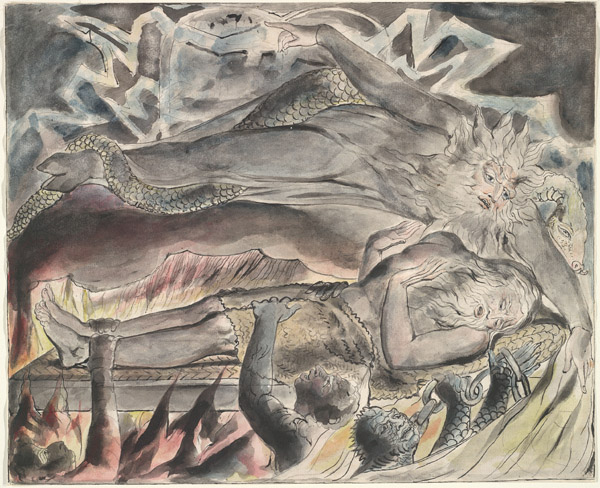
Illustrations to The Grave
Designed by Blake engraved by Schiavonetti

This is an extract from Chapter Two of Ram Horn'd With Gold by Larry Clayton. 

If its visions of love express the quality of a culture, so also does the face which it presents to death. Our society expends enormous sums on the professional removal of all evidence of death from our consciousness, even in the teeth of the stark reality. Ernest Becker, in The Denial of Death, showed the ubiquity of this impulse in American culture. His title, a poetic term, can just as easily mean one thing as the other. Like all symbols of value we encounter good denials of death and bad ones.
      
The poetry of Walt Whitman expresses one of the best. Like our poet Whitman was so sure of Eternity that the end of natural life had no terrors for him. He gained first hand experience with death as a hospital volunteer during the Civil War. Exceptionally memorable is his address to a dying soldier, "I don't commiserate, I congratulate you". Here is the exact opposite of the forms of denial most often exercised by the mortician, who simply does all he can to encourage us not to think about it.

In one of his earliest writings Blake explored the meaning of death to an ordinary young man and his loved ones. The Couch of Death (Erdman 441) voices the common fears of humanity but moves to the faithful reality that Blake possessed throughout his days, ending "and the youth breathes out his soul with joy into eternity".
Couch of Death 
"...Sorrow linked them together,
leaning on one another's necks alternately--like lilies, dropping
tears in each other's bosom, they stood by the bed like reeds
bending over a lake, when the evening drops trickle down.  His
voice was low as the whisperings of the woods when the wind is
asleep, and the visions of Heaven unfold their visitation. 
Parting is hard, and death is terrible; I seem to walk through a
deep valley, far from the light of day, alone and comfortless!
The damps of death fall thick upon me! Horrors stare me in the
face! I look behind, there is no returning; Death follows after
me; I walk in regions of Death, where no tree is; without a
lantern to direct my steps, without a staff to support me."
Blake's idealism found expression in the simple inversion of death, an idea that goes back as far as Heraclitus, who speaking of the Eternals said, "we live their death, and we die their life". The thought comes down to us through Euripides, Plato, and many others as late as Thomas Wolfe.
Most often when Blake speaks of "Death Eternal" he expresses the viewpoint of the Eternals; they meant by the term "this mortal life". Three times in Plate 14 of Milton the poet in Heaven, having heard the "Bard's Song" about Satan and recognizing Satan as his own Self-hood, says, "I go to Eternal Death!". He clearly means to return to this world, reenacting the kenosis (self emptying) of Christ.

Otherwise Blake used the word 'death' more straightforwardly than he had used 'love' and in two general senses. In fairly common parlance death is the opposite of the creative. Speaking of the Law in 'Jerusalem' the Divine Voice says:
"No individual can keep these Laws, for they are death To every energy of man and forbid the springs of life."

If you read Paul's epistles, you will discover that he used 'death' in the same ways. For example "And you hath he quickened, who were dead in trespasses and sins" (Ephesians 2:1). Paul is always reminding the Christian that he participates in the death and resurrection of Christ.

Secondly, Blake used 'death' in its most proper sense as the end of mortal life, but whenever he touched this subject, he always denied the materialistic viewpoint that death is the end. A clear example comes in Gates of Paradise, a short synoptic and pictorial description of Blake's myth of life:
" But when once I did descry The Immortal Man that cannot Die, Thro' evening shades I haste away To close the Labours of my Day."

Though he lived intensely, the love of the Ideal and his life long visions of Eternity led Blake to yearn for the Beyond and to depreciate material existence. Like the apostle Paul he had a "desire to depart, and to be with Christ; which is far better". Blake made a deliberate attempt through the aid of the doctrine of correspondences to live each moment of earthly life in the eternal realm, "to see a World in a Grain of Sand". Or expressed negatively:
"I assert for My Self that I do not behold the outward Creation & that to me it is hindrance & not Action; it is as the Dirt upon my feet, No part of Me."

And as stated in CHAPTER ONE he died with a song of praise on his lips. His life and all his art provide a convincing testimony for the reality of the Beyond. It was really Death that was "Dirt upon his feet".

Finally Blake used 'death' in the uniquely Christian context of self giving. At the end of 'Jerusalem' Jesus explains to Albion the meaning of his own death and its significance as a universal form of relationship:
      "...Fear not Albion: unless I die thou canst not live;
But if I die I shall arise again & thou with me.
This is Friendship & Brotherhood: without it Man is Not. ...
....Wouldest thou love one who never died
For thee, or ever die for one who had not died for thee?
And if God dieth not for Man & giveth not himself
Eternally for Man, Man could not exist; for Man is Love
As God is Love; every kindness to another is a little Death 
In the Divine Image, nor can Man exist but by Brotherhood.
*************************************

     These explorations of 'love' and 'death' may help the reader to grasp some of the poetic meanings attached to Blake's other terms of value, words like heaven and hell, good and evil, truth and error. Always watch for irony, for the other point of view, the reverse side of the coin. In such ways Blake continually provokes the intellect. He delights the person who enjoys an intellectual challenge--and frustrates others. He intimated as much in a letter to Dr. Trusler, who likely belonged to the second category:
" But you ought to know that What is Grand is necessarily
obscure to Weak men. That which can be made Explicit to
the Idiot is not worth my care. The wisest of the Ancients
consider'd what is not too Explicit as the fittest for
Instruction, because it rouzes the faculties to act. I
name Moses, Solomon, Esop, Homer, Plato."

Thursday, May 21, 2026

Reading the Gospel


British Museum
Illustrations to Young's Night Thoughts


First posted Nov 2010

How Blake Read the Gospel

All his life Blake read the Bible, loved it, and engaged in dialogue with its immortal authors. Virtually every line of his poetry and every picture he painted had direct reference to some biblical idea that Blake had meditated upon.

In vivid contrast many of the orthodox don't read the Bible at all; they just wave it! Little wonder they dislike Blake. His early ironic description of his work as the Bible of Hell certainly helped to confirm their prejudice.
__________________________________________________________________

"Thou read'st black where I read white."
(Everlasting Gospel)

There are essentially two ways to read the Bible; Blake referred to them as black and white. What did he mean? We might look at Urizen's Book of Brass as the black book. It's a book of rules, a book of law. It tells people what to do, and more poignantly, what not to do.

Even today ordinary people see the Bible in this way, which helps to explain why hardly anyone reads it today. The few who do read it do so dutifully and dully. Such a reading constrains consciousness; it makes the reader obedient and unimaginative. The faithful few who feel that they should read their Bible often approach it in a child like way bordering on the childish. Reading the black book inhibits the imagination, deadens the mind and prevents spiritual development. At its worst it has led to many instances of religious persecution and violence against dissenters.

But Blake read it white. The white book is not a book of rules, but a book of visions, a book of wonders. It provokes thought, causes the imagination to soar. Blake must have learned to read at about the age of four, when he had his first vision-- the frightful face at the window. Perhaps we've all been frightened by the Bible in one way or another; many people have had a sufficiently negative experience to leave it strictly alone. But little William overcame his fright and kept reading, and the next vision we hear of was more positive--a tree full of angels.

All the evidence suggests that for the next sixty five years Blake's Bible reading and his visions went hand in hand; his art is the record of it all. Whoever becomes really interested in Blake's visions will find himself reading the Bible because that's where most of them begin. In spite of this his secular critics have looked all over the world for his sources.

One of the greatest things that Blake has to offer the reader is that he makes you see and read the Bible in a new and better way. Not for nothing did the youthful circle of admirers of Blake's last years refer to him as the Interpreter.

The black book has most often been read as law, as history, in a restricted, literal interpretation. If the priest can get people to see it this way, and only this way, then he has secure control over his flock of sheep. In contrast Blake suggests that it's symbolic. Although written in categories of time and space, the temporal dimension is only instrumental; it points to the Beyond, the Eternal, the Real.

Too often people reading 'black' concern themselves with foolish questions such as "Did it really happen? Was Jonah really swallowed by the whale, or rather by the big fish?" But in Blake's vision that isn't the important thing. The important thing is "What does it mean?" The reader of the black book gets himself tied up in knots about the veracity or historicity of Jonah and his aquatic friend.

Blake shows you the Jonah in your psyche and helps you get some grasp of what the turbulent sea means to you personally. It's experiential, exciting! it puts you in touch with reality!, which is not material at all but spiritual. Literal or symbolic is black or white, and probably the two minds will never meet. At this point I simply urge you to join Blake and read white:
    "Why is the Bible more Entertaining & Instructive than any other book? Is it not because [it is] addressed to the Imagination which is Spiritual Sensation, and but mediately to the Understanding or Reason?"
    (Letter To Trusler; Erdman 702-3)                                                                                                                                                                                                                                  All of the above is taken from Chapter Six of the Blake Primer.    

Wednesday, August 06, 2025

Blake's Poetry

From Chapter Two of Ram Horn'd with Gold  by Larry Clayton..

                                Style

Poetry by its nature yields meaning at more than one level. Most of Blake's poetry has significance at three primary levels: political or historical, personal or psychological, and religious or metaphysical. Blake would have denied these distinctions because life to him was all one. He saw the political spiritually, the historical metaphysically. This means that the reader may encounter an initial confusion, but if he perseveres in the face of the complexities of symbols and thought forms, he eventually discovers a wealth of meaning. Once again the guiding principle is that everything points to and converges upon the eternal reality underlying what Blake called the shadows of life.

To think and speak eternally is no small achievement for him or for us. Pursuing this aim he floundered for many years (See CHAPTER ONE). The words of Los in 'The Four Zoas' record the moment when Blake got a firm grip on what he sought for himself and for us:

..."I already feel a World within
Opening its gates, & in it all the real substances
Of which these in the outward World are shadows which
pass away."

After twenty years in the visionary wilderness that "World within" opened its gates into the mind of the mature artist and poet. Then he began to exercise the greatest freedom in his artistic use of the shadows. They served him in every conceivable way to elucidate the real world within. All the shadows, all natural phenomena, all historical events, all works of art, his own included, he treated as fluctuating insubstantials which illustrate or point to the eternal reality.

Blake thought so much of Infinity that he learned to take great liberties with time and space. In this he followed the style of the most imaginative books of the Bible. As a young man sitting at the feet of Swedenborg he had learned the doctrine of correspondences which had come down from the Bible through the heterodox tradition. As Blake applied it, every material thing has a spiritual or eternal referrent. In the words of the alchemical tradition, "As above, so below". In the Book of Revelation for example Babylon, a code word for Rome, more generally connotes the citadel of worldly power and evil. Blake of course used it in the same way. He used geographical locations of all sorts to point to spiritual realities. Africa symbolizes slavery in all its forms, particularly the "mind forg'd manacles" of the moral law. America symbolizes the hope of freedom.  

He often succeeded in translating historical events and personages into spiritual realities. Constantine and Charlemayne symbolize war with religion as its handmaid. Albion is Blake's master symbol for Man, but sometimes Moses symbolizes Man; Michael and Satan then symbolize the forces of light and 
darkness in contest for Man. 
Harvard Art Museums
"Angel Michael Binding Satan"

Beginning with the traditional language of symbolic discourse Blake learned to translate every facet of man's experience into a symbol of the ultimate:

Letters, To Thomas Butts, (E 712)

                      ..."Each grain of Sand,
                      Every Stone on the Land,
                      Each rock & each hill,
                      Each fountain & rill,
                      Each herb & each tree,
                      Mountain, hill, earth & sea,
                      Cloud, Meteor & Star,
                      Are Men Seen Afar."

          And two years later, in another letter poem:

Letters, To Thomas Butts, (E 721)
            "For double the vision my Eyes do see,
            And a double vision is always with me.
            With my inward Eye 'tis an old Man grey;
            With my outward, a Thistle across my way."

Four Zoas, Night VII, Page 85, ( E 368)
Los speaking to Spectre
"If we unite in one, another better world will be  
Opend within your heart & loins & wondrous brain
Threefold as it was in Eternity & this the fourth Universe 
Will be Renewd by the three & consummated in Mental fires
But if thou dost refuse Another body will be prepared
PAGE 86 
For me & thou annihilate evaporate & be no more
For thou art but a form & organ of life & of thyself
Art nothing being Created Continually by Mercy & Love divine

Los furious answerd. Spectre horrible thy words astound my Ear
With irresistible conviction I feel I am not one of those 
Who when convincd can still persist. tho furious.controllable
By Reasons power. Even I already feel a World within
Opening its gates & in it all the real substances
Of which these in the outward World are shadows which pass away
Come then into my Bosom & in thy shadowy arms bring with thee   
My lovely Enitharmon. I will quell my fury & teach
Peace to the Soul of dark revenge & repentance to Cruelty

So spoke Los & Embracing Enitharmon & the Spectre 

Clouds would have folded round in Extacy & Love uniting" 


Thursday, July 31, 2025

LARRY'S MHH

Blake Archive
Original in Library of Congress
The Marriage of Heaven and Hell
Plate 1, Copy D
From Larry's Blake book:
          
Blake wrote a strange document called The Marriage of Heaven and Hell in which he stood the dominant consciousness on its head.

          The Marriage of Heaven and Hell embodies new communicative skills which Blake used to raise consciousness, not among his contemporaries, few of whom ever saw it, but among later generations.  In Marriage of Heaven and Hell and in subsequent prophecies he describes a world of thought, imagination and reality foreign to the socially conditioned mind.  He deconditions us and reprograms us, or in his language he attempts to raise us "into a perception of the infinite." (Cf Blake's conversation with Ezekiel in Marriage of Heaven and Hell: Erdman p. 39)

          Marriage of Heaven and Hell celebrates Blake's discovery of his identity as a prophet and of the use of irony, which he likely learned from Isaiah.  He called himself a devil, but that does not have the satanic implications that simpletons have ascribed to it; all his life Blake showed implacable enmity to Satan.  Still perhaps his greatest weapon was the ability to turn conventional ideas upside down and let us see another reality beside the prevailing group-think. "Without Contraries is no progression". (Marriage of Heaven and Hell, Plate 3; Erdman p. 34)

          For example laws are for the protection of society - or sometimes for the advantage of those who make them.  Wealth is virtue - or sometimes thievery.  Worship is life giving - unless it's idolatrous. War is terrible - but also profitable.  These are called antinomies.  Blake called them contraries, and the "Proverbs
of Hell" in Marriage of Heaven and Hell express his realization that much of the world's thinking is illegitimately one sided. In a strange way Blake's vision showed him the other side of the coin.  This is what he shared in the decades when he fought back.

 Marriage of Heaven and Hell, Plate 22, (E 43)
"A Memorable Fancy
Once I saw a Devil in a flame of fire. who arose before an Angel that sat on a cloud. and the Devil utterd these words. The worship of God is. Honouring his gifts in other men each according to his genius. and loving the [PL 23] greatest men best, those who envy or calumniate great men hate God, for there is no other God. The Angel hearing this became almost blue but mastering himself he grew yellow, & at last white pink & smiling, and then replied, Thou Idolater, is not God One? & is not he visible in Jesus Christ? and has not Jesus Christ given his sanction to the law of ten commandments and are not all other men fools, sinners, & nothings? The Devil answer'd; bray a fool in a morter with wheat. yet shall not his folly be beaten out of him: if Jesus Christ is the greatest man, you ought to love him in the greatest degree; now hear how he has given his sanction to the law of ten commandments: did he not mock at the sabbath, and so mock the sabbaths God? murder those who were murderd because of him? turn away the law from the woman taken in adultery? steal the labor of others to support him? bear false witness when he omitted making a defence before Pilate? covet when he pray'd for his disciples, and when he bid them shake off the dust of their feet against such as refused to lodge them? I tell you, no virtue can exist without breaking these ten commandments: Jesus was all virtue, and acted from im[PL 24]pulse: not from rules. When he had so spoken: I beheld the Angel who stretched out his arms embracing the flame of fire & he was consumed and arose as Elijah. Note. This Angel, who is now become a Devil, is my particular friend: we often read the Bible together in its infernal or diabolical sense which the world shall have if they behave well I have also: The Bible of Hell: which the world shall have whether they will or no.
One Law for the Lion & Ox is Oppression"

Monday, July 14, 2025

The Two Ways

First Posted Match 2019 

Wikipedia Commons 
Illustration to the Book of Job 
Linnell Set
This is an extract from Chapter Four (FAITH) of Ram Horn'd With Gold by Larry Clayton.  

      In 'Milton' Blake speaks of two streams flowing from a fountain in a rock of crystal: one goes straight to Eden; the other is more torturous. They represent of course two possible journeys through life, and he could speak of both because he lived both. The first stream represents the child-like consciousness that enabled Blake (that enables anyone gifted with it) to live every moment in the light of Eternity. The other, more common path wanders all over this God-forsaken vale of tears, but it winds up at the same place.


      That's the most incredible good news for anybody who can hear it. The apostle Paul hinted at it a time or two; perhaps it was the truth that he was forbidden to tell. Origen believed it, no doubt one of the reasons the Church Fathers kicked him out. In the 19th Century an entire denomination arose whose primary emphasis was this particular good news--the Universalists. Actually this good news could not be pronounced with authority except by someone like Blake who had traveled both journeys; he knew whereof he spoke.

      If you believe that all came originally from the One and that in the fullness of time all things in Christ are gathered together in one, then as a consequence the two paths do meet at the end as Blake claimed. We can put this in a more properly theological context with Blake's expressed response to the Calvinistic doctrine of Double Predestination.

      Double Predestination contains as its lower half the grim old notion of Hell that has probably done as much as anything else in theology to discredit the Christian faith in the eyes of the modern world. Calvin taught the hoary old superstition that most of the world's population are destined to live without Christ and to die and move on to eternal torment; a lucky few have a happier destiny. The lucky few included Calvin of course and his friends, especially his obedient friends. In contrast Origen, perhaps Paul, and surely Blake believed in single predestination: the two streams converge at the end.

      Blake expended an enormous amount of his creative energy combating Double Predestination. He heaped scorn upon scorn on the Calvinistic God who curses his children. His break with Swedenborg followed his discovery that Swedenborg was a "Spiritual Predestinarian, more abominable than Calvin's". He later lamented over him and called him the "Samson, shorn by the Churches."
In Milton Blake ironically inverted the Calvinistic categories of 'elect' and 'reprobate'. With incredible elegance he used Jesus' words on Calvin like a two edged sword. He simply pronounced on behalf of Christ the obvious truth, as if to say, "Calvin, your doctrine is of the world, and your first shall be last in my kingdom."

      Double Predestination is a consequence of a more fundamental error of Rahab, the whore of Babylon, the organized Church, "Imputing sin and righteousness to individuals". Blake addressed that error with his doctrine of states, which we look at in a moment.

      In Marriage of Heaven and Hell Blake examined most directly the conventional idea of Hell and pronounced it a delusion of a certain type of mind. In Visions of the Last Judgment he gave his straightforward views about the meaning of the biblical Hell. Again in 'Jerusalem', "What are the Pains of Hell but Ignorance, Bodily Lust, Idleness & devastation of the things of the Spirit?"

      However the conventional Hell does seem to have some biblical basis: Isaiah 66:24, Mark 9:43ff, Matthew 25:41 provide examples. How do you deal with all those scriptures? In the first place Blake felt perfectly free to discount anything in the Bible that he found incongruent with his vision, at least to discount its conventional meaning. The immediate experience always exercised authority over anything second hand. The inerrancy of scripture, another of the Five Fundamentals, meant just about as much to him as Double Predestination.

      In the second place, although the doctrine of hell has most often been used as a means of anathematizing those with whom one disagrees, there are certainly more creative ways to deal with it. Blake chose one of these, what he called the doctrine of states. In a conversation with the "seven Angels of the Presence" Milton is told by Lucifer: "We are not individuals but states.../ Distinguish therefore states from individuals in those states."

      And at the end of the first chapter of Jerusalem the daughters of Beulah pray as follows:
"Descend O Lamb of God & take away the imputation of Sin
By the Creation of States & the deliverance of Individuals  Evermore Amen...
But many doubted & despaird & imputed Sin & Righteousness       
To Individuals & not to States, and these Slept in Ulro"
      (Jerusalem, 25.12 Erdman 170)

      To distinguish states from individuals is the only means of forgiveness of sins. In the centuries since Blake enlightened Christians have learned to condemn sin without condemning the sinner. The most enlightened condemn no one, realizing that they themselves are as sinful as anyone else. For such a consciousness the only authentic preaching becomes confessional preaching.

      The relationship between Blake's doctrine of states and the conventional doctrine of hell becomes clear in Plate 16 of the Job series where Job and his wife watch the 'old man' in themselves take the plunge with their master "into the everlasting fire prepared for the devil and his angels". This of course is a spiritual or psychic event. The crude and ludicrous superstition of the conventional doctrine of hell stems from a spiritual blindness that attempts to impose the material upon the Beyond--once again the Lockian fallacy, the assumption that 'material' is 'real'.

      The Last Judgment in Blake is the consummation devoutly to be hoped for when truth takes its rightful place in man's psyche. Error is "burnt up the Moment Men cease to behold it". The person wedded to error finds this a fearsome prospect; the one who wants to be free finds it a glorious one. We're all headed for the last judgment--by the direct childlike route or the torturous worldly route. It's the fervent hope of the eternalist and the bane of the materialist. Blake as was said before, traveled both routes. His exquisite lyrics attest to the first; his (often tormented) prophetic declamation to the second. The childlike route is so crystal clear as to need little explanation; the second obviously needs a great deal. Looking closely at the first may be good preparation for the second.

      An incident from Blake's last years suggests something of the nature of the torturous route which was Blake's life. The old poet was telling the story of the Prodigal Son. He got to the moment when the wandering boy at last returns to the Father. At that point Blake broke down in tears; he couldn't go on. The story casts a revealing light on a primitive relationship that must have provided a lot of the dynamic for Blake's creativity.

      Psychologists tell us that a person's early relationship with his father has a great bearing on his image of God. Applying that idea to Blake's poetry one could infer that Blake as a child had a gruesome relationship with his father. However we find little suggestion of this in the biography. On the contrary the preponderance of the evidence suggests a permissive and understanding parent. (The only exception seems to be the threat to beat the eight year old for his 'lie' about the tree full of angels.) In any event 'father' has unpleasant associations in Blake's poetry, especially in the theological realm. He adored Jesus, but he obviously had trouble believing Jesus' word about the loving Father.
       
The Neo-platonic interpreters have theorized that Blake couldn't forgive the Creator for condemning us to this prison house of mortal life. I think a more universal explanation fits the facts. Everyone has difficulty forgiving his father and/or creator for the dimensions of horror in life which threaten in one way or another to overwhelm the psyche. Few or none of us have done a really adequate job of this. Most often we've repressed the sensitive idealist; we've closed off from consciousness those unpleasant ultimate realities which seem to have no answer.

      "Did he who made the Lamb make thee?" Has anyone really asked that question since 1794? Nietzsche asked it and went crazy. In our generation Jung has come closest, and that's what makes him great. Most of us, even the best of Christians, have partitioned off and closed out that ultimate question, the ultimate doubt expressed by the dying Saviour on the cross. This William Blake could not do; like Jesus he was condemned to face consciously the penalty of our finitude.

Songs of Innocence and Experience, Song 42, Erdman 24 
"The Tyger.                           

Tyger Tyger, burning bright,
In the forests of the night;
What immortal hand or eye,
Could frame thy fearful symmetry?

In what distant deeps or skies.      
Burnt the fire of thine eyes?          
On what wings dare he aspire?     
What the hand, dare sieze the fire?

And what shoulder, & what art,
Could twist the sinews of thy heart?
And when thy heart began to beat,
What dread hand? & what dread feet?
 
What the hammer? what the chain, 
In what furnace was thy brain?
What the anvil? what dread grasp,       
Dare its deadly terrors clasp!              

When the stars threw down their spears 
And water'd heaven with their tears:
Did he smile his work to see?                
Did he who made the Lamb make thee? 

Tyger Tyger burning bright,
In the forests of the night:           
What immortal hand or eye,         
Dare frame thy fearful symmetry?"

      Frye has spoken of the 'abyss of consciousness'. Enion, the primeval mother in 4Z is condemned to it by her love of her children. At the end of Night ii she calls our attention to this blindness which we have chosen and its opposite, the abyss of consciousness which she (and Blake in her) is condemned to face; here is her complaint.

      Something is terribly wrong in this created universe, and in the face of this underlying wrongness the idea of a loving Father as Creator simply doesn't fit all the facts. This consciousness, which Blake shared with Dostoevsky in the person of Ivan Karamazov, interrupted Blake's childlike innocence and precipitated the torturous journey "through the Aerial Void and all the Churches".

      Probably a majority of people will always refuse such an invitation; they will cling to the refuge of their Church, or Bible, or President, or fraternity, or whatever form of authority they have made their obeisance to, whatever they have found to block out the abyss of consciousness. A few will have at least a sympathetic or vicarious interest in the problem posed by Blake and Dostoevsky. A handful will perceive that to realize their full humanity and the God Within they must proceed beyond innocence. They, too, must take that long journey and plumb life to its wholeness. The art of Blake offers a good map for the trip.