Showing posts with label Future age. Show all posts

Saturday, July 23, 2022

FEAST OF THE ETERNALS

 First posted September 2009 

At the conclusion of 4Zs, Blake created this beautiful poetic image of Tharmas and Urthona, body and spirit, Man and God, as they depart the Golden feast. Divisions have been reconciled, unity has been achieved, a new age has begun, rejoicing is underway.

Four Zoas: Night the Ninth, pg 137, (E 405)

"Then Tharmas & Urthona rose from the Golden feast satiated
With Mirth & joy Urthona limping from his fall on Tharmas leand
In his right hand his hammer Tharmas held his Shepherds crook
Beset with gold gold were the ornaments formed by the sons of Urizen
Then Enion & Ahania & Vala & the wife of Dark Urthona
Rose from the feast in joy ascending to their Golden Looms
There the wingd shuttle Sang the spindle & the distaff & the Reel
Rang sweet the praise of industry. Thro all the golden rooms
Heaven rang with winged Exultation All beneath howld loud
With tenfold rout & desolation roard the Chasms beneath
Where the wide woof flowd down & where the Nations are gatherd together"

Since I haven't been able to find an image that represents the Feast of the Eternals, I'll substitute another scene of rejoycing, connecting the lower and higher levels. Note the bread, the wine, the scroll, the compass,the lyre and other of Blake's symbols. 
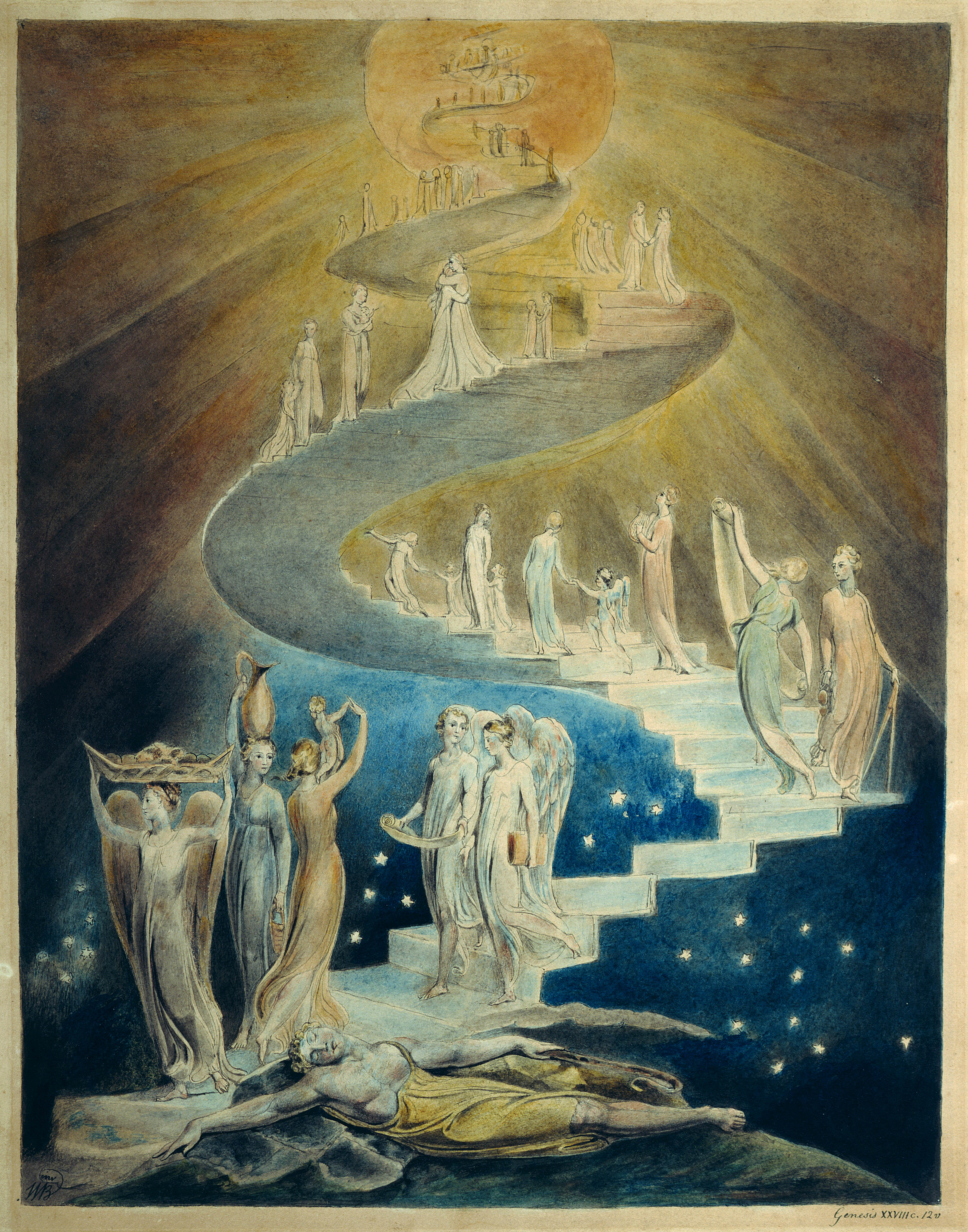
Wikipedia Commons
Jacob's Ladder
Genesis 28:12
 Jacob's Ladder

Here is a hymn we used to sing with the Catholic Charismatics at Georgetown University which uses a similar theme and expresses some of the same sentiments: GOD AND MAN AT TABLE ARE SAT DOWN.
God And Man At Table Are Set Down
O, welcome all you noble saints of old,
As now before your very eyes unfold
The wonders all so long ago foretold.
God and man at table are sat down.

Elders, martyrs, all are falling down;
Prophets, patriarchs are gath’ring round,
What angels longed to see now we have found.
God and man at table are sat down.

Beggers, lame, and harlots also here;
Repentant publicans are drawing near;
Wayward ones come home without a fear.
God and man at table are sat down.

When at last this earth shall pass away,
When Jesus and his bride are one to stay,
The feast of love is just begun that day.
God and man at table are sat down.

(Copyright 1972, Dawn Treader Music.)


Thursday, July 19, 2018

Fox and Blake

First posted Oct 2009.

George Fox of course lived in the 17th century; Blake in the late 18th and early 19th century. But what did they have in common?

Anyone familiar with the Pendle Hill pamphlets should look at No 177: Woolman and Blake
Jerusalem, Plate 52, (E 201) 
"Those who Martyr others or who cause War are Deists, but never
can be Forgivers of Sin.  The Glory of Christianity is, To
Conquer by Forgiveness.  All the Destruction therefore, in
Christian Europe has arisen from Deism, which is Natural
Religion. 
 I saw a Monk of Charlemaine 
Arise before my sight 
  I talkd with the Grey Monk as we stood
In beams of infernal light

  Gibbon arose with a lash of steel         
And Voltaire with a wracking wheel
  The Schools in clouds of learning rolld 
Arose with War in iron & gold.

  Thou lazy Monk they sound afar          
In vain condemning glorious War           
  And in your Cell you shall ever dwell    
Rise War & bind him in his Cell.

  The blood. red ran from the Grey Monks side
His hands & feet were wounded wide
  His body bent, his arms & knees          
Like to the roots of ancient trees

  When Satan first the black bow bent
And the Moral Law from the Gospel rent
  He forgd the Law into a Sword
And spilld the blood of mercys Lord.
     
  Titus! Constantine!  Charlemaine!       
O Voltaire! Rousseau! Gibbon! Vain
  Your Grecian Mocks & Roman Sword      
Against this image of his Lord!

  For a Tear is an Intellectual thing;           
And a Sigh is the Sword of an Angel King
  And the bitter groan of a Martyrs woe     
Is an Arrow from the Almighties Bow!"
Titus! Constantine! Charlemagne Luther: what did all these men have in common? Blake cited them as names of churches (heavens), but what else did they have in common? They were all involved in war!

Many Christians consider Constantine a great hero because he legalized Christianity in the Roman Empire. Less well known is the fact that he ordained (and required) uniformity of belief among Christians. Thereafter it was the non-orthodox who were illegal, a long line of them going all the way down to Quakers and beyond. What they all had in common was insisting on a direct relationship with God, not through a priest. Blake was one of them!

Why Luther? well he supported the Protestant Princes' war against the Pope (it was called the Thirty Years War). On occasion he incited people to violence.

Blake virtually equated the state church with war; he wrote:

Songs of Experience, Songs 46, (E 26)
London
"How the Chimney-sweeper's cry
Every black'ning Church appalls;
And the hapless Soldier's sigh
Runs in blood down Palace walls".

People don't allow themselves to be oppressed en mass without resisting, to be ruled by foreigners. Oh no! In the New Age Blake looked forward to the end of war:
"Empire is no more! and now the
lion and wolf shall cease."

British Museum 
Watercolor Illustration for
Young's Night Thoughts 
Marriage of Heaven and Hell, Plate 25, (E 44)
"A Song of Liberty 
... 
Empire is no more! and now the lion & wolf shall cease.                         
                          Chorus
Let the Priests of the Raven of dawn, no longer in deadly black, with hoarse note curse the sons of joy.
Nor his accepted brethren whom, tyrant, he calls free; lay the bound or build the roof.
Nor pale religious letchery call that virginity, that wishes but acts not!
For every thing that lives is Holy"
 

Tuesday, November 26, 2013

THE JOURNEY X


British Museum
For the Sexes: Gates of Paradise
Plate 8


For the Sexes: Gates of Paradise, Plate 8, (E 263) 
"8 My Son! my Son!  


For the Sexes: Gates of Paradise, Plate 19, (E 268) 
Keys
"8 In Vain-glory hatcht & nurst 
By double Spectres Self Accurst 
My Son! my Son! thou treatest me 
But as I have instructed thee"


A young man lifts an arrow above his head pointing it toward a seated pensive man resting on a stone seat. The long haired bearded man resembles Jehovah, Job or Urizen. In the man's right hand is an object shaped something like a cane, cross, sword or stake. In spite of the arrow the boy does not appear threatening or the man fearful.


The words of the Caption and of the Key are addressed to the adolescent by the  mature man:

"My Son! my Son! thou treatest me
 But as I have instructed thee"

The boy in the image is announcing his emancipation from the father. The young man has been brought up in the conventional way to have a strong superego and a strong ego. He can now use these as weapons against the family and society in which he has been raised. But the strength of his psychic development in two areas is unbalanced. It is turned against his identity which is his true self and against his body which desires sexual expression. 

Externally the boy wants to free himself from his father, his school and his cultural milieu (including the mores which restrict sexual activity.) Internally he wants to be released from the demands of the unexamined superego and the self-righteous ego. Establishing his own identity through gaining self-knowledge and internal balance will allow him to proceed on his journey. 


Visions of Daughters of Albion, Plate 7, (E 50)
"In happy copulation; if in evening mild. wearied with work;
Sit on a bank and draw the pleasures of this free born joy.

The moment of desire! the moment of desire! The virgin
That pines for man; shall awaken her womb to enormous joys
In the secret shadows of her chamber; the youth shut up from     
The lustful joy. shall forget to generate. & create an amorous image
In the shadows of his curtains and in the folds of his silent pillow.
Are not these the places of religion? the rewards of continence?
The self enjoyings of self denial? Why dost thou seek religion?
Is it because acts are not lovely, that thou seekest solitude,   
Where the horrible darkness is impressed with reflections of desire.

Father of jealousy. be thou accursed from the earth!
Why hast thou taught my Theotormon this accursed thing?"

Jerusalem, Plate 28, (E 174)
"And Albion spoke from his secret seat and said                   

All these ornaments are crimes, they are made by the labours
Of loves: of unnatural consanguinities and friendships
Horrid to think of when enquired deeply into; and all
These hills & valleys are accursed witnesses of Sin
I therefore condense them into solid rocks, stedfast!         
A foundation and certainty and demonstrative truth:
That Man be separate from Man, & here I plant my seat."

Milton, Plate 14 [15], (E 108) 
"I in my Selfhood am that Satan: I am that Evil One!              
He is my Spectre! in my obedience to loose him from my Hells
To claim the Hells, my Furnaces, I go to Eternal Death."

Milton, Plate 38 [43], (E 139)
"Satan! my Spectre! I know my power thee to annihilate
And be a greater in thy place, & be thy Tabernacle               
A covering for thee to do thy will, till one greater comes
And smites me as I smote thee & becomes my covering.
Such are the Laws of thy false Heavns! but Laws of Eternity
Are not such: know thou: I come to Self Annihilation
Such are the Laws of Eternity that each shall mutually     
Annihilate himself for others good, as I for thee[.]"

Notebook, My Spectre, (E 477)
"Let us agree to give up Love
And root up the infernal grove                                 
Then shall we return & see
The worlds of happy Eternity

& Throughout all Eternity  
I forgive you you forgive me
As our dear Redeemer said                                   
This the Wine & this the Bread"

Genesis 4
[3] In the course of time Cain brought to the LORD an offering of the fruit of the ground,
[4] and Abel brought of the firstlings of his flock and of their fat portions. And the LORD had regard for Abel and his offering,
[5] but for Cain and his offering he had no regard. So Cain was very angry, and his countenance fell.
[6] The LORD said to Cain, "Why are you angry, and why has your countenance fallen?
[7] If you do well, will you not be accepted? And if you do not do well, sin is couching at the door; its desire is for you, but you must master it." 


Matthew 12
[46] While he was still speaking to the people, behold, his mother and his brothers stood outside, asking to speak to him.
[48] But he replied to the man who told him, "Who is my mother, and who are my brothers?"
[49] And stretching out his hand toward his disciples, he said, "Here are my mother and my brothers!
[50] For whoever does the will of my Father in heaven is my brother, and sister, and mother."

Monday, February 11, 2013

MEMORABLE LINES

There are as many ways to study Blake as there are to study any complex subject. To start a study of any subject an entry point must be found through something that is familiar and relatively simple. Many  people find that Songs of Innocence & Experience offers an introduction which stimulates their interest. Another point of entry may be to become  familiar with some of Blake's succinct and striking statements which represent the thought he develops and expands throughout his lifetime.

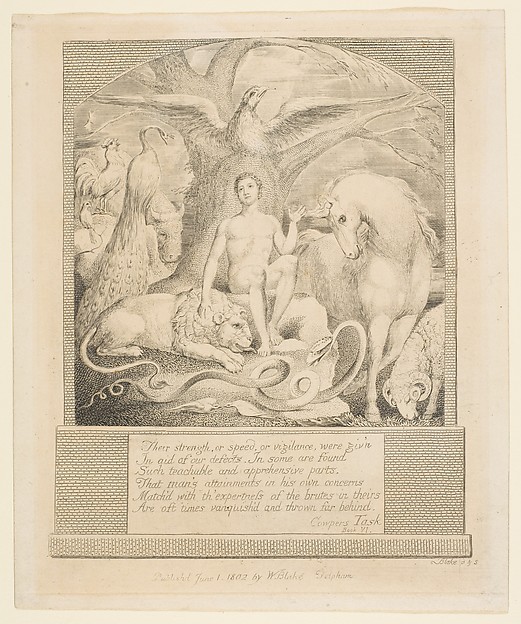
Metropolitan Museum of Art
www.metmuseum.org
Adam and the Beasts, Illustration from Hayley's Ballads

Words and ideas may gradually  become familiar and find a lodging place in our minds. Then they may  begin their work of altering the ingrained habits of thought that prevent us from creating that new heaven of imagination which Blake so longed for and so worked for.  
Memorable Lines 
1.
"He who would see the Divinity must see him in his Children
One first, in friendship & love; then a Divine Family, & in the midst
Jesus will appear; so he who wishes to see a Vision; a perfect Whole        
Must see it in its Minute Particulars"

2.
"Friendship cannot exist without Forgiveness of Sins continually"

3.
"A Last Judgment is not for the purpose of making Bad
Men better but for the Purpose of hindering them from opressing
the Good with Poverty & Pain by means of Such Vile Arguments &
Insinuations"

4.
"What are all the Gifts of the
Spirit but Mental Gifts whenever any Individual Rejects Error &
Embraces Truth a Last Judgment passes upon that Individual" 

5.
"Error is
Created Truth is Eternal Error or Creation will be Burned Up &
then & not till then Truth or Eternity will appear It is Burnt up
the Moment Men cease to behold it"  

6.
"I care not whether a Man is Good or Evil; all that I care
Is whether he is a Wise Man or a Fool. Go! put off Holiness    
And put on Intellect:"

7.
"Holiness is not The Price of Enterance into Heaven Those
who are cast out Are All Those who having no Passions of their
own because No Intellect.  Have spent their lives in Curbing &
Governing other Peoples by the Various arts of Poverty & Cruelty
of all kinds" 

8.
"All Life consists of these Two Throwing off Error continually
& recieving Truth Continually."

9.
"Man has no Body distinct from his Soul for that calld Body is
a portion of Soul discernd by the five Senses. the chief inlets
of Soul in this age"

10.
"These the Visions of Eternity 
But we see only as it were the hem of their garments
When with our vegetable eyes we view these wond'rous Visions"

11.
"For God himself enters Death's Door always with those that enter 
And lays down in the Grave with them, in Visions of Eternity
Till they awake & see Jesus & the Linen Clothes lying
That the Females had Woven for them, & the Gates of their Fathers House"

12.
"I pretend not to holiness! yet I pretend to love,
to see, to converse with daily, as man with man, & the more to
have an interest in the Friend of Sinners." 

Saturday, August 13, 2011

BLAKE'S BARD

Blake's Watercolours 
for the Poems of Thomas Gray 
Design Number 65
The Bard. a Pindaric Ode
Blake's Introduction to Songs of Experience invites us to attend to the voice of the Bard who announces the prospect of the dawning of a new day. 


Songs of Experience, Song 30, (E 17)
"Introduction.
Hear the voice of the Bard!
Who Present, Past, & Future sees
Whose ears have heard,
The Holy Word,
That walk'd among the ancient trees.

Calling the lapsed Soul
And weeping in the evening dew:
That might controll,
The starry pole;
And fallen fallen light renew!

O Earth O Earth return!
Arise from out the dewy grass;
Night is worn,
And the morn
Rises from the slumberous mass,

Turn away no more:
Why wilt thou turn away
The starry floor
The watry shore
Is giv'n thee till the break of day."

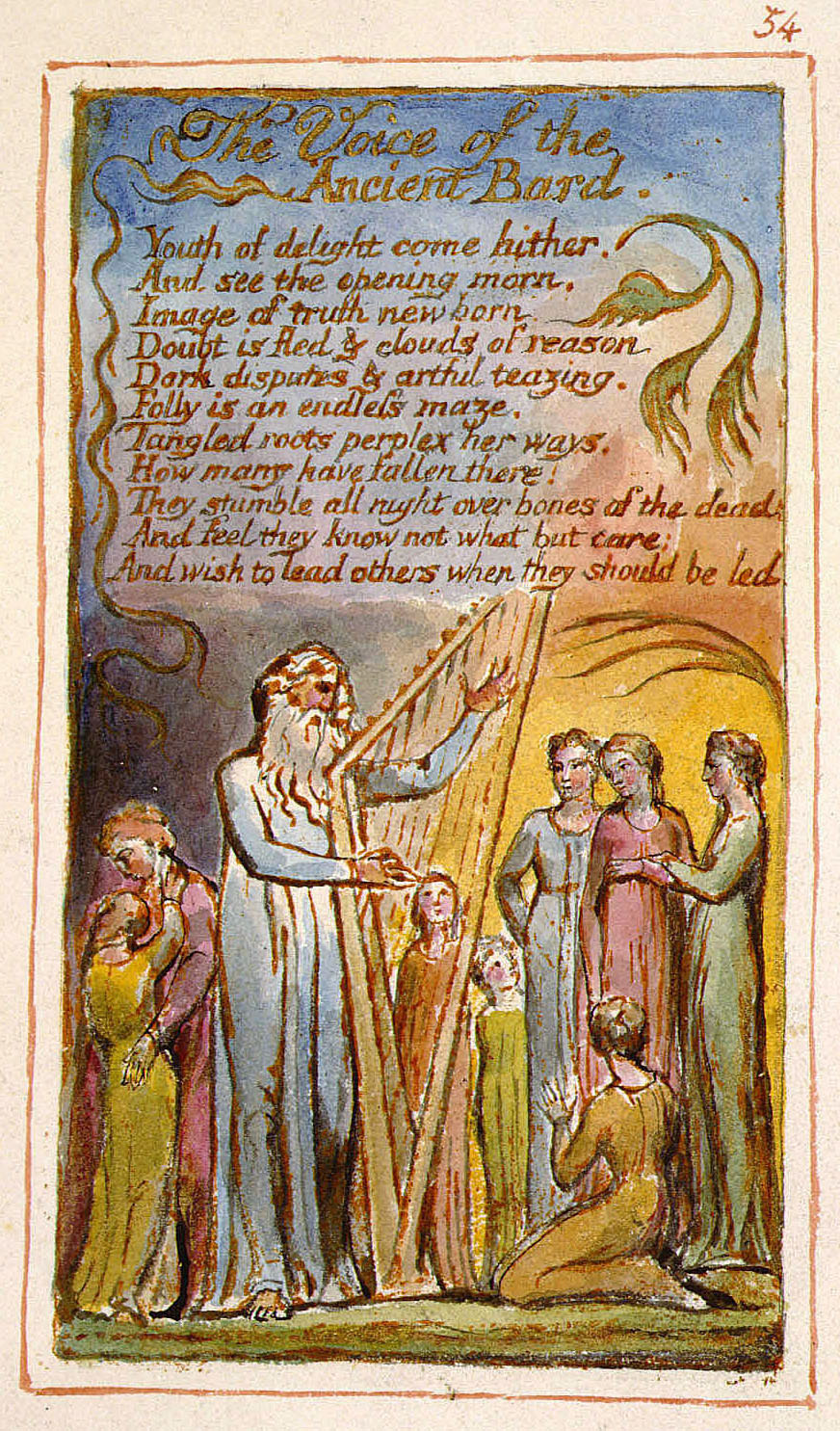
In the Voice of the Ancient Bard, the opening morn as an image of truth is offered by the Ancient Bard to the youth, but with a warning of the maze of darkness left by previous generations of misguided teachers.

Songs of Experience , Song 54, (E 31)
"The Voice of the Ancient Bard.

Youth of delight come hither:
And see the opening morn,
Image of truth new born.
Doubt is fled & clouds of reason.
Dark disputes & artful teazing.
Folly is an endless maze,
Tangled roots perplex her ways,

How many have fallen there!
They stumble all night over bones of the dead,
And feel they know not what but care
And wish to lead others, when they should be led."

The Bard in America takes on an even darker aspect as he speaks of the terrors of Eternal Death which he says have been long foretold.

America, Plate 2, (E 51)

"Silent as despairing love, and strong as jealousy,
The hairy shoulders rend the links, free are the wrists of fire;
Round the terrific loins he siez'd the panting struggling womb;
It joy'd: she put aside her clouds & smiled her first-born smile;
As when a black cloud shews its lightnings to the silent deep.

Soon as she saw the terrible boy then burst the virgin cry.

I know thee, I have found thee, & I will not let thee go;
Thou art the image of God who dwells in darkness of Africa;
And thou art fall'n to give me life in regions of dark death.
On my American plains I feel the struggling afflictions
Endur'd by roots that writhe their arms into the nether deep:
I see a serpent in Canada, who courts me to his love;
In Mexico an Eagle, and a Lion in Peru;
I see a Whale in the South-sea, drinking my soul away.
O what limb rending pains I feel. thy fire & my frost
Mingle in howling pains, in furrows by thy lightnings rent;
This is eternal death; and this the torment long foretold."

Lines which were removed in some copies of America record an enraged Bard ashamed of his own song. The Bard himself destroys his instrument and turns away to lament the vision about which he has sung.

"[ The stern Bard ceas'd, asham'd of his own song; enrag'd he swung
His harp aloft sounding, then dash'd its shining frame against
A ruin'd pillar in glittring fragments; silent he turn'd away,
And wander'd down the vales of Kent in sick & drear lamentings.]"

Blake's Bard bears a closer resemblance to the Old Testament prophets than to a medieval bard who sang the praises of his patron. The Bard fits the description of the visionary as proclaimed by Northrop Frye in Fearful Symmetry: "the business of the visionary [is] to proclaim the Word of God to a society under the domination of Satan; and ... the visionary's social position is typically that of an isolated voice crying in the wilderness against the injustice and hypocrisy of the society from which he sprung." (Page 336)

Tuesday, May 11, 2010

Gates of Paradise Picture 11

The title here is Aged Ignorance and what Digby called the couplet(?) was 
" In Aged Ignorance profound,
Holy and cold, I clipp'd the wings
Of all sublunary things,":

pdimagearchive
Gates of Paradise
Plate 11
Aged Ignorance! What a piquant and meaningful name for so many things; it immediately calls to mind a white haired old codger sitting on a bench outside the country store spitting tobacco juice and pooh-pooh-ing anything new that anyone has been foolish enough to mention. (Not that country stores have a corner on aged ignorance; actually it's endemic; let everyone survey his own mind critically.)

Digby says on page 43): "This refers to the tendency to try to explain everything in life by the known." How about the man in the middle of the 19th century who lamented because he felt that everything possible had already been invented.

Wieman referred to it as the created good, at the expense of the creative event. There are many ways to express this fundamental truth of the human psyche; one of them is conservative vs liberal (generic, not necessarily political).

With those three lines and small image Blake can make us aware of this fundamental truth of the human psyche. We live in Plato's Cave, with "chains of the mind locked up", unable to move away from our prejudices, and only when we become aware of our deplorable condition do we have a chance to turn and look for the light. As AA can tell you, you have to hit bottom first.

In an earlier post (called Clipped) the matter was discussed in terms of the generation gap; some kids leave home at the earliest opportunity, and there may be good reasons for that decision.

Wednesday, February 17, 2010

LOSS of LIBERTY

This is one of the Blake's early poems. It was published in the conventional way in 1783 through the the patronage of a friend. As it turned out Poetical Sketches was Blake's only printed volume, all others he engraved himself. 

 Poetical Sketches (E 411) 
SONG
"How sweet I roam'd from field to field, 
And tasted all the summer's pride, 
'Till I the prince of love beheld, 
Who in the sunny beams did glide! He shew'd me lilies for my hair, 
And blushing roses for my brow; 
He led me through his gardens far, 
Where all his golden pleasures grow, 
With sweet May dews my wings were wet, 
And Phoebus fir'd my vocal rage; 
He caught me in his silken net, And shut me in his golden cage. 
He loves to sit and hear me sing, 
Then, laughing, sports and plays with me; 
Then stretches out my golden wing, 
And mocks my loss of liberty." 

This poem is said to have been written before Blake was 14 years old. So it may be seen as a coming-of-age poem. It contains metaphors Blake will depend on throughout his career: 'prince of love', 'lilies,' 'roses,' 'brow,' 'gardens,' 'golden,' 'fire,' 'net,' 'wing' and 'liberty.' 

Some see the poem as referring to the restricting nature of sexual entanglements. It can be seen also as describing the experience of a young person being on the cusp between childhood and adolescence. Even for as precocious a child as Blake, there would be a transition point where the boy recognizes his own abilities and possibilities. He realizes that he can be (and will be) more that he was (or could be) as a child. He begins to see more and experience more. His emotional nature is aroused and his voice is unleashed. 

But a dilemma arises. There are forces that restrict the full expression of his gifts. He feels he is being limited and restrained. What expression is allowed to him, may be a source of amusement to those who are unable to appreciate his unconventional abilities. The liberty which the young person thought he had found is soon circumscribed in the same old ways or in new ways entirely. 

Often in his writing Blake returns to this topic of the youthful impetus for freedom, self-expression and change being met with the forces of tribalism, conservatism and the mores of convention. You may have noticed that we have touched on it in several other posts. But if you follow the thread of this youthful, energetic character as it is developed, and evolves throughout Blake's work, I think you will find his name is Los. 

 Youthful Impetus for Freedom  

If you click on the label Future age, you will find other posts where Blake treats the way things have been, and the way things may be.


Sunday, December 20, 2009

BEYOND EXPERIENCE

In later copies of Songs of Innocence and of Experience, the last three poems are TO TIRZAH, THE SCHOOL BOY, and THE VOICE OF THE ANCIENT BARD. In his The Illuminated Blake, Erdman postulates that, this "arrangement of the concluding plates impl[ies] an apocalyptic metamorphosis at the end of the series of emblems, beyond Innocence and Experience." Erdman suggests "that the Eternal Man 'has risen' out of the realm of' 'Contrary States.' 

TO TIRZAH picture
Songs of Innocence & of Experience, Plate 49, (E 30)
  "To Tirzah  

Whate'er is Born of Mortal Birth, 
Must be consumed with the Earth 
To rise from Generation free; 
Then what have I to do with thee? 
The Sexes sprung from Shame & Pride 
Blow'd in the morn: in evening died 
But Mercy changd Death into Sleep; 
The Sexes rose to work & weep. 
Thou Mother of my Mortal part. 
With cruelty didst mould my Heart. 
And with false self-decieving tears, 
Didst bind my Nostrils Eyes & Ears. 
Didst close my Tongue in senseless clay 
And me to Mortal Life betray: 
The Death of Jesus set me free, 
Then what have I to do with thee? 
[text on illustration: It is Raised a Spiritual Body]"

So looking at these three poems as a group, we ask why they are chosen to conclude Songs of Innocence and of Experience. TO TIRZAH represents the realization that mortal life has been a temporary substitute for the real thing in Eternity. The mortal body is to be raised a spiritual body. The picture recalls to my mind both the Good Samaritan and the Raising of Lazarus, two stories of healing and recovery.
SCHOOL BOY picture

Songs of Innocence & of Experience, Song 53, (E 31)
"The School Boy                                                 t 

I love to rise in a summer morn,
When the birds sing on every tree;
The distant huntsman winds his horn,
And the sky-lark sings with me.
O! what sweet company. 

But to go to school in a summer morn,
O! it drives all joy away;
Under a cruel eye outworn,
The little ones spend the day,
In sighing and dismay.

Ah! then at times I drooping sit,
And spend many an anxious hour.
Nor in my book can I take delight,
Nor sit in learnings bower,
Worn thro' with the dreary shower. 
 
How can the bird that is born for joy,
Sit in a cage and sing.
How can a child when fears annoy,
But droop his tender wing,
And forget his youthful spring.

O! father & mother, if buds are nip'd,
And blossoms blown away,
And if the tender plants are strip'd
Of their joy in the springing day,
By sorrow and cares dismay, 

How shall the summer arise in joy.
Or the summer fruits appear,
Or how shall we gather what griefs destroy
Or bless the mellowing year,
When the blasts of winter appear." 

The School Boy appears to be autobiographical. Young William was not forced to attend school, and his imagination benefited from the freedom he was allowed. He asks how can the adult have the resources to go beyond innocence and experience if the imagination has not been fed and nourished on the sights and sounds and simple joys of unfettered thought and play. He illustrates this by a delightful group of children playing marbles, stretching, climbing, swinging and reading. This plate was originally in Songs of Innocence; now we see it illustrating the stage beyond Experience where the contraries have been resolved through recognition, love and forgiveness. Blake himself has survived the 'blasts of winter' mentioned in the plate, and made us better for it.

The Voice of the Ancient Bard completes the series on an ambivalent note. The old man is singing and playing his song, and gathers a new generation about him, but he wears a shackle on his ankle. The faces of the children reveal anxiety as they are invited to the new morn and warned about past mistakes. Only if they can avoid being led by those who are not qualified, can they avoid repeating the cycle of despair which the previous generation followed. Blake's unstated answer to the children is that they should trust their own imaginations to provide them with the thread that connects them to the infinite.

So perhaps as a group the three poems are meant to be an invitation to go beyond Experience into Blake's favorite place, the world of Imagination and Vision.

BARD picture


Songs of Innocence & of Experience, Song 54, (E 31)
"The Voice of the Ancient Bard

Youth of delight! come hither
And see the opening morn,
Image of Truth new-born.
Doubt is fled, and clouds of reason,
Dark disputes and artful teazing.
Folly is an endless maze;
Tangled roots perplex her ways;
How many have fallen there!
They stumble all night over bones of the dead;
And feel—they know not what but care;
And wish to lead others, when they should be led."

Wednesday, December 09, 2009

Jerusalem

The Bible story reports that Joseph of Arimathea lent his tomb for the burial of the crucified Jesus.

Legend suggests that Joseph of Arimathea, was the Lord's uncle (maternal no doubt), that he owned tin mines in Cornwall (England), and that Jesus may have accompanied him in a trip to Britain as a youngster. From that the legend grew.

Blake of course was familiar with both stories (the biblical one and the legendary one), and they led to the famous poem and hymn called Jerusalem that appears in the Preface of Milton. Here are the tune and words:

And did those feet in ancient time,
Walk upon Englands mountains green:
And was the holy Lamb of God,
On Englands pleasant pastures seen!

And did the Countenance Divine,
Shine forth upon our clouded hills?
And was Jerusalem builded here,
Among these dark Satanic Mills?
Bring me my Bow of burning gold:

Bring me my Arrows of desire:
Bring me my Spear: O clouds unfold!
Bring me my Chariot of fire!
I will not cease from Mental Fight,
Nor shall my sword sleep in my hand:
Till we have built Jerusalem,
In Englands green & pleasant Land.

(Would to God that all the Lords people were Prophets.) Numbers XI. ch 29 v.
This hymn became immensely popular and bid fair
to replace God Save the King (at least in some circles.)

Sunday, November 22, 2009

Clipped

It's doubtful that Blake had much experience as a father, but he had serious misgivings about "the Heavenly Father:

See the picture.

Aged Ignorance! what might that be:

Jehovah, who came with a thump on the head!

Father, who whips (stunts) the growing sprout, for
whatever reason, basically for not obeying a convention,

School! which systematically molds (or tries to mold) the pupil into obedience.

Blake (so far as we know) was never a biological father; perhaps he understood that no (or at least few) adequately raise a son without (at least some) clipping.

The clipped son becomes a father; he may swear he'll
never do to his sons what his father did to him; but he
does.

And so it goes: inadequate fathers, inadequate schools, inadequate conventions, inadequate lives for the multitude--raised without creativity.

The dutiful multitude are the Redeemed; the rulers:
schoolmasters, judges, senators, are the Elect. A few
who escaped the clipping (or at least were clipped less) may hear the call to prophesy. They are the Reprobate:

From Milton: plate 7:
"The Elect from before the foundation of the World:
The second, The Redeem'd. The Third. The Reprobate & Form'd
To destruction from the mothers womb: follow with me my plow.
Of the first class was Satan: with incomparable mildness;
His primitive tyrannical attempts on Los: with most endearing love
He soft intreated Los to give to him......"

Aged Ignorance is really a very searching critique of society. We all could do better. Urizen was terrified of futurity. Thank God for the Saviour who brought to us forgiveness.

Read again the Intro to the chapter in Jerusalem To the Christians: Plate 77 (E231)
"We are told to abstain from fleshly desires that we may lose no
time from the Work of the Lord. Every moment lost, is a moment
that cannot be redeemed every pleasure that intermingles with
the duty of our station is a folly unredeemable & is planted
like the seed of a wild flower among our wheat. All the
tortures of repentance. are tortures of self-reproach on account
of our leaving the Divine Harvest to the Enemy, the struggles of
intanglement with incoherent roots. I know of no other
Christianity and of no other Gospel than the liberty both of
body & mind to exercise the Divine Arts of Imagination.
Imagination the real & eternal World of which this Vegetable
Universe is but a faint shadow & in which we shall live in our
Eternal or Imaginative Bodies, when these Vegetable Mortal
Bodies are no more."

Saturday, September 05, 2009

FEAST OF THE ETERNALS

First posted September 2009 
At the conclusion of 4Zs, Blake created this beautiful poetic image of Tharmas and Urthona, body and spirit, Man and God, as they depart the Golden feast. Divisions have been reconciled, unity has been achieved, a new age has begun, rejoicing is underway.

Four Zoas: Night the Ninth, pg 137, (E 405)

"Then Tharmas & Urthona rose from the Golden feast satiated
With Mirth & joy Urthona limping from his fall on Tharmas leand
In his right hand his hammer Tharmas held his Shepherds crook
Beset with gold gold were the ornaments formed by the sons of Urizen
Then Enion & Ahania & Vala & the wife of Dark Urthona
Rose from the feast in joy ascending to their Golden Looms
There the wingd shuttle Sang the spindle & the distaff & the Reel
Rang sweet the praise of industry. Thro all the golden rooms
Heaven rang with winged Exultation All beneath howld loud
With tenfold rout & desolation roard the Chasms beneath
Where the wide woof flowd down & where the Nations are gatherd together"

Since I haven't been able to find an image that represents the Feast of the Eternals, I'll substitute another scene of rejoycing, connecting the lower and higher levels. Note the bread, the wine, the scroll, the compass,the lyre and other of Blake's symbols. 
Wikipedia Commons
Jacob's Ladder
Genesis 28:12
 Jacob's Ladder

Here is a hymn we used to sing with the Catholic Charismatics at Georgetown University which uses a similar theme and expresses some of the same sentiments: GOD AND MAN AT TABLE ARE SAT DOWN.
God And Man At Table Are Set Down
O, welcome all you noble saints of old,
As now before your very eyes unfold
The wonders all so long ago foretold.
God and man at table are sat down.

Elders, martyrs, all are falling down;
Prophets, patriarchs are gath’ring round,
What angels longed to see now we have found.
God and man at table are sat down.

Beggers, lame, and harlots also here;
Repentant publicans are drawing near;
Wayward ones come home without a fear.
God and man at table are sat down.

When at last this earth shall pass away,
When Jesus and his bride are one to stay,
The feast of love is just begun that day.
God and man at table are sat down.

(Copyright 1972, Dawn Treader Music.)


Wednesday, September 02, 2009

SPIRITUAL DESCENDENTS

Apparently Blake eventually realized that he had been
blessed and singled out to give what he had received,
not to to the small circle of folks around him, but
to the generations which would follow. The furious
effort that he put into his work in spite of the
slight affirmation he received, indicates to me that
he believed that his influence could penetrate
history as psychological development caught up with
him. He could look back at Homer, Jesus and Paul
(among others), who produced not for their
contemporaries but for their spiritual descendants,
and seek to be among them.
__________________________________________
Of this frontispiece for JERUSALEM, Erdman says: "We may suppose that Los in his London human form as William Blake, is entering a dark place with his illumination, as Jesus enters Hell with his key; that he is leading us toward a scene of action; that his arresting hand invites our attention; that he is preparing to give himself, as Milton on the title page of Milton." Los Entering The Grave


Thursday, August 27, 2009

Children of the Future Age

In Blake there are no simple answers and no single
answers. In his Introduction to A BLAKE DICTIONARY,
Damon says:

"Blake was not content only to record: he wanted to
force his reader to think along with him. No great work
of art has its meaning on the surface, ... He was
determined not to have his own meanings sidetracked
by surface meanings. So he removed surface meanings."

We struggle to figure out what Blake meant as he wrote
it, what his imaginative insights mean to us, what they
mean to others, what they would mean if applied to the
psyche or the society.

The poem to which this quote is prefaced:
Link to Blake Archive with multiple copies
Link to Plate and Text

"Children of the future age
reading this indignant page
know that now in former time
love, sweet love
was thought a crime."

This brings to my mind how our children will see and
experience the world differently from the way we do.
Our indignation is different from theirs. Love, sex,
and criminality play different roles in society in
different ages.
Blake is interested in a New Age where the reasoning
power will not dominate the imagination, where many
values will be inverted, where forgiveness will replace
wrath. But he didn't give us a map to guide us into the
world to come, just a myth.

Wednesday, October 18, 2006

Shrinking the Gap

Ezekiel talked to Blake about "the desire of raising other men to the perception of the Infinite" (MHH).

Here's a modern equivalent of Blake's famous conversation in the last place you might expect it:

The Gap stands for the relatively uncivilized (uh unglobalized) part of the world, with about 1/3 of the world's population. Or you might call it the global equivalent of America's Wild West, where the law comes out of the mouth of a six shooter. Half the time a brutal, barbaric terrorizing dictator makes the law, while the terrorized population struggle to get enough food to live.

20 years ago 2/3 of the world's population lived like that, but since 1980 only half of the 40% living on a dollar or less a day still do. It's called globalization.

I know it has worked a hardship on all the auto workers and such like who watched their jobs exported to South Korea or China or such places, but it has dropped the starvation in those places radically. So whether it's good or bad depends on whether America is all that matters to you or you have a more cosmopolitan outlook; maybe whether you're an "American Christian" or a plain Christian.

These insights came from a military analyst named Thomas P.M.Barnett, a man whose writings would cause the average good Quaker to avert his eyes. BUT-

Strangely enough near the end of his second famous book, called Blueprint for Action he reports a wealth of email from clergymen. (Once again we have to discriminate between "American Christian clergymen" and plain Christian clergymen.)

Barnett believes the Gap must be shrunk, and often through military intervention, after which investment and general "connectivity" begins to flow in, and with it law, and commerce, and wealth (for the gap and for those who invest in it). I might try exhaustively to explain the proposals he outlines in The Pentagon's New Map and Blueprint for Action, but I could do no better than to quote at length two paragraphs on page 270 of the second:

"Globalization will rule this planet or it will be ruled in pieces by forces far less beneficent than free markets and collective security schemes. We cannot turn off this hughly powerful process of global integration without triggering its opposite force-- disintegration. Such a decision to withdraw from the world would send it into a fracturing spiral of unprecedented magnitude precisely because the Leviathan's (American military's) departure from the global security system would create a power vacuum that other core pillars would feel compelled to fill with their own competing military activities. Globalization could easily split into a plethora of antagonistic blocs, replicating the [political] dynamics of the first half of the 20th century. Make no mistake-- the burden of picking up those pieces- yet again- would not somehow be magically outsourced to the rest of the world, but to our children and grandchildren....

"Americans need to see the world for the ties that bind the nations and economies together, and not simply fixate on the vertical borders that give the illusion that the pain and suffering of the gap can always be kept distant from our shores. [This is to help] citizens understand that connectivity is my main goal because an informed citizenry will ... demand ... better strategic global leadership from Washington and better understand the long term scope of this effort to shrink the gap."

I understand that he's saying in essence this is the only way to "win the war against terrorism". Although I don't totally agree with Mr. Barnett, I'm impressed with the fact that he (only, as far as I know) has provided a scenario for the future more hopeful than the prospect of continuous military activity to guard ourselves against what has been called the "axis of evil".

Many readers of this post may wonder what all this has to do with the quote from Blake. I may be just foolish enough to see a correspondence between Ezekiel's Infinite and Barnett's Connectivity. And I may be just foolish enough to think that Barnett's slant on peace may be more creative than that of droves of "knee jerk peace lovers".