Showing posts with label Jung. Show all posts

Saturday, August 01, 2026

ZOAS AS ARCHETYPES

First posted May 2011

Blake uses the Zoas as a means of presenting the aspects of the psyche which he sees internally and recognizes as the structure of the human mind. Early in Blake's life he recognized that there were internal divisions within himself. Reason, desire, imagination and sensation each tried to claim the uppermost position in the allocation of his time and resources. Blake personified these abstractions as the 'Four Mighty Ones in Every Man.'

The beginning of the Four Zoas brings to our attention the four mighty ones who do battle:

Four Zoas, Night I, Page 3, (E 300)
"The Song of the Aged Mother which shook the heavens with wrath
Hearing the march of long resounding strong heroic Verse
Marshalld in order for the day of Intellectual Battle

Four Mighty Ones are in every Man;"

Later Blake identifies the Four Zoas and their positions in the Eternal World.

Four Zoas, Night VII, Page 74, (E 351)
"But in Eternal times the Seat of Urizen is in the South
Urthona in the North Luvah in East Tharmas in West"

Laurens van der Post, in Jung and the Story of Our Time, speaking of Jung's observation that the conflict between the conscious and unconscious forces in the mind led to mental illness notes that :

"The trouble started only when the part of the human personality which was conscious behaved as if it were the whole of the man. There was nothing this unconscious world abhorred more than one-sidedness. When one extreme of spirit attempted a monopoly for itself another extreme sooner of later rose titanic in the unconscious to overthrow it. That is why the history of man was so much a swing from one opposite of spirit into another as Heraclitus had observed millenniums before." (Page 209)

The trouble starts in Blake's myth when the positions of the Zoas are altered by the deal between Urizen and Luvah. The harmonious balance is ruined.

Milton, PLATE 19 [21], (E 112)
"Four Universes round the Mundane Egg remain Chaotic
One to the North, named Urthona: One to the South, named Urizen:
One to the East, named Luvah: One to the West, named Tharmas
They are the Four Zoa's that stood around the Throne Divine!
But when Luvah assum'd the World of Urizen to the South:
And Albion was slain upon his mountains, & in his tent;
All fell towards the Center in dire ruin, sinking down.
And in the South remains a burning fire; in the East a void.
In the West, a world of raging waters; in the North a solid,
Unfathomable! without end. But in the midst of these,
Is built eternally the Universe of Los and Enitharmon:
Towards which Milton went, but Urizen oppos'd his path."

Van der Post writes of the collective unconscious and archetypes of Jung as the patterns of the mind which organize its form and put to use the psyche's energy.

"He [Jung] revealed how in this collective unconscious of the individual man were infinite resources of energy, organized in definite patterns. Each of these patterns had at its disposal its own form of energy and somewhere located, as it were, in the center, between the unconscious and the conscious, there was a master pattern to which all the others subscribed and all their other energies could be joined in one transcendental orbit. He called these patterns, first of all, 'primordial images,' ... but later changed to 'archetypes,' an idea rediscovered from Saint Augustine, and before him from Hermes Trimegistus, who proclaimed in the Poimandres, 'You have seen in your mind the archetypal image!'" (Page 209)

In Jerusalem we learn the Zoas have lost their original abilities and exemplify the opposite characteristics:

Jerusalem, Plate 38, (E184)
"They [the Four Zoas] saw their Wheels rising up poisonous against Albion
Urizen, cold & scientific: Luvah, pitying & weeping
Tharmas, indolent & sullen: Urthona, doubting & despairing
Victims to one another & dreadfully plotting against each other
To prevent Albion walking about in the Four Complexions."

Jerusalem, Plate 49, (E 199)
"Because the Evil is Created into a State. that Men
May be deliverd time after time evermore. Amen.
Learn therefore O Sisters to distinguish the Eternal Human
That walks about among the stones of fire in bliss & woe
Alternate! from those States or Worlds in which the Spirit travels:
This is the only means to Forgiveness of Enemies"


Blake and Jung both sought consciousness of the internal dynamics of the psyche, awareness of the forces seeking expression or dominance, and recognition of 'the Eternal Human That walks about among the stones of fire in bliss & woe.'


Frontispiece to Bürger's "Leonora" (London, 1796)
Designed by Blake, Engraved by Perry


Van der Post explains Jung's concept of wholeness:

"Wholeness was the ultimate of man's conscious and unconscious seeking; indeed consciousness was so important because it was the chosen instrument of the unconscious seeking the abolition of partialities in a harmony of differences that is wholeness." (Page 219) 


Saturday, March 14, 2026

CREATIVE FANTASY

First posted Feb 2019

Wikipedia Commons
Milton's Mysterious Dream,
Watercolor Illustration to Milton's L'Allegro and Il Penseroso

Since the unconscious is an aspect of the mind to which the conscious mind has little access, there is difficulty in discerning its content. If an individual behaves in a way which is inconsistent with the values to which he consciously ascribes, he may be under the control of unconscious forces which are unacceptable to the society in which he lives. The apostle Paul said, "For the good that I would I do not: but the evil which I would not, that I do." If a person is seeking to understand why he fails to measure up to the standards which he consciously sets for himself, he may find some answers in myth and dreams for these are ways the unconscious makes itself known to the conscious mind.

By seeking to understand what messages are conveyed to his own psyche by dreams and myth one learns to assimilate a broader range of experience which applies to him and to the world consciousness to which he belongs.

Kathleen Raine on Page 126 of Defending Ancient Springs quoted Jung as recalling 'the unending myth of death and rebirth, and of the multitudinous figures who weave in and out of this mystery': 

"Of this story no single life can realize more than a part; but beneath our individual experience is the pooled experience of our inheritance, Jung's 'collective unconscious' which discloses itself so he says, only through the medium of creative fantasy. 'It comes alive in the creative man, it reveals itself in the vision of the artist, in the inspiration of the thinker, in the inner experience of the mystic.' the mythologies of all races are its embodiment; the psychologists are newcomers in a field long known to the poets; a fact they are apt to forget.
...
Dreams resemble myths in their personification and symbolic forms and enactments; and the knowledge which myths and dreams alike mediate and embody is not conceptual knowledge; in symbols the soul can speak, but not the discursive reason. Explanations come afterwards and are far less fundamental; one has only to think of the countless expositions given some myth, which always survives these attempts to throw light upon its mystery. But the sign of the initiate of the ancient Mysteries was the finger laid upon the lips, the sign of silence. The Mysteries cannot be divulged because they elude verbal formulation."


Songs of Innocence and of Experience, Song 41, (E 24)
"The Angel  

I Dreamt a Dream! what can it mean?
And that I was a maiden Queen:
Guarded by an Angel mild:
Witless woe, was ne'er beguil'd!

And I wept both night and day
And he wip'd my tears away
And I wept both day and night
And hid from him my hearts delight

So he took his wings and fled:
Then the morn blush'd rosy red:
I dried my tears & armed my fears,
With ten thousand shields and spears,

Soon my Angel came again;
I was arm'd, he came in vain:
For the time of youth was fled            
And grey hairs were on my head." 

Europe, Plate 9, (E 62)
"Enitharmon slept,                                                
Eighteen hundred years: Man was a Dream!
The night of Nature and their harps unstrung:
She slept in middle of her nightly song,
Eighteen hundred years, a female dream!"

Milton, Plate 15 [17], (E 109)
"As when a man dreams, he reflects not that his body sleeps,
Else he would wake; so seem'd he entering his Shadow: but
With him the Spirits of the Seven Angels of the Presence
Entering; they gave him still perceptions of his Sleeping Body;
Which now arose and walk'd with them in Eden, as an Eighth   
Image Divine tho' darken'd; and tho walking as one walks
In sleep; and the Seven comforted and supported him.

Like as a Polypus that vegetates beneath the deep!
They saw his Shadow vegetated underneath the Couch
Of death: for when he enterd into his Shadow: Himself:           
His real and immortal Self: was as appeard to those
Who dwell in immortality, as One sleeping on a couch
Of gold; and those in immortality gave forth their Emanations
Like Females of sweet beauty, to guard round him & to feed
His lips with food of Eden in his cold and dim repose!           

But to himself he seemd a wanderer lost in dreary night."

Sunday, December 28, 2025

NATIVITY ODE 6

Repost from December 2009 

Wikipedia Commons
On the Morning of Christ's Nativity
Object 6, Butts Set
The Night of Peace

Generation to Blake was a gift from God to prevent the part of Eternity that separated from the whole, from falling into nonentity. Each birth is a reenactment of that mercy which gives a new opportunity for a return to the wholeness of Eternity.

The entry of the immortal spirit into the physical world, is what the images of nativity attempt to portray. Incorporation of the spiritual in the physical is a movement that sets off a process of evolving awareness of incarnation: the unity of body and spirit.

In Blake's words, the Nativity is concerned with the 'mortal birth.' Blake's primary interest was in the birth to immortality. Blake added TO TIRZAH to Songs of Experience in later copies of Songs as his affirmation of the raising of the spiritual body. But just as 'generation is the image of regeneration', birth is the image of rebirth, and the child is the image of the new man.

Here is a passage from Jung in which consciousness itself is the child which is born daily, or moment by moment out of the inner depths.

"Consciousness does not create itself-it wells up from unknown depths. In childhood it awakens gradually, and all through life it wakes each morning out of the depths of sleep from an unconscious condition. It is like a child that is born daily out of the primordial womb of the unconscious. . . . It is not only influenced by the unconscious but continually emerges out of it in the form of numberless spontaneous ideas and sudden flashes of thought." ["The Psychology of Eastern Meditation," CW 11, par. 935.]

The consciousness that Blake tried to convey was that of being a part of the one body; and being open to a direct connection to the world which is unseen but always present: Eternity.

Songs of Innocence and Experience, Song 52 (E30)
TO TIRZAH
"Whate'er is Born of Mortal Birth,
Must be consumed with the Earth
To rise from Generation free;
Then what have I to do with thee?

The Sexes sprung from Shame & Pride
Blow'd in the morn: in evening died
But Mercy changd Death into Sleep;
The Sexes rose to work & weep.

Thou Mother of my Mortal part.
With cruelty didst mould my Heart.
And with false self-decieving tears,
Didst bind my Nostrils Eyes & Ears.

Didst close my Tongue in senseless clay
And me to Mortal Life betray:
The Death of Jesus set me free,
Then what have I to do with thee?"

[text on illustration: It is Raised a Spiritual Body]

Jerusalem, Plate 7 (E149)
"And the Religion of Generation which was meant for the destruction
Of Jerusalem, become her covering, till the time of the End.
O holy Generation! [Image] of regeneration!
O point of mutual forgiveness between Enemies!

Birthplace of the Lamb of God incomprehensible!" 

V

But peacefull was the night
Wherin the Prince of light
His raign of peace upon the earth began:
The Windes, with wonder whist,

XXVII

But see the Virgin blest,
Hath laid her Babe to rest.
Time is our tedious Song should here have ending,
Heav'ns youngest-teemed Star 
Hath fixt her polisht Car,
Her sleeping Lord with Handmaid Lamp attending.
And all about the Courtly Stable,
Bright-harnest Angels sit in order serviceable.

Smoothly the waters kist,
Whispering new joyes to the milde Ocean,
Who now hath quite forgot to rave,
While Birds of Calm sit brooding on the charmed wave.


Saturday, August 23, 2025

LIMITED & ETERNAL

British Museum
Illustrations to Young's Night Thoughts

First posted Jan 2019

Near the end of his final book, Jung reached some conclusions on the ultimate questions facing man.

From C. G. Jung's Memories, Dreams, Reflections, Page 325:
"The decisive question for man is this: Is he related to something infinite or not?
...
The more a man lays stress on false possessions, the less sensitivity he has for what is essential, the less satisfying is his life. He feels limited because he has limited aims, and the result is envy and jealousy. If we understand and feel that there is in this life a link with the infinite, desires and attitudes change.
...
Only consciousness of our narrow confinement in the self forms the link to the limitlessness of the unconscious. In such awareness we experience ourselves concurrently as limited and eternal, as both the one and the other."


Perhaps Blake would have quibbled if he had heard Jung's statement that man breaks through to awareness of the unity of the limited and the eternal, through consciousness of his constraints. But both men were struggling to reconcile the poles of a paradox. Man experiences himself as divided, as living in two worlds - the sordid world of the survival of the fittest, and the divine world of innocence where 'all things work together for good.' One which imprisons him in time and space and one which invites him to soar in his imagination.

Reconciling the opposite poles of the dilemma may have come more naturally to Blake because he spoke the language of poetry whereas Jung spoke the language of science. Blake provided us with first hand images in metaphor and pictures to facilitate the experience of reconciliation. Jung analyzed dreams and myths for the material that supported ideas and concepts which he formulated intellectually.   


All Religions are One, (E 1)
 "The Religions of all Nations are derived from
each Nations different reception of the Poetic Genius which is
every where call'd the Spirit of Prophecy."
All Religions are One, (E 1)
  As all men are alike (tho' infinitely various) So
all Religions & as all similars have one source 
  The true Man is the source he being the Poetic Genius

There is No Natural Religion, (E 2)
  The desire of Man being Infinite the possession is Infinite
& himself Infinite
     Conclusion,   If it were not for the Poetic or Prophetic
character. the Philosophic & Experimental would soon be at the
ratio of all things & stand still, unable to do other than repeat
the same dull round over again
     Application.   He who sees the Infinite in all things sees
God.  He who sees the Ratio only sees himself only.
 Therefore God becomes as we are, that we may be as he is"

Marriage of Heaven and Hell,Plate 13, (E 39)
 "I then asked Ezekiel. why he eat dung, & lay so long on his
right  & left side? he answerd. the desire of raising other men
into a  perception of the infinite" 
Marriage of Heaven and Hell, Plate 14, (E 39)
 "If the doors of perception were cleansed every thing would
appear  to man as it is: infinite.
   For man has closed himself up, till he sees all things thro'
narrow chinks of his cavern."

Marriage of Heaven and Hell, Plate 18, (E 41)
"By degrees we beheld the infinite Abyss, fiery as the smoke 
of a burning city; beneath us at an immense distance was the sun,
black but shining[;] round it were fiery tracks on which revolv'd
vast spiders, crawling after their prey; which flew or rather
swum in the infinite deep, in the most terrific shapes of animals
sprung from corruption. & the air was full of them, & seemd
composed of them; these are Devils. and are called Powers of the
air, I now asked my companion which was my eternal lot? he said,
between the black & white spiders 
  But now, from between the black & white spiders a cloud and
fire burst and rolled thro the deep blackning all beneath, so
that the nether deep grew black as a sea & rolled with a terrible
noise: beneath us was nothing now to be seen but a black tempest,
till looking east between the clouds & the waves, we saw a
cataract of blood mixed with fire and not many stones throw from
us appeard and sunk again the scaly fold of a monstrous serpent.
at last to the east, distant about three degrees appeard a fiery
crest above the waves slowly it reared like a ridge of golden
rocks till we discoverd two globes of crimson fire. from which
the sea fled away in clouds of smoke, and now we saw, it was the
head of Leviathan. his forehead was divided into streaks of green
& purple like those on a tygers forehead: soon we saw his mouth &
red gills hang just above the raging foam tinging the black deep
with beams of blood, advancing toward [PL 19] us with all the
fury of a spiritual existence.
  My friend the Angel climb'd up from his station into the mill;
I remain'd alone, & then this appearance was no more, but I found
myself sitting on a pleasant bank beside a river by moon light
hearing a harper who sung to the harp. & his theme was, The man
who never alters his opinion is like standing water, & breeds
reptiles of the mind." 

Monday, December 30, 2024

BLAKE & OLOLON

Blake Archive
Library of Congress
Milton
Plate 50

1) Ololon seeking Milton who appears in Blake's garden
Milton, Plate 37 [41], (E 137)
"The Virgin answerd. Knowest thou of Milton who descended
Driven from Eternity; him I seek! terrified at my Act
In Great Eternity which thou  knowest!  I come him to seek

So Ololon utterd in words distinct the anxious thought
Mild was the voice, but more distinct than any earthly           
That Miltons Shadow heard & condensing all his Fibres
Into a strength impregnable of majesty & beauty infinite
I saw he was the Covering Cherub & within him Satan
And Raha[b], in an outside which is fallacious! within
Beyond the outline of Identity, in the Selfhood deadly           
And he appeard the Wicker Man of Scandinavia in whom
Jerusalems children consume in flames among the Stars

Descending down into my Garden, a Human Wonder of God
Reaching from heaven to earth a Cloud & Human Form
I beheld Milton with astonishment & in him beheld            
The Monstrous Churches of Beulah, the Gods of Ulro dark
Twelve monstrous dishumanizd terrors Synagogues of Satan.
A Double Twelve & Thrice Nine: such their divisions."

2) Ololon, as a Virgin, is beheld in Blake's garden

Milton, Plate 36 [40], (E 136)

"For Ololon step'd into the Polypus within the Mundane Shell

They could not step into Vegetable Worlds without becoming
The enemies of Humanity except in a Female Form          
And as One Female, Ololon and all its mighty Hosts
Appear'd: a Virgin of twelve years nor time nor space was
To the perception of the Virgin Ololon but as the
Flash of lightning but more  quick the Virgin in my Garden
Before my Cottage stood for the Satanic Space is delusion        

For when Los joind with me he took me in his firy whirlwind
My Vegetated portion was hurried from Lambeths shades
He set me down in Felphams Vale & prepard a beautiful
Cottage for me that in three years I might write all these Visions
To display Natures cruel holiness: the deceits of Natural Religion[.]   
Walking in my Cottage Garden, sudden I beheld
The Virgin Ololon & address'd her as a Daughter of Beulah[:]

Virgin of Providence fear not to enter into my Cottage
What is thy message to thy friend: What am I now to do
Is it again to plunge into deeper affliction? behold me          
Ready to obey, but pity thou my Shadow of Delight
Enter my Cottage, comfort her, for she is sick with fatigue" 
3)  Milton's Shadow enters
Milton, Plate 37 [41], (E 137)
"The Virgin answerd. Knowest thou of Milton who descended
Driven from Eternity; him I seek! terrified at my Act
In Great Eternity which thou  knowest!  I come him to seek

So Ololon utterd in words distinct the anxious thought
Mild was the voice, but more distinct than any earthly           
That Miltons Shadow heard & condensing all his Fibres
Into a strength impregnable of majesty & beauty infinite
I saw he was the Covering Cherub & within him Satan
And Rahab, in an outside which is fallacious! within
Beyond the outline of Identity, in the Selfhood deadly           
And he appeard the Wicker Man of Scandinavia in whom
Jerusalems children consume in flames among the Stars

Descending down into my Garden, a Human Wonder of God
Reaching from heaven to earth a Cloud & Human Form
I beheld Milton with astonishment & in him beheld            
The Monstrous Churches of Beulah, the Gods of Ulro dark
Twelve monstrous dishumanizd terrors Synagogues of Satan.
A Double Twelve & Thrice Nine: such their divisions."
Milton, Plate 39 [44],(E 140)
"So Milton
Labourd in Chasms of the Mundane Shell, tho here before
My Cottage midst the Starry Seven, where the Virgin Ololon
Stood trembling in the Porch: loud Satan thunderd on the stormy Sea
Circling Albions Cliffs in which the Four-fold World resides     
Tho seen in fallacy outside: a fallacy of Satans Churches"
4) Milton hears Ololon's account, and calls for annihilation of selfhood  
Milton, Plate 40 [46], (E 141)
"Before Ololon Milton stood & percievd the Eternal Form Of that mild Vision; wondrous were their acts by me unknown Except remotely; and I heard Ololon say to Milton I see thee strive upon the Brooks of Arnon. there a dread And awful Man I see, oercoverd with the mantle of years. I behold Los & Urizen. I behold Orc & Tharmas; The Four Zoa's of Albion & thy Spirit with them striving In Self annihilation giving thy life to thy enemies Are those who contemn Religion & seek to annihilate it Become in their Femin[in]e portions the causes & promoters Of these Religions, how is this thing? this Newtonian Phantasm This Voltaire & Rousseau: this Hume & Gibbon & Bolingbroke This Natural Religion! this impossible absurdity Is Ololon the cause of this? O where shall I hide my face These tears fall for the little-ones: the Children of Jerusalem Lest they be annihilated in thy annihilation. No sooner she had spoke but Rahab Babylon appeard Eastward upon the Paved work across Europe & Asia Glorious as the midday Sun in Satans bosom glowing: A Female hidden in a Male, Religion hidden in War Namd Moral Virtue; cruel two-fold Monster shining bright A Dragon red & hidden Harlot which John in Patmos saw And all beneath the Nations innumerable of Ulro Appeard, the Seven Kingdoms of Canaan & Five Baalim Of Philistea. into Twelve divided, calld after the Names Of Israel: as they are in Eden. Mountain. River & Plain City & sandy Desart intermingled beyond mortal ken But turning toward Ololon in terrible majesty Milton Replied. Obey thou the Words of the Inspired Man All that can be annihilated must be annihilated That the Children of Jerusalem may be saved from slavery There is a Negation, & there is a Contrary The Negation must be destroyd to redeem the Contraries The Negation is the Spectre; the Reasoning Power in Man This is a false Body: an Incrustation over my Immortal Spirit; a Selfhood, which must be put off & annihilated alway To cleanse the Face of my Spirit by Self-examination."
5)  Ololon perceives her responsibility for Milton's error 

Milton, Plate 41 [48] (E 142)
"These are the destroyers of Jerusalem, these are the murderers
Of Jesus, who deny the Faith & mock at Eternal Life:
Who pretend to Poetry that they may destroy Imagination;
By imitation of Natures Images drawn from Remembrance
These are the Sexual Garments, the Abomination of Desolation
Hiding the Human lineaments as with an Ark & Curtains
Which Jesus rent: & now shall wholly purge away with Fire
Till Generation is swallowd up in Regeneration.
Then trembled the Virgin Ololon & replyd in clouds of despair

Is this our Feminine Portion the Six-fold Miltonic Female      
Terribly this Portion trembles before thee O awful Man
Altho' our Human Power can sustain the severe contentions
Of Friendship, our Sexual cannot: but flies into the Ulro.
Hence arose all our terrors in Eternity! & now remembrance
Returns upon us! are we Contraries O Milton, Thou & I            
O Immortal! how were we led to War the Wars of Death
Is this the Void Outside of Existence, which if enterd into
PLATE 42 [49]          
Becomes a Womb? & is this the Death Couch of Albion
Thou goest to Eternal Death & all must go with thee"
6) Sixfold virgin divides, flees to Milton's shadow, Ololon descends to Felpham's vale
Milton, Plate 42 [49] (E 143)             
"Becomes a Womb? & is this the Death Couch of Albion
Thou goest to Eternal Death & all must go with thee

So saying, the Virgin divided Six-fold & with a shriek
Dolorous that ran thro all Creation a Double Six-fold Wonder!
Away from Ololon she divided & fled into the depths              
Of Miltons Shadow as a Dove upon the stormy Sea.

Then as a Moony Ark Ololon descended to Felphams Vale
In clouds of blood, in streams of gore, with dreadful thunderings
Into the Fires of Intellect that rejoic'd in Felphams Vale
Around the Starry Eight: with one accord the Starry Eight became 
One Man Jesus the Saviour. wonderful! round his limbs
The Clouds of Ololon folded as a Garment dipped in blood
Written within & without in woven letters: & the Writing
Is the Divine Revelation in the Litteral expression:
A Garment of War, I heard it namd the Woof of Six Thousand Years 

And I beheld the Twenty-four Cities of Albion
Arise upon their Thrones to Judge the Nations of the Earth
And the Immortal Four in whom the Twenty-four appear Four-fold
Arose around Albions body: Jesus wept & walked forth
From Felphams Vale clothed in Clouds of blood, to enter into     
Albions Bosom, the bosom of death & the Four surrounded him
In the Column of Fire in Felphams Vale; then to their mouths the Four
Applied their Four Trumpets & them sounded to the Four winds

Terror struck in the Vale I stood at that immortal sound
My bones trembled. I fell outstretchd upon the path              
A moment, & my Soul returnd into its mortal state
To Resurrection & Judgment in the Vegetable Body
And my sweet Shadow of Delight stood trembling by my side

Immediately the Lark mounted with a loud trill from Felphams Vale
And the Wild Thyme from Wimbletons green & impurpled Hills       
And Los & Enitharmon rose over the Hills of Surrey
Their clouds roll over London with a south wind, soft Oothoon
Pants in the Vales of Lambeth weeping oer her Human Harvest
Los listens to the Cry of the Poor Man: his Cloud
Over London in volume terrific, low bended in anger.             

Rintrah & Palamabron view the Human Harvest beneath 
Their Wine-presses & Barns stand open; the Ovens are prepar'd 
The Waggons ready: terrific Lions & Tygers sport & play 
All Animals upon the Earth, are prepard in all their strength"

Milton, Plate 43 [50] (E 144)            
"To go forth to the Great Harvest & Vintage of the Nations

                                  Finis"

Milton, the poem, consists of two books. In the first the poet Milton leaves heaven to complete his unfinished work on earth. In the second book he engages with his feminine aspect who is called Ololon. Some of the pairs of words which describe the divided masculine/feminine are: spirit/matter, creator/created, inner/outer, essence/manifestation, sky/earth, active/receptive. The book Milton attempts to reconcile these contraries.

The final passages in W J T Mitchell's essay Blake's Radical Comedy, contained in the anthology Blake's Sublime Allegory, clarify the roles of Milton and Ololon in Blake's Milton.  

Pages 304-307
"The meeting of Milton and Ololon, then, is simultaneously a revelation of the archetypal errors of masculine and feminine consciousness and a redemption of those errors...But the first thing we could agree upon is that the concept surely involves the epic value of courage. Milton does not come to teach passivity or quietistic humility; that is the lesson of Satan.

...The second thing we ought to notice is that the courage required for self-annihilation is not in itself sufficient to redeem either the self or the world. Milton's act would remain within the fruitless cycle of creation and destruction which continues to trap the male imagination, even after his descent, if it were not for Ololon's response, her renewal of life to balance his descent to death.

...Milton's act of self-annihilation, which has been promised from the beginning as the central event of the poem, is never described...Milton's self-annihilation is not a particular act which he performs at the end of his descent; it is a continuous process which begins when he first sheds his robe of the promise to return to the fallen world and which continues beyond the end of the poem...

The meaning of Milton, then, is in the reverberations between the desents of Milton and Ololon. We can look at them as representing the active and passive poles of consciousness, the maker-destroyer of systems versus the principle of life and inspiration in both the maker and his system...

Blake created a system in his poems lest he be enslaved by another man's; but his real problem, it should be clear, was to design a system that would self-destruct. Milton, the character, is transformed in the course of his poem into just such a paradoxical entity, a State called 'Eternal Annihilation.' Milton, the poem, is built to embody the same paradox."


Those of you who ascribe to Carl Jung's psychology will notice that the same emphasis that Jung put on the recognition of the Anima as essential to completing the psyche, is apparent in Blake's Milton regarding Ololon's recognition. As incorporating aspects of the Anima is necessary in accomplishing the psychic development of the male, so is including Ololon's qualities indispensible to Milton.  


Wednesday, August 07, 2024

BLAKE & DREAMS 1

Illustrations to Young's Night Thoughts

Copy of image in British Museum

“The dream is the small hidden door in the deepest and most intimate sanctum of the soul, which opens to that primeval cosmic night that was soul long before there was conscious ego and will be soul far beyond what a conscious ego could ever reach.” Carl Jung

The quote is from "The Meaning of Psychology for Modern Man" (1933) an essay by Carl Jung that was published in 1933 as the second part of his series “On Psychology.”

Pictured is the threefold materialized body - moving from the feet to the head we see:

Horses - body - energies -  Tharmas
Marriage of Heaven and Hell, Plate 4, (E 34) 
"2. Energy is the only life and is from the Body and Reason is
the bound or outward circumference of Energy.
3 Energy is Eternal Delight
Hunter -  loins - passions - (daughter of) Urizen
Ahania, Plate 2, (E 84)
"6: But the strong arm that sent it, remember'd
The sounding beam; laughing it tore through
That beaten mass: keeping its direction
The cold loins of Urizen dividing.

7: Dire shriek'd his invisible Lust                           
Deep groan'd Urizen! stretching his awful hand
Ahania (so name his parted soul)
He siez'd on his mountains of jealousy.
He groand anguishd & called her Sin,
Woman - heart - emotions - Luvah 
Four Zoas, Night VII ,Page 84, (E 359)
"This thou well rememberest listen I will tell
What thou forgettest. They in us & we in them alternate Livd  
Drinking the joys of Universal Manhood. One dread morn
Listen O vision of Delight One dread morn of goary blood
The manhood was divided for the gentle passions making way   
Thro the infinite labyrinths of the heart & thro the nostrils issuing
In odorous stupefaction stood before the Eyes of Man   
A female bright."
Owl - head - mind - Urthona

Jerusalem, Plate 82, (E 240)

"then they saw the Furna[c]es opend, & in tears
Began to give their souls away in the Furna[c]es of affliction.
Los saw & was comforted at his Furnaces uttering thus his voice. 

I know I am Urthona keeper of the Gates of Heaven,
And that I can at will expatiate in the Gardens of bliss;
But pangs of love draw me down to my loins which are
Become a fountain of veiny pipes: O Albion! my brother!
Plate 83
Corruptibility appears upon thy limbs, and never more  
Can I arise and leave thy side, but labour here incessant
Till thy awaking! yet alas I shall forget Eternity!"  

We are accustomed to thinking of the material outer world as having some independent existence. This is the exterior world mediated through consciousness. But the world of dreams is an internal world coming to us from the unconscious which exists within our psyches exclusively. The images which came to Blake existed first in his mind. He brought them from his unconscious and expressed them in symbolic language when they reached his conscious mind. 

We may recieve material which resides in our unconscious through dreaming but often it never reaches our consciousness. Blake had the uncanny ability to bring into the light material which primarily resides in the collective unconscious which we know primarily through archetypes. Blake's poetry and visual images can become an avenue through which we become acquainted with material which is hidden from us in our own unconscious minds. If we believe, as Blake did, that the world of thought is the real world, we have a key to that interior world through studying Blake.

Vision of Last Judgment, (E 565)

"Mental Things are alone Real what is Calld Corporeal Nobody Knows
of its Dwelling Place <it> is in Fallacy & its Existence an
Imposture  Where is the Existence Out of Mind or Thought Where is
it but in the Mind of a Fool." 

Tuesday, January 02, 2024

WHOLENESS

 Reposted from Nov 12, 2010 

Jerusalem, PLATE 63, (E 213)
"Jehovah stood among the Druids in the Valley of Annandale
When the Four Zoas of Albion, the Four Living Creatures, the Cherubim
Of Albion tremble before the Spectre, in the starry likeness of the Plow
Of Nations. And their Names are Urizen & Luvah & Tharmas & Urthona"

Milton Percival, author of William Blake's Circle of Destiny, was capable of revealing psychological meaning in Blake's poetry and pictures. He understood that Blake was depicting internal dynamics as he presented his Four Mighty ones in the one giant body of Albion.

On page 20 we read:
"It is in his presentation of the Zoas that much of the power of Blake's myth lies. They are not the bloodless abstractions common to allegory. Blake believed in them. They are in consequence realities of the imagination, with power to terrify us as they terrified their creator. No other poet has given us so profound a sense of the helplessness of man before the primal forces of life; and no other poet, so passionate a denial of that helplessness. He fears these forces, because he sees them as demonic, with power over him; but he takes hope from the fact that these forces are in him - that they are himself. When man shall have brought them again into harmony, they will become his willing servants."

Jung touches on several of the same paradigms of psychic development as does Percival in this passage from his Psychological Commentary in Tibetan Book of the Dead, Edited by W. Y. Evans-Wentz:

"Fear of self-sacrifice lurks deep in every ego, and this fear is often only [of] the precariously controlled demand of the unconscious forces to burst out in full strength. No one who strives for selfhood (individuation) is spared this dangerous passage, for that which is feared also belongs to the wholeness of the self -- the sub-human, or supra-human world of psychic ‘dominants’ (archetypes) from which the ego originally emancipated itself with enormous effort, and then only partially, for the sake of a more or less illusory freedom. This liberation is certainly a very necessary and very heroic undertaking, but it represents nothing final: it is merely the creation of a subject, who, in order to find fulfillment, has still to be confronted by an object. This [object], at first sight, would appear to be the world, which is swelled out with projections for that very purpose. Here we seek and find our difficulties, here we seek and find our enemy, here we seek and find what is dear and precious to us; and it is comforting to know that all evil and all good is to be found out there, in the visible object, where it can be conquered, punished, destroyed, or enjoyed. But nature herself does not allow this paradisal state of innocence to continue for ever. There are, and always have been, those who cannot help but see that the world and its experiences are in the nature of a symbol, and that it really reflects something that lies hidden in the subject himself, in his own trans-subjective reality."

In the beginning of the Book of Urizen Blake expresses a recognition of the disturbance in the psyche which has given power to a force which is 'Obscure, shadowy, void, solitary.' He gladly hears the call to have the 'dark visions of torment' revealed to him.

Urizen, PLATE 2, (E 74)
"PRELUDIUM TO THE [FIRST] BOOK OF URIZEN

Of the primeval Priests assum'd power,
When Eternals spurn'd back his religion;
And gave him a place in the north,
Obscure, shadowy, void, solitary.

Eternals I hear your call gladly,
Dictate swift winged words, & fear not
To unfold your dark visions of torment."

Entering in the dark, unknown aspects of the psyche changes the occupation of the mind to the experience of emotional states which are both pleasant and painful and which appear to be outside of the mind.

Jerusalem, Plate 68, (E 222)
"Sometimes I curse & sometimes bless thy fascinating beauty
Once Man was occupied in intellectual pleasures & energies
But now my soul is harrowd with grief & fear & love & desire
And now I hate & now I love & Intellect is no more:
There is no time for any thing but the torments of love & desire
The Feminine & Masculine Shadows soft, mild & ever varying
In beauty: are Shadows now no more, but Rocks in Horeb"

To be torn asunder, to be under the control of your own wrath, to experience fury, anguish and terror - these are the 'far worse' things of which Los and Blake know. But they know too that Albion will be made whole.

Jerusalem, Plate 7, (E 150)
"Los answer'd. Altho' I know not this! I know far worse than this:
I know that Albion hath divided me, and that thou O my Spectre,
Hast just cause to be irritated: but look stedfastly upon me:
Comfort thyself in my strength the time will arrive,
When all Albions injuries shall cease, and when we shall
Embrace him tenfold bright, rising from his tomb in immortality.
They have divided themselves by Wrath. they must be united by
Pity: let us therefore take example & warning O my Spectre,
O that I could abstain from wrath! O that the Lamb
Of God would look upon me and pity me in my fury.
In anguish of regeneration! in terrors of self annihilation:
Pity must join together those whom wrath has torn in sunder,
And the Religion of Generation which was meant for the destruction
Of Jerusalem, become her covering, till the time of the End."

The reunification of Albion, the archetype of the complete (individuated) individual and of the undivided mankind, restores the connection between humanity and the 'Universal Father' in 'Infinitude.'

Jerusalem, PLATE 97, (E 256)
Jerusalem, Plate 99

"Awake! Awake Jerusalem! O lovely Emanation of Albion
Awake and overspread all Nations as in Ancient Time
For lo! the Night of Death is past and the Eternal Day
Appears upon our Hills: Awake Jerusalem, and come away

So spake the Vision of Albion & in him so spake in my hearing
The Universal Father. Then Albion stretchd his hand into Infinitude."


Wednesday, May 24, 2023

ENERGY AND ARCHETYPE 3

Yale Center for British Art
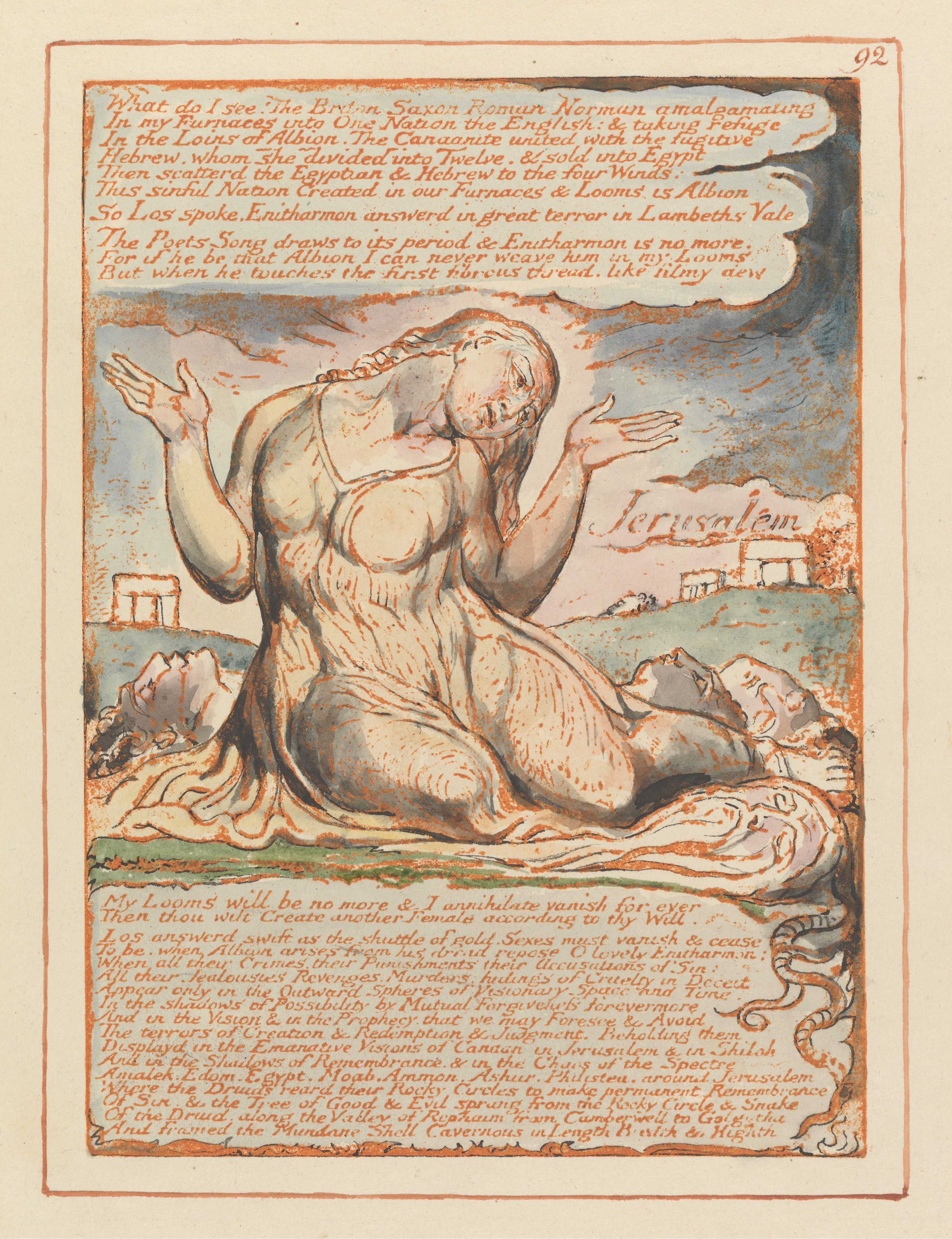
Jerusalem
Plate 92

This study of Blake's The Four Zoas is available on the internet. If you are interested in the relationship between the thought of William Blake and that of Carl Jung you may find it enlightening.


ENERGY AND ARCHETYPE: A JUNGIAN ANALYSIS OF
THE FOUR ZOAS BY WILLIAM BLAKE

by Lee T. Hamilton 

From the second section of this thesis which is a detailed analysis of the poem, read quotes from the study highlighted in blue.

Night the Seventh - Page 78

Page 80-81

The Tree along with the creation of religion in the form of
the Web of Urizen represent the conscious, intellectual
attempts of Reason to limit and control the passionate
energies of man.

Page 82

The classical
example of this conflict is God and Satan, but even they
are only the symbols of something more basic. The god
threatened by a demon of passion represents the good and
rational mind threatened by the chaotic, primitive forces
of irrationality. It is the basic conscious v. unconscious
dialectic (Jung, V, 112).

Page 90

The bursting of the Gates of Enitharmon's heart signals
the possibility of a return to Beulah by her animus, Los.
But before Los can return to Beulah and thereby redeem
Albion and the other functions, he must reintegrate, or
reconcile, his shadow and anima; that is, he must reinte-
grate the Spectre of Urthona and Enitharmon within himself.
The Spectre of Urthona tells him what he must do.

Page 94

As this second version of "Night the Seventh" closes,
Blake introduces his doctrine of Forgiveness. This is an
essential element in the redemption of Albion and the sub-
sequent return to Eden. As Los draws Urizen from the ranks
of warring elements, he feels love for him.

"Startled was Los; he found his Enemy Urizen now
"In his hands; he wondered that he felt love
& not hate.
"His whole soul loved him." (Keynes, p. 332)   

Love is the strongest force of man's being. Love and com-
passion were, to Blake, requisites for a return to man's
original state, for his return to Eden.

Night the Eighth - Page 97

As this night begins, the "Council of God," symbolized
by Jesus, meets to decide upon a course of action to redeem
Albion from his sleep of death.
 

Page 99

Los beholds the Divine Vision, the self, descend through
the broken gates of Enitharmon's heart. The vision re-
presents the knowledge of the self which inspires and sustains
them in their labors as they create bodies for the Spectres
of the dead.

Page 100

Urizen, seeing the Lamb of God, is baffled by his
incarnation. He is confused by the Lamb's apparently dual
nature; he is unable to account for the opposite values
which the Lamb seems to incorporate. On the one hand, he
sees Jesus related to the revolutionary passion of Orc; on
the other, he is aware of his close relationship to Luvah and
the emotion of Love. This is a salient characteristic of
the self; it is a coincidence of opposites (Jung, V, 368). 

Page 108

Albion is bound around by Orc, who
himself is an unconscious content. The "scaly monsters"
vomited into the deep are the contents of the unconscious.
Because they come from Orc, they represent the contents
repressed by the ego-conscious one-sidedness of Urizen.
They are the lost memories of Eden. Again, the rock upon
which Albion sleeps symbolizes the unconscious self. Aside
from being unconscious of the eternal world, Albion is also
unaware of his own potential for internal harmony and psychic
wholeness. Both images are part and parcel of the same
general malaise, that of being cut off from one's psychic
roots or of being out of touch with the unconscious. 

Night the Ninth - Page 117

Urizen's sons prepare the "Plow of ages" (Keynes, p. 365) for their father, and the sons of Urthona turn the weapons of war and engines of destruction into instruments of peace and life. Urizen begins to plow the psychic universe.

Page 118 

When the Thinking function is properly reintegrated
and reunited with its anima, he no longer represses the
other functions. Consequently, Orc consumes himself in his
own "mental flames" and is restored to his normal state in
the form of Vala and Luvah, the Feeling function. Vala and
Luvah are put into Urizen's hands by the "Regenerate Man,"
Albion. By this gesture, Blake recognizes the need for
Feeling, or emotion, to be tempered by Reason.

Page 119

The feast is a symbolic reuniting of the various aspects of
the psyche.
It is the reintegration of the four functions.
The food at the eternal feast is bread and wine, the
elements of the Eucharist. The feast therefore has the
spiritual quality of a communion, which is itself an act of
integration with God
(Jung, IX, pt. 2, 144). In this
instance, the sharing of food represents the union of Albion
with his functions. In a larger sense, it symbolizes their
union with the God-image within man, the self.

Page 123

The poem ends as Urthona rises in his renewed power
and strength.
"Urthona is arisen in his strength, no longer now
Divided from Enitharmon, no longer the Spectre Los.
Where is the Spectre of Prophecy? where the delusive Phantom?
Departed: & Urthona rises from the ruinous Walls
In all his ancient strength to form the golden armour of science
For intellectual War. The war of swords departed now,
The dark Religions are departed & sweet Science reigns."(Keynes, p. 379)

Psychic totality, individuation, has been achieved
in a reintegration of the four functions under the auspices
of Urthona, the Intuitive function.  

Hamilton notes this passage from William Blake: His Philosophy and Symbols, by S. Foster Damon, Page ix:

"Blake's thought was of the clearest and deepest;
his poetry of the subtlest and strongest; his
painting of the highest and most luminous. He
tried to solve problems which concern us all,
and his answers to them are such as to place
him among the greatest thinkers of several
centuries."