Sunday, March 10, 2019

Love

Wikipedia Commons 
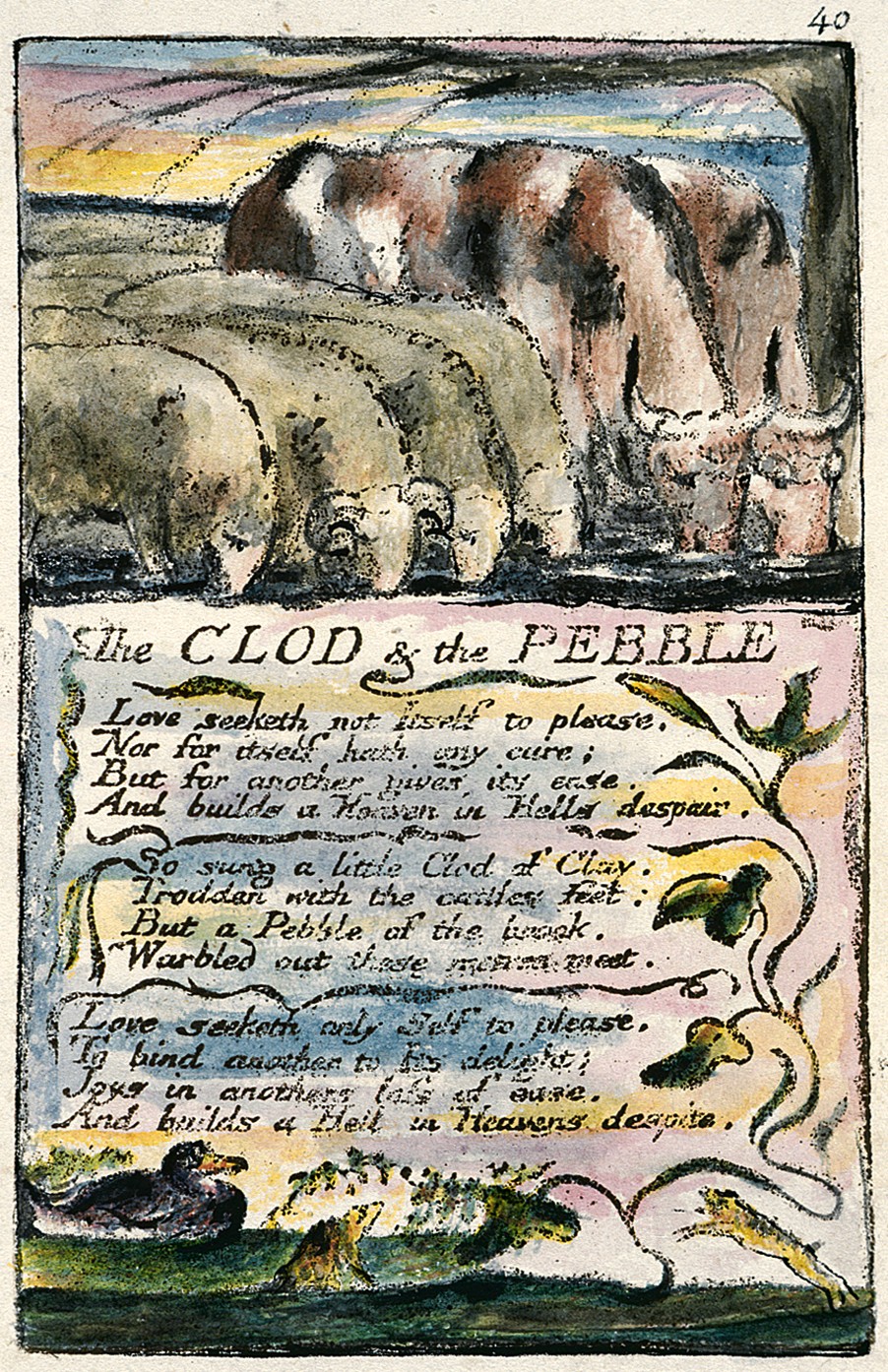
Songs of Innocence & of Experience
Plate 40, Copy L

This is an extract from Chapter Two of Ram Horn'd With Gold by Larry Clayton. 


 A very elementary lesson about love confronts the reader of "The Clod and the Pebble". It shows with stark simplicity the two kinds of love, divine and demonic.


Two kinds of love! Blake will explore the pebble's love with its infinite variety of forms before he allows us to rest again in the love of God. Blake's poem,Visions of the Daughters of Albion, (Look also at the Plates) begins with the words, "I loved Theotormon".


The heroine, Oothoon, thus describes the first significant act in a life of horror. Before the consummation of her love for Theotormon she is raped by Bromion. Then Theotormon won't have her; well named, he's tormented by God. Woman as a possession makes life hell for everyone. Here we find Blake's first full manifestation of the "torments of love and jealousy".


At the climax of this strange love song, with the irony all spent, Oothoon properly assesses conventional love and brands it, 
"self-love that envies all, a creeping skeleton With lamplike eyes watching around the frozen marriage bed." 
     Those are hot, passionate words of righteous indignation at what fallen men have made of love. Oothoon then proceeds to offer a happier form of married love: 
"But silken nets and traps of adamant will Oothoon spread, And catch for thee girls of mild silver, or of furious gold. I'll lie beside thee on a bank & view their wanton play In lovely copulation, bliss on bliss, with Theotormon"


With these extravagant images the young poet shocks his reader into an awareness of love's spectrum of value. In the ironic language of 'The Marriage of Heaven and Hell' the first, jealous love, is the love of Heaven or Restraint, and the second, the selfless love, is that of Hell or Eternal Delight. This version of values set the style for Blake's use of the word. It became in his hands a sharp sword penetrating to the core of society's ills.


The subtitle of The Four Zoas begins, "The Torments of Love & Jealousy". Violent and passionate feelings characterize the entire epic. As soon as the reader can envision 4Z as a whole, he will perceive that all these passionate feelings in all of these characters have a common destructiveness and alienating effect, until the Moment of Grace recorded in Night vii. Love, hate, fear, pride, humiliation, all are united in this common fallenness.


In Night i the primeval pair, Los and Enitharmon, set the tone for the meaning of love in this fallen world. (They all too aptly portray the emotional universe of many married couples):


"Alternate Love & Hate [filled] his breast: hers Scorn & Jealousy". 
Enitharmon believes love to be a one way street. Speaking to Los of their parents: "...if we grateful prove They will withhold sweet love, whose food is thorns & bitter roots."

And in Night ii she announces her philosophy of the relations between man and woman: "The joy of woman is the death of her most best beloved Who dies for Love of her In torments of fierce jealousy & pangs of adoration."


There you have love at its worst! This fairly represents Blake's ironic use of the word in his major work. In Blake's symbolic structure of thought love is most often a function of woman, who is a symbol of fallenness . Not until 'Jerusalem' do we meet the feminine embodiment of the Christian graces, among them love divine.


The notebook poem which begins, "My Spectre around me night and day" merits study as an approach to understanding the use of Blake's symbolism to express his deepest feelings about life. I quote the climax of it. In the first verse Blake means by 'love' very much what Paul in Romans 8 meant by 'flesh'. In the second, without using the word, he expresses in the fullest possible way what divine love meant to him: 
"Let us agree to give up Love, And root up the infernal grove;  
Then shall we return & see The worlds of happy Eternity.
& Throughout all Eternity I forgive you, you forgive me.  
As our dear Redeemer said:

This the Wine & this the Bread."

As these lines suggest, Blake had a strong sense of reticence about using the sacred words in the sacred sense, perhaps because he had so exhaustively explored their profane senses. Nevertheless in the poem "William Bond" from the Pickering Manuscript he gave an exquisite portrait of romantic love, purified of fallenness and filled with the divine. Read the last two verses: 
"I thought Love livd in the hot sun Shine                 
But O he lives in the Moony light
I thought to find Love in the heat of day
But sweet Love is the Comforter of Night

Seek Love in the Pity of others Woe
In the gentle relief of anothers care               
In the darkness of night & the winters snow
In the naked & outcast Seek Love there"

Thursday, March 07, 2019

Larry's Dream

British Museum
Illustrations to Young's Night Thoughts

On plate 12 of The Marriage of Heaven and Hell Blake relates what he calls a Memorable Fancy. The passage has proven to be memorable because it tells a story, contains significant truth and is amusing. Larry was so impressed with Blake's interaction with Isaiah and Ezekiel that he posted an account of his own experience in Heaven with William Blake.   

Marriage of Heaven & Hell, Plate 12, (E 38)
"                    A Memorable Fancy.                            
   The Prophets Isaiah and Ezekiel dined with me, and I asked
them how they dared so roundly to assert. that God spake to them; 
and  whether they did not think at the time, that they would be 
misunderstood, & so be the cause of imposition.
   Isaiah answer'd. I saw no God. nor heard any, in a finite
organical perception; but my senses discover'd the infinite in
every thing, and as  I was then perswaded. & remain confirm'd;
that the voice of honest indignation is the voice of God, I cared
not for consequences but  wrote.
   Then I asked: does a firm perswasion that a thing is so, make it so?
   He replied.  All poets believe that it does, & in ages of imagination
this firm perswasion removed mountains; but many are not capable
of a firm perswasion of any thing.
   Then Ezekiel said. The philosophy of the east taught the first 
principles of human perception     some nations held one
principle for  the origin & some another, we of Israel taught
that the Poetic Genius (as  you now call it) was the first
principle and all the others merely  derivative, which was the
cause of our despising the Priests & Philosophers  of other
countries, and prophecying that all Gods [PL 13] would at last be
proved. to originate in ours & to be the tributaries of the
Poetic  Genius, it was this. that our great poet King David
desired so fervently  & invokes so patheticly, saying by this he
conquers enemies & governs kingdoms; and we so loved our God.
that we cursed in his name all  the deities of surrounding
nations, and asserted that they had rebelled; from these opinions
the vulgar came to think that all nations would at last be
subject to the jews.
   This said he, like all firm perswasions, is come to pass, for all 
nations believe the jews code and worship the jews god, and what
greater subjection can be
   I heard this with some wonder, & must confess my own
conviction.  After dinner I ask'd Isaiah to favour the world with
his lost works, he said none of equal value was lost.  Ezekiel
said the same of his.
   I also asked Isaiah what made him go naked and barefoot three
years? he answerd, the same that made our friend Diogenes the
Grecian.
   I then asked Ezekiel. why he eat dung, & lay so long on his
right  & left side? he answerd. the desire of raising other men
into a  perception of the infinite this the North American tribes
practise. & is he honest who resists his genius or conscience.
only for the sake of present  ease or gratification?"          

Larry's post from September 23, 2010:

A Dream
Catherine Blake said her only problem with her husband was that he spent too much time in Heaven. In our dreams we may be closer to Blake's Heaven than is possible in our waking hours. Some day we may realize that where we live now is largely vaporous.

Larry's dream: The other day I had dinner with Blake, and I asked him if he had said all he had to say by 1828. He said "'pretty much', 'pretty much', especially if you've experienced all the words and pictures that I left behind."

I asked him if there was anything more he would like to tell us now from his present life. He said, "Oh yes, a great deal; but I've experienced nothing that your corporeal mind would find meaningful." he went on to say that where he now lived and what he now knew was separated from me by a great chasm, much like the one between Lazarus in Abraham's bosom and Dives.

He reminded me of Paul's experience in the Third Heaven where "He heard unspeakable words, which it is not lawful for a man to utter".


I asked Blake if he had recently come in contact with Isaiah or Ezekiel. He said that Ezekiel and he had become bosom buddies, "we laughed together over the peculiar directive that Ezekiel had received from God". He also told Ezekiel that that affair had meant a lot to him and given him a vivid awareness of the "perception of the infinite" (MHH13, E39)

Blake went on to say that in due course, at the acceptable time, he would be glad to introduce me to Ezekiel or to anyone else I desired to meet. He also arranged a tennis match for me with Kenny Rosewall.
I asked Blake how his Spectre had been most hurtful to him. He promptly replied as follows: in my Revolutionary zeal for Liberty I bad mouthed a fair number of people who seemed to be against it. I've now met these people one by one and come with them to good accord, I include Bacon, Newton, Locke, and a host of others" (It was too many for me to remember, even in that rapturous state.)

I was just about to make further requests when the alarm clock sounded, and I was aroused from my Heavenly Vision or perhaps I went back to the corporeal sleep.


Larry did not often engage in such fanciful thinking but I can remember another time when he set up an imagined situation to illustrate a point. In the old days when segregation was practiced throughout much of the United States, there was a question among some as to whether blacks and whites would associate with one another when they got to heaven. Larry's answer was that in heaven all sang together in the celestial choir under the direction of a black choirmaster. People who found it unacceptable could withdrew and find themselves a segregated corner of hell. Larry, like Blake, was not very careful about saying things that could get him into trouble.


Ezekiel 4
[4] Lie thou also upon thy left side, and lay the iniquity of the house of Israel upon it: according to the number of the days that thou shalt lie upon it thou shalt bear their iniquity.
[5] For I have laid upon thee the years of their iniquity, according to the number of the days, three hundred and ninety days: so shalt thou bear the iniquity of the house of Israel.
[6] And when thou hast accomplished them, lie again on thy right side, and thou shalt bear the iniquity of the house of Judah forty days: I have appointed thee each day for a year.
[7] Therefore thou shalt set thy face toward the siege of Jerusalem, and thine arm shall be uncovered, and thou shalt prophesy against it.
[8] And, behold, I will lay bands upon thee, and thou shalt not turn thee from one side to another, till thou hast ended the days of thy siege.
[9] Take thou also unto thee wheat, and barley, and beans, and lentiles, and millet, and fitches, and put them in one vessel, and make thee bread thereof, according to the number of the days that thou shalt lie upon thy side, three hundred and ninety days shalt thou eat thereof.
[10] And thy meat which thou shalt eat shall be by weight, twenty shekels a day: from time to time shalt thou eat it.
[11] Thou shalt drink also water by measure, the sixth part of an hin: from time to time shalt thou drink.
[12] And thou shalt eat it as barley cakes, and thou shalt bake it with dung that cometh out of man, in their sight.
[13] And the LORD said, Even thus shall the children of Israel eat their defiled bread among the Gentiles, whither I will drive them.
[14] Then said I, Ah Lord GOD! behold, my soul hath not been polluted: for from my youth up even till now have I not eaten of that which dieth of itself, or is torn in pieces; neither came there abominable flesh into my mouth.
[15] Then he said unto me, Lo, I have given thee cow's dung for man's dung, and thou shalt prepare thy bread therewith.
[16] Moreover he said unto me, Son of man, behold, I will break the staff of bread in Jerusalem: and they shall eat bread by weight, and with care; and they shall drink water by measure, and with astonishment:
[17] That they may want bread and water, and be astonied one with another, and consume away for their iniquity.

Wednesday, March 06, 2019

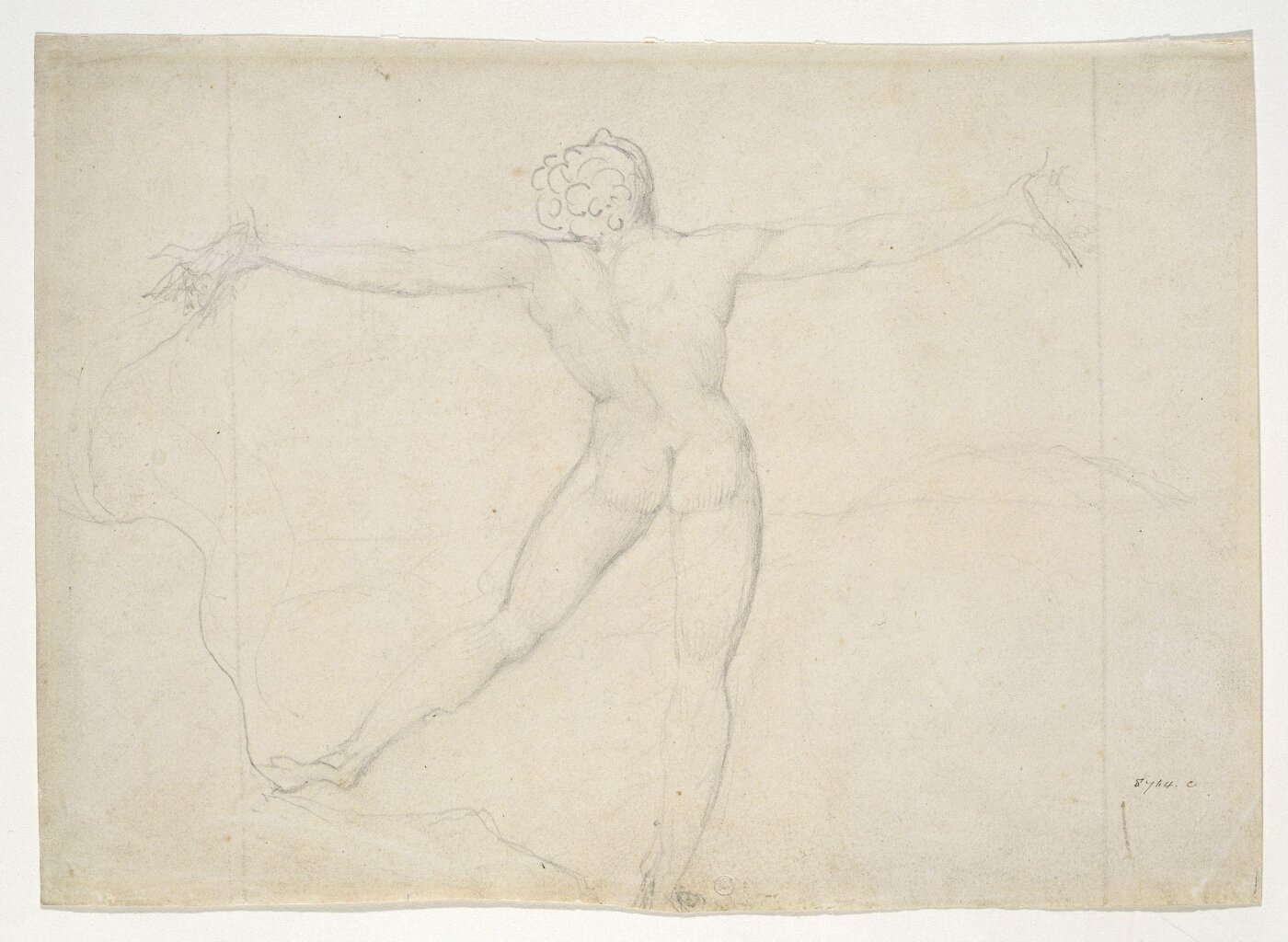
ALBION ROSE


Victoria & Albert Museum
Pencil Drawing 
ca. 1780
British Museum
Large Book of Designs
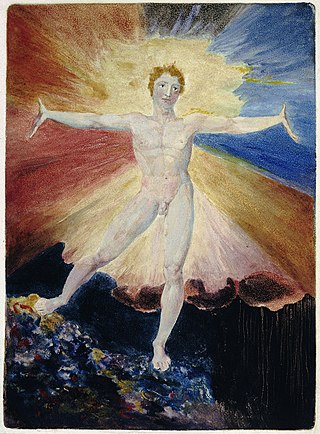
Albion Rose
Color Engraving, 1794-96

Legend: Albion rose from where he labourd at the Mill with Slaves
National Gallery
The Dance of Albion
Engraving
c. 1803/1810

Blake used Albion as a symbol for all of mankind and particularly of the people with whom he was best acquainted: the British. The body of the individual was extrapolated and superimposed onto one human body which was inclusive of all humanity. Being the image created by God in reflection of His own image, Albion was perfect and complete.

Artist as he was, Blake pictured Albion in his vitality. He invented his image as an engraving in 1780 revised it after 1803. He color printed it between 1794 and 1796.

The Tate Gallery book William Blake on page 242 includes this statement:
"The emergence of this image of British liberty as a giant form was the outcome of Blake's desire to create an Albion for his own times but also rooted in ancient mythology."

Annotations to Berkley's Siris, (E 663) 
"Harmony [&] Proportion are Qualities & Not Things The
Harmony & Proportion of a Horse are not the same with those of a
Bull Every Thing has its 
own Harmony & Proportion Two Inferior Qualities in it For its
Reality is Its Imaginative Form" 
Four Zoas, Night VII, Page 98 [90], (E 370) 
"Los drew them forth out of the deeps planting his right foot firm
Upon the Iron crag of Urizen thence springing up aloft
Into the heavens of Enitharmon in a mighty circle

And first he drew a line upon the walls of shining heaven    
And Enitharmon tincturd it with beams of blushing love
It remaind permanent a lovely form inspird divinely human
Dividing into just proportions Los unwearied labourd
The immortal lines upon the heavens till with sighs of love
Sweet Enitharmon mild Entrancd breathd forth upon the wind   
The spectrous dead Weeping the Spectres viewd the immortal works
Of Los Assimilating to those forms Embodied & Lovely
In youth & beauty in the arms of Enitharmon mild reposing"
Inscriptions, WB inv 1780, (E 671) 
     "Albion rose from where he labourd at the Mill with Slaves
     Giving himself for the Nations he danc'd the dance of Eternal Death"

Four Zoas, Night IX, Page 134, (E 402) 
"Let the slave grinding at the mill run out into the field
Let him look up into the heavens & laugh in the bright air
Let the inchaind soul shut up in darkness & in sighing           
Whose face has never seen a smile in thirty weary years
Rise & look out   his chains are loose his dungeon doors are open" 
Leonardo da Vinci's Vitruvian Man:  
  More More.
 

Friday, March 01, 2019

MY SPECTRE

British Museum
Illustrations to Young's Night Thoughts

One of the facets of self-knowledge is the realization that we have within ourselves a bundle of inconsistencies. We act out these contrary states without consciousness of their source. There is value in tracing our feelings, rationalizations or outward behaviors to the facets of ourselves which are being expressed. In so doing we inform ourselves of the dynamics of the divisions within ourselves which prevent us from measuring up to the image of ourselves we hope to attain. In The King and the Corpse, Heinrich Zimmer refers to Blake's poem My Spectre in elucidating the powers which are actively preventing (or assisting) the transformation which man is seeking.

From The King and the Corpse, Page 221:
"As William Blake has put it: 'My Spectre around me night & day.' Wherever we look we discover our own inescapable selves. Wherever we step, a portion of our unknown self steps before us significantly, mysteriously fashioned and projected. Our destiny, our environment, our enemies, our companions - we have built them all. They stalk out of the depth, essential and self-produced. That is why to an enlightened person everything encountered is a manifestation of the initiating priest, a spiritual guide able to bestow the key. The shapes of the initiating powers change, but always in accordance with out own need and guilt; they reflect the degree of our own nescience or maturity. And they prefigure the transformation required of us, the tasks we have yet to solve,"      

Songs and Ballads, My Spectre, (E 475)
"My Spectre around me night & day
Like a Wild beast guards my way
My Emanation far within               
Weeps incessantly for my Sin                                  

A Fathomless & boundless deep     
There we wander there we weep
On the hungry craving wind
My Spectre follows thee behind

He scents thy footsteps in the snow
Wheresoever thou dost go               
Thro the wintry hail & rain
When wilt thou return again

Dost thou not in Pride & scorn        
Fill with tempests all my morn 
And with jealousies & fears
Fill my pleasant nights with tears

Seven of my sweet loves thy knife
Has bereaved of their life
Their marble tombs I built with tears  
And with cold & shuddering fears   

Seven more loves weep night & day
Round the tombs where my loves lay     
And seven more loves attend each night
Around my couch with torches bright

And seven more Loves in my bed
Crown with wine my mournful head       
Pitying & forgiving all
Thy transgressions great & small

When wilt thou return & view
My loves & them to life renew     
When wilt thou return & live
When wilt thou pity as I forgive       

Never Never I return                   
Still for Victory I burn
Living thee alone Ill have                
And when dead Ill be thy Grave

Thro the Heavn & Earth & Hell
Thou shalt never never quell
I will fly & thou pursue
Night & Morn the flight renew       

Till I turn from Female Love            
And root up the Infernal Grove          
I shall never worthy be                 
To Step into Eternity

And to end thy cruel mocks             
Annihilate thee on the rocks
And another form create
To be subservient to my Fate

Let us agree to give up Love
And root up the infernal grove                                 
Then shall we return & see
The worlds of happy Eternity

& Throughout all Eternity                     
I forgive you you forgive me
As our dear Redeemer said                                   
This the Wine & this the Bread"
Blake used many symbols to reveal the process of ridding oneself from impediments to spiritual growth. In the phrase; 'Till I turn from Female Love And root up the Infernal Grove,' he is giving instruction on how to solve the problem of being entrapped by the Spectre in a mind that repeats the 'same dull round.'  That is if we turn from our devotion to the the outward enticements, and if we remove form our minds our false ideas and the ways of thinking that keep us bewildered, we will find ourselves capable of reaching a level of consciousness beyond our present ability. 

Milton, Plate 14 [15], (E 108)
"I in my Selfhood am that Satan: I am that Evil One!             
He is my Spectre! in my obedience to loose him from my Hells
To claim the Hells, my Furnaces, I go to Eternal Death." 

Jerusalem, Plate 7, (E 150)
"Such are the Generations of the Giant Albion,
To separate a Law of Sin, to punish thee in thy members.         

Los answer'd. Altho' I know not this! I know far worse than this:
I know that Albion hath divided me, and that thou O my Spectre,
Hast just cause to be irritated: but look stedfastly upon me:
Comfort thyself in my strength the time will arrive,
When all Albions injuries shall cease, and when we shall         
Embrace him tenfold bright, rising from his tomb in immortality.
They have divided themselves by Wrath. they must be united by
Pity: let us therefore take example & warning O my Spectre,
O that I could abstain from wrath! O that the Lamb
Of God would look upon me and pity me in my fury.                
In anguish of regeneration! in terrors of self annihilation:
Pity must join together those whom wrath has torn in sunder,"

Jerusalem, Plate 73, (E 173)
 "And O thou Lamb of God, whom I    
Slew in my dark self-righteous pride:
  Art thou return'd to Albions Land!
And is Jerusalem thy Bride?

  Come to my arms & never more
Depart; but dwell for ever here:         
  Create my Spirit to thy Love:
Subdue my Spectre to thy Fear,

  Spectre of Albion! warlike Fiend!
In clouds of blood & ruin roll'd:
  I here reclaim thee as my own         
My Selfhood! Satan! armd in gold."

Jerusalem, Plate 41, (E 184)
[illustration, with inscription, reversed: 
"Each Man is in his Spectre's power
Until the arrival of that hour,  
When his Humanity awake
And cast his Spectre into the Lake" 

Sunday, February 24, 2019

SEEKING OBLIVION

 Sir Thomas Malory’s Book of King Arthur and of his Noble Knights of the Round Table

Lancelot's crisis of identity:
"with the rebuke that Queen Guenever gave him I saw him swoon to the earth; and when he awoke he took his sword in his hand, naked save his shirt, and leapt out at a window with the grisliest groan that ever I heard man make."

Fruitless search to return him to Camelot:
"And then they rode from country to country, in forests, and in wilderness, and in wastes; and ever they laid watch both at forests and at all manner of men as they rode, to hearken and spere after him, as he that was a naked man, in his shirt, with a sword in his hand. And thus they rode nigh a quarter of a year, endlong and overthwart, in many places, forests and wilderness, and oft-times were evil lodged for his sake; and yet for all their labour and seeking could they never hear word of him. And wit you well these three knights were passing sorry."

He lived like a beast in the wilderness:
"speak we of Sir Launcelot that suffered and endured many sharp showers, that ever ran wild wood from place to place, and lived by fruit and such as he might get, and drank water two year; and other clothing had he but little but his shirt and his breech."
Museum of Fine Arts Boston
Large Color Printed Drawings
Nebuchadnezzar
When One encounters a dilemma for which no solution seems possible, one turns aside from the world and enters the forest of confusion and despair. Blake pictured Nebuchadnezzar in such a condition, and he wrote of Theotormon experiencing the same torment. The implication is that unless a solution to the conflicted situation is found, madness might ensue. Nebuchadnezzar and Lancelot each underwent a period of temporary withdrawal from sanity in which he shed his clothing, withdrew into the wilderness and lived as a wild animal.
Theomorton lost his bearings when he rejected Oothoon, thinking her defiled. 
Visions of Daughters of Albion, Plate 3, (E 47)
"Then Theotormon broke his silence. and he answered.

Tell me what is the night or day to one o'erflowd with woe?
Tell me what is a thought? & of what substance is it made?
Tell me what is a joy? & in what gardens do joys grow?
And in what rivers swim the sorrows? and upon what mountains
Plate 4
Wave shadows of discontent? and in what houses dwell the wretched
Drunken with woe forgotten. and shut up from cold despair.

Tell me where dwell the thoughts forgotten till thou call them forth
Tell me where dwell the joys of old! & where the ancient loves?
And when will they renew again & the night of oblivion past?"

After Enion fled, Tharmas found life to be 'endless torment.'               
Four Zoas, Night IV, Page 47, (E 331)
[Tharmas speaks:]
"How is this All my hope is gone for ever fled            
Like a famishd Eagle Eyeless raging in the vast expanse          
Incessant tears are now my food. incessant rage & tears
Deathless for ever now I wander seeking oblivion
In torrents of despair in vain. for if I plunge beneath
Stifling I live. If dashd in pieces from a rocky height
I reunite in endless torment. would I had never risen            
From deaths cold sleep beneath the bottom of the raging Ocean"   

Los' struggle was between continuing to support Albion and maintaining his own integrity. 
Jerusalem, Plate 6, (E 149)
"But still the Spectre divided, and still his pain increas'd!

In pain the Spectre divided: in pain of hunger and thirst:
To devour Los's Human Perfection, but when he saw that Los
PLATE 7
Was living: panting like a frighted wolf, and howling
He stood over the Immortal, in the solitude and darkness:
Upon the darkning Thames, across the whole Island westward.
A horrible Shadow of Death, among the Furnaces: beneath
The pillar of folding smoke; and he sought by other means,       
To lure Los: by tears, by arguments of science & by terrors:
Terrors in every Nerve, by spasms & extended pains:
While Los answer'd unterrified to the opake blackening Fiend

And thus the Spectre spoke: Wilt thou still go on to destruction?
Till thy life is all taken away by this deceitful Friendship?    
He drinks thee up like water! like wine he pours thee
Into his tuns: thy Daughters are trodden in his vintage
He makes thy Sons the trampling of his bulls, they are plow'd
And harrowd for his profit, lo! thy stolen Emanation
Is his garden of pleasure! all the Spectres of his Sons mock thee
Look how they scorn thy once admired palaces! now in ruins
Because of Albion! because of deceit and friendship!"
Paul sought deliverance because he could not measure up to the laws' demands.
Romans 7
[19] For the good that I would I do not: but the evil which I would not, that I do.
[20] Now if I do that I would not, it is no more I that do it, but sin that dwelleth in me.
[21] I find then a law, that, when I would do good, evil is present with me.
[22] For I delight in the law of God after the inward man:
[23] But I see another law in my members, warring against the law of my mind, and bringing me into captivity to the law of sin which is in my members.
[24] O wretched man that I am! who shall deliver me from the body of this death?


Thursday, February 21, 2019

FIRST VISION

British Museum
Small Book of Designs
From Marriage of Heaven and Hell
Milton Klonsky's book William Blake, The Seer and His Visions, published in 1977, approaches the study of Blake from his own unique position as do each of us. Klonsky was the product of his time and his environment and wrote with the zeal of one immersed in the dawning of a new age.

W. C. Bamberger on the blog named Zoamorphosis tells us that:

"Klonsky was a classic 'Village Intellectual' who set out to know everything interesting there was to know—about drugs, drink, poetry, politics, and most memorably, the great poet artist William Blake. And, further, to combine all this in unexpected ways, give it some topspin, and serve it back with style."

Klonsky began his book with a striking account of his 'first and only' use of LSD. Were it not for the role that Blake's poetry played in that experience it would not have had such a profound impact on Klonsky.
On page 8 of Klonsky's book he relates the consequences of his 'trip' as opening him to a new way of seeing and an alteration of his awareness of time and eternity:  

"My 'trip', I knew, would last from five to six hours...but suppose it were to take fifty years, sixty, a whole lifetime? What then? As if existence itself were a more subtly corrosive kind of acid, consuming and flaying us, almost unawares, from within and without, to whose pangs we gradually become accustomed until the end. It occurred to me then, as I lurched and plodded off the beach, that this is what Blake must have meant when he wrote: 'Time is the mercy of Eternity; without Times swiftness/Which is the swiftest of all things: all were eternal torment':
...
"Looking back now I can recall neither visions nor apparitions, disembodied genii nor spirits out of the vasty deep - unless, perhaps, that of Blake himself, whom I invoked to preside over the scene. What I saw instead ('As the Eye,' said Blake, 'such the Object') was the world as I had always conceived it to be, the only 'real' reality of matter reduced to minuter and minuter particles in a space-time expanding to infinity-eternity, no more no less,  according to the scientific dispensation of Newton & Einstein, but which I had never perceived so 'im-mediativtely' and 'into-it-ively' until then."

These are the passages from Blake which were incorporated in Klonsky's intense LSD experience:
Marriage of Heaven and Hell, Plate 14, (E 39)
 "If the doors of perception were cleansed every thing would
appear  to man as it is: infinite.
   For man has closed himself up, till he sees all things thro'
narrow chinks of his cavern."

Songs of Experience, Introduction, (E 18)
"Turn away no more:
Why wilt thou turn away
The starry floor
The watry shore
Is giv'n thee till the break of day."

Auguries of Innocence, (E 490)
"To see a World in a Grain of Sand
And a Heaven in a Wild Flower
Hold Infinity in the palm of your hand
And Eternity in an hour"

Milton, Plate 17, (E 110) 
"The Mundane Shell, is a vast Concave Earth: an immense
Hardend shadow of all things upon our Vegetated Earth
Enlarg'd into dimension & deform'd into indefinite space,
In Twenty-seven Heavens and all their Hells; with Chaos
And Ancient Night; & Purgatory. It is a cavernous Earth
Of labyrinthine intricacy,"

Milton, Plate 24 [26], (E 121)
"Time is the mercy of Eternity; without Times swiftness
Which is the swiftest of all things: all were eternal torment:"  
_________________
In addition W. C. Bamberger has this to say about Klonsky's  involvement with Blake:
"Blake intoxicates Klonsky, helps him look at the world with sustained energy, and from new perspectives - with the added benefit of avoiding the damaging effects of less literary and artistic drugs."

"Such perception, Klonsky points out, 'must be personal. . .  [Has] to be seen by himself alone. There can be no other eyewitness.'"

Letters, To Rev Trusler, (E 701)
But I
hope that none of my Designs will be destitute of Infinite
Particulars which will present themselves to the Contemplator. 
And tho I call them Mine   I know that they are not Mine being of
the same opinion with Milton when he says That the Muse visits
his Slumbers & awakes & governs his Song when Morn purples The
East. & being also in the predicament of that prophet who says  I
cannot go beyond the command of the Lord to speak good or bad 

Letters, To Thomas Butts, (E 712)
"To my Friend Butts I write
     My first Vision of Light
     On the yellow sands sitting
     The Sun was Emitting
     His Glorious beams
     From Heavens high Streams
     Over Sea over Land
     My Eyes did Expand
     Into regions of air
     Away from all Care
     Into regions of fire
     Remote from Desire
     The Light of the Morning
     Heavens Mountains adorning
     In particles bright
     The jewels of Light
     Distinct shone & clear--
     Amazd & in fear
     I each particle gazed
     Astonishd Amazed
     For each was a Man
     Human formd.  Swift I ran
     For they beckond to me
     Remote by the Sea
     Saying.  Each grain of Sand
     Every Stone on the Land
     Each rock & each hill
     Each fountain & rill
     Each herb & each tree
     Mountain hill Earth & Sea
     Cloud Meteor & Star
     Are Men Seen Afar"

Monday, February 18, 2019

OPENING THE GATES

Wikimedia Commons
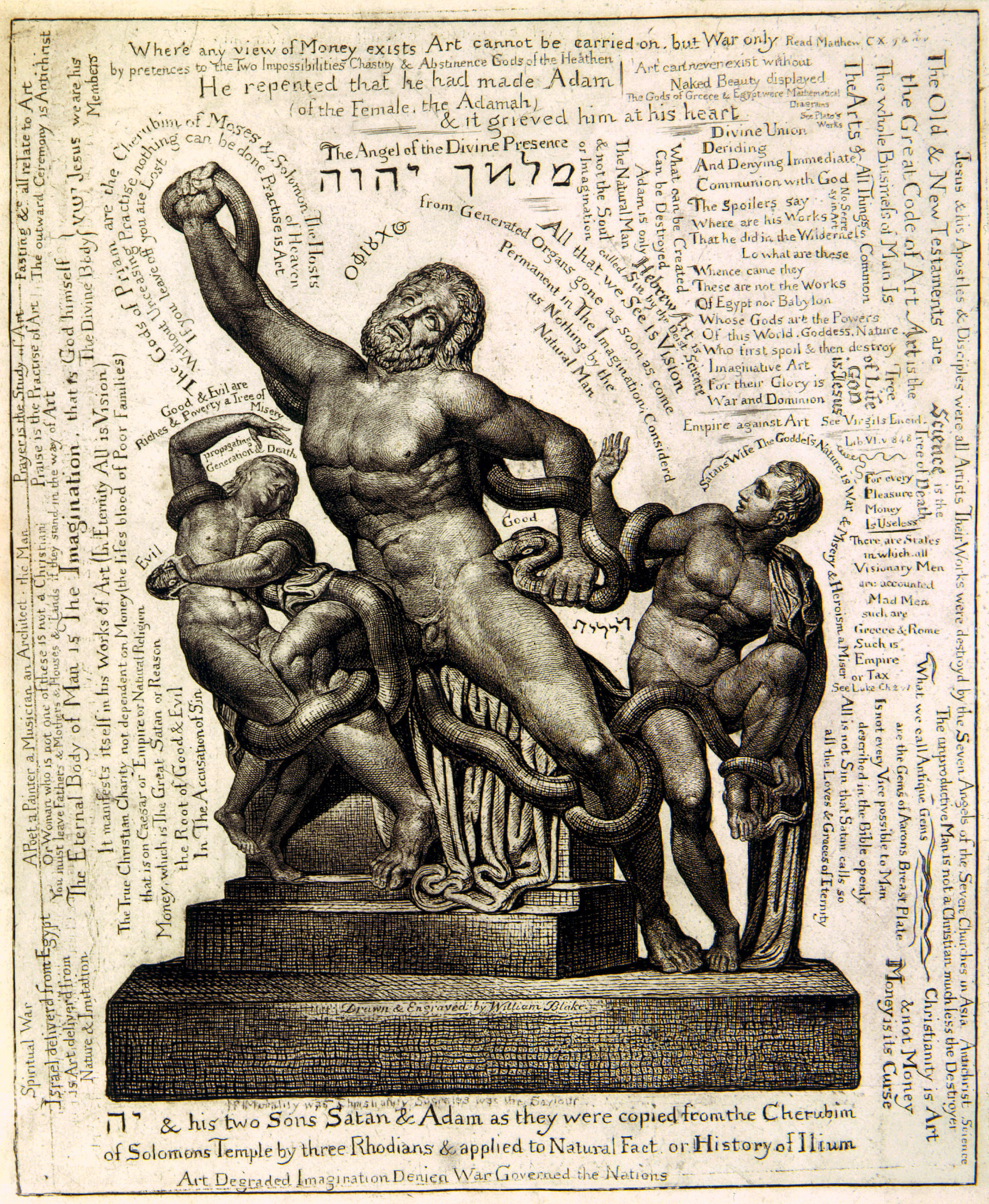
Laocoon
Blake's wide ranging comments on Art, Life, Creation, Good and Evil are contained on this print. You can greatly enlarge the image by right-clicking on picture and opening in a new window.

Joseph Campbell shared with Blake a desire to open the minds of men to a perception of the infinite. We find in The Flight of the Wild Gander his thoughts on breaking through the mental resistance to becoming open to 'immediate, unmitigated, perfectly direct experience'.

The Flight of the Wild Gander:

"In the simplest of terms, I think we might say that when a situation or phenomenon evokes in us a sense of existence (instead of some reference to the possibility of an assurance of meaning) we have an experience of this kind. The sense of existence may be shallow or profound, more of less intense, accordance to our capacity or readiness; but even a brief shock...can yield an experience of no-mind: that is to say, the poetical order, the order of art. When this occurs, our own reality-reality-beyond-meaning is awakened (or perhaps better: we are awakened to out own reality-beyond-meaning), and we experience an affect which is neither thought nor feeling but an interior impact...[We] have had, for an instant, a sense of existence: a moment of unevaluated, unimpeded, lyric life - antecedent to both language and feeling; such can never be communicated empirically verifiable propositions, but only suggested by art."  (Page 186) 

Campbell thought that man was capable of making a quantum leap in consciousness as had been achieved to reach our current level of development which gave us the ability to build a civilization based on cities, agriculture, and institutions. To move to a higher development the individual consciousness would turn inward and use the imagination to create art which was an expression of existence on the other side of silence. There is no map to guide man into unexplored territory; his inner knowing must overcome his trepidation.

The Flight of the Wild Gander:

"[W]ith the rise of the modern scientific method of research in the sixteenth and seventeenth centuries, and development in the eighteenth, nineteenth and twentieth of the power driven machine, the human race was brought across a culture threshold...outdated bronze and iron age heritages give place to forms not imagined. And that they are giving place surely is clear. "Man is condemned," as Sartre says, 'to be free." ... For there is, in fact, in quiet places, a great deal of spiritual quest and finding...by ones and twos, there entering the forest at those points which they themselves have chosen, where they see it to be most dark, and there is no path or way." (Page 225)

No Natural Religion, (E 2)
"None could have other than natural or organic thoughts if
he had none but organic perceptions"

Marriage of Heaven and Hell, Plate 12, (E 38)
"Isaiah answer'd. I saw no God. nor heard any, in a finite
organical perception; but my senses discover'd the infinite in
every thing, and as  I was then perswaded. & remain confirm'd;
that the voice of honest indignation is the voice of God, I cared
not for consequences but  wrote."

Visions of Daughters of Albion, Plate 4, (E 48)
"Thou knowest that the ancient trees seen by thine eyes have fruit;
But knowest thou that trees and fruits flourish upon the earth
To gratify senses unknown? trees beasts and birds unknown:       
Unknown, not unpercievd, spread in the infinite microscope,
In places yet unvisited by the voyager. and in worlds
Over another kind of seas, and in atmospheres unknown:
Ah! are there other wars, beside the wars of sword and fire!
And are there other sorrows, beside the sorrows of poverty!      
And are there other joys, beside the joys of riches and ease?
And is there not one law for both the lion and the ox?
And is there not eternal fire, and eternal chains?
To bind the phantoms of existence from eternal life?
Then Oothoon waited silent all the day. and all the night" 

Milton, Plate 32 [36], (E 132)
"Judge then of thy Own Self: thy Eternal Lineaments explore       
What is Eternal & what Changeable? & what Annihilable!

The Imagination is not a State: it is the Human Existence itself
Affection or Love becomes a State, when divided from Imagination
The Memory is a State always, & the Reason is a State
Created to be Annihilated & a new Ratio Created                  
Whatever can be Created can be Annihilated   Forms cannot"

On Virgil, (E 270)
"Mathematic Form is Eternal in the Reasoning Memory.  Living
Form is Eternal Existence."

Four Zoas, Night II, PAGE 24, (E 314) 
"Mighty was the draught of Voidness to draw Existence in"

Four Zoas, Night IV, Page 87 (E 369)
"Los trembling answerd Now I feel the weight of stern repentance
Tremble not so my Enitharmon at the awful gates    
Of thy poor broken Heart I see thee like a shadow withering
As on the outside of Existence but look! behold! take comfort!
Turn inwardly thine Eyes & there behold the Lamb of God
Clothed in Luvahs robes of blood descending to redeem
O Spectre of Urthona take comfort O Enitharmon   
Couldst thou but cease from terror & trembling & affright
When I appear before thee in forgiveness of ancient injuries  
Why shouldst thou remember & be afraid. I surely have died in pain
Often enough to convince thy jealousy & fear & terror
Come hither be patient let us converse together because  
I also tremble at myself & at all my former life"

Annotations to Lavater, (E 594)
"Lavater: Sense seeks and finds the thought; the thought seeks
and finds genius.
Blake: & vice. versa. genius finds thought without seekg & thought
thus, producd finds sense

Lavater: The poet, who composes not before the moment of
inspiration, and as that leaves him ceases--composes, and he
alone, for all men, all classes, all ages.
Blake: Most Excellent

Lavater: He, who has frequent moments of complete existence,
is a hero, though not laurelled, is crowned, and without crowns,
a king: he only who has enjoyed immortal moments can reproduce
them.
Blake: O that men would seek immortal moments   O that men would
converse with God"

Laocoon, (E 273)
"The Eternal Body of Man is The IMAGINATION.
The whole Business of Man Is The Arts & All Things Common
The Old & New Testaments are the Great Code of Art
Jesus & his Apostles & Disciples were all Artists
SCIENCE is the Tree of DEATH
ART is the Tree of LIFE  GOD is JESUS

Prayer is the Study of Art
Praise is the Practise of Art
Fasting &c. all relate to Art
The outward Ceremony is Antichrist
Without Unceasing Practise nothing can be done" 

Four Zoas, Night VII, Page 86, (E 368) 
"Los furious answerd. Spectre horrible thy words astound my Ear
With irresistible conviction I feel I am not one of those 
Who when convincd can still persist. tho furious. controllable
By Reasons power. Even I already feel a World within
Opening its gates & in it all the real substances
Of which these in the outward World are shadows which pass away
Come then into my Bosom & in thy shadowy arms bring with thee   
My lovely Enitharmon. I will quell my fury & teach
Peace to the Soul of dark revenge & repentance to Cruelty

So spoke Los & Embracing Enitharmon & the Spectre
Clouds would have folded round in Extacy & Love uniting"
. 

Thursday, February 14, 2019

IMAGINATIVE ART


Blake Archive
Private Collection
Compositions from the Works Days and Theogony of Hesiod
Modesty and Justice returning to heaven
Engraved by William Blake after John Flaxman

At the age of ten Blake enrolled in drawing school. At the age of thirteen he began his apprenticeship as an engraver. At twenty-two he completed his apprenticeship and began study at the Royal Academy Schools. He was well prepared to earn his living as a professional engraver which he did for the rest of his life. He is remembered, however, for his poetry, his illuminated books and his philosophical and psychological insights. His craft of engraving allowed him to express his creative intellect in ways worthy of his talent. 

Blake had the gift of seeing beyond the natural world perceived by the senses -  a characteristic which was not unique although unusual if not cultivated. But his ability to communicate what he saw in words and pictures, has not often been duplicated. It is no wonder that he was not recognized by his contemporaries when he presented visions of a world they could not apprehend. If generations following his develop a level of consciousness adequate to apprehend beyond the limits of materiality, they will find a treasure trove in Blake's work to expand the dimensions of their world. 

Kathleen Raine saw that Blake as well as other poets and artists had a 'perception of the infinite' although they were out of favor with the dominant culture. They are preserving the essential knowledge, held in trust since ancient times, which will allow humanity to be transformed into a full, clear and true reflection of the Divine in whose image man is created.    
From Defending Ancient Springs by Kathleen Raine, Page 160:

"Demotic art ('paint the warts') dwells upon the blemishes the eye sees; imaginative art reflects 'the true man', 'To which all lineaments tend and seek with love and sympathy', as Blake said. Imaginative poetry alone has a real function to perform; for the pseudo-arts of realism perform no function beyond the endless reporting of the physical world; which quantitative science (whose proper function it is) can do very much better. But true poetry has the power of transforming consciousness itself by holding before us icons, images of forms only partially and superficially realized in 'ordinary life'."

Page 165
"Blake had read Plotinus on the Beautiful, and seems to be echoing his very images when he answers those critics who objected to his representation of spiritual essences with real bodies that they would do well to consider that the Venus, the Minerva, the Jupiter and the Apollo, which they admire in Greek statues are all of the representations of spiritual existences, of gods immortal to the mortal and perishing organs of sight. And yet they are embodied and organized in solid marble. Plato, Plotinus and all who have followed their doctrine have known that to copy from a mental form, an idea, is to come nearer to perfection than to copy nature; which is itself only a reflection, image or imprint of an anterior pattern. The artist must look to the original not the copy."


Jerusalem, Plate 38 [41], (E 184)
"Then Los grew furious raging: Why stand we here trembling around
Calling on God for help; and not ourselves in whom God dwells
Stretching a hand to save the falling Man: are we not Four
Beholding Albion upon the Precipice ready to fall into Non-Entity:
Seeing these Heavens & Hells conglobing in the Void. Heavens over Hells
Brooding in holy hypocritic lust, drinking the cries of pain 
From howling victims of Law: building Heavens Twenty-seven-fold.
Swelld & bloated General Forms, repugnant to the Divine-
Humanity, who is the Only General and Universal Form         
To which all Lineaments tend & seek with love & sympathy
All broad & general principles belong to benevolence
Who protects minute particulars, every one in their own identity."
Descriptive Catalogue, (E 531)
"No man can believe that either Homer's Mythology, or Ovid's,
were the production of Greece, or of Latium; neither will any one
believe, that the Greek statues, as they are called, were
the invention of Greek Artists; perhaps the Torso is the only
original work remaining; all the rest are evidently copies,
though fine ones, from greater works of the Asiatic Patriarchs.
The Greek Muses are daughters of Mnemosyne, or Memory, and not of
Inspiration or Imagination, therefore not authors of such sublime
conceptions.  Those wonderful originals seen in my visions, were
some of them one hundred feet in height; some were painted as
pictures, and some carved as basso relievos, and some as groupes
of statues, all containing mythological and recondite meaning,
where more is meant than meets the eye."

Public Address, PAGE 59, (E 574)
     "Men think they can Copy Nature as Correctly  as I copy 
Imagination this they will find Impossible. & all the Copies or
Pretended Copiers
of Nature from Rembrat to Reynolds Prove that Nature becomes
tame to its Victim nothing but Blots & Blurs.  Why are
Copiers of Nature Incorrect while Copiers of Imagination are
Correct this is manifest to all"

Public Address, (E 578) 
"Countrymen Countrymen do not suffer yourselves to be disgracd

The English Artist may be assured that he is doing an injury
& injustice to his Country while he studies & imitates the
Effects of Nature.  England will never rival Italy while we
servilely copy. what the Wise Italians Rafael & Michael Angelo
scorned nay abhorred as Vasari tells us

     Call that the Public Voice which is their Error
     Like as a Monkey peeping in a Mirror
     Admires all his colours brown & warm
     And never once percieves his ugly form

What kind of Intellects must he have who sees only the Colours of
things & not the Forms of Things" 
Descriptive Catalogue, (E 544)  
"It will be necessary for the Painter to say
something concerning his ideas of Beauty, Strength and Ugliness.
  The Beauty that is annexed and appended to folly, is a
lamentable accident and error of the mortal and perishing life;
it does but seldom happen; but with this unnatural mixture the
sublime Artist can have nothing to do; it is fit for the
burlesque.  The Beauty proper for sublime art, is lineaments, or
forms and features that are capable of being the receptacles of
intellect; accordingly the Painter has given in his beautiful
man, his own idea of intellectual Beauty.  The face and limbs
that deviates or alters least, from infancy to old age, is the
face and limbs of greatest Beauty and perfection."

Annotations to Reynolds, (E 648)
 "Knowledge of Ideal Beauty. is Not to be Acquired It is Born
with us Innate Ideas. are in Every Man Born with him. they are
truly Himself.  The Man who says that we have No Innate Ideas
must be a Fool & Knave.  Having No Con-Science or Innate
Science" 

Annotations to Reynolds, (E 541)
"The connoisseurs and artists who have made objections to
Mr. B.'s mode of representing spirits with real bodies, would do
well to consider that the Venus, the Minerva, the Jupiter, the
Apollo, which they admire in Greek statues, are all of them
representations of spiritual existences of God's immortal, to
the mortal perishing organ of sight; and yet they are embodied
and organized in solid marble.  Mr. B. requires the same latitude
and all is well.  The Prophets describe what they saw in Vision
as real and existing men whom they saw with their imaginative and
immortal organs; the Apostles the same; the clearer the organ the
more distinct the object.  A Spirit and a Vision are not, as the 
modern philosophy supposes, a cloudy vapour or a
nothing: they are organized and minutely articulated beyond all
that the mortal and perishing nature can produce.  He who does
not imagine in stronger and better lineaments, and in stronger
and better light than his perishing mortal eye can see does not
imagine at all.  The painter of this work asserts that all his
imaginations appear to him infinitely more perfect and more
minutely organized than any thing seen by his
mortal eye.  Spirits are organized men:"

Monday, February 11, 2019

CREATIVE FANTASY

Wikipedia Commons
Milton's Mysterious Dream,
Watercolor Illustration to Milton's L'Allegro and Il Penseroso
Since the unconscious is an aspect of the mind to which the conscious mind has little access, there is difficulty in discerning its content. If an individual behaves in a way which is inconsistent with the values to which he consciously ascribes, he may be under the control of unconscious forces which are unacceptable to the society in which he lives. The apostle Paul said, "For the good that I would I do not: but the evil which I would not, that I do." If a person is seeking to understand why he fails to measure up to the standards which he consciously sets for himself, he may find some answers in myth and dreams for these are ways the unconscious makes itself known to the conscious mind.

By seeking to understand what messages are conveyed to his own psyche by dreams and myth one learns to assimilate a broader range of experience which applies to him and to the world consciousness to which he belongs.

Kathleen Raine on Page 126 of Defending Ancient Springs quoted Jung as recalling 'the unending myth of death and rebirth, and of the multitudinous figures who weave in and out of this mystery': 

"Of this story no single life can realize more than a part; but beneath our individual experience is the pooled experience of our inheritance, Jung's 'collective unconscious' which discloses itself so he says, only through the medium of creative fantasy. 'It comes alive in the creative man, it reveals itself in the vision of the artist, in the inspiration of the thinker, in the inner experience of the mystic.' the mythologies of all races are its embodiment; the psychologists are newcomers in a field long known to the poets; a fact they are apt to forget.
...
Dreams resemble myths in their personification and symbolic forms and enactments; and the knowledge which myths and dreams alike mediate and embody is not conceptual knowledge; in symbols the soul can speak, but not the discursive reason. Explanations come afterwards and are far less fundamental; one has only to think of the countless expositions given some myth, which always survives these attempts to throw light upon its mystery. But the sign of the initiate of the ancient Mysteries was the finger laid upon the lips, the sign of silence. The Mysteries cannot be divulged because they elude verbal formulation."

Songs of Innocence and of Experience, Song 41, (E 24)
"The Angel  

I Dreamt a Dream! what can it mean?
And that I was a maiden Queen:
Guarded by an Angel mild:
Witless woe, was ne'er beguil'd!

And I wept both night and day
And he wip'd my tears away
And I wept both day and night
And hid from him my hearts delight

So he took his wings and fled:
Then the morn blush'd rosy red:
I dried my tears & armed my fears,
With ten thousand shields and spears,

Soon my Angel came again;
I was arm'd, he came in vain:
For the time of youth was fled            
And grey hairs were on my head." 
Europe, Plate 9, (E 62)
"Enitharmon slept,                                                
Eighteen hundred years: Man was a Dream!
The night of Nature and their harps unstrung:
She slept in middle of her nightly song,
Eighteen hundred years, a female dream!"

Milton, Plate 15 [17], (E 109)
"As when a man dreams, he reflects not that his body sleeps,
Else he would wake; so seem'd he entering his Shadow: but
With him the Spirits of the Seven Angels of the Presence
Entering; they gave him still perceptions of his Sleeping Body;
Which now arose and walk'd with them in Eden, as an Eighth   
Image Divine tho' darken'd; and tho walking as one walks
In sleep; and the Seven comforted and supported him.

Like as a Polypus that vegetates beneath the deep!
They saw his Shadow vegetated underneath the Couch
Of death: for when he enterd into his Shadow: Himself:           
His real and immortal Self: was as appeard to those
Who dwell in immortality, as One sleeping on a couch
Of gold; and those in immortality gave forth their Emanations
Like Females of sweet beauty, to guard round him & to feed
His lips with food of Eden in his cold and dim repose!           

But to himself he seemd a wanderer lost in dreary night."

Friday, February 08, 2019

MAKING OF MYTH

Wikimedia Commons
Mercy and Truth Are Met Together
Although when we read Blake's poetry we may be most aware of the particular characters and images which we encounter, that is not all there is to it. The minutiae may be thought of as the instrumentality which serves the myth as a whole. But the myth itself also means more, for like all myth, it is pointing beyond itself to truth that cannot be expressed in words. Although we may wish that Blake's thoughts should be unequivocally stated so that we could read Jerusalem in the way that we read the newspaper, that is impossible. It is up to the reader to make his own intuitive contribution by fitting the parts into a whole which may be elusive.  

Kathleen Raine on page 135 of Defending Ancient Springs expresses the artistry of the poet who has the gift of being a vehicle for presenting the moment when eternity penetrates time and renovates the whole:

"So for Yeats the vision of what lies behind the veil came in glimpses, seldom in whole symbolic episodes, still less in myths which unfold like those of Blake, into great epic drama enacted in an interior country within whose spaces we move freely. The unit of such poetry is not the symbol. Myths are not built by adding piece by piece, they are not the sum of symbolic parts. The unit of the myth is the whole enactment, and all its figures; each symbol exists as a part within that imaginative unity, from which it is inseparable, and by which it is determined; as a sentence determines words, and is not merely their sum.
...in every turbulent encounter with the mighty form of his Zoas, we recognize parts within a great whole whose harmony is implicit. The ability to handle the units of myth - which might be defined as dynamic symbol, symbol in transformation - ought to be recognized as the supreme poetic gift. In such poetry the symbolic parts are inseparable from the imaginative configuration and constellations within which they appear...we do not think of these as separate symbols but as parts of the world in which the poem moves, as we move in nature. Yer considered separately each symbol is used with the precision of words in a language of which the poet has perfect mastery."


Milton, Plate 5, (E 98) 
"While the Females prepare the Victims. the Males at Furnaces 
And Anvils dance the dance of tears & pain. loud lightnings
Lash on their limbs as they turn the whirlwinds loose upon
The Furnaces, lamenting around the Anvils & this their Song

Ah weak & wide astray! Ah shut in narrow doleful form
Creeping in reptile flesh upon the bosom of the ground      
The Eye of Man a little narrow orb closd up & dark
Scarcely beholding the great light conversing with the Void
The Ear, a little shell in small volutions shutting out
All melodies & comprehending only Discord and Harmony
The Tongue a little moisture fills, a little food it cloys  
A little sound it utters & its cries are faintly heard
Then brings forth Moral Virtue the cruel Virgin Babylon

Can such an Eye judge of the stars? & looking thro its tubes
Measure the sunny rays that point their spears on Udanadan
Can such an Ear filld with the vapours of the yawning pit.  
Judge of the pure melodious harp struck by a hand divine?
Can such closed Nostrils feel a joy? or tell of autumn fruits
When grapes & figs burst their covering to the joyful air
Can such a Tongue boast of the living waters? or take in
Ought but the Vegetable Ratio & loathe the faint delight     
Can such gross Lips percieve? alas! folded within themselves
They touch not ought but pallid turn & tremble at every wind

Thus they sing Creating the Three Classes among Druid Rocks    
Charles calls on Milton for Atonement. Cromwell is ready
James calls for fires in Golgonooza. for heaps of smoking ruins  
In the night of prosperity and wantonness which he himself Created
Among the Daughters of Albion among the Rocks of the Druids"

Milton, Plate 31 [34], (E 130)
"Thou hearest the Nightingale begin the Song of Spring;
The Lark sitting upon his earthy bed: just as the morn
Appears; listens silent; then springing from the waving Corn-field! loud
He leads the Choir of Day! trill, trill, trill, trill,
Mounting upon the wings of light into the Great Expanse:
Reecchoing against the lovely blue & shining heavenly Shell:
His little throat labours with inspiration; every feather
On throat & breast & wings vibrates with the effluence Divine    
All Nature listens silent to him & the awful Sun
Stands still upon the Mountain looking on this little Bird

With eyes of soft humility, & wonder love & awe.
Then loud from their green covert all the Birds begin their Song
The Thrush, the Linnet & the Goldfinch, Robin & the Wren         
Awake the Sun from his sweet reverie upon the Mountain:
The Nightingale again assays his song, & thro the day,
And thro the night warbles luxuriant; every Bird of Song
Attending his loud harmony with admiration & love.
This is a Vision of the lamentation of Beulah over Ololon!       

Thou percievest the Flowers put forth their precious Odours!
And none can tell how from so small a center comes such sweets 
Forgetting that within that Center Eternity expands
Its ever during doors, that Og & Anak fiercely guard[.]
First eer the morning breaks joy opens in the flowery bosoms     
Joy even to tears, which the Sun rising dries; first the Wild Thyme
And Meadow-sweet downy & soft waving among the reeds.
Light springing on the air lead the sweet Dance: they wake
The Honeysuckle sleeping on the Oak: the flaunting beauty
Revels along upon the wind; the White-thorn lovely May           
Opens her many lovely eyes: listening the Rose still sleeps    
None dare to wake her. soon she bursts her crimson curtaind bed
And comes forth in the majesty of beauty; every Flower:
The Pink, the Jessamine, the Wall-flower, the Carnation
The Jonquil, the mild Lilly opes her heavens! every Tree,        
And Flower & Herb soon fill the air with an innumerable Dance
Yet all in order sweet & lovely, Men are sick with Love!
Such is a Vision of the lamentation of Beulah over Ololon"

Jerusalem, Plate 3, (E 145)
    "Reader! [lover] of books! [lover] of heaven,
    And of that God from whom [all books are given,]
    Who in mysterious Sinais awful cave
    To Man the wond'rous art of writing gave,
    Again he speaks in thunder and in fire!                
    Thunder of Thought, & flames of fierce desire:
    Even from the depths of Hell his voice I hear,
    Within the unfathomd caverns of my Ear.
    Therefore I print; nor vain my types shall be:
    Heaven, Earth & Hell, henceforth shall live in harmony" 

Poetical Sketches, SONG, (E 413)
"Love and harmony combine,
And around our souls intwine,
While thy branches mix with mine,
And our roots together join.

Joys upon our branches sit,    
Chirping loud, and singing sweet;
Like gentle streams beneath our feet
Innocence and virtue meet.

Thou the golden fruit dost bear,
I am clad in flowers fair;    
Thy sweet boughs perfume the air,
And the turtle buildeth there.

There she sits and feeds her young,
Sweet I hear her mournful song;
And thy lovely leaves among,
There is love: I hear his tongue.   

There his charming nest doth lay,
There he sleeps the night away;
There he sports along the day,
And doth among our branches play." 

Annotations to Reynolds, (E 659)
 "Demonstration Similitude & Harmony are Objects of Reasoning 
Invention Identity & Melody are Objects of Intuition" 

Monday, February 04, 2019

SPIRITUAL SENSE

British Museum
Illustrations to Young's Night thoughts
William Blake and Crabb Robinson attempted to communicate with one another but there was a language barrier between them. Blake's mind was occupied by a perception of the infinite and he could only speak the language of allusion, metaphor and reference to the non-material. Joseph Campbell had a similar problem with an interviewer who insisted that myth was a lie. Campbell demonstrated to him the difference between a simile and a metaphor to show that metaphoric thought can't be contained in prosaic speech.

Irene Langridge in her book William Blake: A Study of His Life and Art Work, published in 1904, used a conversation between Blake and Robinson to shed light the use of natural speech and spiritual speech. Natural speech approaches a subject from the exterior: to speak at a spiritual level one must enter into the subject and speak from the relationship which one establishes. 

Here are quotes from page 64 of William Blake: A Study of His Life and Art Work:
"In Blake’s conversations with Crabb Robinson, this mystic view of Christ is very apparent. “On my asking,” writes Mr. Robinson, “in what light he viewed the great questions of the duty of Jesus,” he said, “He is the only God. But then,” he added, “and so am I, and so are you.”
 
Keeping this point in view,—Blake’s belief in the identity of the Spirit of God behind all phenomena, the homogeneous character of the great creative Energy or Imagination expressing Itself through various forms and organisms,—another extract from Crabb Robinson’s diary will help us still nearer home to Blake’s point of view. He writes: “In the same tone, he said repeatedly, ‘The Spirit told me.’ I took occasion to say, ‘You express yourself as Socrates used to do. What resemblance do you suppose there is between your spirit and his?’ ‘The same as between our countenances.’ He paused and added, ‘I was Socrates,’ and then, as if correcting himself, ‘a sort of brother. I must have had conversations with him. So I had with Jesus Christ. I have an obscure recollection of having been with both of them.’ I suggested on philosophic grounds the impossibility of supposing an immortal being created an a parte post without an a parte ante. His eye brightened at this, and he fully concurred with me. ‘To be sure, it is impossible. We are all co-existent with God, members of the Divine Body. We are all partakers of the Divine Nature.’”
 
The latter words seem as ordinary and orthodox as on first reading his assertion that he was Socrates seems wild and mad. But all Blake really meant (and I think Crabb Robinson only half took his meaning) was, that the vegetative universe being a mere shadow, so are the accidents of personality, the age one is born into, the organic form which incloses the spirit. So his personality and that of Socrates, their imprisonment in the “vegetative” life were differences of no account, being transitory. But he and Socrates were one (or at least related) at the point where their spirits (the eternal verity) touched, and melted each into the other.
 
He understood the Bible in its spiritual sense. As to the natural sense, “Voltaire was commissioned by God to expose that. I have had much intercourse with Voltaire, and he said to me, ‘I blasphemed the Son of Man, and it shall be forgiven me, but they (the enemies of Voltaire) blasphemed the Holy Ghost in me, and it shall not be forgiven them.’” This affords an instance of the manner in which Blake intuitively probed beneath the appearance, and divined the spirit beneath, discarding the fact or body with which it clothed itself. " 

Laocoon, (E 275) 
"If Morality was Christianity Socrates was the Saviour"
Description of Last Judgment, (E 554)
"The Hebrew Bible & the Gospel of
Jesus are not Allegory but Eternal Vision or Imagination of All
that Exists <Note here that Fable or Allegory is Seldom without
some Vision Pilgrims Progress is full of it   the Greek Poets the
same but Allegory & Vision ought 
to be known as Two Distinct Things & so calld for the Sake of
Eternal Life   Plato has made Socrates say that Poets & Prophets do
not Know or Understand what they write or Utter   this is a most
Pernicious Falshood.    If they do not pray [it] is an inferior Kind to
be calld Knowing    Plato confutes himself"

Letters, To Butts, (E 730)
"Thus I hope that all our three years trouble Ends in
Good Luck at last & shall be forgot by my affections & only
rememberd by my Understanding to be a Memento in time to come &
to speak to future generations by a Sublime Allegory which is now
perfectly completed into a Grand Poem[.] I may praise it since I
dare not pretend to be any other than the Secretary the Authors
are in Eternity I consider it as the Grandest Poem that This
World Contains.  Allegory addressd to the Intellectual powers
while it is altogether hidden from the Corporeal Understanding is
My Definition of the Most Sublime Poetry. it is also somewhat in
the same manner defind by Plato.  This Poem shall by Divine
Assistance be progressively Printed & Ornamented with Prints &
given to the Public--But of this work I take care to say little
to Mr H. since he is as much averse to my poetry as he is to a
Chapter in the Bible"

ON HOMERS POETRY, (E 269)            
"Every Poem must necessarily be a perfect Unity, but why Homers is
peculiarly so, I cannot tell: he has told the story of
Bellerophon & omitted the judgment of Paris which is not only a
part, but a principal part of Homers subject
  But when a Work has Unity it is as much in a Part as in the
Whole. the Torso is as much a Unity as the Laocoon
  As Unity is the cloke of folly so Goodness is the cloke of
knavery  Those who will have Unity exclusively in Homer come out
with a Moral like a sting in the tail: Aristotle says Characters
are either Good or Bad: now Goodness or Badness has nothing to do
with Character. an Apple tree a Pear tree a Horse a Lion, are
Characters but a Good Apple tree or a Bad, is an Apple tree
still: a Horse is not more a Lion for being a Bad Horse. that is
its Character; its Goodness or Badness is another consideration.
  It is the same with the Moral of a whole Poem as with the Moral Goodness
of its parts Unity & Morality, are secondary considerations &
belong to Philosophy & not to Poetry, to Exception & not to Rule,
to Accident & not to Substance. the Ancients calld it eating of
the tree of good & evil.
  The Classics, it is the Classics! & not Goths nor Monks, that
Desolate Europe with Wars."

John 19
[6] When the chief priests therefore and officers saw him, they cried out, saying, Crucify him, crucify him. Pilate saith unto them, Take ye him, and crucify him: for I find no fault in him.
[7] The Jews answered him, We have a law, and by our law he ought to die, because he made himself the Son of God.
[8] When Pilate therefore heard that saying, he was the more afraid;
[9] And went again into the judgment hall, and saith unto Jesus, Whence art thou? But Jesus gave him no answer.
[10] Then saith Pilate unto him, Speakest thou not unto me? knowest thou not that I have power to crucify thee, and have power to release thee?
[11] Jesus answered, Thou couldest have no power at all against me, except it were given thee from above: therefore he that delivered me unto thee hath the greater sin.
[12] And from thenceforth Pilate sought to release him: but the Jews cried out, saying, If thou let this man go, thou art not Caesar's friend: whosoever maketh himself a king speaketh against Caesar.

.