 |
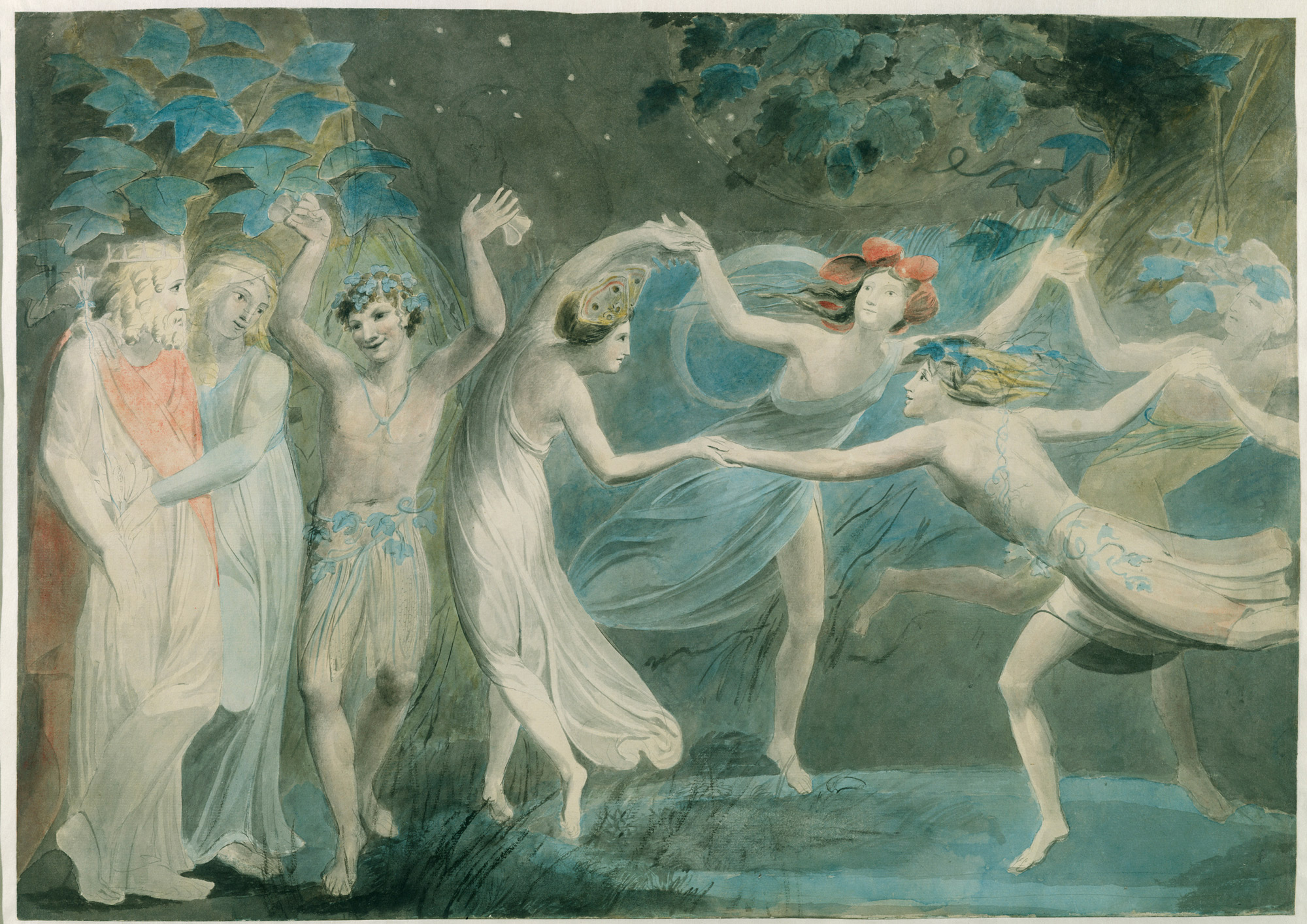
| Wikipedia Commons Oberon, Titania and Puck with Fairies Dancing c. 1786 |
In a very early biography of Blake (Life of Blake, By Allan Cunningham) there is reported a conversation of Blake with a lady at a dinner party:
"'Did you ever see a fairy's funeral, madam?' he once said to a lady, who happened to sit by him in company. 'Never, sir!' was the answer. 'I have,' said Blake, 'but not before last night. I was walking alone in my garden, there was great stillness among the branches and flowers and more than common sweetness in the air; I heard a low and pleasant sound, and I knew not whence it came. At last I saw the broad leaf of a flower move, and underneath I saw a procession of creatures of the size and colour of green and gray grasshoppers, bearing a body laid out on a rose leaf, which they buried with songs, and then disappeared. It was a fairy funeral.'"
In his Descriptive Catalogue, Blake introduces the idea that in Shakespeare and Chaucer fairies are rulers of the vegetable world, perhaps indicating that he uses them in the same way.
Descriptive Catalogue, (E 535)
"By way of illustration, I instance Shakspeare's Witches in
Macbeth. Those who dress them for the stage, consider
them as wretched old women, and not as Shakspeare intended, the
Goddesses of Destiny; this shews how Chaucer has been
misunderstood in his sublime work. Shakspeare's Fairies also
are the rulers of the vegetable world, and so are Chaucer's;
let them be so considered, and then the poet will be understood,
and not else."
Blake's best known passage about a fairy introduces his prophecy Europe which he published in 1794. In Blake's system fairies are associated with the Element air, and the Zoa Urizen.
Europe, Plate iii, (E 60)
"Five windows light the cavern'd Man; thro' one he breathes the air;
Thro' one, hears music of the spheres; thro' one, the eternal vine
Flourishes, that he may recieve the grapes; thro' one can look.
And see small portions of the eternal world that ever groweth;
Thro' one, himself pass out what time he please, but he will not;
For stolen joys are sweet, & bread eaten in secret pleasant.
So sang a Fairy mocking as he sat on a streak'd Tulip,
Thinking none saw him: when he ceas'd I started from the trees!
And caught him in my hat as boys knock down a butterfly.
How know you this said I small Sir? where did you learn this song?
Seeing himself in my possession thus he answered me:
My master, I am yours. command me, for I must obey.
Then tell me, what is the material world, and is it dead?
He laughing answer'd: I will write a book on leaves of flowers,
If you will feed me on love-thoughts, & give me now and then
A cup of sparkling poetic fancies; so when I am tipsie,
I'll sing to you to this soft lute; and shew you all alive
The world, when every particle of dust breathes forth its joy.
I took him home in my warm bosom: as we went along
Wild flowers I gatherd; & he shew'd me each eternal flower:
He laugh'd aloud to see them whimper because they were pluck'd.
They hover'd round me like a cloud of incense: when I came
Into my parlour and sat down, and took my pen to write:
My Fairy sat upon the table, and dictated EUROPE."
The conversation of Blake about the fairy funeral which sent ripples out in the literary world may be pursued at this website about Lucy Hooper.


1 comment:
Lucy Hoopers Poem
d "The Fairy's Funeral" by master Victorian fairy painter; John Anster Fitzgerald 1864.
“The Fairy’s Funeral” by Lucy Hooper
"The dreamer walked, at closing day,
Among the folding flowers,
While yet its last and brilliant ray
Lingered midst summer bowers;
No bitter care, no jarring tone
Disturbed him–he was there alone,
His thoughts were hushed in sweetest rest,
Nature was bright–her votary blest!
A strain of music filled
The quiet sunset air,
The listener's ear was thrilled–
Who were the players there?
No step was near, no voice to greet,
But when was minstrelsy so sweet?
So low, so soft, so sad the sound,
He paused–the leaves were stirred around;
He bent to earth, unclosed a flower,
Its azure bell proved fairy bower,
And first to mortal eye were shown
The wonders of a world unknown!
Beneath that folded leaf,
He saw a moving throng,
And listened to their music's breath,
As the fairies stole along;
A bright and sparkling crowd, I ween,
But where in that array, the queen?
On a rose leaf bed
Reposed the dead,
The tone of song
From her lips has gone,
And the crown from her lovely head;
But those who wept her, by her side
Had placed her fairy wand of pride.
Entranced the dreamer heard,
As the bright throng glittered by,
That sweet, low fairy dirge,
And its sad melody,
As with many songs, and fairy grace,
They chose the greenest resting place,
Where summer flowers bloomed bright and fair,
And sunbeams melted in the air,
And gently laid the burden down,
And then the radiant scene was done,
The melody was heard no more,
The listner paused–the spell was o'er;
But gentle memories and song
Clung to his heart and lingered long.
Sweet dreamer! Would such thoughts could come
To soothe me when I muse alone."
Post a Comment