Saturday, September 26, 2009

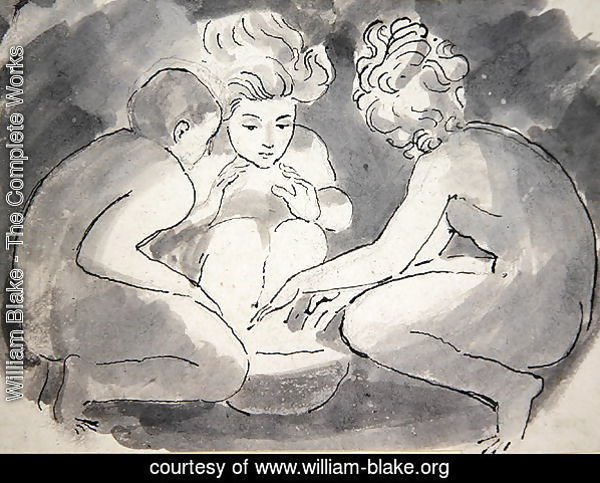
CHILDREN ROUND FIRE

As I read "The Chimney Sweeper" presented in the post above, I realized the the boy in this picture and Tom Dacre of the poem both have shaved heads. So the little boy represented in the picture is likely a chimney sweeper, and all three around the fire represent street children huddled together for warmth as well as light.

https://www.william-blake.org/Children-Round-A-Fire.html

 LET US BE THE CHILDREN AROUND BLAKE'S FIRE


Friday, September 25, 2009

MINUTE PARTICULARS

From William Blake's Jerusalem: Plate 91

"He who would see the Divinity must see him in his Children
One first, in friendship & love; then a Divine Family, & in the midst
Jesus will appear; so he who wishes to see a Vision; a perfect Whole
Must see it in its Minute Particulars; Organized & not as thou
O Fiend of Righteousness pretendest; thine is a Disorganized
And snowy cloud: brooder of tempests & destructive War
You smile with pomp & rigor: you talk of benevolence & virtue!
I act with benevolence & virtue & get murderd time after time:
You accumulate Particulars, & murder by analyzing, that you
May take the aggregate; & you call the aggregate Moral Law:
And you call that Swelld & bloated Form; a Minute Particular.
But General Forms have their vitality in Particulars: & every
Particular is a Man; a Divine Member of the Divine Jesus.

So Los cried at his Anvil in the horrible darkness weeping!"


Looking at this passage as a whole, we look into a conundrum. Part of the problem is that if we try to apply it to others, we are either fault-finding or projecting. If we apply it to ourselves, we are called Jungians. Let's take it one section at a time.

"He who would see the Divinity must see him in his Children
One first, in friendship & love; then a Divine Family, & in the midst
Jesus will appear;"

This path to Jesus may be thought of as the path through 'innocence'.
It is direct and uncomplicated but not open to many of us. It is the way of participating in the creative process through immersion in God's
love.

The following lines suggest a more complex process of achieving wholeness. It involves altering consciousness and breaking down the patterns that dominate our thinking. Blake is looking deep into the
human psyche:

"o he who wishes to see a Vision; a perfect Whole
Must see it in its Minute Particulars; Organized & not as thou
O Fiend of Righteousness pretendest; thine is a Disorganized
And snowy cloud: brooder of tempests & destructive War"

He focuses our attention on the processes through which we organize people, places, things, ideas or whatever, convincing ourselves that it is the right way, the only way. Perceiving reality in the wrong way(materialistically and legalistically) gives a clouded, distorted picture which leads to anger and destructiveness.

"You smile with pomp & rigor: you talk of benevolence & virtue!
I act with benevolence & virtue & get murderd time after time:"

Then he talks of hiding behind the persona and failing to connect with the 'real' in others thereby taking the life from them and from ourselves.

"You accumulate Particulars, & murder by analyzing, that you
May take the aggregate; & you call the aggregate Moral Law:
And you call that Swelld & bloated Form; a Minute Particular."

He points out the errors of living in the mind and constructing further defenses against the 'real' (spiritual) world, leading to a confusion of categories.

"But General Forms have their vitality in Particulars: & every
Particular is a Man; a Divine Member of the Divine Jesus."

Now he reaches the level of integration: SEEING the Divine Image in all, including within ourselves. This is Blake's reply to his implied question of how to 'see a Vision, a Perfect whole.'

"So Los cried at his Anvil in the horrible darkness weeping!"

Los is undergoing this process himself and watching with anguish as humanity is remolded and reborn.

Jesus as the healer: The Raising of Lazarus

Thursday, September 24, 2009

NECESSITIES

Matthew 6:28
"Consider the lilies, how they grow: they toil not, neither do they spin; yet I say unto you, Even Solomon in all his glory was not arrayed like one of these. But if God doth so clothe the grass in the field, which to-day is, and to-morrow is cast into the oven; how much more shall he clothe you, O ye of little faith? And seek not ye what ye shall eat, and what ye shall drink, neither be ye of doubtful mind. For all these things do the nations of the world seek after: but your Father knoweth that ye have need of these things. Yet seek ye his kingdom, and these things shall be added unto you. Fear not, little flock; for it is your Father's good pleasure to give you the kingdom."

When I read this passage prosaically, it is hard to accept because I know rationally that everything is not provided for in the natural world. There are those who go hungry and who suffer needs of all sorts. When I first heard these words sung I recognized them as poetry. Then they spoke to me at a different level. I knew they spoke of a deeper aspect of God's provision. I knew that God's love is all encompassing, and that we need to look from a God's eye view to see that God provides for out every need.


A view of necessities: The Piper
Songs of Innocence, Frontispiece


In this letter to his friend Anna Flaxman, Blake who often suffered need because there was little market for his art, indicates that God provides the true necessities - 'The Bread of sweet Thought' and the 'Wine of Delight.' His mind and his spirit were adequately provided for even in times when his body suffered from deprivation.


Letters, "To my dear Friend Mrs Anna Flaxman" (E 709)

"The Bread of sweet Thought & the Wine of Delight
Feeds the Village of Felpham by day & by night
And at his own door the blessd Hermit does stand
Dispensing Unceasing to all the whole Land
W. BLAKE"

Wednesday, September 16, 2009

The Last Judgment

The concept of the last judgment has driven millions of people out of the Church, out of Christianity. A fair number of these refugees from Christianity have rejected Christendom, not necessarily a faith in "the Good Lord"; they may pray nightly but never go near a church.

Some of these "poor benighted souls" have found refuge among Quakers, who deplore war, but, more important, believe "there is that of God in everyone".

The fortunate few, with or without Quakerism, have found WB, who lampooned Christendom unmercifully. Urizen, (pic) brought the law, but who brought grace? Jesus the Forgiveness of course.

With a few words from Blake's Vision of the Last Judgment he brought that grossly misunderstood concept to its merciful conclusion:

"What are all the Gifts of the
Spirit but Mental Gifts whenever any
Individual Rejects Error & Embraces Truth a
Last Judgment passes upon that Individual."
(Erdman 562)

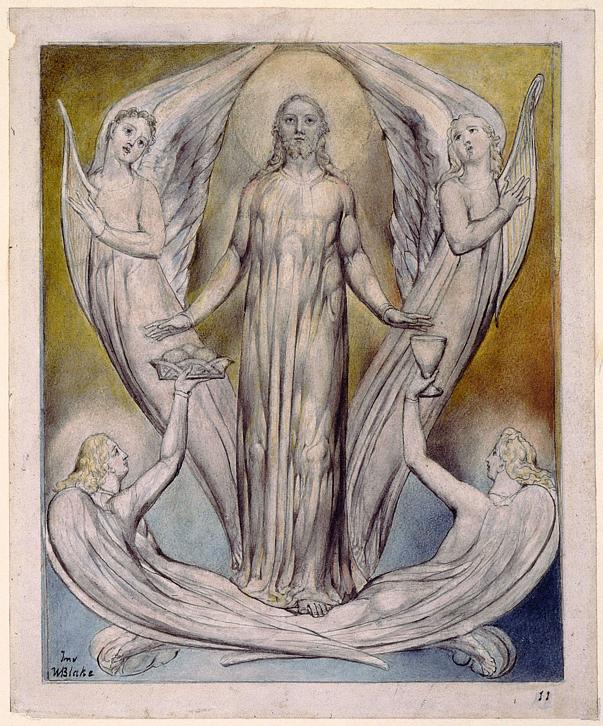
'Andrew and Simon Peter Searching for Christ'

We don't need to fight Evil (no, no, by golly), but to reject the Errors that clutter up our minds; we thus become those "rich enlightened souls" who join WB in Heaven.

Tuesday, September 15, 2009

BLAKE AND EVIL

Blake was outspoken in his opposition to oppressive behaviors and to mistaken ideas. Because the enforcement of an external law was the root of much of mankind's suffering, and his inability to perceive the infinite; Blake relentlessly spoke against the law as the construction of Urizen.

The term 'error' was what Blake used to refer to what many call evil. He considered error to be a state and not a person. Error could be brought to light, dealt with and eliminated. Blake's goal was that every person may reach the state of internal unity and brotherhood with man.

Athough this passage at first appears to be harsh condemnation, its meaning changes a we look at it in the light of Blake's vocabulary.

InscrDante 5, (E689)
"Swedenborg does the same in saying that in
this World is the Ultimate of Heaven
This is the most damnable Falshood of
Satan & his Antichrist"

Mercy and Truth are met together, Righteousness and Peace have kissed each other

Notice what Blake is saying:
The idea of 'this World' being the 'Ultimate of Heaven' is abhorrent to him, since his whole psyche and philosophy are committed to the notion that Eternity is the only true reality. As always he wouldn't use prosaic language (as I have used) to state this. He states his reaction according to his system of thought.

'Damnable' means being worthy of complete rejection.
'Falsehood' is error - a state which is created so that the individual should not be blamed.
'Satan' is another word for error, he is the "State of Death and not a human existence."(J49:67)

Since in Blake's system, "One Error not remov'd will destroy a human Soul" (J46:11), it is merciful to remove error. Antichrist is that which opposes Christ, another error to be replaced by truth.

Blake doesn't call Swedenborg evil, he says he is in a state of error. What Blake is doing is speaking the truth in as direct and powerful a way as he is capable of.

(Thanks to Damon's A BLAKE DICTIONARY for help in explaining this)

Sunday, September 13, 2009

THE GOOD LIFE

Milton O. Percival in his book WILLIAM BLAKE'S CIRCLE OF DESTINY, analyzed the ideas that lie behind Blake's thinking. He finds Blake to exhibit familiar tenets of idealism. These are the ones he names:
1.) Appearances are not reality
2.) Intuition is a prime source of knowledge
3.) The mind creates the universe in its own likeness
4.) The cosmic mind corresponds to the individual mind
5.) Reality is mental
Percival adds these tenets in Blake's thought.
6.) The individual and universal minds are identical in nature
7.) The supreme experience is ecstasy
8.) The good life is unitive concerning itself in building Jerusalem

Percival describes the good life as envisioned by Blake thus:
"It requires that one make the mystical identification of oneself with others and of all with God; and that one should have faith in that identification when the immediate perception fades. ...

"The good life must be built by faith or experience, on the qualities of imagination.To attempt to build it on the qualities of reason or sense is to reduce a god-like man to a handful of dust."

Blake in his poetry continually restates and develops these tenets. Furthermore he lived his life by these tenets in his commitment to Eternity and to the expression of Imagination.

"Drinking at the River of Life"

Saturday, September 12, 2009

Ah! Sunflower

"Ah! sunflower, weary of time,
Who countest the steps of the sun,
Seeking after that sweet golden clime
Where the traveller’s journey is done;

Where the youth pined away with desire,
And the pale virgin shrouded in snow,
Arise from their graves and aspire;
Where my sunflower wishes to go."
(Songs of Experience, Erdman 25)

Frye tells us that this may be seen to reflect biblical
passages about work, such as "work for the night is coming".

"In Ah! Sunflower the flower that turns its face to the sun
through its passage across the sky is the emblem of all those
who have repressed or frustrated their desires to the point
at which they all consolidate into a desire for the sunset of death".

Once again:
"Seeking after that sweet golden clime
Where the traveller's journey is done."

(from Frye in Words with Power p. 90-91)

"The passage of the sun symbolizes our journey through life
(through this vale of tears.) Focusing on the sun, as the
flower does, indicates preoccupation with the objective, the
material; Blake considered that a much lesser way to live.

In Visions of the Last Judgment Blake wrote:

"Error is Created Truth is Eternal Error or Creation
will be Burned Up & then & not till then Truth
or Eternity will appear It is Burnt up the Moment Men
cease to behold it I assert for My self that I do not
behold the Outward Creation & that to me it is
hindrance & not Action it is as the Dirt upon
my feet No part of Me. What it will be Questiond When
the Sun rises do you not see a round

Disk of fire somewhat like a Guinea O no no I see an Innumerable
company of the Heavenly host crying Holy Holy Holy is the Lord
God Almighty I question not my Corporeal or Vegetative Eye any
more than I would Question a Window concerning a Sight I look
thro it & not with it." (VLJ-N95; E565-6)

Wikimedia Commons
Milton's Paradise Regained 
Christ Ministered to by Angels

Ah! Sunflower also reflects a passage in Gates of Paradise:

"But when once I did descry
The Immortal Man that cannot Die
Thro evening shades I haste away
To close the Labours of my Day"
(Gates of Paradise 39-42; E269)
.

Friday, September 11, 2009

DIVINE BODY


The Angel of the Divine Presence


"We are all co-existent with God, members of the Divine body.
We are all partakers of the Divine nature." William Blake
(quoted by Crabb Robinson in his diary)


Crabb Robinson Diary


I see a dimension of Christianity beyond following Jesus'
teaching on the Great Commandment, and the Last Judgment.
This is the dimension arising from the Resurrection and the
Incarnation. The message of Jesus could not be completed in
his physical lifetime, because it was to be a demonstration
of a new relationship between God and man. Jesus' promise
that his Spirit would live on and be available to his
disciples, was fulfilled in the empty grave, the post-crucifixion
appearances, and at Pentecost (and ever since.)
We are the
recipients of the promised Holy Spirit. Jesus
by becoming
Incarnate (Spirit in Body) demonstrates that we
too are
incarnated Spirits, bodies which are vehicles for
the indwelling
Holy Spirit. "Members of the Divine body"
as brother William says.
We Quakers are fond of saying there is "that of God in
everyone", which unites us as One Being.

Tuesday, September 08, 2009

Four Zoas - 2

"Ephesians 6:12 For we wrestle not against flesh and blood, but against principalities,
against powers, against the rulers of the darkness of this world, against spiritual wickedness in high places." Blake wrote this verse in Greek at the beginning of The Four Zoas. Sure enough in the thousands of words that follow he does (and we do) exactly that. The principalities and powers are within us. Our lives are made up of these wrestlings.

"Los was the fourth immortal starry one, & in the Earth Of a bright Universe Empery attended day & night Days & nights of revolving joy, Urthona was his name".

The fourth one! In Bloom's commentary in the back of Erdman, he points to an analogy between Los, the 'fourth immortal starry one' and the fourth one in the fiery furnace of the book of Daniel, "the form of the fourth is like the Son of God" (Daniel 3:25).

Los is the most hopeful of the Zoas - imaginative, intuitive, closely analogous to the Son of God, although his career in The Four Zoas is torturous, frequently destructive before becoming creative.

Blake started with a summary description of
Los, but then he 'began with parent power -- Tharmas.
As we read Blake we constantly encounter seeming contradiction of this sort. He began with Los, but then he began with Tharmas. Did he do that to confuse us? to provoke us into the use of our own imagination? Who knows?

Monday, September 07, 2009

JOB, BLAKE & JUNG

William Blake, Carl Jung and the author of the Book of Job, seem to agree that the experience of Job represented a change in the relationship of man and God. Job struggles against the perceived injustice of God and the suffering it brings upon him. Job receives a direct intervention from God in the shape of God speaking to him from the whirlwind. Because Job was truthful with God and confronted God with the human point of view, he received an answer demonstrating God's power, wisdom and mystery. 

After his trials Job's fortunes are restored and he receives God's favor. The role that Satan (the personification of evil) plays in the story is pivotal. Satan is allowed by God to test Job because of Job's reputation for righteousness. This perhaps is the hinge of the story because Satan, not God is in charge of testing Job. In the end Job's demands convince God to relate to him directly.  

Satan before the Throne of God, Illustrations to the Book of Job (Linnell Set) 

Here is a quote from Jung in a letter to Morton Kelsey (from CARL JUNG: WOUNDED HEALER OF THE SOUL by Claire Dunne): 

 "This is what happens in Job: The creator sees himself through the eyes of man's consciousness and this is the reason why God has to become man, and why man is progressively gifted with the dangerous prerogative of the divine "mind." You have it in Christ's saying: "Ye are gods" and man has not even begun to know himself." 

Edward Edinger, in ENCOUNTER WITH THE SELF: A JUNGIAN COMMENTARY ON WILLIAM BLAKE'S ILLUSTRATIONS OF THE BOOK OF JOB describes the encounter of Job with God as "a divine encounter by which the ego is rewarded with some insight into the transpersonal psyche." And he further says "The ego, by holding fast to its integrity, is granted a realization of the Self." 

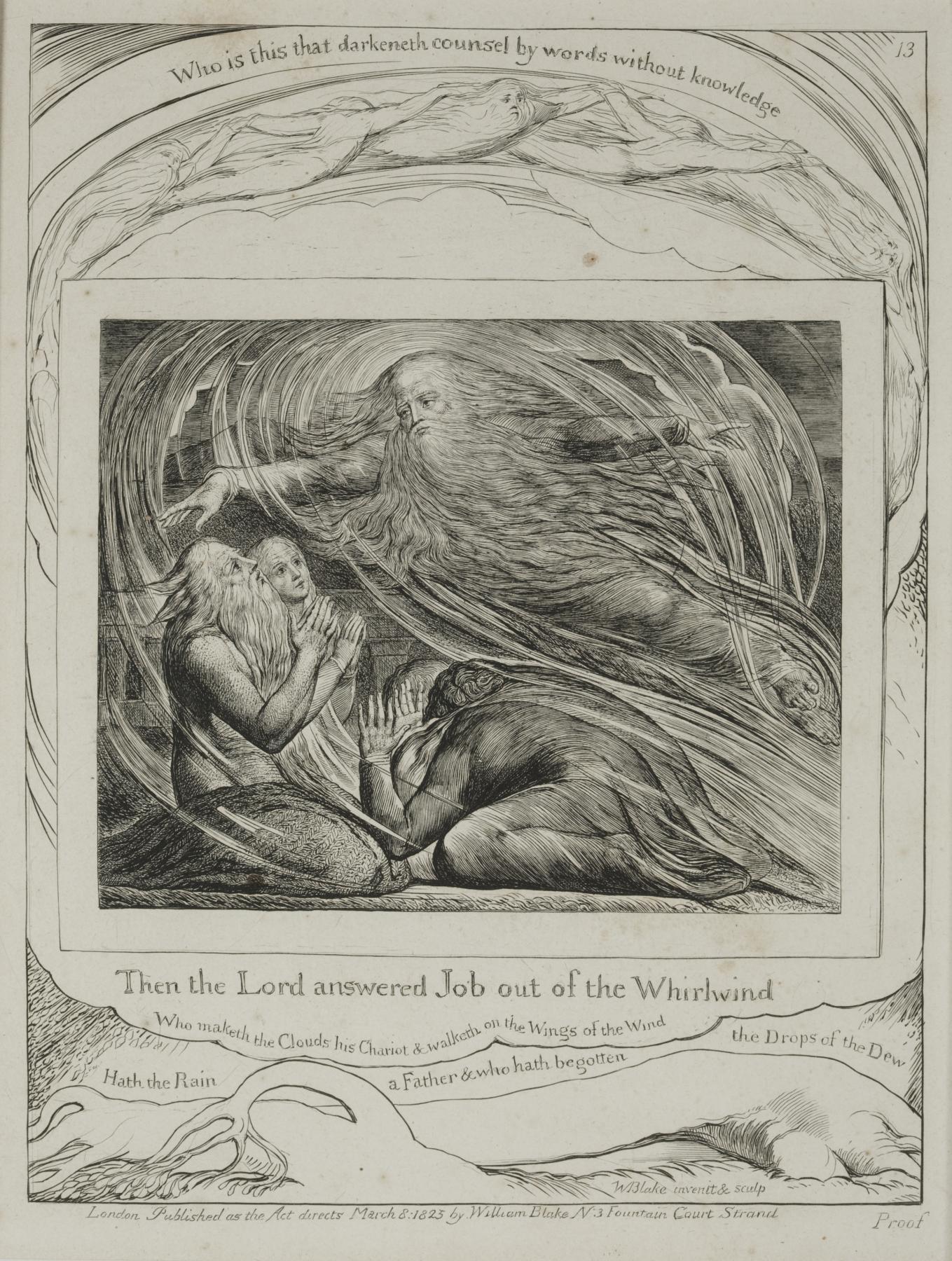
 Blake's book, ILLUSTRATIONS TO THE BOOK OF JOB, consists of 21 plates which tell Job's story in a few words and in highly symbolic pictures. Plate 13 represents the encounter of Job with God in the whirlwind which is the intimate experience of a man directly with the numinous. The next plate, number 14, depicts a rebirth of consciousness. The central picture is surrounded with images and words from the creation story in Genesis. The text includes "When the morning Stars sang together & all the sons of God shouted for joy." (Job 38:7) The central image depicts at the top four angels among the stars rejoicing. In the center is kneeling God with outstretched arms and a bright sun-like halo. Beside him are Apollo with the sun, and Artemis with the moon. At the lowest level are Job his wife and the three comfronters, who are allowed to witness the celebration of the this new stage of creation. The next seven plates illustrate the changed relationship between Job and God. 

Damon in A BLAKE DICTIONARY explains the process Job underwent in terms to going through stages represented by the Seven Eyes of God. In the end "His manhood purged of all error, is now complete." Each one of us is searching for images to represent indescribable experience. 

For links to Blake's illustrations consult the post: Blake's Pictures for Job

.

Sunday, September 06, 2009

The Four Zoas

A Subjective Reading
A Personal Experience

(A valued friend put me on to a discussion of 4Z found
on pages 203-32 of Blake's Sublime Allegory. Most
[or all?] of this post derives from that essay: On Reading the Four Zoas by Mary Lynn Johnson and Brian Wilkie. Hopefully there may be other posts to come on 4Z.)

"...we want most to encourage the sort of visceral and
personal response to this deeply introspective poem
that we believe Blake demands of his readers." (203)

"...we must recognize that the movement of the poem...yields its meaning in proportion to our
willingness to examine what happens within us."

After those lines on the first page the writers proceed
with a cursory statement of the plot; that's revealed
in the first page of 4Z:

"Four Mighty Ones are in every Man;
a Perfect Unity
(John XVII c. 21 & 22 & 23 v)

Cannot Exist. but from the Universal
Brotherhood of Eden
(John I c. 14. v)

The Universal Man. To Whom be
Glory Evermore Amen"
(John I c. 14. v)

The Universal Man of course is Albion-- representing
an eternal Great Britain, representing the people of
the world in Eternity, representing the perfect you.

"Albion looks up, rises from the rock in just wrath and is about to walk 'into the Heavens'" (Erdman)

The "Four Mighty Ones" (the four Zoas) are Tharmas,
Urthona, Urizen, and Luvah. Blake "begins with
Tharmas..", but before the "beginning " he tell us about
Los (the worldly version of Urthona), "Urthona was his
name", who represents here all the Zoas, in Eternity
with "days and nights of revolving joy", then the plot
is announced:


"His fall into Division & his Resurrection to Unity His
fall into the Generation of Decay & Death & his
Regeneration by the Resurrection from the dead."

It's the old, old story everyone can read in the Bible;
In 4Z Blake gave us his version of it -- one of course
of many.

Saturday, September 05, 2009

FEAST OF THE ETERNALS

First posted September 2009 
At the conclusion of 4Zs, Blake created this beautiful poetic image of Tharmas and Urthona, body and spirit, Man and God, as they depart the Golden feast. Divisions have been reconciled, unity has been achieved, a new age has begun, rejoicing is underway.

Four Zoas: Night the Ninth, pg 137, (E 405)

"Then Tharmas & Urthona rose from the Golden feast satiated
With Mirth & joy Urthona limping from his fall on Tharmas leand
In his right hand his hammer Tharmas held his Shepherds crook
Beset with gold gold were the ornaments formed by the sons of Urizen
Then Enion & Ahania & Vala & the wife of Dark Urthona
Rose from the feast in joy ascending to their Golden Looms
There the wingd shuttle Sang the spindle & the distaff & the Reel
Rang sweet the praise of industry. Thro all the golden rooms
Heaven rang with winged Exultation All beneath howld loud
With tenfold rout & desolation roard the Chasms beneath
Where the wide woof flowd down & where the Nations are gatherd together"

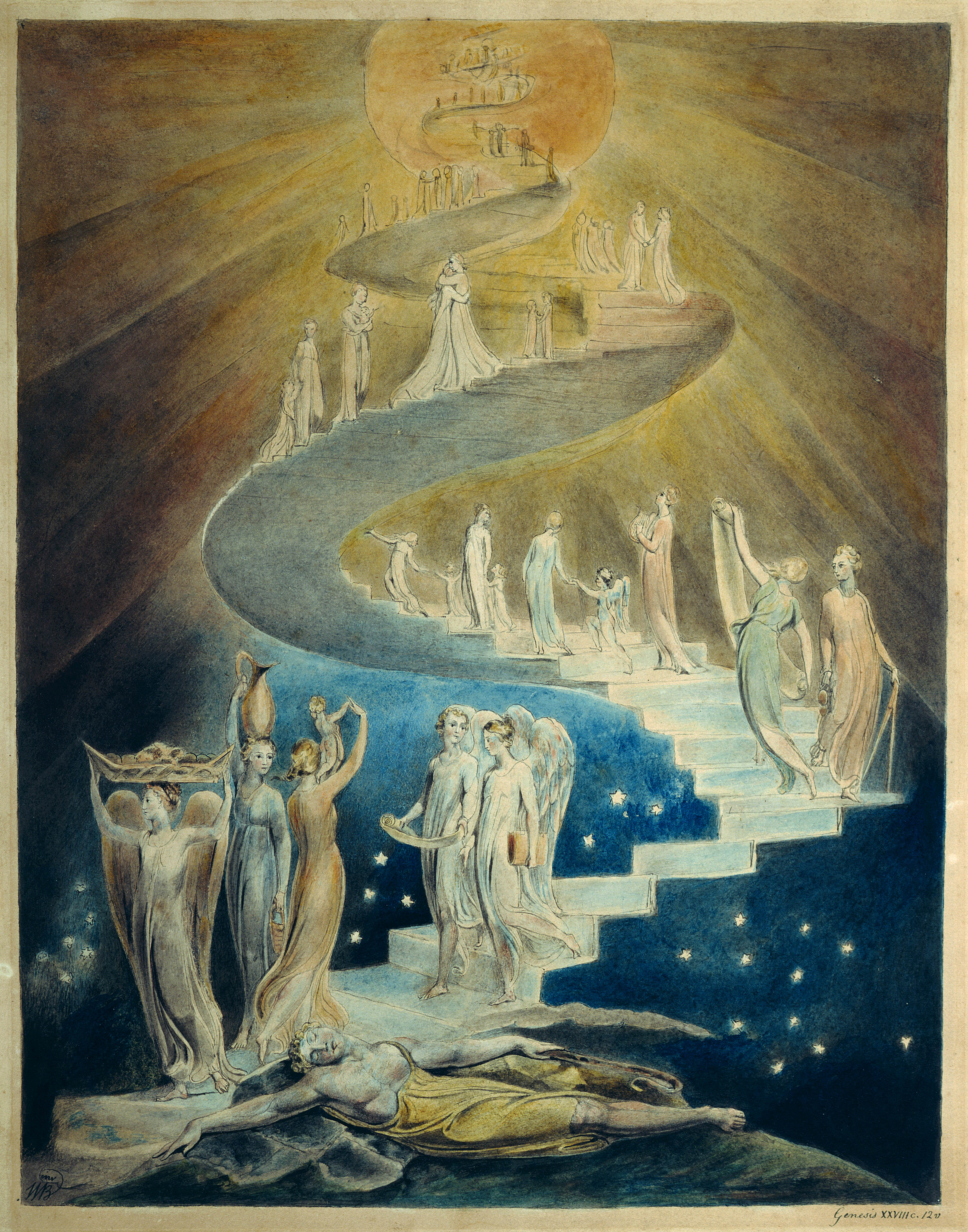
Since I haven't been able to find an image that represents the Feast of the Eternals, I'll substitute another scene of rejoycing, connecting the lower and higher levels. Note the bread, the wine, the scroll, the compass,the lyre and other of Blake's symbols. 
Wikipedia Commons
Jacob's Ladder
Genesis 28:12
 Jacob's Ladder

Here is a hymn we used to sing with the Catholic Charismatics at Georgetown University which uses a similar theme and expresses some of the same sentiments: GOD AND MAN AT TABLE ARE SAT DOWN.
God And Man At Table Are Set Down
O, welcome all you noble saints of old,
As now before your very eyes unfold
The wonders all so long ago foretold.
God and man at table are sat down.

Elders, martyrs, all are falling down;
Prophets, patriarchs are gath’ring round,
What angels longed to see now we have found.
God and man at table are sat down.

Beggers, lame, and harlots also here;
Repentant publicans are drawing near;
Wayward ones come home without a fear.
God and man at table are sat down.

When at last this earth shall pass away,
When Jesus and his bride are one to stay,
The feast of love is just begun that day.
God and man at table are sat down.

(Copyright 1972, Dawn Treader Music.)


Friday, September 04, 2009

More Resources

The Tate Museum in London is one of the fountains of Blake Learning. There you might find more examples of Blake's graphic art than anywhere else. They have built an online resource for just what we want:
William Blake Online.

If you click on the Collection, it may be slow coming up, but it's worth it. Click on B to get to Blake, then click on one of the pictures and put it in another window to give the largest image.
.

JOB: BLAKE'S PICTURES

Wikipedia Commons
Illustrations of the Book of Job
Plate 13

If you enjoy looking at pictures as I do, you can introduce yourself to Blake's understanding of Job by looking at the pictures he made. There are two series in the Blake Archive. First the plates for his book ILLUSTRATIONS OF THE BOOK OF JOB, which are black and white engravings. The central picture is surrounded by snippets of text from the biblical Job or elsewhere, and decorative images with symbolic meaning. 

From one viewing you can get a flavor or the work, but study is required to learn more of what Blake wanted to convey of his vision.

Click on this link and page down to the illustrations and the text in Wikipedia

In the Blake Archive view the engraved Illustrations of the Book of Job.

In the Archive you will also find Blake's watercolors of the same scenes from Job which he produced for Thomas Butts. Absent are the symbolic borders, but present are the lovely colors. For aesthetic purposes these pictures are the most satisfying, but they convey less of Blake's understanding of Job. 

Enjoy!

BOOK OF JOB

.
Satan before the Throne of God Click on image to see detail.

The Book of Job represents a strong link among the Bible, Blake and Jung. In each their writing about Job involves development of thinking about the relationship of God and man. The Book of Job is a unique book in the Old Testament as it explores changing ideas about God; Jung's ANSWER TO JOB is the product of the wisdom he developed through experience of unconscious realities; Blake's ILLUSTRATIONS TO THE BOOK OF JOB develops the theme of Job as a part of Blake's vision.

Each author worked in his own milieu. JOB in the OT is a man of the OT culture undergoing the kind of encounters with God had by Abraham, Moses and the patriarchs. In ANSWER TO JOB, Jung works with psychological dynamics as expressed by the character Job in experiencing God's revelations. Blake creates an illustrated expression of Job's experience in the context of images from a broad understanding of psychological/spiritual symbols. The three documents complement one another and together enhance our understanding of the evolution of the consciousness of God.

There will be more about Job later; its a big subject.
.

Wednesday, September 02, 2009

SPIRITUAL DESCENDENTS

Apparently Blake eventually realized that he had been
blessed and singled out to give what he had received,
not to to the small circle of folks around him, but
to the generations which would follow. The furious
effort that he put into his work in spite of the
slight affirmation he received, indicates to me that
he believed that his influence could penetrate
history as psychological development caught up with
him. He could look back at Homer, Jesus and Paul
(among others), who produced not for their
contemporaries but for their spiritual descendants,
and seek to be among them.
__________________________________________
Of this frontispiece for JERUSALEM, Erdman says: "We may suppose that Los in his London human form as William Blake, is entering a dark place with his illumination, as Jesus enters Hell with his key; that he is leading us toward a scene of action; that his arresting hand invites our attention; that he is preparing to give himself, as Milton on the title page of Milton." Los Entering The Grave


FOURFOLD READING

One of the better known sayings of William Blake concerns "Fourfold Vision." This is from a letter he wrote to his long term friend and supporter Thomas Butts.

"Now I a fourfold vision see
And a fourfold vision is given to me
Tis fourfold in my supreme delight
And three fold in soft Beulahs night
And twofold Always. May God us keep
From Single vision & Newtons sleep"

Blake's ability to envision the psyche as fourfold can be used as a guide to reading Blake on for different levels.

1) It would be possible to read him at the literal level as an account of material, sensual events. This may be the most difficult way to read him because his account would be of historical characters meeting mythological or fictional ones, people being thrown into furnaces or ground up by harrows, curtains being hung in the far reaches of space, and individuals dividing into multiple individuals. Our mind would reject these images as accounts of material activities just as we reject reading all mythologies as history. This kind of reaction could be said to be that of Tharmas. ("a portion of the Soul discerned by the five Senses")

2)We may read Blake on a reasoning level, associating his images with thought forms or patterns which are familiar to our rational minds. So we split off various dimensions of his thought and influences and look at these objectively building systems to explain some aspect of the body of work he produced. In this case we are viewing Blake as Urizen (symbolizing Reason) would view him. Blake portrayed this level of thinking with his famous image of Newton. Image of Newton

3)At the level of emotion we may become involved with the processes he describes, as psychic realities. We begin to see our own psychological process in terms of the characteristics and functioning of Blake's Men, Emanations, and Specters. As Luvah (who include all emotions) we enter into the dynamics of the interactions among Blake's portrayals of our inner functions.

4)The level of imagination represents a transformation or conversion to a spiritual perception. At this level the spirit will speak through the words, not just with or in the words. If Blake is inspired himself, (and he seemed to believe that he was a prophet in the same sense as the OT prophets;) his words can transmit to our spirits through a direct connection with the spirit in him. This level of communication, which Blake called Imagination, was his primary interest. His time, his energy, his goods, his thought, his labor were directed toward expressing Imagination and trying to awaken it in others. Through Imagination we get the fullest understanding of Blake. Non-sensory perception is represented by Urthona (the creative imagination of the individual.)


America a Prophecy,
Title Page "In the mental realm of the prophetic cloud a female and a male philosopher are assisted by a page-turning child . The alert female is already doing so, for the girl at her back is directing us, not her, to the subtitle and the battlefield....The leaping female turns the page." (Erdman)


If we focus on which of these fourfold methods we are using to read (or to understand one another, or to teach our children, or preform various other tasks), we gain a better understanding of the meaning for Blake of fourfold vision, and a greater ability to perceive fourfold reality.

Read Blake or About Blake

People interested in Blake are more apt to read
about Blake than to read Blake. Reading The Four
Zoas, Milton, or Jerusalem are awesome undertakings.
Until you've begun to understand the man's language,
it's a losing proposition. There's a core set of
metaphors that he used repeatedly, although like all
metaphors his are subject to various entonations, and
often used for an object or its opposite.

To enable intelligent reading of the major prophecies
there is a great abundance of interpretations of his
works. Where to begin??? Those of us who have made a
few steps in that direction can perhaps give a bit of
guidance to the beginning student.

Northrup Frye's Fearful Symmetry was the work that
made me a life long lover of Blake's poetry. It's not
easy; I read it five times before I was able to get
more than a few glimmers of light. But it's very
rewarding; you're likely smarter than me, in which
case one or two readings may get you well into the
big poems.

Frye was a celebrated literature critique; after
finishing Fearful Symmetry he said that if he had it
to do over, he would have written more of an
introduction than what he actually did.

The one who gave the simplest introduction for me
was Milton Percival's Circle of Destiny; it's more
systematic and more elementary.

But Kathleen Raine's Blake and Tradition was what made
me a real enthusiast. That's the most easily readable
one, and it's filled with some of Blake's loveliest
pictures. Unfortunately Blake and Tradition is out of
print now, but a fairly good substitute may be found
in her little book, Blake and Antiquity.

Put any books recommended here in Amazon's website,
and you'll find they may have an advanced price, but
page down and you most often see other copies (used
or new) on sale much more cheaply (that's the virtue
of Amazon's farm system).

There is also an amazing amount of valuable information
on line; and this website is here to help you with
any questions you may have.

Good luck with your study of William Blake.

Monday, August 31, 2009

JUNG AND SPIRIT

Some people question the Christianity of Carl Jung.
He divided his religious life from his professional life,
but in later years he became more open about revealing
his inner relationship to God . Although he never
spoke of his religion in the conventional religious
terminology that had been used by his family for
generations, he said enough to show that he had a
faith that was deep and personal.

"When John Freeman asked Jung in a 1959 BBC interview
if he believed in God, he answered, "I don't need to
believe....I know," thereby landing himself in
controversy again."

"The divine Presence is more than anything else. There
is more than one way to the rediscovery of the 'genus
divinum' in us. This is the only thing that matters....I
wanted the proof of a living Spirit and I got it....Don't
ask me at what price....I don't want to prescribe a way
to other people, because I know that my way has been
prescribed to me by a hand far above my reach. I know
it all sounds so damned grand. I am sorry that it does,
but I don't mean it. It is grand and I am only trying to
be a decent tool and don't feel grand at all."

Letter to FR.Victor White

This sounds like a man who knew the Spirit within.
Jesus didn't ask for more than that.

'The Descent of Peace' from On the Night of Christ's Nativity.

Quotes from CARL JUNG: WOUNDED HEALER
OF THE SOUL by Claire Dunne

Link to Wounded Healer


Saturday, August 29, 2009

Blake and Jung

Most Blake students have a passing acquaintance with
psychology, and especially with jungian psychology.
Although coming from very different backgrounds,
Blake and Jung had a great deal in common:

Jung was the son of a minister, the grandson of two
ministers, the nephew of dozens of them. Nevertheless
when he was four he dreamed that a gigantic turd had
fallen from the sky upon the local cathedral.

Blake was the son of a draper -- from a lower middle
class family. When he was four he ran screaming to
his mother to report that he had seen an ugly God in
his window. His religious experience presumably
sprang from the "radical dissenter" values and beliefs
of his mother.

The ugly God dominated Blake's thoughts for the next
three decades. The pages of his poetry were filled
with description of the ugly God: in
Urizen;
Nobodaddy was another name he used.

So we may say that both men had a prophetic role
against the established religion of their day. However
both of them are very popular among people who, like
them, deplore the corruption and excesses of so much
of popular religion.

To gain a close acquaintance with Jung and especially
to see how closely he resembled Blake, you need to
read Memories, Dreams, Reflections.

VISIONS of JUNG & BLAKE

After returning from a long, near fatal illness C G Jung experienced a state where visions absorbed his nightly pursuits. 
 
MEMORIES, DREAMS, REFLECTIONS (PG 295,296):
  "We shy away from the word "eternal," but I can describe the experience only as the ecstasy of a non-temporal state in which present, past, and future are one. Everything that happens in time had been brought together into a concrete whole. Nothing was distributed over time, nothing could be measured by temporal concepts. The experience might best be defined as a state of feeling, but one which cannot be produced by imagination. How can I imagine that I exist simultaneously the day before yesterday, today, and the day after tomorrow? There would be things which would not yet have begun, other things which would be indubitably present, and others again which would already be finished and yet all this would be one. The only thing that feeling could grasp would be a sum, an iridescent whole, containing all at once expectation of a beginning, surprise at what is now happening, and satisfaction or disappointment with the result of what has happened. One is interwoven into an indescribable whole and yet observes it with complete objectivity."  
 
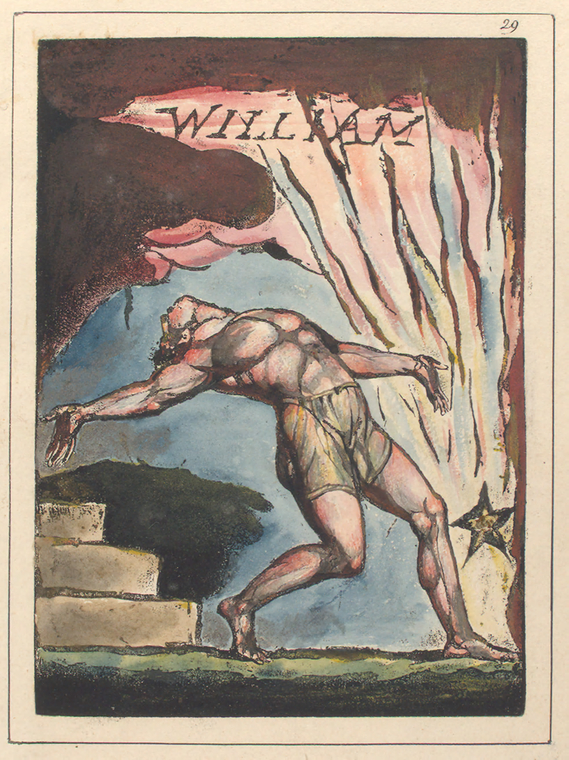
Milton, Plate 32 Erdman says of this image "Knowing it will be impossible to receive the full inspiration of Milton by the mind alone, Blake has to go and catch a falling star." 
 
New York Public Library
Milton
Plate 29 [32]

 Blake's experience of visions, which must have been similar to Jung's, are conveyed to us in a totally different way. Jung used an intellectual, objective way to describe an emotional, subjective experience. Blake involves us in his experience by evoking suggestive images to allow us a perception of the non-temporal, simultaneous, interwoven wholeness. 
 
Here is an example from Blake's MILTON, plate 39 (E 140): 
 
"Suddenly around Milton on my Path, the Starry Seven
Burnd terrible! my Path became a solid fire, as bright
As the clear Sun & Milton silent came down on my Path.           
And there went forth from the Starry limbs of the Seven: Forms
Human; with Trumpets innumerable, sounding articulate
As the Seven spake; and they stood in a mighty Column of Fire
Surrounding Felphams Vale, reaching to the Mundane Shell, Saying

Awake Albion awake! reclaim thy Reasoning Spectre. Subdue        

Him to the Divine Mercy, Cast him down into the Lake
Of Los, that ever burneth with fire, ever & ever Amen!
Let the Four Zoa's awake from Slumbers of Six Thousand Years"


Friday, August 28, 2009

IMMORTAL GAIN

From a letter of consolation which Blake wrote to his
friend Hayley we read:

"good many other softenings to the whole--I know that
our deceased friends are more really with us than when
they were apparent to our mortal part. Thirteen years
ago. I lost a brother & with his spirit I converse daily &
hourly in the Spirit. & See him in my remembrance in
the regions of my Imagination. I hear his advice & even
now write from his Dictate--Forgive me for expressing
to you my Enthusiasm which I wish all to partake of
Since it is to me a Source of Immortal Joy even in this
world by it I am the companion of Angels. May you
continue to be so more & more & to be more & more
perswaded. that every Mortal loss is an Immortal Gain.
The Ruins of Time builds Mansions in Eternity."

Blake's brother Robert as shown in the poem Milton.

Larry expressed the sentiment that, "every Mortal loss
is an Immortal Gain," at our Quaker Meeting recently.
Or perhaps he used this similar quote, "I verily believe
it Every Death is an improvement of the State of the
Departed." What a comfort to be confident as Blake was
that our loved ones have gone on to better things when
they leave us.

The Ascension
.

Thursday, August 27, 2009

Children of the Future Age

In Blake there are no simple answers and no single
answers. In his Introduction to A BLAKE DICTIONARY,
Damon says:

"Blake was not content only to record: he wanted to
force his reader to think along with him. No great work
of art has its meaning on the surface, ... He was
determined not to have his own meanings sidetracked
by surface meanings. So he removed surface meanings."

We struggle to figure out what Blake meant as he wrote
it, what his imaginative insights mean to us, what they
mean to others, what they would mean if applied to the
psyche or the society.

The poem to which this quote is prefaced:
Link to Blake Archive with multiple copies
Link to Plate and Text

"Children of the future age
reading this indignant page
know that now in former time
love, sweet love
was thought a crime."

This brings to my mind how our children will see and
experience the world differently from the way we do.
Our indignation is different from theirs. Love, sex,
and criminality play different roles in society in
different ages.
Blake is interested in a New Age where the reasoning
power will not dominate the imagination, where many
values will be inverted, where forgiveness will replace
wrath. But he didn't give us a map to guide us into the
world to come, just a myth.

Tuesday, August 25, 2009

ROBES OF BLOOD

Larry wrote:  KNEELING MAN AT THE SHORE
The features and meanings in the
Arlington Tempera
are subject to various interpretations; that's true in fact of all works of art. In particular color representations of this picture reveal things lost to monochrome viewers. The kneeling man at the shore wore a crimson robe. The red robe contributes to Damon (A BLAKE DICTIONARY) seeing the red-robed man kneeling on the shore as Luvah, the Zoa who represented the emotions to Blake. Raine viewing the scene from the Greek mythological perspective, saw him as Odysseus, Digby (SYMBOL AND IMAGE IN WILLIAM BLAKE) saw him in a function of Blake's larger mythological structure as Albion and Jesus who represent the total Humanity.

The contrast between Raine's (BLAKE AND TRADITION) and Digby's interpretations of the picture show how full is the meaning conveyed by the artist to two scholars in very different disciplines. The Greek origin of the setting comes out in Raine's identification of the images(and the total story) as very clearly an adaptation of the Odyssey. Cave of the Nymphs Meanwhile the same images lend themselves in a more direct sense to the system that Blake created; to a great degree a psychological one. (Digby perceived the Greek story told here in strictly Jungian terms.)

In all likelihood Blake portrayed this image to convey all
three facets of the complex character: the red robed man on the shore should be seen as by Damon as Luvah; and as by Raine as Odysseus; and as by Digby as Albion and Jesus. Since the kneeling man is wearing a red robe he suggests to Blake readers a recurring image whether we see him as Odysseus, Luvah, Jesus or Albion.

Blake used 'robes of blood' as a major symbol in his poetry. Look at:

FOUR ZOAS 1-13.8-9; E308:
"Eternity appeard above them as One Man infoldedIn Luvah[s] ROBES OF BLOOD & bearing all his afflictions"

FOUR ZOAS 2-32.13-14; E321
"The heavens were closd and spirits mournd their bondage night and day And the Divine Vision appeard in Luvahs ROBES OF BLOOD"

FOUR ZOAS 7a-87.43-4; E369|
"Turn inwardly thine Eyes & there behold the Lamb of God
Clothed in Luvahs ROBES OF BLOOD descending to redeem"

Blake undoubted knew well the account in Rev. 19 of the appearance of the Christ at the end times, including verse 13: "And he was clothed with a VESTURE DIPPED IN BLOOD: and his name is called The Word of God." (KJV)

And finally we come to plate 42 in MILTON including:

"Then as a Moony Ark Ololon descended to Felphams Vale
In clouds of blood, in streams of gore, with dreadful thunderings
Into the Fires of Intellect that rejoic'd in Felphams Vale
Around the Starry Eight: with one accord the Starry Eight became
One Man Jesus the Saviour. wonderful! round his limbs
The Clouds of Ololon folded as a GARMENT DIPPED IN BLOOD
Written within & without in woven letters: & the Writing
Is the Divine Revelation in the Litteral expression:
A Garment of War, I heard it namd the Woof of Six Thousand Years"

We may suppose that Digby's acquaintance with these
accounts led him to name the man on the shore Albion - Jesus.
Would anyone care to exegete this last passage? (Damon suggested spiritual war)

Ellie's reply:
I've heard it said that life is a struggle. We can't expect to get through it without being battered and bruised. In our daily relationships we endure wounds and inflict wounds, inadvertently as well as deliberately. Most of our wounds are to our psyches, both our own and those whom we attack through our own unconscious defensiveness or projection.So we ourselves can be seen as the bloodied robes. Our psyches as well as our bodies are 'a clothing for the Soul Divine'. Joy and Woe In as far as we can see ourselves as members of the 'body of Christ'(1st Corinthians 12:27), as participants in the Divine Humanity which Blake called Albion, we also are the bloodied robes which Blake spoke of in regard to Luvah and Jesus. Sacred though these raiments be, they can be washed and mended and rewoven into unsullied garments suitable for entry into Jerusalem.

Monday, August 24, 2009

Blake's Image of Saints in Dante

Toward the end of his life William Blake began a series
of illustrations for Dante's DIVINE COMEDY for his
patron and friend John Linnell. Blake left 102 of these
watercolor illustrations when he died: seventy-two for
the Inferno, twenty for the Purgatorio, and ten for the
Paradiso. Blake's designs are said to be not mere
illustrations but commentary on Dante's text.
(Martin Butlin)

One illustration for the Paradiso particularly caught my
attention.

In Martin Butlin's WILLIAM BLAKE, published by the
Tate, he makes these comments on the picture I noticed:
"Blake illustrates the successive appearances of
St. Peter, St. James and St. John. St. Peter, who
questions Dante on Faith, is represented by Blake's
type for Urizen; St. James, who questions Dante on
Hope, as Luvah; and St. John, who questions Dante on
Love, as Los or the Poetic Genius. Together they
represent Reason, Feeling and Imagination. The
overlapping of the three globes in which they are
shown, embracing Dante and Beatrice whose echoing
gestures reflect harmony, is a marvelously vivid image
of reunion of Man's various elements that is requisite
of true salvation."

Quite a summation of the Bible, Blake's myth, religion
and psychology!

The picture named 'St. Peter, St. James, Dante and
Beatrice with St. John also' can be found at:


Blake's image from Dante

In this picture it is fascinating to see how Blake
integrated Dante's poetry into his own visual
vocabulary.

Dante's three conversations with St. Peter, St. James
and St. John about faith, hope and love respectively
are amalgamated into one scene. Blake himself
wouldn't be left out of the creative process, so he gives
the three saints correspondence to three of his Zoas.
He skews the character of the Zoas to align them with
the saints .

Urizen is a pretty good fit with St. Peter since Blake has
identified Urizen with the fallen church consistently.
The association of Urizen with faith is perhaps by his
building a structure to try to make sense of being.
Peter's first recognition of Jesus as the Messiah is a
prime example of his faith. The identification of Peter
with Urizen is implied by his facial appearance which is
congruent with multiple images of Urizen as he is
associated with the vengeful God of the Old Testament,
and by the faint image of the scroll which Peter holds in
his left hand.

For a rare image of the Four Zoes together, see:

4z's in Book of Urizen

If Luvah is paired with St. James, it might be on the
basis of putting into practice the spiritual truth we
receive, which is emphasized in the New Testament
'Letter of James.' I don't know why hope would be
associated with either St. James or Luvah.

Los, the Eternal Prophet, pictured as the descending
Holy Spirit becomes in the picture, St. John, the author
of the Apocalypse or 'Book of Revelation.' Although it is
not the characteristic usually assigned to Los, love is
entirely appropriate to him in his role as the Poetic
Genius opening the world to imagination. St. John
exemplifies love as the author of the gospel stressing
unity among men, and between God and man.

In his characteristic way of making his figures
ambiguous or subject to multiple interpretations, Blake
may have been thinking of the lower central image of
Dante and Beatrice as Albion, (Humanity as realized in
the one Man) or as Tharmas the fourth of the Four
Zoas, who can be associated with the senses or the
physical body.

Better students than I, of Dante, Blake and the Bible
should be able to see much more in this picture than I do.
Marriage of Heaven and Hell

Reading this little book gives you an ideal introduction to William Blake's values and writing style.

Rusty Shell is a long term scholar of Blake. His blog on MHH gave us a good, detailed, down-to-earth introduction to the early Blake. Read it and if you're really interested in MHH you'll find a bonus in the shape of a PDF (file), essentially a lesson plan for a class in William Blake's famous book.

If you want to go straight to MHH click on this site.

If you have questions, use the comment option.

Saturday, August 22, 2009

BLAKE: PHENOMENON OR VISIONARY

Was Blake widely read and influential among his contemporaries? NO.

Did he build institutions to transform society? NO.

Did he establish a school of thought to perpetuate his ideas? NO.

Was he a leader who changed his little corner of the world? NO.

Did he have wealth, power or success? NO.

Did he leave a legacy, a body of work in words and pictures, that is becoming recognized as a treasure for developing the human mind and spirit? YES!

When I look at the resources that have been made available for the study of this obscure artist and poet who lived about the time America was being born, I am delighted. Who else has all his poetry and prose available online. Who else has an online concordance to his work to make it immediately searchable for every word or phrase. Who has a web site devoted to displaying his graphic output in the most technologically sophisticated and artistically sensitive way.

So why have all this effort and all these resources been devoted to this artist whose books were produced by the two, or threes, sometimes by the dozens or left in manuscript form only?

Is he becoming known now because he is difficult to read and produces images which are mystifying at first glance? Or can we find some other reasons. Effort is being made into figuring him out. Some study him objectively to describe how he fits in the body of English literature, or how he was influenced by traditions of multiple sorts, or how the times in which he lived determined his understanding of the world. The structure of his work; the techniques he used; his relationship to philosophies, psychologies, religions; how he fits into various structures of thought in science, politics, aesthetics - all ways in which he is being studied as an object from every direction.

But there is another way to study him - subjectively. By looking at what he taught through his poetic visions and graphic images, by looking at the content, not just the form of his output; we can engage in the process of absorbing into our psyches what he had to teach. Of course one wouldn't want to allow someone to influence one's psyche unless one was convinced of the benevolence of the artist, poet or teacher.

So one way to get started on Blake is through becoming familiar with quotes from his works which encapsulate some of his original expressions of archetypal ideas.

"Everything possible to be believed is an image of truth."

"Eternity is in love with the productions of time."

"I give you the end of a golden string
Only wind it into a ball,
It will lead you in through heavens gate
built in Jerusalem's wall."

" Man was made for joy and woe
And if this he rightly know,
He through life may safely go,
Joy and Woe woven fine,
A clothing for the Soul Divine."

If we become convinced that we want to gain access to his insights, of course we will let him speak to us directly through the words of his poetry and the visual images. Of course we will get help in understanding his complex mythology from scholars and Blake enthusiasts. But we shouldn't allow ourselves to be drawn into making our studies objective rather than subjective. If we don't come to see Blake as a great man, with a gift of genius from God "to raise the consciousness on men to a perception of the Infinite", we will have missed the reason for studying him, and for all the effort that has been made to make him available to us.

EUROPE, Plate 13 "Till the night of holy shadows and human solitude is past!"

Wednesday, August 19, 2009

Beginning Blake

.
A Place to Begin

Anyone may learn to known and love William Blake. Small steps include reading, asking questions, making comments about posts made here (or anywhere else for that matter). We are ordinary people interested in Blake and anxious to meet and converse with any others.

Tip 1:
The primary text for Blake is on line. The url is Contents

Tip 2:
If you want to locate a quote (or a word or phrase) click on the Concordance.

Tip 3:
If you have a question just comment on this (or any) post and ask it.

Rusty's God Blog: William Blake: The Marriage of Heaven and Hell

Rusty's God Blog: William Blake: The Marriage of Heaven and Hell

WB's CONVERSION

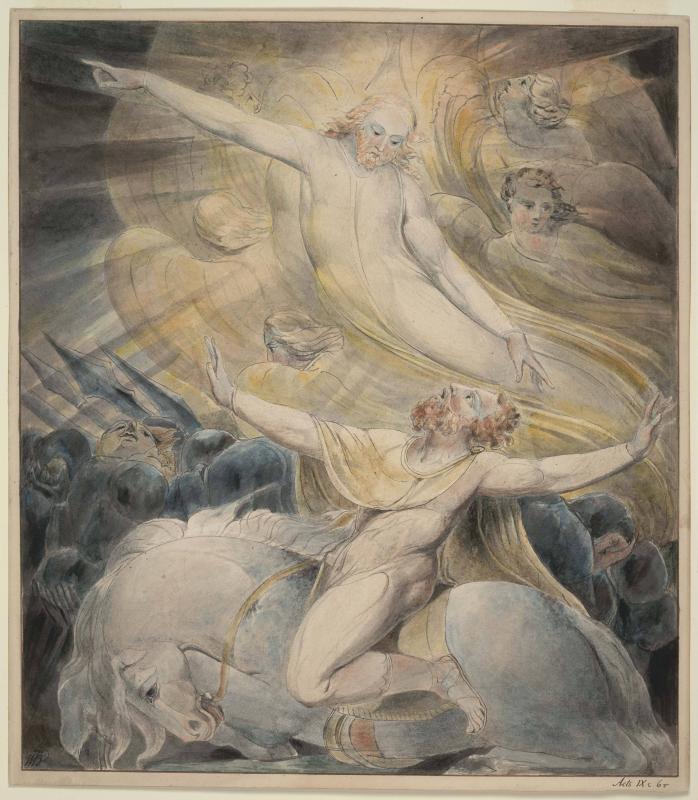
Here is an account of William Blake's conversion experience which he included in MILTON a POEM in TWO BOOKS. The experience he describes took place near the end of his sojourn in Felpham where he had been sorely tried by outer circumstances and inner doubts.

MILTON 21.4

"But Milton entering my Foot; I saw in the nether
Regions of the Imagination; also all men on Earth,
And all in Heaven, saw in the nether regions of the Imagination
In Ulro beneath Beulah, the vast breach of Miltons descent.
But I knew not that it was Milton, for man cannot know
What passes in his members till periods of Space & Time
Reveal the secrets of Eternity: for more extensive
Than any other earthly things, are Mans earthly lineaments.

And all this Vegetable World appeard on my left Foot,
As a bright sandal formd immortal of precious stones & gold:
I stooped down & bound it on to walk forward thro' Eternity.

MILTON 22.4

"While Los heard indistinct in fear, what time I bound my sandals
On; to walk forward thro' Eternity, Los descended to me:
And Los behind me stood; a terrible flaming Sun: just close

Behind my back; I turned round in terror, and behold.
Los stood in that fierce glowing fire; & he also stoop'd down
And bound my sandals on in Udan-Adan; trembling I stood
Exceedingly with fear & terror, standing in the Vale
Of Lambeth: but he kissed me and wishd me health.
And I became One Man with him arising in my strength:
Twas too late now to recede. Los had enterd into my soul:
His terrors now posses'd me whole! I arose in fury & strength."

These are the phrases which lead me to call this a conversion
experience:
1) "reveal the secrets of Eternity"
2) "I stooped down & bound it on to walk forward thro' Eternity."
3) "And Los behind me stood; a terrible flaming Sun: just close Behind my back; I turned round in terror, and behold."
4) "And I became One Man with him arising in my strength:"
5) "Twas too late now to recede. Los had enterd into my soul: His terrors now posses'd me whole! I arose in fury & strength"

Since Los to Blake is the Prophet of Eternity - the expression of the creative Imagination - and Blake is speaking in his own voice in these words; I call it an account of a conversion experience, a decisive turning toward the Eternal.

Huntington Museum
The Conversion of Saul


Monday, September 15, 2008

Help

This blog leans heavily on hyperlinks. Use your mouse to click on any hyperlink, and it will take you to the subject of the link.

Click with this right button of your mouse, and you may bringup the subject in another tag or window, which allows you toreturn quickly to what you were reading at first.

The sidebar contains a lot of links:
1. With the Archive section you may reach any post to this blog. Click on a month, and it shows all the posts for that month.

2. The labels give you a view of all the posts with that subject.

3. Contributors will give you a view of the profile of the oneyou link on.

4. Links to Online Blake give you access to many Blake websites including his complete works.

Tuesday, February 12, 2008

Blake's Vision of God


Of all the Christian spiritual leaders of the past
200 years this British poet would be placed near
the top by any enlightened Christian. God
was the primary theme and motif of his poetry, his
pictures, and his life. His poetry and pictures
contained his revelations of the reality of life,
ultimate reality, which we call God.

At three he ran screaming to his mother after the
sight of a grim punishing God in his window. A few
years later a similar vision embraced a roomful of
angels. Brought up in a Swedenburg and/or
Moravian climate he escaped the common
fallacies that go by the name of Christian
orthodoxy. But the first half of his life he
occupied wrestling with the Old Testament God.

With The Marriage of Heaven and Hell
he inverted the conventional values of good,
obedient, unimaginative church goers (more likely
to idolize and follow their minister than their God).
Blake called them angels, and called those who
ask questions, who think independently, who
experiment, devils.

With Songs of Innocence and Experience he
portrayed first the childlike, who have not met a
judging God, and second those who have tasted that fateful experience.

In his prophetic books Blake exhaustively pictured
the judging God, the Rulemaker and Enforcer
worshipped today by 'fundamentalist'
Christians and Muslims.

Through the years Blake gradually got free from
the baleful influence of a God of Control, used
mainly by the most powerful to control the rest
of us. He came to refer to him as Old Nobodaddy.

In the fullness of time Blake met the God introduced
to us by Jesus: the Loving Heavenly Father. The
gospel was a matter of forgiveness. Most of us have
to forgive (our) God, forgive our parents, our
spouses, most of all ourselves. Blake's First Vision of Light is the moment when he came into that glad awareness. Afterward the old negative ideas of Diety faded away to be replaced by the New Creation characterized by the Gifts of the Spirit.

Image from Songs of Innocence: Jesus and children in LITTLE BLACK BOY. Click on image for enlargement.


Saturday, January 26, 2008

psytheomyth

.
Genesis: Adam, Eve and Satan

Psychology, Theology, Mythology: in the last analysis the three things all merge together into one, especially in Blake. Every verse tells something about the human mind, and about God, all wrapped together in the language of poetry and myth. For an example look at an analysis of Genesis 3.

Tuesday, January 01, 2008

Resources

The links provide the best Blake online:
1. The Primer together with Ram Horn'd with Gold is Larry Clayton's online book with a comprehensive description of Blake's work especially emphasizing his spiritual dimension.

2. Contents gives access to most of Blake's works in poetry and prose.

3. The Concordance shows the location(s) of any word you offer it.

4. The Blake Archive allows you to read the text and view the pictures of all of his illuminated works.

Monday, December 31, 2007

Golgonooza

This is a response to friend Clint Stevens' post to the Yahoo Blake group.

It really doesn't respond to Clint's architectural questions, but the general question of Golgonnza in Blake's vision. However re spatial concepts: you may understand that the culmination of Gol is in Beulah, where space is completely evanescent. In that light Blake may be expected to use spatial (and temporal) terms playfully.

Blake was a highly spiritual (religious) man and Golgonooza can be best seen in that light.
In my simplistic understanding of Golgonooza it is the work of "art" and "artists", or perhaps the imaginative work of creative people in the world, or in Albion if you prefer, or in your own psyche-- of a period of 6000 years.

These works have a ambiguous history or nature, continually building and destroying like Jeremiah was called to do. You might also call it the work of angels in a demonic world (truth forever on the scaffold). The best work of the artisans of Golgonooza is chequered or flawed with many vestiges of Ulro, but consciously or hopefully moving toward Beulah. There of course it becomes Jerusalem.

The Church, which purports to be about growing into or building the kingdom of God can only be one of the lesser dimensions of Gol's inhabitants. As the master said,
"A Poet a Painter a Musician an Architect: the Man
Or Woman who is not one of these is not a Christian"
(LAOCOON prose; Erdman 274).

The final image from Illustrations to the book of Job (The Linnell Set) shows Job's family as musicians playing their instruments.

Sunday, December 02, 2007

Exaggeration for Emphasis

People use one (or both) of two basic languages:
1. The vernacular or ordinary
2. Poetic language.

Our Blake spoke the poetic language from birth (as do most babies, but they unfortunately soon lose it). In many places ordinary language is understated: "I don't like him", may announce an intention of killing him.

In contrast poets are free to exaggerate. It may shock us into the truth they mean to convey. Blake was very, very good at that. Sometimes we just have to make allowances, but best of all is to be shocked into the truth.

Now which of these languages do we have here:
Good and Evil are deadly dreams that the Soul may fall into when it leaves Paradise following the Serpent.

Tuesday, November 27, 2007

Lewis and Blake

We know that Lewis was familiar enough to name one of his best books, The Great Divorce, in response to Blake's Marriage of Heaven and Hell. But I wonder if he had read the major poems.

"'When Aslan said you could never go back to Narnia,' he meant the Narnia you were thinking of. But that was not the real Narnia. That had a beginning and an end. It was only a shadow or a copy of the real Narnia which has always been there and always will be there: just as our own world, England and all, is only a shadow or copy of something in Aslan's real world. You need not mourn over Narnia, Lucy. All of the old Narnia that mattered, all the dear creatures, have been drawn into the real Narnia through the Door. And of course it is different; as different as a real thing is from a shadow or as waking life is from a dream.'" (from The Last Battle, 1956)"

Wednesday, September 26, 2007

Blake and the Bible

I've written a detailed explanation of Blake's basic use of the Bible and of the meaning it had for him. Go to Finally the Bible.

Monday, August 13, 2007

Jesus said Love

Early on in his career Blake realized that the church had it all wrong. Since the days of Constantine the church has been the bastion of society, the very same (sort of) society that Jesus deplored. He didn't suck up to the organizations; he named them for what they were. They were Rome and the Temple Worship; they were and are about power. But power is not Jesus's program; he preferred Love.

They cast him out; and Blake also doesn't go well in church.

Perception of the Infinite

Ezekiel once acted out a bizarre symptom of the prospects of the Israelites, lying for 3 months on his right side, then 3 months on his left. Mr.Blake once had a conversatiion with him and asked him why he had done it and the answer came clearly: "the desire of raising other [people] into a perception of the infinite".

Who can doubt that William actually had that interview with Zeke? But if truth be known, that desire became the agenda for Blake's life, and perhaps the generic life purpose of every true prophet.

He saw things that most of us don't, and he urgently needed to show them to us, to show us how to see them.

There are many kinds of seeing and many levels of consciousness, but with the natural proclivity to resort to the dialectic we might say there are two:

1. The sense-based, natural, materialistic consciousness (Blake called this Ulro; Jesus called it Hell).

2. Vision, coming forth from the inner man, the Light, the Now. It's a different kind of consciousness, a perception of the infinite (Blake called it Eden; Jesus called it the Kingdom of Heaven or the Kingdom of God).

Jesus showed us with his life how to live eternally; and he told us we could do it. Blake did it, periodically at least, and like Jesus he wanted us to share that heavenly gift.

He called it Vision; that's what he lived for, those eternal moments were all that matters. If you can't do it continuously, then you can talk about it, write about it, draw it, paint it. He did (and you can) show us how to see.

Do you want to see? Read Blake.

Friday, July 20, 2007

Urizen and Ahania

You will find Assault on a Woman here.

For further information keep following the Blake Primer.