Ghost of Abel, Plate 2, (E 272)
"Abel-- Are these the Sacrifices of Eternity O Jehovah, a Broken Spirit
And a Contrite Heart. O I cannot Forgive! the Accuser hath
Enterd into Me as into his House & I loathe thy Tabernacles
As thou hast said so is it come to pass: My desire is unto Cain
And He doth rule over Me: therefore My Soul in fumes of Blood
Cries for Vengeance: Sacrifice on Sacrifice Blood on Blood
Jehovah-- Lo I have given you a Lamb for an Atonement instead
Of the Transgres[s]or, or no Flesh or Spirit could ever Live
Abel-- Compelled I cry O Earth cover not the Blood of Abel
Abel sinks down into the Grave. from which arises Satan
Armed in glittering scales with a Crown & a Spear
Satan-- I will have Human Blood & not the blood of Bulls or Goats
And no Atonement O Jehovah the Elohim live on Sacrifice
Of Men: hence I am God of Men: Thou Human O Jehovah.
By the Rock & Oak of the Druid creeping Mistletoe & Thorn
Cains City built with Human Blood, not Blood of Bulls & Goats
Thou shalt Thyself be Sacrificed to Me thy God on Calvary
Jehovah-- Such is My Will. Thunders
that Thou Thyself go to Eternal Death
In Self Annihilation even till Satan Self-subdud Put off Satan
Into the Bottomless Abyss whose torment arises for ever & ever.
On each side a Chorus of Angels entering Sing the
following
The Elohim of the Heathen Swore Vengeance for Sin! Then Thou stoodst
Forth O Elohim Jehovah! in the midst of the darkness of the Oath! All Clothed
In Thy Covenant of the Forgiveness of Sins: Death O Holy! Is this Brotherhood
The Elohim saw their Oath Eternal Fire; they rolled apart trembling over The
Mercy Seat: each in his station fixt in the Firmament by Peace Brotherhood
and Love.
The Curtain falls
The Voice of Abels Blood
1822 W Blakes Original Stereotype was 1788"
Here you may meet William Blake, join hands in a discussion, ask questions. This is your Blake Commentary.
Saturday, July 16, 2011
EVOLUTION OF CONSCIOUSNESS
Friday, July 15, 2011
BLAKE AT YALE
Paul Mellon began collecting the works of William Blake in 1941. You can read about Mellon's acquisitions of Blake's works in The Human Form Divine by Patrick Noon. He states: "After 1941, hardly a year passed without Mr. Mellon acquiring some Blake opus. The harvest is impressive, consisting as it does of four tempera paintings, one mono-type, several hundred prints and watercolors, and several dozen engraved books; however, it is the twelve Illuminated Books that confer on this collection its stature of eminence."
The Illuminated Books in the Paul Mellon Collection:
Book of Thel (Copy B) and (Copy R)
Europe, A Prophecy (Copy A)
Songs of Innocence and Songs of Experience (Copy F) and (Copy L)
There is No Natural Religion (Copy B)
Songs of Innocence (Copy G)
Visions of the Daughters of Albion (Copy I)
America, A Prophecy (Copy M) and (Copy R)
Book of Urizen (Copy A) and (Copy C)
Jerusalem (Copy E)
The Illuminated Books in the Paul Mellon Collection:
Book of Thel (Copy B) and (Copy R)
Europe, A Prophecy (Copy A)
Songs of Innocence and Songs of Experience (Copy F) and (Copy L)
There is No Natural Religion (Copy B)
Songs of Innocence (Copy G)
Visions of the Daughters of Albion (Copy I)
America, A Prophecy (Copy M) and (Copy R)
Book of Urizen (Copy A) and (Copy C)
Jerusalem (Copy E)
The prize possession of the Mellon Collection at
![]() |
Jerusalem Plate 1 |
Yale is the only complete color copy of Jerusalem. Blake took great care in producing his final print of Jerusalem and it remained in his possession at his death.
Yale has made available to the public online the 537 items in the Blake collection. The University does not restrict the use of its Blake material as it is in the public domain.
Thursday, July 14, 2011
HUMAN IMAGINATION
Psychological work is done in cooperation between inner awareness and outward behavior. Blake wants to change how the outer world is experienced by changing the inner perceptions.
Kathleen Raine in Golgonooza City of Imagination tells us that:
"We must remember at all times that a 'world' for Blake is situated not in Cartesian space but in consciousness; therefore every change of consciousness changes the world." (Page 18)
and
"Blake, we must remember, is writing of creation not in terms of matter but of consciousness - the faculty which experiences'." (Page 16)
The first lines of Blake's first illuminated book acknowledge 'the faculty which experiences' as the 'true faculty of knowing.'
All Religions are One , (E 1)
"The Voice of one crying in the Wilderness
The Argument
As the true method of knowledge is experiment
the true faculty of knowing must be the faculty which
experiences. This faculty I treat of."
Raine continues:
"The Universe, according to Orphic tradition, is Apollo's lyre whose harmonies are a divine utterance, a divine communication of meaning and beauty. By banishing the phenomena from the Imagination - the 'faculty which experiences' - they are emptied of all significance, retaining only a quantitative existence. 'What is within is now seen without' and humankind 'raw to the hungry wind' live no longer in immeasurable incorporeal space but 'in a little and dark Land'. Yet even from this fallen race the world of Imagination is not wholly withdrawn; within every creature 'eternity expands'. the mortal worm, oppressed by Urizen, natural reason, has at all times access to the indwelling Imagination: (Page 19)
Jerusalem , Plate 27, (E 173)
"He witherd up the Human Form,
By laws of sacrifice for sin:
Till it became a Mortal Worm:
But O! translucent all within."
Four Zoas, Night II, Page 25, (E 314)
"Their eyes their ears nostrils & tongues roll outward they behold
What is within now seen without they are raw to the hungry wind
They become Nations far remote in a little & dark Land"
To Blake there is no impediment to gaining access to the ever expanding worlds of eternity because within each of us are openings through which we can pass from the mundane to imaginative. The means is available to us too through love, forgiveness, and expanded awareness.
Jerusalem, Plate 5, (E 147)
"I rest not from my great task!
To open the Eternal Worlds, to open the immortal Eyes
Of Man inwards into the Worlds of Thought: into Eternity
Ever expanding in the Bosom of God. the Human Imagination"
Illustrations for Milton's L'Allegro
Night Startled by the Lark
Blake's accompanying text: "The Lark is an Angel on the Wing; dull Night starts from his Watch Tower on a Cloud. The Dawn with her dappled Horses arises above the Earth: the Earth beneath awakes at the Lark's voice."
Kathleen Raine in Golgonooza City of Imagination tells us that:
"We must remember at all times that a 'world' for Blake is situated not in Cartesian space but in consciousness; therefore every change of consciousness changes the world." (Page 18)
and
"Blake, we must remember, is writing of creation not in terms of matter but of consciousness - the faculty which experiences'." (Page 16)
The first lines of Blake's first illuminated book acknowledge 'the faculty which experiences' as the 'true faculty of knowing.'
All Religions are One , (E 1)
"The Voice of one crying in the Wilderness
The Argument
As the true method of knowledge is experiment
the true faculty of knowing must be the faculty which
experiences. This faculty I treat of."
Raine continues:
"The Universe, according to Orphic tradition, is Apollo's lyre whose harmonies are a divine utterance, a divine communication of meaning and beauty. By banishing the phenomena from the Imagination - the 'faculty which experiences' - they are emptied of all significance, retaining only a quantitative existence. 'What is within is now seen without' and humankind 'raw to the hungry wind' live no longer in immeasurable incorporeal space but 'in a little and dark Land'. Yet even from this fallen race the world of Imagination is not wholly withdrawn; within every creature 'eternity expands'. the mortal worm, oppressed by Urizen, natural reason, has at all times access to the indwelling Imagination: (Page 19)
Jerusalem , Plate 27, (E 173)
"He witherd up the Human Form,
By laws of sacrifice for sin:
Till it became a Mortal Worm:
But O! translucent all within."
Four Zoas, Night II, Page 25, (E 314)
"Their eyes their ears nostrils & tongues roll outward they behold
What is within now seen without they are raw to the hungry wind
They become Nations far remote in a little & dark Land"
To Blake there is no impediment to gaining access to the ever expanding worlds of eternity because within each of us are openings through which we can pass from the mundane to imaginative. The means is available to us too through love, forgiveness, and expanded awareness.
"I rest not from my great task!
To open the Eternal Worlds, to open the immortal Eyes
Of Man inwards into the Worlds of Thought: into Eternity
Ever expanding in the Bosom of God. the Human Imagination"
Illustrations for Milton's L'Allegro
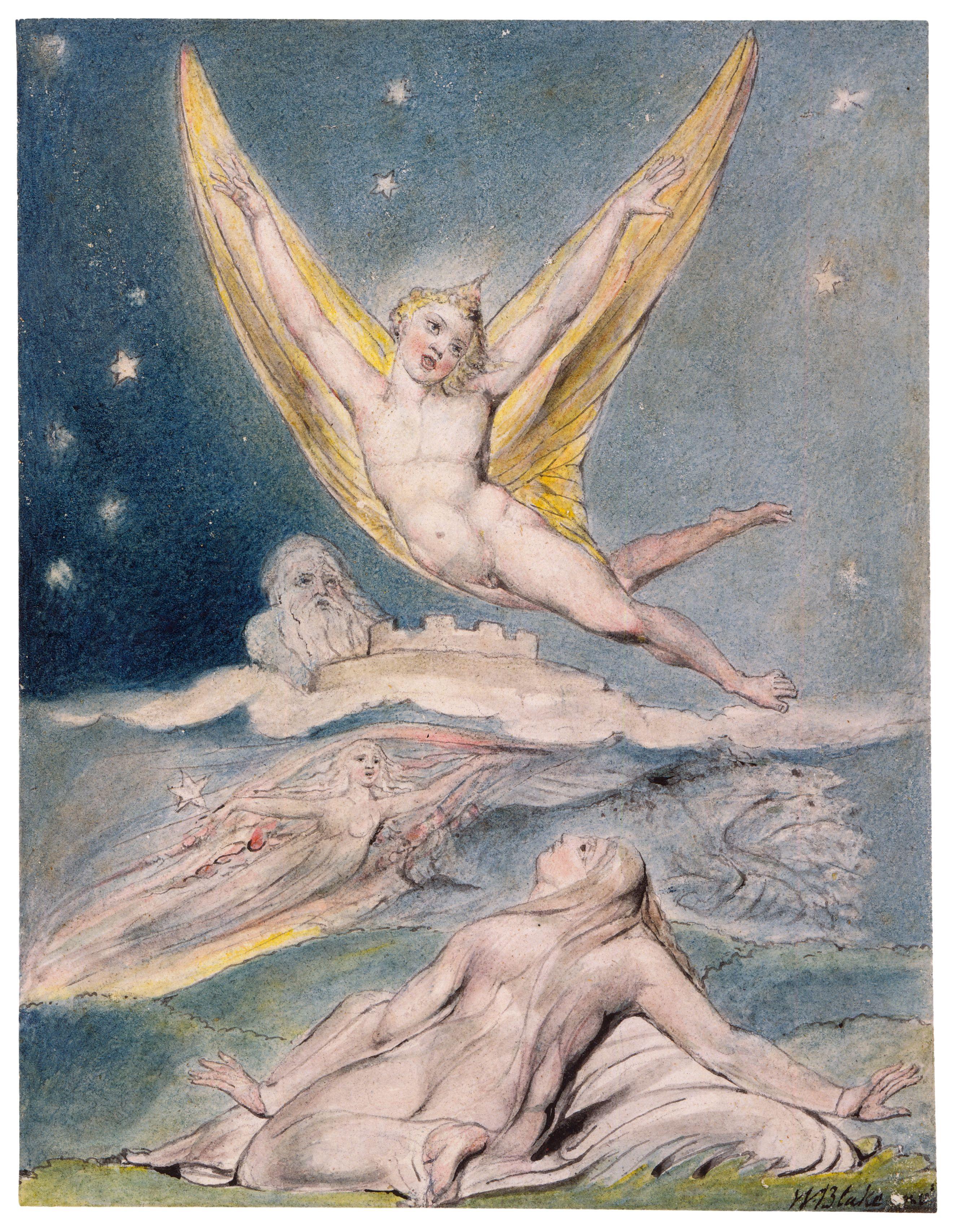
Night Startled by the Lark
Blake's accompanying text: "The Lark is an Angel on the Wing; dull Night starts from his Watch Tower on a Cloud. The Dawn with her dappled Horses arises above the Earth: the Earth beneath awakes at the Lark's voice."
Wednesday, July 13, 2011
Blake's Myth Again
The Myth:
Look at MHH,: PLATE 11:
"I must Create a System, or be enslav'd by another Mans
I will not Reason or Compare: my business is to Create"
(Erdman 153 Jerusalem)
Look at MHH,: PLATE 11:
"The ancient Poets animated all sensible objects with Gods or Geniuses calling them by the names and adorning them with the properties of woods, rivers, mountains, lakes, cities, nations, and whatever their enlarged & numerous senses could percieve. And particularly they studied the genius of each city & country. placing it under its mental deity. Till a system was formed, which some took advantage of & enslav'd the vulgar by attempting to realize or abstract the mental deities from their objects: thus began Priesthood. Choosing forms of worship from poetic tales. And at length they pronounced that the Gods had orderd such things. Thus men forgot that All deities reside in the human breast.”
“Hell” is presented at great length in The Four Zoas and in Jerusalem. He called it Ulro. Starting with Eternity newborns inhabit Beulah (on dry land). However they more or less always find themselves in the Sea of Land and Sea. (Picture is in the back of 'Blake and Antiquity'.)
In a manner of speaking Blake's Myth involved a re-creation of the Bible. Both works proceed as follows:
1. A worldly creation, including making of Man,
2. A fall leading to expulsion from the Garden. (In Blake's Version the dire consequences of eating of the fruit of the Tree of Good and Evil. Blake denied any reality to Good and Evil; instead he used the terms: Truth and Error. Men don't sin, he says. They make errors. Forgiveness, the most powerful word for Blake wipes out the error. In his Reflections of A Vision of the Last Judgment he made this statement:
“ What are all the Gifts of the Spirit but Mental Gifts whenever any Individual Rejects Error & embraces Truth a Last Judgment passes upon that Individual”, which of course in my book amounts to Universalism in the original sense of the word.")
3. A further Fall into The Sea of Time and Space, which Blake called Ulro.
“Hell” is presented at great length in The Four Zoas and in Jerusalem. He called it Ulro. Starting with Eternity newborns inhabit Beulah (on dry land). However they more or less always find themselves in the Sea of Land and Sea. (Picture is in the back of 'Blake and Antiquity'.)
But this phase, called generation (to a fleshly existence) leads eventually
through Forgiveness to
4. Regeneration and Apocalypse. "Death is swallowed up in Victory".
A better way is to speak of Albion (equivalent to Adam).
Beulah is an earthly place where the eternals resort for R&R from the “severe contentions of Friendship, our Sexual cannot: but flies into the Ulro”.
“And War & Hunting: the Two Fountains of the River of Life
Are become Fountains of bitter Death and corroding Hell"
Blake's myth is an alternative version of the Bible myth:
Albion, the Eternal Man, Adam lived in Eternity, but becoming tired of the fierce contentions of Friendship dropped down to Beulah. Unfortunately he fell asleep and divided into the four zoas:
Tharmas: our basic physicality.
Urizen: our reasoning faculty
Luvah: our feeling function
Urthona/Los: our imagination (intuition)
We all have those Jungian functions. One is called the dominant function; another is our inferior function.
The zoas got into all sorts of conflict with one another and with their Emanations (their female dimension). The emanations are wonderful until they fall into spidery dominating elements.
All of them have descended from Beulah to Ulro (Blake's name for Hell).
Here we languish until love and forgiveness heal us through generation, then regeneration, then redemption, then awaking in Eternity.
That's Blake's myth in a nutshell.
Tuesday, July 12, 2011
SYMBOLIC LANGUAGE
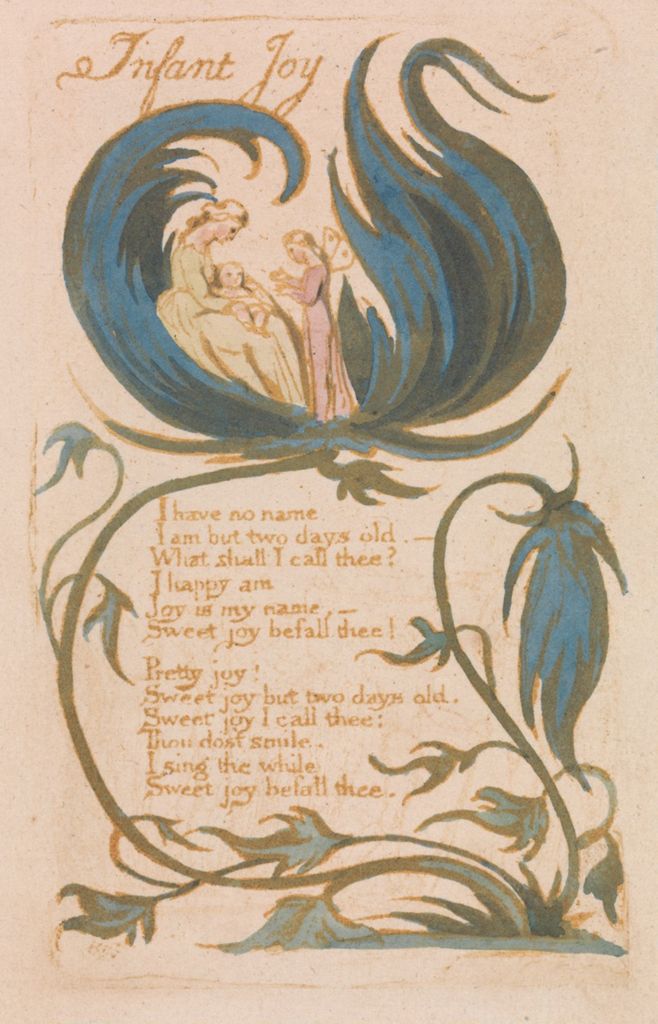
Songs of Innocence (E 16)
Infant Joy
"Sweet Joy Befall Thee"
Besides his well known (to Blake students), A Blake Dictionary, S. Foster Damon wrote William Blake: His Philosophy and Symbols, which also has much to teach about Blake's poetry and how it can be understood. This quote about various levels of meaning which the symbol can represent is found on page 65.
"Practically the whole existence of poetry consists of imposing of human values on natural objects...
Symbolism is the recognition and fixation of these values. It is the highest form of that process usually performed by the weaker metaphor and the still weaker simile. The simile states a resemblance, the metaphor states an identity, and the symbol assumes the identity without direct statement. In the first case love would be likened to a rose; in the second case, Love would be called a rose; in the third, the Rose would appear unexplained. There is a still higher rung in this Jacob's Ladder: the rung popularly known as Prophecy. Here the Rose would indicate some particular act in the past, present, or future. A specific temporal significance is thus imposed upon the Symbol, which hitherto dealt with Eternities...
Let us return , then, to the symbol. Blake, of course, knew perfectly well what he was doing. He deliberately interpreted objects to show their relation to, and their expression of, mankind. Everything he saw revealed to him its inner essence, which was in turn the revelation of a truth. Only through this method could Truth be approached. Isis cannot be seen unveiled, for the mortal eye itself is her vesture. The great secrets cannot be told; the very syllables are their mask....
And thus we learn a strange fact: that the clearer, the more precise, Blake's writings become, the more obscure they seem. The trouble is not with Blake, it lies in our own inability to understand. The fires of Hell still seem like torment and insanity to us, the Angels. Therefore Blake cried so fiercely: 'Go! put off Holiness, and put on Intellect!' "
It is not difficult to find passages in Blake to illustrate the use of the symbol to reveal multiple layers of psychological, poetic and spiritual meanings. How does this speak to you?
Four Zoas, Night VIII, Page 113-114, (E 384)
[Enion speaking:]
"Listen: I will tell you what is done in the caverns of the grave
the lamb of God has rent the veil of mystery
When the mortal disappears in improved knowledge cast away
The former things so shall the Mortal gently fade away
And so become invisible to those who still remain
Listen I will tell thee what is done in the caverns of the grave
The Lamb of God has rent the Veil of Mystery soon to return
In Clouds & Fires around the rock & the Mysterious tree
As the seed waits Eagerly watching for its flower & fruit
Anxious its little soul looks out into the clear expanse
To see if hungry winds are abroad with their invisible army
So Man looks out in tree & herb & fish & bird & beast
Collecting up the scatterd portions of his immortal body
Into the Elemental forms of every thing that grows
He tries the sullen north wind riding on its angry furrows
The sultry south when the sun rises & the angry east
When the sun sets when the clods harden & the cattle stand
Drooping & the birds hide in their silent nests. he stores his thoughts
As in a store house in his memory he regulates the forms
Of all beneath & all above & in the gentle West
Reposes where the Suns heat dwells he rises to the Sun
And to the Planets of the Night & to the stars that gild
The Zodiac & the stars that sullen stand to north & south
He touches the remotest pole & in the Center weeps
That Man should Labour & sorrow & learn & forget & return
To the dark valley whence he came to begin his labours anew
In pain he sighs in pain he labours in his universe
Screaming in birds over the deep & howling in the Wolf
Over the slain & moaning in the cattle & in the winds
And weeping over Orc & Urizen in clouds & flaming fires
And in the cries of birth & in the groans of death his voice
Is heard throughout the Universe whereever a grass grows
Or a leaf buds The Eternal Man is seen is heard is felt
And all his Sorrows till he reassumes his ancient bliss"
This is symbolic language at its finest; not allegory, simile or metaphor but living symbols which may enter the Soul of Man: an opportunity to collect the 'scattered portions of [our] immortal bodies.'
First posted May 2010.
Monday, July 11, 2011
WESTERN GATE
Jerusalem, Plate 12, (E 156)
"And the Four Points are thus beheld in Great Eternity
West, the Circumference: South, the Zenith: North,
The Nadir: East, the Center, unapproachable for ever.
These are the four Faces towards the Four Worlds of Humanity
In every Man. Ezekiel saw them by Chebars flood.
And the Eyes are the South, and the Nostrils are the East.
And the Tongue is the West, and the Ear is the North.
And the North Gate of Golgonooza toward Generation;
Has four sculpturd Bulls terrible before the Gate of iron.
And iron, the Bulls: and that which looks toward Ulro,
Clay bak'd & enamel'd, eternal glowing as four furnaces:
Turning upon the Wheels of Albions sons with enormous power.
And that toward Beulah four, gold, silver, brass, & iron:
PLATE 13
And that toward Eden, four, form'd of gold, silver, brass, &
iron.
The South, a golden Gate, has four Lions terrible, living!
That toward Generation, four, of iron carv'd wondrous:
That toward Ulro, four, clay bak'd, laborious workmanship
That toward Eden, four; immortal gold, silver, brass & iron.
The Western Gate fourfold, is closd: having four Cherubim
Its guards, living, the work of elemental hands, laborious task!
Like Men, hermaphroditic, each winged with eight wings
That towards Generation, iron; that toward Beulah, stone;
That toward Ulro, clay: that toward Eden, metals.
But all clos'd up till the last day, when the graves shall yield
their dead
The Eastern Gate, fourfold: terrible & deadly its ornaments:
Taking their forms from the Wheels of Albions sons; as cogs
Are formd in a wheel, to fit the cogs of the adverse wheel.
That toward Eden, eternal ice, frozen in seven folds
Of forms of death: and that toward Beulah, stone:
The seven diseases of the earth are carved terrible.
And that toward Ulro, forms of war: seven enormities:
And that toward Generation, seven generative forms."
Milton, Plate 5, (E 98)
"And this is the manner of the Daughters of Albion in their beauty
Every one is threefold in Head & Heart & Reins, & every one
Has three Gates into the Three Heavens of Beulah which shine
Translucent in their Foreheads & their Bosoms & their Loins
Surrounded with fires unapproachable: but whom they please
They take up into their Heavens in intoxicating delight"
In the world of generation man is not Fourfold as he is in Eternity, but is Threefold. In the south is his head, in the east is his heart and in the north is his loins. The west is vacant, or the Western Gate is closed. The body, the forth aspect in Eternity, no longer gives access to the real world of Eternity. Tharmas, the Zoa of the body, no longer has the ability to provide the integrating force which facilitates the unity of man.
Milton O. Percival gives us his wisdom on this subject in William Blake's Circle of Destiny, (Page 295):
"Note 15.36. cosmic man: That south, east, and north are the head, heart, and loins will not, I suppose, be questioned. The evidence is explicit. The evidence for the west being the Body may be briefly summarized. The west is 'outwards every way.' As the fall begins, Tharmas and Enion (the dual regents of the west) are said to constitute Nature (the cosmic body). At this point also Enion weaves a 'filmy woof' containing Tharmas; this is his new conception of the physical universe. As the fall progresses, it is the world of Tharmas which troubles Urizen (the Mind). At the time of the Flood Tharmas appears as the 'rough demon of the waters,' an overwhelming multiple and material universe. It is he who commands the universe to be rebuilt in the forms of 'death and decay'. The fall drags Enion into the indefinite of matter - into the Grave, whence she speaks with a comprehensive knowledge of the suffering of nature. As regeneration begins and the unity of Eden begins to be restored, Albion is said to gather 'the scattered portions of his immortal body.' The unity of Eden, which is placed in Tharmas's western region, is suggested by the fact that the Eternals live there in 'perfect harmony,' meeting together as 'One Man.'"
The Threefold sexual man of generation cannot be returned to the Fourfold complete man of Eternity unless heart, head, loins and body regain the ability to function in 'perfect harmony' through the opening of his Western Gate.
Four Zoas, Night VII, PAGE 95 [87] (SECOND PORTION), (E 368)
"If we unite in one[,] another better world will be
Opend within your heart & loins & wondrous brain
Threefold as it was in Eternity & this the fourth Universe
Will be Renewd by the three & consummated in Mental fires
But if thou dost refuse Another body will be prepared"
Genesis 3
[23] Therefore the LORD God sent him forth from the garden of Eden, to till the ground from whence he was taken.
[24] So he drove out the man; and he placed at the east of the garden of Eden Cherubims, and a flaming sword which turned every way, to keep the way of the tree of life.
Blake's Illustrations to Milton's Paradise Lost
The Expulsion of Adam and Eve from the Garden of Eden
Butts Set 1808
"And the Four Points are thus beheld in Great Eternity
West, the Circumference: South, the Zenith: North,
The Nadir: East, the Center, unapproachable for ever.
These are the four Faces towards the Four Worlds of Humanity
In every Man. Ezekiel saw them by Chebars flood.
And the Eyes are the South, and the Nostrils are the East.
And the Tongue is the West, and the Ear is the North.
And the North Gate of Golgonooza toward Generation;
Has four sculpturd Bulls terrible before the Gate of iron.
And iron, the Bulls: and that which looks toward Ulro,
Clay bak'd & enamel'd, eternal glowing as four furnaces:
Turning upon the Wheels of Albions sons with enormous power.
And that toward Beulah four, gold, silver, brass, & iron:
PLATE 13
And that toward Eden, four, form'd of gold, silver, brass, &
iron.
The South, a golden Gate, has four Lions terrible, living!
That toward Generation, four, of iron carv'd wondrous:
That toward Ulro, four, clay bak'd, laborious workmanship
That toward Eden, four; immortal gold, silver, brass & iron.
The Western Gate fourfold, is closd: having four Cherubim
Its guards, living, the work of elemental hands, laborious task!
Like Men, hermaphroditic, each winged with eight wings
That towards Generation, iron; that toward Beulah, stone;
That toward Ulro, clay: that toward Eden, metals.
But all clos'd up till the last day, when the graves shall yield
their dead
The Eastern Gate, fourfold: terrible & deadly its ornaments:
Taking their forms from the Wheels of Albions sons; as cogs
Are formd in a wheel, to fit the cogs of the adverse wheel.
That toward Eden, eternal ice, frozen in seven folds
Of forms of death: and that toward Beulah, stone:
The seven diseases of the earth are carved terrible.
And that toward Ulro, forms of war: seven enormities:
And that toward Generation, seven generative forms."
Milton, Plate 5, (E 98)
"And this is the manner of the Daughters of Albion in their beauty
Every one is threefold in Head & Heart & Reins, & every one
Has three Gates into the Three Heavens of Beulah which shine
Translucent in their Foreheads & their Bosoms & their Loins
Surrounded with fires unapproachable: but whom they please
They take up into their Heavens in intoxicating delight"
In the world of generation man is not Fourfold as he is in Eternity, but is Threefold. In the south is his head, in the east is his heart and in the north is his loins. The west is vacant, or the Western Gate is closed. The body, the forth aspect in Eternity, no longer gives access to the real world of Eternity. Tharmas, the Zoa of the body, no longer has the ability to provide the integrating force which facilitates the unity of man.
Milton O. Percival gives us his wisdom on this subject in William Blake's Circle of Destiny, (Page 295):
"Note 15.36. cosmic man: That south, east, and north are the head, heart, and loins will not, I suppose, be questioned. The evidence is explicit. The evidence for the west being the Body may be briefly summarized. The west is 'outwards every way.' As the fall begins, Tharmas and Enion (the dual regents of the west) are said to constitute Nature (the cosmic body). At this point also Enion weaves a 'filmy woof' containing Tharmas; this is his new conception of the physical universe. As the fall progresses, it is the world of Tharmas which troubles Urizen (the Mind). At the time of the Flood Tharmas appears as the 'rough demon of the waters,' an overwhelming multiple and material universe. It is he who commands the universe to be rebuilt in the forms of 'death and decay'. The fall drags Enion into the indefinite of matter - into the Grave, whence she speaks with a comprehensive knowledge of the suffering of nature. As regeneration begins and the unity of Eden begins to be restored, Albion is said to gather 'the scattered portions of his immortal body.' The unity of Eden, which is placed in Tharmas's western region, is suggested by the fact that the Eternals live there in 'perfect harmony,' meeting together as 'One Man.'"
The Threefold sexual man of generation cannot be returned to the Fourfold complete man of Eternity unless heart, head, loins and body regain the ability to function in 'perfect harmony' through the opening of his Western Gate.
Four Zoas, Night VII, PAGE 95 [87] (SECOND PORTION), (E 368)
"If we unite in one[,] another better world will be
Opend within your heart & loins & wondrous brain
Threefold as it was in Eternity & this the fourth Universe
Will be Renewd by the three & consummated in Mental fires
But if thou dost refuse Another body will be prepared"
[23] Therefore the LORD God sent him forth from the garden of Eden, to till the ground from whence he was taken.
[24] So he drove out the man; and he placed at the east of the garden of Eden Cherubims, and a flaming sword which turned every way, to keep the way of the tree of life.
Blake's Illustrations to Milton's Paradise Lost
The Expulsion of Adam and Eve from the Garden of Eden
Butts Set 1808
Sunday, July 10, 2011
Perennial Reader
Everyone knows that William Blake was a great reader. What isn't generally known; what is in fact a great mystery is where he got the books or where he did the reading. I haven't succeeded in finding any information about that (tell me if there is any).
Blake went to school for part of one day; that's all the formal education he seems to have acquired. Of course he had some journeyman training. However he appeared to be the most learned person of his generation, which makes him what we call an autodidact -- self-educated.
Very likely his learning began with the Bible; that's demonstrated by the use he made of the Bible in his creative work. He had a thorough acquaintance with the Bible, but he never confined himself to a literal understanding; he didn't see it as history -- no, as poetry. The primary difference is that poetry is susceptible to various meanings, depending on the perception of the reader. Likewise the meaning of any element of the Bible is various, depending on the perception of the reader.
Among the Books of the Bible that he favored he named Ezra and Isaiah; but in MHH he mentioned Ezekiel; he had a conversation with Ezekiel (plate 13). Some of his works demonstrated a considerable acquaintance with Revelation, in the same way that John had shown an extensive acquaintance with The Old Testament.
In a Letter to Flaxman Blake wrote:
"Now my lot in the Heavens is this; Milton
lovd me in childhood & shewd me his face, Ezra
came with Isaiah the Prophet, but Shakespeare in
riper years gave me his hand; Paracelsus & Behmen
appeard to me."
If you're serious about William Blake here's your reading list:
Jacob Boehme: Aside from the Bible nothing meant more to Blake than William Law's translation of this German mystic (some would say Gnostic). The more of Boehme you read, the more Blake you will see and understand. (the English called him Behmen.)
John Milton: Blake identified strongly with Milton -- and had some marked differences with him. Paradise Lost had a great influence on him. In Plate 6 of MHH he said that Milton "was a true Poet and of the Devils party without knowing it". In Vision, writing The Book of Milton he found it necessary to call Milton back from Heaven to correct his spiritual mistakes (much like God sent his Son to save the world).
Swedenborg: Blake's parents had been attracted to this Swedish philosopher and mystic. He and his wife likely attended the Swedenborg Church in London. But he soon saw the man's deficiencies -- and lampooned him in some early works. He undoubtedly learned something from Swedenborg and lamented about him in Milton, "O Swedenborg! strongest of men, the Samson shorn by the Churches! "
Shakespeare is given by Blake as one of his significant literary relationships. I haven't found that in reading Blake. David Whitmarsh apparently has a lot of say on that score.
Paracelsus (1493-1541): To learn how this man affected Blake you might best consult Milton Percival's Circle of Destiny (probably the best introduction to Blake). He has a chapter on Alchemical Symbolism, and reading this will help you understand how and why the furnaces come up so often in the major prophecies.
Although Thomas Taylor was one year younger than Blake, his translations of Plato and the Neo-Platonists led our poet's interests emphatically in that direction. Thereafter the Greek and Roman myths loomed large in Blake's poetry and pictures.
Homer was a major source for Blake's works. Although he expressed some contempt for Homer, he drew heavily on Homer's stories, using Ovid more often than Homer himself. To get some understanding of how Blake used Homer take a look at my file on myths. The Sea of Time and Space is directly about the Odyssey, a pictorial description in fact (of course it's about a lot of other things as well).
Hermes Trismegistus was a special interest of Blake's as well as a dozen similar arcane and esoteric works too numerous to discuss in this post. But perhaps there will be more to come.
First posted by Larry on January 14, 2010.
Blake went to school for part of one day; that's all the formal education he seems to have acquired. Of course he had some journeyman training. However he appeared to be the most learned person of his generation, which makes him what we call an autodidact -- self-educated.
Very likely his learning began with the Bible; that's demonstrated by the use he made of the Bible in his creative work. He had a thorough acquaintance with the Bible, but he never confined himself to a literal understanding; he didn't see it as history -- no, as poetry. The primary difference is that poetry is susceptible to various meanings, depending on the perception of the reader. Likewise the meaning of any element of the Bible is various, depending on the perception of the reader.
Among the Books of the Bible that he favored he named Ezra and Isaiah; but in MHH he mentioned Ezekiel; he had a conversation with Ezekiel (plate 13). Some of his works demonstrated a considerable acquaintance with Revelation, in the same way that John had shown an extensive acquaintance with The Old Testament.
In a Letter to Flaxman Blake wrote:
"Now my lot in the Heavens is this; Milton
lovd me in childhood & shewd me his face, Ezra
came with Isaiah the Prophet, but Shakespeare in
riper years gave me his hand; Paracelsus & Behmen
appeard to me."
If you're serious about William Blake here's your reading list:
Jacob Boehme: Aside from the Bible nothing meant more to Blake than William Law's translation of this German mystic (some would say Gnostic). The more of Boehme you read, the more Blake you will see and understand. (the English called him Behmen.)
John Milton: Blake identified strongly with Milton -- and had some marked differences with him. Paradise Lost had a great influence on him. In Plate 6 of MHH he said that Milton "was a true Poet and of the Devils party without knowing it". In Vision, writing The Book of Milton he found it necessary to call Milton back from Heaven to correct his spiritual mistakes (much like God sent his Son to save the world).
Swedenborg: Blake's parents had been attracted to this Swedish philosopher and mystic. He and his wife likely attended the Swedenborg Church in London. But he soon saw the man's deficiencies -- and lampooned him in some early works. He undoubtedly learned something from Swedenborg and lamented about him in Milton, "O Swedenborg! strongest of men, the Samson shorn by the Churches! "
Shakespeare is given by Blake as one of his significant literary relationships. I haven't found that in reading Blake. David Whitmarsh apparently has a lot of say on that score.
Paracelsus (1493-1541): To learn how this man affected Blake you might best consult Milton Percival's Circle of Destiny (probably the best introduction to Blake). He has a chapter on Alchemical Symbolism, and reading this will help you understand how and why the furnaces come up so often in the major prophecies.
Although Thomas Taylor was one year younger than Blake, his translations of Plato and the Neo-Platonists led our poet's interests emphatically in that direction. Thereafter the Greek and Roman myths loomed large in Blake's poetry and pictures.
Homer was a major source for Blake's works. Although he expressed some contempt for Homer, he drew heavily on Homer's stories, using Ovid more often than Homer himself. To get some understanding of how Blake used Homer take a look at my file on myths. The Sea of Time and Space is directly about the Odyssey, a pictorial description in fact (of course it's about a lot of other things as well).
Hermes Trismegistus was a special interest of Blake's as well as a dozen similar arcane and esoteric works too numerous to discuss in this post. But perhaps there will be more to come.
First posted by Larry on January 14, 2010.
Saturday, July 09, 2011
Annihilate the Selfhood
We hear about this from Blake only after his conversion to Christianity; it was a consequence of the Moment of Grace.
Blake spent his youth denouncing the 'Enemy': an oppressive political and economic conspiracy against Albion--its tool, the 'State Church' (all churches in fact), exploitation of the poor, the Art merchants who approved only commercial art (they had dealt with Blake like the Pharisees dealt with Jesus), and finally the misguided help of a 'corporeal friend'.
![]() |
Wikipedia Commons Jerusalem Plate 76, Copy A |
After all this came the Moment when he heard the voice: "thou ram horn'd with gold", and he knew himself accepted and used by the Eternal Powers that abide after all the above has passed away. Here he was at that point in his journey through life, and in the system which he reported on:
He came to see that the 'Enemy' was within (we have met the enemy, and he is Us).
He 'came to himself', he confessed his sins.
Henceforth the annihilation of his selfhood (Jerusalem, Plate 5, line 23)
and the power of Forgiveness became his chief motifs.
The old, old story was told again.
Friday, July 08, 2011
WEALTH IN POVERTY
Gospel of Thomas
(29) Jesus said, "If the flesh came into being because of spirit, it is a wonder. But if spirit came into being because of the body, it is a wonder of wonders. Indeed, I am amazed at how this great wealth has made its home in this poverty."
Blake was never wealthy but he went through periods ranging from relative affluence to abject poverty. One constant in his life in spite of his circumstances was that he continued to work at his art whatever difficulties there were. If you look at pictures he produced when you know he was destitute, there is no intimation that he was working in poverty. In fact the period in which he returned to London in 1803 after the three years in Felphan was a time when his income was at a low ebb. However inspiration had returned to him giving him renewed reason to produce what his imagination led him to. His hopes of earning significant income from his art were repeatedly thwarted, but that gave him more time to put into the writing and engraving of Jerusalem which he probably knew from the beginning would not earn appreciable money. In 1818 John Linnell was added to Thomas Butts as a supporter who provided regular commissions. These two men provided the roof over his head and food on the table through years of productive labor when Blake lived according to vision and imagination.
The quote I begin with from the Gospel of Thomas came to mind as I thought of the treasures of art and poetry Blake had produced when his outward circumstances were miserable. In a strange way Blake's spirit was expressed in his art because he lived without the world's rewards. His work became the body in which his spirit resided. The 'wonder' of which Jesus spoke, which made its home in this poverty, is seen in the wealth of spirit expressed in Blake as he struggled outwardly with lack and loss and little.
This image from Blake's illustrations for Edward Young's Night Thoughts encapsulates a wealth of ideas which recur in Blake extended myth.
Songs of Innocence, SONGS 33, (E 19)
HOLY THURSDAY
"Is this a holy thing to see,
In a rich and fruitful land,
Babes reduced to misery,
Fed with cold and usurous hand?
Is that trembling cry a song?
Can it be a song of joy?
And so many children poor?
It is a land of poverty!
And their sun does never shine.
And their fields are bleak & bare.
And their ways are fill'd with thorns.
It is eternal winter there.
For where-e'er the sun does shine,
And where-e'er the rain does fall:
Babe can never hunger there,
Nor poverty the mind appall."
(29) Jesus said, "If the flesh came into being because of spirit, it is a wonder. But if spirit came into being because of the body, it is a wonder of wonders. Indeed, I am amazed at how this great wealth has made its home in this poverty."
Blake was never wealthy but he went through periods ranging from relative affluence to abject poverty. One constant in his life in spite of his circumstances was that he continued to work at his art whatever difficulties there were. If you look at pictures he produced when you know he was destitute, there is no intimation that he was working in poverty. In fact the period in which he returned to London in 1803 after the three years in Felphan was a time when his income was at a low ebb. However inspiration had returned to him giving him renewed reason to produce what his imagination led him to. His hopes of earning significant income from his art were repeatedly thwarted, but that gave him more time to put into the writing and engraving of Jerusalem which he probably knew from the beginning would not earn appreciable money. In 1818 John Linnell was added to Thomas Butts as a supporter who provided regular commissions. These two men provided the roof over his head and food on the table through years of productive labor when Blake lived according to vision and imagination.
The quote I begin with from the Gospel of Thomas came to mind as I thought of the treasures of art and poetry Blake had produced when his outward circumstances were miserable. In a strange way Blake's spirit was expressed in his art because he lived without the world's rewards. His work became the body in which his spirit resided. The 'wonder' of which Jesus spoke, which made its home in this poverty, is seen in the wealth of spirit expressed in Blake as he struggled outwardly with lack and loss and little.
This image from Blake's illustrations for Edward Young's Night Thoughts encapsulates a wealth of ideas which recur in Blake extended myth.
The final verse of Holy Thursday epitomises the mental state which allowed Blake to work without regard to outward hardships.
Songs of Innocence, SONGS 33, (E 19)
HOLY THURSDAY
"Is this a holy thing to see,
In a rich and fruitful land,
Babes reduced to misery,
Fed with cold and usurous hand?
Is that trembling cry a song?
Can it be a song of joy?
And so many children poor?
It is a land of poverty!
And their sun does never shine.
And their fields are bleak & bare.
And their ways are fill'd with thorns.
It is eternal winter there.
For where-e'er the sun does shine,
And where-e'er the rain does fall:
Babe can never hunger there,
Nor poverty the mind appall."
Thursday, July 07, 2011
The Word within the Word
Northrup Frye was a very famous literary critic,
and a great deal can be found about him on the
web. A Canadian, Frye went to seminary and became
a parish minister; then he went to Oxford and got
an M.A. in English Literature. He wrote his
thesis on William Blake.
A great many books came from his pen; the first
one was Fearful Symmetry (1944). Frye opens the
door to a depth understanding of Blake's poetry (and
pictures). It took five readings of Fearful Symetry
(30 years ago) to open my mind to William Blake.
In the eighties, near the end of his life, Frye
published two monumental volumes of "The Bible as
Literature"; they speak directly to the depth
understanding of our poet.
Some of the statements in 'The Word with the Word'
(chapter five of Fearful Symmetry) may sound
enigmatic; just stay with them, and light will come.
This chapter is a lucid description of Frye's primary
gift to literature, to meaning and religion.
All words are metaphors; the meanings they convey
depend upon the author's mind - and frame of mind
when he writes them; and upon the reader's (or
hearer's) mind when he reads or hears them. (Most
of the purposeless arguments over virtually anything
stem from failure to understand this basic fact.)
For Western culture the Bible is the Great Code of
Art; it embodies the Universal Myth, basically
fourfold: Creation, The Fall, Redemption,
Apocalypse. Blake believed that it was the
guiding myth undergirding virtually all discourse.
"Blake's poetry is all related to a central myth...
and the primary basis of this myth is the Bible.
...
The Bible is therefore the archetype of Western
culture, and the Bible...provides the basis for most
of our major art" (Fearful Symmetry, p. 109).
The word of God was Jesus (cf John 1). Anything
that you say or write may be the Word of God-- the
Jesus in you (Paul).
In Plate 3 of Jerusalem (Erdman p. 145) we can read:
"I also hope the Reader will be with me, wholly One in
Jesus our Lord, who is the God [of Fire] and Lord [of
Love] to whom the Ancients look'd and saw his day afar off,
with trembling & amazement. The Spirit of Jesus is continual
forgiveness of sin"
This is the Word in Blake's consciousness.
Jerusalem, (Erdman p. 180):
"Saying. Albion! Our wars are wars of life, & wounds of love,
With intellectual spears, & long winged arrows of thought:
Mutual in one anothers love and wrath all renewing
We live as One Man; for contracting our infinite senses
We behold multitude; or expanding: we behold as one,
As One Man all the Universal Family; and that One Man
We call Jesus the Christ: and he in us, and we in him,
Live in perfect harmony in Eden the land of life,
Giving, receiving, and forgiving each others trespasses.
He is the Good shepherd, he is the Lord and master:
He is the Shepherd of Albion, he is all in all,
In Eden: in the garden of God: and in heavenly Jerusalem."
First posted by Larry, December 30, 2009.
and a great deal can be found about him on the
web. A Canadian, Frye went to seminary and became
a parish minister; then he went to Oxford and got
an M.A. in English Literature. He wrote his
thesis on William Blake.
A great many books came from his pen; the first
one was Fearful Symmetry (1944). Frye opens the
door to a depth understanding of Blake's poetry (and
pictures). It took five readings of Fearful Symetry
(30 years ago) to open my mind to William Blake.
In the eighties, near the end of his life, Frye
published two monumental volumes of "The Bible as
Literature"; they speak directly to the depth
understanding of our poet.
Some of the statements in 'The Word with the Word'
(chapter five of Fearful Symmetry) may sound
enigmatic; just stay with them, and light will come.
This chapter is a lucid description of Frye's primary
gift to literature, to meaning and religion.
All words are metaphors; the meanings they convey
depend upon the author's mind - and frame of mind
when he writes them; and upon the reader's (or
hearer's) mind when he reads or hears them. (Most
of the purposeless arguments over virtually anything
stem from failure to understand this basic fact.)
For Western culture the Bible is the Great Code of
Art; it embodies the Universal Myth, basically
fourfold: Creation, The Fall, Redemption,
Apocalypse. Blake believed that it was the
guiding myth undergirding virtually all discourse.
"Blake's poetry is all related to a central myth...
and the primary basis of this myth is the Bible.
...
The Bible is therefore the archetype of Western
culture, and the Bible...provides the basis for most
of our major art" (Fearful Symmetry, p. 109).
The word of God was Jesus (cf John 1). Anything
that you say or write may be the Word of God-- the
Jesus in you (Paul).
In Plate 3 of Jerusalem (Erdman p. 145) we can read:
"I also hope the Reader will be with me, wholly One in
Jesus our Lord, who is the God [of Fire] and Lord [of
Love] to whom the Ancients look'd and saw his day afar off,
with trembling & amazement. The Spirit of Jesus is continual
forgiveness of sin"
This is the Word in Blake's consciousness.
Jerusalem, (Erdman p. 180):
"Saying. Albion! Our wars are wars of life, & wounds of love,
With intellectual spears, & long winged arrows of thought:
Mutual in one anothers love and wrath all renewing
We live as One Man; for contracting our infinite senses
We behold multitude; or expanding: we behold as one,
As One Man all the Universal Family; and that One Man
We call Jesus the Christ: and he in us, and we in him,
Live in perfect harmony in Eden the land of life,
Giving, receiving, and forgiving each others trespasses.
He is the Good shepherd, he is the Lord and master:
He is the Shepherd of Albion, he is all in all,
In Eden: in the garden of God: and in heavenly Jerusalem."
First posted by Larry, December 30, 2009.
Wednesday, July 06, 2011
CREATION OF EVE
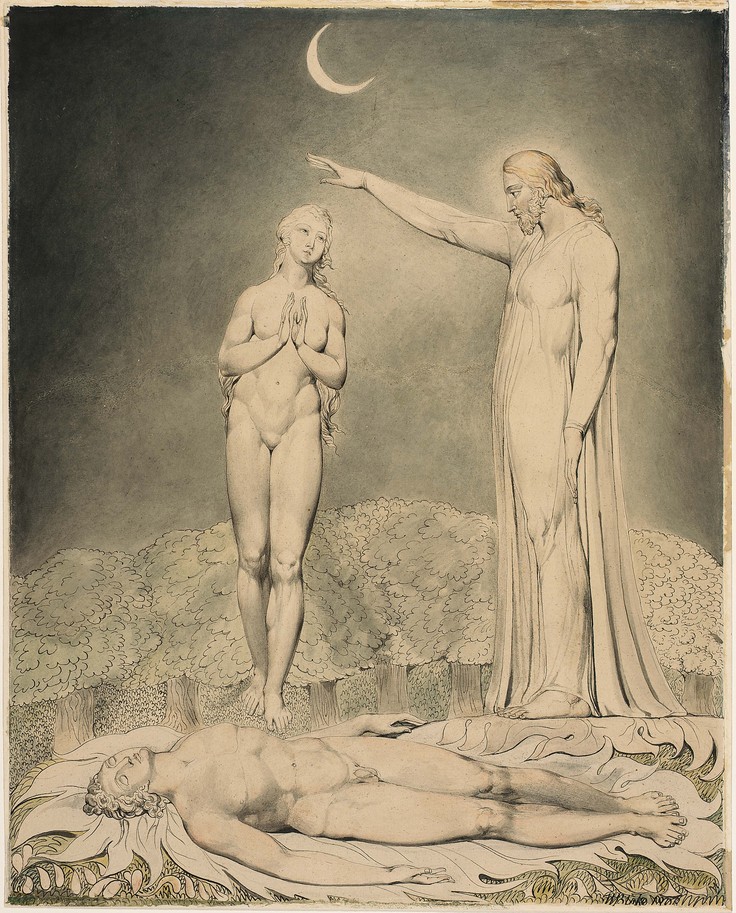
Blake often writes of the splitting off of the emanation from the unified man as an occasion of destruction and sorrow; a portent of a downward spiral of disintegration. This image from the illustrations to Paradise Lost portrays the creation of Eve from the contrary perspective: the Eternal perspective. Eve is seen not as being made of clay as was the description of Adam's creation in the Bible. She is not taken from the flesh of Adam by the removal of one of his ribs. She is created by Christ as a spiritual being, not of the earth or man but as individual with the potential to develop spiritually.
The book William Blake at the Huntington, by Robert N. Essick comments on this picture:
"In Adam's recounting of this scene [in Paradise Lost], he does not specifically refer to Christ's presence. Yet Milton consistently attributes the creation of the world to Christ as the Father's 'effectual might' (3:170) and the performative incarnation of His creative 'Word' (7:163). Thus, Blake's presentation of Christ as Eve's creator does not violate the text even though it stands outside the tradition established by Renaissance paintings such as Michelangelo's Sistine fresco, that God is the divine creator of Eve. Here and elsewhere throughout the Paradise Lost watercolors, Blake takes every opportunity to emphasize Christ's energetic presence.
...In his later writings, however, Blake presents this primal scene as a fortunate fall. As he writes on plate 42 of his conclusive epic, Jerusalem, 'when Man sleeps in Beulah [a version of Eden], the Savior in mercy takes / Contraction's Limit [Adam], and of the Limit he forms Woman: That / Himself may in process of time be born Man to Redeem.' By creating Eve, Christ prepares for His own incarnation in her descendant, the man Jesus." (Page 120)
Paradise Lost , Book 3
John Milton
"To whom the great Creatour thus reply'd.
O Son, in whom my Soul hath chief delight,
Son of my bosom, Son who art alone
My word, my wisdom, and effectual might,
All hast thou spok'n as my thoughts are, all
As my Eternal purpose hath decreed:
Man shall not quite be lost, but sav'd who will,
Yet not of will in him, but grace in me
Freely voutsaft; once more I will renew
His lapsed powers,"
Click on picture to enlarge.
The book William Blake at the Huntington, by Robert N. Essick comments on this picture:
"In Adam's recounting of this scene [in Paradise Lost], he does not specifically refer to Christ's presence. Yet Milton consistently attributes the creation of the world to Christ as the Father's 'effectual might' (3:170) and the performative incarnation of His creative 'Word' (7:163). Thus, Blake's presentation of Christ as Eve's creator does not violate the text even though it stands outside the tradition established by Renaissance paintings such as Michelangelo's Sistine fresco, that God is the divine creator of Eve. Here and elsewhere throughout the Paradise Lost watercolors, Blake takes every opportunity to emphasize Christ's energetic presence.
...In his later writings, however, Blake presents this primal scene as a fortunate fall. As he writes on plate 42 of his conclusive epic, Jerusalem, 'when Man sleeps in Beulah [a version of Eden], the Savior in mercy takes / Contraction's Limit [Adam], and of the Limit he forms Woman: That / Himself may in process of time be born Man to Redeem.' By creating Eve, Christ prepares for His own incarnation in her descendant, the man Jesus." (Page 120)
John Milton
"To whom the great Creatour thus reply'd.
O Son, in whom my Soul hath chief delight,
Son of my bosom, Son who art alone
My word, my wisdom, and effectual might,
All hast thou spok'n as my thoughts are, all
As my Eternal purpose hath decreed:
Man shall not quite be lost, but sav'd who will,
Yet not of will in him, but grace in me
Freely voutsaft; once more I will renew
His lapsed powers,"
Click on picture to enlarge.
Tuesday, July 05, 2011
GOOGLE BOOKS
If you have an interest in reading the early books about William Blake as well as what is being written about him in our own day, you will find a tremendous resource in Google books. Many of the out of copyright Blake books have been digitized by Google. Unlike the copyright books which Google makes available, these books are published in their entirety without deletions. Furthermore they are available as text files as well as image files so that passages can be copied and saved for your own individual use or to share with others.
You may find that early works about Blake's writing offers critical information and analysis which you are less likely to find in current books. The early writers were closer to Blake's times. They were frequently giving their full attention to understanding the content of his work. Current works sometimes assume the basic mastery of Blake's content and focus on 'minute details' of literary criticism. So have a look at these out of print, out of copyright volumes which are at your fingertips.

Here is a sample passage from the introduction to The prophetic books of William Blake: Milton by William Blake, Eric Robert Dalrymple Maclagan, Archibald G Russell:
"The substance of the poem [Milton] is almost entirely autobiographical. Blake himself tells us, in one of his letters, that it is descriptive of ' the spiritual acts ' of his ' three years' slumber on the banks of ocean.' Both the characters and the action have their counterparts in the drama which had been enacted at Felpham. The disguise is often a close one: but we are told that it is a ' sublime allegory,' and ' allegory addressed to the intellectual powers, while it is altogether hidden from the corporeal understanding,' is Blake's 'definition of the most sublime poetry.' The writing was 'from immediate dictation, twelve or sometimes twenty or thirty lines at a time, without premeditation, and even against' his ' will.' ' Thus,' he writes, ' the time it has taken in writing was rendered non-existent, and an immense poem exists ... all produced without labour or study.' The purpose of the book is clearly stated on p[late]. 36, 11. 21-25 [E 137]:
'. . When Los join'd with me he took me in his fiery whirlwind:
My vegetated portion was hurried from Lambeth's shades:
He set me down in Felpham's vale and prepar'd a beautiful
Cottage for me, that in three years I might write all these visions,
To display Nature's cruel holiness: the deceits of natural religion.'"
You may find that early works about Blake's writing offers critical information and analysis which you are less likely to find in current books. The early writers were closer to Blake's times. They were frequently giving their full attention to understanding the content of his work. Current works sometimes assume the basic mastery of Blake's content and focus on 'minute details' of literary criticism. So have a look at these out of print, out of copyright volumes which are at your fingertips.
Here is a sample passage from the introduction to The prophetic books of William Blake: Milton by William Blake, Eric Robert Dalrymple Maclagan, Archibald G Russell:
"The substance of the poem [Milton] is almost entirely autobiographical. Blake himself tells us, in one of his letters, that it is descriptive of ' the spiritual acts ' of his ' three years' slumber on the banks of ocean.' Both the characters and the action have their counterparts in the drama which had been enacted at Felpham. The disguise is often a close one: but we are told that it is a ' sublime allegory,' and ' allegory addressed to the intellectual powers, while it is altogether hidden from the corporeal understanding,' is Blake's 'definition of the most sublime poetry.' The writing was 'from immediate dictation, twelve or sometimes twenty or thirty lines at a time, without premeditation, and even against' his ' will.' ' Thus,' he writes, ' the time it has taken in writing was rendered non-existent, and an immense poem exists ... all produced without labour or study.' The purpose of the book is clearly stated on p[late]. 36, 11. 21-25 [E 137]:
'. . When Los join'd with me he took me in his fiery whirlwind:
My vegetated portion was hurried from Lambeth's shades:
He set me down in Felpham's vale and prepar'd a beautiful
Cottage for me, that in three years I might write all these visions,
To display Nature's cruel holiness: the deceits of natural religion.'"
Monday, July 04, 2011
INTRODUCTION TO OUR BLOG
This is a repost of an earlier post intended to help Blake students get started:
An anonymous reader has asked that we provide more information in our posts. So I will try to explain what we are attempting to do in our Blake blog.
First we want to focus our attention on William Blake and his writing.
We are not experts but students of Blake. We follow our own interests. We are interested in sharing what we have learned of Blake and would would like to tailor our posts to the interests of the reader. We hope readers will let us know what interests them about Blake.
There have been posts which attempt to introduce the reader to studying Blake especially using the resources on the internet. The links to the text of Blake's poetry and prose, and to his graphic works are provided. A link to Larry's online book which includes a primer is also a useful tool. (These files can be electronically searched for specific topics.) Within the posts we often provide links to external files which expand the study to wider sources.
None of Blake's work is simple to understand. Beginners can start with Songs of Innocence and Experience. Marriage of Heaven and Hell grabs the attention of many with its irony. The major prophecies can be approached a little at a time rather than entire. If you are visually oriented, the visual images can be used as an avenue to draw you into reading the poetry.
Blake's body of work is large and complex. On our blog we have not attempted a systematic study. We are giving clues to solving the mystery. Analysts of Blake's work often tell us that Blake expected the reader to go beyond what was stated in the text, to perceive the underlying meaning. We hope our readers will sift through the blog posts looking for cracks or doors or highways through which they may enter Blake's mind and heart and imagination.
Reading Blake may expand your mind, nourish your spirit, or enrich your imagination; don't expect it to put money in your pocket, expand your social circle or impress your professors.
Here are some earlier posts which may help the neophyte.
Bible
Perception
Vision
Emphasis
Help
Fourfold
Idealism
Reader
Plates
4Z's
I can't end without a quote from Blake as well as the picture.Liberty or Stems of VegetationMilton, Plate 50
Jerusalem, Plate 60, (E 209)
"within the Furnaces the Divine Vision appeard
On Albions hills: often walking from the Furnaces in clouds
And flames among the Druid Temples & the Starry Wheels
Gatherd Jerusalems Children in his arms & bore them like
A Shepherd in the night of Albion which overspread all the Earth
I gave thee liberty and life O lovely Jerusalem
And thou hast bound me down upon the Stems of Vegetation"
An anonymous reader has asked that we provide more information in our posts. So I will try to explain what we are attempting to do in our Blake blog.
First we want to focus our attention on William Blake and his writing.
We are not experts but students of Blake. We follow our own interests. We are interested in sharing what we have learned of Blake and would would like to tailor our posts to the interests of the reader. We hope readers will let us know what interests them about Blake.
There have been posts which attempt to introduce the reader to studying Blake especially using the resources on the internet. The links to the text of Blake's poetry and prose, and to his graphic works are provided. A link to Larry's online book which includes a primer is also a useful tool. (These files can be electronically searched for specific topics.) Within the posts we often provide links to external files which expand the study to wider sources.
None of Blake's work is simple to understand. Beginners can start with Songs of Innocence and Experience. Marriage of Heaven and Hell grabs the attention of many with its irony. The major prophecies can be approached a little at a time rather than entire. If you are visually oriented, the visual images can be used as an avenue to draw you into reading the poetry.
Blake's body of work is large and complex. On our blog we have not attempted a systematic study. We are giving clues to solving the mystery. Analysts of Blake's work often tell us that Blake expected the reader to go beyond what was stated in the text, to perceive the underlying meaning. We hope our readers will sift through the blog posts looking for cracks or doors or highways through which they may enter Blake's mind and heart and imagination.
Reading Blake may expand your mind, nourish your spirit, or enrich your imagination; don't expect it to put money in your pocket, expand your social circle or impress your professors.
Here are some earlier posts which may help the neophyte.
Perception
Vision
Emphasis
Help
Fourfold
Idealism
Reader
Plates
4Z's
I can't end without a quote from Blake as well as the picture.Liberty or Stems of VegetationMilton, Plate 50
Jerusalem, Plate 60, (E 209)
"within the Furnaces the Divine Vision appeard
On Albions hills: often walking from the Furnaces in clouds
And flames among the Druid Temples & the Starry Wheels
Gatherd Jerusalems Children in his arms & bore them like
A Shepherd in the night of Albion which overspread all the Earth
I gave thee liberty and life O lovely Jerusalem
And thou hast bound me down upon the Stems of Vegetation"
Sunday, July 03, 2011
DOOR OF DEATH
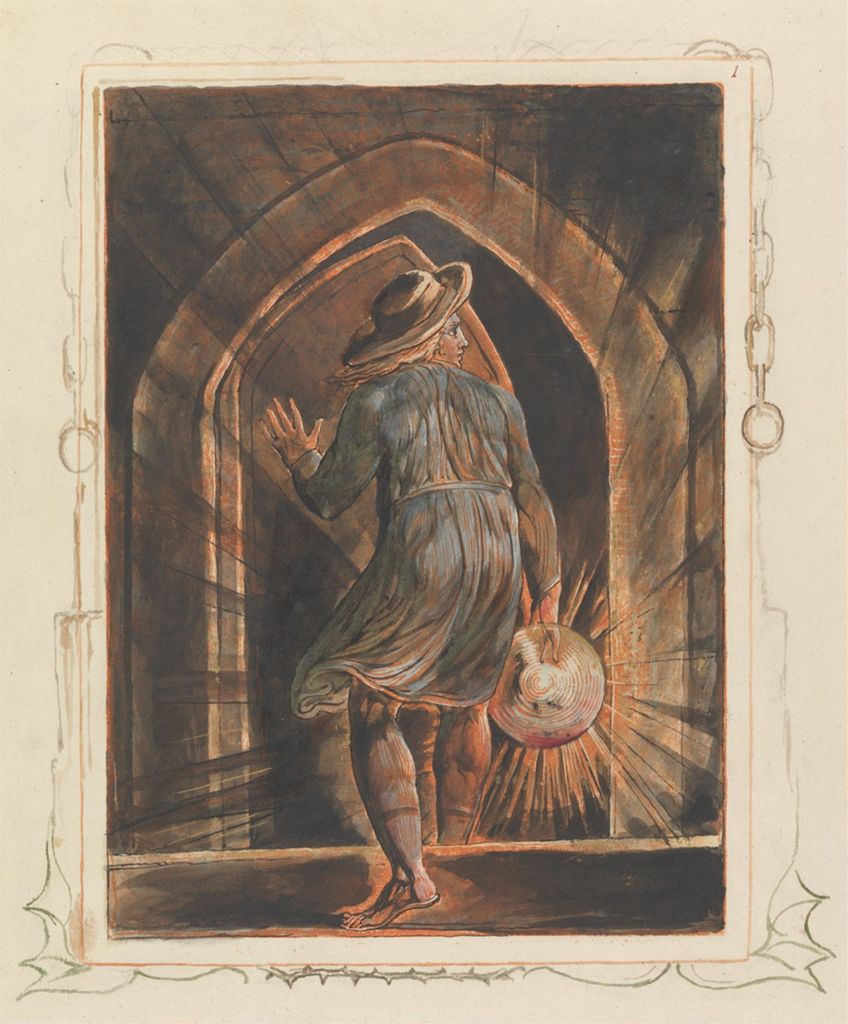
Blake's Jerusalem begins with a memorable image of Los entering the dark doorway of a crypt carrying in his hand a light to illuminate his steps. The ideas contained in the post CONSUMED IN FIRE follow from the concepts incorporated in the image and legend in this frontispiece. The 'Door of death' which Los enters is to the world which we call life. Entering the physical world is experienced as Death to eternity. Reentering eternity is experienced as death to the world. In the Gospels Jesus had this to say:
Luke 17
[33] Whosoever shall seek to save his life shall lose it; and whosoever shall lose his life shall preserve it.
John 12
[25] He that loveth his life shall lose it; and he that hateth his life in this world shall keep it unto life eternal.
Minna Doskow book Jerusalem: Structure and Meaning in Poetry and Picture analyzes the text and illustrations of Jerusalem. Also included is a facsimile of Blake's book which facilitates the study of both facets of Blake's communication. She writes this about the initial plate of Jerusalem:
"The full-page illustration of Los entering 'the Door of Death for Albion's sake Inspired' (1:19) with which Jerusalem opens captures the situation of the whole poem in the image of a single action, a single figure, and a single moment. From the graffiti over the doorway, we learn of the two adjacent, coexistent, and omnipresent realms the the poem explores - the Void (also called sleep, Ulro, or Generation in the poem) and Existence (alternatively called awakening, Eden, or Eternity). While the poem tells us much about the meaning of these two realms, this plate immediately gives us their salient features. Existence is characterized by the imaginative light pictured in the illustration, while the Void is poetically described by sleep, shadow and rock (1:3-4). Albion's initial position is in the void, dead, with petrified and 'fixed' intellect and emotions (his 'sublime' and 'pathetic' qualities [1:4]), enclosed by limited reason (his covering 'Spectrous Power' [1:5]), which does not allow him to see further than this fallen universe that he creates and is limited to (1:1-2)." (Page 26)
Jerusalem, Title Page, (E 144)
JERUSALEM
The Emanation of The Giant Albion
1804 Printed by W. Blake Sth Molton St.
PLATE 1
[The following text is not visible in this copy of the plate but readable other copies.]
[Above the archway:]
"There is a Void, outside of Existence, which if enterd into
Englobes itself & becomes a Womb, such was Albions Couch
A pleasant Shadow of Repose calld Albions lovely Land
His Sublime & Pathos become Two Rocks fixd in the Earth
His Reason his Spectrous Power, covers them above
Jerusalem his Emanation is a Stone laying beneath
O [Albion behold Pitying] behold the Vision of Albion
[On right side of archway:]
Half Friendship is the bitterest Enmity said Los
As he enterd the Door of Death for Albions sake Inspired
The long sufferings of God are not for ever there is a Judgment
[On left side, in reversed writing:]
Every Thing has its Vermin O Spectre of the Sleeping Dead"
As Doskow implies, she and Blake both wrote their books to 'contrast between sleep in Ulro (Albion's fallen state) and the awakened Eternal Life (the Savior's unified state of identity and mutual love between man and God) [which] could not become more complete than it is at the outset.' (Page 16)
It is all about changing sleep to awakening, death to life, Ulro to Eternity.
Saturday, July 02, 2011
Blake and Dante
Blake considered Dante to be one of the greatest writers; however as explained in Illustrating Dante, he disagreed with Dante's orthodox theology. In fact he disagreed with all manner of 'orthodox theology'; to agree with any such thing would be for Blake being "enslaved by another man's system". He felt that we all must create our own system. Like George Fox Blake believed 'there was that of God' in everyone.
That of God in you is not the same as that of God in me (or in anyone else). It is the 'poetic genius':
"He who Loves feels love descend into him & if he has wisdom may percieve it is from the Poetic Genius which is the Lord" (Annotations to Swedenborg; Erdman 603)
According to my system love is God; Blake has called it here 'the Poetic Genius which is the Lord'.
The term Lord is a generic one. In the days of Jesus it was used generally for any person of higher status. It has come (in some orthodoxies) to be used for Jesus, while for others it is God.
God is within and without. I think Blake understood that. Dante had wisdom, and Blake respected him as such, but his wisdom was based on the general Catholic orthodoxy, for which Blake had little use.
**********************
Very early in his writings (E43) Blake showed his evaluation of Dante's poetry (MHH plate 21):
"..................Any man of mechanical talents
may from the writings of Paracelsus or Jacob Behmen, produce ten thousand volumes of equal value with Swedenborg's.
And from those of Dante or Shakespear, an infinite number."
In Jerusalem (Plate 73) he gave another listing of Great Men created by Los:
"..................................................................Los Creates Adam Noah Abraham Moses Samuel David Ezekiel
[Pythagoras Socrates Euripedes Virgil Dante Milton]"
(although we're told that on reflection he deleted Dante from the list).
In E634 he wrote: "Dante was an Emperors Man", by that he meant of course a hireling.
In seven letters to Linnell, who had commissioned him to do the Illustrations to Dante's Inferno he described his progress.
The Blake can be found at the Works
That of God in you is not the same as that of God in me (or in anyone else). It is the 'poetic genius':
"He who Loves feels love descend into him & if he has wisdom may percieve it is from the Poetic Genius which is the Lord" (Annotations to Swedenborg; Erdman 603)
According to my system love is God; Blake has called it here 'the Poetic Genius which is the Lord'.
The term Lord is a generic one. In the days of Jesus it was used generally for any person of higher status. It has come (in some orthodoxies) to be used for Jesus, while for others it is God.
God is within and without. I think Blake understood that. Dante had wisdom, and Blake respected him as such, but his wisdom was based on the general Catholic orthodoxy, for which Blake had little use.
"..................Any man of mechanical talents
may from the writings of Paracelsus or Jacob Behmen, produce ten thousand volumes of equal value with Swedenborg's.
And from those of Dante or Shakespear, an infinite number."
In Jerusalem (Plate 73) he gave another listing of Great Men created by Los:
"..................................................................Los Creates Adam Noah Abraham Moses Samuel David Ezekiel
[Pythagoras Socrates Euripedes Virgil Dante Milton]"
(although we're told that on reflection he deleted Dante from the list).
In E634 he wrote: "Dante was an Emperors Man", by that he meant of course a hireling.
In seven letters to Linnell, who had commissioned him to do the Illustrations to Dante's Inferno he described his progress.
The Blake can be found at the Works
Friday, July 01, 2011
CONSUMED IN FIRE
Originally on Plate 14 of Marriage of Heaven and Hell
Existence to Blake is the life Eternal. What we usually call life is Eternal Death. The realization the we live eternally through Jesus, the Imagination, is our entry into Eternity. Eternal Death is consumed by Eternal Life because it has no eternal existence.
Marriage of Heaven and Hell, PLATE 14,(E 39)
The ancient tradition that the world will be consumed in fire
at the end of six thousand years is true. as I have heard from
Hell.
For the cherub with his flaming sword is hereby commanded to
leave his guard at the tree of life, and when he does, the whole
creation will be consumed, and appear infinite. and holy whereas
it now appears finite & corrupt.
This will come to pass by an improvement of sensual enjoyment.
But first the notion that man has a body distinct from his
soul, is to be expunged; this I shall do, by printing in the
infernal method, by corrosives, which in Hell are salutary and
medicinal, melting apparent surfaces away, and displaying the
infinite which was hid.
If the doors of perception were cleansed every thing would
appear to man as it is: infinite.
For man has closed himself up, till he sees all things thro'
narrow chinks of his cavern."
Four Zoas , Night IX, PAGE 136, (E 404)
"O terrible wine presses of Luvah O caverns of the Grave
How lovely the delights of those risen again from death
O trembling joy excess of joy is like Excess of grief
So sang the Human Odors round the wine presses of Luvah
But in the Wine presses is wailing terror & despair
Forsaken of their Elements they vanish & are no more
No more but a desire of Being a distracted ravening desire
Desiring like the hungry worm & like the gaping grave
They plunge into the Elements the Elements cast them forth
Or else consume their shadowy semblance Yet they obstinate
Tho pained to distraction Cry O let us Exist for
This dreadful Non Existence is worse than pains of Eternal Birth
Eternal Death who can Endure. let us consume in fires
In waters stifling or in air corroding or in earth shut up
The Pangs of Eternal birth are better than the Pangs of Eternal Death"
Vision of the Last Judgment , (E 563)
"Many suppose that before [Adam]
Idea that can enter the Mind as it takes away all sublimity from
the Bible & Limits All Existence to Creation & to Chaos To the
Time & Space fixed by the Corporeal Vegetative Eye & leaves the
Man who entertains such an Idea the habitation of Unbelieving
Demons Eternity Exists and All things in Eternity Independent of
Creation which was an act of Mercy"
The Library of Congress provides a PDF file of The Marriage of Heaven and Hell. Use this link, scroll down to Marriage of Heaven and Hell, and select PDF. Read the text with the images.
Subscribe to:
Posts (Atom)


.jpg)