Thursday, August 04, 2011

THIS FOOLISH BODY

William Blake died on August 12, 1827 at the age of 70. A few months earlier he had written to his friend George Cumberland.

Letters, Number 91, (E 783)


[To] George Cumberland Esqre, Culver Street, Bristol

N 3 Fountain Court Strand 12 April 1827
Dear Cumberland
I have been very near the Gates of Death & have returned
very weak & an Old Man feeble & tottering, but not in Spirit &
Life not in The Real Man The Imagination which Liveth for Ever.
In that I am stronger & stronger as this Foolish Body decays. I
thank you for the Pains you have taken with Poor Job. I know too
well that a great majority of Englishmen are fond of The
Indefinite which they Measure by Newtons Doctrine of the Fluxions
of an Atom. A Thing that does not Exist. These are Politicians
& think that Republican Art is Inimical to their Atom. For a
Line or Lineament is not formed by Chance a Line is a Line in its
Minutest Subdivision[s] Strait or Crooked It is Itself & Not
Intermeasurable with or by any Thing Else Such is Job but since
the French Revolution Englishmen are all Intermeasurable One by
Another Certainly a happy state of Agreement to which I for One
do not Agree. God keep me from the Divinity of Yes & No too The
Yea Nay Creeping Jesus from supposing Up & Down to be the same
Thing as all Experimentalists must suppose
You are desirous I know to dispose of some of my Works & to
make Pleasin[g], I am obliged to you & to all who do so
But having none remaining of all that I had Printed I cannot
Print more Except at a great loss for at the time I printed those
things I had a whole House to range in now I am shut up in a
Corner therefore am forced to ask a Price for them that I
scarce expect to get from a Stranger. I am now Printing a Set of
the Songs of Innocence & Experience for a Friend at Ten Guineas
which I cannot do under Six Months consistent with my other Work,
so that I have little hope of doing any more of such things. the
Last Work I produced is a Poem Entitled Jerusalem the Emanation
of the Giant Albion, but find that to Print it will Cost my Time
the amount of Twenty Guineas One I have Finishd It contains 100
Plates but it is not likely that I shall get a Customer for it
As you wish me to send you a list with the Prices of these
things they are as follows

...............L s d
America 6. 6. 0
Europe 6. 6. 0
Visions &c 5. 5. 0
Thel 3. 3. 0
Songs of Inn. & Exp. 10. 10. 0
Urizen 6. 6. 0

The Little Card I will do as soon as Possible but when you
Consider that I have been reduced to a Skeleton from which I am
slowly recovering you will I hope have Patience with me.
Flaxman is Gone & we must All soon follow every one to his
Own Eternal House Leaving the Delusive Goddess Nature & her Laws
to get into Freedom from all Law of the Members into The Mind in
which every one is King & Priest in his own House God Send it so
on Earth as it is in Heaven
I am Dear Sir Yours Affectionately
WILLIAM


Blake captures numerous motifs from his art and poetry in this summation of life's cycle in the little calling card for Cumberland which became his final engraving.

Wednesday, August 03, 2011

The Illuminated Mind

Reading from Plate 35 of Milton (Erdman 136):

"There is a Moment in each day that Satan cannot find.
Nor can his Watch Fiends find it, but the Industrious find
This Moment & it multiply. & when it once is found
It renovates every Moment of the Day if rightly placed"

Goodness knows, that's the desideratum every Blakean
wants to achieve. Our Daily Bread is to remember the visions that came to us after the magical Moment and to record and communicate them to those we love.

Love's Body is a little book with pointers to Norman Brown's visions. It invites us to record our visions as they occur and as time allows to communicate them to whomever God may have sent to hear, see, or experience them.

A young person has the Energy to do this.
He may do it during his most creative years. As we all know, energy flags with age; as the years go by, we find the Energy of the active baby that we all longed for is steadily and unfortunately more and more rare. Would that I had the energy I had at twenty. Blake's Minute gives us a chance to make the most of what our aging body allows.

Conservation of Energy! (it goes somewhere); as Blakeans and Christians we can direct it to the most important place.

"Follow your bliss", said
Joseph Campbell. 'Redeem the time' says the New Testament, and John Wesley, and William Blake. In Jerusalem Plate 47, introducing Chapter Four, To the Christians, we read:

" We are told to abstain from fleshly desires that we may lose no
time from the Work of the Lord. Every moment lost, is a moment
that cannot be redeemed every pleasure that intermingles with the
duty of our station is a folly unredeemable & is planted like the
seed of a wild flower among our wheat."
That Moment may spread to the limit of your energy level. Be thankful for it.

Expansion and Contraction:

Satan is the Limit of Contraction. It's the most he (it) can do to
enslave you to the God of this World (pure materiality!)

Adam is the Limit of Expansion. (Larry's vision; not Blake's)

In Plate 42 of Jerusalem Los) was speaking to whom?
To Albion "in deepest night of Ulro
":
"Thou wast the Image of God surrounded by the Four Zoa's
Three thou hast slain! I am the Fourth: thou canst not destroy me.
Thou art in Error; trouble me not with thy righteousness.
I have innocence to defend and ignorance to instruct:
I have no time for seeming; and little arts of compliment,
In morality and virtue: in self-glorying and pride.
There is a limit of Opakeness, and a limit of Contraction;
In every Individual Man, and the limit of Opakeness,
Is named Satan: and the limit of Contraction is named Adam.
But when Man sleeps in Beulah, the Saviour in mercy takes
Contractions Limit, and of the Limit he forms Woman: That
Himself may in process of time be born Man to redeem
But there is no Limit of Expansion! there is no Limit of Translucence
In the bosom of Man for ever from eternity to eternity.
Therefore I break thy bonds of righteousness; I crush thy messengers!
That they may not crush me and mine: do thou be righteous,
And I will return it; otherwise I defy thy worst revenge"
(Erdman 189)

Blake scholars learned the minute particulars- one by one, until Blake's

poetry became a code.

A Blake Group might begin with two and add another as she/he appears.

To share our visions is the most fascinating, creative activity we may
imagine.

Tuesday, August 02, 2011

TO THE CHRISTIANS

                  Jerusalem 
                   Plate 76
Albion  Jesus

In the fourth of the full page illustrations (from the British Museum - notice the names Albion and Jesus on this copy) used as chapter heads for Blake's Jerusalem, he pictured Jesus crucified on the tree of mystery above the worshiping Albion. The image may be taken as a picture of Albion achieving recognition of the love and sacrifice of Jesus who as the Breath Divine stirred Albion back to life. However the image also reminds us of the traditional representation of the crucified Christ of organized religion. The Jesus Blake recognized was within his heart and mind, the 'bright Preacher of Life' not the 'dark Preacher of Death'. Blake did not think well of organized religion, including organized Christianity. He practiced the religion of Jesus, a religion which directly connects man to the Eternal Reality, the indwelling word,Christ or the Holy Spirit. Such religion requires no buildings, moral codes, ceremonies, priests or judges. Blake's argument was that the self-appointed authorities, the 'priests', had assumed leadership of Jesus' legacy of spiritual experience and teaching and had made it into a worldly, material institution. The loss of the initial revelation which had come through Jesus was accompanied by the equally damaging development of a religion of chastity, accusation of sin, and projection of the deity onto an entity distant in time and space.

Jerusalem, Plate 77, (E 232) 
" I stood among my valleys of the south
And saw a flame of fire, even as a Wheel
Of fire surrounding all the heavens: it went
From west to cast against the current of
Creation and devourd all things in its loud                      
Fury & thundering course round heaven & earth
By it the Sun was rolld into an orb:
By it the Moon faded into a globe,
Travelling thro the night: for from its dire
And restless fury, Man himself shrunk up           
Into a little root a fathom long.
And I asked a Watcher & a Holy-One
Its Name? he answerd. It is the Wheel of Religion
I wept & said. Is this the law of Jesus
This terrible devouring sword turning every way    
He answerd; Jesus died because he strove
Against the current of this Wheel: its Name
Is Caiaphas, the dark Preacher of Death
Of sin, of sorrow, & of punishment;
Opposing Nature! It is Natural Religion            
But Jesus is the bright Preacher of Life
Creating Nature from this fiery Law,
By self-denial & forgiveness of Sin.

Go therefore, cast out devils in Christs name
Heal thou the sick of spiritual disease           
Pity the evil, for thou art not sent
To smite with terror & with punishments
Those that are sick, like the Pharisees
Crucifying &,encompassing sea & land
For proselytes to tyranny & wrath,                
But to the Publicans & Harlots go!
Teach them True Happiness, but let no curse
Go forth out of thy mouth to blight their peace
For Hell is opend to heaven; thine eyes beheld
The dungeons burst & the Prisoners set free." 
 Luke 4 
[16] And he came to Nazareth, where he had been brought up: and, as his custom was, he went into the synagogue on the sabbath day, and stood up for to read. 
[17] And there was delivered unto him the book of the prophet Esaias. And when he had opened the book, he found the place where it was written, 
[18] The Spirit of the Lord is upon me, because he hath anointed me to preach the gospel to the poor; he hath sent me to heal the brokenhearted, to preach deliverance to the captives, and recovering of sight to the blind, to set at liberty them that are bruised, 
[19] To preach the acceptable year of the Lord. 
[20] And he closed the book, and he gave it again to the minister, and sat down. And the eyes of all them that were in the synagogue were fastened on him.
 [21] And he began to say unto them, This day is this scripture fulfilled in your ears. 
Matthew 10 
[8] Heal the sick, cleanse the lepers, raise the dead, cast out devils: freely ye have received, freely give. 

 Three other posts have also highlighted full page illustration at beginnings of the chapters of Jerusalem:  

TO THE JEWS 

Monday, August 01, 2011

Gates of Eden, Paradise, and Heaven

The three subjects may well be considered synonyms; Blake was deeply concerned with all three entities, as is the Bible.

Eden is a common name for The Garden where the first man and woman lived in innocent bliss; but they preferred consciousness (in terms of the knowledge of Good and Evil) and were cast out of Eden. Look at Genesis 3.

Re 3:24 (3:24 So he drove out the man; and he placed at the east of the garden of Eden Cherubims, and a flaming sword which turned every way, to keep the way of the tree of life) , this comment is useful:
"The flaming sword keeps the way of the tree of life. William Blake had an idea going beyond what the writer of Genesis could say:

"For the cherub with his flaming sword is hereby commanded to leave his guard at the tree of life, and when he does, the whole creation will be consumed, and appear infinite and holy whereas it now appears finite & corrupt." (Marriage of Heaven and Hell, Plate 14)

We might also cite some passages in Revelation (near the end) where the 'tree of life' reappears. Both Blake and the writer of Revelation were speaking of the Parousia."`

Ezekiel's Covering Cherub (Ezekiel 28:1-19) might well be seen as the contrary of Heaven. Blake identified it with the angel with the flaming sword at the Gate to Paradise. Somewhere in Fearful Symmetry Northrup Frye described the human desire for fulfilment like this: you have only to jump through the ring of fire. (Frye mentioned the Cherub often in his classic.)

*************************************************
A reader of "Final Lesson" made this comment:
" is Heavens gate meant to lead IN to Jerusalem through the wall, or OUT of Jerusalem through the wall?

When I think of the actual gates in the walls around Jerusalem, they go both ways... in and out of the city...

But "heavens gate" sounds like a gate into heaven.

Do you see my confusion...? "

My response:
First of all "heavens gate" is a gate into heaven!
Most of us hope to go in; Jesus and John Milton came out!

So what is "Jerusalem's wall"? Well what is Jerusalem? A symbol (it means many
things to many people!) Jerusalem, the emanation of Albion may symbolize 'that of God in you'; Jerusalem is the bride of Christ. Jerusalem is Imagination. Jerusalem of course is a city in Palestine. The New Jerusalem IMO is subtantially equivalent to Heaven.

Blake's two versions of The Gates of Paradise are well worth looking at. In this context we may see the Gates represent steps along our mortal journey into Eternity or immortality.

Blake's system and myth included four walls and four gates, one in each direction. For example the Western Gate (Tharmas) is sense based, material, and hence only mortal.

Note: Computers vary widely with their output; people's acuity of sight also varies widely. to read comfortable older people need bigger type; when a post is projected on the wall, a large type face is desirable.

Sunday, July 31, 2011

TO THE DEISTS


Yale Center for British Art
Jerusalem
Plate 51
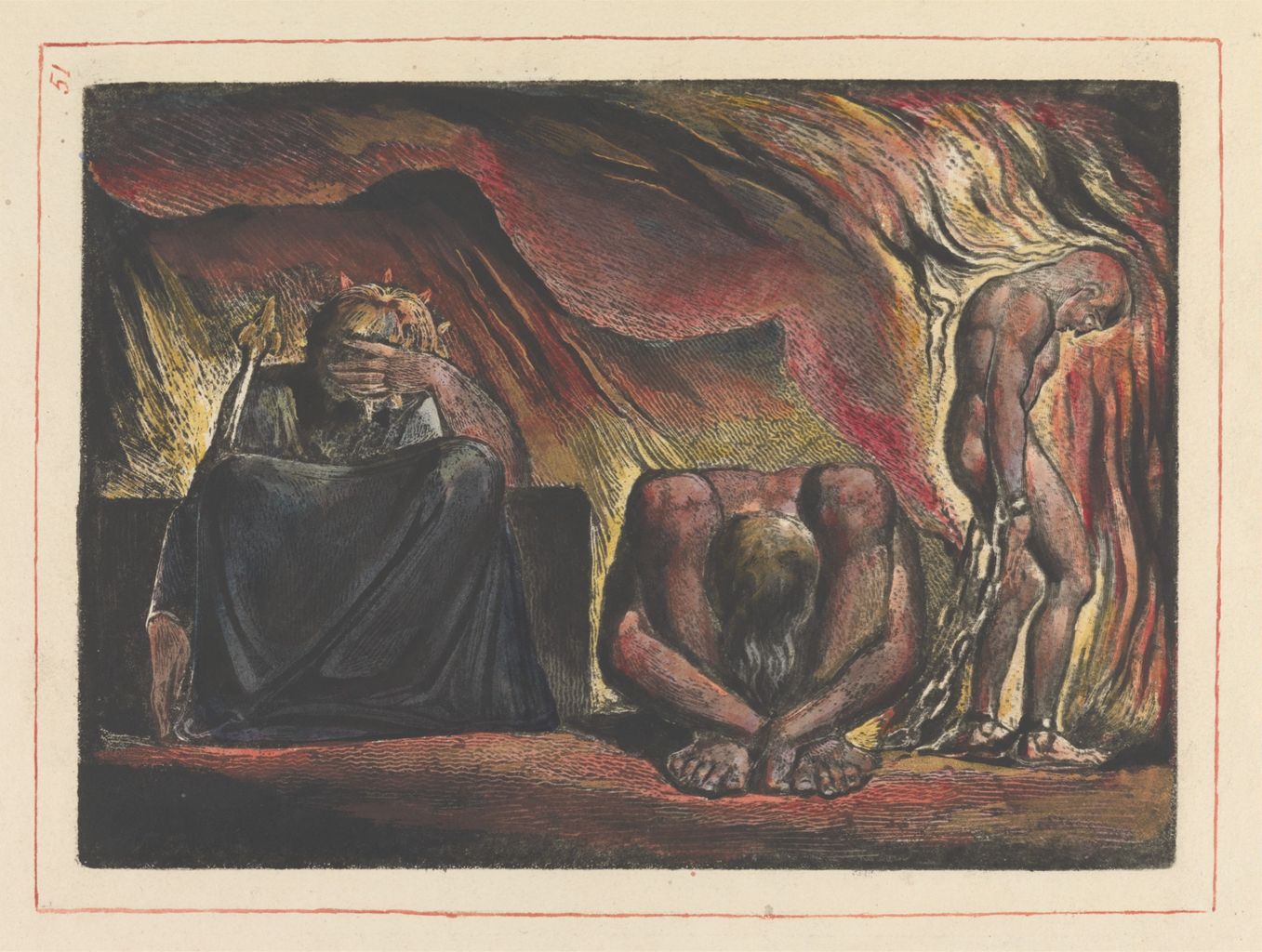
Vala, Hyle and Skofeld, showing the crowned Vala

Jerusalem, Plate 51
Vala... Hyle... Skofeld
[materialism, rationalism, destruction]

The wisdom of John Middleton Murry shines on every page of his book William Blake, first published in 1933. In his chapter Forgiveness and War we read:

"Deism is the religion of the Selfhood; Christianity of Self-annihilation...The ultimate and inevitable expression of the unannihilated Selfhood, whether it assumes the disguise of philosophy or patriotism, or - in the politics of interest and 'security - no disguise at all, is war.
Between the world of the Selfhood, in all its forms, and the world of Self-annihilation there is a gulf of the kind that divides one order of being from another; and the outward and visible sign of their absolute heterogeneity is that in the world of the Selfhood, war is inevitable, while in the world of Self-annihilation, war is impossible. For Self-annihilation is Forgiveness, and where there is Forgiveness, there War cannot be. War is thus the test, simple and infallible, of the world's Christianity." (Page 315)

Jerusalem , Plate 52, (E 201)
"But the Religion of Jesus, Forgiveness of Sin, can never
be the cause of a War nor of a single Martyrdom.
Those who Martyr others or who cause War are Deists, but never
can be Forgivers of Sin. The Glory of Christianity is, To
Conquer by Forgiveness. All the Destruction therefore, in
Christian Europe has arisen from Deism, which is Natural
Religion."

The three figures in the image for the beginning of chapter three of Jerusalem - To the Deists - as labeled in another print, picture Vala, Hyle and Scofeld. They may be seen to represent the end product of following the Deistic philosophy. All three have lost their vitality and humanity and connection with each other.

Vala as fallen Nature is hard, dark, covered and closed although she bears the trappings of royalty which her sons bestowed upon her.

Hyle, a traditional name for matter, has assumed the shape of a cube which lets nothing in or out. Scholars associate Hyle with Haley who facilitated Blake's residence in Felpham. Blake soon learned that Haley intended for him forsake inspiration to engage in shallow projects of Haley's choosing. Blake's imagination could not be contained in the enclosure of purely material consciousness which occupied Haley.

The role which Scofeld played in Blake's life resulted in his becoming a complex symbol in Blake's poetry. Blake ejected Scofeld, a soldier, from his garden after an exchange of harsh words. Scofeld brought the charge of sedition against Blake. Although Blake was exonerated he had to endure being labeled an accused criminal and brought to trial. Scofeld was a weak and troubled man, a reprobate deserving of forgiveness and yet a real threat to Blake's freedom. The incident with Scofeld was instrumental in Blake's struggle to understand his own Selfhood and confront the necessity of annihilating it.

Luke 11
[52] Woe unto you, lawyers! for ye have taken away the key of knowledge: ye entered not in yourselves, and them that were entering in ye hindered.
[53] And as he said these things unto them, the scribes and the Pharisees began to urge him vehemently, and to provoke him to speak of many things:
[54] Laying wait for him, and seeking to catch something out of his mouth, that they might accuse him.

Jerusalem, PLATE 25, (E 170)
"And there was heard a great lamenting in Beulah: all the Regions
Of Beulah were moved as the tender bowels are moved: & they said:

Why did you take Vengeance O ye Sons of the mighty Albion?
Planting these Oaken Groves: Erecting these Dragon Temples
Injury the Lord heals but Vengeance cannot be healed:
As the Sons of Albion have done to Luvah: so they have in him
Done to the Divine Lord & Saviour, who suffers with those that suffer:
For not one sparrow can suffer, & the whole Universe not suffer also,
In all its Regions, & its Father & Saviour not pity and weep.
But Vengeance is the destroyer of Grace & Repentance in the bosom
Of the Injurer: in which the Divine Lamb is cruelly slain:
Descend O Lamb of God & take away the imputation of Sin
By the Creation of States & the deliverance of Individuals Evermore Amen"

Friday, July 29, 2011

TO THE JEWS

Yale Center for British Art 
Jerusalem
Plate 26

Jerusalem, Plate 26
Legend on Plate 26

"SUCH VISIONS HAVE APPEARD TO ME
AS I MY ORDERD RACE HAVE RUN
JERUSALEM IS NAMED LIBERTY
AMONG THE SONS OF ALBION

HAND JERUSALEM"

The image of Hand and Jerusalem which begins the second chapter of Jerusalem - To The Jews - presents a dramatic scene in which Jerusalem resists the invitation of Hand to follow his false religion. Minna Doskow in William Blake's Jerusalem states that:
"Hand's religion of sin and punishment, moral virtue, atonement, and sacrifice of others (described in pl. 9) represents the version of Jewish legalism which chapter 2 exposes as error, while Jerusalem, who is 'named Liberty among the Sons of Albion' according to the inscription below her figure, symbolizes the liberated Jewish prophetic tradition that the chapter offers as an alternative to error." (Page 33)

A clearer picture of the threat of Hand's false religion appears in the text on Plate 9:

Jerusalem, Plate 8-9, (E 151)
"Hand has absorbd all his Brethren in his might
All the infant Loves & Graces were lost, for the mighty Hand
PLATE 9
Condens'd his Emanations into hard opake substances;
And his infant thoughts & desires, into cold, dark, cliffs of death.
His hammer of gold he siezd; and his anvil of adamant.
He siez'd the bars of condens'd thoughts, to forge them:
Into the sword of war: into the bow and arrow:
Into the thundering cannon and into the murdering gun
I [Los] saw the limbs form'd for exercise, contemn'd: & the beauty of
Eternity, look'd upon as deformity & loveliness as a dry tree:
I saw disease forming a Body of Death around the Lamb
Of God, to destroy Jerusalem, & to devour the body of Albion
By war and stratagem to win the labour of the husbandman:
Awkwardness arm'd in steel: folly in a helmet of gold:
Weakness with horns & talons: ignorance with a rav'ning beak!
Every Emanative joy forbidden as a Crime:
And the Emanations buried alive in the earth with pomp of religion:
Inspiration deny'd; Genius forbidden by laws of punishment:
I saw terrified; I took the sighs & tears, & bitter groans:
I lifted them into my Furnaces; to form the spiritual sword.
That lays open the hidden heart: I drew forth the pang
Of sorrow red hot: I workd it on my resolute anvil:"

Hand appearance and position in the image on Plate 26 presents the "parody of inspiration that Hand's religion presents in both its Judaic origins and Christian continuation." (Page 33)

Doskow points out that:
"True religion will not be led astray and inverted by false, although it may temporarily be cast into shadow by it, as Jerusalem is by Hand in the illustration. Hand's attempt 'to destroy Jerusalem, & devour the body of Albion' (9:10) is thus doomed to failure, although he does not realize it. The interchange is dramatized in more detail as false religion tries to destroy Jerusalem and Albion in the chapter itself. (Page 33)

The contrast between false and true religion is presented on plate 53. False: "
many doubted & despaird & imputed Sin & Righteousness To Individuals & not to States". True: "This is Jerusalem in every Man/A Tent & Tabernacle of Mutual Forgiveness."


Jerusalem, Plate 53, (E 171)
"Thus wept they in Beulah over the Four Regions of Albion
But many doubted & despaird & imputed Sin & Righteousness
To Individuals & not to States, and these Slept in Ulro.
PLATE 54
In Great Eternity, every particular Form gives forth or Emanates
Its own peculiar Light, & the Form is the Divine Vision
And the Light is his Garment This is Jerusalem in every Man
A Tent & Tabernacle of Mutual Forgiveness Male & Female Clothings.
And Jerusalem is called Liberty among the Children of Albion

But Albion fell down a Rocky fragment from Eternity hurld
By his own Spectre, who is the Reasoning Power in every Man
Into his own Chaos which is the Memory between Man & Man"

.

Thursday, July 28, 2011

Blake's Cloud

In Blake's writing 'cloud' or one of its derivatives appear 426 times; his
work
had to be influenced by Number 9:15-23.

This is taken from The Little Black Boy;
the Little Black Boy said to the white
child:
"And we are put on earth a little space,
That we may learn to bear the beams of love,
And these black bodies and this sun-burnt face
Is but a cloud, and like a shady grove.

For when our souls have learn'd the heat to bear
The cloud will vanish we shall hear his voice.
Saying: come out from the grove my love & care,
And round my golden tent like lambs rejoice."

***************************************************************
Here are the words of Thel:
"But Thel is like a faint cloud kindled at the rising sun:
I vanish from my pearly throne, and who shall find my place.

Queen of the vales the Lilly answerd, ask the tender cloud,
And it shall tell thee why it glitters in the morning sky,
And why it scatters its bright beauty thro' the humid air.
Descend O little cloud & hover before the eyes of Thel.

The Cloud descended, and the Lilly bowd her modest head:
And went to mind her numerous charge among the verdant grass.

O little Cloud the virgin said, I charge thee tell to me,
Why thou complainest not when in one hour thou fade away:
Then we shall seek thee but not find; ah Thel is like to thee.
I pass away. yet I complain, and no one hears my voice.

The Cloud then shew'd his golden bead & his bright form emerg'd,
Hovering and glittering on the air before the face of Thel.

O virgin know'st thou not. our steeds drink of the golden springs
Where Luvah doth renew his horses: look'st thou on my youth,

And fearest thou because I vanish and am seen no more.
Nothing remains; O maid I tell thee, when I pass away,
It is to tenfold life, to love, to peace, and raptures holy:
Unseen descending, weigh my light wings upon balmy flowers;
And court the fair eyed dew. to take me to her shining tent;
The weeping virgin, trembling kneels before the risen sun,
Till we arise link'd in a golden band, and never part;
But walk united, bearing food to all our tender flowers

Dost thou O little Cloud? I fear that I am not like thee;
For I walk through the vales of Har. and smell the sweetest
flowers;
But I feed not the little flowers: I hear the warbling birds,
But I feed not the warbling birds. they fly and seek their food;
But Thel delights in these no more because I fade away,
And all shall say, without a use this shining woman liv'd,
Or did she only live. to be at death the food of worms.

The Cloud reclind upon his airy throne and answer'd thus.

Then if thou art the food of worms. O virgin of the skies,
How great thy use. how great thy blessing; every thing that
lives,
Lives not alone, nor for itself: fear not and I will call
The weak worm from its lowly bed, and thou shalt hear its voice.
Come forth worm of the silent valley, to thy pensive queen.

The helpless worm arose, and sat upon the Lillys leaf,
And the bright Cloud saild on, to find his partner in the vale."

Wednesday, July 27, 2011

TO THE PUBLIC

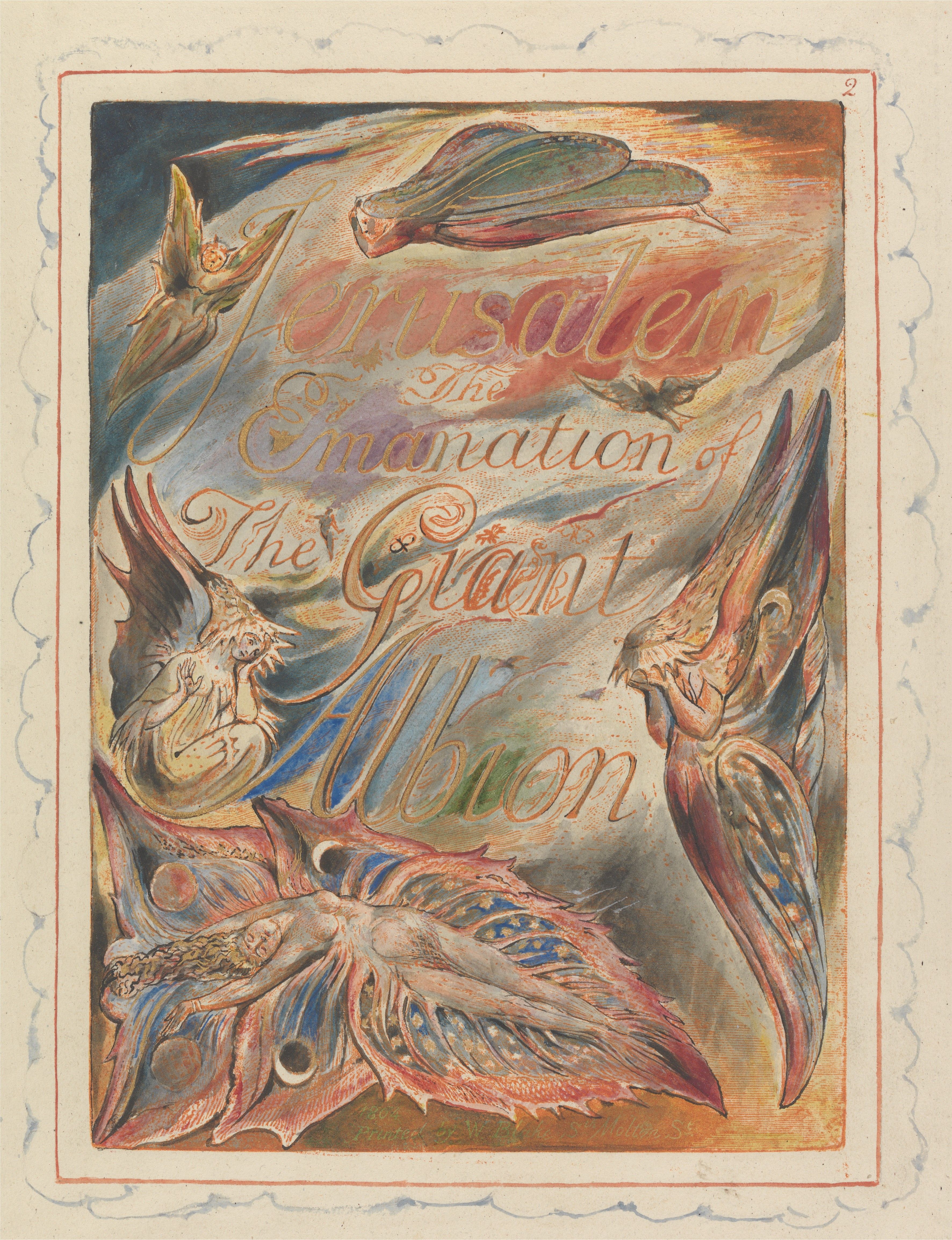
In the frontispiece of Jerusalem we see Los entering the Door of Death to wake the Giant Albion from the sleep which has numbed his senses, distorted his reason and bound his imagination. The following plate acts a a title page for the work and introduces the first chapter of the book - To the Public. The butterfly images represent phases of Jerusalem the emanation of Albion, who like her male counterpart is asleep to her true Eternal nature. The artist Blake has used his skills and imagination to present the 'lovely, mild Jerusalem' in her splendor.

Yale Center for British Art
Jerusalem
Plate 2


Later on Plate 86 of the poem Blake uses words to present Jerusalem. Notice how the word picture complements, supplements and reinforces the image which introduced the poem, and in which we are introduced to Jerusalem, the Emanation of the Giant Albion. The lovely Jerusalem is pictured four-fold and described three-fold.


Jerusalem, PLATE 86, (E 244)
"I see thy Form O lovely mild Jerusalem, Wingd with Six Wings
In the opacous Bosom of the Sleeper, lovely Three-fold
In Head & Heart & Reins, three Universes of love & beauty
Thy forehead bright: Holiness to the Lord, with Gates of pearl
Reflects Eternity beneath thy azure wings of feathery down
Ribbd delicate & clothd with featherd gold & azure & purple
From thy white shoulders shadowing, purity in holiness!
Thence featherd with soft crimson of the ruby bright as fire
Spreading into the azure Wings which like a canopy
Bends over thy immortal Head in which Eternity dwells
Albion beloved Land; I see thy mountains & thy hills
And valleys & thy pleasant Cities Holiness to the Lord
I see the Spectres of thy Dead O Emanation of Albion.

Thy Bosom white, translucent coverd with immortal gems
A sublime ornament not obscuring the outlines of beauty
Terrible to behold for thy extreme beauty & perfection
Twelve-fold here all the Tribes of Israel I behold
Upon the Holy Land: I see the River of Life & Tree of Life
I see the New Jerusalem descending out of Heaven
Between thy Wings of gold & silver featherd immortal
Clear as the rainbow, as the cloud of the Suns tabernacle

Thy Reins coverd with Wings translucent sometimes covering
And sometimes spread abroad reveal the flames of holiness
Which like a robe covers: & like a Veil of Seraphim
In flaming fire unceasing burns from Eternity to Eternity
Twelvefold I there behold Israel in her Tents
A Pillar of a Cloud by day: a Pillar of fire by night
Guides them: there I behold Moab & Ammon & Amalek
There Bells of silver round thy knees living articulate
Comforting sounds of love & harmony & on thy feet
Sandals of gold & pearl, & Egypt & Assyria before me
The Isles of Javan, Philistea, Tyre and Lebanon

Thus Los sings upon his Watch walking from Furnace to Furnace."
.

Monday, July 25, 2011

JERUSALEM WEPT


The final chapter of Jerusalem is addressed 'To the Christians'. Doskow refers to Chapter 4 as treating affective error, whereas chapter 1 treated the entire story, chapter 2 treated religious error, and chapter 3 treated rational error.

Of great concern to Blake was the fact that the spiritual experience of Jesus had been transformed into a religion which deprived man of the liberty to use the imagination to express the fullness of his spirit. In Chapter 4, Jerusalem as an expression of that liberty, has been distorted by the sons of Albion. This is another example of the war between emotions as represented by Jerusalem, and reason represented by the Sons of Albion. Los will assume the job of protecting Jerusalem in her fallen state from Albion's spectrous sons.
Yale Center for British Art
Jerusalem 
Plate 78

Comments from Minna Doskow's William Blake's Jerusalem:
"Here a bird-headed human figure sits upon a white rock surrounded by the sea of time and space. Vala's clouds dominate the sky while the sun of imagination sets at the left, its brown rays sending an ominous light over the whole. The figure with the bird of prey's beak represents Albion's twelve spectrous sons, who the text explains are "ravening to devour/The Sleeping Humanity". (Page 141)

Jerusalem like the other fallen emanations becomes involved in emotional errors against the male:
"As Enitharmon extols secrecy, jealousy, feminine domination, pride, and morality, and uses sexuality as the ultimate weapon in her arsenal, she echo's the affective errors of the other fallen females;" (Page 151)

Jerusalem, PLATE 78, (E 233)
"Chapter 4
The Spectres of Albions Twelve Sons revolve mightily
Over the Tomb & over the Body: ravning to devour
The Sleeping Humanity.
Los with his mace of iron
Walks round: loud his threats, loud his blows fall
On the rocky Spectres, as the Potter breaks the potsherds;
Dashing in pieces Self-righteousnesses: driving them from Albions
Cliffs: dividing them into Male & Female forms in his Furnaces
And on his Anvils: lest they destroy the Feminine Affections
They are broken. Loud howl the Spectres in his iron Furnace

While Los laments at his dire labours, viewing Jerusalem,
Sitting before his Furnaces clothed in sackcloth of hair;
Albions Twelve Sons surround the Forty-two Gates of Erin,
In terrible armour, raging against the Lamb & against Jerusalem,
Surrounding them with armies to destroy the Lamb of God.
They took their Mother Vala, and they crown'd her with gold:
They namd her Rahab, & gave her power over the Earth

The Concave Earth round Golgonooza in Entuthon Benython,
Even to the stars exalting her Throne, to build beyond the Throne
Of God and the Lamb, to destroy the Lamb & usurp the Throne of God
Drawing their Ulro Voidness round the Four-fold Humanity

Naked Jerusalem lay before the Gates upon Mount Zion
The Hill of Giants, all her foundations levelld with the dust!

Her Twelve Gates thrown down: her children carried into captivity
Herself in chains: this from within was seen in a dismal night
Outside, unknown before in Beulah, & the twelve gates were fill'd
With blood; from Japan eastward to the Giants causway, west
In Erins Continent: and Jerusalem wept upon Euphrates banks
Disorganizd; an evanescent shade, scarce seen or heard among
Her childrens Druid Temples dropping with blood wanderd weeping!
And thus her voice went forth in the darkness of Philisthea.

My brother & my father are no morel God hath forsaken me
The arrows of the Almighty pour upon me & my children
I have sinned and am an outcast from the Divine Presence!"

Milton Percival, in William Blake's Circle of Destiny, explains the role the feminine emotions play in bringing Albion to a state in which his regeneration is possible:

"The feminine emotions, driven in desperation by the increasing severity of the rational mind, turn from vengeance to forgiveness in their own defense...the emotions have been driven by the doubting rational mind into such narrow and cruel forms, such perversions of their own nature, that a sudden conversion is induced... Redeemed from error's power, the female unites herself again with her masculine contrary. As Blake puts it, the female "is made receptive of generation through mercy in the potters furnace." The sterile feminine world is made spiritually productive. Christ is born in Vala's woven mantle. (Page 228)
...
"Such then is the redemptive process. By means of it the emotional life (the feminine contrary) is made self-sacrificing and the original relationship of the contraries is restored. (Page 229)

Doskow concludes her commentary with these words:
"Contraries that form the basis of progression and dialectic within the poem, therefore, still continue within imaginative existence. They complement each other in living relationships so that finite and infinite, natural and immortal, are not exclusive but interdependent. As soon as such conditions obtain, liberty prevails - everyone's Emanation is called Jerusalem. Man can then exercise the arts of imagination in creative effort. He is unified with the world and his fellow men through sympathy and brotherhood, and his society reflects his regeneration in external conditions. The moment of Eternal Life forecast at the outset is now accomplished." (Page 169)


This post follows posts on the first chapter of Jerusalem: To the Public, and the second chapter: To the Jews, and the third: To the Deists.

Sunday, July 24, 2011

Some aphorisms

Ellie suggested that I list some favorite aphorisms:
Before 1980 you might expect from me, in response to almost
anything, a verse of scripture. After 1983 it became a verse from Blake.

Some of them are listed here in bold, and the description perhaps seves to explicate what I take to be the meaning (you may very legitimately find other meanings).

Here are some most commonly quoted:
"I give you the end of a Golden String Only wind it into a ball: It will let you in at Heaven's Gate Built in Jerusalem's wall."

What is the Golden String? how about the Christ
Consciousness? That's something you must work at
assiduously; it involves continuously annihilating your
internal spectre. 'Winding the ball' is a lifelong project,
but the end of it is Heaven's Gate.

"My Spectre around me night and day Like a wild beast upon my way"

The devil in you never sleeps.
Give him a chance and he will rend your psyche
limb from limb.

But when your 'string' is fully wound you may meet this:

"Then shall we return & see
The worlds of happy Eternity
& Throughout all Eternity
I forgive you you forgive me
As our dear Redeemer said
This the Wine & this the Bread"

That's the shape of the Eternity that Blake
was always talking about. I call it UPSTAIRS.

Jesus was about Forgiveness of Sin.
He forgives and forgives and forgives.
But to enjoy his benefit we have to forgive
like [Blake] forgave his Spectre in the poem.

"Both read the Bible day & night But thou readst black where
I read white
"
(The Everlasting Gospel; E517ff)

Way back some centuries ago the concept of 'The
Everlasting Gospel became current, generally
understood in this way:
The Trinity denotes epochs in three stages of
God's Revelation:
The Father is found in the Old Testament.
The Son is found in the New Testament.
The Holy Spirit includes all subsequent revelations,
including my vision and yours.

The poetry of Blake emphatically occurs in the
third period.

In 1810-12 Blake labored with The Everlasting Gospel:
Extracts:
"The Vision of Christ that thou dost see
Is my Visions Greatest Enemy
Thine has a great hook nose like thine
Mine has a snub nose like to mine
Thine is the Friend of All Mankind
Mine speaks in parables to the Blind
Thine loves the same world that mine hates
Thy Heaven doors are my Hell Gates
.........
Both read the Bible day & night
But thou readst black where I read white"
(Erdman 517ff)

In Plate 98 of Jerusalem Blake wrote:
"The Druid Spectre was Annihilate loud thundring
rejoicing
Fourfold Annihilation & at the clangor of the Arrows of
Intellect
The innumerable Chariots of the Almighty appeard in
Heaven
And Bacon & Newton & Locke, & Milton & Shakspear &
Chaucer
A Sun of blood red wrath surrounding heaven on all sides
around
Glorious incompreh[en]sible by Mortal Man"

So at the end Blake forgave his mortal enemies; here the term
Bacon and Newton and Locke is a metaphor for all Blake's
enemies. He has complied with the commandment:
"Forgive us our trespasses as we forgive those who
trespass against us."

"Know that after Christ's death he became Jehovah".
(MHH plate 6 ; E35)

What in the world does that mean?
In his natural life Jesus put forth the Father;
the epitome may well be the story of the Prodigal Son.
But after he died he became Jehovah?Link
He had told us to look to the Father, but after he died
orthodox Christian's looked to Jesus; he took the place of God.
They pray to him, not to the Father!
That's why Blake said that, speaking with heavy irony.

"Satan is the State of Death, & not a Human existence:"
(Jerusalem , Plate 49; E 198)
(This one from Ellie)

"I must create a system or be enslav'd by another Mans"
We must create our own belief structure and values or else
depend upon someone elses.
We will be conventional, dependent people or Individualists.

"Without contraries is no progression
Attraction and Repulsion, Reason and Energy,
Love and Hate, are necessary to human existence.
From these contraries spring what the religious
call Good and Evil."

Saturday, July 23, 2011

VEGETATED MORTAL EYE

This post follows posts on the first chapter of Jerusalem; To the Public and the second chapter: To the Jews.

Chapter 3 of Jerusalem is addressed to the Deists, those with a consciousness that rejects a direct and immediate connection between God and man. Sense data, processed by the rational mind, is the only admissible evidence to the Deist. The figure of Rahab is used by Blake to epitomize the Deistic perspective. The experience of the 'Spiritual Fourfold' is:
"incomprehensible
To the Vegetated Mortal Eye's perverted & single vision"

Jerusalem, PLATE 53, (E 202)
" Chap 3.

But Los, who is the Vehicular Form of strong Urthona
Wept vehemently over Albion where Thames currents spring
From the rivers of Beulah; pleasant river! soft, mild, parent stream
And the roots of Albions Tree enterd the Soul of Los
As he sat before his Furnaces clothed in sackcloth of hair
In gnawing pain dividing him from his Emanation;
Inclosing all the Children of Los time after time.
Their Giant forms condensing into Nations & Peoples & Tongues
Translucent the Furnaces, of Beryll & Emerald immortal:
And Seven-fold each within other: incomprehensible
To the Vegetated Mortal Eye's perverted & single vision

The Bellows are the Animal Lungs. the hammers, the Animal Heart
The Furnaces, the Stomach for Digestion; terrible their fury
Like seven burning heavens rang'd from South to North

Here on the banks of the Thames, Los builded Golgonooza,
Outside of the Gates of the Human Heart,
beneath Beulah
In the midst of the rocks of the Altars of Albion. In fears
He builded it, in rage & in fury. It is the Spiritual Fourfold
London: continually building & continually decaying desolate!

In eternal labours: loud the Furnaces & loud the Anvils
Of Death thunder incessant around the flaming Couches of
The Twentyfour Friends of Albion and round the awful Four
For the protection of the Twelve Emanations of Albions Sons
The Mystic Union of the Emanation in the Lord; Because
Man divided from his Emanation is a dark Spectre
His Emanation is an ever-weeping melancholy Shadow

But she is made receptive of Generation thro' mercy
In the Potters Furnace, among the Funeral Urns of Beulah
From Surrey hills, thro' Italy and Greece, to Hinnoms vale."


Jerusalem

Plate 53
Image from
Library of Congress
Click on LC image to enlarge


The following quotes are from Minna Doskow's William Blake's Jerusalem: structure and meaning in poetry and picture which you
can read online or purchase through Better World Books.

Page 111
"As Los and Albion divide,repeating the initial ongoing action of the poem, Rahab sits brooding over the description within the huge sunflower that dominates the opening plate of the chapter (pl. 53). This pictorial opening to chapter 3 parallels that of chapter 2, just as the poetical beginning does, for it also depicts a fallen female, a flower, and the sea as plate 28 does. Vala's lily of plate 28, however has been exchanged in plate 53 for Rahab's sunflower, the flower tied inexorably to time, following the sun all its life...Ironically though Rahab on her Deistic sunflower throne obscures the sun and its imaginative potential and shadows the worlds of time and space that she blankly regards. Her seated attitude with head in hands suggests Deism's philosophical abstraction and accompanying despair...Her wings , which parody the butterfly wings of Jerusalem, contain the moon, earth, and stars, but not the sun. They include the fallen elements of the universe only not the imaginative, and therefore accurately represent the Deistic natural world."

Page 138
[Rahab is] "that system of mystery, self-righteousness, sin, war, generative sexuality, and moral virtue which must be overcome for the Edenic world to prevail."
"...she has acted as the sacrificial priestess in Reason's temple, as natural religion, and destructive nature within Deism."

Page 118
"Left to Deism the world become pure matter under Albion's daughters and pure mathematics and empirical science under his sons."

So it is Rahab who is chosen as the image to represent the reasoning error which expresses itself in Deism. The female as materiality gains power over the male as he is cut off from a 'perception of the infinite.' Chapter 3 develops the theme of the accumulation of power in Rahab and the resulting political, social and personal ramifications. The error of Deism, produced by the loss of the imaginative connection to Eternity, fosters man's trust in reasoning along with the trust in the material or 'Natural' world of Rahab.
.

Friday, July 22, 2011

Lessons -1

This is a (edited) copy of a post in Lessons:

Look at The Marriage of Heaven and Hell:

PLATE 11 The ancient Poets animated all sensible
objects with Gods or Geniuses calling them by the
names and adorning them with the properties of woods, rivers, mountains, lakes, cities, nations, and
whatever their enlarged & numerous senses could
percieve. And particularly they studied the genius
of each city & country. placing it under its mental
deity. Till a system was formed, which some took
advantage of & enslav'd the vulgar by attempting to realize or abstract the mental deities from their
objects: thus began Priesthood.

Choosing forms of worship from poetic tales.
And at length they pronounced that the Gods had orderd such things. Thus men forgot that All deities reside in the human breast.”

We could discuss that at length, but look at a later
one:
“I must create a system or be enslavd by another Mans I will not reason and compare, my business is to Create”(Jerusalem; E153)

In a manner of speaking Blake's Myth involved a re-creation of the Bible. Both works proceed as follows:
1. The Biblical version: A worldly creation, including making of Man, a Fall leading to expulsion from the Garden, the dire consequences of eating of the fruit of the Tree of Good and Evil.

2. In Blake's version, Creation occurred after the Fall; he ascribed it to his reasoning faculty, Urizen.

Blake denied any reality to Good and Evil; instead he used the terms: Truth and Error. Men don't sin, he says. They make errors. Forgiveness, the most powerful word for Blake wipes out the error. In his Reflections of A Vision of the Last Judgment he made this statement:
“What are all the Gifts of the Spirit but Mental Gifts whenever any Individual Rejects Error & embraces Truth a Last Judgment passes upon that Individual”, which of course in my book amounts to Universalism in the original sense of the word."

“Hell” is presented at great length in The Four Zoas and in Jerusalem. He called it Ulro. Starting with Eternity newborns inhabit Beulah (on dry land). However they more or less always find themselves in the Sea of Time and Space. (The picture is in the back of Blake and Antiquity.)

A better way is to speak of Albion (equivalent to Adam); Beulah is an earthly place where the eternals resort for R&R from the “severe contentions of Friendship, our
Sexual cannot: but flies into the Ulro”.

Blake's myth is an alternative version of the Bible myth:

Creation: Albion, the Eternal Man, Adam lived in Eternity, but becoming tired of the fierce contentions of Friendship and dropped down to Beulah. Unfortunately he fell asleep and divided into the four zoas:

Tharmas: our basic physicality.
Urizen: our reasoning faculty
Luvah: our feeling function
Urthona/Los: our imagination (intuition)

We all have those Jungian functions. One is called the dominant function; another is our inferior function.

The zoas got into all sorts of conflict with one another and with their Emanations (their female dimension). The emanations are wonderful until they fall into spidery dominating elements.

All of them have descended from Beulah to Ulro (Blake's name for Hell).
Here we languish until love and forgiveness heal us through generation, then regeneration, then redemption, then awaking in Eternity.

That's Blake's myth in a nutshell. We might devote an hour to it some time in the next month.


Thursday, July 21, 2011

FROM SACRIFICE OF SELF

In the post THROUGH ETERNAL DEATH we dealt with Doskow's introduction to the first of the four chapters of Jerusalem, the one addressed 'To the Public'. The introduction to the second chapter, 'To the Jews', claims our attention now.

Doscow ( William Blake's Jerusalem) makes clear that the second chapter is addressed to the level of consciousness represented by 'The Jews' and not by a historical group of people. In this chapter Albion is to experience the consequences of the religious error of practicing a religion based "codes of moral law that define sin and punishment, and second on the idea of an absent, invisible exiled God who dwells in chaos." Albion will be shown the alternative to this error: the possibility of assimilating a religion based on "codes of love, mutuality and acceptance and God as 'The Human Form Divine.'" (Page 72)
Each chapter of Jerusalem begins with a full page plate which gives in symbolic pictorial language an introduction to the content of the chapter. Following the illustrative plate is a plate which addresses a particular group whose errors Blake wishes to explore. Next is the first page of the chapter which states in words and pictures the problem he is treating and its potential solution.
Yale Center for British Art
Jerusalem, Plate 28


Additional image from
Library of Congress
Click LC picture to enlarge


Now lets see what Doskow has to say about Jerusalem, Plate 28, which is the third plate of chapter 2:

"While the poetic text of the plate concentrates on the male expression of Albion's religious error in Albion and his sons, the illustration depicts the same error in terms of Albion's female parts as Vala dominates Jerusalem. Two naked females in the illustration embrace face to face before a golden net...Furthermore both figures sit on a huge lily, symbol of Vala..., surrounded by the watery world of time and space." (Page 76)

"Man's self-reduction to the merely natural state that results from his religious error and is expressed in Vala's domination also appears in the figure Ruben. In him we see the further limitations of Albion' sensuality, the reduction of his other four senses (sight, smell, taste, hearing) in addition to touch (sexuality) limited by Vala."

Jerusalem , PLATE 28, (E 174)
Chap: 2.

"Every ornament of perfection, and every labour of love,
In all the Garden of Eden, & in all the golden mountains
Was become an envied horror, and a remembrance of jealousy:
And every Act a Crime, and Albion the punisher & judge.

And Albion spoke from his secret seat and said

All these ornaments are crimes, they are made by the labours
Of loves: of unnatural consanguinities and friendships
Horrid to think of when enquired deeply into; and all
These hills & valleys are accursed witnesses of Sin
I therefore condense them into solid rocks, stedfast!
A foundation and certainty and demonstrative truth:
That Man be separate from Man, & here I plant my seat.

Cold snows drifted around him: ice coverd his loins around
He sat by Tyburns brook, and underneath his heel, shot up!
A deadly Tree, he nam'd it Moral Virtue, and the Law
Of God who dwells in Chaos hidden from the human sight.


The Tree spread over him its cold shadows, (Albion groand)
They bent down, they felt the earth and again enrooting
Shot into many a Tree! an endless labyrinth of woe!

From willing sacrifice of Self, to sacrifice of (miscall'd) Enemies
For Atonement: Albion began to erect twelve Altars,
Of rough unhewn rocks, before the Potters Furnace
He nam'd them Justice, and Truth. And Albions Sons
Must have become the first Victims, being the first transgressors
But they fled to the mountains to seek ransom: building A Strong
Fortification against the Divine Humanity and Mercy,
In Shame & Jealousy to annihilate Jerusalem!"

When the reading of the body of the text gets confusing, it may be helpful to return to the first three plates of a chapter to reorient oneself by the use of these three pages of 'maps' which Blake provides to help his reader through bewildering territory. Read online Minna Doskow's William Blake's Jerusalem: structure and meaning in poetry and picture for an in depth commentary on Jerusalem and a facsimile of Blake's complete book.
From the Library of Congress website you may download a PDF of the entire 100 plates of Jerusalem. This won't be the color copy, but you will be able to get an overview, select specific pages, zoom in for detail, and enjoy reading your own copy of Jerusalem.


Wednesday, July 20, 2011

EVENING STAR

TO THE EVENING STAR

by: William Blake (1757-1827)

  • HOU fair-hair'd angel of the evening,
  • Now, whilst the sun rests on the mountains, light
  • Thy bright torch of love; thy radiant crown
  • Smile on our loves, and while thou drawest the
  • Blue curtains of the sky, scatter thy silver dew
  • On every flower that shuts its sweet eyes
  • In timely sleep. Let thy west wind sleep on
  • The lake; speak silence with thy glimmering eyes,
  • And wash the dusk with silver. Soon, full soon,
  • Dost thou withdraw; then the wolf rages wide,
  • And then the lion glares through the dun forest:
  • The fleeces of our flocks are cover'd with
  • Thy sacred dew: protect them with thine influence!
  • Tuesday, July 19, 2011

    GHOST OF ABEL

    These are the plates for Blake's The Ghost of Abel which was quoted in the post EVOLUTION OF CONSCIOUSNESS.


    Careful attention to the symbolic images will enhance your appreciation for this poem.

    Monday, July 18, 2011

    THROUGH ETERNAL DEATH

    Minna Doskov's has written a useful guide to the complexities of reading Jerusalem in her book William Blake's Jerusalem. The four chapters of Jerusalem are addressed to the Public, the Jews, the Deists and the Christians. Doskow explains that each is directed to:
    "a particular group that in Blake's view typifies the error exposed in the chapter. These groups, however, refer to states of consciousness, rather than historical entities. Just as sleep, passage, and awakening are metaphors for for a particular state of Albion's consciousness, so are Jews, Deists, and Christians (the dedicatory groups of chapters 2, 3, and 4 respectively)." (Page 20)
    ...
    "The first two lines of chapter 1 contain the action of the whole; the prologue and epilogue display it graphically. The first confrontation between Albion and the Savior outlines all other confrontations. The first chapter's frontispiece and dedication embraces the chapter as well as the whole poem. Each subsequent chapter's dedication takes one piece of the whole and explores it, summarizing the content of the entire chapter." (Page 21)


    Jerusalem, Plate 4
    Library of Congress


    Jerusalem, PLATE 4, (E 146)
    "Chap: I
    Of the Sleep of Ulro! and of the passage through
    Eternal Death! and of the awaking to Eternal Life.


    This theme calls me in sleep night after night, & ev'ry morn
    Awakes me at sun-rise, then I see the Saviour over me
    Spreading his beams of love, & dictating the words of this mild
    song.

    Awake! awake O sleeper of the land of shadows, wake! expand!
    I am in you and you in me, mutual in love divine:
    Fibres of love from man to man thro Albions pleasant land.

    In all the dark Atlantic vale down from the hills of Surrey
    A black water accumulates, return Albion! return!
    Thy brethren call thee, and thy fathers, and thy sons,
    Thy nurses and thy mothers, thy sisters and thy daughters
    Weep at thy souls disease, and the Divine Vision is darkend:
    Thy Emanation that was wont to play before thy face,
    Beaming forth with her daughters into the Divine bosom
    [Where!!]
    Where hast thou hidden thy Emanation lovely Jerusalem
    >From the vision and fruition of the Holy-one?
    I am not a God afar off, I am a brother and friend;
    Within your bosoms I reside, and you reside in me:
    Lo! we are One; forgiving all Evil; Not seeking recompense!
    Ye are my members O ye sleepers of Beulah, land of shades!

    But the perturbed Man away turns down the valleys dark;
    [Saying. We are not One: we are Many, thou most
    simulative
    ]
    Phantom of the over heated brain! shadow of immortality!
    Seeking to keep my soul a victim to thy Love! which binds
    Man the enemy of man into deceitful friendships:
    Jerusalem is not! her daughters are indefinite:
    By demonstration, man alone can live, and not by faith.
    My mountains are my own, and I will keep them to myself!

    The Malvern and the Cheviot, the Wolds Plinlimmon & Snowdon
    Are mine. here will I build my Laws of Moral Virtue!
    Humanity shall be no more: but war & princedom & victory!

    So spoke Albion in jealous fears, hiding his Emanation
    Upon the Thames and Medway, rivers of Beulah: dissembling
    His jealousy before the throne divine, darkening, cold!"

    Doskow subtitles her book Structure and Meaning in Poetry and Picture. She gives the graphic content as well as the written material careful attention.

    "'In his first speech, Albion demonstrates all three basic components of his fall, his religious, rational and affective errors that are all investigated in this chapter and then in detail separately in the three following chapters of the poem."
    ...
    [The Savior presents the] "opposing alternatives" [which are] "equally available for Albion's consciousness as the illustration indicates (pl. 4), for it pictures both fallen Albion controlled by error and unfallen Albion soaring freely. The network of lines in the right lower margin of this plate exemplifies the same opposing alternatives, for what it represents depends upon the beholder's consciousness. Looked at in Albion's fallen terms, it represents the deceitful bonds he mentions and the net that Vala so often uses to ensare mankind. Regarded, however in the Savior's imaginative terms, it becomes those fibers of love he mentions which establish the divine brotherhood of man." (Page 45)
    ...
    "The cowled figure resembles the fallen female spirit who controls the merely natural world...she is only partially successful in Jerusalem... Grasping the head of one naked male figure, fallen Albion, who is seated on the rocky shore, she controls his intellect and vision. The other naked male figure, unfallen Albion, eludes her grasp and turns his attention and praying hands to the soaring figures rising in a parabola from him. Here are Albion's ongoing alternatives graphically represented...The exploration of these choices forms the substance of the poem graphically as well as poetically, for each choice is unfolded in subsequent illustrations." (Page 19)

    Blake brings all the powers of his imagination together to impress on men's psyches the stark choices which lie before each individual and each nation.

    Sunday, July 17, 2011

    MY EYES DID EXPAND

    Ram Horn'd with Gold

    A Blake Hypertext Commentary

    The Spiritual Autobiography of William Blake

    Edited by Larry Clayton


    "Blake sent this poem to the one faithful Christian he knew who had befriended and loved him. The circumstances leave no doubt as to the identity of the One Man. The poem poetically expresses Blake's faith as it relates to God, Man and the relationship between the two. It expresses what the Christian faith has to say about the relationship as well as it can be expressed verbally. It also expresses with vivid eloquence the child like nature of the entrance to the kingdom of God. Blake here celebrates and confesses it. To interpret Blake's experience we could use any number of hackneyed phrases representing the various dialects of the language of Zion; suffice it to say that for most of them as for Blake this is the main event, the center of the Moment of Grace. At this point Jesus became and forever afterward remained the One and the ever present Reality which Blake had formerly known as the Infinite or Eternal. For Blake Jesus was a Man, the Reality of Life, and most ultimately the All. In all three instances Blake strictly followed Johnine and Pauline strains of the New Testament."
    Letters, 16, Oct 1800, (E 712) 
    
    "To my Friend Butts I write
       My first Vision of Light
       On the yellow sands sitting
       The Sun was Emitting
       His Glorious beams
       From Heavens high Streams
       Over Sea over Land
       My Eyes did Expand
       Into regions of air
       Away from all Care
       Into regions of fire
       Remote from Desire
       The Light of the Morning
       Heavens Mountains adorning
       In particles bright
       The jewels of Light
       Distinct shone & clear--
       Amazd & in fear
       I each particle gazed
       Astonishd Amazed
       For each was a Man
       Human formd.
       ...
       I stood in the Streams
       Of Heavens bright beams
       And Saw Felpham sweet
       Beneath my bright feet
       In soft Female charms
       And in her fair arms
       My Shadow I knew
       And my wifes shadow too
       And My Sister & Friend.
       We like Infants descend
       In our Shadows on Earth
       Like a weak mortal birth
       My Eyes more & more
       Like a Sea without shore
       Continue Expanding
       The Heavens commanding
       Till the jewels of Light
       Heavenly Men beaming bright
       Appeard as One Man
       Who Complacent began
       My limbs to infold
       In his beams of bright gold
       Like dross purgd away
       All my mire & my clay
       Soft consumd in delight
       In his bosom sun bright
       I remaind.  Soft he smild
       And I heard his voice Mild
       Saying This is My Fold
       O thou Ram hornd with gold"
    
    Look also at this  Plate from America a Prophecy, copy A, in the collection of the Morgan Library