Tuesday, October 13, 2015

Tree of Mystery

Genesis 2:7-17

[7] And the LORD God formed man of the dust of the ground, and breathed into his nostrils the breath of life; and man became a living soul.
[8] And the LORD God planted a garden eastward in Eden; and there he put the man whom he had formed.
[9] And out of the ground made the LORD God to grow every tree that is pleasant to the sight, and good for food; the tree of life also in the midst of the garden, and the tree of knowledge of good and evil.
[10] And a river went out of Eden to water the garden; and from thence it was parted, and became into four heads.
[11] The name of the first is Pison: that is it which compasseth the whole land of Havilah, where there is gold;
[12] And the gold of that land is good: there is bdellium and the onyx stone.
[13] And the name of the second river is Gihon: the same is it that compasseth the whole land of Ethiopia.
[14] And the name of the third river is Hiddekel: that is it which goeth toward the east of Assyria. And the fourth river is Euphrates.
[15] And the LORD God took the man, and put him into the garden of Eden to dress it and to keep it.
[16] And the LORD God commanded the man, saying, Of every tree of the garden thou mayest freely eat:
[17] But of the tree of the knowledge of good and evil
, thou shalt not eat of it: for in the day that thou eatest thereof thou shalt surely die.

This is the biblical source of the Tree of Mystery and of many other things in 'Blake'.

*****************************************************************************

The Tree of Mystery occurs once in the Book of Ahania and nowhere else except in the Four Zoas.
This extract comes from 'Ahania':

"3: For when Urizen shrunk away                      
From Eternals, he sat on a rock
Barren; a rock which himself
From redounding fancies had petrified
Many tears fell on the rock,
Many sparks of vegetation;                             
Soon shot the pained root
Of Mystery, under his heel:
It grew a thick tree; he wrote
In silence his book of iron:

- 86 -(of Erdman's book)

Till the horrid plant bending its boughs    
Grew to roots when it felt the earth
And again sprung to many a tree.

4: Amaz'd started Urizen! when
He  beheld  himself compassed round
And high roofed over with trees             
He arose but the stems stood so thick
He with difficulty and great pain
Brought his Books, all but the Book

PLATE 4
Of iron, from the dismal shade


5: The Tree still grows over the Void
Enrooting itself all around
An endless labyrinth of woe!

6: The corse of his first begotten          
On the accursed Tree of MYSTERY:
On the topmost stem of this Tree


Watercolor Illustration to Milton's Paradise Lost by William Blake


Look also at this 'Good and Evil'

Monday, October 12, 2015

DEATH OF BITTER HOPE [109]

British Library
Four Zoas Manuscript
Page 109
Four Zoas, Night VIII, Page 108, (E 384)
"O how the horrors of Eternal Death take hold on Man   
His faint groans shake the caves & issue thro the desolate rocks 
PAGE 113 [109]
"And the Strong Eagle now with num[m]ing cold blighted of feathers
Once like the pride of the sun now flagging in cold night
Hovers with blasted wings aloft watching with Eager Eye
Till Man shall leave a corruptible body he famishd hears him groan
And now he fixes his strong talons in the pointed rock 
And now he beats the heavy air with his enormous wings
Beside him lies the Lion dead & in his belly worms
Feast on his death till universal death devours all
And the pale horse seeks for the pool to lie him down & die
But finds the pools filled with serpents devouring one another
He droops his head & trembling stands & his bright eyes decay
These are the Visions of My Eyes the Visions of Ahania

Thus cries Ahania Enion replies from the Caverns of the Grave

Fear not O poor forsaken one O land of briars & thorns
Where once the Olive flourishd & the Cedar spread his wings 
Once I waild desolate like thee my fallow fields in fear
Cried to the Churchyards & the Earthworm came in dismal state
I found him in my bosom & I said the time of Love
Appears upon the rocks & hills in silent shades but soon
A voice came in the night a midnight cry upon the mountains 
Awake the bridegroom cometh I awoke to sleep no more
But an Eternal Consummation is dark Enion
The watry Grave. O thou Corn field O thou Vegetater happy
More happy is the dark consumer hope drowns all my torment
For I am now surrounded by a shadowy vortex drawing 
The Spectre quite away from Enion that I die a death
Of bitter hope altho I consume in these raging waters
The furrowd field replies to the grave I hear her reply to me
Behold the time approaches fast that thou shalt be as a thing
Forgotten when one speaks of thee he will not be believd 
When the man gently fades away in his immortality 

When the mortal disappears in improved knowledge cast away
The former things so shall the Mortal gently fade away
And so become invisible to those who still remain
Listen I will tell thee what is done in the caverns of the grave" 


Wiki Commons
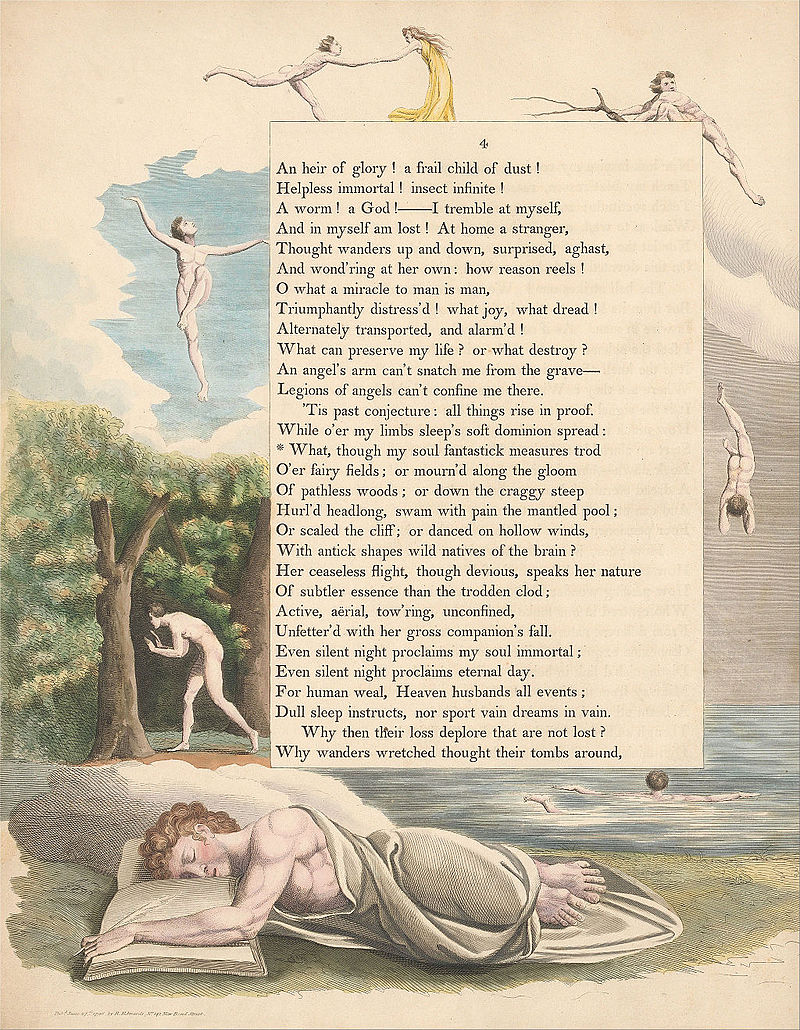
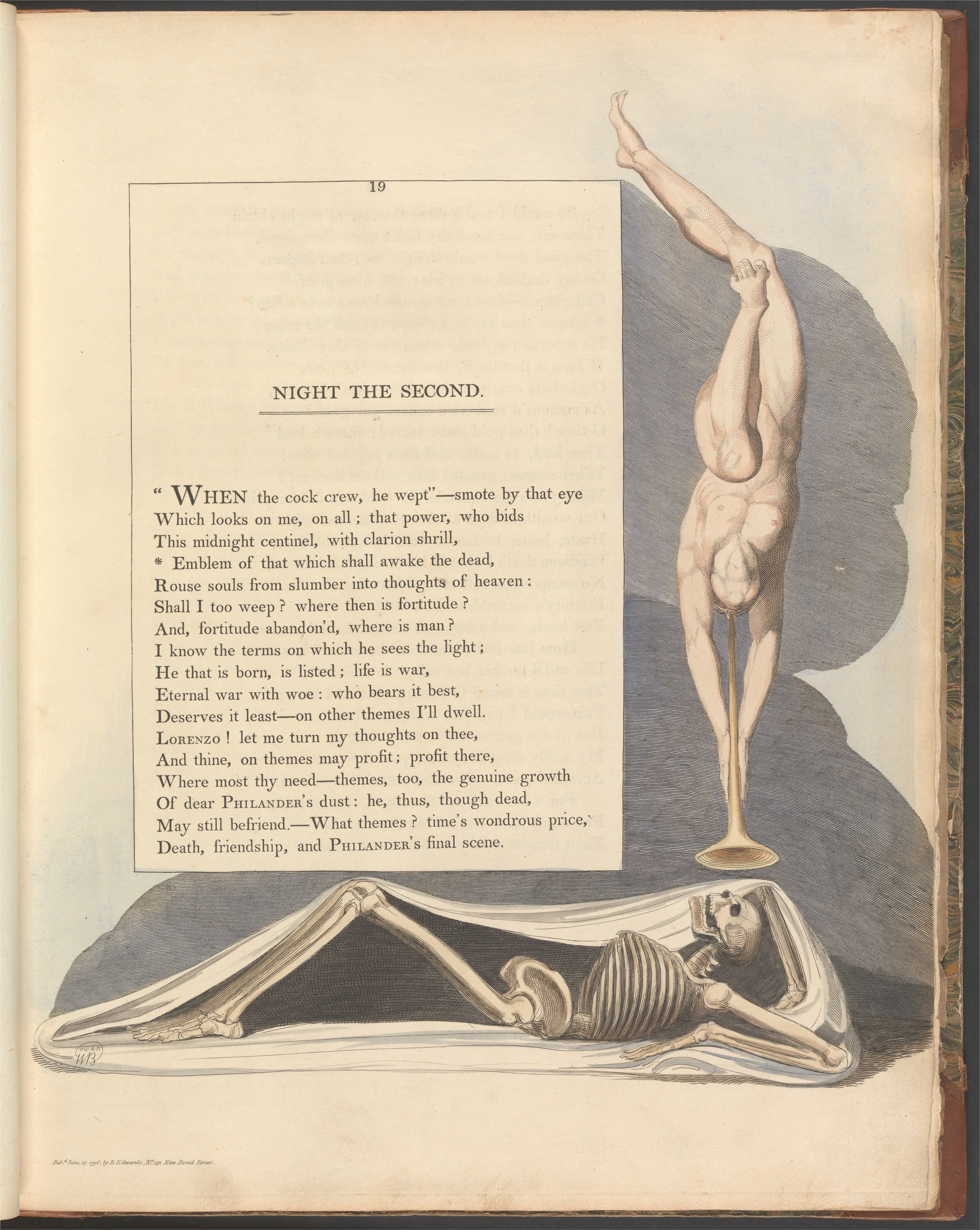
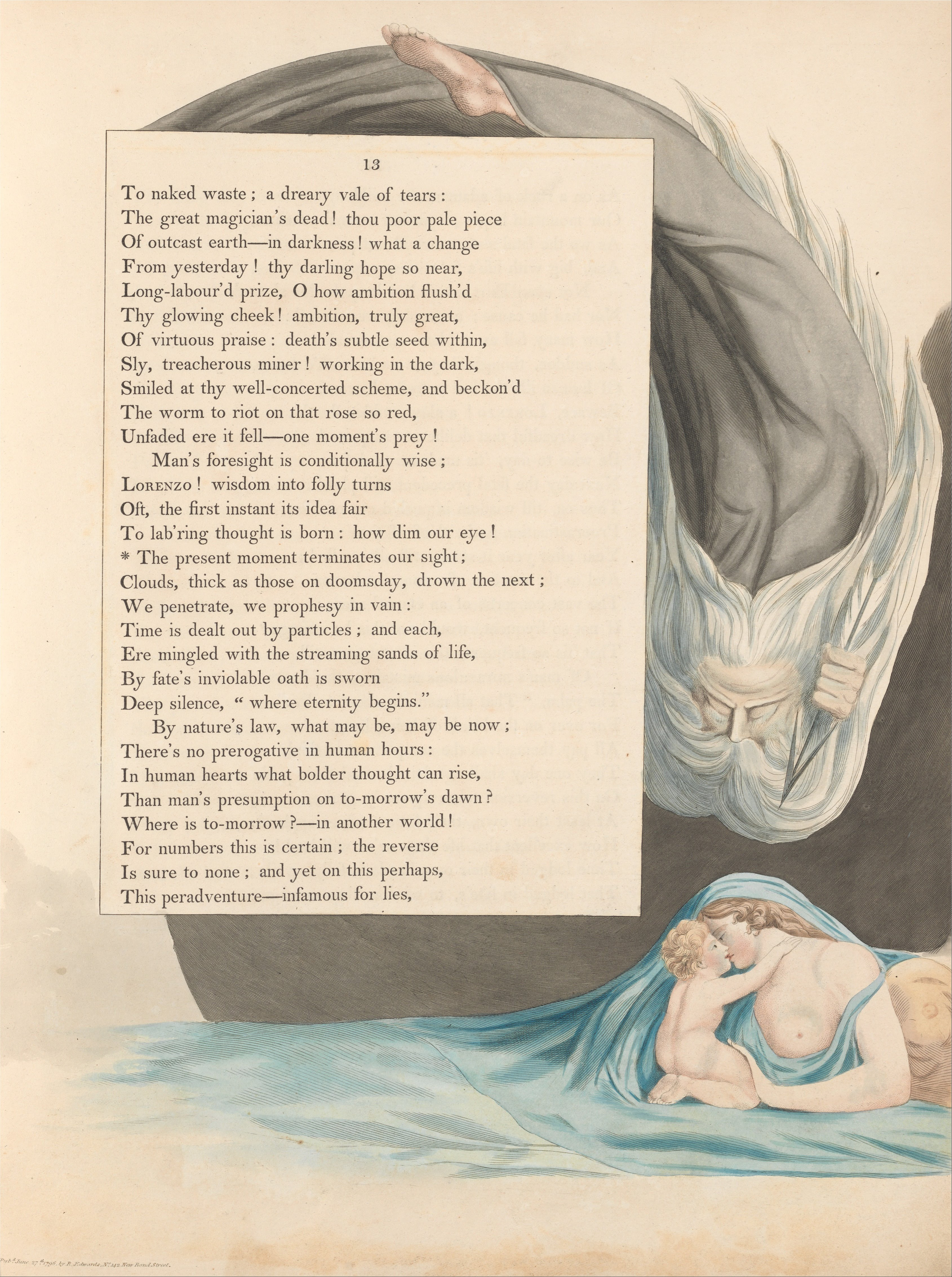
Illustrations to Young's Night Thoughts
Enion is being drawn away from the role she has played as the epitome of the natural world dissociated from integrating spirit. The cycle of life living on death will not continue when physical life is recognized as the portal to spiritual life. Enion saw that it was the Spectre which had drawn her away into the 'raging waters'. Her unexpressed hope is to be returned to Tharmas so that body and soul may function as one - acting as the human instinct.
 

Death in the material world plunges the corruptible body into decay and disintegration. 

Death to the material world releases the spirit to a new awakening.


Marriage of Heaven & Hell, Plate 4, (E 34)

                 "The voice of the Devil

  All Bibles or sacred codes. have been the causes of the
following Errors.
  1. That Man has two real existing principles Viz: a Body & a
Soul.
  2. That Energy. calld Evil. is alone from the Body. & that
Reason. calld Good. is alone from the Soul.
  3. That God will torment Man in Eternity for following his
Energies.
  But the following Contraries to these are True
  1 Man has no Body distinct from his Soul for that calld Body is
a portion of Soul discernd by the five Senses. the chief inlets
of Soul in this age
  2. Energy is the only life and is from the Body and Reason is
the bound or outward circumference of Energy.
  3 Energy is Eternal Delight"

Saturday, October 10, 2015

Albion

Albion has a composite character second to none. It means (originally) England, but at a deeper level it means the cosmos, which is a man!. (In this Blake agrees with the Adam Kadmon of the Kabbalah, the Heavenly Man of Philo, St. Paul's heavenly man, the second Adam, and the cosmic man of Gnostic mythology, and the Hindu god, Krishna.)
       Albion, the eternal man, fell asleep into mortality in Beulah. We read at the beginning of Night 2 these ominous words:
    Rising upon his Couch of Death Albion beheld his Sons
    Turning his Eyes outward to Self, losing the Divine Vision. Albion called Urizen & said:
    "Take thou possession! take this Scepter! go forth in my might
    For I am weary, & must sleep in the dark sleep of Death.
He divides and divides into four parts, the four zoas (strangely similar to the four functions promulgated a hundred years later by Carl Jung).
       This dissolution of the cosmic man, described at the beginning of The Four Zoas, passes through the Circle of Destiny, and at the end of The Four Zoas he awakens from his mortal sleep and resumes his place in Eternity. That in essence is a thumbnail account of Blake's myth: descent from Eternity, struggle, and eventually return.

Jerusalem plate 76

*****************************************************************
From Wikipedia, the free encyclopedia
This article is about the archaic name for Great Britain. For other uses, see Albion (disambiguation).
Not to be confused with Alban.

The White Cliffs of Dover may have given rise to the name Albion
Albion (Ancient GreekἈλβίων) is the oldest known name of the island of Great Britain. Today, it is still sometimes used poetically to refer to the island. The name for Scotland in the Celtic languages is related to Albion: Alba in Scottish Gaelic,Alba (genitive Alban, dative Albain) in IrishNalbin in Manx and Alban in Welsh,Cornish and Breton. These names were later Latinised as Albania and Anglicised as Albany, which were once alternative names for Scotland.
New Albion and Albionoria ("Albion of the North") were briefly suggested as names of Canada during the period of the Canadian Confederation.[1][2] CaptainArthur Phillip originally named the Sydney Cove "New Albion", but for uncertain reasons the colony acquired the name "Sydne

Friday, October 09, 2015

PUT OFF MORTALITY [107]

British Library
Four Zoas Manuscript
Page 107

Four Zoas, Night VIII, Page 106, (E 382)
"No longer now Erect the King of Light outstretchd in fury
Lashes his tail in the wild deep his Eyelids like the Sun 
Arising in his pride enlighten all the Grizly deeps
His scales transparent give forth light like windows of the morning
His neck flames with wrath & majesty he lashes the Abyss 
Beating the Desarts & the rocks the desarts feel his power
They shake their slumbers off. They wave in awful fear
Calling the Lion & the Tyger the horse & the wild Stag
PAGE 111 [107] 
The Elephant the wolf the Bear the Lamia the Satyr
His Eyelids give their light around his folding tail aspires
Among the stars the Earth & all the Abysses feel h[i]s fury  
When as the snow covers the mountain oft petrific hardness
Covers the deeps at his vast fury mo[a]ning in his rock      
Hardens the Lion & the Bear trembling in the Solid mountain
They view the light & wonder crying out in terrible existence
Up bound the wild stag & the horse behold the King of Pride

Oft doth his Eye emerge from the Abyss into the realms
Of his Eternal day & memory strives to augment his ruthfulness 
Then weeping he descends in wrath drawing all things in his fury
Into obedience to his will & now he finds in vain
That not of his own power he bore the human form erect
Nor of his own will gave his Laws in times of Everlasting
For now fierce Orc in wrath & fury rises into the heavens 
A King of wrath & fury a dark enraged horror
And Urizen repentant forgets his wisdom in the abyss      
In forms of priesthood in the dark delusions of repentance
Repining in his heart & spirit that Orc reignd over all
And that his wisdom servd but to augment the indefinite lust 

Then Tharmas & Urthona felt the stony stupor rise
Into their limbs Urthona shot forth a Vast Fibrous form
Tharmas like a pillar of sand rolld round by the whirlwind
An animated Pillar rolling round & round in incessant rage

Los felt the stony stupor & his head rolld down beneath 
Into the Abysses of his bosom the vessels of his blood
Dart forth upon the wind in pipes writhing about in the Abyss
And Enitharmon pale & cold in milky juices flowd
Into a form of Vegetation living having a voice
Moving in rootlike fibres trembling in fear upon the Earth 

And Tharmas gave his Power to Los Urthona gave his strength
Into the youthful prophet for the Love of Enitharmon
And of the nameless Shadowy female in the nether deep
And for the dread of the dark terrors of Orc & Urizen

Thus in a living Death the nameless shadow all things bound 
All mortal things made permanent that they may be put off
Time after time by the Divine Lamb who died for all
And all in him died. & he put off all mortality
PAGE 122 [108] 
Tharmas on high rode furious thro the afflicted worlds 
Pursuing the Vain Shadow of Hope fleeing from identity
In abstract false Expanses that he may not hear the Voice
Of Ahania wailing on the winds in vain he flies for still
The voice incessant calls on all the children of Men" 
Wiki Commons
Illustrations to Young's Night Thoughts

Poetry is written not in words but in images: the evanescent thread that moves through the words from mind to mind. Blake, on page 107, is allowing us to witness the collapse of Urizen. The sleeping man dreamt of the rise and fall of entities which inhabit his mind and are projected outward onto a world which he called real. Blake saw the process of solidifying things into mortal forms as essential to casting off mistaken perceptions. The example of Christ who put off mortality to assume immortality is the paradigm for dying to error in order to live in truth.


To be born again is to put off mortality: to be born not to flesh or blood or self-will but to consciousness of the Word of God being with you, dwelling in you and acting through you. Although at this point Urizen had not been born again, he had come to the realization:

"That not of his own power he bore the human form erect 
Nor of his own will gave his Laws in times of Everlasting".

The transformation of Urizen became possible when he knew that it was not his own strength and wisdom that sustained him.      

John 1
[1] In the beginning was the Word, and the Word was with God, and the Word was God.
[2] The same was in the beginning with God.
[3] All things were made by him; and without him was not any thing made that was made.
[4] In him was life; and the life was the light of men.
[5] And the light shineth in darkness; and the darkness comprehended it not.
...
[12] But as many as received him, to them gave he power to become the sons of God, even to them that believe on his name:
[13] Which were born, not of blood, nor of the will of the flesh, nor of the will of man, but of God.

.

Wednesday, October 07, 2015

Blake and Dante


You may read in Milton O. Percival's Circle of Destiny  page 1:

"I predict then, that when the evidence is in, it will be found that in the use
of tradition Blake exceeded Milton and was second, if to anyone, only to Dante."

In the concordance Blake mentioned Dante 27 times; many could be searched,
but I show here only 2:

Look at the Marriage of Heaven and Hell (Plate 22):
Have now another plain fact. Any man of mechanical talents may, from the writings of Paracelsus or Jacob Behmen, produce ten thousand volumes of equal value with Swedenborg's, and from those of Dante or Shakespear an infinite number.
But when he has done this, let him not say that he knows better than his master, for he only holds a candle in sunshine.


In Letter 62:|       
 Mr. Fuseli's Count Ugolino is the father of sons of feeling |        
and dignity, who would not sit looking in their parent's face in 
the moment of his agony, but would rather retire and die in 
        
secret, while they suffer him to indulge his passionate and         
innocent grief, his innocent and venerable madness, and insanity, 
and fury, and whatever paltry cold hearted critics cannot, 
because they dare not, look upon. Fuseli's Count Ugolino is a 
man of wonder and admiration, of resentment against man and 
devil, and of humilitation before God; prayer and parental 
affection fills the figure from head to foot. The child in his 
arms, whether boy or girl signifies not, (but the critic must be 
a fool who has not read Dante, and who does not know a boy from a         
girl); I say, the child is as beautifully drawn as it is       
coloured--in both, inimitable! and the effect of the whole is 
truly sublime, on account of that very colouring which our critic 
calls black and heavy. 

Tuesday, October 06, 2015

UNLESS I DIE [105]

Ezekiel
[3] And he said unto me, Son of man, can these bones live? And I answered, O Lord GOD, thou knowest.
[4] Again he said unto me, Prophesy upon these bones, and say unto them, O ye dry bones, hear the word of the LORD.
[5] Thus saith the Lord GOD unto these bones; Behold, I will cause breath to enter into you, and ye shall live:
...
[12] Therefore prophesy and say unto them, Thus saith the Lord GOD; Behold, O my people, I will open your graves, and cause you to come up out of your graves, and bring you into the land of Israel.
[13] And ye shall know that I am the LORD, when I have opened your graves, O my people, and brought you up out of your graves,
[14] And shall put my spirit in you, and ye shall live, and I shall place you in your own land: then shall ye know that I the LORD have spoken it, and performed it, saith the LORD.


British Library 
Four Zoas Manuscript 
Page 105 

Four Zoas, Night VIII, PAGE 109 [105], (E 378)
"The Lamb of God stood before Satan opposite    
In Entuthon Benithon in the shadows of torments & woe
Upon the heights of Amalek taking refuge in his arms 
The Victims fled from punishment for all his words were peace 

Urizen calld together the Synagogue of Satan in dire Sanhedrim 
To Judge the Lamb of God to Death as a murderer & robber
As it is written he was numberd among the transgressors

Cold dark opake the Assembly met twelvefold in Amalek
Twelve rocky unshapd forms terrific forms of torture & woe
Such seemd the Synagogue to distant view amidst them beamd     
A False Feminine Counterpart Lovely of Delusive Beauty         
Dividing & Uniting at will in the Cruelties of Holiness
Vala drawn down into a Vegetated body now triumphant
The Synagogue of Satan Clothed her with Scarlet robes & Gems
And on her forehead was her Dame written in blood   Mystery 
When viewd remote She is One when viewd near she divides
To multitude as it is in Eden so permitted because
It was the best possible in the State called Satan to Save
From Death Eternal & to put off Satan Eternally

The Synagogue Created her from Fruit of Urizens tree 
By devilish arts abominable unlawful unutterable
Perpetually vegetating in detestable births
Of Female forms beautiful thro poisons hidden in secret
Which give a tincture to false beauty then was hidden within  
The bosom of Satan The false Female as in an ark & veil 
Which christ must rend & her reveal Her Daughters are Calld
Tirzah She is namd Rahab their various divisions are calld    
The Daughters of Amalek Canaan & Moab binding on the Stones   
Their victims & with knives tormenting them singing with tears
Over their victims Hear ye the song of the Females of Amalek 

O thou poor human form O thou poor child of woe
Why dost thou wander away from Tirzah why me compell to bind thee 
If thou dost go away from me I shall consume upon the rocks
These fibres of thine eyes that used to wander in distant heavens
Away from me I have bound down with a hot iron   
These nostrils that Expanded with delight in morning skies
I have bent downward with lead molten in my roaring furnaces
My soul is seven furnaces incessant roars the bellows
Upon my terribly flaming heart the molten metal runs
In channels thro my fiery limbs O love O pity O pain 
O the pangs the bitter pangs of love forsaken
Ephraim was a wilderness of joy where all my wild beasts ran
The river Kanah wanderd by my sweet Manassehs side       
Go Noah fetch the girdle of strong brass heat it red hot 
Press it around the loins of this expanding cruelty 
Shriek not so my only love
Bind him down Sisters bind him down on Ebal mount of Cursing
Malah come forth from Lebanon & Hoglah from Mount sinai
Come circumscribe this tongue of sweets & with a Screw of iron
Fasten this Ear into the Rock Milcah the task is thine 
Weep not so sisters weep not so our life depends on this
Or mercy & truth are fled away from Shechem & Mount Gilead
Unless my beloved is bound upon the Stems of Vegetation

Such are the songs of Tirzah such the loves of Amalek
The Lamb of God descended thro the twelve portions of Luvah 
Bearing his sorrows & rec[iev]ing all his cruel wounds
PAGE 110 [106] (FIRST PORTION) 
Thus was the Lamb of God condemnd to Death      
They naild him upon the tree of Mystery weeping over him
And then mocking & then worshipping calling him Lord & King"


Jerusalem, Plate 96, (E 255)
"Jesus replied Fear not Albion unless I die thou canst not live
But if I die I shall arise again & thou with me            
This is Friendship & Brotherhood without it Man Is Not

So Jesus spoke!"


Wiki Commons
Illustrations to Young's Night Thoughts
The more starkly truth is revealed, the more strident becomes the resistance to reformation. The appearance of the Lamb of God stimulates the development of additional forms of external manifestations. Vala, drawn down into a vegetated body, becomes Rahab and Tirzah. The cruelties of a loveless world are expressed by the Females of Amalek who, as a group, are the forces who oppose Jerusalem's appearence.  

Only the intervention of the Lamb of God entering the Gates of Death can reverse the movement into the depths of the abyss.

_____________________
Matthew 23
[33] Ye serpents, ye generation of vipers, how can ye escape the damnation of hell?
[34] Wherefore, behold, I send unto you prophets, and wise men, and scribes: and some of them ye shall kill and crucify; and some of them shall ye scourge in your synagogues, and persecute them from city to city:
[35] That upon you may come all the righteous blood shed upon the earth, from the blood of righteous Abel unto the blood of Zacharias son of Barachias, whom ye slew between the temple and the altar.
[36] Verily I say unto you, All these things shall come upon this generation.
[37] O Jerusalem, Jerusalem, thou that killest the prophets, and stonest them which are sent unto thee, how often would I have gathered thy children together, even as a hen gathereth her chickens under her wings, and ye would not!
[38] Behold, your house is left unto you desolate.
[39] For I say unto you, Ye shall not see me henceforth, till ye shall say, Blessed is he that cometh in the name of the Lord.

Sunday, October 04, 2015

Parad 7


From Paradiso XXXI 1-12 etc:
CANTO XXXI

In fashion, as a snow-white rose, lay then
Before my view the saintly multitude,
Which in his own blood Christ espous'd.  Meanwhile
That other host, that soar aloft to gaze
And celebrate his glory, whom they love,
Hover'd around; and, like a troop of bees,
Amid the vernal sweets alighting now,
Now, clustering, where their fragrant labour glows,
Flew downward to the mighty flow'r, or rose
From the redundant petals, streaming back
Unto the steadfast dwelling of their joy.
Faces had they of flame, and wings of gold;
The rest was whiter than the driven snow.
And as they flitted down into the flower,
From range to range, fanning their plumy loins,
Whisper'd the peace and ardour, which they won
From that soft winnowing.  Shadow none, the vast
Interposition of such numerous flight
Cast, from above, upon the flower, or view
Obstructed aught.  For, through the universe,
Wherever merited, celestial light
Glides freely, and no obstacle prevents.

All there, who reign in safety and in bliss,
Ages long past or new, on one sole mark
Their love and vision fix'd.  O trinal beam
Of individual star, that charmst them thus,
Vouchsafe one glance to gild our storm below!

If the grim brood, from Arctic shores that roam'd,
(Where helice, forever, as she wheels,
Sparkles a mother's fondness on her son)
Stood in mute wonder 'mid the works of Rome,
When to their view the Lateran arose
In greatness more than earthly; I, who then
From human to divine had past, from time
Unto eternity, and out of Florence
To justice and to truth, how might I choose
But marvel too?  'Twixt gladness and amaze,
In sooth no will had I to utter aught,
Or hear.  And, as a pilgrim, when he rests
Within the temple of his vow, looks round
In breathless awe, and hopes some time to tell
Of all its goodly state: e'en so mine eyes
Cours'd up and down along the living light,
Now low, and now aloft, and now around,
Visiting every step.  Looks I beheld,
Where charity in soft persuasion sat,
Smiles from within and radiance from above,
And in each gesture grace and honour high.

So rov'd my ken, and its general form
All Paradise survey'd: when round I turn'd
With purpose of my lady to inquire
Once more of things, that held my thought suspense,
But answer found from other than I ween'd;
For, Beatrice, when I thought to see,
I saw instead a senior, at my side,
 Rob'd, as the rest, in glory.  Joy benign
Glow'd in his eye, and o'er his cheek diffus'd,
With gestures such as spake a father's love.
And, "Whither is she vanish'd?"  straight I ask'd.

"By Beatrice summon'd," he replied,
"I come to aid thy wish.  Looking aloft
To the third circle from the highest, there
Behold her on the throne, wherein her merit
Hath plac'd her."  Answering not, mine eyes I rais'd,
And saw her, where aloof she sat, her brow
A wreath reflecting of eternal beams.
Not from the centre of the sea so far
Unto the region of the highest thunder,
As was my ken from hers; and yet the form
Came through that medium down, unmix'd and pure,

"O Lady! thou in whom my hopes have rest!
Who, for my safety, hast not scorn'd, in hell
To leave the traces of thy footsteps mark'd!
For all mine eyes have seen, I, to thy power
And goodness, virtue owe and grace.  Of slave,
Thou hast to freedom brought me; and no means,
For my deliverance apt, hast left untried.
Thy liberal bounty still toward me keep.
That, when my spirit, which thou madest whole,
Is loosen'd from this body, it may find
Favour with thee."  So I my suit preferr'd:
And she, so distant, as appear'd, look'd down,

_
Wiki Common Last Plate of William Blake's Illustrations of Dante

Beatrice and Dante

"Dante and Beatrice" redirects here. For the painting by Henry Holiday, see Dante and Beatrice (painting).
According to Dante, he first met Beatrice when his father took him to the Portinari house for a May Day party. At the time, Beatrice was eight years old, a year younger than Dante. Dante was instantly taken with her and remained so throughout her life even though she married another man, banker Simone dei Bardi, in 1287. Beatrice died three years after the marriage in June 1290 at the age of 24. Dante continued to hold an abiding love and respect for the woman after her death, even after he married Gemma Donati in 1285 and had children. After Beatrice's death, Dante withdrew into intense study and began composing poems dedicated to her memory. The collection of these poems, along with others he had previously written in his journal in awe of Beatrice, became La Vita Nuova.

Dante and Beatrice, by Henry Holiday. Dante looks longingly at Beatrice (in center) passing by with friend Lady Vanna (red) along the Arno River
According to the autobiographic La Vita Nuova, Beatrice and Dante met only twice during their lives. Even less credible is the numerology behind these encounters, marking out Dante's life in periods of nine years. This amount of time falls in line with Dante's repeated use of the number three or multiples of, derived from the Holy Trinity. It is more likely that the encounters with Beatrice that Dante writes of are the two that fulfill his poetic vision, and Beatrice, like Petrarch's Laura, seem to blur the line between an actual love interest and a means employed by the poet in his creations.
Following their first meeting, Dante was so enthralled by Beatrice that he later wrote in La Vita NuovaEcce Deus fortior me, qui veniens dominabitur michi ("Behold, a deity stronger than I; who coming, shall rule over me.") Indeed, Dante frequented parts of Florence, his home city, where he thought he might catch even a glimpse of her. As he did so, he made great efforts to ensure his thoughts of Beatrice remained private, even writing poetry for another lady, so as to use her as a "screen for the truth".
Dante's courtly love for Beatrice continued for nine years, before the pair finally met again. This meeting occurred in a street of Florence, which she walked along dressed in white and accompanied by two older women. She turned and greeted him, her salutation filling him with such joy that he retreated to his room to think about her. In doing so, he fell asleep, and had a dream which would become the subject of the first sonnet in La Vita Nuova.

Beatrice used to pray atSanta Margherita de' Cerchiwhere she is interred
In this dream, a mighty figure appeared before him, and spoke to him. Although he could not make out all the figure said, he managed to hear "Ego dominus tuus", which means "I am your Lord". In the figure's arms was Beatrice, sleeping and covered by a crimson cloth. The figure awoke Beatrice, and made her eat Dante's burning heart. An English translation of this event, as described in La Vita Nuova, appears below:
And betaking me to the loneliness of mine own room, I fell to thinking of this most courteous lady, thinking of whom I was overtaken by a pleasant slumber, wherein a marvelous vision was presented to me: for there appeared to be in my room a mist of the colour of fire, within the which I discerned the figure of a Lord of terrible aspect to such as should gaze upon him, but who seemed there-withal to rejoice inwardly that it was a marvel to see. Speaking he said many things, among the which I could understand but few; and of these, this: "I am thy Lord". In his arms it seemed to me that a person was sleeping, covered only with a crimson cloth; upon whom looking very attentively, I knew that it was the Lady of the Salutation, who had deigned the day before to salute me. And he who held her held also in his hand a thing that was burning in flames, and he said to me "Behold thy heart". But when he had remained with me a little while, I thought that he set himself to awaken her that slept; after the which he made her to eat that thing which flamed in his hand; and she ate as one fearing.[2]
This was the last encounter between the pair, since Beatrice died eight years later at the young age of twenty-four in 1290.

Tomb of Beatrice in Santa Margherita de' Cerchi.
The manner in which Dante chose to express his love for Beatrice often agreed with the Middle Ages concept of courtly love. Courtly love was a secret, unrequited and highly respectful form of admiration for another person. Yet it is still not entirely clear what caused Dante to fall in love with Beatrice. Since he knew very little of the real Beatrice, and that he had no great insight to her character, it is perhaps unusual that he did. But he did, and there are clues in his works as to why:
She has ineffable courtesy, is my beatitude, the destroyer of all vices and the queen of virtue, salvation.[this quote needs a citation]
Dante saw Beatrice as a saviour, one who removed all evil intentions from him. It is perhaps this idea of her being a force for good that he fell in love with, a force which he believed made him a better person. This is certainly viable, since he does not seem concerned with her appearance—at least not in his writings. He only once describes her complexion, and her "emerald" eyes.

_

Saturday, October 03, 2015

SINGING SONGS [103]

British Library
Four Zoas Manuscript
Page 103
Four Zoas, Night VIII, Page 103, (E 375)
"The sorrower of Eternity in love with tears submiss I rear 
My Eyes to thy Pavilions hear my prayer for Luvahs sake
I see the murderer of my Luvah clothd in robes of bloodt
He who assured my Luvahs throne in times of Everlasting
Where hast thou hid him whom I love in what remote Abyss 
Resides that God of my delight O might my eyes behold
My Luvah then could I deliver all the sons of God
From Bondage of these terrors & with influences sweet  
As once in those eternal fields in brotherhood & Love
United we should live in bliss as those who sinned not 
The Eternal Man is seald by thee never to be deliverd
We are all servants to thy will O King of Light relent
Thy furious power be our father & our loved King
But if my Luvah is no more If thou hast smitten him       
And laid him in the Sepulcher Or if thou wilt revenge     
His murder on another Silent I bow with dread
But happiness can never [come] to thee O King nor me
For he was source of every joy that this mysterious tree
Unfolds in Allegoric fruit. When shall the dead revive
Can that which has existed cease or can love & life Expire 

Urizen heard the Voice & saw the Shadow. underneath
His woven darkness & in laws & deceitful religions
Beginning at the tree of Mystery circling its root
She spread herself thro all the branches in the power of Orc
A shapeless & indefinite cloud in tears of sorrow incessant 
Steeping the Direful Web of Religion swagging heavy it fell
From heaven to heavn thro all its meshes altering the Vortexes 
Misplacing every Center hungry desire & lust began
Gathering the fruit of that Mysterious tree till Urizen
Sitting within his temple furious felt the num[m]ing stupor
Himself tangled in his own net in sorrow lust repentance

Enitharmon wove in tears Singing Songs of Lamentations
And pitying comfort as she sighd forth on the wind the spectres
And wove them bodies calling them her belovd sons & daughters
Employing the daughters in her looms & Los employd the Sons 
In Golgonoozas Furnaces among the Anvils of time & space
Thus forming a Vast family wondrous in beauty & love
And they appeard a Universal female form created
From those who were dead in Ulro from the Spectres of the dead


PAGE 104 (FIRST PORTION) 
And Enitharmon namd the Female Jerusalem the holy
Wondring she saw the Lamb of God within Jerusalems Veil
The divine Vision seen within the inmost deep recess
Of fair Jerusalems bosom in a gently beaming fire"


Wiki Commons
Illustrations to Young's Night Thoughts
Vala in the form of the Shadowy Female laments the loss of Luvah whose emanation she is. She calls on Urizen to reveal the status of Luvah: living or dead. Luvah lives in Orc the bringer of strife, and Vala lives in the Religion of Mystery, the cruel religion of a hidden God demanding obedience and sacrifice. Urizen is entangled in the net of religion which originated from his desire to replace the translucence of Eternity with the opacity of materiality.

The winged and veiled female records in her booklet the infractions which are among the fruits of the Tree of Mystery. The reclining figure, who seems to be inebriated, appears to represent the fallen level of Luvah who originally was the cup-bearer of the Eternal.

In contrast to the confused status of Luvah, Urizen, Vala and Orc, Blake writes of the joyous work in which Los and Enitharmon engage. The development here is that as an alternative to the Shadowy Female, there is formed a "Universal female form created From those who were dead in Ulro from the Spectres of the dead." The work of Los and Enitharmon has gone beyond giving life to the disembodied dead. In aggregate the enlivened souls bring forth Jerusalem as the Divine Vision, counterpart to Jesus. 

The work performed by Los and Enitharmon is clarified in Blake's Four Zoas: The Design of a Dream by Brian Wilkie and Mary Lynn Johnson:
"Out of the unreal, deathly, antihuman, formlessness, Los and Enitharmon work continually to bring into full being whatever is potentially real, alive, and human: Los's transformation of war into love is one of the many points in Night VIII where opposites collide. Before evil, error, and death can be seen as non-entities to be cast off, all that is real under their dominion must be remade. What is left after that, since it is only delusion, will disappear in the mental fires of Night IX." (Page 175)

Friday, October 02, 2015

parad 6

Dante in the Empyrean Drinking at the River of Light


Object 101 of William Blake's Illustrations of Dante

From Paradiso XXX 61-99:
No sooner to my list’ning ear had come
The brief assurance, than I understood
New virtue into me infus’d, and sight
Kindled afresh, with vigour to sustain
Excess of light, however pure. I look’d;
And in the likeness of a river saw
Light flowing, from whose amber-seeming waves
Flash’d up effulgence, as they glided on
’Twixt banks, on either side, painted with spring,
Incredible how fair; and, from the tide,
There ever and anon, outstarting, flew
Sparkles instinct with life; and in the flow’rs
Did set them, like to rubies chas’d in gold;
Then, as if drunk with odors, plung’d again
Into the wondrous flood; from which, as one
Re’enter’d, still another rose.

Wiki Commons
Dante in the Empyrean Drinking at the River of Light

Classics and the Western Canon discussion

http://www.goodreads.com/topic/show/1243849-paradiso-30-beatrice-transfigured-the-river-of-light-the-celestial-rose

Ciardi:

"THE GREAT THEME is drawing to a close. Here in the Empyrean, Beatrice is at last at home, her beauty made perfect, and Dante utters a lofty PRAISE OF BEATRICE. Beatrice promises Dante a VISION OF BOTH HOSTS OF PARADISE. He is blinded by a new radiance, hears a voice announce that he shall be given new powers, and immediately he sees a VISION OF A RIVER OF LIGHT. As in the Terrestrial Paradise, he is commanded to drink. No sooner is his face submerged in the water than the vision grows circular and re-forms as a VISION OF THE MYSTIC ROSE.

Reynolds/Sayers:

The transcendant and inexpressible beauty of Beatrice: When the light of God and of the angels has vanished from his view, Dante turns to look once more at Beatrice. He finds her so transfigured that all he has ever said till now in praise of her would be inadequate to express her beauty at this moment. In this solemn and deeply moving image, Dante conveys, in the allegory, that only God can fully know and fully comprehend the beauty and truth of the most sublime doctrines of theology. In the story, Beatrice is about to return to her throne in the Empyrean and no mortal can express the glory of a blessed spirit, for it is derived from the vision of God.

The Empyrean: Beyond the nine spheres which circle the earth, contained within no space, and beyond time, is the Empyrean, the abode of God, the angels, and the saints. To this place, or state of being, Dante has now come. But first his eyes are dazzled by the light which swathes him. Once again he is blinded and this second temporary death of the eyesight, giving birth to the final vision of Paradise, is taken by some commentators to be an allegory of death itself. No living being can see God; therefore, if the vision is to be made credible, something analagous to the separating of the soul from the body must take place. It seems more probable that the kindling of his new sight is a further symbol of the Thomist doctrine that the state of blessedness is reached by means of vision, whence comes the love of the soul for God, and, from such love, joy that transcends all delight.

The River of Light: By a succession of images, Dante seeks to convey the gradualness of his approach to the ultimate vision. His first sight of the Empyrean is symbolical, a foreshadowing of the truth which he will behold. The river, flowing from an infinite height, symbolizes divine grace poured forth upon creation. The flowers on the banks are the souls of the redeemed, the living sparks represent the angels who minister grace to the souls. Dante has first to drink, with his eyes, of the river of grace. As he does so, its contours change and he sees it as a circular sea of light. This is said by most commentators to symbolize the light of glory which proceeds from the Divine Essence. In the story, Dante learns that it is reflected from the convex surface of the Primum Mobile, to which it gives that life and potency which is distributed by the angels to the stellar heaven and the planetary spheres and so, ultimately, to the earth and to mankind.

The White Rose: The circle of light, which is the light of God’s glory, forms the yellow of the vast white rose which Dante next beholds. Its petals rising in more than a thousand tiers are the thrones of the blessed, whom Dante can perceive despite the distance, for he is now beyond the limitations of time and space. The rose in mediaeval literature was the symbol of earthly love; Dante’s white rose is the symbol of divine love."


Thursday, October 01, 2015

ENORMOUS WORKS [101]

British Library
Four Zoas Manuscript
Page 101

Four Zoas, Night VIII, Page 101, (E 374)
"To the four winds hopeless of future. All futurity 
Seems teeming with Endless Destruction never to be repelld 
Desperate remorse swallows the present in a quenchless rage

When Urizen saw the Lamb of God clothed in Luvahs robes
Perplexd & terrifid he Stood tho well he knew that Orc
Was Luvah But he now beheld a new Luvah. Or One
Who assumed Luvahs form & stood before him opposite
But he saw Orc a Serpent form augmenting times on times
In the fierce battle & he saw the Lamb of God & the World of Los
Surrounded by his dark machines for Orc augmented swift
In fury a Serpent wondrous among the Constellations of Urizen
A crest of fire rose on his forehead red as the carbuncle
Beneath down to his eyelids scales of pearl then gold & silver 
Immingled with the ruby overspread his Visage down
His furious neck writ[h]ing contortive in dire budding pains
The scaly armour shot out. Stubborn down his back & bosom
The Emerald Onyx Sapphire jasper beryl amethyst
Strove in terrific emulation which should gain a place 
Upon the mighty Fiend the fruit of the mysterious tree   
Kneaded in Uveths kneading trough. Still Orc devourd the food
In raging hunger Still the pestilential food in gems & gold
Exuded round his awful limbs Stretching to serpent length
His human bulk While the dark shadowy female brooding over 
Measurd his food morning & evening in cups & baskets of iron

With tears of sorrow incessant she labourd the food of Orc
Compelld by the iron hearted sisters Daughters of Urizen
Gathring the fruit of that mysterious tree circling its root
She spread herself thro all the branches in the power of Orc 

Thus Urizen in self deci[e]t his warlike preparations fabricated
And when all things were finishd sudden wavd among the Stars    
His hurtling hand gave the dire signal thunderous Clarions blow
And all the hollow deep rebellowd with the wonderous war        

Terrified & astonishd Urizen beheld the battle take a form 
Which he intended not a Shadowy hermaphrodite black & opake
The Soldiers namd it Satan but he was yet unformd & vast
Hermaphroditic it at length became hiding the Male
Within as in a Tabernacle Abominable Deadly

The battle howls the terrors fird rage in the work of death
Enormous Works Los Contemplated inspird by the holy Spirit
Los builds the Walls of Golgonooza against the stirring battle 
That only thro the Gates of Death they can enter to Enitharmon
Raging they take the human visage & the human form

Feeling the hand of Los in Golgonooza & the force
Attractive of his hammers beating & the Silver looms
Of Enitharmon singing lulling cadences on the wind 
They humanize in the fierce battle where in direful pain
Troop by troop the beastial droves rend one another sounding loud
The instruments of sound & troop by troop in human forms they urge"
 
Wiki commons 
Illustrations to Young's Night Thoughts

On Page 101 of the Four Zoas Blake used the literal conditions of war which were experienced in Europe in 1804 as his metaphor for prelude to apocalypse. In this construction Britain was Urizen, France was Luvah. All Europe was being sucked into a conflict of greater proportions than anyone intended. The weapons devised exceed in destructiveness any used to conduct war in the past. The haven of peace and love maintained by Los and Enitharmon in Golgonooza was surrounded by the machines of war.

David Erdman, who was best qualified to explain Blake's writing in its historical setting, writes on page 400 of Prophet Against Empire:
"Hard it is for the prophet who sees rulers choosing apparently endless war. For a time 'Desperate remorse swallows the present in a quenchless rage'. The scope of preparation in 1804 did not suggest a short conflict. How long would it continue? Did it end in 1815 at Waterloo? Has it ended yet? Here was the great crisis of Blake's vision of history. How could he survive in the bleak concentration camp whose endless corridors he now began to pace? How long could he keep his 'quenchless rage' alive - or rather, how long his love: for that seemed to be the test, to continue to believe in brotherhood, which meant to fight in some way: how continue to love those who were dehumanized by Satan?"

Page 401 
"When the Republic of France became an aggressive Empire, it entered the state of Satan: 'When Luvah in Orc became a Serpent he descended into the state calld Satan.' Yet the people of France were not doomed, nor was France to be destroyed; rather it was to be pitied and protected in the womb of the future, for it had at least tried to fight for the future. In the City of Art a kind Enitharmon preserved 'her well beloved knowing that he was Orc's human remains She tenderly lovd him above all his brethern.' In his republican art Blake kept alive a warm sympathy for prodigal and errant France.
"
.