Saturday, July 14, 2018

Blake's Style

Throughout the 19th Century the works of William Blake suffered almost total neglect. His message simply surpassed contemporary currents of thought. A voracious reader, Blake mastered (and used) the symbology of the Bible, Plato, the Neoplatonists, Greek mythology, Paracelsus, Boehme, and who knows what else.

During the 20th century his reputation as a poet and thinker steadily grew. His most popular collection of poems, 'Songs of Innocence and Experience', has won general recognition as a classic.

Blake's three largest works, called the major prophecies, still offer technical difficulties that may defeat the casual reader. Once they were thought to represent the eccentric vagaries of an unbalanced mind; many people considered Blake insane. Intensive Blake scholarship over the past eighty years has slowly deciphered the cryptograms and clarified (at least some of) the mysteries.

What had seemed the most insane passages often proved on closer examination to be the most rational and meaningful. A growing body of translation and interpretation has made the major prophecies accessible and rewarding to the reader willing to take reasonable pains with them. They are now about as accessible to the general reader as is the Bible. Those who share Blake's values (spiritual, psychological, political, religious, etc.) will certainly find it easier to enjoy than the generality of the population.

A systematic acquaintance with Blake's literary peculiarities will enhance the reader's enjoyment of his poetry. This chapter introduces a few guiding principles of his thought processes and literary and artistic style. First of all we should note that Blake combined word and picture in a unique synthesis.

Although he wrote unadorned poems and painted wordless pictures, his primary mode of expression was the illuminated manuscript, an intimate blend of graphic and verbal art. To provide a full exposition of this unique double form is beyond the modest goal of this work; the illuminated form is simply mentioned as a most distinctive facet of Blake's art.

One simple clue to reading Blake concerns his use of dialogue; he spoke with many voices. He exercised this freedom especially with the larger prophecies, the three major works. These on first reading may seem to present insuperable difficulties, but the reader who pays close attention to the identity of the speaker at each point may thereby break down the forest into manageable groves of trees. In his three long poems Blake gave titles to various elements or speeches; they became units, landmarks or guideposts, casting light on what at first seemed general confusion.

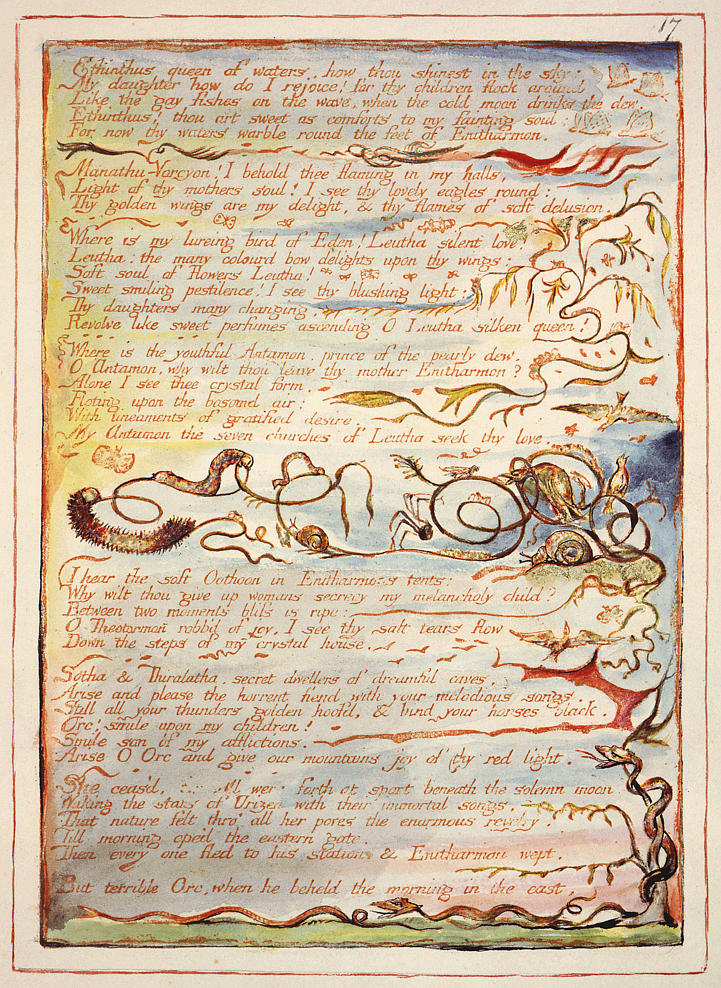
In Night I of The Four Zoas for example we find Enitharmon's Song of Death, the "Nuptial Song" of the "demons of the deep", and the message of the Daughters of Beulah, which they call the "Wars of Death Eternal". These three songs comprise three of the many selves of the human psyche; needless to say their ideas and attitudes vary immensely. They all describe the same event, but they see it, oh, so differently. They use the same words with different meanings. For example consider that what the daughters call "Death Eternal" the demons call marriage. In this way Blake challenges the reader and stretches his mind and immensely rewards whoever will accept the challenge. He gives us the end of a golden string.

Four Zoas, Night I, Page 13, (E 308)
"And Los & Enitharmon sat in discontent & scorn
The Nuptial Song arose from all the thousand thousand spirits  
Over the joyful Earth & Sea, and ascended into the Heavens
For Elemental Gods their thunderous Organs blew; creating
Delicious Viands. Demons of Waves their watry Eccho's woke!
Bright Souls of vegetative life, budding and blossoming    
Page 14
Stretch their immortal hands to smite the gold & silver Wires
And with immortal Voice soft warbling fill all Earth & Heaven.
With doubling Voices & loud Horns wound round sounding
Cavernous dwellers fill'd the enormous Revelry, Responsing!
And Spirits of Flaming fire on high, govern'd the mighty Song.   

And This the Song! sung at The Feast of Los & Enitharmon"

---------------------------------
Adelaide University
Marriage of Heaven and Hell
Plate 12


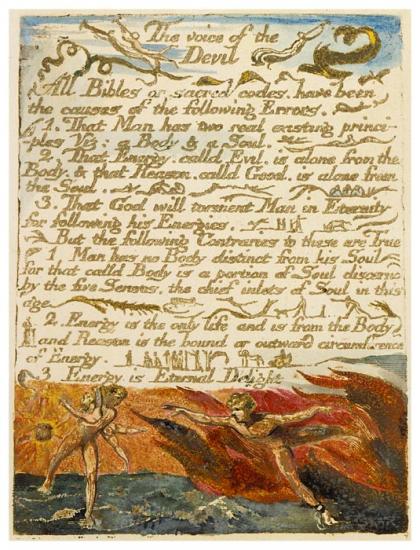
In The Marriage of Heaven and Hell (the 2nd Memorable Fancy) Blake placed in the mouth of Ezekiel a statement of his own primary purpose as an artist and as a man, "the desire of raising other men into a perception of the infinite". That basic aim pervades Blake's art; he was supremely interested in what he called the infinite or the eternal, and he believed that every man has access to it through his imagination.

Friday, July 13, 2018

Blake's Urizen

First posted Feb 2011.

Wikimedia Commons
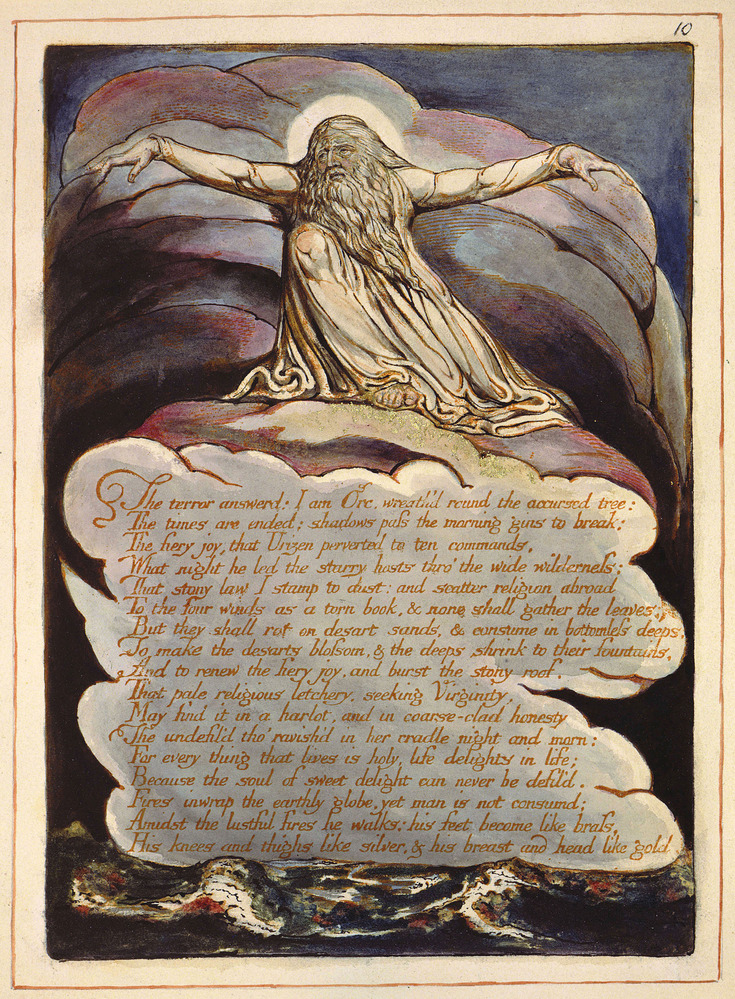
America
Plate 10


Blake's Urizen!


Yes, Blake had one-- the Urizen within; we all have one: the thinking component of our psyche. We can only begin to understand Blake when we realize that his IQ had to be frightening. You and I might have a sudden thought; Blake had an Explosion-- of Urizen or Luvah, either one and sometimes all together. The average person wants nothing to do with such an individual (that means of course that if you read this, you are Not average.


Blake's mind was infinitely expansible-- and contractable, as in Plate 55 of Jerusalem (E205):
"Let the Human Organs be kept in their perfect Integrity
At will Contracting into Worms, or
Expanding into Gods
.........
"Such are these Ulro Visions, for tho we sit down within
The plowed furrow, listning to the weeping clods till we
Contract or Expand Space at will: or if we raise ourselves
Upon the chariots of the morning. Contracting or Expanding Time!
Every one knows, we are One Family! One Man blessed for ever"

(But the Heavenly Visions know nothing of time or space; those are artifacts of the World.)

"Damn braces Bless relaxes." (MHH plate 9; Erdman 37)
 

In MHH Blake's Energy and Creativity ran away with him; he despised restraints: turn out all the stops; put the volume pedal on the floor. MHH is shocking in the Nth degree, frightening! All his life his problem was self-control (the last of the Gifts of the Spirit). He had no desire for Self-control.

Galatians (Phillips Translation)
5:22-25 - The Spirit however, produces in human life fruits such as these: love, joy, peace, patience, kindness, generosity, fidelity, tolerance and self-control - and no law exists against any of them.


Lucky for Blake he had a wife, a good and faithful wife: indulgent, but she had a limit. (If Nietzsche and Van Gogh had achieved a successful marriage, they might have flamed out so early.)

So as we see Blake had a Urizen within. Urizen believed in Control; he gave the Law, and Blake fought him. He also had a Luvah within. Blake fought the first battle with the struggle between Urizen and Luvah; it was a power struggle between the two inner 'gods', and eventually they made
a deal: Urizen, the Light Bearer, gave the Sun to Luvah (Luvah took over the South, while Urizen moved to the North (For a while Blake seemed free from the Law and gave himself up to Feeling).
"When man lives by Urizen's 'beast-formed science' he is in nonexistence. The change from nonexistence to existence - the change from Satan to Christ" (William Blake's Circle of Destiny, Percival, Page 231) 
It was a fragile arrangement; Luvah, like Icarus, got too close to the Sun and crashed. Meanwhile Urizen continued his (false) Creation. He went from bad to worse. In his rocky creation he look ahead; Futurity terrified him, took all his ego and left him a quivering failure. Los came in and subdued him (which seems to represent Blake's Imagination getting the best of his fears).

Once Los had won the battle he found his hatred of Urizen melting away; he found he loved him; he rehabilitated him, so that Urizen was now able to recognize and accept a New Lord.

In Jerusalem 98 Blake told of the final reconciliation of Urizen, Luvah, Urthona, and Tharmas. It is the Apocalypse, the End of Eternal Death leading to Eternal Life, when we graduate from Mortal Life, all is United into the One Man (
as in John 17:21).

Jerusalem, Plate 97, (E 256)
 "So spake the Vision of Albion & in him so spake in my hearing   
The Universal Father. Then Albion stretchd his hand into Infinitude.
And took his Bow. Fourfold the Vision for bright beaming Urizen
Layd his hand on the South & took a breathing Bow of carved Gold
Luvah his hand stretch'd to the East & bore a Silver Bow bright shining
Tharmas Westward a Bow of Brass pure flaming richly wrought   
Urthona Northward in thick storms a Bow of Iron terrible thundering.
And the Bow is a Male & Female & the Quiver of the Arrows of Love,
Are the Children of this Bow: a Bow of Mercy & Loving-kindness:  laying
Open the hidden Heart in Wars of mutual Benevolence Wars of Love
And the Hand of Man grasps firm between the Male & Female Loves  
And he Clothed himself in Bow & Arrows in awful state Fourfold"
Jerusalem, Plate 98, (E 257) 
"The Four Living Creatures Chariots of Humanity Divine Incomprehensible
In beautiful Paradises expand These are the Four Rivers of Paradise 
And the Four Faces of Humanity fronting the Four Cardinal Points
Of Heaven going forward forward irresistible from Eternity to Eternity

And they conversed together in Visionary forms dramatic which bright
Redounded from their Tongues in thunderous majesty, in Visions
In new Expanses, creating exemplars of Memory and of Intellect  
Creating Space, Creating Time according to the wonders Divine
Of Human Imagination," 
John 17
[22] And the glory which thou gavest me I have given them; that they may be one, even as we are one:
[23] I in them, and thou in me, that they may be made perfect in one; and that the world may know that thou hast sent me, and hast loved them, as thou hast loved me.  .

Thursday, July 12, 2018

A Turning Point


First Posted July 2010.
The Moment of Grace

Life is made up of turning points, but if you're fortunate, somewhere along life's crooked path you may take a most significant turning point to the right:

The parable of the prodigal son is archetypal; we can focus on similar occurrences since Jesus spoke those words.

Wikimedia Commons

Songs of Innocence and of Experience 

Plate 45

Luke 15
 

[17]
And when he came to himself, he said, How many hired servants of my
father's have bread enough and to spare, and I perish with hunger!
[18] I will arise and go to my father, and will say unto him, Father, I have sinned against heaven, and before thee,
[19] And am no more worthy to be called thy son: make me as one of thy hired servants.
[20]
And he arose, and came to his father. But when he was yet a great way
off, his father saw him, and had compassion, and ran, and fell on his
neck, and kissed him.


That Moment in our poet's life has for me an endless fascination. Blake might have been a famous man, teacher to the Royal Family, world renowned artist; he might have dedicated his life to the Main Chance, but he found a better way. The critical Moment (the darkness before the dawn) came after Hayley had given William and Catherine a comfortable cottage and a comfortable care free life as a miniaturist, but "he came to himself". He returned to London, penniless, but free. Thereafter the main chance ceased to be a temptation. Blake celebrated that decisive Moment in letter 16 to his true (spiritual) friend, Captain Butts.


Letters, Letter 16, (E 713)
     "To my Friend Butts I write
     My first Vision of Light
     On the yellow sands sitting
     The Sun was Emitting
     His Glorious beams
     From Heavens high Streams
     Over Sea over Land
     My Eyes did Expand
     Into regions of air
     Away from all Care
     Into regions of fire
     Remote from Desire
     The Light of the Morning
     Heavens Mountains adorning
     In particles bright
     The jewels of Light
     Distinct shone & clear--
     Amazd & in fear
     I each particle gazed
     Astonishd Amazed
     For each was a Man
     Human formd...

     These are guards of My Fold
     O thou Ram hornd with gold"

He also mentioned it in another letter to William Hayley....

 
Letters, Letter 51, (E 756)
"I have entirely reduced that spectrous Fiend to his station, whose annoyance has been the ruin of my labours for the last passed twenty years of my life. He is the enemy of conjugal love and is the Jupiter of the Greeks, an iron-hearted tyrant, the ruiner of ancient Greece.......I was again enlightened with the light I enjoyed in my youth, and which has for exactly twenty years been closed from me as by a door and by window-shutters."

The imprint of that Moment fills the pages of his poetry:
In the 9th Night of The Four Zoas you may read of the regeneration and awakening of Vala, the "sinless soul", the incorrigible female. (This passage owes a lot to the Greek myth, Cupid and Psyche.)

Four Zoas, Night IX, Page 128, (E 397)
"So spoke the Sinless Soul & laid her head on the downy fleece 
Of a curld Ram who stretchd himself in sleep beside his mistress
And soft sleep fell upon her eyelids in the silent noon of day

Then Luvah passed by & saw the sinless Soul
And said   Let a pleasant house arise to be the dwelling place
Of this immortal Spirit growing in lower Paradise" 

After the Moment of Grace annihilation of the Selfhood became a primary theme for Blake. In Milton he put these words in the mouth of the hero returned from Heaven, addressed to Ololon, his emanation:

Milton Plate 40 [46], (E 142)
"But turning toward Ololon in terrible majesty Milton Replied. 

Obey thou the Words of the Inspired Man
All that can be annihilated must be annihilated
That the Children of Jerusalem may be saved from slavery
There is a Negation, & there is a Contrary
The Negation must be destroyd to redeem the Contraries
The Negation is the Spectre; the Reasoning Power in Man
This is a false Body: an Incrustation over my Immortal
Spirit; a Selfhood, which must be put off & annihilated alway
To cleanse the Face of my Spirit by Self-examination.
Plate 41 [48]:
To bathe in the Waters of Life; to wash off the Not Human
I come in Self-annihilation & the grandeur of Inspiration
To cast off Rational Demonstration by Faith in the Saviour
To cast off the rotten rags of Memory by Inspiration
To cast off Bacon, Locke & Newton from Albions covering
To take off his filthy garments, & clothe him with Imagination
To cast aside from Poetry, all that is not Inspiration"
 
Milton is a difficult poem, but Blake must have written it shortly after his Moment of Grace.

Blake celebrated the (miraculous?) turning point of Odysseus (my, your, Albion's, Everyman's) with his famous Arlington Tempera, called the Circle of Destiny.

In Blake's poetry, which is above all autobiographical, he marked the moment of truth for Los and all the rest of his characters who made up various elements of his psyche, of mine, yours or Albion's.

Wednesday, July 11, 2018

Blake's Symbolism II

First posted Sep 2011.

A most significant key to Blake's symbolism came to light only in 1947 when Arlington Court was bequeathed to the British National Trust. Among the furnishings there was a large tempera by Blake, called alternatively The Sea of Time and Space or The Cave of the Nymphs. This treasure had been hidden from public eyes for a century.

(Most of us are unlikely to see the original, but Blake and Antiquity by Kathleen Raine offers several glimpses of the picture with a detailed account of the symbols it contains. There is no better way to begin an understanding of Blake at the deeper level than to read carefully and study this small and accessible book.)
 
The picture contains the essential symbolism of Blake's myth; the theme goes back to Homer, then to Plato and Porphyry. (To understand Blake's myth one would be well advised to study this link with care--at least the first part of Taylor's article.)

 Blake and Taylor were approximately the same age and as young men close friends. Many people think that Taylor introduced Blake to the Platonic and Neoplatonic traditions. It seems certain that Taylor's On the Homeric Cave of the Nymphs deeply influenced the painting of the Arlington Tempera. It also introduced a great number of the most common symbols used in Blake's myth; they were used over and over throughout Blake's work.
The Morgan Library and Museum
Marriage of Heaven and Hell
Plate 4

Another good introduction to Blake's myth is The Marriage of Heaven and Hell. It comes from an angry young man pouring his scorn on the conventions that cripple us; the language is pungent, the words are pointed, provocative, and outrageous.

 A conventional person will find this whole work offensive and repulsive, but the young person at the stage of life where he's ready to kick over the traces, is quickly attracted -- if he has enough wit to understand irony and not take everything at face value.

We might call it an ironic satire. In 1789 Blake was 32, at the height of his physical (though perhaps not mental) powers. He had experienced the Divine Vision.


 He knew it was meant for mankind, although so far limited to Jesus and a few others. But with the advent of the French Revolution he foresaw its spread throughout the world. (Of course in that he was soon doomed to disappointment-- with the appearance of Madame Guillotine.) Nevertheless with a peak of spiritual exuberance he proceeded to announce the coming New Age:
    "The ancient tradition that the world will be consumed in fire at the end of six thousand years is true, as I have heard from Hell. For the cherub with his flaming sword is hereby commanded to leave his guard at the tree of life, and when he does, the whole creation will be consumed and appear infinite and holy whereas it now appears finite & corrupt.... If the doors of perception were cleansed every thing would appear to man as it is, infinite. For man has closed himself up, till he sees all things thro' narrow chinks of his cavern. (Plate 14 of MHH)
       For this gem Blake drew upon Genesis and Plato.   Blake knew that the Divine Vision depended upon your ability to avert your eyes and attention from the material and to focus upon the Spiritual, the Eternal, which can only dwell in the Imagination (for Blake the Imagination was everything!). The society of Blake's day uniformly failed to do that, as does ours! Blake desperately, emphatically, and continuously endeavoured to awaken us to a spiritual consciousness, to break the 'mind forg'd manacles'.

Pursuant to this aim:
    "How do you know but every bird that cuts the air Is an immense world of delight, clos'd by your senses five?" (MHH, Plate 7, (E 35))
And look at Plate 13:
    "I then asked Ezekiel. why he eat dung, and lay so long on his right and left side? he answered, "the desire of raising other men into a perception of the Infinite". (E 39|
       Back in 1788 with There is No Natural Religion he had disposed of a sense-based consciousness as any kind of arbiter of the meaning of life:
    "Man's perceptions are not bounded by organs of perception. He percieves more than sense (tho' ever so acute) can discover." (There Is No Natural Religion, (E 2))
       Look at Section VII of NNR. Reason or the ratio are his terms for confining one's mental activity to the senses. And he thought less and less of it as he grew older. In notes on Vision of the Last Judgment he wrote:
       "I assert for myself that I do not behold the Outward Creation and that to me it is hindrance and not Action it is as the Dirt upon my feet No part of Me.
       What it will be Question'd When the Sun rises do you not see a round Disk of fire somewhat like a Guinea? O no, no, I see an Innumerable company of the Heavenly host crying Holy Holy Holy is the Lord God Almighty." (Vision of Last Judgment, (E 565)

 On MHH (Plate 16) Blake tells us about the prolific (prophetic types, creative people who grasp the Eternal) and the devouring (those who worship the created good). Of course he counted himself among the prolific. John Middleton Murry has pointed out that in this moment of the everlasting 'good-and-evil' in which we live Blake may have projected the 'evil' upon the public who had uniformly ignored him. Murry suggested that it was a necessary "moment in his life".
 
If that be true, we have the record of the moment when Blake "came to himself" to the point where he confessed that his Selfhood continued to dominate him. He eventually came to realize that one cannot operate in the Sea of Time and Space without the Selfhood; thus he faced the necessity to continually annihilate and regenerate it with his alternation between Heaven and this vale of tears in which we live. (As Christians understand, the selfhood is brought into subjection and becomes the servant of the Self (Christ)).
 
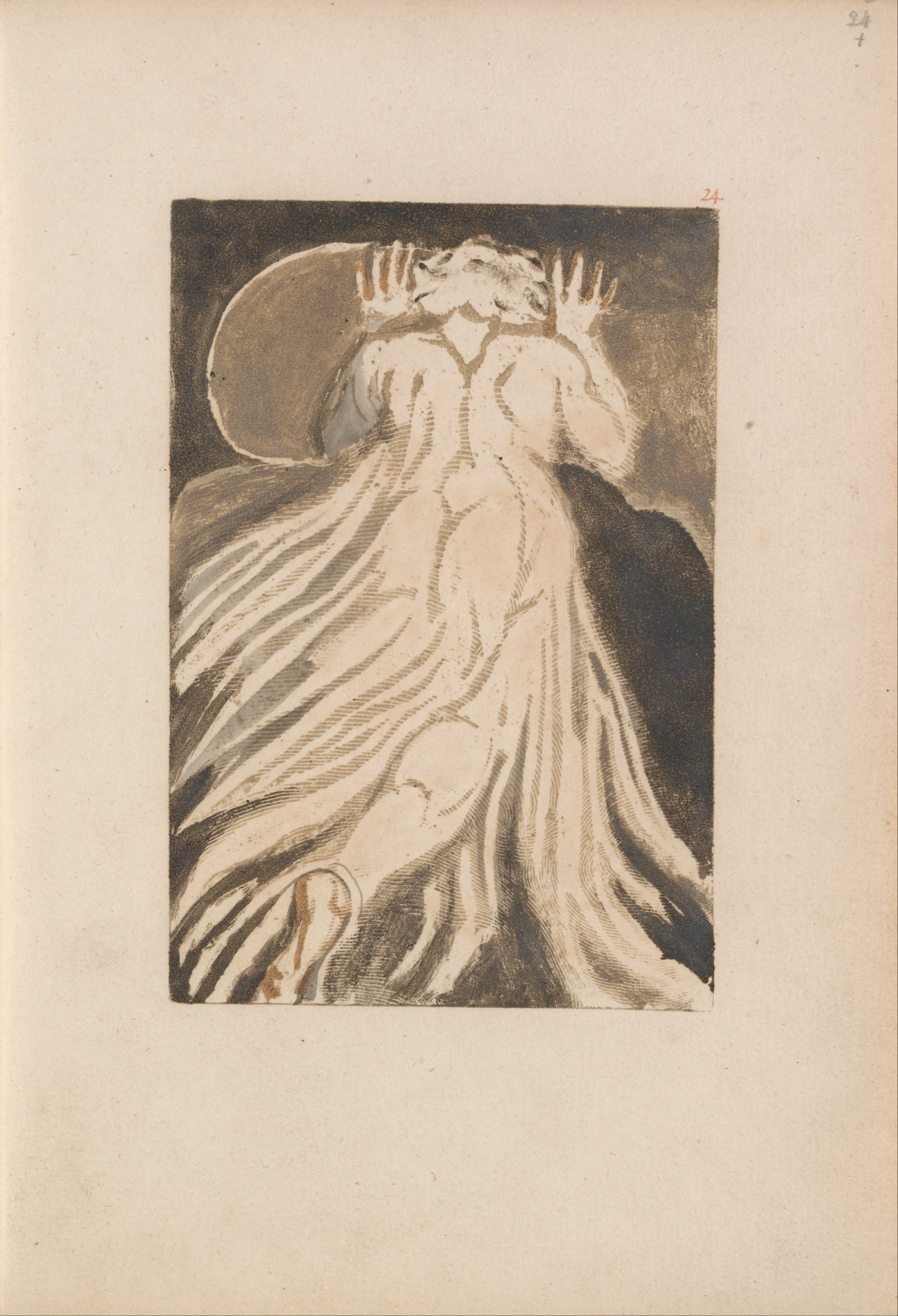
 In Plate 24 he promised to the world the Bible of Hell. John Middleton Murry described it as follows:
The first book of these, The Book of Urizen is to a large degree a parody of Genesis. The Book of Ahania corresponds precisely to Exodus. The third book is The Book of Los (1795).

MHH was prior to Blake's myth proper, like a preamble or preface. It defines ideas and terms that are to be understood as the myth evolves, a special language you have to learn to get into the major works - The Four Zoas, Milton and Jerusalem.

(This is a portion of Chapter Ten of the Blake Primer.).

Tuesday, July 10, 2018

The Clod of Clay

First posted March 2010.

Blake's myth posits our pre-existence, like Thel in the pastoral Vale of Har; we all choose material, temporal life. That's why we're here-- for a time! Eventually we will return--whether we will or not.

But like Thel the choice was ours; we chose life; she declined.

Why do those in the 'above' choose mortal life? Who can say? Some do; some don't.

Thel explored the option. She found the end of mortal life fearsome. With a screech she forsook the world and presumably returned to Har.

--------------------------------------
For Blake everything is a man: rocks, clouds, all creatures, the whole Creation"
"Cities are Men....and Rivers & Mountains are also Men; everything is Human, mighty! sublime!" (Jerusalem, Plate 34 [38], E 180)
Also lilies, clouds, worms, a Clod of Clay.

Wikimedia Commons
Book of Thel
Plate 6
In Thel we meet the Lilly, the Cloud, the Worm, the Clod of Clay. The last one had this to say:
Book of Thel, Plate 4, (E 5)
"...on Thel she fix'd her humble eyes;
'O beauty of the vales of Har, we live not for ourselves.
Thou seest me the meanest thing, and so I am indeed:
My bosom of itself is cold, and of itself is dark,
But he that loves the lowly pours his oil upon my head,
And kisses me, and binds his nuptial bands around my breast,
And says: "Thou mother of my children, I have loved thee,
And I have given thee a crown that none can take away."
But how this is, sweet maid, I know not, and I cannot know;
I ponder, and I cannot ponder, yet I live and love.'

Such a beautiful passage! the 'Clod of Clay' is the mother of God's children, 'he that loves the lowly'. God promises to redeem the entire Creation. ("the whole Creation groans in travail ......waiting for the Redemption" (Romans 22).
------------------------------------
"Cities are Men, fathers of multitudes, and Rivers & Mount[a]ins Are also Men; every thing is Human, mighty! sublime! (Jerusalem, Plate 34, E 180)

And from Milton, Plate 22, (E 117):

"Six Thousand Years
Are finishd. I return! both Time & Space obey my will.
I in Six Thousand Years walk up and down: for not one
Moment Of Time is lost, nor one Event of Space unpermanent.
But all remain: every fabric of Six Thousand Years
Remains permanent: tho' on the Earth where Satan
Fell, and was cut off all things vanish & are seen no more
They vanish not from me & mine, we guard them first & last.
The generations of men run on in the tide of Time
But leave their destind lineaments permanent for ever & ever."

You could construct an elaborate and beautiful cosmology out of that idea:

Jerusalem Plate 99, (E 258):

"All Human Forms identified even Tree Metal Earth & Stone. all
Human Forms identified, living going forth & returning wearied
Into the Planetary lives of Years Months Days & Hours reposing And then Awaking into his Bosom in the Life of Immortality."

When we've completely annihilated our Selfhood, our journey is complete:
"When once I did descry the immortal man who cannot die Through evening shades I haste away to close the labors of my day." Gates of Paradise, (E 269)
.

Monday, July 09, 2018

ACCUSERS


Wikipedia Commons     Large Book of Designs
The Accusers


Link to image from British Museum
Link to image from National Gallery


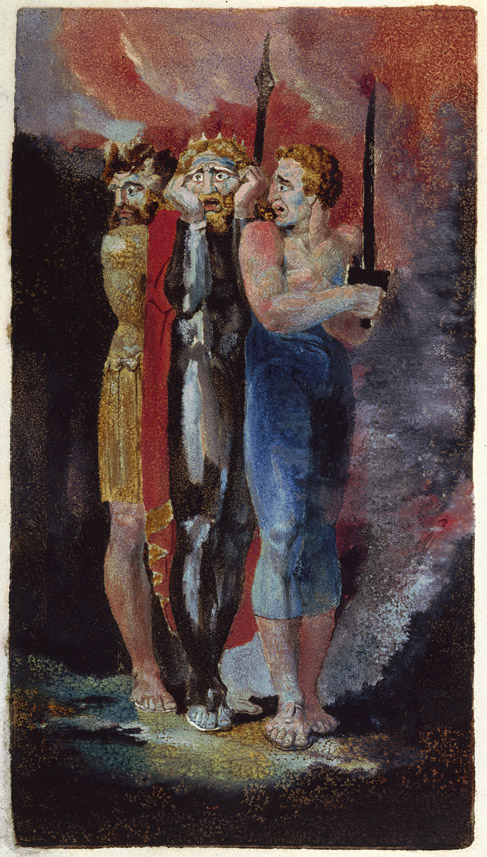
Blake created a print in 1793 which he was to reuse several times because it expressed so well his political, spiritual and psychological views. He first called the image 'Our End is Come.' Erdman, in Prophet Against Empire (Page 206), describes it as 'the hysterical king, flanked by two chief warriors who grip sword and spear, [who] stands inside a threshold enveloped in flames.' The second issue was captioned, 'When the senses are shaken, And the Soul is driven to madness', to suggest the madness of the king. In the third version the caption below the picture reads: 'A Scene in the Last Judgment / Satans' holy Trinity The Accuser The Judge & The Executioner'. Above the Picture we see: 'The Accusers of Theft Adultery Murder'; with the words 'Theft', 'Adultery' and 'Murder' labeling the three men.

The madness of the king refers to the episodes of madness that King George III experienced in 1788-9 and later in his reign. King George's militarism is represented by the warrior on his right, his political tyranny by the counselor on his left. There was much in the British government of which Blake disapproved, and he suggested it in the picture. But the consequences to those who committed destructive acts is most evident in the faces of the men portrayed. They exhibit the sorrow, terror, despair and fear which they had caused others to experience through war, impoverishment, imprisonment and oppression.

Erdman suggests that in labeling the picture 'The Accusers of Theft Adultery Murder', Blake had made a bitter jest: 'those who accuse are guilty and those who judge will be judged by the flaming sword; and the executioner shall be consumed in the conflagration of his own igniting.' (Page 207)

Erdman continues on Page 208: "The king in his expression of amazement bears kinship to the kings as accusers of adultery in Queen Emma and Jane Shore... Burke in speeches and pamphlets in which he raised the property question accused both France and English radicals of intending theft ('levelling'). Pitt was an accuser of Murder when he urged Parliament to arm against France because of the murder of the King of France..."

Blake describes Satan as the accuser. In the inscription Blake names the accusers as Satan's Holy Trinity. The state of error which Satan represents, is to be annihilated at the Last Judgment. The accusers are aspects of Satan, the selfhood. They become what they see (or they see what they have become). As error they have no permanent existence and may well say "Our End Is Come."

Four Zoas, Page 107 [115], (E 380)
"There is a State namd Satan learn distinct to know O Rahab
The Difference between States & Individuals of those States
The State namd Satan never can be redeemd in all Eternity"

Milton, Plate 23 [25], (E 119)
"lest they write them in their Books, & in the Scroll
Of mortal life, to condemn the accused: who at Satans Bar
Tremble in Spectrous Bodies continually day and night
While on the Earth they live in sorrowful Vegetations
O when shall we tread our Wine-presses in heaven; and Reap
Our wheat with shoutings of joy, and leave the Earth in peace"

Descriptive Catalogue, Page 86 ,(E 564)
"as he came at first to deliver those who were bound under the
Knave not to deliver the Knave He Comes to Deliver Man the
[Forgiven] not Satan the Accuser we do not
find any where that Satan is Accused of Sin he is only accused of
Unbelief & thereby drawing Man into Sin that he may accuse him.
Such is the Last Judgment a Deliverance from Satans Accusation
Satan thinks that Sin is displeasing to God he ought to know that
Nothing is displeasing to God but Unbelief & Eating of the Tree
of Knowledge of Good & Evil"

Descriptive Catalogue, Page 92, (E 565)
"Forgiveness of Sin is only at the Judgment Seat of Jesus the
Saviour where the Accuser is cast out. not because he Sins but
because he torments the Just & makes them do what he condemns as
Sin & what he knows is opposite to their own Identity"

The System of Blake and the Bible

"I must Create a System or be enslavd by another Mans"
Jerusalem, Plate 10, (E 153)
"Therefore Los stands in London building Golgonooza
Compelling his Spectre to labours mighty; trembling in fear
The Spectre weeps, but Los unmovd by tears or threats remains

I must Create a System, or be enslav'd by another Mans           
I will not Reason & Compare: my business is to Create

So Los, in fury & strength: in indignation & burning wrath
Shuddring the Spectre howls. his howlings terrify the night
He stamps around the Anvil, beating blows of stern despair
He curses Heaven & Earth, Day & Night & Sun & Moon               
He curses Forest Spring & River, Desart & sandy Waste
Cities & Nations, Families & Peoples, Tongues & Laws
Driven to desperation by Los's terrors & threatning fears
Los cries, Obey my voice & never deviate from my will
And I will be merciful to thee: be thou invisible to all         
To whom I make thee invisible, but chief to my own Children" 
 It's very nice when you begin to grasp the system that Blake created instead of choosing a conventional life. But the most fascinating thing is to reach some understanding of how it relates to the 'system' of the Bible.
In Joachim of Flora's Everlasting Gospel there are three stages: O.T. (the Father, who ruled by the law), N.T. (the Son where Love becomes dominant), and post-Resurrection (the Holy Spirit). Jesus told us he was leaving mortal form so that we might be led by the Holy Spirit (John 14:25-29).
Blake expressed this theory of Religion with three of his Zoas: Urizen with the Father, Luvah with the Son, and Los with the Holy Spirit. In his mind (at least part of the time) Urizen with the Fall became arrogant and thirsty for Power and chose to run the World; he always had his book before him, and he ruled by the book; he claimed to be God.
As The Four Zoas begins (with the Fall), Luvah is said to have stolen Urizen's horses of light and thereby exerted his dominance.
Four Zoas, Night I, Page 9, (E 305)
"Urizen sleeps in the porch 
Luvah and Vala woke & flew up from the Human Heart    
Into the Brain; from thence upon the pillow Vala slumber'd.
And Luvah siez'd the Horses of Light, & rose into the Chariot of Day" 
In Blake's poetry there's much conflict between the two Zoas (psychologically - thought and feeling, or reason and impulse). This conflict occurred in Blake's psyche. In the early years freedom (free love, etc.) was dominant; in the course of his life the two functions came into (or rose to) the pre-Fall balance. (You can approximately relate this to the conflict between biblical priests and prophets; it goes on throughout the Bible. Blake definitely chose prophecy, as did Jesus - love rather than law. This accounts for the high valuation he placed on forgiveness, making it virtually synonymous with the love of God and neighbor.)
Wikipedia Commons
Illustrations to Paradise Lost
Page 3

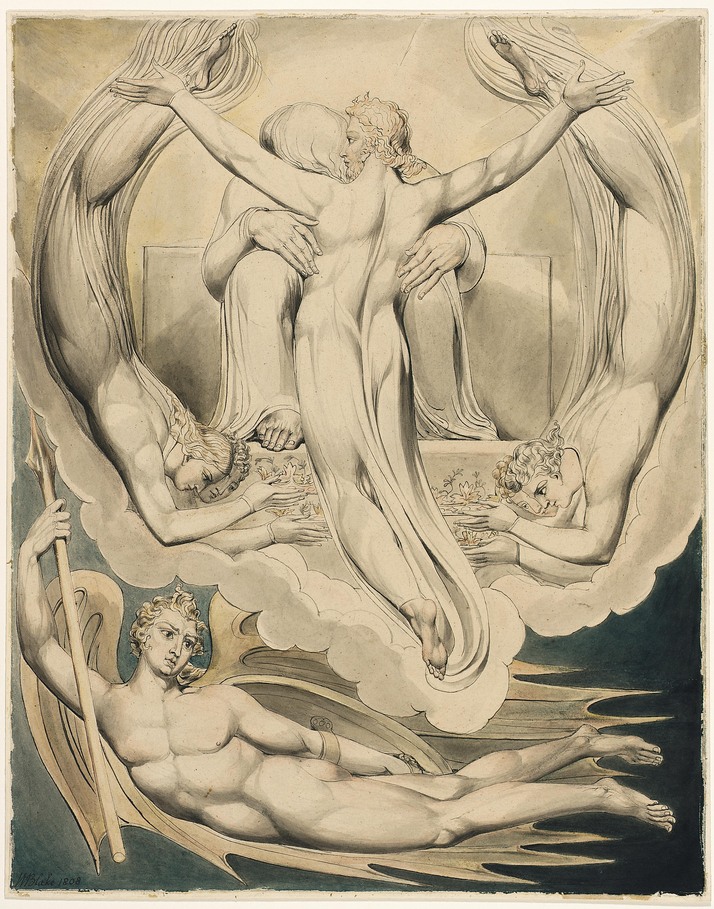
Blake identified creative imagination with Los; Los was a blacksmith with a furnace. The Bible is full of references to a furnace: Isaiah 48:10 for example. It found expression in the hymn How Firm a Foundation.
In the Bible and in Blake there is an underlying fourfold structure. Running through it is a myth of four phases: Creation, the Fall, Redemption, and Apocalypse. This is the sequence of events in Blake's system as well as in the Bible's.

Sunday, July 08, 2018

Dark Satanic Mills


First posted Oct 2009.

The famous hymn called 'Jerusalem' is found in the Preface of Blake's poem Milton:

"And did those feet in ancient time,
Walk upon Englands mountains green:
And was the holy Lamb of God,
On Englands pleasant pastures seen!

And did the Countenance Divine,
Shine forth upon our clouded hills?
And was Jerusalem builded here,
Among these dark Satanic Mills?

Bring me my Bow of burning gold:
Bring me my Arrows of desire:
Bring me my Spear: O clouds unfold!
Bring me my Chariot of fire!

I will not cease from Mental Fight,
Nor shall my Sword sleep in my hand:
Till we have built Jerusalem,
In Englands green & pleasant Land.

Would to God that all the Lords people were Prophets.
(Numbers ch 11, verse 29)"


From Little Black Boy in Songs of Innocence we read "To lean in joy upon our fathers knee."


Like most of what Blake wrote 'Satanic Mills' has more
than one meaning. The most obvious one might be the
monuments to the Industrial Revolution that took
thousands of landless, homeless peasants and paid them
a pittance to work 16 hours a day at a deadening,
repetitive task.

That happened not just to adults but to very young
children. Charles Dickens novels gives a taste of that
outrage, and it was echoed as late as the mid 20th
century in furniture and garment factories in this
country.
British Museum
Illustration's to Young's Night Thoughts

More basic to Blake's spiritual and psychological orientation was the sense in which it was applied in an earlier post: "the same dull round", applicable to the essentially meaningless lives that millions of people live.

They may or may not go to essentially meaningless churches (or taverns) in search of something made inaccessible to them by the deadening atmosphere of the schools they attended.

At the end of Chapter Three of Jerusalem (Plate 76; E230-31) Blake imagined the horrible reality of a return to the beginning of history at its end:

"For Los in Six Thousand Years walks up & down continually
That not one Moment of Time be lost & every revolution
Of Space he makes permanent in Bowlahoola & Cathedron.

And these the names of the Twenty-seven Heavens & their
Churches Adam, Seth, Enos, Cainan, Mahalaleel, Jared,
Enoch, Methuselah, Lamech; these are the Giants mighty,
Hermaphroditic Noah, Shem, Arphaxad, Cainan the Second,
Salah, Heber, Peleg, Reu, Serug, Nahor, Terah: these
are the Female Males: A Male within a Female hid as in
an Ark & Curtains. Abraham, Moses, Solomon, Paul,
Constantine, Charlemaine, Luther. these Seven are the
Male Females: the Dragon Forms The Female hid within a
Male: thus Rahab is reveald Mystery Babylon the Great:
the Abomination of Desolation
Religion hid in War: a Dragon red, & hidden Harlot

But Jesus breaking thro' the Central Zones of Death &
Hell Opens Eternity in Time & Space; triumphant in
Mercy

Thus are the Heavens formd by Los within the Mundane
Shell And where Luther ends Adam begins again in
Eternal Circle...."

"where Luther ends Adam begins" expresses the
fear that there will be only 'another dull round' of
history..

But Blake saw a happier outcome as you find portrayed at
the ends of The Four Zoas and Jerusalem.

Saturday, July 07, 2018

MORAVIAN CONNECTION

First posted June 2010.

In recent years it has been learned that William Blake's mother had been a Moravian during her first marriage and was said to have been from a Moravian family. After her husband's death she left the Moravians and married James Blake in 1752.

The Moravians originated in central Europe and moved about as they were persecuted for their non-orthodox beliefs and practices. They emphasized a religion of the heart, expressed in a life of religious disciplines and freedom for emotional and aesthetic activities.

They had a missionary zeal to spread the Gospel and sent members to far flung sites. Peter Bohler was sent to England to establish contact with Christians at Oxford. He became associated with a young John Wesley and they both traveled to the new colony in Georgia which had been established to provide opportunity for the British underclass such as those in the debtor's prison - the Marshalsea.

When Wesley and Bohler returned to London they were among those who established the Fetter Lane Society in 1738. As were many religious societies in that day, Fetter Lane was non-denominational. Later Wesley left Fetter Lane and established Foundry and other societies which became the foundation of the Methodist Church. Fetter Lane became the Moravian Church to which Catherine Armitage applied for membership in 1750. During the period when Blake was a young man, Wesley was active in his ministry throughout England: preaching salvation from sin, organizing societies for the converted to grow in the faith, encouraging a deep personal religious experience among believers.

Victoria and Albert Museum
The Transfiguration
Wesley, the Oxford educated son of a Church of England minister preached in the fields to the outcasts, the poor and the oppressed, and he converted them to lives of sobriety and frugality. Blake, the son of a hosier, without formal education created sublime poetry and artwork to speak to the intellect and imagination about the possibility of living in Eternity. Both men were unaccepted by the establishment. Both men carved out distinctive lifestyles to carry out their religious vision. Both were significantly influenced by the Moravian movement which found form in a little meeting called the Fetter Lane Society.

Wesley had nothing to say about Blake, but Blake made mention of Wesley with admiration.

Milton, Plate 22, (E 118) Rintrah speaking:
 "O Swedenborg! strongest of men, the Samson shorn by the Churches!
Shewing the Transgresors in Hell, the proud Warriors in Heaven:
Heaven as a Punisher & Hell as One under Punishment:
With Laws from Plato & his Greeks to renew the Trojan Gods,
In Albion; & to deny the value of the Saviours blood.
But then I rais'd up Whitefield, Palamabron raisd up Westley,    

And these are the cries of the Churches before the two Witnesses[']
Faith in God the dear Saviour who took on the likeness of men:
Becoming obedient to death, even the death of the Cross
The Witnesses lie dead in the Street of the Great City
No Faith is in all the Earth: the Book of God is trodden under Foot:       
He sent his two Servants Whitefield & Westley; were they Prophets
Or were they Idiots or Madmen? shew us Miracles!
Plate 23 [25]
Can you have greater Miracles than these? Men who devote
Their lifes whole comfort to intire scorn & injury & death" 
Wesley's explanatory note on the Two Witnesses of Revelation:
1:3"And I - Christ. Will give to my two witnesses - These seem to be two prophets; two select, eminent instruments. Some have supposed (though without foundation) that they are Moses and Elijah, whom they resemble in several respects. To prophesy twelve hundred and sixty days - Common days, that is, an hundred and eighty weeks. So long will they prophesy, (even while that last and sharp treading of the holy city continues,) both by word and deed, witnessing that Jesus is the Son of God, the heir of all things, and exhorting all men to repent, and fear, and glorify God. Clothed in sackcloth - The habit of the deepest mourners, out of sorrow and concern for the people."  

Friday, July 06, 2018

Influences on Blake

First posted Nov 2009.

There's an uncanny similarity between the culture Blake
was born into and the present: The majority culture was
radically materialistic, while an alternative (New Age) one
thrived, especially in religious circles.

Blake's parents may have been Swedenborgians; his mother had been a
Moravian during her first marriage; these two radically dissenting sects
had their due influence on the young Blake's religious outlook.


Wikimedia Commons
Songs of Innocence
Plate 40
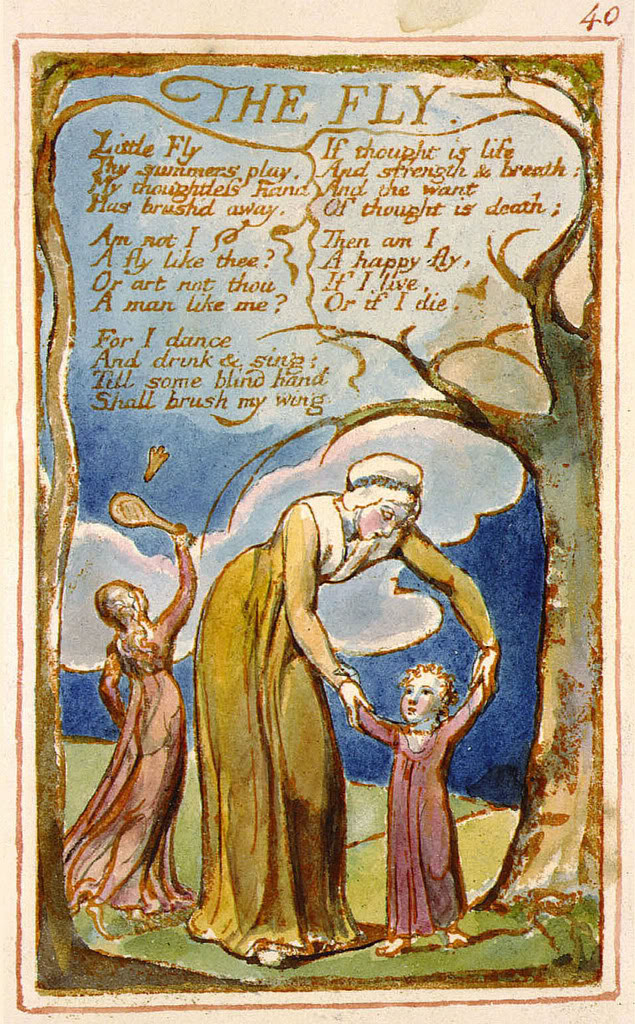
Blake enjoyed a happy childhood, with remarkably liberal and permissive parents; he started school at the appropriate age, but his academic career was a short one: when the schoolmaster birched a fellow pupil, little William made a quick exit and never returned.

Like many such 'dropouts' Blake became an autodidact; he probably knew more than any person alive of the "perennial philosophy", the 
wisdom of the ages. It was a wisdom that
the materialistic culture had turned its back on with the excessive secularism of the Enlightenment.

In late 18th century England School was for the middle class, a station to which Blake always aspired. But outside the middle class boys were generally apprenticed; Blake became an apprentice to a well regarded engraver. Thereafter he made his primary income as an engraver; a great many of his poems were engraved as illuminated poetry, which Blake practically invented.

Husbands in general tend to be deeply influenced by
their wives, and Blake was no exception. He married an
illiterate woman, but she soon became literate; for 40
years Catherine Blake helped William with his creations and
gave him unlimited encouragement and emotional support.

Re intellectual influences the Bible was first and foremost;
it's hard to find a page of Blake's poetry without a
quotation or at least allusion to some biblical idea.

Second to the Bible is what I called above the 'perennial
philosophy', what Kathleen Raine called the 'canon of the
western esoteric tradition.' It includes an enormous variety
of written material. In a letter he wrote to John Flaxman
when he was 33 Blake only touched the surface:

"Now my lot in the Heavens is this; Milton lovd me in
childhood & shewd me his face Ezra came with Isaiah the
Prophet, but Shakespeare in riper years gave me his hand
Paracelsus & Behmen [Boehme] appeard to me. terrors
appeard in the Heavens above."

One might add Spencer, Dante, and a host of others. Blake
was an inveterate and omnivorous reader; you have to
wonder how he could have accessed all the stuff to which
he had obviously been exposed.

We all encounter influences, both positive and negative. The
primary negative influence Blake felt was the prevailing
materialism; he referred to it as Bacon, Newton and Locke.

.

Thursday, July 05, 2018

Sons of Los

First posted Oct 21, 2009.

Urizen is given credit for creation of the world; but at least part of it should actually go to Los.

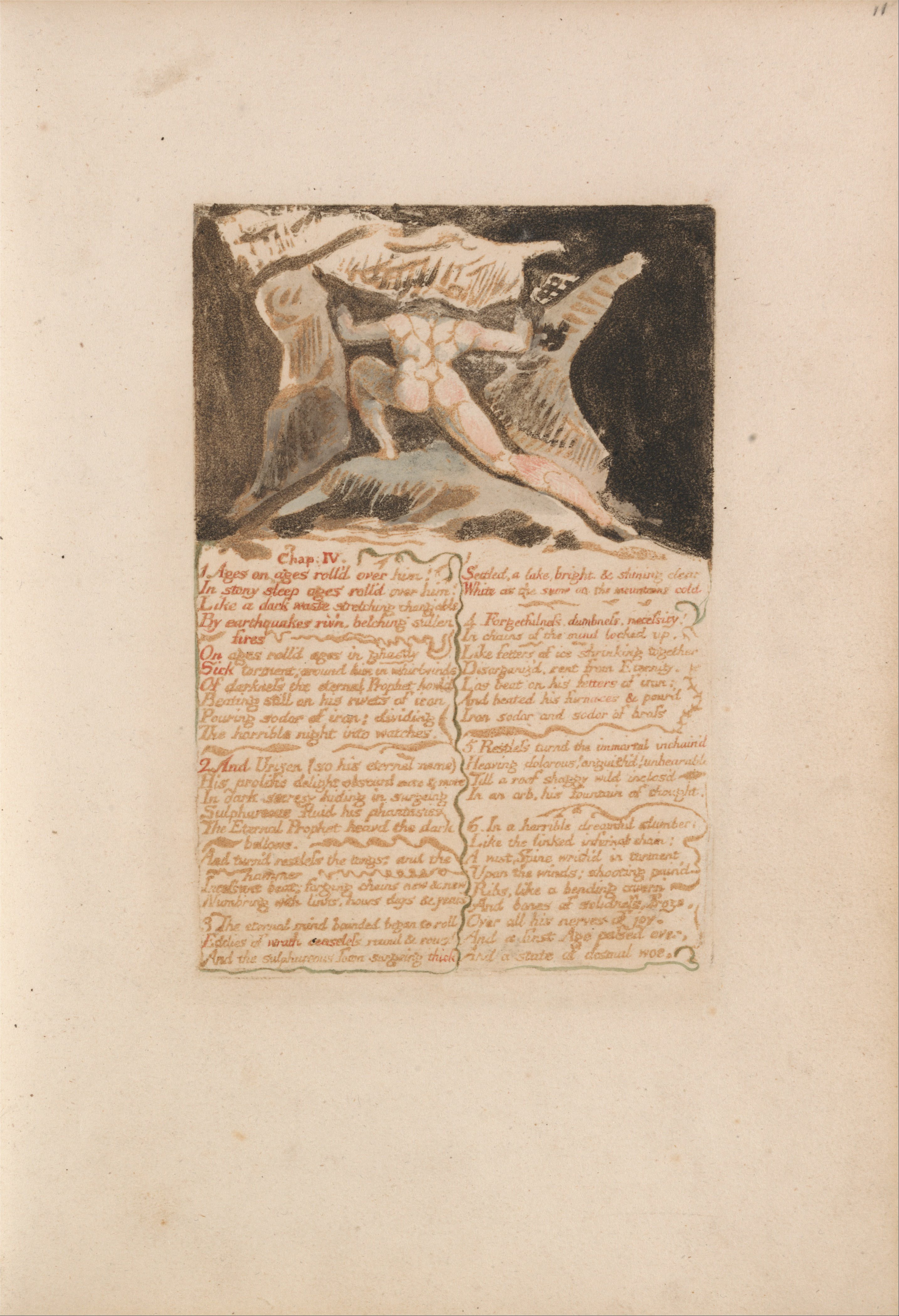
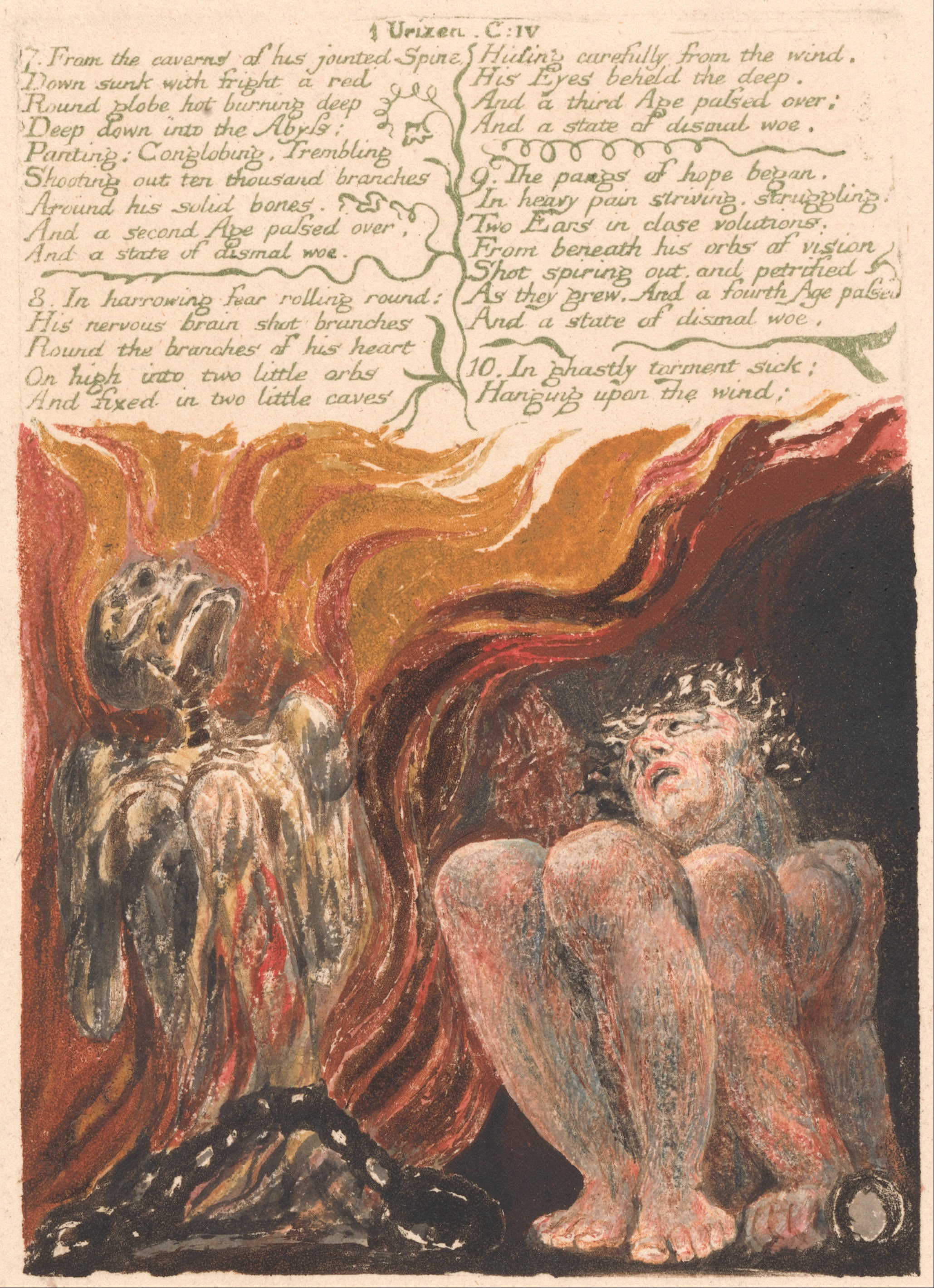
Look at Chapter IV of the Book of Urizen where in seven ages 'in a state of dismal woe,' Los proceeded to endow Urizen with the five senses.

Book of Urizen, Plate 10, (E 75)
"5. Restless turnd the immortal inchain'd
Heaving dolorous! anguish'd! unbearable
Till a roof shaggy wild inclos'd
In an orb, his fountain of thought.

6. In a horrible dreamful slumber;                              
Like the linked infernal chain;
A vast Spine writh'd in torment
Upon the winds; shooting pain'd
Ribs, like a bending cavern
And bones of solidness, froze                 
Over all his nerves of joy.      
And a first Age passed over,                     
And a state of dismal woe.           
Plate 11

7. From the caverns of his jointed Spine,
Down sunk with fright a red
Round globe hot burning deep
Deep down into the Abyss:
Panting: Conglobing, Trembling                     
Shooting out ten thousand branches
Around his solid bones.
And a second Age passed over,
And a state of dismal woe.

8. In harrowing fear rolling round;                   
His nervous brain shot branches
Round the branches of his heart.
On high into two little orbs
And fixed in two little eaves
Hiding carefully from the wind,                        
His Eyes beheld the deep,
And a third Age passed over:
And a state of dismal woe.

9. The pangs of hope began,
In heavy pain striving, struggling.     
Two Ears in close volutions.
From beneath his orbs of vision
Shot spiring out and petrified
As they grew. And a fourth Age passed
And a state of dismal woe.         

10. In ghastly torment sick;
Hanging upon the wind;
Plate 13
Two Nostrils bent down to the deep.
And a fifth Age passed over;
And a state of dismal woe.

11. In ghastly torment sick;
Within his ribs bloated round,        
A craving Hungry Cavern;
Thence arose his channeld Throat,
And like a red flame a Tongue
Of thirst & of hunger appeard.
And a sixth Age passed over:         
And a state of dismal woe.

12. Enraged & stifled with torment
He threw his right Arm to the north
His left Arm to the south
Shooting out in anguish deep,          
And his Feet stampd the nether Abyss
In trembling & howling & dismay.
And a seventh Age passed over:
And a state of dismal woe."

Properly speaking Blake meant by Sons of Los just about everyone and everything:

Milton, Plate 26 [28], (E 123)
"These are the Sons of Los, & these the Labourers of the Vintage
Thou seest the gorgeous clothed Flies that dance & sport in summer
Upon the sunny brooks & meadows: every one the dance
Knows in its intricate mazes of delight artful to weave:
Each one to sound his instruments of music in the dance,     
To touch each other & recede; to cross & change & return
These are the Children of Los; thou seest the Trees on mountains
The wind blows heavy, loud they thunder thro' the darksom sky
Uttering prophecies & speaking instructive words to the sons
Of men
: These are the Sons of Los! These the Visions of Eternity

But we see only as it were the hem of their garments
When with our vegetable eyes we view these wond'rous Visions"
Wikipedia Commons
Europe a Prophecy
Plate 17


Some of Sons of Los


James Rieger even claims the Holy Word is a garment which may be called a Son of Los:
"The idiom of the Bard's Song is to the Holy Word as nature is to eternity. Both are garments, and both may be called Sons of Los." (Page 297)


Wednesday, July 04, 2018

The Book of Urizen

First posted in Oct 2009.

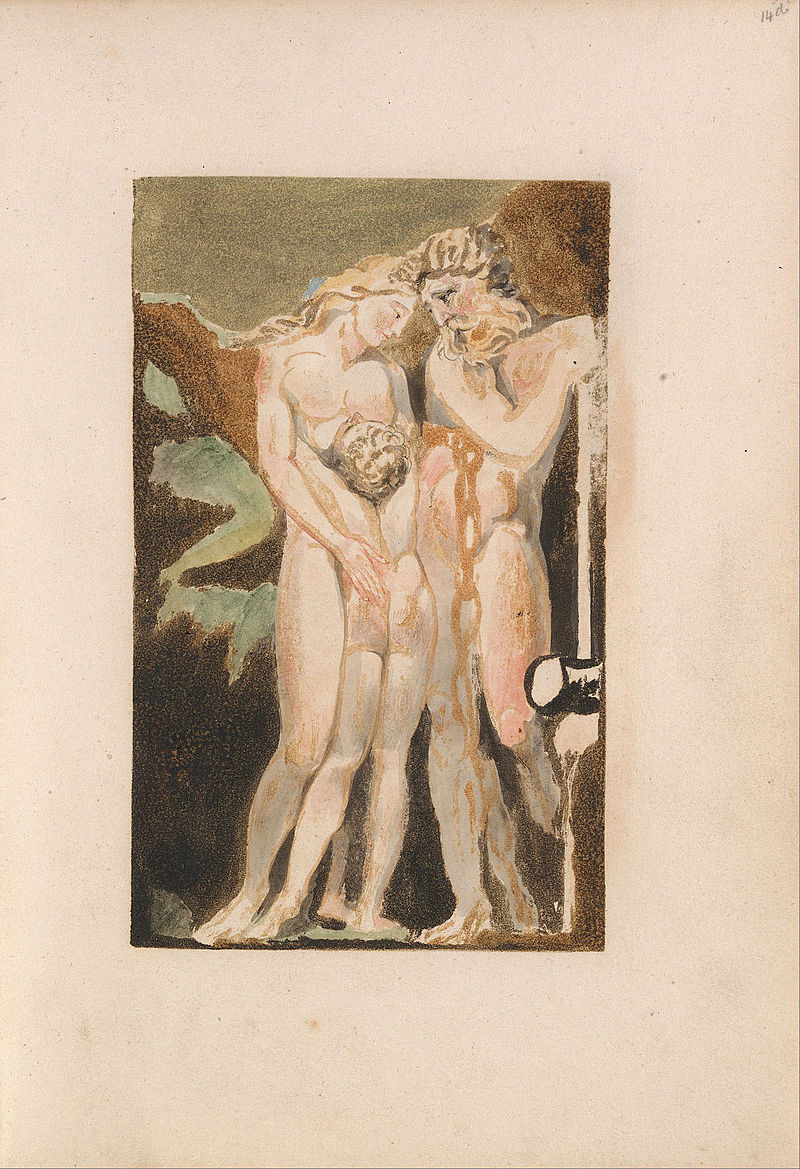
This might be considered Blake's first attempt to create his own system (in order not to be "enslaved by another's"). He at least begins the myth; but through the years it will take many turns.

Plate 3
He began with 'a horrible event', the separation
of Urizen from Eternity, from a condition where
Earth was not; Death was not. For most of the book things are going from bad to worse.

Urizen proceeded to write the Book of Brass with the "seven deadly sins of the soul", with laws of peace, laws of love, of unity.... one command, one joy, one King, one Law.

Plate 5
After aeons of anguish and howlings and pains and fierce madness "the vast world of Urizen appeared".
Los (introduced here) "kept watch for the Eternals
to confine the obscure separation alone".

Plate 6
"Los wept.....Urizen was rent from his side...
and rent from Eternity." And "the Eternals said
'what is this? Death. Urizen is a clod of clay.'"

In Plate 9 "Los howl'd in a dismal stupor....till the wrenching apart was healed.
But the wrenching of Urizen heal'd not."

In Plate 12 Los, "The Eternal Prophet" (a blacksmith) proceeds to work on Urizen who was cursed by
"Forgetfulness, dumbness,necessity!
In chains of the mind locked up."

Thus began the Seven Ages in which Los gave the five senses to Urizen; each one involved "a state of dismal woe". (Plate 12-13, and 15)
Los appreciated the misery and horror of Urizen's state, but nevertheless "The Eternal Prophet and Urizen clos'd"; (a pregnant sentence! Urizen had been rent from Los' side (in plate 7), but now in Plate 15 they clos'd.


Plate 16  Which led to Pity, which led to a globe of blood which became the first female (not very high among Blake's values,) but perhaps a precursor to a better value! Look at The Four Zoas at the end of Night 7, where we learn that having finally subdued his enemy, Urizen, Los find that "his whole soul loved him he beheld him an infant."

This is a sort of turning point in the Book of Urizen.

Plate 17
The Eternals thought poorly of Los' division into male and female (cf Matthew 2:20-25), but Los pitied and embrac'd her. In due course Enitharmon experienced pregancy; out of that came a child whom they called Orc.  And a shriek ran thro' Eternity ...at the birth of the Human shadow.

Plate 18
As Orc grew there developed the "Chain of Jealousy", and Orc wound up chained to the top of a mountain.
(Orc represented revolution, which Blake had found to be of little or no value!).  But Enitharmon "bore and enormous race'.

Plate 22
With the "globe of fire" lighting his journey Urizen sicken'd...to see his sons and daughters weeping, wailing.  He cursed them "for he saw that no flesh nor spirit could keep his iron laws one moment."
"For he saw that life lived upon death."

Plate 23
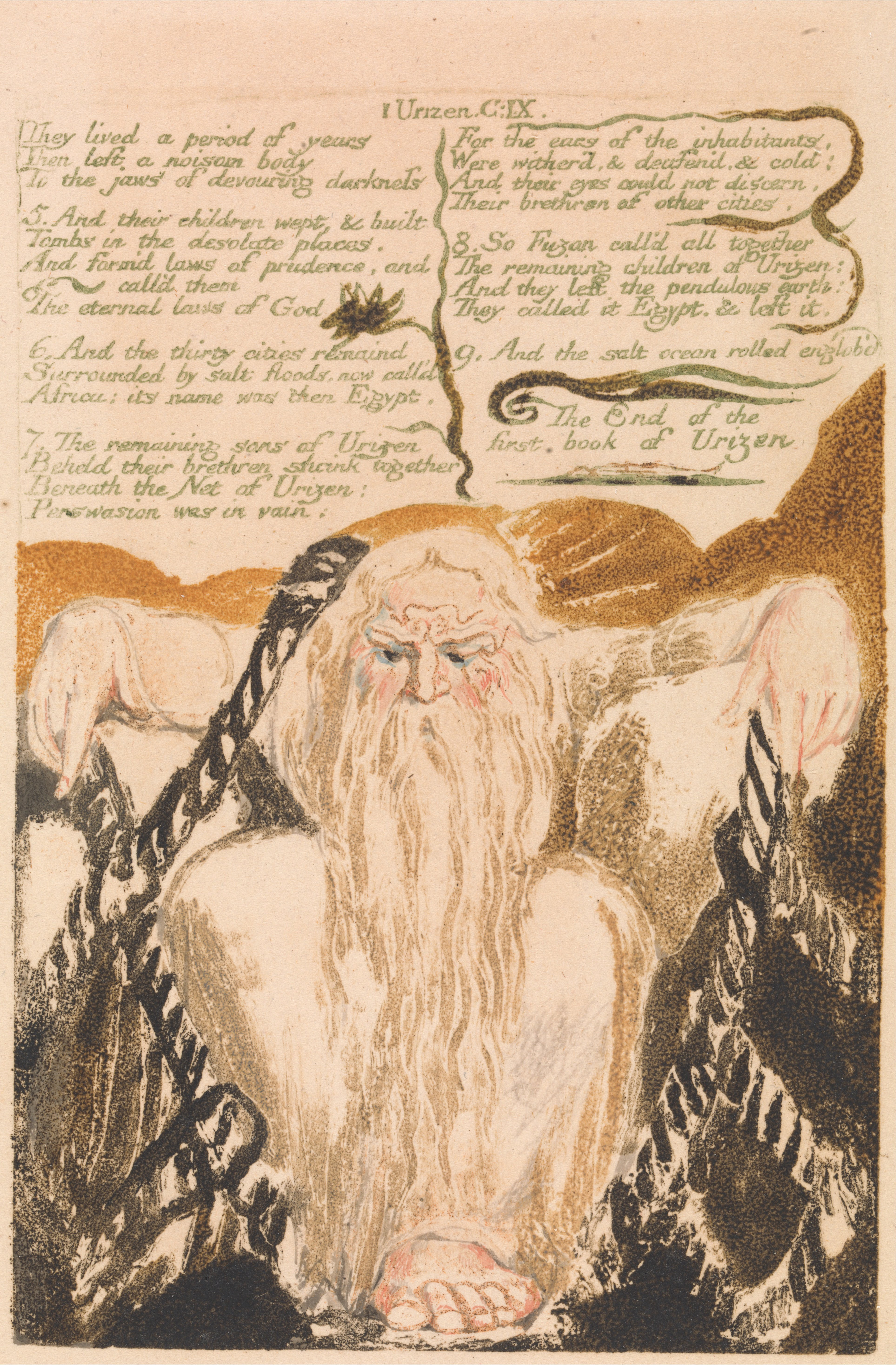
Urizen wandered in sorrow and wherever he walked a strong Web formed (like a Female in embryo) "like to the human brain." And all call'd it the Net of Religion.

Plate 27
"Then the inhabitants of those (Urizen's) cities for "Six days they shrunk up from existence,
And on the seventh day they rested,
And they blessed the seventh day, in sick hope
And forgot their eternal life."

At the end we might say that Fuzon (Urizen's "first begotten, last born") initiated a sort of rebellion or exodus.


Tuesday, July 03, 2018

Stones of Fire

Updated from Oct 2009.

A very prominent symbol in the Bible, 'stones' occurs 161 times in the Old and New Testaments. One that Blake especially loved accrues thus in Ezekiel:

Ezekiel 28
13 Thou hast been in Eden the garden of God; every precious stone was thy covering, the sardius, topaz, and the diamond, the beryl, the onyx, and the jasper, the sapphire, the emerald, and the carbuncle, and gold: the workmanship of thy tabrets and of thy pipes was prepared in thee in the day that thou wast created.
14 Thou art the anointed cherub that covereth; and I have set thee so: thou wast upon the holy mountain of God; thou hast walked up and down in the midst of the stones of fire.

The covering cherub! the stones of fire!

Blake may be best understood as an expander of the Bible. He made very good use of the two symbols mentioned above, and amplified the meanings used by Ezekiel:

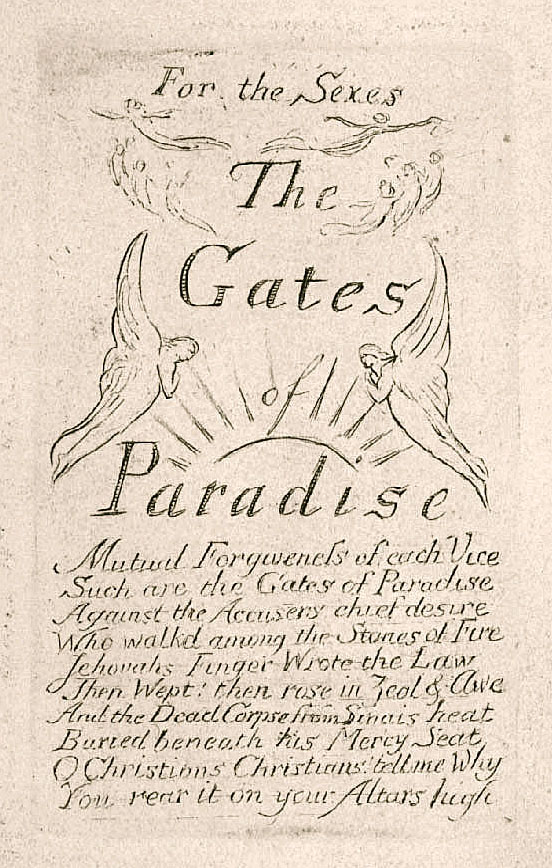
Stones of Fire appears in the Prologue of The Gates of Paradise:
 
"Mutual Forgiveness of each Vice
Such are the Gates of Paradise
Against the Accusers chief desire
Who walkd among the Stones of Fire" (E 258)
Wikipedia Commons
Gates of Paradise, For the Sexes
Prologue
  
To get a clue of the meaning we go to 1 Kings 18:38:
 
"Then the fire of the LORD fell, and consumed the burnt sacrifice, and the wood, and the stones, and the dust, and licked up the water that was in the trench."

This is from the account of Elijah's contest with the prophets of Baal.

We notice how the fire consumed the stone. We know the fire was from God, the stone a symbol of matter: Spirit burns up matter. That's Blake's message in a nutshell: spirit takes the place of matter. In our pilgrimage through life the material is gradually superseded by the spirit (God, Heaven).

'Stones of fire' represents a conjunction of matter and spirit. Ezekiel was speaking of a brilliant, successful potentate of his day, who had achieved greatly but who would be brought down by God. One such as was Lucifer, associated by Ezekiel and by Blake with the Covering Cherub (another name for Satan or the Selfhood).

Although Blake's source for the Covering Cherub was Ezekiel, Genesis 3:23  might have been Ezekiel's source:

"So he drove out the man; and he placed at the east of the garden of Eden Cherubims, and a flaming sword which turned every way, to keep the way of the tree of life."

In The Marriage of Heaven and Hell Blake had this to say about the Covering Cherub: 

"The ancient tradition that the world will be consumed in fire 
at the end of six thousand years is true. as I have heard from 
Hell.
   For the cherub with his flaming sword is hereby commanded to 
leave his guard at the tree of life, and when he does, the whole 
creation will be consumed, and appear infinite. and holy whereas
it now  appears finite & corrupt." (Marriage of Heaven and Hell, Plate 14) 

This shows what Blake thought of the biblical story of the Fall. In his myth the Fall occurs when man is kicked out of Eden (or just falls asleep), but the Return is set in motion also. In all versions of Blake's myth the end of the story is a happy event; the literary heads might call it a Romance rather than a Tragedy.

There's a great deal more to be said about the story of the Fall, especially about the Tree of Good and Evil; I'll tell you more about the Tree at a later date.
.

Monday, July 02, 2018

AFTER BARD'S SONG II

First posted by Larry in Oct 2009.

The Bard's Song led to a loud murmuring in the Heavens of Albion, and "the loud voic'd Bard terrify'd took refuge in Miltons bosom;" then Milton "took off the robe of the promise, & ungirded himself from the oath of God.
 

Milton, Plate 14 [15], (E 108)
"And Milton said, I go to Eternal Death! The Nations still
Follow after the detestable Gods of Priam; in pomp
Of warlike selfhood, contradicting and blaspheming.
When will the Resurrection come; to deliver the sleeping body
From corruptibility: O when Lord Jesus wilt thou come?
Tarry no longer; for my soul lies at the gates of death.
I will arise and look forth for the morning of the grave.
I will go down to the sepulcher to see if morning breaks!
I will go down to self annihilation and eternal death,
Lest the Last Judgment come & find me unannihilate."
And I be siez'd & giv'n into the hands of my own Selfhood
The Lamb of God is seen thro' mists & shadows, hov'ring
Over the sepulchers in clouds of Jehovah & winds of Elohim
A disk of blood, distant; & heav'ns & earth's roll dark between
What do I here before the Judgment? without my Emanation?
With the daughters of memory, & not with the daughters of
inspiration[?]
I in my Selfhood am that Satan: I am that Evil One!
He is my Spectre! in my obedience to loose him from my Hells
To claim the Hells, my Furnaces, I go to Eternal Death."


The way Blake saw him.
British Museum
Milton
Plate 13
This of course is a climactic moment in the poem. An unheard of thing! One leaves Heaven to return to 'this vale of tears'. Well, not quite unprecedented; Milton simply followed the path of Jesus. In that way Blake gave Milton (the man) the highest approval possible.
 

Blake's myth was to a large degree patterned after Paradise Lost. His difference with Milton resembled one of those "severe contentions of Friendship." Milton had spoken; Blake replied in MHH; now he replies again! That's the shape of the poem as far as Blake himself was concerned.
 

Thereafter Milton allied himself with Los, giving with Blake a triumvirate against which none could stand.
 
Milton is an essay describing the triumph of Jesus over all the forces of the world.
 

It is difficult to immediately grasp, but yields immense returns to anyone determined enough to come to an understanding of it. 
.
.