Monday, September 02, 2024

BLAKE & DREAMS 3

 Katharine of Aragon was the first wife of Henry VIII of England. He attempted to have the marriage annuled in order to marry Anne Boleyn. When the Pope refused to grant an annulment, a schism developed between England and the Catholic Church. Catherine died at Kimbolton Castle on 7 January 1536

Fitzwilliam Museum
Queen Katharine Drean
circa 1783 to 1790

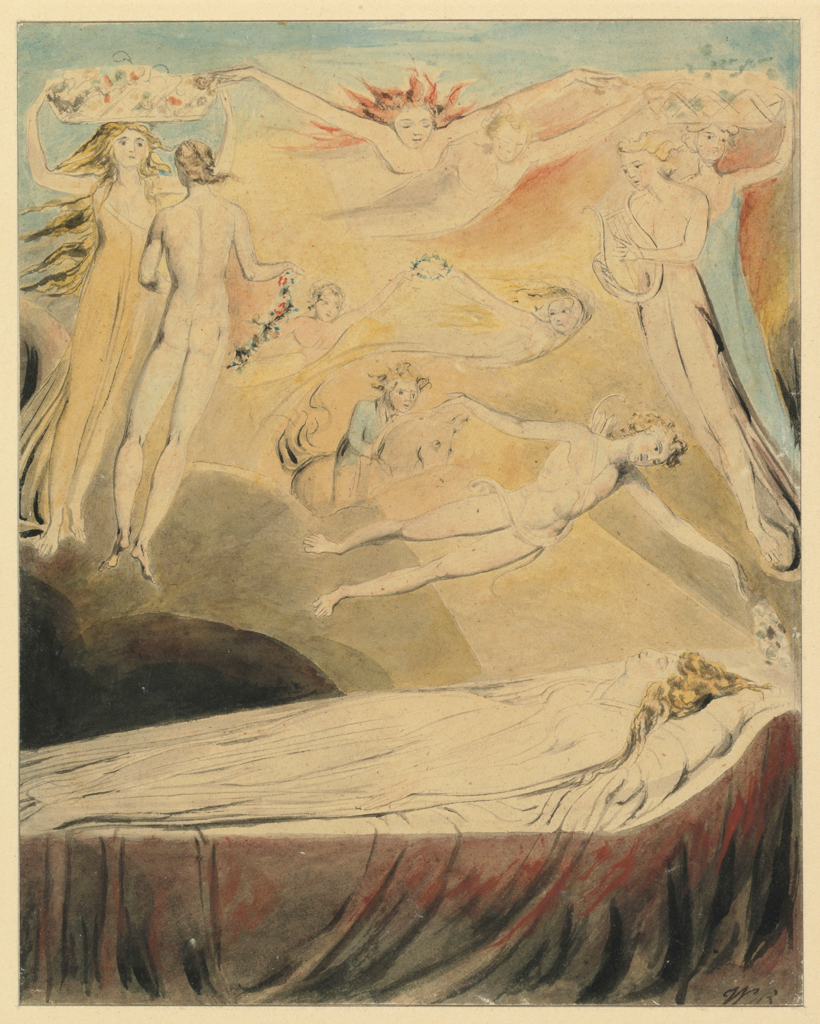
Blake's picture titled Queen Katharine's Dream is an illustration to lines from William Shakespeare's play Henry VII. Blake choose to illustrate lines from the play which echo his own feelings. As Katharine of Aragon the first wife of Henry lies on her deathbed she reports a dream which she had of the glorious world which awaited her.

Henry VIII , Scene IV
"KATHARINE
No? Saw you not, even now, a blessed troop
Invite me to a banquet; whose bright faces
Cast thousand beams upon me, like the sun?
They promised me eternal happiness;
And brought me garlands, Griffith, which I feel
I am not worthy yet to wear: I shall, assuredly.
GRIFFITH
I am most joyful, madam, such good dreams
Possess your fancy."

Blake painted illustrations for this scene at least three times. A earliest image of the scene resides in the Fitzwilliam Museum, Cambridge and is dated between 1783 and 1790. Look for motifs from Visions of the Daughters of Albion, Blake's lithograph of Enoch, and Plate 33 (37) of Jerusalem in this painting. Shown here are the later images.

British Museum, London (dated 1809).................
National Gallery, Washington
                                                                              (dated 1825)


Saturday, August 10, 2024

BLAKE & DREAMS 2

THE PILGRIMS PROGRESS
FROM THIS WORLD
TO THAT WHICH IS TO COME
DELIVERED 
UNDER THE SIMILITUDE
OF A DREAM
By John Bunyan's with an introduction by John T. Winterich
Illustrated with Water-colors by WILLIAM BLAKE  

 Pilgrim's Dream

"As I walked through the wilderness of this world, I came upon a certain place, where there was a den—and I laid down in that place to sleep. And as I slept, I dreamed a dream. I dreamed, and, behold—I saw a man clothed with rags, standing with his face turned away from his own house, with a Book in his hand, and a great burden upon his back. I looked, and saw him open the Book, and read therein; and as he read, he wept and trembled! And not being able to contain himself any longer—he broke out with a lamentable cry, saying, 'What shall I do?'"

Blake portrays three level in his image:

The dream which is a vehicle through which the dreamer may gain access to levels of consciousness below his ego consciousness.

Sleeping which is a necessary condition which allows the brain to be activated in such a way that unconscious content surfaces.

The unconscious which may release supressed material as well as well as activate protections which prevent damage.

Blake knew that listening to one's dreams was a way of getting in touch with the aspects of the psyche which are not ordinarily accessable. When Blake illustrated Pilgrim's Progress which was written as a sequence of episodes in Bunyan's dream, he reached into his unconscious to make known what may have been opaque in Bunyan's allegory. Bunyan did not focus on the dream state itself but in Blake's first illustration he revealed that the dreamer is subject to levels of consciousness different from those of waking experience. 

The sleeping pilgrim is not reconstructing memories but reliving incidents in his life which fit into a pattern through which a pilgrim travels. In the upper level of the picture Blake faintly represents the episodes through the pilgrim will travel in Bunyan's dream. The dreamer who lies asleep bears no resemblemce to the  pilgrim who will undertake the journey. Beneath the dreamer lies a sleeping lion. Blake used a lion as a symbol for the love and protection which is afforded to the innocent lamb who is vulnerable to the wrath of the wolf who would do him harm.

    
Milton, PLATE 15 [17], (E 109)
"As when a man dreams, he reflects not that his body sleeps,
Else he would wake; so seem'd he entering his Shadow: but
With him the Spirits of the Seven Angels of the Presence
Entering; they gave him still perceptions of his Sleeping Body;
Which now arose and walk'd with them in Eden, as an Eighth   
Image Divine tho' darken'd; and tho walking as one walks
In sleep; and the Seven comforted and supported him.

Like as a Polypus that vegetates beneath the deep!
They saw his Shadow vegetated underneath the Couch
Of death: for when he enterd into his Shadow: Himself:           
His real and immortal Self: was as appeard to those
Who dwell in immortality, as One sleeping on a couch
Of gold; and those in immortality gave forth their Emanations
Like Females of sweet beauty, to guard round him & to feed
His lips with food of Eden in his cold and dim repose!           

But to himself he seemd a wanderer lost in dreary night.
Onwards his Shadow kept its course among the Spectres; call'd
Satan, but swift as lightning passing them, startled the shades
Of Hell beheld him in a trail of light as of a comet
That travels into Chaos: so Milton went guarded within." 
Songs and ballads, (E 486)     
"The Land of Dreams

Awake awake my little Boy
Thou wast thy Mothers only joy
Why dost thou weep in thy gentle sleep
Awake thy Father does thee keep

O what Land is the Land of Dreams     
What are its Mountains & what are its Streams
O Father I saw my Mother there
Among the Lillies by waters fair

Among the Lambs clothed in white
She walkd with her Thomas in sweet delight   
I wept for joy like a dove I mourn
O when shall I again return

Dear Child I also by pleasant Streams
Have wanderd all Night in the Land of Dreams
But tho calm & warm the Waters wide  
I could not get to the other side

Father O Father what do we here
In this Land of unbelief & fear
The Land of Dreams is better far
Above the light of the Morning Star"   


In Dark Figures in the Desired Country, Gerda Norvig makes this statement about the healing powers which are called forth when one engages in the process of individuation:
"Blake seems to be giving here graphic expression to a common psychological rule that goes beyond Bunyan's: the rule that active differentiation of the contents of the dark side of the self precedes spiritual assistance, but also literally creates a space for the healing powers of the psyche to move into as they well up from archetypal dimensions recognized as existing deep in the background of our mental landscape." (Page 148)

Damon, A Blake Dictionary

"The Lion is commonly known as the protector of the Lamb...the Lion's warth is particulrly directed against the wolves who prey upon the flocks.
...
The Lion is spiritual wrath, inspired by pity...while the Tyger's blind warth is purely emotional." (Page 242)


Wednesday, August 07, 2024

BLAKE & DREAMS 1

Illustrations to Young's Night Thoughts

Copy of image in British Museum

“The dream is the small hidden door in the deepest and most intimate sanctum of the soul, which opens to that primeval cosmic night that was soul long before there was conscious ego and will be soul far beyond what a conscious ego could ever reach.” Carl Jung

The quote is from "The Meaning of Psychology for Modern Man" (1933) an essay by Carl Jung that was published in 1933 as the second part of his series “On Psychology.”

Pictured is the threefold materialized body - moving from the feet to the head we see:

Horses - body - energies -  Tharmas
Marriage of Heaven and Hell, Plate 4, (E 34) 
"2. Energy is the only life and is from the Body and Reason is
the bound or outward circumference of Energy.
3 Energy is Eternal Delight
Hunter -  loins - passions - (daughter of) Urizen
Ahania, Plate 2, (E 84)
"6: But the strong arm that sent it, remember'd
The sounding beam; laughing it tore through
That beaten mass: keeping its direction
The cold loins of Urizen dividing.

7: Dire shriek'd his invisible Lust                           
Deep groan'd Urizen! stretching his awful hand
Ahania (so name his parted soul)
He siez'd on his mountains of jealousy.
He groand anguishd & called her Sin,
Woman - heart - emotions - Luvah 
Four Zoas, Night VII ,Page 84, (E 359)
"This thou well rememberest listen I will tell
What thou forgettest. They in us & we in them alternate Livd  
Drinking the joys of Universal Manhood. One dread morn
Listen O vision of Delight One dread morn of goary blood
The manhood was divided for the gentle passions making way   
Thro the infinite labyrinths of the heart & thro the nostrils issuing
In odorous stupefaction stood before the Eyes of Man   
A female bright."
Owl - head - mind - Urthona

Jerusalem, Plate 82, (E 240)

"then they saw the Furna[c]es opend, & in tears
Began to give their souls away in the Furna[c]es of affliction.
Los saw & was comforted at his Furnaces uttering thus his voice. 

I know I am Urthona keeper of the Gates of Heaven,
And that I can at will expatiate in the Gardens of bliss;
But pangs of love draw me down to my loins which are
Become a fountain of veiny pipes: O Albion! my brother!
Plate 83
Corruptibility appears upon thy limbs, and never more  
Can I arise and leave thy side, but labour here incessant
Till thy awaking! yet alas I shall forget Eternity!"  

We are accustomed to thinking of the material outer world as having some independent existence. This is the exterior world mediated through consciousness. But the world of dreams is an internal world coming to us from the unconscious which exists within our psyches exclusively. The images which came to Blake existed first in his mind. He brought them from his unconscious and expressed them in symbolic language when they reached his conscious mind. 

We may recieve material which resides in our unconscious through dreaming but often it never reaches our consciousness. Blake had the uncanny ability to bring into the light material which primarily resides in the collective unconscious which we know primarily through archetypes. Blake's poetry and visual images can become an avenue through which we become acquainted with material which is hidden from us in our own unconscious minds. If we believe, as Blake did, that the world of thought is the real world, we have a key to that interior world through studying Blake.

Vision of Last Judgment, (E 565)

"Mental Things are alone Real what is Calld Corporeal Nobody Knows
of its Dwelling Place <it> is in Fallacy & its Existence an
Imposture  Where is the Existence Out of Mind or Thought Where is
it but in the Mind of a Fool." 

Tuesday, July 30, 2024

Reconcilation

 From Chapter Nine of Ram Horn'd with Gold by Larry Clayton

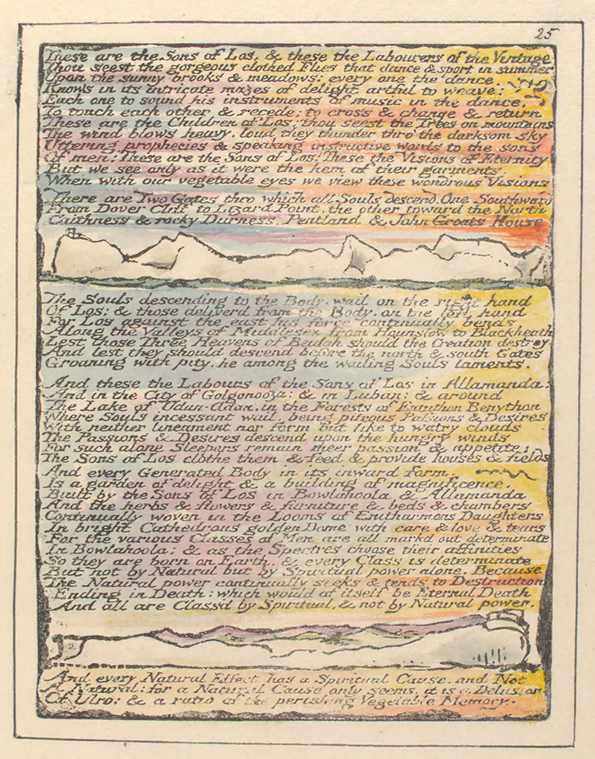
New York Public Library
Milton
Plate 25

For five plates in 'Milton' Blake extols
the World of Los, the sum total of imaginative creation, the art,
the culture, the decency that has raised mankind at times, if on-
ly momentarily, above the satanic level of a universe groaning in
travail.
Milton, Plate 26 [28], (E 123)
"These are the Sons of Los, & these the Labourers of the Vintage
Thou seest the gorgeous clothed Flies that dance & sport in summer
Upon the sunny brooks & meadows: every one the dance
Knows in its intricate mazes of delight artful to weave: 
Each one to sound his instruments of music in the dance,      
To touch each other & recede; to cross & change & return
These are the Children of Los; thou seest the Trees on mountains
The wind blows heavy, loud they thunder thro' the darksom sky
Uttering prophecies & speaking instructive words to the sons
Of men: These are the Sons of Los! These the Visions of Eternity 

But we see only as it were the hem of their garments
When with our vegetable eyes we view these wond'rous Visions
...And every Natural Effect has a Spiritual Cause, and Not
A Natural: for a Natural Cause only seems, it is a Delusion 
 Of Ulro: & a ratio of the perishing Vegetable Memory."

This brief description of 'Milton' has only touched on
a few of the most essential meanings of a poem that contains a
thousand facets. But one other thing needs to be said about
'Milton'. Among all the hidden riches to be sought out there
emerges the realization that 'Milton' also represents a beginning
of Blake's reconciliation with the Church that had suffered his
violent enmity through the years. 

Blake had held the Church in
low regard for two reasons: First, it had too much blood on its
hands; Second, he had always understood how far the Church had
failed to be what it was called to. John Milton had also refused
to affiliate with worldly (in Blake's terminology 'satanic') or-
ganizations which called themselves the Church. Still as spirit-
ual leader of the English people Milton represented the best of
the English Church. Reconciliation with him was for Blake (among
other things) a symbolic first step in forgiving "God's people" for
failing to be that in the truest sense. 

So he joined Milton in
confession, in self annihilation, in the forgiveness which had be-
come his new and only abiding concept of the meaning of God. Like
Milton he remained outside the established Church, but he chose to
be buried with the Anglican order of worship!


Monday, July 22, 2024

SENSES SHRINK

First posted May 2011 

An image that Blake uses for the Fall of Man (the division into duality or multiplicity), is presented as the limitation of man's sensory acuity. The senses of Eternity are flexible, expanding and contracting at will: their perceptions are infinite.

The Book of Urizen dramatizes the process of the infinite senses becoming the senses five that we recognize and enjoy today. It is not a happy sight to see the powers of Eternity being defined and limited into the narrow range of sight, sound, smell, and taste and touch to which we have access.

  Wikimedia Commons 
Book of Urizen 
Copy G,  Plate 13
Book of Urizen, Plate 12, (E 76) 
"8. In harrowing fear rolling round;
His nervous brain shot branches
Round the branches of his heart.
On high into two little orbs
And fixed in two little eaves
Hiding carefully from the wind,
His Eyes beheld the deep,
And a third Age passed over:
And a state of dismal woe.

9. The pangs of hope began,
In heavy pain striving, struggling.
Two Ears in close volutions.
From beneath his orbs of vision
Shot spiring out and petrified
As they grew. And a fourth Age passed
And a state of dismal woe.

PLATE 13
10. In ghastly torment sick;
Hanging upon the wind;
Two Nostrils bent down to the deep.
And a fifth Age passed over;
And a state of dismal woe.

11. In ghastly torment sick;
Within his ribs bloated round,
A craving Hungry Cavern;
Thence arose his channeld Throat,
And like a red flame a Tongue
Of thirst & of hunger appeard.
And a sixth Age passed over:
And a state of dismal woe.
...
PLATE 25, (E 82)
The Senses inward rush'd shrinking,
Beneath the dark net of infection.

2. Till the shrunken eyes clouded over
Discernd not the woven hipocrisy
But the streaky slime in their heavens
Brought together by narrowing perceptions
Appeard transparent air; for their eyes
Grew small like the eyes of a man
And in reptile forms shrinking together"

The inability to perceive reality shows itself in man's forgetting Eternity from which he originated. This limits his ability to discern the possibility of living as he is meant to live. His limited perceptions further cloud his mind to the distorted conditions which he becomes satisfied with living under in the world he has made for himself.

Letter to Truxler, (E 702)
"As a man is So he Sees.
As the Eye is formed such are its Powers"

We are limited in what we see by who we are; likewise we are limited in who we are by what we see. In our present circumstances the distortions of our perceptions cause us to accept war, imprisonment, impoverishment, exploitation, and destruction of the environment. Likewise we are diminished in our self-perception by what we see is happening around us. Cleansing the windows of perception is a way to alter the direction in which we are heading. Blake has the journey to regeneration begin by Los recognizing himself in his enemy Urizen. Our return journey can begin with a recognition that we are creating the self-destructing world in our own image. Healing ourselves can heal our world.

Marriage of Heaven and Hell, Plate 14, (E 39)
"If the doors of perception were cleansed every thing would
appear to man as it is: infinite.
For man has closed himself up, till he sees all things thro'
narrow chinks of his cavern."


Friday, July 19, 2024

HUMAN FORM

Blake Archive
Illustrations to Milton's Paradise Lost
Butts Set
Christ Offers to Redeem Man


There are only two ultimate realities to Blake: the Divine Humanity and the Human Form.
Milton, Plate 32 [35], (E 131)
"the Spectre of Albion, who made himself a God &, destroyed the Human Form Divine.
But the Divine Humanity & Mercy gave us a Human Form" 
We are given life in the Human Form by the Divine Humanity. The Human Form we receive is Four-fold. It is not unified but divided into four Faces directed toward the four compass points. Each of the 'four mighty ones' manisfests in one of these psychological directions.
  
Jerusalem, Plate 15, (E 159)
"In every Nation of the Earth till the Twelve Sons of Albion
Enrooted into every Nation: a mighty Polypus growing
From Albion over the whole Earth: such is my awful Vision.   

I see the Four-fold Man. The Humanity in deadly sleep
And its fallen Emanation. The Spectre & its cruel Shadow.
I see the Past, Present & Future, existing all at once
Before me; O Divine Spirit sustain me on thy wings!
That I may awake Albion from His long & cold repose."       
So this is the arrrangement of the Four-fold Man:
Humanity - Man's inmost part (North) 
Fallen Emanation (East) 
Spectre (South)
Cruel Shadow (West) 
The spiritual dimension of man is his Humanity, the God in whose image he is created. As a Zoa the Humanity corresponds to Urthona.

His fallen Emanation is the form that is expressed in the material world: feminine, passive, and capable of developing a separate will which seeks dominion over the male. It is in Luvah and his World, Beulah, that the fallen Emanation is most evident.

When the Emanation separates from the man, he is left "a selfish and ravening Spectre. His rational power, unchecked by his Emanation, dominates him."(Damon, page 121) The fallen Urizen, or Satan is analogous with the Spectre.

Tharmas must be the cruel shadow. This implies that the body and the senses are delusive reflections of the spirit and spiritual sensation.

Jerusalem, Plate 10, (E 153)
"The Spectre answer'd. Art thou not ashamd of those thy Sins
That thou callest thy Children? lo the Law of God commands
That they be offered upon his Altar: O cruelty & torment
For thine are also mine! I have kept silent hitherto,            
Concerning my chief delight: but thou hast broken silence
Now I will speak my mind! Where is my lovely Enitharmon
O thou my enemy, where is my Great Sin?  She is also thine
I said: Now is my grief at worst: incapable of being
Surpassed: but every moment it accumulates more & more           
It continues accumulating to eternity! the joys of God advance
For he is Righteous: he is not a Being of Pity & Compassion
He cannot feel Distress: he feeds on Sacrifice & Offering:
Delighting in cries & tears & clothed in Holiness & solitude
But my griefs advance also, for ever & ever without end          
O that I could cease to be! Despair! I am Despair
Created to be the great example of horror & agony: also my
Prayer is vain I called for compassion: compassion mockd
Mercy & pity threw the grave stone over me & with lead
And iron, bound it over me for ever: Life lives on my
Consuming: & the Almighty hath made me his Contrary
To be all evil, all reversed & for ever dead: knowing
And seeing life, yet living not; how can I then behold
And not tremble; how can I be beheld & not abhorrd

So spoke the Spectre shuddring, & dark tears ran down his shadowy face
Which Los wiped off, but comfort none could give! or beam of hope
Yet ceasd he not from labouring at the roarings of his Forge
With iron & brass Building Golgonooza in great contendings
Till his Sons & Daughters came forth from the Furnaces
At the sublime Labours for Los. compelld the invisible Spectre  
Plate 11
To labours mighty, with vast strength, with his mighty chains,
In pulsations of time, & extensions of space, like Urns of Beulah
With great labour upon his anvils, & in his ladles the Ore
He lifted, pouring it into the clay ground prepar'd with art;
Striving with Systems to deliver Individuals from those Systems; 
That whenever any Spectre began to devour the Dead,
He might feel the pain as if a man gnawd his own tender nerves.

Then Erin came forth from the Furnaces, & all the Daughters of Beulah
Came from the Furnaces, by Los's mighty power for Jerusalems
Sake: walking up and down among the Spaces of Erin:              
And the Sons and Daughters of Los came forth in perfection lovely!
And the Spaces of Erin reach'd from the starry heighth, to the starry depth.

Los wept with exceeding joy & all wept with joy together!
They feard they never more should see their Father, who
Was built in from Eternity, in the Cliffs of Albion."
Jerusalem, Plate 12, (E 156)
"And the Four Points are thus beheld in Great Eternity
West, the Circumference: South, the Zenith: North,               
The Nadir: East, the Center, unapproachable for ever.
These are the four Faces towards the Four Worlds of Humanity
In every Man. Ezekiel saw them by Chebars flood.
And the Eyes are the South, and the Nostrils are the East.
And the Tongue is the West, and the Ear is the North. 
Jerusalem, Plate 37 [41], (E 184)
[illustration, with inscription, reversed] 
"Each Man is in his Spectre's power
          Untill the arrival of that hour,
          When his Humanity awake
          And cast his Spectre into the Lake" 
Jerusalem, Plate 44 [30], (E 193)
"And the Divine hand was upon them bearing them thro darkness
Back safe to their Humanity as doves to their windows:
Therefore the Sons of Eden praise Urthonas Spectre in Songs
Because he kept the Divine Vision in time of trouble."
Jerusalem, Plate 79, ( E 236)
"O Vala! Humanity is far above
Sexual organization; & the Visions of the Night of Beulah"
Jerusalem, Plate 96, (E 255)
"Then Jesus appeared standing by Albion as the Good Shepherd
By the lost Sheep that he hath found & Albion knew that it
Was the Lord the Universal Humanity, & Albion saw his Form     
A Man. & they conversed as Man with Man, in Ages of Eternity
And the Divine Appearance was the likeness & similitude of Los"
Jerusalem, Plate 98, (E 257)
"Driving outward the Body of Death in an Eternal Death & Resurrection   
Awaking it to Life among the Flowers of Beulah rejoicing in Unity
In the Four Senses in the Outline the Circumference & Form, for ever
In Forgiveness of Sins which is Self Annihilation. it is the Covenant of Jehovah

The Four Living Creatures Chariots of Humanity Divine incomprehensible
In beautiful Paradises expand These are the Four Rivers of Paradise   
And the Four Faces of Humanity fronting the Four Cardinal Points
Of Heaven going forward forward irresistible from Eternity to Eternity
And they conversed together in Visionary forms dramatic"
Descriptive Catalogue, (E 536)
 "These Gods
are visions of the eternal attributes, or divine names, which,
when erected into gods, become destructive to humanity.
They ought to be the servants, and not the masters of man, or of
society.  They ought to be made to sacrifice to Man, and not man
compelled to sacrifice to them; for when separated from man or
humanity, who is Jesus the Saviour, the vine of eternity, they
are thieves and rebels, they are destroyers."
Last Judgement, (E 553)
"many Infants appear in the Glory
representing the Eternal Creation flowing from the Divine
Humanity in Jesus who opens the Scroll of Judgment upon his knees
before the Living & the Dead"
Thursday, July 18, 2024

SELF-KNOWLWDGE

Wikipedia Commons
Malevolence

In the following two passages we see how Blake applied to his associates the growing understanding of the motivating forces which were within himself . He saw in their behaviour that they were dominated by forces were within themselves, but unknown to those who possessed them. Blake increased his understanding of himself by observing in Hayley and Reynolds things which they did not know about themselves but were expressed overtly.

Blake confessed that he didn't know what he was getting into when he moved to Felpham at Hayley's invitation. He anticipated better circumstances because he was attempting to leave a stressful situation in London. Blake soon found that Hayley's motivations were not directed by the spirit but by purely material concerns. He intended to move Blake away from writing visionary poetry as he felt led to do, and into activities designed for monetary gain.

Blake felt that Hayley's rejection of the leadership of the spirit worked against his gaining understanding of the 'natural hidden' forces which were working against him.

In th case of Reynolds, Blake recognized that he was using his position as president of the Royal Academy to attempt to destroy the reputations of the very artists whom Blake most admired.

To Blake the praise that Reynolds gave to Rafael and Michelangelo could be recognized as attempts to to poison admiration of their skills as a means of revenge against their vision and artistic ability. The praise that he afforded them was not for what they valued in art but for what they abhorred. The harm that Reynolds did was to the public and to the students who accepted his evaluation. If it was behavior of which he was unconscious, he was allowing his lack of self-knowledge to determine his relationship to others. Whether unintentionally or maliciously he allowed his own failure to resolve his inner conflicts to do harm.

Letters, To Butts, (E 723)

"When I came down here I was more sanguine than I am at present but it was because I was ignorant of many things which have since occurred & chiefly the unhealthiness of the place Yet I do not repent of coming, on a thousand accounts. & Mr H I doubt not will do ultimately all that both he & I wish that is to lift me out of difficulty. but this is no easy matter to a man who having Spiritual Enemies of such formidable magnitude cannot expect to want natural hidden ones"

Annotations to Reynolds, (E 642)

  "I consider Reynolds's Discourses to the Royal Academy as the
Simulations of the Hypocrite who Smiles particularly where he
means to Betray.  His Praise of Rafael is like the Hysteric Smile
of Revenge   His Softness & Candour. the hidden trap. & the
poisoned feast, He praises Michael Angelo for Qualities which
Michael Angelo Abhorrd; & He blames Rafael for the only Qualities
which Rafael Valued,  Whether Reynolds. knew what he was doing.
is nothing to me; the Mischief is just the same, whether a Man
does it Ignorantly or Knowingly:"

Monday, July 15, 2024

MORNING STARS

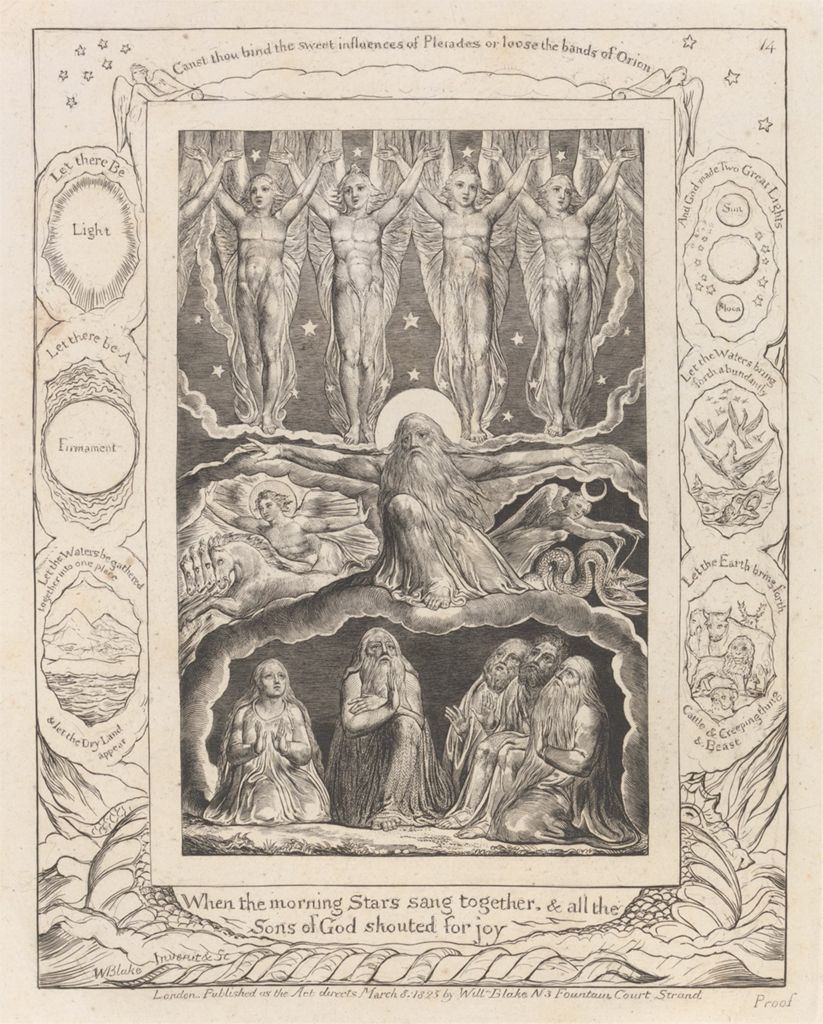
In commenting on William Blake's Illustrations of the Book of Job in The Art of William Blake, Anthony Blunt wrote on page 86: 

"For once he reduced his visions to terms which are readily intelligible to all, and they gained not lost in the process...

In technique the engravings are masterly. As we know from Gilchrist, Blake had refreshed his mind and his hand by a renewed study of the engravings of Marcantonio and Durer, which he loved since childhood, and his graver takes on a new subtlety and produces a great variety of effects which he had hardly ever achieved in the earlier dry manner of his master Basire. The outline remains as firm as ever, but the modelling is fuller, the effects of light more varied, the texture richer, so that the absence of color is more than made up for; and the engravings have a concentration and force lacking in the preliminary water-colours. The variety of mood is as great as in earlier works but is achieved by moderate means...Ecstasy is given its most splendid expression in the famous plate When the Morning Stars Sang Together (Plate 14).

Yale Center for British Art
Illustrations of the Book of Job
Plate 14

"This last plate was Blake's final statement of a formal theme on which he had many variations and which derived ultimately from a crude engraving of a relief from Persepolis in Bryant's New system of ancient Mythology, published in 1776, the row of figures standing with their arms stretched upwards and overlapping. This device had appeared in one of the illustrations to Young's Night Thoughts, where the figures are cherubim with six wings, four of which cover their bodies and legs. The Job water-colours show four figures with one pair of wings each, clad in short skirts and flanked by two wisps of a cloud. In the engravings the group is made more coherent and more lively by the introduction of flowing gauze-like dresses which cover the figures right down to their feet and link with the line of the clouds, integrating them into the design. But Blake's most effective change at this stage is to add, at each end of the row of figures, an extra arm cut off by the edge of the plate, which suggests with striking effect that the row is continued indefinitely beyond the frame of the engraving and ads mystery to the whole conception."

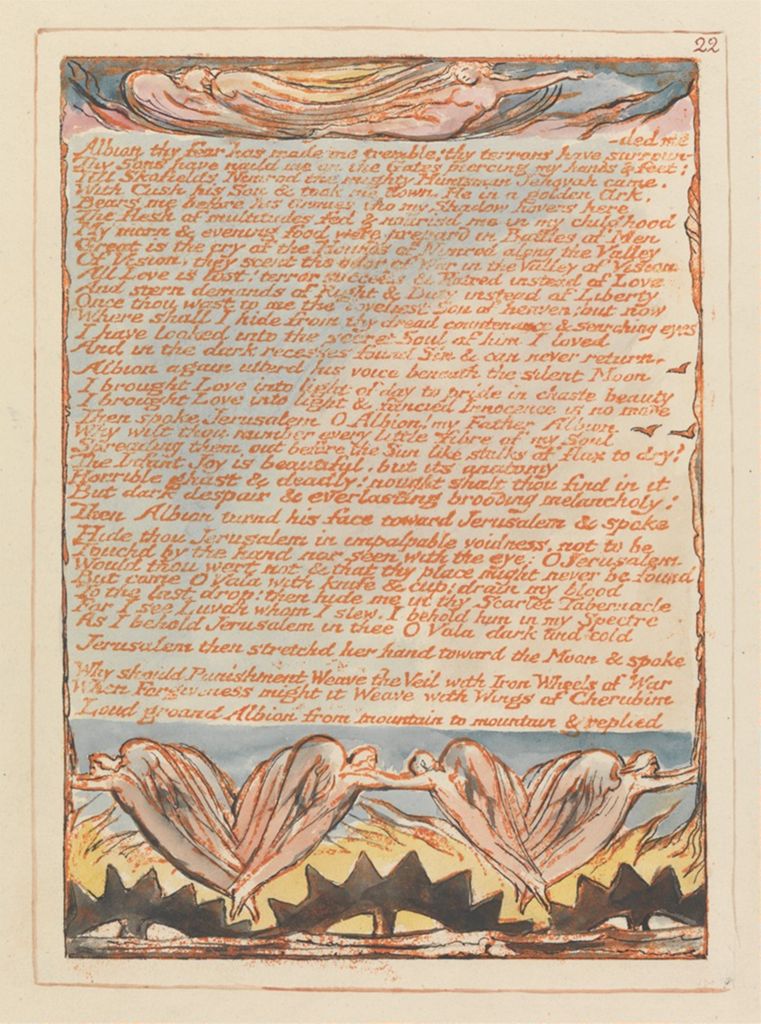
Blake made at least two additional images of this motif. In his illustrations to Milton's On the Morning of Christ's Nativity he pictured five angels is a row, enclosed in a circle of angels. At the bottom of plate 22 of Jerusalem Blake contrasted the Wings of Cheribim with Iron Wheels of war. The angels once again reach out to each other with the implication that an infinite pattern continues.

"Why should Punishment Weave the Veil with Iron Wheels of War
When Forgiveness might it Weave with Wings of Cherubim" 

This image of interlocked angels singing their praise and gratitude was Blake's response to the following verses in the Book of Job:

Job 38

[4] Where wast thou when I laid the foundations of the earth? declare, if thou hast understanding.
[5] Who hath laid the measures thereof, if thou knowest? or who hath stretched the line upon it?
[6] Whereupon are the foundations thereof fastened? or who laid the corner stone thereof;
[7] When the morning stars sang together, and all the sons of God shouted for joy?

The words Morning Star appear also in the Book of Revelation.

Revelation 22

[16] I Jesus have sent mine angel to testify unto you these things in the churches. I am the root and the offspring of David, and the bright and morning star.
[17] And the Spirit and the bride say, Come. And let him that heareth say, Come. And let him that is athirst come. And whosoever will, let him take the water of life freely.


In the Four Zoas Urizen and his obedient sons came not. The turned away.

Four Zoas, Night III, Page 37, (E 326)         

"Now sat the King of Light on high upon his starry throne
And bright Ahania bow'd herself before his splendid feet

O Urizen look on Me. like a mournful stream  
I Embrace round thy knees & wet My bright hair with my tears: 
Why sighs my Lord! are not the morning stars thy obedient Sons   
Do they not bow their bright heads at thy voice? at thy command
Do they not fly into their stations & return their light to thee
The immortal Atmospheres are thine, there thou art seen in glory
Surrounded by the ever changing Daughters of the Light
Why wilt thou look upon futurity darkning present joy"
Four Zoas, Night V, Page 64, (E 343)
"I well remember for I heard the mild & holy voice
Saying O light spring up & shine & I sprang up from the deep  
He gave to me a silver scepter & crownd me with a golden crown
& said Go forth & guide my Son who wanders on the ocean  

I went not forth. I hid myself in black clouds of my wrath       
I calld the stars around my feet in the night of councils dark
The stars threw down their spears & fled naked away
We fell. I siezd thee dark Urthona In my left hand falling
I siezd thee beauteous Luvah thou art faded like a flower"  

Songs of Innocence and of Experience, Song 30, (E 18) 

"O Earth O Earth return!
Arise from out the dewy grass;
Night is worn,
And the morn
Rises from the slumberous mass, 
 
Turn away no more
Why wilt thou turn away
The starry floor
The watry shore
Is giv'n thee till the break of day."

Saturday, July 06, 2024

The Furnace

First posted August 2014

The magnum opus of Northrop Frye was a two volume work about 'The Bible and Literature';  it crowned his career in the last years of his life. The first volume was called The Great Code and the last one, written just before he died, was Words with Power. (One exciting statement is "Blake's lifelong project was to produce his own revised and updated version of the Scriptures.")

'Words with Power' has in its Contents four 'Variations on a Theme', each one with it own chapter: "the Mountain, the Garden, the Cave and the Furnace." Obviously each of these is related to significant material in Blake's works.  In this post we will concentrate on "The Furnace":


In this picture we see Los, the Blacksmith at his shop. His furnace is going; above it the Spectre hovers.

Jerusalem, Plate 6, (E 148)
"His spectre driv'n by the Starry Wheels of Albions sons, black and 
Opake divided from his back; he labours and he mourns!

For as his Emanation divided, his Spectre also divided
In terror of those starry wheels: and the Spectre stood over Los 
Howling in pain: a blackning Shadow, blackning dark & opake
Cursing the terrible Los: bitterly cursing him for his friendship
To Albion, suggesting murderous thoughts 
Los rag'd and stamp'd the earth in his might & terrible wrath!
He stood and stampd the earth! then he threw down his hammer in rage &
In fury: then he sat down and wept, terrified! Then arose
And chaunted his song, labouring with the tongs and hammer:
But still the Spectre divided, and still his pain increas'd
In pain the Spectre divided: in pain of hunger and thirst:"

'Furnace' appears often in Blake's poetry (168 times); here is a fruitful one:
Jerusalem, Plate 96, (E 256)
"Albion stood in terror: not for himself but for his Friend
Divine, & Self was lost in the contemplation of faith
And wonder at the Divine Mercy & at Los's sublime honour
Do I sleep amidst danger to Friends! O my Cities & Counties
Do you sleep! rouze up! rouze up. Eternal Death is abroad
So Albion spoke & threw himself into the Furnaces of affliction
All was a Vision, all a Dream: the Furnaces became
Fountains of Living Waters Howing from the Humanity Divine
And all the Cities of Albion rose from their Slumbers, and All
The Sons & Daughters of Albion on soft clouds Waking from Sleep
Soon all around remote the Heavens burnt with flaming fires
And Urizen & Luvah & Tharmas & Urthona arose into
Albions Bosom: Then Albion stood before Jesus in the Clouds
Of Heaven Fourfold among the Visions of God in Eternity"

On page 296 of Words with Power Frye wrote:
"The image of the furnace may be used for either the negative or
positive aspects of the lower world. The negative or demonic world
is the traditional hell which is a furnace of heat without light.
The positive one is purgatorial, a crucible from which the redeemed
emerge purified like metal in a smelting operation ... 
We have two aspects of all these furnace images and their relatives: an environment which is either evil to be escaped from, or imperfect to be transformed by an inward fire. The transforming inward fire, we said, the energy of the human body, and the physical body is a metaphorical crucible for the spiritual body that arises from it." 
(Read the book at The Internet Archive
; it's full of meaning.)

Professor Marx described Blake's furnace thusly:
"Frye's fourth variation and last chapter is called the Furnace. Its theme is 
"lower wisdom," relating it to the lower love of the previous chapter and to 
the higher wisdom of the mountain in chapter 5. The wisdom and power of 
the Furnace is not communicated from on high by God, but is forged within 
by His rivals. Frye calls that self-made wisdom titanic creative energy. Its 
primary concern is making or work or possession or property. What these 
apparently unrelated terms have in common is the self-driven extension of the 
self--that which one produces and thereby owns."

Monday, July 01, 2024

ORC

First posted February 2016

America
Plate 4
Enlarged Segment
 
Blake lived through an age of revolution. He was 19 years old when the American colonies declared their independence from the British Empire. When he was 36 the French executed their monarch. He observed the cycle and consequences of revolution at home and abroad. Blake's character Orc was developed in response to his observation of actual revolution.

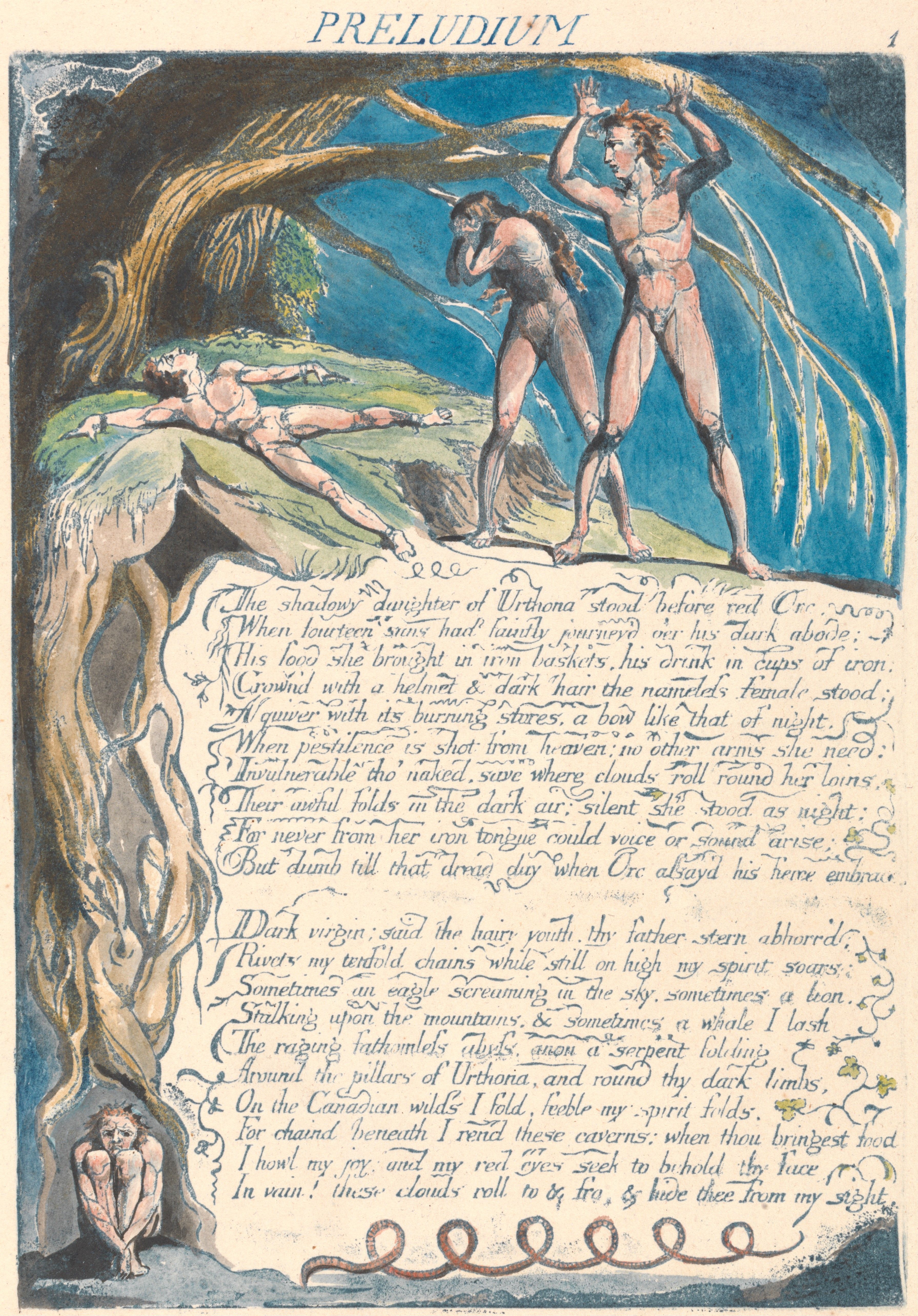
Blake's first mention of Orc by name is in the Preludium to America published in 1793. Orc is portrayed as having reached maturity, burst his bonds a restraint and exploded into Revolution.

 
Yale Center for British Art
Urizen
Copy A, Plate 18
 
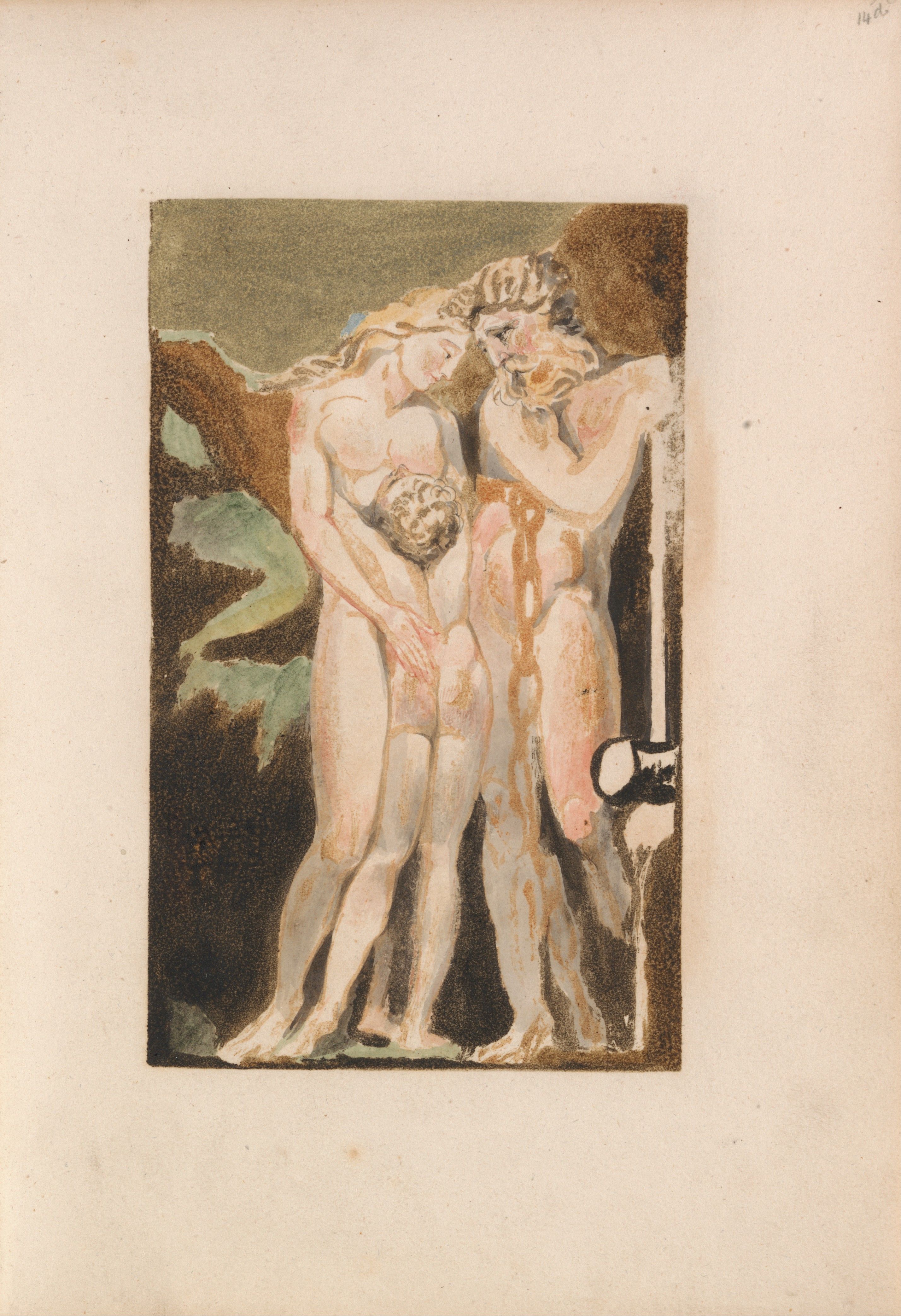
To Blake Orc originated through Los and Enitharmon. Los personified the voice of prophecy which spoke God's word to an alienated world. Enitharmon represented the world to which the prophecy was spoken. Their child Orc choose to ally himself with Enitharmon and her world. Orc like his father sought change but he hadn't the self restraint of Los. Orc's revolutionary powers were pitted against Urizen's restrictive efforts to construct a world which could not accommodate the unpredictability of imagination. Orc, however, eventually submitted to Urizen's dictates. Allied with Urizen's life-denying thinking, Orc's emotion-driven activities degenerated into terrorism and anarchy.


In Fearful Symmetry Northrop Frye states on page 217:
"Revolution attracts sympathy more because it is revolution than because of what it proposes to substitute... But as Orc stiffens into Urizen, it becomes manifest that the world is so constituted that no cause can triumph in it and still preserve its imaginative integrity. The imagination is mental, and never has a preponderance of physical force on its side."

Yale Center for British Art
America
Plate 12, Copy A

Frye continues with this quote from Blake:  

Vision of Last Judgment, (E 564)  "The Whole Creation Groans to be deliverd there will always be as many Hypocrites born as Honest Men & they will always have superior Power in Mortal Things You cannot have Liberty in this World without what you call Moral Virtue & you cannot have Moral Virtue without the Slavery of that half of the Human Race who hate what you call Moral Virtue"
 
Paul had stated in the New Testament that we wait in hope for the ultimate transformation which will not come about by use of physical force.  
Romans 8
[22] For we know that the whole creation groaneth and travaileth in pain together until now.
[23] And not only they, but ourselves also, which have the firstfruits of the Spirit, even we ourselves groan within ourselves, waiting for the adoption, to wit, the redemption of our body.
[24] For we are saved by hope: but hope that is seen is not hope: for what a man seeth, why doth he yet hope for?
[25] But if we hope for that we see not, then do we with patience wait for it.
 
Yale Center for British Art
America
Plate 3, Copy A
Four Zoas, Night V, Page 60, (E 340)
"Tharmas laid the Foundations & Los finishd it in howling woe
But when fourteen summers & winters had revolved over 
  
Their solemn habitation Los beheld the ruddy boy 
Embracing his bright mother & beheld malignant fires 
In his young eyes discerning plain that Orc plotted his death 
Grief rose upon his ruddy brows. a tightening girdle grew 
Around his bosom like a bloody cord. in secret sobs 
He burst it, but next morn another girdle succeeds 
Around his bosom.  Every day he viewd the fiery youth 
With silent fear & his immortal cheeks grew deadly pale   
Till many a morn & many a night passd over in dire woe 
Forming a girdle in the day & bursting it at night   
The girdle was formd by day by night was burst in twain 
Falling down on the rock an iron chain link by link lockd   
Enitharmon beheld the bloody chain of nights & days 
Depending from the bosom of Los & how with griding pain 
He went each morning to his labours. with the spectre dark 
Calld it the chain of jealousy. Now Los began to speak 
His woes aloud to Enitharmon. since he could not hide 
His uncouth plague. He siezd the boy in his immortal hands
While Enitharmon followd him weeping in dismal woe              
Up to the iron mountains top & there the Jealous chain
Fell from his bosom on the mountain. The Spectre dark
Held the fierce boy Los naild him down binding around his limbs
The accursed chain O how bright Enitharmon howld & cried
Over her son. Obdurate Los bound down her loved joy" 
Milton, Plate 18 [20], (E 111)
"Orc answerd. Take not the Human Form O loveliest. Take not
Terror upon thee! Behold how I am & tremble lest thou also
Consume in my Consummation; but thou maist take a Form
Female & lovely, that cannot consume in Mans consummation
Wherefore dost thou Create & Weave this Satan for a Covering[?]  
When thou attemptest to put on the Human Form, my wrath  
Burns to the top of heaven against thee in Jealousy & Fear.
Then I rend thee asunder, then I howl over thy clay & ashes
When wilt thou put on the Female Form as in times of old
With a Garment of Pity & Compassion like the Garment of God      
His garments are long sufferings for the Children of Men
Jerusalem is his Garment & not thy Covering Cherub O lovely
Shadow of my delight who wanderest seeking for the prey."

So spoke Orc when Oothoon & Leutha hoverd over his Couch"
Milton, Plate 29 [31], (E 127)
"But Rintrah & Palamabron govern over Day & Night
In Allamanda & Entuthon Benython where Souls wail:
Where Orc incessant howls burning in fires of Eternal Youth,
Within the vegetated mortal Nerves; for every Man born is joined 
Within into One mighty  Polypus, and this Polypus is Orc.

But in the Optic vegetative Nerves Sleep was transformed
To Death in old time by Satan the father of Sin & Death
And Satan is the Spectre of Orc & Orc is the generate Luvah"
Milton, Plate 40 [46], (E 141)
"I heard Ololon say to Milton

I see thee strive upon the Brooks of Arnon. there a dread
And awful Man I see, oercoverd with the mantle of years.   
I behold Los & Urizen. I behold Orc & Tharmas;
The Four Zoa's of Albion & thy Spirit with them striving
In Self annihilation giving thy life to thy enemies"

Northrop Frye, Fearful Symmetry on Page 218:
"Orc is completely bound to the cyclic wheel of life. He cannot represent an entry into the new world, but only the power of renewing an exhausted form of the old one."

Christopher Z Hobson
The Chained Boy: Orc and Blake's Idea of Revolution