Saturday, September 12, 2015

Parad 1


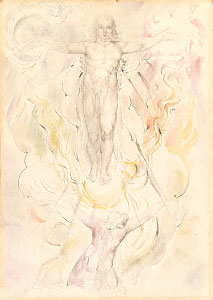
Dante Adoring Christ


From Paradiso XIV:

CANTO XIV


From centre to the circle, and so back
From circle to the centre, water moves
In the round chalice, even as the blow
Impels it, inwardly, or from without.
Such was the image glanc'd into my mind,
As the great spirit of Aquinum ceas'd;
And Beatrice after him her words
Resum'd alternate: "Need there is (tho' yet
He tells it to you not in words, nor e'en
In thought) that he should fathom to its depth
Another mystery.  Tell him, if the light,
Wherewith your substance blooms, shall stay with you
Eternally, as now: and, if it doth,
How, when ye shall regain your visible forms,
The sight may without harm endure the change,
That also tell."  As those, who in a ring
Tread the light measure, in their fitful mirth
Raise loud the voice, and spring with gladder bound;
Thus, at the hearing of that pious suit,
The saintly circles in their tourneying
And wond'rous note attested new delight.

     Whoso laments, that we must doff this garb
Of frail mortality, thenceforth to live
Immortally above, he hath not seen
The sweet refreshing, of that heav'nly shower.

     Him, who lives ever, and for ever reigns
In mystic union of the Three in One,
Unbounded, bounding all, each spirit thrice
Sang, with such melody, as but to hear
For highest merit were an ample meed.
And from the lesser orb the goodliest light,
With gentle voice and mild, such as perhaps
The angel's once to Mary, thus replied:
"Long as the joy of Paradise shall last,
Our love shall shine around that raiment, bright,
As fervent; fervent, as in vision blest;
And that as far in blessedness exceeding,
As it hath grave beyond its virtue great.
Our shape, regarmented with glorious weeds
Of saintly flesh, must, being thus entire,
Show yet more gracious.  Therefore shall increase,
Whate'er of light, gratuitous, imparts
The Supreme Good; light, ministering aid,
The better disclose his glory: whence
The vision needs increasing, much increase
The fervour, which it kindles; and that too
The ray, that comes from it.  But as the greed
Which gives out flame, yet it its whiteness shines
More lively than that, and so preserves
Its proper semblance; thus this circling sphere
Of splendour, shall to view less radiant seem,
Than shall our fleshly robe, which yonder earth
Now covers.  Nor will such excess of light
O'erpower us, in corporeal organs made
Firm, and susceptible of all delight."

    
Dante Adoring Christ
William Blake Illustrating Dante
National Gallery of Victoria
From Paradiso XIV:


From wiki Paradiso

Paradiso (pronounced [paraˈdiːzo]; Italian for "Paradise" or "Heaven") is the third and final part of Dante's Divine Comedy, following the inferno and the Purgatorio. It is an allegory telling of Dante's journey through Heaven, guided by Beatrice, who symbolises theology. In the poem, Paradise is depicted as a series of concentric spheres surrounding the Earth, consisting of the MoonMercuryVenus, theSunMarsJupiterSaturn, the Fixed Stars, the Primum Mobile and finally, the Empyrean. It was written in the early 14th century. Allegorically, the poem represents the soul's ascent to God.
The Paradiso begins at the top of Mount Purgatory, at noon on the Wednesday after Easter. After ascending through the sphere of fire believed to exist in the earth's upper atmosphere (Canto I), Beatrice guides Dante through the nine celestial spheres of Heaven, to the Empyrean, which is the abode of God. The nine spheres are concentric, as in the standard medieval geocentric model of cosmology,[1] which was derived from Ptolemy. The Empyrean is non-material. As with his Purgatory, the structure of Dante's Heaven is therefore of the form 9+1=10, with one of the ten regions different in nature from the other nine.
During the course of his journey, Dante meets and converses with several blessed souls. He is careful to say that these all actually live in bliss with God in the Empyrean:
"But all those souls grace the Empyrean;
and each of them has gentle life though some
sense the Eternal Spirit more, some less."[2]
However, for Dante's benefit (and the benefit of his readers), he is "as a sign"[3] shown various souls in planetary and stellar spheres that have some appropriate connotation.

While the structures of the Inferno and Purgatorio were based around different classifications of sin, the structure of the Paradiso is based on the four cardinal virtues (PrudenceJustice,Temperance, and Fortitude) and the three theological virtues (FaithHope, and Charity).

The fervour, which it kindles; and that too
The ray, that comes from it.  But as the greed
Which gives out flame, yet it its whiteness shines
More lively than that, and so preserves
Its proper semblance; thus this circling sphere
Of splendour, shall to view less radiant seem,
Than shall our fleshly robe, which yonder earth
Now covers.  Nor will such excess of light
O'erpower us, in corporeal organs made
Firm, and susceptible of all delight."

Friday, September 11, 2015

IF WE UNITE [85]

British Library
Four Zoas Manuscript
Page 85

No one has accused Blake of consistency in writing the Four Zoas. He made constant alterations in his attempt to convey the vision of truth which he perceived. Page 85 offers particular problems because there is an instruction on a later page to move the later part of the text to a different position. Erdman in transcribing the text for the Four Zoas moved the second portion of the text to page 95. We, however, will consider page 85 as originally written including text from two pages in Erdman. The intervening pages provide detail of the process of transformation which Los underwent. Nothing can be changed in isolation; change is always an exchange whose enactment spreads repercussions in every direction.

Four Zoas, Night VII, PAGE 85, (E 360) 
"Astonishd filld with tears the spirit of Enitharmon beheld
And heard the Spectre bitterly she wept Embracing fervent   
Her once lovd Lord now but a Shade herself also a shade
Conferring times on times among the branches of that Tree

Thus they conferrd among the intoxicating fumes of Mystery    
Till Enitharmons shadow pregnant in the deeps beneath
Brought forth a wonder horrible. While Enitharmon shriekd
And trembled thro the Worlds above Los wept his fierce soul was terrifid
At the shrieks of Enitharmon at her tossings nor could his eyes percieve
The cause of her dire anguish for she lay the image of Death     
Movd by strong shudders till her shadow was deliverd then she ran
Raving about the upper Elements in maddning fury

She burst the Gates of Enitharmons heart with direful Crash
Nor could they ever be closd again the golden hinges were broken
And the gates broke in sunder & their ornaments defacd
Beneath the tree of Mystery for the immortal shadow shuddering
Brought forth this wonder horrible a Cloud she grew & grew
Till many of the dead burst forth from the bottoms of their tombs
In male forms without female counterparts or Emanations   
Cruel and ravening with Enmity & Hatred & War  
In dreams of Ulro dark delusive drawn by the lovely shadow

The Spectre terrified gave her Charge over the howling Orc"

Four Zoas, Night VII, PAGE 95 [87] (SECOND PORTION), (E 367) 
"Then took the tree of Mystery root in the World of Los
Its topmost boughs shooting a fibre beneath Enitharmons couch 
The double rooted Labyrinth soon wavd around their heads  

But then the Spectre enterd Los's bosom Every sigh & groan
Of Enitharmon bore Urthonas Spectre on its wings
Obdurate Los felt Pity Enitharmon told the tale
Of Urthona. Los embracd the Spectre first as a brother
Then as another Self; astonishd humanizing & in tears    
In Self abasement Giving up his Domineering lust

Thou never canst embrace sweet Enitharmon terrible Demon. Till
Thou art united with thy Spectre Consummating by pains & labours
That mortal body & by Self annihilation back returning      
To Life Eternal be assurd I am thy real Self   
Tho thus divided from thee & the Slave of Every passion
Of thy fierce Soul Unbar the Gates of Memory look upon me
Not as another but as thy real Self I am thy Spectre
Thou didst subdue me in old times by thy Immortal Strength
When I was a ravning hungring & thirsting cruel lust & murder   
Tho horrible & Ghastly to thine Eyes tho buried beneath
The ruins of the Universe. hear what inspird I speak & be silent

If we unite in one[,] another better world will be        
Opend within your heart & loins & wondrous brain
Threefold as it was in Eternity & this the fourth Universe 
Will be Renewd by the three & consummated in Mental fires
But if thou dost refuse Another body will be prepared"


Wiki Commons 
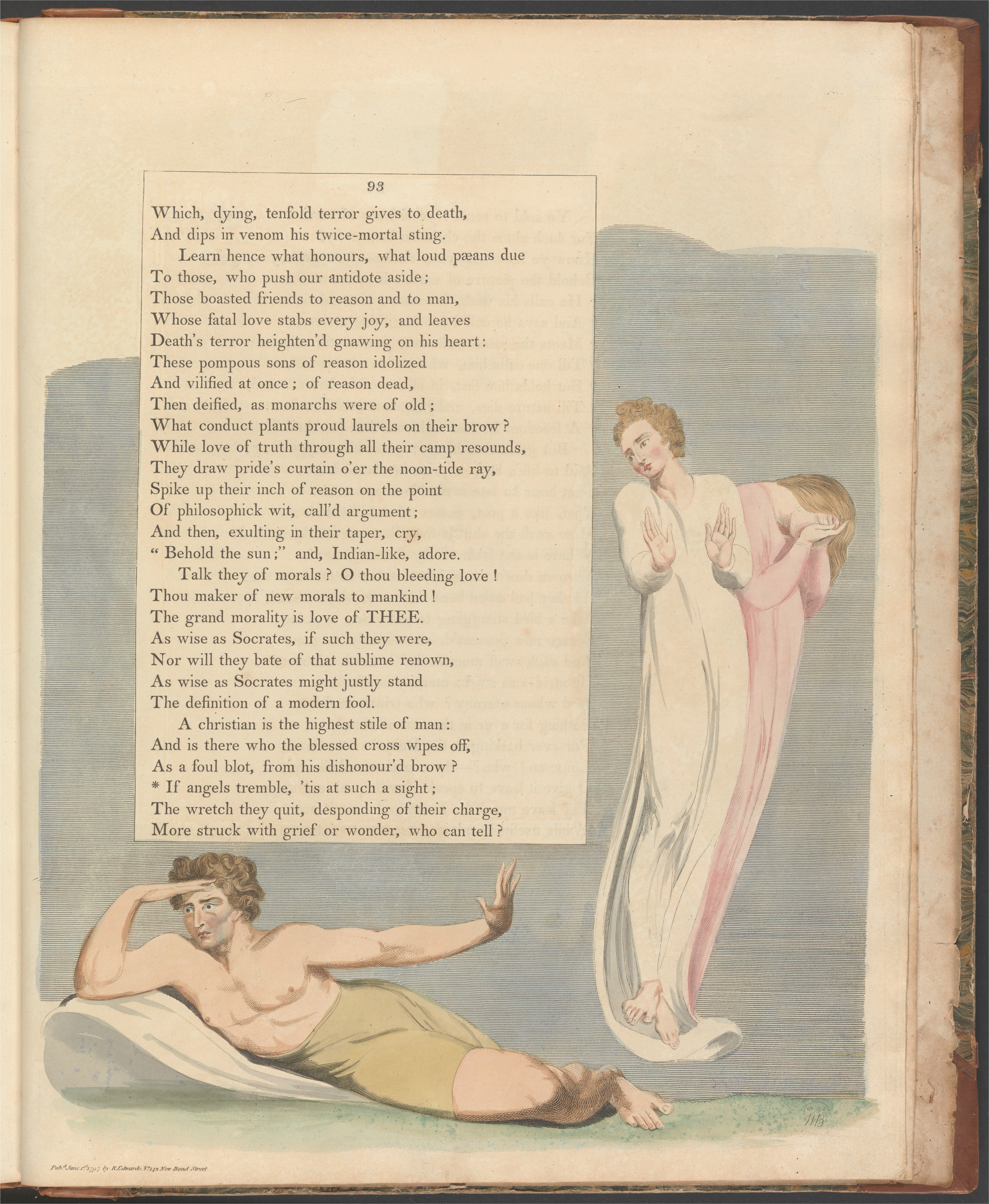
Illustrations to Night Thoughts 
Blake's image on the page from Night Thoughts does not attempt to represent the complex action which was related in the text, but it gives an impression of some of the emotions involved. We see a man dismayed by the struggle of another man attempting to make an agonizing decision. We see a woman bent in pity or anguish over internal or external happenings. The standing figures although two, appear bound together. They are not on solid ground but are on a different plane of existence. The reclining figure in deep thought is trying to envision an unclear possibility. With his left hand he tries to hold back what may befall him.

Several momentous events are related on this page. First two shades (unsubstantial beings) - the spirit of Enitharmon, and the Spectre, unite to give birth to a wonder horrible. Second the gates of Enitharmon's heart are broken, never to be mended. Third Los became susceptible to feeling emotion for the Spectre, which led him to attempt to unite with the Spectre.

Post on page 83, post on page 87.

Thursday, September 10, 2015

Perga 15

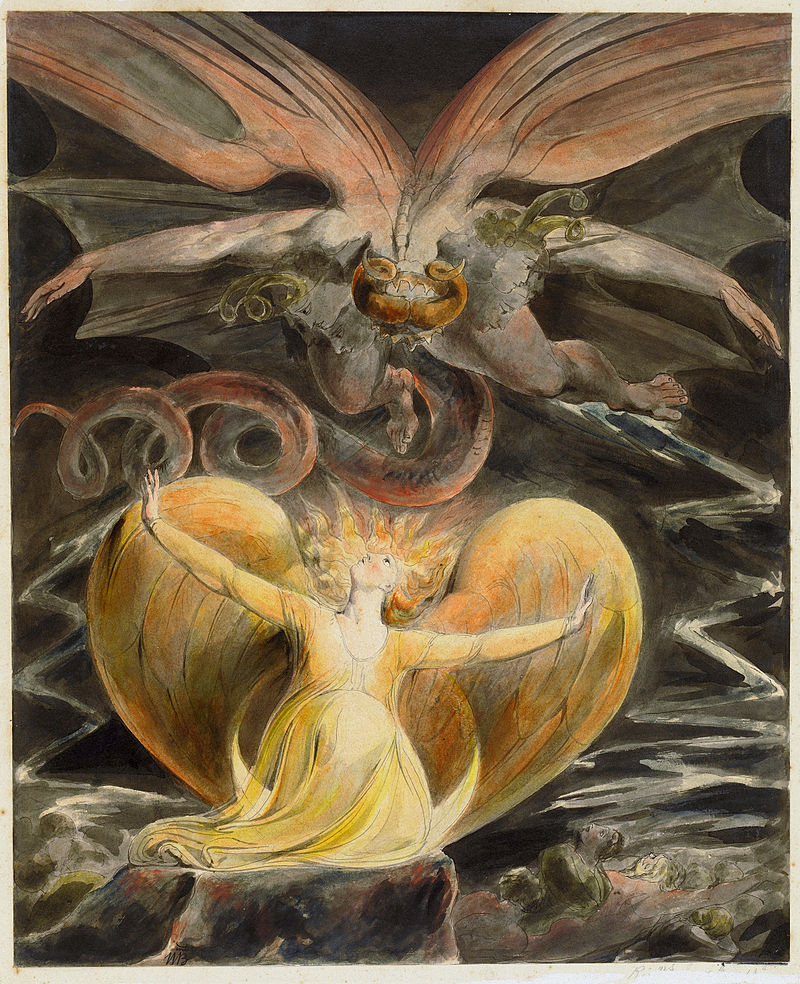
The Harlot and the Giant

The Harlot and the Giant
Blake's Illustrations of Dante


This image suggests Blake's 'Great Dragon':

Blake's Great Dragon
From Wiki Commons


From Revelation : 

King James Bible
And there appeared another wonder in heaven; and behold a great red dragon, having seven heads and ten horns, and seven crowns upon his heads.

Wednesday, September 09, 2015

SHADOW OF ENITHARMON [81]

John Middleton Murry in William Blake, his study of Blake's life and works, makes this perceptive statement:
"Blake's prophetic books, strange and obscure as they are at first approach, are alive in this deepest sense of all. They are on incessant process of destruction and creation, of creation through destruction. Their seeming chaos is the apparent confusion which attends swift and precipitate growth: the husks of the old are incessantly being split in sunder under the urge of the new realization." (Page 171)
British Library
Four Zoas Manuscript
Page 81
Four Zoas, Night VII, Page 80, (E 356)
"Urizen envious brooding sat & saw the secret terror
Flame high in pride & laugh to scorn the source of his deceit    
Nor knew the source of his own but thought himself the Sole author
PAGE 81
Of all his wandering Experiments in the horrible Abyss
He knew that weakness stretches out in breadth & length he knew
That wisdom reaches high & deep & therefore he made Orc
In Serpent form compelld stretch out & up the mysterious tree
He sufferd him to Climb that he might draw all human forms    
Into submission to his will nor knew the dread result

Los sat in showers of Urizen watching cold Enitharmon 
His broodings rush down to his feet producing Eggs that hatching
Burst forth upon the winds above the tree of Mystery
Enitharmon lay on his knees. Urizen tracd his Verses   
In the dark deep the dark tree grew. her shadow was drawn down
Down to the roots it wept over Orc. the Shadow of Enitharmon

Los saw her stretchd the image of death upon his witherd valleys
Her Shadow went forth & returnd Now she was pale as Snow
When the mountains & hills are coverd over & the paths of Men shut up
But when her spirit returnd as ruddy as a morning when
The ripe fruit blushes into joy in heavens eternal halls 
Sorrow shot thro him from his feet it shot up to his head
Like a cold night that nips the root & shatters off the leaves 
Silent he stood oer Enitharmon watching her pale face   
He spoke not he was Silent till he felt the cold disease
Then Los mournd on the dismal wind in his jealous lamentation

Why can I not Enjoy thy beauty   Lovely Enitharmon
When I return from clouds of Grief in the wandring Elements
Where thou in thrilling joy in beaming summer loveliness 
Delectable reposest ruddy in my absence flaming with beauty
Cold pale in sorrow at my approach trembling at my terrific
Forehead & eyes thy lips decay like roses in the spring 
How art thou Shrunk thy grapes that burst in summers vast Excess
Shut up in little purple covering faintly bud & die    
Thy olive trees that pourd down oil upon a thousand hills
Sickly look forth & scarcely stretch their branches to the plain
Thy roses that expanded in the face of glowing morn."

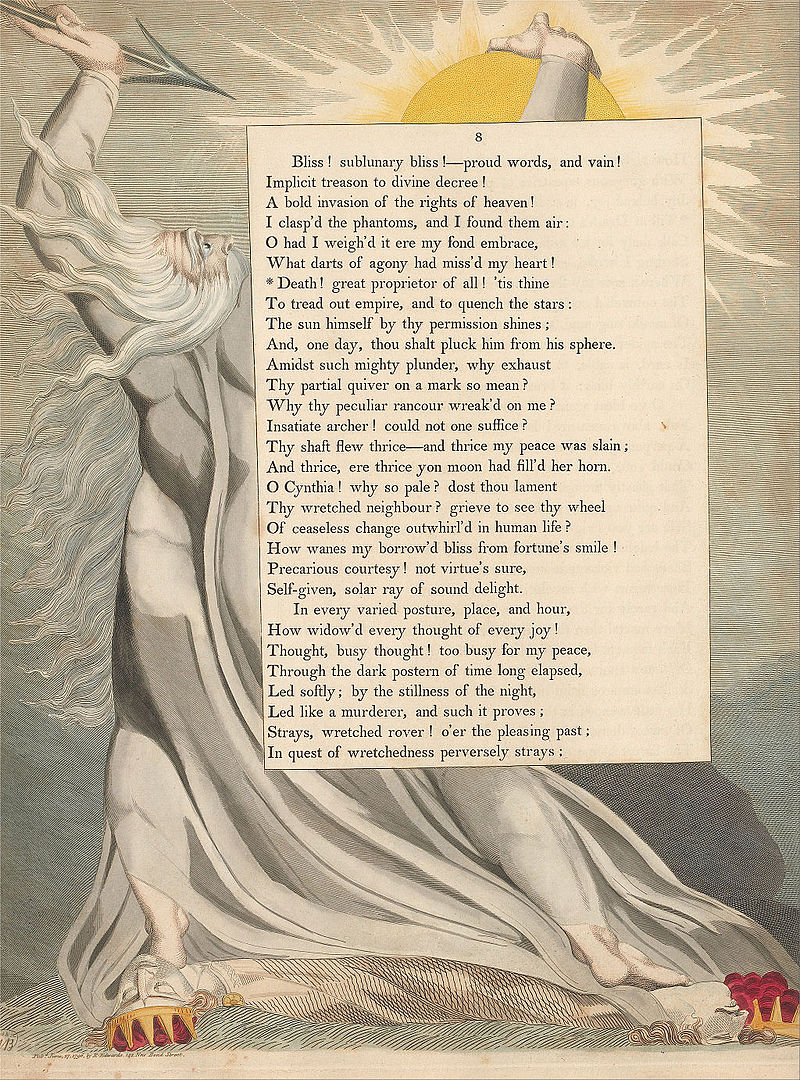
Blake uses an illustrations from his engravings for Young's Night Thoughts to accompany his text for page 80 of the Four Zoas. The connection of the image to his account of the Serpent being forced to climb the Tree of Mystery, and Los feeling estranged from Enitharmon is less than obvious. We must look deeper to see the figure in the picture as Urizen as he with one hand tears down the sun, with the other aims a spear of destruction. Underfoot Urizen tramples two figures who have opposed him. 

Wiki Commons
Illustrations to Night Thoughts
The text identifies the Shadow of Enitharmon as the 'image of death' which dominates Los' thoughts, (not Enitharmon herself but a dark shade from his subconscious.) Enitharmon as cold and distant, and Urizen as dominant, work together in Los' mind to to produce the 'cold disease' jealousy which Blake announced on on the title page was a theme of the Four Zoas.

"The torments of Love & Jealousy in 
 The Death and Judgement. 
 of Albion the Ancient Man"

Early in Blake's passage he calls to mind that it was Jesus who was raised on the tree, lifted up and drew all men to him.
John 12
[30] Jesus answered and said, This voice came not because of me, but for your sakes.
[31] Now is the judgment of this world: now shall the prince of this world be cast out.
[32] And I, if I be lifted up from the earth, will draw all men unto me.

Monday, September 07, 2015

Perga 14

this is perga 14:
Canto 29 of Dante's Purgatorio:

CANTO XXIX


Singing, as if enamour'd, she resum'd
And clos'd the song, with "Blessed they whose sins
Are cover'd."  Like the wood-nymphs then, that tripp'd
Singly across the sylvan shadows, one
Eager to view and one to 'scape the sun,
So mov'd she on, against the current, up
The verdant rivage.  I, her mincing step
Observing, with as tardy step pursued.

Between us not an hundred paces trod,
The bank, on each side bending equally,
Gave me to face the orient.  Nor our way
Far onward brought us, when to me at once
She turn'd, and cried: "My brother! look and hearken."
And lo! a sudden lustre ran across
Through the great forest on all parts, so bright
I doubted whether lightning were abroad;
But that expiring ever in the spleen,
That doth unfold it, and this during still
And waxing still in splendor, made me question
What it might be: and a sweet melody
Ran through the luminous air.  Then did I chide
With warrantable zeal the hardihood
Of our first parent, for that there were earth
Stood in obedience to the heav'ns, she only,
Woman, the creature of an hour, endur'd not
Restraint of any veil: which had she borne
Devoutly, joys, ineffable as these,
Had from the first, and long time since, been mine.

While through that wilderness of primy sweets
That never fade, suspense I walk'd, and yet
Expectant of beatitude more high,
Before us, like a blazing fire, the air
Under the green boughs glow'd; and, for a song,
Distinct the sound of melody was heard.

O ye thrice holy virgins! for your sakes
If e'er I suffer'd hunger, cold and watching,
Occasion calls on me to crave your bounty.
Now through my breast let Helicon his stream
Pour copious; and Urania with her choir
Arise to aid me: while the verse unfolds
Things that do almost mock the grasp of thought.

Onward a space, what seem'd seven trees of gold,
The intervening distance to mine eye
Falsely presented; but when I was come
So near them, that no lineament was lost
Of those, with which a doubtful object, seen
Remotely, plays on the misdeeming sense,
Then did the faculty, that ministers
Discourse to reason, these for tapers of gold
Distinguish, and it th' singing trace the sound
"Hosanna."  Above, their beauteous garniture
Flam'd with more ample lustre, than the moon
Through cloudless sky at midnight in her full.

I turn'd me full of wonder to my guide;
And he did answer with a countenance
Charg'd with no less amazement: whence my view
Reverted to those lofty things, which came
So slowly moving towards us, that the bride
Would have outstript them on her bridal day.

The lady called aloud: "Why thus yet burns
Affection in thee for these living, lights,
And dost not look on that which follows them?"

I straightway mark'd a tribe behind them walk,
As if attendant on their leaders, cloth'd
With raiment of such whiteness, as on earth
Was never.  On my left, the wat'ry gleam
Borrow'd, and gave me back, when there I look'd.
As in a mirror, my left side portray'd.

When I had chosen on the river's edge
Such station, that the distance of the stream
Alone did separate me; there I stay'd
My steps for clearer prospect, and beheld
The flames go onward, leaving, as they went,
The air behind them painted as with trail
Of liveliest pencils! so distinct were mark'd
All those sev'n listed colours, whence the sun
Maketh his bow, and Cynthia her zone.
These streaming gonfalons did flow beyond
My vision; and ten paces, as I guess,
Parted the outermost.  Beneath a sky
So beautiful, came foul and-twenty elders,
By two and two, with flower-de-luces crown'd.


All sang one song: "Blessed be thou among
The daughters of Adam! and thy loveliness
Blessed for ever!"  After that the flowers,
And the fresh herblets, on the opposite brink,
Were free from that elected race; as light
In heav'n doth second light, came after them
Four animals, each crown'd with verdurous leaf.
With six wings each was plum'd, the plumage full
Of eyes, and th' eyes of Argus would be such,
Were they endued with life.  Reader, more rhymes
Will not waste in shadowing forth their form:
For other need no straitens, that in this
I may not give my bounty room.  But read
Ezekiel; for he paints them, from the north
How he beheld them come by Chebar's flood,
In whirlwind, cloud and fire; and even such
As thou shalt find them character'd by him,
Here were they; save as to the pennons; there,
From him departing, John accords with me.

The space, surrounded by the four, enclos'd
A car triumphal: on two wheels it came
Drawn at a Gryphon's neck; and he above
Stretch'd either wing uplifted, 'tween the midst
And the three listed hues, on each side three;
So that the wings did cleave or injure none;
And out of sight they rose.  The members, far
As he was bird, were golden; white the rest
With vermeil intervein'd.  So beautiful
A car in Rome ne'er grac'd Augustus pomp,
Or Africanus': e'en the sun's itself
Were poor to this, that chariot of the sun
Erroneous, which in blazing ruin fell
At Tellus' pray'r devout, by the just doom
Mysterious of all-seeing Jove.  Three nymphs
at the right wheel, came circling in smooth dance;
The one so ruddy, that her form had scarce
Been known within a furnace of clear flame:
The next did look, as if the flesh and bones
Were emerald: snow new-fallen seem'd the third.


Now seem'd the white to lead, the ruddy now;
And from her song who led, the others took
Their treasure, swift or slow.  At th' other wheel,
A band quaternion, each in purple clad,
Advanc'd with festal step, as of them one
The rest conducted, one, upon whose front
Three eyes were seen.  In rear of all this group,
Two old men I beheld, dissimilar
In raiment, but in port and gesture like,
Solid and mainly grave; of whom the one
Did show himself some favour'd counsellor
Of the great Coan, him, whom nature made
To serve the costliest creature of her tribe.
His fellow mark'd an opposite intent,
Bearing a sword, whose glitterance and keen edge,
E'en as I view'd it with the flood between,
Appall'd me.  Next four others I beheld,
Of humble seeming: and, behind them all,
One single old man, sleeping, as he came,
With a shrewd visage.  And these seven, each
Like the first troop were habited, but wore
No braid of lilies on their temples wreath'd.
Rather with roses and each vermeil flower,
A sight, but little distant, might have sworn,
That they were all on fire above their brow.

Whenas the car was o'er against me, straight.
Was heard a thund'ring, at whose voice it seem'd
The chosen multitude were stay'd; for there,
With the first ensigns, made they solemn halt


Beatrice Addressing Dante, by William Blake, showing the "chariot triumphal" bearing Beatrice and drawn by the Griffin, as well as four of the ladies representing virtues, Canto 29.
From wiki:

The Earthly Paradise


Beatrice Addressing Dante, by William Blake, showing the "chariot triumphal" bearing Beatrice and drawn by the Griffin, as well as four of the ladies representing virtues, Canto 29.
At the summit of Mount Purgatory is the Earthly Paradise or Garden of Eden.[60] Allegorically, it represents the state of innocence that existed before Adam and Eve fell from grace – the state which Dante's journey up Mount Purgatory has been recapturing.[60] Here Dante meets Matilda, a woman whose literal and allegorical identity "is perhaps the most tantalizing problem in the Comedy."[60] Critics up to the early twentieth century have connected her with the historical Matilda of Tuscany,[61] but others suggested a connection with the dream of Leah in Canto XXVII.[62] However, Matilda clearly prepares Dante for his meeting with Beatrice,[60] the woman to whom (historically) Dante dedicated his previous poetry, the woman at whose request (in the story) Virgil was commissioned to bring Dante on his journey,[63] and the woman who (allegorically) symbolizes the path to God[64] (Canto XXVIII).
With Matilda, Dante witnesses a procession which forms an allegory within the allegory, somewhat like Shakespeare's play within a play. It has a very different style from the Purgatorio as a whole, having the form of a masque, where the characters are walking symbols rather than real people. The procession consists of (Canto XXIX):

Dante and Matilda (formerly calledDante and Beatrice) by John William Waterhouse, 1915.
The appearance of Beatrice,[78] and a dramatic reconciliation scene between Beatrice and Dante, in which she rebukes his sin (Cantos XXX and XXXI), help cover the disappearance of Virgil, who, as a symbol of non-Christian philosophy and humanities, can help him no further in his approach to God[79] (and in the rest of the Divine Comedy, Beatrice is Dante's guide):
"But Virgil had deprived us of himself,
Virgil, the gentlest father, Virgil, he
to whom I gave my self for my salvation;

and even all our ancient mother lost
was not enough to keep my cheeks, though washed
with dew, from darkening again with tears."[80]

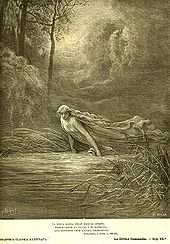
Matilda helps Dante pass through the River Lethe, Canto 31.
Dante then passes through the River Lethe, which erases the memory of past sin (Canto XXXI),[81] and sees an allegory of Biblical and Church history, in which the chariot plays the role of the Church. This allegory includes a denunciation of the corrupt papacy of the time, and its ties to the French monarchy[82] (Canto XXXII):
"Just like a fortress set on a steep slope,
securely seated there, ungirt, a whore,
whose eyes were quick to rove, appeared to me;

and I saw at her side, erect, a giant,
who seemed to serve as her custodian;
and they again, again embraced each other."[83]
Finally, Dante drinks from the River Eunoë, which restores good memories, and prepares him for his ascent to Heaven (described in the Paradiso). As with the other two parts of the Divine Comedy, the Purgatorio ends on the word "stars" (Canto XXXIII):
"From that most holy wave I now returned
to Beatrice; remade, as new trees are
renewed when they bring forth new boughs, I was
pure and prepared to climb unto the stars."[84]

Sunday, September 06, 2015

FIRE & ICE [79]

My previous post LIKE A BLIGHTED TREE highlighted page 77 of the Four Zoas, the first page of one of the two distinct versions of Night VII. Harold Bloom (Blake's Apocalypse) tells us that this is the second attempt of Blake to write a satisfactory path from the dilemma which developed in the first six nights to the resolution which occurs in the final two nights. To Bloom the first writing of Night VII resulted in an impasse regarding how resolution of the conflicts could be accomplished. In the second version Blake developed strategies to bring about the breaking down of divisions among Urizen, Los and Enitharmon which set the stage for the Lamb of God to make his appearance in Night VIII.
 

Following only the pages in the second version of Night VII which contain images from Night Thoughts, we skip to page 79. We read here of the contention between Orc and Urizen, fire and ice, the forces for change and the forces for the status quo. In the mind, Orc struggled for the emotions to be expressed without restraint. Unfortunately for Orc, he had been chained to a rock deep in a cavern of the subconscious. Urizen, although free to act consciously, exercised self-restraint. His agenda was to impose limits because of his fear of futurity, and because of his inability to allow the intuitive expression of liberty. Urizen's control ironically was maintained by imposing suffering since none can fulfill his laws.
 
Jerusalem, Plate 31 [35], (E 177)
"No individual can keep these Laws, for they are death
To every energy of man, and forbid the springs of life;"
 
British Library
Four Zoas Manuscript
Page 79
Four Zoas, Night VII, Page 78, (E 354)
"Orc answer'd Curse thy hoary brows. What dost thou in this deep
Thy Pity I contemn scatter thy snows elsewhere
PAGE 79 
I rage in the deep for Lo my feet & hands are naild to the burning rock
Yet my fierce fires are better than thy snows   Shuddring thou sittest
Thou art not chaind Why shouldst thou sit cold grovelling demon of woe
In tortures of dire coldness now a Lake of waters deep
Sweeps over thee freezing to solid still thou sitst closd up     
In that transparent rock as if in joy of thy bright prison
Till overburdend with its own weight drawn out thro immensity
With a crash breaking across the horrible mass comes down
Thundring & hail & frozen iron haild from the Element
Rends thy white hair   yet thou dost fixd obdurate brooding sit 
Writing thy books. Anon a cloud filld with a waste of snows
Covers thee still obdurate still resolvd & writing still
Tho rocks roll oer thee tho floods pour tho winds black as the Sea
Cut thee in gashes tho the blood pours down around thy ankles
Freezing thy feet to the hard rock still thy pen obdurate        
Traces the wonders of Futurity in horrible fear of the future
I rage furious in the deep for lo my feet & hands are naild
To the hard rock or thou shouldst feel my enmity & hate
In all the diseases of man falling upon thy grey accursed front

Urizen answerd Read my books explore my Constellations 
Enquire of my Sons & they shall teach thee how to War
Enquire of my Daughters who accursd in the dark depths
Knead bread of Sorrow by my stern command for I am God
Of all this dreadful ruin   Rise O daughters at my Stern command

Rending the Rocks Eleth & Uveth rose & Ona rose       
Terrific with their iron vessels driving them across
In the dim air they took the book of iron & placd above
On clouds of death & sang their songs Kneading the bread of Orc
Orc listend to the song compelld hungring on the cold wind
That swaggd heavy with the accursed dough. the hoar frost ragd   
Thro Onas sieve   the torrent rain pourd from the iron pail
Of Eleth & the icy hands of Uveth kneaded the bread
The heavens bow with terror underneath their iron hands
Singing at their dire work the words of Urizens book of iron
While the enormous scrolls rolld dreadful in the heavens above   
And still the burden of their song in tears was poured forth
The bread is Kneaded let us rest O cruel father of children

But Urizen remitted not their labours upon his rock"

British museum
Illustrations to Young's Night Thoughts
The image Blake chose for this page included a grieving figure, a fresh grave, a stone tablet (either of the law or a tombstone), and a wall or tomb separating the woman from the living. The figure reaching down to touch the woman points upward to an alternative experience. Options are available to the wretched conditions which man tolerates. Blake intended for his reader to confront the causes of fallenness in our world, but he intended also for man to search for the path that leads to Life.

Matthew 7
[14] For the gate is narrow and the way is hard, that leads to life, and those who find it are few.