Wednesday, January 29, 2020

TIME'S END

Time was a subject that interested Blake. He applied himself to developing an understanding of time beyond the simple sequence of moments flowing from past to future. Susan Fox, in Poetic Forms in Blake's Milton, showed how Blake used the device of simultaneity to demonstrate the mutability of time. Most impressive to me was her insight into understanding that the 'visionary moment' when 'past and future are joined' represented an end to time in the same sense that time ended when the Seventh Seal was broken in the Book of Revelation. As Blake wrote: Poetic Work is conceived and accomplished in that moment which transcends ordinary time as time is breached and eternity entered.     

Poetic Forms in Blake's Milton, Susan Fox,Page 17:

"Each of two the books of the poem [Milton] offers a range of perspectives on the central action from Eden to Ulro and from remembered past to foretold future, but in each all perspectives focus on a single instant, the instant of the purgation and union of Milton and Ololon, the instant in which past and future are joined in the abolition of time. Even those events in the poem which are clearly antecedent to its main action,  the events of the Bard's Song and the creation of Beulah, are described as the action occurs: Milton decides to descend as he hears the Bard sing (and we shall see, his decision is identical with his descent), and the Daughters of Beulah sing their history as Ololon descends. Milton's descent is both simultaneous and identical with Ololon's descent; all the other actions of the poem, past and present, are merely component actions of the focal event.

The instant of their descents is the culmination of what Blake describes at the end of Book I as a kind of visionary moment:

"Every Time less than a pulsation of the artery 
Is equal in its period & value to Six Thousand Years. 
PLATE 29 [31] 
For in this Period the Poets Work is Done: and all the Great 
Events of Time start forth & are concievd in such a Period 
Within a Moment: a Pulsation of the Artery."
Milton, (E 127)

 ... All the actions of the poem occur in the last measurable segment of the moment, the last fragment of time itself, the instant before apocalypse puts an end to time."
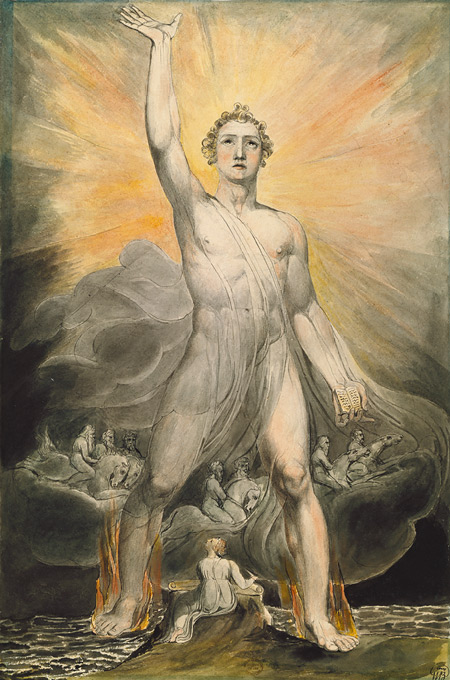


Wikipedia Commons
Angel of Revelation
Rev.10
[1] And I saw another mighty angel come down from heaven, clothed with a cloud: and a rainbow was upon his head, and his face was as it were the sun, and his feet as pillars of fire:
[2] And he had in his hand a little book open: and he set his right foot upon the sea, and his left foot on the earth,
[3] And cried with a loud voice, as when a lion roareth: and when he had cried, seven thunders uttered their voices.
[4] And when the seven thunders had uttered their voices, I was about to write: and I heard a voice from heaven saying unto me, Seal up those things which the seven thunders uttered, and write them not.
[5] And the angel which I saw stand upon the sea and upon the earth lifted up his hand to heaven,

[6] And sware by him that liveth for ever and ever, who created heaven, and the things that therein are, and the earth, and the things that therein are, and the sea, and the things which are therein, that there should be time no longer:

.

Wednesday, January 22, 2020

God's Presence

Posted by Larry to another blog in 2010.


Forgiving God

That's the primary job in life - for all of us. Blake was no exception. Jacob wrestled with God all night. Blake accused God, denounced Him, despised Him, annihilated Him, but God always returned as He always does sooner or later. This is the way he finally learned to deal with God; he addressed God as follows:

"And throughout Eternity
I forgive you I forgive you You forgive me
As the dear Redeemer said
This the wine and this the bread"

How did Blake deal with God before he learned that. I've posted and posted on that subject, and there's still much to say:

Consider the 'four year old' seeing an angry God at the window; many or most of us have had this experience in some form: there was
something out there that you didn't know, didn't trust, not like Mom (sad are you if Mom was like that; unfortunately there are too many such people). For many this experience of an unfriendly Reality deeply covers their lives.


But note the 'tree full of angels'; that's archetypal, too. "
Somebody up there likes me". Good things happen to people, and they have no idea how or why or by whom. Blake was surrounded by angels all his life (not the angels of MHH, but there was that, too).

So Blake's earliest days witnessed the essential otherness, ambiguity of Divinity, a quandary that he spent his life resolving. Blake was a mortal, but his true life was in Eternity, as was that of Jesus, and perhaps us all.


As a projection Blake was able to 'wrestle with God', and he did that for many years; he projected a multitude of (frequently unpleasant) experiences to God:

His matrimonial endeavors suffered a setback and then a glad recovery when Catherine offered herself (she pities him!) For forty years she proved to be his greatest friend.


He met disappointment at the Royal Academy in the person of Joshua Reynolds. This led to comparative artistic obscurity the rest of his life.
However to say that he lived as an isolate would not be quite true:

He had a chance to associate with some creative people (James Basire, the kindly engraver who gave Blake many opportunities at creative work;
the kindly publisher, Joseph Johnson, who not only published some of his work, but invited him into the inner circle where other intellectuals gathered; John Flaxman introduced him to Mrs Henry Matthew who invited him into her drawing room where he met many artists and musicians; she and Flaxman also arranged for the publication of Poetical Sketches (1783); Robert Blake, William's brother was a kindred spirit who meant a great deal to him (even after death he often met with and got advice from); the Swiss Painter, Fuseli, was another kindred spirit:


("The only Man that eer I knew
Who did not make me almost spew 
Was Fuseli he was both Turk & Jew  
And so dear Christian Friends how do you do")
(Erdman 507)
 
And of course in his last years Blake enjoyed the friendship and encouragement of the Shoreham Ancients, who sat at his feet and gladly took in much of his wisdom.

Each of these friends, and all of them together showed Blake that 'somebody up there liked him'. The fully mature Blake was happy in his acquaintance with and love of the God who had emerged after all the struggles of his youth.
"I rose up at the dawn of day
Get thee away get thee away
Prayst thou for Riches away away
This is the Throne of Mammon grey

Said I this sure is very odd                                   
I took it to be the Throne of God
For every Thing besides I have
It is only for Riches that I can crave

I have Mental Joy & Mental Health
And Mental Friends & Mental wealth
I've a Wife I love & that loves me
I've all But Riches Bodily

I am in Gods presence night & day
And he never turns his face away
The accuser of sins by my side does stand                    
And he holds my money bag in his hand" 
(Erdman 481) 
Harvard Art Museums/Fogg Museum, Bequest of Grenville L. Winthrop
Illustrations to The Divine Comedy
Plate 80
Lucia Carrying Dante in His Sleep
 

Tuesday, January 21, 2020

BLAKE & ROSSETTI

Wikipedia Commons
Illustrations to Pastorals of Virgil
Thenot Remonstrates with Colinet

Blake's Notebook came into the possession of Dante Gabriel Rossetti almost by chance. Since Rossetti like Blake was both an artist and a poet, it is no wonder that he was interested in it. Much of what Blake had produced in his lifetime was in the possession of Frederick Tatum after Catherine Blake's death. However the Notebook, which Blake treasured as a memento of his deceased younger brother Robert, was given by Catherine to Blake's pupil Samuel Palmer. Somehow Samuel's brother William acquired the notebook and sold it to Rossetti for half a guinea in 1847. Rossetti undertook the task of transcribing much of the text for his own use.

From a doctoral dissertation by J. C. E. Bassalik-de Vries we read that:
" The influence which William Blake exercised on Dante Gabriel Rossetti was of a three-fold nature. He owes much to him:
a) as a philosopher,
b) as a poet,
c) as a painter.
It was however, as I mentioned above, Blake's mysticism, by which Dante Gabriel Rossetti was mostly impressed, and therefore I shall speak of this influence in the first place. It should, however, be borne in mind that Blake's philosophic doctrines were laid down in a literary and in an artistic form, viz: in his poems and in his pictures, and that therefore it is often very difficult and sometimes impossible to separate Blake the philosopher from Blake the artist or the poet, so that when I make this division for the sake of clearness and discuss successively Blake's influence from a philosophical, literary, and artistic point of view, these influences must not be thought of as existing isolated, but as continually supporting and correcting each other."

Rossetti was influential in the writing of the important early biography of William Blake by Alexander and Anne Gilchrist. So, through Palmer, we trace the passing of Blake's impact through the Shoreham Ancients who formed a circle of young admirers of Blake down, to Dante Gabriel Rossetti who was a founder of the Pre-Raphaelite Brotherhood which carried on the tradition of Gothic and Romantic Art under spiritual influence
Milton, Plate 27 [29], (E 125)
"But in Eternity the Four Arts: Poetry, Painting, Music,          
And Architecture which is Science: are the Four Faces of Man.
Not so in Time & Space: there Three are shut out, and only
Science remains thro Mercy: & by means of Science, the Three
Become apparent in time & space, in the Three Professions

Poetry in Religion: Music, Law: Painting, in Physic & Surgery:

That Man may live upon Earth till the time of his awaking,
And from these Three, Science derives every Occupation of Men."

Jerusalem, Plate 3, (E 146)
 "I therefore have produced
a variety in every line, both of cadences & number of syllables. 
Every word and every letter is studied and put into its fit
place: the terrific numbers are reserved for the terrific
parts--the mild & gentle, for the mild & gentle parts, and the
prosaic, for inferior parts: all are necessary to each other. 
Poetry Fetter'd, Fetters the Human Race! Nations are Destroy'd,
or Flourish, in proportion as Their Poetry Painting and Music,
are Destroy'd or Flourish! The Primeval State of Man, was Wisdom,
Art, and Science." 
 
Descriptive Catalogue, (E 541)
 "Weaving the winding sheet of Edward's race by means of
sounds of spiritual music and its accompanying expressions of
articulate speech is a bold, and daring, and most masterly
conception, that the public have embraced and approved with
avidity.  Poetry consists in these conceptions; and shall
Painting be confined to the sordid drudgery of facsimile re
presentations of merely mortal and perishing substances, and
not be as poetry and music are, elevated into its own proper
sphere of invention and visionary conception? No, it shall not 
be so!  Painting, as well as poetry and music, exists and exults 
in immortal thoughts."    

Vision of Last Judgment, (E 560)
" Poetry admits not a
Letter that is Insignificant    so Painting admits not a Grain of
Sand or a Blade of Grass Insignificant much less an
Insignificant Blur or Mark" 

Annotations to Reynolds, (E 634)
   "Cunning & Morality are not Poetry but Philosophy the Poet is
Independent & Wicked the Philosopher is Dependent & Good
     Poetry is to excuse Vice & show its reason & necessary
purgation"

Annotations to Wordsworth, (E 665)
"One Power alone makes a Poet.-Imagination The Divine Vision"  
 

A related post

Thursday, January 16, 2020

NEW BORN

Blake was concerned that mankind abdicates his power to be in charge of the exercise of his most precious gifts. He is given a body to live in time and space and gain experience. He is given emotions to form bonds of trust and friendship with humanity. He is given an intellect through which he may develop understanding of himself and his natural world. He is given his intuitive imagination through which he finds his connection with the Eternal World beyond and within himself.

There is no cause for despair if man refuses to be deceived by what appears to be but is not. The shadows projected upon the wall of the cave of our minds may appear to be real. But when that of real substance becomes visible, the shadowy illusions are seen for what they are.

First Corinthians 13
[9] For we know in part, and we prophesy in part.
[10] But when that which is perfect is come, then that which is in part shall be done away.

Songs Of Experience, Plate 54,  (E 31)
"The Voice of the Ancient Bard. 

Youth of delight come hither:
And see the opening morn,
Image of truth new born.
Doubt is fled & clouds of reason.
Dark disputes & artful teazing.
Folly is an endless maze,
Tangled roots perplex her ways,

How many have fallen there!
They stumble all night over bones of the dead,
And feel they know not what but care
And wish to lead others, when they should be led."

Four Zoas, Night IX, Page 119,  (E 389)
"When shall the Man of future times become as in days of old 
O weary life why sit I here & give up all my powers
To indolence to the night of death when indolence & mourning
Sit hovring over my dark threshold. tho I arise look out
And scorn the war within my members yet my heart is weak
And my head faint Yet will I look again unto the morning 
Whence is this sound of rage of Men drinking each others blood
Drunk with the smoking gore & red but not with nourishing wine

The Eternal Man sat on the Rocks & cried with awful voice"
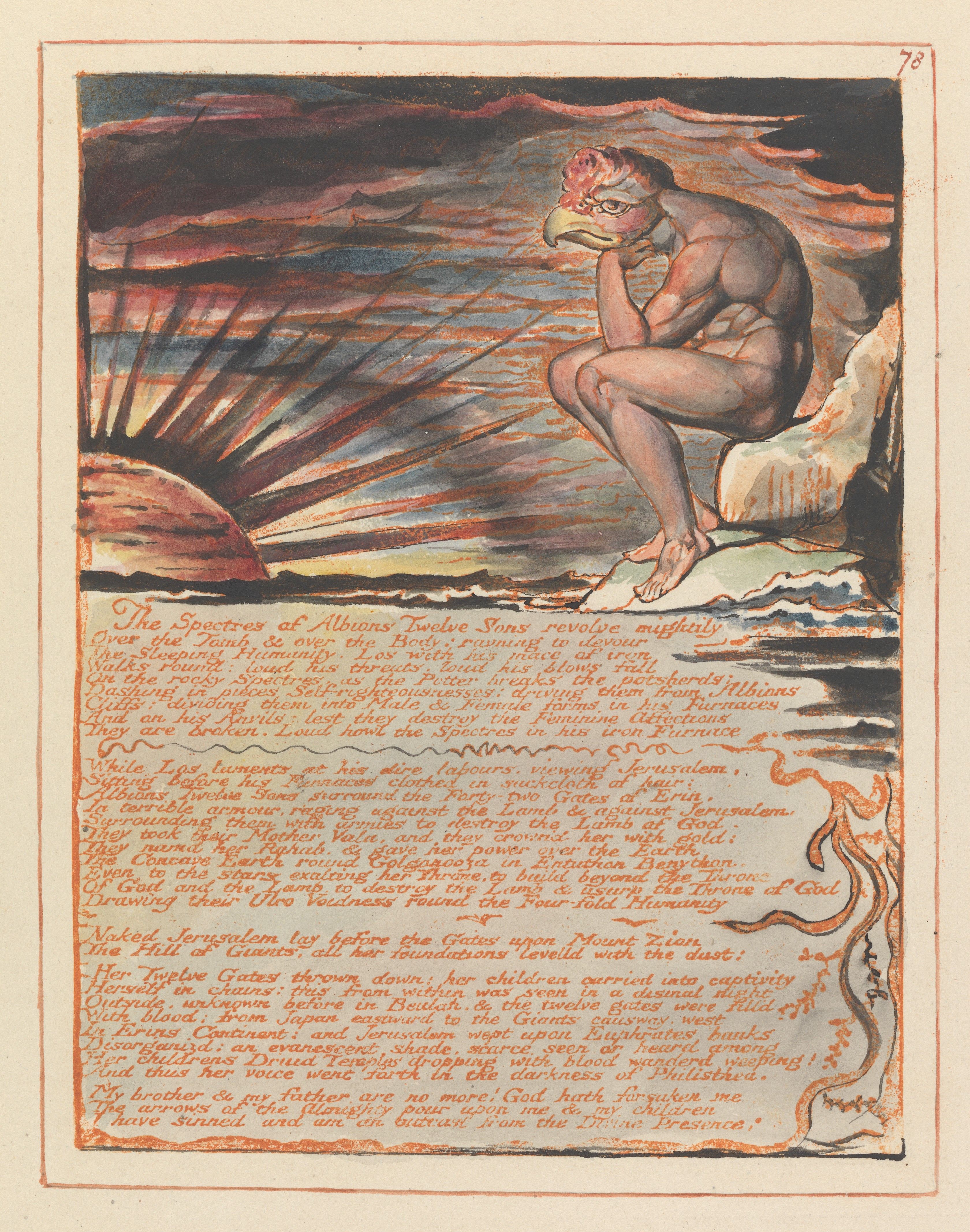
Yale Center for British Art
Jerusalem
Plate 78 
Four Zoas, Night VII, Page 86, (E 368)
"Los furious answerd. Spectre horrible thy words astound my Ear With irresistible conviction I feel I am not one of those Who when convincd can still persist. tho furious.controllable By Reasons power. Even I already feel a World within Opening its gates & in it all the real substances Of which these in the outward World are shadows which pass away Come then into my Bosom & in thy shadowy arms bring with thee My lovely Enitharmon. I will quell my fury & teach Peace to the Soul of dark revenge & repentance to Cruelty So spoke Los & Embracing Enitharmon & the Spectre Clouds would have folded round in Extacy & Love uniting"
.

Friday, January 10, 2020

GRAPHIC MUSE

British Museum
The Graphic Muse
Engraving after Sir Joshua Reynolds

This post came about because I came across an image in the collection of the British Museum by William Blake after Sir Joshua Reynolds. I was surprised to see it because I was aware of the contentious relationship between Blake and Reynolds. Apparently the publisher of the book in which Blake's engraving appeared arranged the commission for Blake.

The website of the Royal Academy published this statement about the image:
 
An Inquiry Into The Requisite Cultivation And Present State Of The Arts Of Design In England. By Prince Hoare.

The frontispiece shows a drawing of 'The Graphic Muse' holding a scroll inscribed 'Theory'. The two-page publisher's advertisement has the title, 'Books recently published by Richard Phillips, No. 6, Bridge-Street, Blackfriars.' The artist and playwright, Prince Hoare, had been appointed honorary Secretary for Foreign Correspondence at the Royal Academy of Arts in 1799,

This information is provided by the British Museum:
The Graphic Muse

Frontispiece to Hoare's "Inquiry" (London, 1806); a draped allegorical female figure seated among clouds, holding a scroll with the word "Theory"; after Reynolds (Mannings 2168). 1806 Engraving, etching and stipple

Lettered above image with object title; lettered below with production detail, "Sr Josha Reynolds pinxt / Blake. sc."; lettered below with caption, "... To explore / What lovelier forms in Natures boundless shore / Are best to Art allied ... / Sketched from the Picture by Sir Joshua Reynolds on the ceiling of the Library of the Royal Academy."; lettered below with publication line, "Pubd. Febr,, 21, 1806, by R. Phillips. No,, 6 Bridge Street. Blackfriars".


Following his apprenticeship as an engraver Blake was admitted to the Royal Academy as an associate. He was eligible to take classes and attend lectures provided by the Academy. At that time the president of the Royal Academy was the successful portrait painter Sir Joshua Reynolds who frequently lectured to the students on the process and purpose of Art. Years later when the lectures of Reynolds were published, Blake annotated his copy with excoriating comments on Reynolds' theory of Art.

The esteem with which the Academy held Reynolds is demonstrated by the fact that his painting The Graphic Muse adorned the ceiling of the Academy.  Surely it must have seemed to Blake the supreme irony that in 1806 he was engaged to engrave The Graphic Muse for the Frontispiece of An Inquiry Into The Requisite Cultivation And Present State Of The Arts Of Design In England by Prince Hoare. 

Here are quotes from Blake's annotations to The Works of Sir Joshua Reynolds, edited by Edmond Malone. London, 1798:
"This Man was Hired to Depress Art   This is the opinion of
Will Blake   my Proofs of this Opinion are given in the following
Notes
 
     Degrade first the Arts if you'd Mankind degrade,
     Hire Idiots to Paint with cold light & hot shade:
     Give high Price for the worst, leave the best in disgrace,
     And with Labours of Ignorance fill every place.

The Man who asserts that there is no Such Thing as Softness
in Art & that every thing in Art is Definite & Determinate has
not been told this by Practise but by Inspiration & Vision
because Vision is Determinate & Perfect & he Copies That without
Fatigue Every thing being Definite & determinate   Softness is
Produced Alone by Comparative Strength & Weakness in the Marking
out of the Forms
     I say These Principles could never be found out by the Study
of Nature without Con or Innate Science

  A Work of Genius is a Work "Not to be obtaind by the
Invocation of Memory & her Syren Daughters. but by Devout prayer
to that Eternal Spirit. who can enrich with all utterance &
knowledge & sends out his Seraphim with the hallowed fire of his
Altar to touch & purify the lips of whom he pleases." Milton
     
The following [Lecture] <Discourse> is
particularly Interesting to Blockheads. as it Endeavours to prove
That there is No such thing as Inspiration & that any Man of a
plain Understanding may by Thieving from Others. become a Mich
Angelo

 Knowledge of Ideal Beauty. is Not to be Acquired It is Born
with us Innate Ideas. are in Every Man Born with him. they are
<truly> Himself.  The Man who says that we have No Innate Ideas
must be a Fool & Knave.  Having No Con-Science or Innate
Science

The Ancients did not mean to Impose when they  affirmd 
their  belief  in Vision & Revelation Plato was in Earnest. 
Milton was in Earnest.  They believd that God did Visit Man
Really & Truly & not as Reynolds pretends  

    He who does not Know Truth at Sight is unworthy of Her
Notice

Burke's Treatise on the Sublime & Beautiful is founded on
the Opinions of Newton & Locke on this Treatise Reynolds has
grounded many of his assertions. in all his Discourses   I read
Burkes Treatise when very Young at the same time I read Locke on
Human Understanding & Bacons Advancement of Learning   on Every
one of these Books I wrote my Opinions & on looking them over
find that my Notes on Reynolds in this Book are exactly Similar. 
I felt the Same Contempt & Abhorrence then; that I do now.  They
mock Inspiration & Vision   Inspiration & Vision was then & now
is & I hope will
always Remain my Element my Eternal Dwelling place. how can I
then hear it Contemnd without returning Scorn for Scorn--"

Monday, January 06, 2020

TIME/ETERNITY

Blake used Six Thousand years to represent the Time that had elapsed since creation. Before creation there was no time, only Eternity. The six thousand year period as it relates to Eternity is a moment where there is the appearance of occurrences outside of Eternity. In Time 'all things vanish and are seen no more.' In Eternity the productions of Time leave 'lineaments permanent for ever & ever.'  

To Blake inspiration occurs at the intersection between Time and Eternity. The moment of inspiration seems to have no duration because it moves outside of Time and within Eternity. We may create the image of an exchange between Time and Eternity at these pregnant points which allows a flow in either or both directions. We may invite Eternity into the Time through which we are flowing, or we may exit Time and leave behind its restraints to enjoy the expanded perception of Eternity. 

Marriage of Heaven and Hell, Plate 7, (E 35) 
"Eternity is in love with the productions of time." 

Milton, PLATE 22 [24], (E 117)
"I am that Shadowy Prophet who Six Thousand Years ago    
Fell from my station in the Eternal bosom. Six Thousand Years
Are finishd. I return! both Time & Space obey my will.
I in Six Thousand Years walk up and down: for not one Moment
Of Time is lost, nor one Event of Space unpermanent
But all remain: every fabric of Six Thousand Years               
Remains permanent: tho' on the Earth where Satan
Fell, and was cut off all things vanish & are seen no more
They vanish not from me & mine, we guard them first & last
The generations of men run on in the tide of Time
But leave their destind lineaments permanent for ever & ever.    

So spoke Los as we went along to his supreme abode."

Milton, PLATE 28 [30],(E 126)
"And every Moment has a Couch of gold for soft repose,
(A Moment equals a pulsation of the artery) 
And between every two Moments stands a Daughter of Beulah
To feed the Sleepers on their Couches with maternal care."

Milton, Plate 28 [30], (E 127)
"Every Time less than a pulsation of the artery
Is equal in its period & value to Six Thousand Years.
PLATE 29 [31]
For in this Period the Poets Work is Done: and all the Great
Events of Time start forth & are concievd in such a Period
Within a Moment: a Pulsation of the Artery."

Milton, PLATE 35 [39], (E 139) 
"There is a Moment in each Day that Satan cannot find
Nor can his Watch Fiends find it, but the Industrious find
This Moment & it multiply. & when it once is found
It renovates every Moment of the Day if rightly placed[.]        
In this Moment Ololon descended to Los & Enitharmon
Unseen beyond the Mundane Shell Southward in Miltons track

Just in this Moment when the morning odours rise abroad
And first from the Wild Thyme, stands a Fountain in a rock
Of crystal flowing into two Streams, one flows thro Golgonooza   

And thro Beulah to Eden beneath Los's western Wall
The other flows thro the Aerial Void & all the Churches
Meeting again in Golgonooza beyond Satans Seat

The Wild Thyme is Los's Messenger to Eden, a mighty Demon" 
In Jerusalem we read of an opposite flow in which Eternity enters Time. We get in this passage a sense of the cost incurred when a occupant of Eternity endures the separation of entering the time/space continuum.
Jerusalem, Plate 48, (E 197)
"And this the manner of the terrible Separation
The Emanations of the grievously afflicted Friends of Albion
Concenter in one Female form an Aged pensive Woman.
Astonish'd! lovely! embracing the sublime shade: the Daughters of Beulah
Beheld her with wonder! With awful hands she took                
A Moment of Time, drawing it out with many tears & afflictions
And many sorrows: oblique across the Atlantic Vale
Which is the Vale of Rephaim dreadful from East to West,
Where the Human Harvest waves abundant in the beams of Eden
Into a Rainbow of jewels and gold, a mild Reflection from        
Albions dread Tomb. Eight thousand and five hundred years
In its extension. Every two hundred years has a door to Eden
She also took an Atom of Space, with dire pain opening it a Center
Into Beulah: trembling the Daughters of Beulah dried
Her tears. she ardent embrac'd her sorrows. occupied in labours  
Of sublime mercy in Rephaims Vale. Perusing Albions Tomb
She sat: she walk'd among the ornaments solemn mourning.
The Daughters attended her shudderings, wiping the death sweat
Los also saw her in his seventh Furnace, he also terrified
Saw the finger of God go forth upon his seventh Furnace:         
Away from the Starry Wheels to prepare Jerusalem a place.
When with a dreadful groan the Emanation mild of Albion.
Burst from his bosom in the Tomb like a pale snowy cloud,
Female and lovely, struggling to put off the Human form
Writhing in pain. The Daughters of Beulah in kind arms reciev'd  
Jerusalem: weeping over her among the Spaces of Erin,
In the Ends of Beulah, where the Dead wail night & day.

And thus Erin spoke to the Daughters of Beulah, in soft tears" 

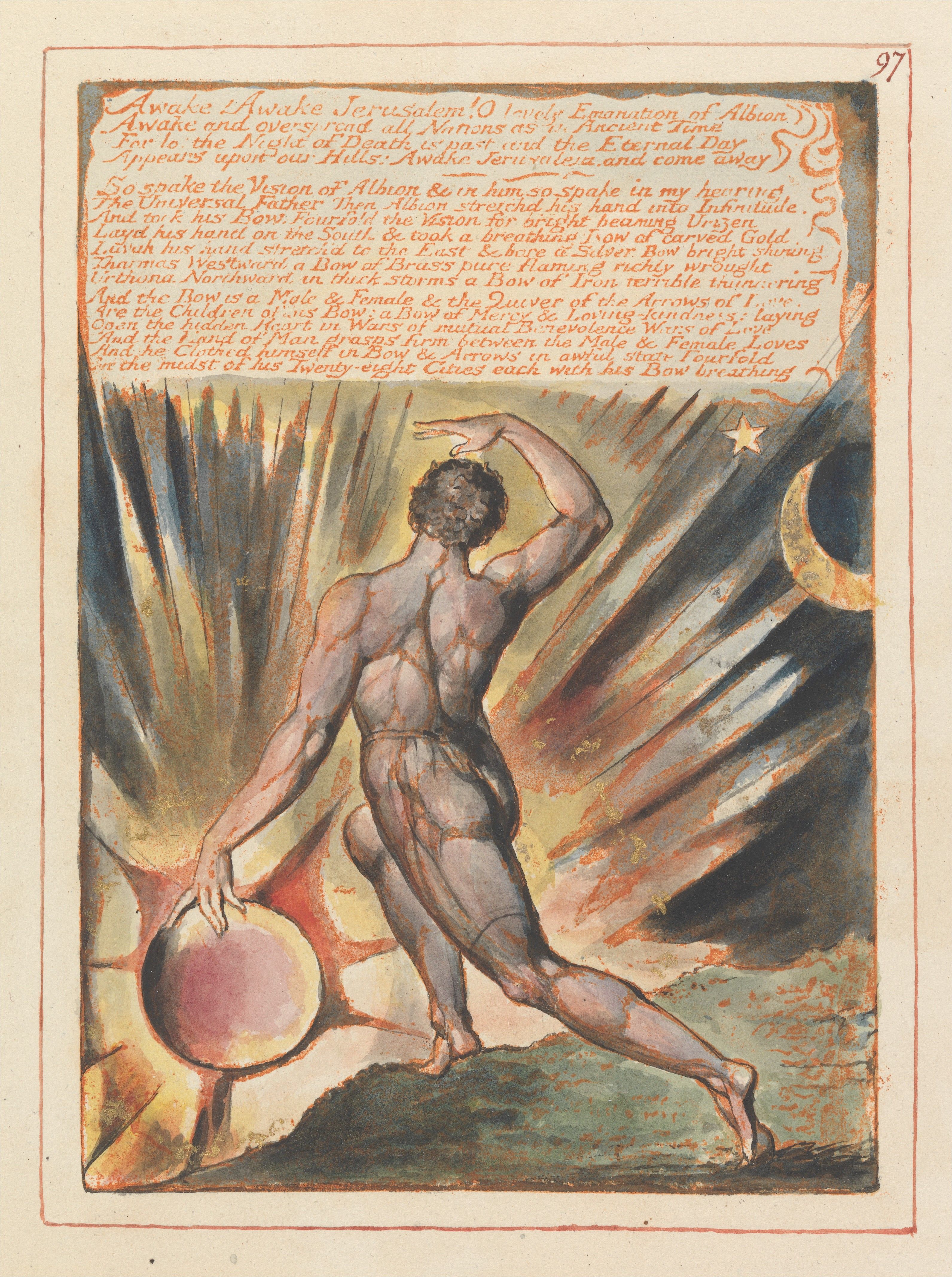
In the image we see Los, representing time, as he crosses the boundary between Time and Eternity. He faces the expanse of the bright unknown carrying with him the illumination, the spiritual sun, which enlightened his sojourn in Time. Left behind are the moon (Luvah) which reflects what light it receives, and the star which sheds the dim light of fallen intellect (Urizen). 

Yale Center for British Art
Jerusalem
Plate 97


Wednesday, January 01, 2020

Understanding Blake

In 2014 Larry posted this material from the Appendix of his Blake Primer. The authors he mentioned here offer a wealth of insight into Blake's mind.

The pre-Raphaelites, especially D.G.Rossetti, found in Blake an
early exponent of the non-material and anti-establishment values
for which they stood. Swinburne picked up this interest and
wrote "A Critical Essay" on Blake lavish in its praise of the poet.

In the Victorian era Swinburne played the role of devil, and it was
Blake's deviltry (nonconformism) that most appealed to him. He
mistakenly perceived Blake as an exponent of art for art's sake,
which was his own game at the time. Obviously art meant
something far different to Blake than it meant to Swinburne.

Swinburne's "Critical Essay" was an outrage against the
establishment and a distortion of Blake's art.
Nevertheless it helped to keep Blake's name alive
through a dismal philistine age.

The mainstream of Blake's legacy comes down through
the Irish poet, Yeats. Yeats derived much of his own imagery
from the Blake; his poems breathe with the Blakean spirit.

With E.J.Ellis Yeats wrote what became at the turn of
the century the primary Blake study. Yeats explained Blake
with his own language and thought forms, and Mona Wilson
found his interpretation of Blake "often more obscure than
Blake's own text".

Be that as it may, Yeats kept the flame burning and prepared
the way for the explosion of interest in Blake that came in the
twenties. In 1910 Joseph Wicksteed worked out some of
the basic principles of Blake's symbology and made them
public in his volume, Blake's Vision of the Book of Job.
Speaking for his generation of Blake scholars Northrop Frye
said they had all learned their Blake symbology from
Wicksteed.  Wicksteed's Job in fact provides an excellent
beginning for the serious Blake student.

 Sir Geoffrey Keynes' three volume work, Blake's Complete Writings 
appeared in 1925; with revisions it has remained the
definitive text. Two years later Mona Wilson's biography
appeared, based upon the earlier works of Gilchrist and Symons:
Her biography remains for the ordinary student the best source
of information about Blake's life.

Foster Damon's William Blake: His Philosophy and Symbols appeared about the same time. This work is hard to find today,
but most of the interpreters who worked in the following decades
acknowledged a debt to Damon. His Blake Dictionary, published in
1965 and still available, is an extremely useful source of information
about Blake.

The year 1938 saw a creative and valuable interpretation of Blake
at the hands of Milton Percival. His book, Circle of Destiny, is a
systematic, cogent, and readable introduction to Blake's thought.
Percival became the primary Blake interpreter for C.G.Jung and for
Kathleen Raine:
Kathleen Raine.

In 1946 William Purcel Witcut wrote a little book relating the Four Zoas to Jung's four psychic functions, entitled Blake, A Psychological Study.

Thursday, December 19, 2019

PRESENCE OF ANGELS

Wikipedia commons
Christ in the Sepulcher Guarded by Angels
From The Cabinet Gallery of Pictures by Allan Cunningham, Page 12:

"Blake, who always saw in fancy every form he drew, believed that angels descended to painters of old, and sat for their portraits. When he himself sat to Phillips for that fine portrait so beautifully engraved by Schiavonetti, the painter, in order to obtain the most unaffected attitude, and the most poetic expression, engaged his sitter in a conversation concerning the sublime in art. “We hear much,” said Phillips, “ of the grandeur of Michael Angelo; from the engravings, I should say he has been over-rated; he could not paint an angel so well as Raphael.” “He has not been over-rated, Sir,” said Blake, “and he could paint an angel better than Raphael.” “Well, but” said the other, “you never saw any of the paintings of Michael Angelo; and perhaps speak from the opinions of others; your friends may have deceived you.” “I never saw any of the paintings of Michael Angelo,” replied Blake, “but I speak from the opinion of a friend who could not be mistaken.” “A valuable friend truly,” said Phillips, “ and who may he be I pray?” “The arch-angel Gabriel, Sir,” answered Blake. “A good authority surely, but you know evil spirits love to assume the looks of good ones; and this may have been done to mislead you.” 

“Well now, Sir,” said Blake “this is really singular; such were my own suspicions; but they were soon removed—I will tell you how. I was one day reading Young's Night Thoughts, and when I came to that passage which asks ‘who can paint an angel,” I closed the book and cried, “Aye! who can paint an angel?" A voice in the room answered, “Michael Angelo could.” “And how do you know,” I said, looking round me, but I saw nothing save a greater light than usual. “I know,” said the voice, “for I sat to him : I am the archangel Gabriel.” “Oho!” I answered, “you are, are you: I must have better, assurance than that of a wandering voice; you may be an evil spirit—there are such in the land.” “You shall have good assurance,” said the voice, “can an evil spirit do this " “I looked whence the voice came, and was then aware of a shining shape, with bright wings, who diffused much light. As I looked, the shape dilated more and more : he waved his hands; the roof of my study opened; he ascended into heaven; he stood in the sun and beckoning to me, moved the universe. An angel of evil could not have done that - it was the arch-angel Gabriel. 

The painter marvelled much at this wild story; but he caught from Blake's looks, as he related it, that rapt poetic expression which has rendered his portrait one of the finest of the English school."


This account by Blake of being in the presence of and conversing with an angel is included in Allan Cunningham's book The Cabinet Gallery of Pictures. When Blake created images of Angels he captured some of the ethereal quality which he described to Phillips when he was sitting for the painting of his portrait. Having had vivid experiences of angelic visions, Blake communicated the Eternal Realities of the Spiritual World convincingly. 

Songs of Innocence, Plate 20, (E 13)
"Night
The sun descending in the west.
The evening star does shine.
The birds are silent in their nest,
And I must seek for mine,
The moon like a flower,
In heavens high bower;
With silent delight,
Sits and smiles on the night.

Farewell green fields and happy groves,
Where flocks have took delight;
Where lambs have nibbled, silent moves 
The feet of angels bright; 
Unseen they pour blessing, 
And joy without ceasing,
On each bud and blossom,
And each sleeping bosom.

They look in every thoughtless nest,
Where birds are coverd warm;
They visit caves of every beast,
To keep them all from harm;
If they see any weeping,
That should have been sleeping
They pour sleep on their head
And sit down by their bed."

Letters (E 701)
"I find more & more that my Style of Designing is a Species
by itself. & in this which I send you have been compelld by my
Genius or Angel to follow where he led if I were to act otherwise
it would not fulfill the purpose for which alone I live. which is
in conjunction with such men as my friend Cumberland to renew the
lost Art of the Greeks" 
.

Tuesday, December 17, 2019

INNER REALITY


Library of Congress
Marriage of Heaven & Hell
Plate 10

As a mental exercise Blake tries to get his reader to look at his world in a different way. He asks us to look at 'reality' as something which is a product of of our own thinking rather than as objective facts which determine our interpretations and our actions. If you are an observer of other people you probably realize that your own mind and the minds of others are not congruent. Take that observation a step further and acknowledge that individuals either see through the lens of generally accepted conventions, or they use their own mental abilities to process the input they receive through their senses from an exterior world. If such is the case, the mind itself creates their 'reality' which does not arrive pre-processed as the events of history or the sights and sounds from outside of the body.

On Page 72, of her biography, William Blake, Kathleen Raine tells us that Blake pushes us to look deeper than surface ills to find ways to make changes to outer circumstances:       

"For Blake, outward events and circumstances were the expressions of states of mind, ideologies, mentalities, and not, as for the determanist-materialist ideologies of the modern world, their causes. Blake's 'dark Satanic Mills', so often invoked in the name of social reform, prove, when we read Milton (the poem in which these mills are most fully described) to be the mechanistic 'laws' of Bacon, Newton and Locke, of which industrial landscapes are a reflection and expression. Man has made his machines in the image of his ideology. So, always, Blake tries to discover the source of social and private ills within man. Only a change of the heart and mind of the nation can create a new society and new cities less hideous than those created by an atheist and mechanistic rationalism."

Descriptive Catalogue, (E 543)
 "All had originally one
language, and one religion, this was the religion of Jesus, the
everlasting Gospel.  Antiquity preaches the Gospel of Jesus.  The
reasoning historian, turner and twister of causes and
consequences, such as Hume, Gibbon and Voltaire; cannot with all
their artifice, turn or twist one fact or disarrange self evident
action and reality.  Reasons and opinions concerning acts, are not
history.  Acts themselves alone are history, and these are
neither the exclusive property of Hume, Gibbon nor Voltaire,
Echard, Rapin, Plutarch, nor Herodotus.  Tell me the Acts, O
historian, and leave me to reason upon them as I please; away
with your reasoning and your rubbish.  All that is not action is
not worth reading.  Tell me the What; I do not want you to
tell me the Why, and the How; I can find that out myself, as well
as you can, and I will not be fooled by you into opinions, that
you please to impose, to disbelieve what you think improbable or
impossible.  His opinions, who does not see spiritual agency, is
not worth any man's reading; he who rejects a fact because it is
improbable, must reject all History and retain doubts only."

Milton, Plate 26 [28], (E 123)
"And every Generated Body in its inward form,

Is a garden of delight & a building of magnificence,

Built by the Sons of Los in Bowlahoola & Allamanda

And the herbs & flowers & furniture & beds & chambers

Continually woven in the Looms of Enitharmons Daughters

In bright Cathedrons golden Dome with care & love & tears

For the various Classes of Men are all markd out determinate

In Bowlahoola; & as the Spectres choose their affinities

So they are born on Earth, & every Class is determinate

But not by Natural but by Spiritual power alone
, Because

The Natural power continually seeks & tends to Destruction

Ending in Death: which would of itself be Eternal Death

And all are Class'd by Spiritual, & not by Natural power.

And every Natural Effect has a Spiritual Cause, and Not
A Natural: for a Natural Cause only seems, it is a Delusion      
Of Ulro: & a ratio of the perishing Vegetable Memory."
  

Sunday, December 15, 2019

Blake's Style

Wikipedia Commons   Jerusalem   Plate 37, Detail   

From
Blake's Style published Oct 6, 2014

   One simple clue to reading Blake concerns his use of dialogue; he spoke with many voices. He exercised this freedom especially with the larger prophecies, the three major works. These on first reading may seem to present insuperable difficulties, but the reader who pays close attention to the identity of the speaker at each point will thereby break down the forest into manageable groves of trees. In his three long poems Blake gave titles to various elements or speeches; they became units, landmarks or guideposts, casting light on what at first seemed general confusion. 

In Night i of 'The Four Zoas' for example we find Enitharmon's Song of Death (FZ1-10.9; E305), second the "Nuptial Song" of the "demons of the deep" (FZ1-13.20; E308), and third the message of the Daughters of Beulah, which they call the "Wars of Death Eternal"(FZ1-21.13; E311). These three songs comprise three of the many selves of the human psyche; needless to say their ideas and attitudes vary immensely. They all describe the same event, but they see it, oh, so differently. They use the same words with different meanings. For example consider that what the daughters call "Death Eternal" the demons call marriage. In this way Blake challenges the reader and stretches his mind and immensely rewards whoever will accept the challenge. He gives us the end of a golden string.

Ellie added:
In the early pages of the Four Zoas the disintegration process was presented from various perspectives. Although it was Albion, the totality, who was coming apart, it was the broken factions who were left to explain what was happening. Enitharmon who had been released from her parents and her twin brother promised to sing a Song of Death. The death of the old order she saw an opportunity. By turning away and refusing to 'look upon the Universal Vision' she would 'drink up' all the powers of man.

Four Zoas, Night 1, Page 9, (E 305)
"But the two youthful wonders wanderd in the world of Tharmas
Thy name is Enitharmon; said the fierce prophetic boy
While thy mild voice fills all these Caverns with sweet harmonyO how our Parents sit & mourn in their silent secret bowers
Page 10
But Enitharmon answerd with a dropping tear & frowning
Dark as a dewy morning when the crimson light appears
To make us happy let them weary their immortal powers
While we draw in their sweet delights while we return them scorn
On scorn to feed our discontent; for if we grateful proveThey will withhold sweet love, whose food is thorns & bitter roots.We hear the warlike clarions we view the turning spheres
Yet Thou in indolence reposest holding me in bonds  Hear! I will sing a Song of Death! it is a Song of Vala!
The Fallen Man takes his repose: Urizen sleeps in the porch
Luvah and Vala woke & flew up from the Human Heart
Into the Brain; from thence upon the pillow Vala slumber'd.And Luvah siez'd the Horses of Light, & rose into the Chariot of DaySweet laughter siezd me in my sleep! silent & close I laughd
For in the visions of Vala I walkd with the mighty Fallen One I heard his voiceI heard his voice among the branches, & among sweet flowers. Why is the light of Enitharmon darken'd in dewy morn
Why is the silence of Enitharmon a terror & her smile a whirlwind
Uttering this darkness in my halls, in the pillars of my Holy-onesWhy dost thou weep as Vala? & wet thy veil with dewy tears,
In slumbers of my night-repose, infusing a false morning?Driving the Female Emanations all away from Los I have refusd to look upon the Universal VisionAnd wilt thou slay with death him who devotes himself to thee
Once born for the sport & amusement of Man now born to drink up all his PowersPage 11I heard the sounding sea; I heard the voice weaker and weaker;The voice came & went like a dream, I awoke in my sweet bliss.Then Los smote her upon the Earth twas long eer she revivdHe answer'd, darkning more with indignation hid in smiles
I die not Enitharmon tho thou singst thy Song of Death"

Los, whose emanation Enitharmon was, made his protest by striking Enitharmon. His regret over this act of violence led to a proposed marriage between the two which was celebrated at the Nuptial Feast. Rather than repairing the breach the Nuptial Feast awoke the 'Demon of Waves' who initiated 'vegetative life' with 'Spirits of Flaming fire on high' to govern 'the mighty Song.' The process had moved out of the control of Los and Enitharmon as additional forces were turned loose.

Four Zoas, Night 1, Page 13, (E 308)
"And Los & Enitharmon sat in discontent & scorn
The Nuptial Song arose from all the thousand thousand spirits
Over the joyful Earth & Sea, and ascended into the Heavens
For Elemental Gods their thunderous Organs blew; creating
Delicious Viands. Demons of Waves their watry Eccho's woke!
Bright Souls of vegetative life, budding and blossoming
Page 14
Stretch their immortal hands to smite the gold & silver Wires
And with immortal Voice soft warbling fill all Earth & Heaven.
With doubling Voices & loud Horns wound round sounding
Cavernous dwellers fill'd the enormous Revelry, Responsing!
And Spirits of Flaming fire on high, govern'd the mighty Song.
And This the Song! sung at The Feast of Los & Enitharmon"

Those observing the events from the perspective of Beulah, gave a report to the divine presence. Their account focused on Urizen and Luvah, two aspects of the human psyche, who began a plot to gain power over Jerusalem, the emanation of Albion.

Four Zoas, Night 1, Page 21, (E 311)
"So spoke the Ambassadors from Beulah & with solemn mourning
They were introducd to the divine presence & they kneeled down
In Conways Vale thus recounting the Wars of Death Eternal
The Eternal Man wept in the holy tent Our Brother in Eternity Even Albion
Even Albion whom thou lovest wept in pain his family
Slept round on hills & valleys in the regions of his love
But Urizen awoke & Luvah woke & thus conferrd
Thou Luvah said the Prince of Light behold our sons & daughters
Reposd on beds. let them sleep on. do thou alone depart
Into thy wished Kingdom where in Majesty & Power
We may erect a throne. deep in the North I place my lot
Thou in the South listen attentive. In silent of this night
I will infold the Eternal tent in clouds opake while thou
Siezing the chariots of the morning. Go outfleeting ride
Afar into the Zenith high bending thy furious course
Southward with half the tents of men inclosd in clouds
Will lay my scepter on Jerusalem the Emanation
On all her sons & on thy sons O Luvah & on mine
Till dawn was wont to wake them then my trumpet sounding loud
Ravishd away in night my strong command shall be obeyd
For I have placd my centinels in stations each tenth man
Is bought & sold & in dim night my Word shall be their law" 

So the fall of man can appear as release from constrains as it did to Enitharmon, as an imposition of a new order of governing as it did at the nuptials of Los and Enitharmon, and as distancing of man from his connection to the Infinite, as it did to Unizen and Luvah when they sought to overthrow the established psychic order. There are among the processes which Blake describes in detail as he develops his characters and leads his reader along the path to regeneration.
.

Friday, December 13, 2019

Reprobate

First posted Saturday, August 30, 2014
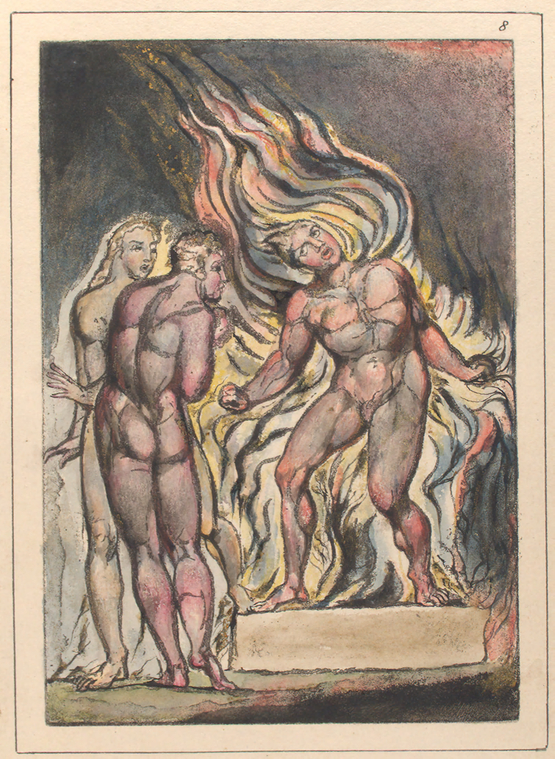
New York Public Library
Milton
Plate 8

'Reprobate' appears 7 times in Milton and once in Jerusalem. When Blake wrote Milton he had a developed new concept of the sorts of people.

The conventional understanding of the classes of men: 
1. The Elect are best known and admired class; they more or less run things in the materialistic culture in which we, like Blake, live. The Elect live in the top rung of society. 
2. The redeemed are middle class people who obey the Elect, but with some reservations. They are conventional people who lack 'their own system' of values and more or less follow the herd of the materialistic majority of the population.
3. The reprobates are thought of as lower class of people, very much like Jesus was thought of by the privileged class.

In this post we will attempt to show what Blake meant  by these classes.

From an earlier post:
"Orthodox religion designated three positions which man may have in relation to God. The Elect were those were accepted by God because they were obedient to his Laws. The Redeemed were those who may be saved if they repented of their wrongdoing and believed. The Transgressors had broken the Law and were condemned to eternal punishment. 

Blake redefined the three types. The Elect to him were the conventional law-abiders like the pharisees who prevented the entry of the spirit. The Redeemed were oppressed by the Elect because they were led by the spirit and not the law. The Transgressors or Reprobate were willing to break the law or move outside of the orthodox structure for the sake of the oppressed." 
  

In this way Blake's category of the Elect was linked to Satan, the Redeemed was linked to Palamabron, and the Reprobate to Rintrah. 

(Following in the train of The Marriage of Heaven and Hell which reversed Angels and Devils, the three classes are a general reversal of ordinary ideas.)

Milton, Plate 13: (E 107)
"The Elect shall meet the Redeem'd. on Albions rocks they shall meet
Astonish'd at the Transgressor, in him beholding the Saviour."

Jerusalem, Plate 83, (E 241) 
"O Albion, my brother!
Jerusalem hungers in the desart! affection to her children!
The scorn'd and contemnd youthful girl, where shall she fly?
Sussex shuts up her Villages. Hants, Devon & Wilts
Surrounded with masses of stone in orderd forms, determine then
A form for Vala and a form for Luvah, here on the Thames
Where the Victim nightly howls beneath the Druids knife:
A Form of Vegetation, nail them down on the stems of Mystery:
O when shall the Saxon return with the English his redeemed brother!
O when shall the Lamb of God descend among the Reprobate!"


Milton, Plate 8, (E 102)
"But Rintrah who is of the reprobate: of those form'd to destruction                                       
Milton, Plate 11 [12], (E 105)
"the Class of Satan shall be calld the Elect, & those
Of Rintrah. the Reprobate, & those of Palamabron the Redeem'd
For he is redeem'd from Satans Law, the wrath falling on Rintrah"

Milton, Plate 13 [14], (E 107)
"He died as a Reprobate. he was Punish'd as a transgressor! 
Glory! Glory! Glory! to the Holy Lamb of God 
I touch the heavens as an instrument to glorify the Lord! 
And the Elect shall say to the Redeemd. We behold it is of Divine 
Mercy alone! of Free Gift and Election that we live.
Our Virtues & Cruel Goodnesses, have deserv'd Eternal Death."
_____________________________
John 1
[14] And the Word was made flesh, and dwelt among us, (and we beheld his glory, the glory as of the only begotten of the Father,) full of grace and truth.

First John 2
[1] My little children, these things write I unto you, that ye sin not. And if any man sin, we have an advocate with the Father, Jesus Christ the righteous:
[2] And he is the propitiation for our sins: and not for ours only, but also for the sins of the whole world.