Tuesday, May 11, 2021

BLAKE'S DESIGNS

Wikipedia Commons
Illustrations to Blair's The Grave
 

Heavens Portals Wide Expand to Let Him In

The Grave
At the end of the text of the 1803 edition of The Grave are unsigned comments. It is likely that a sympathetic friend wrote the comments in conjunction with Blake's explanations. Since Fuseli wrote a statement for the introduction, he may have been the author of the final remarks as well. The congruence of the arrangement and analysis of the designs with Blake's thinking makes it likely that it was written by Fuseli with the assistance of Blake.


Click on the ROMAN NUMERAL to see Blake's watercolor for the specific design for the description of the image.
"OF THE DESIGNS"

"By the arrangement here made, the regular progression of Man, from his first descent into the Vale of Death, to his last admission into Life eternal, is exhibited. These Designs, detached from the Work they embellish, form of themselves a most interesting Poem.

I. THE DESCENT OF CHRIST INTO THE GRAVE.

“ Eternal King, whose potent arm sustains
The keys of Death and Hell ! ”

II. THE DESCENT OF MAN INTO THE VALE OF DEATH.

The pious daughter weeping and conducting her sire onward; age, creeping carefully on hands and knees; an elder, without friend or kindred; a miser ; a bachelor, blindly proceeding, no one knows where, ready to drop into the dark abyss ; frantic youth rashly devoted to vice and passion, rushing past the diseased and old, who totters on crutches; the wan declining virgin ; the miserable and distracted widow; the hale country youth ; and the mother and her numerous progeny, already arrived in this valley, are among speak irresistibly to the feelings.

III. DEATH'S DOOR.
The Door opening, that seems to make utter darkness visible; age, on crutches, hurried by a tempest into it.Above is the renovated man seated in light and glory.
IV. THE STRONG AND WICKED

MAN DYING. Extent of limb, a broad capacious chest, heaving in agony, and prodigious muscular force, so exerted as to pourtray the excruciating torments of mind and body, all contribute to give a fearful picture of the Strong and Wicked Man in the pangs of Death. His masculine soul is hurried through the casement in flame, while his daughter hides her face with horror not to be resisted, and his frantic wife rushes forward, as if resolved to share his fate.

V. THE GOOD OLD MAN DYING.

Never perhaps were two subjects more happily conceived, and beautifully contrasted, than this and the former. In that all is confusion, hurry, and terror ; in this are perfect repose, beatic hope, and heavenly consolation.

Peace in his countenance, his hand on the gospel, his soul devoutly ascending to eternal bliss, his affectionate children, some in prayer, others believing, or at least anxiously hoping, that he still lives; all denote how great is the happiness of the Good Man in the Hour of Death.

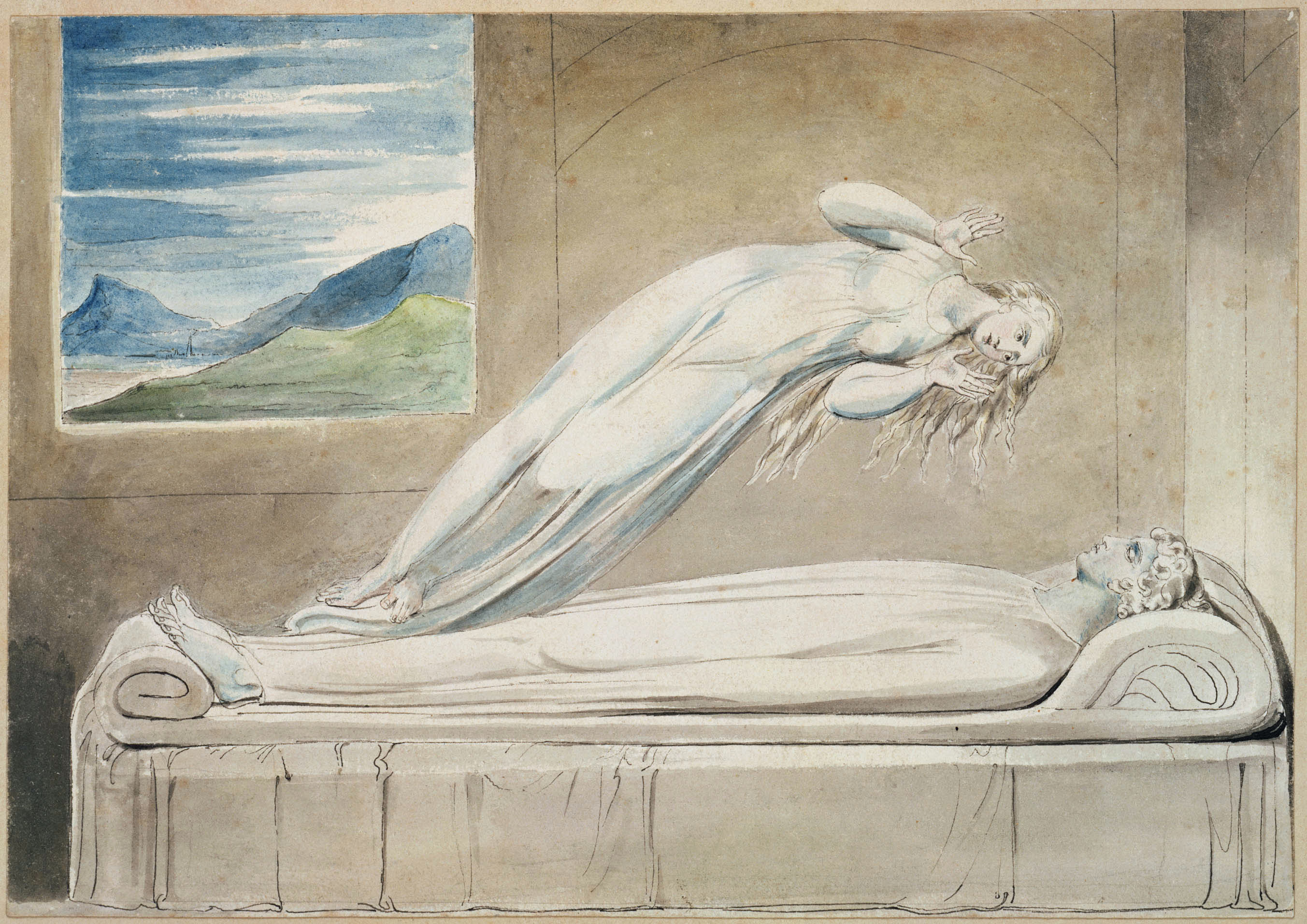
VI. THE SOUL HOVERING OVER THE BODY.

How wishfully she looks On all she's leaving, now no longer her’s !”

VII. THE SOUL EXPLORING THE RECESSES OF THE GRAVE.

The Soul, prior to the dissolution of the Body, exploring through and beyond the tomb, and there discovering the emblems of mortality and of immortality,

VIII. THE COUNSELLOR, KING, WARRIOR, MOTHER, AND CHILD.

All are equal in the Grave. Wisdom, Power, Valour, Beauty, and Innocence, at the hour of death, alike are impotent and unavailing.

IX. THE SKELETON RE-ANIMATED.

When the dread trumpet sounds, the slumb’ring dust, Not unattentive to the call, awakes”; while the world in flames typifies the renovation of all things, the end of Time, and the beginning of Eternity.

X. THE RE-UNION OF SOUL AND BODY.
The Body springs from the grave, the Soul descends from an opening cloud ; they rush together with inconceivable energy; they meet, never again to part !
XI. A FAMILY MEETING IN HEAVEN.
The sweet felicity, the endearing tenderness, the ineffable affection, that are here depicted, are sufficiently obvious. The Husband clasps the Wife; the Children embrace; the Boy recognises and eagerly springs to his Father.
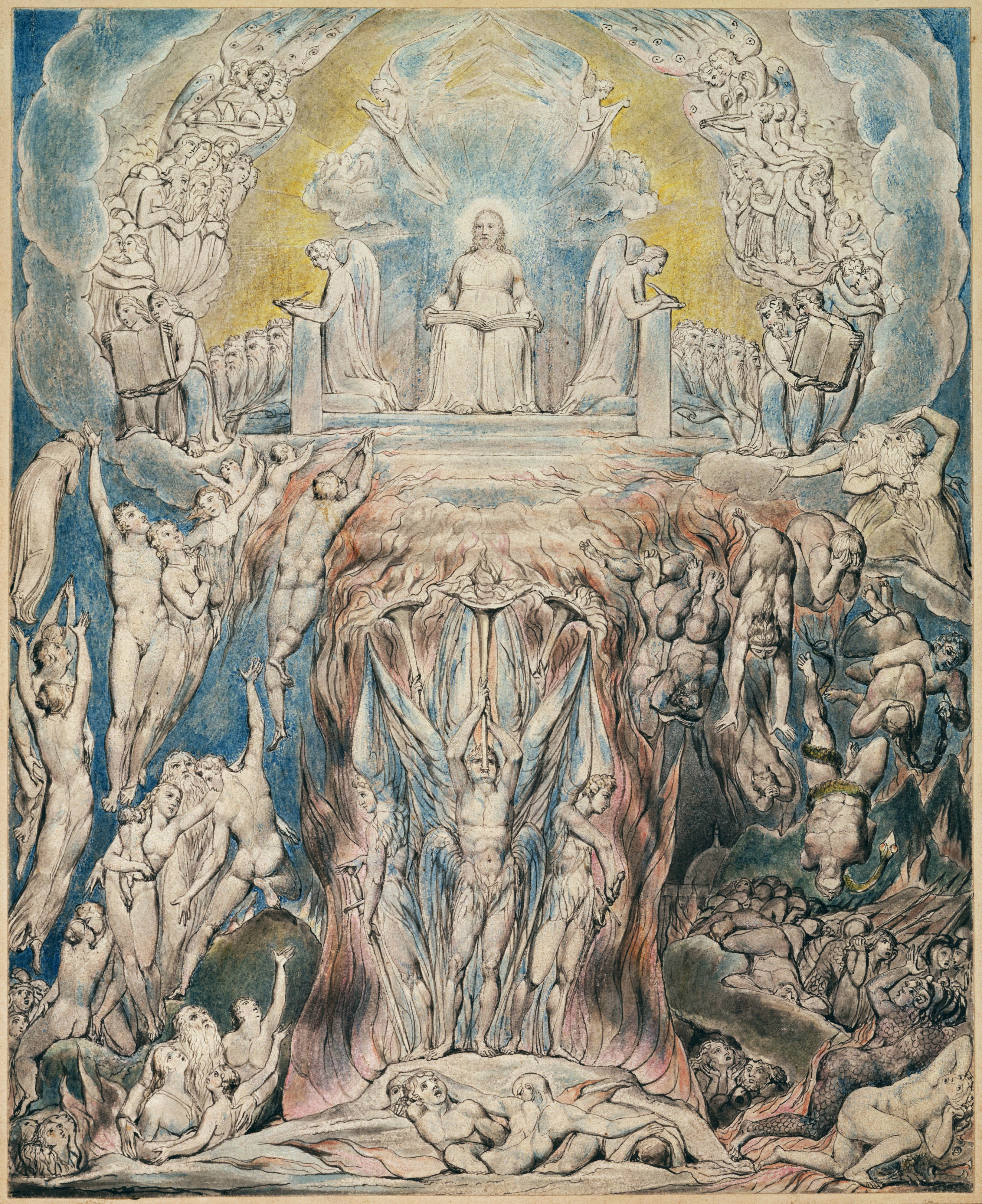
XII. THE LAST JUDGMENT.

Christ coming to judgment in the clouds of heaven, with the “ Thrones set, and the Books opened.” On his knees lies the Book of Life. The Recording Angels kneel on each side of his throne, and the Elders are also seated on each side of Him to judge the world. Surrounding the throne are the blessed, entering into their joy; and arising from these, on each hand, are two clouds of figures: one with the insignia of Baptism; the other with the insignia of the Lord's Supper, inclosing a glorification of angels, with harps. Beneath, on the right hand of Christ, are the blessed, rising in the air to judgment; on the left hand are the cursed: Some are precipitating themselves from the face of Him that sitteth on the Throne (among them is Satan, wound round with the Serpent), others are pleading their own righteousness, and others, beneath, fleeing with banners and spears among the rocks, crying to the “rocks to cover them."

Beneath these are represented the harlot's mystery, and the dragon, who fee before the face of the Judge.

In the centre, standing on the midst of the earth, is the angel with the last trumpet. On each side of him is an angel : that on the left is drawing his sword on the wicked; that on the right is sheathing his sword on the just, who are rising in various groups, with joy and affection, family by family. The angel with the trumpet, and his accompanying ministers of judgment, are surrounded by a column of flame, which spreads itself in various directions over the earth, from which the dead are bursting forth, some in terror, some in joy. On the opening cloud, on each hand of Christ, are two figures, supporting the books of remembrance: that over the just is beheld with humiliation; that over the wicked with arrogance. A sea of fire issues from beneath the throne of Christ, destructive to the wicked, but salutary to the righteous. Before the sea of Fire the clouds are rolled back, and the heavens 'are rolled together as a scroll.'”

Monday, May 10, 2021

DEFENDING FRIENDS

Wikipedia Commons
Illustrations to Blair's The Grave
Reunion of Soul and Body

William Blake and Henry Fuseli shared the trait of being misunderstood by many of their contemporaries. Each felt compelled to defend the other when he felt his friend was under attack by someone who was incapable of appreciating the level of insight the other had reached.

Blake wrote this letter for publication in the Monthly Magazine. Blake was reacting to criticism in the article published in the Bell's Weekly Messenger which found fault with Fuseli's portrayal of the physical and mental suffering of Count Ugolino when he and his children were imprisoned in Pisa.

Letters, (E 768)
To the Editor of the Monthly Magazine.
[In the Monthly Magazine, XXI (July 1, 1806)]

"SIR,
     My indignation was exceedingly moved at reading a criticism
in Bell's Weekly Messenger (25th May) on the picture of Count
Ugolino, by Mr. Fuseli, in the Royal Academy exhibition; and your
Magazine being as extensive in its circulation as that Paper, as
it also must from its nature be more permanent, I take the
advantageous opportunity to counteract the widely-diffused malice
which has for many years, under the pretence of admiration of the
arts, been assiduously sown and planted among the English public
against true art, such as it existed in the days of Michael
Angelo and Raphael.  Under pretence of fair criticism and
candour, the most wretched taste ever produced has been upheld
for many, very many years: but now, I say, now its end is come.
Such an artist as Fuseli is invulnerable, he needs not my
defence; but I should be ashamed not to set my hand and shoulder,
and whole strength, against those wretches who, under pretence of
criticism, use the dagger and the poison.
     My criticism on this picture is as follows:

     Mr. Fuseli's Count Ugolino is the father of sons of feeling
and dignity, who would not sit looking in their parent's face in
the moment of his agony, but would rather retire and die in
secret, while they suffer him to indulge his passionate and
innocent grief, his innocent and venerable madness, and insanity,
and fury, and whatever paltry cold hearted critics cannot,
because they dare not, look upon.  Fuseli's Count Ugolino is a
man of wonder and admiration, of resentment against man and
devil, and of humilitation before God; prayer and parental
affection fills the figure from head to foot.  The child in his
arms, whether boy or girl signifies not, (but the critic must be
a fool who has not read Dante, and who does not know a boy from a
girl); I say, the child is as beautifully drawn as it is
coloured--in both, inimitable! and the effect of the whole is
truly sublime, on account of that very colouring which our critic
calls black and heavy.  The German flute colour, which was used
by the Flemings, (they call it burnt bone), has possessed the eye
of certain connoisseurs, that they cannot see appropriate
colouring, and are blind to the gloom of a real terror.

     The taste of English amateurs has been too much formed upon
pictures imported from Flanders and Holland; consequently our
countrymen are easily brow-beat on the subject of painting; and
hence it is so common to hear a man say, "I am no judge of
pictures:" but, O Englishmen! know that every man ought to be a
judge of pictures, and every man is so who has not been
connoisseured out of his senses.
     
 A gentleman who visited me the other day, said, "I am very
much surprised
at the dislike that some connoisseurs shew on viewing the
pictures of Mr. Fuseli; but the truth is, he is a hundred years
beyond the present generation." Though I am startled at such
an assertion, I hope the contemporary taste will shorten the
hundred years into as many hours; for I am sure that any
person consulting his own eyes must prefer what is so
supereminent; and I am as sure that any person consulting
his own reputation, or the reputation of his country, will
refrain from disgracing either by such ill-judged criticisms in
future.
Yours,
WM. BLAKE. 
_____________ 
Fuseli's support of Blake was provided when the publisher Cromek reneged on his promise to have Blake engrave his own designs for a new issue of Blair's The Grave. When Cromek engaged Schiavonetti to do the engravings, depriving Blake of the income, Fuselli contributed remarks in support of Blake's designs in the introduction to the publication.

The recognition of Blake's designs by Fuseli may have eased the sting of rejection, but it did not allieviate the harm which Blake had endured. Fuseli could defend Blake attempts to make perceptible the spiritual world in imagery which was accessible to the public, but he couldn't overcome common man's taste for the predictable and conventional.

The Grave

London, July 1808.

Cromek wrote:

"To the elegant and classical taste of Mr. FUSELI he is indebted for excellent remarks on the moral worth and picturesque dignity of the Designs that accompany this Poem. Mr. Philips is entitled to his kindest thanks, for the capitally painted Portrait of Mr. William Blake, which is here presented to the Subscribers; and to Mr. SCHIAVONETTI he is under still greater obligations for a ETCHINGS which, it is not too much praise to say, no other artist could have executed so ably."

Fuseli wrote:

"The moral series here submitted to the Public, from its object and method of execution, has a double claim on general attention.

In an age of equal refinement and corruption of manners, when systems of education and seduction go hand in hand; when religion itself compounds with fashion; when in the pursuit of present enjoyment, all consideration of futurity vanishes, and the real object of life is lost—in such an age, every exertion confers a benefit on society which tends to impress man with his destiny, to hold the mirror up to life, less indeed to discriminate its characters, than those situations which show what all are born for, what all ought to act for, and what all must inevitably come to.

The importance of this object has been so well understood at every period of time, from the earliest and most innocent, to the latest and most depraved, that reason and fancy have exhausted their stores of argument and imagery, to impress it on the mind : animate and inanimate nature, the seasons, the forest and the field, the bee and ant, the larva, chrysalis and moth, have lent their real or supposed analogies with the origin, pursuits, and end of the human race, so often to emblematic purposes, that instruction is become stale, and attention callous. The serpent with its tail in its mouth, from a type of eternity, is become an infant's bauble ; even the nobler idea of Hercules pausing between virtue and vice, or the varied imagery of Death leading his patients to the grave, owe their effect upon us more to technic excellence than allegoric utility.

Aware of this, but conscious that affectation of originality and trite repetition would equally impede the author of the moral series before us, has endeavoured to wake sensibility by touching our sympathies with nearer, less ambiguous, and less ludicrous imagery, than what mythology, Gothic superstition, or symbols as far-fetched as inadequate, could supply. His invention has been chiefly employed to spread a familiar and domestic atmosphere round the most important of all subjects, to connect the visible and the invisible world, without provoking probability, and to lead the eye from the milder light of time to the radiations of eternity.

Such is the plan and the moral part of the author's invention; the technic part, and the execution of the artist, though to be examined by other principles, and addressed to a narrower circle, equally claim approbation, sometimes excite our wonder, and not seldom our fears, when we see him play on the very verge of legitimate invention; but wildness so picturesque in itself, so often redeemed by taste, simplicity, and elegance, what child of fancy, what artist would wish to discharge? The groups and single figures on their own basis, abstracted from the general composition, and considered without attention to the plan, frequently exhibit those genuine and unaffected attitudes, those simple graces which nature and the heart alone can dictate, and only an eye inspired by both, discover. Every class of artists, in every stage of their progress or attainments, from the student to the finished master, and from the contriver of ornament, to the painter of history, will find here materials of art and hints of improvement !"
HENRY FUSELI.


Friday, May 07, 2021

VIEW OF BLAKE

Johann Caspar Lavater (1741-1801) 
Essays on Physiognomy: Designed to Promote the Knowledge and the Love of Mankind,  
Illustration by William Blake

Crabb Robinson's interest in William Blake extended to an effort to make Blake known in Germany. The following article clarifies Robinson's rational for writing his Essay for publication in a German magazine. As a contemporary of Blake, he gave an impression of Blake as an Englishman who shared romantic aspirations with the political and artistic movement taking place in Germany. 
 
This passage is from an article by Karen Junod,  published online: 06 Jul 2012

Crabb Robinson, Blake, and Perthes's Vaterländisches Museum (1810–1811)

"Crabb Robinson's essay on Blake was published anonymously in the single issue of the second volume of the Vaterländisches Museum, immediately after the review of Bouterwek's work, thus representing a bibliographic and symbolic extension of the latter's history of European literature. Crabb Robinson's was the last item to be published before the magazine's demise, and the third to be devoted to a visual artist – the other two being Raphael and Goethe's friend, Wilhelm Tischbein (Vaterländisches Museum 1810, 120–23 and 230–42 respectively). Crabb Robinson's piece was not the first account of Blake in Germany. By 1789 the artist was known well enough to be listed in Carl Heinrich von Heinecken's Dictionnaire des artistes (1778–1790), published in Leipzig (Heinecken iii, 3). Blake's 1797 engravings for Edward Young's Night Thoughts (1742–1745), which had been circulating in Germany since approximately 1800, had also been commented upon by the novelist Jean Paul Richter in several of his letters.9 Richter had received a copy of Young's Night Thoughts from Emil Leopold August, Duke of Sachsen-Gotha-Altenburg, though he feigned to ignore the identity of his benefactor (Bentley, Blake Records 113–15).

Crabb Robinson started to think more carefully about his piece on Blake when Perthes, whom he had met during his second stay in Hamburg between January and September 1807, asked him to “send him an article for a new German magazine entitled Vaterländische Annalen” (Bentley, Blake Records 296). Crabb Robinson had just seen Blake's works at an exhibition at 28 Broad Street, in London's Golden Square, and had been fascinated by the talents of this “insane poet painter & engraver” (Bentley, Blake Records 296). Years later, in his Reminiscences, Crabb Robinson also confessed that he had been “deeply interested by the Catalogues as well as the pictures” of Blake, and that he therefore “took four copies” (Bentley, Blake Records 298–99). It is this catalogue that provided the main inspiration for his essay in the Vaterländisches Museum, though Crabb Robinson also gleaned some biographical details from Benjamin Heath Malkin's own account of the artist in A Father's Memoirs of his Child (1806) and from Henry Fuseli's introduction to the 1808 edition of Blair's Grave. The essay was originally written in English and was subsequently translated into German by a certain Dr Julius, a doctor and friend of Perthes with whom he co-edited the Vaterländisches Museum (Wright 138–39).

Crabb Robinson acknowledged that the primary goal of his essay was to make Blake “as well known as possible,” though he did confess that he knew “too little of his history to claim to give a complete account of his life” (Bentley, Blake Records 601 and 594). Crabb Robinson's modest rhetorical style further surfaces in the assertion that his piece had “nothing in it of the least value” (Bentley, Blake Records 594). Crabb Robinson's self-effacing conviction may have partly stemmed from the fact that his observations were based entirely on Blake's texts and pictures; they did not include any personal details on the artist, whom the writer had not yet met in person. Introduced by an epigraph from Shakespeare's Midsummer Night's Dream – “The lunatic, the lover, and the poet / Are of imagination all compact,” – Crabb Robinson's essay quickly moves on to some fleeting observations about the complex yet “attractive” (Bentley, Blake Records 594) union of genius and madness. Crabb Robinson manifestly saw Blake as an unusual artist and individual, describing him as the most prominent and representative member in the whole race of “ecstatics, mystics, seers of visions, and dreamers of dreams” (Bentley, Blake Records 594). Throughout the essay, Crabb Robinson underlines Blake's eccentric singularity and his stubbornness in following his own artistic path. He believes that the painter's emerging genius is distinguished by its lack of interest and concern for the “usual, ordinary employment” (Bentley, Blake Records 595) of his friends and fellow artists. Although Crabb Robinson views Blake's artistic deviance and his obstinate wish for aesthetic independence as a sign of strength and superior talent, he also believes that the artist's insistence on self-reliance was a decisive element in keeping him confined to relative obscurity, especially at the beginning of his career.

Throughout, Crabb Robinson's essay combines aesthetic judgement and factual information; it includes details about Blake's birth in London, his apprenticeship with the engraver James Basire, his passion for Gothic architecture, his drawing excursions to Westminster Abbey, and his activity as a collector of engravings (Bentley, Blake Records 594). The main bulk of his piece, however, focuses on describing the technique and the meaning of Blake's art and poetry. Several paragraphs are devoted to Blake's linear designs: “His greatest enjoyment,” Crabb Robinson writes, “consists in giving bodily form to spiritual essence” (Bentley, Blake Records 597). Crabb Robinson interprets Blake's intercourse with the spiritual world as congruent with that of Emanuel Swedenborg, whom Crabb Robinson sees as a direct source of inspiration for the artist. The author's commentaries on Blake's pictures and linear style are articulated in the idiom of a connoisseur. His disapproval of Blake's sweeping condemnation of the Dutch and Venetian masters – whom the artist qualifies as “most cruel . . . and most outrageous demons” (Bentley, Blake Records 596) – also testifies to Crabb Robinson's knowledge of the visual arts and his understanding of contemporary aesthetic currents.

The remarks Crabb Robinson makes about Blake's poetic activities are less powerful. Although he admits that Blake's “poems breathe the same spirit and are distinguished by the same peculiarities as his drawings and his critical prose” (Bentley, Blake Records 600), he believes that the metre of the poems included in the Poetical Sketches “is usually [so] loose and careless as to betray a total ignorance of the art.” Nonetheless, Crabb Robinson admits that “there is a wildness and loftiness of imagination in certain dramatic fragments which testifies to genuine poetical feeling” (Bentley, Blake Records 600–1). Several poems are inserted in the essay, in the original and in translation, including “To the Muses,” the “Introduction” from the Songs of Innocence, “Holy Thursday,” “The Tyger,” and “The Garden of Love.” Crabb Robinson's critical appreciation of these texts usually consists of brief, undeveloped commentaries: whilst he believes that Blake's Songs of Innocence are “child-like songs of the greatest beauty and simplicity,” he remains puzzled as to the significance of Songs of Experience, which he reads as “metaphysical riddles and mystical allegories” (Bentley, Blake Records 601).10 Crabb Robinson also confesses his inability to give a sufficient account of several poems, including Europe, Prophecy, and America, which he finds are too “obscure . . . mysterious and incomprehensible” (Bentley, Blake Records 602).

Significantly, Crabb Robinson concludes his essay by emphasizing the German character of Blake's art and poetry and the appropriateness of his subject for a German periodical. Crabb Robinson clearly counted upon a more widespread appreciation in Germany for the mystery and obscurity surrounding Blake's personality and work – an obscurity, he adds in his essay, “which one would expect from a German rather than an Englishman,” and which “assuredly cannot lessen the interest which all men, Germans in a higher degree even than Englishmen, must take in the contemplation of such a character” (Bentley, Blake Records 603). Crabb Robinson's evaluation was the first of a long series of other statements that have acknowledged the proximity between Blake's aesthetics and those of the German Frühromantik.11 Blake's affinities with his German contemporaries were certainly no coincidence. If such affinities might be attributed to parallel developments from similar literary, visual, and philosophical sources, including Jacob Boehme, they were also the result of several direct encounters with Henry Fuseli and Johann Jacob Lavater, whose frontispiece to the Aphorisms on Man (1789) Blake engraved.12 In Lavater's work, in particular, Blake had found support for his more transcendental and idealistic tendencies, and his belief that external, physionomical appearances reflect internal realities (Earle).

...
Like Runge, Blake was highly inspired by Flaxman's purified designs. In fact, Blake's belief in the primacy of the line at the expense of colours resurfaces in Crabb Robinson's own essay, when the latter writes about Blake's disparagement of the Venetian and Flemish schools. Crabb Robinson's further reference to one of Blake's aesthetic “doctrines,” namely that “The great and golden rule of art, as well as of life, is this: That the more distinct, sharp, and wirey the bounding line, the more perfect the work of art” (Bentley, Blake Records 596) emphasises the redemptive function of the line and its defining role in the concept of art and life. Crabb Robinson's observation, quoted above, that Blake's greatest enjoyment consisted “in giving bodily form to spiritual essence” (Bentley, Blake Records 597) is another instance in the essay which underpins Blake's conviction as to the metaphorical associations that link the line with human identity.20 Blake's own designs for his Songs of Innocence and of Experience include many linear shapes, which Crabb Robinson describes as either forms resembling “monstrous hieroglyphs of the Egyptians” or, paradoxically, as “not ungraceful arabesques” (Bentley, Blake Records 601).Anglo-German Connections and Common Language
......

If we bear in mind the cultural and political context in which Perthes's magazine was published, the decision to include Crabb Robinson's piece on Blake in the Vaterländisches Museum may appear less surprising than at first sight. The text, with its implicit and explicit references to the Germanic character of Blake's art and poetry, underpinned Perthes's aim to promote Germanic art, literature, and culture, indeed to keep alive and strengthen the Germanic spirit among his readers. Besides Blake's aesthetic affinities with Runge, and Crabb Robinson's overt admission of the Germanic-ness of his subject at the end of his essay, other, perhaps more oblique, references in his article underline the close connections between England and Germany. Having acknowledged that among Blake's “aberrations,” there were also “gleams of reason” (Bentley, Blake Records 598), Crabb Robinson writes that “The Protestant author of Herzensergiessungen eines kunstliebenden Klosterbruders created the character of a Catholic in whom religion and love of art are mixed into one essence, and this same person, remarkably enough, has turned up in Protestant England” (Bentley, Blake Records 599). Crabb Robinson's allusion to Wilhelm Heinrich Wackenroder's influential book (first published anonymously in Berlin in 1797) is particularly significant for several reasons. Not only does it identify Blake as the English re-incarnation of a fictive German artist who succeeded in producing an art that was the product of both emotional feelings and religious devotion – a characteristic, as we have seen, essential for Pietists like Runge and Perthes:21 significantly, Crabb Robinson's reference to Wackenroder's Herzensergiessungen is also an allusive reference to medieval art and literature, and especially to the “sacred” Albrecht Dürer. In truth, Wackenroder's assessment of Dürer was instrumental in changing certain views that eighteenth-century critics had articulated about the artist, including his provincialism and his desire to remain in Germany (Sanford 446). Rather than interpreting Dürer's localism as a lack of artistic ambition, Wackenroder presented Dürer's provincialism as a laudable mark of national pride.

In his biographical essay, Crabb Robinson specifically singles out Dürer as one of Blake's idols.22 The implicit and explicit presence of Dürer in Crabb Robinson's piece was thus highly symbolic: on the one hand, it underpinned the patriotic message of Perthes's magazine (Dürer, we remember, acquired his iconic status during the rise of German nationalism); on the other hand, however, by its transfer of the protagonist of the Herzensergiessungen from Germany to England, it simultaneously undermined and neutralized the more nationalistic element latent in the Herzensergiessungen and relocated Dürer within a more international and cosmopolitan environment.

...

Conclusion

Clearly, Perthes's Vaterländisches Museum negotiated the binary and antagonistic impulses between nationalism and cosmopolitanism, between the local and the general, between the German and the Germanic. Although Perthes's periodical served political and nationalistic ends in its effort to infuse a sense of power and self-confidence into its readers and stir them into action, the Vaterländisches Museum still in some measure espoused the cosmopolitan outlook of the time, putting forward the idea that all human beings belong to the human community.

Within such a political and cultural framework, Crabb Robinson's piece on Blake articulated the very tension with which Perthes was dealing. Implicitly as well as explicitly, Blake emerged as a figure that channelled Perthes's conflicting loyalties. Interestingly, the format of the periodical itself and the position of Crabb Robinson's essay, sandwiched as it was between the review of Bouterwek's Von der neuesten englischen Poesie and the Schluss-Anmerkung, moulded Blake's reputation in two reconcilable ways: not only did it present him as a figure whose art contained and could transmit elements of German culture and German identity, but at the same time it also introduced the English poet as a quintessentially cosmopolitan artist, a man speaking a language that went beyond borders and beyond nationalities.

The initial success of Perthes's periodical exceeded all expectations. It was, however, short-lived. Only one year after its first issue, in 1811, the Vaterländisches Museum ceased publication. The purpose and ideals at the core of Perthes' project were suddenly dashed by Napoleon's annexation of Hamburg to the French Empire in 1811. Indeed, Perthes argued that because he no longer had a “Vaterland,” there could be no Vaterländisches Museum anymore. Deeply affected by the turn of political events, and increasingly aware of the dangers of pursuing his publishing activities, Perthes brought the publication of his journal to an end."


Marriage of Heaven and Hell, Plate 27, (E 44)
A Song of Liberty

15. Down rushd beating his wings in vain the jealous king: his grey brow'd councellors, thunderous warriors, curl'd veterans, among helms, and shields, and chariots horses, elephants: banners, castles, slings and rocks, 16. Falling, rushing, ruining! buried in the ruins, on Urthona's dens. 17. All night beneath the ruins, then their sullen flames faded emerge round the gloomy king, 18. With thunder and fire: leading his starry hosts thro' the waste wilderness he promulgates his ten commands, glancing his beamy eyelids over the deep in dark dismay, 19. Where the son of fire in his eastern cloud, while the morning plumes her golden breast, 20. Spurning the clouds written with curses, stamps the stony law to dust, loosing the eternal horses from the dens of night, crying Empire is no more! and now the lion & wolf shall cease. Chorus Let the Priests of the Raven of dawn, no longer in deadly black, with hoarse note curse the sons of joy. Nor his accepted brethren whom, tyrant, he calls free; lay the bound or build the roof. Nor pale religious letchery call that virginity, that wishes but acts not! For every thing that lives is Holy"


Thursday, May 06, 2021

RETURN JOURNEY

Wikipedia Commons
Illustrations to Blair's The Grave
Soul Exploring the Recesses of the Grave


 Interview with Charles Frazier author of Cold Mountain:

"I wished I had been able to ask him [my great-great grandfather] how he looked at the war when he volunteered and how he looked at it when he came home. So, the story I found myself writing became an Odyssey, not an Iliad. Returning, not going. A long journey home through a devastated world. Late in the third century BC, the Greek geographer Eratosthenes wrote: "You will find the scene of the wanderings of Odysseus when you find the cobbler who sewed up the bag of the four winds." His point, of course, had to do with readers who get twisted up trying to untangle fact and fiction, especially the ones needing too much of the former."

The journey of the second half of life is a journey of return. The accomplishments of the first half of life are complete. Now what has been divided will be united; what has been lost will be recovered; what has been forgotten will be remembered; what is in error will be annihilated.

In the Odyssey, Odysseus is returning home to his wife Penelope who has been weaving a shroud for her father-in-law. By day she weaves, by night she unweaves to avoid finishing the garment.

In Cold Mountain, Inman is returning home to Ada, the woman he loves. Ada has been learning to be self-sufficient in a war torn world, simultaneously she is longing to be reunited with Inman.

In Blake's Milton Ololon has followed Milton's descent to earth believing that joined together they can restore the Imaginative Vision which had been lost to man in the Fall.

In Homer's work as well as in Blake's, weaving is a metaphor for taking the threads of time and arranging them in ways that form the fabric of experience. The same thing is happening in Frazier's work but the weaving metaphor is not explicitly used. All three authors use the journey in such a way that the hero accomplishes tasks that prepare him to be united to his female portion which will make him complete.

We see from Blake and Homer that weaving and unweaving are both necessary. The skills and achievements which serve well when one is focused on the outer world fail to be suitable when in the second half of life developing an inner life is paramount. 


Milton,Plate 32 [35], (E 132)
"The Imagination is not a State: it is the Human Existence itself
Affection or Love becomes a State, when divided from Imagination
The Memory is a State always, & the Reason is a State
Created to be Annihilated & a new Ratio Created                  
Whatever can be Created can be Annihilated Forms cannot
The Oak is cut down by the Ax, the Lamb falls by the Knife
But their Forms Eternal Exist, For-ever. Amen Hallelujah

Thus they converse with the Dead watching round the Couch of Death.
For God himself enters Death's Door always with those that enter 
And lays down in the Grave with them, in Visions of Eternity
Till they awake & see Jesus & the Linen Clothes lying
That the Females had Woven for them, & the Gates of their 
Fathers House"

Milton, Plate 41 [48], (E 143)
"Then trembled the Virgin Ololon & replyd in clouds of despair Is this our Feminine Portion the Six-fold Miltonic Female Terribly this Portion trembles before thee O awful Man Altho' our Human Power can sustain the severe contentions Of Friendship, our Sexual cannot: but flies into the Ulro. Hence arose all our terrors in Eternity! & now remembrance Returns upon us! are we Contraries O Milton, Thou & I O Immortal! how were we led to War the Wars of Death Is this the Void Outside of Existence, which if enterd into Plate 42 [49] Becomes a Womb? & is this the Death Couch of Albion Thou goest to Eternal Death & all must go with thee So saying, the Virgin divided Six-fold & with a shriek Dolorous that ran thro all Creation a Double Six-fold Wonder! Away from Ololon she divided & fled into the depths Of Miltons Shadow as a Dove upon the stormy Sea. Then as a Moony Ark Ololon descended to Felphams Vale In clouds of blood, in streams of gore, with dreadful thunderings Into the Fires of Intellect that rejoic'd in Felphams Vale Around the Starry Eight: with one accord the Starry Eight became One Man Jesus the Saviour. wonderful! round his limbs The Clouds of Ololon folded as a Garment dipped in blood Written within & without in woven letters: & the Writing Is the Divine Revelation in the Litteral expression: A Garment of War, I heard it namd the Woof of Six Thousand Years" ON HOMERS POETRY, (E 269) "Every Poem must necessarily be a perfect Unity, but why Homers is peculiarly so, I cannot tell: he has told the story of Bellerophon & omitted the judgment of Paris which is not only a part, but a principal part of Homers subject But when a Work has Unity it is as much in a Part as in the Whole. the Torso is as much a Unity as the Laocoon As Unity is the cloke of folly so Goodness is the cloke of knavery Those who will have Unity exclusively in Homer come out with a Moral like a sting in the tail: Aristotle says Characters are either Good or Bad: now Goodness or Badness has nothing to do with Character. an Apple tree a Pear tree a Horse a Lion, are Characters but a Good Apple tree or a Bad, is an Apple tree still: a Horse is not more a Lion for being a Bad Horse. that is its Character; its Goodness or Badness is another consideration. It is the same with the Moral of a whole Poem as with the Moral Goodness of its parts Unity & Morality, are secondary considerations & belong to Philosophy & not to Poetry, to Exception & not to Rule, to Accident & not to Substance. the Ancients calld it eating of the tree of good & evil. The Classics, it is the Classics! & not Goths nor Monks, that Desolate Europe with Wars." Annotations to Lavater, (E 592) Lavater:  "Whatever is visible is the vessel or veil of the invisible past, present, future--as man penetrates to this more, or perceives it less, he raises or depresses his dignity of being." Blake: " A vision of the Eternal Now--"

Friday, April 30, 2021

ENCOUNTERS

British Museum
Illustrations to Young's Night Thoughts

Henry Crabb Robinson was a journalist and a lawyer, but he is remembered for his interest in interviewing exceptional people, especially people of genius. Blake was in his waning years when he became acquainted with Robinson through a supporter - Mrs Aders.

Since Robinson was a devoted Diarist he recorded accounts of his visits with Blake whom he found both interesting and perplexing. Blake had spent his lifetime meditating on the relationship between God and man. Although his ideas were startling to Robinson, they were well reasoned on the basis of his own experience of the spiritual dimension. The thinkers who had influenced Blake were foreign to Robinson. But because Robinson continued to visit him and engage in conversation, Blake expressed his unconventional ideas and Robinson preserved them in his dairy. There is no evidence that Robinson ever really grasped what Blake was talking about.

DIARY REMINISCENCES AND CORRESPONDENCE of HENRY CRABB ROBINSON

Vol 2 - including Blake


Robinson wrote:

December 10th [1825] - Dined with Aders. A very remarkable and interesting evening. The party at dinner, Blake the painter, and Linnell a painter. In the evening Miss Denman and Miss Flaxman came. Shall I call Blake artist, genius, mystic or madman. Probably he is all. I will put down without method what I can recollect of the conversation of this remarkable man. He has a most interesting appearance. He is now old (sixty eight), pale with a Socratic countenance and an expression of great sweetness though with something of languor about it except when animated, and then he has about him an air of inspiration The conversation turned on art, poetry, and religion. He brought with him an engraving of his Canterbury Pilgrims. One of the figures in it is like a figure in a picture to Mr Aders. "They say I stole it from this picture said Blake but I did it twenty years before. I knew of this picture in my youth I was always studying paintings of this kind, wonder there is a resemblance." In this he seemed to explain humanly what he had done. But at another time he spoke of paintings as being what he had seen in his visions And when he said my visions it was in the ordinary unemphatic tone in which speak of every day matters. In the same tone he said repeatedly, "The Spirit told me." I took occasion to say, "You express as Socrates used to do." What resemblance do you suppose there between your spirit and his. "The same as between our countenances." He paused and added, "I was Socrates" and then as correcting himself said, "a sort of brother. I must have had conversations with him. So I had with Jesus Christ, I have an recollection of having been with both of them." I suggested on philosophical grounds the impossibility of supposing an immortal being created, an eternity à parte post without an eternity à parte ante. His eye brightened at this and he fully concurred with me. "To sure it is impossible. We are all co existent with God members the Divine body. We are all partakers of the Divine nature." In this by the by Blake has but adopted an ancient Greek idea connected with this idea.

I will mention here though it formed of our talk as we were walking homeward that on my asking in what light he viewed the great question concerning the deity of Jesus Christ he said, "He is the only God." But then he added' "and so am I and so are you." He had just before and that occasioned question been speaking of the errors of Jesus Christ. "Jesus Christ should not have allowed himself to be crucified and should not have attacked the Government." On my inquiring how this view could be reconciled with the sanctity and Divine qualities of Jesus. Blake said, "He was not then become the Father." Connecting well as one can these fragmentary sentiments it would be hard to fix Blake's station between Christianity, Platonism, and Spinozism. Yet he professes to be very hostile to Plato and reproaches Wordsworth with being not a Christian but a Platonist.   

...

"There is no use in education. I hold it to be wrong It is the great sin It is eating of the tree of the knowledge of good and evil. This was the fault of Plato He knew of nothing but the virtues and vices and good and evil. There is nothing in all that Everything is good in God's eyes." On my putting the obvious question, "Is there nothing absolutely evil in what men do" - "I am no judge of that. Perhaps not in God s eyes." He sometimes spoke as if he denied altogether the existence of evil and as if we had nothing to do with right and wrong; it being sufficient to consider all things as alike the work of God. Yet at other times he spoke of there being error in heaven. I asked about the moral character of Dante in writing his "Vision" - was he pure? "!Pure!" said Blake; "do you think there is any purity in God's eyes. The angels in heaven are no more so than we. 'He chargeth his angels with folly.'" He afterwards represented the Supreme Being as liable to error. "Did he not repent him that he had made Nineveh?" It is easier to repeat the personal remarks of Blake than these metaphysical speculations, so nearly allied to the most opposite systems of philosophy. Of himself he said he acted by command. The Spirit said to him, "Blake be an artist and nothing else." In this is felicity. His eye glistened while he spoke of the joy of himself solely to divine art. Art is inspiration. When Michael or Raphael or Mr Flaxman does any of his fine things, he does them in the Spirit." Blake said, "I should be sorry if I had earthly fame, for whatever natural glory a man has is so much from his spiritual glory. I wish to do nothing for profit. I wish to live for art. I want nothing whatever. I am quite happy." 

...

February 2nd [1827]- Götzenberger the young painter from Germany and I accompanied him to Blake. We looked over Blake's Dante. Götzenberger was highly gratified by the designs. I interpreter between them. Blake seemed gratified by the visit said nothing remarkable.

It was on this occasion that I saw Blake for the last. He died on the 12th of August. His genius as an artist was by Flaxman and Fuseli, and his poems excited great interest in. His theosophic dreams bore a close resemblance to those Swedenborg. I have already referred to an article written by me on Blake for the Hamburg Patriotic - Annals 5. My interest in remarkable man was first excited in 1806. Dr Malkin our Grammar School head master published in that year a memoir of a very precocious child who died. An engraving of a portrait of him by Blake was prefixed. Dr Malkin gave an account of Blake as a painter and poet and of his visions and added some specimens his poems including the Tiger.

...

Late 1827 - visit to Catherine

She had the wife's virtue of virtues, an implicit reverence for her husband. It is quite certain that she believed in all his visions. On one occasion speaking of his visions she said, "You know, dear, the first time you saw God was when you were four years old and he put his head to the window and set you a screaming." In a word she was formed on the Miltonic model, and, like the first wife, Eve, worshipped God in her husband.

  "He for God only she for God in him"  


From Blake's Notebook, (E481)
"I rose up at the dawn of day Get thee away get thee away Prayst thou for Riches away away This is the Throne of Mammon grey Said I this sure is very odd I took it to be the Throne of God For every Thing besides I have It is only for Riches that I can crave I have Mental Joy & Mental Health And Mental Friends & Mental wealth Ive a Wife I love & that loves me Ive all But Riches Bodily I am in Gods presence night & day And he never turns his face away The accuser of sins by my side does stand And he holds my money bag in his hand For my worldly things God makes him pay
And hed pay for more if to him I would pray And so you may do the worst you can do Be assurd Mr Devil I wont pray to you Then If for Riches I must not Pray God knows I little of Prayers need say So as a Church is known by its Steeple If I pray it must be for other People He says if I do not worship him for a God I shall eat coarser food & go worse shod So as I dont value such things as these You must do Mr Devil just as God please"


Monday, April 26, 2021

BLAKE & DANTE

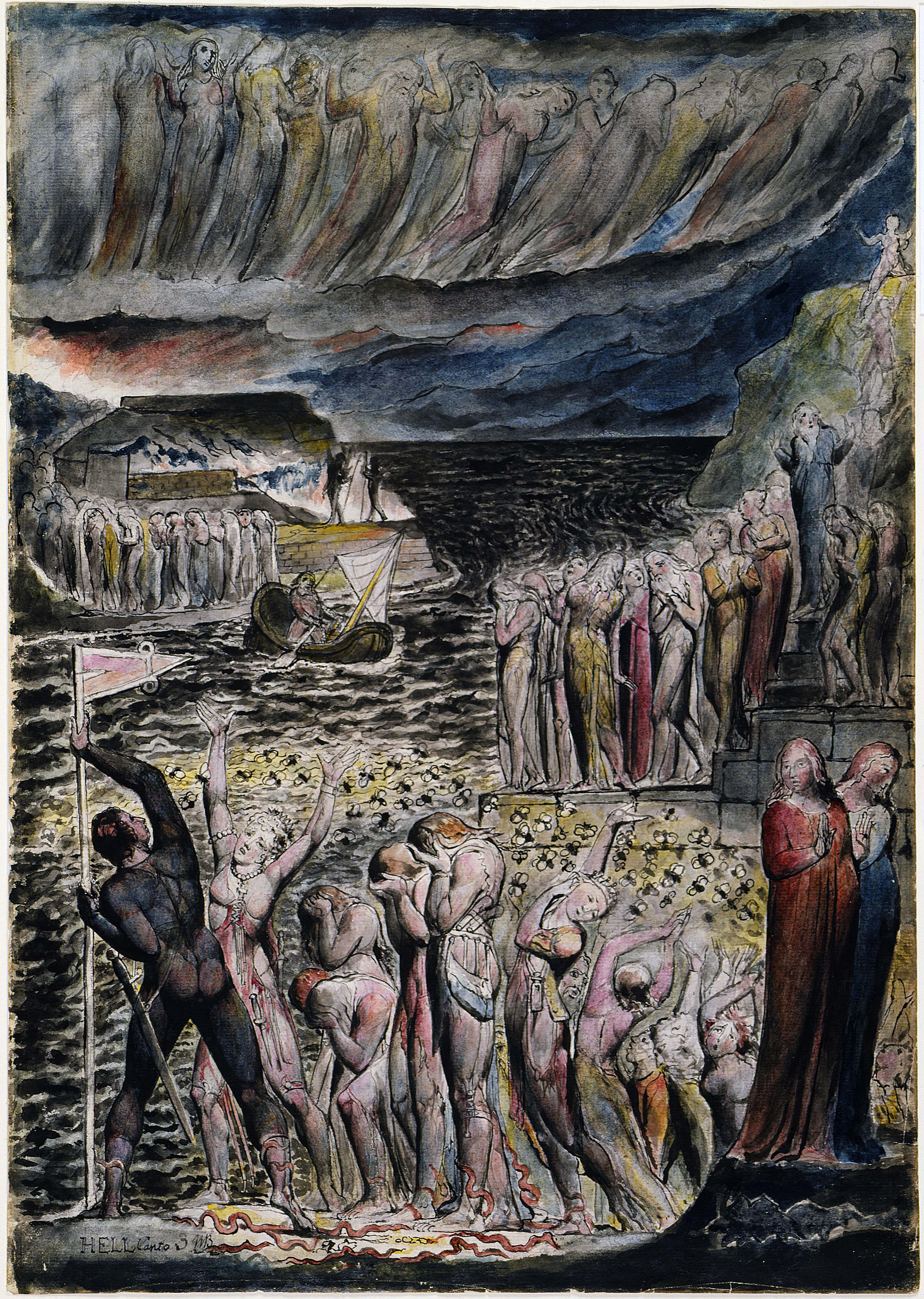
"The Vestibule of Hell and the Souls Mustering to Cross the Acheron"
Plate 5
Dante, Cato III
To enlarge image, right click on picture, select open in a new window, move cursor around picture to show detail. Close window to return.
 

Blake and Dante were at opposite poles in regard to their understanding of the nature of God. Blake reached the conclusion that God's love could reconcile the world to himself. Dante perceived of a God of vengeance who related to humanity by devising punishments for man's transgressions. Although Blake recognized Dante as a  gifted poet who was capable of receiving visions, he objected to the way Dante understood God. When Blake was commissioned to illustrate the Divine Comedy, he undertook it with enthusiasm but with reservations. Blake used his illustrations to show the punishments that Dante had imagined for his enemies and for those who had broken the rules of their society. He also showed how perverse were the tortures which Dante devised.

Blake's illustration for Canto III which he created with a high degree of skill and thought, illustrates the classical final step of the entry into Hell of those who deserve to experience the torments of Hell - the crossing of the river Acheron . Those who have not received the grace of Baptism remain in the limbo of neither enduring Hell of being received in Heaven.

Across the top of the picture are the angels who had not joined either side in the war in Heaven which Milton described in Paradise Lost. On the right side are the individuals who have not aligned themselves with either good of evil in their journey through life, either through not being Baptized by the Church or by being indecisive. Those in the foreground are those whom Dante places in the category of individuals whose sinfulness makes them unfit for Heaven until punishment (torture) induces repentance.

Blake knew that struggles took place within individuals, between the forces of good and evil, between life and death, between Eternity and the fallen world. Blake pursued the theme that mankind was capable of regeneration through casting off error and assimilating truth: that Truth when revealed in the depth of the soul is irresistible.

However, like Dante, Blake saw the danger of being wishy-washy of being immersed in the lake of Udan-Adan which he called a "Lake not of Waters but of Spaces Perturbd black & deadly." Blake took great stock in the definite. To be defined and organized and articulated is the condition of men who are aware of their own Eternal being and that of their fellow men.

S. Foster Damon, A Blake Dictionary
"Udan-Adan
The condition of formlessness, of the indefinite."

Milton Klonsky, Blake's Dante, Page 138
"Drifting aimlessly across the sky are the feckless and pusillanimous angels who refused to take sides in the civil war in Heaven between God and Satan."

Descriptive Catalogue, (E 541)
"A Spirit and a Vision are not, as the modern philosophy supposes, a cloudy vapour or a nothing: they are organized and minutely articulated beyond all that the mortal and perishing nature can produce. He who does not imagine in stronger and better lineaments, and in stronger and better light than his perishing mortal eye can see does not imagine at all. The painter of this work asserts that all his imaginations appear to him infinitely more perfect and more minutely organized than any thing seen by his mortal eye. Spirits are organized men."

Annotations to Watson
, (E 613) "The Man who pretends to be a modest enquirer into the truth of a self evident thing is a Knave The truth & certainty of Virtue & Honesty i.e Inspiration needs no one to prove it it is Evident as the Sun & Moon He who stands doubting of what he intends whether it is Virtuous or Vicious knows not what Virtue means. no man can do a Vicious action & think it to be Virtuous. no man can take darkness for light. he may pretend to do so & may pretend to be a modest Enquirer. but is a Knave" Jerusalem, Plate 5 (E 148) "But all within is open'd into the deeps of Entuthon Benython A dark and unknown night, indefinite, unmeasurable, without end. Abstract Philosophy warring in enmity against Imagination (Which is the Divine Body of the Lord Jesus. blessed for ever)."
Jerusalem, Plate 7, (E 149)
"They put forth their spectrous cloudy sails; which drive their 
Constellations over the deadly deeps of indefinite Udan-Adan
Kox is the Father of Shem & Ham & Japheth, he is the Noah
Of the Flood of Udan-Adan".

Jerusalem, Plate 55, (E 205)
"And the voices of the Living Creatures were heard in the clouds of heaven
Crying: Compell the Reasoner to Demonstrate with unhewn Demonstrations
Let the Indefinite be explored. and let every Man be judged
By his own Works, Let all Indefinites be thrown into Demonstrations
To be pounded to dust & melted in the Furnaces of Affliction:
He who would do good to another, must do it in Minute Particulars 
General Good is the plea of the scoundrel hypocrite & flatterer:
For Art & Science cannot exist but in minutely organized Particulars
And not in generalizing Demonstrations of the Rational Power.
The Infinite alone resides in Definite & Determinate Identity
Establishment of Truth depends on destruction of Falshood continually    
On Circumcision: not on Virginity, O Reasoners of Albion

So cried they at the Plow. Albions Rock frowned above
And the Great Voice of Eternity rolled above terrible in clouds
Saying Who will go forth for us! & Who shall we send before our face?"

Jerusalem, Plate 80, (E 237)
"And Rahab like a dismal and indefinite hovering Cloud
Refusd to take a definite form. she hoverd over all the Earth
Calling the definite, sin: defacing every definite form;"

Letters, to Cumberland, (E 783)
"For a Line or Lineament is not formed by Chance a Line is a Line in its
Minutest Subdivision[s] Strait or Crooked It is Itself & Not
Intermeasurable with or by any Thing Else Such is Job but since
the French Revolution Englishmen are all Intermeasurable One by
Another Certainly a happy state of Agreement to which I for One
do not Agree.  God keep me from the Divinity of Yes & No too The
Yea Nay Creeping Jesus from supposing Up & Down to be the same
Thing as all Experimentalists must suppose"

Four Zoas, Night IV, PAGE 52, (E 334) "I will compell thee to rebuild by these my furious waves Death choose or life thou strugglest in my waters, now choose life And all the Elements shall serve thee to their soothing flutes"

Revelation 3
[15] I know thy works, that thou art neither cold nor hot: I would thou wert cold or hot.
[16] So then because thou art lukewarm, and neither cold nor hot, I will spue thee out of my mouth.
[17] Because thou sayest, I am rich, and increased with goods, and have need of nothing; and knowest not that thou art wretched, and miserable, and poor, and blind,
and naked:


2nd Corinthians 5
[18] And all things are of God, who hath reconciled us to himself by Jesus Christ, and hath given to us the ministry of reconciliation;
[19] To wit, that God was in Christ, reconciling the world unto himself, not imputing their trespasses unto them; and hath committed unto us the word of reconciliation.

Divine Comedy
Inferno
Cato III
"Then looking farther onwards I beheld
A throng upon the shore of a great stream:
Whereat I thus: "Sir! grant me now to know
Whom here we view, and whence impell'd they seem
So eager to pass o'er, as I discern
Through the blear light?"  He thus to me in few:
"This shalt thou know, soon as our steps arrive
Beside the woeful tide of Acheron."
...
Then with eyes downward cast and fill'd with shame,
Fearing my words offensive to his ear,
Till we had reach'd the river, I from speech
Abstain'd.  And lo! toward us in a bark
Comes on an old man hoary white with eld,
...
Then all together sorely wailing drew To the curs'd strand, that every man must pass Who fears not God. Charon, demoniac form, With eyes of burning coal, collects them all, ...
Thus go they over through the umber'd wave, And ever they on the opposing bank Be landed, on this side another throng Still gathers. "Son," thus spake the courteous guide, "Those, who die subject to the wrath of God, All here together come from every clime, And to o'erpass the river are not loth: For so heaven's justice goads them on, that fear Is turn'd into desire. Hence ne'er hath past Good spirit. If of thee Charon complain, Now mayst thou know the import of his words." ...
Then to me The gentle guide: "Inquir'st thou not what spirits Are these, which thou beholdest? Ere thou pass Farther, I would thou know, that these of sin Were blameless; and if aught they merited, It profits not, since baptism was not theirs, The portal to thy faith. If they before The Gospel liv'd, they serv'd not God aright; And among such am I. For these defects, And for no other evil, we are lost;"


Sunday, April 18, 2021

BIOGRAPHY 6

From Chapter 1 of Larry's book Ram Horn'd With Gold.

  Jerusalem

      The primary monument of Blake - the new man - is the epic poem, 'Jerusalem'. The old man wrote of fallenness; the new man continues to describe the world as it is, but the note of grace runs like a thread through all the hell of fallen life and leads us out in the last pages into heaven. 'Jerusalem' is for the reader who knows Blake; he can rejoice. Others are well advised not to invest much in the poem until they have some grounding in Blake's myth and his symbolic language. However any reader acquainted with the Book of Revelation may find joy in Blake's closing vision of the end of time and the moral principle upon which it rests.

       Apocalyptic yearnings were the staple diet of the religious radical mind and the school which Blake most nearly approached. After his awakening in 1800 his vision of apocalypse was fleshed out and glorified by his positive faith in Jesus, who died for our sins. He saw all the fallenness fall away like a cloud when following Jesus' example of self giving love.

Jerusalem, Plate 96, (E 256)

"Jesus said. Wouldest thou love one who never died
For thee or ever die for one who had not died for thee
And if God dieth not for Man & giveth not himself           
Eternally for Man Man could not exist. for Man is Love:
As God is Love: every kindness to another is a little Death
In the Divine Image nor can Man exist but by Brotherhood

So saying. the Cloud overshadowing divided them asunder
Albion stood in terror: not for himself but for his Friend     
Divine, & Self was lost in the contemplation of faith
And wonder at the Divine Mercy & at Los's sublime honour

Do I sleep amidst danger to Friends! O my Cities & Counties
Do you sleep! rouze up! rouze up. Eternal Death is abroad

So Albion spoke & threw himself into the Furnaces of affliction 
All was a Vision, all a Dream: the Furnaces became
Fountains of Living Waters Howing from the Humanity Divine
And all the Cities of Albion rose from their Slumbers, and All
The Sons & Daughters of Albion on soft clouds Waking from Sleep
Soon all around remote the Heavens burnt with flaming fires    
And Urizen & Luvah & Tharmas & Urthona arose into
Albions Bosom: Then Albion stood before Jesus in the Clouds
Of Heaven Fourfold among the Visions of God in Eternity"

British Museum
Jerusalem
Plate 76

No one has ever looked more deeply into the evil of the world and discovered so glorious an outcome. It has cheered all of the sorrowful who have known Blake, and it will cheer many more in the future. It's in this that he most vividly resembled his Lord, who suffered crucifixion and death and gave back life and love.

Wikipedia Commons
Illustrations of the Book of Job
Plate 18

With the completion of 'Jerusalem' Blake's poetic work was done, but his crowning work of art came in a series of pictures created as Illustrations of the Book of Job. That Biblical work has mystified many through the ages, and many diverse interpretations of it have been offered. Blake seized upon it for one last telling of his story. A picture is worth a thousand words, and these 21 pictures speak with simple eloquence of the man who had the whole world, saw it turn to ashes, and saw a new and better world take its place. In the course of these events Job's vision of God turned to Satan, and a new and more real vision took its place. The most vivid image for me is the picture and moment when Job and his wife intently watch Satan falling from Heaven and by his side fall two small figures who may be identified as old Job and old wife; two new creatures have taken their place. These pictures merit much study, and they yield a simple but profound understanding of Blake's life and myth, and, if he is right, the life of every man and of the world.

In his last years a small group of liberal and progressive artists gathered around Blake, and he at last enjoyed a modest measure of that human acceptance which had eluded him for most of his life. John Linnell assumed the loving care supplied in earlier days by Thomas Butts; all but two of our last series of letters are addressed to this young artist and his wife. Illness overtook Blake in 1826, but he remained in high spirits and had a song of praise on his lips, an original of course, at the moment of his departure from this world.

1 John 4
[11] Beloved, if God so loved us, we ought also to love one another.
[12] No man hath seen God at any time. If we love one another, God dwelleth in us, and his love is perfected in us.
[13] Hereby know we that we dwell in him, and he in us, because he hath given us of his Spirit.