Saturday, May 13, 2023

ENERGY AND ARCHETYPE

Wikipedia Commons
Book of Urizen
Plate 8, Copy G

This study of Blake's The Four Zoas is available on the internet. If you are interested in the relationship between the thought of William Blake and that of Carl Jung you may find it enlightening.

ENERGY AND ARCHETYPE: A JUNGIAN ANALYSIS OF
THE FOUR ZOAS BY WILLIAM BLAKE

August, 1974

By Lee T. Hamilton 

"The purpose of this study is to examine the parallels between the tenets of Carl Jung's psychology and the mythopoeic structure of Blake's poem, The Four Zoas." 

From the second section of the thesis which is a detailed analysis of the poem, read quotes from the study hightlighted in blue. 

Night One of The Four Zoas

reason to emotion

Page 39

The song tells how Luvah, the Feeling function, and his anima, Vala,
sought to depose Urizen in his role as the Thinking function. Luvah, like Phaethon, stole the horses of Intellect and drove Urizen's chariot across the vault of consciousness.

"The Fallen Man takes his repose, Urizen sleeps in the porch,
"Luvah and Vala wake & fly up from the Human Heart
"Into the Brain from thence; upon the pillow Vala slumbered,

Page 40 

"And Luvah siez'd the Horses of Light & rose
into the Chariot of Day. (Keynes, p. 271

 ...

The original fall was a fall from undifferentiated psychic content into differentiation, or from unconsciousness into consciousness.

reason declares himself God

Page 41

Urizen descends and declares himself "God from Eternity to Eternity" (Keynes, p. 273).  

This is the "hybris of consciousness" which Jung said is the chief failure of
modern man and against which Blake constantly inveighed. It is the hybris of consciousness to pretend that everything derives from its primacy,
despite the fact that consciousness itself demonstrably comes from an older unconscious psyche. (Jung, X, 443)

intuition joins with reason 

Page 43

The Divine Providence which oversees all of the events of the poem appears above the feast as "One Man," a symbol of unity and integration. The One Man is later identified as Jesus.

... 

 At the feast, Los and Enitharmon eat "the fleshly bread" and drink "the nervous wine" (Keynes, p. 274). These eucharistic elements symbolize communion with the temporal world, the world of Urizen. Any communion with the temporal world is an act of union with the world of Urizen. Any communion is an act of integration with God (June, IX, pt. 2, 144). Therefore, by partaking of the elements of the communion, Los and Enitharmon are symbolically integrated with Urizen and his fallen world;
this is a loss of Vision.

intuition takes lead

Page 44

The scene now shifts to Eden where the Council of God
meets,
"As one Man,
& that One Man
They call Jesus the Christ, & they in him & he in them
Live in Perfect harmony, in Eden the land of life."
(Keynes, p. 277)

This is the self, the suprapersonal entity that oversees and guides psychic life. It is a God-image and cannot be distinguished from the role of the self. Here is the "Hand Divine" that guides the events of the poem, the process of psychic integration that orders and unifies the disparate
elements of psychic life. 

 Page 44

The messengers from Beulah enter and report Albion's
fall from Beulah. Their version of the second fall emphasizes
a conspiracy between Urizen and Luvah as the cause of the
fall from Beulah. The debate between Urizen and Luvah seems
to foreshadow subsequent events. This debate reveals the
two rational functions arguing with one another over the
question of who will be the dominant one.

 Page 45

The second night begins as Albion loses his Divine Vision and abdicates power to the Thinking function, Urizen. 

Albion abdicates to Urizen

Page 46 

The Divine Vision is the unity of all things, the perception of the unity of multeity. By turning his eyes "outward to Self" (Keynes, p. 280), Albion loses the Divine Vision. Blake's "Self" should not be confused with Jung's self. Blake means that Albion turns away from the internal unity of the Vision by directing his newly differentiated powers of consciousness
to the outer world of materiality.
Here Blake means selfhood or ego-consciousness by the term "Self." By turning vision "outward," the separation of the subjective from the objective, of Self from non-Self, is achieved. Albion substitutes the rule of Reason or Intellect for the unifying
and controlling influence of the Jungian self which normally oversees the psyche. 

He gives the scepter of power to Urizen, who rises from the marriage feast of Los and Enitharmon and exults in his new power, but his exultation is short-lived. He is sobered by the vision of the "Abyss," which is the unconscious.

To be continued in the next post.

Wednesday, May 10, 2023

Destination

First posted April 2019.

This is an extract from Chapter Five (GOD) of Ram Horn'd With Gold by Larry Clayton.

Yale Center for British Art
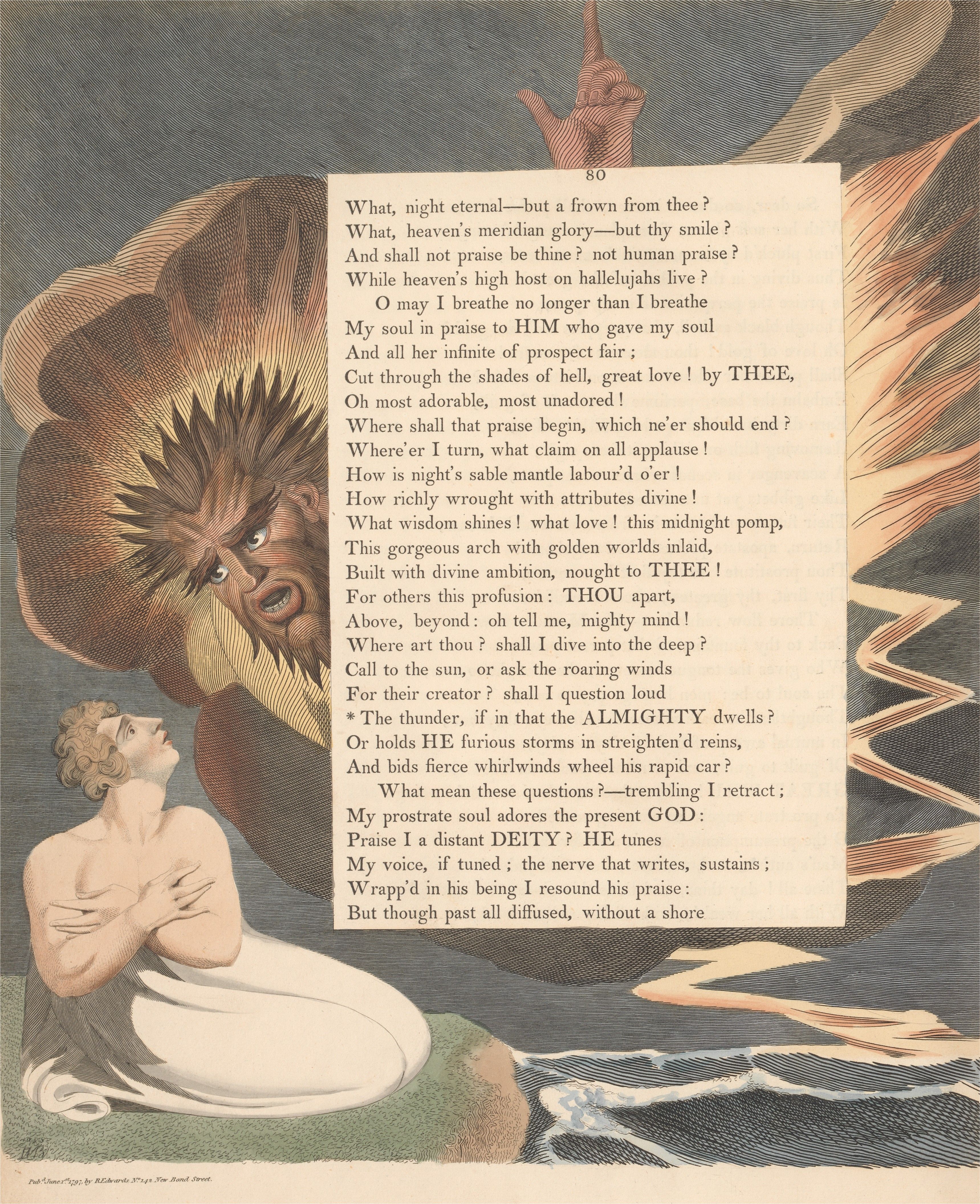
Illustrations to Young's Night Thoughts


The Divine Vision

Throughout this chapter we have followed Blake as he encountered, faced, studied, named, and denounced the false God in the many guises in which he appears to man. This enterprise occupied the first half of his adult life. But during this time he was always aware of something real behind the shadow. As a child he had loved the Lamb:

Songs of Innocence, Song 8, (E 9)
"Little Lamb, who made thee?
Dost thou know who made thee?
Gave thee life, and bid thee feed
By the stream and o'er the mead;

Gave thee clothing of delight,
Softest clothing, wooly, bright;
Gave thee such a tender voice
Making all the vales rejoice?
Little Lamb, who made thee?
Dost thou know who made thee?

Little Lamb, I'll tell thee,
Little Lamb, I'll tell thee:
He is called by thy name,
For he calls himself a Lamb.
He is meek, and he is mild;
He became a little child.
I a child, and thou a lamb,
We are called by his name.
Little Lamb, God bless thee!
Little Lamb, God bless thee!"

As a youth Blake's mind came to be overshadowed by the Tyger. Some interpreters believe that at a certain point he began to see Jesus as misguided: in the 'Song of Los' he wrote that Jesus "received a Gospel from wretched Theotormon". Theotormon symbolizes the legalistic repression of impulse. If Blake did turn away from Jesus, it was by no means an uncommon stage of life for a young man.

Blake always put an ultimate trust in the imaginative power that gave him visions of infinite joy. But at the age of 24 through a failure of consciousness he had chosen a measure of satanic power with a consequent loss of spiritual perception; the Divine Vision faded. There followed the years of struggle with the God of this World, and as we have seen, his experience at Felpham (his "first Vision of Light") led to his definite rejection of the Tempter. In 1803 he returned to London, having prepared himself for an additional grace which shortly fell upon him. In a letter to Hayley dated Oct. 23, 1804 he gave an account of an awesome change that had come into his life:

Letters, To William Hayley, (E 756)
"Suddenly on the day after visiting the Truchsessian Gallery of pictures, I was again enlightened with the light I enjoyed in my youth, and which has for exactly twenty years been closed from me as by a door and by window-shutters."

It's doubtful that he expected Hayley to understand this fully, but we are eternally indebted to both of them for passing it down to us. It marks in a most objective way the return of the Divine Vision, who had been overshadowed by Blake's preoccupation with the God of this World.

The progression of Blake's poetry shows the eclipse of Christ through the long struggle of the nineties. Now he proceeded to introduce the Lamb into 4Z with a group of additional lines at strategic places. These images means relatively little to the secular reader, but cause great joy to the Christian.

The Destination

The healing of Los, described in Night vii of 'The Four Zoas', prepares the way for Christ's coming into history. Night viii tells the story of Jesus: the Incarnation, the Crucifixion, and the Resurrection of the spiritual body. It's important to remember that in Blake's mental world and in his poetry these are psychic rather than historical events.

Blake had always worshiped the Divine Vision. In his twenty years in the wilderness the Divine Vision dimmed and lost the immediacy which had informed the beautiful poems of Innocence. Kathleen Raine points to a few lines that describe with peculiar luminosity this dimming of the Divine Vision:

Jerusalem , Plate 66, (E 219)
"And as their eye & ear shrunk, the heavens shrunk away:
The Divine Vision became First a burning flame [Moses], then a column
Of fire [the Exodus],then an awful fiery wheel surrounding earth and heaven [Ezekiel],
And then a globe of blood wandering distant in an unknown night:" [false Christianity]
 
This describes Blake's personal experience and that of Mankind. But at or after Felpham he recovered the Divine Vision and realized that his name is Jesus.

He spent the rest of his life celebrating the momentous event and the Name and proclaiming its reality in a hundred ways. It had happened to him, and it would happen to the world.

With the ensuing works of art Blake gives us a portrait of Jesus in many ways original. It may prove to be the most vital portrait of Jesus for the present age. The quest for the historical Jesus long ago became a vain enterprise. Every worshiper has endowed the Divine Man with his own highest values, and Blake was no exception. His mature or final portrait of Jesus has four salient features. Three of them expressed convictions that he had held for a lifetime and repeatedly expressed poetically and pictorially. The fourth was a new experience, the touch of grace; it irradiated the first three with glory.
 

Sunday, May 07, 2023

MENTAL TRAVELLER

Wikipedia Commons 

Gates of Paradise - for the Sexes

In the thought of C G Jung the dynamic of individuation involves the ego/self axis which connects the conscious and unconscious functioning of the psyche. The ego, or consciousness, arises from the original state of unconsciousness which is the undifferentiated psyche. Jung calls the total psyche the Self; Blake calls the total psyche Albion.   

Jung and Blake discern that when consciousness develops, the connection between conscious mental processing and the unconscious totality is fractured. This is imaged as the division into the four functions in Jung and into the Four Zoas in Blake. Both men directed their thoughts to the restoration of the psyche as a unified whole which would incorporate the sundered parts and express each without division or competition.

In Blake the Zoa which became dominant was Urizen, the reasoning power of man. In Jung the ego, which acted as the executive of the psyche, was the thinking function. Blake and Jung agree that thought - not emotion, sensation, or intuition - governed the conscious functioning of the psyche.

Blake portrayed the aspects of the psyche which were not dominant as struggling to wrest control from the rational function. This represented a tug of war in the individual as the separate parts sought expression. Luvah, Tharmas and Los battled with Urizen until the Eternal form of Los - Urthona - brought all into a unity as it was in the unconscious before the psyche interacted with the external world.

The parallel process took place in Jung's system. The divided psyche which was under control of the rational mind reconnected with the unified unconscious called the Self. Through the process of individuation the ego experienced that the totality of the psyche was the Self and the ego was drawn back into the greater reality.   

Blake discerned that the ultimate reconciliation restored to man the ability to perceive the Infinite Eternal Divine. Jung expressed the resolution of the process of restoring wholeness to the psyche in terms of the ego gradually subordinating itself to the completeness of the Self which was as close to a God-image as Jung went.

************************************     

Jerusalem, Plate 27, (E 171)
"You have a tradition, that Man anciently containd in his mighty
limbs all things in Heaven & Earth: this you recieved from the
Druids.
  'But now the Starry Heavens are fled from the mighty limbs of
Albion'" 

Milton, Plate 29 [31], (E 127)

"The Sky is an immortal tent built by the Sons of Los
And every Space that a Man views around his dwelling-place:
Standing on his own roof, or in his garden on a mount
Of twenty-five cubits in height, such space is his Universe;
And on its verge the Sun rises & sets. the Clouds bow
To meet the flat Earth & the Sea in such an orderd Space:
The Starry heavens reach no further but here bend and set        
On all sides & the two Poles turn on their valves of gold:
And if he move his dwelling-place, his heavens also move.
Wher'eer he goes & all his neighbourhood bewail his loss:
Such are the Spaces called Earth & such its dimension:
As to that false appearance which appears to the reasoner,       
As of a Globe rolling thro Voidness, it is a delusion of Ulro
The Microscope knows not of this nor the Telescope. they alter
The ratio of the Spectators Organs but leave Objects untouchd
For every Space larger than a red Globule of Mans blood.
Is visionary: and is created by the Hammer of Los                
And every Space smaller than a Globule of Mans blood. opens
Into Eternity of which this vegetable Earth is but a shadow:
The red Globule is the unwearied Sun by Los created
To measure Time and Space to mortal Men. every morning.
Four Zoas, Night IX, Page 121,(E 391) 
"And the Eternal Man Said Hear my words O Prince of Light  
PAGE 122 
Behold Jerusalem in whose bosom the Lamb of God
Is seen tho slain before her Gates he self renewd remains
Eternal & I thro him awake to life from deaths dark vale
The times revolve the time is coming when all these delights
Shall be renewd & all these Elements that now consume            
Shall reflourish. Then bright Ahania shall awake from death
A glorious Vision to thine Eyes a Self renewing Vision" 
Four Zoas, Night IX, Page 133, (E 402)
"Not for ourselves but for the Eternal family we live
Man liveth not by Self alone but in his brothers face            
Each shall behold the Eternal Father & love & joy abound

So spoke the Eternal at the Feast they embracd the New born Man
Calling him Brother image of the Eternal Father. they sat down
At the immortal tables sounding loud their instruments of joy
Calling the Morning into Beulah the Eternal Man rejoicd   
Four Zoas, Night IX, Page 136, (E 404)
"This dreadful Non Existence is worse than pains of Eternal Birth  
Eternal Death who can Endure. let us consume in fires
In waters stifling or in air corroding or in earth shut up
The Pangs of Eternal birth are better than the Pangs of Eternal Death"

Thursday, May 04, 2023

Death

Blake Archive 
Illustrations to The Grave
Designed by Blake engraved by Schiavonetti
 First posted March 2019
 
This is an extract from Chapter Two of Ram Horn'd With Gold by Larry Clayton. 
 
 If its visions of love express the quality of a culture, so also does the face which it presents to death. Our society expends enormous sums on the professional removal of all evidence of death from our consciousness, even in the teeth of the stark reality. Ernest Becker, in The Denial of Death, showed the ubiquity of this impulse in American culture. His title, a poetic term, can just as easily mean one thing as the other. Like all symbols of value we encounter good denials of death and bad ones.
  
The poetry of Walt Whitman expresses one of the best. Like our poet Whitman was so sure of Eternity that the end of natural life had no terrors for him. He gained first hand experience with death as a hospital volunteer during the Civil War. Exceptionally memorable is his address to a dying soldier, "I don't commiserate, I congratulate you". Here is the exact opposite of the forms of denial most often exercised by the mortician, who simply does all he can to encourage us not to think about it.

In one of his earliest writings Blake explored the meaning of death to an ordinary young man and his loved ones. The Couch of Death (Erdman 441) voices the common fears of humanity but moves to the faithful reality that Blake possessed throughout his days, ending "and the youth breathes out his soul with joy into eternity".
Couch of Death 
"...Sorrow linked them together,
leaning on one another's necks alternately--like lilies, dropping
tears in each other's bosom, they stood by the bed like reeds
bending over a lake, when the evening drops trickle down.  His
voice was low as the whisperings of the woods when the wind is
asleep, and the visions of Heaven unfold their visitation. 
Parting is hard, and death is terrible; I seem to walk through a
deep valley, far from the light of day, alone and comfortless!
The damps of death fall thick upon me! Horrors stare me in the
face! I look behind, there is no returning; Death follows after
me; I walk in regions of Death, where no tree is; without a
lantern to direct my steps, without a staff to support me."  
Blake's idealism found expression in the simple inversion of death, an idea that goes back as far as Heraclitus, who speaking of the Eternals said, "we live their death, and we die their life". The thought comes down to us through Euripides, Plato, and many others as late as Thomas Wolfe.
 
Most often when Blake speaks of "Death Eternal" he expresses the viewpoint of the Eternals; they meant by the term "this mortal life". Three times in Plate 14 of Milton the poet in Heaven, having heard the "Bard's Song" about Satan and recognizing Satan as his own Self- hood, says, "I go to Eternal Death!". He clearly means to return to this world, reenacting the kenosis (self emptying) of Christ.

Otherwise Blake used the word 'death' more straightforwardly than he had used 'love' and in two general senses. In fairly common parlance death is the opposite of the creative. Speaking of the Law in 'Jerusalem' the Divine Voice says:
"No individual can keep these Laws, for they are death To every energy of man and forbid the springs of life."

If you read Paul's epistles, you will discover that he used 'death' in the same ways. For example "And you hath he quickened, who were dead in trespasses and sins" (Ephesians 2:1). Paul is always reminding the Christian that he participates in the death and resurrection of Christ.

Secondly, Blake used 'death' in its most proper sense as the end of mortal life, but whenever he touched this subject, he always denied the materialistic viewpoint that death is the end. A clear example comes in Gates of Paradise, a short synoptic and pictorial description of Blake's myth of life:
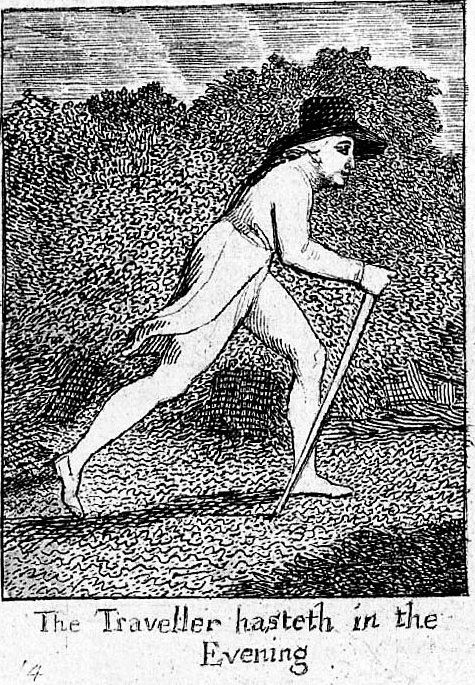
" But when once I did descry The Immortal Man that cannot Die, Thro' evening shades I haste away To close the Labours of my Day."

Though he lived intensely, the love of the Ideal and his life long visions of Eternity led Blake to yearn for the Beyond and to depreciate material existence. Like the apostle Paul he had a "desire to depart, and to be with Christ; which is far better". Blake made a deliberate attempt through the aid of the doctrine of correspondences to live each moment of earthly life in the eternal realm, "to see a World in a Grain of Sand". Expressed negatively,
"I assert for My Self that I do not behold the outward Creation & that to me it is hindrance & not Action; it is as the Dirt upon my feet, No part of Me."

And as stated in CHAPTER ONE he died with a song of praise on his lips. His life and all his art provide a convincing testimony for the reality of the Beyond. It was really Death that was "Dirt upon his feet".

Finally Blake used 'death' in the uniquely Christian context of self giving. At the end of 'Jerusalem' Jesus explains to Albion the meaning of his own death and its significance as a universal form of relationship:
      "...Fear not Albion: unless I die thou canst not live;
But if I die I shall arise again & thou with me.
This is Friendship & Brotherhood: without it Man is Not. ...
....Wouldest thou love one who never died
For thee, or ever die for one who had not died for thee?
And if God dieth not for Man & giveth not himself
Eternally for Man, Man could not exist; for Man is Love
As God is Love; every kindness to another is a little Death 
In the Divine Image, nor can Man exist but by Brotherhood."

*************************************
     These explorations of 'love' and 'death' may help the reader to grasp some of the poetic meanings attached to Blake's other terms of value, words like heaven and hell, good and evil, truth and error. Always watch for irony, for the other point of view, the reverse side of the coin. In such ways Blake continually provokes the intellect. He delights the person who enjoys an intellectual challenge--and frustrates others. He intimated as much in a letter to Dr. Trusler, who likely belonged to the second category:
" But you ought to know that What is Grand is necessarily
obscure to Weak men. That which can be made Explicit to
the Idiot is not worth my care. The wisest of the Ancients
consider'd what is not too Explicit as the fittest for
Instruction, because it rouzes the faculties to act. I
name Moses, Solomon, Esop, Homer, Plato."
 

Monday, May 01, 2023

10 QUOTES EIGHTH

Yale Center for British Art
Jerusalem
Plate 6

 *

I have Mental Joy & Mental Health
And Mental Friends & Mental wealth     
Ive a Wife I love & that loves me
Ive all But Riches Bodily
* 

"I am not a God afar off, I am a brother and friend;
Within your bosoms I reside, and you reside in me:

* 

"I am in Gods presence night & day    
And he never turns his face away"
* 

Seek Love in the Pity of others' Woe,
In the gentle relief of another's care,
In the darkness of night & the winter's snow,
In the naked & outcast, Seek Love there!"
 

*
And all must love the human form,
In heathen, turk or jew.
Where Mercy, Love & Pity dwell,
There God is dwelling too  
*
I must Create a System, or be enslav'd by another Mans           
I will not Reason & Compare: my business is to Create 
*
Giving a body to Falshood that it may be cast off for ever.
*
One Error not remov'd, will destroy a human Soul
Repose in Beulahs night, till the Error is remov'd 
* 
What are all the Gifts of the
Spirit but Mental Gifts whenever any Individual Rejects Error &
Embraces Truth a Last Judgment passes upon that Individual
*
When the Sun rises  do  you  not  see  a  round 
Disk of fire somewhat like a Guinea   O no no I see an Innumerable
company of the Heavenly host crying Holy Holy Holy is the Lord
God Almighty 
*