Monday, December 22, 2025

NATIVITY ODE 4

Repost from December 2009

Wikipedia Commons
Illustration to Milton's Nativity Ode 
Object 4, Thomas Set
The Overthrow of Apollo and the Pagan Gods

It was in 1629 when John Milton was 21 years old that he wrote the first of his poems in English. His earlier poems were written in Latin or Greek. The first and last sections of On the Morning of Christ's Nativity  deal with the birth of the Christ Child and the longer middle section gives accounts of the expulsion of pagan gods. This represents a movement in Milton's interest, and in the subject matter of his study and reading. His academic career had emphasized classical literature although he was well acquainted with the Bible. Reaching the age of maturity, he turned away from pagan religious figures which had been objects of devotionion in earlier civilizations, and toward describing the life of Christ, 

Blake made two sets of six illustration for On the Morning of Christ's Nativity In 1809 he was comissioned to make a set for Rev. Joseph Thomas; between 1811 and 1820 he completed a set for his most loyal patron, Thomas Butts.

Blake in his characteristic way, saw the birth of Christ as part of the larger picture, as did Milton. The Bible, John Milton, the history of religion, cosmology, and his own myth; each play a role in Blake's response to Jesus' birthday.

"On the Morning of Christ's Nativity"

The Blake Archive provides this in its introduction to "On the Morning of Christ's Nativity:"
"Blake's interest in the 'Nativity Ode' began some years before his execution of these water colors. His illuminated book, Europe a Prophecy (1794), clearly shows the influence of Milton's ode. By 1809, Blake may have taken a renewed interest in the poem because of his increasingly Christocentric theological views. His harsh criticism of classical civilization resonates with two of the 'Nativity' designs, 'The Old Dragon' and 'The Overthrow of Apollo and the Pagan Gods' (objects 3 and 4). Modern critics have been hard pressed to find Blake dissenting from Milton's own iconography and perspectives in the ode."

Milton, Nativity Ode
XIX.
The Oracles are dumm,
No voice or hideous humm
Runs through the arched roof in words deceiving.
Apollo from his shrine
Can no more divine,
With hollow shreik the steep of Delphos leaving.

No nightly trance, or breathed spell,
Inspires the pale-ey'd Priest from the prophetic cell.
...
The brutish gods of Nile as fast, 
Isis and Orus, and the Dog Anubis hast.
XXIV 
Nor is Osiris seen 
In Memphian Grove, or Green, 
Trampling the unshowr'd 
Grasse with lowings loud: 
Nor can he be at rest 
Within his sacred chest, 
Naught but profoundest 
Hell can be his shroud
In vain with Timbrel'd Anthems dark 
The sable-stoled Sorcerers bear his worshipt Ark. 

Europe a Prohecy,  Plate 2, (E61)
"Ah! I am drown'd in shady woe, and visionary joy.

And who shall bind the infinite with an eternal band?
To compass it with swaddling bands? and who shall cherish it
With milk and honey?
I see it smile & I roll inward & my voice is past.

She ceast & rolld her shady clouds
Into the secret place.
Plate 3
A PROPHECY
The deep of winter came;
What time the secret child,
Descended thro' the orient gates of the eternal day:
War ceas'd, & all the troops like shadows fled to their abodes."
Jerusalem, Plate 55, (E 205)
"Then far the greatest number were about to make a Separation     
And they Elected Seven, calld the Seven Eyes of God;
Lucifer, Molech, Elohim, Shaddai, Pahad, Jehovah, Jesus.
They namd the Eighth. he came not, he hid in Albions Forests"
Jerusalem, Plate 37 [41], (E 137)
"And these their Names & their Places within the Mundane Shell
In Tyre & Sidon I saw Baal & Ashtaroth. In Moab Chemosh          
In Ammon, Molech: loud his Furnaces rage among the Wheels
Of Og, & pealing loud the cries of the Victims of Fire!
And pale his Priestesses infolded in Veils of Pestilence, border'd
With War; Woven in Looms of Tyre & Sidon by beautiful Ashtaroth.
In Palestine Dagon, Sea Monster! worshipd o'er the Sea.      
Thammuz in Lebanon & Rimmon in Damascus curtaind
Osiris: Isis: Orus: in Egypt: dark their Tabernacles on Nile
Floating with solemn songs, & on the  Lakes of Egypt nightly
With pomp, even till morning break & Osiris appear in the sky
But Belial of Sodom & Gomorrha, obscure Demon of Bribes
And secret Assasinations, not worshipd nor adord; but 
With the finger on the lips & the back turnd to the light
And Saturn Jove & Rhea of the Isles of the Sea remote
These Twelve Gods. are the Twelve Spectre Sons of the Druid Albion "

Thursday, December 18, 2025

NATIVITY ODE 3

Wikipedia Commons
Illustration to Milton's Nativity Ode 
Object 3, Butts Set
The Old Dragon

Seven Headed Dragon

Revelation 12

[1] And there appeared a great wonder in heaven; a woman clothed with the sun, and the moon under her feet, and upon her head a crown of twelve stars:
[2] And she being with child cried, travailing in birth, and pained to be delivered.
[3] And there appeared another wonder in heaven; and behold a great red dragon, having seven heads and ten horns, and seven crowns upon his heads.
[4] And his tail drew the third part of the stars of heaven, and did cast them to the earth: and the dragon stood before the woman which was ready to be delivered, for to devour her child as soon as it was born.
[5] And she brought forth a man child, who was to rule all nations with a rod of iron: and her child was caught up unto God, and to his throne.
[6] And the woman fled into the wilderness, where she hath a place prepared of God, that they should feed her there a thousand two hundred and threescore days.
[7] And there was war in heaven: Michael and his angels fought against the dragon; and the dragon fought and his angels,
[8] And prevailed not;
neither was their place found any more in heaven.
[9] And the great dragon was cast out, that old serpent, called the Devil, and Satan, which deceiveth the whole world: he was cast out into the earth, and his angels were cast out with him.
[10] And I heard a loud voice saying in heaven, Now is come salvation, and strength, and the kingdom of our God, and the power of his Christ: for the accuser of our brethren is cast down, which accused them before our God day and night.

Milton and Blake affirm the tale told by John of Patmos in the Book of Revelation. The birth of the Christ child initiated the coming of salvation, however the opposition to God's initative would continue until God makes 'all things new'. The Dragon as a form of Satan was followed by a third of the angels out of heaven. The defeat of the forces of Satan by Michael and his angels forced them into the earth but did not destroy them. 

John's account of the struggle continued until the new Jerusalem came down from God out of heaven. Only those whose names are 'written in the Lamb's book of life' would enter therein.

Revelation Chapter 21

[22] And I saw no temple therein: for the Lord God Almighty and the Lamb are the temple of it.
[23] And the city had no need of the sun, neither of the moon, to shine in it: for the glory of God did lighten it, and the Lamb is the light thereof.
[24] And the nations of them which are saved shall walk in the light of it: and the kings of the earth do bring their glory and honour into it.
[25] And the gates of it shall not be shut at all by day: for there shall be no night there.
[26] And they shall bring the glory and honour of the nations into it.
[27] And there shall in no wise enter into it any thing that defileth, neither whatsoever worketh abomination, or maketh a lie: but they which are written in the Lamb's book of life.

On the Morning of Christ's Nativity, XVIII

"And then at last our bliss
Full and perfect is,
   But now begins; for from this happy day
Th'old Dragon under ground,
In straiter limits bound,
Not half so far casts his usurped sway,
And wroth to see his Kingdom fail,
Swings the scaly Horror of his folded tail."

Four Zoas, Page 120, (E 390)

"I will cast thee out              
If thou repentest not & leave thee as a rotten branch to be burnd
With Mystery the Harlot & with Satan for Ever & Ever
Error can never be redeemd in all Eternity
But Sin Even Rahab is redeemd in blood & fury & jealousy
That line of blood that stretchd across the windows of the morning 
Redeemd from Errors power. Wake thou dragon of the Deeps
Page 121 
Urizen wept in the dark deep anxious his Scaly form
To reassume the human & he wept in the dark deep

Saying O that I had never drank the wine nor eat the bread 
Of dark mortality nor cast my view into futurity"


Wednesday, December 17, 2025

NATIVITY ODE 2

Repost from December 2009

GOSPEL OF LUKE
2:8-12 - There were some shepherds living in the same part of the country, keeping guard throughout the night over their flocks in the open fields. Suddenly an angel of the Lord stood by their side, the splendour of the Lord blazed around them, and they were terror-stricken. But the angel said to them, 'Do not be afraid! Listen, I bring you glorious news of great joy which is for all the people. This very day, in David's town, a Saviour has been born for you. He is Christ, the Lord. Let this prove it to you: you will find a baby, wrapped up and lying in a manger.'

2:13-14 - And in a flash there appeared with the angel a vast host of the armies of Heaven, praising God, saying, 'Glory to God in the highest Heaven! Peace upon earth among men of goodwill! 
Wikipedia Commons
Illustrations to Milton's Nativity Ode
Object 2
The Annunciation to the Shepherds

Since the first image we form of ourselves is that of a body, we may formulate the idea that at some point the spirit enters the body and begins to express itself through the body. But as Blake explains here, it is the bodies which are made for the spirits which pre-exist.

As Albion represents the Universal Man, Jerusalem represents the Universal Woman: the 'vast family wondrous in beauty and love.' Albion is fourfold, Jerusalem is unified: the expression of the Divine Vision within the Universal Man. In this passage, Blake presents the idea that redemption begins when 'the Lamb of God' becomes visible within the Unified Spiritual Body which is Jerusalem. The song of the angels, sung when the birth of Jesus was announced to the shepherds, is echoed in Blake's verses at this point.


Four Zoas: Night the Eighth, Page 103 (E376)

"Enitharmon wove in tears Singing Songs of Lamentations
And pitying comfort as she sighd forth on the wind the spectres
And wove them bodies calling them her belovd sons and daughters

Employing the daughters in her looms & Los employd the Sons
In Golgonoozas Furnaces among the Anvils of time & space
Thus forming a Vast family wondrous in beauty & love
And they appeard a Universal female form created
From those who were dead in Ulro from the Spectres of the dead

PAGE 104 (FIRST PORTION)
And Enitharmon namd the Female Jerusalem the holy
Wondring
 she saw the Lamb of God within Jerusalems Veil
The divine Vision seen within the inmost deep recess
Of fair Jerusalems bosom in a gently beaming fire


Then sang the Sons of Eden round the Lamb of God & said
Glory Glory Glory to the holy Lamb of God
Who now beginneth to put off the dark Satanic body

Now we behold redemption Now we know that life Eternal
Depends alone upon the Universal hand & not in us
"

GOSPEL OF LUKE
2:25-32 - In Jerusalem was a man by the name of Simeon. He was an upright man, devoted to the service of God, living in expectation of the 'salvation of Israel'. His heart was open to the Holy Spirit, and it had been revealed to him that he would not die before he saw the Lord's Christ. He had been led by the Spirit to go into the Temple, and when Jesus' parents brought the child in to have done to him what the Law required, he took him up in his arms, blessed God, and said - 'At last, Lord, you can dismiss your servant in peace, as you promised! For with my own eyes I have seen your salvation which you have made ready for every people - a light to show truth to the Gentiles and bring glory to your people Israel.


Monday, December 15, 2025

NATIVITY ODE 1


First posted December 2009

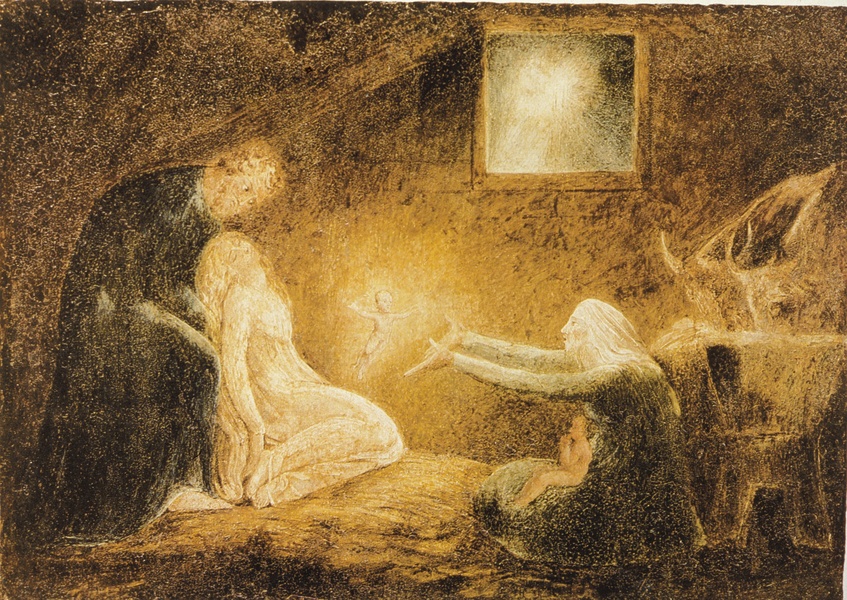
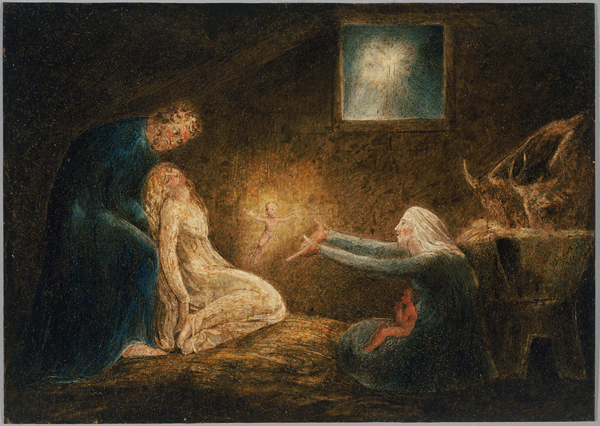
For "On the Morning of Christ's Nativity" by John Milton, Blake made two sets of six watercolor illustrations. There is much to observe. Blake's pictures like Milton's poetry did not focus only on the supplanting of Apollo and heathen gods. The first and last pictures, like the beginning and ending of Milton's poem present a more conventional portrait of the birth of the child based on accounts in the Gospels of Luke and Matthew.


Huntington Collection
Illustrations to Milton's Nativity Ode
Object 1, Butt's Set
Descent of Peace

Blake of course, added distinctive features to his illustrations. In her book Blake's Vision of the Poetry of Milton, Bette Charlene Werner, on page 119 and following, points out some things that speak of Blake's own philosophy. Quoting from her book:

> "With the angelic figure of Peace and the recumbent form of Nature the artist suggests the union of heaven and earth in the Word made flesh.
> the Huntington version of the design emphasizes the divinity, not only of Christ, but also by implication of man.
> The Child is pictured springing forth in unfettered freedom. The figure suggests at once the "Heav'n-born-childe" of Milton's ode and the preexistent soul whose material birth Blake describes in "Infant Sorrow" (E27, SoE48):
"My mother groand! my father wept.
Into the dangerous world I lept."
The Blessed Infant, ablaze with the radiance of spiritual existence, is the light that puts the inferior flame of the sun to shame.
> According to Blake "everything that lives is holy for the source of life / Descends to be a weeping babe." (E323) That understanding may explain his portrayal of Nature here, not as one whose ugliness requires a covering, but as a figure whose naked beauty is still apparent beneath the translucent covering of snow. The veiled form of Nature in this illustration is, like the Vala of Blake's own mythology, an embodiment of the vale of tears and the veil of materiality.
> Like Milton, Blake sees in the Incarnation not only the humility of Christ, emptying himself of his Godhead, but the glorification of man. He identifies Jesus, the Divine Humanity, with Imagination and insists: "Man is All Imagination God is Man & exists in us & we in him." (E664) This understanding makes the Nativity not only the fulfillment of God's becoming man, but a promise of salvation through the spiritual union of all men in in the One Man who is Jesus, the Savior."
End of Quotes

Milton's On the Morning of Christ's Nativity

Thursday, December 11, 2025

THE NATIVITY

Previously posted December 2022

Matthew 1
[18] Now the birth of Jesus Christ was on this wise: When as his mother Mary was espoused to Joseph, before they came together, she was found with child of the Holy Ghost.
[19] Then Joseph her husband, being a just man, and not willing to make her a publick example, was minded to put her away privily.
[20] But while he thought on these things, behold, the angel of the Lord appeared unto him in a dream, saying, Joseph, thou son of David, fear not to take unto thee Mary thy wife: for that which is conceived in her is of the Holy Ghost.
[21] And she shall bring forth a son, and thou shalt call his name JESUS: for he shall save his people from their sins.

Luke 2
[3] And all went to be taxed, every one into his own city.
[4] And Joseph also went up from Galilee, out of the city of Nazareth, into Judaea, unto the city of David, which is called Bethlehem; (because he was of the house and lineage of David:)
[5] To be taxed with Mary his espoused wife, being great with child.
[6] And so it was, that, while they were there, the days were accomplished that she should be delivered.
[7] And she brought forth her firstborn son, and wrapped him in swaddling clothes, and laid him in a manger; because there was no room for them in the inn.

Wikipedia Commons
The Nativity

Blake's tempera image of the Nativity was painted on copper in 1799 for Thomas Butts and belongs to the Philadelphia Museum. An enlargement of the image can be viewed in the Blake Archive.

Most striking in this image is the portrayal of the infant Jesus. The child is seen as a spiritual rather than a physical being. He is not subject to the force of gravity for he is suspended in the air. There is no need for additional light in the stable for he is the source of light which radiates to his surroundings. He has left his father and mother and is moving toward Elizabeth who holds her promised son, the infant John, on he lap. Blake's first illustration to Milton's On the Morning of Christ's Nativity is an expansion of this picture but the all important soaring Christ Child appears in both. In another post he is identified with the weeping babe 


Friday, December 05, 2025

ENION'S LAMENTS

Original in British Library
Four Zoas, Night i
Page 6
Enion Asleep

WHY

Night the First

Four Zoas, Page 17-18 (E 310) Night the First, Line1

Post Lament i

https://ramhornd.blogspot.com/2019/04/lament-i.html


PRICE OF EXPERIENCE

Night the Second

Four Zoas, Page 35-36 (E 324) Night the Second, Line 1

Post Lament ii

https://ramhornd.blogspot.com/2019/04/lament-ii.html


THARMAS I HAVE LOST THEE

Night the Third

Four Zoas, Page 45 (E 329) Night the ThirdLine 2 ff

Post Lament iii

https: //ramhornd.blogspot.com/2019/05/lament-iii.html


MORTAL GENTLY FADES AWAY

Night the Eighth

Four Zoas, Page 113-4 (E 383) Night the Eighth, Line 13 

Post Lament iv

https://ramhornd.blogspot.com/2019/05/lament-iv.html

________________________________________________

Four Zoas, Night III, Page 45, (E 329)
"These are the words of Enion heard from the cold waves of despair

O Tharmas I had lost thee. & when I hoped I had found thee
O Tharmas do not thou destroy me quite but let
A little shadow. but a little showery form of Enion
Be near thee loved Terror. let me still remain & then do thou
Thy righteous doom upon me. only let me hear thy voice           
Driven by thy rage I wander like a cloud into the deep
Where never yet Existence came, there losing all my life
I back return weaker & weaker, consume me not away
In thy great wrath. tho I have sinned. tho I have rebelld
Make me not like the things forgotten as they had not been       
Make not the thing that loveth thee. a tear wiped away

Tharmas replied riding on storms his voice of Thunder rolld" 
Enion, the Emanation of Tharmas or the body, represents the generative instinct. She is the material expression of the instictive functioning of the physical body. Enion flees from Tharmas as a result of their quarrel over his awakening sexual instinct. Before they separate they procreate the infants Los and Enitharmon. Their children form the world by embodying the qualities Time and Space.

In William Blake's Circle of Destiny by Milton O Percival we learn of the cycle which Tharmas and Enion are following:
 
"There are two co-operating principles, one formative and intellectual, the other recipient and material." (Page 257) 

"This is the procession downward and outward - from mind to matter, from light to darkness, from reason to unreason, from the One to the Many. The return procession - upward and inward - recovers, step by step, what has been lost." (Page 259)

"As the Zoas fall, the physical world undergoes changes correspondent to those in the spiritual world. The fall is allegorized. The Divine Vision is replaced by the "Dark Religions"; the eternal world by the mortal world. Enion in her mortal state is the mortal body that "originated with the Fall and was called Death and cannot be removed but by a Last Judgment." As Albion sinks into doubt and unbelief, she descends, as a mental concept, from her spiritual and immortal state as far as nonentity itself, that blank, invisible, intangible, basic matter of ancient metaphysics...In this role she becomes the "dark consumer," an "eternal consummeration," the purveyor of Los's "vegetable fires." But all things are redemed in Christ, his advent brings to Enion the hope of release." (Page 266)

First Corinthians 15
[9] For I am the least of the apostles, that am not meet to be called an apostle, because I persecuted the church of God.
[10] But by the grace of God I am what I am: and his grace which was bestowed upon me was not in vain; but I laboured more abundantly than they all: yet not I, but the grace of God which was with me.
[11] Therefore whether it were I or they, so we preach, and so ye believed.
[12] Now if Christ be preached that he rose from the dead, how say some among you that there is no resurrection of the dead?
[13] But if there be no resurrection of the dead, then is Christ not risen:
[14] And if Christ be not risen, then is our preaching vain, and your faith is also vain.
[15] Yea, and we are found false witnesses of God; because we have testified of God that he raised up Christ: whom he raised not up, if so be that the dead rise not.
[16] For if the dead rise not, then is not Christ raised:
[17] And if Christ be not raised, your faith is vain; ye are yet in your sins.
[18] Then they also which are fallen asleep in Christ are perished.
[19] If in this life only we have hope in Christ, we are of all men most miserable.
[20] But now is Christ risen from the dead, and become the firstfruits of them that slept.
[21] For since by man came death, by man came also the resurrection of the dead.
[22] For as in Adam all die, even so in Christ shall all be made alive.