Showing posts with label ARCHETYPE. Show all posts

Wednesday, August 23, 2023

BLAKE'S ARCHETYPES

Wikipedia Commons
America 
Plate 10 
 
When we attempt to understand how our own psyches are structured we realize that our reasoning power developed upon a pre-existing capability of which the reason has no knowledge. The 'form' on which the subsequent development built is called by Jung 'archetypes'. For the psyche to reach its maximum state the individual has the task of recognizing what is hidden from his conscious mind in the archetypes.
 
Jung postulates that the form of the archetypes are inborn. The brain of each individual is organized in such a way that awareness of similar archetypes is common to us all. As the mind becomes aware of the patterns which are innate they become filled with content from the experience of the individual.  
  
Four Archetypes, CG Jung 
Page 1

"There is an a priori factor in all human activities, namely the inborn, preconscious and unconscious individual structure of the psyche."

Page 12

... "There are present in every psyche forms which are unconscious but nevertheless active-living dispositions, ideas in the Platonic sense, that perform and and continually influence our thoughts and feelings and actions...archetypes are not determined as regards their content, but only as regards their form and then only to a very limited degree."

Page 18 

"Our task is not, therefore, to deny the archetype, but to dissolve the projections, in order to restore their contents to the individual who has involuntarily lost them by projecting them outside himself."  

Like Jung, Blake knew that the reasoning power was incomplete. There are abilities which are outside of the purview of reasoning, sensation, and consciousness.  Blake states that man "percieves more than sense (tho' ever so acute) can discover".   
 
THERE is NO NATURAL RELIGION, [a], (E 2)
  "The Argument   Man has no notion of moral fitness but from
Education.  Naturally he is only a natural organ subject to
Sense.
  I  Man cannot naturally Percieve, but through his natural or 
bodily organs
  II  Man by his reasoning power. can only compare & judge of 
what he has already perciev'd.
  III  From a perception of only 3 senses or 3 elements none 
could deduce a fourth or fifth
  IV  None could have other than natural or organic thoughts if
he had none but organic perceptions
  V  Mans desires are limited by his perceptions. none can desire
what he has not perciev'd
  VI  The desires & perceptions of man untaught by any thing but
organs of sense, must be limited to objects of sense."

THERE is NO NATURAL RELIGION, [b], (E 2)
  "I  Mans perceptions are not bounded by organs of perception. he
percieves more than sense (tho' ever so acute) can discover.
  II  Reason or the ratio of all we have already known. is not
the same that it shall be when we know more.
  [III lacking]
  IV  The bounded is loathed by its possessor.  The same dull
round even of a univer[s]e would soon become a mill with
complicated wheels.
  V  If the many become the same as the few, when possess'd,
More! More! is the cry of a mistaken soul, less than All cannot
satisfy Man.
  VI  If any could desire what he is incapable of possessing, 
despair must be his eternal lot.
VII The desire of Man being Infinite the possession is Infinite
& himself Infinite
     Conclusion,   If it were not for the Poetic or Prophetic
character. the Philosophic & Experimental would soon be at the
ratio of all things & stand still, unable to do other than repeat
the same dull round over again
     Application.   He who sees the Infinite in all things sees
God.  He who sees the Ratio only sees himself only.

Therefore God becomes as we are, that we may be as he is" 
Blake's awareness of the structure of the mind was his recognition of the permanence of mental realities which were not limited by temporal/spacial considerations.

Although Blake used the word 'archetype' only once, he used the word permanent numerous times with reference to the mental world which we inhabit:

America, Plate 10, (E 55)
"Thus wept the Angel voice & as he wept the terrible blasts
Of trumpets, blew a loud alarm across the Atlantic deep.
No trumpets answer; no reply of clarions or of fifes,
Silent the Colonies remain and refuse the loud alarm.

On those vast shady hills between America & Albions shore;       
Now barr'd out by the Atlantic sea: call'd Atlantean hills:
Because from their bright summits you may pass to the Golden world
An ancient palace, archetype of mighty Emperies,
Rears its immortal pinnacles, built in the forest of God
By Ariston the king of beauty for his stolen bride,              

Here on their magic seats the thirteen Angels sat perturb'd
For clouds from the Atlantic hover o'er the solemn roof."
Milton, Plate 22[24], (E 117)
"I in Six Thousand Years walk up and down: for not one Moment
Of Time is lost, nor one Event of Space unpermanent
But all remain: every fabric of Six Thousand Years               
Remains permanent: tho' on the Earth where Satan
Fell, and was cut off  all things vanish & are seen no more
They vanish not from me & mine, we guard them first & last
The generations of men run on in the tide of Time
But leave their destind lineaments permanent for ever & ever.
Jerusalem, Plate 13, (E 157) 
"A Concave Earth wondrous, Chasmal, Abyssal, Incoherent!
Forming the Mundane Shell: above; beneath: on all sides surrounding 
Golgonooza: Los walks round the walls night and day.             

He views the City of Golgonooza, & its smaller Cities:
The Looms & Mills & Prisons & Work-houses of Og & Anak:
The Amalekite: the Canaanite: the Moabite: the Egyptian:
And all that has existed in the space of six thousand years:
Permanent, & not lost  not lost nor vanishd, & every little act,  
Word, work, & wish, that has existed, all remaining still

Four Zoas, Night Night VII, Page 98, (E 370)

"And first he drew a line upon the walls of shining heaven    
And Enitharmon tincturd it with beams of blushing love
It remaind permanent a lovely form inspird divinely human
Dividing into just proportions Los unwearied labourd
The immortal lines upon the heavens till with sighs of love
Sweet Enitharmon mild Entrancd breathd forth upon the wind   
The spectrous dead Weeping the Spectres viewd the immortal works
Of Los Assimilating to those forms Embodied & Lovely
In youth & beauty in the arms of Enitharmon mild reposing"
Four Zoas, Night VIII, Page 113, (E384) 
"The furrowd field replies to the grave I hear her reply to me
Behold the time approaches fast that thou shalt be as a thing
Forgotten when one speaks of thee he will not be believd 
When the man gently fades away in his immortality
When the mortal disappears in improved knowledge cast away
The former things so shall the Mortal gently fade away
And so become invisible to those who still remain
Listen I will tell thee what is done in the caverns of the grave  
Vision of Last Judgment, Page 70, (E 555)
 "The Nature of Visionary Fancy or Imagination is very little
Known & the Eternal nature & permanence of its ever Existent
Images is considerd as less permanent than the things of
Vegetative & Generative Nature yet the Oak dies as well as the
Lettuce but Its Eternal Image & Individuality never dies." 
Vision of Last Judgment, Page 71, (E 555)
"There Exist
in that Eternal World the Permanent Realities of Every Thing
which we see are reflected in this Vegetable Glass of Nature" 


Monday, April 17, 2023

ZOAS AS ARCHETYPES

First posted in May 2011
 
Blake used the Zoas as a means of presenting the aspects of the psyche which he saw internally and recognized as the structure of the human mind. Early in Blake's life he recognized that there were internal divisions within himself. Reason, desire, imagination and sensation - each tried to claim the uppermost position in the allocation of his time and resources. Blake personified these abstractions as the 'Four Mighty Ones in Every Man.'

The beginning of the Four Zoas brings to our attention the four mighty ones who do battle:
 
Four Zoas, Night I, Page 3, (E 300)
"The Song of the Aged Mother which shook the heavens with wrath
Hearing the march of long resounding strong heroic Verse
Marshalld in order for the day of Intellectual Battle

Four Mighty Ones are in every Man;"

Later Blake identified the Four Zoas and their positions in the Eternal World.

Four Zoas, Night VII, Page 74, (E 351)
"But in Eternal times the Seat of Urizen is in the South
Urthona in the North Luvah in East Tharmas in West"

Laurens van der Post, in Jung and the Story of Our Time, speaking of Jung's observation that the conflict between the conscious and unconscious forces in the mind led to mental illness notes that :

"The trouble started only when the part of the human personality which was conscious behaved as if it were the whole of the man. There was nothing this unconscious world abhorred more than one-sidedness. When one extreme of spirit attempted a monopoly for itself another extreme sooner of later rose titanic in the unconscious to overthrow it. That is why the history of man was so much a swing from one opposite of spirit into another as Heraclitus had observed millenniums before." (Page 209)

The trouble started in Blake's myth when the positions of the Zoas were altered by the deal between Urizen and Luvah. The harmonious balance was ruined.

Milton, PLATE 19 [21], (E 112)
"Four Universes round the Mundane Egg remain Chaotic
One to the North, named Urthona: One to the South, named Urizen:
One to the East, named Luvah: One to the West, named Tharmas
They are the Four Zoa's that stood around the Throne Divine!
But when Luvah assum'd the World of Urizen to the South:
And Albion was slain upon his mountains, & in his tent;
All fell towards the Center in dire ruin, sinking down.
And in the South remains a burning fire; in the East a void.
In the West, a world of raging waters; in the North a solid,
Unfathomable! without end. But in the midst of these,
Is built eternally the Universe of Los and Enitharmon:
Towards which Milton went, but Urizen oppos'd his path."

Van der Post wrote of the collective unconscious and archetypes of Jung as the patterns of the mind which organize its form and put to use the psyche's energy.

"He [Jung] revealed how in this collective unconscious of the individual man were infinite resources of energy, organized in definite patterns. Each of these patterns had at its disposal its own form of energy and somewhere located, as it were, in the center, between the unconscious and the conscious, there was a master pattern to which all the others subscribed and all their other energies could be joined in one transcendental orbit. He called these patterns, first of all, 'primordial images,' ... but later changed to 'archetypes,' an idea rediscovered from Saint Augustine, and before him from Hermes Trimegistus, who proclaimed in the Poimandres, 'You have seen in your mind the archetypal image!'" (Page 209)

In Jerusalem we learn the Zoas have lost their original abilities and exemplify the opposite characteristics:

Jerusalem, Plate 38, (E184)
"They [the Four Zoas] saw their Wheels rising up poisonous against Albion
Urizen, cold & scientific: Luvah, pitying & weeping
Tharmas, indolent & sullen: Urthona, doubting & despairing
Victims to one another & dreadfully plotting against each other
To prevent Albion walking about in the Four Complexions."

Jerusalem, Plate 49, (E 199)
"Because the Evil is Created into a State. that Men
May be deliverd time after time evermore. Amen.
Learn therefore O Sisters to distinguish the Eternal Human
That walks about among the stones of fire in bliss & woe
Alternate! from those States or Worlds in which the Spirit travels:
This is the only means to Forgiveness of Enemies"

Blake and Jung both sought consciousness of the internal dynamics of the psyche, awareness of the forces seeking expression or dominance, and recognition of 'the Eternal Human That walks about among the stones of fire in bliss & woe.'


Frontispiece to Bürger's "Leonora" (London, 1796)
Designed by Blake, Engraved by Perry


Van der Post explained Jung's concept of wholeness:
 
"Wholeness was the ultimate of man's conscious and unconscious seeking; indeed consciousness was so important because it was the chosen instrument of the unconscious seeking the abolition of partialities in a harmony of differences that is wholeness." (Page 219)


Tuesday, April 21, 2020

DIVINE INFANT


Book of Urizen Detail of Plate 20

Jung and Blake agree that transformation is a complex process. Each who seeks to discard the accumulation of defenses and disguises which overlay the center of the psyche, undergoes a process of removing layers to reveal what lies within. The Divine Infant symbolizes the potential for development once the Center or Soul has been approached. If the individual has faced the unknown which he feared he may return to functioning in the outer world. But he will be tossed into the sea to be cleansed of any excess baggage he intended to retain before he can be transformed into a new being.  

June Singer makes this statement in Boundaries of the Soul, her book about the practice of Jung's psychology:
Page 223
 
"The archetype of the divine child, for example, tends to appear in advance of a transformation in the psyche. His appearance recalls the marking of aeons in the history of the world which were heralded by the appearance of an infant who overthrows the old order and, with passion and inspiration, begins a new one. The power of this archetype is nowhere better expressed than in William Blake's poem, A Song of Liberty. The Eternal Female, the anima, gives birth to the divine child, a sun god with flaming hair. This evokes the jealous rage of the old king, the 'starry King' of night and darkness and all the decadence that has come upon the world. Though the king flings the divine child on the western sea, the child will not be drowned. A night sea journey will take place and when it is finished the son of morning will rise in the east to bring his light to the world:
 
Marriage of Heaven and Hell, Plate 25, (E 44) 
A Song of Liberty 
1. The Eternal Female groand! it was heard over all the Earth:
...
7. In her trembling hands she took the new, born terror howling; 
8. On those infinite mountains of light now barr'd out by the atlantic sea, the new born fire stood before the starry king
9. Flag'd with grey brow'd snows and thunderous visages the jealous wings wav'd over the deep. 
10. The speary hand burned aloft, unbuckled was the shield, forth went the hand of jealousy among the flaming hair, and hurl'd the new born wonder thro' the starry night. 
11. The fire, the fire, is falling!
...
13. The fiery limbs, the flaming hair, shot like the sinking sun into the western sea. ...
18. With thunder and fire: leading his starry hosts thro' the waste wilderness he promulgates his ten commands, glancing his beamy eyelids over the deep in dark dismay,
19. Where the son of fire in his eastern cloud, while the morning plumes her golden breast
20. Spurning the clouds written with curses, stamps the stony law to dust, loosing the eternal horses from the dens of night, crying 

Empire is no more! and now the lion & wolf shall cease."
_______________________
1John.3
[1] Behold, what manner of love the Father hath bestowed upon us, that we should be called the sons of God: therefore the world knoweth us not, because it knew him not.
[2] Beloved, now are we the sons of God, and it doth not yet appear what we shall be: but we know that, when he shall appear, we shall be like him; for we shall see him as he is.

THERE is NO NATURAL RELIGION,  (E 2)
    " He who sees the Infinite in all things sees
God.  He who sees the Ratio only sees himself only.

Therefore God becomes as we are, that we may be as he is"
 

Tuesday, March 24, 2020

FRYE & ARCHETYPES

Yale Center for British Art
Jerusalem
Detail of Plate 62


After writing Fearful Symmetry, Northrop Frye wrote Anatomy of Criticism to further explore the aspects of literary criticism to which his acquaintance with Blake had led. Although Frye understood the use to which Jung had put the word Archetype, he choose to use the word as a more general term. His archetype referred to a pervasive, widely accepted symbol rather than content of the unconscious working its way into conscious thought.

He recognized that in trying to link literary works over time and type, some symbols played a particularly significant role. But he did not draw the conclusion that the symbols he studied in Blake and linked with antiquity, lived within his own mind through the collective unconscious. Perhaps because we inherently think of ourselves as separate individuals we initially resist the idea that there is a symbolic language to which we can all tune our ears because it is written in the psyche. 

Anatomy  of  Criticism, by Northrop Frye
FOUR  ESSAYS 
With  a  Foreword by Harold Bloom


Page xiii
"This book forced itself on me while I was trying to write some­thing else, and it probably still bears the marks of the reluctance with which a great part of it was composed. After completing a study of William Blake (Fearful Symmetry, 1947), I determined to apply the principles of literary symbolism and Biblical typology which I had learned from Blake to another poet, preferably one who had taken these principles from the critical theories of his own day, instead of working them out by himself as Blake did. I therefore began a study of Spenser's Faerie Queene, only to dis­cover that in my beginning was my end. The introduction to Spenser became an introduction to the theory of allegory, and that theory obstinately adhered to a much larger theoretical structure. The basis of argument became more and more discursive, and less and less historical and Spenserian. I soon found myself entangled in those parts of criticism that have to do with such words as "myth," "symbol," "ritual," and "archetype," and my efforts to make sense of these words in various published articles met with enough interest to encourage me to proceed further along these lines. Eventually the theoretical and the practical aspects of the task I had begun completely separated. What is here offered is pure critical theory, and the omission of all specific criticism, even, in three of the four essays, of quotation, is deliberate. The present book seems to me, so far as I can judge at present, to need a com­plementary volume concerned with practical criticism, a sort of morphology of literary symbolism."

Page 99
"It is concerned, therefore, with the social aspect of poetry, with poetry as the focus of a community. The symbol in this phase is the communicable unit, to which I give the name archetype: that is, a typical or recurring image. I mean by an archetype a symbol which connects one poem with another and thereby helps to unify and integrate our literary experience. And as the archetype is the communicable symbol, archetypal criticism is primarily con­cerned with literature as a social fact and as a mode of communica­tion. By the study of conventions and genres, it attempts to fit poems into the body of poetry as a whole."

Page 118
"If archetypes are communicable symbols, and there is a center of archetypes, we should expect to find, at that center, a group of universal symbols. I do not mean by this phrase that there is any archetypal code book which has been memorized by all human societies without exception. I mean that some symbols are images of things common to all men, and therefore have a communicable power which is potentially unlimited. Such symbols include those of food and drink, of the quest or journey, of light and darkness, and of sexual fulfilment, which would usually take the form of marriage."

Page 291
"This is why I call the form the archetypal masque, the word archetype being in this con­text used in Jung's sense of an aspect of the personality capable of dramatic projection. Jung's persona and anima and counsellor and shadow throw a great deal of light on the characterization of mod­ern allegorical, psychic, and expressionist dramas, with their circus barkers and wraith-like females and inscrutable sages and obsessed demons."

Page 304
The essential difference between novel and romance lies in the conception of characterization. The romancer does not attempt to create "real people" so much as stylized figures which expand into psychological archetypes. It is in the romance that we find Jung's libido, anima, and shadow reflected in the hero, heroine, and vil­lain respectively. That is why the romance so often radiates a glow of subjective intensity that the novel lacks, and why a suggestion of allegory is constantly creeping in around its fringes. Certain elements of character are released in the romance which make it nat­urally a more revolutionary form than the novel. The novelist deals with personality, with characters wearing their personae or social masks. He needs the framework of a stable society, and many of our best novelists have been conventional to the verge of fussiness. The romancer deals with individuality, with characters in vacuo idealized by revery, and, however conservative he may be, something nihilistic and untamable is likely to keep breaking out of his pages."

Page 353
"It looks now as though Freud's view of the Oedipus complex were a psychological conception that throws some light on literary criticism. Perhaps we shall eventually decide that we have got it the wrong way round: that what happened was that the myth of Oedi­pus informed and gave structure to some psychological investiga­tions at this point. Freud would in that case be exceptional only in having been well read enough to spot the source of the myth. It looks now as though the psychological discovery of an oracular mind "underneath" the conscious one forms an appropriate al­legorical explanation of a poetic archetype that has run through literature from the cave of Trophonius to our own day. Perhaps it was the archetype that informed the discovery: it is after all con­siderably older, and to explain it in this way would involve us in less anachronism. The informing of metaphysical and theological constructs by poetic myths, or by associations and diagrams analo­gous to poetic myths, is even more obvious."


Try reading this as an archetype of birth into the physical world.
Jerusalem, Plate 56, (E 206)
"This World is all a Cradle for the erred wandering Phantom:
Rock'd by Year, Month, Day & Hour; and every two Moments
Between, dwells a Daughter of Beulah, to feed the Human Vegetable
Entune: Daughters of Albion. your hymning Chorus mildly!
Cord of affection thrilling extatic on the iron Reel:
To the golden Loom of Love! to the moth-labourd Woof
A Garment and Cradle weaving for the infantine Terror:
For fear; at entering the gate into our World of cruel           
Lamentation: it flee back & hide in Non-Entitys dark wild
Where dwells the Spectre of Albion: destroyer of Definite Form.
The Sun shall be a Scythed Chariot of Britain: the Moon; a Ship
In the British Ocean! Created by Los's Hammer; measured out
Into Days & Nights & Years & Months. to travel with my feet      
Over these desolate rocks of Albion: O daughters of despair!
Rock the Cradle, and in mild melodies tell me where found
What you have enwoven with so much tears & care? so much
Tender artifice: to laugh: to weep: to learn: to know;
Remember! recollect what dark befel in wintry days               

O it was lost for ever! and we found it not: it came
And wept at our wintry Door: Look! look! behold! Gwendolen
Is become a Clod of Clay! Merlin is a Worm of the Valley!"

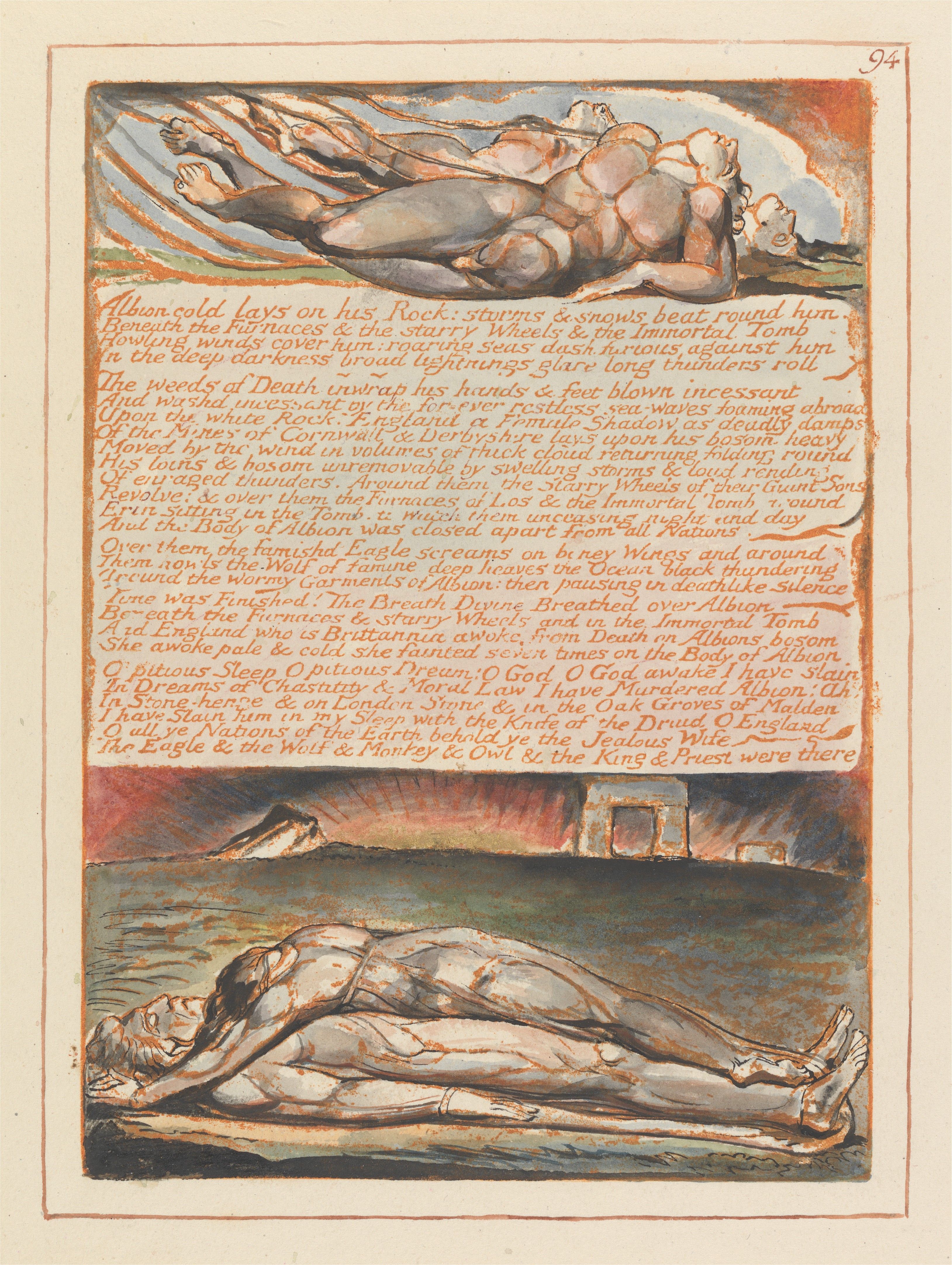
.

Saturday, March 21, 2020

DISINTEGRATION

Yale Center for British Art , Jerusalem

Plate 94

In his little book Blake: A Psychological Study Witcutt included a Chapter titled The Anatomy of Disintegration. ln it he attempted to associate Blake's experiences in growing up with the conflicts among Blake's characters in his poems. Witcutt thought that there was an event in Blake's youth which was so traumatic for him that he enacted his psychic reactions in the interactions among his characters. Witcutt was a minister as well as a student of psychology: to him Blake endured a religious and a psychic trauma as he matured. He considers that there was a breakdown (perhaps associated with a sense of sinfulness) in Blake's psychological organization at about 14 years of age. This is the age at which Blake began his apprenticeship as well as the age associated with puberty. Whatever trauma may have occurred, it has not been identified.

Blake's early or juvenile poetry, which was published in Poetical Sketches, suggests a transition from an idyllic childhood to an adolescence of exploration. Since Blake did not attend school, he apparently assumed responsibility for educating himself. The poems included in Poetical Sketches were written between the ages of 12 and 20. It is clear from Frye's analysis of this work that Blake was not only writing poetry but learning from the masters how to write poetry. He would copy the styles of other poets in order to learn from them, but his intention was to invent his own style suitable for his intended content.

So Blake's teen years were occupied with studying literature, teaching himself how to be a poet, and learning the craft of engraving through his apprenticeship to Basire. He submitted to the discipline of being apprenticed in an exacting field. At the same time he educated himself in a complementary art to balance his ability to communicate graphically. He used his rational and physical abilities in learning engraving; he depended on his imagination and emotion to master poetry. If there was a struggle to coordinate multitude abilities, it helped him to see the inner facets of his mind which might either be in conflict or harmony.   

Perhaps the mythic figures which Blake created did not come from consciousness of failure and guilt as Witcutt indicated, but from the overwhelming sense of possibilities which must be coordinated in order for each to contribute to the wholeness of the man of the new age.


Quotes from W P Witcutt's Blake: A Psychological Study:
Page 52
"Sin causes the disorientation of all the powers of the soul;...
Blake, with his clear view of the symbolic forms in which the imagination clothes the inner workings of the soul, saw the whole drama enacted and re-enacted. It haunted him continually; literally he could think of little else...underneath the surface of his mind, a surface clear and transparent to him, he could not help seeing the turmoil caused by that shattering event."


Jerusalem, Plate 32 [36], (E 178)
"And the Four Zoa's clouded rage East & West & North & South      
They change their situations, in the Universal Man.
Albion groans, he sees the Elements divide before his face.
And England who is Brittannia divided into Jerusalem & Vala
And Urizen assumes the East, Luvah assumes the South
In his dark Spectre ravening from his open Sepulcher             

And the Four Zoa's who are the Four Eternal Senses of Man
Became Four Elements separating from the Limbs of Albion
These are their names in the Vegetative Generation
[West Weighing East & North dividing Generation South bounding]
And Accident & Chance were found hidden in Length Bredth & Highth
And they divided into Four ravening deathlike Forms
Fairies & Genii & Nymphs & Gnomes of the Elements.
These are States Permanently Fixed by the Divine Power"
Page 58 
"Orc ('who is Luvah') is unloosed at the age of fourteen in the poem 'America' and bound at the same age in 'Vala.' These apparentlely contradictory symbols evidently refer to the same event, and seem to point to the conclusion that the Trauma took place in Blake's fourteenth year.
After his repression of Luvah Albion sinks down into a deathlike sleep upon a rock amid the waters of the unconscious."

Page 81
"The man of dominant thought would write out these psychological events in his own abstract terminology: but to the intuitive introvert such as Blake or Shelley they appear as the conflicts of awesome figures...The figures first of all appeared to his imagination just like a vivid dream, and enacted their dreamlike conflicts, made their speeches. It was afterwards that he puzzled, wondering, over what could be the meaning of their symbolic actions; and gave them names. His first instinct was always to draw what he had seen; thus it is that Blake's poetry is really a commentary on his engravings."

Page 90
"Jungian psychology recognizes another world from which thought may draw data - the inner world of the unconscious mind, the world of the archetypes. This was the only world in which Blake was interested; he repressed extroverted sensation to the utmost"

Page 91
"Blake was obsessed by the conflict of the four functions within himself and spent his life trying to resolve the conflict."

Page 102
"It would be hard to find a better statement of the process of disintegration, of the sinking of repressed functions into the unconscious ("buried beneath in dark obliviom") and of eventual reintegration." 
  
Four Zoas, Night IX, Page 126,(E 395)
"If Gods combine against Man Setting their Dominion above
The Human form Divine. Thrown down from their high Station       
In the Eternal heavens of Human Imagination: buried beneath  
In dark Oblivion with incessant pangs ages on ages
In Enmity & war first weakend then in stern repentance
They must renew their brightness & their disorganizd functions
Again reorganize till they resume the image of the human 
Cooperating in the bliss of Man obeying his Will
Servants to the infinite & Eternal of the Human form"

Milton, Plate 1, (E 95)
                 "To justify the Ways of God to Men

                           Preface.

The Stolen and Perverted Writings of Homer & Ovid: of Plato &
Cicero. which all Men ought to contemn: are set up by artifice
against the Sublime of the Bible. but when the New Age is at
leisure to Pronounce; all will be set right: & those Grand Works
of the more ancient & consciously & professedly Inspired Men,
will hold their proper rank, & the Daughters of Memory shall
become the Daughters of Inspiration. Shakspeare & Milton were
both curbd by the general malady & infection from the silly Greek
& Latin slaves of the Sword.

     Rouze up O Young Men of the New Age! set your foreheads
against the ignorant Hirelings! For we have Hirelings in the
Camp, the Court, & the University: who would if they could, for
ever depress Mental & prolong Corporeal War. Painters! on you I
call! Sculptors! Architects! Suffer not the fash[i]onable Fools
to depress your powers by the prices they pretend to give for
contemptible works or the expensive advertizing boasts that they
make of such works; believe Christ & his Apostles that there is a
Class of Men whose whole delight is in Destroying. We do not 
want either Greek or Roman Models if we are but just & true to
our own Imaginations, those Worlds of Eternity in which we shall
live for ever; in Jesus our Lord."


Tuesday, March 17, 2020

BLAKE & JUNG 2

Wikipedia Commons
Watercolor Illustrations to Book of Job
Page 16, Linnell Set
In attempting to find a point of congruence between the thought of Blake and the thought of Jung, I find that Jung has left detailed autobiographic information whereas Blake embedded his self-knowledge in his poetry and comments and letters. Jung recognized much of his thought to be as a result of non-rational encounters with the unconscious, but he saw himself as a scientist and wrote of his experiences through his reasoning function. Many aspects of science were mistrusted by Blake, as was dependence on reason; therefore he made no attempt to express his visionary, symbolic experiences in the prosaic language of the rational scientist.  

Perhaps what Jung found 'inauthentic' was Blake's failure to translate into ordinary language the psychological insights which he recounted through his mythic characters. However Blake would have abhorred the idea of trying to reduce his imaginative thinking into the language of reason.  

Toward the end of his life when his reputation was established as a scientific psychologist, Jung felt free to disclose the source of his insights into how the conscious mind is nourished by the unconscious which is revealed in myth, dreams and fantasy. Jung's buried life was hidden from the scientific community but he dictated and recorded his inner experiences with his student and assistant Aniela Jaffe. The record of the upwellings from his unconscious was published as Memories, Dreams and Reflections in 1961, the year he died. Further insight into his inner life was revealed in 2009 when The Red Book was published. It contains the basic raw material which Jung accumulated from the years which he spent digging deeper into his own psyche. It is his testimony to his soul's journey in words and pictures.   

Quotes from Memories, Dreams, Reflections, Page 199

"When I parted with Freud, I knew I was plunging into the unknown. Beyond Freud, after all, I knew nothing; but I had taken the step into darkness. When that  happens, and such a dream comes, one feels it is an act of grace.

It has taken me virtually forty-five years to distill within the vessel of my scientific work the things I experienced and wrote down at that time. As a young man my goal had been to accomplish something in my science. But then, I hit upon this stream of lava, and the heat of its fires reshaped my life. That was the primal stuff which compelled me to work upon it, and my works are a more or less successful endeavor to incorporate this incandescent matter into the contemporary picture of the world.

The years when I was pursuing my inner images were the most productive of my life - in them everything essential was decided. It all began then, the later details were only supplements and clarifications of the material that burst forth from the unconscious, and at first swamped me. It was the prima materia for a lifetimes work." 

Page 221
"In Mysterium Coniunctionis my psychology was at last given its place in reality and established on its historical foundations. The moment I touched bottom, I reached the bounds of scientific understanding, the transcendental, the nature of the archetypes per se, concerning which no further scientific statements can be made."

Page 222

"My life is what I have done, my scientific work; the one is inseparable from the other. The work is the expression of my inner development;  for commitments to the contents of the unconscious forms the man and produces his transformations. My work can be regarded as stations along life's way.

All of my writings can be regarded as tasks imposed from within, their source was a fateful compulsion. What I wrote were things that assailed me from within myself."


Urizen, Plate 2, (E 70)
"PRELUDIUM 
Of the primeval Priests assum'd power,
When Eternals spurn'd back his religion;
And gave him a place in the north,
Obscure, shadowy, void, solitary.

Eternals I hear your call gladly,                                
Dictate swift winged words, & fear not
To unfold your dark visions of torment."

Letters, To Trusler, (E 701)
"[I]cannot previ-
ously describe in words what I mean to Design for fear I should
Evaporate the Spirit of my Invention.  But I
hope that none of my Designs will be destitute of Infinite
Particulars which will present themselves to the Contemplator. 
And tho I call them Mine   I know that they are not Mine being of
the same opinion with Milton when he says That the Muse visits
his Slumbers & awakes & governs his Song when Morn purples The
East. & being also in the predicament of that prophet who says  I
cannot go beyond the command of the Lord to speak good or bad"

Letters, To Butts, (E 724)
"I am under the direction of Messengers from Heaven Daily &
Nightly but the nature of such things is not as some suppose.
without trouble or care.  Temptations are on the right hand &
left behind the sea of time & space roars & follows swiftly he
who keeps not right onward is lost & if our footsteps slide in
clay how can we do otherwise than fear & tremble. but I should
not have troubled You with this account of my spiritual state
unless it had been necessary in explaining the actual cause of my
uneasiness into which you are so kind as to Enquire for I never
obtrude such things on others unless questiond & then I never
disguise the truth--But if we fear to do the dictates of our
Angels & tremble at the Tasks set before us. if we refuse to do
Spiritual Acts. because of Natural Fears or Natural Desires!  Who
can describe the dismal torments of such a state!--I too well
remember the Threats I heard!--If you who are organized by Divine
Providence for Spiritual communion.  Refuse & bury your Talent in
the Earth even tho you should want Natural Bread. Sorrow &
Desperation
pursues you thro life! & after death shame & confusion of face to
eternity--Every one in Eternity will leave you aghast at the Man
who was crownd with glory & honour by his brethren & betrayd
their cause to their enemies."


Romans 7
[22] For I delight in the law of God, in my inmost self,
[23] but I see in my members another law at war with the law of my mind and making me captive to the law of sin which dwells in my members.
[24] Wretched man that I am! Who will deliver me from this body of death?
 

Wednesday, March 11, 2020

BLAKE & JUNG

Wikipedia Commons
Book of Urizen

Plate 21


"The primordial image, or archetype, is a figure—be it a daemon, a human being, or a process—that constantly recurs in the course of history and appears wherever creative fantasy is freely expressed. Essentially, therefore, it is a mythological figure. (...) In each of these images there is a little piece of human psychology and human fate, a remnant of the joys and sorrows that have been repeated countless times in our ancestral history." 
Carl Jung, On the Relation of Analytical Psychology to Poetry, in Collected Works 15, 127

In his exploration of his own psyche Jung reached into parts on his mind with which he had been unacquainted. Below his consciousness he found intimations of material which entered consciousness unexpectedly and by unpredicted pathways. As he allowed himself to be led into the unexplored areas he gave names to what he discovered. The structure nearest to consciousness became the subconscious. Pushing the boundary further he explored his temporarily lost memories and suppressed feelings. This level he called individual unconscious. He found that there is a collective unconscious as well, which is the shared inheritance of humanity. The contents of the collective unconscious he named archetypes.

He configured the collective unconscious into two classes: the active personalities such as the Mother and the Trickster, and the processes which he called archetypes of transformation. In my recent posts I have focused on Blake's development of his myth in terms of some universal human experiences which fit the understanding of archetypes as described by Jung. Blake brought forth archetypal ideas without attributing them to a source called the unconscious.

In notebooks Jung recorded his experience of entering and exploring his unconscious. This edeavour was precipitated by his alienation from Freud who had been his mentor. When Jung found it necessary to reject Freud's sexual theory of the psyche, he entered a period of formulating his own system which led to the process of individuation.

It is a well known observation that Jung and Blake shared many ideas. I have found only one acknowledgement from Jung that he was exposed to Blake's teachings. Without mentioning the source a Library of Congress website associated with an exhibition of Jung's The Red Book included a statement about Jung's attitude to Blake: "Jung wrote that he found 'Blake a tantalizing study, since he compiled a lot of half or undigested knowledge in his fantasies. According to my ideas they are an artistic production rather than an authentic representation of unconscious processes.'" It would have been impossible for Jung not to have seen similarities in Blake's work and the work he engaged in himself. I can only surmise that it was necessary for Jung to find the source of his psychology only in his encounter with the unconscious. Blake who wrote in English (not in the languages most familiar to Jung) and used images of the human body (not abstract mandalas) to present his psychological insights did not have the authenticity Jung sought. 


Here are some correlations which may be helpful in working with Archetypes.

Blake's Archetypes      Jung's Archetypes       Blake's Myth    Abstrations
Journey                            Birth                            Jerusalem            Life
Nature                             The Mother                   Vala                     World
Spirit                                The Anima                   Urthona               Eternity
Body                                 Power                         Tharmas             Physical
Selfhood                          Death                           Urizen                 Evil
Guidance                         The Hero                     Los                      Soul
Birth                                 The Child                     Luvah                  Innocence
Marriage                          Rebirth                         Albion                  Unification

Descriptive Catalogue, (E 532)
" NUMBER III.
Sir Jeffery Chaucer and the nine and twenty Pilgrims on
their journey to Canterbury.

THE time chosen is early morning, before sunrise, when the jolly
company are just quitting the Tabarde Inn.  The Knight and Squire
with the Squire's Yeoman lead the Procession, next follow the
youthful Abbess, her nun and three priests; her greyhounds attend
her.

               "Of small hounds had she that she fed
               "With roast flesh, milk and wastel bread."

Next follow the Friar and Monk; then the Tapiser, the Pardoner,
and the Somner and Manciple.  After these "Our Host," who oc[pies 
the center of the cavalcade; directs them to the Knight
as the person who would be likely to commence their task of each
telling a tale in their order.  After the Host follow the
Shipman, the Haberdasher, the Dyer, the Franklin, the Physician,
the Plowman, the Lawyer, the poor Parson, the Merchant, the Wife
of Bath, the Miller, the Cook, the Oxford Scholar, Chaucer
himself, and the Reeve comes as Chaucer has described:

            "And ever he rode hinderest of the rout."

These last are issuing from the gateway of the Inn; the Cook and
the Wife of Bath are both taking their morning's draught of
comfort.  Spectators stand at the gateway of the Inn, and are
composed of an old Man, a Woman and Children.
...
 The characters of Chaucer's Pilgrims are the characters
which compose all ages and nations: as one age falls, another
rises, different to mortal sight, but to immortals only the same;
for we see the same characters repeated again and again, in
animals, vegetables, minerals, and in men; nothing new occurs in
identical existence; Accident ever varies, Substance can
never suffer change nor decay.
  Of Chaucer's characters, as described in his Canterbury
Tales, some of the names or titles are altered by time, but the
characters themselves for ever remain unaltered, and 
consequently they are the
physiognomies or lineaments of universal human life, beyond which
Nature never steps.  Names alter, things never alter."

Thursday, March 05, 2020

MARRIAGE

Yale Center for British Art
Jerusalem
Detail Plate 18

Meeting the Shadow, from the chapter by John A Sanford:

"...if we consciously carry the burden of the opposites in our nature, the secret, irrational, healing process that goes on in the unconscious can operate to our benefit, and work toward the synthesis of the personality. This irrational healing process, which finds a way around seemingly in surmountable obstacles, has a particularly feminine quality to it. It is the rational, logical masculine mind that declares that opposites like ego and Shadow, light and dark, can never be united. However the feminine spirit is capable of finding a synthesis where logic says none can be found." Page 32 

Marriage as an archetypes is the reunion of what has been separated. When man enters the condition of creation his initial state of non-differentiation is fractured. There is a cascade of divisions which follows the division between 'heaven and earth'

Genesis 1
[1] In the beginning God created the heavens and the earth.
[2] The earth was without form and void, and darkness was upon the face of the deep; and the Spirit of God was moving over the face of the waters. 

Consciousness grows from differentiation of one from the other: of heaven from earth, of light from darkness, of male from female. But multiplicity is not final: it reaches its limit and returns. The multitude makes the return journey to the the One bringing with it gifts from experience in Time and Space.

Blake's earliest Illuminated book was titled The Marriage of Heaven and Hell. In it he contrasted accepted interpretations in literature, philosophy, and religion with alternative ideas. He aimed to shock readers into looking at the world from an imaginative rather than a rational perspective. He introduced the conventional perspective by writing: 

"From these contraries spring what the religious call Good & 
Evil. Good is the passive that obeys Reason. Evil is the active
springing from Energy. 
Good is Heaven. Evil is Hell." Plate 3
 
In The Marriage of Heaven and Hell the basic dichotomy between Good and Evil, as so defined, would be explored from the perspectives of the Angel and the Devil. Although Blake was not trying to reconcile Good and Evil, he was trying to disrupt the conventional ways that people accepted Good and Evil. The exploration of contraries was the method by which a Marriage could take place. The individual should actively live with the differences, not automatically accepting or rejecting, until they are brought together into a recognizable pattern which is congruent with the truth one accepts internally or consciously. 


Among the symbols which Blake developed to work out the process of being divided and reunited are:
Beulah - married
Vala and Jerusalem - matter and spirit
Four Zoas - divided psyche
Worlds - levels of development
The final scene from Jerusalem - awakening


Milton, Plate 25 [27], (E 122)
"Lambeth mourns calling Jerusalem. she weeps & looks abroad
For the Lords coming, that Jerusalem may overspread all Nations  
Crave not for the mortal & perishing delights, but leave them
To the weak, and pity the weak as your infant care; Break not
Forth in your wrath lest you also are vegetated by Tirzah
Wait till the Judgement is past, till the Creation is consumed
And then rush forward with me into the glorious spiritual    
Vegetation; the Supper of the Lamb & his Bride; and the
Awaking of Albion our friend and ancient companion.

So Los spoke. But lightnings of discontent broke on all sides round
And murmurs of thunder rolling heavy long & loud over the mountains
While Los calld his Sons around him to the Harvest & the Vintage."

Jerusalem, Plate 20, (E 166)
"Albion lov'd thee! he rent thy Veil! he embrac'd thee! he lov'd thee!
Astonish'd at his beauty & perfection, thou forgavest his furious love:
I redounded from Albions bosom in my virgin loveliness.
The Lamb of God reciev'd me in his arms he smil'd upon us:
He made me [Jerusalem] his Bride & Wife: he gave thee [Vala] to Albion.             
Then was a time of love: O why is it passed away!
Then Albion broke silence and with groans reply'd
Plate 21
O Vala! O Jerusalem! do you delight in my groans
You O lovely forms, you have prepared my death-cup:"

Jerusalem, Plate 27, (E 171)
  "The fields from Islington to Marybone, 
To Primrose Hill and Saint Johns Wood:
  Were builded over with pillars of gold, 
And there Jerusalems pillars stood.

  Her Little-ones ran on the fields                             
The Lamb of God among them seen
  And fair Jerusalem his Bride:
Among the little meadows green."

Jerusalem, Plate 29 [33], (E 175)
"Vala was Albions Bride & Wife in great Eternity
The loveliest of the daughters of Eternity when in day-break  

I emanated from Luvah over the Towers of Jerusalem
And in her Courts among her little Children offering up
The Sacrifice of fanatic love! why loved I Jerusalem!
Why was I one with her embracing in the Vision of Jesus
Wherefore did I loving create love, which never yet              
Immingled God & Man, when thou & I, hid the Divine Vision
In cloud of secret gloom which behold involve me round about  
Know me now Albion: look upon me I alone am Beauty
The Imaginative Human Form is but a breathing of Vala"

Four Zoas, Night IX, Page122, (E 391)
"Thus shall the male & female live the life of Eternity           
Because the Lamb of God Creates himself a bride & wife
That we his Children evermore may live in Jerusalem
Which now descendeth out of heaven a City yet a Woman
Mother of myriads redeemd & born in her spiritual palaces
By a New Spiritual birth Regenerated from Death"                  

Vision of Last Judgment, (E 558)
"a Youthful couple are awakd by
their Children  an Aged patriarch is awakd by his aged wife  He is
Albion our Ancestor  patriarch of the Atlantic Continent whose
History Preceded that of the Hebrews & in whose Sleep 
Creation began,"


Four Zoas, Night IX, Page 122, (E 391)
"The winter thou shalt plow & lay thy stores into thy barns       
Expecting to recieve Ahania in the spring with joy
Immortal thou. Regenerate She & all the lovely Sex
From her shall learn obedience & prepare for a wintry grave
That spring may see them rise in tenfold joy & sweet delight
Thus shall the male & female live the life of Eternity           
Because the Lamb of God Creates himself a bride & wife
That we his Children evermore may live in Jerusalem
Which now descendeth out of heaven a City yet a Woman
Mother of myriads redeemd & born in her spiritual palaces
By a New Spiritual birth Regenerated from Death                  

Urizen Said. I have Erred & my Error remains with me"  
Jerusalem, Plate 88, (E 246)
"Los answerd sighing like the Bellows of his Furnaces

I care not! the swing of my Hammer shall measure the starry
round[.]
When in Eternity Man converses with Man they enter
Into each others Bosom (which are Universes of delight)
In mutual interchange. and first their Emanations meet
Surrounded by their Children. if they embrace & comingle
The Human Four-fold Forms mingle also in thunders of Intellect
But if the Emanations mingle not; with storms & agitations
Of earthquakes & consuming fires they roll apart in fear
For Man cannot unite with Man but by their Emanations
Which stand both Male & Female at the Gates of each Humanity
How then can I ever again be united as Man with Man
While thou my Emanation refusest my Fibres of dominion.
When Souls mingle & join thro all the Fibres of Brotherhood
Can there be any secret joy on Earth greater than this?"

Jerusalem, Plate 96, (E 256)
"All
The Sons & Daughters of Albion on soft clouds Waking from Sleep
Soon all around remote the Heavens burnt with flaming fires    
And Urizen & Luvah & Tharmas & Urthona arose into
Albions Bosom: Then Albion stood before Jesus in the Clouds
Of Heaven Fourfold among the Visions of God in Eternity
Plate 97
Awake! Awake Jerusalem! O lovely Emanation of Albion
Awake and overspread all Nations as in Ancient Time
For lo! the Night of Death is past and the Eternal Day
Appears upon our Hills: Awake Jerusalem, and come away

So spake the Vision of Albion & in him so spake in my hearing   
The Universal Father. Then Albion stretchd his hand into Infinitude.
And took his Bow. Fourfold the Vision for bright beaming Urizen
Layd his hand on the South & took a breathing Bow of carved Gold
Luvah his hand stretch'd to the East & bore a Silver Bow bright shining
Tharmas Westward a Bow of Brass pure flaming richly wrought   
Urthona Northward in thick storms a Bow of Iron terrible thundering.

And the Bow is a Male & Female & the Quiver of the Arrows of Love,
Are the Children of this Bow: a Bow of Mercy & Loving-kindness: laying
Open the hidden Heart in Wars of mutual Benevolence Wars of Love
And the Hand of Man grasps firm between the Male & Female Loves" 


Gospel of Thomas (Translated by Thomas O. Lambdin)
(22) Jesus saw infants being suckled. He said to his disciples, "These infants being suckled are like those who enter the kingdom." They said to him, "Shall we then, as children, enter the kingdom?" Jesus said to them, "When you make the two one, and when you make the inside like the outside and the outside like the inside, and the above like the below, and when you make the male and the female one and the same, so that the male not be male nor the female; and when you fashion eyes in the place of an eye, and a hand in place of a hand, and a foot in place of a foot, and a likeness in place of a likeness; then will you enter the kingdom."

Romans 8
[38] For I am persuaded, that neither death, nor life, nor angels, nor principalities, nor powers, nor things present, nor things to come,
[39] Nor height, nor depth, nor any other creature, shall be able to separate us from the love of God, which is in Christ Jesus our Lord.


Matthew 23
[37] O Jerusalem, Jerusalem, thou that killest the prophets, and stonest them which are sent unto thee, how often would I have gathered thy children together, even as a hen gathereth her chickens under her wings, and ye would not!
[38] Behold, your house is left unto you desolate.
[39] For I say unto you, Ye shall not see me henceforth, till ye shall say, Blessed is he that cometh in the name of the Lord.

Matthew 25
[35] For I was an hungred, and ye gave me meat: I was thirsty, and ye gave me drink: I was a stranger, and ye took me in:
[36] Naked, and ye clothed me: I was sick, and ye visited me: I was in prison, and ye came unto me.
[37] Then shall the righteous answer him, saying, Lord, when saw we thee an hungred, and fed thee? or thirsty, and gave thee drink?
[38] When saw we thee a stranger, and took thee in? or naked, and clothed thee?
[39] Or when saw we thee sick, or in prison, and came unto thee?
[40] And the King shall answer and say unto them, Verily I say unto you, Inasmuch as ye have done it unto one of the least of these my brethren, ye have done it unto me.


In Boundaries of the Soul,  June Singer wrote:
"In his later work he [Jung] was devoted to the possibility of bringing together the opposites, to finding the harmony both within and without that is consonant with seeing the person as a whole, instead of as collection of parts and peices. The process of analysis, almost by definition, is taking apart and looking at the pieces. But this must be done with the principle in mind that the pieces,  when examined separately, are like an automobile which has been taken apart for repair. You might be able to find out what is wrong with it, but that doesn't solve the problem. Only when it is put back together again is it whole. It is more than a collection of its parts. It can do what the parts separately cannot do. It runs." Page 250