Showing posts with label Visions. Show all posts

Friday, October 09, 2026

BURNING BRIGHT

 First posted April 2018

Wikimedia Commons
Songs of Innocence and of Experience
Copy Z, Plate 45
The Little Vagabond

Larry and I have written very little about Blake's Tyger although it is Blake's best known and perhaps most provocative poem. It may also contain his most influential thought and message. In Robert Persig's Lila we find an instance of the content of The Tyger not being referenced directly, but by association entering the consciousness of a larger dimension.   

Like Blake, Persig in his book was attempting to provide an opening to a consciousness beyond the habitual frame in which we ordinarily operate. Pirsig's reference to Blake's Tyger in association with perceptions of exterior light in unexpected situations, is a portent of receiving the inner transforming light.

If we reflect on the methods by which we receive light we may focus first on the light from distant objects which we receive through our physical eyes. Second might be the enlightenment which we experience in our minds when we break into new insight about a person, object, situation or idea. Third is consciousness of the light itself when it spreads its illumination in some unusual or intense fashion. Pirsig wrote of experiencing the light as it radiated from an object or person or event of peculiar significance. Blake's experience in the Truchsessian Gallery enhanced his ability to see more clearly in the external world because his inner light was intensified. Pirsig used the the internal generation of light by Blake's Tyger as symbolic of transformation taking place in the psyche.    

Lila by Robert Pirsig, Page 339:

"During Phaedrus' time of insanity when he wandered freely outside the limits of cultural reality, this light had been a valued companion, pointing out things to him that he would otherwise have missed, appearing at an event his rational thought had indicated was unimportant, but which he later discovered had been more important than he had known. Often it had occurred at events he could not figure out the importance of, but had left him wondering.

He saw it once on a small kitten. After that for a long time the kitten followed him wherever he went and he wondered if the kitten saw it too.

He had seen it once around a tiger at the zoo. The tiger had suddenly looked at him with what seemed like surprise and had come over to the bars for a closer look. The the illumination began to appear around the tiger's face. That was all. Afterward, that experience associated itself with William Blake's 'Tiger! Tiger! burning bright.'

The eyes had blazed with what seemed to be inner light."

Letters, To Hayley, (E 756)
"Suddenly,
on the day after visiting the Truchsessian Gallery of pictures, I
was again enlightened with the light I enjoyed in my youth, and
which has for exactly twenty years been closed from me as by a
door and by window-shutters."

Milton, Plate 1, (E 95)
  "And did the Countenance Divine,             
     Shine forth upon our clouded hills?"

Milton, Plate 5, (E 98)
"And this is the manner of the Daughters of Albion in their beauty
Every one is threefold in Head & Heart & Reins, & every one
Has three Gates into the Three Heavens of Beulah which shine
Translucent in their Foreheads & their Bosoms & their Loins
Surrounded with fires unapproachable: but whom they please
They take up into their Heavens in  intoxicating  delight" 

Milton, Plate 10, (E 104)
"Every thing in Eternity shines by its own Internal light: but thou
Darkenest every Internal light with the arrows of thy quiver
Bound up in the borns of jealousy to a deadly fading Moon
And Ocalythron binds the Sun into a Jealous Globe
That every thing is fixd Opake without Internal light"  

Jerusalem, Plate 19, (E 164)
"Where once he sat he weary walks in misery and pain:
His Giant beauty and perfection fallen into dust:
Till from within his witherd breast grown narrow with his woes:
The corn is turn'd to thistles & the apples into poison:         
The birds of song to murderous crows, his joys to bitter groans!
The voices of children in his tents, to cries of helpless infants!
And self-exiled from the face of light & shine of morning,
In the dark world a narrow house! he wanders up and down,
Seeking for rest and finding none! and hidden far within,        
His Eon weeping in the cold and desolated Earth.

All his Affections now appear withoutside:   

So Los lamented over Satan, who triumphant divided the Nations"

Four Zoas, Night VII, Page 81, (E 357)
"Thy roses that expanded in the face of glowing morn
Page 82 
Hid in a little silken veil scarce breathe & faintly shine
Thy lilies that gave light what time the morning looked forth
Hid in the Vales faintly lament & no one hears their voice"

Songs and Ballads, (E 477)
"Mock on Mock on Voltaire Rousseau
Mock on Mock on! tis all in vain!
You throw the sand against the wind
And the wind blows it back again

And every sand becomes a Gem                          
Reflected in the beams divine
Blown back they blind the mocking Eye 
But still in Israels paths they shine

The Atoms of Democritus
And Newtons Particles of light          
Are sands upon the Red sea shore
Where Israels tents do shine so bright"

Songs and Ballads, From Notebook, (E 480)
"My Designs unchangd remain      
Time may rage but rage in vain
For above Times troubled Fountains
On the Great Atlantic Mountains
In my Golden House on high
There they Shine Eternally"     

Auguries of Innocence, (E 492)
"Every Night & every Morn
Some to Misery are Born 
Every Morn & every Night
Some are Born to sweet delight
Some are Born to Endless Night
We are led to Believe a Lie 
When we see not Thro the Eye 
Which was Born in a Night to perish in a Night
When the Soul Slept in Beams of Light
God Appears & God is Light
To those poor Souls who dwell in Night 
But does a Human Form Display
To those who Dwell in Realms of day"

Songs of Innocence and of Experience, Plate 42, (E 24)
"The Tyger.                         

Tyger Tyger, burning bright,
In the forests of the night;
What immortal hand or eye,
Could frame thy fearful symmetry?

In what distant deeps or skies.       
Burnt the fire of thine eyes?           
On what wings dare he aspire?     
What the hand, dare sieze the fire?

And what shoulder, & what art,
Could twist the sinews of thy heart?
And when thy heart began to beat,
What dread hand? & what dread feet?
 
What the hammer? what the chain, 
In what furnace was thy brain?
What the anvil? what dread grasp,       
Dare its deadly terrors clasp!               

When the stars threw down their spears   
And water'd heaven with their tears:
Did he smile his work to see?          
Did he who made the Lamb make thee? 

Tyger Tyger burning bright,
In the forests of the night:                        
What immortal hand or eye,                     
Dare frame thy fearful symmetry?"  

Matthew 17
[1] And after six days Jesus taketh Peter, James, and John his brother, and bringeth them up into an high mountain apart,
[2] And was transfigured before them: and his face did shine as the sun, and his raiment was white as the light.
[3] And, behold, there appeared unto them Moses and Elias talking with him.
[4] Then answered Peter, and said unto Jesus, Lord, it is good for us to be here: if thou wilt, let us make here three tabernacles; one for thee, and one for Moses, and one for Elias.
[5] While he yet spake, behold, a bright cloud overshadowed them: and behold a voice out of the cloud, which said, This is my beloved Son, in whom I am well pleased; hear ye him.
[6] And when the disciples heard it, they fell on their face, and were sore afraid.
[7] And Jesus came and touched them, and said, Arise, and be not afraid.
[8] And when they had lifted up their eyes, they saw no man, save Jesus only.


Sunday, October 09, 2022

JACOB'S LADDER

British Museum
Jacob's Ladder

Genesis 28

[10] And Jacob went out from Beer-sheba, and went toward Haran.
[11] And he lighted upon a certain place, and tarried there all night, because the sun was set; and he took of the stones of that place, and put them for his pillows, and lay down in that place to sleep.
[12] And he dreamed, and behold a ladder set up on the earth, and the top of it reached to heaven: and behold the angels of God ascending and descending on it.
[13] And, behold, the LORD stood above it, and said, I am the LORD God of Abraham thy father, and the God of Isaac: the land whereon thou liest, to thee will I give it, and to thy seed;
[14] And thy seed shall be as the dust of the earth, and thou shalt spread abroad to the west, and to the east, and to the north, and to the south: and in thee and in thy seed shall all the families of the earth be blessed.
[15] And, behold, I am with thee, and will keep thee in all places whither thou goest, and will bring thee again into this land; for I will not leave thee, until I have done that which I have spoken to thee of.
[16] And Jacob awaked out of his sleep, and he said, Surely the LORD is in this place; and I knew it not.
[17] And he was afraid, and said, How dreadful is this place! this is none other but the house of God, and this is the gate of heaven.
[18] And Jacob rose up early in the morning, and took the stone that he had put for his pillows, and set it up for a pillar, and poured oil upon the top of it.
[19] And he called the name of that place Bethel: but the name of that city was called Luz at the first.

As Jacob sleeps and dreams, resting his head upon a stone, he watches angels spiraling toward heaven on a staircase. But the traffic on the stair goes in both directions. Jacob is being transported to heaven, and heaven is descending into his brain. By Jacob listening and responding the place where he lies becomes a gate to heaven.  

Milton, Plate 28 [30], (E 126)

"And every Hour has a bright golden Gate carved with skill.
And every Day & Night, has Walls of brass & Gates of adamant,
Shining like precious stones & ornamented with appropriate signs:"

Jerusalem, Plate 34 [38],(E 181)
"There is in Albion a Gate of precious stones and gold            
Seen only by Emanations, by vegetations viewless,
Bending across the road of Oxford Street; it from Hyde Park
To Tyburns deathful shades, admits the wandering souls
Of multitudes who die from Earth: this Gate cannot be found
PLATE 35 [39]
By Satans Watch-fiends tho' they search numbering every grain
Of sand on Earth every night, they never find this Gate.
It is the Gate of Los. Withoutside is the Mill, intricate, dreadful" 
Listen as Ian McGilchrist responds to Blake's image of Jacob's Ladder. 

Descriptive Catalogue, (E 543)

"All these things are written in Eden.  
The artist is an inhabitant of that happy country, and if 
every thing goes on as it has begun, the world of vegetation 
and generation may expect to be opened again to Heaven, 
through Eden, as it was in the beginning." 
Vision of Last Judgment, (E 556) 
"Moses & Abraham are not here meant but the States Signified by
those Names the Individuals being representatives or Visions of
those States as they were reveald to Mortal Man in the Series of
Divine Revelations. as they are written in the Bible these
various States I have seen in my Imagination when distant they
appear as One Man but as you approach they appear
Multitudes of Nations.  Abraham hovers above his posterity which
appear as Multitudes of Children ascending from the Earth
surrounded by Stars as it was said As the Stars of Heaven for
Multitude   Jacob & his Twelve Sons hover beneath
the feet of Abraham & recieve their children from the Earth" 
Vision of Last Judgment, (E 561)
"The Cloud that opens rolling apart before the throne &
before the New Heaven & the New Earth is Composed of Various
Groupes of Figures particularly the Four Living Creatures
mentiond in Revelations as Surrounding the Throne these I suppose
to have the chief agency in removing the 
old heavens & the old Earth to make way for the New Heaven & the
New Earth to descend from the throne of God & of the Lamb." 
Vision of Last Judgment, (E 561)
"Around the Throne Heaven is opend & the Nature of
Eternal Things Displayd All Springing from the Divine Humanity
All beams from him Because as he himself has said All
dwells in him He is the Bread & the Wine he is the Water of
Life" 
Vision of Last Judgment, (E 566) 
"I assert for My self that I do
not behold the Outward Creation & that to me it is hindrance &
not Action it is as the Dirt upon my feet No part of Me. What it
will be Questiond When the Sun rises  do  you  not  see  a  round 
Disk of fire somewhat like a Guinea O no no I see an Innumerable
company of the Heavenly host crying Holy Holy Holy is the Lord
God Almighty I question not my Corporeal or Vegetative Eye any
more than I would Question a Window concerning a Sight I look
thro it & not with it."  

Letters, To Butts, (E 724) 
"The Thing I
have most at Heart! more than life or all that seems to make life
comfortable without.  Is the Interest of True Religion & Science
& whenever any thing appears to affect that Interest. (Especially
if I myself omit any duty to my Station as a
Soldier of Christ) It gives me the greatest of torments, I am not
ashamed afraid or averse to tell You what Ought to be Told.  That
I am under the direction of Messengers from Heaven Daily &
Nightly but the nature of such things is not as some suppose.
without trouble or care." 
Letters, To Hayley, (E 740)
"love & gratitude the two
angels who stand at heavens gate  ever open  ever inviting guests
to the marriage   O foolish Philosophy! Gratitude is Heaven
itself there could be no heaven without Gratitude" 


Thursday, October 06, 2022

BURNING BUSH

Victoria & Albert Museum
Moses and the Burning Bush

The shepherd Moses has led his flock out of the desert to Horab the mountain of God. In Blake's picture Moses turns his face to his right side. He holds a scroll in his right hand. Beside his right side is a ram. His attention is focused on the bush which burns and is not consumed. The right side of the picture is bright while the left side of the picture is darkened by an overhanging tree of the type which Blake used to represent error. Blake saw two sides to Moses.

Moses listens as the voice of God addresses him from the burning bush calling him by name. Moses is receptive to God's call and responds, "Here am I." 

The voice of God tells Moses that he is to go to the Pharaoh in order to deliver his people "out of the hand of the Egyptians, and to bring them up out of that land unto a good land." Moses continues the conversation with God. His reluctance is overcome when God assures him that he will be with him.

Exodus 3:12
And he said, Certainly I will be with thee; and this shall be a token unto thee, that I have sent thee: When thou hast brought forth the people out of Egypt, ye shall serve God upon this mountain.

Although Blake considered Moses a great prophet and an instrument of God, in Blake's estimation Moses entered into error on two accounts. First in promulgating the ten commands which intended to impose standards of morality. Blake says "Moses beheld upon Mount Sinai forms of dark delusion" (Song of Los, E 67). In Blake's opinion Jesus who was "all virtue,and acted from impulse, not from rules", violated in spirit every one of the ten Commandments. It was not the failure to follow the Law that offended Blake but the attempt to uniformly impose an absolute morality which perverted the "fiery joy" of life "to ten commands"(America, E 54). 

Marriage of Heaven and Hell, Plate 22, (E 43) 
"if Jesus Christ is the
greatest man, you ought to love him in the greatest degree; now
hear how he has given his sanction to the law of ten
commandments: did he not mock at the sabbath, and so mock the
sabbaths God? murder those who were murderd because of him? turn
away the law from the woman taken in adultery? steal the labor of
others to support him? bear false witness when he omitted making
a defence before Pilate? covet when he pray'd for his disciples,
and when he bid them shake off the dust of their feet against
such as refused to lodge them? I tell you, no virtue can exist
without breaking these ten commandments: Jesus was all virtue,
and acted from impulse: not from rules."

The second great error of Moses was massacring the nations who occupied Canaan before the Israelites arrived. "God never makes one man murder another nor one nation...To Extirpate a nation by means of another nation is as wicked as to destroy an individual. (Annotations to Watson, E 641) 

Exodus 3
[1] Now Moses kept the flock of Jethro his father in law, the priest of Midian: and he led the flock to the backside of the desert, and came to the mountain of God, even to Horeb.
[2] And the angel of the LORD appeared unto him in a flame of fire out of the midst of a bush: and he looked, and, behold, the bush burned with fire, and the bush was not consumed.
[3] And Moses said, I will now turn aside, and see this great sight, why the bush is not burnt.
[4] And when the LORD saw that he turned aside to see, God called unto him out of the midst of the bush, and said, Moses, Moses. And he said, Here am I.
[5] And he said, Draw not nigh hither: put off thy shoes from off thy feet, for the place whereon thou standest is holy ground.
[6] Moreover he said, I am the God of thy father, the God of Abraham, the God of Isaac, and the God of Jacob. And Moses hid his face; for he was afraid to look upon God.
[7] And the LORD said, I have surely seen the affliction of my people which are in Egypt, and have heard their cry by reason of their taskmasters; for I know their sorrows;
[8] And I am come down to deliver them out of the hand of the Egyptians, and to bring them up out of that land unto a good land and a large, unto a land flowing with milk and honey; unto the place of the Canaanites, and the Hittites, and the Amorites, and the Perizzites, and the Hivites, and the Jebusites.
[9] Now therefore, behold, the cry of the children of Israel is come unto me: and I have also seen the oppression wherewith the Egyptians oppress them.
[10] Come now therefore, and I will send thee unto Pharaoh, that thou mayest bring forth my people the children of Israel out of Egypt.
[11] And Moses said unto God, Who am I, that I should go unto Pharaoh, and that I should bring forth the children of Israel out of Egypt?
[12] And he said, Certainly I will be with thee; and this shall be a token unto thee, that I have sent thee: When thou hast brought forth the people out of Egypt, ye shall serve God upon this mountain.
[13] And Moses said unto God, Behold, when I come unto the children of Israel, and shall say unto them, The God of your fathers hath sent me unto you; and they shall say to me, What is his name? what shall I say unto them?
[14] And God said unto Moses, I AM THAT I AM: and he said, Thus shalt thou say unto the children of Israel, I AM hath sent me unto you.
[15] And God said moreover unto Moses, Thus shalt thou say unto the children of Israel, The LORD God of your fathers, the God of Abraham, the God of Isaac, and the God of Jacob, hath sent me unto you: this is my name for ever, and this is my memorial unto all generations. 
 
Letters, To Trusler, (E 702)
"The wisest of the Ancients considerd what is not too Explicit as the fittest for Instruction because it rouzes the faculties to act. I name Moses Solomon Esop Homer Plato"
Annotations to Watson, (E 617) 
"Of what consequence is it whether Moses wrote the Pentateuch
or no.  If Paine trifles in some of his objections it is folly to
confute him so seriously in them & leave his more material ones
unanswered  Public Records as If Public Records were True 
     *Impossible for the facts are such as none but the actor
could tell, if it is True Moses & none but he could write it
unless we allow it to be Poetry & that poetry inspired 
     [P 16] If historical facts can be written by inspiration
Miltons Paradise Lost is as true as Genesis. or Exodus. but the
Evidence is nothing for how can he who writes what he has neither
seen nor heard of. be an Evidence of The Truth of his history"
Annotations to Watson,(E 618) 
"I cannot concieve the Divinity of the <books in the> Bible
to consist either in who they were written by or at what time or
in the historical evidence which may be all false in the eyes of
one man & true in the eyes of another but in the Sentiments &
Examples which whether true or Parabolic are Equally useful as
Examples given to us of the perverseness of some & its consequent
evil & the honesty of others & its consequent good  This sense of
the Bible is equally true to all & equally plain to all. none can
doubt the impression which he recieves from a book of Examples. 
If he is good he will abhor wickedness in David or Abraham if he
is wicked he will make their wickedness an excuse for his & so he
would do by any other book."
Thanks to A Blake Dictionary by S. Foster Damon, page 286.
 

Monday, May 31, 2021

GHOST OF ABEL

First posted Jul 7, 2014 as SEEING VISIONS III.

"Eve: were it not better to believe Vision With all our might & strength tho we are fallen & lost"

 Michael Davis wrote in William Blake: A New Kind of Man on page 151:

"In December 1821 Byron published his sensationally bold drama Cain: A Mystery. Parsons preached against it from Kentish Town to Pisa and Blake challenged Byron's pessimism in a terse, seventy-five line poetic drama complete with stage-directions, The Ghost of Abel: 'A Revelation In the Visions of Jehovah seen by William Blake'. The prelude, addressed to LORD BYRON in the Wilderness' of error, asks 'Can a Poet doubt the Visions of Jehovah?' and concludes 'Imagination is Eternity': although mortal life is unreal, true life is everlasting. When grief-stricken Eve, with Adam, has seen and heard the ghost of Abel, 'the Accuser & Avenger Of Blood', she asks 'were it not better to believe Vision With all our might & strength, tho' we are fallen & lost?' and Adam concurs. They kneel before Jehovah, who declares 'I have given you a Lamb for an atonement instead Of the Transgressor.' Abel's vengeful Spectre sinks into the grave, from which Satan then arises, armed, to demand human blood on Calvary. Jehovah banishes him to annihilation of self in the Abyss, for only when error is cast out can regeneration begin. Angels sing of Jehovah's forgiveness: peace, brotherhood and love are eternal reality. So the brilliantly drama ends.

This work, dated 1822, is Blake's last in relief etching."


The Ghost of Abel, (E 270)
PLATE 1
"THE GHOST of ABEL
                            
A Revelation In the Visions of Jehovah
Seen by William Blake

To LORD BYRON in the Wilderness
          What doest thou here Elijah?
          Can a Poet doubt the Visions of Jehovah? Nature has no Outline:
          but Imagination has.  Nature has no Tune: but Imagination has!
          Nature has no Supernatural & dissolves: Imagination is Eternity

     Scene.  A rocky Country.  Eve fainted over the dead body
     of Abel which lays near a Grave.  Adam kneels by her Jehovah stands above

Jehovah-- Adam!
Adam--    I will not hear thee more thou Spiritual Voice
          Is this Death?
Jehovah--                Adam!
Adam--                        It is in vain: I will not hear thee
          Henceforth! Is this thy Promise that the Womans Seed
          Should bruise the Serpents head: Is this the Serpent? Ah!
          Seven times, O Eve thou hast fainted over the Dead Ah! Ah!     

          Eve revives
Eve--     Is this the Promise of Jehovah! O it is all a vain delusion
          This Death & this Life & this Jehovah!
Jehovah--                                 Woman! lift thine eyes

          A Voice is heard coming on
Voice--    O Earth cover not thou my Blood! cover not thou my Blood

          Enter the Ghost of Abel
Eve--     Thou Visionary Phantasm thou art not the real Abel.
Abel-     Among the Elohim a Human Victim I wander I am their House
          Prince of the Air & our dimensions compass Zenith & Nadir
          Vain is thy Covenant O Jehovah I am the Accuser & Avenger
          Of Blood O Earth Cover not thou the Blood of Abel
Jehovah-- What Vengeance dost thou require
Abel--                          Life for Life! Life for Life! 
Jehovah-- He who shall take Cains life must also Die O Abel
                  And who is he? Adam wilt thou, or Eve thou do this
Adam--    It is all a Vain delusion of the all creative Imagination
          Eve come away & let us not believe these vain delusions
          Abel is dead & Cain slew him! We shall also Die a Death
          And then! what then? be as poor Abel a Thought: or as 
          This! O what shall I call thee Form Divine! Father of Mercies
          That appearest to my Spiritual Vision: Eve seest thou also.
Eve--     I see him plainly with my Minds Eye. I see also Abel living:
          Tho terribly afflicted as We also are. yet Jehovah sees him
PLATE 2
          Alive & not Dead: were it not better to believe Vision
          With all our might & strength tho we are fallen & lost
Adam--    Eve thou hast spoken truly. let us kneel before his feet.

          They Kneel before Jehovah

Abel--    Are these the Sacrifices of Eternity O Jehovah, a Broken Spirit
          And a Contrite Heart. O I cannot Forgive! the Accuser hath          
          Enterd into Me as into his House & I loathe thy Tabernacles
          As thou hast said so is it come to pass: My desire is unto Cain
          And He doth rule over Me: therefore My Soul in fumes of Blood
          Cries for Vengeance: Sacrifice on Sacrifice Blood on Blood
Jehovah-- Lo I have given you a Lamb for an Atonement instead
          Of the Transgres[s]or, or no Flesh or Spirit could ever Live
Abel--    Compelled I cry O Earth cover not the Blood of Abel

          Abel sinks down into the Grave. from which arises Satan
          Armed in glittering scales with a Crown & a Spear 

Satan--   I will have Human Blood & not the blood of Bulls or Goats
          And no Atonement O Jehovah the Elohim live on Sacrifice
          Of Men: hence I am God of Men: Thou Human O Jehovah.
          By the Rock & Oak of the Druid creeping Mistletoe & Thorn
          Cains City built with Human Blood, not Blood of Bulls & Goats
          Thou shalt Thyself be Sacrificed to Me thy God on Calvary
Jehovah-- Such is My Will.                     Thunders
                           that Thou Thyself go to Eternal Death
          In Self Annihilation even till Satan Self-subdud Put off Satan
          Into the Bottomless Abyss whose torment arises for ever & ever.

          On each side a Chorus of Angels entering Sing the following

The Elohim of the Heathen Swore Vengeance for Sin! Then Thou stoodst
Forth O Elohim Jehovah! in the midst of the darkness of the Oath! All Clothed
In Thy Covenant of the Forgiveness of Sins: Death O Holy! Is this Brotherhood
The Elohim saw their Oath Eternal Fire; they rolled apart trembling over The
Mercy Seat: each in his station fixt in the Firmament by Peace Brotherhood and Love.

          The Curtain falls
          The Voice of Abels Blood
          1822 W Blakes Original Stereotype was 1788" 

We have seen that Blake was misunderstood and became an object of rejection because of his placing higher value on his visionary exercises than his associates could affirm. However, when we realize the use Blake put to his Vision, we can stand in awe.

Blake's response to the publication of Lord Byron's Cain: A Mystery was a visionary experience of his own which he presented in The Ghost of Abel.

Blake wrote The Ghost of Abel as a mini-drama so that it would be experienced in a time frame. The evolution of consciousness was being revealed as a process which each character was undergoing. Blake indicated in the preliminary statement that he would address, not natural events, but Eternal events. The framework of The Ghost  of Abel, and the reaction of readers to it would hold something which was much larger than its container.

What Blake attempts to communicate in his visual/verbal imagery is the compete panoply of man's mutual relationship to God. The Ghost of Abel is a summary of the modifications in man and in God which occur through confronting experiences of death, guilt, vengeance, forgiveness, sacrifice and self-annihilation. 

Wikipedia Commons
The Ghost of Abel
Detail, Page 2


Examine closely the two plates in the Library of Congress. Click on full page icon for the enlargement in order to scrutinize the tiny images which illustrate the text. Then left click to enlarge more and move around page.

Wednesday, July 25, 2018

VISIONS of JUNG AND BLAKE

First posted Aug 2009.

After returning from a long, near fatal illness C G Jung experienced a state where visions absorbed his nightly pursuits. Here is his description from Memories, Dream, Reflections:

"We shy away from the word "eternal," but I can describe
the
experience only as the ecstasy of a non-temporal state
in which
present, past, and future are one. Everything
that happens in
time had been brought together into a
concrete whole. Nothing
was distributed over time,
nothing could be measured by temporal
concepts. The
experience might best be defined as a state
of feeling, but
one which cannot be produced by imagination.
How
can I imagine that I exist simultaneously the day before

yesterday, today, and the day after tomorrow? There would
be things which would not yet have begun, other things
which
would be indubitably present, and others again
which would
already be finished and yet all this would be
one. The only
thing that feeling could grasp would be
a sum, an iridescent
whole, containing all at once
expectation of a beginning,
surprise at what is now
happening, and satisfaction or
disappointment with the
result of what has happened. One is interwoven
into an
indescribable whole and yet observes it with complete
objectivity." 
(Page 295)
Wikipedia Commons
Milton
Plate 32
Erdman, in The Illuminated Blake, says of this image "Knowing it will be impossible to receive the full inspiration of Milton by the mind alone, Blake has to go and catch a falling star."

Blake's experience of visions, which must have been similar to Jung's, are conveyed to us in a totally different way. Jung used an intellectual, objective way to describe an emotional, subjective experience. Blake involves us in his experience by evoking suggestive images to allow us a perception of the non-temporal, simultaneous, interwoven wholeness.

Milton, Plate 39, (E 140)
"Suddenly around Milton on my Path, the Starry Seven
Burnd terrible! my Path became a solid fire, as bright
As the clear Sun & Milton silent came down on my Path.
And there went forth from the Starry limbs of the Seven: Forms
Human; with Trumpets innumerable, sounding articulate
As the Seven spake; and they stood in a mighty Column of Fire
Surrounding Felphams Vale, reaching to the Mundane Shell, Saying
Awake Albion awake! reclaim thy Reasoning Spectre. Subdue

Him to the Divine Mercy, Cast him down into the Lake
Of Los, that ever burneth with fire, ever & ever Amen!
Let the Four Zoa's awake from Slumbers of Six Thousand Years"
.

Monday, February 13, 2017

JOB - PAGE 9

Wikipedia Commons
The vision of Eliphaz
Butts Set of Illustrations for the Book of Job
Page 9
 
This is the Legend on the engraving which Blake later made of this image:

"Shall mortal man be more just than God? shall a man be more pure than his maker? Behold he putt no trust in his servants; and his angels he charged with folly (Job 4:17-18)

Then a Spirit passed before my face; the hair of my flesh stood up (Job 4:15)"

Job 4
[1] Then Eliphaz the Temanite answered and said,
...
[12] Now a thing was secretly brought to me, and mine ear received a little thereof.
[13] In thoughts from the visions of the night, when deep sleep falleth on men,
[14] Fear came upon me, and trembling, which made all my bones to shake.
[15] Then a spirit passed before my face; the hair of my flesh stood up:
[16] It stood still, but I could not discern the form thereof: an image was before mine eyes, there was silence, and I heard a voice, saying,
[17] Shall mortal man be more just than God? shall a man be more pure than his maker?
[18] Behold, he put no trust in his servants; and his angels he charged with folly:] 
[19] How much less in them that dwell in houses of clay, whose foundation is in the dust, which are crushed before the moth?
[20] They are destroyed from morning to evening: they perish for ever without any regarding it.
[21] Doth not their excellency which is in them go away? they die, even without wisdom.

Job 5
[17] Behold, happy is the man whom God correcteth: therefore despise not thou the chastening of the Almighty:
[18] For he maketh sore, and bindeth up: he woundeth, and his hands make whole.

Blake was familiar with visions. He relied on them to keep him in touch with the unseen world. Frightening visions were not alien to him. Gilchrist reported that Blake once ran out of his house upon seeing "a horrible grim figure, 'scaly, speckled, very awful,' stalking down stairs before him." The account in the Biblical Book of Job of Eliphaz's vision brought forth from Blake a picture of man being frightened by the appearance of God standing before him in a vivid dream. 

Eliphaz, one of Job's three comforters, sought to intimidate Job by presenting his dream in which God appeared before him with a dreadful countenance. Eliphaz intimates that this angry, hostile God will turn his wrath on Job and destroy him because he had set himself to be more just and pure than God Himself. Job however knew of a God who corrected his servant and intended to make him whole when he had been chastened.


Book of Urizen, Plate 2, (E 70)
"PRELUDIUM TO THE BOOK OF URIZEN 

Of the primeval Priests assum'd power,
When Eternals spurn'd back his religion;
And gave him a place in the north,
Obscure, shadowy, void, solitary.

Eternals I hear your call gladly,                                
Dictate swift winged words, & fear not
To unfold your dark visions of torment."

Milton, PLATE 26 [28], (E 122) 
"These are the Sons of Los, & these the Labourers of the Vintage
Thou seest the gorgeous clothed Flies that dance & sport in summer
Upon the sunny brooks & meadows: every one the dance
Knows in its intricate mazes of delight artful to weave:
Each one to sound his instruments of music in the dance,      
To touch each other & recede; to cross & change & return
These are the Children of Los; thou seest the Trees on mountains
The wind blows heavy, loud they thunder thro' the darksom sky
Uttering prophecies & speaking instructive words to the sons
Of men: These are the Sons of Los! These the Visions of Eternity 

But we see only as it were the hem of their garments
When with our vegetable eyes we view these wond'rous Visions"  
Jerusalem,Plate 25, (E 170)
"Injury the Lord heals but Vengeance cannot be healed:            
As the Sons of Albion have done to Luvah: so they have in him
Done to the Divine Lord & Saviour, who suffers with those that suffer:
For not one sparrow can suffer, & the whole Universe not suffer also,
In all its Regions, & its Father & Saviour not pity and weep.
But Vengeance is the destroyer of Grace & Repentance in the bosom
Of the Injurer: in which the Divine Lamb is cruelly slain:
Descend O Lamb of God & take away the imputation of Sin
By the Creation of States & the deliverance of Individuals Evermore Amen

Thus wept they in Beulah over the Four Regions of Albion
But many doubted & despaird & imputed Sin & Righteousness       
To Individuals & not to States, and these Slept in Ulro.

PLATE 26 

   SUCH VISIONS HAVE APPEARD TO ME 
     AS I MY ORDERD RACE HAVE RUN 
      JERUSALEM IS NAMED LIBERTY 
       AMONG THE SONS OF ALBION"

Friday, December 26, 2014

TRUMPET'S SOUND 2

This post is a continuation of TRUMPET'S SOUND. We reached the bottom of the page
A Vision of the Last Judgment
Page 51
Drawings of William Blake: 92 Pencil Studies
By Sir Geoffrey Keynes
by following the Fall on the left side of Jesus. Blake's account continues the circular movement from the bottom on the right of Jesus moving upward. The area surrounding the throne will be included in a later post.

A Vision of the Last Judgment, (E 558)
"while the Wicked contend with each other on the brink of 
perdition.  on tho Right a Youthful couple are awakd by
their Children an Aged patriarch is awakd by his aged wife He is
Albion our Ancestor patriarch of the Atlantic Continent whose
History Preceded that of the Hebrews & in whose Sleep or Chaos
Creation began,  at their head
the Aged Woman is Brittannia  the Wife of Albion   Jerusalem is
their Daughter  little Infants creep out of   
ground       flowery mould into the Green fields of the
blessed who in various joyful companies embrace & ascend to meet
Eternity 
     The Persons who ascend to Meet the Lord coming in the Clouds
with power & great Glory. are representations of those States
described in the Bible under the Names of the Fathers before &
after the Flood Noah is seen in the Midst of these Canopied by a
Rainbow. on his right hand Shem & on his Left Japhet these three
Persons represent Poetry Painting & Music the three Powers in
Man of conversing with Paradise which the flood did not Sweep
away 
     Above Noah is the Church Universal represented by a Woman
Surrounded by Infants There is such a State in Eternity it is
composed of the Innocent civilized Heathen & the Uncivilized
Savage who having not the Law do by Nature the things containd in
the Law.  This State appears like a Female crownd with Stars
driven into the Wilderness She has the Moon under her feet      
     The Aged Figure with Wings having a writing tablet & taking
account of the numbers who arise is That Angel of the Divine
Presence mentiond in Exodus XIVc 19v & in other Places this Angel
is frequently calld by the Name of Jehovah Elohim The I am of the
Oaks of Albion 
     Around Noah & beneath him are various figures Risen into the
Air among these are Three Females representing those who are
not of the dead but of those found Alive at the Last Judgment
they appear to be innocently gay & thoughtless   not among
the Condemnd because ignorant of crime in the midst of a
corrupted Age    the Virgin Mary was of this Class.  A Mother
Meets her numerous Family in the Arms of their Father these are
representations of the Greek Learned & Wise as also of those of
other Nations such as Egypt & Babylon in which were multitudes
who shall meet the Lord coming in the Clouds 
     The Children of Abraham or Hebrew Church are represented as
a Stream of Light   Figures on which are seen Stars
somewhat like the Milky way they ascend from the Earth where
Figures kneel Embracing above the Graves & Represent Religion or
Civilized Life such as it is in the Christian Church who are the
Offspring of the Hebrew  
Just above the graves & above the spot where the
Infants creep out of the Ground Stand two a Man & Woman these are
the Primitive Christians.  The two Figures in  flames
by the side of the Dragons cavern represents the Latter state of
the Church when on the verge of Perdition yet protected by a
Flaming Sword.  Multitudes are seen ascending from the Green
fields of the blessed in which a Gothic Church is representative
of true Art Calld Gothic in All Ages   On
the right hand of Noah a Woman with Children represents the State
Calld Laban the Syrian it is the Remains of Civilization in the
State from whence Abraham was  taken    On the
right hand of Noah A Female descends to meet her Lover or Husband
representative of that Love calld Friendship which Looks for no
other heaven than their Beloved & in him sees all reflected as in
a Glass of Eternal Diamond 
     On the right hand of these rise the Diffident & Humble & on
their left a solitary Woman with her infant these are caught up
by three aged Men who appear as suddenly emerging from the blue
sky for their help.  These three Aged Men represent Divine
Providence as opposd to & distinct from Divine vengeance
represented by three Aged men on the side of the Picture among
the Wicked with scourges of fire 
     If the Spectator could Enter into these Images in his
Imagination approaching them on the Fiery Chariot of his
Contemplative Thought if he could Enter into Noahs Rainbow or
into his bosom or could make a Friend & Companion of one of these
Images of wonder which always intreats him to leave mortal things
as he must know then would he arise from his Grave then would he
meet the Lord in the Air & then he would be happy
...
    Above the Head of Noah is Seth this State calld Seth is Male
& Female in a higher state of Happiness & wisdom than Noah being
nearer the State of Innocence beneath the feet of Seth two
figures represent the two Seasons of Spring & Autumn. while
beneath the feet of Noah Four Seasons represent [our present
changes of Extremes] the Changed State made by the flood. 
     By the side of Seth is Elijah he comprehends all the
Prophetic Characters he is seen on his fiery Chariot bowing
before the throne of the Saviour. in like manner The figures of
Seth & his wife Comprehends the Fathers before the flood & their
Generations when seen remote they appear as One Man. a little
below Seth on his right are Two Figures a Male & Female with
numerous Children these represent those who were not in the Line
of the Church & yet were Saved from among the Antediluvians who
Perished. between Seth & these a female figure with the back
turnd represents the Solitary State of those who previous
to the Flood walked with God  
     All these arise toward the opening Cloud before the Throne
led onward by triumphant Groupes of Infants. & the Morning Stars
sang together
     Between Seth & Elijah three Female Figures crownd with
Garlands Represent Learning & Science which accompanied Adam out
of Eden  
     The Cloud that opens rolling apart before the throne &
before the New Heaven & the New Earth is Composed of Various
Groupes of Figures particularly the Four Living Creatures
mentiond in Revelations as Surrounding the Throne these I suppose
to have the chief agency in removing the 
old heavens & the old Earth to make way for the New Heaven & the
New Earth to descend from the throne of God & of the Lamb. that
Living Creature on the Left of the Throne Gives to the Seven
Angels the Seven Vials of the wrath of God with which they
hovering over the Deeps beneath pour out upon the wicked their
Plagues   the Other Living Creatures are descending with a Shout &
with the Sound of the Trumpet Directing the Combats in the upper
Elements in the two Corners of the Picture      on the Left hand
Apollyon is foild before the Sword of Michael & on the Right the
Two Witnesses are subduing their Enemies    Around the Throne
Heaven is Opened     On the Cloud are opend the Books of
Remembrance of Life & of Death before that of Life on the Right
some figures bow in humiliation before that of Death on the
left the Pharisees are pleading their own Righteousness the one
Shines with beams of Light the other utters Lightnings & tempests
A Last Judgment is Necessary because Fools flourish" 

Sunday, July 13, 2014

BLAKE & SOCRATES

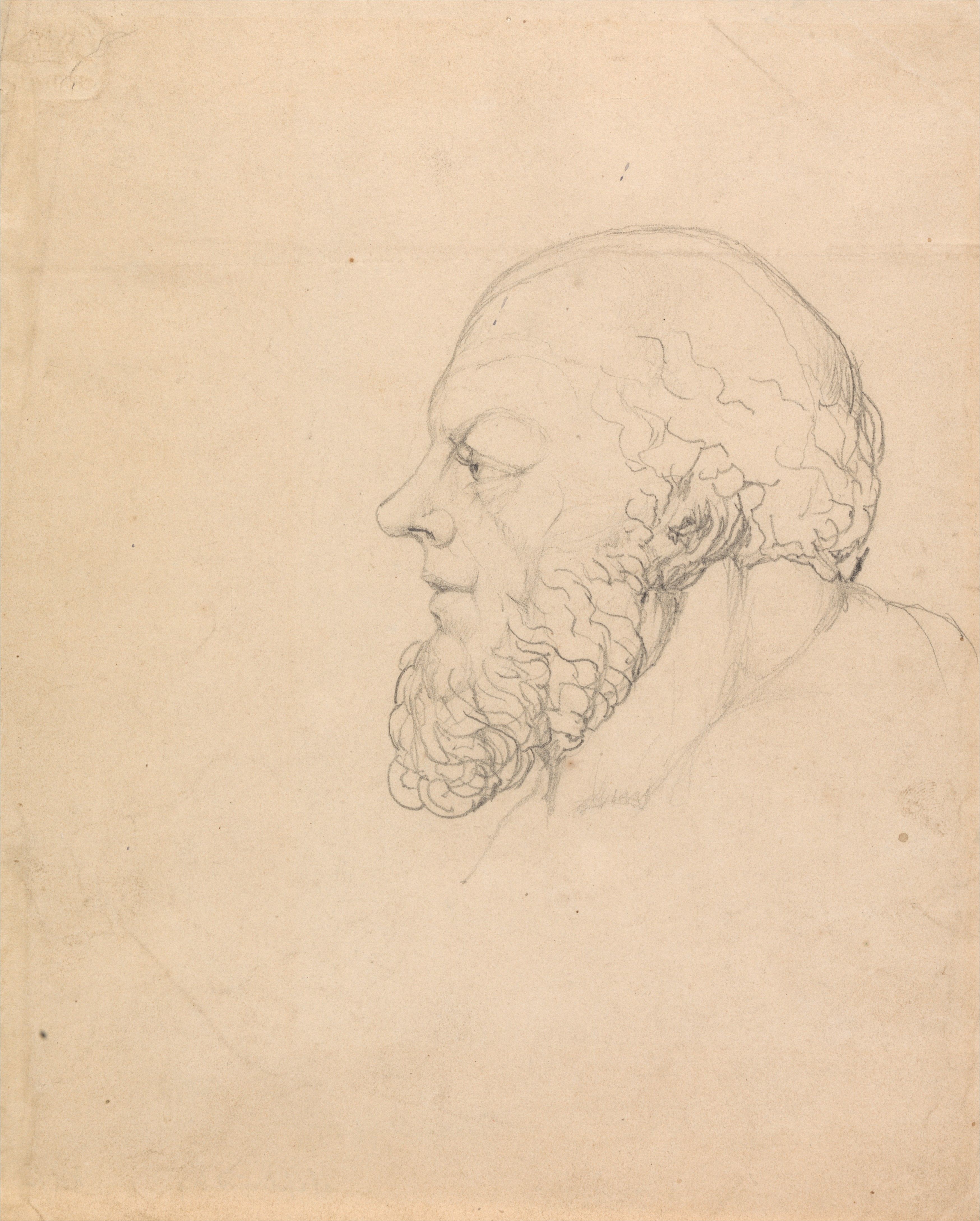
One of the visionary heads which Blake drew under the encouragement of Varley was of the Greek scholar and teacher Socrates. According to Crabb Robinson Blake felt closely akin to Socrates:

"In this he seemed to explain humanly what he had done, but he at another time spoke of his paintings as being what he had seen in his visions. And when he said my visions it was in the ordinary unemphatic tone in which we speak of trivial matters that every one understands and cares nothing about. In the same tone he said repeatedly, the 'Spirit told me.' I took occasion to say—You use the same word as Socrates used. What resemblance do you suppose is there between your spirit and the spirit of Socrates?' The same as between our countenance.' He paused and added—'I was Socrates.' And then, as if correcting himself, 'A sort of brother. I must have had conversations with him. So I had with Jesus Christ. I have an obscure recollection of having been with both of them.'"

Yale Center for British Art
Visionary Head
Socrates
The reservations which Blake had about Socrates seemed to be that he presented himself as a philosopher not as a mystic. Blake could appreciate most enthusiastically one who acknowledged a debt to visionary experience as the source of his knowledge. Blake considered that philosophers dealt in abstract mental constructs rather than direct intuitive experience accessed through the imagination. To Blake morality as taught by Socrates was an impediment to spiritual development if it was not subservient to the indwelling Spirit through which man had direct and immediate access to the truth.

Laocoon, (E 275) 
"If Morality was Christianity Socrates was the Saviour"
Song of Los, Plate 3, (E 67)
"When Rintrah gave Abstract Philosophy to Brama in the East:
(Night spoke to the Cloud!
Lo these Human form'd spirits in smiling hipocrisy. War
Against one another; so let them War on; slaves to the eternal Elements)
Noah shrunk, beneath the waters;                                 
Abram fled in fires from Chaldea;
Moses beheld upon Mount Sinai forms of dark delusion:

To Trismegistus. Palamabron gave an abstract Law:
To Pythagoras Socrates & Plato.

Times rolled on o'er all the sons of Har, time after time        
Orc on Mount Atlas howld, chain'd down with the Chain of Jealousy
Then Oothoon hoverd over Judah & Jerusalem
And Jesus heard her voice (a man of sorrows) he recievd
A Gospel from wretched Theotormon.

The human race began to wither, for the healthy built            
Secluded places, fearing the joys of Love
And the disease'd only propagated:
So Antamon call'd up Leutha from her valleys of delight:
And to Mahomet a loose Bible gave.
But in the North, to Odin, Sotha gave a Code of War,             
Because of Diralada thinking to reclaim his joy.
Plate 4
These were the Churches: Hospitals: Castles: Palaces:
Like nets & gins & traps to catch the joys of Eternity
     And all the rest a desart;
Till like a dream Eternity was obliterated & erased."

Friday, March 14, 2014

Visions of God

       According to Blake Ezekiel once acted out a bizarre symptom of the prospects of the Israelites, lying for an inordinate period of time on his left side, then another period on his right. Mr. Blake had a conversatiion with him about that and asked him why he had done it; the answer came clearly: "the desire of raising other [people] into a perception of the infinite" (Marriage of Heaven and Hell, Plate 13)

    Who can doubt that William actually had that interview with Zeke? But if truth be known, that desire became the agenda for Blake's life, and perhaps the generic life purpose of every true prophet.
       He saw things that most of us don't see, and he urgently needed to show them to us, to show us how to see them.

    There are many kinds of seeing and many levels of consciousness, but with the natural proclivity to resort to the dialectic we might say there are two:


       1. The sense-based, natural, materialistic time and space consciousness (Blake called this Ulro; Jesus called it Hell).

       2. 1st Corinthians 13:12:
For now we see through a glass, darkly; but then face to face: now I know in part; but then shall I know even as also I am known.

Jesus showed us with his life how to live eternally; and he told us we could do it. Blake did it, periodically at least, and like Jesus he wanted us to share that heavenly gift.
       He called it Vision; that's what he lived for, those eternal moments were all that matters. If you can't do it continuously, then you can talk about it, write about it, draw it, paint it. He did (and you can) show us how to see.


God appears and God is Light 

To those poor Souls who dwell in Night, 
But does a Human Form display 
To those who dwell in Realms of Day.
The Ancient of Days (1794)
Watercolor etching by William Blake

(William Blake, Auguries of Innocence)


This leads to the Ancient of Days: 
From Wikipedia, the free encyclopedia:
Ancient of Days is a name for God in the Biblical Book of  Daniel: in the original Aramaic Atik Yomin; in the Greek Septuagint Palaios Hemeron; and in the Vulgate Antiquus Dierum.
The title "Ancient of Days" has been used as a source of inspiration in art and music, denoting the Creator's aspects of eternity combined with perfection. William Blake's watercolour and relief etching entitled "The Ancient of Days" is one such example.

Immortal, invisible, God Only Wise      


Thursday, October 25, 2012

Visions of the Daughters of Albion 5


(Here of course is a continuation of the text of the previous plate: Oothoon's lament.)

In happy copulation; if in evening mild, wearied with work;
Sit on a bank and draw the pleasures of this free born joy.

The moment of desire! the moment of desire! The virgin
That pines for man; shall awaken her womb to enormous joys
In the secret shadows of her chamber; the youth shut up from
The lustful joy, shall forget to generate, & create an amorous image
In the shadows of his curtains and in the folds of his silent pillow.
Are not these the places of religion? the rewards of continence!
The self enjoyings of self denial? Why dost thou seek religion?
Is it because acts are not lovely, that thou seekest solitude,
Where the horrible darkness is impressed with reflections of desire.

Father of Jealousy, be thou accursed from the earth!
Why hast thou taught my Theotormon this accursed thing?
Till beauty fades from off my shoulders darken'd and cast out,
A solitary shadow wailing on the margin of non-entity.

I cry, Love! Love! Love! happy happy Love! free as the mountain wind!
Can that be Love, that drinks another as a sponge drinks water?
That clouds with jealousy his nights, with weepings all the day:
To spin a web of age around him, grey and hoary! dark!
Till his eyes sicken at the fruit that hangs before his sight.
Such is self-love that envies all! a creeping skeleton
With lamplike eyes watching around the frozen marriage bed.

But silken nets and traps of adamant will Oothoon spread,
And catch for the girls of mild silver, or of furious gold;
I'll lie beside thee on a bank & view their wanton play
In lovely copulation bliss on bliss with Theotormon;
Red as the rosy morning, lustful as the first born beam,
Oothoon shall view his dear delight, nor e'er with jealous cloud
Come in the heavens of generous love; nor selfish blightings bring.
Does the sun walk in glorious raiment, on the secret floor

Notes:

I. The Picture here is less a propos; it would be more appropriate 
where the Daughters of Albion are mentioned--at the end of the poem.

Erdman's Illuminated tells us that five of the 'daughters' are 
pictured  here, which requires considerable imagination to envision; 
a more reasonable representation of the 'daughters' is seen on the last plate.

the youth shut up from The lustful joy and
Does the sun walk in glorious raiment, on the secret floor.
Blake has many meanings for sun, but here it's associated with freedom.

The virgin and the youth alike are frustrated by the prohibitions of the conventional world. 

Blake used this idea elsewhere:

"Ah, sunflower, weary of time,
Who countest the steps of the sun;
Seeking after that sweet golden clime
Where the traveller’s journey is done;

Where the Youth pined away with desire,
And the pale virgin shrouded in snow,
Arise from their graves, and aspire
Where my Sunflower wishes to go!"
(Songs of Experience [Erdman 25)

A lot of data about this poem is found in an essay by william J. 

"The flower which turns its head to follow the sun's course and is 
yet rooted to the earth is Blake's symbol for all men and women whose 
lives are dominated and spoiled by a longing which they can never 
hope to satisfy and who are held down to the earth despite their 
desire for release into some brighter, freer sphere."
(Found in C.M.Bowra's The Romantic Imagination)