Showing posts with label Bunyan. Show all posts

Saturday, August 10, 2024

BLAKE & DREAMS 2

THE PILGRIMS PROGRESS
FROM THIS WORLD
TO THAT WHICH IS TO COME
DELIVERED 
UNDER THE SIMILITUDE
OF A DREAM
By John Bunyan's with an introduction by John T. Winterich
Illustrated with Water-colors by WILLIAM BLAKE  

 Pilgrim's Dream

"As I walked through the wilderness of this world, I came upon a certain place, where there was a den—and I laid down in that place to sleep. And as I slept, I dreamed a dream. I dreamed, and, behold—I saw a man clothed with rags, standing with his face turned away from his own house, with a Book in his hand, and a great burden upon his back. I looked, and saw him open the Book, and read therein; and as he read, he wept and trembled! And not being able to contain himself any longer—he broke out with a lamentable cry, saying, 'What shall I do?'"

Blake portrays three level in his image:

The dream which is a vehicle through which the dreamer may gain access to levels of consciousness below his ego consciousness.

Sleeping which is a necessary condition which allows the brain to be activated in such a way that unconscious content surfaces.

The unconscious which may release supressed material as well as well as activate protections which prevent damage.

Blake knew that listening to one's dreams was a way of getting in touch with the aspects of the psyche which are not ordinarily accessable. When Blake illustrated Pilgrim's Progress which was written as a sequence of episodes in Bunyan's dream, he reached into his unconscious to make known what may have been opaque in Bunyan's allegory. Bunyan did not focus on the dream state itself but in Blake's first illustration he revealed that the dreamer is subject to levels of consciousness different from those of waking experience. 

The sleeping pilgrim is not reconstructing memories but reliving incidents in his life which fit into a pattern through which a pilgrim travels. In the upper level of the picture Blake faintly represents the episodes through the pilgrim will travel in Bunyan's dream. The dreamer who lies asleep bears no resemblemce to the  pilgrim who will undertake the journey. Beneath the dreamer lies a sleeping lion. Blake used a lion as a symbol for the love and protection which is afforded to the innocent lamb who is vulnerable to the wrath of the wolf who would do him harm.

    
Milton, PLATE 15 [17], (E 109)
"As when a man dreams, he reflects not that his body sleeps,
Else he would wake; so seem'd he entering his Shadow: but
With him the Spirits of the Seven Angels of the Presence
Entering; they gave him still perceptions of his Sleeping Body;
Which now arose and walk'd with them in Eden, as an Eighth   
Image Divine tho' darken'd; and tho walking as one walks
In sleep; and the Seven comforted and supported him.

Like as a Polypus that vegetates beneath the deep!
They saw his Shadow vegetated underneath the Couch
Of death: for when he enterd into his Shadow: Himself:           
His real and immortal Self: was as appeard to those
Who dwell in immortality, as One sleeping on a couch
Of gold; and those in immortality gave forth their Emanations
Like Females of sweet beauty, to guard round him & to feed
His lips with food of Eden in his cold and dim repose!           

But to himself he seemd a wanderer lost in dreary night.
Onwards his Shadow kept its course among the Spectres; call'd
Satan, but swift as lightning passing them, startled the shades
Of Hell beheld him in a trail of light as of a comet
That travels into Chaos: so Milton went guarded within." 
Songs and ballads, (E 486)     
"The Land of Dreams

Awake awake my little Boy
Thou wast thy Mothers only joy
Why dost thou weep in thy gentle sleep
Awake thy Father does thee keep

O what Land is the Land of Dreams     
What are its Mountains & what are its Streams
O Father I saw my Mother there
Among the Lillies by waters fair

Among the Lambs clothed in white
She walkd with her Thomas in sweet delight   
I wept for joy like a dove I mourn
O when shall I again return

Dear Child I also by pleasant Streams
Have wanderd all Night in the Land of Dreams
But tho calm & warm the Waters wide  
I could not get to the other side

Father O Father what do we here
In this Land of unbelief & fear
The Land of Dreams is better far
Above the light of the Morning Star"   


In Dark Figures in the Desired Country, Gerda Norvig makes this statement about the healing powers which are called forth when one engages in the process of individuation:
"Blake seems to be giving here graphic expression to a common psychological rule that goes beyond Bunyan's: the rule that active differentiation of the contents of the dark side of the self precedes spiritual assistance, but also literally creates a space for the healing powers of the psyche to move into as they well up from archetypal dimensions recognized as existing deep in the background of our mental landscape." (Page 148)

Damon, A Blake Dictionary

"The Lion is commonly known as the protector of the Lamb...the Lion's warth is particulrly directed against the wolves who prey upon the flocks.
...
The Lion is spiritual wrath, inspired by pity...while the Tyger's blind warth is purely emotional." (Page 242)


Friday, September 08, 2023

Enlightenments

Previously posted on Dec 17, 2017

We all reach God in some way, but among those closest to God were several Soldiers of the Cross. These examples all show a long continued inner turmoil and struggle rewarded in due course by that special gift that Eternity offers to the most faithful.
-----------------------------------------------------
 
His heart leapt for joy
 “Now after I had received that opening from the Lord that to be trained at Oxford or Cambridge was not enough to equip a man to be a minister of Christ, I respected the priests less, and looked more after the dissenting Christians. And among them I saw there was some tenderness, and many of them came afterwards to be convinced, for they had some openings from God. But as I had forsaken all the priests, so I left the separatist Preachers, also, together with those called the most experienced people. For I saw there was no one among them all who could speak to my condition. And when all my hope in them and in all men were gone, so that I had nothing outwardly to help me, nor could I even tell what to do, then, Oh then, I heard a voice which said, “There is one — even Christ Jesus — who can speak to thy condition!” And when I heard it, my heart leapt for joy. Then the Lord showed me why there was no one on the earth who could speak to my condition. The reason was that I was to give him all the glory. For all are concluded under sin, and shut up in unbelief as I had been, so that Jesus Christ might have the pre-eminence, as the one who enlightens, and gives grace, faith and power. So, when God works, who shall prevent it? And I knew this experimentally through my experiences.”"
(From the Journal of George Fox)
------------------------------------------------------------------------------

The Loss of the Burden in Pilgrims Progress

Blake's Illustrations to Bunyan's Pilgrims Progress
 
Christian is at the Cross; his burden is cast off (at the lower left of the picture):
"To take my cross up day by day,
And serve the Lord with fear.
Now I saw in my dream, that they went on,
and Great-Heart before them. So they went,
and came to the place where Christian's
burden fell off his back and tumbled into a
sepulchre. Here then they made a pause; and
here also they blessed God."
(from Pilgrim's Progress)
 
"finally he was relieved by the text, 'The blood of Jesus Christ His Son cleanseth us from all sin.'" John Bunyan's Conversion
 
----------------------------------------------

His Heart was strangely warmed

.John Wesley was a super-Christian at Oxford. He demanded rigorous adherence to certain practices, carried out by his disciples; they were called methodists. Once ordained he went to the colony of Georgia to save the heathen, but he came to realize that he needed salvation himself.

Returning to England there was a terrible storm at sea and everyone quailed with fear for their lives; everyone that is except a group of Moravians who continued in prayer and showed great equanimity.

Back in London Wesley continued to worry about his salvation until, in 1738:
"In the evening I went very unwillingly to a society in Aldersgate Street, where one was reading Luther’s preface to the Epistle to the Romans. About a quarter before nine, while he was describing the change which God works in the heart through faith in Christ, I felt my heart strangely warmed. I felt I did trust in Christ, Christ alone, for salvation; and an assurance was given me that he had taken away my sins, even mine, and saved me from the law of sin and death."

He was generally considered to be one of the greatest men in 18th century England and was thought by many to have saved England from Revolution.
 
-------------------------------------------------------

The Truchsessian Museum

The Enlightenment of William Blake was on this wise:
"O lovely Felpham, parent of Immortal Friendship, to thee I am eternally
indebted for my three years rest from perturbation and the strength I now enjoy. Suddenly, on the day after visiting the Truchsessian Gallery of
pictures, I was again enlightened with the light I enjoyed in my youth, and which has for exactly twenty years been closed from me as by a door and by window-shutters. Consequently I can, with confidence, promise you ocular demonstration of my altered state on the plates I am now engraving after Romney, whose spiritual aid has not a little conduced to my restoration to the light of Art." (Erdman 756)

He wrote this in Letter 51 (To William Hayley) 23 October 1804.

-----------------------------------------------------

Renunciation

".....Albert Schweitzer's biography of J. S. Bach, written in 1905, had also proved an immediate success. At 30 years of age Schweitzer was tall, broad-shouldered, darkly handsome, and a witty charismatic writer, preacher, and lecturer: clearly, a bright future lay before him. However, one spring morning in 1905, he experienced a stunning religious revelation: it came to him that at some point in the years just ahead he must renounce facile success and devote himself unsparingly to the betterment of mankind's condition.
Accordingly, several years later, Schweitzer threw over his several careers as author, lecturer, and organ recitalist and plunged into the study of medicine - his aim being to go to Africa as a medical missionary. He won his medical degree in 1912. The year before, he had married Helene Bresslau, a professor's daughter who had studied nursing in order to work at his side in Africa; in 1919 the couple had a daughter, Rhena.

In 1913 the Schweitzers journeyed to what was then French Equatorial Africa. There, after various setbacks, they founded the Albert Schweitzer Hospital at Lambaréné, on the Ogooué River, "at the edge of the primeval forest." This area now lies within the independent West African republic of Gabon. Funds were scarce and equipment primitive, but native Africans thronged to the site, and in the decades that followed, many thousands were treated." (From Answers.Com)
----------------------------------

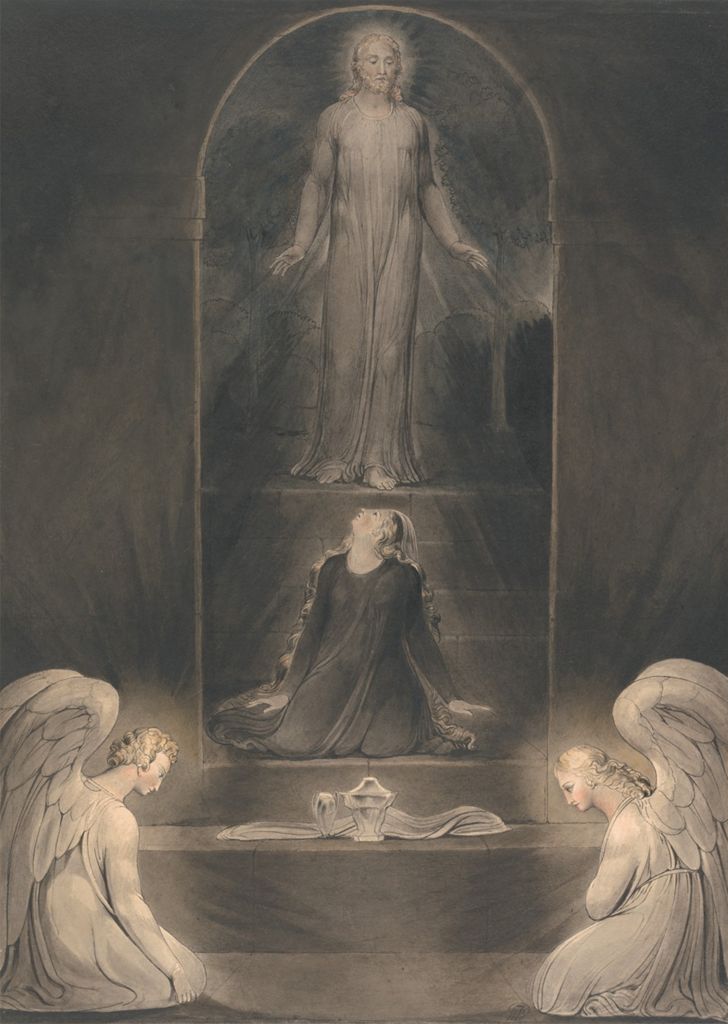
Magdalene Encounters the Risen Christ

Yale Center for British Art
Mary Magdalen at the Sepulchre

Sunday, August 15, 2021

THE SOUL'S JOURNEY

First posted April 2012 

Illustrations to Bunyan's Pilgrims Progress
 

We revisit the Arlington Tempera about which much more needs to be said. I plan to relate more of what Kathleen Raine writes in Blake and Tradition about the Arlington Tempera. However today I will first repost material from two of Larry's posts from September 2009 & 11. Raine treats the Arlington Tempera in a section of her book which she names: The Myth of the Soul. The Soul's journey is traced in the wanderings of Vala and in the imagery of the Arlington Tempera.

Larry Clayton's post:

" A most significant key to Blake's symbolism came to light only in 1947 when Arlington Court was bequeathed to the British National Trust. Among the furnishings there was a large tempera by Blake, called alternatively The Sea of Time and Space or The Cave of the Nymphs. This treasure had been hidden from public eyes for a century.

(Most of us are unlikely to see the original, but Blake and Antiquity by Kathleen Raine offers several glimpses of the picture with a detailed account of the symbols it contains. There is no better way to begin an understanding of Blake at the deeper level than to read carefully and study this small and accessible book.)

The picture contains the essential symbolism of Blake's myth; the theme goes back to Homer, then to Plato and Porphyry.

Blake and Taylor were approximately the same age and as young men close friends. Many people think that Taylor introduced Blake to the Platonic and Neoplatonic traditions. It seems certain that Taylor's On the Homeric Cave of the Nymphs deeply influenced the painting of the Arlington Tempera. It also introduced a great number of the most common symbols used in Blake's myth; they were used over and over throughout Blake's work."

Continuing from another post:

"The last post included a link to the Arlington Tempera. You may see it as an excellent portrayal of the Circle of Destiny.

One of the common names for the picture is The Sea of Time and Space. However Damon suggested The Circle of Life as a more appropriate term.

The sea in the picture is only one of several vital scenes; it occurs in the left foreground. The right hand part portrays the Cave of the Nymphs, found in the 13th book of the Odyssey. In fact it's from an interpretation of the cave by Porphyry, a 3rd century a Neoplatonist philosopher.

The upper left portrays Eternity. The center shows two prominent characters. The man kneeling on the shore has been given several names: Odysseus by Kathleen Raine, Luvah by Damon, Albion/Jesus by Digby, or better yet, Everyman (you and I). He has gotten close to completion of the circle of destiny; without looking at the sea he is throwing the girdle of Leucothea which she had lent him to be able to swim ashore (Blake used Book 5 of the Odyssey for this feature).

Behind 'Everyman' stands a woman, perhaps Athena (Raine), Vala (Damon), the anima (Digby). (This shows how Blake says different things to different people -- much like the Bible!)

On the right side of the picture there's an image you might imagine as a double escalator with the right side going down and the left up. Down the northern come the souls with a hankering for mortal life. Up the southern may go Everyman:

Gates of Paradise, The Keys of the Gates, (E 269)
"13 But when once I did descry
The Immortal Man that cannot Die
14 Thro evening shades I haste away
To close the Labours of my Day"

We can only suppose that Everyman, responding to the radiant woman's signal, looked up and moved!"

To conclude here is a quote from Raine's Blake and Tradition:
"The figure of the soul is symbolized by a series of female figures, each a little more complex than the last - Thel, Lyca, Oothoon, Vala, and Jerusalem. All these experience descent, suffering and return... In Jerusalem the story of the soul is Christianized but retains traces of the earlier myths out of which grew this latest expression of Blake's mature spiritual insight and perfected artistry." (Page 67,68)


Wednesday, November 11, 2020

CONTRARIES

Wikipedia Commons
Man Sweeping the Interpreter's Parlour
Scene from Bunyan's Pilgrim's Progress

It is not easy for us to grasp how contraries can be equally true, but since we live in a time when divisions seem to be how we define ourselves, it is a necessary exercise. The exercise of seeing may be helpful in understanding how to bring together two contraries. Think of two contraries, lets say wrath and pity, as existing at the extremes of a vast expanse of space. If we attempt to focus on wrath, pity will be totally out of focus. We wouldn't be able to see it clearly enough to describe it. If we change our focus to see pity clearly, wrath will be only a blur. There is a point of focus where both wrath and pity are part of a clear picture. This allows us to see the contraries as equally true. However it we insist on not focusing so that we see them both, but concentrate on one or the other, we experience the false reasoning which negates the finely balanced contraries.

Rintrah as Wrath and Palamabron as Pity worked together as brothers until Satan interfered by exchanging the harrow, the instrument of pity, for the mill, the instrument of reasoning. Satan introduced the false reasoning which took away Palamabron's ability to practice pity or drive the harrow.

In this passage of scripture we see how differing treatments are necessary to deal with differing individuals. A gentle form of wrath, a reprimand, is required for the rule-breaker; a mild sort of pity, encouragement, is offered to the timid; the weak who are those with distorted thinking, are offered help to see more clearly.      

1st Thessalonians
Phillips Translation

5:13b-18 - Live together in peace, and our instruction to this end is to reprimand the unruly, encourage the timid, help the weak and be very patient with all men. Be sure that no one repays a bad turn by a bad turn; good should be your objective always, among yourselves and in the world at large. Be happy in your faith at all times. Never stop praying. Be thankful, whatever the circumstances may be. If you follow this advice you will be working out the will of God expressed to you in Jesus Christ. 
Jerusalem, Plate 43 [29], (E 191)
"I elected Albion for my glory; I gave to him the Nations,
Of the whole Earth. he was the Angel of my Presence: and all
The Sons of God were Albions Sons: and Jerusalem was my joy.
The Reactor hath hid himself thro envy. I behold him.
But you cannot behold him till he be reveald in his System       
Albions Reactor must have a Place prepard: Albion must Sleep
The Sleep of Death, till the Man of Sin & Repentance be reveald.
Hidden in Albions Forests he lurks: he admits of no Reply
From Albion: but hath founded his Reaction into a Law
Of Action, for Obedience to destroy the Contraries of Man.     
He hath compelld Albion to become a Punisher & hath possessd
Himself of Albions Forests & Wilds! and Jerusalem is taken!"

Monday, March 21, 2016

PILGRIM & EVANGELIST

Reposted from February 04, 2015. 

Pilgrims's Progress 
John Bunyan
"{12} Now, I saw, upon a time, when he was walking in the fields, that he was, as he was wont, reading in his book, and greatly distressed in his mind; and, as he read, he burst out, as he had done before, crying, "What shall I do to be saved?"
{13} I saw also that he looked this way and that way, as if he would run; yet he stood still, because, as I perceived, he could not tell which way to go. I looked then, and saw a man named Evangelist coming to him and asked, Wherefore dost thou cry? [Job 33:23]
{14} He answered, Sir, I perceive by the book in my hand, that I am condemned to die, and after that to come to judgement [Heb. 9:27]; and I find that I am not willing to do the first [Job 16:21], nor able to do the second. [Ezek. 22:14]
CHRISTIAN no sooner leaves the World but meets EVANGELIST, who lovingly him greets With tidings of another: and doth show Him how to mount to that from this below.
{15} Then said Evangelist, Why not willing to die, since this life is attended with so many evils? The man answered, Because I fear that this burden is upon my back will sink me lower than the grave, and I shall fall into Tophet. [Isa. 30:33] And, Sir, if I be not fit to go to prison, I am not fit, I am sure, to go to judgement, and from thence to execution; and the thoughts of these things make me cry.
{16} Then said Evangelist, If this be thy condition, why standest thou still? He answered, Because I know not whither to go. Then he gave him a parchment roll, and there was written within, Flee from the wrath to come. [Matt. 3.7]
{17} The man therefore read it, and looking upon Evangelist very carefully, said, Whither must I fly? Then said Evangelist, pointing with his finger over a very wide field, Do you see yonder wicket-gate? [Matt. 7:13,14] The man said, No. Then said the other, Do you see yonder shining light? [Ps. 119:105; 2 Pet. 1:19] He said, I think I do. Then said Evangelist, Keep that light in your eye, and go up directly thereto: so shalt thou see the gate; at which, when thou knockest, it shall be told thee what thou shalt do."

Illustrations to Pilgrim's Progress
Plate 3
Christian Meets Evangelist
Blake's third illustration to Bunyan's Pilgrim's Progress shows the meeting of Christian and the Evangelist. Bunyan himself could be the Evangelist since he was employed as both a tinker and an itinerant preacher. Blake pictures alternatives which are available to Pilgrim as he considers his journey: the city of destruction from which he came, the forest of confusion, the mountain of illumination, and the gate to which Evangelist directs him. The gate, however, is not pictured in the direction Evangelist points but close-by if Christian were to look back. Significantly Pilgrim is no longer is scrutinizing his book of scripture from which he could directly encounter God's Word. 

There was a broad range of dissenting Christians in England from the time of Bunyan and Milton and Fox in the 17th century to Blake's time in the 18th and 19th centuries. Although Blake and Bunyan were both dissenters their theologies were vastly different. Bunyan was from the Puritan tradition; Blake determined to create his own system rather than be enslaved to another mans. Pilgrim's Progress conforms to the approach to religious faith and practice which Bunyan sought to propagate. The path was predetermined and one's choices were limited. Bunyan and Blake both went to scripture as their primary source of spiritual teaching but approached it differently. 

Gerda Norvig explains this difference on Page 37 of Dark Figures in the Desired Country:
"The reason for this rigidity was that there was no [Puritan] sanction for interpreting episodes of Scripture as dynamic myth or vision, quite the reverse. Many influential tracts warned readers not to 'raise their contemplations by fancy and imagination above Scripture revelation' lest they dark[en] counsel without  knowledge, uttering thing which they understood not, which have no substance or spiritual food of faith in them.' Blake's conception that the purpose of scriptural prophecy, like that of art, was 'to open the immortal Eyes of Man inwards into the Worlds of Thought: into Eternity / Ever expanding' would have seemed anathema to the Puritan exegete of Bunyan's day. The inner worlds of thought were simply not felt to be trustworthy enough regions in which to find truth, and the idea of expanding into eternity would have terrified men and women who sought definitive boundaries to clarify a shaky divine identity and to keep them safely focused on the straight and narrow."

Blake searched Pilgrim's Progress for episodes which would lend themselves to support his own experience that the scripture was meant to be internalized, enabling it to become transformative. Bunyan thought in terms of altering outward behavior by following the path to salvation outlined by his Puritan faith. Blake, however recognized the critical events in Pilgrim's journey were changes in the psyche which allowed the pilgrim or the dreamer to achieve further growth toward becoming healed and whole (or individuated as Jung would define it.)

Letters, Number 52, (E 758) 
 "For O happiness never enough to be
grateful for! I have lost my Confusion of Thought while at work &
am as much myself when I take the Pencil or Graver into my hand
as I used to be in my Youth I have indeed fought thro a Hell of
terrors & horrors (which none could know but myself.) in a
Divided Existence now no longer Divided. nor at war with myself I
shall travel on in the Strength of the Lord God as Poor Pilgrim
says" 

Vision of Last Judgment, (E 554)
"The Last Judgment is not Fable or Allegory
but Vision   Fable or Allegory are a totally distinct & inferior
kind of Poetry.  Vision or Imagination is a Representation of
what Eternally Exists.  Really & Unchangeably.  Fable or Allegory
is Formd by the Daughters of Memory.  Imagination is Surrounded
by the daughters of Inspiration who in the aggregate are calld
Jerusalem     The Hebrew Bible & the Gospel of
Jesus are not Allegory but Eternal Vision or Imagination of All
that Exists   Pilgrims Progress is full of it   the Greek Poets the
same but  ought
to be known as Two Distinct Things & so calld for the Sake of
Eternal Life"  

Thursday, March 05, 2015

Pilgrim's Progress


Here are the words with which Pilgrims's Progress begins:

As I walked through the wilderness of this world, I lighted on a certain place where was a den,3 and laid me down in that place to sleep; and as I slept, I dreamed a dream. I dreamed, and behold, I saw a man clothed with rags, standing in a certain place, with his face from his own house, a book in his hand, and a great burden upon his back.Isa 64:6Luke 14:33Psalm 38:4.

I looked and saw him open the book, and read therein; and as he read, he wept and trembled; and not being able longer to contain, he brake out with a lamentable cry, saying, “What shall I do?” Acts 2:3716:30Habak 1:2,3.

In this plight, therefore, he went home, and restrained himself as long as he could, that his wife and children should not perceive his distress; but he could not be silent long, because that his trouble increased. Wherefore at length he brake his mind to his wife and children; and thus he began to talk to them: “O, my dear wife,” said he, “and you the children of my bowels, I, your dear friend, am in myself undone by reason of a burden that lieth hard upon me; moreover, I am certainly informed that this our city will be burnt with fire from heaven; in which fearful overthrow, both myself, with thee my wife, and you my sweet babes, shall miserably come to ruin, except (the which yet I see not) some way of escape can be found whereby we may be delivered.”

At this his relations were sore amazed; not for that they believed that what he had said to them was true, but because they thought that some frenzy distemper had got into his head; therefore, it drawing towards night, and they hoping that sleep might settle his brains, with all haste they got him to bed. But the night was as troublesome to him as the day; wherefore, instead of sleeping, he spent it in sighs and tears. So when the morning was come, they would know how he did. He told them, “Worse and worse:” he also set to talking to them again; but they began to be hardened.

They also thought to drive away his distemper by harsh and surly carriage to him; sometimes they would deride, sometimes they would chide, and sometimes they would quite neglect him. Wherefore he began to retire himself to his chamber to pray for and pity them, and also to condole his own misery; he would also walk solitarily in the fields, sometimes reading, and sometimes praying: and thus for some days he spent his time.


Beginning of PP:
The Pilgrim's Progress from This World to That Which Is to Come; Delivered under the Similitude of a Dream is a Christian allegory written by John Bunyan (1628–1688) and published in February, 1678. It is regarded as one of the most significant works of religious English literature,[1][2][3][4] has been translated into  more than 200 languages, and has never been out of print.[5][6] Bunyan began his work while in theBedfordshire county prison for violations of the Conventicle Act, which prohibited the holding of religious services outside the auspices of the established Church of England. Early Bunyan scholars like John Brown believed The Pilgrim's Progress was begun in Bunyan's second, shorter imprisonment for six months in 1675,[7]but more recent scholars like Roger Sharrock believe that it was begun during Bunyan's initial, more lengthy imprisonment from 1660–72 right after he had written his spiritual autobiography, Grace Abounding to the Chief of Sinners.[8]


Plate 1 of Pilgrims Progress
Wikipedia

THE PILGRIM'S PROGRESS

In the Similitude of a Dream


{10} As I walked through the wilderness of this world, I lighted on a certain place where was a Den, and I laid me down in that place to sleep: and, as I slept, I dreamed a dream. I dreamed, and behold, I saw a man clothed with rags, standing in a certain place, with his face from his own house, a book in his hand, and a great burden upon his back. [Isa. 64:6; Luke 14:33; Ps. 38:4; Hab. 2:2; Acts 16:30,31]

I looked, and saw him open the book, and read therein;

Tuesday, March 03, 2015

Blake and Bunyan


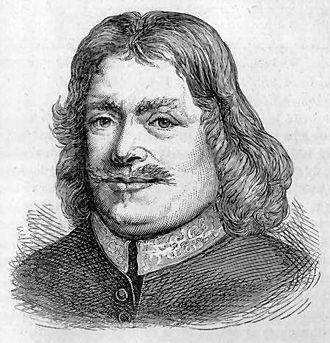
John Bunyan from Wikipedia
The timeline of John Bunyan (1628) lies  between Milton (1608) and Blake (1758).  
Blake was thoroughly familiar with Bunyan but had some serious theological differences 
with him.  In the first place Bunyan's masterpiece, Pilgrim's Progress was an allegory; 
Blake depreciates allegory:

"[[A Vision of the Last Judgment] PAGE 68]:
 The Last Judgment is not Fable or Allegory  but Vision 
Fable or Allegory are a totally distinct & inferior"
(Erdman 554)

However Blake knew and respected Bunyan in spite of their differences.

Blake died in 1828 and began his illustrations of Pilgrim's Progress in 1824.


Here's Bunyan's Introduction to Pilgrim's Progress:

WHEN at the first I took my pen in hand Thus for to write,
 I did not understand That I at all should make a little book In such a mode: 
nay, I had undertook To make another, which when almost done, Before I was aware, 
this begun. And thus it was: I, writing of the way And race of saints in this our gospel day, 
Fell suddenly into an allegory About their journey and the way to glory, 
In more than twenty things, which I set down. This done, I twenty more had in my crown; 
And they again began to multiply, Like sparks that from the coals of fire do fly. 
Nay, then, thought I, if that you breed so fast, I’ll put you by yourselves, 
lest you at last Should prove ad infinitum, and eat out The book that I already am about. 
 Well, so I did: but yet I did not think To show to all the world my pen and ink 
In such a mode; I only thought to make I knew not what. Nor did I undertake 
Thereby to please my neighbour — no, not I! I did it mine own self to gratify.


John Bunyan , baptised 28 November 1628 – 31 August 1688) was an English writer and preacher best remembered as the author of the religious allegory The Pilgrim's Progress.

In addition to The Pilgrim's Progress, Bunyan wrote nearly sixty titles, many of them expanded sermons.

Bunyan came from the village of Elstow, near Bedford. He had little schooling and at the age of sixteen joined the Parliamentary army during the first stage of the English Civil War. After three years in the army he returned to Elstow and took up the trade of tinker, which he had learnt from his father.

He became interested in religion after his marriage, attending first the parish church and then joining the Bedford Meeting, a nonconformist group in Bedford, and becoming a preacher.

After the restoration of the monarch, when the freedom of nonconformists was curtailed, Bunyan was arrested and spent the next twelve years in gaol as he refused to undertake to give up preaching. During this time he wrote a spiritual autobiography, Grace Abounding to the Chief of Sinners, and began work on his most famous book, The Pilgrim's Progress, which was not published until some years after his release.

Bunyan's later years, in spite of another shorter term of imprisonment, were spent in relative comfort as a popular author and preacher, and pastor of the Bedford Meeting. He died aged 59 or 60 after falling ill on a journey to London and is buried in Bunhill Fields.

The Pilgrim's Progress became one of the most published books in the English language; 1,300 editions having been printed by 1938, 250 years after the author's death.

Wednesday, February 18, 2015

INTERPRETER'S PARLOUR II

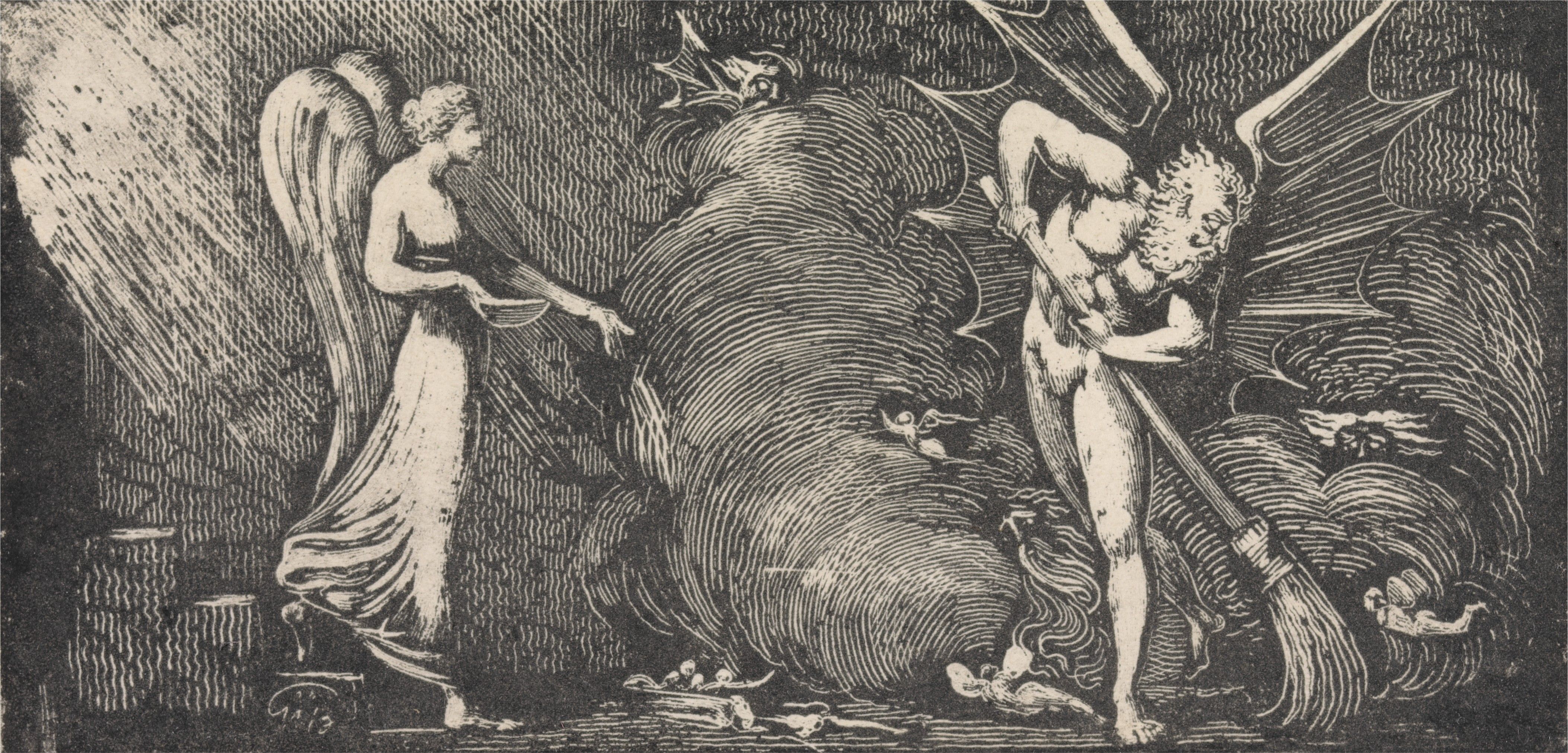
The first illustration Blake made for Bunyan's Pilgrim's Progress was a print which he produced before 1822, perhaps much earlier. He created a white line engraving of The Man Sweeping the Interpreter's Parlor which illustrated the second lesson of the Interpreter to Christian in Pilgrim's Progress. The series of 28 watercolor illustrations to Pilgrim's Progress was painted in approximately 1824. 

Yale Center for British Art
Man Sweeping Interpreter's Parlour

Sin did not play the same role in Blake's theology as it did in Bunyan's. Because Blake believed that everything that lives is holy, his effort was directed toward releasing man's energies, not toward removing his sinfulness. Blake's picture The Man Sweeping the Interpreter's Parlor may be seen allegorically as Bunyan wrote his account: representing the sinful, corrupt nature of man which is brought under control by the Law & the Gospel. However Blake's image lends itself to further insight apropos to his own attitude to sin. Blake saw the child as born innocent, not as burdened by original sin which Bunyan saw to be the heritage of humanity from Adam and Eve. Sin to Blake was simply failure to exercise one's ability to perceive the Eternal. It was not man's sinfulness which had to be eradicated but his blindness to the bliss which he was meant to experience. The nearest Blake can to imputing sin was calling man to task for hindering - preventing others from developing their own spiritual potential.

To Blake man needed to cleanse himself of the idea that the world can be separated into 'good and evil.' There are functions of the psyche which perform different tasks but all are valuable and necessary to completeness. By picturing the Law as the Devil and the Gospel as the Angel, Blake impels us to think of how the Law functions in performing necessary tasks which complete the tasks performed by the Gospel. As Paul said in Galatians 3, 'The law is the pedagogue'.  

Although there is no mention of either in Bunyan's account, Blake pictures an angel and a devil in his engraving of The Man Sweeping the Interpreter's Parlor. Blake may well have been picturing the energies of the diabolic figure as removing, not sin, but the chains that bound man to the conventions of a tyrannical society and a repressive religion. In which case the angelic damsel who is descending the stair, represents reason, 'the bound and outward circumference of Energy.' Blake has encouraged us to see contraries united, not opposed but functioning together. Wrath and Pity, Woe and Joy, Time and Eternity, Evil and Good, Body and Soul, Energy and Reason: not combating but cooperating.

Marriage of Heaven & Hell, Plate 4, (E 35)
                 "The voice of the Devil
  All Bibles or sacred codes. have been the causes of the
following Errors.
  1. That Man has two real existing principles Viz: a Body & a
Soul.
  2. That Energy. calld Evil. is alone from the Body. & that
Reason. calld Good. is alone from the Soul.
  3. That God will torment Man in Eternity for following his
Energies.
  But the following Contraries to these are True
  1 Man has no Body distinct from his Soul for that calld Body is
a portion of Soul discernd by the five Senses. the chief inlets
of Soul in this age
  2. Energy is the only life and is from the Body and Reason is
the bound or outward circumference of Energy.
  3 Energy is Eternal Delight" 

By writing an allegory Bunyan attempted to pin down his metaphors to single meanings. Blake's mind could not allow a one-to-one correspondence between a word and the thoughts which could be attached to it. Blake saw such a correspondence as Urizenic and wrote extensively on the pitfalls of following the reasoning mind into the labyrinths of delusion.


Vision of The Last Judgment, (E 554)
                     "For the Year 1810
        Additions to Blakes Catalogue of Pictures 

     The Last Judgment when all those are Cast away who trouble
Religion with Questions concerning Good & Evil or Eating of the
Tree of those Knowledges or Reasonings which hinder the Vision of
God turning all into a Consuming fire  Imaginative Art &
Science & all Intellectual Gifts all the Gifts of the Holy Ghost
are [despisd] lookd upon as of no use & only Contention
remains to Man then the Last Judgment begins & its Vision is seen
by the [Imaginative Eye] of Every one according to the
situation he holds
      The Last Judgment is not Fable or Allegory
but   Vision Fable or Allegory are a totally distinct & inferior
kind of Poetry.  Vision or Imagination is a Representation of
what Eternally Exists.  Really & Unchangeably.  Fable or Allegory
is Formd by the Daughters of Memory.  Imagination is Surrounded
by the daughters of Inspiration who in the aggregate are calld
Jerusalem" 


Galatians 3 
 [24] Wherefore the law was our schoolmaster to bring us unto Christ, that we might be justified by faith. 
[25] But after that faith is come, we are no longer under a schoolmaster. 
[26] For ye are all the children of God by faith in Christ Jesus.

Romans 12
[14] Bless them which persecute you: bless, and curse not.
[15] Rejoice with them that do rejoice, and weep with them that weep.
[16] Be of the same mind one toward another. Mind not high things, but condescend to men of low estate. Be not wise in your own conceits.
[17] Recompense to no man evil for evil. Provide things honest in the sight of all men.
[18] If it be possible, as much as lieth in you, live peaceably with all men.
[19] Dearly beloved, avenge not yourselves, but rather give place unto wrath: for it is written, Vengeance is mine; I will repay, saith the Lord.
[20] Therefore if thine enemy hunger, feed him; if he thirst, give him drink: for in so doing thou shalt heap coals of fire on his head.
[21] Be not overcome of evil, but overcome evil with good.

Gerda Norvig's commentary on The Interpreter's Parlor is found on pages 48-61 of Dark Figures in the Desired Country.


Pilgrim's Progress
John Bunyan
"CHR. Sir, said Christian, I am a man that am come from the City of Destruction, and am going to the Mount Zion; and I was told by the man that stands at the gate, at the head of this way, that if I called here, you would show me excellent things, such as would be a help to me in my journey.
 

{72} INTER. Then said the Interpreter, Come in; I will show that which will be profitable to thee. So he commanded his man to light the candle, and bid Christian follow him: so he had him into a private room, and bid his man open a door; the which when he had done, Christian saw the picture of a very grave person hang up against the wall; and this was the fashion of it. It had eyes lifted up to heaven, the best of books in his hand, the law of truth was written upon his lips, the world was behind his back. It stood as if it pleaded with men, and a crown of gold did hang over his head.
CHR. Then said Christian, What meaneth this?
 

{73} INTER. The man whose picture this is, is one of a thousand; he can beget children [1 Cor. 4:15], travail in birth with children [Gal. 4:19], and nurse them himself when they are born. And whereas thou seest him with his eyes lift up to heaven, the best of books in his hand, and the law of truth writ on his lips, it is to show thee that his work is to know and unfold dark things to sinners; even as also thou seest him stand as if he pleaded with men: and whereas thou seest the world as cast behind him, and that a crown hangs over his head, that is to show thee that slighting and despising the things that are present, for the love that he hath to his Master's service, he is sure in the world that comes next to have glory for his reward. Now, said the Interpreter, I have showed thee this picture first, because the man whose picture this is, is the only man whom the Lord of the place whither thou art going, hath authorised to be thy guide in all difficult places thou mayest meet with in the way; wherefore, take good heed to what I have shewed thee, and bear well in thy mind what thou hast seen, lest in thy journey thou meet with some that pretend to lead thee right, but their way goes down to death.
 

{74} Then he took him by the hand, and led him into a very large parlour that was full of dust, because never swept; the which after he had reviewed a little while, the Interpreter called for a man to sweep. Now, when he began to sweep, the dust began so abundantly to fly about, that Christian had almost therewith been choked. Then said the Interpreter to a damsel that stood by, Bring hither the water, and sprinkle the room; the which, when she had done, it was swept and cleansed with pleasure.
 

{75} CHR. Then said Christian, What means this?
INTER. The Interpreter answered, This parlour is the heart of a man that was never sanctified by the sweet grace of the gospel; the dust is his original sin and inward corruptions, that have defiled the whole man. He that began to sweep at first, is the Law; but she that brought water, and did sprinkle it, is the Gospel. Now, whereas thou sawest, that so soon as the first began to sweep, the dust did so fly about that the room by him could not be cleansed, but that thou wast almost choked therewith; this is to shew thee, that the law, instead of cleansing the heart (by its working) from sin, doth revive, put strength into, and increase it in the soul, even as it doth discover and forbid it, for it doth not give power to subdue. [Rom. 7:6; 1 Cor. 15:56; Rom. 5:20]
 

{76} Again, as thou sawest the damsel sprinkle the room with water, upon which it was cleansed with pleasure; this is to show thee, that when the gospel comes in the sweet and precious influences thereof to the heart, then, I say, even as thou sawest the damsel lay the dust by sprinkling the floor with water, so is sin vanquished and subdued, and the soul made clean through the faith of it, and consequently fit for the King of glory to inhabit. [John 15:3; Eph. 5:26; Acts 15:9; Rom. 16:25,26; John 15:13] "
.

Monday, February 16, 2015

INTERPRETER'S PARLOUR

Some time between 1660 and 1675 when John Bunyan was twice imprisoned for holding religious services out of the auspice of the established church, he began work on Pilgrim's Progress, his allegory of Christian's progress from 'this world to that which is to come'. He describes a stop on Christian's journey at the House of the Interpreter who was to instruct him on the right way to live the Christian life. In 1822, William Blake made an illustration for one of the lessons taught in the House of the Interpreter. Pilgrim was led into a parlor filled with dust; a man was called to sweep but he only stirred up the dust. A damsel was called to sprinkle the room with water with the result that the room was easily swept clean.

The Interpreter explained to Pilgrim: "This parlor is the heart of a man that was never sanctified by the sweet grace of the gospel: the dust is his original sin, and inward corruptions that have defiled the whole man. He that began to sweep at first, is the Law; but she that brought water, and did sprinkle it, is the Gospel. Now, whereas thou sawest that so soon as the first began to sweep, the dust did so fly about that the room by him could not be cleansed, but that thou wast almost choked therewith; this is to show thee, that the Law, instead of cleansing the heart (by its working) from sin, doth revive, put strength into, and increase it in the soul, even as it doth discover and forbid it, but doth not give power to subdue."

Yale Center for British Art
Man Sweeping Interpreter's Parlour
 

Blake's understanding of the roles of the law and the gospel is set forth in these passages in Jerusalem. In this first section Blake is saying that the forgiveness of God does not require 'Moral Virtue' but that we mutually sacrifice for, and continually forgive one another.


Jerusalem, Plate 61, (E 212)
"Saying, Doth Jehovah Forgive a Debt only on condition that it shall
Be Payed? Doth he Forgive Pollution only on conditions of Purity
That Debt is not Forgiven! That Pollution is not Forgiven
Such is the Forgiveness of the Gods, the Moral Virtues of the
Heathen, whose tender Mercies are Cruelty. But Jehovahs Salvation
Is without Money & without Price, in the Continual Forgiveness of Sins
In the Perpetual Mutual Sacrifice in Great Eternity! for behold!
There is none that liveth & Sinneth not! And this is the Covenant
Of Jehovah: If you Forgive one-another, so shall Jehovah Forgive You:
That He Himself may Dwell among You."

Here Blake tells us that 'accusation of sin & judgment' is the root of our quarrels and violence leading to Eternal Death.

Jerusalem, Plate 64, (E215)
"All Quarrels arise from Reasoning. the secret Murder, and
The violent Man-slaughter. these are the Spectres double Cave
The Sexual Death living on accusation of Sin & judgment
To freeze Love & Innocence into the gold & silver of the Merchant
Without Forgiveness of Sin Love is Itself Eternal Death"

Now Blake contrasts the message of Jesus: self-denial, forgiveness of sin, casting out devils, healing, pity, and setting prisoners free with that of the Pharisees (the chief proponents of the law): smiting with terror and punishment, crucifying, and proselyting to tyranny and wrath.

Jerusalem, Plate 77, (E 232)
"But Jesus is the bright Preacher of Life
Creating Nature from this fiery Law,
By self-denial & forgiveness of Sin.

Go therefore, cast out devils in Christs name
Heal thou the sick of spiritual disease
Pity the evil, for thou art not sent
To smite with terror & with punishments
Those that are sick, like the Pharisees
Crucifying &,encompassing sea & land
For proselytes to tyranny & wrath,
But to the Publicans & Harlots go!
Teach them True Happiness, but let no curse
Go forth out of thy mouth to blight their peace
For Hell is opend to heaven; thine eyes beheld
The dungeons burst & the Prisoners set free."

Blake and Bunyan were both teaching the message of Paul in the second chapter of Galatians: "a man is justified not by performing what the Law commands but by faith in Jesus Christ. We ourselves are justified by our faith and not by our obedience to the Law, for we have recognized that no one can achieve justification by doing the 'works of the Law'" (Galatians 2:16, Phillips Translation). Bunyan had the Interpreter explain to Pilgrim; "when the gospel comes in the sweet and precious influences thereof to 
the heart...so is sin vanquished and subdued, and the soul made clean...."

Galatians 2 (KJV)
[16] Knowing that a man is not justified by the works of the law, but by the faith of Jesus Christ, even we have believed in Jesus Christ, that we might be justified by the faith of Christ, and not by the works of the law: for by the works of the law shall no flesh be justified.


The little circle of younger artists who gathered around Blake in his later years referred to his humble home as the House of the Interpreter.

Saturday, February 14, 2015

GATES OF HEAVEN

"My dark and cloudy words, they do but hold
The truth, as cabinets enclose the gold." Bunyan

The process of learning invariably involves going from the known into the unknown. We begin with what we are capable of doing and proceed to what is beyond our present capabilities. In our lives we have crossed this threshold many times from the very first times when we learned to suck air into our lungs and milk from our mothers' breast. Nevertheless learning always involves overcoming inertia and taking risk. Reluctance to relinquish our present positions for the uncertain prospect of finding security in that hazy possibilities which may replace them is perceived as threat.

Learning to see as Blake sees may seem a particularly threatening activity because we have invested so much in learning to think rationally - trusting only evidence and proof and linear thought patterns. Blake has devised an approach to design and writing which breaks down the patterns or rationality to facilitate imaginative activity.
In one sense Norvig's book (Dark Figures in the Desired Country: Blake's Illustrations to the Pilgrim's Progress) is an account of her learning Visionary Hermeneutics. She says:
"Normally hermeneutics refers to a set of predetermined interpretive strategies that a reader brings to and imposes on a work for one or more ulterior purposes..." (Page 4) However Blake's strategy was to apply the imagination in such a way that the internal and external context of the work interact to stimulate the activity of the imagination of the reader. But the imagination is not just put to use for interpretation, it gains self awareness and is strengthened through the process. "I have been speaking of visionary hermeneutics as a process that depends less on rules of interpretation than on an imaginative perspective, meaning both a perspective we learn to take toward the image and a perspective the imagination gradually gains on itself." (Page 6)                 
Illustrations to Pilgrim's Progress  
Plate 28
At the Gates of Heaven
Norvig attempts to enlighten her audience on Blake's practice of Visionary Hermeneutics which she learned from her teacher William Blake by studying his illustrations to Bunyan's Pilgrim's Progress. The heart of her book is her commentary on each of Blake's 28 illustrations. But the illustrations are not to be viewed individually but as a whole, commenting on one another and complementing others as do Blake's Illustration to the Book of Job. She compares, in detail, the process that they illustrate to the process delineated in Gates of Paradise. In the illustrations to Pilgrim's Progress as in his work from beginning to end, Blake sought to open to his readers the avenue to the visionary world he experienced.

Descriptive Catalogue, Penance of Jane Shore, (E 550)
"This Drawing was done above Thirty Years ago, and proves
to the Author, and he thinks will prove to any discerning eye,
that the productions of our youth and of our maturer age
are equal in all essential points."

Norvig observes: "Even in the Songs [of Innocence & of Experience] itself a much more intricate pattern of mutual commentary, plotted by the progressive permutations of repeated verbal and pictorial motifs shown in changing contexts throughout the song cycle, emerges to enrich the work as a sort of primer of visionary literacy." (Page 5)

In Blake's iIllustration Pilgrim and Hopeful, together with the two Ministering Spirits, arise as a quaternity, signifying in Blake's system the wholeness that has been achieved by passing through the stages of spiritual development discernable to Blake in Pilgrim's journey.

Pilgrim's Progress
John Bunyan
"Hopeful also would endeavour to comfort him, saying, Brother, I see the gate, and men standing by to receive us: but Christian would answer, It is you, it is you they wait for; you have been Hopeful ever since I knew you. And so have you, said he to Christian. Ah! brother! said he, surely if I was right he would now arise to help me; but for my sins he hath brought me into the snare, and hath left me. Then said Hopeful, My brother, you have quite forgot the text, where it is said of the wicked, "There are no bands in their death, but their strength is firm. They are not in trouble as other men, neither are they plagued like other men. [Ps. 73:4,5] These troubles and distresses that you go through in these waters are no sign that God hath forsaken you; but are sent to try you, whether you will call to mind that which heretofore you have received of his goodness, and live upon him in your distresses.

{393} Then I saw in my dream, that Christian was as in a muse a while. To whom also Hopeful added this word, Be of good cheer, Jesus Christ maketh thee whole; and with that Christian brake out with a loud voice, Oh, I see him again! and he tells me, "When thou passest through the waters, I will be with thee, and through the rivers, they shall not overflow thee." [Isa. 43:2] Then they both took courage, and the enemy was after that as still as a stone, until they were gone over. Christian therefore presently found ground to stand upon, and so it followed that the rest of the river was but shallow. Thus they got over. Now, upon the bank of the river, on the other side, they saw the two shining men again, who there waited for them; wherefore, being come out of the river, they saluted them, saying, We are ministering spirits, sent forth to minister for those that shall be heirs of salvation. Thus they went along towards the gate."