Showing posts with label Dylan. Show all posts

Tuesday, April 26, 2022

BLAKE & DYLAN II

First posted Oct 2010

Book of Urizen, Plate 22, (E 82)
"The tormented element stretch'd
From the sorrows of Urizen's soul."


When Larry was writing his Blake Book, (Ram Horn'd with Gold) in the seventies and eighties the influence of Bob Dylan was everywhere including under our roof. He wrote a chapter on Blake and Dylan for his book but it was not included in the online version. Since I posted on the influence of Blake's poetry on Dylan's song EVERY GRAIN OF SAND, I'd like to pass along some of what Larry said in the missing chapter:


"In style Dylan closely approaches Blake as a symbolist. Fiercely eclectic like the English poet, he drew with utmost freedom upon his entire experience for the imagery of his lyrics. This means that the listener unversed in Dylan's experience will have the same sort of problems with his lyrics as so many have had with '4Z's' or 'Jerusalem'. Much of it comes through as sheer gibberish to all except the few somewhere in the vicinity of Dylan's mind. It helps to know the sixties Greenwich Village scene, country music, blues and rock as well as Verlaine, Rimbaud and Baudelaire, plus a few other esoteric sources.

"It also helps to know the Bible. Nowhere are Blake and Dylan more alike than in their dependence upon Biblical symbolism. Dylan is fully capable of throwing a wicked curve, when for example, one of his songs embedded in the western ethos where clean hands evoke the gambling man, and suddenly he switches to the imagery of Psalm 24: "His clothes are dirty but his hands are clean". [Example from Michael Gray's book.]

"Whether he knew of Blake's letter to Trusler or not, Dylan certainly put into practice the advice of the "Wisest of the Ancients [who] consider'd what was not too Explicit as the fittest for instruction, because it rouzes the faculties to act". For the intellectually curious the lure of the two men is identical: to find the kernel of meaning in the peculiar wrapping."

It is fascinating to compare the lives of these two poets whose struggles to express their enormous gifts, and to master the psychological conflicts of warring aspects of their minds were played out so publicly in their poetry. As Larry says:
"We should realize that this ['The Wicked Messenger'] like most of Dylan's songs is essentially autobiographical. He shared Blake's perspective on the oneness of the human race. He knew that his (and our) experiences are universal. The song ends appropriately with this message to the messenger: 'If you cannot bring good news, then don't bring any.'" Our two messengers brought their good news even though they often dipped into the deepest and darkest reaches of the psyche to bring it into the light.

Lyrics to Wicked Messenger

Monday, April 25, 2022

BLAKE & DYALN

First posted Oct 2010
 
An illustration extracted from page 61 of
William Blake, painter and poet
by Richard Garnett

A plaintive song of Bob Dylan's which was evidently written under the influence of William Blake is titled EVERY GRAIN OF SAND. It was written during what is know as Dylan's Christian period. I see in the song echoes of "Auguries of Innocence" and what may be called the "Jerusalem Hymn" from the beginning of Blake's Milton. Dylan writes of the faith and fears experienced as one travels on the spiritual journey in a world of danger and temptation. Blake's images provide an affirmative note of comfort.


Milton,
Plate 1, (E 95)
"And did those feet in ancient time,
Walk upon Englands mountains green:
And was the holy Lamb of God,
On Englands pleasant pastures seen!

And did the Countenance Divine,
Shine forth upon our clouded hills?
And was Jerusalem builded here,
Among these dark Satanic Mills?

Bring me my Bow of burning gold:
Bring me my Arrows of desire:
Bring me my Spear: O clouds unfold!
Bring me my Chariot of fire!

I will not cease from Mental Fight,
Nor shall my Sword sleep in my hand:
Till we have built Jerusalem,
In Englands green & pleasant Land."

[Pickering Manuscript], Blake's Notebook, (E 490)
AUGURIES OF INNOCENCE
"To see a World in a Grain of Sand
And a Heaven in a Wild Flower
Hold Infinity in the palm of your hand
And Eternity in an hour
A Robin Red breast in a Cage
Puts all Heaven in a Rage
A Dove house filld with doves & Pigeons
Shudders Hell thro all its regions
A dog starvd at his Masters Gate
Predicts the ruin of the State"

This poem continues for 132 lines. The final lines were used prominently in the movie "Dead Man".

EVERY GRAIN OF SAND
by Bob Dylan
"In the time of my confession, in the hour of my deepest need
When the pool of tears beneath my feet flood every newborn seed
There’s a dyin’ voice within me reaching out somewhere
Toiling in the danger and in the morals of despair

Don’t have the inclination to look back on any mistake
Like Cain, I now behold this chain of events that I must break
In the fury of the moment I can see the Master’s hand
In every leaf that trembles, in every grain of sand

Oh, the flowers of indulgence and the weeds of yesteryear
Like criminals, they have choked the breath of conscience and good cheer
The sun beat down upon the steps of time to light the way
To ease the pain of idleness and the memory of decay

I gaze into the doorway of temptation’s angry flame
And every time I pass that way I always hear my name
Then onward in my journey I come to understand
That every hair is numbered like every grain of sand

I have gone from rags to riches in the sorrow of the night
In the violence of a summer’s dream, in the chill of a wintry light
In the bitter dance of loneliness fading into space
In the broken mirror of innocence on each forgotten face

I hear the ancient footsteps like the motion of the sea
Sometimes I turn, there’s someone there, other times it’s only me
I am hanging in the balance of the reality of man
Like every sparrow falling, like every grain of sand"

Copyright © 1981 by Special Rider Music

Emmy Lou Harris singing EVERY GRAIN OF SAND


Sunday, April 24, 2022

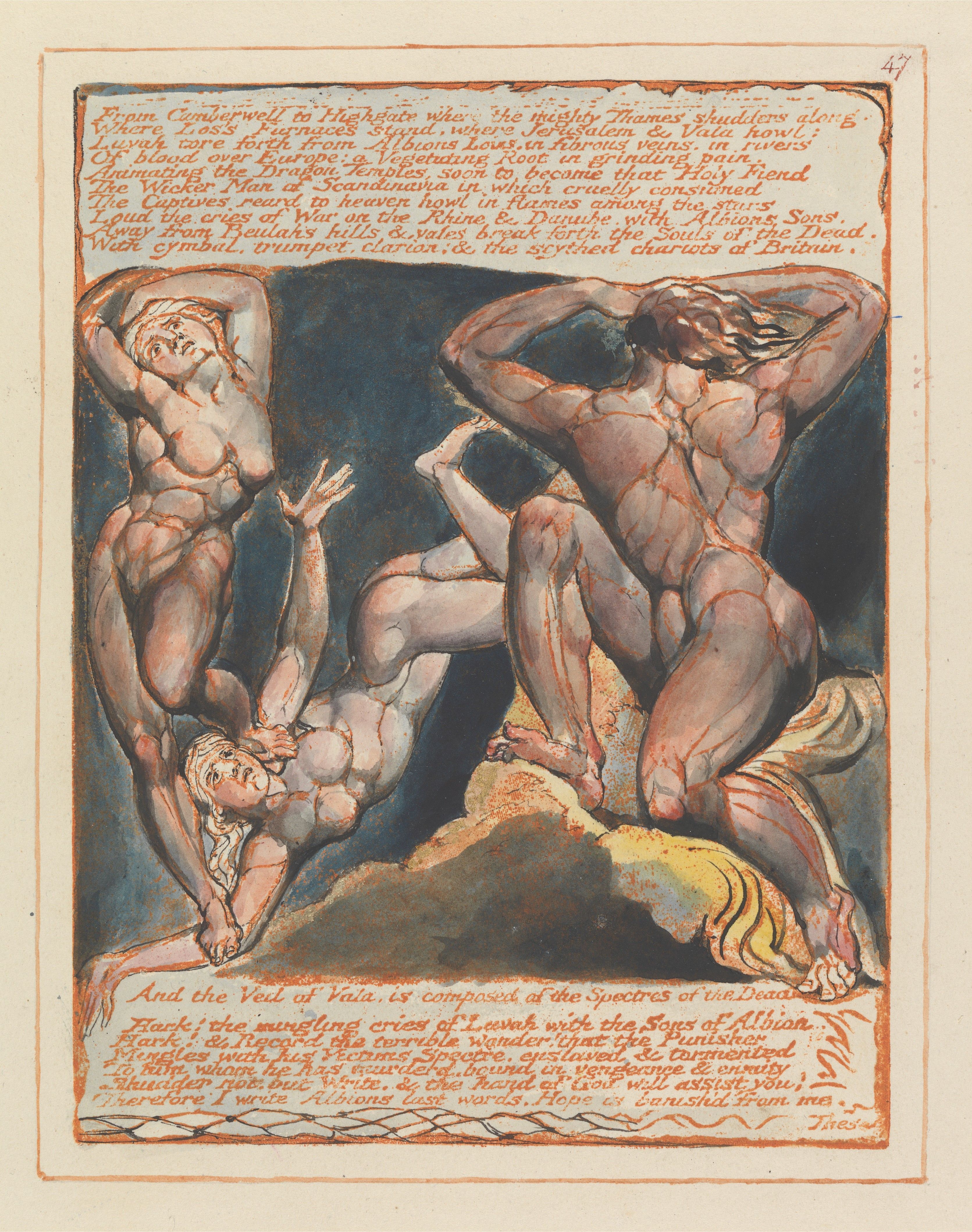
HOPE IS BANISHED

Yale Center for British Art
Jerusalem
Plate 47
 
  Dylan's life is one of the strangest odysseys, the details of which are not known to me, and may never be told. Dylan has always been at one level a very private person. Nevertheless the outline of his spiritual journey (up to now) belongs to the public and is sufficiently clear to relate it to the Blakean circle of destiny which we have studied in this book. 
 
In Blake and in Dylan we see two men who "call no man father", who fundamentally reject all forms of outward authority. Each communes with his own spirit, and this communion leads to the same end, to the encounter with Christ the King. The passage of 200 years has obscured the drama in Blake's case, so much so that his secular students almost completely lost sight of it. But Dylan's conversion is too new to be anything less than a collective trauma. His secular fans were sheerly appalled, confronted with a reality which they had systematically ignored. But Dylan's Christian audience by and large have failed to note the significance of the event, largely through the minuteness of their vision. In the history of Christianity it bears comparison to the Damascus Road, or to the strange warming of John Wesley's heart. 
 
Any number of pages could be devoted to relating Blake and Dylan, but one significant point deserves special emphasis: both men spent their pre-Christian decade celebrating fallenness. Hopefully by now the reader will have some grasp of what I mean by Blake's celebration of fallenness. Examples of this motif in Dylan's work are too numerous to do more than sample. Speaking in general the celebration of fallenness is the acme of the prophet's function. He points out to us what's wrong with our society, and he does this with the kind of language designed to raise things forcibly into our consciousness. 
 
Ezekiel had told Blake that his bizarre pantomimes were aimed at "raising other men into a perception of the infinite". Blake became pretty bizarre in his language at times, and so did Dylan, both for the purpose stated by Ezekiel. A review of Dylan's 1965 album, "Highway 61, Revisited", indicates that the denizens of Desolation Row are about as fouled up as any of Blake's giant forms. 

Here's verse 8 of the song of that name:
"Now at midnight all the agents
And the superhuman crew
Come out and round up everyone
That knows more than they do
Then they bring them to the factory ~
Where the heart attack machine Is strapped across their shoulders
And then the kerosene Is brought down from the castles
By insurance men who go
Check to see that nobody is escaping
To Desolation Row"
 
Jerusalem, Plate 47, (E 196)
[When Albion utterd his last words Hope is banishd from me]                                                   t
From Camberwell to Highgate where the mighty Thames shudders along,
Where Los's Furnaces stand, where Jerusalem & Vala howl:
Luvah tore forth from Albions Loins, in fibrous veins, in rivers
Of blood over Europe: a Vegetating Root in grinding pain.
Animating the Dragon Temples, soon to become that Holy Fiend
The Wicker Man of Scandinavia in which cruelly consumed
The Captives reard to heaven howl in flames among the stars
Loud the cries of War on the Rhine & Danube, with Albions Sons,
Away from Beulahs hills & vales break forth the Souls of the Dead,   
With cymbal, trumpet, clarion; & the scythed chariots of Britain.

And the Veil of Vala, is composed of the Spectres of the Dead

Hark! the mingling cries of Luvah with the Sons of Albion
Hark! & Record the terrible wonder! that the Punisher
Mingles with his Victims Spectre, enslaved and tormented         
To him whom he has murderd, bound in vengeance & enmity
Shudder not, but Write, & the hand of God will assist you!
Therefore I write Albions last words. Hope is banish'd from me."

Thursday, October 13, 2016

DYLAN'S CHRONICLES

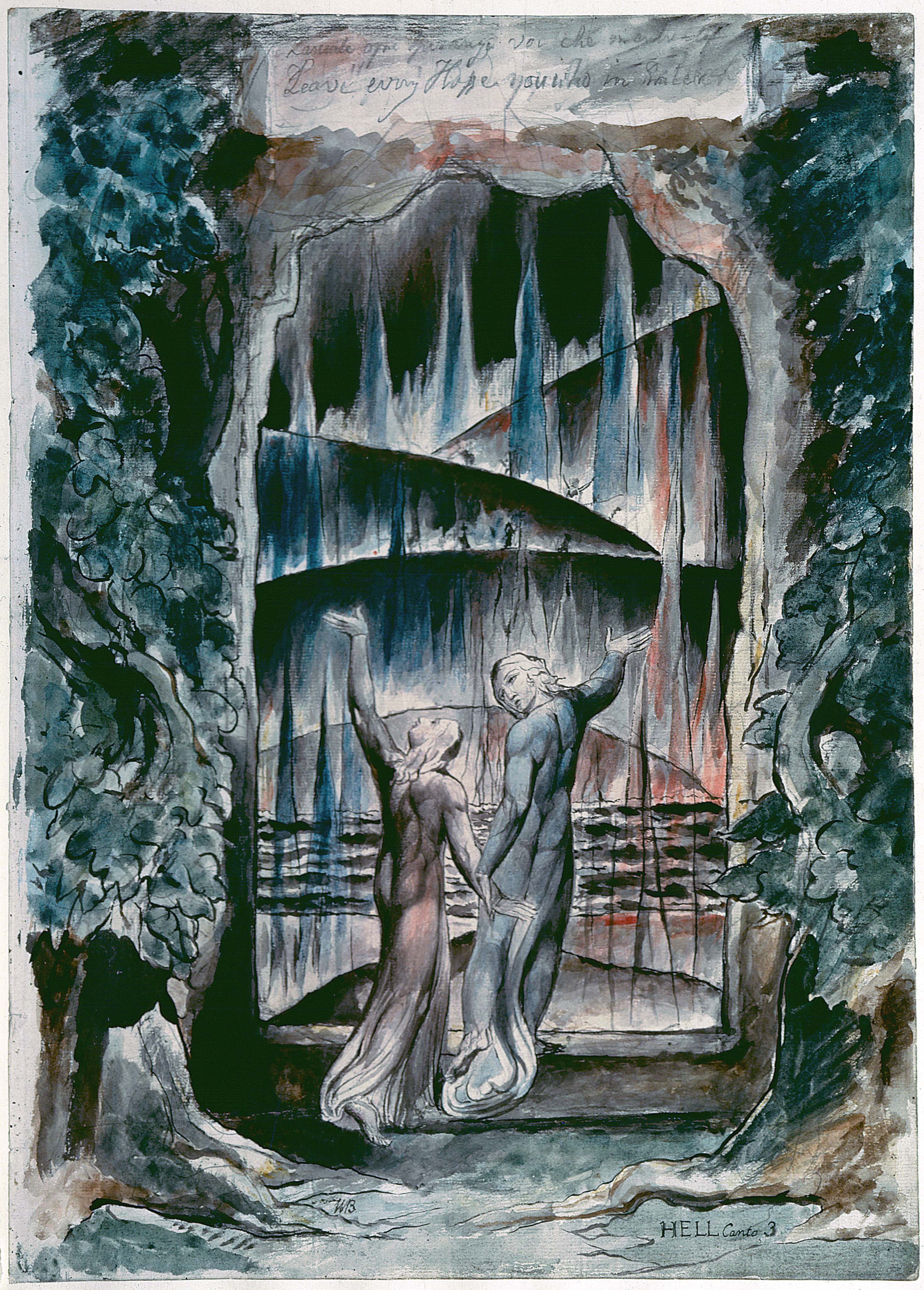
Wikipedia Commons Illustrations to Dante's  Divine Comedy
The Inscription over Hell-Gate

Reposted from March 2014.
 Our thoughts, our interests, and our activities either go out in many directions or they become focused on a single point that acts as a magnet drawing everything to it. The point of convergence doesn't prevent one from reaching out to multiple influences but brings those influences together to amplify them around an organizing principle. When we look at Blake's life history we can recognize that his ultimate focus was for the purpose of communicating his perception of the infinite by creating a new art form which he called illuminated books . His original intention could not have been directed to that outcome because neither the means nor the content existed before he invented them.

I've been reading Bob Dylan's Chronicles, Vol 1 searching for similarities between Blake and Dylan. I found that the two men endured many of the same types of experiences and reacted to them in similar ways. The lessons that they learned from experience surfaced in their art. I think that the reason that we are reminded of Blake in Dylan's work is that these two gifted artists shared the same intensity of focus and developed the ability to bring from the depths of their psyches symbolic material.


Dylan presents his development as an artist as pursuing multiple avenues within his chosen field of Folk Music until he discovered his own calling and voice. The intensity with which he followed each style, and the thoroughness with which he mastered the techniques of each of his chosen 'masters' was exhaustive. But imitation was not his goal. With Blake, Dylan could have said:
"I must Create a System, or be enslav'd by another Mans
I will not Reason & Compare: my business is to Create" (Jerusalem) 


You might say that Blake and Dylan each reached many dead ends in their lives and began anew. In Blake's writings this scenario was described as being thrown into 'the furnace of affliction', or pursuing error until it could be annihilated. Both men annihilated their error by taking from their experience the 'gold' which had been refined and allowing the 'dross' to be consumed in the fire.
 

The life scrips of Blake and Dylan were different in many ways but they both were fiercely independent. Neither would allow himself to be defined by the majority culture. Each pursued his art as an avenue to open the minds of men to content which lay buried, but could be accessed for the development of humanity. Each was led to the message he would deliver by his single minded willingness to follow the execution of his art in the direction it was leading him. If neither man was able to maintain the pinnacle of creativity he had reached, there is no fault in that.
 

Quotes from Chronicles, Volume One by Bob Dylan:
Page 115
"All I'd ever done was sing songs that were dead straight and expressed powerful new realities...I had very little in common with and knew even less about a generation I was supposed to be the voice of...Being true to yourself, that was the thing. I was more a cowpuncher than a Pied Piper."

Page 236
"Folk music was a reality of a more brilliant dimension. It exceeded all human understanding, and it called out to you, you could disappear and be sucked into it. I felt right at home in this mystical realm made up not with individuals so much as archetypes, vividly drawn archetypes of humanity, metaphysical in shape, each rugged and filled with natural knowing and inner wisdom. Each demanding a degree of respect. I could believe in the full spectrum of it and sing about it. It was so real, so more true to life than life itself. It was life magnified. Folk music was all I needed to exist." 

Page 292
"The folk music scene had been a paradise I had to leave, like Adam had to leave the garden...The road out there would be treacherous, and I didn't know where it would lead but I followed it anyway. It was a strange world ahead that would unfold, a thunderhead of a world with jagged lightning edges. Many got it wrong and never did get it right. It was wide open. I went straight into it. One thing for sure, not only was it not run by God, but it wasn't run by the devil either." 

Page 218
"I would have liked to give him the kind of songs that he wanted, like "Masters of War," "Hard Rain," "Gates of Eden," but those kinds of songs were written under different circumstances, and circumstances never repeat themselves. Not Exactly. I couldn't get to those kinds of songs for him or anyone else. To do it you have to have power and dominion over the spirits. I had done it once, and once was enough. Someone would come along eventually who would have it again - someone who see into things, the truth of things - not metaphorically, either, but really see, like seeing into metal and making it melt, see it for what it was and reveal it for what it was with the hard words and vicious insight."


 You can find in Chronicles what you are looking for. What I was seeking was some way that Dylan might be connected to William Blake. I never found that Dylan read Blake or was overtly influenced by Blake's work. What I did find was that the cauldrons in which Blake and Dylan immersed themselves led them to experience life and thought is similar ways. The intensity of focus transformed their minds in such a way that the unconscious archetypal realities came to the surface.

Friday, July 01, 2016

FOLLOW THE LINKS

Reposted from August 26, 2013.

A spiritual friend whom we met on the internet commented on Larry's recent post Blake's Main Chance. His comment was about people who lead ordinary lives as William Blake did, and accomplish extraordinary things. Larry replied by commenting that he, like Whitman, had written his book on government time. I followed that hint by searching for a connection between Blake and Whitman. I found a few literary and historical associations which led to Whitman's grave in New Jersey which was patterned after Death's Door in Blake's image for Blair's The Grave. Through a video on YouTube I was able to make a visit to Whitman's home in Camden NJ and his grave which is recognizable as Blake's portrayal of the door through which one passes to reach another dimension. I passed through that door and saw in Camden all the agony in Blake's London which led him to call it Babylon, a place of captivity and oppression. The woe of perceiving the deteriorated city was followed by the joy of hearing the background music and reading that the lyrics were by Woody Guthrie. I wound up hearing the voices and guitar music of my two sons back in the day when we were under the same roof, singing and playing Woody Guthrie, Bob Dylan, Arlo Guthrie, John Lennon, etc. . 

Morgan Library
America
Plate 14, Copy A 
When the mind is open (or opened) to receiving multiple intimations of images of truth, the connections with the brotherhood of man and with the cosmos are achieved. The wall is breached. We become members of the one body which to Blake is Albion animated by Jesus.
David Erdman on Page 587 of Blake's Poetry and Designs is attempting to convey a similar idea:
 
"In other words, when we wind up the thread of  the illuminated poem into the golden ball of a single, dynamic, visualizable orb, we are ready to enter into new expanses, through heaven's gate, built in Jerusalem's wall - or in this instance, through the 'breach in the city ... after the battle.' It may be as Frye says, that Blake 'hardly seems to have noticed that he had perfected a radically new form of mixed art.' He hardly seem to have  cared, any more than he cared to question a window concerning his sight. It mattered little to him whether picture penetrated poem or poem penetrated picture, if only their  human, apocalyptic meaning would penetrate our hearts and minds."

Auguries of Innocence, (E 491)
"It is right it should be so 
Man was made for Joy & Woe
And when this we rightly know
Thro the World we safely go
Joy & Woe are woven fine
A Clothing for the soul divine"
Marriage of Heaven & Hell, Plate 8, (E 37)
"Every thing possible to be believ'd is an image of truth."
Jerusalem, Plate 88, (E 246)
"How then can I ever again be united as Man with Man
While thou my Emanation refusest my Fibres of dominion.
When Souls mingle & join thro all the Fibres of Brotherhood
Can there be any secret joy on Earth greater than this?" 
Jerusalem, Plate 96, (E 255)
"Jesus replied Fear not Albion unless I die thou canst not live
But if I die I shall arise again & thou with me            
This is Friendship & Brotherhood without it Man Is Not"
Jerusalem, Plate 77, (E 231)
"I give you the end of a golden string,
Only wind it into a ball:
It will lead you in at Heavens gate,
Built in Jerusalems wall."
Vision of Last Judgment, (E 565)
"I assert for My self that I do
not behold the Outward Creation & that to me it is hindrance &
not Action it is as the Dirt upon my feet No part of Me. What it
will be Questiond When the Sun rises  do  you  not  see  a  round 
Disk of fire somewhat like a Guinea O no no I see an Innumerable
company of the Heavenly host crying Holy Holy Holy is the Lord
God Almighty I question not my Corporeal or Vegetative Eye any
more than I would Question a Window concerning a Sight I look
thro it & not with it."    

Saturday, November 01, 2014

A Grain of Sand

From Wikipedia, the free encyclopedia.

William Blake, The Great Red Dragon and the Woman Clothed in Sun.


From Blake and Dylan
[Pickering Manuscript], Blake's Notebook, (E 490)
This poem continues for 132 lines. The final lines were used prominently in the movie "Dead Man".
From EVERY GRAIN OF SAND by Bob Dylan

William Blake's body of work has influenced countless writers, poets and painters, and his legacy is often apparent in modern popular culture.[1] His artistic endeavours, which included songwriting in addition to writing, etching and painting, often espoused a sexual and imaginative freedom that has made him a uniquely influential figure, especially since the 1960s. Far more than any other canonical writer, his songs have been set and adapted by popular musicians including  Folk musicians, such as M. Ward, have adapted or incorporated portions of his work in their music, and figures such as Bob Dylan,[2] Alasdair Gray and Allen Ginsberg have been influenced by him. The genre of the graphic novel traces its origins to Blake's etched songs and Prophetic Books, as does the genre of fantasy art.[3]

AUGURIES OF INNOCENCE
"To see a World in a Grain of Sand
And a Heaven in a Wild Flower
Hold Infinity in the palm of your hand
And Eternity in an hour
A Robin Red breast in a Cage
Puts all Heaven in a Rage
A Dove house filld with doves & Pigeons
Shudders Hell thro all its regions
A dog starvd at his Masters Gate
Predicts the ruin of the State"

From Bob Dylan's
Don’t have the inclination to look back on any mistake
Like Cain, I now behold this chain of events that I must break
In the fury of the moment I can see the Master’s hand
In every leaf that trembles, in every grain of sand

I gaze into the doorway of temptation’s angry flame
And every time I pass that way I always hear my name
Then onward in my journey I come to understand
That every hair is numbered like every grain of sand

I hear the ancient footsteps like the motion of the sea
Sometimes I turn, there’s someone there, other times it’s only me
I am hanging in the balance of the reality of man
Like every sparrow falling, like every grain of sand

ellie said...
Milton,PLATE 35 [39],(E 181)
By Satans Watch-fiends tho' they search numbering every grain
Of sand
Of sand on Earth every night, they never find this Gate.
It is the Gate of Los. Withoutside is the Mill, intricate,
dreadful
And fill'd with cruel tortures; but no mortal man can find the
Mill
Of Satan, in his mortal pilgrimage of seventy years
For Human beauty knows it not: nor can Mercy find it! But
In the Fourth region of Humanity, Urthona namd[,]
Mortality begins to roll the billows of Eternal Death
Before the Gate of Los. Urthona here is named Los.
And here begins the System of Moral Virtue, named Rahab.
Albion fled thro' the Gate of Los, and he stood in the Gate.

Thursday, October 30, 2014

Appendix 10

Nowhere are Blake and Dylan more alike than in their dependence upon biblical symbolism. Dylan is fully capable of throwing a wicked curve, when for example, one of his songs is embedded in the western ethos where clean hands evoke bad gambling men, and he suddenly switches to the imagery of Psalm 24:

"Who may ascend the mountain of the Lord?
    Who may stand in his holy place?
4 The one who has clean hands and a pure heart,
    who does not trust in an idol


Dyan's song:
"His clothes, are dirty but his hands are clean". 

Whether he knew of Blake's letter to Trusler or not, Dylan certainly put into practice the advice of the "wisest of the Ancients [Who] consider'd what is not too Explicit as the fittest for Instruction, because it rouzes the faculties to act". 


For the intellectually curious the lure of Blake and Dylan

is identical: to find the kernel of meaning in the peculiar wrapping. Throughout his entire artistic career Dylan depended heavily upon biblical images and language. 

"Blowing in the Wind", the song that brought his first fame back in 1962, obviously evokes the words of Jesus found at John 3.8, "the wind blows where it will". For Jesus and Dylan alike the wind symbolizes Spirit. One would not be too far off to say that "Blowing in the Wind" initiated a spiritual revolution in American culture. 


Dylan's later song, "Idiot Wind", in a far different mood, still uses wind as an image of spirit. Biblical imagery can be found in every one of the twenty five albums that Dylan has released. 


But look at just one song from the John Wesley Harding record, called "The Wicked Messenger". Like so much of Blake's poetry this song is clear as mud to the biblically illiterate. 


"There was a wicked messenger--from Eli he did come. (Now the sons of Eli were worthless men;) His tongue, it could not speak, but only flatter. (they flatter with their tongue)"  

I picked up this example, almost en toto from Michael Gray's book.  


"One day he just appeared with a note in his hand..." (Devotees of the Christmas story may remember that the priest Zechaias lost his speech when he expressed scepticism over Gabriel's message that his aged wife would have a son--to be named John. Upon the birth of the child Zecharias wrote a note saying, "His name is John", and recovered his speech.) 


From Dylan's song:"The soles of my feet, I swear they're burning." 

From Isaiah 52:1  
(How beautiful upon the moutains are the feet of him who bring's good tidings.")

 The feet in biblical symbolism is often associated with the bringing of news, the messenger. And Paul, in his passage on the whole armor of God, advises the Christian to have his feet shod with the preparation of the gospel of peace. 


The wicked messenger's feet are burning because he hasn't done this. 

"Blonde on Blonde" was not exactly the gospel of peace. We should realize that this like most of Dylan's songs in essentially autobiographical. He shared Blake's perspective on the oneness of the human race. He knew that fundamentally his (and our) experiences are universal. 


The song ends appropriately with this message to the messenger: "If ye cannot bring good news, then don't bring any."


Dylan likely got the burning soles from Dante who, in the third ring of the Inferno, found the simonists suspended head down with the soles of their feet licked by flames. 

"The Wicked Messenger" is more overtly biblical than most of Dylan's output, but less direct allusions abound throughout his lyrics. Not exactly a "Bible soaked Protestant", but maybe the nearest thing to it among modern artists. 


What does the future hold? Michael Gray credits Dylan, the secular artist, with the monumental achievement of lifting the popular musical. taste to the level of real art. Dylan, the Christian, creating art in the Blakean meaning of the word, must of necessity address himself to the more awesome task of raising the popular spiritual level to a Christian faith with some Intellect. Is that expecting too much of the man? or of God?  


Tuesday, October 28, 2014

Appendix 9

Appendix 9
Dylan shared with Blake an extreme anti-war position. In fact he set in motion forces that eventually helped to end a war. Blake was less successful, though just as passionate. Both men moved from the overt themes of protest to the "contention against principalities and powers", and both incurred the displeasure of some of their admirers in so doing (largely posthumous ones in Blake's case).

By 1966 Dylan was acknowledged chief prophet of the American counterculture; his corrosive judgments filled the minds of the young and nurtured their spirits, while their adulation poisoned his.

238

"Blonde on Blonde" is his mad, infected St. Vitus Dance, chaotic, nihilistic, a paean of fallenness, and Dylan projects himself as more personally involved than Blake ever did in his most lurid passages. Dylan is Los after binding Urizen, and he proceeds to chain his creative energy to hell just as Los had done.For example Dylan and his associates may have sounded the death knell to 'machismo', at least to the North American manifestation of it, the sick masculine attitude that trivializes sexual relationships and makes of woman a plaything. 
Dylan allowed himself to be interviewed by Playboy, but his sexual values undercut the Playboy philosophy, and very likely undercut Playboy sales as well, much more than the antipornographers have ever done. Dylan disparaged possessiveness and jealousy just as Blake had done two centuries before with VDA.


239
 

Looking at Dylan's 'I ain't me, babe:
"You say you're looking for someone 
Who'll pick you up each time you fall, 
To gather flowers constantly 
And to come each time you call: 
But it ain't me, babe." 

After his first sobering up in l968 Dylan apparently turned to the experience of love as the summum bonum, and according to Michael Gray it became for about a decade Dylan's most serious alternative to a traditional religious perspective. It seemed as if he had to live through the 'female will' phase that Blake had always feared and despised. Gray tells us that the seventies decade was for Dylan an inner struggle between Sara and Christ. 'Somewhere near the climax of that struggle he wrote a song named Isis (the Egyptian Astarte), which shows how close to the Blakean position his sexual philosophy had become:

"Isis, oh, Isis, you mystical child. 
What drives me to you is what drives me insane." 

Put that beside Blake's plea to his emanation:

"Let us agree to give up Love
And root up the infernal grove;
Then we shall return & see
The worlds of happy Eternity." 

Dylan's marriage broke up in 1977, and two years later he made a public commitment to Christ. Afterward he attempted, to use the hackneyed phrase so often applied to Blake, to Christianize his art, so far with less acclaim than greeted his earlier music.

In style Dylan closely approaches Blake as a symbolist. Fiercely eclectic like the English poet, he drew with utmost freedom upon his entire experience for the imagery of his lyrics. This means that the listener unversed in Dylan's experience will have the same sort of problems with his lyrics like "Blowin' in the Wind" that so many have had with 'Jerusalem'.

Much of it comes through as sheer gibberish to all except the few who begin. (Please don't take that in the most obvious sense.)

240
It helps to know the sixties Greenwich Village scene, country music, blues and rock as well as Verlaine, Rimbaud and Baudelaire, plus a few other esoteric sources. It also helps to know the Bible.

Sunday, October 26, 2014

Appendix 8

The most Blakean mind of the 20th Century may belong to the folk singer, Bob Dylan. Dylan drank deeply from the Blakean springs; he obviously knew and loved Blake for many years before he surrendered to the Christian gospel.

We find Bob Dylan's Career as a Blakean Visionary & Romantic  published a year ago.
One might seek out a number of lines among Dylan's lyrics that suggest an obvious Blakean source. Or one could show the Blakean spirit active and alive in much of Dylan's art. In this section the reader is invited to look at the Blakean dimension of Dylan's structure of values implicit in his lyrical inventions. That enterprise might profitably be stretched out to great length; here are a few of the highlights: 

235 

If Blake was the most radical poetic dissenter of his generation, then Dylan may occupy that place in ours. Blake questioned authority at the deepest level. The irreverences of Dylan's lyrics had the same meaning to his listeners: "Don't follow leaders Watch the parkin' meters". 

 Following Blake's cue the sixties generation questioned the moral and political leadership of the country in ways that had never happened before. Dylan and Blake both knew that power resides in the people, and they aimed to encourage the people to assume full responsibility for themselves. 

In that aim Dylan succeeded more significantly than did Blake, more in fact than he hoped to. In an earlier verse of the song quoted above Dylan sang, "you don't need a weatherman", and soon found a revolutionary underground emerge called the Weathermen. They sought a violent revolution, but Dylan, like Blake and Jesus before him, wanted a more fundamental revolution in the hearts of men and women. 

The phenomenal response to Dylan's early protest songs led to authority problems that Blake had never had to face. Dylan's fans wanted him for their leader, and he hated and despised that idea; he knew what would follow. He identified with the moment in Jesus' life when the crowd tried to make him king by force. 

A lot of Dylan's bizarre actions in the middle sixties were related to an attempt to avoid that destiny. In 1980 he sang the biblical scene that had haunted him.for years.
Few men have been in a better position to understand what that moment meant to Jesus. 

"The multitude wanted to make him king 
"Put a crown upon his head 
"Why did he slip away to a quiet place instead?" 

(From 'In the Garden' on 'Saved', cut in 1980)

It makes a lot of sense to compare Dylan's output of the sixties with Blake's in the nineties of his century.

                                                          236 

 The end of each decade witnessed a meeting with the Lord, which makes it clear that each decade encompassed a spiritual journey. Dylan's life is one of the strangest odysseys, the details of which are not known to me, and may never be told. Dylan has always been at one level a very private person. Nevertheless the outline of his spiritual journey (up to now) belongs to the public and is sufficiently clear to relate to the Blakean circle of destiny which we have studied in this book. 

In Blake and in Dylan we see two men who "call no man father", who fundamentally reject all forms of outward authority. Each communes with his own spirit, and this communion leads to the same end, to the encounter with Christ the King. The passage of 200 years has obscured the drama in Blake's case, so much so that his secular students almost completely lost sight of it. 

But Dylan's conversion is too new to be anything less than a collective trauma. His secular fans were sheerly appalled, confronted with a reality which they had systematically ignored. But Dylan's Christian audience by and large have failed to note the significance of the event, largely through the minuteness of their vision. In the history of Christianity it bears comparison to the Damscus Road, or to the strange warming of John Wesley's heart. 
Any number of pages could be devoted to relating Blake and Dylan, but one significant point deserves special emphasis: 

The celebration of fallenness is the acme of the prophet's function. He points out to us what's wrong with our society, and he does this with the kind of language designed to raise things forcibly into our consciousness. Ezekiel had told Blake that his bizarre pantomimes were aimed at raising others to a perception of the infinite". Blake became pretty bizarre at times.

Both men spent their pre-Christian decade celebrating fallenness. Hopefully by now the reader will have some grasp of what I mean by Blake's celebration of fallenness. Examples of this motif in Dylan's work are too numerous to do more than sample. 

 A review of Dylan's l965 album, "Highway 61, Revisited", indicates that the denizens of Desolation Row are about as fouled up as any of Blake's giant forms. Here's verse 8 of the
song of that name: 

"Now at midnight all the agents And the superhuman crew 
Come out and round up everyone That knows more than they do 
Then they bring them to the factory ~ 
Where the heart attack machine Is strapped across their shoulders 
And then the kerosene Is brought down from the castles 
By insurance men  who go Check to see that nobody is escaping."

 Against the background of the horror in Vietnam 'To Desolation Row' and many other of Dylan's 1965 lyrics come through as a cry of pain much like Blake's Book of Urizen. 

Saturday, February 22, 2014

Dylan-1

The most Blakean mind of the 20th Century may belong to the folk singer, Bob Dylan. He drank deeply from the Blakean Springs; he had obviously known and loved Blake for many years before he surrendered to the Christian Gospel.

 Blake had written poetry and composed pictures long before he fell in love with Jesus; much the same thing happened with Dylan. But Dylan had loved Blake much longer.

 Blake was the most radical poetic dissenter of his generation, and so was Dylan. Prophets, they focused on the fallacies of their cultures. Dylan scorned organized religion and established morals; likewise Blake. Following Blake's cue the sixties generation questioned the moral and political leadership of the country in ways that had never happened before in America. The two prophets both knew that power rightfully resides in the people, and they aimed to encourage the people to take full responsibility for themselves. In that aim Dylan suceeded more than Blake could have: In one of his songs he wrote "you don't need a weatherman".

A revolutionary underground emerged called the Weathermen.  They sought a violent revolution, but Dylan, like Blake and also Jesus wanted a more fundamental revolution in the hearts of men and women.

It makes a lot of sense to compare the sixties with Blake's in the nineties of his century: the end of each decade witnessed a meeting with the Lord.  This shows that each decade encompassed a spitirual journey.

Dylan always was at one level a very private person.  Nevertheless  the outline of his spiritual journey for those with insight belongs to the public and is sufficiently clear to relate to the Blakean Circle of Destiny.

In Blake and in Dylan we see two men who "call no man father" (Matthew 23:9) and fundamentally reject all forms of outward authority.  Each communes with his own spirit, and his communion leads to the same end, to the encounter with Christ, the King.

The passage of 200 years has obscured the drama in Blake's case, so much so that his secular interpreters almost completely lost sight of it.  But Dylan's conversion was too new to be anything less than a collective drama.  His devotees gloried in his lack of religion, until they were knocked over by his conversion.  His secular fans were sheerly appalled; they were confronted with a reality which they had systematically ignored.

Blake had always been aware of the failure of organized religion, but with Dylan's conversion he found it bit by bit.  They were all inadequate.

In the history of Christianity Dylan's conversion bears comparison with Paul's 'Damascus Road' (Book of Acts:9 or to the strange warming of John Wesley's heart.

Any number of pages could be devoted to relating Blake and Dylan, but one significant point deserves special emphasis: both men spent their pre-Christian decade celebrating fallennes. This should be readily apparent to readers of this blog as far as Blake is concerned; examples of this motif in Dylan's are too numerous to do more than sample.

 Look at A_Hard_Rain's_a-Gonna_Fall. 

Speaking in general the celebration of fallenness is the acme of the prophet's function: he points out to us what's wrong with our society and he does this with a kind of language designed to raise things forcibly into our consciousness. Ezekiel had told Blake that his bizarre pantomimes  were aimed at 'raising other men into a perception of the Infinite."  Blake became pretty bizarre in his language at times and so did Dylan, both for the purpose stated by Ezekiel.

By 1966 Dylan was acknowledged chief prophet of the American counter culture; his corrosive judgments filled the minds of of the young and nurtured their spirits, while their adulation poisoned his. "Blonde on Blonde" is his sad, infected St. Virus Dance, chaotic and nihilistic, a paean of fallenness, and Dylan projected himself as more personally involved than Blake ever did in his most lurid passages.  Dylan is Los after binding Urizen and he proceeds to chain his creative energy to Hell just as Los had done.


Wikipedia Commons
Los and Spectre
Jerusalem Plate 6