Showing posts with label Bible. Show all posts

Thursday, September 24, 2026

JOHN THE BAPTIST

First Posted Dec. 2020

Fitzwilliam Museum
Virgin Hushing Young John the Baptist
Painting

The first words that Blake engraved as a statement in an Illuminated Book were "The Voice of one crying in the Wilderness". They appear on the first page of ALL RELIGIONS are ONE. This can be seen as an announcement that Blake identified with John the Baptist and with Isaiah before him. Like John he knew himself to be outside of the establishment, in the wilderness where the patterns of civilization had not been imposed. His voice would cry out from the place where most people did not venture. His insistent message would be that change was required. He brought not his own message but the word that came to him from the 'poetic or prophetic character.' The message which he intended to deliver was that 'He who sees the Infinite in all things sees God.'

 ALL RELIGIONS are ONE, (E 3)
"VII The desire of Man being Infinite the possession is Infinite
& himself Infinite
     Conclusion,   If it were not for the Poetic or Prophetic
character. the Philosophic & Experimental would soon be at the
ratio of all things & stand still, unable to do other than repeat
the same dull round over again
     Application.   He who sees the Infinite in all things sees
God.  He who sees the Ratio only sees himself only.

Therefore God becomes as we are, that we may be as he is"

Isaiah 40
[1] Comfort ye, comfort ye my people, saith your God.
[2] Speak ye comfortably to Jerusalem, and cry unto her, that her warfare is accomplished, that her iniquity is pardoned: for she hath received of the LORD's hand double for all her sins.
[3] The voice of him that crieth in the wilderness, Prepare ye the way of the LORD, make straight in the desert a highway for our God.
[4] Every valley shall be exalted, and every mountain and hill shall be made low: and the crooked shall be made straight, and the rough places plain:
[5] And the glory of the LORD shall be revealed, and all flesh shall see it together: for the mouth of the LORD hath spoken it.

Luke 3
[1] Now in the fifteenth year of the reign of Tiberius Caesar, Pontius Pilate being governor of Judaea, and Herod being tetrarch of Galilee, and his brother Philip tetrarch of Ituraea and of the region of Trachonitis, and Lysanias the tetrarch of Abilene,
[2] Annas and Caiaphas being the high priests, the word of God came unto John the son of Zacharias in the wilderness.

[3] And he came into all the country about Jordan, preaching the baptism of repentance for the remission of sins;
[4] As it is written in the book of the words of Esaias the prophet, saying, The voice of one crying in the wilderness, Prepare ye the way of the Lord, make his paths straight.
[5] Every valley shall be filled, and every mountain and hill shall be brought low; and the crooked shall be made straight, and the rough ways shall be made smooth;
[6] And all flesh shall see the salvation of God.

John the Baptist was the son of a priest Zacharias and his wife Elizabeth who was a cousin of Jesus' mother Mary. Blake does not write about John but shows him in pictures with Jesus. There are two images of the child John with the child Jesus and several images of John baptizing Jesus in the Jordan river before Jesus retreated to the wilderness and was tempted by the devil.

In this passage Jerusalem turns to Jesus for guidance in understanding how mankind may be released from the cycle of physical life and physical death. Jesus and Jerusalem play the role played by John the Baptist. They carry the concern for making it possible for Albion, mankind, to make the return journey. The alienation will not be overcome at the 'last day' but by following the path that Jesus followed: 'I Die & pass the limits of possibility, as it appears To individual perception.'  The route is through the 'wilderness' but the individual does not travel alone for Jesus invites him to 'come with me', to 'walk' in the paths of experience, and promises that he is 'always with thee.'

We read in the words of Isaiah and Luke that this traveling through distance and difficulties will be eased by the knowledge that what shall be revealed in the end is nothing less than glorious.

John 11
[25] Jesus said unto her, I am the resurrection, and the life: he that believeth in me, though he were dead, yet shall he live:


Jerusalem, Plate 62, (E 213)
[Jerusalem replied]
"Shall Albion arise? I know he shall arise at the Last Day!
I know that in my flesh I shall see God: but Emanations
Are weak. they know not whence they are, nor whither tend.

Jesus replied. I am the Resurrection & the Life.
I Die & pass the limits of possibility, as it appears
To individual perception. Luvah must be Created                  
And Vala; for I cannot leave them in the gnawing Grave.
But will prepare a way for my banished-ones to return
Come now with me into the villages. walk thro all the cities.
Tho thou art taken to prison & judgment, starved in the streets
I will command the cloud to give thee food & the hard rock       
To flow with milk & wine, tho thou seest me not a season
Even a long season & a hard journey & a howling wilderness!
Tho Valas cloud hide thee & Luvahs fires follow thee!
Only believe & trust in me, Lo. I am always with thee!

So spoke the Lamb of God while Luvahs Cloud reddening above      
Burst forth in streams of blood upon the heavens & dark night
Involvd Jerusalem. & the Wheels of Albions Sons turnd hoarse
Over the Mountains & the fires blaz'd on Druid Altars
And the Sun set in Tyburns Brook where Victims howl & cry."

Luke 1
[11] And there appeared unto him an angel of the Lord standing on the right side of the altar of incense.
[12] And when Zacharias saw him, he was troubled, and fear fell upon him.
[13] But the angel said unto him, Fear not, Zacharias: for thy prayer is heard; and thy wife Elisabeth shall bear thee a son, and thou shalt call his name John.
...
[18] And Zacharias said unto the angel, Whereby shall I know this? for I am an old man, and my wife well stricken in years.
[19] And the angel answering said unto him, I am Gabriel, that stand in the presence of God; and am sent to speak unto thee, and to shew thee these glad tidings.
...
[26] And in the sixth month the angel Gabriel was sent from God unto a city of Galilee, named Nazareth,
[27] To a virgin espoused to a man whose name was Joseph, of the house of David; and the virgin's name was Mary.
[28] And the angel came in unto her, and said, Hail, thou that art highly favoured, the Lord is with thee: blessed art thou among women.
[29] And when she saw him, she was troubled at his saying, and cast in her mind what manner of salutation this should be.
[30] And the angel said unto her, Fear not, Mary: for thou hast found favour with God.
...
[34] Then said Mary unto the angel, How shall this be, seeing I know not a man?
[35] And the angel answered and said unto her, The Holy Ghost shall come upon thee, and the power of the Highest shall overshadow thee: therefore also that holy thing which shall be born of thee shall be called the Son of God.
[36] And, behold, thy cousin Elisabeth, she hath also conceived a son in her old age: and this is the sixth month with her, who was called barren.
[37] For with God nothing shall be impossible.
[38] And Mary said, Behold the handmaid of the Lord; be it unto me according to thy word. And the angel departed from her.
[39] And Mary arose in those days, and went into the hill country with haste, into a city of Juda;
[40] And entered into the house of Zacharias, and saluted Elisabeth.
[41] And it came to pass, that, when Elisabeth heard the salutation of Mary, the babe leaped in her womb; and Elisabeth was filled with the Holy Ghost:
[42] And she spake out with a loud voice, and said, Blessed art thou among women, and blessed is the fruit of thy womb.
[43] And whence is this to me, that the mother of my Lord should come to me?
[44] For, lo, as soon as the voice of thy salutation sounded in mine ears, the babe leaped in my womb for joy.
[45] And blessed is she that believed: for there shall be a performance of those things which were told her from the Lord.

Luke 2
[11] And there appeared unto him an angel of the Lord standing on the right side of the altar of incense.
[12] And when Zacharias saw him, he was troubled, and fear fell upon him.
[13] But the angel said unto him, Fear not, Zacharias: for thy prayer is heard; and thy wife Elisabeth shall bear thee a son, and thou shalt call his name John.
[14] And thou shalt have joy and gladness; and many shall rejoice at his birth.
[15] For he shall be great in the sight of the Lord, and shall drink neither wine nor strong drink; and he shall be filled with the Holy Ghost, even from his mother's womb.
[16] And many of the children of Israel shall he turn to the Lord their God.
[17] And he shall go before him in the spirit and power of Elias, to turn the hearts of the fathers to the children, and the disobedient to the wisdom of the just; to make ready a people prepared for the Lord.

Saturday, July 11, 2026

AGONY IN THE GARDEN

First posted July 2012

Gethseneme 

Painting Illustrating the Bible
Composed c 1799-1803


IMAGE ENHANCED FOR DETAIL


Luke 22 (RSV)
[39] And he came out, and went, as was his custom, to the Mount of Olives; and the disciples followed him.
[40] And when he came to the place he said to them, "Pray that you may not enter into temptation."
[41] And he withdrew from them about a stone's throw, and knelt down and prayed,
[42] "Father, if thou art willing, remove this cup from me; nevertheless not my will, but thine, be done."
[45] And when he rose from prayer, he came to the disciples and found them sleeping for sorrow,
[46] and he said to them, "Why do you sleep? Rise and pray that you may not enter into temptation."
[47] While he was still speaking, there came a crowd, and the man called Judas, one of the twelve, was leading them. He drew near to Jesus to kiss him;

In Blake's image called 'Agony in the Garden' the two central figures: Jesus and the comforter are in the light. The disciples who accompanied Jesus are barely visible in the surrounding shadows. The title of the picture aptly describes the state of mind of Jesus as he struggles to understand and accept the role he is to play in the redemption of humanity. But the figure reaching down to support Jesus is portrayed as equally central to the dynamic event. We may name this figure, who is in the human form although reaching out of a cloud and the source of radiating energy and light, the Holy Spirit.

Many times Blake repeated the theme that man is not alone in his situation no matter how bleak the circumstances look. God has made provisions for the return of man to the eternal condition of unity, forgiveness and brotherhood.
 
Four Zoas, Page 56, (E 338)
"And first he found the Limit of Opacity & namd it Satan
In Albions bosom for in every human bosom these limits stand
And next he found the Limit of Contraction & namd it Adam
While yet those beings were not born nor knew of good or Evil

Then wondrously the Starry Wheels felt the divine hand. Limit
Was put to Eternal Death Los felt the Limit & saw
The Finger of God touch the Seventh furnace in terror
And Los beheld the hand of God over his furnaces
Beneath the Deeps in dismal Darkness beneath immensity
And he who takes vengeance alone is the criminal of Providence;"

Jerusalem, Plate 62, (E 213)
"Jesus replied. I am the Resurrection & the Life.
I Die & pass the limits of possibility, as it appears
To individual perception. Luvah must be Created
And Vala; for I cannot leave them in the gnawing Grave.
But will prepare a way for my banished-ones to return

Come now with me into the villages. walk thro all the cities.
Tho thou art taken to prison & judgment, starved in the streets
I will command the cloud to give thee food & the hard rock
To flow with milk & wine, tho thou seest me not a season
Even a long season & a hard journey & a howling wilderness!
Tho Valas cloud hide thee & Luvahs fires follow thee!
Only believe & trust in me, Lo. I am always with thee!"

Jerusalem, Plate 82, (E 241) 
"Los saw & was comforted at his Furnaces uttering thus his voice.
I know I am Urthona keeper of the Gates of Heaven,
And that I can at will expatiate in the Gardens of bliss;
But pangs of love draw me down to my loins which are
Become a fountain of veiny pipes: O Albion! my brother!
Plate 83
Corruptibility appears upon thy limbs, and never more
Can I arise and leave thy side, but labour here incessant
Till thy awaking! yet alas I shall forget Eternity! Against the
Patriarchal pomp and cruelty, labouring incessant
I shall become an Infant horror. Enion! Tharmas! friends
Absorb me not in such dire grief: O Albion, my brother!
Jerusalem hungers in the desart! affection to her children!
The scorn'd and contemnd youthful girl, where shall she fly?
Sussex shuts up her Villages. Hants, Devon & Wilts
Surrounded with masses of stone in orderd forms, determine then
A form for Vala and a form for Luvah, here on the Thames
Where the Victim nightly howls beneath the Druids knife:
A Form of Vegetation, nail them down on the stems of Mystery:
O when shall the Saxon return with the English his redeemed brother!
O when shall the Lamb of God descend among the Reprobate!"

Much of Blake's vision is the ability to recognize and understand the 'ways of God' as he provides the means that man may perceive his own Divine Humanity. For Blake the spirit is always reaching down and lifting up and becoming one with his beloved mankind.

.

Thursday, May 21, 2026

Reading the Gospel


British Museum
Illustrations to Young's Night Thoughts


First posted Nov 2010

How Blake Read the Gospel

All his life Blake read the Bible, loved it, and engaged in dialogue with its immortal authors. Virtually every line of his poetry and every picture he painted had direct reference to some biblical idea that Blake had meditated upon.

In vivid contrast many of the orthodox don't read the Bible at all; they just wave it! Little wonder they dislike Blake. His early ironic description of his work as the Bible of Hell certainly helped to confirm their prejudice.
__________________________________________________________________

"Thou read'st black where I read white."
(Everlasting Gospel)

There are essentially two ways to read the Bible; Blake referred to them as black and white. What did he mean? We might look at Urizen's Book of Brass as the black book. It's a book of rules, a book of law. It tells people what to do, and more poignantly, what not to do.

Even today ordinary people see the Bible in this way, which helps to explain why hardly anyone reads it today. The few who do read it do so dutifully and dully. Such a reading constrains consciousness; it makes the reader obedient and unimaginative. The faithful few who feel that they should read their Bible often approach it in a child like way bordering on the childish. Reading the black book inhibits the imagination, deadens the mind and prevents spiritual development. At its worst it has led to many instances of religious persecution and violence against dissenters.

But Blake read it white. The white book is not a book of rules, but a book of visions, a book of wonders. It provokes thought, causes the imagination to soar. Blake must have learned to read at about the age of four, when he had his first vision-- the frightful face at the window. Perhaps we've all been frightened by the Bible in one way or another; many people have had a sufficiently negative experience to leave it strictly alone. But little William overcame his fright and kept reading, and the next vision we hear of was more positive--a tree full of angels.

All the evidence suggests that for the next sixty five years Blake's Bible reading and his visions went hand in hand; his art is the record of it all. Whoever becomes really interested in Blake's visions will find himself reading the Bible because that's where most of them begin. In spite of this his secular critics have looked all over the world for his sources.

One of the greatest things that Blake has to offer the reader is that he makes you see and read the Bible in a new and better way. Not for nothing did the youthful circle of admirers of Blake's last years refer to him as the Interpreter.

The black book has most often been read as law, as history, in a restricted, literal interpretation. If the priest can get people to see it this way, and only this way, then he has secure control over his flock of sheep. In contrast Blake suggests that it's symbolic. Although written in categories of time and space, the temporal dimension is only instrumental; it points to the Beyond, the Eternal, the Real.

Too often people reading 'black' concern themselves with foolish questions such as "Did it really happen? Was Jonah really swallowed by the whale, or rather by the big fish?" But in Blake's vision that isn't the important thing. The important thing is "What does it mean?" The reader of the black book gets himself tied up in knots about the veracity or historicity of Jonah and his aquatic friend.

Blake shows you the Jonah in your psyche and helps you get some grasp of what the turbulent sea means to you personally. It's experiential, exciting! it puts you in touch with reality!, which is not material at all but spiritual. Literal or symbolic is black or white, and probably the two minds will never meet. At this point I simply urge you to join Blake and read white:
    "Why is the Bible more Entertaining & Instructive than any other book? Is it not because [it is] addressed to the Imagination which is Spiritual Sensation, and but mediately to the Understanding or Reason?"
    (Letter To Trusler; Erdman 702-3)                                                                                                                                                                                                                                  All of the above is taken from Chapter Six of the Blake Primer.    

Monday, April 13, 2026

PRIMER - MYTH

British Museum
Illustration of the Prodigal Son.

Blake Archive
The Prodigal Son's return to his father.


Fitzwilliam Museum
The father's reception of his son.

Songs of Innocence and of Experience, Plate 45, (E 26)
"And God like a father rejoicing to see,
His children as pleasant and happy as he:
Would have no more quarrel with the Devil or the Barrel
But kiss him & give him both drink and apparel."

Myth -This passage is from Larry Clayton's book, Chapter Nine:

"Many people have called William Blake unique among English poets as the creator of a complete mythology. In a standard dictionary "without foundation in fact"  appears as the fifth meaning of 'mythical', but this is probably what the term conveys in common parlance. Therefore we must begin our study of Blake's myth by raising our consciousness of the word. 'Logos', 'myth', 'epic'--these three words have a common root. In literary and theological language myths are statements about the non-material ultimate. Some people of course avoid the non-material, considering it to be without foundation in fact; it's doubtful that any such reader has endured to his point of our study.

Blake considered the non-material to be the real; his art centered around the  endeavour to express the reality of the non-material. The meaning of his entire  artistic enterprise we may call his myth. His object was to fit all of experience into a total framework of meaning that will inform life. Our object is to grasp that total  framework; once we do that, we have a myth of meaning.

The diagram below schematically represents the shape of Blake's myth. All his  poetic and artistic work fits into this scheme of cosmic/psychic meaning. 
Only four of an infinite number of possible examples are included. The first is a general statement of Blake's scheme. Second with his story of the Prodigal Son in which Jesus gave us a personal paradigm of the history of the Chosen People and of the Human Race. Third is the career of alcoholism's progressive deterioration until the sufferer hits bottom, followed by recovery, providing a striking modern analogy, although not Blakean per se. Blake did use as a recurring motif the story of Lazarus found in the Gospel of John. But the primary paradigm of this myth is the Incarnation, Crucifixion, Resurrection, and Ascension of Christ. However Blake did not express this, probably did not fully realize it, until 1800 when he experiened an awakening.

This chapter illustrates the application of this fundamental myth in Blake's major poetic works. The development of Blake's epic will be traced through the various stages of his spiritual journey. In essence it's the same journey we all take; you could call it the history of Man. Blake called it the Circle of Destiny."

Wednesday, March 11, 2026

FURNACE

Blake Archive
Morgan Library and Museum
Jerusalem
Plate 6

We turn again to Northrop Frye's last major work, Words With Power: Being a Second Study of "The Bible and Literature." 

In Part 2 of his book Frye devotes the four chapters to four metaphoric topics: the Mountain, the Garden, the Cave and the Furnace. He calls these chapters "essays on comparative mythology, organized around four primary concerns: the concern to make and create, the concern to love, the concern to sustain oneself and assimilate the environment, with its metaphorical kernal of food, and the concern to escape from slavery and restraint." (Page 139) 

From Fearful Symmetry by Northrop Frye, Page 290

"But there is no image of an inscrutable fate which may not be also an image of creative power, and the winepress and mill may represent not only the disintegration of form, but the reuniting of all nature into the body and blood of a universal Man. Thus the gathering-in of life to prevent its death may be a symbol of apocalypse...In Night IX Blake expands this apocalyptic aspect of his bread and wine symbolism into a superb fantasia in which Luvah gathers the vintage and Urizen the harvest, Tharmas winnows the grain and Urthona grinds it in the mill... The process is part of the great communion feast in which human life is reintigrated into its real form. 

The same regenerative meaning belongs also to the furnace. Man's body may remain a natural hell of unsatisfied desire, or it may become an imaginative purgatory, a crucible from which the purified mind emerges. In that case the furnace, the body of Luvah, is operated by Los, which is the fiery furnace shown us in the Book of Daniel." 

Daniel 3

[23] And these three men, Shadrach, Meshach, and Abed-nego, fell down bound into the midst of the burning fiery furnace.
[24] Then Nebuchadnezzar the king was astonied, and rose up in haste, and spake, and said unto his counsellers, Did not we cast three men bound into the midst of the fire? They answered and said unto the king, True, O king.
[25] He answered and said, Lo, I see four men loose, walking in the midst of the fire, and they have no hurt; and the form of the fourth is like the Son of God.
[26] Then Nebuchadnezzar came near to the mouth of the burning fiery furnace, and spake, and said, Shadrach, Meshach, and Abed-nego, ye servants of the most high God, come forth, and come hither. Then Shadrach, Meshach, and Abed-nego, came forth of the midst of the fire.
[27] And the princes, governors, and captains, and the king's counsellers, being gathered together, saw these men, upon whose bodies the fire had no power, nor was an hair of their head singed, neither were their coats changed, nor the smell of fire had passed on them.
[28] Then Nebuchadnezzar spake, and said, Blessed be the God of Shadrach, Meshach, and Abed-nego, who hath sent his angel, and delivered his servants that trusted in him, and have changed the king's word, and yielded their bodies, that they might not serve nor worship any god, except their own God.

On page 296 of Words with Power Frye wrote:
"The image of the furnace may be used for either the negative or
positive aspects of the lower world. The negative or demonic world
is the traditional hell which is a furnace of heat without light.
The positive one is purgatorial, a crucible from which the redeemed
emerge purified like metal in a smelting operation."
 
The importance of the furnace to Blake as an agent of change is indicated by the fact that the word furnace occurs 171 times in his writings. Although several of Blake's characters are associated with furnaces, Los the blacksmith is the principle operator. His is the job of shaping the raw materials into the human form. 

Frye indicates that there a two sides ot the image of the furnace. In the hymn "How firm a foundation" we sing in the fourth verse: 
“When through fiery trials thy pathway shall lie,
My grace, all sufficient, shall be thy supply;
The flame shall not hurt thee; I only design
Thy dross to consume, and thy gold to refine.”

The hymn is stating that our life's journey will not always be easy or pleasant; that our experience will force us into arduous situations that will try our endurance. For this the hymn writer uses the metaphor of the furnace whose intense heat removes that which can be annihilated from the pure, indestructable material which will enable us to achieve the goal of our journey. That which can be relinquished must be subjected to the testing of the fire so that we may learn to rely on God's wisdom and love to guide us.  

In the Books of Genesis and  Exodus we follow the journey of the children of 
Abraham as they pass through the furnace of Egypt which became progressively more onerous as the years passed.

Exodus 2
[23] And it came to pass in process of time, that the king of Egypt died: and the children of Israel sighed by reason of the bondage, and they cried, and their cry came up unto God by reason of the bondage.
[24] And God heard their groaning, and God remembered his covenant with Abraham, with Isaac, and with Jacob.
[25] And God looked upon the children of Israel, and God had respect unto them.
Exodus 3
[9] Now therefore, behold, the cry of the children of Israel is come unto me: and I have also seen the oppression wherewith the Egyptians oppress them.
[10] Come now therefore, and I will send thee unto Pharaoh, that thou mayest bring forth my people the children of Israel out of Egypt.
Exodus 6
[11] Go in, speak unto Pharaoh king of Egypt, that he let the children of Israel go out of his land.
Exodus 12
[41] And it came to pass at the end of the four hundred and thirty years, even the selfsame day it came to pass, that all the hosts of the LORD went out from the land of Egypt.

Blake's use of the furnace:

Jerusalem, Plate 8, (E 151)
"He saw that Los was the sole, uncontrolld Lord of the Furnaces
Groaning he kneeld before Los's iron-shod feet on London Stone,
Hungring & thirsting for Los's life yet pretending obedience.
While Los pursud his speech in threatnings loud & fierce.
Thou art my Pride & Self-righteousness: I have found thee out:
Thou art reveald before me in all thy magnitude & power
Thy Uncircumcised pretences to Chastity must be cut in sunder!
Thy holy wrath & deep deceit cannot avail against me
Nor shalt thou ever assume the triple-form of Albions Spectre
For I am one of the living: dare not to mock my inspired fury
If thou wast cast forth from my life! if I was dead upon the mountains
Thou mightest be pitied & lovd: but now I am living; unless
Thou abstain ravening I will create an eternal Hell for thee.
Take thou this Hammer & in patience heave the thundering Bellows
Take thou these Tongs: strike thou alternate with me: labour obedient"
Jerusalem, Plate 9, (E 152)
"I saw terrified; I took the sighs & tears, & bitter groans:
I lifted them into my Furnaces; to form the spiritual sword.
That lays open the hidden heart:
I drew forth the pang
Of sorrow red hot: I workd it on my resolute anvil:
I heated it in the flames of Hand, & Hyle, & Coban
Nine times; Gwendolen & Cambel & Gwineverra
Are melted into the gold, the silver, the liquid ruby,
The crysolite, the topaz, the jacinth, & every precious stone,
Loud roar my Furnaces and loud my hammer is heard:
I labour day and night, I behold the soft affections
Condense beneath my hammer into forms of cruelty
But still I labour in hope, tho' still my tears flow down.
That he who will not defend Truth, may be compelld to defend
A Lie: that he may be snared and caught and snared and taken
That Enthusiasm and Life may not cease: arise Spectre arise!"
Jerusalem Plate 10, (E 152) t
"Into the Furnaces & into the valleys of the Anvils of Death
And into the mountains of the Anvils & of the heavy Hammers
Till he should bring the Sons & Daughters of Jerusalem to be
The Sons & Daughters of Los that he might protect them from
Albions dread Spectres
; storming, loud, thunderous & mighty
The Bellows & the Hammers move compell'd by Los's hand."


Saturday, January 10, 2026

BLAKE & WORD of GOD

 First posted Dec 2010

Wikipedia Commons
Victoria and Albert Museum
All Religions Are One
Title Page

Jonathan Roberts and Christopher Rowland contributed a chapter to the Blackwell Companion to the Bible in English Literature in which they present their views on Blake's use of the Bible. On page 375-76 they write:

"Blake was influenced by a view of the Bible which has a long history in Christianity and may have been a part of the radical religious underground of which he was an inheritor. In this view the Word of God is not a book but a person: Christ ( see John 1:14. "And the Word was made flesh and dwelt among us" and Hebrews 1:1-2. "God...Hath in these last days spoken unto us by his Son"). In short, the Bible bears witness to the Word of God (that is Christ), but is not in itself the Word of God. Blake manifests this view when he writes:

'The Bible or Word of God, [when read] exclusive of conscience or the Word of God Universal, is that Abomination which like the Jewish ceremonies is for ever removed & henceforth every man may converse with God & be a King & Priest in his own house.' (Erdman, p.614) [Annotations to Bishop Watson]

"Here Blake exalts 'the Word of God Universal' (Christ, or conscience) over the 'Peculiar Word of God' (the Bible as the exclusive mode of divine communication). This distinction between the two 'Words' (Christ and the Bible) means that an individual inspired by the former (through conscience, the Divine Spirit within) may contest and criticize the latter."
End of Quote

Rowland and Roberts are right that this view has a long history and is apparent in Blake's writing. The view of placing the Living Word (acting through the Holy Spirit) above the Written Word (recorded in books) opens up the possibility of continuing revelation which Blake wholeheartedly affirmed. Placing complete and final trust in the recorded Word limits further revelation of Divine Truth. This obstacle to the possibility of the evolution of spiritual consciousness through the work of Imagination is removed through placing trust in the Living word of Christ. Rowland and Roberts were conveying their view that Blake most trusted the word that came to him in thought, and Vision and the expressions of the Imagination.

Tuesday, November 25, 2025

GIVING NAMES

First Posted June 2014 

Pollock House
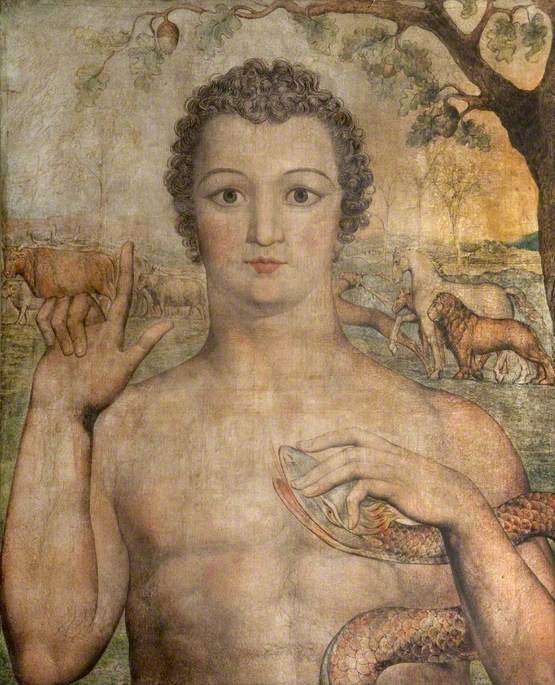
Adam Naming the Beasts 

Genesis 2

[18]Then the LORD God said, "It is not good that the man should be alone; I will make him a helper fit for him."
[19] So out of the ground the LORD God formed every beast of the field and every bird of the air, and brought them to the man to see what he would call them; and whatever the man called every living creature, that was its name.
[20] The man gave names to all cattle, and to the birds of the air, and to every beast of the field; but for the man there was not found a helper fit for him.


Peter Ackroyd, on page 300 of Blake: A Biography, says of this picture:
"We can arise and meet the gaze of the primordial Adam, then, and see in that blessed moment the very origin and meaning of the Divine Vision by which all things are known and named. Boehme's words are appropriate here, in his descriptions of the luminous primordial man 'who knew the language of God and the angels ...And Adam knew that he was within every creature, and he gave to each its appropriate name.'"

Vision of Last Judgment, (E 560)
 "If the Spectator could Enter into these Images in his
Imagination approaching them on the Fiery Chariot of his
Contemplative Thought if he could Enter into Noahs Rainbow or
into his bosom or could make a Friend & Companion of one of these
Images of wonder which always intreats him to leave mortal things
as he must know then would he arise from his Grave then would he
meet the Lord in the Air & then he would be happy   General
Knowledge is Remote Knowledge it is in Particulars that Wisdom
consists & Happiness too.  Both in Art & in Life General Masses
are as Much Art as a Pasteboard Man is Human Every Man has Eyes
Nose & Mouth this Every Idiot knows but he who enters into &
discriminates most minutely the Manners & Intentions the
[Expression] Characters in all their branches is the
alone Wise or Sensible Man & on this discrimination All Art is
founded.  I intreat then that the Spectator will attend to the
Hands & Feet to the Lineaments of the Countenances they are all
descriptive of Character & not a line is drawn without intention
& that most discriminate & particular as Poetry admits not a
Letter that is Insignificant so Painting admits not a Grain of
Sand or a Blade of Grass Insignificant much less an
Insignificant Blur or Mark" 

Sunday, November 23, 2025

EVE & BIRDS

First posted June 1014

In 1810 Blake painted a series of four pictures for Thomas Butts. The first of the group was shown in the post Giving Names. While the first picture showed Adam naming the animals, the second is said to be Eve naming the birds. However there is no Biblical precedent for Eve naming the birds. Blake was using Eve and the birds to point us in the direction of separation of the female from the male which initiated the sexuality of Generation. 
 
Eve is the figure who transitions Eden to generation. Kathleen Raine, on page 41 of Blake and Antiquity, tells us that the birds with Eve are the 'lureing birds of love.'

We can see in Adam the undivided man whose straightforward gaze engages our own gaze, or he looks past us to the infinite, eternal world beyond. Eve's eyes are focused not on the viewer, or on heaven above, or on eternity, but on something in her own world which has attracted her attention. If in this set of pictures Blake used Adam as a symbol for Creation he used Eve as a symbol for the Fall. 


Book of Urizen, Plate 18, (E 78)
"9. All Eternity shudderd at sight
Of the first female now separate                       
Pale as a cloud of snow
Waving before the face of Los

10. Wonder, awe, fear, astonishment,
Petrify the eternal myriads;
At the first female form now separate                  
Plate 19
They call'd her Pity, and fled"

Jerusalem, Plate 86, (E 245)
"And Enitharmon like a faint rainbow waved before him         
Filling with Fibres from his loins which reddend with desire
Into a Globe of blood beneath his bosom trembling in darkness
Of Albions clouds. he fed it, with his tears & bitter groans
Hiding his Spectre in invisibility from the timorous Shade
Till it became a separated cloud of beauty grace & love       
Among the darkness of his Furnaces dividing asunder till
She separated stood before him a lovely Female weeping
Even Enitharmon separated outside, & his Loins closed
And heal'd after the separation: his pains he soon forgot:
Lured by her beauty outside of himself in shadowy grief.      
Two Wills they had; Two Intellects: & not as in times of old.

Silent they wanderd hand in hand like two Infants wandring
From Enion in the desarts, terrified at each others beauty
Envying each other yet desiring, in all devouring Love,"
The primary characteristic of the fall of man to Blake was not disobedience or sin but the loss of the awareness of Eternity with its attendant inability to perceive that one is known by God and knows God intuitively. Paul's book of Romans says something of the same when he speaks of man losing the power of seeing the 'invisible nature' of the created world, and worshiping the images rather than the creator. 

Romans 1
[19] For what can be known about God is plain to them, because God has shown it to them.
[20] Ever since the creation of the world his invisible nature, namely, his eternal power and deity, has been clearly perceived in the things that have been made. So they are without excuse;
[21] for although they knew God they did not honor him as God or give thanks to him, but they became futile in their thinking and their senseless minds were darkened.
[22] Claiming to be wise, they became fools,
[23] and exchanged the glory of the immortal God for images resembling mortal man or birds or animals or reptiles.
[24] Therefore God gave them up in the lusts of their hearts to impurity, to the dishonoring of their bodies among themselves,
[25] because they exchanged the truth about God for a lie and worshiped and served the creature rather than the Creator, who is blessed for ever! Amen.

Friday, November 21, 2025

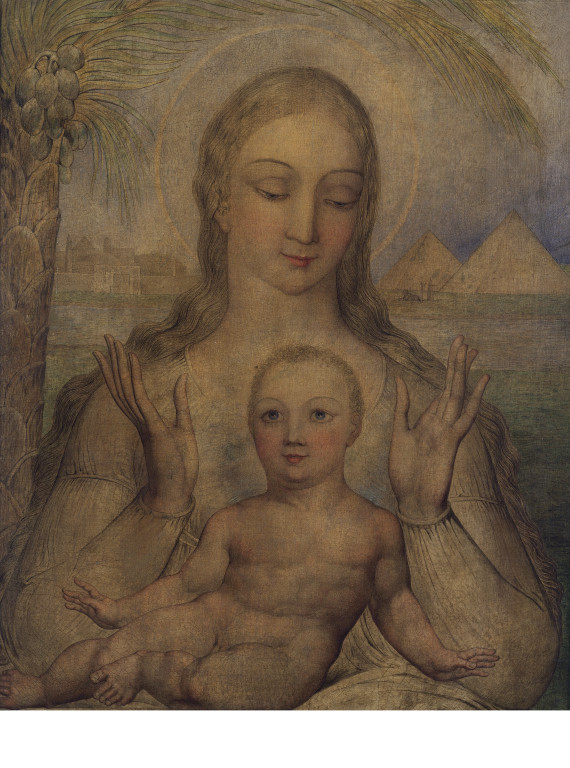
THE CHILD IN EGYPT

Victoria & Albert Museum
Virgin & Child In Egypt
First posted June 2014

The third of the group of four paintings Blake created for Thomas Butts in 1810 is called
 Virgin and Child in Egypt. In Blake's system the third stage is Generation: participation in the sexual world in which man lives in Time and Space and has a physical body. The mother and child represent procreation, the characteristic of the natural world which, along with death, typifies the stage of generation. The other prominent features of the picture are the symbols of the location in Egypt: the palm tree, the pyramids and the palace. For the Hebrews the significance of Egypt is the bondage from which they were released under the leadership of Moses. Blake is suggesting that the stage of generation is a bondage from which man seeks release.

Christians consider that the ministry of Jesus represented a second Exodus providing release from the bondage to sin and death. Jesus came to introduce the stage of development where each man knows his own spiritual nature and learns to give expression to the God within his own heart, and mind, and soul, and body. 

Songs of Innocence and of Experience
, Plate 52, (E 30)
"To Tirzah              
Whate'er is Born of Mortal Birth,
Must be consumed with the Earth
To rise from Generation free;
Then what have I to do with thee?

The Sexes sprung from Shame & Pride
Blow'd in the morn: in evening died
But Mercy changd Death into Sleep;
The Sexes rose to work & weep.

Thou Mother of my Mortal part.
With cruelty didst mould my Heart. 
And with false self-decieving tears,
Didst bind my Nostrils Eyes & Ears.

Didst close my Tongue in senseless clay
And me to Mortal Life betray:
The Death of Jesus set me free, 
Then what have I to do with thee?

[text on illustration: It is Raised a Spiritual Body]
Milton, Plate 24 [26], (E 120)
"And Palamabron thou rememberest when Joseph an infant;
Stolen from his nurses cradle wrapd in needle-work
Of emblematic texture, was sold to the Amalekite,
Who carried him down into Egypt where Ephraim & Menassheh        
Gatherd my Sons together in the Sands of Midian
And if you also flee away and leave your Fathers side,
Following Milton into Ulro, altho your power is great
Surely you also shall become poor mortal vegetations
Beneath the Moon of Ulro: pity then your Fathers tears"   
Gen.26
[1] Now there was a famine in the land, besides the former famine that was in the days of Abraham. And Isaac went to Gerar, to Abim'elech king of the Philistines.
[2] And the LORD appeared to him, and said, "Do not go down to Egypt; dwell in the land of which I shall tell you.
[3] Sojourn in this land, and I will be with you, and will bless you; for to you and to your descendants I will give all these lands, and I will fulfil the oath which I swore to Abraham your father.
[4] I will multiply your descendants as the stars of heaven, and will give to your descendants all these lands; and by your descendants all the nations of the earth shall bless themselves:
[5] because Abraham obeyed my voice and kept my charge, my commandments, my statutes, and my laws."
[6] So Isaac dwelt in Gerar.


Genesis 37
[23] So when Joseph came to his brothers, they stripped him of his robe, the long robe with sleeves that he wore;
[24] and they took him and cast him into a pit. The pit was empty, there was no water in it.
[25] Then they sat down to eat; and looking up they saw a caravan of Ish'maelites coming from Gilead, with their camels bearing gum, balm, and myrrh, on their way to carry it down to Egypt.
[26] Then Judah said to his brothers, "What profit is it if we slay our brother and conceal his blood?
[27] Come, let us sell him to the Ish'maelites, and let not our hand be upon him, for he is our brother, our own flesh." And his brothers heeded him.
[28] Then Mid'ianite traders passed by; and they drew Joseph up and lifted him out of the pit, and sold him to the Ish'maelites for twenty shekels of silver; and they took Joseph to Egypt.

Exodus 29
[45] And I will dwell among the people of Israel, and will be their God.
[46] And they shall know that I am the LORD their God, who brought them forth out of the land of Egypt that I might dwell among them; I am the LORD their God.

Matthew 2
[12] And being warned in a dream not to return to Herod, they departed to their own country by another way.
[13] Now when they had departed, behold, an angel of the Lord appeared to Joseph in a dream and said, "Rise, take the child and his mother, and flee to Egypt, and remain there till I tell you; for Herod is about to search for the child, to destroy him."
[14] And he rose and took the child and his mother by night, and departed to Egypt,

[15] and remained there until the death of Herod. This was to fulfil what the Lord had spoken by the prophet, "Out of Egypt have I called my son." 


Tuesday, November 18, 2025

BLAKE'S FRESCOS

First posted June 2014

To fully appreciate the impact of the four paintings which Blake painted for Thomas Butts in 1810 we would need to be in Butts' home and see them hanging together on a wall. Although many of Blake's pictures are small, these are large with dimensions of approximately 30 inches by 25 inches . They were executed in a tempera technique on fine linen. Blake inscribed them with the date, his name and the word 'Fresco', his term for tempera. The paintings now reside in three museums, the Adam and Eve images in the Glasgow Museum, the Virgin and Child in the Victoria & Albert Museum, and the Christ image in the Fogg Museum at Harvard.

The four images are shown together here to compare and contrast. The unifying style signifies that the group is to be interpreted as a whole. The details of the focus of the eyes, the positions of the hands, the representative trees, and the backgrounds distinguish characteristics of each stage of development.

Eve Naming Birds
Adam Naming Beasts


Harvard Art Museums
Fogg Museum

www.harvardartmuseums.org
Christ Blessing
Virgin and Child in Egypt
Blake executed these images during the period of his life in which he was most interested in reaching the public through exhibiting his watercolor work (including tempera or fresco) at the Royal Academy and promoting the use of art in his native land.
Advertisement of Exhibition, (E 527)
 "Fresco Painting, as it is now practised, is like
most other things, the contrary of what it pretends to be.
  The execution of my Designs, being all in Water-colours,
(that is in Fresco) are regularly refused to be exhibited by the
Royal Academy, and the British Institution has, 
this year, followed its example, and has effectually excluded me 
by this Resolution; I therefore invite those Noblemen and 
Gentlem[e]n, who are its Subscribers, to inspect what they have 
excluded: and those who have been told that my Works are
but an unscientific and irregular Eccentricity, a Madman's
Scrawls, I demand of them to do me the justice to examine before
they decide.
  There cannot be more than two or three great Painters or
Poets in any Age or Country; and these, in a corrupt state of
Society, are easily excluded, but not so easily obstructed.  They
have ex[c]luded Watercolours; it is therefore become necessary
that I should exhibit to the Public, in an Exhibition of my own,
my Designs, Painted in Watercolours.  If Italy is enriched and
made great by RAPHAEL, if MICHAEL ANGELO is its supreme glory, if
Art is the glory of a Nation, if Genius and Inspiration are the
great Origin and Bond of Society, the distinction my Works have
obtained from those who best understand such things, calls for my
Exhibition as the greatest of Duties to my Country.  
                                             WILLIAM BLAKE"

Descriptive Catalogue, (E 531)
"All Frescos are as high finished as miniatures or enamels,
and they are known to be unchangeable; but oil being a body
itself, will drink or absorb very little colour, and changing
yellow, and at length brown, destroys every colour it is mixed
with, especially every delicate colour.  It turns every permanent
white to a yellow and brown putty, and has compelled the use of
that destroyer of colour, white lead; which, when its protecting
oil is evaporated, will become lead again.  This is an awful
things to say to oil Painters; they may call it madness, but it
is true.  All the genuine old little Pictures, called Cabinet
Pictures, are in fresco and not in oil, Oil was not used except
by blundering ignorance, till after Vandyke's time, but the art
of fresco painting [P 7] being lost, oil became a fetter to
genius, and a dungeon to art.  But one convincing proof among
many others, that these assertions are true is, that real gold
and silver cannot be used with oil, as they are in all the old
pictures and in Mr. B.'s frescos."