Showing posts with label Singer. Show all posts

Friday, August 08, 2025

TITLE PAGE MHH

Fitzwilliam Museum
The Marriage of Heaven and Hell
Copy I,  Plate 1
Printed 1827


Insight From The Unholy Bible: Blake, Jung and the Collective Unconscious
by June Singer
"Blake serves notice that in this little book we must expect the unexpected."  
Page 43

June Singer begins her sturdy of Blake's The Marriage of Heaven and Hell by describing the title page of his book. At the top of the page is a scene which includes the first three words of the title and images of two couples under leafless trees. The woman of the couple to the right is prone on the ground, the man is kneeling beside her with a babe in his arms. Singer calls this scene the Earth. She states that "Blake gives less space to the earth than to the underworld because to him the daily activity of conscious life was the palest part of existence." She sees that the figures in this space "approch precariously close to the rim of the bottomless depths from which individual consciousness emerges." 

The middle section of the picture is divided into the left side representing the "sinister, dark, or hidden side", covered with flames of Hell. On the right side are dark and bright clouds of Heaven. This section symboizes the abyss into the pairs of opposites, represented as couples, have fallen from the earth above.

In the lower section we enter "the limitless underground regions below the threshold of consciousness." This is the area Blake felt compelled to enter:

"When Blake comes to a place in his life where his understanding of the world about him - the problems of nations in their struggle for freedom from tyranny, the travail of the working people of his own England trying to maintain themselves against the incursion of the machine - and the lack of satisfaction in his personal life and especially in his marriage, bring him to the point of despair, he sinks his own roots deeper into a place of quiet darkness where he can hope to find restoration." He was led to explore Heaven and Hell and "the archetypal opposites from which they sprang."

The lowest part of the picture in which the word HELL appears, contains male and female figures embracing. Singer postulates that Blake "consciously identifies" with the male figure on the right, the side of consciousness. The darker unconscious side of his personality is represented by the female on the left. Singer states that the embrace "is in reality a confrontation between the male ego and the 'other,' between the male who sees himself as a rational being able to perform successfully in the manner prescribed by the social order and the female afire with energy which knows no bounds or limitation...Reason and Energy are seen as the two contraries which struggle within Blake, and whose interaction so deeply concerns him in this work." 


Thursday, February 08, 2024

SOUL QUOTES

Wikipedia Commons
Introduction to Songs of Experience
Some of what Blake wrote about the soul can be found in the passages quoted below. They include these words about the soul:  
The soul is subject to falling away, to passing through states, but is never defiled. It can be hidden or return to the mortal state or be 'harrowd with grief & fear & love & desire,' It can conceal sin. The soul can experience terror or view the 'Infernal Storm.' The soul can be given away and can seek for her maker. The sinless soul dwells with the immortal spirit. When the soul approaches the gates of death, or dies within, the Divine Saviour descends and the Divine Vision weeps. Error & Illusion rent the soul.
June Singer in Seeing Through the Visible World, gives these insights into how the soul functions beginning on page xxii:
"...The more you encompass of the visible world with the knowing of the mind, the more aware you may become of the expanse of the unknowable. 
But there is another way of knowing: the knowing of the soul. This kind of knowing has been called gnosis since ancient times to distinguish it from the kind of knowledge that comes from intellect and reason alone. Psyche is the Greek term for soul, and it is in this sense that I use it. Soul or psyche, is that aspect of the individual that is composed of both conscious and unconscious aspects: ways of knowing of which we are primarily aware (such as thinking, feeling, and sensation),  and ways of knowing that seem to be mobilized primarily in realms of the unconscious (for example, intuition, speculation, imagination, and dreaming). All these ways of knowing belong to the realm of the psyche or soul. Mind is included in the psyche, but the psyche is not limited to the exercise of the mental processes. The soul bridges the gap between what can be learned through the mind, through the senses, through the intellect and through the exercise of scientific observation - and the intuitive awareness of a deep abiding space that may be penetrated by consciousness but can never be encompassed by it."
Songs of Innocence and of Experience, Songs 30, (E 18)
"Introduction.
Hear the voice of the Bard! 
Who Present, Past, & Future sees
Whose ears have heard,
The Holy Word,
That walk'd among the ancient trees.

Calling the lapsed Soul
And weeping in the evening dew:
That might controll,
The starry pole;
And fallen fallen light renew!" 
Songs of Innocence and of Experience, Combined Title Page, (E 6)
"Shewing the Two Contrary States of the Human Soul"    
America, Plate 8, (E 54)
"For every thing that lives is holy, life delights in life;
Because the soul of sweet delight can never be defil'd."
Jerusalem, Plate 22, (E 168)
"Loud groand Albion from mountain to mountain & replied
Plate 23
Jerusalem! Jerusalem! deluding shadow of Albion!
Daughter of my phantasy! unlawful pleasure! Albions curse!
I came here with intention to annihilate thee! But
My soul is melted away, inwoven within the Veil
Hast thou again knitted the Veil of Vala, which I for thee       
Pitying rent in ancient times. I see it whole and more
Perfect, and shining with beauty! But thou! O wretched Father! 

Jerusalem reply'd, like a voice heard from a sepulcher:
Father! once piteous! Is Pity. a Sin? Embalm'd in Vala's bosom
In an Eternal Death for. Albions sake, our best beloved.         
Thou art my Father & my Brother: Why hast thou hidden me,
Remote from the divine Vision: my Lord and Saviour."
Milton, Plate 42 [49], (E 143)
"Terror struck in the Vale I stood at that immortal sound
My bones trembled. I fell outstretchd upon the path              
A moment, & my Soul returnd into its mortal state
To Resurrection & Judgment in the Vegetable Body
And my sweet Shadow of Delight stood trembling by my side

Immediately the Lark mounted with a loud trill from Felphams Vale
And the Wild Thyme from Wimbletons green & impurpled Hills"       
Jerusalem, Plate 68, (E 222)
"Once Man was occupied in intellectual pleasures & energies   
But now my soul is harrowd with grief & fear & love & desire
And now I hate & now I love & Intellect is no more:
There is no time for any thing but the torments of love & desire
The Feminine & Masculine Shadows soft, mild & ever varying
In beauty: are Shadows now no more, but Rocks in Horeb           
Plate 69
Then all the Males combined into One Male & every one
Became a ravening eating Cancer growing in the Female
A Polypus of Roots of Reasoning Doubt Despair & Death.
Going forth & returning from Albions Rocks to Canaan:
Devouring Jerusalem from every Nation of the Earth."
Four Zoas, Night I, Page 4, (E 301)
"Enion said--Thy fear has made me tremble thy terrors have surrounded me                                              t
All Love is lost Terror succeeds & Hatred instead of Love
And stern demands of Right & Duty instead of Liberty.
Once thou wast to Me the loveliest son of heaven--But now        
 
Why art thou Terrible and yet I love thee in thy terror till
I am almost Extinct & soon shall be a Shadow in Oblivion
Unless some way can be found that I may look upon thee & live
Hide me some Shadowy semblance. secret whispring in my Ear
In secret of soft wings. in mazes of delusive beauty             
I have lookd into the secret soul of him I lovd
And in the Dark recesses found Sin & cannot return

Trembling & pale sat Tharmas weeping in his clouds
Why wilt thou Examine every little fibre of my soul
Spreading them out before the Sun like Stalks of flax to dry     
The infant joy is beautiful but its anatomy
Horrible Ghast & Deadly nought shalt thou find in it
But Death Despair & Everlasting brooding Melancholy
Four Zoas, Night VII, Page 85, (E 360)
"Thus they conferrd among the intoxicating fumes of Mystery    
Till Enitharmons shadow pregnant in the deeps beneath
Brought forth a wonder horrible. While Enitharmon shriekd
And trembled thro the Worlds above Los wept his fierce soul was terrifid
At the shrieks of Enitharmon at her tossings nor could his eyes percieve
The cause of her dire anguish for she lay the image of Death     
Movd by strong shudders till her shadow was deliverd then she ran
Raving about the upper Elements in maddning fury

She burst the Gates of Enitharmons heart with direful Crash
Nor could they ever be closd again the golden hinges were broken
And the gates broke in sunder & their ornaments defacd       
Beneath the tree of Mystery for the immortal shadow shuddering
Brought forth this wonder horrible a Cloud she grew & grew
Till many of the dead burst forth from the bottoms of their tombs
In male forms without female counterparts or Emanations    
Cruel and ravening with Enmity & Hatred & War  
In dreams of Ulro dark delusive drawn by the lovely shadow 

The Spectre terrified gave her Charge over the howling Orc" 
Songs and Ballads, (E 480)
[From Blake's Notebook] 
 "The Caverns of the Grave Ive seen 
And these I shewd to Englands Queen
But now the Caves of Hell I view     
Who shall I dare to shew them to
What mighty Soul in Beautys form     
Shall dauntless View the Infernal Storm 
Egremonts Countess can controll         
The flames of Hell that round me roll   
If she refuse I still go on"
Four Zoas, Night II, Page 26, (E 317)
"I brought her thro' the Wilderness, a dry & thirsty land
And I commanded springs to rise for her in the black desart
Till she became a Dragon winged bright & poisonous  
I opend all the floodgates of the heavens to quench her thirst
Plate 27 
And I commanded the Great deep to hide her in his hand
Till she became a little weeping Infant a span long
I carried her in my bosom as a man carries a lamb
I loved her I gave her all my soul & my delight
I hid her in soft gardens & in secret bowers of Summer           
Weaving mazes of delight along the sunny Paradise
Inextricable labyrinths, She bore me sons & daughters
And they have taken her away & hid her from my sight
They have surrounded me with walls of iron & brass, O Lamb     
Of God clothed in Luvahs garments little knowest thou          
Of death Eternal that we all go to Eternal Death"
Four ZoasNight IX, Page 127, (E 396)
"Rise sluggish Soul why sitst thou here why dost thou sit & weep
Yon Sun shall wax old & decay but thou shalt ever flourish 
The fruit shall ripen & fall down & the flowers consume away
But thou shalt still survive arise O dry thy dewy tears

Hah! Shall I still survive whence came that sweet & comforting voice
And whence that voice of sorrow O sun thou art nothing now to me
Go on thy course rejoicing & let us both rejoice together 
I walk among his flocks & hear the bleating of his lambs
O that I could behold his face & follow his pure feet
I walk by the footsteps of his flocks come hither tender flocks
Can you converse with a pure Soul that seeketh for her maker
You answer not then am I set your mistress in this garden 
Ill watch you & attend your footsteps you are not like the birds"
Four Zoas, Night IX, Page 127, (E 397)
"My Luvah here hath placd me in a Sweet & pleasant Land
And given me fruits & pleasant waters & warm hills & cool valleys
Here will I build myself a house & here Ill call on his name
Here Ill return when I am weary & take my pleasant rest

So spoke the Sinless Soul & laid her head on the downy fleece 
Of a curld Ram who stretchd himself in sleep beside his mistress
And soft sleep fell upon her eyelids in the silent noon of day

Then Luvah passed by & saw the sinless Soul
And said   Let a pleasant house arise to be the dwelling place
Of this immortal Spirit growing in lower Paradise" 
Milton, Plate 14 [15], (E 108)
"And Milton said, I go to Eternal Death! The Nations still
Follow after the detestable Gods of Priam; in pomp               
Of warlike selfhood, contradicting and blaspheming.
When will the Resurrection come; to deliver the sleeping body
From corruptibility: O when Lord Jesus wilt thou come?
Tarry no longer; for my soul lies at the gates of death.
I will arise and look forth for the morning of the grave.       
I will go down to the sepulcher to see if morning breaks!
I will go down to self annihilation and eternal death,
Lest the Last Judgment come & find me unannihilate"

Jerusalem, Plate 42, (E 189)
"Thus Albion sat, studious of others in his pale disease:
Brooding on evil: but when Los opend the Furnaces before him:
He saw that the accursed things were his own affections,
And his own beloveds: then he turn'd sick! his soul died within him
Also Los sick & terrified beheld the Furnaces of Death           
And must have died, but the Divine Saviour descended
Among the infant loves & affections, and the Divine Vision wept
Like evening dew on every herb upon the breathing ground"
Jerusalem, Plate 35 [39], (E 181)

"Los answerd, troubled: and his soul was rent in twain
Must the Wise die for an Atonement? does Mercy endure Atonement? 
 No! It is Moral Severity, & destroys Mercy in its Victim. 
So speaking, not yet infected with the Error & Illusion,"


Tuesday, April 21, 2020

DIVINE INFANT


Book of Urizen Detail of Plate 20

Jung and Blake agree that transformation is a complex process. Each who seeks to discard the accumulation of defenses and disguises which overlay the center of the psyche, undergoes a process of removing layers to reveal what lies within. The Divine Infant symbolizes the potential for development once the Center or Soul has been approached. If the individual has faced the unknown which he feared he may return to functioning in the outer world. But he will be tossed into the sea to be cleansed of any excess baggage he intended to retain before he can be transformed into a new being.  

June Singer makes this statement in Boundaries of the Soul, her book about the practice of Jung's psychology:
Page 223
 
"The archetype of the divine child, for example, tends to appear in advance of a transformation in the psyche. His appearance recalls the marking of aeons in the history of the world which were heralded by the appearance of an infant who overthrows the old order and, with passion and inspiration, begins a new one. The power of this archetype is nowhere better expressed than in William Blake's poem, A Song of Liberty. The Eternal Female, the anima, gives birth to the divine child, a sun god with flaming hair. This evokes the jealous rage of the old king, the 'starry King' of night and darkness and all the decadence that has come upon the world. Though the king flings the divine child on the western sea, the child will not be drowned. A night sea journey will take place and when it is finished the son of morning will rise in the east to bring his light to the world:
 
Marriage of Heaven and Hell, Plate 25, (E 44) 
A Song of Liberty 
1. The Eternal Female groand! it was heard over all the Earth:
...
7. In her trembling hands she took the new, born terror howling; 
8. On those infinite mountains of light now barr'd out by the atlantic sea, the new born fire stood before the starry king
9. Flag'd with grey brow'd snows and thunderous visages the jealous wings wav'd over the deep. 
10. The speary hand burned aloft, unbuckled was the shield, forth went the hand of jealousy among the flaming hair, and hurl'd the new born wonder thro' the starry night. 
11. The fire, the fire, is falling!
...
13. The fiery limbs, the flaming hair, shot like the sinking sun into the western sea. ...
18. With thunder and fire: leading his starry hosts thro' the waste wilderness he promulgates his ten commands, glancing his beamy eyelids over the deep in dark dismay,
19. Where the son of fire in his eastern cloud, while the morning plumes her golden breast
20. Spurning the clouds written with curses, stamps the stony law to dust, loosing the eternal horses from the dens of night, crying 

Empire is no more! and now the lion & wolf shall cease."
_______________________
1John.3
[1] Behold, what manner of love the Father hath bestowed upon us, that we should be called the sons of God: therefore the world knoweth us not, because it knew him not.
[2] Beloved, now are we the sons of God, and it doth not yet appear what we shall be: but we know that, when he shall appear, we shall be like him; for we shall see him as he is.

THERE is NO NATURAL RELIGION,  (E 2)
    " He who sees the Infinite in all things sees
God.  He who sees the Ratio only sees himself only.

Therefore God becomes as we are, that we may be as he is"
 

Friday, May 31, 2019

UNHOLY BIBLE

Wikipedia Commons
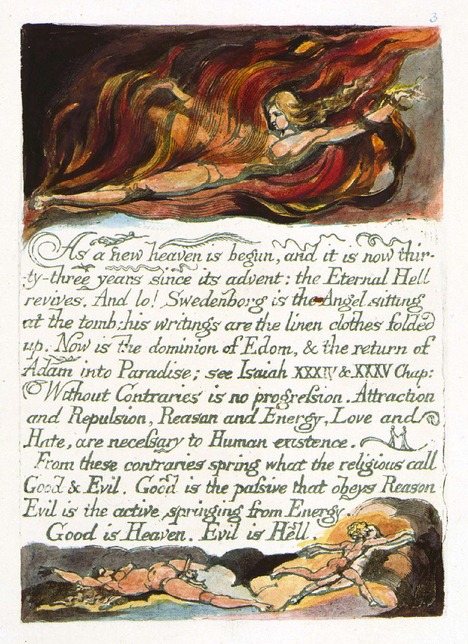
Marriage of Heaven & Hell
Plate 3
Updated from August 2010.

June Singer, a Jungian psychologist, wrote several books on psychology but only one book on Blake. Her first book which developed from her thesis for her analysts diploma from the C. G. Jung Institute in Zurich, is titled The Unholy Bible: Blake, Jung and the Collective Unconscious. Although most of the book is a psychological analysis of The Marriage of Heaven and Hell, she provides insight into the later prophetic writings as well. In this passage she explains The Four Zoas in terms of individuation. The quote from Blake represents the reassembling of the pieces after 'all things are changd'.

"The long poem , The Four Zoas, describes the many aspects of man as they are differentiated from one another.The symbolism amazingly parallels the analytic process of differentiating the many unconscious contents from the other, and then gradually reintegrating them into a new and productive unity. The parallel is even more impressive when we consider that Blake uses the schema of nine nights of dreams, since dreams in analytical psychology provide the key to understanding the unconscious processes. It is with this key that Blake has unlocked 'the doors of perception' as he promised he would in The Marriage of Heaven and Hell. At the end of the ninth night man beholds the infinite vision, and he sings the Ode to Joy (we recall the first two lines, first uttered by the enslaved wives and children of America): [Four Zoas, Page 138, (E 406)]

'The Sun has left his blackness & has found a fresher morning
And the mild moon rejoices in the clear & cloudless night
And Man walks forth from midst of the fires the evil is all
consumd
His eyes behold the Angelic spheres arising night & day
The stars consumd like a lamp blown out & in their stead behold
The Expanding Eyes of Man behold the depths of wondrous worlds
One Earth one sea beneath nor Erring Globes wander but Stars
Of fire rise up nightly from the Ocean & one Sun
Each morning like a New born Man issues with songs & Joy
Calling the Plowman to his Labour & the Shepherd to his rest
He walks upon the Eternal Mountains raising his heavenly voice
Conversing with the Animal forms of wisdom night & day
That risen from the Sea of fire renewd walk oer the Earth

For Tharmas brought his flocks upon the hills & in the Vales
Around the Eternal Mans bright tent the little Children play
Among the wooly flocks The hammer of Urthona sounds
In the deep caves beneath his limbs renewd his Lions roar
Around the Furnaces & in Evening sport upon the plains
They raise their faces from the Earth conversing with the Man

How is it we have walkd thro fires & yet are not consumd
How is it that all things are changd even as in ancient times' " 


More from Singer (Page 214):
"It is as if though the writing of this book were a very private experience, like a dream that belonged to Blake alone. It was the working through of  the difficult union foretold in The Marriage of Heaven and Hell. An inner marriage was taking place in the psyche which was more real than his conventional with Catherine. As masculine creative force, his energy spurted forth abundantly. As feminine receptive vessel, his anima aspect functioned in his work to contain and shape that stream. 
 
'The cistern contains: the fountain overflows.' It was a secret happening, a pregnancy, which could not be shown prematurely to the public. This is why, I believe,  Blake never engraved this book. Murry [John Middleton] states it well when he says, 'It is the travail of Blake's final rebirth.'"  
.

Thursday, May 30, 2019

PROLIFIC

Wikipedia Commons
Marriage of Heaven and Hell
Plate 16
Marriage of Heaven & Hell, PLATE 16, (E 40)
   "The Giants who formed this world into its sensual existence
and  now seem to live in it in chains; are in truth. the causes
of its life & the sources of all activity, but the chains are,
the cunning of weak  and tame minds. which have power to resist
energy. according to the proverb, the weak in courage is strong
in cunning.
   Thus one portion of being, is the Prolific. the other, the
Devouring:  to the devourer it seems as if the producer was in
his chains, but it is not so, he only takes portions of existence
and fancies that the whole.
   But the Prolific would cease to be Prolific unless the
Devourer as a sea recieved the excess of his delights.
   Some will say, Is not God alone the Prolific? I answer, God
only   Acts & Is, in existing beings or Men.
   These two classes of men are always upon earth, & they should
be enemies; whoever tries [PL 17] to reconcile them seeks to
destroy existence.   
   Religion is an endeavour to reconcile the two.
   Note.  Jesus Christ did not wish to unite but to seperate
them, as in  the Parable of sheep and goats! & he says I came not
to send Peace  but a Sword.
   Messiah or Satan or Tempter was formerly thought to be one of
the  Antediluvians who are our Energies."

Annotations to Reynolds, (E 656)
"Reynolds: The mind is but a barren soil; a soil which is soon
exhausted, and will produce no crop, . . . 
Blake:The Mind that could have produced this Sentence must have
been Pitiful a Pitiable Imbecillity.  I always thought that the
Human Mind was the most Prolific of All Things & Inexhaustible  I
certainly do Thank God that I am not like Reynolds" 

June Singer, in The Unholy Bible, made this statement:
"What Blake seems to be saying here is that with the development of ego consciousness, a sense of identity as 'I,' man takes the place of the giant. Man differs from the giant in that the prolific and devouring aspects in man are separated, whereas in the giant they were combined as two portions of one being. The two aspects are expressed, according to Blake's thinking, in two types of men, in whom either one or the other of these aspects predominates." (Page 141)

Singer saw the Prolific as the poet, and the Devourer as the conventional or reasonable man. In the New Testament book of Matthew we see a division between two irreconcilable beings. There is final resolution in which the sheep are divided from the goats. It is the sheep who inherit and receive the Father's blessing while the goats are cast out. 

Matthew 25
[31] When the Son of man shall come in his glory, and all the holy angels with him, then shall he sit upon the throne of his glory:
[32] And before him shall be gathered all nations: and he shall separate them one from another, as a shepherd divideth his sheep from the goats:
[33] And he shall set the sheep on his right hand, but the goats on the left.
[34] Then shall the King say unto them on his right hand, Come, ye blessed of my Father, inherit the kingdom prepared for you from the foundation of the world:

...
[41] Then shall he say also unto them on the left hand, Depart from me, ye cursed, into everlasting fire, prepared for the devil and his angels:

Singer observed that Blake was involved in a lifelong struggle taking place in himself between his 'freely flowing energies' which welled up from his imagination, and the 'binding restraints' required by society. Singer asks us to consider if Blake may have done well to resolve these two sides of himself in order to make his productive side more acceptable to conventional norms. Apparently Blake found that a compromise he was unwilling to make.

Friday, February 20, 2015

SEEING THROUGH

British Museum
Illustrations to Young's Night Thoughts
The influence of William Blake on June Singer is apparent in the title of her book, Seeing Through the Visible World. Seeing through the eye to Blake was extra-sensory. It was using Spiritual Sensation to perceive beyond the physical world to the Eternal where ordinary senses are inadequate. Singer explores, not seeing through the eye, but seeing through the world which our senses perceive, to the the invisible world from which we can draw insight and wisdom for our journey through life. The invisible world which Singer most wanted to explore was the unconscious world within the psyche.

At the conclusion of her book she acknowledges that the two worlds are indivisible, parts of one organic whole which is all inclusive and ever present:

"Finally we will know that the visible world and the invisible world are only concepts created by the intellect, the functions of which are to analyze, to discriminate, to reason, to judge.

 
If we could even for a moment throw away our concepts and see with the inner eye through all the veils of conditioning, we would know that there is only one world, one indissoluble world. We would see that all the creatures on earth are part of a single system. There is no preferred species; there is no preferred race. In the eye of Wisdom we are all equals, participants in one cosmic system. The world we experience as visible was never separate from the whole; it only seemed so. The separation was an illusion. There is no other place from which we came, except in the illusions cherished by the mind. There is no other place to which we must someday go. It is all here, all now, in its entirety. The future dose not exist, the past is already gone. What we do we must do in this moment. There is no other or preferred moment. When we can accept what is before our eyes, accept it with our whole heart, we no longer have anything to fear, anything to long for. All we need to set the world aright is here. We have only to see it." (Page 221)
Jerusalem, Plate 13, (E 157)
"(But whatever is visible to the Generated Man,
Is a Creation of mercy & love, from the Satanic Void.)           
The land of darkness flamed but no light, & no repose:
The land of snows of trembling, & of iron hail incessant:
The land of earthquakes: and the land of woven labyrinths:
The land of snares & traps & wheels & pit-falls & dire mills:
The Voids, the Solids, & the land of clouds & regions of waters:
With their inhabitants: in the Twenty-seven Heavens beneath Beulah:
Self-righteousnesses conglomerating against the Divine Vision:
A Concave Earth wondrous, Chasmal, Abyssal, Incoherent!
Forming the Mundane Shell: above; beneath: on all sides surrounding
Golgonooza: Los walks round the walls night and day."
 
Jerusalem, Plate 72, (E 227) 
"The Nations wait for Jerusalem. they look up for the Bride

France Spain Italy Germany Poland Russia Sweden Turkey
Arabia Palestine Persia Hindostan China Tartary Siberia
Egypt Lybia Ethiopia Guinea Caffraria Negroland Morocco          
Congo Zaara Canada Greenland Carolina Mexico
Peru Patagonia Amazonia Brazil. Thirty-two Nations
And under these Thirty-two Classes of Islands in the Ocean
All the Nations Peoples & Tongues throughout all the Earth

And the Four Gates of Los surround the Universe Within and       
Without; & whatever is visible in the Vegetable Earth, the same
Is visible in the Mundane Shell; reversd in mountain & vale
And a Son of Eden was set over each Daughter of Beulah to guard
In Albions Tomb the wondrous Creation: & the Four-fold Gate
Towards Beulah is to the South[.] Fenelon, Guion, Teresa,    
Whitefield & Hervey, guard that Gate; with all the gentle Souls
Who guide the great Wine-press of Love; Four precious stones that Gate:"
Four Zoas, Night II, Page 33, (E 321)
"For many a window ornamented with sweet ornaments                
Lookd out into the World of Tharmas, where in ceaseless torrents 
His billows roll where monsters wander in the foamy paths

On clouds the Sons of Urizen beheld Heaven walled round 
They weighd & orderd all & Urizen comforted saw         
The wondrous work flow forth like visible out of the invisible   
For the Divine Lamb Even Jesus who is the Divine Vision 
Permitted all lest Man should fall into Eternal Death
For when Luvah sunk down himself put on the robes of blood
Lest the state calld Luvah should cease. & the Divine Vision
Walked in robes of blood till he who slept should awake     

Thus were the stars of heaven created like a golden chain
To bind the Body of Man to heaven from failing into the Abyss 
Each took his station, & his course began with sorrow & care" 
 
Annotations to Lavater, (E 592)
Lavater wrote: "Whatever is visible is the vessel or veil of the
invisible past, present, future--as man penetrates to this more,
or perceives it less, he raises or depresses his dignity of
being."
Blake commented: "A vision of the Eternal Now-"
 
Blake's Autograph in Album of William Upcott,(E 698)
[Blake's quotation in his autograph]
  "For what delights the Sense is False & Weak 
     Beyond the Visible World she soars to Seek 
     Ideal Form, The Universal Mold
  Michael Angelo.  Sonnet as Translated by Mr Wordsworth"


Deuteronomy 29
[4] but to this day the LORD has not given you a mind to understand, or eyes to see, or ears to hear.
[5] I have led you forty years in the wilderness; your clothes have not worn out upon you, and your sandals have not worn off your feet;
[6] you have not eaten bread, and you have not drunk wine or strong drink; that you may know that I am the LORD your God.

Ezekiel 12
[1] The word of the LORD also came unto me, saying,
[2] Son of man, thou dwellest in the midst of a rebellious house, which have eyes to see, and see not; they have ears to hear, and hear not: for they are a rebellious house.

Thursday, August 08, 2013

MHH 24

Wikipedia Commons 
Marriage of Heaven and Hell
Plate 24

Marriage of Heaven and Hell, Plate 24, (E 43)

"Jesus was all virtue,and acted from impulse: not from rules. When he had so spoken: I beheld the Angel who stretched out his arms embracing the flame of fire & he was consumed and arose as Elijah. This Angel, who is now become a Devil, is my particular friend: we often read the Bible together in its infernal or diabolical sense which the world shall have if they behave well
I have also: The Bible of Hell: which the world shall have whether they will or no. 

One Law for the Lion & Ox is Oppression"


"Jesus was all virtue,
and acted from impulse: not from rules."

This was Blake's mantra; he was an extreme antinomian: dictionary definition - "a person who maintains that Christians are freed from the 
moral law by virtue of grace as set forth in the gospel."

Ephesians 2:8-9
8 For by grace are ye saved through faith; and that not of yourselves: it is the gift of God:
9 Not of works, lest any man should boast.
 
"Jesus was all virtue,
and acted from impulse: not from rules. When he had so spoken: I beheld the Angel who stretched out his arms embracing the flame of fire & he was consumed and arose as Elijah. 
Note. This Angel, who is now become a Devil, is my particular friend: we often read the Bible together in its infernal or diabolical sense which the world shall have if they behave well 
I have also: The Bible of Hell: which the world shall have whether they will or no. 
One Law for the Lion & Ox is Oppression (Erdman 43-4)
 

How did the Angel become a Devil and become Blake's friend? Because
he turned into Elijah; from being an Enforcer of a set of laws he became
a prophet, using the Bible intelligently rather than blindly.

By reading the Bible in its infernal or diabolical sense Blake meant using

it as poetry rather than legally.  Blake continually preaches this message,
to read and understand the Bible in that sense.  He did that with almost
every word he wrote.  Study Blake's use of the Bible; it runs through 
virtually all his poetry.

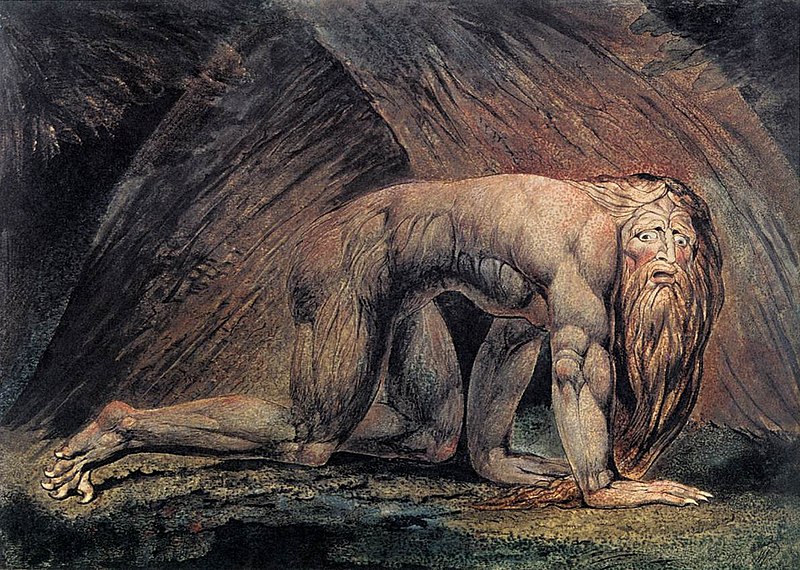
The picture of Nebuchadnezzar closely resembles the one in this plate:

From Wikimedia commons

This picture was a development from the Plate above and an illustration of the Book of Daniel.
[24] This is the interpretation, O king, and this is the decree of the most High, which is come upon my lord the king:
[25] That they shall drive thee from men, and thy dwelling shall be with the beasts of the field, and they shall make thee to eat grass as oxen, and they shall wet thee with the dew of heaven, " O king, and this is the decree of the most High, which is come upon my lord the king:

June Singer said "the kingdom of God - that is Imagination - is a gift of grace to be found in those men who have been chosen to receive it." (The Unholy Bible page 172)

Tuesday, November 27, 2012

BLAKE'S MESSAGE XI

June Singer offers us the insights of a Jungian psychoanalyst in her book The Unholy Bible, Blake, Jung and the Collective Unconscious. She recognises Blake's willingness to delve into the darker, more rejected aspects of the relationship of God and man. She explores the dissension man experiences internally as his psychological components struggle to gain dominance within the divided fallen individual. Singer believes that Blake demonstrated methods of bringing unconscious material into consciousness in order to integrate warring aspects into a cohesive whole.

Page 5

"But Blake's entire work might have been forgotten in the years after his death were it not for one poem in Songs of Experience in which the striking image achieved immediate popularity. Almost every English schoolchild knows it by heart, yet its implications stir the most sophisticated to ponder the mystery of the ultimate creative power."


The Tyger

Page 6
"The lasting and overwhelming response to this poem acknowledges the recognition of a central concept in Blake's work. This is the need to become aware of the other side of God, the side not accepted either by social agreement or by orthodox religious practice. Blake says that while he who made the Lamb is worshipped and praised  in all the churches, he who fashioned the Tyger to pierce the darkness of the tangled forest with his perceptive eye, is also God. God of the Lamb is worshipped at prescribed interval, but God of the Tyger is held in fear by day and night, for none may escape him when be pursues. Blake
wrote as though he felt that enough had been said about the symbol of gentleness which is traditionally associated with Jesus. He was more concerned with the fierce and the frightful which threatens innocence and light. And it follows that such a man would address himself boldly also to the darker area of man's life, which is hidden in shadow and must be invaded and explored if man is to approach any degree of self-awareness."   

Yale Center for British Art 
Book of Urizen
Plate 5, copy C
Page 9
 "Always there have been those who could experience these forces as tremendous powers which might threaten to overwhelm them at certain times and at other times infuse them with a creative urge which would drive them to produce original ideas, works of art or new scientific concepts. Blake was fascinated by this extra dimension of psychic life and he felt impelled to write how it manifested in him. Without the detachment of the modern psychologist, he wrote of his own experience more as a participant than as an observer and yet the raw material of the inner drama is all there...Our position enables us to take a step away from Blake and to consider his writing as descriptive of the psychological processes that were going on in him. This is not to imply that those processes are basically different in kind from those which are going on in every man. It is only that, acting on his naive conviction that what he wrote was dictated by an unseen voice and that his paintings were no more the reproductions of what the inner eye had already perceived, Blake threw a brilliant light into a realm that for most men is sheathed in the darkness of disbelief."         

Tuesday, May 17, 2011

DISPUTE OVER CHILD

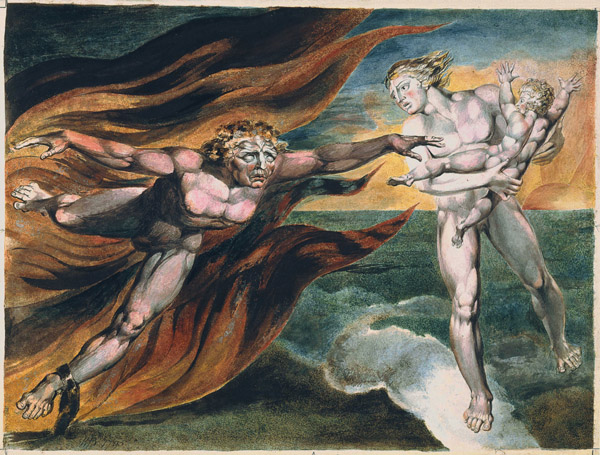
Blake first invented the image which became known as the 'Good and Evil Angels Struggling for Possession of a Child' as an illustration on Plate 4 of The Marriage of Heaven and Hell. The text presents two sets of contraries.

Marriage of Heaven & Hell, Plate, (E 34)
"The voice of the Devil

All Bibles or sacred codes. have been the causes of the
following Errors.
1. That Man has two real existing principles Viz: a Body & a
Soul.
2. That Energy. calld Evil. is alone from the Body. & that
Reason. calld Good. is alone from the Soul.
3. That God will torment Man in Eternity for following his
Energies.
But the following Contraries to these are True
1 Man has no Body distinct from his Soul for that calld Body is
a portion of Soul discernd by the five Senses. the chief inlets
of Soul in this age
2. Energy is the only life and is from the Body and Reason is
the bound or outward circumference of Energy.
3 Energy is Eternal Delight"

Contraries
Body...............Soul
Energy...........Reason
Evil.................Good

Blake used the same picture later as the basis for a watercolor painting and for an engraving reversing the positions of the figures. Here is the image from the Large Book of Designs.

If you are of the Devil's party the angel on the left is the good angel, if you favor conventional religion the angel on the right is the good angel. If you listen to Blake good and evil are contraries which can be resolved when they are seen in the light of Forgiveness and Brotherhood. Neither contrary is meant to claim possession of the child who represents their reconciliation. Each time Blake reproduced this image he modified it. In some the angel in flames is chained, in some he is blind. In some the angel in the light clings to the child, in some he releases it. In some the angels are both male, in some the sex is ambiguous. Blake found no way to present the tension between the contraries which encompassed all their dimensions. He gives us a variety of presentations so that we can resolve the tensions ourselves (and resolve the tensions within ourselves.)

Here are samples of comments on the picture.

Comment from the Tate Museum's Display Caption:
"In his annotations to a text by Lavater, Blake claimed that ‘Active Evil is better than Passive Good’, rendering the figures in this picture somewhat ambiguous. Perhaps the chain attached to the ‘evil’ angel’s ankle suggests the curtailing of energy by misguided rational thought?

In constructing his figures, Blake evokes conventional eighteenth century stereotypes. The heavy build and darker skin of the ‘evil’ angel suggest a non-European character, described by Lavater as ‘strong, muscular, agile; but dirty, indolent and trifling’, while the fair hair and light skin of the ‘good’ angel are consonant with ideas of physical – and intellectual – perfection."

From Inspiration of William Blake By Jah Wobble
"This painting conveys a strong sense of unreality, a form of artificiality reminiscent of simplistic childlike drama. William Blake informs me that there is a stage in the development of the human soul where we are handed over to the forces of darkness, often represented in his poetry by the state, church and family. This aspect can also be seen from the viewpoint of purely inner experience, dark primal instinct versus reason, the conscious versus the unconscious."

Terry Eagleton in The Guardian:
"Political states keep power by convincing us of our limitations.
They do so, too, by persuading us to be "moderate"; Blake, however, was not enamoured of the third way. The New Testament that Gordon Brown reads in his Presbyterian fashion as a model of prudence, conscience and sobriety, Blake read as a hymn to creative recklessness. He sees that Jesus's ethics are extravagant, hostile to the calculative spirit of the utilitarians. If they ask for your coat, give them your cloak; if they ask you to walk one mile, walk two. The road of excess leads to the palace of wisdom, and those who restrain their desires do so because their desires are feeble enough to be restrained."

June Singer in The Unholy Bible:
"The young child seen here is the newborn infant of Plate 3. He is Imagination, the treasured possession of the feminine spirit of energy. The anima, mistress of the soul, holds fast to her love-child, and keeps him out of reach of the masculine figure who represents Reason."

So, what does it mean to you?

Friday, August 13, 2010

ANGEL & DEVIL

Marriage of Heaven and Hell, Plate 22-24, (E 43)

"A Memorable Fancy

Once I saw a Devil in a flame of fire. who arose before an
Angel that sat on a cloud. and the Devil utterd these words.
The worship of God is. Honouring his gifts in other men
each according to his genius. and loving the greatest men
best, those who envy or calumniate great men hate God, for there
is no other God.
The Angel hearing this became almost blue but mastering
himself he grew yellow, & at last white pink & smiling, and then
replied,
Thou Idolater, is not God One? & is not he visible in Jesus
Christ? and has not Jesus Christ given his sanction to the law of
ten commandments and are not all other men fools, sinners, &
nothings?
The Devil answer'd; bray a fool in a morter with wheat. yet
shall not his folly be beaten out of him: if Jesus Christ is the
greatest man, you ought to love him in the greatest degree; now
hear how he has given his sanction to the law of ten
commandments: did he not mock at the sabbath, and so mock the
sabbaths God? murder those who were murderd because of him? turn
away the law from the woman taken in adultery? steal the labor of
others to support him? bear false witness when he omitted making
a defence before Pilate? covet when he pray'd for his disciples,
and when he bid them shake off the dust of their feet against
such as refused to lodge them? I tell you, no virtue can exist
without breaking these ten commandments: Jesus was all virtue,
and acted from impulse: not from rules.
When he had so spoken: I beheld the Angel who stretched out
his arms embracing the flame of fire & he was consumed and arose
as Elijah.

Note. This Angel, who is now become a Devil, is my
particular friend: we often read the Bible together in its
infernal or diabolical sense which the world shall have if they
behave well
I have also: The Bible of Hell: which the world shall have
whether they will or no.

One Law for the Lion & Ox is Oppression"

June Singer, in The Unholy Bible, has worked out some of the meanings in The Marriage of Heaven Hell. Singer has followed and scrutinized the struggle between the Angel and the Devil to reach the point where the contraries of reason and energy can accommodate one another allowing the most complete expression of the creative forces. I hope these quotes from her will help you to understand the reasoning she presents in explaining plates 22-24.

The dialog between the angel and the devil is drawing to its conclusion. The resolution of the conflict between the contraries of reason and energy will come to a climax on these plates. The resolution hinges on the idea that, "Except as man experiences God in his own life, God is incomprehensible to him."..."The angel is shocked and angered by the blasphemous words of the Devil. But in its very emotional reaction, the beginning of a transformation takes place."... " The Angel takes into himself some of that fierce, energetic force which must affect the status of his conventional belief. The Angel becomes "volatile," active and participating, and when he speaks out for the traditional morality supposedly sanctioned by Jesus, it is the last proud rallying cry in defense of a citadel which is already falling."..."In Jesus Christ as the fulfiller of the law and Jesus Christ the lawbreaker, a bridge is formed upon which two contraries, represented by Angel an Devil can approach one another. Out of their intimate confrontation arise the imagination and the vision which make it possible to relate reason and restraint to energy and desire.
The Angel accepts the fire and embraces it, and vision tells us the he is consumed and arises as Elijah." ..."Blake proposes that the two aspects of man, Devil and Angel, be joined together and that they participate in coming to new and revolutionary understandings. The Bible formerly the Angel's book, is not discarded; rather it is read in the diabolic - that is, the original poetic sense."...
Library of Congress
Marriage of Heaven and Hell 
Plate 4, Copy D

"The Protestant passion for the Bible as the possession of the individual, to be read finally by the inner light of each believers spirit, is Blake's most direct heritage from the radical elements in English religious tradition. Blake's "Bible of Hell," the sequence of his engraved poems, is the first of the great Romantic displacements of the Biblical revelation into the poetic world of the individual creator." (Quotes from pages 163-171)


Wednesday, August 11, 2010

REASON & DESIRE

In The Marriage of Heaven and Hell, Blake was exploring the nature of the contraries and the relationship between contraries. June Singer ( The Unholy Bible) explains Blake's writing of The Marriage of Heaven and Hell in terms of his desire to tap into the energy which he recognized in the Satan which Milton wrote about. The restraint which conventional rational thinking could place on the liberty with which Blake wanted to live, and the expressiveness with which he desired to write, was what he wanted to explore. By adopting the position of the Angel's contrary, the unrestrained, uninhibited outlaw - the Devil - he sought to access the source of energy which was unavailable to reason.

On Page 71 Singer states:
"Blake now proposes to follow Milton's Devil, that is, to pay attention to his own desire and permit the impersonal voice of that Devil to speak through him. With this commitment he enters upon the hero's quest, the night sea journey, the dark night of the soul, the voyage that has been called by many names but which all must travel if they are driven toward the goal of realizing their creative potentialities. It is the way of travail and hardship, where the traveler is exposed to the attacks and seductions of worldly and spiritual pleasures because he is open to everything he may perceive, to sights and voices and all the impressions of the senses, and even to extrasensory impressions...

"This section of the Marriage is a crucial one, for it comments upon the change of attitude which marks the creative man's departure from tradition and from the limiting bounds of Reason. To walk with Satan and his children, called Sin and Death, takes courage and an overwhelming necessity of desire. Those whose desire is weak enough to be restrained will never experience either the tortures or beatific visions which alternatively appear to the traveler on the way to individuation."

Marriage of Heaven and Hell, PLATE 4, (E 34)

"The voice of the Devil
All Bibles or sacred codes. have been the causes of the
following Errors.
1. That Man has two real existing principles Viz: a Body & a
Soul.
2. That Energy. calld Evil. is alone from the Body. & that
Reason. calld Good. is alone from the Soul.
3. That God will torment Man in Eternity for following his
Energies.
But the following Contraries to these are True
1 Man has no Body distinct from his Soul for that calld Body is
a portion of Soul discernd by the five Senses. the chief inlets
of Soul in this age
2. Energy is the only life and is from the Body and Reason is
the bound or outward circumference of Energy.
3 Energy is Eternal Delight

PLATE 5
Those who restrain desire, do so because theirs is weak enough
to be restrained; and the restrainer or reason usurps its place &
governs the unwilling.
And being restraind it by degrees becomes passive till it is
only the shadow of desire."

Other Posts based on Singer's work.

Complete Marriage of Heaven and Hell as online book on Wikisource.

Marriage of Heaven and Hell as a video on youtube by Ulver.

Saturday, August 07, 2010

UNHOLY BIBLE

Wikipedia Commons
Marriage of Heaven & Hell
Plate 3
Updated from August 2010.

June Singer, a Jungian psychologist, wrote several books on psychology but only one book on Blake. Her first book which developed from her thesis for her analysts diploma from the C. G. Jung Institute in Zurich, is titled The Unholy Bible: Blake, Jung and the Collective Unconscious. Although most of the book is a psychological analysis of The Marriage of Heaven and Hell, she provides insight into the later prophetic writings as well. In this passage she explains The Four Zoas in terms of individuation. The quote from Blake represents the reassembling of the pieces after 'all things are changd'.

"The long poem , The Four Zoas, describes the many aspects of man as they are differentiated from one another.The symbolism amazingly parallels the analytic process of differentiating the many unconscious contents from the other, and then gradually reintegrating them into a new and productive unity. The parallel is even more impressive when we consider that Blake uses the schema of nine nights of dreams, since dreams in analytical psychology provide the key to understanding the unconscious processes. It is with this key that Blake has unlocked 'the doors of perception' as he promised he would in The Marriage of Heaven and Hell. At the end of the ninth night man beholds the infinite vision, and he sings the Ode to Joy (we recall the first two lines, first uttered by the enslaved wives and children of America): [Four Zoas, Page 138, (E 406)]

'The Sun has left his blackness & has found a fresher morning
And the mild moon rejoices in the clear & cloudless night
And Man walks forth from midst of the fires the evil is all
consumd
His eyes behold the Angelic spheres arising night & day
The stars consumd like a lamp blown out & in their stead behold
The Expanding Eyes of Man behold the depths of wondrous worlds
One Earth one sea beneath nor Erring Globes wander but Stars
Of fire rise up nightly from the Ocean & one Sun
Each morning like a New born Man issues with songs & Joy
Calling the Plowman to his Labour & the Shepherd to his rest
He walks upon the Eternal Mountains raising his heavenly voice
Conversing with the Animal forms of wisdom night & day
That risen from the Sea of fire renewd walk oer the Earth

For Tharmas brought his flocks upon the hills & in the Vales
Around the Eternal Mans bright tent the little Children play
Among the wooly flocks The hammer of Urthona sounds
In the deep caves beneath his limbs renewd his Lions roar
Around the Furnaces & in Evening sport upon the plains
They raise their faces from the Earth conversing with the Man

How is it we have walkd thro fires & yet are not consumd
How is it that all things are changd even as in ancient times' " 


More from Singer (Page 214):
"It is as if though the writing of this book were a very private experience, like a dream that belonged to Blake alone. It was the working through of  the difficult union foretold in The Marriage of Heaven and Hell. An inner marriage was taking place in the psyche which was more real than his conventional with Catherine. As masculine creative force, his energy spurted forth abundantly. As feminine receptive vessel, his anima aspect functioned in his work to contain and shape that stream. 
'The cistern contains: the fountain overflows.' It was a secret happening, a pregnancy, which could not be shown prematurely to the public. This is why, I believe,  Blake never engraved this book. Murry [John Middleton] stated it well when he says , 'It is the travail of Blake' final rebirth. 

Friday, January 29, 2010

PERILOUS PATH

June Singer, in her book Seeing Through the Visible World, explores Blake's 'perilous path' in conjunction with Jung's individuation (although she doesn't doesn't mention that term). She associates the dangers of exploring deeper levels of consciousness with encountering the lonely and uncertain struggles of the 'just man'. The reversals of definitions and values which occur as we explore the hidden aspects of the psyche are reflected by the 'just man's' journey on the perilous path.
MHH, Plate 2, (E 33)

She further uses plate 17 of MHH to illuminate the threats in the
"struggles between the side of ego-consciousness and the lesser known shadow side, or in the conflict between inner opposites of the masculine and the feminine, or in the battle between oneself and the tribal gods with their repeated demands for fealty, devotion, and sacrifice."

Marriage of Heaven and Hell, Plate 17, (E 40)
"An Angel came to me and said. O pitiable foolish young man! O horrible! O dreadful state! consider the hot burning dungeon thou art preparing for thyself to all eternity, to which thou art going in such career.
I said. perhaps you will be willing to shew me my eternal lot & we will contemplate together upon it and see whether your lot or mine is most desirable
So he took me thro' a stable & thro' a church & down into the church vault at the end of which was a mill: thro' the mill we went, and came to a cave. down the winding cavern we groped our tedious way till a void boundless as a nether sky appeard beneath us & we held by the roots of trees and hung over this immensity; but I said, if you please we will commit ourselves to this void and see whether providence is here also, if you will not I will? but he answerd. do not presume O young-man but as we here remain behold thy lot which will soon appear when the darkness passes away
So I remaind with him sitting in the twisted root of an oak. he was suspended in a fungus which hung with the head downward into the deep:"

Blake gives an apt warning of the difficulty and danger of undertaking the alteration of the psyche which is initiated by choosing to explore the invisible world.

Which will we choose: the 'perilous path' or the 'paths of ease.'

In the Illuminated Blake, Erdman uses these words to describe this image; "A living form from the abyss".