Showing posts with label Blake archive. Show all posts

Tuesday, February 03, 2015

Blake and 'Church'


            Blake and 'Church'

     Here we look at the uses Blake made of the word 'church' in
his poetry.
                     
                                         i
Blake's Friends:

     To the best of our knowledge Blake belonged to no organized
church. We do know of two groups which might generically qualify
as churches, using the word in its broadest possible sense. The
first gathered around the radical publisher, Joseph Johnson, Blake's
primary employer and the friend of Mary Wollstonecraft, Joseph Priestly, Richard Price, Thomas Paine and other radical intellectuals. While the conventional church exists as a primary bulwark of the status quo, Joseph Johnson's group by and large conceived of Christ as a revolutionary. Dissenters of a variety of persuasions, they were united by their awareness of the need for social and political change. They considered this the primary agenda of any truly spiritual communion.

      Blake was in accord with these ideas. The Johnson group nurtured
him and provided the communal support which we generally associate with
church groups. The second group gathered around Blake in his last
decade. It was made up of young artists, some of them devout. They
looked to Blake for aesthetic and spiritual guidance and provided him
the communal support that lent grace to his last years.

      After Blake's Moment of Grace around 1800 he might have joined
a church if he could have found one whose primary doctrine was the
forgiveness of sins. But like Milton before him and Lincoln after him
he never discovered a church that met his qualifications.

      Anyone who loves Blake and has had a happier experience of the
church could wish
for him more in the way of community. Alienated from the worshiping
community by its partial theology and partial practice, he was
confined to his own visions and the nurture he could find at the
outer fringes of the church. In addition he learned from the
Christian classics of the ages, particularly the off beat ones. St.
Teresa was a favorite.

      We know little or nothing of the social agency by which the
Ranter tradition came down to him. All of these are elements of the
Universal Church upon which Blake drew and to which he belonged.
Blessed with a worshiping fellowship beyond that of his wife, his
lot might have been happier and his witness plainer to others.

      Even so the church is fortunate to have his contribution.
Isaiah and Jeremiah,not to mention Jesus, also suffered alienation
from their communities. At the deepest level none of the four men
rejected the  church, but rather the church rejected them. Blake
was too deeply attached to the priesthood of the believer to be able
to submit to any spiritual authority politically assigned: Let every
man be "King and Priest in his own house". In the words of Foster
Damon "The Church Universal was the only church that Blake recognized.
Its doctrine is the Everlasting Gospel, its congregation the Brotherhood of
Man, its symbol the Woman in the Wilderness, its architecture Gothic (p.82)."


Sunday, March 09, 2014

WELCOME

Updated post from October 12, 2012

Yale Center for British Art 

Portrait of William Blake 

engraved by Charles H. Jeens
This portrait of Blake from the Yale Center for British Art was engraved by Charles H. Jeens from a painting from life by Blake's friend John Linnell. The portrait was used as the frontispiece of The Life of William Blake by Alexander Gilchrist (pub. 1863).

 
We welcome your visit to our blog and invite you to spend some time with us. Although we try to share our understanding of Blake with our guests, we are most interested in making available to you the tools to study Blake independently. The links that are provided in almost every post connect you with sites, articles and individuals which have information and insight to share. We recommend books which have enriched our understanding of Blake: some of which you may read online, others which may be borrowed through your library's interlibrary loan system, or others may be purchased new or used through online services such as Better World Books.
 
The Complete Poetry and Prose of William Blake edited by David V Erdman is available as a html document which can be downloaded to your computer. The passages from Blake which we print are usually from this file and the page numbers (E xxx) refer to it.
 
The pictures we include come from many sources. The Blake Archive acts a repository for a large and increasing volume of Blake's images but restricts the use to viewing and linking only. We do not post pictures retrieved from the Blake Archive. Other institutions allow the use of their images since they are all long out of copyright. Many of our images come from the Library of Congress Rosenwald Collection. Both the British Museum and Yale University, which have large holdings, are sources of images we are allowed to post. Wikimedia Commons presents a wide variety of Blake images which we use freely. We have also used many images from a site called the Complete Works which is advertising copies of paintings for sale. A large number of institutions have Blake works which are rarely seen; some have been digitized and made available for copying. It is far more possible for the public to view and use Blake images now than it was just a few years ago.

 
Our blog now has over 1700 posts which are archived and sometimes indexed. The search box at top left of the blog allows you to search for specific terms of phrases (enclosed in quotes). Resources which may help your studies are linked in the sidebar and heading.

 
We hope you have found something here which you are looking for. The study and enjoyment of Blake offers many possibilities. We welcome suggestions on how to improve our blog and better meet the needs of our readers.

Friday, October 12, 2012

WELCOME

Songs of Innocence
The Echoing Green
British Museum

We welcome your visit to our blog and invite you to spend some time with us. Although we try to share our understanding of Blake with our guests, we are most interested in making available to you the tools to study Blake independently. The links that are provided in almost every post connect you with sites, articles and individuals which have information and insight to share. We recommend books which have enriched our understanding of Blake: some of which you may read online, others which may be borrowed through your library's interlibrary loan system, or others may be purchased new or used through online services such as Better World Books.

The Complete Poetry and Prose of William Blake edited by David V Erdman is available as a html document which can be downloaded to your computer. The passages from Blake which we print are usually from this file and the page numbers (E ___) refer to it.

The pictures we include come from many sources. The Blake Archive acts a repository for a large and increasing volume of Blake's images but restricts the use to viewing and linking only. We do not post pictures retrieved from the Blake Archive. Other institutions allow the use of their images since they are long out of copyright. Many of our images come from the Library of Congress Rosenwald Collection. Both the British Museum and Yale University, which have large holdings, are sources of images we are allowed to post. Wikimedia Commons presents a wide variety of Blake images which we use freely. We have also used many images from a site called the Complete Works which is advertising copies of paintings for sale. A large number of institutions have Blake works which are rarely seen; some have been digitized and made available for copying. It is far more possible for the public to view and use Blake images now than it was just a couple of years ago.

Our blog now has over 1200 posts which are archived and sometimes indexed. The search box at top left of the blog allows you to search for specific terms of phrases (enclosed in quotes). Resources which may help your studies are linked in the sidebar and heading.

We hope you have found something here which you are looking for. The study and enjoyment of Blake offers many possibilities. We welcome suggestions on how to improve our blog and better meet the needs of our readers.

Thursday, September 22, 2011

WELCOME

Songs of Innocence
The Echoing Green
British Museum

We welcome your visit to our blog and invite you to spend some time with us. Although we try to share our understanding of Blake with our guests, we are most interested in making available to you the tools to study Blake independently. The links that are provided in almost every post connect you with sites, articles and individuals which have information and insight to share. We recommend books which have enriched our understanding of Blake: some of which you may read online, others which may be borrowed through your library's interlibrary loan system, or others may be purchased new or used through online services such as Better World Books.

The Complete Poetry and Prose of William Blake edited by David V Erdman is available as a html document which can be downloaded to your computer. The passages from Blake which we print are usually from this file and the page numbers (E ___) refer to it.

The pictures we include come from many sources. The Blake Archive acts a repository for a large and increasing volume of Blake's images but restricts the use to viewing and linking only. We do not post pictures retrieved from the Blake Archive. Other institutions allow the use of their images since the are long out of copyright. Many of our images come from the Library of Congress Rosenwald Collection. Both the British Museum and Yale University, which have large holdings, are sources of images we are allowed to post. Wikimedia Commons presents a wide variety of Blake images which we use freely. We have also used many images from a site called the Complete Works which is advertising copies of paintings for sale. A large number of institutions have Blake works which are rarely seen; some have been digitized and made available for copying. It is far more possible for the public to view and use Blake images now than it was just a couple of years ago.

Our blog now has over 800 posts which are archived and sometimes indexed. The search box at top left of the blog allows you to search for specific terms of phrases (enclosed in quotes). Resources which may help your studies are linked in the sidebar and heading.

We hope you have found something here which you are looking for. The study and enjoyment of Blake offers many possibilities. We welcome suggestions on how to improve our blog and better meet the needs of our readers.

Saturday, January 01, 2011

ILLUSTRATING THE BIBLE

The Blake Archive has recently announced the addition of a series of Blake's paintings produced for Thomas Butts and identified as Paintings Illustrating the Bible. There are nineteen subjects for the Old and New Testaments.

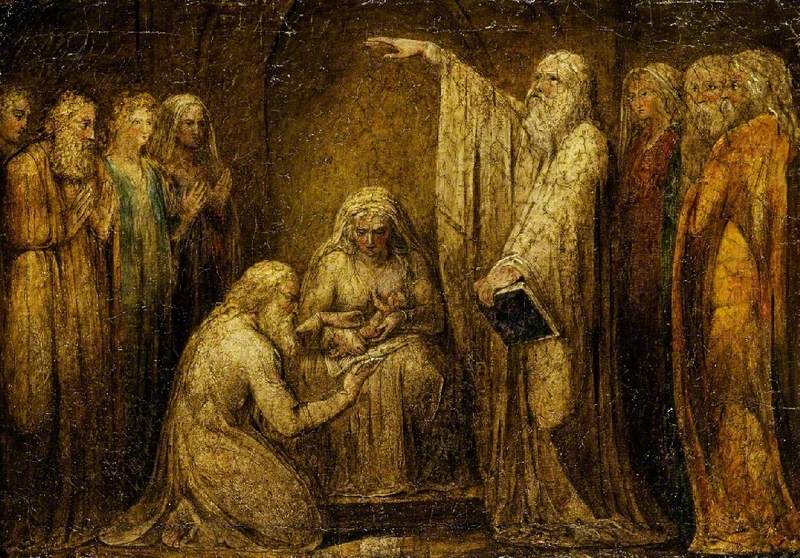
Luke 2:21,  And when eight days were accomplished for the circumcising of the child, his name was called JESUS, which was so named of the angel before he was conceived in the womb.

Fitzwilliam Museum
The Circumcision

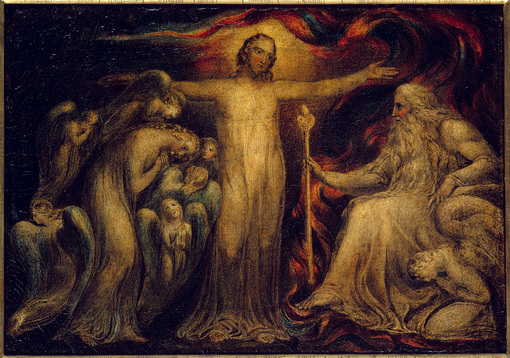
The final picture of the group in the Archive is particularly appealing : "Christ The Mediator": Christ Pleading Before the Father for St. Mary Magdalene. In this picture Blake portrays the theme of forgiveness. Christ acting as the advocate for the sinner intervenes with Jehovah on the part of Magdalene who was said to have been a harlot.

Mark 16
[9] Now when Jesus was risen early the first day of the week, he appeared first to Mary Magdalene, out of whom he had cast seven devils.

On this the eighth day after the celebration of the birth of Jesus (the first day of the new year), the day on which circumcision is performed according to the Law of Moses, it is appropriate to observe Christ intervening in the exercise of the Law before the Father on the part of the woman who both was forgiven and discovered the empty grave.

Wednesday, July 21, 2010

INTERPRETATIONS

To demonstrate how an individual can give different interpretations to Blake's illustrations at different times and in different circumstances, lets look at Plate 64 of Jerusalem.

In The Illuminated Blake (page 343), Erdman has this to say about the figure at the bottom of plate 64: "At the bottom this scroll of Natural Religion reaches the Rational Power, and the "Indefinite Spectre" Urizen, with fingers on book, checking with his index finger the message of the blots and blurs on the veil. At the top of the page: "The figure blindly writing the scroll, sleeping on it, yet with a sunburst (yellow against pink) of potential halo around her head is evidently Vala..."

In choosing the picture from Plate 64, as the illustration on the cover of The Complete Poetry and Poems of William Blake, Erdman sees the picture in a more personal manner:

"The design on our cover, constructed upon plate 64 of the Mellon copy of Jerusalem, was inspired by our editorial respect for the Committee on Scholarly Editions (CSE). The proofreader at the bottom with knuckles on text represents the five of us who, as required by the Committee "to prevent recontamination of the text," will have been "scrupulously and repeatedly" proofreading during the course of this book's production. Why that left hand held to shield the text from the light shining from the inspired (but nodding) author, with quill on scroll beautifully unfolding to constitute a New Heaven? Our attention must be upon what the author wrote, not upon our vision of his vision, even though we keep watching. That greater liberty is the reader's privilege."
The Complete Poetry and Prose of William Blake, page XXVII

It is a privilege to read the words of Blake as Erdman and his committee provided them the to us. The greater liberty of trying to discern Blake's vision through the text, we pursue as diligently as Erdman pursued his editing. Without the diligent and meticulous work of Erdman and his associstes, Blake's vision would not be so easily available to us.

Here is the Plate 64 image from the Blake Archive, which allows us to view the only color copy of Jerusalem in existence.

Monday, June 14, 2010

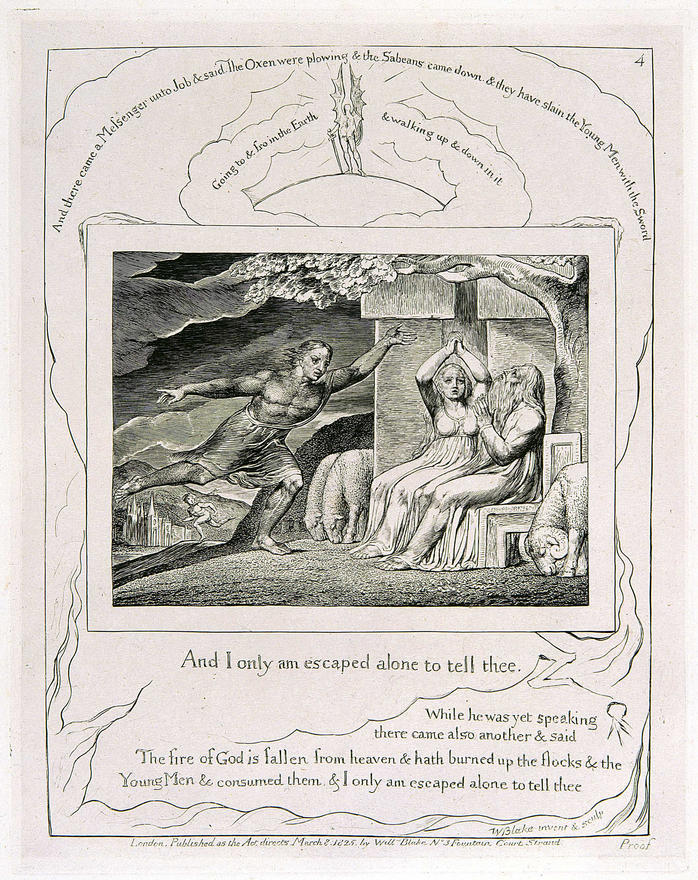
Job: Picture 4

This picture shows the arrival of the first of three messengers; Another one shows up in the background. They're coming from the cathedral area in the lower left corner of the picture; this suggests that the destruction envisioned here concerns the established religious values. The fact that we're finding so many religious people who have left the church today suggests that the Job scene is being reenacted right now. In Job's day the three 'friends' who came to comfort Job certainly represented conventional religious values.

Job and his wife are sitting under a megalithic shelter, which also enacts the primitive nature of Job's faith. More than once Blake referred to conventional religion as druidic.

Reading the text in the Bible- Job 1:
'8 Then the LORD said to Satan, "Have you considered my servant Job? There is no one on earth like him; he is blameless and upright, a man who fears God and shuns evil."
9 "Does Job fear God for nothing?" Satan replied.
10 "Have you not put a hedge around him and his household and everything he has? You have blessed the work of his hands, so that his flocks and herds are spread throughout the land.  
11 But stretch out your hand and strike everything he has, and he will surely curse you to your face."
12 The LORD said to Satan, "Very well, then, everything he has is in your hands, but on the man himself do not lay a finger."
Then Satan went out from the presence of the LORD.
13 One day when Job's sons and daughters were feasting and drinking wine at the oldest brother's house,
14 a messenger came to Job and said, "The oxen were plowing and the donkeys were grazing nearby,  
15 and the Sabeans attacked and carried them off. They put the servants to the sword, and I am the only one who has escaped to tell you!"
16 While he was still speaking, another messenger came and said, "The fire of God fell from the sky and burned up the sheep and the servants, and I am the only one who has escaped to tell you!"
17 While he was still speaking, another messenger came and said, "The Chaldeans formed three raiding parties and swept down on your camels and carried them off. They put the servants to the sword, and I am the only one who has escaped to tell you!"
18 While he was still speaking, yet another messenger came and said, "Your sons and daughters were feasting and drinking wine at the oldest brother's house,
19 when suddenly a mighty wind swept in from the desert and struck the four corners of the house. It collapsed on them and they are dead, and I am the only one who has escaped to tell you!"
20 At this, Job got up and tore his robe and shaved his head. Then he fell to the ground in worship 21 and said:
"Naked I came from my mother's womb,
and naked I will depart. The LORD gave and the LORD has taken away; may the name of the LORD be praised."
22 In all this, Job did not sin by charging God with wrongdoing."

Saturday, May 22, 2010

NIGHT THOUGHTS

During 1795 and 1796 William Blake spent a large part of his time preparing illustrations for a new edition of Edward Young's Night Thoughts a popular book which had been issued first in 1742. There were to be 4 new volumes published for which over 500 illustrations were needed. With impressive energy Blake produced watercolor designs at a fast pace.

In the book William Blake, by Hamlyn, Phillips, Ackroyd and Butler, we read that: "[Blake] gave emphasis to the poem as a Christian narrative by including numerous images of Jesus Christ; for example, at the beginning of the collected watercolor designs Blake added images of the Resurrection of Christ, a subject of minor interest in the poem."

An example of image of Christ: arm'd them with fierce flames. Click on Image to zoom.

The first volume with Blake's images was published in 1797 with 43 engravings which Blake made from his designs. These were to be the only images to be published since the publisher went out of business before additional volumes were issued. The 43 engraved plates of the published volume can be viewed in the Blake Archive.The watercolors which represented the bulk of the work and the labor of 2 years of Blake's life are in the British Museum and can be viewed online but it takes some patience.

For his work in producing 537 watercolor designs and 43 engravings Blake earned 20 guineas!

A recent publication values his work more highly:
The only full, colour facsimile ever published. Your chance to own this magnificent Limited Edition facsimile with 537 illustrations by William Blake. Last few copies remaining. Published price: US$ 1,975.00
The Folio Society Night Thoughts

Where I can find appropriate designs to accompany my posts, I will provide links to images in the British Museum.

Thursday, December 10, 2009

NATIVITY I


Blake in his characteristic way, sees the birth of Christ as part of a larger picture. The Bible, John Milton, the history of religion, cosmology, and his own myth; each play a role in Blake's response to Jesus' birthday.

"On the Morning of Christ's Nativity"

The Blake Archive provides this in its introduction to "On the Morning of Christ's Nativity:"

"Blake's interest in the 'Nativity Ode' began some years before his execution of these water colors. His illuminated book, Europe a Prophecy (1794), clearly shows the influence of Milton's ode. By 1809, Blake may have taken a renewed interest in the poem because of his increasingly Christocentric theological views. His harsh criticism of classical civilization resonates with two of the 'Nativity' designs, 'The Old Dragon' and 'The Overthrow of Apollo and the Pagan Gods' (objects 3 and 4). Modern critics have been hard pressed to find Blake dissenting from Milton's own iconography and perspectives in the ode."

Milton, Nativity Ode

From Europe a Prohecy (E61,2.12):
"Ah! I am drown'd in shady woe, and visionary joy.

And who shall bind the infinite with an eternal band?
To compass it with swaddling bands? and who shall cherish it
With milk and honey?
I see it smile & I roll inward & my voice is past.

She ceast & rolld her shady clouds
Into the secret place.

PLATE 3
A PROPHECY

The deep of winter came;
What time the secret child,
Descended thro' the orient gates of the eternal day:
War ceas'd, & all the troops like shadows fled to their abodes."

Monday, October 12, 2009

PICTURES ADDED

We have added pictures links to many of the older posts. These are not necessarily images which appear with the text quoted, but other of Blake's pictures which illustrate some aspect of the material treated in the post. Many of the links are to the Blake Archive but we also link to the Tate, the Huntington, other museums, and to a site called the Complete Blake.

Blake continued to produced watercolors, sketches, engravings and, temperas throughout his life. Much of his output is now in museum collections, and made available to the public through the internet. His poetry and pictures complement each other; they both focus our attention on his vision of the Infinite which he felt compelled to communicate.

To understand Blake it's best to read both the words and pictures.Jerusalem, Plate 40 Click on next link and then on the picture for Enlargement On the right margin of this image Erdman (in The Illuminated Blake) identifies the figures as Los and Enitharmon, but in their "mundane vehicles" as William and Catherine Blake. "Here he is walking in the line, which his right foot sends spiraling down to Catherine's arms and feet." Their exuberance in decorating this plate seems to come from these lines in the passage:
"But Glory to the Merciful One for he is of tender mercies!
And the Divine Family wept over him as One Man."

Friday, September 04, 2009

JOB: BLAKE'S PICTURES

Wikipedia Commons
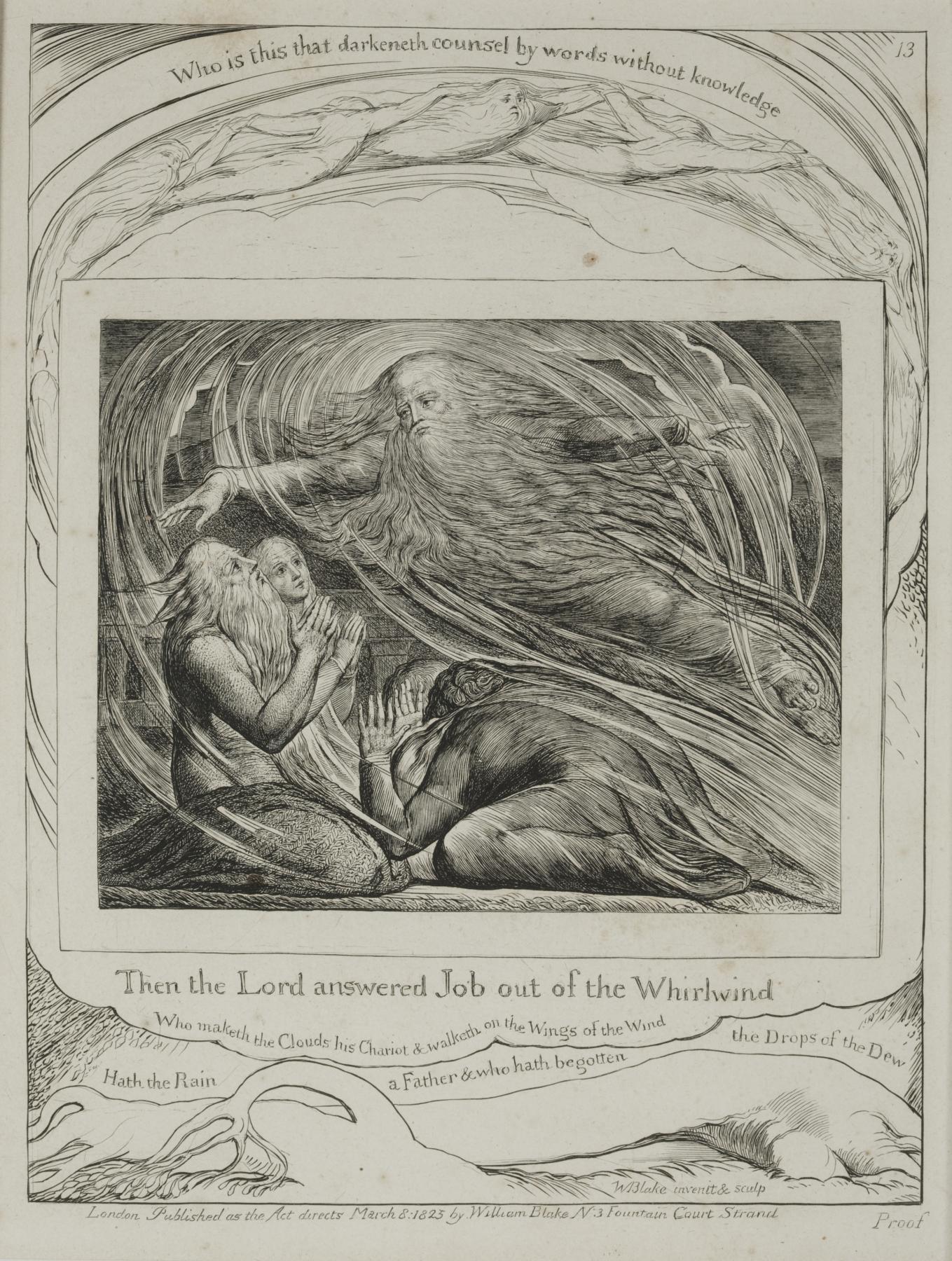
Illustrations of the Book of Job
Plate 13

If you enjoy looking at pictures as I do, you can introduce yourself to Blake's understanding of Job by looking at the pictures he made. There are two series in the Blake Archive. First the plates for his book ILLUSTRATIONS OF THE BOOK OF JOB, which are black and white engravings. The central picture is surrounded by snippets of text from the biblical Job or elsewhere, and decorative images with symbolic meaning. 

From one viewing you can get a flavor or the work, but study is required to learn more of what Blake wanted to convey of his vision.

Click on this link and page down to the illustrations and the text in Wikipedia. 

In the Blake Archive view the engraved Illustrations of the Book of Job.

In the Archive you will also find Blake's watercolors of the same scenes from Job which he produced for Thomas Butts. Absent are the symbolic borders, but present are the lovely colors. For aesthetic purposes these pictures are the most satisfying, but they convey less of Blake's understanding of Job. 

Enjoy!

Monday, August 24, 2009

Blake's Image of Saints in Dante

Toward the end of his life William Blake began a series
of illustrations for Dante's DIVINE COMEDY for his
patron and friend John Linnell. Blake left 102 of these
watercolor illustrations when he died: seventy-two for
the Inferno, twenty for the Purgatorio, and ten for the
Paradiso. Blake's designs are said to be not mere
illustrations but commentary on Dante's text.
(Martin Butlin)

One illustration for the Paradiso particularly caught my
attention.

In Martin Butlin's WILLIAM BLAKE, published by the
Tate, he makes these comments on the picture I noticed:
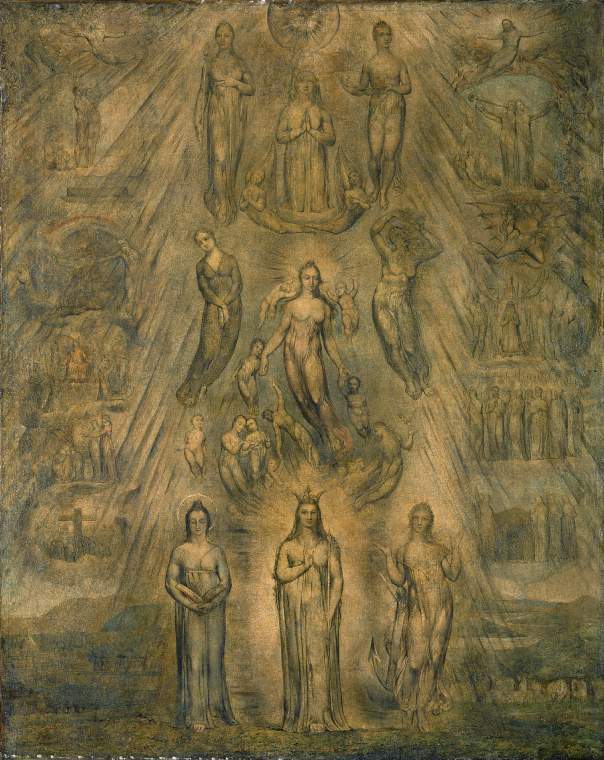
"Blake illustrates the successive appearances of
St. Peter, St. James and St. John. St. Peter, who
questions Dante on Faith, is represented by Blake's
type for Urizen; St. James, who questions Dante on
Hope, as Luvah; and St. John, who questions Dante on
Love, as Los or the Poetic Genius. Together they
represent Reason, Feeling and Imagination. The
overlapping of the three globes in which they are
shown, embracing Dante and Beatrice whose echoing
gestures reflect harmony, is a marvelously vivid image
of reunion of Man's various elements that is requisite
of true salvation."

Quite a summation of the Bible, Blake's myth, religion
and psychology!

The picture named 'St. Peter, St. James, Dante and
Beatrice with St. John also' can be found at:


Blake's image from Dante

In this picture it is fascinating to see how Blake
integrated Dante's poetry into his own visual
vocabulary.

Dante's three conversations with St. Peter, St. James
and St. John about faith, hope and love respectively
are amalgamated into one scene. Blake himself
wouldn't be left out of the creative process, so he gives
the three saints correspondence to three of his Zoas.
He skews the character of the Zoas to align them with
the saints .

Urizen is a pretty good fit with St. Peter since Blake has
identified Urizen with the fallen church consistently.
The association of Urizen with faith is perhaps by his
building a structure to try to make sense of being.
Peter's first recognition of Jesus as the Messiah is a
prime example of his faith. The identification of Peter
with Urizen is implied by his facial appearance which is
congruent with multiple images of Urizen as he is
associated with the vengeful God of the Old Testament,
and by the faint image of the scroll which Peter holds in
his left hand.

For a rare image of the Four Zoes together, see:

4z's in Book of Urizen

If Luvah is paired with St. James, it might be on the
basis of putting into practice the spiritual truth we
receive, which is emphasized in the New Testament
'Letter of James.' I don't know why hope would be
associated with either St. James or Luvah.

Los, the Eternal Prophet, pictured as the descending
Holy Spirit becomes in the picture, St. John, the author
of the Apocalypse or 'Book of Revelation.' Although it is
not the characteristic usually assigned to Los, love is
entirely appropriate to him in his role as the Poetic
Genius opening the world to imagination. St. John
exemplifies love as the author of the gospel stressing
unity among men, and between God and man.

In his characteristic way of making his figures
ambiguous or subject to multiple interpretations, Blake
may have been thinking of the lower central image of
Dante and Beatrice as Albion, (Humanity as realized in
the one Man) or as Tharmas the fourth of the Four
Zoas, who can be associated with the senses or the
physical body.

Better students than I, of Dante, Blake and the Bible
should be able to see much more in this picture than I do.