Showing posts with label Moravian. Show all posts

Friday, February 17, 2023

MORAVIAN MOTHER 7

 Wikipedia Commons
America
Frontispiece

When I posted on six different aspects of Blake's thought which are congruent with practices of the Moravian Church, I neglected to write on the attitude toward war. The Moravians were long known as a Peace Church although they have not always been completely committed to pacifism. Blake's attitude toward war evolved over time also. 

As a young man Blake was not opposed to the French Revolution or the American Revolution in principle. Later in life he expressed in his poem 'The Gray Monk' the idea that the violence of war could never accomplish the goals which the exercise of justice and mercy could. At the end of The Four Zoas when "The war of swords departed", the new age of science reigned for the pursuit of intellectual war. Blake knew that "the Religion of Jesus, Forgiveness of Sin, can never be the cause of a War."

When John Wesley traveled to the Colony of Georgia in 1736 he was a passenger on a ship with Moravians who like Wesley were  journeying as missionaries. Wesley made this observation of his fellow passengers:

"And every day had given them occasion of showing a meekness which no injury could move. If they were pushed, struck, or thrown down, they rose again and went away; but no complaint was found in their mouth. There was now an opportunity of trying whether they were delivered from the Spirit of fear, as well as from that of pride, anger, and revenge." 

This is testimony to the spirit of pacifism exhibited by Moravians during the lifetime of Blake's mother. William would have learned from his mother that one need not react against attacks if one were guided by mercy, peace and love within.  

On The Flaming Heretic blog Craig D. Atwood wrote of the history of Moravian pacifism: 

"The Brotherly Agreement they signed in 1727 stipulated that they would seek to live in peace with all people. Disputes were to be settled through conversation rather than violence."

"Some of the younger Moravians in Pennsylvania and North Carolina did enlist in the revolutionary army and were allowed to rejoin the church after the war."

"For four hundred years the Moravian Church maintained a fairly consistent peace witness, but this was largely forgotten during the titanic conflicts of the past two centuries." 

Read of the first Fourth of July celebration. 

Songs and Ballads, (E 478) 
 "Morning

To find the western path
Right thro the gates of Wrath
I urge my way
Sweet Mercy leads me on
With soft repentant moan         
I see the break of day

The war of swords & spears
Melted by dewy tears
Exhales on high
The Sun is freed from fears     
And with soft grateful tears
Ascends the sky." 
Songs and Ballads, (E 489)
  "The Grey Monk 
I die I die the Mother said
My Children die for lack of Bread               
What more has the merciless Tyrant said
The Monk sat down on the Stony Bed              

The blood red ran from the Grey Monks side 
His hands & feet were wounded wide
His Body bent his arms & knees
Like to the roots of ancient trees

His eye was dry no tear could flow
A hollow groan first spoke his woe 
He trembled & shudderd upon the Bed             
At length with a feeble cry he said

When God commanded this hand to write
In the studious hours of deep midnight
He told me the writing I wrote should prove     
The Bane of all that on Earth I lovd            

My Brother starvd between two Walls
His Childrens Cry my Soul appalls
I mockd at the wrack & griding chain            
My bent body mocks their torturing pain         

Thy Father drew his sword in the North
With his thousands strong he marched forth      
Thy Brother has armd himself in Steel           
To avenge the wrongs thy Children feel          

But vain the Sword & vain the Bow 
They never can work Wars overthrow
The Hermits Prayer & the Widows tear
Alone can free the World from fear

For a Tear is an Intellectual Thing      
And a Sigh is the Sword of an Angel King 
And the bitter groan of the Martyrs woe    
Is an Arrow from the Almighties Bow

The hand of Vengeance found the Bed        
To which the Purple Tyrant fled
The iron hand crushd the Tyrants head 
And became a Tyrant in his stead"           
Milton, Plate 1, (E 95)
"I will not cease from Mental Fight,
     Nor shall my Sword sleep in my hand
     Till we have built Jerusalem,                     
     In Englands green & pleasant Land."  
Jerusalem, Plate 52, (E 201) 
 "But you also charge the poor Monks & Religious with being the
causes of War: while you acquit & flatter the Alexanders &
Caesars, the Lewis's & Fredericks: who alone are its causes & its
actors.  But the Religion of Jesus, Forgiveness of Sin, can never
be the cause of a War nor of a single Martyrdom.
  Those who Martyr others or who cause War are Deists, but never
can be Forgivers of Sin.  The Glory of Christianity is, To
Conquer by Forgiveness.  All the Destruction therefore, in
Christian Europe has arisen from Deism, which is Natural
Religion.                          

  I saw a Monk of Charlemaine                       
Arise before my sight 
  I talkd with the Grey Monk as we stood            
In beams of infernal light

  Gibbon arose with a lash of steel                 
And Voltaire with a wracking wheel
  The Schools in clouds of learning rolld           
Arose with War in iron & gold.

  Thou lazy Monk they sound afar                    
In vain condemning glorious War                     
  And in your Cell you shall ever dwell             
Rise War & bind him in his Cell.

  The blood. red ran from the Grey Monks side
His hands & feet were wounded wide
  His body bent, his arms & knees          
Like to the roots of ancient trees

  When Satan first the black bow bent
And the Moral Law from the Gospel rent
  He forgd the Law into a Sword
And spilld the blood of mercys Lord.
     
  Titus! Constantine!  Charlemaine!                 
O Voltaire! Rousseau! Gibbon! Vain
  Your Grecian Mocks & Roman Sword                  
Against this image of his Lord!

  For a Tear is an Intellectual thing;               
And a Sigh is the Sword of an Angel King
  And the bitter groan of a Martyrs woe              
Is an Arrow from the Almighties Bow!"
Jerusalem, Plate 65, (E 216)
"Then left the Sons of Urizen the plow & harrow, the loom
The hammer & the chisel, & the rule & compasses; from London fleeing
They forg'd the sword on Cheviot, the chariot of war & the battle-ax,
The trumpet fitted to mortal battle, & the flute of summer in Annandale
And all the Arts of Life. they changd into the Arts of Death in Albion.
The hour-glass contemnd because its simple workmanship.
Was like the workmanship of the plowman, & the water wheel,
That raises water into cisterns: broken & burnd with fire:
Because its workmanship. was like the workmanship of the shepherd. 
And in their stead, intricate wheels invented, wheel without wheel:
To perplex youth in their outgoings, & to bind to labours in Albion
Of day & night the myriads of eternity that they may grind
And polish brass & iron hour after hour laborious task!
Kept ignorant of its use, that they might spend the days of wisdom
In sorrowful drudgery, to obtain a scanty pittance of bread:
In ignorance to view a small portion & think that All,
And call it Demonstration: blind to all the simple rules of life.

Now: now the battle rages round thy tender limbs O Vala
Now smile among thy bitter tears: now put on all thy beauty      
Is not the wound of the sword sweet! & the broken bone delightful?
Wilt thou now smile among the scythes when the wounded groan in the field?
We were carried away in thousands from London; & in tens
Of thousands from Westminster & Marybone in ships closd up:
Chaind hand & foot, compelld to fight under the iron whips       
Of our captains; fearing our officers more than the enemy."

Four Zoas, Night IX, Page 139, (E 407)

"Urthona is arisen in his strength no longer now
Divided from Enitharmon no longer the Spectre Los                
Where is the Spectre of Prophecy where the delusive Phantom
Departed & Urthona rises from the ruinous walls
In all his ancient strength to form the golden armour of science
For intellectual War The war of swords departed now
The dark Religions are departed & sweet Science reigns           

                  End of The Dream" 
 
MORAVIAN MOTHER         

Friday, March 11, 2022

MORAVIAN MOTHER 6

Wikipedia Commons
Illustrations to Blair's The Grave
The Soul Hovering over the Body

It took me a long time to realize how much William Blake's attitude toward death had been shaped by his mother's Moravian connection. William Blake must have learned early that the end of physical life is a stage on the journey of the the soul to his eternal home. His mother had lost her first husband while they were both members of the Moravian Meeting in Fetters Lane. Her first husband Thomas Armitage died in 1751, the first year that the Moravians buried members in God's Acre in London. The term God's Acre was chosen to indicate the continuity of the congregation where those who were called home were buried using identical flat stones marking the location. Burials were not in biological family groups but with others of the same gender and marital status indicating that their primary loyalty was to the continuing life of the community of believers.

In 1787 William lost his beloved younger brother Robert to tuberculous, the same disease which had taken his mother's first husband. Robert died at age nineteen representing an enormous loss to his brother. However William was able to continue his relationship with Robert on a spiritual level. Because William's spiritual sensation was acute he continued to converse with his brother, receive advice and instruction from him and enjoy the feeling that Robert's 'Mortal loss' was 'Immortal Gain.'

Being conscious that there is a physical world and a spiritual world, also that there is a physical life and a spiritual life, enables one to distinguish between the body which is transient and the spirit which continues after the body ceases to support physical life. Among Moravians exit from the physical world by the Immortal Spirit is thought of as a home-going, as the return of the soul to its Eternal Home.

Here are a few quotes from Adelaide Fries's book The Road to Salem, an account to the settlement of the Moravians in North Carolina.

"I had long since learned not to use the word 'death' in connection with the departure of one of our members, that term being reserved for cases of outsiders of whose spiritual condition the Brethern knew little or too much." Page 158

"On  August 29th a messenger came to Friedland telling us that a little before ten o'clock in the morning his soul had gone home, leaving his mortal remains to rest in peace." Page 263

 "Once he whispered, 'O Thou, dear Savior,' but about seven o'clock he quietly and blessedly fell asleep. He had spoken of the beauty of a quick home-going, and it was granted to him." Page 266

Anna Catharina (Antes) Ernst, on whose diary The Road to Salem is based, wrote this after the death of her beloved first husband who was the community doctor:

"No light pierced my gloom until one day when the Lord sent a friend to show me a poem which had been written by our surveyor, Christian Reuter, as he was recovering from a serious attack of the dread fever. The lines set forth a dream he had had, in which two angels stood beside his bed, but passed him by because he was not yet ripe for the heavenly harvest; and a second dream in which he saw the Lord looking down upon sorely tried Bethabara, and heard Him say:

'This hundred-thousand-acre field
Now truly consecrate shall be,
Therefore the angel reapers come
And bear the first fruits home to me
.'

So that was what God's Acre meant! Not a place of burial, not even a measure of land consecrated to God, but a field in which the bodies of believers were laid awaiting the glories of the resurrection! I knew that, of course, but I had never realized what it could mean to one whose best beloved lay there. How sweet it was to think of my Martin, one of the pioneers in this hundred-thousand-acre field that we call Wachovia, now one of the first-fruits standing in that glorious presence, his labors accepted, his soul ripe for the harvest. Humbly I accepted the comfort which the Saviour gave me, and the last lines of Brother Reuter's poem became my prayer:

'Lord Jesus Christ,
Thou art so true,
Thou art so merciful to all,
I pray for grace Thy will to do,
To trust Thy love whate'er befall.'


It is no wonder that the Moravian influence can be seen is the poetry Blake wrote when he was young. This poem is from Poetical Sketches the book of his youthful poems published by his friends in 1783. The poems were written between his twelveth and twenty-first years. The dying young man in the poem, after meditating on his own sinfullness, receives a vision of his soul joyfully entering eternity. Later when his younger brother Robert died, William is reported to have seen his brother's 'released spirit ascend heavenward.'

Poetical Sketches, THE COUCH OF DEATH, (E 440-441)
"if I lift up
my head, sin covers me as a cloak! O my dear friends, pray ye for
me! Stretch forth your hands, that my helper may come! Through
the void space I walk between the sinful world and eternity! 
...
The youth lay silent--his mother's arm was
under his head; he was like a cloud tossed by the winds, till the
sun shine, and the drops of rain glisten, the yellow harvest
breathes, and the thankful eyes of the villagers are turned up in
smiles.  The traveller that hath taken shelter under an oak, eyes
the distant country with joy!  Such smiles were seen upon the
face of the youth! a visionary hand wiped away his tears, and a
ray of light beamed around his head!  All was still.  The moon
hung not out her lamp, and the stars faintly glimmered in the
summer sky; the breath of night slept among the leaves of the
forest; the bosom of the lofty hill drank in the silent dew,
while on his majestic brow the voice of Angels is heard, and
stringed sounds ride upon the wings of night.  The sorrowful pair
lift up their heads, hovering Angels are around them, voices of
comfort are heard over the Couch of Death, and the youth breathes
out his soul with joy into eternity." 

In his own voice Blake revealed his attitude toward death when he wrote letters to his dearest friends.

Letters, To Hayley, (E 705)

"Thirteen years ago.  I lost a
brother & with his spirit I  converse daily & hourly in the
Spirit.  & See him in my remembrance in the  regions of my
Imagination.  I hear his advice & even now write from his
Dictate--Forgive me for expressing to you my Enthusiasm which I
wish all to  partake of Since it is to me a Source of Immortal
Joy even in this world by it  I am the companion of Angels.  May
you continue to be so more & more & to  be more & more perswaded. 
that every Mortal loss is an Immortal Gain.  The  Ruins of Time
builds Mansions in Eternity."
Letters, To Linnell, (E 774)
"I verily believe it Every Death is an improvement of the State of
the Departed."
Letters, To Cumberland. (E 783) 
 "I have been very near the Gates of Death & have returned
very weak & an Old Man feeble & tottering, but not in Spirit &
Life not in The Real Man The Imagination which Liveth for Ever.
In that I am stronger & stronger as this Foolish Body decays." 
 Letters, To Linnell, (E 784)
    "Flaxman is Gone & we must All soon follow every one to his
Own Eternal House Leaving the Delusive Goddess Nature & her Laws
to get into Freedom from all Law of the Members into The Mind in
which every one is King & Priest in his own House  God Send it so
on Earth as it is in Heaven"
Gates of Paradise, The Keys of the Gates, (E 269) 
"13 But when once I did descry
      The Immortal Man that cannot Die
14 Thro evening shades I haste away
     To close the Labours of my Day"


Gospel of John (Phillips Translation)

12:23-26 - Jesus told them, "The time has come for the Son of Man to be glorified. I tell you truly that unless a grain of wheat falls into the earth and dies, it remains a single grain of wheat; but if it does, it brings a good harvest. The man who loves his own life will destroy it, and the man who hates his life in this world will preserve it for eternal life. If a man wants to enter my service, he must follow my way; and where I am, my servant will also be. And my Father will honour every man who enters my service.


Thursday, February 24, 2022

MORAVIAN MOTHER 5

Wikipedia Commons
Joseph of Arimathea preaching to the inhabitants of Britain
 
 Luke 24 (Phillips Translation) 
45-47 - Then he opened their minds so that they could understand the scriptures, and added, "That is how it was written, and that is why it was inevitable that Christ should suffer, and rise from the dead on the third day. So must the change of heart which leads to the forgiveness of sins be proclaimed in his name to all nations, beginning at Jerusalem."


Blake's mother was surely aware of the missionary activities of the Moravians who aimed to bring the Gospel to people in far flung locations. They experienced the joy and satisfaction of living in community under the guidance of the spirit and wanted to share it.

"They sent out the first missionaries when there were only 300 inhabitants in Herrnhut. Within 30 years, the church sent hundreds of Christian missionaries to many parts of the world, including the Caribbean, North and South America , the Arctic, Africa, and the Far East."

Arthur Freeman wrote this for the Center for Moravian Studies:

"A third mark of the Gemeine was mission. Christ had given his church a mission. Each one of the Gospels concludes with some equivalent of a commissioning of his disciples. In John Jesus sends his disciples as his Father had sent him (e.g. John 17:18). Both the life and activity of the Gemeine carry out this mission.Its life expresses the very relationship which Christ calls the church to facilitate for others and which gives those exploring the Gospel an experiential referent. In I John 1:3 others were invited into the fellowship with the Father and the Son which constitutes the life and fellowship of the community.

Hence for Moravians a crucial step in mission was always the planting of a Gemeine where the life with Christ was lived out and could be experienced by others. The mission as action was going where Christ would have the Gemeine go, keeping in mind that mission and evangelism was God’s business. One had to discern, follow, and participate in what God was doing. What then began as preaching excursions into areas surrounding Herrnhut, following the spiritual experience of 1727, in a few years brought Moravians to the West Indies and North America and then to many other parts of the world to “win souls for the Lamb.” Within ten years Moravians had gone also to Greenland, Surinam, South Africa, the Gold Coast, Algeria, Arctic Russia, and Ceylon."

From the beginning to the end of his career Blake saw that the nations of the world were one people joined by one spirit which spoke to all according to their various means of reception. Albion was Blake's symbol for undivided mankind. All nations were contained and expressed by Albion or by the 'Poetic Genius' as stated in Blake's earliest Illuminated Book. 

ALL RELIGIONS are ONE (E 1)

"PRINCIPLE. 5. The Religions of all Nations are derived from
each Nations different reception of the Poetic Genius which is
every where call'd the Spirit of Prophecy."

Blake's prophetic message was taken from the book of Numbers and quoted on the first plate of Milton. Damon tells us that prophets do not predict the future but reveal Eternal Truths. To spread such truth to all nations Blake accepted as his mission 'awaking to Eternal Life' all those who sleep in the 'land of shadows.'

Milton, Plate 1, (E 95)
 "I will not cease from Mental Fight,
     Nor shall my Sword sleep in my hand:
     Till we have built Jerusalem,                     
     In Englands green & pleasant Land.

Would to God that all the Lords people were Prophets.
                                        Numbers XI. ch 29 v."

Jerusalem, Plate 4, (E 146)
"Of the Sleep of Ulro! and of the passage through
Eternal Death! and of the awaking to Eternal Life.

This theme calls me in sleep night after night, & ev'ry morn
Awakes me at sun-rise, then I see the Saviour over me
Spreading his beams of love, & dictating the words of this mild song.  

Awake! awake O sleeper of the land of shadows, wake! expand!
I am in you and you in me, mutual in love divine:"

Blake is specific in naming nations to make it clear that Albion is inclusive and that his prophetic words are appropriate for everyone, everywhere.

Milton, Plate 31 [34],(E130)
"And all Nations wept in affliction Family by Family
Germany wept towards France & Italy: England wept & trembled
Towards America: India rose up from his golden bed:
As one awakend in the night: they saw the Lord coming            
In the Clouds of Ololon with Power & Great Glory!"

Jerusalem, Plate 24, (E 170)
"Thy Sons came to Jerusalem with gifts, she sent them away
With blessings on their hands & on their feet, blessings of gold,
And pearl & diamond: thy Daughters sang in her Courts:           
They came up to Jerusalem; they walked before Albion
In the Exchanges of London every Nation walkd
And London walkd in every Nation mutual in love & harmony
Albion coverd the whole Earth, England encompassd the Nations,
Mutual each within others bosom in Visions of Regeneration;      
Jerusalem coverd the Atlantic Mountains & the Erythrean,
From bright Japan & China to Hesperia France & England.
Mount Zion lifted his head in every Nation under heaven:
And the Mount of Olives was beheld over the whole Earth:
The footsteps of the Lamb of God were there: but now no more     
No more shall I behold him, he is closd in Luvahs Sepulcher."

Jerusalem, Plate 72, (E 227)
"These are the Land of Erin

All these Center in London & in Golgonooza. from whence
They are Created continually East & West & North & South
And from them are Created all the Nations of the Earth           
Europe & Asia & Africa & America, in fury Fourfold! 
[Legend on image] 
Continually Building. Continually Decaying because of
Love & Jealousy

And Thirty-two the Nations: to dwell in Jerusalems Gates
O Come ye Nations Come ye People Come up to Jerusalem
Return Jerusalem & dwell together as of old! Return
Return! O Albion let Jerusalem overspread all Nations            
As in the times of old! O Albion awake! Reuben wanders
The Nations wait for Jerusalem. they look up for the Bride

France Spain Italy Germany Poland Russia Sweden Turkey
Arabia Palestine Persia Hindostan China Tartary Siberia
Egypt Lybia Ethiopia Guinea Caffraria Negroland Morocco          
Congo Zaara Canada Greenland Carolina Mexico
Peru Patagonia Amazonia Brazil. Thirty-two Nations
And under these Thirty-two Classes of Islands in the Ocean
All the Nations Peoples & Tongues throughout all the Earth

And the Four Gates of Los surround the Universe Within and       
Without; & whatever is visible in the Vegetable Earth, the same
Is visible in the Mundane Shell; reversd in mountain & vale"

Jerusalem, Plate 97, (E 256)
"Awake! Awake Jerusalem! O lovely Emanation of Albion
Awake and overspread all Nations as in Ancient Time
For lo! the Night of Death is past and the Eternal Day
Appears upon our Hills: Awake Jerusalem, and come away

So spake the Vision of Albion & in him so spake in my hearing   
The Universal Father. Then Albion stretchd his hand into Infinitude."

Inscriptions, (E 671)                  
     "Albion rose from where he labourd at the Mill with Slaves
     Giving himself for the Nations he danc'd the dance of Eternal Death"
  

Revelation 22
[1] And he shewed me a pure river of water of life, clear as crystal, proceeding out of the throne of God and of the Lamb.
[2] In the midst of the street of it, and on either side of the river, was there the tree of life, which bare twelve manner of fruits, and yielded her fruit every month: and the leaves of the tree were for the healing of the nations.
[3] And there shall be no more curse: but the throne of God and of the Lamb shall be in it; and his servants shall serve him:
[4] And they shall see his face; and his name shall be in their foreheads.
[5] And there shall be no night there; and they need no candle, neither light of the sun; for the Lord God giveth them light: and they shall reign for ever and ever.
 

Saturday, February 19, 2022

MORAVIAN MOTHER 4

Library of Congress
Book of Urizen
Copy G, Plate 21


Symbolically the words heart and love are used as synonyms. In this passage from Road to Salem by Adelaide Fries we see how the Moravians equated the love within Christ with the love within the heart of mankind. William Blake may have grown up with the understanding that within our hearts is that love given by God but unless it is kept alive by faith and practice it may sleep unexpressed. 

From Road to Salem:

"It quoted the address which Brother von Watteville then made to the children, in which he 'spoke of the inexpressible blessedness which came through the birth of Christ,' spoke also of the 'flame of love' which burned in the heart of Christ, leading Him to give himself for the redemption of the world, which should kindle an answering flame in the heart of every child who heard the story. He told them that each child was about to receive a lighted wax taper, tied with a small red ribbon, to remind them all of what he had just explained to them; and the account in the old church paper even gave the verse he sang for them:

'Oh little Jesus, Thee I love!
Kindle a pure and holy flame
Within the heart of every child
Like that which from Thine own heart came.'" (Page 132) 
 
Songs of Innocence (E 9)
"Little Black Boy
And we are put on earth a little space,
That we may learn to bear the beams of love,
And these black bodies and this sun-burnt face      
Is but a cloud, and like a shady grove.
SONGS 10  
For when our souls have learn'd the heat to bear
The cloud will vanish we shall hear his voice.
Saying: come out from the grove my love & care,
And round my golden tent like lambs rejoice." 

Blake personified in the Zoa Luvah as the emotional nature of man. In its unfallen state it was uncontaminated by the distortions which characterize love's expression on our world. Blake looked at the dynamics of the Four Zoas to show ways in which each perfect state had become destructive rather than productive. Much of what Blake said about Luvah were expressions of his condition in the fallen world. In his poem William Bond, Blake recognized how love should be sought in the fallen world in which we live. The world of sorrow and darkness is the same world which moved the heart of the Christ to suffer for the redemption of the world. 

Songs and Ballads, William Bond, (E 497)
"I thought Love livd in the hot sun Shine                 
But O he lives in the Moony light
I thought to find Love in the heat of day
But sweet Love is the Comforter of Night

Seek Love in the Pity of others Woe
In the gentle relief of anothers care               
In the darkness of night & the winters snow
In the naked & outcast Seek Love there"


Blake used Jerusalem, the Emanation of Albion, the Eternal man, to represent the unfallen condition which gave access to the total love of the Eternal which was universally available. But access to the spiritual dimension is also provided in this world. Man is capable of passing through the gates to heaven when he recognizes them and accepts the invitation. There are however obstructions which the individual must clear away before the way is open. 
Jerusalem, Plate 24, (E 170)
"Yet thou wast lovely as the summer cloud upon my hills
When Jerusalem was thy hearts desire in times of youth & love."

Milton, Plate 5, (E 98)
"And this is the manner of the Daughters of Albion in their beauty
Every one is threefold in Head & Heart & Reins, & every one
Has three Gates into the Three Heavens of Beulah which shine
Translucent in their Foreheads & their Bosoms & their Loins
Surrounded with fires unapproachable: but whom they please
They take up into their Heavens in intoxicating delight"

Jerusalem, Plate 9, (E 152)
"I took the sighs & tears, & bitter groans:
I lifted them into my Furnaces; to form the spiritual sword.
That lays open the hidden heart: "

The Moravian religion is said to be a Heart Religion since the relationship with the Savior, to them, is first experienced through the heart. Understanding of the Christ comes from the head and develops after the love from God is experience by the heart. 


"The theological understanding of the Ancient Moravian Church was particularly formed by its dividing all theological and ecclesial matters into essentials, ministerials and incidentals. For it the essential was the relationship with the Triune God expressed in the three-fold response of faith, love and hope. In the Zinzendorfian period we have the emphasis on basic truths or fundamentals, and Heart Religion (the heart relationship with the Savior) -- somewhat equivalent to the essential of the Ancient Church. This is a very explicit theology, though it is not a systematic theology. Zinzendorf, for example, did not write a systematic theology because he theologically believed that it was not possible -- one cannot know and express God that way."

Jerusalem, Plate 86, (E 244)
"I see thy Form O lovely mild Jerusalem, Wingd with Six Wings
In the opacous Bosom of the Sleeper, lovely Three-fold
In Head & Heart & Reins, three Universes of love & beauty"


Zinzendorf's refusal to formulate a systematic theology parallels Blake's using symbolic language to express in his poetry and designs the truth which he could not express in prosaic or scientific language. The struggle between Luvah and Urizen demonstrated the division between the heart and head which he experienced internally and which plagued the Age of Enlightenment in which he lived.  

Jerusalem, Plate 52, (E 201)
"Your Religion O Deists: Deism, is the Worship of the God
of this World by the means of what you call Natural Religion and
Natural Philosophy, and of Natural Morality or
Self-Righteousness, the Selfish Virtues of the Natural Heart. 
This was the Religion of the Pharisees who murderd Jesus.  Deism
is the same & ends in the same.
 Voltaire Rousseau Gibbon Hume. charge the Spiritually Religious
with Hypocrisy! but how a Monk or a Methodist either, can be a
Hypocrite: I cannot concieve.  We are Men of like passions with
others & pretend not to be holier than others: therefore, when a
Religious Man falls into Sin, he ought not to be calld a
Hypocrite: this title is more properly to be given to a Player
who falls into Sin; whose profession is Virtue & Morality & the
making Men Self-Righteous.  Foote in calling Whitefield,
Hypocrite: was himself one: for Whitefield pretended not to be
holier than others: but confessed his Sins before all the World;
Voltaire! Rousseau! You cannot escape my charge that you are
Pharisees & Hypocrites, for you are constantly talking of the
Virtues of the Human Heart, and particularly of your own, that
you may accuse others & especially the Religious, whose errors,
you by this display of pretended Virtue, chiefly design to
expose.

Jerusalem, Plate 98
"And the Bow is a Male & Female & the Quiver of the Arrows of Love,
Are the Children of this Bow: a Bow of Mercy & Loving-kindness: laying
Open the hidden Heart in Wars of mutual Benevolence Wars of Love
And the Hand of Man grasps firm between the Male & Female Loves  
And he Clothed himself in Bow & Arrows in awful state Fourfold
In the midst of his Twenty-eight Cities each with his Bow breathing"

Four Zoas, Night V, Page 62, (E 343)
"When satiated with grief they returnd back to Golgonooza     
Enitharmon on the road of Dranthon felt the inmost gate          , 
Of her bright heart burst open & again close with a deadly pain 
Within her heart Vala began to reanimate in bursting sobs       
And when the Gate was open she beheld that dreary Deep          
Where bright Ahania wept. She also saw the infernal roots        

Of the chain of Jealousy & felt the rendings of fierce howling Orc" 
Four Zoas, Night VII, Page 85, (E 360)
She burst the Gates of Enitharmons heart with direful Crash
Nor could they ever be closd again the golden hinges were broken
And the gates broke in sunder & their ornaments defacd       
Beneath the tree of Mystery for the immortal shadow shuddering

Four Zoas, Night VII, Page 95, (E 368)
If we unite in one[,] another better world will be      
Opend within your heart & loins & wondrous brain
Threefold as it was in Eternity & this the fourth Universe 
Will be Renewd by the three & consummated in Mental fires
But if thou dost refuse Another body will be prepared"

Four Zoas, Night VII, Page 86, (E 369)
Los trembling answerd Now I feel the weight of stern repentance
Tremble not so my Enitharmon at the awful gates    
Of thy poor broken Heart I see thee like a shadow withering
As on the outside of Existence but look! behold! take comfort!
Turn inwardly thine Eyes & there behold the Lamb of God
Clothed in Luvahs robes of blood descending to redeem
O Spectre of Urthona take comfort O Enitharmon   
Couldst thou but cease from terror & trembling & affright
When I appear before thee in forgiveness of ancient injuries   
Why shouldst thou remember & be afraid. I surely have died in pain
Often enough to convince thy jealousy & fear & terror
Come hither be patient let us converse together because  
I also tremble at myself & at all my former life

Enitharmon answerd I behold the Lamb of God descending
To Meet these Spectres of the Dead I therefore fear that he
Will give us to Eternal Death fit punishment for such
Hideous offenders Uttermost extinction in eternal pain"  

Friday, February 11, 2022

MORAVIAN MOTHER 3

British Museum
Jacob's Ladder
c.1799-1807

Psalms 133

[1] Behold, how good and how pleasant it is for brethren to dwell together in unity!

Another name for the Moravian Church is Unity of the Brethern or Unitas Fratrum in Latin. The early origins of the Moravian movement came in 1457 AD when John Huss declared that the Bible, not the Pope or bishops, was the final authority for the church. "Hus wanted to return the Church in Bohemia and Moravia to the practices of early Christianity: performing the liturgy in the language of the people, allowing lay people to receive both the bread and the cup during communion, and eliminating Papal indulgences and the idea of purgatory." There were both successful and unsuccessful attempts by the people of eastern Europe to follow the beliefs introduced by Huss. It wasn't until 1722 that disaffected bands of Protestants from Moravia were given refuge on his estate in Saxony by Count Zinzendorf.

The community which grew on Zinzendorf's estate at Herrnhut became an experiment in living together in Brotherhood as is implied by the name Unity of the Brethern.

"Count Zinzendorf's ideal was a fellowship of all Christians, regardless of denominational names, and the Moravian Brethren sought in the Diaspora not to convert people to the Moravian Church but to awaken the hearts of believers and make them better members of the churches to which they already belonged."

John 10 
[16] And other sheep I have, which are not of this fold: them also I must bring, and they shall hear my voice; and there shall be one fold, and one shepherd.
[17] Therefore doth my Father love me, because I lay down my life, that I might take it again.
[18] No man taketh it from me, but I lay it down of myself. I have power to lay it down, and I have power to take it again. This commandment have I received of my Father.

John 17
[11] And now I am no more in the world, but these are in the world, and I come to thee. Holy Father, keep through thine own name those whom thou hast given me, that they may be one, as we are.
[21] That they all may be one; as thou, Father, art in me, and I in thee, that they also may be one in us: that the world may believe that thou hast sent me.
[22] And the glory which thou gavest me I have given them; that they may be one, even as we are one
[23] I in them, and thou in me, that they may be made perfect in one; and that the world may know that thou hast sent me, and hast loved them, as thou hast loved me.

The concept of Brotherhood depends on the love which is know as agape - love which is self-giving not self-protecting, or self-agandising. It aims to freely provide for the needs of others rather than seeking to receive a reward in return. When Blake wrote the Clod and the Pebble he pointed out the difference between the agape love which characterizes brotherhood and selfish love which uses a semblance of love to benefit oneself at the cost of others. Brotherhood is unifying, selfishness is divisive.

Songs of Experience, Plate 32, (E 19)
"The CLOD & the PEBBLE                 
Love seeketh not Itself to please,
Nor for itself hath any care;
But for another gives its ease,
And builds a Heaven in Hells despair. 19

     So sang a little Clod of Clay, 
     Trodden with the cattles feet:
     But a Pebble of the brook,
     Warbled out these metres meet.

Love seeketh only Self to please,
To bind another to Its delight:
Joys in anothers loss of ease,
And builds a Hell in Heavens despite."

When Blake wrote of Brotherhood he discriminated between the the earthly and the heavenly. The Brotherhood which may be experience in our present circumstances is an image of the Universal Brotherhood of Eden - the eternal dimension. When Jesus met with his disciples after the resurrection, he emphasized to them the unity or oneness, 1) among his followers, 2) between himself and his followers, and 3) between his followers and God. Such unity generates the Divine Family which is espressed on earth if we live in the Eternal Dimension.  

Milton, Plate 23 [25], (E 119)
"Remember how Calvin and Luther in fury premature
Sow'd War and stern division between Papists & Protestants
Let it not be so now! O go not forth in Martyrdoms & Wars
We were plac'd here by the Universal Brotherhood & Mercy
With powers fitted to circumscribe this dark Satanic death
And that the Seven Eyes of God may have space for Redemption."

Milton, Plate 32 [35], (E 131)
"But the Divine Humanity & Mercy gave us a Human Form           
Because we were combind in Freedom & holy Brotherhood"

The Brotherhood to which Blake referred results from the internalization of God, or to a realization that like Jesus we are incarnations. The selfish love of Vala is external or of the earth, the brotherly love grows from recognizing the God which is within our hearts, and minds and bodies and spirits.

Jerusalem, Plate 4, (E 146)
"I am not a God afar off, I am a brother and friend;
Within your bosoms I reside, and you reside in me: 
Lo! we are One; forgiving all Evil; Not seeking recompense!      
Ye are my members O ye sleepers of Beulah, land of shades!"

Jerusalem, Plate 29 [33](E 176)
[Vala speaks]
"Born of the Woman to obey the Woman O Albion the mighty
For the Divine appearance is Brotherhood, but I am Love"

There is much more that Blake says about Brotherhood but nothing is more powerful than this passage. If we realize that we subsist "by Brotherhood & Universal Love" how can we fail to seek to know that Universal Love or to implement that Brotherhood.

Four Zoas, Night IX, Page 133, (E 401)
"And One of the Eternals spoke All was silent at the feast 

Man is a Worm wearied with joy he seeks the caves of sleep
Among the Flowers of Beulah in his Selfish cold repose
Forsaking Brotherhood & Universal love in selfish clay
Folding the pure wings of his mind seeking the places dark
Abstracted from the roots of Science then inclosd around   
In walls of Gold we cast him like a Seed into the Earth
Till times & spaces have passd over him duly every morn
We visit him covering with a Veil the immortal seed
With windows from the inclement sky we cover him & with walls
And hearths protect the Selfish terror till divided all 

In families we see our shadows born. & thence we know | Ephesians
That Man subsists by Brotherhood & Universal Love     |    iii c.
We fall on one anothers necks more closely we embrace |   10 v   

Not for ourselves but for the Eternal family we live
Man liveth not by Self alone but in his brothers face            
Each shall behold the Eternal Father & love & joy abound

So spoke the Eternal at the Feast they embracd the New born Man
Calling him Brother image of the Eternal Father. they sat down
At the immortal tables sounding loud their instruments of joy
Calling the Morning into Beulah the Eternal Man rejoicd"  

Tuesday, February 08, 2022

MORAVIAN MOTHER 2

Yale center for British Art
Jerusalem
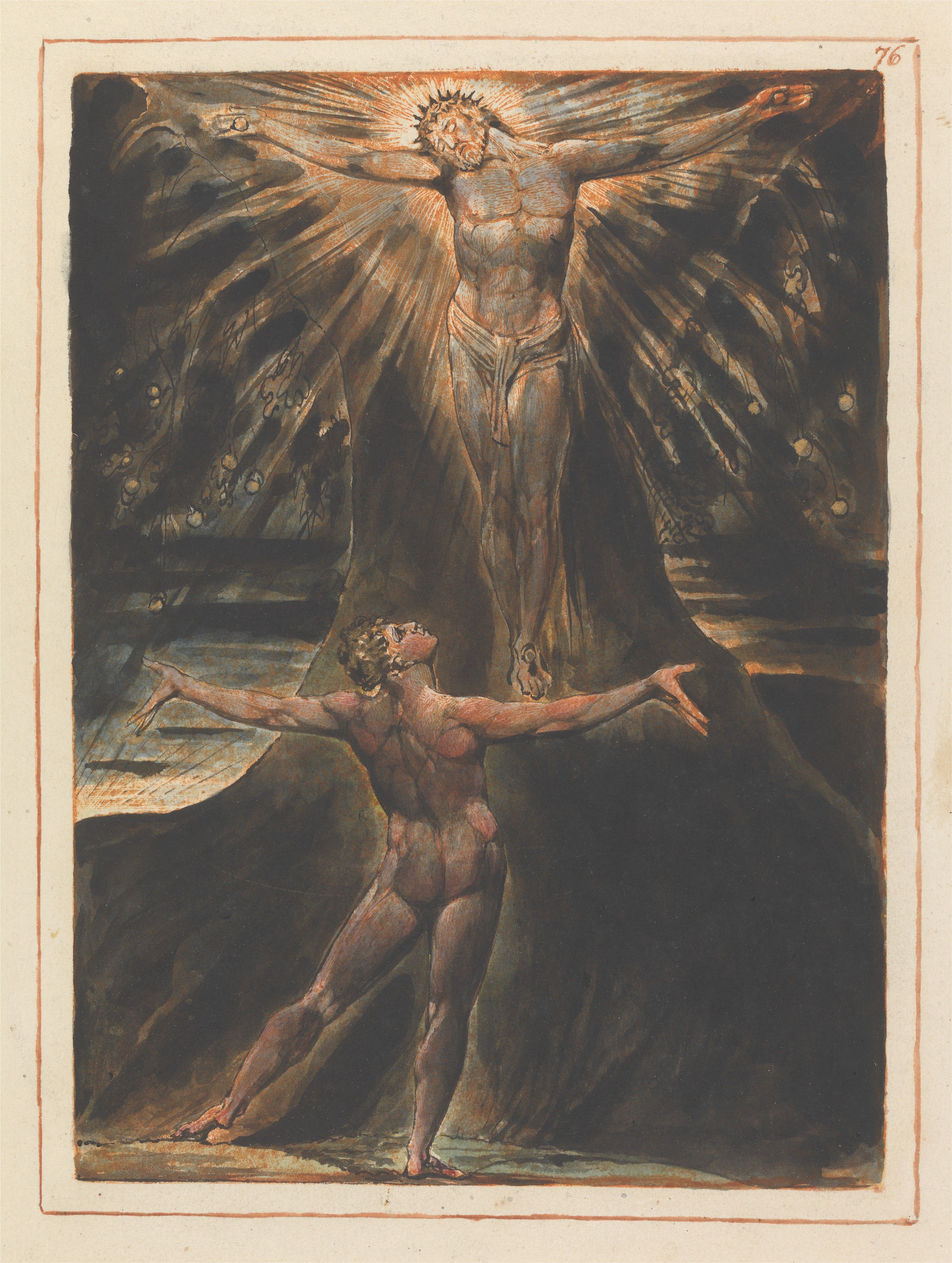
Plate 76

Wounds of Jesus the Christ

Head wound - crown of thorns and striking of his head were used in mocking of Jesus

Hand wounds - pierced with nails to be hung from cross

Foot wounds - body supported by nails driven into the feet

Side wound - pierced by soldier's spear; water and blood flowed from wound

__________________

Matthew 29
[27] Then the soldiers of the governor took Jesus into the common hall, and gathered unto him the whole band of soldiers.
[28] And they stripped him, and put on him a scarlet robe.
[29] And when they had platted a crown of thorns, they put it upon his head, and a reed in his right hand: and they bowed the knee before him, and mocked him, saying, Hail, King of the Jews!
[30] And they spit upon him, and took the reed, and smote him on the head.
[31] And after that they had mocked him, they took the robe off from him, and put his own raiment on him, and led him away to crucify him.
 
John 19  
[28] After this, Jesus knowing that all things were now accomplished, that the scripture might be fulfilled, saith, I thirst.
[29] Now there was set a vessel full of vinegar: and they filled a spunge with vinegar, and put it upon hyssop, and put it to his mouth.
[30] When Jesus therefore had received the vinegar, he said, It is finished: and he bowed his head, and gave up the ghost.
[31] The Jews therefore, because it was the preparation, that the bodies should not remain upon the cross on the sabbath day, (for that sabbath day was an high day,) besought Pilate that their legs might be broken, and that they might be taken away.
[32] Then came the soldiers, and brake the legs of the first, and of the other which was crucified with him.
[33] But when they came to Jesus, and saw that he was dead already, they brake not his legs:
[34] But one of the soldiers with a spear pierced his side, and forthwith came there out blood and water. 
[35] And he that saw it bare record, and his record is true: and he knoweth that he saith true, that ye might believe.
[36] For these things were done, that the scripture should be fulfilled, A bone of him shall not be broken.
[37] And again another scripture saith, They shall look on him whom they pierced.
 
John 20
[19] Then the same day at evening, being the first day of the week, when the doors were shut where the disciples were assembled for fear of the Jews, came Jesus and stood in the midst, and saith unto them, Peace be unto you.
[20] And when he had so said, he shewed unto them his hands and his side. Then were the disciples glad, when they saw the Lord.
[21] Then said Jesus to them again, Peace be unto you: as my Father hath sent me, even so send I you.
[22] And when he had said this, he breathed on them, and saith unto them, Receive ye the Holy Ghost:
[23] Whose soever sins ye remit, they are remitted unto them; and whose soever sins ye retain, they are retained.
[24] But Thomas, one of the twelve, called Didymus, was not with them when Jesus came.
[25] The other disciples therefore said unto him, We have seen the Lord. But he said unto them, Except I shall see in his hands the print of the nails, and put my finger into the print of the nails, and thrust my hand into his side, I will not believe.
[26] And after eight days again his disciples were within, and Thomas with them: then came Jesus, the doors being shut, and stood in the midst, and said, Peace be unto you.
[27] Then saith he to Thomas, reach hither thy finger, and behold my hands; and reach hither thy hand, and thrust it into my side: and be not faithless, but believing. 
[28] And Thomas answered and said unto him, My Lord and my God. 


In the article Recovering the Lost Moravian History of William Blake’s Family by Keri Davies and Marsha Keith Schuchard we can read the letter that Blake's mother wrote when applying for membership in the Congregation of the Lamb which was the Moravian group meeting in Fetter Lane.

"The Moravian Church archive also contains a letter of application from Catherine Armitage, expressing the same intense “Blood and Wounds” Moravian spirituality as her husband’s...The letter bears no date, but is probably written at the same time as her husband’s, 14 November 1750."

"My Dear Bretheren & Sistors
I have very littell to say of my self for I am a pore crature and full of wants but my Dear Saviour will satisfy them all I should be glad if I could allways lay at the Cross full as I do know thanks be to him last friday at the love feast Our Savour was pleased to make me Suck his wounds and hug the Cross more then Ever and I trust will more and more till my fraile nature can hould no more at your request I have rit but I am not worthy of the blessing it is desird for I do not Love our Dear Savour halfe enough but if it is will to bring me among his hapy flock in closer conection I shall be very thankful I would tell you more of my self but itt is nothing thats good so now I will rite of my Savour that is all Love
Here let me drink for ever drink
nor never once depart
for what I tast makes me to cry
fix at this Spring My heart
Dear Savour thou has seen how oft
I’ve turnd away from thee
O let thy work renewd to day
Remain eternally
Catherine Armitage"


This letter displays the emphasis on the Wounds of Jesus and on the Cross on which Jesus was crucified. These ideas dominated the theology of Count Zinzendorf the primary Moravian Church leader who died in 1760 when William Blake was a young child. The Zinzendorf theology focused attention on the suffering of Jesus as payment for the sins of individuals. By participating in the pain, physical and mental, which Jesus endured on the cross and in the events leading up to the crucifixion, Zinzendorf taught that the penitent became worthy of having his sins forgiven. Jesus was seen as the Lamb whose blood was shed as a sacrifice for sinful mankind.
 
Isaiah 53
[1] Who hath believed our report? and to whom is the arm of the LORD revealed?
[2] For he shall grow up before him as a tender plant, and as a root out of a dry ground: he hath no form nor comeliness; and when we shall see him, there is no beauty that we should desire him.
[3] He is despised and rejected of men; a man of sorrows, and acquainted with grief: and we hid as it were our faces from him; he was despised, and we esteemed him not.
[4] Surely he hath borne our griefs, and carried our sorrows: yet we did esteem him stricken, smitten of God, and afflicted.
[5] But he was wounded for our transgressions, he was bruised for our iniquities: the chastisement of our peace was upon him; and with his stripes we are healed.
[6] All we like sheep have gone astray; we have turned every one to his own way; and the LORD hath laid on him the iniquity of us all.
[7] He was oppressed, and he was afflicted, yet he opened not his mouth: he is brought as a lamb to the slaughter, and as a sheep before her shearers is dumb, so he openeth not his mouth.
[8] He was taken from prison and from judgment: and who shall declare his generation? for he was cut off out of the land of the living: for the transgression of my people was he stricken.
[9] And he made his grave with the wicked, and with the rich in his death; because he had done no violence, neither was any deceit in his mouth.
[10] Yet it pleased the LORD to bruise him; he hath put him to grief: when thou shalt make his soul an offering for sin, he shall see his seed, he shall prolong his days, and the pleasure of the LORD shall prosper in his hand.


Saturday, January 29, 2022

MORAVIAN MOTHER

Wikimedia Commons
Fitzwilliam Museum
Songs of Innocence and of Experience
Plate 22, Spring


William Blake's mother Catherine had been a Moravian during her first marriage. Her husband Thomas Armitage died of consumption in 1751 and she married James Blake in 1752. James and Catherine had four sons and a daughter born between 1753 and 1764. When Catherine married James she gave up membership in the Fetter Lane Society which was her Moravian connection because of the total commitment  they required. However the principles and practices of her Moravian community would have stayed with her.

Lets look at some ways in which the Moravian traditions may have continued to influence Catherine as she raised her children. Characteristic of Moravian worship was the use of song. They wrote their own hymns, committed them to memory and often based their whole worship service on singing. They were dependent on the Bible in public and private worship for instruction and inspiration. Work, learning and spiritual nurture were woven together in their daily lives. They engaged in missionary activities to bring the Gospel of Jesus Christ to far flung parts of the world. They developed a sensitivity to the Holy Spirit to bring them emotional and visionary experiences. Unity and Brotherhood were major themes in their activities. The sexual union of man and wife played a strong role in Moravian thought.

Now look at young William, a boy of exceptional intellectual and artistic talent, growing up with the nurture of such a mother. The accounts of Blake's childhood tell us he saw visions from a young age. The only formal schooling he had before his apprenticeship was at Pars School of Drawing. He reported that he was befriended by Old Testament prophets in childhood. His early attempts at writing poetry were published by friends in 1784. The fragments of a manuscript which goes by the name of Island in the Moon records singing among his circle of friends and includes preliminary poems of Songs of Innocence.

In Blake's major poetry we see the frequent but not explicit themes which can be traced back to the influence of his mother's Moravian background.  
 
Letters, (E 707)
"To My Dearest Friend John Flaxman these lines 
 
I bless thee O Father of Heaven & Earth that ever I saw Flaxmans face 
Angels stand round my Spirit in Heaven. the blessed of Heaven are my friends upon Earth 
When Flaxman was taken to Italy. Fuseli was giv'n to me for a season 
And now Flaxman hath given me Hayley his friend to be mine such my lot upon Earth 
Now my lot in the Heavens is this; Milton lovd me in childhood & shewd me his face  
Ezra came with Isaiah the Prophet, but Shakespeare in riper years gave me his hand 
Paracelsus & Behmen appeard to me. terrors appeard in the Heavens above 
And in Hell beneath & a mighty & awful change threatend the Earth 
The American War began All its dark horrors passed before my face Across the Atlantic to France. 
Then the French Revolution commencd in thick clouds 
And My Angels have told me. that seeing such visions I could not subsist on the Earth 
But by my conjunction with Flaxman who knows to forgive Nervous Fear 
I remain for Ever Yours 
WILLIAM BLAKE


Ram Horn'd with Gold
By Larry Clayton 
Chapter Eight
Bible
Like Los Blake walks up and down the biblical scene
from Adam to John of Patmos. He takes what best serves his
purpose, or rather the biblical symbols rearrange themselves
kaleidoscopically into his visions of eternity. These together
add up to a cogent and provocative commentary on the Bible and on its child, the Christian faith. Out of this intuitive unconscious process arose the great themes of his faith, embodied in his art: the universal man, fallen and fractured, struggling, redeemed and returning in the fullness of time into the blessed unity from which he came. This is the essential story of the Bible for one who reads it whole and without the constraints and blinders of what I have called the black book.

It should be said however that Blake found inspiration for his myth from many other sources beside the Bible; the secular critics have pointed them out in great detail. He drew impartially on everything in his experience, but found the Bible his richest fountain. The other sources were secondary and for the most part commentaries on or elaborations of the biblical truths. 

Much as he loved the Bible, Blake ascribed paramount authority to his visions. The true man of God has visions which refine, bring up to date, and correct the earlier visions of the earlier prophets. This is where Blake departed from the orthodox attitude to the Bible, which he called reading it black. This is where he acted on the heritage of English dissent. 

This is how he saw the New Light and became a man of the New Age."   
 
To be Continued.