Showing posts with label Conversion. Show all posts

Sunday, January 11, 2026

BLAKE'S FAITH

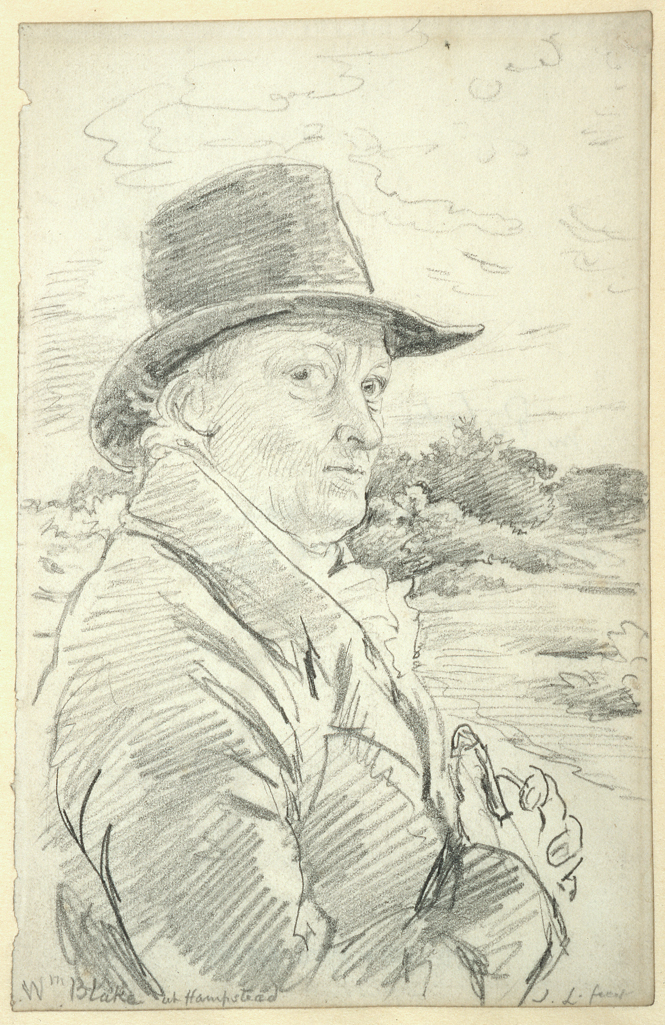
Larry posted this in April 2015. It is a portion of  Ram Horn'd with Gold by Larry Clayton.

"This book is an introduction to William Blake's thought with primary emphasis on its spiritual dimension. Recent Blake literature has come largely from secular interpreters. The religious community for the most part have totally ignored Blake. Nevertheless he was a profoundly spiritual man.

My introduction to Blake focuses on his spiritual life as expressed in his aesthetics, politics, and psychology. "

Faith 2

God

    that they may be one, even as we are one: I in them
    and thou in me, that they may be made perfect in one.
    (John 17)

      The theologues of the forties and fifties learned from Paul Tillich that everyone has an ultimate concern, his God. People in Alcoholics Anonymous have told some of their theologically confused members that, lacking any better God, they may worship a 'pot on the mantle', anything at all to break that devotion to the bottle which is actually the worship of a lower form of the self. To remain sober one must believe in a Higher Power of some sort.
       
     The important thing is that one's Higher Power be not a projection of some lower form of self; that's idolatry. The person seriously interested in ultimate reality engages in a life long search for the most real image he can discover, the image of his God. A person's best image of God nurtures his spirit as he goes through life.
       
      The Bible contains a multiplicity of images of God. For example we read about the finger of God, the nostrils of God, even the backside of God. All his life Blake maintained a high level of respect for the Bible as vision. Nevertheless he refused to worship other men's visions of God:

"I (you!) must create a system, or be enslaved by another man's (Jerusalem, 10.21; E153)". 

      He's saying that we have a choice: to adhere to the conventions (whatever conventions may be for us) or to create our own values from our own experience. Blake did this for a lifetime, creating his own myth of meaning, and with his creative works he expressed it over and over again.

       The only thing Blake really trusted was his own immediate direct vision, and he possessed his soul in varying degrees of patience until that vision clarified (and you may be sure that it was criticized, corrected and amended over and over again. The 'Felpham Moment' marks the decisive clarification of Blake's vision of God. Even then the Father remained for Blake a symbol of subjection to the other man's vision, of spiritual tyranny. His own vision came to center upon Jesus.

       Nobodaddy, Father of Jealousy, Urizen, all the creator and authority figures that filled the young Blake's mind, represented in essence his rejection of other men's images of God.

The "Vision of Ahania" (4Z: chapter 3, 39.13ff; E327) expressed Blake's dawning awareness of a fundamental spiritual truth: the transcendental image which had dominated institutional religion is most often a projection of man's primitive negativities. The ultimate negativities, repressed into the unconscious, irupt into consciousness as the ultimate positivity, a God built upon sand, a "shadow from his wearied intellect". This passage, probably as much as anything else in his experience, inspired Thomas Altizer in the sixties to launch his Death of God movement.

       Blake depreciated the God of Law and Wrath in order to exalt the God of Forgiveness. He believed that the far off, elusive, mysterious, transcendental image of God freezes man into spiritual immobility. He wanted to liberate men's minds from this imposture and put them in touch with the true source of creativity:
    "Seek not thy heavenly father then beyond the skies,
    There Chaos dwells & ancient Night & Og & Anak old. " (Milton 20:33-34)

    "I am not a God afar off, I am a brother and friend;
    Within your bosoms I reside, and you reside in me:
    Lo! we are One, forgiving all Evil, Not seeking recompense.
    Ye are my members...."
           (Jerusalem 4:18-21)
       The prophetic poems which Blake wrote prior to 1800 concern his efforts to know, describe and deal with the old, jealous, wrathful, creator image; he finally dismissed it as a "shadow from his wearied intellect" (FZ3-40.3). The later, major prophecies, Milton and Jerusalem, also contain this theme, happily outweighed by the new vision.

Prior to the Felpham Moment Blake had worshipped his own visionary endowment, his Pot on the Mantle; he called it the Poetic Genius and later the Imagination. 

The evolving figure of Los building Golgonooza personified what we might call a pre-Christian God. When grace fell upon Blake, he came to see the true embodiment of God in Jesus.
       
      In a letter to his friend and patron, Thomas Butts, he described the experience of redemption that had come to him:
       "And now let me finish with assuring you that tho I have been very unhappy I am so no longer I am again Emerged into the light of Day I still & shall to Eternity Embrace Christianity and Adore him who is the Express image of God."  
LettersNovr. 22: 18O2, (E 720)

       Following John and Paul quite literally Blake believed that all things belong to Jesus. He is in them (us) and they (we) are in him. All his life Blake had kept a firm grip on the oneness of humanity and its identity with God. At the Moment of Grace he came to see all as One Man and his own forgiven and accepted place in that Man's bosom. In the poem the Man refers to the All as "My Fold" and names the awakened Blake as his herald: "Thou Ram horn'd with gold".

       Blake sent this poem to the one faithful Christian he knew who had befriended and loved him. The circumstances leave no doubt as to the identity of the One Man. The poem poetically expresses Blake's faith as it relates to God, Man and the relationship between the two. It expresses what the Christian faith has to say about the relationship as well as it can be expressed verbally. It also expresses with vivid eloquence the child like nature of the entrance to the kingdom of God. Blake here celebrates and confesses it. 

      To interpret Blake's experience we could use any number of hackneyed phrases representing the various dialects of the language of Zion; suffice it to say that for most of them as for Blake this is the main event, the center of the Moment of Grace. At this point Jesus became and forever afterward remained the One and the ever present Reality which Blake had formerly known as the Infinite or Eternal. For Blake Jesus was a Man, the Reality of Life, and most ultimately the All. In all three instances Blake strictly followed Johannine and Pauline strains of the New Testament.

Friday, September 08, 2023

Enlightenments

Previously posted on Dec 17, 2017

We all reach God in some way, but among those closest to God were several Soldiers of the Cross. These examples all show a long continued inner turmoil and struggle rewarded in due course by that special gift that Eternity offers to the most faithful.
-----------------------------------------------------
 
His heart leapt for joy
 “Now after I had received that opening from the Lord that to be trained at Oxford or Cambridge was not enough to equip a man to be a minister of Christ, I respected the priests less, and looked more after the dissenting Christians. And among them I saw there was some tenderness, and many of them came afterwards to be convinced, for they had some openings from God. But as I had forsaken all the priests, so I left the separatist Preachers, also, together with those called the most experienced people. For I saw there was no one among them all who could speak to my condition. And when all my hope in them and in all men were gone, so that I had nothing outwardly to help me, nor could I even tell what to do, then, Oh then, I heard a voice which said, “There is one — even Christ Jesus — who can speak to thy condition!” And when I heard it, my heart leapt for joy. Then the Lord showed me why there was no one on the earth who could speak to my condition. The reason was that I was to give him all the glory. For all are concluded under sin, and shut up in unbelief as I had been, so that Jesus Christ might have the pre-eminence, as the one who enlightens, and gives grace, faith and power. So, when God works, who shall prevent it? And I knew this experimentally through my experiences.”"
(From the Journal of George Fox)
------------------------------------------------------------------------------

The Loss of the Burden in Pilgrims Progress

Blake's Illustrations to Bunyan's Pilgrims Progress
 
Christian is at the Cross; his burden is cast off (at the lower left of the picture):
"To take my cross up day by day,
And serve the Lord with fear.
Now I saw in my dream, that they went on,
and Great-Heart before them. So they went,
and came to the place where Christian's
burden fell off his back and tumbled into a
sepulchre. Here then they made a pause; and
here also they blessed God."
(from Pilgrim's Progress)
 
"finally he was relieved by the text, 'The blood of Jesus Christ His Son cleanseth us from all sin.'" John Bunyan's Conversion
 
----------------------------------------------

His Heart was strangely warmed

.John Wesley was a super-Christian at Oxford. He demanded rigorous adherence to certain practices, carried out by his disciples; they were called methodists. Once ordained he went to the colony of Georgia to save the heathen, but he came to realize that he needed salvation himself.

Returning to England there was a terrible storm at sea and everyone quailed with fear for their lives; everyone that is except a group of Moravians who continued in prayer and showed great equanimity.

Back in London Wesley continued to worry about his salvation until, in 1738:
"In the evening I went very unwillingly to a society in Aldersgate Street, where one was reading Luther’s preface to the Epistle to the Romans. About a quarter before nine, while he was describing the change which God works in the heart through faith in Christ, I felt my heart strangely warmed. I felt I did trust in Christ, Christ alone, for salvation; and an assurance was given me that he had taken away my sins, even mine, and saved me from the law of sin and death."

He was generally considered to be one of the greatest men in 18th century England and was thought by many to have saved England from Revolution.
 
-------------------------------------------------------

The Truchsessian Museum

The Enlightenment of William Blake was on this wise:
"O lovely Felpham, parent of Immortal Friendship, to thee I am eternally
indebted for my three years rest from perturbation and the strength I now enjoy. Suddenly, on the day after visiting the Truchsessian Gallery of
pictures, I was again enlightened with the light I enjoyed in my youth, and which has for exactly twenty years been closed from me as by a door and by window-shutters. Consequently I can, with confidence, promise you ocular demonstration of my altered state on the plates I am now engraving after Romney, whose spiritual aid has not a little conduced to my restoration to the light of Art." (Erdman 756)

He wrote this in Letter 51 (To William Hayley) 23 October 1804.

-----------------------------------------------------

Renunciation

".....Albert Schweitzer's biography of J. S. Bach, written in 1905, had also proved an immediate success. At 30 years of age Schweitzer was tall, broad-shouldered, darkly handsome, and a witty charismatic writer, preacher, and lecturer: clearly, a bright future lay before him. However, one spring morning in 1905, he experienced a stunning religious revelation: it came to him that at some point in the years just ahead he must renounce facile success and devote himself unsparingly to the betterment of mankind's condition.
Accordingly, several years later, Schweitzer threw over his several careers as author, lecturer, and organ recitalist and plunged into the study of medicine - his aim being to go to Africa as a medical missionary. He won his medical degree in 1912. The year before, he had married Helene Bresslau, a professor's daughter who had studied nursing in order to work at his side in Africa; in 1919 the couple had a daughter, Rhena.

In 1913 the Schweitzers journeyed to what was then French Equatorial Africa. There, after various setbacks, they founded the Albert Schweitzer Hospital at Lambaréné, on the Ogooué River, "at the edge of the primeval forest." This area now lies within the independent West African republic of Gabon. Funds were scarce and equipment primitive, but native Africans thronged to the site, and in the decades that followed, many thousands were treated." (From Answers.Com)
----------------------------------

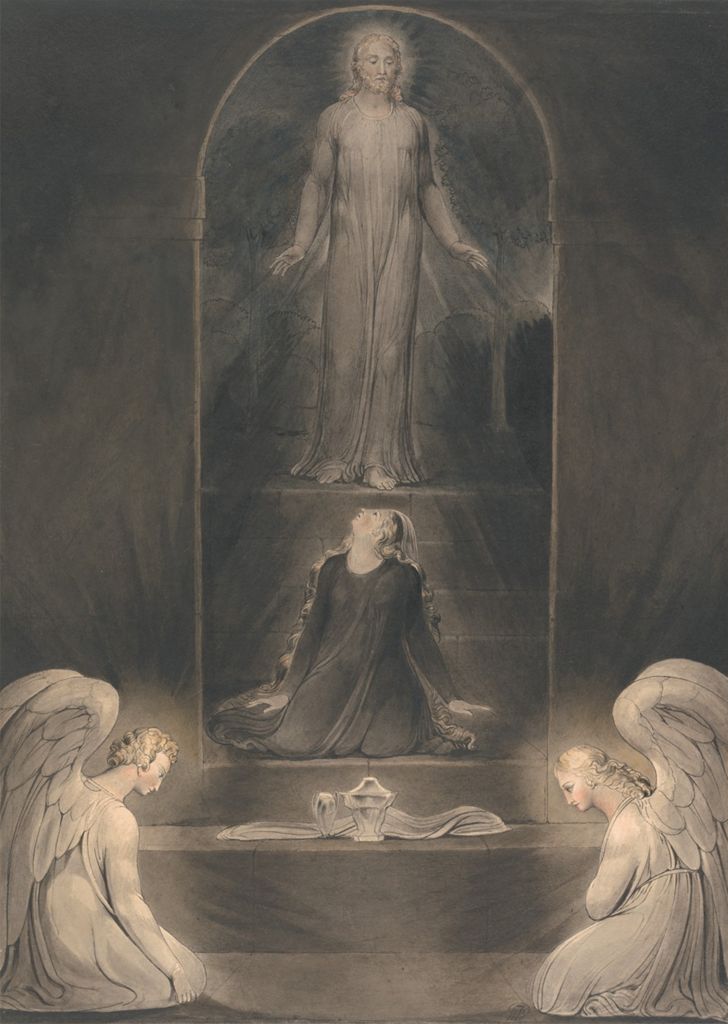
Magdalene Encounters the Risen Christ

Yale Center for British Art
Mary Magdalen at the Sepulchre

Friday, June 02, 2023

Images of Grace

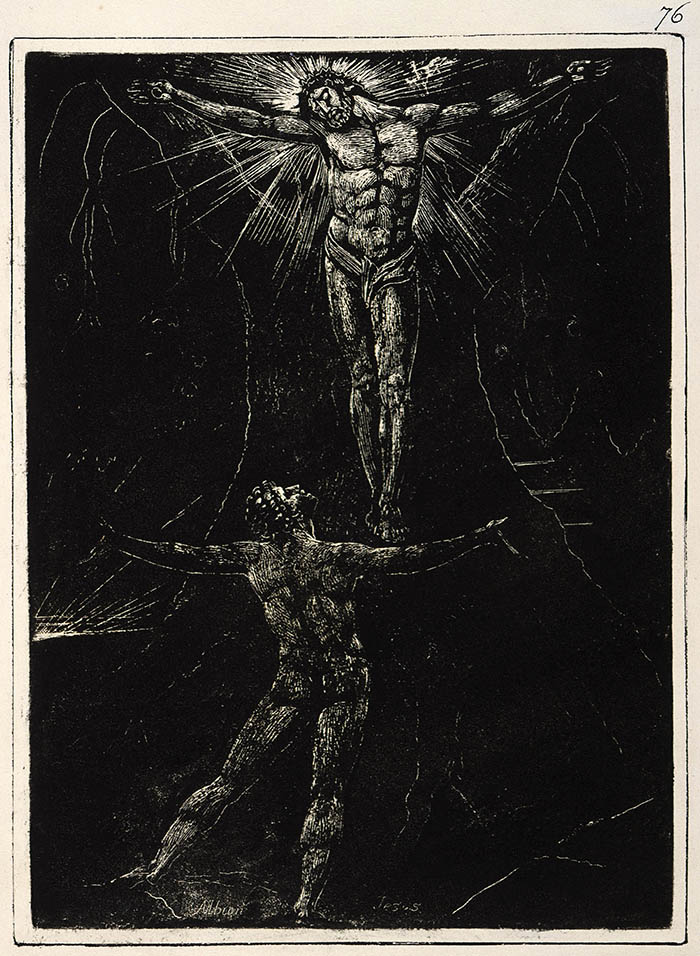
British Museum
Jerusalem
Plate 76

CHAPTER SIX

Bible

Images of Grace

For the Christian of course Blake's happiest use of the Bible occurs with his statements of the gospel; these came after his Moment of Grace in 1800. 'The Four Zoas' had been an attempt to organize experience into a pattern of meaning. In the years before grace Blake's concept of redemption rested upon the efforts of Los, the Imagination, to create meaning out of the chaos of fallen life.

This process begins in Night iv and goes on to the end of the poem. Blake called it "building Golgonooza", an adaptation of the biblical drama of rebuilding fallen Jerusalem. Blake took this from the book of Ezra , one of his earliest companions. At the beginning of Night ix, written after the Moment of Grace , Los and Enitharmon are no longer building Golgonooza; now they are building Jerusalem!

In the earlier years salvation for Blake lay in art, as it has for so many sensitive souls before and after his day. Once he met grace, Jesus became for Blake the One and the All. Jesus subsumed Blake's art and redeemed it. He tells us that Jesus appeared to him in "the likeness and similitude of Los".

Kierkegaard spoke of the aesthetic phase. Some aesthetes among Blake's critics, valuing art more highly than Christ, have experienced the change as a deterioration of Blake's art. Christians in contrast see the new work like Blake saw it, as a glorified art, sublimated and fulfilled:

  • Prayer is the Study of Art.

  • Praise is the Practise of Art.

  • Fasting &c., all relate to Art. br ....

  • Jesus & his Apostles & Disciples were all Artists.

  • ....

  • The Old & New Testaments are the Great Code of Art.

  • Art is the Tree of Life.

  • (Selected Passages from The Laocoon)

These are certainly provocative words! We should know that the Bible is art in its highest form, but never art for art's sake, always art for God's sake. In the Laocoon inscriptions (quoted above) Blake made a frontal attack upon the "aesthetic" orientation by pointing out the identity between true art and true godlinesss, the "Tree of Life", which was God's original intention for man before the serpent snarled up his plans.

It became a special joy and a labor of love for Blake after his conversion to go back and recolor his Biblically inspired myth with those previously discounted parts of the Bible which now burned in his consciousness. Matthew, Mark, Luke and John tell the story of the Lord of Love, adored by thousands who know little or nothing about the rest of the Bible. Blake now puts Jesus at the center, or rather the apex, of his myth of meaning.

The 17th chapter of John is probably the central passage of scripture for Blake's myth, both before and after the Moment of Grace. In it Jesus prays to the Holy Father:

[21] That they all may be one; as thou, Father, art in me, and I in thee, that they also may be one in us: that the world may believe that thou hast sent me.
[22] And the glory which thou gavest me I have given them; that they may be one, even as we are one:
[23] I in them, and thou in me, that they may be made perfect in one

Blake's visionary experience from his earliest days had centered on this image of oneness. All of his reading in the heterodox tradition had reinforced it as the basic shape of reality. The Gnostics, the Neo-platonists, the alchemists, the Cabbalists, the Christian mystics, all had emphasized the supernal oneness of God and Man and life. Blake had seen all trouble and sorrow and brokenness in terms of the fracture and separation or division from the primeval oneness. This was the basic idea of his myth:

"Daughters of Beulah, Sing His fall into Division & his Resurrection to Unity." Four Zoas, Page 4, (E 301)

And now on the sands of Felpham he had met the One, been folded into his bosom and heard himself affectionately named by the One ("Thou Ram Horn'd with Gold"). Turning to scripture with new eyes, irradiated with his First Vision of Light he finds the Saviour praying that we might be one as he is one with the Father.

In the eternal realm the sequence is reversed: the divine prayer had in earliest childhood fallen into the deepest levels of Blake's being. Like the veritable mustard seed it lay there exerting an unconscious force, guiding him to the Gnostics (who knew more about oneness than did the Church Fathers), the Neoplatonists, and the others. And when the soil of Blake's psyche was fully prepared, the seed burst out in the full embodiment of the vision of Light, when for Blake the One became flesh.

This is the center of the Christian faith: that we are one, that we are all Christ's members. Those who deny to Blake the name of Christian on the basis of his 'white' reading of the Bible thereby betray their own off centeredness. Certainly he was no orthodox Christian; orthodox Christianity in its many forms has been way off center. When Blake dreamed of the One and met the One and sang of the One, he imaginatively incarnated the answer to the divine prayer. Is there any better way to be a Christian?

Read more about Blake's Moment of Grace and it's implications.


Wednesday, May 10, 2023

Destination

First posted April 2019.

This is an extract from Chapter Five (GOD) of Ram Horn'd With Gold by Larry Clayton.

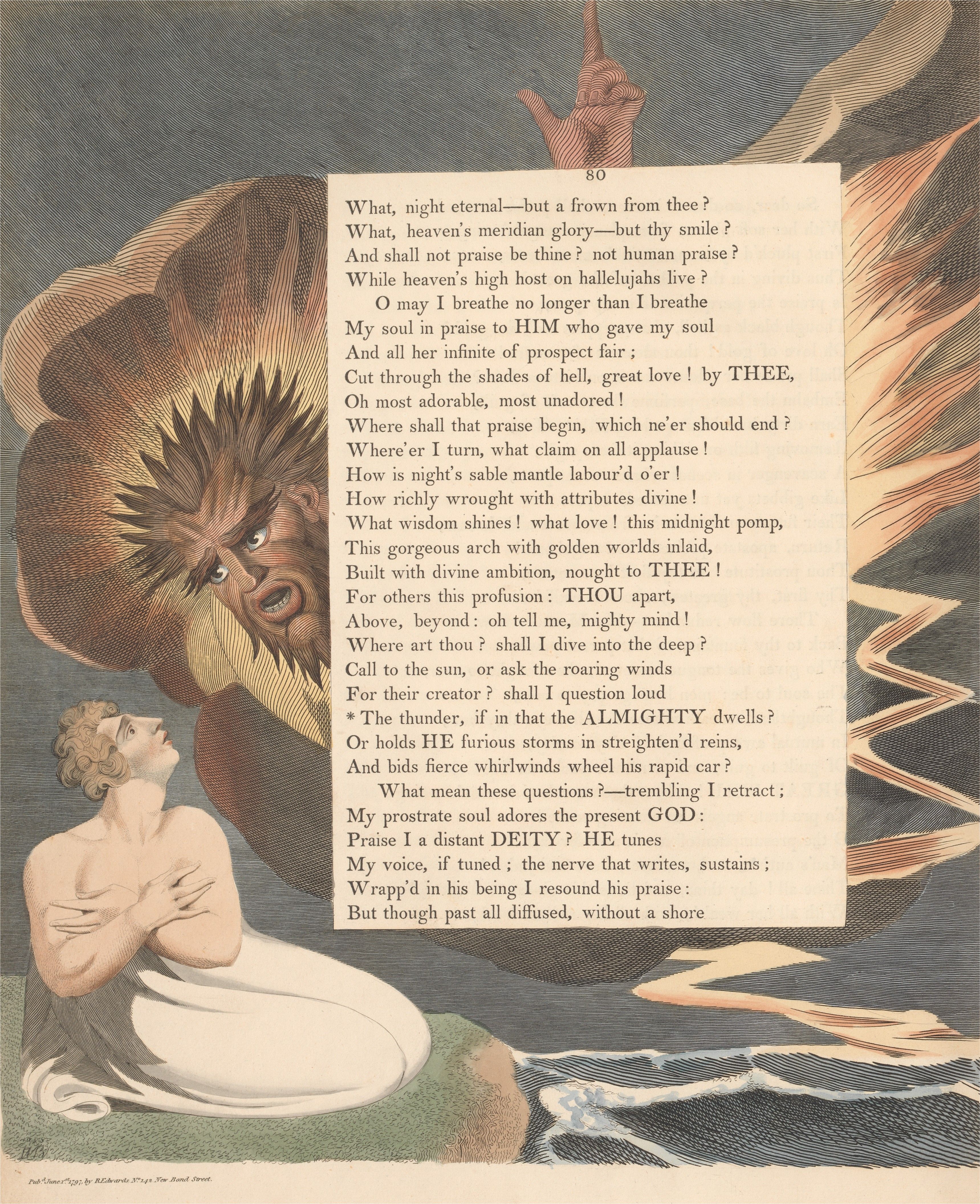
Yale Center for British Art
Illustrations to Young's Night Thoughts


The Divine Vision

Throughout this chapter we have followed Blake as he encountered, faced, studied, named, and denounced the false God in the many guises in which he appears to man. This enterprise occupied the first half of his adult life. But during this time he was always aware of something real behind the shadow. As a child he had loved the Lamb:

Songs of Innocence, Song 8, (E 9)
"Little Lamb, who made thee?
Dost thou know who made thee?
Gave thee life, and bid thee feed
By the stream and o'er the mead;

Gave thee clothing of delight,
Softest clothing, wooly, bright;
Gave thee such a tender voice
Making all the vales rejoice?
Little Lamb, who made thee?
Dost thou know who made thee?

Little Lamb, I'll tell thee,
Little Lamb, I'll tell thee:
He is called by thy name,
For he calls himself a Lamb.
He is meek, and he is mild;
He became a little child.
I a child, and thou a lamb,
We are called by his name.
Little Lamb, God bless thee!
Little Lamb, God bless thee!"

As a youth Blake's mind came to be overshadowed by the Tyger. Some interpreters believe that at a certain point he began to see Jesus as misguided: in the 'Song of Los' he wrote that Jesus "received a Gospel from wretched Theotormon". Theotormon symbolizes the legalistic repression of impulse. If Blake did turn away from Jesus, it was by no means an uncommon stage of life for a young man.

Blake always put an ultimate trust in the imaginative power that gave him visions of infinite joy. But at the age of 24 through a failure of consciousness he had chosen a measure of satanic power with a consequent loss of spiritual perception; the Divine Vision faded. There followed the years of struggle with the God of this World, and as we have seen, his experience at Felpham (his "first Vision of Light") led to his definite rejection of the Tempter. In 1803 he returned to London, having prepared himself for an additional grace which shortly fell upon him. In a letter to Hayley dated Oct. 23, 1804 he gave an account of an awesome change that had come into his life:

Letters, To William Hayley, (E 756)
"Suddenly on the day after visiting the Truchsessian Gallery of pictures, I was again enlightened with the light I enjoyed in my youth, and which has for exactly twenty years been closed from me as by a door and by window-shutters."

It's doubtful that he expected Hayley to understand this fully, but we are eternally indebted to both of them for passing it down to us. It marks in a most objective way the return of the Divine Vision, who had been overshadowed by Blake's preoccupation with the God of this World.

The progression of Blake's poetry shows the eclipse of Christ through the long struggle of the nineties. Now he proceeded to introduce the Lamb into 4Z with a group of additional lines at strategic places. These images means relatively little to the secular reader, but cause great joy to the Christian.

The Destination

The healing of Los, described in Night vii of 'The Four Zoas', prepares the way for Christ's coming into history. Night viii tells the story of Jesus: the Incarnation, the Crucifixion, and the Resurrection of the spiritual body. It's important to remember that in Blake's mental world and in his poetry these are psychic rather than historical events.

Blake had always worshiped the Divine Vision. In his twenty years in the wilderness the Divine Vision dimmed and lost the immediacy which had informed the beautiful poems of Innocence. Kathleen Raine points to a few lines that describe with peculiar luminosity this dimming of the Divine Vision:

Jerusalem , Plate 66, (E 219)
"And as their eye & ear shrunk, the heavens shrunk away:
The Divine Vision became First a burning flame [Moses], then a column
Of fire [the Exodus],then an awful fiery wheel surrounding earth and heaven [Ezekiel],
And then a globe of blood wandering distant in an unknown night:" [false Christianity]
 
This describes Blake's personal experience and that of Mankind. But at or after Felpham he recovered the Divine Vision and realized that his name is Jesus.

He spent the rest of his life celebrating the momentous event and the Name and proclaiming its reality in a hundred ways. It had happened to him, and it would happen to the world.

With the ensuing works of art Blake gives us a portrait of Jesus in many ways original. It may prove to be the most vital portrait of Jesus for the present age. The quest for the historical Jesus long ago became a vain enterprise. Every worshiper has endowed the Divine Man with his own highest values, and Blake was no exception. His mature or final portrait of Jesus has four salient features. Three of them expressed convictions that he had held for a lifetime and repeatedly expressed poetically and pictorially. The fourth was a new experience, the touch of grace; it irradiated the first three with glory.
 

Thursday, November 07, 2019

ILLUSTRATING SHAKESPEARE 2

British Museum 
Watercolor 1809

As if an Angel Dropped from the clouds
"but Shakespeare in riper years
gave me his hand"
[Letter to Flaxman, E 707]

With his wide range of interests and knowledge Blake did not confine himself to illustrating/interpreting the bible. For Rev Joseph Thomas, who became an enthusiastic collector of Blake's work, he created this watercolor from Shakespeare's Henry IV. It was included in Thomas' copy of the second folio of Shakespeare's plays.

These are lines from Part 1, Act IV which Blake illustrated:
"All furnished, all in arms,
All plumed like estridges that with the wind
Baited like eagles having lately bathed,
Glittering in golden coats like images,
As full of spirit as the month of May,
And gorgeous as the sun at midsummer,
Wanton as youthful goats, wild as young bulls.
I saw young Harry with his beaver on,

His cuisses on his thighs, gallantly armed
Rise from the ground like feathered Mercury
And vaulted with such ease into his seat
As if an angel dropped down from the clouds,

To turn and wind a fiery Pegasus

And witch the world with noble horsemanship."

This scene portrayed a moment of transformation for young Hal. On the battlefield his prowess was realized as fitting him for his future role as king. Blake used the horse Pegasus, and the rising sun to symbolize the new energy with which the young prince had been imbued. The momentous event was recorded by a heavenly scribe. To be fully prepared the Prince must then secure the horse with the rope he held.

An earlier lost fresco treatment of this subject was included in Blake's exhibit of 1809 for which the Descriptive Catalogue was written:
Descriptive Catalogue, (E 545)

                       "NUMBER VI.
  A Spirit vaulting from a cloud to turn and wind a fiery
Pegasus--Shakspeare.  The horse of Intellect is leaping from the
cliffs of Memory and Reasoning; it is a barren Rock: it is also
called the Barren Waste of Locke and Newton.

THIS Picture was done many years ago, and was one of the first
Mr. B. ever did in Fresco; fortunately or rather providentially
he left it unblotted and unblurred, although molested continually
by blotting and blurring demons; but he was also compelled to
leave it unfinished for reasons that will be shewn in the following."
Milton, Plate 1, (E 95)
"Shakspeare & Milton were
both curbd by the general malady & infection from the silly Greek
& Latin slaves of the Sword.

Descriptive Catalogue, (E 534)
 "For the Host who follows this group, and holds the center 
of the cavalcade, is a first rate character, and his jokes are 
no trifles; they are always, though uttered with audacity, and
equally free with the Lord and the Peasant, they are always
substantially and weightily expressive of knowledge and
experience; Henry Baillie, the keeper of the greatest Inn, of 
the greatest City; for such was the Tabarde Inn in Southwark, 
near London: our Host was also a leader of the age.
By way of illustration, I instance Shakspeare's Witches in
Macbeth.  Those who dress them for the stage, consider
them as wretched old women, and not as Shakspeare intended, the
Goddesses of Destiny; this shews how Chaucer has been
misunderstood in his sublime work.  Shakspeare's Fairies also 
are the rulers of the vegetable world, and so are Chaucer's; 
let them be so considered, and then the poet will be understood, 
and not else.

Here is a quote from the source of my information:
Chantelle L. MacPhee (2002) "All the World's a Stage": William Blake and William Shakespeare. PhD thesis.

"Joseph Thomas commissioned this illustration from Blake for his copy of the second folio of Shakespeare's plays. The inspiration for the picture comes from 1 Henry IV 4.1.107-110, where Sir Richard Vernon at the Battle of Shrewsbury comments on the sudden transformation of Prince Hal into a soldier who vaulted with such ease into his seat As if an angel [dropp' d] down from the clouds To turn and wind a fiery Pegasus And witch the world with noble horsemanship.

Prince Hal's transformation on the battlefield not only confirms his military prowess, but his intellectual prowess as well. The illustration's suggestion of the "dawn of a new day" and Pegasus's reaction in the picture space suggest rebirth, regeneration and the male figure's stance suggests final acceptance of his future role as King of England."

Thursday, July 12, 2018

A Turning Point


First Posted July 2010.
The Moment of Grace

Life is made up of turning points, but if you're fortunate, somewhere along life's crooked path you may take a most significant turning point to the right:

The parable of the prodigal son is archetypal; we can focus on similar occurrences since Jesus spoke those words.

Wikimedia Commons

Songs of Innocence and of Experience 

Plate 45

Luke 15
 

[17]
And when he came to himself, he said, How many hired servants of my
father's have bread enough and to spare, and I perish with hunger!
[18] I will arise and go to my father, and will say unto him, Father, I have sinned against heaven, and before thee,
[19] And am no more worthy to be called thy son: make me as one of thy hired servants.
[20]
And he arose, and came to his father. But when he was yet a great way
off, his father saw him, and had compassion, and ran, and fell on his
neck, and kissed him.


That Moment in our poet's life has for me an endless fascination. Blake might have been a famous man, teacher to the Royal Family, world renowned artist; he might have dedicated his life to the Main Chance, but he found a better way. The critical Moment (the darkness before the dawn) came after Hayley had given William and Catherine a comfortable cottage and a comfortable care free life as a miniaturist, but "he came to himself". He returned to London, penniless, but free. Thereafter the main chance ceased to be a temptation. Blake celebrated that decisive Moment in letter 16 to his true (spiritual) friend, Captain Butts.


Letters, Letter 16, (E 713)
     "To my Friend Butts I write
     My first Vision of Light
     On the yellow sands sitting
     The Sun was Emitting
     His Glorious beams
     From Heavens high Streams
     Over Sea over Land
     My Eyes did Expand
     Into regions of air
     Away from all Care
     Into regions of fire
     Remote from Desire
     The Light of the Morning
     Heavens Mountains adorning
     In particles bright
     The jewels of Light
     Distinct shone & clear--
     Amazd & in fear
     I each particle gazed
     Astonishd Amazed
     For each was a Man
     Human formd...

     These are guards of My Fold
     O thou Ram hornd with gold"

He also mentioned it in another letter to William Hayley....

 
Letters, Letter 51, (E 756)
"I have entirely reduced that spectrous Fiend to his station, whose annoyance has been the ruin of my labours for the last passed twenty years of my life. He is the enemy of conjugal love and is the Jupiter of the Greeks, an iron-hearted tyrant, the ruiner of ancient Greece.......I was again enlightened with the light I enjoyed in my youth, and which has for exactly twenty years been closed from me as by a door and by window-shutters."

The imprint of that Moment fills the pages of his poetry:
In the 9th Night of The Four Zoas you may read of the regeneration and awakening of Vala, the "sinless soul", the incorrigible female. (This passage owes a lot to the Greek myth, Cupid and Psyche.)

Four Zoas, Night IX, Page 128, (E 397)
"So spoke the Sinless Soul & laid her head on the downy fleece 
Of a curld Ram who stretchd himself in sleep beside his mistress
And soft sleep fell upon her eyelids in the silent noon of day

Then Luvah passed by & saw the sinless Soul
And said   Let a pleasant house arise to be the dwelling place
Of this immortal Spirit growing in lower Paradise" 

After the Moment of Grace annihilation of the Selfhood became a primary theme for Blake. In Milton he put these words in the mouth of the hero returned from Heaven, addressed to Ololon, his emanation:

Milton Plate 40 [46], (E 142)
"But turning toward Ololon in terrible majesty Milton Replied. 

Obey thou the Words of the Inspired Man
All that can be annihilated must be annihilated
That the Children of Jerusalem may be saved from slavery
There is a Negation, & there is a Contrary
The Negation must be destroyd to redeem the Contraries
The Negation is the Spectre; the Reasoning Power in Man
This is a false Body: an Incrustation over my Immortal
Spirit; a Selfhood, which must be put off & annihilated alway
To cleanse the Face of my Spirit by Self-examination.
Plate 41 [48]:
To bathe in the Waters of Life; to wash off the Not Human
I come in Self-annihilation & the grandeur of Inspiration
To cast off Rational Demonstration by Faith in the Saviour
To cast off the rotten rags of Memory by Inspiration
To cast off Bacon, Locke & Newton from Albions covering
To take off his filthy garments, & clothe him with Imagination
To cast aside from Poetry, all that is not Inspiration"
 
Milton is a difficult poem, but Blake must have written it shortly after his Moment of Grace.

Blake celebrated the (miraculous?) turning point of Odysseus (my, your, Albion's, Everyman's) with his famous Arlington Tempera, called the Circle of Destiny.

In Blake's poetry, which is above all autobiographical, he marked the moment of truth for Los and all the rest of his characters who made up various elements of his psyche, of mine, yours or Albion's.

Sunday, December 17, 2017

Enlightenments

First posted on Wednesday, March 09, 2011

We all reach God in some way, but among those closest to God were several Soldiers of the Cross. These examples all show a long continued inner turmoil and struggle rewarded in due course by that special gift that Eternity offers to the most faithful.

-----------------------------------------------------

His heart leapt for joy

“Now after I had received that opening from the Lord that to be trained at Oxford or Cambridge was not enough to equip a man to be a minister of Christ, I respected the priests less, and looked more after the dissenting Christians. And among them I saw there was some tenderness, and many of them came afterwards to be convinced, for they had some openings from God. But as I had forsaken all the priests, so I left the separatist Preachers, also, together with those called the most experienced people. For I saw there was no one among them all who could speak to my condition. And when all my hope in them and in all men were gone, so that I had nothing outwardly to help me, nor could I even tell what to do, then, Oh then, I heard a voice which said, “There is one — even Christ Jesus — who can speak to thy condition!” And when I heard it, my heart leapt for joy. Then the Lord showed me why there was no one on the earth who could speak to my condition. The reason was that I was to give him all the glory. For all are concluded under sin, and shut up in unbelief as I had been, so that Jesus Christ might have the pre-eminence, as the one who enlightens, and gives grace, faith and power. So, when God works, who shall prevent it? And I knew this experimentally through my experiences.”"
(From the Journal of George Fox)
------------------------------------------------------------------------------

The Loss of the Burden in Pilgrims Progress

Blake's Illustrations to Bunyan's Pilgrims Progress

Christian is at the Cross; his burden is cast off (at the lower left of the picture):
"To take my cross up day by day,
And serve the Lord with fear.
Now I saw in my dream, that they went on,
and Great-Heart before them. So they went,
and came to the place where Christian's
burden fell off his back and tumbled into a
sepulchre. Here then they made a pause; and
here also they blessed God."
(from Pilgrim's Progress)

----------------------------------------------

His Heart was strangely warmed

.John Wesley was a super-Christian at Oxford. He demanded rigorous adherence to certain practices, carried out by his disciples; they were called methodists. Once ordained he went to the colony of Georgia to save the heathen, but he came to realize that he needed salvation himself.

Returning to England there was a terrible storm at sea and everyone quailed with fear for their lives; everyone that is except a group of Moravians who continued in prayer and showed great equanimity.

Back in London Wesley continued to worry about his salvation until, in 1738:
"In the evening I went very unwillingly to a society in Aldersgate Street, where one was reading Luther’s preface to the Epistle to the Romans. About a quarter before nine, while he was describing the change which God works in the heart through faith in Christ, I felt my heart strangely warmed. I felt I did trust in Christ, Christ alone, for salvation; and an assurance was given me that he had taken away my sins, even mine, and saved me from the law of sin and death."

He was generally considered to be one of the greatest men in 18th century England and was thought by many to have saved England from Revolution.
-------------------------------------------------------

The Truchsessian Museum

The Enlightenment of William Blake was on this wise:
"O lovely Felpham, parent of Immortal Friendship, to thee I am eternally
indebted for my three years rest from perturbation and the strength I now enjoy. Suddenly, on the day after visiting the Truchsessian Gallery of
pictures, I was again enlightened with the light I enjoyed in my youth, and which has for exactly twenty years been closed from me as by a door and by window-shutters. Consequently I can, with confidence, promise you ocular demonstration of my altered state on the plates I am now engraving after Romney, whose spiritual aid has not a little conduced to my restoration to the light of Art." (Erdman 756)

He wrote this in Letter 51 (To William Hayley) 23 October 1804.

-----------------------------------------------------

Renunciation

".....Albert Schweitzer's biography of J. S. Bach, written in 1905, had also proved an immediate success. At 30 years of age Schweitzer was tall, broad-shouldered, darkly handsome, and a witty charismatic writer, preacher, and lecturer: clearly, a bright future lay before him. However, one spring morning in 1905, he experienced a stunning religious revelation: it came to him that at some point in the years just ahead he must renounce facile success and devote himself unsparingly to the betterment of mankind's condition.
Accordingly, several years later, Schweitzer threw over his several careers as author, lecturer, and organ recitalist and plunged into the study of medicine - his aim being to go to Africa as a medical missionary. He won his medical degree in 1912. The year before, he had married Helene Bresslau, a professor's daughter who had studied nursing in order to work at his side in Africa; in 1919 the couple had a daughter, Rhena.

In 1913 the Schweitzers journeyed to what was then French Equatorial Africa. There, after various setbacks, they founded the Albert Schweitzer Hospital at Lambaréné, on the Ogooué River, "at the edge of the primeval forest." This area now lies within the independent West African republic of Gabon. Funds were scarce and equipment primitive, but native Africans thronged to the site, and in the decades that followed, many thousands were treated." (From Answers.Com)

Friday, March 31, 2017

AWAKENINGS

First published by Larry on Friday, November 27, 2009.

British Museum
Illustrations to Edward Young's Night Thoughts
Love Lets Down These Silver Chains of Light
In the Gospel of John, Nicodemus heard Jesus say, "you
must be born again" representing the most significant
event in a person's life-- their awakening from a purely
physical, materialistic life to a Perception of the Infinite
(MHH, Plate 13, lines 21-23, E39).


A person with inherent gifts of imagination and insight
into their psyche may be susceptible to moments of new
insight that seem like a rebirth. (Three seminary
professors told this student that 'you must be born
again, and again, and again'.)


Such a rebirth for our poet occurred in 1804, and he
immediately reported it to his (corporeal) friend and
physical benefactor, William Hayley; in Letter 51,
dated 23 October 1804 (Erdman 756) Blake wrote:

"Suddenly, on the day after visiting the Truchsessian
Gallery of pictures, I was again enlightened with the
light I enjoyed in my youth, and which has for exactly
twenty years been closed from me as by a door and by
window-shutters." (This letter is well worth reading
but I skipped the first three paragraphs.)


Although the experience had brought Blake a
significant increase in his creative powers, you may
envision even more significant ones in the years before:

Letter 16 to Butts (Oct 2, 1800), mentioned often
recently
, which I called first vision of light, appeared
to me to be more critical in Blake's spiritual development.
It was the word from God that empowered him to the
magnificent statement of faith that his great poems
represented.


The letter to Hayley was of another genre; we might call
it an attempt to express his own spiritual attitude in a
way acceptable to the 'non-spirtual friend'. In
contrast Blake poured out his heart to his really
supportive friend, Butts.


All 91 of the letters, printed on 85 pages of Erdman's
Complete Poetry and Prose... reward the reader. You may
become weary from coping with the continuous barrage of
metaphors, figures, images, etc in Blake's works of art;
turn to the letters, which offer few obstacles to good
understanding.


We read and study Blake many different ways. The 91
letters might provide other 'visions of light'.


Friday, October 07, 2016

Enlightenments

First posted March 2011.

We all reach God in some way, but among those closest to God were several Soldiers of the Cross. These examples all show a long continued inner turmoil and struggle rewarded in due course by that special gift that Eternity offers to the most faithful.
-----------------------------------------------------

His heart leapt for joy

“Now after I had received that opening from the Lord that to be trained at Oxford or Cambridge was not enough to equip a man to be a minister of Christ, I respected the priests less, and looked more after the dissenting Christians. And among them I saw there was some tenderness, and many of them came afterwards to be convinced, for they had some openings from God. But as I had forsaken all the priests, so I left the separatist Preachers, also, together with those called the most experienced people. For I saw there was no one among them all who could speak to my condition. And when all my hope in them and in all men were gone, so that I had nothing outwardly to help me, nor could I even tell what to do, then, Oh then, I heard a voice which said, “There is one — even Christ Jesus — who can speak to thy condition!” And when I heard it, my heart leapt for joy. Then the Lord showed me why there was no one on the earth who could speak to my condition. The reason was that I was to give him all the glory. For all are concluded under sin, and shut up in unbelief as I had been, so that Jesus Christ might have the pre-eminence, as the one who enlightens, and gives grace, faith and power. So, when God works, who shall prevent it? And I knew this experimentally through my experiences.”"
(From the Journal of George Fox)


                    ------------------------------------------------------------------------------

The Loss of the Burden in Pilgrims Progress

Blake's Illustrations to Bunyan's Pilgrims Progress

Christian is at the Cross; his burden is cast off (at the lower left of the picture):
"To take my cross up day by day,
And serve the Lord with fear.
Now I saw in my dream, that they went on,
and Great-Heart before them. So they went,
and came to the place where Christian's
burden fell off his back and tumbled into a
sepulchre. Here then they made a pause; and
here also they blessed God."
(from Pilgrim's Progress)

----------------------------------------------

His Heart was strangely warmed

.John Wesley was a super-Christian at Oxford. He demanded rigorous adherence to certain practices, carried out by his disciples; they were called methodists.
Once ordained he went to Georgia to save the heathen, but he came to realize that
he needed salvation himself.

Returning to England there was a terrible storm at sea and everyone quailed with fear for their lives; everyone that is except a group of Moravians who continued in prayer and showed great equanimity.

Back in London Wesley continued to worry about his salvation until, in 1738:
"In the evening I went very unwillingly to a society in Aldersgate Street, where one was reading Luther’s preface to the Epistle to the Romans. About a quarter before nine, while he was describing the change which God works in the heart through faith in Christ, I felt my heart strangely warmed. I felt I did trust in Christ, Christ alone, for salvation; and an assurance was given me that he had taken away my sins, even mine, and saved me from the law of sin and death."

He was generally considered to be the greatest man in the 18th century and was thought by many to have saved England from Revolution.
----------------------------------------------------------------------

The Truchsessian Museum

The Enlightenment of William Blake was on this wise:
"O lovely Felpham, parent of Immortal Friendship, to thee I am eternally
indebted for my three years rest from perturbation and the strength I now
enjoy. Suddenly, on the day after visiting the Truchsessian Gallery of
pictures, I was again enlightened with the light I enjoyed in my youth, and
which has for exactly twenty years been closed from me as by a door and by window-shutters. Consequently I can, with confidence, promise you ocular demonstration of my altered state on the plates I am now engraving after
Romney, whose spiritual aid has not a little conduced to my restoration to
the light of Art." (Erdman 756)
He wrote this in Letter 51 (To William Hayley) 23 October 1804.

-----------------------------------------------------

Renunciation

".....Albert Schweitzer's biography of J. S. Bach, written in 1905, had also proved an immediate success. At 30 years of age Schweitzer was tall, broad-shouldered, darkly handsome, and a witty charismatic writer, preacher, and lecturer: clearly, a bright future lay before him. However, one spring morning in 1905, he experienced a
stunning religious revelation: it came to him that at some point in the years just ahead he must renounce facile success and devote himself unsparingly to the betterment of mankind's condition.Accordingly, several years later, Schweitzer threw over his several careers as author, lecturer, and organ recitalist and plunged into the study of medicine - his aim being to go to Africa as a medical missionary. He won his medical degree in 1912. The year before, he had married Helene Bresslau, a professor's daughter who had studied nursing in order to work at his side in Africa; in 1919 the couple had a daughter, Rhena.
In 1913 the Schweitzers journeyed to what was then French Equatorial Africa. There, after various setbacks, they founded the Albert Schweitzer Hospital at Lambaréné, on the Ogooué River, "at the edge of the primeval forest." This area now lies within the independent West African republic of Gabon. Funds were scarce and equipment primitive, but native Africans thronged to the site, and in the decades that followed, many thousands were treated." (From Answers.Com)
                                                        ----------------------------------------

                                                 Magdalene Encounters the Risen Christ

Yale Center for British Art


 Mary Magdalen at the Sepulchre
Jerusalem, Plate 62, (E 213)
"But I thy Magdalen behold thy Spiritual Risen Body"