Showing posts with label Shakespeare. Show all posts

Monday, September 02, 2024

BLAKE & DREAMS 3

 Katharine of Aragon was the first wife of Henry VIII of England. He attempted to have the marriage annuled in order to marry Anne Boleyn. When the Pope refused to grant an annulment, a schism developed between England and the Catholic Church. Catherine died at Kimbolton Castle on 7 January 1536

Fitzwilliam Museum
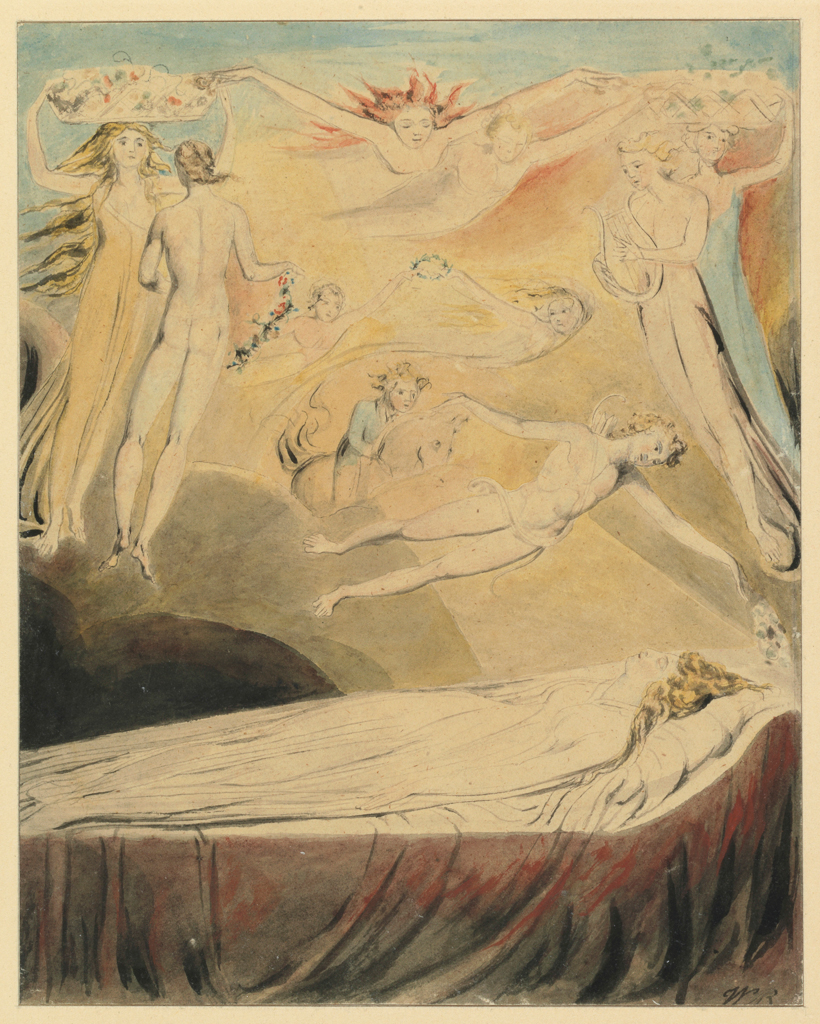
Queen Katharine Drean
circa 1783 to 1790

Blake's picture titled Queen Katharine's Dream is an illustration to lines from William Shakespeare's play Henry VII. Blake choose to illustrate lines from the play which echo his own feelings. As Katharine of Aragon the first wife of Henry lies on her deathbed she reports a dream which she had of the glorious world which awaited her.

Henry VIII , Scene IV
"KATHARINE
No? Saw you not, even now, a blessed troop
Invite me to a banquet; whose bright faces
Cast thousand beams upon me, like the sun?
They promised me eternal happiness;
And brought me garlands, Griffith, which I feel
I am not worthy yet to wear: I shall, assuredly.
GRIFFITH
I am most joyful, madam, such good dreams
Possess your fancy."

Blake painted illustrations for this scene at least three times. A earliest image of the scene resides in the Fitzwilliam Museum, Cambridge and is dated between 1783 and 1790. Look for motifs from Visions of the Daughters of Albion, Blake's lithograph of Enoch, and Plate 33 (37) of Jerusalem in this painting. Shown here are the later images.

British Museum, London (dated 1809).................
National Gallery, Washington
                                                                              (dated 1825)


Friday, October 08, 2021

LARGE COLOR PRINTS 8

First posted Feb 2014

Each of the images in the Large Color Printed Drawings includes paradox. In the House of Death we confront the sorrows of disease and torture and despair as described in Milton's Paradise Lost which this image is said to represent.
 
Paradise Lost
, Book XI, Line 477
"Immediately a place
Before his eyes appeard, sad, noysom, dark,
A Lazar-house it seemd, wherein were laid
Numbers of all diseas'd, all maladies
Of gastly Spasm, or racking torture, qualmes
Of heart-sick Agonie, all feavorous kinds,
Convulsions, Epilepsies, fierce Catarrhs, Intestin Stone and Ulcer, Colic pangs,
Daemoniac Phrenzie, moaping  Melancholie
And Moon-struck madness, pining Atrophie
Marasnus and wide-wasting Pestilence,
Dropsies, and Asthma's, and Joint-racking Rheums.
Dire was the tossing, deep the groans, despair
Tended the sick busiest from Couch to Couch;
And over them triumphant Death his Dart
Shook, but delaid to strike, though oft invokt
With vows, as thir chief good, and final hope."

British Museum
Large Color Printed Drawings House of Death
 

But Blake tells us that these afflictions are of the mortal body which passes away when man is born is his spiritual body.

Vision of Last Judgment, (E 564)
"Many Persons such as Paine & Voltaire with some
of the Ancient Greeks say we will not Converse concerning Good
& Evil we will live in Paradise & Liberty   You may do so in
Spirit but not in the Mortal Body as you pretend till after the
Last Judgment for in Paradise they have no Corporeal & Mortal
Body that originated with the Fall & was calld Death & cannot be
removed but by a Last judgment while we are in the world of
Mortality we Must Suffer   The Whole Creation Groans to be
deliverd there will always be as many Hypocrites born as Honest
Men & they will always have superior Power in Mortal Things   You
cannot have Liberty in this World without what you call Moral
Virtue & you cannot have Moral Virtue without the Slavery of that
half of the Human Race who hate what you call Moral Virtue" 

Blake used the image of Nebuchadnezza when he had fallen into the form of a beast to represent man when he had fallen to the limit of his descent from Eden. This I take to be a statement about the Limit of Contraction. Man has been given the form of Adam, a human form. Taking the form of a beast was a turning point allowing him to reverse directions and recover a vision of Eternity.
 
When nature, the outer world, competes its descent it takes the form of death. Blake speaks of this as the Limit of Contraction or Satan. It is the natural or physical body which is susceptible to death. When man recognizes himself as a spirit which is immortal, he transcends the Limit of Contraction and frees himself from the power of Satan and his offspring death.

Gates of Paradise, Keys of the Gates, (E 268) 
"13 But when once I did descry The Immortal Man that cannot Die 
14 Thro evening shades I haste away To close the Labours of my Day 
15 The Door of Death I open found"

 From William Blake's Circle of Destiny by Milton O Percival, Page 233:   

"Satan and Adam have not been 'fixed,' Christ has not taken on the body of death, to make permanent the limitations of fallen man. The sexual religion will not permanently replace the Divine Vision. Such a hypothesis is the assumption of the unbeliever.

'Voltaire insinuates that these Limits are the cruel work of God
Mocking the Remover of Limits & the Resurrection of the Dead'  (E 228)
On the contrary the limits, like other fixations under Los's hammer, have their ultimate end the removal of all limitations. Christ appears in the mortal form of man that man may take on the immortal form of Christ."

Jerusalem, Plate 42, (E 189) 
"There is a limit of Opakeness, and a limit of Contraction;
In every Individual Man, and the limit of Opakeness,             
Is named Satan: and the limit of Contraction is named Adam.
But when Man sleeps in Beulah, the Saviour in mercy takes
Contractions Limit, and of the Limit he forms Woman: That
Himself may in process of time be born Man to redeem
But there is no Limit of Expansion! there is no Limit of Translucence.   
In the bosom of Man for ever from eternity to eternity.
Therefore I break thy bonds of righteousness; I crush thy messengers!
That they may not crush me and mine: do thou be righteous,
And I will return it; otherwise I defy thy worst revenge:
Consider me as thine enemy: on me turn all thy fury              
But destroy not these little ones, nor mock the Lords anointed:
Destroy not by Moral Virtue, the little ones whom he hath chosen!" 
Four Zoas, Night IV, Page 56, (E 337)
"Such were the words of Beulah of the Feminine Emanation 
The Empyrean groand throughout All Eden was darkend
The Corse of Albion lay on the Rock the sea of Time & Space
Beat round the Rock in mighty waves & as a Polypus
That vegetates beneath the Sea the limbs of Man vegetated      
In monstrous forms of Death a Human polypus of Death

The Saviour mild & gentle bent over the corse of Death
Saying If ye will Believe your Brother shall rise again   
And first he found the Limit of Opacity & namd it Satan
In Albions bosom for in every human bosom these limits stand     
And next he found the Limit of Contraction & namd it Adam
While yet those beings were not born nor knew of good or Evil

Then wondrously the Starry Wheels felt the divine hand. Limit
Was put to Eternal Death Los felt the Limit & saw
The Finger of God touch the Seventh furnace in terror            
And Los beheld the hand of God over his furnaces
Beneath the Deeps in dismal Darkness beneath immensity" 
_______________________________________  


Romans 8 
18] I consider that the sufferings of this present time are not worth comparing with the glory that is to be revealed to us.
[19] For the creation waits with eager longing for the revealing of the sons of God; 
[20] for the creation was subjected to futility, not of its own will but by the will of him who subjected it in hope; 
[21] because the creation itself will be set free from its bondage to decay and obtain the glorious liberty of the children of God. 
[22] We know that the whole creation has been groaning in travail together until now; 
[23] and not only the creation, but we ourselves, who have the first fruits of the Spirit, groan inwardly as we wait for adoption as sons, the redemption of our bodies. 

First Corinthians 15
[21] For as by a man came death, by a man has come also the resurrection of the dead. 
[22] For as in Adam all die, so also in Christ shall all be made alive.  
[23] But each in his own order: Christ the first fruits, then at his coming those who belong to Christ. 
[24] Then comes the end, when he delivers the kingdom to God the Father after destroying every rule and every authority and power. 
[25] For he must reign until he has put all his enemies under his feet. 
[26] The last enemy to be destroyed is death.


Thursday, November 07, 2019

ILLUSTRATING SHAKESPEARE 2

British Museum 
Watercolor 1809

As if an Angel Dropped from the clouds
"but Shakespeare in riper years
gave me his hand"
[Letter to Flaxman, E 707]

With his wide range of interests and knowledge Blake did not confine himself to illustrating/interpreting the bible. For Rev Joseph Thomas, who became an enthusiastic collector of Blake's work, he created this watercolor from Shakespeare's Henry IV. It was included in Thomas' copy of the second folio of Shakespeare's plays.

These are lines from Part 1, Act IV which Blake illustrated:
"All furnished, all in arms,
All plumed like estridges that with the wind
Baited like eagles having lately bathed,
Glittering in golden coats like images,
As full of spirit as the month of May,
And gorgeous as the sun at midsummer,
Wanton as youthful goats, wild as young bulls.
I saw young Harry with his beaver on,

His cuisses on his thighs, gallantly armed
Rise from the ground like feathered Mercury
And vaulted with such ease into his seat
As if an angel dropped down from the clouds,

To turn and wind a fiery Pegasus

And witch the world with noble horsemanship."

This scene portrayed a moment of transformation for young Hal. On the battlefield his prowess was realized as fitting him for his future role as king. Blake used the horse Pegasus, and the rising sun to symbolize the new energy with which the young prince had been imbued. The momentous event was recorded by a heavenly scribe. To be fully prepared the Prince must then secure the horse with the rope he held.

An earlier lost fresco treatment of this subject was included in Blake's exhibit of 1809 for which the Descriptive Catalogue was written:
Descriptive Catalogue, (E 545)

                       "NUMBER VI.
  A Spirit vaulting from a cloud to turn and wind a fiery
Pegasus--Shakspeare.  The horse of Intellect is leaping from the
cliffs of Memory and Reasoning; it is a barren Rock: it is also
called the Barren Waste of Locke and Newton.

THIS Picture was done many years ago, and was one of the first
Mr. B. ever did in Fresco; fortunately or rather providentially
he left it unblotted and unblurred, although molested continually
by blotting and blurring demons; but he was also compelled to
leave it unfinished for reasons that will be shewn in the following."
Milton, Plate 1, (E 95)
"Shakspeare & Milton were
both curbd by the general malady & infection from the silly Greek
& Latin slaves of the Sword.

Descriptive Catalogue, (E 534)
 "For the Host who follows this group, and holds the center 
of the cavalcade, is a first rate character, and his jokes are 
no trifles; they are always, though uttered with audacity, and
equally free with the Lord and the Peasant, they are always
substantially and weightily expressive of knowledge and
experience; Henry Baillie, the keeper of the greatest Inn, of 
the greatest City; for such was the Tabarde Inn in Southwark, 
near London: our Host was also a leader of the age.
By way of illustration, I instance Shakspeare's Witches in
Macbeth.  Those who dress them for the stage, consider
them as wretched old women, and not as Shakspeare intended, the
Goddesses of Destiny; this shews how Chaucer has been
misunderstood in his sublime work.  Shakspeare's Fairies also 
are the rulers of the vegetable world, and so are Chaucer's; 
let them be so considered, and then the poet will be understood, 
and not else.

Here is a quote from the source of my information:
Chantelle L. MacPhee (2002) "All the World's a Stage": William Blake and William Shakespeare. PhD thesis.

"Joseph Thomas commissioned this illustration from Blake for his copy of the second folio of Shakespeare's plays. The inspiration for the picture comes from 1 Henry IV 4.1.107-110, where Sir Richard Vernon at the Battle of Shrewsbury comments on the sudden transformation of Prince Hal into a soldier who vaulted with such ease into his seat As if an angel [dropp' d] down from the clouds To turn and wind a fiery Pegasus And witch the world with noble horsemanship.

Prince Hal's transformation on the battlefield not only confirms his military prowess, but his intellectual prowess as well. The illustration's suggestion of the "dawn of a new day" and Pegasus's reaction in the picture space suggest rebirth, regeneration and the male figure's stance suggests final acceptance of his future role as King of England."

Monday, October 28, 2019

ILLUSTRATING SHAKESPEARE

Originally posted October 2011.

Othello and Desdemona
Dated about 1780
from Thomas Butts collection
Museum of Fine Arts Boston
acquired 1890

In the collection of the Museum of Fine Arts Boston is a group of Blake's illustrations to Shakespeare which are said to have been painted around 1780. Each picture is a close-up portrait of one or two characters in a play of Shakespeare. The pictures were later in Thomas Butts' collection although the estimated date of production is years before Butts is known to have been purchasing Blake's art.

In 1779 Blake had completed his apprenticeship as an engraver with Basire. He was enrolled in the Royal Academy Schools and was seeking to establish himself as a painter as well as an engraver. The Shakespeare pictures are conventional subjects painted in a conventional style, far from the subject matter and methods of production Blake was to employ as he matured.

Here are more of Blake's illustrations for Shakespeare's plays in the Museum of Fine Arts Boston:

Lear and Cordelia

Cordelia and Sleeping Lear


Lear Grasping a Sword

Falstaff and Prince Hal

Macbeth and Lady Macbeth

Juliet Asleep
.

Saturday, December 27, 2014

Shakespeare 0


File:William Blake - William Shakespeare - Manchester City Gallery - Tempera on canvas c 1800.jpg

From Wikimedia Commons, the free media repository

English: Shakespeare by William Blake 1800
Object Name: painting
Artist/Maker: Blake, William Role in production: artist Place of Creation: Europe, United Kingdom, England Date: 1800-1803 (circa)
Medium / Material: tempera
Support: canvas
Technique: tempera on canvas
Description: A head portrait of William Shakespeare. He is depicted here with a faint smile, wearing an Elizabethan collar, surrounded by his own characters. To the right of the figurehead, Macbeth stands beside the three witches and to his left, Hamlet observes a ghostly crowned figure. A wreath of rose leaves frames his head whilst ferns fringe and decorate the top corners, in white on the right and black on the left.
Dimensions
Type: Sight Height: 41 cm Width: 79.5 cm Depth:
Type: Frame Height: 50.8 Width: 88.7 Depth: 7.6


Thursday, December 25, 2014

Shakespeare 15


Brutus and Caesar's Ghost, illustration to 'Julius Caesar' IV, iii by William Blake


Act IV, Scene 3
Brutus’s tent.

Julius Caesar

Hamlet and Julius Caesar

Around 1599, Shakespeare took a sudden departure from writing comedies to focus on the darker themes of moral ambiguity and corruption, both of the state and the individual. The result was two of his finest works, Hamlet and Julius Caesar, which share many common elements. Both plays revolve around the grave ramifications of "the cease of majesty." Both Hamlet's father and Caesar return as spirits to demand revenge. Both tragic heroes, Hamlet and Brutus, are philosophical men with high moral ideals who are forced out of their element and into action, but fail to act appropriately; Hamlet due to irresolution and Brutus to self-delusion. One could find many more parallels. Interestingly, Shakespeare alludes to Julius Caesar twice in Hamlet, in 1.1:
In the most high and palmy state of Rome,
A little ere the mightiest Julius fell,
The graves stood tenantless and the sheeted dead
Did squeak and gibber in the Roman streets. (113-116)


---
Enter BRUTUS and CASSIUS
  • CassiusThat you have wrong'd me doth appear in this:
    You have condemn'd and noted Lucius Pella 1980
    For taking bribes here of the Sardians;
    Wherein my letters, praying on his side,
    Because I knew the man, were slighted off.
  • BrutusYou wronged yourself to write in such a case.
  • CassiusIn such a time as this it is not meet 1985
    That every nice offence should bear his comment.
  • BrutusLet me tell you, Cassius, you yourself
    Are much condemn'd to have an itching palm;
    To sell and mart your offices for gold
    To undeservers.1990
  • CassiusI an itching palm!
    You know that you are Brutus that speak this,
    Or, by the gods, this speech were else your last.
  • BrutusThe name of Cassius honours this corruption,
    And chastisement doth therefore hide his head.1995
  • BrutusRemember March, the ides of March remember:
    Did not great Julius bleed for justice' sake?
    What villain touch'd his body, that did stab,
    And not for justice? What, shall one of us 2000
    That struck the foremost man of all this world
    But for supporting robbers, shall we now
    Contaminate our fingers with base bribes,
    And sell the mighty space of our large honours
    For so much trash as may be grasped thus? 2005
    I had rather be a dog, and bay the moon,
    Than such a Roman.
  • CassiusBrutus, bay not me;
    I'll not endure it: you forget yourself,
    To hedge me in; I am a soldier, I, 2010
    Older in practise, abler than yourself
    To make conditions.
  • BrutusGo to; you are not, Cassius.
  • BrutusI say you are not.2015
  • CassiusUrge me no more, I shall forget myself;
    Have mind upon your health, tempt me no further.
  • BrutusHear me, for I will speak. 2020
    Must I give way and room to your rash choler?
    Shall I be frighted when a madman stares?
  • CassiusO ye gods, ye gods! must I endure all this?
  • BrutusAll this! ay, more: fret till your proud heart break;
    Go show your slaves how choleric you are, 2025
    And make your bondmen tremble. Must I budge?
    Must I observe you? must I stand and crouch
    Under your testy humour? By the gods
    You shall digest the venom of your spleen,
    Though it do split you; for, from this day forth, 2030
    I'll use you for my mirth, yea, for my laughter,
    When you are waspish.
  • BrutusYou say you are a better soldier:
    Let it appear so; make your vaunting true, 2035
    And it shall please me well: for mine own part,
    I shall be glad to learn of noble men.
  • CassiusYou wrong me every way; you wrong me, Brutus;
    I said, an elder soldier, not a better:
    Did I say 'better'?2040
  • BrutusIf you did, I care not.
  • CassiusWhen Caesar lived, he durst not thus have moved me.
  • BrutusPeace, peace! you durst not so have tempted him.
  • CassiusWhat, durst not tempt him!
  • BrutusFor your life you durst not!
  • CassiusDo not presume too much upon my love;
    I may do that I shall be sorry for.
  • BrutusYou have done that you should be sorry for. 2050
    There is no terror, Cassius, in your threats,
    For I am arm'd so strong in honesty
    That they pass by me as the idle wind,
    Which I respect not. I did send to you
    For certain sums of gold, which you denied me: 2055
    For I can raise no money by vile means:
    By heaven, I had rather coin my heart,
    And drop my blood for drachmas, than to wring
    From the hard hands of peasants their vile trash
    By any indirection: I did send 2060
    To you for gold to pay my legions,
    Which you denied me: was that done like Cassius?
    Should I have answer'd Caius Cassius so?
    When Marcus Brutus grows so covetous,
    To lock such rascal counters from his friends, 2065
    Be ready, gods, with all your thunderbolts;
    Dash him to pieces!
  • CassiusI did not: he was but a fool that brought 2070
    My answer back. Brutus hath rived my heart:
    A friend should bear his friend's infirmities,
    But Brutus makes mine greater than they are.
  • BrutusI do not, till you practise them on me.
  • BrutusI do not like your faults.
  • CassiusA friendly eye could never see such faults.
  • BrutusA flatterer's would not, though they do appear
    As huge as high Olympus.
  • CassiusCome, Antony, and young Octavius, come, 2080
    Revenge yourselves alone on Cassius,
    For Cassius is aweary of the world;
    Hated by one he loves; braved by his brother;
    Cheque'd like a bondman; all his faults observed,
    Set in a note-book, learn'd, and conn'd by rote, 2085
    To cast into my teeth. O, I could weep
    My spirit from mine eyes! There is my dagger,
    And here my naked breast; within, a heart
    Dearer than Plutus' mine, richer than gold:
    If that thou be'st a Roman, take it forth; 2090
    I, that denied thee gold, will give my heart:
    Strike, as thou didst at Caesar; for, I know,
    When thou didst hate him worst, thou lovedst him better
    Than ever thou lovedst Cassius.
  • BrutusSheathe your dagger: 2095
    Be angry when you will, it shall have scope;
    Do what you will, dishonour shall be humour.
    O Cassius, you are yoked with a lamb
    That carries anger as the flint bears fire;
    Who, much enforced, shows a hasty spark, 2100
    And straight is cold again.
  • CassiusHath Cassius lived
    To be but mirth and laughter to his Brutus,
    When grief, and blood ill-temper'd, vexeth him?
  • BrutusWhen I spoke that, I was ill-temper'd too.2105
  • CassiusDo you confess so much? Give me your hand.
  • CassiusHave not you love enough to bear with me, 2110
    When that rash humour which my mother gave me
    Makes me forgetful?
  • BrutusYes, Cassius; and, from henceforth,
    When you are over-earnest with your Brutus,
    He'll think your mother chides, and leave you so.2115
  • Poet[Within] Let me go in to see the generals;
    There is some grudge between 'em, 'tis not meet
    They be alone.
  • Lucilius[Within] You shall not come to them.
  • Poet[Within] Nothing but death shall stay me.2120
Enter Poet, followed by LUCILIUS, Tintinius, and LUCIUS
  • CassiusHow now! what's the matter?
  • PoetFor shame, you generals! what do you mean?
    Love, and be friends, as two such men should be;
    For I have seen more years, I'm sure, than ye.2125
  • CassiusHa, ha! how vilely doth this cynic rhyme!
  • BrutusGet you hence, sirrah; saucy fellow, hence!
  • CassiusBear with him, Brutus; 'tis his fashion.
  • BrutusI'll know his humour, when he knows his time:
    What should the wars do with these jigging fools? 2130
    Companion, hence!
Exit Poet
  • BrutusLucilius and Tintinius, bid the commanders
    Prepare to lodge their companies to-night.2135
  • CassiusAnd come yourselves, and bring Messala with you
    Immediately to us.
Exeunt LUCILIUS and Tintinius
  • BrutusLucius, a bowl of wine!
Exit LUCIUS
  • CassiusI did not think you could have been so angry.
  • BrutusO Cassius, I am sick of many griefs.
  • CassiusOf your philosophy you make no use,
    If you give place to accidental evils.
  • BrutusNo man bears sorrow better. Portia is dead.2145
  • CassiusHow 'scaped I killing when I cross'd you so?
    O insupportable and touching loss!
    Upon what sickness?2150
  • BrutusImpatient of my absence,
    And grief that young Octavius with Mark Antony
    Have made themselves so strong:—for with her death
    That tidings came;—with this she fell distract,
    And, her attendants absent, swallow'd fire.2155
Re-enter LUCIUS, with wine and taper
  • BrutusSpeak no more of her. Give me a bowl of wine. 2160
    In this I bury all unkindness, Cassius.
  • CassiusMy heart is thirsty for that noble pledge.
    Fill, Lucius, till the wine o'erswell the cup;
    I cannot drink too much of Brutus' love.
  • BrutusCome in, Tintinius! 2165
    [Exit LUCIUS]
    [Re-enter Tintinius, with MESSALA]
    Welcome, good Messala.
    Now sit we close about this taper here,
    And call in question our necessities.2170
  • BrutusNo more, I pray you.
    Messala, I have here received letters,
    That young Octavius and Mark Antony
    Come down upon us with a mighty power, 2175
    Bending their expedition toward Philippi.
  • MessalaMyself have letters of the selfsame tenor.
  • BrutusWith what addition?
  • MessalaThat by proscription and bills of outlawry,
    Octavius, Antony, and Lepidus, 2180
    Have put to death an hundred senators.
  • BrutusTherein our letters do not well agree;
    Mine speak of seventy senators that died
    By their proscriptions, Cicero being one.
  • MessalaCicero is dead,
    And by that order of proscription.
    Had you your letters from your wife, my lord?
  • MessalaNor nothing in your letters writ of her?2190
  • MessalaThat, methinks, is strange.
  • BrutusWhy ask you? hear you aught of her in yours?
  • BrutusNow, as you are a Roman, tell me true.2195
  • MessalaThen like a Roman bear the truth I tell:
    For certain she is dead, and by strange manner.
  • BrutusWhy, farewell, Portia. We must die, Messala:
    With meditating that she must die once,
    I have the patience to endure it now.2200
  • MessalaEven so great men great losses should endure.
  • CassiusI have as much of this in art as you,
    But yet my nature could not bear it so.
  • BrutusWell, to our work alive. What do you think
    Of marching to Philippi presently?2205
  • CassiusI do not think it good.
  • CassiusThis it is:
    'Tis better that the enemy seek us:
    So shall he waste his means, weary his soldiers, 2210
    Doing himself offence; whilst we, lying still,
    Are full of rest, defense, and nimbleness.
  • BrutusGood reasons must, of force, give place to better.
    The people 'twixt Philippi and this ground
    Do stand but in a forced affection; 2215
    For they have grudged us contribution:
    The enemy, marching along by them,
    By them shall make a fuller number up,
    Come on refresh'd, new-added, and encouraged;
    From which advantage shall we cut him off, 2220
    If at Philippi we do face him there,
    These people at our back.
  • BrutusUnder your pardon. You must note beside,
    That we have tried the utmost of our friends, 2225
    Our legions are brim-full, our cause is ripe:
    The enemy increaseth every day;
    We, at the height, are ready to decline.
    There is a tide in the affairs of men,
    Which, taken at the flood, leads on to fortune; 2230
    Omitted, all the voyage of their life
    Is bound in shallows and in miseries.
    On such a full sea are we now afloat;
    And we must take the current when it serves,
    Or lose our ventures.2235
  • CassiusThen, with your will, go on;
    We'll along ourselves, and meet them at Philippi.
  • BrutusThe deep of night is crept upon our talk,
    And nature must obey necessity;
    Which we will niggard with a little rest. 2240
    There is no more to say?
  • CassiusNo more. Good night:
    Early to-morrow will we rise, and hence.
  • BrutusLucius!
    [Enter LUCIUS] 2245
    My gown.
    [Exit LUCIUS]
    Farewell, good Messala:
    Good night, Tintinius. Noble, noble Cassius,
    Good night, and good repose.2250
  • CassiusO my dear brother!
    This was an ill beginning of the night:
    Never come such division 'tween our souls!
    Let it not, Brutus.
  • BrutusEvery thing is well.2255
  • BrutusGood night, good brother.
  • Tintinius[with MESSALA] Good night, Lord Brutus.
  • BrutusFarewell, every one.
    [Exeunt all but BRUTUS] 2260
    [Re-enter LUCIUS, with the gown]
    Give me the gown. Where is thy instrument?
  • BrutusWhat, thou speak'st drowsily?
    Poor knave, I blame thee not; thou art o'er-watch'd. 2265
    Call Claudius and some other of my men:
    I'll have them sleep on cushions in my tent.
  • LuciusVarro and Claudius!
Enter VARRO and CLAUDIUS
  • VarroCalls my lord?2270
  • BrutusI pray you, sirs, lie in my tent and sleep;
    It may be I shall raise you by and by
    On business to my brother Cassius.
  • VarroSo please you, we will stand and watch your pleasure.
  • BrutusI will not have it so: lie down, good sirs; 2275
    It may be I shall otherwise bethink me.
    Look, Lucius, here's the book I sought for so;
    I put it in the pocket of my gown.
VARRO and CLAUDIUS lie down
  • LuciusI was sure your lordship did not give it me.2280
  • BrutusBear with me, good boy, I am much forgetful.
    Canst thou hold up thy heavy eyes awhile,
    And touch thy instrument a strain or two?
  • LuciusAy, my lord, an't please you.
  • BrutusIt does, my boy: 2285
    I trouble thee too much, but thou art willing.
  • LuciusIt is my duty, sir.
  • BrutusI should not urge thy duty past thy might;
    I know young bloods look for a time of rest.
  • LuciusI have slept, my lord, already.2290
  • BrutusIt was well done; and thou shalt sleep again;
    I will not hold thee long: if I do live,
    I will be good to thee.
    [Music, and a song]
    This is a sleepy tune. O murderous slumber, 2295
    Lay'st thou thy leaden mace upon my boy,
    That plays thee music? Gentle knave, good night;
    I will not do thee so much wrong to wake thee:
    If thou dost nod, thou break'st thy instrument;
    I'll take it from thee; and, good boy, good night. 2300
    Let me see, let me see; is not the leaf turn'd down
    Where I left reading? Here it is, I think.
    [Enter the Ghost of CAESAR]
    How ill this taper burns! Ha! who comes here?
    I think it is the weakness of mine eyes 2305
    That shapes this monstrous apparition.
    It comes upon me. Art thou any thing?
    Art thou some god, some angel, or some devil,
    That makest my blood cold and my hair to stare?
    Speak to me what thou art.2310
  • CaesarThy evil spirit, Brutus.
  • CaesarTo tell thee thou shalt see me at Philippi.
  • BrutusWell; then I shall see thee again?
  • CaesarAy, at Philippi.2315
  • BrutusWhy, I will see thee at Philippi, then.
    [Exit Ghost]
    Now I have taken heart thou vanishest:
    Ill spirit, I would hold more talk with thee.
    Boy, Lucius! Varro! Claudius! Sirs, awake! Claudius!2320
  • LuciusThe strings, my lord, are false.
  • BrutusHe thinks he still is at his instrument.
    Lucius, awake!
  • BrutusDidst thou dream, Lucius, that thou so criedst out?2325
  • LuciusMy lord, I do not know that I did cry.
  • BrutusYes, that thou didst: didst thou see any thing?
  • BrutusSleep again, Lucius. Sirrah Claudius!
    [To VARRO] 2330
    Fellow thou, awake!
  • BrutusWhy did you so cry out, sirs, in your sleep?
  • Varro[with Claudius] Did we, my lord?2335
  • BrutusAy: saw you any thing?
  • VarroNo, my lord, I saw nothing.
  • BrutusGo and commend me to my brother Cassius;
    Bid him set on his powers betimes before, 2340
    And we will follow.
  • Varro[with Claudius] It shall be done, my lord.
[Exeunt]
---