Showing posts with label Four Zoas Night I. Show all posts

Friday, December 05, 2025

ENION'S LAMENTS

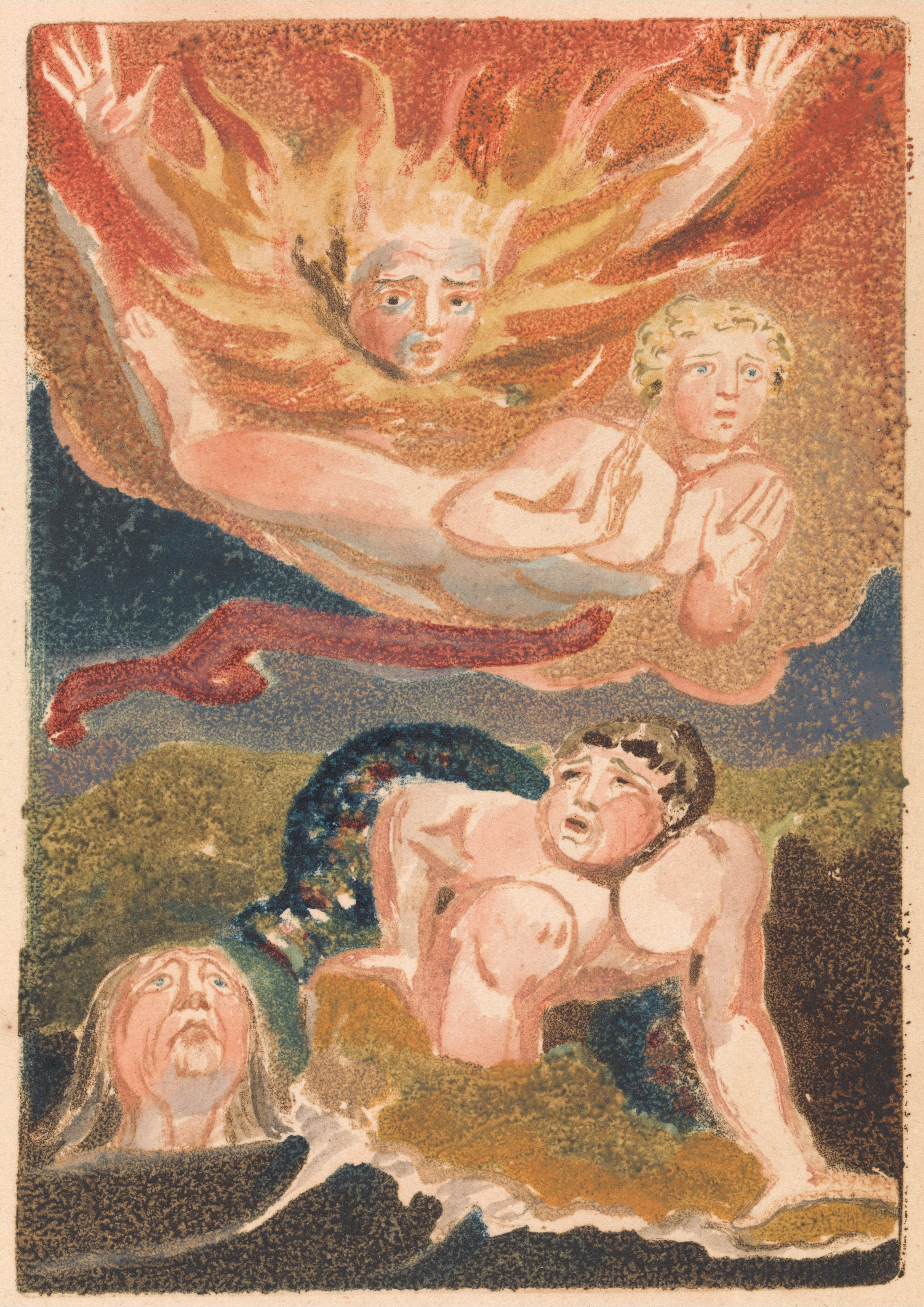
Original in British Library
Four Zoas, Night i
Page 6
Enion Asleep

WHY

Night the First

Four Zoas, Page 17-18 (E 310) Night the First, Line1

Post Lament i

https://ramhornd.blogspot.com/2019/04/lament-i.html


PRICE OF EXPERIENCE

Night the Second

Four Zoas, Page 35-36 (E 324) Night the Second, Line 1

Post Lament ii

https://ramhornd.blogspot.com/2019/04/lament-ii.html


THARMAS I HAVE LOST THEE

Night the Third

Four Zoas, Page 45 (E 329) Night the ThirdLine 2 ff

Post Lament iii  AI has seen fit to alter this link - use the URL below to reach the post

https: //ramhornd.blogspot.com/2019/05/lament-iii.html


MORTAL GENTLY FADES AWAY

Night the Eighth

Four Zoas, Page 113-4 (E 383) Night the Eighth, Line 13 

Post Lament iv

https://ramhornd.blogspot.com/2019/05/lament-iv.html

________________________________________________

Four Zoas, Night III, Page 45, (E 329)
"These are the words of Enion heard from the cold waves of despair

O Tharmas I had lost thee. & when I hoped I had found thee
O Tharmas do not thou destroy me quite but let
A little shadow. but a little showery form of Enion
Be near thee loved Terror. let me still remain & then do thou
Thy righteous doom upon me. only let me hear thy voice           
Driven by thy rage I wander like a cloud into the deep
Where never yet Existence came, there losing all my life
I back return weaker & weaker, consume me not away
In thy great wrath. tho I have sinned. tho I have rebelld
Make me not like the things forgotten as they had not been       
Make not the thing that loveth thee. a tear wiped away

Tharmas replied riding on storms his voice of Thunder rolld" 
Enion, the Emanation of Tharmas or the body, represents the generative instinct. She is the material expression of the instictive functioning of the physical body. Enion flees from Tharmas as a result of their quarrel over his awakening sexual instinct. Before they separate they procreate the infants Los and Enitharmon. Their children form the world by embodying the qualities Time and Space.

In William Blake's Circle of Destiny by Milton O Percival we learn of the cycle which Tharmas and Enion are following:
 
"There are two co-operating principles, one formative and intellectual, the other recipient and material." (Page 257) 

"This is the procession downward and outward - from mind to matter, from light to darkness, from reason to unreason, from the One to the Many. The return procession - upward and inward - recovers, step by step, what has been lost." (Page 259)

"As the Zoas fall, the physical world undergoes changes correspondent to those in the spiritual world. The fall is allegorized. The Divine Vision is replaced by the "Dark Religions"; the eternal world by the mortal world. Enion in her mortal state is the mortal body that "originated with the Fall and was called Death and cannot be removed but by a Last Judgment." As Albion sinks into doubt and unbelief, she descends, as a mental concept, from her spiritual and immortal state as far as nonentity itself, that blank, invisible, intangible, basic matter of ancient metaphysics...In this role she becomes the "dark consumer," an "eternal consummeration," the purveyor of Los's "vegetable fires." But all things are redemed in Christ, his advent brings to Enion the hope of release." (Page 266)

First Corinthians 15
[9] For I am the least of the apostles, that am not meet to be called an apostle, because I persecuted the church of God.
[10] But by the grace of God I am what I am: and his grace which was bestowed upon me was not in vain; but I laboured more abundantly than they all: yet not I, but the grace of God which was with me.
[11] Therefore whether it were I or they, so we preach, and so ye believed.
[12] Now if Christ be preached that he rose from the dead, how say some among you that there is no resurrection of the dead?
[13] But if there be no resurrection of the dead, then is Christ not risen:
[14] And if Christ be not risen, then is our preaching vain, and your faith is also vain.
[15] Yea, and we are found false witnesses of God; because we have testified of God that he raised up Christ: whom he raised not up, if so be that the dead rise not.
[16] For if the dead rise not, then is not Christ raised:
[17] And if Christ be not raised, your faith is vain; ye are yet in your sins.
[18] Then they also which are fallen asleep in Christ are perished.
[19] If in this life only we have hope in Christ, we are of all men most miserable.
[20] But now is Christ risen from the dead, and become the firstfruits of them that slept.
[21] For since by man came death, by man came also the resurrection of the dead.
[22] For as in Adam all die, even so in Christ shall all be made alive.


Wednesday, January 17, 2024

INDIVIDUATION

Wikipedia Commons
Four Zoas, Night VII
Page 39

To seek self-knowledge is to enter the maze through which there is no direct path.

Quotes from On the Nature of the Psyche, by C G Jung:

Page 133

"Every other science has so to speak an outside; not so psychology, whose object is the inside subject of all science.

Psychology therefore culminates of necessity in a developmental process which is peculiar to the psyche and consists of integrating the unconscious contents into consciousness. 

I doubt my ability to give a proper account of the change that comes over the subject under the influence of the individuation process; ... if the unconscious if to be integrated indispensable business of coming to terms with the unconscious components of the personality. Once these unconscious components are made conscious, it results not only in their assimilation to the already existing personality, but a transformation of the latter." 

Page 134

"the ego ... cannot easily be altered ... If the structure of the ego-consciousness is strong enough to withstand the assault ... there is an alteration of the ego as well as of the unconscious contents... the ego is ousted from its central and dominating position... the unconscious contents has vitalized the personality, enriched it  and created a figure that somehow dwarfs the ego in scope and intensity...In this way the will, as disposable energy, gradually subordinates itself to the stronger factor, namely the new totality-figure I call the self."  

Page 135 (Note)

"Conscious wholeness consists in a successful union of ego and self, so that both preserve their intrinsic qualities. If, instead of this union, the ego is overpowered by the self, then the self too does not attain the form it ought to have, but remains on a primitive level and can express itself only in archaic symbols."

Page 136

"the self comprises infinitely more than a mere ego, as the symbolism has shown of old. It is as much one's own self, and all other selves, as the ego. Individuation does not shut on out from the world, but gathers the world to oneself."


Both William Blake and Carl Jung were consumed with understanding the human psyche. As a starting point they each looked inward into their own condition. To share their insights Blake used poetic language and Jung used a more prosaic or scientific style. Each man developed his own vocabulary to describe the inner realities he discovered. But if we look closely at what they found we see  the similarities.  


THERE is NO NATURAL RELIGION, (E 2)
The Author & Printer W Blake
IV  None could have other than natural or organic thoughts if
he had none but organic perceptions
  V  Mans desires are limited by his perceptions. none can desire
what he has not perciev'd
  VI  The desires & perceptions of man untaught by any thing but
organs of sense, must be limited to objects of sense.
  THERE is NO NATURAL RELIGION [b]   
I  Mans perceptions are not bounded by organs of perception. he
percieves more than sense (tho' ever so acute) can discover. ...
VII The desire of Man being Infinite the possession is Infinite
& himself Infinite"
Milton, Plate 2, (E 96)  
"Come into my hand    
By your mild power; descending down the Nerves of my right arm
From out the Portals of my Brain, where by your ministry
The Eternal Great Humanity Divine. planted his Paradise,
And in it caus'd the Spectres of the Dead to take sweet forms
In likeness of himself. Tell also of the False Tongue! vegetated
Beneath your land of shadows: of its sacrifices. and
Its offerings; even till Jesus, the image of the Invisible God
Became its prey; a curec, an offering, and an atonement,
For Death Eternal in the heavens of Albion, & before the Gates
Of Jerusalem his Emanation, in the heavens beneath Beulah  
Jerusalem, Plate 4, (E 146)
"Of the Sleep of Ulro! and of the passage through
Eternal Death! and of the awaking to Eternal Life.

This theme calls me in sleep night after night, & ev'ry morn
Awakes me at sun-rise, then I see the Saviour over me 
Spreading his beams of love, & dictating the words of this mild song.  
Awake! awake O sleeper of the land of shadows, wake! expand!
I am in you and you in me, mutual in love divine:" 
Milton, Plate 35 [39], (E 35)
"So spake Ololon in reminiscence astonishd, but they
Could not behold Golgonooza without passing the Polypus
A wondrous journey not passable by Immortal feet, & none         
But the Divine Saviour can pass it without annihilation.
For Golgonooza cannot be seen till having passd the Polypus
It is viewed on all sides round by a Four-fold Vision
Or till you become Mortal & Vegetable in Sexuality
Then you behold its mighty Spires & Domes of ivory & gold        
And Ololon examined all the Couches of the Dead.
Even of Los & Enitharmon & all the Sons of Albion
And his Four Zoas terrified & on the verge of Death"
Jerusalem, PLATE 63, (213)
"Jehovah stood among the Druids in the Valley of Annandale
When the Four Zoas of Albion, the Four Living Creatures, the Cherubim
Of Albion tremble before the Spectre, in the starry likeness of the Plow
Of Nations. And their Names are Urizen & Luvah & Tharmas & Urthona"
Four Zoas, Night 1, Page 1, E 300)
" THE FOUR ZOAS

          The torments of Love & Jealousy in 
                The Death and Judgement
               of Albion the Ancient Man
                                  by William Blake 1797
...
Night the First
The Song of the Aged Mother which shook the heavens with wrath
Hearing the march of long resounding strong heroic Verse
Marshalld in order for the day of Intellectual Battle

Four Mighty Ones are in every Man;
   a Perfect Unity                   John XVII c. 21 & 22 & 23 v
Cannot Exist. but from the Universal                             
   Brotherhood of Eden                 John I c. 14. v

The Universal Man. To Whom be
     Glory Evermore Amen       <Greek [kai eskanosen en [h]amen]>

[What] are the Natures of those Living Creatures the
     Heavenly Father only
[Knoweth] no Individual [Knoweth nor] Can know
     in all Eternity  

Los was the fourth immortal starry one, & in the Earth
Of a bright Universe Empery attended day & night                 
Days & nights of revolving joy, Urthona was his name

PAGE 4  
In Eden; in the Auricular Nerves of Human life
Which is the Earth of Eden, he his Emanations propagated
Fairies of Albion afterwards Gods of the Heathen, Daughter of Beulah Sing
His fall into Division & his Resurrection to Unity
His fall into the Generation of Decay & Death & his Regeneration 
     by the Resurrection from the dead"  
Milton, (Plate 24 [26], (E 119)
"the Seven Eyes of God continually
Guard round them, but I the Fourth Zoa am also set
The Watchman of Eternity, the Three are not! & I am preserved
Still my four mighty ones are left to me in Golgonooza           
Still Rintrah fierce, and Palamabron mild & piteous
Theotormon filld with care, Bromion loving Science

You O my Sons still guard round Los. O wander not & leave me Rintrah,"
Milton, Plate 28 [30], (E 126)
"While the poor indigent is like the diamond which tho cloth'd
In rugged covering in the mine, is open all within
And in his hallowd center holds the heavens of bright eternity
Milton, Plate 30 [33], (E 131)
"And none can tell how from so small a center comes such sweets
Forgetting that within that Center Eternity expands
Its ever during doors, that Og & Anak fiercely guard"
Four Zoas, Night VIII, Page 114, (E 385)
"He touches the remotest pole & in the Center weeps
That Man should Labour & sorrow & learn & forget & return
To the dark valley whence he came to begin his labours anew
In pain he sighs in pain he labours in his universe
Screaming in birds over the deep & howling in the Wolf
Over the slain & moaning in the cattle & in the winds
And weeping over Orc & Urizen in clouds & flaming fires   
And in the cries of birth & in the groans of death his voice 
Is heard throughout the Universe whereever a grass grows
Or a leaf buds   The Eternal Man is seen is heard   is felt
And all his Sorrows till he reassumes his ancient bliss

Such are the words of Ahania & Enion. Los hears & weeps" 

Sunday, December 15, 2019

Blake's Style

Wikipedia Commons   Jerusalem   Plate 37, Detail   

From
Blake's Style published Oct 6, 2014

   One simple clue to reading Blake concerns his use of dialogue; he spoke with many voices. He exercised this freedom especially with the larger prophecies, the three major works. These on first reading may seem to present insuperable difficulties, but the reader who pays close attention to the identity of the speaker at each point will thereby break down the forest into manageable groves of trees. In his three long poems Blake gave titles to various elements or speeches; they became units, landmarks or guideposts, casting light on what at first seemed general confusion. 

In Night i of 'The Four Zoas' for example we find Enitharmon's Song of Death (FZ1-10.9; E305), second the "Nuptial Song" of the "demons of the deep" (FZ1-13.20; E308), and third the message of the Daughters of Beulah, which they call the "Wars of Death Eternal"(FZ1-21.13; E311). These three songs comprise three of the many selves of the human psyche; needless to say their ideas and attitudes vary immensely. They all describe the same event, but they see it, oh, so differently. They use the same words with different meanings. For example consider that what the daughters call "Death Eternal" the demons call marriage. In this way Blake challenges the reader and stretches his mind and immensely rewards whoever will accept the challenge. He gives us the end of a golden string.

Ellie added:
In the early pages of the Four Zoas the disintegration process was presented from various perspectives. Although it was Albion, the totality, who was coming apart, it was the broken factions who were left to explain what was happening. Enitharmon who had been released from her parents and her twin brother promised to sing a Song of Death. The death of the old order she saw an opportunity. By turning away and refusing to 'look upon the Universal Vision' she would 'drink up' all the powers of man.

Four Zoas, Night 1, Page 9, (E 305)
"But the two youthful wonders wanderd in the world of Tharmas
Thy name is Enitharmon; said the fierce prophetic boy
While thy mild voice fills all these Caverns with sweet harmonyO how our Parents sit & mourn in their silent secret bowers
Page 10
But Enitharmon answerd with a dropping tear & frowning
Dark as a dewy morning when the crimson light appears
To make us happy let them weary their immortal powers
While we draw in their sweet delights while we return them scorn
On scorn to feed our discontent; for if we grateful proveThey will withhold sweet love, whose food is thorns & bitter roots.We hear the warlike clarions we view the turning spheres
Yet Thou in indolence reposest holding me in bonds  Hear! I will sing a Song of Death! it is a Song of Vala!
The Fallen Man takes his repose: Urizen sleeps in the porch
Luvah and Vala woke & flew up from the Human Heart
Into the Brain; from thence upon the pillow Vala slumber'd.And Luvah siez'd the Horses of Light, & rose into the Chariot of DaySweet laughter siezd me in my sleep! silent & close I laughd
For in the visions of Vala I walkd with the mighty Fallen One I heard his voiceI heard his voice among the branches, & among sweet flowers. Why is the light of Enitharmon darken'd in dewy morn
Why is the silence of Enitharmon a terror & her smile a whirlwind
Uttering this darkness in my halls, in the pillars of my Holy-onesWhy dost thou weep as Vala? & wet thy veil with dewy tears,
In slumbers of my night-repose, infusing a false morning?Driving the Female Emanations all away from Los I have refusd to look upon the Universal VisionAnd wilt thou slay with death him who devotes himself to thee
Once born for the sport & amusement of Man now born to drink up all his PowersPage 11I heard the sounding sea; I heard the voice weaker and weaker;The voice came & went like a dream, I awoke in my sweet bliss.Then Los smote her upon the Earth twas long eer she revivdHe answer'd, darkning more with indignation hid in smiles
I die not Enitharmon tho thou singst thy Song of Death"

Los, whose emanation Enitharmon was, made his protest by striking Enitharmon. His regret over this act of violence led to a proposed marriage between the two which was celebrated at the Nuptial Feast. Rather than repairing the breach the Nuptial Feast awoke the 'Demon of Waves' who initiated 'vegetative life' with 'Spirits of Flaming fire on high' to govern 'the mighty Song.' The process had moved out of the control of Los and Enitharmon as additional forces were turned loose.

Four Zoas, Night 1, Page 13, (E 308)
"And Los & Enitharmon sat in discontent & scorn
The Nuptial Song arose from all the thousand thousand spirits
Over the joyful Earth & Sea, and ascended into the Heavens
For Elemental Gods their thunderous Organs blew; creating
Delicious Viands. Demons of Waves their watry Eccho's woke!
Bright Souls of vegetative life, budding and blossoming
Page 14
Stretch their immortal hands to smite the gold & silver Wires
And with immortal Voice soft warbling fill all Earth & Heaven.
With doubling Voices & loud Horns wound round sounding
Cavernous dwellers fill'd the enormous Revelry, Responsing!
And Spirits of Flaming fire on high, govern'd the mighty Song.
And This the Song! sung at The Feast of Los & Enitharmon"

Those observing the events from the perspective of Beulah, gave a report to the divine presence. Their account focused on Urizen and Luvah, two aspects of the human psyche, who began a plot to gain power over Jerusalem, the emanation of Albion.

Four Zoas, Night 1, Page 21, (E 311)
"So spoke the Ambassadors from Beulah & with solemn mourning
They were introducd to the divine presence & they kneeled down
In Conways Vale thus recounting the Wars of Death Eternal
The Eternal Man wept in the holy tent Our Brother in Eternity Even Albion
Even Albion whom thou lovest wept in pain his family
Slept round on hills & valleys in the regions of his love
But Urizen awoke & Luvah woke & thus conferrd
Thou Luvah said the Prince of Light behold our sons & daughters
Reposd on beds. let them sleep on. do thou alone depart
Into thy wished Kingdom where in Majesty & Power
We may erect a throne. deep in the North I place my lot
Thou in the South listen attentive. In silent of this night
I will infold the Eternal tent in clouds opake while thou
Siezing the chariots of the morning. Go outfleeting ride
Afar into the Zenith high bending thy furious course
Southward with half the tents of men inclosd in clouds
Will lay my scepter on Jerusalem the Emanation
On all her sons & on thy sons O Luvah & on mine
Till dawn was wont to wake them then my trumpet sounding loud
Ravishd away in night my strong command shall be obeyd
For I have placd my centinels in stations each tenth man
Is bought & sold & in dim night my Word shall be their law" 

So the fall of man can appear as release from constrains as it did to Enitharmon, as an imposition of a new order of governing as it did at the nuptials of Los and Enitharmon, and as distancing of man from his connection to the Infinite, as it did to Unizen and Luvah when they sought to overthrow the established psychic order. There are among the processes which Blake describes in detail as he develops his characters and leads his reader along the path to regeneration.
.

Thursday, September 12, 2019

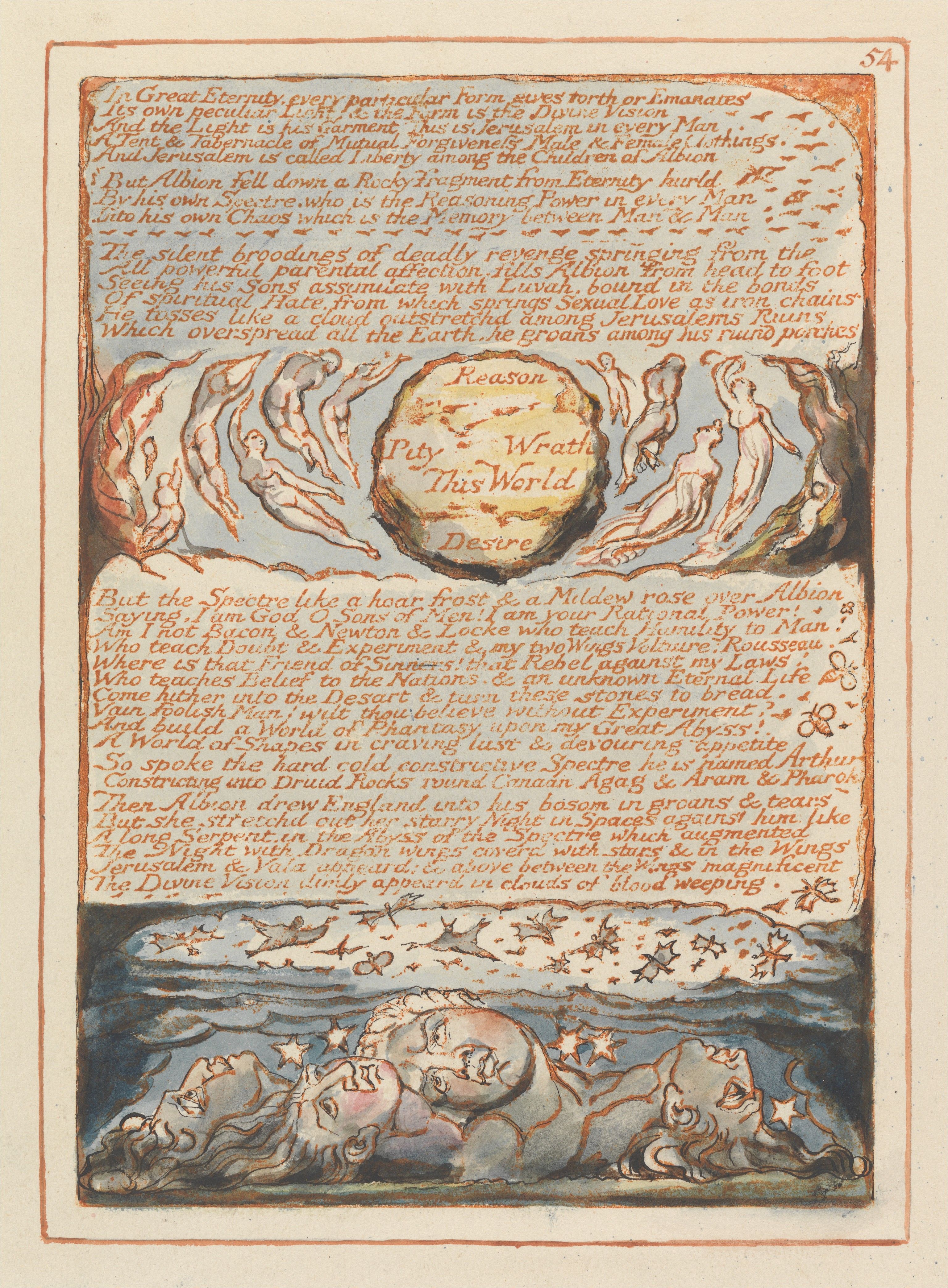
STARRY HOST


Yale Center for British Art

Jerusalem 
Plate 54

The wisdom integral to reason was distributed to the stars when Urizen fell. It became incorporated in the Starry Host which followed Urizen through the wilderness. In as much as man follows Urizen through the confusion of corporeality he is the Starry Host. It is interesting that two of the meanings of the word host may be applied to Blake's phrase. The multitude of humanity which concedes control of the mind to rationality are members of the Starry Host. But man must invite and allow Urizen to become his master; he must be a willing host to the dominance of Urizen. Man chooses to become the Starry Host.


Los, 'who is the Vehicular Form of strong Urthona', the source of intuition, imagination and integration, refused to concede. His first reaction was to oppose Urizen using the same fury which Urizen used. However, when in his anger he struck Enitharmon, he began a cascade of degradation which was not easy to reverse. 

Marriage of Heaven and Hell, Plate 26, (E 44)
Song of Liberty

"15. Down rushd beating his wings in vain the jealous king: his
grey brow'd councellors, thunderous warriors, curl'd veterans,
among helms, and shields, and chariots horses, elephants:
banners, castles, slings and rocks,

16. Falling, rushing, ruining! buried in the ruins, on Urthona's
dens.
17. All night beneath the ruins, then their sullen flames faded
emerge round the gloomy king,
18. With thunder and fire: leading his starry hosts thro' the waste wilderness he promulgates his ten commands, glancing his beamy eyelids over the deep in dark dismay,"
waste wilderness he promulgates his ten commands,
glancing his beamy eyelids over the deep in dark dismay,"

America, Plate 8, (E 54)
"The terror answerd: I am Orc, wreath'd round the accursed tree:
The times are ended; shadows pass the morning gins to break;
The fiery joy, that Urizen perverted to ten commands,
What night he led the starry hosts thro' the wide wilderness:
That stony law I stamp to dust: and scatter religion abroad
To the four winds as a torn book, & none shall gather the leaves;"

Four Zoas, Night I, Page 12, (E 307)
"Sullen sat Los plotting Revenge. Silent he eye'd the Prince   
Of Light. Silent the prince of Light viewd Los. at length a brooded  
Smile broke from Urizen for Enitharmon brightend more & more
Sullen he lowerd on Enitharmon but he smild on Los

Saying Thou art the Lord of Luvah into thine hands I give
The prince of Love the murderer    his soul is in thine hands
Pity not Vala for she pitied not the Eternal Man                 
Nor pity thou the cries of Luvah. Lo these starry hosts
They are thy servants if thou wilt obey my awful Law     

Los answerd furious art thou one of those who when most complacent
Mean mischief most. If you are such Lo! I am also such
One must be master. try thy Arts I also will try mine        
For I percieve Thou hast Abundance which I claim as mine

Urizen startled stood but not Long soon he cried
Obey my voice young Demon I am God from Eternity to Eternity

Thus Urizen spoke collected in himself in awful pride

Art thou a visionary of Jesus the soft delusion of Eternity   
Lo I am God the terrible destroyer & not the Saviour
Why should the Divine Vision compell the sons of Eden
to forego each his own delight to war against his Spectre 
The Spectre is the Man the rest is only delusion & fancy

So spoke the Prince of Light & sat beside the Seat of Los        
Upon the sandy shore rested his chariot of fire
Ten thousand thousand were his hosts of spirits on the wind:
Ten thousand thousand glittering Chariots shining in the sky:
They pour upon the golden shore beside the silent ocean.
Rejoicing in the Victory & the heavens were filld with blood  

The Earth spread forth her table wide. the Night a silver cup
Fill'd with the wine of anguish waited at the golden feast
But the bright Sun was not as yet; he filling all the expanse
Slept as a bird in the blue shell that soon shall burst away

Los saw the wound of his blow he saw he pitied he wept  
Los now repented that he had smitten Enitharmon he felt love
Arise in all his Veins he threw his arms around her loins
To heal the wound of his smiting

They eat the fleshly bread, they drank the nervous wine"  


Tuesday, April 23, 2019

LAMENT I

Four Zoas, Night I
Page 18

In the Four Zoas the first psychic division which takes place is between Tharmas and Enion. Blake uses these two characters to symbolize a mental division which is basic in the development of the operation of the human mind. I think of it in terms of the infant first being able to recognize that the mother whom he can touch, see, hear, and smell, and, most importantly, from whom he receives sustenance, is outside of himself. If Tharmas is the sensing being who becomes aware, Enion is the external world from whom the the sensations come.

Thinking about Tharmas and Enion in this way explains why Tharmas is constantly in pursuit of Enion who constantly flees. He seeks to return to that bliss of undifferentiated consciousness.She seeks to preserve the ability to step outside of self-reflection. It also indicates something of the underlying unity of the internal world with the external world: the unity to which Albion must return when he is restored to wholeness.

Sukie Colgrave in her book Uniting Heaven & Earth wrote of the process of separation from the totality and the desire to overcome the divisions which ensued:

"As humanity awoke millennia ago from its instinctive at-oneness with the cosmos, so each individual emerges, at some moment, from his or her own pre-conscious identity with the Mother. This initial loss coincides with the birth of human consciousness. It is followed by a struggle between the desire for freedom and knowledge and the longing for wholeness and peace. The tension between these two impulses propels the restless psyche ever onward in search of a kingdom in which freedom and unity belong together, in which understanding and peace are no longer in conflict." (Page 198)

The character Enion is best known for her laments of which there are four in the Four Zoas. In these she explores the implications of existence in matter as the field in which experience is gained. Her first lament in Night I finds her wandering desolate, acutely aware of the suffering and futility of the varied manifestations of life which have been generated in matter as a consequence of the origin of time and space which give matter definition.

Children early learn to use the question 'Why?' They find it a powerful tool with which to explore their world. With it they force their parents to explore their own assumptions and interpretations about how the world works. The question 'Why?' is a challenge to emphathize, to put oneself into the position occupied by another, to see and feel more than what is a part of our individual perception. If we stop asking that question we will never get to the root of the dual nature of humanity - an eternal spirit confined in a mortal body.

Four Zoas, Night I, PAGE 17, (E 310)
"Enion blind & age-bent wept upon the desolate wind  

Why does the Raven cry aloud and no eye pities her?
Why fall the Sparrow & the Robin in the foodless winter?
Faint! shivering they sit on leafless bush, or frozen stone 

Wearied with seeking food across the snowy waste; the little     
Heart, cold; and the little tongue consum'd, that once in thoughtless joy
Gave songs of gratitude to waving corn fields round their nest.

Why howl the Lion & the Wolf? why do they roam abroad?         
Deluded by summers heat they sport in enormous love
And cast their young out to the hungry wilds & sandy desarts     
PAGE 18
Why is the Sheep given to the knife? the Lamb plays in the Sun
He starts! he hears the foot of Man! he says, Take thou my wool
But spare my life, but he knows not that winter cometh fast.

The Spider sits in his labourd Web, eager watching for the Fly
Presently comes a famishd Bird & takes away the Spider           
His Web is left all desolate, that his little anxious heart
So careful wove; & spread it out with sighs and weariness.

This was the Lamentation of Enion round the golden Feast
Eternity groand and was troubled at the image of Eternal Death
Without the body of Man an Exudation from his sickning limbs"


Monday, November 26, 2018

Myth in Blake 4

Continuing the description of the The Four Zoas from Larry's Ram Horn'd with Gold we learn of the Zoas - Tharmas, Urthona, Urizon and Luvah. When in the Book of Urizen Blake pictured the elements - water, earth, air and fire - he gave us images to associate with the Zoas.
 
Yale Center for British Arts
Book of Urizen
Plate 24, Copy c
 

The first four nights of this aborted masterpiece recount the fall of each of the four zoas: Tharmas, the body; Luvah, the feelings; Urizen, the mind; and finally Urthona (Los), the imagination or spirit.. These four steps in the fall of Man contain a wealth of rich detail, but one central event Blake described repeatedly in the words of various characters: Urizen and Luvah (Mind and Feeling) struggle for dominion over the sleeping man, Albion. Luvah seizes Urizen's steeds of light and mounts into the sky. Urizen retreats into the north, the rightful place of Urthona, the imagination. These mistakes lead to a long sequence of cataclysmic disasters that condemn mankind to his fallen condition. For six nights we read an almost unrelieved account of the Fall; we read about falling, about fallenness, described in voluminous detail in a hundred ways. Blake felt intensely that we have come a long, long way from the Garden, and he explored with exceeding minuteness every step of the dismal journey, down and out.
We can begin our orientation to the poem by looking closely at what I have called the central event of the Fall. Blake put it in the mouths of several characters and each one has his or her own particular slant. The reader has to decide for himself whose account to believe. This may depend upon the reader as much as it does upon Blake.


The earliest description of the central event comes in the words of Enitharmon, a notoriously untrustworthy character at this point; we may call her the Queen of fallen space. In a conversation with her consort, Los, the prophetic boy, she gives her interpretation of the Fall:

Four Zoas, Night I, Page 1, (E 305)
“Hear! I will sing a Song of Death! it is a Song of Vala!
The Fallen Man takes his repose, Urizen sleeps in the porch,
Luvah & Vala wake & fly up from the Human Heart
Into the brain from thence; upon the pillow Vala slumber'd,
And Luvah seized the Horses of Light & rose into the Chariot of Day
Sweet laughter seized me in my sleep...”
The Fallen Man takes his repose, Urizen sleeps in the porch,
Luvah & Vala wake & fly up from the Human Heart
Into the brain from thence; upon the pillow Vala slumber'd,
And Luvah seized the Horses of Light & rose into the Chariot of Day
Sweet laughter seized me in my sleep...”

Saturday, November 24, 2018

Myth in Blake 6

Wikipedia Commons
Song of Los 
Copy E, Plate 4

This central event of the Fall gives the key to the meaning of The Four Zoas. Before we proceed with the outline of the poem, we need to look at one other central fact: the identity of Los, the fourth zoa (in Eternity called Urthona). Whereas the 'central event' gives the key to six thousand years of fallenness, so the identity of Los gives the key to redemption. This becomes clear in the end when we read about Jesus, the Imagination, but from the beginning we should be aware that Los is the fourth who makes Man whole. Blake derived the first three in part from Daniel's three friends who were cast into the fiery furnace by Nebuchadnezzar. Los was the fourth, whom the king saw walking in the furnace "like the Son of God". Like the other zoas Los has a chequered career, but he is always moving toward this ultimately revealed identity. 

Near the end of 'Jerusalem' Blake put the finishing touches on Los's identity with these words:

Jerusalem, Plate 95, (E 255)
"Therefore the Sons of Eden praise Urthona's Spectre [Los] in songs 
Because he kept the Divine Vision in time of trouble"
And in the following plate:

Jerusalem, Plate 96, (E 255)
"Then Jesus appeared....
And the Divine Appearance was the likeness and similitude of Los"
The clue to this identity appears at the very beginning of The Four Zoas where the poet states his theme:

Four Zoas, Night I, Page 3, (E 301)
"Four Mighty Ones are in every Man; 
a Perfect Unity 
Cannot Exist but from the Universal 
Brotherhood of Eden, 
The Universal Man, to Whom be 
Glory Evermore. Amen.
Los was the fourth immortal starry one, & in the Earth 
Of a bright Universe, Empery attended day & night, 
Days & nights of revolving joy. Urthona was his name
In Eden....... Daughters of Beulah, Sing, 
His fall into Division & his Resurrection to Unity: 
His fall into the Generation of decay & death, & his Regeneration by the Resurrection from the dead."

Here Blake has made the antecedent of 'his' deliberately ambiguous: Albion, the Ancient Man, of course, but also los. It is Los's career that we follow most intently. Blake deeply identified with Los, and so do we if we read the poem with imagination.
But "Begin with Tharmas, Parent power dark'ning in the West". Tharmas represents the Body, or in the psychic realm the instinct, and in Eternity he's a glorious shepherd. But "dark'ning in the West" beneath the jealous attack of his emanation, Enion, he sets in motion the Circle of Destiny and sinks into the sea where he becomes an insane old man. From his 'corse' arises the ravening spectre, a most gruesome embodiment of pure egocentricity. A loveless embrace of Enion leads to the birth of Los and Enitharmon, the divided earthly form of Urthona. (Note that all this happens after the 'central event', although in the poem we read about it first.)
This first earthly family displays the ubiquitous dialectic of Blake (and of universal experience); the angelic and demonic processes go on side by side. Enion's intense mother love turns her daughter, Enitharmon, into a teasing and heartless bitch and drives Enion to the abyss where she becomes a disembodied voice of pure consciousness. We hear her voice at the end of Nights i, ii, and viii sounding the purest prophetic judgment on what has transpired. In a real sense Enion is Blake. (For more on Enion see Pages 75 and 88).
When Enitharmon sings her Song of Death (quoted a few pages back), Los strikes her down and then gives his own, more prophetic account of the Fall. Enitharmon retaliates by calling down Urizen. This precipitates the first encounter between these two adversaries in one of the relationships that dominates the poem--and Blake's life as well (See Chapter One). In this initial confrontation Los weakens through his pity or remorse over Enitharmon and joins the Nuptial Feast of Fallenness. In the New Testament the marriage of the Lamb inaugurates the Kingdom of Heaven; this demonic parody of it announces the Kingdom of Satan. Enion responds with her first stirring prophetic utterance, concluding the first night in the earlier draft.
.

Thursday, January 14, 2016

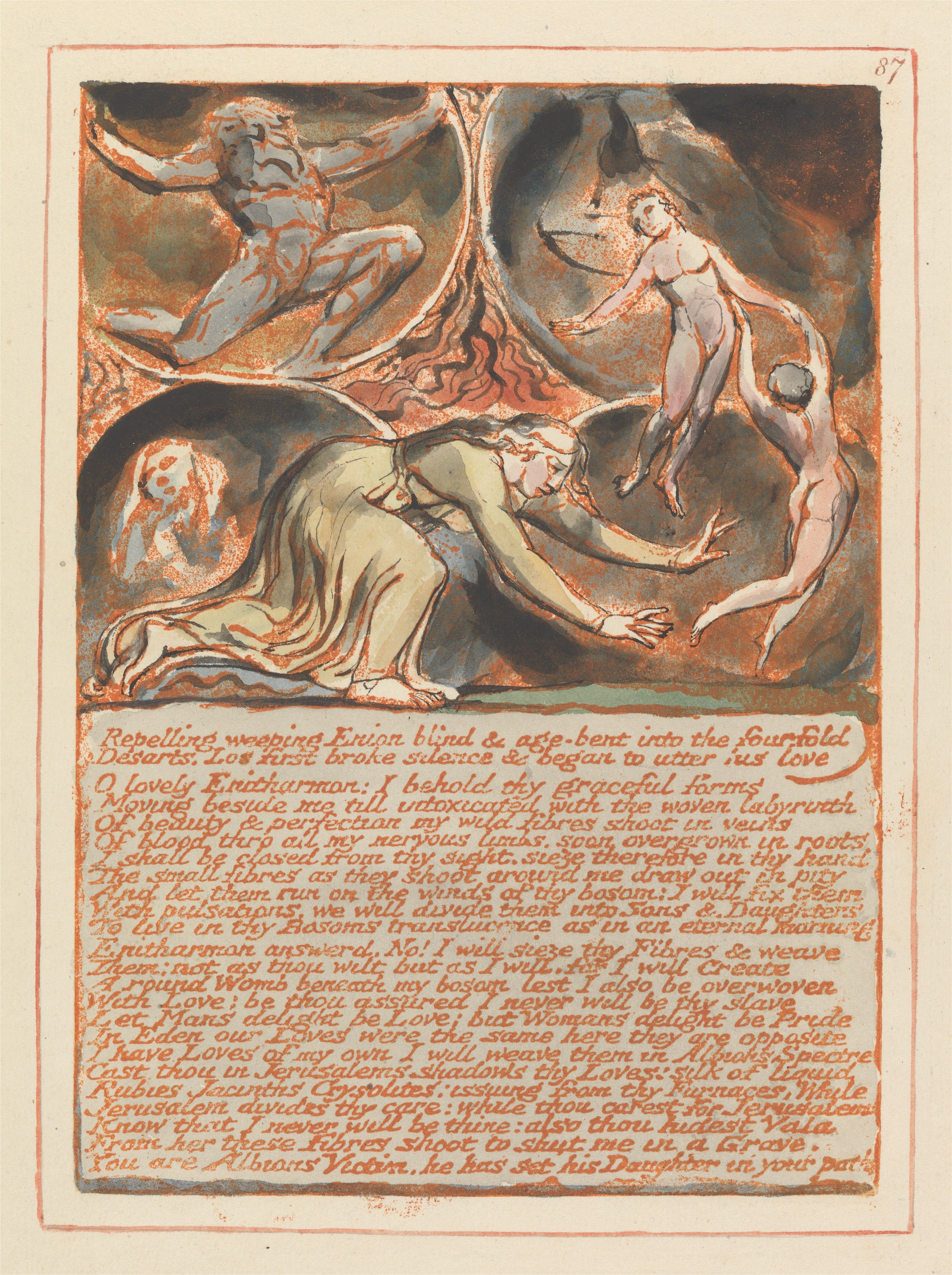
ENION

Yale Center for British Art
Jerusalem
Plate 87, Copy E

The separation of Tharmas from his emanation Enion is intimately bound to the creation of what we perceive as the world of matter. One way we can envision this is that the consciousness of man developed to the point where he discriminated between what went on in own mind, and what was reflected to his mind through his senses from an outer world of material objects. Blake prefers for us to envision this as Enion fleeing from Tharmas and becoming the mother of Time & Space. Tharmas could not reverse the process once it had begun. Enion was destined to wander sorrowfully outside of the Eternal world which she and Tharmas had enjoyed before the separation took place.
 

Enion seems to be the character who carried the burden of the separation and descent more than any other. She had lost her connection with the inner world when she became alienated from Tharmas. Her children withdrew from her and formed from her substance a world she could not enter. Her response was to speak laments which articulated the condition of humanity in a world without consciousness of Eternity.

Four Zoas, Night I, Page 4, (E 301)
"Begin with Tharmas Parent power. darkning in the West

Lost! Lost! Lost! are my Emanations      Enion O Enion  
We are become a Victim to the Living We hide in secret  
I have hidden Jerusalem in Silent Contrition    O Pity Me
I will build thee a Labyrinth also O pity me    O Enion  
Why hast thou taken sweet Jerusalem from my inmost Soul  
Let her Lay secret in the Soft recess of darkness & silence
It is not Love I bear to [Jerusalem] It is Pity    
She hath taken refuge in my bosom & I cannot cast her out.

The Men have recieved their death wounds & their Emanations are fled 
To me for refuge & I cannot turn them out for Pitys sake   
Enion said--Thy fear has made me tremble thy terrors have surrounded me  
All Love is lost Terror succeeds & Hatred instead of Love
And stern demands of Right & Duty instead of Liberty.
Once thou wast to Me the loveliest son of heaven--But now        
 
Why art thou Terrible and yet I love thee in thy terror till
I am almost Extinct & soon shall be a Shadow in Oblivion
Unless some way can be found that I may look upon thee & live
Hide me some Shadowy semblance. secret whispring in my Ear
In secret of soft wings. in mazes of delusive beauty             
I have lookd into the secret soul of him I lovd
And in the Dark recesses found Sin & cannot return

Trembling & pale sat Tharmas weeping in his clouds"

Four Zoas, Night I, PAGE 8, (E 304) 
"Till with fierce pain she brought forth on the rocks her sorrow & woe
Behold two little Infants wept upon the desolate wind.

The first state weeping they began & helpless as a wave
Beaten along its sightless way growing enormous in its motion to
Its utmost goal, till strength from Enion like richest summer shining               
Raisd the bright boy & girl with glories from their heads out beaming      
Drawing forth drooping mothers pity drooping mothers sorrow  

They sulk upon her breast her hair became like snow on mountains
Weaker & weaker, weeping woful, wearier and wearier
Faded & her bright Eyes decayd melted with pity & love           
Page 9
And then they wanderd far away she sought for them in vain 
In weeping blindness stumbling she followd them oer rocks & mountains
Rehumanizing from the Spectre in pangs of maternal love
Ingrate they wanderd scorning her drawing her Spectrous Life
Repelling her away & away by a dread repulsive power             
Into Non Entity revolving round in dark despair.
And drawing in the Spectrous life in pride and haughty joy   
Thus Enion gave them all her spectrous life

Then Eno a daughter of Beulah took a Moment of Time          
And drew it out to Seven thousand years with much care & affliction
And many tears & in Every year made windows into Eden 

She also took an atom of space & opend its center
Into Infinitude & ornamented it with wondrous art
Astonishd sat her Sisters of Beulah to see her soft affections
To Enion & her children & they ponderd these things wondring     
And they Alternate kept watch over the Youthful terrors
They saw not yet the Hand Divine for it was not yet reveald
But they went on in Silent Hope & Feminine repose

But Los & Enitharmon delighted in the Moony spaces of Eno"
Four Zoas, Night VIII, PAGE 114 [110], (E 385) 
"He touches the remotest pole & in the Center weeps
That Man should Labour & sorrow & learn & forget & return
To the dark valley whence he came to begin his labours anew
In pain he sighs in pain he labours in his universe
Screaming in birds over the deep & howling in the Wolf
Over the slain & moaning in the cattle & in the winds
And weeping over Orc & Urizen in clouds & flaming fires   
And in the cries of birth & in the groans of death his voice 
Is heard throughout the Universe whereever a grass grows
Or a leaf buds   The Eternal Man is seen is heard   is felt
And all his Sorrows till he reassumes his ancient bliss

Such are the words of Ahania & Enion. Los hears & weeps"