Showing posts with label Sexuality. Show all posts

Tuesday, December 06, 2022

Sex as Symbol

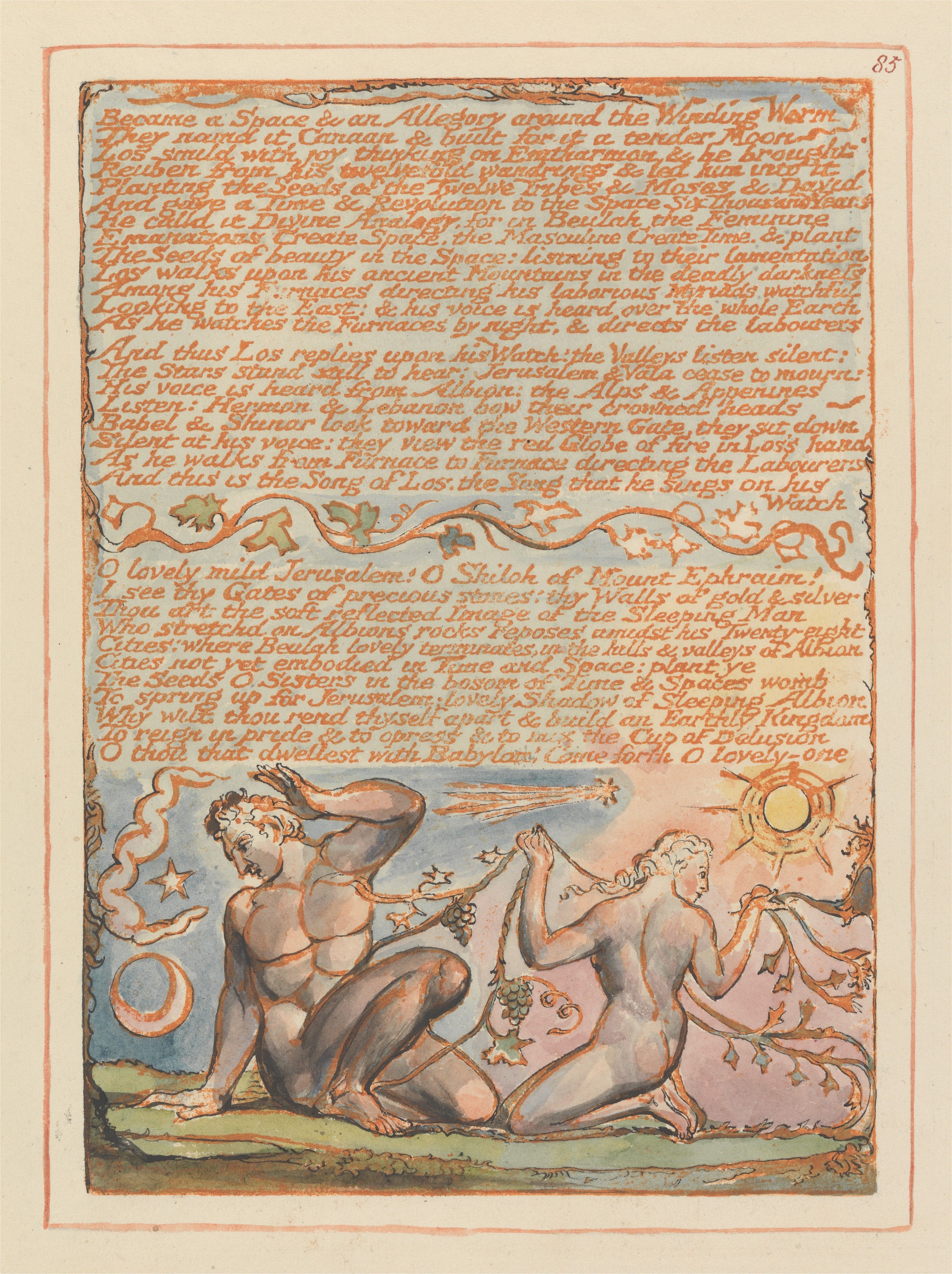
Yale Center for British Art
Jerusalem
Plate 85

Chapter 8, Blake Primer 

 Sex as Symbol

       Blake used the female as the basic symbol for the material and for the materialistic viewpoint. The history of this concept goes as far back as the beginning of time. The Sun represents a masculine God, the Moon, a Goddess, such as Diana, the great goddess of Ephesus, whose priests raised a riot against the apostle Paul, reported at Acts 19.

       Long after MHH he wrote Jerusalem where the "female will" approaches identity with Satan. Both terms connote a preoccupation with the material, putting it first and only. Thus when we read a passage like:

spoken by Vala, the personification of the "female will", we understand that Blake is not talking about what we know as the sex economy, but rather making a hard nosed statement of the nature of fallenness: the dominance of the material over the spiritual, a dominance all too evident in his age as in ours. This sad situation was always Blake's major concern, and the basic symbol with which he expressed it was that of sex. When we remember to translate male/female into spiritual/material or eternal/temporal, we make a great gain in our understanding of Blake.

       Milton's theory of sex influenced Blake as much as any other literary source. Paradise Lost provides a definitive model for much of the sexual imagery that Blake used. Professor Frye calls our attention to a line in Book iv of P . L. describing Adam and Eve: "Hee for God only, shee for God in him" Frye reminds us that this applies only to the unfallen pair; it assigns to Adam a purely spiritual authority. The male dominance of material history Frye calls a "fallen analogy" of that spiritual relationship.

       All this enriches our understanding of the meaning of Astarte in her many forms and of the priests' reactions to her which color virtually every word of the Old Testament and its literary descendants: God is male, the Creator; Nature is female, the Creation. The soul (of man and woman) is female in relation to her Creator. Christ is the bridegroom; in union with him we all (of both sexes) become part of the bride. The modern man can accept this only as an imperfect metaphor for spiritual reality.

iii

Generation

 According to Blake's myth sexes begin in the moony night of Beulah where the Eternals came to rest from the arduous wars of intellect that have filled their sunny days in Eden:

       Beulah, one of Blake's most ambiguous images, is a way station between Eden and Ulro. The Eternal, sleeping in Beulah, may rise from his sexual dreams and return to the activity of Eden, or he may fall further into Death Eternal, which is exactly what happened to Albion. Unable to find his way back to Heaven he lapsed into a deeper form of sleep where the female develops a will of her own and lures the male into the "torments of love and Jealousy". Late in Jerusalem the warrior, speaking for Albion, gives a glimpse of his true (fallen) situation and laments"

______________________________________________________________

       ( There are four worlds in Blake's psychic universe:
       Eternity
       Beulah
       Ulro

       Generation)

       Man in Eternity is androgynous. In Beulah, which means Married, the sexes are divided into loving and restful contraries. With the Fall the Female Will becomes dominant; the Human Form deteriorates to the sexual in which male and female, spirit and matter, exist in a state of constant warfare. Man has fallen into the fourth world of Ulro. But whatever falls may rise again.

       The third world, Generation, is the world of Los, fallen man's imaginative faculty. Los generates or brings forth artistic creations, structures of thought, myths of meaning, much as a woman brings forth children. These creations always turn bad (or perhaps just moldy) and are broken up and cast into Los's furnace for renewal. The process of generation and destruction would go on indefinitely, like the cycle of Nature, but the Moment of Grace breaks in upon it. Los learns to forgive. His emanation, Enitharmon, now joins him as an instrument of a regeneration offering redemptive promise. Blake proclaims, "0 holy generation, image of regeneration".

       The change in Los and Enitharmon, who together make up fallen man's imaginative faculty, prepares the ground for the generation of Jesus. The Sons of Eden announce this event in Night viii of Four Zoas with a paean of praise. Careful study of the entire song will cast more light on the meaning of Blake's symbolism of sex and generation; here are the final seven lines:

       What Blake reports next should be a welcome change for the by now outraged feminist. With his usual consistency he follows the divine annunciation with the appearance of Satan, and the worst thing he can say about Satan is to call him a "male without a female":

Saturday, September 21, 2019

CATHERINE BLAKE 1

From Private Collection
Sketch of Catherine
True marriage is a mystical bond. It depends upon two people having the desire to achieve a meeting of their minds. Unless each partner is capable of appreciating the other's differences as benefits to the union, there will be strife and dissension. William and Catherine Blake did not marry because they recognized only their similarities, but because they valued the qualities in the other which were absent in themselves. William needed the stability of Catherine, while she needed the stimulation of his active mind. There were things each gave up to accommodate the other. Any hope she may have had for a conventional life she relinquished; something of his fiery, contentious nature he subdued. They each valued the condition of marriage more than the need to realize his/her own individual desires.   

Catherine was not educated; in fact she signed her marriage certificate with an X. But William did not value formal education since he never sat at the foot of a schoolmaster himself. Catherine, the daughter of a green grocer, married at twenty years of age. She was prepared for a simple life of working with her husband who taught her the skills she needed in order to assist his career. What was her unique contribution over the years was a calmness of spirit upon which William could rely when his fierce need to create overstimulated his mind. 

In The Stranger from Paradise, a Biography of William Blake by G.E. Bentley, Jr, there is a quote from Frederick Tatum:

"he fancied , that while she looked at him, as he worked, her sitting quite still by...[his] side, doing nothing, soothed his tempestuous mind & he has many a time when a strong desire presented itself to overcome any difficulty in the Plates or Drawings, ... in the middle of the night risen & requested her to get up with him & sit by his side, in which she cheerfully acquiesced". Page 70

Gates of Paradise, For the Sexes, (E 268)
16 Thou'rt my Mother from the Womb
     Wife, Sister, Daughter to the Tomb
     Weaving to Dreams the Sexual strife
     And weeping over the Web of Life
Four Zoas, Night IX, Page 122, (E 391)
"The winter thou shalt plow & lay thy stores into thy barns       
Expecting to recieve Ahania in the spring with joy
Immortal thou. Regenerate She & all the lovely Sex
From her shall learn obedience & prepare for a wintry grave
That spring may see them rise in tenfold joy & sweet delight
Thus shall the male & female live the life of Eternity           
Because the Lamb of God Creates himself a bride & wife
That we his Children evermore may live in Jerusalem
Which now descendeth out of heaven a City yet a Woman
Mother of myriads redeemd & born in her spiritual palaces
By a New Spiritual birth Regenerated from Death                  

Urizen Said. I have Erred & my Error remains with me"

Songs and Ballads, Blake's notebook, (E 481)
"I have Mental Joy & Mental Health
And Mental Friends & Mental wealth    
Ive a Wife I love & that loves me
Ive all But Riches Bodily"

Letters, (E 709)
"To William Hayley Esqre at Miss Pooles, Lavant
near Chichester, Sussex
Hercules Buildings Lambeth Sept 16. 1800

Leader of My Angels
     My Dear & too careful & over joyous Woman has Exhausted her
strength to such a degree with expectation & gladness added to
labour in our removal that I fear it will be Thursday before we
can get away from this---- City   I shall not be able to avail
myself of the assistance of Brunos fairies.  But I invoke the
Good Genii that Surround Miss Pooles Villa to shine upon my
journey thro the Petworth road which by your fortunate advice I
mean to take but whether I come on Wednesday or Thursday That Day
shall be marked on my calendar with a Star of the first magnitude
     Eartham will be my first temple & altar My wife is like a
flame of many colours of precious jewels whenever she hears it
named Excuse my haste & recieve my hearty Love & Respect
I am Dear Sir
Your Sincere
WILLIAM BLAKE

My fingers Emit sparks of fire with Expectation of my future
labours"
.


Friday, September 26, 2014

Blake Sex 8

Final Discussion of 'Blake's Sex'

The allegoric drama of good and evil in terms of the two females intensifies throughout the epic poem 'Jerusalem' until the final awakening of Albion, when sexes disappear. The first indication of this comes in the dialogue of Los and Enitharmon:Enitharmon answer'd in great terror in Lambeth's Vale:

From Jerusalem Plate 92: 
"The Poet's Song draws to its period, and Enitharmon is no more;
For if he be that Albion, I can never weave him in my Looms,
But when he touches the first fibrous thread, like filmy dew
My Looms will be no more and I annihilate vanish for ever.

Then thou wilt Create another Female according to thy Will."
Los answer"d swift as the shuttle of gold: "Sexes must vanish &
cease
To be when Albion arises from his dread repose, 0 lovely Enitharmon:
When all their Crimes, their Punishments, their Accusations of Sin,
Ail their Jealousies, Revenges, Murders, hidings of Cruelty in Deceit
Appear only in the Outward Spheres of Visionary Space and Time,
In the shadows of Possibility, by Mutual Forgiveness for evermore,
And in the Vision and in the Prophecy, that we may Foresee & Avoid
The terrors of Creation & Redemption & Judgment....
(Erdman 252)

Soon comes the last mention of the woman of the world. She is connected with her sexual counterpart and described in the very specific terms which John used in Revelation 17.

If Bacon, Newton, Locke
Deny a Conscience in Man & the Communion of Saints & Angels,
Contemning the Divine Vision & Fruition, Worshiping the Deus
Of the Heathen, the God of This World, & the Goddess Nature,
Mystery, Babylon the Great, The Druid Dragon 61 hidden Harlot,
Is it not that Signal of the Morning which was told us in the
Beginning?
(Erdman 253-4)

Now Blake attempts to visualize the true place of sex in Eternity:

On Plate 97 of Jerusalem:
Awake, Awake, Jerusalem! 0 lovely Emanation of Albion,
Awake and overspread all Nations as in Ancient Time;
For lo! the Night of Death is past and the Eternal Day
Appears upon our Hills. Awake, Jerusalem and come away!
...Then Albion stretch'd his hand into Infinitude
And took his Bow....
And the bow is a Male and Female, and the Quiver of the Arrows of
Love
And the Children of this Bow, a bow of Mercy & Loving-kindness
laying
Open the hidden Heart in Wars of mutual Benevolence, Wars of
Love;
And the Hand of Man grasps firm between the Male and Female Loves.
And he Clothed himself in Bow and Arrows, in awful state, Fourfold ....
(Erdman 256)

And after the final chorus of the multiple aspects of Man, Blake tells us that he 

"heard the Name of their Emanation: they are named Jerusalem." And so ends 'Jerusalem'. 

(Erdman 258)

(**************************************************)

Summary

After all this detail We can begin our summary of Blake's theory of sex with Jesus' reply to the Sadducee's mocking question about the woman married to seven husbands: "for when they shall rise from the dead, they neither marry nor are given in marriage, but are as the angels which are in heaven."

        Blake begins here, with the assumption that sexual division relates to this world, but not to Eternity. Sex appears in Beulah, a moony rest from the arduous creative activity of Eden. The "Female Will" condemns Man to the loss of Eternity, which Blake calls "the Sleep of Ulro".

Sex signifies fallenness, and the jealous and proudly chaste female symbolizes the active principle of evil, also identified with a materialistic viewpoint whose values are coercion and love of power.

       Blake's vision of Jesus humanized his theory of sex. He began to use the biblical image of Jerusalem as the bride of Christ, named his last and greatest epic 'Jerusalem', and ultimately was able to rationalize the heterodox doctrine of sex with the glorified female as the emanation of the Eternal Man. Blake's female thus joined all the rest of his personal images in traveling the Circle of Destiny, materializing in the Fall and etherealizing in the Return.

       Through all his journey Blake had a characteristically liberal and enlightened view of womankind, an entirely different matter from the sexual symbolism that filled his pages. His true and abiding feelings about the relation between men and women appear early in his works in his "Annotations to Lavater": "Let the men do their duty and the women will be such wonders; the female life lives from the light of the male: see a man's female dependants, you know the man." Admittedly short of the high standards of present day feminism, Blake's vision of womanhood considerably surpassed that of most of his contemporaries-- and perhaps most of ours.

Wednesday, September 24, 2014

Blake Sex 7


'Jerusalem'


At the very beginning of Blakes' poem, Jerusalem, he makes us fully aware that the new woman represents something entirely other than the disreputable matter of earlier writing. She is just the opposite; she is Spirit or rather the manifestation of Spirit in this world. The Saviour confronts the sleeping Albion and identifies his disease, "where hast thou hidden thy Emanation, lovely Jerusalem". But the "perturbed Man" denies Christ and denies Jerusalem: "Jerusalem is not! her daughters are indefinite: By demonstration man alone can live, and not by faith. A few lines further the poet announces that Jerusalem is scatter'd abroad like a cloud of smoke thro' nonentity. Moab & Ammon & Amalek & Canaan & Egypt & Aram Receive her little ones for sacrifices and the delights of cruelty.

The place names represent the six heathen nations or the powers of evil that surround the Chosen People. The import of all this in another biblical phrase is that "He who departs from evil makes himself a prey".

Very shortly we meet the Daughters of Albion; they represent the feminine dimension of the materialistic impulses of Man: "Names anciently remember'd, but now contemn'd as fictions. Although in every bosom they controll our Vegetative powers". Eventually a redemptive moment occurs when, Los having subdued and integrated his Spectre, his Sons and Daughters "come forth from the Furnaces". Erin, like America a symbol of redemption, addresses Jerusalem: Vala is but thy Shadow, 0 thou loveliest among women! A shadow animated by thy tears, 0 mournful Jerusalem! Why wilt thou give to her a Body whose life is but a Shade? Her joy and love, a shade, a shade of sweet repose: But animated and vegetated she is a devouring Worm. What shall we do for thee, 0 lovely mild Jerusalem?

The fallen Sons of Albion express the opposite viewpoint. In Plate 18, in a prophetic statement worthy of Isaiah in its irony, the twelve Sons of Albion describe explicitly and in detail their relationship to Jerusalem and to Vala: Cast, Cast ye Jerusalem forth! The Shadow of delusions! The Harlot daughter! Mother of pity and dishonourable forgiveness! Our Father Albion's sin and shame! But father now no more, Nor sons, nor hateful peace & love, nor soft complacencies, With transgressors meeting in brotherhood around the table Or in the porch or garden. No more the sinful delights Of age and youth, and boy and girl, and animal and herb, And river and mountain, and city & village, and house and family, Beneath the Oak and Palm, beneath the Vine and fig tree, In Self-denial!--But War and deadly contention Between Father and Son, and light and love! All bold asperities Of Haters met in deadly strife, rending the house & garden The unforgiving porches, the tables of enmity, and beds And chambers of trembling & suspicion, hatreds of age & youth, And boy & girl, & animal & herb, & river & mountain, And city & village, and house & family, That the Perfect May live in glory, redeem'd by Sacrifice of the Lamb And of his children before sinful Jerusalem. To build Babylon the City of Vala, the Goddess Virgin-Mother. She is our Mother! Nature! Jerusalem is our Harlot-Sister Return'd with Children of pollution to defile our House With Sin and Shame. Cast, Cast her into the Potter's field! Her little ones She must slay upon our Altars, and her aged Parents must be carried into captivity: to redeem her Soul, To be for a Shame & a Curse, and to be our Slaves for ever.

In an extended passage too long to quote here Blake gives a colloquy with the fainting, confused Albion and the two females competing for his heart. It's actually a recreation of the earlier colloquy in VDA, and infinitely richer and fuller. Albion wavers exactly like Theotormon; Vala, like Bromion, is implacably blind, and Jerusalem has the eloquence of the earlier heroine. In this scene, like the earlier one, Blake describes the eternal battle between faith and worldliness.

Look also at the passage on Plates 32-34 and remember that Albion, Vala and Los each speaks from his own viewpoint. To understand Blake's vision the reader must imaginatively enter the psychic state of each of the three characters. Los most often speaks from the poet's true standpoint, and the following lines put his position about as plainly as it can be put:What may Man be? who can tell! but what may Woman be To have power over Man from Cradle to corruptible Grave? There is a Throne in every Man, it is the Throne of God: This, Woman has claim'd as her own, and Man is no more! Albion is the Tabernacle of Vala and her Temple, And not the Tabernacle and Temple of the Most High. 0 Albion, why wilt thou Create a Female Will?


A few lines along he adds further meaning to his term: Is this the Female Will, 0 ye lovely Daughters of Albion, To Converse concerning Weight & Distance in the Wilds of Newton & Locke?

As the epic progresses, Blake continues to define the two women: Man is adjoin'd to Man by his Emanative portion Who is Jerusalem in every individual Man, and her Shadow is Vala, builded by the Reasoning power in Man.

The idea of building Jerusalem gains prominence in Blake's poetry after the Moment of Grace. Jerusalem, "a city, yet a woman", is builded in the heart of every man by acts of love and kindness, and this is the work of the imagination.


As the third chapter of 'Jerusalem' begins, Blake describes Jerusalem for us once more:In Great Eternity every particular Form gives forth or Emanates Its own peculiar Light, and the Form is the Divine Vision And the Light is his Garment. This is Jerusalem in every Man, A Tent & Tabernacle of Mutual Forgiveness, Male and Female Clothings. And Jerusalem is called Liberty among the Children of Albion.

Blake's ethics of sexual love, his symbolism, and his Christian faith all fit together and reach a climax in a sketch virtually guaranteed to astound and provoke the reader (and no doubt dismay and disgust some). This passage, Plates 61 and 62, is called "Visions of Elohim Jehovah". Here once again forgiveness is the key, and to Blake forgiveness was everything. Vala, the soul of materialism, knows nothing of forgiveness. Jerusalem's liberty is expressed most fully in forgiveness. In this passage Mary, the mother of Jesus, merges with the other Mary, who was forgiven because "she loved much".

"Visions of Elohim Jehovah" could only have been written by a poet who despised the social value placed upon virginity. In an earlier work he had called it "pale religious letchery that wishes but acts not". Blake hated the ideal of chastity, which meant to him a virtuous withholding of woman's body as an exercise of power over the deprived male, and he struck directly at the archetype of the chaste woman. "Visions of Elohim Jehovah" is not a theological statement, but an imaginative vision about meaning and value. The love of Blake will always be confined to people who discriminate between those two things and whose theological perspective is neither glassy eyed nor otherwise rigid.

Blake's Mary has perfect trust in the forgiveness of sin, and her relationship with Joseph becomes a type for the relationship of Jerusalem with Jesus:Jerusalem fainted over the Cross and Sepulcher. She heard the voice: "Wilt thou make Rome thy Patriarch Druid & the Kings of Europe his "horsemen? Man in the Resurrection changes his Sexual Garments at will. "Every harlot was once a Virgin: every Criminal an Infant Love. "Repose on me till the Morning of the Grave. I am thy Life." Jerusalem replied: "I am an outcast: Albion is dead: "I am left to the trampling foot is. the spurning heel: "A Harlot I am call'd: I am sold from street to street: "I am defaced with blows in with the dirt of the Prison, "And wilt thou become my Husband, 0 my Lord & Saviour?"

As Jerusalem progressively gains our sympathy, Vala moves farther and farther in the opposite direction: Then All the Daughters of Albion became One before Los, even Vala And she put forth her hand upon the Looms in dreadful howlings Till she vegetated into a hungry Stomach in a devouring Tongue. Her Hand is a Court of Justice: her Feet two Armies in Battle: Storms & Pestilence in her Locks, and in her Loins Earthquake And Fire & the Ruin of Cities & Nations and Families and Tongues.

Tuesday, September 16, 2014

Blake Sex 4

The Woman

       A little poem which Blake attached to the end of 'Songs of Experience' casts light on his metaphysics as it relates to Mother Nature:  
  To Tirzah
      Whate'er is Born of Mortal Birth
      Must be consumed with the Earth
      To rise from Generation free:
      Then what have I to do with thee? 

      The Sexes sprung from Shame & Pride,
      Blow'd in the room; in evening died;
      But Mercy chang'd Death into Sleep;
      The Sexes rose to work & weep.
      Thou, Mother of my Mortal part,
      With cruelty didst mould my Heart,
      And with false self-deceiving tears
      Didst bind my Nostrils, Eyes and Ears:
      Didst close my Tongue in senseless clay,
      And me to Mortal Life betray.
      The Death of Jesus set me free:
      Then what have I to do with thee?

       "What have I to do with thee?" Here Blake quotes the words which Jesus spoke to his mother at the Wedding of Cana, which indicates the symbolic signification which Mary had for him, "Thou, Mother of my Mortal part"--my material part, my temporal part! Like Paul Blake wants us to know that the "things which are seen" are passing. He goes further than Paul in suggesting that the "things which are seen" are also cruel and oppressive.

      In Blake's prophecies after VDA the female comes to symbolize the temporal. She is associated with the fallen Sea of Time and Space. The first earthly female, Enitharmon, has her origin in a ghastly parody of the story of Adam and Eve: After Los chained Urizen into the fallen forms of creation, he sickened and "became what he beheld", and Enitharmon materialized as a Globe of Blood from his bosom.

       In "The Four Zoas" Enitharmon has a different origin; she and Los are born from the union of Enion and the Spectre of Tharmas. She is an altogether sinister female until the Moment of Grace. When Los comments on the burdens of their parents, she replies:
 
      To make us happy let them weary their immortal powers
      While we draw in their sweet delights, while we return them scorn
      On scorn to feed our discontent; for if we grateful prove
      They will withhold sweet love, whose food is thorns and  bitter roots.
(The Four Zoas [Nt 1], 10.3; E305)

and proceeds to sing him the "Song of Death". A thoroughgoing materialist, she has only the love of the Pebble; she sees the love of the Clod of Clay simply as a weakness to exploit. Enitharmon leads Los to the "Feast of Envy" (The Four Zoas [Nt 2], 23.10; E313), one of Blake's first and greatest epiphanies of Evil.
       At the end of Night ii we find Enitharmon at her worst, using her sex appeal to tease and frustrate, luring Los on only to withdraw, determined to possess him and give nothing:
 
     for thou art mine,
 Created for my will, my slave, tho' strong, tho' I am weak.
 Farewell, the God calls me away.  I depart in my sweet bliss,
(The Four Zoas [Nt 2], 34.46; E323)
and a few lines further:
 The joy of woman is the death of her most best beloved
 Who dies for Love of her
 In torments of fierce jealousy and pangs of adoration.
       These lines perhaps led some to postulate sexual deprivation in Blake's marriage. They certainly reveal first hand experience with a teasing bitch of the worst sort. But in my opinion Catherine could not possibly have been such a woman. However any who have seen materialistic lovers know that it rings true.

       With the fall of Urizen Enitharmon loses her vicious side and becomes simply a clinging, dependent woman. She gives birth to Orc and centers her affection upon him until the Moment of Grace. At that point she begins to cooperate with Los in the building of Golgonooza.

       A much more sinister female is Vala. In Night vii, at the critical hinge of Blake's myth, the Spectre of Urthona and the Shadow of Enitharmon meet beneath the Tree of Mystery and compare notes. Each gives his version of the Fateful Fall, and they agree that the cause was a female. Here is the Shadow's version:
 
      Among the Flowers of Beulah walk'd the Eternal Man & saw
      Vala, the lilly of the desart melting in high noon;
      Upon her bosom in sweet bliss he fainted.  Wonder siez'd
      All heaven; they saw him dark;
       And the Spectre's version:
 
      One dread morn of gory blood
      The manhood was divided, for the gentle passions, making way
      Thro' the infinite labyrinths of the heart & thro' the nostrils
      issuing
      In odorous stupefaction, stood before the Eyes of Man
      A female bright.

       Ahania's vision in Night iii makes the same point. (Bear in mind that in Blake's primary mythology the female represents materiality.) Again the reader should note that in all three of these accounts of the Fall the blame attaches, not to sensual enjoyment, but to the preoccupation with the material which it symbolizes. Blake uses these most vivid concrete images to arouse his reader to the consciousness that Man has turned his back upon the eternal. This becomes clearer as you read further, especially in the first of the three examples given above.


       Vala, called the goddess of Nature, generally stands for preoccupation with the material. 'Bacon, Newton, Locke', the Unholy Trinity of Materialism, and Satan, the God of this World, serve as alternative symbols for the same misfortune, but again and again Blake returns to the Female Will. He names her Vala in his early works. In the fully matured myth the concept broadens to include other female characters: Rahab, Tirzah, and the Daughters of Albion, but all these females represent various facets of Vala.

Monday, November 12, 2012

Sexuality 7


Blake's ethics of sexual love, his symbolism, and his Christian faith all fit together and reach a climax in a sketch virtually guaranteed to astound and provoke the reader (and no doubt dismay and disgust some). 

This passage, Jerusalem Plates 61 and 62, is called "Visions of Elohim Jehovah". Here once again forgiveness is the key, and to Blake forgiveness was everything. Vala, the soul of naterialism, knows nothing of forgiveness. Jerusalem's liberty is expressed most fully in forgiveness. 


In this passage Mary, the mother of Jesus, merges with the other Mary, who was forgiven because "she loved much".

"Visions of Elohim Jehovah" could only have been written by a 
poet who despised the social value placed upon virginity. In an 
earlier work he had called it "pale religious letchery that 
wishes but acts not". Blake hated the ideal of chastity, which 
meant to him a virtuous withholding of woman's body as an 
exercise of power over the deprived male, and he struck directly 
at the archetype of the chaste woman. "Visions of Elohim Jehovah"
is not a theological statement, but an imaginative vision about 
meaning and value. The love of Blake will always be confined to 
people who discriminate between those two things and whose 
theological perspective is neither glassy eyed nor otherwise 
rigid.

Blake's Mary has perfect trust in the forgiveness of sin, and her relationship with Joseph becomes a type for the relationship of Jerusalem with Jesus: Jerusalem fainted over the Cross and Sepulcher. She heard the voice:

"...........................Wilt thou make Rome thy Patriarch 
Druid & the Kings of Europe his horsemen? Man in the 
Resurrection changes his Sexual Garment sat will.
"Every harlot was once a Virgin: every Criminal an Infant Love.
"Repose on me till the Morning of the Grave. I am thy Life. 
Jerusalem replied: "I am an outcast: Albion is dead:
I am left to the trampling foot is. the spurning heel:
"A Harlot I am call'd: I am sold from street to 
street: I am defaced with blows in with the dirt of the 
Prison,And wilt thou become my Husband, 0 my Lord & Saviour?"
As Jerusalem progressively gains our sympathy, Vala moves 
farther and farther in the opposite direction:

"Then All the Daughters of Albion became One before Los, even Vala
And she put forth her hand upon the Looms in dreadful howling
Till she vegetated into a hungry Stomach in a devouring 
Tongue.Her Hand is a Court of Justice: her Feet two Armies in 
Battle:Storms & Pestilence in her Locks, and in her Loins 
Earthquake And Fire & the Ruin of Cities & Nations and Families and Tongues."

The allegoric drama of good and evil in terms of the two 

females continues and intensifies throughout the epic poem 
until the final awakening of Albion, when sexes disappear. 
The first indication of this appears in the dialogue of Los 
and Enitharmon:

"Enitharmon answer'd in great terror in Lambeth's Vale:
The Poet's Song draws to its period, and Enitharmon is no 
more;
For if he be that Albion, I can never weave him in my Looms,
But when he touches the first fibrous thread,like filmy dew
My Looms will be no more and I annihilate vanish for ever.
Then thou wilt Create another Female according to thy Will.

Los answer"d swift as the shuttle of gold: Sexes must vanish & cease
To be when Albion arises from his dread repose, 0 lovely 
Enitharmon:
When all their Crimes, their Punishments, their Accusations of Sin,
All their Jealousies, Revenges, Murders,hidings of Cruelty in 
Deceit Appear only in the Outward Spheres of Visionary 
Space and Time,In the shadows of Possibility, by Mutual 
Forgiveness for evermore,
And in the Vision and in the Prophecy, that we may Foresee & 
Avoid The terrors of Creation & Redemption & Judgment...."

Soon comes the last mention of the woman of the world. She is 
connected with her sexual counterpart and described in the 
very specific terms which John used in Revelation 17:

Jerusalem, Plate 93:
"If Bacon, Newton, Locke Deny a Conscience in Man & the 
Communion of Saints & Angels,Contemning the Divine Vision & 
Fruition, Worshiping the Deus
Of the Heathen, the God of This World, & the Goddess 
Nature, Mystery, Babylon the Great, The Druid Dragon, hidden 
Harlot
Is it not that Signal of the Morning which was told us in the
Beginning?"

In Plate 97 Blake attempts to visualize the true place of sex in 
Eternity:

"Awake, Awake, Jerusalem! 0 lovely Emanation of Albion,
Awake and overspread all Nations as in Ancient Time;
For lo! the Night of Death is past and the Eternal Day
Appears upon our Hills. Awake, Jerusalem and come away!...
Then Albion stretch'd his hand into Infinitude
And took his Bow....And the bow is a Male and Female, and the 
Quiver of the Arrows of Love 
And the Children of this Bow, a bow of Mercy & Loving-
kindness laying Open the hidden Heart in Wars of mutual 
Benevolence, Wars of Love;

And the Hand of Man grasps firm between the Male and Female Loves.
And he Clothed himself in Bow and Arrows, in awful state, Fourfold ...."

And after the final chorus of the multiple aspects of Man, 

Blake tells us that he "heard the Name of their Emanation: 
they are named Jerusalem."

And so ends 'Jerusalem'. 

Thursday, November 08, 2012

Sexuality 5


                    The Two Women

       When Blake began to work on his epic myth, he intended to focus upon the wicked career of 

Vala, but as time went by, he became more interested in the Zoas, which no doubt helped to relieve 
the anti-feminine bent of his metaphysics. Vala temporarily sank to the level of a minor character, 
and Blake laid most of the guilt for man's sorry state upon Urizen. Moment of Grace brought 
another significant change:  Vala divided into two females,  Rahab and Jerusalem, both of whom 
issue from Enitharmon.

       When Blake gave Rahab the alternate name of Babylon, he came into conformance with the 
basic symbology of the Bible. Throughout the scripture we read about these two women/cities. 
Jerusalem is at least potentially the city of God, while Babylon always represents the seat of the 
God of this World. In his last epic, Jerusalem, Blake's Vala has become virtually interchangeable 
with Babylon.

       We have already noted the biblical sources of Blake's two symbolic women in the 12th and
17th chapters of Revelation. In the first of these John sees a woman "clothed with the sun and 
the moon under her feet". In the second he described "the great whore that sitteth upon many 
waters". These two women in the Bible aptly prefigure Blake's Jerusalem and Vala, and a careful 
study of the two chapters will help the reader to shape in his own mind the identity of Blake's two 
characters.

       John and Blake both drew their paired women from earlier sources. Frye calls them "royal
metaphors" for the twin totalities of good and evil, of redemption and damnation that fill the pages
of the Bible. The Tower of Babel, the first city of sin, led to the confusion of tongues. Following 
God's command Abraham, the father of the Hebrews, left Ur, a few miles from Babylon and 
eventually settled in the Promised Land. The first Captivity occured in Egypt, which later biblical 
literature often treats as synonymous with Babylon. The second Captivity took place at 
Babylon. A later captivity was to Rome, which John the Apocalyptist called Babylon: in
Revelation he celebrated the burning of the Whore of Babylon.

       Meanwhile Melchizidek, King of Salem and priest of the Most High God, had blessed Abraham.
Some centuries later David established Jerusalem as his capital. The Song of Solomon is a poem 
and love song about a king and his bride. This theme became a primary symbol of the relation 
between Jerusalem, representing the Chosen People, and God. The prophets constantly referred 
to Jerusalem as a woman, married to God, but too often faithless, whoring after other gods. 
Hosea's stories about the love of the betrayed husband for his faithless wife, Gomer, poetically 
express the highest level of the Hebrew consciousness of God. On occasion the prophets became 
so enraged that they identified Jerusalem with Babylon. For example John spoke of "the great city 
which spiritually is called Sodom and Egypt, where also our Lord was crucified".

      This biblical background prepares us to cope with the woman found in Blake's poem, 
'Jerusalem' .  As we have seen, in the poetry of the first half of Blake's life the woman is sinister. 
She represents the material; the material is unworthy, reprehensible, satanic. This is the typical 
Gnostic position and to a lesser extent the Neo-platonic position. Blake stated it very explicitly and 
with his usual hyperbole in 'Visions of the Last Judgment'  (See also the image): 

"I assert for My Self that I do not behold the outward Creation & that to me it is hindrance and 
not Action;  it is as the Dirt upon my feet. No part of Me."

       He wrote that as late as 1810. Nevertheless after the Moment of Grace Blake's perspective on 
matter (and Woman!) softened. At first there had been only the sinister woman, but now the Woman 
of Grace appeared as well.

       In the poem, Jerusalem, we find a discourse and a conflict between these two women. Vala
speaks for the kingdom of Satan, and Jerusalem speaks for the kingdom of Heaven. Their 
interaction dominates the poem and must fascinate anyone interested in those two subjects. The 
epic is a straightforward conflict between light and darkness as Blake understood those two realities. 
Vala wins most of the battles, but we always know who must win the war.

       Blake describes reality imaginatively and dramatically in terms of ultimate value; this is basically
an expression of faith. If one believes in the higher values: in spirit, in truth, in justice and love, then 
one imagines these things ultimately victorious. Blake did, and he concluded the passage from VLJ 
quoted above: 

"What, it will be Question'd, 'When the Sun rises, do you not see a round disk of fire somewhat like a 
Guinea?  0 no, no, I see an Innumerable company of the Heavenly host crying 'Holy, holy, Holy is 
the Lord God Almighty.'" 

In Blake's final epic Vala represents the guinea sun and Jerusalem the "innumerable company of 
the Heavenly host".  Needless to say those who see only the guinea sun will not be attracted to the poem.

Tuesday, November 06, 2012

Sexuality 4


The Woman


       A little poem which Blake attached to the end of 'Songs of Experience' casts light on 
his metaphysics as it relates to Mother Nature:
  
  To Tirzah
      Whate'er is Born of Mortal Birth
      Must be consumed with the Earth
      To rise from Generation free:
      Then what have I to do with thee? 

      The Sexes sprung from Shame & Pride,
      Blow'd in the room; in evening died;
      But Mercy chang'd Death into Sleep;
      The Sexes rose to work & weep.
      Thou, Mother of my Mortal part,
      With cruelty didst mould my Heart,
      And with false self-deceiving tears
      Didst bind my Nostrils, Eyes and Ears:
      Didst close my Tongue in senseless clay,
      And me to Mortal Life betray.
      The Death of Jesus set me free:
       "What have I to do with thee?" Here Blake quotes the words which Jesus spoke to his 
mother at the wedding of Cana, which indicates the symbolic signification which Mary had 
for him, "Thou, Mother of my Mortal part"--my material part, my temporal part! Like Paul 
Blake wants us to know that the "things which are seen" are passing. He goes further than 
Paul in suggesting that the "things which are seen" are also cruel and oppressive.

Yale Center for British Arts
Plate 85 of Jerusalem 

       In Blake's prophecies after VDA the female comes to symbolize
the temporal. Sheis associated with the fallen Sea of Time and Space.
 
The first earthly female, Enitharroon, has her origin in a ghastly parody 
of  the story of Adam and Eve: After Los chained Urizen into the fallen 
forms of creation, he sickened and "became what he beheld", and 
Enitharmon materialized as a Globe of Blood from his bosom.

       In "The Four Zoas" Enitharmon has a different origin; she and Los
 are born from the union of Enion and the Spectre of Tharmas. She is 
an altogether sinister female until the Moment of Grace. When Los 
comments on the burdens of their parents, she replies: 
To make us happy let them weary their immortal powers
      While we draw in their sweet delights, while we return them scorn
      On scorn to feed our discontent; for if we grateful prove
      They will withhold sweet love, whose food is thorns and  bitter roots.
(The Four Zoas [Nt 1], 10.3; E305)
and proceeds to sing him the "Song of Death". 
A thoroughgoing materialist, she has only the love of
the Pebble
; she sees the love of the Clod of Clay simply as a 

weakness to exploit. Enitharmon leads 
Los to the "Feast of Envy" (The Four Zoas [Nt 2], 23.10; E313), one of Blake's first and greatest 
epiphanies of Evil.
       At the end of Night ii we find Enitharmon at her worst,
using her susex appeal to tease and frustrate, luring Los on only to withdraw, 
determined to possess him and give nothing:

     for thou art mine,
 Created for my will, my slave, tho' strong, tho' I am weak.
 Farewell, the God calls me away.  I depart in my sweet bliss,
(The Four Zoas [Nt 2], 34.46; E323)
and a few lines further:
 The joy of woman is the death of her most best beloved
 Who dies for Love of her
 In torments of fierce jealousy and pangs of adoration.
       These lines perhaps led some to postulate sexual deprivation in Blake's marriage. They 
certainly reveal first hand experience with a teasing bitch of the worst sort. But in my opinion 
Catherine could not possibly have been such a woman. However any who have seen 
materialistic lovers know that it rings true.

       With the fall of Urizen Enitharoon loses her vicious side and becomes simply a clinging, 
dependent woman. She gives birth to Orc and centers her affection upon him until the 
Moment of Grace. At that point she begins to cooperate with Los in the building of Golgonooza.

       A much more sinister female is Vala. In Night vii, at the critical hinge of Blake's myth, the 
Spectre of Urthona and the Shadow of Enitharmon meet beneath the Tree of Mystery and 
compare notes. Each gives his version of the Fateful Fall, and they agree that the cause was 
a female. Here is the Shadow's version:
      Among the Flowers of Beulah walk'd the Eternal Man & saw
      Vala, the lilly of the desart melting in high noon;
      Upon her bosom in sweet bliss he fainted.  Wonder siez'd
      All heaven; they saw him dark;
       And the Spectre's version:
      One dread morn of gory blood
      The manhood was divided, for the gentle passions, making way
      Thro' the infinite labyrinths of the heart & thro' the nostrils
      issuing
      In odorous stupefaction, stood before the Eyes of Man
      A female bright. 
       Ahania's vision in Night iii makes the same point. (Bear in mind that in Blake's primary 
mythology the female represents materiality.) Again the reader should note that in all three 
of these accounts of the Fall the blame attaches, not to sensual enjoyment, but to the 
preoccupation with the material which it symbolizes. Blake uses these most vivid concrete 
images to arouse his reader to the consciousness that Man has turned his back upon the 
eternal. This becomes clearer as you read further, especially in the first of the three  
examples given above.

       Vala, called the goddess of Nature, generally stands for preoccupation with the material. 
'Bacon, Newton, Locke', the Unholy Trinity of Materialism, and Satan, the God of this World, 
serve as alternative symbols for the same misfortune, but again and again Blake returns to the 
Female Will. He names her Vala in his early works. In the fully matured myth the concept 
broadens to include other female characters: Rahab, Tirzah, and the Daughters of Albion, but 
all these females represent various facets of Vala.