Showing posts with label Raine. Show all posts

Saturday, March 14, 2026

CREATIVE FANTASY

First posted Feb 2019

Wikipedia Commons
Milton's Mysterious Dream,
Watercolor Illustration to Milton's L'Allegro and Il Penseroso

Since the unconscious is an aspect of the mind to which the conscious mind has little access, there is difficulty in discerning its content. If an individual behaves in a way which is inconsistent with the values to which he consciously ascribes, he may be under the control of unconscious forces which are unacceptable to the society in which he lives. The apostle Paul said, "For the good that I would I do not: but the evil which I would not, that I do." If a person is seeking to understand why he fails to measure up to the standards which he consciously sets for himself, he may find some answers in myth and dreams for these are ways the unconscious makes itself known to the conscious mind.

By seeking to understand what messages are conveyed to his own psyche by dreams and myth one learns to assimilate a broader range of experience which applies to him and to the world consciousness to which he belongs.

Kathleen Raine on Page 126 of Defending Ancient Springs quoted Jung as recalling 'the unending myth of death and rebirth, and of the multitudinous figures who weave in and out of this mystery': 

"Of this story no single life can realize more than a part; but beneath our individual experience is the pooled experience of our inheritance, Jung's 'collective unconscious' which discloses itself so he says, only through the medium of creative fantasy. 'It comes alive in the creative man, it reveals itself in the vision of the artist, in the inspiration of the thinker, in the inner experience of the mystic.' the mythologies of all races are its embodiment; the psychologists are newcomers in a field long known to the poets; a fact they are apt to forget.
...
Dreams resemble myths in their personification and symbolic forms and enactments; and the knowledge which myths and dreams alike mediate and embody is not conceptual knowledge; in symbols the soul can speak, but not the discursive reason. Explanations come afterwards and are far less fundamental; one has only to think of the countless expositions given some myth, which always survives these attempts to throw light upon its mystery. But the sign of the initiate of the ancient Mysteries was the finger laid upon the lips, the sign of silence. The Mysteries cannot be divulged because they elude verbal formulation."


Songs of Innocence and of Experience, Song 41, (E 24)
"The Angel  

I Dreamt a Dream! what can it mean?
And that I was a maiden Queen:
Guarded by an Angel mild:
Witless woe, was ne'er beguil'd!

And I wept both night and day
And he wip'd my tears away
And I wept both day and night
And hid from him my hearts delight

So he took his wings and fled:
Then the morn blush'd rosy red:
I dried my tears & armed my fears,
With ten thousand shields and spears,

Soon my Angel came again;
I was arm'd, he came in vain:
For the time of youth was fled            
And grey hairs were on my head." 

Europe, Plate 9, (E 62)
"Enitharmon slept,                                                
Eighteen hundred years: Man was a Dream!
The night of Nature and their harps unstrung:
She slept in middle of her nightly song,
Eighteen hundred years, a female dream!"

Milton, Plate 15 [17], (E 109)
"As when a man dreams, he reflects not that his body sleeps,
Else he would wake; so seem'd he entering his Shadow: but
With him the Spirits of the Seven Angels of the Presence
Entering; they gave him still perceptions of his Sleeping Body;
Which now arose and walk'd with them in Eden, as an Eighth   
Image Divine tho' darken'd; and tho walking as one walks
In sleep; and the Seven comforted and supported him.

Like as a Polypus that vegetates beneath the deep!
They saw his Shadow vegetated underneath the Couch
Of death: for when he enterd into his Shadow: Himself:           
His real and immortal Self: was as appeard to those
Who dwell in immortality, as One sleeping on a couch
Of gold; and those in immortality gave forth their Emanations
Like Females of sweet beauty, to guard round him & to feed
His lips with food of Eden in his cold and dim repose!           

But to himself he seemd a wanderer lost in dreary night."

Wednesday, January 28, 2026

SANITY

 First posted July 2022

Wikipedia Commons
Frontispiece
Songs of Experience

Here is a section of An Interview Conducted with Kathleen Raine on July 12, 1993 by Donald E. Stanford:

Interview 

"Stanford: One critic has said recently that Blake was not mad, but he understood and described the mental suffering of madness in a profound way. Do concepts of madness such as schizophrenia, hallucination, and so on have a useful place in Blake criticism and will you comment on the direct question, “was Blake mad?”


Raine: No, of course he wasn’t mad. He was a sane man in a mad world, roughly speaking. Great genius has a wider field of consciousness. That is what genius is: seeing rather more than other men do, perhaps being in advance of his time. Certainly the nature of genius is to not accept current opinion, and Blake certainly did not accept current opinion. I don’t think that words like “schizophrenia” and “paranoia” add much to human discussion of whatever these words mean. Blake himself says, “Plato says that poets do not know what they write and utter. In that case, why is a lesser kind to be called knowing?” In other words, a poet is an inspired man. Blake believed in inspiration. This must be especially remembered with Blake, but all poets have believed in inspiration, that in an inspired state there is a widening of the field of consciousness. Yeats describes genius as bringing together at certain moments the waking and the sleeping mind. The available knowledge is greater in states of inspiration. Blake certainly had this


There is much suffering, as your critic says, in the writings of Blake: the turmoil, the anguish of Jerusalem. But this was not a personal thing; he was talking about the nation. He was a spiritual patriot, and he was speaking of the suffering of the giant Albion, as he calls the English nation. He was a prophet in the sense of the Old Testament prophets in the Jewish Bible, who also were speaking for their nation. They were not speaking of their individual suffering; they were speaking of the national psyche, if you like, into which Blake had certainly a remarkably clear insight. He speaks of living. He says, 'in South Molton Street I see and hear' what is going on in the soul of Albion, which is, of course, the soul of England. In other words, here in South Moulton Street I both see and hear the sufferings of the military, or the war against France that broke out after the French Revolution, of the conscription of soldiers, and the suffering of child labor, the endless sufferings of his people at that time, the hangings of boys at Tyburn for the theft of a yard of cloth, the injustices, the national crimes against which Blake spoke out. You may say these were descriptions of deep, deep suffering, the psychological sufferings of various kinds of mental and physical and spiritual tyrannies in his nation at the time. I wonder what he would have been writing about had he lived now. Certainly many things would have been the same — perhaps not all — but when he writes of London and marking, 'in every face marks of weakness, marks of woe,' he felt the collective suffering: that was the nature of his inspiration. He was not a personal poet expressing himself. He was a national prophet, calling to his nation to awake from their 'deadly sleep,' which is unconsciousness of what is going on, and to awake to the truths of the imagination and to reform many things. This is not madness."


Laocoon, (E 274)
 "There are States in which all Visionary Men are accounted Mad 
   Men   such are Greece & Rome"
 Poetical Sketches, (E 415)
"   MAD SONG.
The wild winds weep,
  And the night is a-cold;
Come hither, Sleep,
  And my griefs infold:   
But lo! the morning peeps          
  Over the eastern steeps,
And the rustling birds of dawn 
The earth do scorn.

Lo! to the vault
  Of paved heaven,              
With sorrow fraught
  My notes are driven:
They strike the ear of night,
  Make weep the eyes of day;
They make mad the roaring winds,      
  And with tempests play.

Like a fiend in a cloud
  With howling woe,
After night I do croud,
  And with night will go;         
I turn my back to the east,

From whence comforts have increas'd;
For light doth seize my brain
With frantic pain."

Annotations to Spurzheim's Observations on Insanity, (E 663) 
 "Cowper came to me & said. O that I
were insane always I will never rest.  Can you not make me truly
insane.  I will never rest till I am so. O that in the bosom of
God I was hid.  You retain health & yet are as mad as any of us
all--over us all--mad as a refuge from unbelief--from Bacon
Newton & Locke"
Letters, to Butts Jany 10 180(3), (E 724) 
"The Thing I
have most at Heart! more than life or all that seems to make life
comfortable without.  Is the Interest of True Religion & Science
& whenever any thing appears to affect that Interest. (Especially
if I myself omit any duty to my [self] <Station> as a
Soldier of Christ) It gives me the greatest of torments, I am not
ashamed afraid or averse to tell You what Ought to be Told.  That
I am under the direction of Messengers from Heaven Daily &
Nightly but the nature of such things is not as some suppose.
without trouble or care.  Temptations are on the right hand &
left behind the sea of time & space roars & follows swiftly he
who keeps not right onward is lost & if our footsteps slide in
clay how can we do otherwise than fear & tremble. but I should
not have troubled You with this account of my spiritual state
unless it had been necessary in explaining the actual cause of my
uneasiness into which you are so kind as to Enquire for I never
obtrude such things on others unless questiond & then I never
disguise the truth--But if we fear to do the dictates of our
Angels & tremble at the Tasks set before us. if we refuse to do
Spiritual Acts. because of Natural Fears or Natural Desires!  Who
can describe the dismal torments of such a state!--I too well
remember the Threats I heard!--If you who are organized by Divine
Providence for Spiritual communion.  Refuse & bury your Talent in
the Earth even tho you should want Natural Bread. Sorrow & Desperation 
pursues you thro life! & after death shame & confusion of face to
eternity--Every one in Eternity will leave you aghast at the Man
who was crownd with glory & honour by his brethren & betrayd
their cause to their enemies.  You will be calld the base Judas
who betrayd his Friend!--Such words would make any Stout man
tremble & how then could I be at ease? But I am now no longer in
That State & now go on again with my Task Fearless. and tho my
path is difficult.  I have no fear of stumbling while I keep it" 
Letters, April 25: 1803, To Butts, (E 728)
"Now I may say to you what perhaps I should not dare to say
to any one else.  That I can alone carry on my visionary studies
in London unannoyd & that I may converse with my friends in
Eternity.  See Visions, Dream Dreams, & prophecy & speak Parables
unobserv'd & at liberty from the Doubts of other Mortals. perhaps
Doubts proceeding from Kindness. but Doubts are always pernicious
Especially when we Doubt our Friends Christ is very decided on
this Point.  'He who is Not With Me is Against Me' There is no
Medium or Middle state & if a Man is the Enemy of my Spiritual
Life while he pretends to be the Friend of my Corporeal. he is a
Real Enemy--but the Man may be the friend of my Spiritual Life
while he seems the Enemy of my Corporeal but Not Vice Versa" 

Monday, October 13, 2025

INNER REALITY

First posted Dec 2019 


Library of Congress
Marriage of Heaven & Hell
Plate 10

As a mental exercise Blake tries to get his reader to look at his world in a different way. He asks us to look at 'reality' as something which is a product of our own thinking rather than as objective facts which determine our interpretations and our actions. If you are an observer of other people you probably realize that your own mind and the minds of others are not congruent. Take that observation a step further and acknowledge that individuals either see through the lens of generally accepted conventions, or they use their own mental abilities to process the input they receive 
from an exterior world through their senses. If such is the case, the mind itself creates their 'reality' which does not arrive pre-processed as the events of history or the sights and sounds from outside of the body.

On Page 72, of her biography, William Blake, Kathleen Raine tells us that Blake pushes us to look deeper than surface ills to find ways to make changes to outer circumstances:       

"For Blake, outward events and circumstances were the expressions of states of mind, ideologies, mentalities, and not, as for the determanist-materialist ideologies of the modern world, their causes. Blake's 'dark Satanic Mills', so often invoked in the name of social reform, prove, when we read Milton (the poem in which these mills are most fully described) to be the mechanistic 'laws' of Bacon, Newton and Locke, of which industrial landscapes are a reflection and expression. Man has made his machines in the image of his ideology. So, always, Blake tries to discover the source of social and private ills within man. Only a change of the heart and mind of the nation can create a new society and new cities less hideous than those created by an atheist and mechanistic rationalism."

Descriptive Catalogue, (E 543)
 "All had originally one
language, and one religion, this was the religion of Jesus, the
everlasting Gospel.  Antiquity preaches the Gospel of Jesus.  The
reasoning historian, turner and twister of causes and
consequences, such as Hume, Gibbon and Voltaire; cannot with all
their artifice, turn or twist one fact or disarrange self evident
action and reality.  Reasons and opinions concerning acts, are not
history.  Acts themselves alone are history, and these are
neither the exclusive property of Hume, Gibbon nor Voltaire,
Echard, Rapin, Plutarch, nor Herodotus.  Tell me the Acts, O
historian, and leave me to reason upon them as I please; away
with your reasoning and your rubbish.  All that is not action is
not worth reading.  Tell me the What; I do not want you to
tell me the Why, and the How; I can find that out myself, as well
as you can, and I will not be fooled by you into opinions, that
you please to impose, to disbelieve what you think improbable or
impossible.  His opinions, who does not see spiritual agency, is
not worth any man's reading; he who rejects a fact because it is
improbable, must reject all History and retain doubts only."

Milton, Plate 26 [28], (E 123)
"And every Generated Body in its inward form,

Is a garden of delight & a building of magnificence,

Built by the Sons of Los in Bowlahoola & Allamanda

And the herbs & flowers & furniture & beds & chambers

Continually woven in the Looms of Enitharmons Daughters

In bright Cathedrons golden Dome with care & love & tears

For the various Classes of Men are all markd out determinate

In Bowlahoola; & as the Spectres choose their affinities

So they are born on Earth, & every Class is determinate

But not by Natural but by Spiritual power alone
, Because

The Natural power continually seeks & tends to Destruction

Ending in Death: which would of itself be Eternal Death

And all are Class'd by Spiritual, & not by Natural power.

And every Natural Effect has a Spiritual Cause, and Not
A Natural: for a Natural Cause only seems, it is a Delusion      
Of Ulro: & a ratio of the perishing Vegetable Memory."

Saturday, August 09, 2025

SWEDENBORG

First posted June 2022

Library of Congress
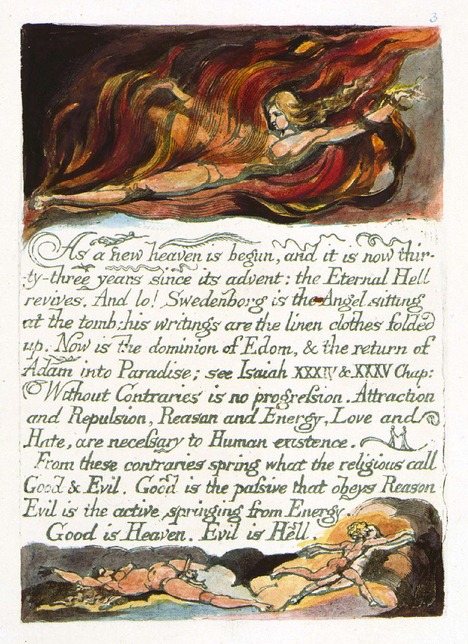
Marriage of Heaven and Hell
Plate 3

 Quote from an earlier post by Larry:

"In the 18th century Emmanuel Swedenborg, the Swedish scientist, philosopher and religionist, had a very high reputation. In London a 'new church' sprang up espousing his values. William Blake's parents were members of the New Church. That probably explains several interesting things about Blake's early life. For example his father appeared to be about as permissive as the average modern father in our culture today, but very atypical for his generation.

Blake was imbued with a great many of the famous man's values, particularly his esoteric religious ones. As a young adult Blake found many of the same ideas among the great thinkers of the ages. He thus became less dependent on Swedenborg's thought forms. With MHH Plates 21 and 22 he declared his independence of his childhood teacher.

Marriage of Heaven and Hell, (E 42)

"Plate 21
  I have always found that Angels have the vanity to speak of
themselves as the only wise; this they do with a confident
insolence sprouting from systematic reasoning:
  Thus Swedenborg boasts that what he writes is new; tho' it
is only the Contents or Index of already publish'd books"
Plate 22
 "Now hear a plain fact: Swedenborg has not written one new
truth: Now hear another: he has written all the old falshoods.
  And now hear the reason.  He conversed with Angels who are
all religious, & conversed not with Devils who all hate religion,
for he was incapable thro' his conceited notions.
  Thus Swedenborgs writings are a recapitulation of all
superficial opinions, and an analysis of the more sublime, but no
further."

Perhaps the chief objection of the mature Blake was that Swedenborg had a positive demeanor re the established church. But one of the things that stayed with Blake was Swedenborg's concept of the Divine Humanity." 

____________________

Here is a section of An Interview Conducted with Kathleen Raine on July 12, 1993 by Donald E. Stanford:

interview 

"Stanford: Why did he leave the Church of the New Jerusalem? 

Raine: Ah, that’s a good question. He wasn’t a churchman really. But he remained to the end of his life a Swedenborgian. This is this much-disputed Blake system. The scholars all scratch their heads about this; but it’s no problem. If you read the “Everlasting Gospel,” which is one of his latest works, it is in fact a point-by-point summary of the five leading beliefs of the Swedenborgian Church of the New Jerusalem, and in his interviews with Crabb Robinson, Robinson asked him about Swedenborg, and Blake said that he was a sent and inspired man, and then added, “but sometimes inspired men go beyond their commission from God.” He followed the Swedenborgian teaching. In fact, we’re all deeply familiar with the phrase “Divine Humanity,” but this phrase is not Blake’s invention; this is Swedenborg. And the Grand Man of the heavens, the one in many, and many in one, of all human souls — this is Swedenborg, and Blake uses this concept in a very beautiful passage in the Four Zoas in which he talks about man contracting our exalted senses with the multitude and expanding what we hold as one, as one man, all the universal family. Swedenborg’s greatest idea, I think, was this of the one in many, and many in one, and the divine presence in man. It was a really very wonderful idea because for him, the Divine Humanity was the eternal Christ, not the historical Christ. That was the Divine Humanity of whom Blake speaks and writes and speaks of as “Jesus the Imagination.” This is purely Swedenborgian. He disagreed with Swedenborg only in one respect: He said Swedenborg put all the good in heaven and the sinners in hell and didn’t realize that both the good and the evil are included in the Divine Humanity who transcends good and evil. That is what The Marriage of Heaven and Hell is about. Point-by-point, it’s quite a funny book. It takes up Swedenborg and his memorable experiences—it’s a running discussion with Swedenborg in semi-satirical terms, but although he poked fun at Swedenborg in certain respects, nevertheless, his system is pure Swedenborgian. I’m sure the only reason why everyone doesn’t know this is that the works of Swedenborg are so boring to read that none of the academics have read them, and I don’t blame them."

Descriptive Catalogue,(E 544)
   "Reasons and opinions concerning acts, are not
history.  Acts themselves alone are history, and these are
neither the exclusive property of Hume, Gibbon nor Voltaire,
Echard, Rapin, Plutarch, nor Herodotus.  Tell me the Acts, O
historian, and leave me to reason upon them as I please; away
with your reasoning and your rubbish.  All that is not action is
not [P 45] worth reading.  Tell me the What; I do not want you to
tell me the Why, and the How; I can find that out myself, as well
as you can, and I will not be fooled by you into opinions, that
you please to impose, to disbelieve what you think improbable or
impossible.  His opinions, who does not see spiritual agency, is
not worth any man's reading; he who rejects a fact because it is
improbable, must reject all History and retain doubts only."
Annotations to Reynolds,(E 658) 
 "The Ancients did not mean to Impose when they  affirmd 
their  belief  in Vision & Revelation  Plato was in Earnest. 
Milton was in Earnest.  They believd that God did Visit Man
Really & Truly & not as Reynolds pretends" 
Marriage of Heaven and Hell, Plate 3, (E 34)
  "As a new heaven is begun, and it is now thirty-three years
since its advent: the Eternal Hell revives. And lo! Swedenborg is
the Angel sitting at the tomb; his writings are the linen clothes folded up
Now is the dominion of Edom, & the return of Adam into
Paradise; see Isaiah XXXIV & XXXV Chap:
  Without Contraries is no progression.  Attraction and
Repulsion, Reason and Energy, Love and Hate, are necessary to
Human existence.
  From these contraries spring what the religious call Good &
Evil. Good is the passive that obeys Reason[.] Evil is the active
springing from Energy.
  Good is Heaven. Evil is Hell." 
Milton, Plate 22 [24], (E 117)
"O Swedenborg! strongest of men, the Samson shorn by the Churches!
Shewing the Transgresors in Hell, the proud Warriors in Heaven:
Heaven as a Punisher & Hell as One under Punishment:
With Laws from Plato & his Greeks to renew the Trojan Gods,
In Albion; & to deny the value of the Saviours blood.
But then I rais'd up Whitefield, Palamabron raisd up Westley,    

And these are the cries of the Churches before the two Witnesses' 
Faith in God  the dear Saviour who took on the likeness of men:
Becoming obedient to death, even the death of the Cross
The Witnesses lie dead in the Street of the Great City
No Faith is in all the Earth: the Book of God is trodden under Foot:       
He sent his two Servants Whitefield & Westley; were they Prophets
Or were they Idiots or Madmen? shew us Miracles!
Plate 23 [25]
Can you have greater Miracles than these? Men who devote
Their lifes whole comfort to intire scorn & injury & death
Awake thou sleeper on the Rock of Eternity Albion awake
The trumpet of Judgment hath twice sounded: all Nations are awake
But thou art still heavy and dull: Awake Albion awake!" 
Descriptive Catalogue, (E 546) 
 "The spiritual Preceptor, an experiment Picture.

THIS subject is taken from the visions of Emanuel Swedenborg.
Universal Theology, [P 53] No. 623.  The Learned, who strive to
ascend into Heaven by means of learning, appear to Children like
dead horses, when repelled by the celestial spheres.  The works
of this visionary are well worthy the attention of Painters and 
Poets; they are foundations for grand things; the reason they 
have not been more attended to, is, because corporeal demons 
have gained a predominance; who the leaders of these are, will 
be shewn below.  Unworthy Men who gain fame among Men, 
continue to govern mankind after death, and in their spiritual 
bodies, oppose the spirits of those, who worthily are famous; 
and as Swedenborg observes, by entering into disease and 
excrement, drunkenness and concupiscence, they possess
themselves of the bodies of mortal men, and shut the doors of
mind and of thought, by placing Learning above Inspiration, O
Artist! you may disbelieve all this, but it shall be at your own
peril."

Wednesday, June 25, 2025

LOGOS & MYTHOS

First posted May 2012

British Museum
Young's Night Thoughts
'I stand at the Door'


In the prologue to the Gospel of John the author uses the word 'logos' to speak of truth which is eternal but inaccessible. The logos which became manifest was embodied in the flesh. By becoming expressed in human form the logos became mythos, and was able to speak to men through images, allegory, and anology. In a sense the Old Testament is logos because the eternal truth came to be expressed in the abstraction of the law. In the New Testament the truth became incarnate in Jesus which opened the way for man to experience God as internal: an ever present reality being forever born in his psyche.


John1
[1] In the beginning was the Word [Logos], and the Word was with God, and the Word was God.
[2] The same was in the beginning with God.
[3] All things were made by him; and without him was not any thing made that was made.
[4] In him was life; and the life was the light of men.
[5] And the light shineth in darkness; and the darkness comprehended it not.
[6] There was a man sent from God, whose name was John.
[7] The same came for a witness, to bear witness of the Light, that all men through him might believe.
[8] He was not that Light, but was sent to bear witness of that Light.
[9] That was the true Light, which lighteth every man that cometh into the world.
[10] He was in the world, and the world was made by him, and the world knew him not.
[11] He came unto his own, and his own received him not.
[12] But as many as received him, to them gave he power to become the sons of God, even to them that believe on his name:
[13] Which were born, not of blood, nor of the will of the flesh, nor of the will of man, but of God.
[14] And the Word was made flesh, and dwelt among us, (and we beheld his glory, the glory as of the only begotten of the Father,) full of grace and truth.

Blake wrote not for the rational mind (associated with the logos), but for the intuitive mind. Dependence on reason, he felt, had led man away from his ability to understand his true nature and construct a reliable paradigm for viewing the world. Raine saw the same division between the rational and intuitive in Plato who addressed some his work to each type of mental processing. Blake applied himself to developing a means of awakening in men the ability to bypass rational or corporeal understanding and speak directly to the intuitive or spiritual sense.


Explaining the inconsistent attitude Blake had toward Plato and Greek culture, Kathleen Raine remarks in 
Blake and Tradition

"...Blake read the Neoplatonists before he read Plato, and the
 Phaperus, Cratylus, Phaedo, Parmenides, and Timaeus before he read the purely discursive works. Neoplatonism stems from one side of Plato - all that he inherited, through Pythagoras and the Orphic tradition, from the 'revealed' wisdom of antiquity. Blake was neither the first nor the last reader of Plato's works to have been bewildered by the presence of two, in many respects contradictory, aspects of his thought - logos and mythos; and he rejected the former with no less vigor than he continued to embrace the latter." (Page 73)

Blake was constantly in the process of refining his ability to restore the lost faculty of man to understand the infinite, eternal reality expressed in mythos.  

Letters
 , 27, (E 730)
[To Thomas Butts] Felpham July 6. 1803

"Thus I hope that all our three years trouble Ends in
Good Luck at last & shall be forgot by my affections & only
rememberd by my Understanding to be a Memento in time to come &
to speak to future generations by a Sublime Allegory which is now
perfectly completed into a Grand Poem[.] I may praise it since I
dare not pretend to be any other than the Secretary the Authors
are in Eternity I consider it as the Grandest Poem that This
World Contains.  Allegory addressd to the Intellectual powers
while it is altogether hidden from the Corporeal Understanding is
My Definition of the Most Sublime Poetry. it is also somewhat in
the same manner defind by Plato."
Northrop Frye, in Fearful Symmetry, tells us:
"A visionary creates, or dwells in, a higher spiritual world in which the objects of perception in this one have become transfigured and charged with a new intensity of symbolism." (Page 8)

Auguries of Innocence , (E 493)

"God Appears and God is Light
To those poor Souls who dwell in Night,
But does a Human Form Display
To those who Dwell in Realms of day."

Annotations to Lavater (E 599)
"God is in the lowest effects as well as in the highest
causes for he is become a worm that he may nourish the weak
For let it be rememberd that creation is. God descending
according to the weakness of man for our Lord is the word of God
& every thing on earth is the word of God & in its essence is God"

Thursday, February 27, 2025

POETRY

First posted August 2017 

Library of Congress
Marriage of Heaven and Hell
Plate 2

Los, as the Vehicular Form of the Eternal Urthona, is his representative in our world - the world of generation. Blake chose poetry as one of his media to express his message because it is adept at conveying spiritual content which is offered by Urthona the Zoa of Imagination. Damon (A Blake Dictionary) tells us that "Los is Poetry, the expression in this world of the Creative Imagination." 

The sense associated with Urthona is hearing which is discerned through the 'labyrinthine Ear.' Poetry is a special kind of sound designed to transmit through sound more than can be discerned in ordinary speech, just as music conveys more than the cacophony of a crowded marketplace.    

From Defending Ancient Springs by Kathleen Raine:
Page 107
"There is one type of resonance which he [William Empson] fails to consider, that resonance which may be present within a image of apparent simplicity, setting into vibration planes of reality and of consciousness other than those of the sensible world: the power of the symbol and of symbolic discourse...

Page 108
"It is in this that the poet distinguishes himself from the philosopher; not in any difference in the nature of their themes but in their way of experiencing them: where philosophy makes distinctions, poetry brings together, creating always wholes and harmonies; the work of the poet is not analysis but synthesis, The symbol may be called the unit of poetic synthesis; as Coleridge in his famous definition implies:

'A symbol is characterized by a translucence of the special in the Individual, or of the General in the Especial, or of the Universal in the General. Above all of the translucence of the Eternal through and in the Temporal. It always partakes of the Reality which it renders intelligible; and while it enunciates the whole, abides itself as a living part of that Unity of which it is representative...

What the poem affirms is that the world is, in its whole and in its parts, living and conscious; it also affirms that there is a hidden source ('heaven') from whose 'gate' visible things issue from invisible.'"   

Marriage of Heaven & Hell, Plate 5, (E 34)
" 1 Man has no Body distinct from his Soul for that calld Body is
a portion of Soul discernd by the five Senses. the chief inlets
of Soul in this age" 
Jerusalem, Plate 98, (E 257)
"According to the Human Nerves of Sensation, the Four Rivers of the Water of Life

South stood the Nerves of the Eye. East in Rivers of bliss the Nerves of the
Expansive Nostrils West, flowd the Parent Sense the Tongue. North stood
The labyrinthine Ear."

Four Zoas Night I, Page 3, (E 201)
"Los was the fourth immortal starry one, & in the Earth
Of a bright Universe Empery attended day & night                 
Days & nights of revolving joy, Urthona was his name
Page 4              
In Eden; in the Auricular Nerves of Human life
Which is the Earth of Eden, he his Emanations propagated
Fairies of Albion afterwards Gods of the Heathen, Daughter of Beulah Sing
His fall into Division & his Resurrection to Unity
His fall into the Generation of Decay & Death & his Regeneration 
by the Resurrection from the dead"  

Europe, Plate iii, (E 60)
"Five windows light the cavern'd Man; thro' one he breathes the air;
Thro' one, hears music of the spheres; thro' one, the eternal vine
Flourishes, that he may recieve the grapes; thro' one can look.
And see small portions of the eternal world that ever groweth;
Thro' one, himself pass out what time he please, but he will not;
For stolen joys are sweet, & bread eaten in secret pleasant."

Jerusalem, Plate 83, (E 241)
"Let Cambel and her Sisters sit within the Mundane Shell:
Forming the fluctuating Globe according to their will,
According as they weave the little embryon nerves & veins     
The Eye, the little Nostrils, & the delicate Tongue & Ears
Of labyrinthine intricacy: so shall they fold the World
That whatever is seen upon the Mundane Shell, the same
Be seen upon the Fluctuating Earth woven by the Sisters."

Jerusalem, Plate 53, (E 202)
"But Los, who is the Vehicular Form of strong Urthona"

Jerusalem, Plate 3, (E 146)
 "I therefore have produced
a variety in every line, both of cadences & number of syllables. 
Every word and every letter is studied and put into its fit
place: the terrific numbers are reserved for the terrific
parts--the mild & gentle, for the mild & gentle parts, and the
prosaic, for inferior parts: all are necessary to each other. 
Poetry Fetter'd, Fetters the Human Race! Nations are Destroy'd,
or Flourish, in proportion as Their Poetry Painting and Music,
are Destroy'd or Flourish! The Primeval State of Man, was Wisdom,
Art, and Science."                      

On Homer's Poetry, (E 269)
"It is the same with the Moral of a whole Poem as with the Moral Goodness
of its parts Unity & Morality, are secondary considerations &
belong to Philosophy & not to Poetry, to Exception & not to Rule,
to Accident & not to Substance. the Ancients calld it eating of
the tree of good & evil."

Descriptive Catalogue, (E 541)
"Painting, as well as poetry and music, exists and exults 
in immortal thoughts."

Vision of Last Judgment, (E 554)
"Fable or Allegory are a totally distinct & inferior
kind of Poetry.  Vision or Imagination is a Representation of
what Eternally Exists.  Really & Unchangeably.  Fable or Allegory
is Formd by the Daughters of Memory.  Imagination is Surrounded
by the daughters of Inspiration who in the aggregate are calld
Jerusalem" 

Vision of Last Judgment, (E 559)
"Noah is seen in the Midst of these Canopied by a
Rainbow. on his right hand Shem & on his Left Japhet these three
Persons represent Poetry Painting & Music the three Powers in
Man of conversing with Paradise which the flood did not Sweep
away" 

Letters, (E 730)
"Thus I hope that all our three years trouble Ends in
Good Luck at last & shall be forgot by my affections & only
rememberd by my Understanding to be a Memento in time to come &
to speak to future generations by a Sublime Allegory which is now
perfectly completed into a Grand Poem[.] I may praise it since I
dare not pretend to be any other than the Secretary the Authors
are in Eternity I consider it as the Grandest Poem that This
World Contains.  Allegory addressd to the Intellectual powers
while it is altogether hidden from the Corporeal Understanding is
My Definition of the Most Sublime Poetry. it is also somewhat in
the same manner defind by Plato.  This Poem shall by Divine
Assistance be progressively Printed & Ornamented with Prints &
given to the Public--But of this work I take care to say little
to Mr H. since he is as much averse to my poetry as he is to a
Chapter in the Bible   He knows that I have writ it for I have
shewn it to him & he had read Part by his own desire & has lookd
with sufficient contempt to enhance my opinion of it."

Wednesday, March 06, 2024

TRUE MAN

Wikipedia Commons
Illustrations to Blair's The Grave
Death of the Good Old Man

In the physical world - the world of time and space - we are conditioned to think of ourselves as physical beings. The body which provides the senses and feeds information to the mind and spirit is a physical body which is transitory. Temporarily associated with the physical body is a spiritual body which is perceived by Blake as the 'true man.'

Underlying the material body is the 'lineaments divine' from which the character is derived. It is up to the individual to 'explore' his 'Eternal Lineaments' in order to allow his Spiritual Body to thrive. The release of the Spiritual Body at physical death is perceived as Resurrection.

This is a passage from William Blake by Kathleen Raine: 

"The spirit is already free; and 'the spiritual body or angel' is the true man, released from its 'excrementitous husk and covering'. Here Blake is close to Swedenborg, whose disembodied spirits are fully human but released from the restrictions of a material body. Swedenborg taught that the Resurrection of the Dead is the freeing of the spiritual body from its earthly envelope, the rotten rags' of mortality...The physical body was beautiful to Blake in so far as it reflected the lineaments of an informing soul or spirit, the 'celestial body' of a famous passage of St Paul's first epistle to the Corinthians, which Blake invokes in his emblem accompanying the poem 'To Tirzah' (c, 1801): It is raised a spiritual body." (Page 112)


ALL RELIGIONS are ONE (E 1)

"PRINCIPLE 1st  That the Poetic Genius is the true Man. and that
the body or outward form of Man is derived from the Poetic
Genius.  Likewise that the forms of all things are derived from
their Genius. which by the Ancients was call'd an Angel & Spirit
& Demon."
Jerusalem, Plate 98, (E 257)
"North stood
The labyrinthine Ear. Circumscribing & Circumcising the excrementitious
Husk & Covering into Vacuum evaporating revealing the lineaments of Man
Driving outward the Body of Death in an Eternal Death & Resurrection"  
Milton, Plate 14 [15], (E 108)
"The loud voic'd Bard terrify'd took refuge in Miltons bosom

Then Milton rose up from the heavens of Albion ardorous!         
The whole Assembly wept prophetic, seeing in Miltons face
And in his lineaments divine the shades of Death & Ulro
He took off the robe of the promise, & ungirded himself from the oath of God

And Milton said, I go to Eternal Death! The Nations still
Follow after the detestable Gods of Priam; in pomp               
Of warlike selfhood, contradicting and blaspheming.
When will the Resurrection come; to deliver the sleeping body
From corruptibility: O when Lord Jesus wilt thou come?"
Milton, Plate 21 [23], (E 115)
"And all in Heaven, saw in the nether regions of the Imagination
In Ulro beneath Beulah, the vast breach of Miltons descent.
But I knew not that it was Milton, for man cannot know
What passes in his members till periods of Space & Time
Reveal the secrets of Eternity: for more extensive               
Than any other earthly things, are Mans earthly lineaments."
Milton, Plate 22 [24], (E 117)
"for not one Moment
Of Time is lost, nor one Event of Space unpermanent
But all remain: every fabric of Six Thousand Years               
Remains permanent: tho' on the Earth where Satan
Fell, and was cut off all things vanish & are seen no more
They vanish not from me & mine, we guard them first & last
The generations of men run on in the tide of Time
But leave their destind lineaments permanent for ever & ever.    
So spoke Los as we went along to his supreme abode." 
Milton, Plate 32 [35], (E 132)
"And thou O Milton art a State about to be Created
Called Eternal Annihilation that none but the Living shall
Dare to enter: & they shall enter triumphant over Death
And Hell & the Grave! States that are not, but ah! Seem to be.

Judge then of thy Own Self: thy Eternal Lineaments explore       
What is Eternal & what Changeable? & what Annihilable!

The Imagination is not a State: it is the Human Existence itself"
Jerusalem, Plate 38 [43], (E 185)
"Humanity, who is the Only General and Universal Form         
To which all Lineaments tend & seek with love & sympathy
All broad & general principles belong to benevolence
Who protects minute particulars, every one in their own identity.
Jerusalem, Plate 59, (E 211)
But the Divine Lamb stood beside Jerusalem. oft she saw          
The lineaments Divine & oft the Voice heard, & oft she said:

O Lord & Saviour, have the Gods of the Heathen pierced thee?"
Four Zoas, Night II,  Page 25, (E 314)
"And the leopards coverd with skins of beasts tended the roaring fires
Sublime distinct their lineaments divine of human beauty   
The tygers of wrath called the horses of instruction from their mangers
They unloos'd them & put on the harness of gold & silver & ivory
In human forms distinct they stood round Urizen prince of Light
Petrifying all the Human Imagination into rock & sand" 
Descriptive Catalogue, (E 541)
" He who does
not imagine in stronger and better lineaments, and in stronger
and better light than his perishing mortal eye can see does not
imagine at all.
Descriptive Catalogue, (E 544)
"The Beauty proper for sublime art, is lineaments, or
forms and features that are capable of being the receptacles of
intellect; accordingly the Painter has given in his beautiful
man, his own idea of intellectual Beauty." 
Vision of last Judgment, (E 560)
"I intreat then that the Spectator will attend to the 
Hands & Feet to the Lineaments of the Countenances they are all
descriptive of Character & not a line is drawn without intention"

First Corinthians 15 - Phillips Translation

15:35-38 - But perhaps someone will ask, "How is the resurrection achieved? With what sort of body do the dead arrive?" Now that is talking without using your minds! In your own experience you know that a seed does not germinate without itself "dying". When you sow a seed you do not sow the "body" that will eventually be produced, but bare grain, of wheat, for example, or one of the other seeds. God gives the seed a "body" according to his laws - a different "body" to each kind of seed.

15:39 - Then again, even in this world, all flesh is not identical. There is a difference in the flesh of human beings, animals, fish and birds.

15:40-41 - There are bodies which exist in this world, and bodies which exist in heaven. These bodies are not, as it were, in competition; the splendour of an earthly body is quite a different thing from the splendour of a heavenly body. The sun, the moon and the stars all have their own particular splendour, while among the stars themselves there are different kinds of splendour.

15:42-44 - These are illustrations here of the raising of the dead. The body is "sown" in corruption; it is raised beyond the reach of corruption. It is "sown" in dishonour; it is raised in splendour. It is sown in weakness; it is raised in power. It is sown a natural body; it is raised a spiritual body. As there is a natural body so will there be a spiritual body.

15:45 - It is written, moreover, that: 'The first man Adam became a living being'.

15:46-49 - So the last Adam is a life-giving Spirit. But we should notice that the order is "natural" first and then "spiritual". The first man came out of the earth, a material creature. The second man came from Heaven and was the Lord himself. For the life of this world men are made like the material man; but for the life that is to come they are made like the one from Heaven. So that just as we have been made like the material pattern, so we shall be made like the Heavenly pattern.

15:50 - For I assure you, my brothers, it is utterly impossible for flesh and blood to possess the kingdom of God. The transitory could never possess the everlasting.

...

15:54 - So when the perishable is lost in the imperishable, the mortal lost in the immortal, this saying will come true: 'Death is swallowed up in victory' 'O death, where is your sting? O Hades, where is your victory?'


Wednesday, February 14, 2024

JUDGMENT

Michelangelo
Sistine Chapel
The Last Judgment

William Blake
Petworth House
A Vision of the Last Judgment

Kathleen Raine in her book, Golgonooza: City of Imagination, focuses on differences in the way that the two artists, Michelangelo and Blake, conceived of the same subject matter. Beginning on Page 144, she describes their perspectives in creating the images of the Last Judgment. She sees them presenting opposing views of  the meaning and purpose of the apocalypse or final resolution of creation. Blake's Christ is a benevolent figure around whom there is a "great circulation of human figures ascending and descending in unbroken flow from the heavens down to the hells, and again rising up to the heavens." Michelangelo's figure of Christ focuses instead on fallen humanity without compassion.

Raine points out that Blake's figures are not historical figures even though we find their stories in the Bible: they are symbolic of the states through which mortal man passes in his journey through life.

Descriptions of the Last Judgment, (E 556)
"on the left 
beneath the falling figure of Cain is Moses casting his tables of
stone into the Deeps. it ought to be understood that the Persons
Moses & Abraham are not here meant but the States Signified by
those Names  the Individuals being representatives or Visions of
those States as they were reveald to Mortal Man in the Series of
Divine Revelations. as they are written in the Bible these
various States I have seen in my Imagination when distant they
appear as One Man but as you approach they appear
Multitudes of Nations.  Abraham hovers above his posterity which
appear as Multitudes of Children ascending from the Earth
surrounded by Stars as it was said As the Stars of Heaven for
Multitude Jacob & his Twelve Sons"
Represented by Blake are archetypes not individuals. In his life's journey a man is passing through archetypal states from which he is released by Jesus the Imagination in order to proceed to the next state. 
Milton Plate 32 [35], (E 132)
"Distinguish therefore States from Individuals in those States.
States Change: but Individual Identities never change nor cease:
You cannot go to Eternal Death in that which can never Die.
Satan & Adam are States" 
Jerusalem, Plate 33 [37],(E 180)
"We live as One Man; for contracting our infinite senses
We behold multitude; or expanding: we behold as one,
As One Man all the Universal Family; and that One Man
We call Jesus the Christ: and he in us, and we in him,        
Live in perfect harmony in Eden the land of life,
Giving, recieving, and forgiving each others trespasses."
Raine observes that in contrast to Blake's Christ who is the "heart of divine radiance" Michelangelo's Christ is "stern and majestic" and "comes to judge the world in terms of its own attainable perfection."

Jerusalem, Plate 49,(E 199)

"Yet they are blameless & Iniquity must be imputed only           
To the State they are enterd into that they may be deliverd:
Satan is the State of Death, & not a Human existence:
But Luvah is named Satan, because he has enterd that State.
A World where Man is by Nature the enemy of Man
Because the Evil is Created into a State. that Men               
May be deliverd time after time evermore. Amen.
Learn therefore O Sisters to distinguish the Eternal Human
That walks about among the stones of fire in bliss & woe
Alternate! from those States or Worlds in which the Spirit travels:
This is the only means to Forgiveness of Enemies"  

Page 159 Raine sums up her impressions of the works of two artists: "Thus  for Michelangelo the Last Judgment represents the end and downfall of the world, for Blake it represents rather an opening of the eyes of the spirit, an end only of illusion to make way for a vision of eternal reality."


Sunday, April 23, 2023

MAKING OF MYTH

Wikimedia Commons
Mercy and Truth Are Met Together

First posted Feb 2019

Although when we read Blake's poetry we may be most aware of the particular characters and images which we encounter, that is not all there is to it. The minutiae may be thought of as the instrumentality which serves the myth as a whole. But the myth itself also means more, for like all myth, it is pointing beyond itself to truth that cannot be expressed in words. Although we may wish that Blake's thoughts should be unequivocally stated so that we could read Jerusalem in the way that we read the newspaper, that is impossible. It is up to the reader to make his own intuitive contribution by fitting the parts into a whole which may be elusive.  

Kathleen Raine on page 135 of Defending Ancient Springs expresses the artistry of the poet who has the gift of being a vehicle for presenting the moment when eternity penetrates time and renovates the whole:

"So for Yeats the vision of what lies behind the veil came in glimpses, seldom in whole symbolic episodes, still less in myths which unfold like those of Blake, into great epic drama enacted in an interior country within whose spaces we move freely. The unit of such poetry is not the symbol. Myths are not built by adding piece by piece, they are not the sum of symbolic parts. The unit of the myth is the whole enactment, and all its figures; each symbol exists as a part within that imaginative unity, from which it is inseparable, and by which it is determined; as a sentence determines words, and is not merely their sum.
...in every turbulent encounter with the mighty form of his Zoas, we recognize parts within a great whole whose harmony is implicit. The ability to handle the units of myth - which might be defined as dynamic symbol, symbol in transformation - ought to be recognized as the supreme poetic gift. In such poetry the symbolic parts are inseparable from the imaginative configuration and constellations within which they appear...we do not think of these as separate symbols but as parts of the world in which the poem moves, as we move in nature. Yer considered separately each symbol is used with the precision of words in a language of which the poet has perfect mastery."


Milton, Plate 5, (E 98) 
"While the Females prepare the Victims. the Males at Furnaces 
And Anvils dance the dance of tears & pain. loud lightnings
Lash on their limbs as they turn the whirlwinds loose upon
The Furnaces, lamenting around the Anvils & this their Song

Ah weak & wide astray! Ah shut in narrow doleful form
Creeping in reptile flesh upon the bosom of the ground      
The Eye of Man a little narrow orb closd up & dark
Scarcely beholding the great light conversing with the Void
The Ear, a little shell in small volutions shutting out
All melodies & comprehending only Discord and Harmony
The Tongue a little moisture fills, a little food it cloys  
A little sound it utters & its cries are faintly heard
Then brings forth Moral Virtue the cruel Virgin Babylon

Can such an Eye judge of the stars? & looking thro its tubes
Measure the sunny rays that point their spears on Udanadan
Can such an Ear filld with the vapours of the yawning pit.  
Judge of the pure melodious harp struck by a hand divine?
Can such closed Nostrils feel a joy? or tell of autumn fruits
When grapes & figs burst their covering to the joyful air
Can such a Tongue boast of the living waters? or take in
Ought but the Vegetable Ratio & loathe the faint delight     
Can such gross Lips percieve? alas! folded within themselves
They touch not ought but pallid turn & tremble at every wind

Thus they sing Creating the Three Classes among Druid Rocks    
Charles calls on Milton for Atonement. Cromwell is ready
James calls for fires in Golgonooza. for heaps of smoking ruins  
In the night of prosperity and wantonness which he himself Created
Among the Daughters of Albion among the Rocks of the Druids"

Milton, Plate 31 [34], (E 130)
"Thou hearest the Nightingale begin the Song of Spring;
The Lark sitting upon his earthy bed: just as the morn
Appears; listens silent; then springing from the waving Corn-field! loud
He leads the Choir of Day! trill, trill, trill, trill,
Mounting upon the wings of light into the Great Expanse:
Reecchoing against the lovely blue & shining heavenly Shell:
His little throat labours with inspiration; every feather
On throat & breast & wings vibrates with the effluence Divine    
All Nature listens silent to him & the awful Sun
Stands still upon the Mountain looking on this little Bird

With eyes of soft humility, & wonder love & awe.
Then loud from their green covert all the Birds begin their Song
The Thrush, the Linnet & the Goldfinch, Robin & the Wren         
Awake the Sun from his sweet reverie upon the Mountain:
The Nightingale again assays his song, & thro the day,
And thro the night warbles luxuriant; every Bird of Song
Attending his loud harmony with admiration & love.
This is a Vision of the lamentation of Beulah over Ololon!       

Thou percievest the Flowers put forth their precious Odours!
And none can tell how from so small a center comes such sweets 
Forgetting that within that Center Eternity expands
Its ever during doors, that Og & Anak fiercely guard[.]
First eer the morning breaks joy opens in the flowery bosoms     
Joy even to tears, which the Sun rising dries; first the Wild Thyme
And Meadow-sweet downy & soft waving among the reeds.
Light springing on the air lead the sweet Dance: they wake
The Honeysuckle sleeping on the Oak: the flaunting beauty
Revels along upon the wind; the White-thorn lovely May           
Opens her many lovely eyes: listening the Rose still sleeps    
None dare to wake her. soon she bursts her crimson curtaind bed
And comes forth in the majesty of beauty; every Flower:
The Pink, the Jessamine, the Wall-flower, the Carnation
The Jonquil, the mild Lilly opes her heavens! every Tree,        
And Flower & Herb soon fill the air with an innumerable Dance
Yet all in order sweet & lovely, Men are sick with Love!
Such is a Vision of the lamentation of Beulah over Ololon"

Jerusalem, Plate 3, (E 145)
    "Reader! [lover] of books! [lover] of heaven,
    And of that God from whom [all books are given,]
    Who in mysterious Sinais awful cave
    To Man the wond'rous art of writing gave,
    Again he speaks in thunder and in fire!                
    Thunder of Thought, & flames of fierce desire:
    Even from the depths of Hell his voice I hear,
    Within the unfathomd caverns of my Ear.
    Therefore I print; nor vain my types shall be:
    Heaven, Earth & Hell, henceforth shall live in harmony" 

Poetical Sketches, SONG, (E 413)
"Love and harmony combine,
And around our souls intwine,
While thy branches mix with mine,
And our roots together join.

Joys upon our branches sit,    
Chirping loud, and singing sweet;
Like gentle streams beneath our feet
Innocence and virtue meet.

Thou the golden fruit dost bear,
I am clad in flowers fair;    
Thy sweet boughs perfume the air,
And the turtle buildeth there.

There she sits and feeds her young,
Sweet I hear her mournful song;
And thy lovely leaves among,
There is love: I hear his tongue.   

There his charming nest doth lay,
There he sleeps the night away;
There he sports along the day,
And doth among our branches play." 

Annotations to Reynolds, (E 659)
 "Demonstration Similitude & Harmony are Objects of Reasoning 
Invention Identity & Melody are Objects of Intuition" 
 

Tuesday, July 12, 2022

SANITY

Wikipedia Commons
Frontispiece
Songs of Experience

Here is a section of An Interview Conducted with Kathleen Raine on July 12, 1993 by Donald E. Stanford:

interview 

"Stanford: One critic has said recently that Blake was not mad, but he understood and described the mental suffering of madness in a profound way. Do concepts of madness such as schizophrenia, hallucination, and so on have a useful place in Blake criticism and will you comment on the direct question, “was Blake mad?”


Raine: No, of course he wasn’t mad. He was a sane man in a mad world, roughly speaking. Great genius has a wider field of consciousness. That is what genius is: seeing rather more than other men do, perhaps being in advance of his time. Certainly the nature of genius is to not accept current opinion, and Blake certainly did not accept current opinion. I don’t think that words like “schizophrenia” and “paranoia” add much to human discussion of whatever these words mean. Blake himself says, “Plato says that poets do not know what they write and utter. In that case, why is a lesser kind to be called knowing?” In other words, a poet is an inspired man. Blake believed in inspiration. This must be especially remembered with Blake, but all poets have believed in inspiration, that in an inspired state there is a widening of the field of consciousness. Yeats describes genius as bringing together at certain moments the waking and the sleeping mind. The available knowledge is greater in states of inspiration. Blake certainly had this


There is much suffering, as your critic says, in the writings of Blake: the turmoil, the anguish of Jerusalem. But this was not a personal thing; he was talking about the nation. He was a spiritual patriot, and he was speaking of the suffering of the giant Albion, as he calls the English nation. He was a prophet in the sense of the Old Testament prophets in the Jewish Bible, who also were speaking for their nation. They were not speaking of their individual suffering; they were speaking of the national psyche, if you like, into which Blake had certainly a remarkably clear insight. He speaks of living. He says, 'in South Molton Street I see and hear' what is going on in the soul of Albion, which is, of course, the soul of England. In other words, here in South Moulton Street I both see and hear the sufferings of the military, or the war against France that broke out after the French Revolution, of the conscription of soldiers, and the suffering of child labor, the endless sufferings of his people at that time, the hangings of boys at Tyburn for the theft of a yard of cloth, the injustices, the national crimes against which Blake spoke out. You may say these were descriptions of deep, deep suffering, the psychological sufferings of various kinds of mental and physical and spiritual tyrannies in his nation at the time. I wonder what he would have been writing about had he lived now. Certainly many things would have been the same — perhaps not all — but when he writes of London and marking, 'in every face marks of weakness, marks of woe,' he felt the collective suffering: that was the nature of his inspiration. He was not a personal poet expressing himself. He was a national prophet, calling to his nation to awake from their 'deadly sleep,' which is unconsciousness of what is going on, and to awake to the truths of the imagination and to reform many things. This is not madness."


Laocoon, (E 274)
 "There are States in which all Visionary Men are accounted Mad 
   Men   such are Greece & Rome"
 Poetical Sketches, (E 415)
"   MAD SONG.
The wild winds weep,
  And the night is a-cold;
Come hither, Sleep,
  And my griefs infold:   
But lo! the morning peeps          
  Over the eastern steeps,
And the rustling birds of dawn 
The earth do scorn.

Lo! to the vault
  Of paved heaven,              
With sorrow fraught
  My notes are driven:
They strike the ear of night,
  Make weep the eyes of day;
They make mad the roaring winds,      
  And with tempests play.

Like a fiend in a cloud
  With howling woe,
After night I do croud,
  And with night will go;         
I turn my back to the east,

From whence comforts have increas'd;
For light doth seize my brain
With frantic pain."

Annotations to Spurzheim's Observations on Insanity, (E 663) 
 "Cowper came to me & said. O that I
were insane always I will never rest.  Can you not make me truly
insane.  I will never rest till I am so. O that in the bosom of
God I was hid.  You retain health & yet are as mad as any of us
all--over us all--mad as a refuge from unbelief--from Bacon
Newton & Locke"
Letters, to Butts Jany 10 180(3), (E 724) 
"The Thing I
have most at Heart! more than life or all that seems to make life
comfortable without.  Is the Interest of True Religion & Science
& whenever any thing appears to affect that Interest. (Especially
if I myself omit any duty to my [self] <Station> as a
Soldier of Christ) It gives me the greatest of torments, I am not
ashamed afraid or averse to tell You what Ought to be Told.  That
I am under the direction of Messengers from Heaven Daily &
Nightly but the nature of such things is not as some suppose.
without trouble or care.  Temptations are on the right hand &
left behind the sea of time & space roars & follows swiftly he
who keeps not right onward is lost & if our footsteps slide in
clay how can we do otherwise than fear & tremble. but I should
not have troubled You with this account of my spiritual state
unless it had been necessary in explaining the actual cause of my
uneasiness into which you are so kind as to Enquire for I never
obtrude such things on others unless questiond & then I never
disguise the truth--But if we fear to do the dictates of our
Angels & tremble at the Tasks set before us. if we refuse to do
Spiritual Acts. because of Natural Fears or Natural Desires!  Who
can describe the dismal torments of such a state!--I too well
remember the Threats I heard!--If you who are organized by Divine
Providence for Spiritual communion.  Refuse & bury your Talent in
the Earth even tho you should want Natural Bread. Sorrow & Desperation 
pursues you thro life! & after death shame & confusion of face to
eternity--Every one in Eternity will leave you aghast at the Man
who was crownd with glory & honour by his brethren & betrayd
their cause to their enemies.  You will be calld the base Judas
who betrayd his Friend!--Such words would make any Stout man
tremble & how then could I be at ease? But I am now no longer in
That State & now go on again with my Task Fearless. and tho my
path is difficult.  I have no fear of stumbling while I keep it" 
Letters, April 25: 1803, To Butts, (E 728)
"Now I may say to you what perhaps I should not dare to say
to any one else.  That I can alone carry on my visionary studies
in London unannoyd & that I may converse with my friends in
Eternity.  See Visions, Dream Dreams, & prophecy & speak Parables
unobserv'd & at liberty from the Doubts of other Mortals. perhaps
Doubts proceeding from Kindness. but Doubts are always pernicious
Especially when we Doubt our Friends Christ is very decided on
this Point.  'He who is Not With Me is Against Me' There is no
Medium or Middle state & if a Man is the Enemy of my Spiritual
Life while he pretends to be the Friend of my Corporeal. he is a
Real Enemy--but the Man may be the friend of my Spiritual Life
while he seems the Enemy of my Corporeal but Not Vice Versa"