Showing posts with label Four Zoas. Show all posts

Saturday, August 01, 2026

ZOAS AS ARCHETYPES

First posted May 2011

Blake uses the Zoas as a means of presenting the aspects of the psyche which he sees internally and recognizes as the structure of the human mind. Early in Blake's life he recognized that there were internal divisions within himself. Reason, desire, imagination and sensation each tried to claim the uppermost position in the allocation of his time and resources. Blake personified these abstractions as the 'Four Mighty Ones in Every Man.'

The beginning of the Four Zoas brings to our attention the four mighty ones who do battle:

Four Zoas, Night I, Page 3, (E 300)
"The Song of the Aged Mother which shook the heavens with wrath
Hearing the march of long resounding strong heroic Verse
Marshalld in order for the day of Intellectual Battle

Four Mighty Ones are in every Man;"

Later Blake identifies the Four Zoas and their positions in the Eternal World.

Four Zoas, Night VII, Page 74, (E 351)
"But in Eternal times the Seat of Urizen is in the South
Urthona in the North Luvah in East Tharmas in West"

Laurens van der Post, in Jung and the Story of Our Time, speaking of Jung's observation that the conflict between the conscious and unconscious forces in the mind led to mental illness notes that :

"The trouble started only when the part of the human personality which was conscious behaved as if it were the whole of the man. There was nothing this unconscious world abhorred more than one-sidedness. When one extreme of spirit attempted a monopoly for itself another extreme sooner of later rose titanic in the unconscious to overthrow it. That is why the history of man was so much a swing from one opposite of spirit into another as Heraclitus had observed millenniums before." (Page 209)

The trouble starts in Blake's myth when the positions of the Zoas are altered by the deal between Urizen and Luvah. The harmonious balance is ruined.

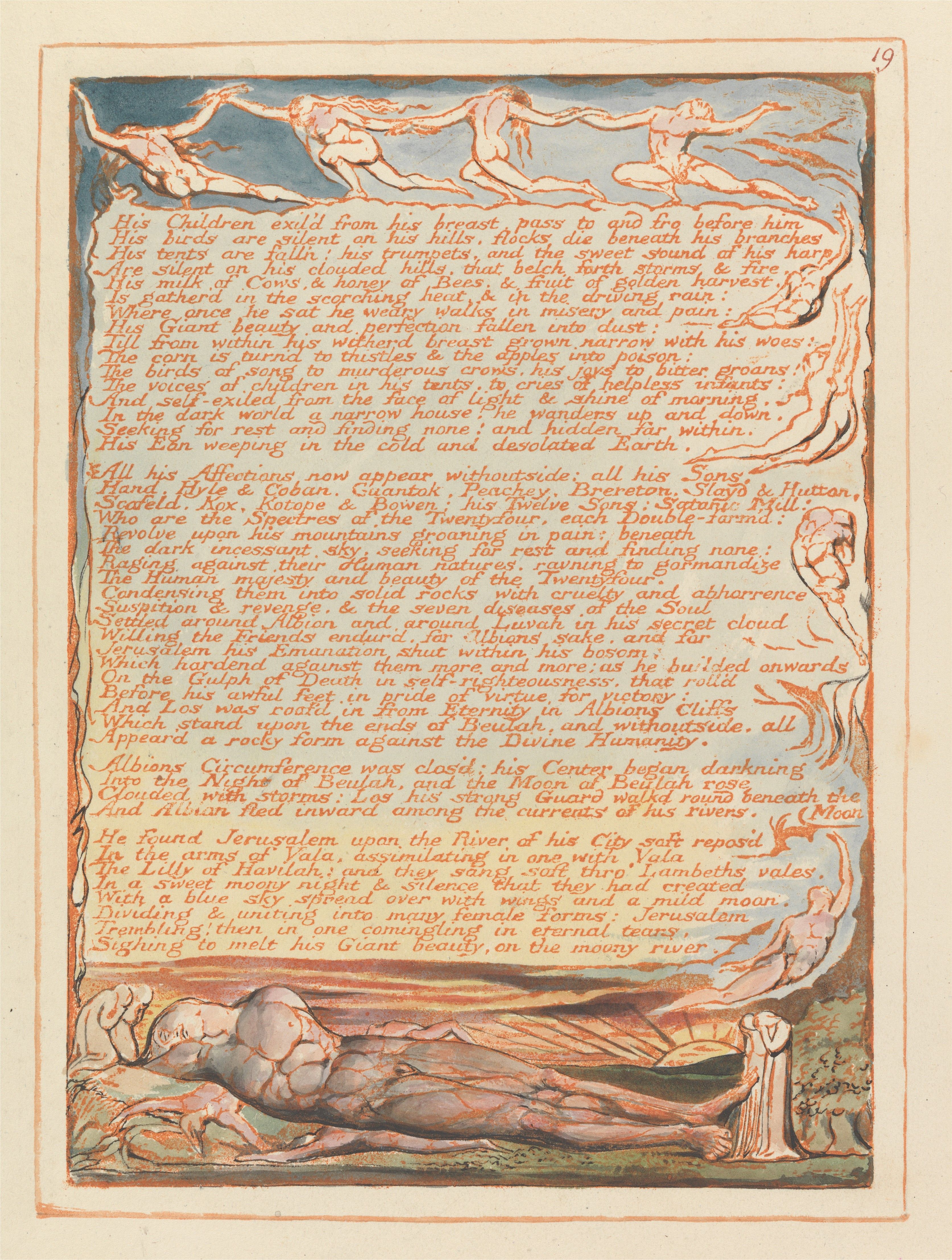
Milton, PLATE 19 [21], (E 112)
"Four Universes round the Mundane Egg remain Chaotic
One to the North, named Urthona: One to the South, named Urizen:
One to the East, named Luvah: One to the West, named Tharmas
They are the Four Zoa's that stood around the Throne Divine!
But when Luvah assum'd the World of Urizen to the South:
And Albion was slain upon his mountains, & in his tent;
All fell towards the Center in dire ruin, sinking down.
And in the South remains a burning fire; in the East a void.
In the West, a world of raging waters; in the North a solid,
Unfathomable! without end. But in the midst of these,
Is built eternally the Universe of Los and Enitharmon:
Towards which Milton went, but Urizen oppos'd his path."

Van der Post writes of the collective unconscious and archetypes of Jung as the patterns of the mind which organize its form and put to use the psyche's energy.

"He [Jung] revealed how in this collective unconscious of the individual man were infinite resources of energy, organized in definite patterns. Each of these patterns had at its disposal its own form of energy and somewhere located, as it were, in the center, between the unconscious and the conscious, there was a master pattern to which all the others subscribed and all their other energies could be joined in one transcendental orbit. He called these patterns, first of all, 'primordial images,' ... but later changed to 'archetypes,' an idea rediscovered from Saint Augustine, and before him from Hermes Trimegistus, who proclaimed in the Poimandres, 'You have seen in your mind the archetypal image!'" (Page 209)

In Jerusalem we learn the Zoas have lost their original abilities and exemplify the opposite characteristics:

Jerusalem, Plate 38, (E184)
"They [the Four Zoas] saw their Wheels rising up poisonous against Albion
Urizen, cold & scientific: Luvah, pitying & weeping
Tharmas, indolent & sullen: Urthona, doubting & despairing
Victims to one another & dreadfully plotting against each other
To prevent Albion walking about in the Four Complexions."

Jerusalem, Plate 49, (E 199)
"Because the Evil is Created into a State. that Men
May be deliverd time after time evermore. Amen.
Learn therefore O Sisters to distinguish the Eternal Human
That walks about among the stones of fire in bliss & woe
Alternate! from those States or Worlds in which the Spirit travels:
This is the only means to Forgiveness of Enemies"


Blake and Jung both sought consciousness of the internal dynamics of the psyche, awareness of the forces seeking expression or dominance, and recognition of 'the Eternal Human That walks about among the stones of fire in bliss & woe.'


Frontispiece to Bürger's "Leonora" (London, 1796)
Designed by Blake, Engraved by Perry


Van der Post explains Jung's concept of wholeness:

"Wholeness was the ultimate of man's conscious and unconscious seeking; indeed consciousness was so important because it was the chosen instrument of the unconscious seeking the abolition of partialities in a harmony of differences that is wholeness." (Page 219) 


Sunday, April 26, 2026

Events of Fall

 Previously posted Nov 2018 

Yale Center for British Art
Jerusalem
Plate 19  
 
Always fiercely eclectic, Blake has gathered his symbols here from a number of sources into a new creation: sleeping man equals fallen man living in darkness; this most general symbol fills the New Testament. For example, "Awake thou that sleepest, and Christ shall give thee light". We live by the light of reason (not always Christ's light!). Urizen, the Sun God, must be asleep to allow Luvah, like the Greek adolescent, Phaethon, to seize his Horses of Light and rise into the Chariot of Day. Zeus struck Phaethon down with a thunderbolt in the story in Ovid’s Metamorphoses. Blake used Ovid as a primary source for his borrowings from Greek mythology.

In Night ii we will find Urizen casting Luvah into the furnaces of affliction, where there is much heat but no light. What was once eternal delight has become unmitigated hell.

Luvah and Vala personify the masculine and feminine dimensions of feeling, and séparated from Luvah, Vala becomes the goddess of fallen nature. Luvah's seizure of the sun and Vala's dalliance on the pillow express in different ways the same event. The Prince of Love is bound to get his wings scorched, and the sleeping Albion is rather foolish to allow this to happen; he has lost his head over a part of himself.

Blake used this double event to say many things to us at many levels. Fundamentally Blake is saying that Man has lost his heavenly wholeness (which he calls the Divine Image) and begun to worship the material, a relatively insignificant part of himself. He turns his back upon the Divine Vision in his dream of Vala. The former is Eternal Life and the latter Eternal Death. The dalliance of Albion with Vala leads to the Eternal Death (fallenness) that we read about in the first six nights. Blake described it symbolically, in many ways, for example, "to converse in the wilds of Newton and Locke". We find here Blake's primary dialectic, between eternal vision and fallen materialism.

Other accounts of this decisive event occur at various places throughout the Four Zoas. The most definitive is that of Ahania. Her dream relates the central event, the primary fall, to an idolatrous worship; just so Blake evaluated organized religion. Albion's worship of his shadow has two immediate consequences: he breaks out with the boils of Job, a biblical symbol of the Fall of Mankind, and he exiles Luvah and Vala from their rightful place in the psychic economy.
__________________________
There are at least six occurrences of the story which I call the central event of the Fall:
K=Keynes, E=Erdman

Enitharmon's Song of Death      Night i. 261-80 K 271-2 --- (E 305)
Ambassadors from Beulah                     i. 484-559 K277-9 --- (E 311)
Ahania's vision                                       iii. 42-102 K 292-4 --- (E 326)
The Spectre of Urthona (first)              iv. 84-110 K 299-300 --- (E 334)
The Shadow of Enitharmon                 vii. 239-64 K 326 --- (E 358)
The Spectre of Urthona (second)        vii. 277-98 K 327 --- (E 359)


Thursday, May 09, 2024

ERDMAN

Wikipedia Commons
America
Plate 12

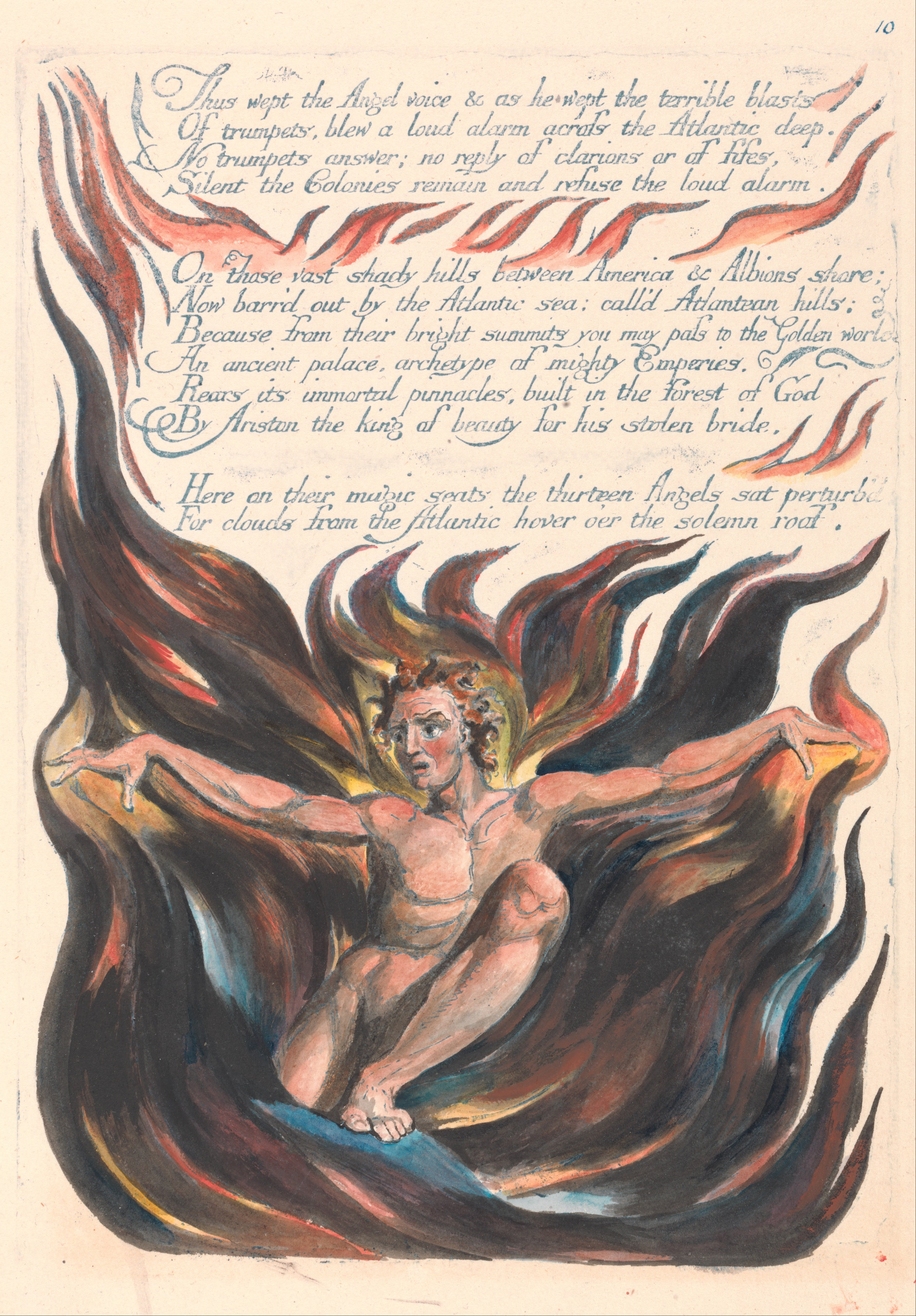
David V Erdman, in Prophet Against Empire, demonstrated how the contraries reason and energy work together to accomplish what neither could accomplish alone.  The opportunity was there for Urizen to cooperate with the Lord of Day and use the Steeds of Light to bring about an accomadation with the energy of those seeking Liberty. He listened instead, however, to Reason and found that Wrath of the oppressed had seized the reins of government in the Age of Revolution. 

Page 194

“The creeping Urizen is supplied with a long soliloquy in a passage of Night Five of The Four Zoas  which is worth taking up here for the light it casts back upon The Marriage of Heaven and Hell and A Song of Liberty and The Tyger.  The fatal error of the jealous king is that his fixing of the horizon ultimately limits himself more than it does the energy of the people.  Royalty can keep its crimson robes, Orleans warned, only if it stops trying to measure of each man 'the circle that he shall run'. (French Revolution, P 91) Soliloquizing as he crawls in the den or narrow circle of his own ideas, the fallen Urizen of Night Five laments too late his imperial mistakes: his choice of war instead of peace, his failure to accept the opportunity to be an enlightened despot when the "mild & holy voice" of divine freedom said, "O light, spring up & shine" and "gave to me a silver sceptre & crownd me with a golden crown" to 'Go forth & guide' the people. 'I went not forth,' he laments, 'I hid myself in black clouds of my wrath, I called the stars around my feet in the night of councils dark'. (FZ's) Thus George assembled his council in 1774; thus Louis the King of France, prepared his ‘starry hosts’ in 1789 and let the spark of humanity in his bosom be 'quench’d in clouds' by 'the Nobles of France, and dark mists.' Each time, in the event, at Yorktown and again at Valmy, ‘The stars threw down their spears & fled naked away'. We fell.  Too late Urizen is sorry he refused to use his ‘Steeds of Light’.  

The language of the soliloquy is doubly revealing.  On the level of practice it is clear that ‘The stars threw down their spears’ means : the armies of counterrevolution were defeated. On the level of theory it is clear that Reason, when it refuses to assist but attempts to hinder Energy, is overthrown.  Denied the peaceful accommodation of the Steeds of Light, the just man seizes the Tigers of Wrath. Vetoed by a stubborn monarch, the French people became, as the London Times of January 7, 1792, put it, 'loose from all restraints, and, in many instances, more ferocious than wolves and tigers'. As Blake put it in Fayette, the French grew bloodthirsty and would 'not submit to the gibbet & halter.' 

If we take the tiger and horse as symbols of untamed Energy and domesticated Reason then it is obvious which of these contraries is more vital in days of revolution. In Hell is a proverbial that 'the tygers of wrath are wiser than the horses of instruction.'
...
Page 196 
The creator must have smiled at Yorktown and at Valmy, not because his people were warlike, but because they seemed ready to coexist with the Lamb, the wrath of the Tiger having done its work. The question, 'Did he smile his work to see?' is perhaps as rhetorical as the corresponding query of Orleans: 'And can Nobles be bound when the people are free, or God weep when his children are happy?'"

Four Zoas, Night V, Page 64, (E 343)
"But now my land is darkend & my wise men are departed

My songs are turned to cries of Lamentation           
Heard on my Mountains & deep sighs under my palace roofs         
Because the Steeds of Urizen once swifter than the light
Were kept back from my Lord & from his chariot of mercies

O did I keep the horses of the day in silver pastures
O I refusd the Lord of day the horses of his prince
O did I close my treasuries with roofs of solid stone            
And darken all my Palace walls with envyings & hate

O Fool to think that I could hide from his all piercing eyes
The gold & silver & costly stones his holy workmanship
O Fool could I forget the light that filled my bright spheres
Was a reflection of his face who calld me from the deep          

I well remember for I heard the mild & holy voice
Saying O light spring up & shine & I sprang up from the deep  
He gave to me a silver scepter & crownd me with a golden crown
& said Go forth & guide my Son who wanders on the ocean  

I went not forth. I hid myself in black clouds of my wrath       
I calld the stars around my feet in the night of councils dark
The stars threw down their spears & fled naked away
We fell. I siezd thee dark Urthona In my left hand falling

I siezd thee beauteous Luvah thou art faded like a flower"
America, Plate 2, (E 52)
"Silent as despairing love, and strong as jealousy,
The hairy shoulders rend the links, free are the wrists of fire;
Round the terrific loins he siez'd the panting struggling womb;
It joy'd: she put aside her clouds & smiled her first-born smile;
As when a black cloud shews its lightnings to the silent deep.   

Soon as she saw the terrible boy then burst the virgin cry.

I know thee, I have found thee, & I will not let thee go;
Thou art the image of God who dwells in darkness of Africa;
And thou art fall'n to give me life in regions of dark death.
On my American plains I feel the struggling afflictions          
Endur'd by roots that writhe their arms into the nether deep:
I see a serpent in Canada, who courts me to his love;
In Mexico an Eagle, and a Lion in Peru;
I see a Whale in the South-sea, drinking my soul away.
O what limb rending pains I feel. thy fire & my frost            
Mingle in howling pains, in furrows by thy lightnings rent;
This is eternal death; and this the torment long foretold."
French Revolution, Page 10(E 294)
"Fear not dreams, fear not visions, nor be you dismay'd with
     sorrows which flee at the morning;
Can the fires of Nobility ever be quench'd, or the stars by a
     stormy night?
Is the body diseas'd when the members are healthful? can the man
     be bound in sorrow
Whose ev'ry func,tion is fill'd with its fiery desire? can the
     soul whose brain and heart
Cast their rivers in equal tides thro' the great Paradise,
     languish because the feet
Hands, head, bosom, and parts of love, follow their high
     breathing joy?
And can Nobles be bound when the people are free, or God weep
     when his children are happy?
Have you never seen Fayette's forehead, or Mirabeau's eyes, or
     the shoulders of Target,
Or Bailly the strong foot of France, or Clermont the terrible
     voice, and your robes
Still retain their own crimson? mine never yet faded, for fire
     delights in its form.
But go, merciless man! enter into the infinite labyrinth of
     another's brain
Ere thou measure the circle that he shall run. Go, thou cold
     recluse,into the fires
Of another's high flaming rich bosom, and return unconsum'd, and
     write laws.
If thou canst not do this, doubt thy theories, learn to consider
     all men as thy equals,
Thy brethren, and not as thy foot or thy hand, unless thou first
     fearest to hurt them."


Wednesday, May 01, 2024

FOUR ZOAS PICTURED

British Museum
Book of Urizen, printed 1794 
Copy D, Plate 14


Library of Congress
Book of Urizen, printed 1818
Copy G, Plate 16 [14]
 

First Posted  October 2009

This rare image of the Four Zoas together appears in the Book of Urizen.


Blake pictured the four Eternals peering down in the unfinished world of Urizen as it divides, falling into the abyss. Most of the copies of this plate display only three of the Zoas. In Blake's characteristic way of allowing imagination to lead him as he created his images, he has added the fourth Zoa Tharmas, to the other three in the late copy.

Blake's characters have different appearances as they are represented at different levels of existence in his myth. Here they are represented at the level of the Eternals; although no physical representation at that spiritual level can be anything more than limited and false.

Nevertheless, we see Urizen on the right, looking down at his own fallen nature as it disintegrates in separation. His beard drags in the water of matter which is created as a result of his fall. Why is he old? Because he is conservatism which must always be replaced by the new and fresh.

Beside Urizen is Los, forever young, who joins Urizen in the descent in order to be the agent of the eventual return. Suggested by the fingers of Los touching the liquid below, as if paint or ink were dripping from his hand, is an intimation of the role of imagination in the regeneration process

Next to the young Los, is another older gentleman, Luvah, who as the emotions, is a level early in physic development. Luvah becomes intimately involved in the struggle to limit the downward fall of Urizen and reverse the division in Albion. At various points Luvah works with or competes with Urizen or Los, but his service is to Jesus.

The Zoa who is missing in most of the images, Tharmas, is pictured as no more than a boy. The contradiction in the character Tharmas is that he is both the 'Parent Power' and the last to be named. Mary Lynn Johnson describes him as "innocence, instinct, the binding force of the human personality, and the body." Perhaps he is closer to the id than is any other of the Zoas, and so closer to the child.

On the engraved plate, words and image work together to involve us in the fall - from the perspective of Eternity.
Book of Urizen, Plate 15 [14], (E 78)                                       
"Thus the Eternal Prophet was divided
Before the death-image of Urizen
For in changeable clouds and darkness
In a winterly night beneath,
The Abyss of Los stretch'd immense:
And now seen, now obscur'd, to the eyes
Of Eternals, the visions remote
Of the dark seperation appear'd.
As glasses discover Worlds
In the endless Abyss of space,      
So the expanding eyes of Immortals
Beheld the dark visions of Los,
And the globe of life blood trembling"

Monday, April 01, 2024

Tharmas & Urthona

British Library
Four Zoas Manuscript
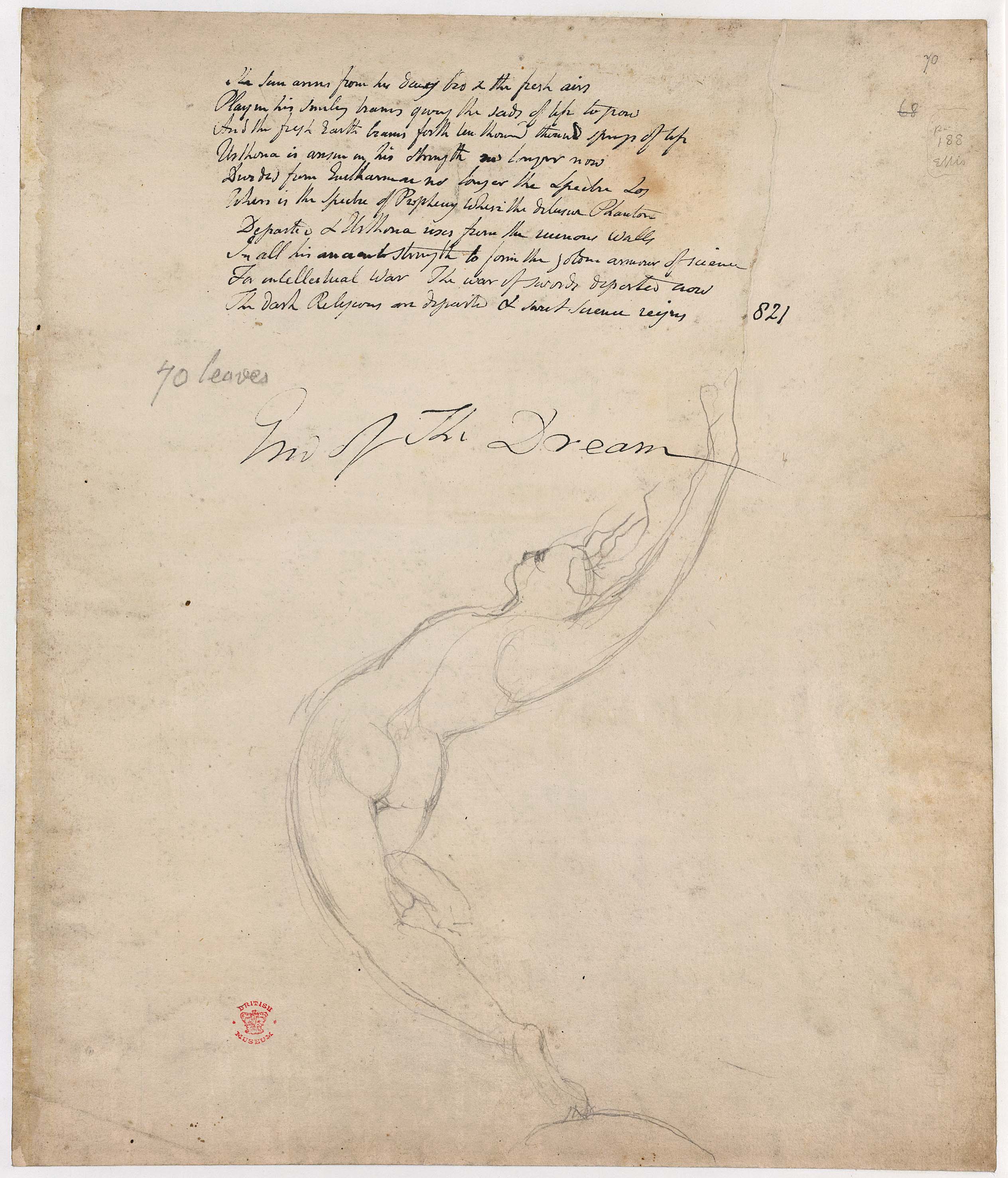
End of the Dream

When William Blake developed the characters who peopled his myth he used  methods which had been passed down from ancient times. He looked within himself, found diverse ways in which his mind worked and gave form to ideas. Although the Zoas, Emanation, Spectres and others came from Blake's mind, they were not unique to Blake. Under different names they lived in other mythologies and belief systems. 

We have often pointed out the similarities between Blake's four Zoas and Jung's four functions. There is not evidence that Jung studied Blake and copied the system Blake developed. Four ways in which both viewed the structure of our thinking came from self reflection. But it is not just that each divided the mind into four parts which function in the same ways as those proposed by the other thinker. The two men recognized that the four formed two pairs which operated in the same ways.

Jung identified Sensation and Intuition as the two kinds of perception; Thinking and Feeling were the two kinds of judgment. Jung's pair of Thinking and Emotion matches Blake's pair of Urizen and Luvah. Jung's pair of Intuition and Sensation matches Urthona and Tharmas. 

The two Zoas who initiated the fall were Urizen and Luvah: reason and emotion, Jung's judging functions.

Four Zoas, Night V, Page 64, (E 343)
[Urizen speaks]

"I well remember for I heard the mild & holy voice
Saying O light spring up & shine & I sprang up from the deep
He gave to me a silver scepter & crownd me with a golden crown
& said Go forth & guide my Son who wanders on the ocean

I went not forth. I hid myself in black clouds of my wrath
I calld the stars around my feet in the night of councils dark
The stars threw down their spears & fled naked away
We fell. I siezd thee dark Urthona In my left hand falling

I siezd thee beauteous Luvah thou art faded like a flower
And like a lilly is thy wife Vala witherd by winds
When thou didst bear the golden cup at the immortal tables
Thy children smote their fiery wings crownd with the gold of heaven
Page 65
Thy pure feet stepd on the steps divine. too pure for other feet
And thy fair locks shadowd thine eyes from the divine effulgence
Then thou didst keep with Strong Urthona the living gates of heaven
But now thou art bound down with him even to the gates of hell

Because thou gavest Urizen the wine of the Almighty
For steeds of Light that they might run in thy golden chariot of pride

I gave to thee the Steeds I pourd the stolen wine
And drunken with the immortal draught fell from my throne sublime"

 After the fall Urizen attemped to establish his kingdom based on rigid principles of law and control. When Urizen was unsuccessful Tharmas declared himself God, Urthona he named his son, and Los he designated Urthona. 

Four Zoas, Night iv, Page 51, (E 334)
"Tharmas before Los stood & thus the Voice of Tharmas rolld

Now all comes into the power of Tharmas. Urizen is falln
And Luvah hidden in the Elemental forms of Life & Death
Urthona is My Son O Los thou art Urthona & Tharmas
Is God.
...

O why did foul ambition sieze thee Urizen Prince of Light

And thee O Luvah prince of Love till Tharmas was divided         
And I what can I now behold but an Eternal Death
Before my Eyes & an Eternal weary work to strive
Against the monstrous forms that breed among my silent waves
Is this to be A God far rather would I be a Man
To know sweet Science & to do with simple companions             
Sitting beneath a tent & viewing sheepfolds & soft pastures"
Urizen's ploy to enlist Luvah in a takeover of as much of the territory of the brain as he could, had repercussions for Tharmas and Urthona as well.
Four Zoas, Night iv. Page 49, (E 332)
"O how Los howld at the rending asunder all the fibres rent
Where Enitharmon joind to his left side in griding pain 
He falling on the rocks bellowd his Dolor. till the blood
Stanch'd, then in ululation waild his woes upon the wind 
And Tharmas calld to the Dark Spectre who upon the Shores
With dislocated Limbs had falln. The Spectre rose in pain
A Shadow blue obscure & dismal. like a statue of lead
Bent by its fall from a high tower the dolorous shadow rose

Go forth said Tharmas works of joy are thine   obey & live
So shall the spungy marrow issuing from thy splinterd bones
Bonify. & thou shalt have rest when this thy labour is done
Go forth bear Enitharmon back to the Eternal Prophet
Build her a bower in the midst of all my dashing waves
Make first a resting place for Los & Enitharmon. then            
Thou shalt have rest. If thou refusest dashd abroad on all
My waves. thy limbs shall separate in stench & rotting & thou
Become a prey to all my demons of despair & hope

The Spectre of Urthona seeing Enitharmon writhd  
His cloudy form in jealous fear & muttering thunders hoarse      
And casting round thick glooms. thus utterd his fierce pangs of heart

Tharmas I know thee. how are we alterd our beauty decayd
But still I know thee tho in this horrible ruin whelmd
Thou once the mildest son of heaven art now become a Rage
A terror to all living things. think not that I am ignorant      
That thou art risen from the dead or that my power forgot
Page 50 
I slumber here in weak repose. I well remember the Day
The day of terror & abhorrence 
When fleeing from the battle thou fleeting like the raven
Of dawn outstretching an expanse where neer expanse had been
Drewst all the Sons of Beulah into thy dread vortex following 
Thy Eddying spirit down the hills of Beulah. All my sons
Stood round me at the anvil where new heated the wedge
Of iron glowd furious prepard for spades & mattocks
Hearing the symphonies of war loud sounding   All my sons
Fled from my side then pangs smote me unknown before. I saw      
My loins begin to break forth into veiny pipes & writhe   
Before me in the wind englobing trembling with strong vibrations
The bloody mass began to animate. I bending over
Wept bitter tears incessant. Still beholding how the piteous form
Dividing & dividing from my loins a weak & piteous               
Soft cloud of snow a female pale & weak I soft embracd
My counter part & calld it Love   I named her Enitharmon
But found myself & her together issuing down the tide
Which now our rivers were become delving thro caverns huge
Of goary blood strugg[l]ing to be deliverd from our bonds        
She strove in vain not so Urthona strove for breaking forth,
A shadow blue obscure & dismal from the breathing Nostrils

Of Enion I issued into the air divided from Enitharmon"
Four Zoas, Night vi, Page 68, (E345)
[Urizen spoke]
"I will give
Chains of dark ignorance & cords of twisted self conceit
That they may curse Tharmas their God & Los his adopted son
That they may curse & worship the obscure Demon of destruction
That they may worship terrors & obey the violent
Go forth sons of my curse Go forth daughters of my abhorrence
Tharmas heard the deadly scream across his watry world
And Urizens loud sounding voice lamenting on the wind"
The injuries to Tharmas (the body) healed but Urthona (the spirit) was left with a limp, an imperfection which connected him with the frailty of humanity in whom he dwelled.

At the ending of the Four Zoas Tharmas is the companion of Urthona. They join together at the Golden Feast in 'mirth and joy'. Urthona (no longer Los) is not deterred from his task of providing the bread and wine to feed the soul of man.  He retreats to the inner world within man's subconscious. 

 Four Zoas, Night ix, Page 137, (E 405)

"The Eternal Man darkend with Sorrow & a wintry mantle   
Coverd the Hills   He said O Tharmas rise & O Urthona

Then Tharmas & Urthona rose from the Golden feast satiated
With Mirth & joy Urthona limping from his fall on Tharmas leand
In his right hand his hammer Tharmas held his Shepherds crook
Beset with gold gold were the ornaments formed by the sons of Urizen 
Then Enion & Ahania & Vala & the wife of Dark Urthona
Rose from the feast in joy ascending to their Golden Looms"
Four Zoas, Night ix, Page 137, (E 405)
"Urthona calld his Sons around him Tharmas calld his sons
Numrous. they took the wine they separated the Lees
And Luvah was put for dung on the ground by the Sons of Tharmas & Urthona
They formed heavens of sweetest worlds of gold & silver & ivory 
Of glass & precious stones They loaded all the waggons of heaven
And took away the wine of ages with solemn songs & joy

Luvah & Vala woke & all the sons & daughters of Luvah
Awoke they wept to one another & they reascended
To the Eternal Man in woe he cast them wailing into              
The world of shadows thro the air till winter is over & gone

But the Human Wine stood wondering in all their delightful Expanses
The Elements subside the heavens rolld on with vocal harmony

Then Los who is Urthona rose in all his regenerate power"
Four Zoas, Night ix, Page 138, (E 406)
"Such are the works of Dark Urthona Tharmas sifted the corn
Urthona made the Bread of Ages & he placed it
In golden & in silver baskets in heavens of precious stone
And then took his repose in Winter in the night of Time
...
For Tharmas brought his flocks upon the hills & in the Vales
Around the Eternal Mans bright tent the little Children play
Among the wooly flocks The hammer of Urthona sounds              
In the deep caves beneath his limbs renewd his Lions roar
Around the Furnaces & in Evening sport upon the plains
They raise their faces from the Earth conversing with the Man
...
Urthona is arisen in his strength no longer now
Divided from Enitharmon no longer the Spectre Los                
Where is the Spectre of Prophecy where the delusive Phantom
Departed & Urthona rises from the ruinous walls
In all his ancient strength to form the golden armour of science
For intellectual War The war of swords departed now
The dark Religions are departed & sweet Science reigns           

                  End of The Dream 


Sunday, March 24, 2024

Four Zoas Summary 4

Blake Archive
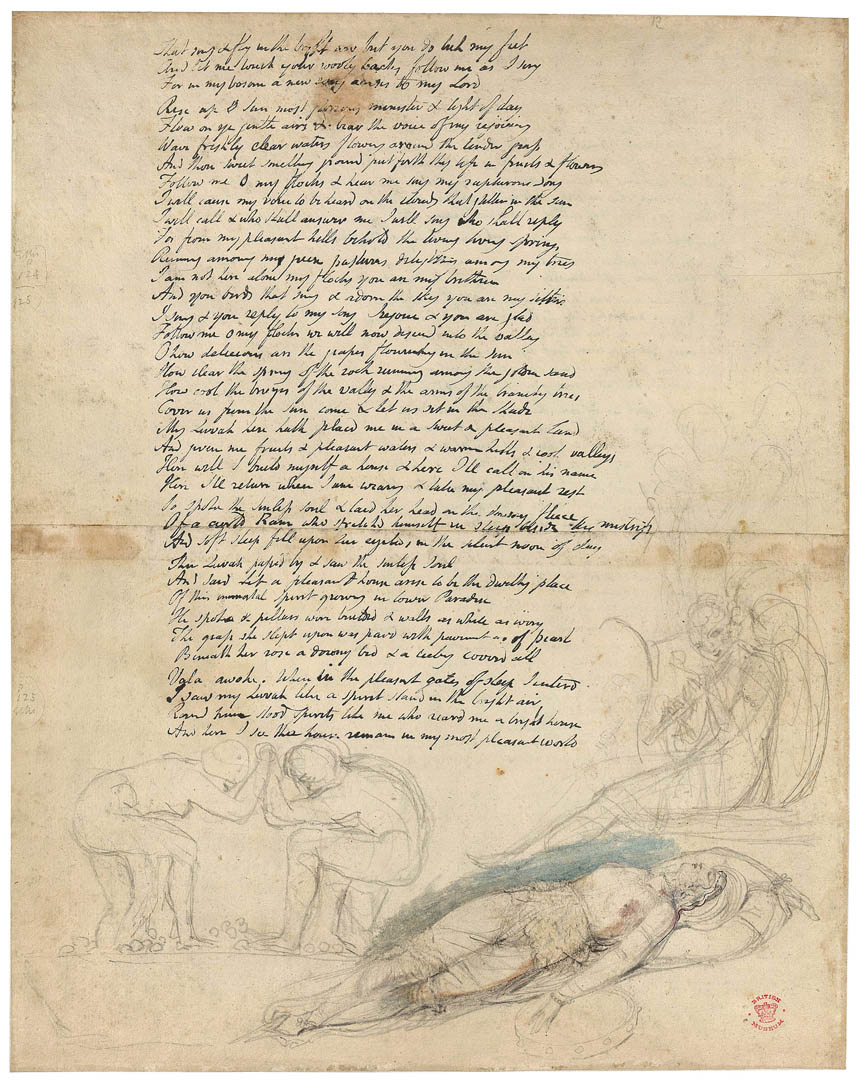
Four Zoas, Night ix, Page 128

Four Zoas, Night ix, Page 128, (E 397)
"Vala awoke. When in the pleasant gates of sleep I enterd
I saw my Luvah like a spirit stand in the bright air
Round him stood spirits like me who reard me a bright house
And here I see thee house remain in my most pleasant world"   

In the last Night Blake let all of his feelings out in a magnificent vision of apocalypse that bears comparison with the one John wrote: 

"Los his vegetable hands 
Outstretch'd; his right hand, branching out in fibrous strength, 
Siez'd the Sun; His left hand, like dark roots, cover'd the Moon, 
And tore them down, cracking the heavens across from immense to immense. 
Then fell the fires of Eternity with loud and shrill
Sound of Loud Trumpet thundering along from heaven to heaven 
A mighty sound articulate Awake ye dead & come To judgment from the four winds Awake & Come away"
(Four Zoas, Night ix, E 386)

     And on and on it goes, much too imposing to describe in this short review. But two things will be said:

     First, Blake draws on John's Apocalypse as he already has in Night viii. The strangest book in the Bible, utterly incomprehensible to the literal mind, has much to offer to the trained imagination. To read the end of 4Z with complete attention gives one a purchase on Blake's great source; Revelation begins to come alive in an exciting new way.

Second, as great as it is, Blake simply wasn't able to 'Christianize' his apocalypse as he had done the two previous Nights. Perhaps it was already too deeply stamped with his pre-Christian mind. Forgiveness is the soul, virtually the alpha and omega of Blake's Christ, but Night ix shows little or no evidence of this new spirit. Only in Jerusalem, in its last plates, do we find a thoroughly Christian apocalypse. Neither Revelation nor Night ix has much of forgiveness; what they do have is vengeance and retribution. Both writers had suffered much at the hands of the ungodly, and both looked with anticipation to the Day of Vengeance. So we must say that Night ix is a modern redoing of John's Apocalypse, while the end of Jerusalem is a Christian recreation of it.

     Blake's epic ends with the eternal man awake, his four Zoas back in union, each carrying out his appointed function in the harmonious consummation of the Age. In the last harvest Urizen reaps, Tharmas threshes, Luvah tramples out the vineyard and Urthona bakes the bread.

     Night ix contains much magnificent poetry. A few lines near the end will provide an appropriate end to this all too inadequate description of Blake's great poem:

"The Sun has left his blackness and has found a fresher morning, 
And the mild moon rejoices in the clear and cloudless night, 
And Man walks forth from the midst of the fires: the evil is all consum'd.
... He walks upon the Eternal Mountains, raising his heavenly voice, 
Conversing with the Animal forms of wisdom night and day, 
... They raise their faces from the Earth, conversing with the Man:
"How is it we have walk'd thro' fires and yet are not consum'd? 
"How is it that all things are chang'd, even as in ancient times?"
The Sun arises from his dewey bed, and the fresh airs 
Play in his smiling beams giving the seeds of life to grow, 
And the fresh Earth beams forth ten thousand thousand springs of life."
(Four Zoas, Night ix, E 406) 

    
Blake's myth is stated concisely in Blake's Four Zoas: The Design of a Dream by Brian Wilkie and Mary Lynn Johnson: 
"Albion is the whole person and mankind. His Emanation is Jerusalem, who represents the perfect freedom enjoyed by man in the unfallen state (called by Blake Eden or Eternity) where he is in harmony with himself and the world. The fallen state is a condition in which each of the four primal powers betrays what is best in himself and wars with the others." 

In The Four Zoas Blake follows the disintegration of Albion's original unity, his struggles as a divided self and the final resolution of Albion reborn as his constituent Zoas, each serving the whole. 

Sunday, March 17, 2024

Four Zoas Summary 3

Four Zoas, Night v, Page 60, (E 340)
"But when fourteen summers & winters had revolved over
Their solemn habitation Los beheld the ruddy boy
Embracing his bright mother & beheld malignant fires
In his young eyes discerning plain that Orc plotted his death"

       As Night ii begins, the Fallen Man, on the point of falling asleep, commissions Urizen as his regent. Urizen soars with pride but immediately falls into the fearful fantasies of the future which dominate all of his attempts at creation. He casts Luvah into the furnaces of affliction and proceeds to build the Mundane Shell, giving Blake a chance to expatiate at great length on how wrongly the world is made.

       Tharmas and Luvah are now thoroughly fallen and estranged from their emanations, and Urizen's turn comes in Night iii. Ahania, Urizen's emanation, reacts to his fearful aggressions with  her own vision of the Fall, and the infuriated Urizen casts her out and promptly falls himself like Humpty Dumpty, an eloquent comment on the fate of all the 'strong' who in fear cast out the 'weak'. With the fall of Reason Tharmas rises to power from the depths of the sea, although he is mentally incompetent in the extreme. He commissions Los to create endlessly and futilly: "Renew these ruin'd souls of Men thro' Earth, Sea, Air & Fire,/To waste in endless corruption, renew thou, I will destroy."

       Los proceeds to bind Urizen with the chains of time and space in the parody of Creation which we have already studied from Book of Urizen, but "terrified at the shapes enslav'd humanity put on, he became what he beheld". ( The second extended Christian interpolation occurs in the midst of this story.)

      Los begins Night v with a sort of St. Vitus Dance to "put on the shape of enslaved humanity", a convulsion which Enitharmon shares, leading to the birth of Orc, a manifestation of Luvah, who at this point represents fallen human feeling. Immediately, "The Enormous Demons woke and howl'd around the new born King,/Crying 'Luvah, King of Love, thou art the King of rage & death'".

       As in Book of Urizen, Orc is bound in the Chain of Jealousy, but his tormented cries awaken Urizen, who concludes Night v with the "Woes of Urizen". His suffering has brought him to a point of self-recognition; he has come to himself in a way reminiscent of the Prodigal Son's moment of truth: "I will arise", which Blake took directly from the story in Luke. Urizen thus shows himself to be human. Unfortunately it's only a temporary lapse, for in Night vi he explores his dens, faces all the brokenness and horror of a ruined universe and as his solution comes up with the  "Net of Religion ". Since pure political tyranny won't work, he turns to a form of religious control.

       We come to the climax of this epic in Night vii when Urizen has approached Orc's prison and induced him to climb the  "Tree of Mystery ", turning into a serpent. This sets the stage for the Genesis account of the Fall, which Blake sees as the beginning of the Return. Enitharmon, attracted by the cries of her son, Orc, comes down to the "Tree of Mystery", where she meets the Spectre of Urthona (FZ, Night  vii, E 358). The Spectre closely corresponds to Jung's 'shadow', and like a skilled analyst Blake brings about the reconciliation of shadow and anima on the way to wholeness).

       From the union of Spectre and Enitharmon two things ensue. The good news is that Los begins to get himself together with his Spectre and his Emanation. From this integration comes forth Jerusalem and from Jerusalem will proceed the Lamb. The bad news is the immediate birth of Rahab, the most sinister female of Blake's pantheon. She personifies all the evils of deceit, treachery, and hateful female pride that most appalled Blake about life. Blake's Rahab is the same character whom John of Patmos called "Mystery, the Whore of Babylon"; Blake eventually gives her these names--and several others as well.

       The Spectre of Urthona, a new idea on Blake's imaginative horizon, foreshadowed the Moment of Grace which was to revolutionize his spiritual world.  Suffice it here to say that the appearance of the Spectre marks Man's (and Blake's) dawning awareness that the evils of the world, which he had so deplored, exist in his own psyche. It marks what Jung referred to as the withdrawal of the projections, which Jung considered vital to the survival of the world. Blake agreed about the seriousness of the process; he stated it with great poetic intensity in the reversed writing found in the illustration to Jerusalem, Plate 41 (E 183) :

"Each man is in his Spectre's power Until the arrival of that hour When his humanity awake And cast his Spectre into the Lake."

       But in Night vii Los doesn't cast his Spectre into the lake; he embraces it, which in a manner of speaking is the same thing. Los doesn't (yet) cast his Spectre into the lake because his humanity is not yet fully awake, but only beginning to awaken. As Blake aptly put, it complete redemption "was not to be effected without Cares & Sorrows & Troubles of six thousand years of self denial and of bitter Contrition". That beautiful line points to the redemptive dimension of all the fallenness and horror we have been reading about. It was Blake's way of saying what Paul said in Romans: "All things work together for good to them that love God...." Blake and Jung and probably Paul would agree that we begin to love God (and stop trying to be God!) when we recognize and accept our own involvement in the horror around us. That's the moment when the six thousand years of change begins.

       The birth of Rahab and the integration of Los lead to an intensification of a drama that has already stretched out for seven nights of excruciating intensity. In Night viii the drama has not only intensified, but it has clarified so that we can no longer fail to understand that the forces of life and of death are in bitter conflict. It has become the old, old story, and Blake leaves no doubt about who represents light and who darkness. Urizen resumes his war for control and out of his ranks of War comes Satan. Rahab conspires to put to death the Saviour who has come down from Heaven and emerged from Jerusalem. The Christian knows that this death is foreordained for final victory, but neither Rahab nor Jerusalem has that awareness, and near the end of Night viii we read these richly evocative words:

"Jerusalem wept over the Sepulcher two thousand years.
Rahab trimphs over all; she took Jerusalem
Captive, a Willing Captive, by delusive arts impell'd
To worship Urizen's Dragon form, to offer her own Children
Upon the bloody Altar. John saw these things Revealed...."(FZ, Night viii, E 385)

    Blake never forgot the involvement of the Christian Church in two thousand years of bloodshed, but here, under the influence of grace, he has a more understanding view of it than he has expressed elsewhere.

TO BE CONTINUED

Wednesday, March 13, 2024

Four Zoas Summary 2

Four Zoas, Night ii, Page 36, (E 326)
"When Urizen slept on his couch. drawn thro unbounded space
Onto the margin of Non Entity the bright Female came
There she beheld the Spectrous form of Enion in the Void
And never from that moment could she rest upon her pillow"
       Other accounts of this decisive event occur at various places throughout the poem. The most definitive is that of Ahania. Her dream relates the central event, the primary fall, to an idolatrous worship; just so Blake evaluated organized religion. Albion's worship of his shadow has two immediate consequences: he breaks out with the boils of Job, a biblical symbol of the Fall of Mankind, and he exiles Luvah and Vala from their rightful place in the psychic economy.
   
        This central event of the Fall gives the key to the meaning of The Four Zoas. Before we proceed with the outline of the poem, we need to look at one other central fact: the identity of Los, the fourth Zoa (in Eternity called Urthona). Whereas the central event gives the key to six thousand years of fallenness, the identity of Los gives the key to redemption. This becomes clear in the end when we read about Jesus, the Imagination, but from the beginning we should be aware that Los is the fourth who makes Man whole. Blake derived the first three Zoas in part from Daniel's three friends who were cast into the fiery furnace by Nebuchadnezzar. Los was the fourth, whom the king saw walking in the furnace "like the Son of God". Like the other Zoas Los has a chequered career, but he is always moving toward this ultimately revealed identity. Near the end of Jerusalem Blake put the finishing touches on Los's Eternal identity with these words:
"Therefore the Sons of Eden praise Urthona's Spectre in songs, 
Because he kept the Divine Vision in time of trouble." (Jerusalem, Plate 95, E 255)   

And on the following plate of Jerusalem:
"Then Jesus appeared.... And the Divine Appearance was the likeness and similitude of Los."     

The clue to this identity appears at the very beginning of 4Z where the poet states his theme:

"Four Mighty Ones are in every Man; a Perfect Unity 
Cannot Exist but from the Universal Brotherhood of Eden, 
The Universal Man, to Whom be Glory Evermore. Amen. 
.... Los was the fourth immortal starry one, and in the Earth 
Of a bright Universe, Empery attended day and night, 
Days and nights of revolving joy. Urthona was his name 
In Eden.... 
Daughters of Beulah, Sing 
His fall into Division and his Resurrection to Unity: 
His fall into the Generation of decay and death, and his Regeneration by the Resurrection from the dead."
(Four Zoas, Night i, E 301)

       Here Blake has made the antecedent of 'his' deliberately ambiguous: Albion, the Ancient Man, of course, but also Los. It is Los's career that we follow most intently. Blake deeply identified with Los, and so do we if we read the poem with imagination.

       But "Begin with Tharmas, Parent power dark'ning in the West". Tharmas represents the body, or in the psychic realm the instinct, and in Eternity he's a glorious shepherd. But "darkening in the West" beneath the jealous attack of his emanation, Enion, he sets in motion the Circle of Destiny (Four Zoas, Night i, E 302) and sinks into the sea where he becomes an insane old man. From his "corse" arises the ravening spectre, a most gruesome embodiment of pure egocentricity. A loveless embrace of Enion leads to the birth of Los and Enitharmon, the divided earthly form of Urthona. (Note that all this happens after the 'central event', although in the poem we read about it first.)

       This first earthly family displays the ubiquitous dialectic of Blake (and of universal experience): the angelic and demonic processes go on side by side. Enion's intense mother love turns her daughter, Enitharmon, into a teasing and heartless bitch and drives Enion to the abyss where she becomes a disembodied voice of pure consciousness. We hear her voice at the end of Nights i, ii, and viii sounding the purest prophetic judgment on what has transpired. In a real sense Enion is Blake. 

       When Enitharmon signs her Song of Death (quoted a few pages back), Los strkes her down and then gives his own, more prophetic account of the Fall. Enitharmon retaliates by calling down Urizen. This precipitates the first encounter between these two adversaries in one of the relationships that dominates the poem--and Blake's life as well. In this initial confrontation Los weakens through his pity or remorse over Enitharmon and joins the  Nuptial Feast of fallenness (FZ Night i, E 307). In the New Testament the marriage of the Lamb inaugurates the Kingdom of Heaven; this demonic parody of it announces the Kingdom of Satan. Enion responds with her first stirring prophetic utterance, concluding the first night in the earlier draft.

       At this point Blake, in a later revision of 4Z, made his first obvious attempt to Christianize his myth. The Daughters of Beulah in their "Wars of Eternal Death" give what is probably the most straightforward, impartial account of the Fall.

TO BE CONTINUED

Monday, March 11, 2024

Four Zoas Summary

Four Zoas, Night i, PAGE 9, (E 304)

"And then they wanderd far away she sought for them in vain
In weeping blindness stumbling she followd them oer rocks & mountains"


       The Four Zoas is a very exotic masterpiece and most definitely an acquired taste. The reader initially encounters an appalling mass of strange ideas and much that appears to be sheer gibberish. But with perseverance the strange ideas become familiar bit by bit, and the gibberish clarifies into some of the most exalted thought forms of the human mind. To the seasoned reader 4Z is a treasure house of imaginative delights. Or call it a mine that releases its gold to the pertinacious. The same could be said of the Bible. 

      Blake wrote the poem over a period of years while his mind and spirit were rapidly developing and changing. It began as the story of Vala, the incarnation of the Female Will. Later it became an account of cosmic and psychic history written in terms of the four Giant Forms--their breakup and struggle for dominion. At Blake's spiritual crisis this seed bed gave birth to Jesus and Jerusalem, his bride. Blake then made an attempt to rewrite 4Z to reflect his new spiritual orientation, but after a while he gave up. 4Z was aborted because Blake's world had fundamentally changed, and he was ready to start over. After many years of looking for the New Age he had become a New Man. The new man wrote Milton and Jerusalem using 4Z as a quarry. 4Z is fascinating in its own right, although unfinished, but most significant as a platform from which to rise to the ethereal glory of the mature poems.

       Focusing on The Four Zoas Milton Percival, who wrote William Blake's Circle of Destiny, tells us that ten characters make up his myth: Two Albions (man), the Eternal One and the One who fell asleep down here in this vale of tears; Four Zoas (Urizen, Luvah, Los, and Tharmas) and their feminine parts (Ahania, Vala, Enitharman, and Enion).

       The first four nights of this aborted masterpiece recount the fall of each of the four Zoas: Tharmas, the body; Luvah, the feelings; Urizen, the mind; and finally Urthona (Los), the imagination or spirit. These four steps in the fall of Man contain a wealth of rich detail, but  one central event Blake described repeatedly in the words of various characters: Urizen and Luvah (Mind and Feeling) struggle for dominion over the sleeping man, Albion. Luvah seizes Urizen's steeds of light and mounts into the sky. Urizen retreats into the north, the rightful place of Urthona, the imagination. 

These mistakes lead to a long series of cataclysmic disasters that condemn mankind to his fallen condition. For six nights we read an almost unrelieved account of the Fall; we read about falling, about fallenness, described in voluminous detail in a hundred ways. Blake felt intensely that we have come a long, long way from the Garden, and he explored with exceeding minuteness every step of the dismal journey, down and out. (You might notice that as extensive as this negative mood is, it closely resembles the Old Testament, a great deal of which consists of flagellations of Israel by the prophets.)

       To begin our orientation to the poem look closely at the central event of the Fall. Blake put it in the mouths of several characters and each one has his or her own particular slant. The reader has to decide for himself whose account to believe. This may depend upon the reader as much as it does upon Blake.

       The earliest description of the central event comes in the words of Enitharmon, a notoriously untrustworthy character at this point; we may call her the queen of fallen space. In a conversation with her consort, Los, the prophetic boy, she gives her interpretation of the Fall:

"Hear! I will sing a Song of Death! it is a Song of Vala! 
The Fallen Man takes his repose, Urizen sleeps in the porch, 
Luvah and Vala wake and fly up from the Human Heart 
Into the brain from thence; upon the pillow Vala slumber'd, 
And Luvah siez'd the Horses of Light and rose into the Chariot of Day. 
Sweet laughter siez'd me in my sleep..." (Four Zoas, Night i, E 305)

      Always fiercely eclectic, Blake has gathered his symbols here from a number of sources into a new creation: sleeping man equals fallen man living in darkness; this most general symbol fills the New Testament. For example, "Awake thou that sleepest, and Christ shall give thee light". We live by the light of reason (not always Christ's light!). Urizen, the Sun God, must be asleep to allow Luvah, like the Greek adolescent, Phaethon, to seize his Horses of Light and rise into the Chariot of Day. Zeus struck Phaethon down with a thunderbolt. In Night ii we find Urizen casting Luvah into the furnaces of affliction, where there is much heat but no light. What was once eternal delight has become unmitigated hell.

       Luvah and Vala personify the masculine and feminine dimensions of feeling, and separated from Luvah Vala becomes the goddess of fallen nature. Luvah's seizure of the sun and Vala's dalliance on the pillow express in different ways the same event. The Prince of Love is bound to get his wings scorched, and the sleeping Albion is rather foolish to allow this to happen; he has lost his head over a part of himself.

       Blake used this double event to say many things to us at many levels. Fundamentally Blake is saying that Man has lost his heavenly wholeness (which he calls the Divine Image) and begun to worship the material, a relatively insignificant part of himself. In his dream of Vala he turns his back upon the Divine Vision. The former is Eternal Death and the latter Eternal Life. The dalliance of Albion with Vala leads to the Eternal Death (fallenness) that we read about in the first six nights. Blake described it symbolically in many ways, for example, "to converse in the wilds of Newton and Locke". We find here Blake's primary dialectic, between eternal vision and fallen materialism.

TO BE CONTINUED

Saturday, November 18, 2023

Forgiving God

Wikipedia Commons
The Soldiers Casting Lots for Christ's Garments

From Ram Horn'd with Gold with added image and quotes.

The Neo-platonic interpreters have theorized that Blake couldn't forgive the creator for condemning us to this prison house of mortal life. I think a more universal explanation fits the facts. Everyone has difficulty forgiving his father and/or creator for the dimensions of horror in life which threaten in one way or another to overwhelm the psyche. Few or none of us have done a really adequate job of this. Most often we've repressed the sensitive idealist; we've closed off from consciousness those unpleasant ultimate realities which seem to have no answer.

"Did he who made the Lamb make thee?" Has anyone really asked that question since 1794? Neitszche asked it and went crazy. In our generation Jung has come closest, and that's what makes him great. Most of us, even the best of Christians, have partitioned off and closed out that ultimate question, the ultimate doubt expressed by the dying Saviour on the cross. This William Blake could not do; like Jesus he was condemned to face consciously the penalty of our finitude. 

Psalms 22

[1] My God, my God, why hast thou forsaken me? why art thou so far from helping me, and from the words of my roaring?

Matthew 27

[46] And about the ninth hour Jesus cried with a loud voice, saying, Eli, Eli, lama sabachthani? that is to say, My God, my God, why hast thou forsaken me?

Frye has spoken of the 'abyss of consciousness'. Enion, the primeval mother in 4Z is condemned to it by her love of her children. At the end of Night II she calls our attention to this blindness which we have chosen and its opposite, the abyss of consciousness which she (and Blake in her) is condemned to face; here is her complaint. 

Four Zoas, Night II, Page 35, (E 325)
"What is the price of Experience do men buy it for a song
Or wisdom for a dance in the street? No it is bought with the price
Of all that a man hath his house his wife his children
Wisdom is sold in the desolate market where none come to buy 
And in the witherd field where the farmer plows for bread in vain

It is an easy thing to triumph in the summers sun
And in the vintage & to sing on the waggon loaded with corn
It is an easy thing to talk of patience to the afflicted
To speak the laws of prudence to the houseless wanderer
Page 36 
To listen to the hungry ravens cry in wintry season
When the red blood is filld with wine & with the marrow of lambs

It is an easy thing to laugh at wrathful elements
To hear the dog howl at the wintry door, the ox in the slaughter house moan
To see a god on every wind & a blessing on every blast           
To hear sounds of love in the thunder storm that destroys our enemies house
To rejoice in the blight that covers his field, & the sickness that cuts off his children
While our olive & vine sing & laugh round our door & our children bring fruits & flowers

Then the groan & the dolor are quite forgotten & the slave grinding at the mill
And the captive in chains & the poor in the prison, & the soldier in the field
When the shatterd bone hath laid him groaning among the happier dead

It is an easy thing to rejoice in the tents of prosperity
Thus could I sing & thus rejoice, but it is not so with me!" 

Something is terribly wrong in this created universe, and in the face of this underlying wrongness the idea of a loving Father as Creator simply doesn't fit all the facts. This consciousness, which Blake shared with Dostoevski in the person of Ivan Karamazov, interrupted Blake's childlike innocence and precipitated the torturous journey "through the Aerial Void and all the Churches". 

 Fyodor Dostoyevsky, The Brothers Karamazov

“Look, suppose that there was one among all those who desire nothing but material and filthy lucre, that one, at least, is like my old Inquisitor, who himself ate roots in the desert and raved, overcoming his flesh, in order to make himself free and perfect, but who still loved mankind all his life, and suddenly opened his eyes and he saw that there is no great moral blessedness in achieving perfection of the will only to become convinced, at the same time, that millions of the rest of God's creatures have been set up only for mockery, that they will never be strong enough to manage their freedom, that from such pitiful rebels will never come giants to complete the tower, that it was not for such geese that the great idealist dreamt his dream of harmony.”

Milton, Plate 35 [39],(E 136) 
"Just in this Moment when the morning odours rise abroad
And first from the Wild Thyme, stands a Fountain in a rock
Of crystal flowing into two Streams, one flows thro Golgonooza   

And thro Beulah to Eden beneath Los's western Wall
The other flows thro the Aerial Void & all the Churches
Meeting again in Golgonooza beyond Satans Seat"

Probably a majority of people will always refuse such an invitation; they will cling to the refuge of their Church, or Bible, or President, or fraternity, or whatever form of authority they have made their obeisance to, whatever they have found to block out the abyss of consciousness. A few will have at least a sympathetic or vicarious interest in the problem posed by Blake and Dostoevski. A handful will perceive that to realize their full humanity and the God Within they must proceed beyond innocence. They, too, must take that long journey and plumb life to its wholeness. The art of Blake offers a good map for the trip.

Songs and Ballads (E 476) 

"My Spectre around me night & day 
Like a Wild beast guards my way 
My Emanation far within  
Weeps incessantly for my Sin
...
& Throughout all Eternity  
I forgive you you forgive me 
As our dear Redeemer said 
This the Wine & this the Bread"