Showing posts with label Innocence. Show all posts

Sunday, July 08, 2018

Dark Satanic Mills


First posted Oct 2009.

The famous hymn called 'Jerusalem' is found in the Preface of Blake's poem Milton:

"And did those feet in ancient time,
Walk upon Englands mountains green:
And was the holy Lamb of God,
On Englands pleasant pastures seen!

And did the Countenance Divine,
Shine forth upon our clouded hills?
And was Jerusalem builded here,
Among these dark Satanic Mills?

Bring me my Bow of burning gold:
Bring me my Arrows of desire:
Bring me my Spear: O clouds unfold!
Bring me my Chariot of fire!

I will not cease from Mental Fight,
Nor shall my Sword sleep in my hand:
Till we have built Jerusalem,
In Englands green & pleasant Land.

Would to God that all the Lords people were Prophets.
(Numbers ch 11, verse 29)"


From Little Black Boy in Songs of Innocence we read "To lean in joy upon our fathers knee."


Like most of what Blake wrote 'Satanic Mills' has more
than one meaning. The most obvious one might be the
monuments to the Industrial Revolution that took
thousands of landless, homeless peasants and paid them
a pittance to work 16 hours a day at a deadening,
repetitive task.

That happened not just to adults but to very young
children. Charles Dickens novels gives a taste of that
outrage, and it was echoed as late as the mid 20th
century in furniture and garment factories in this
country.
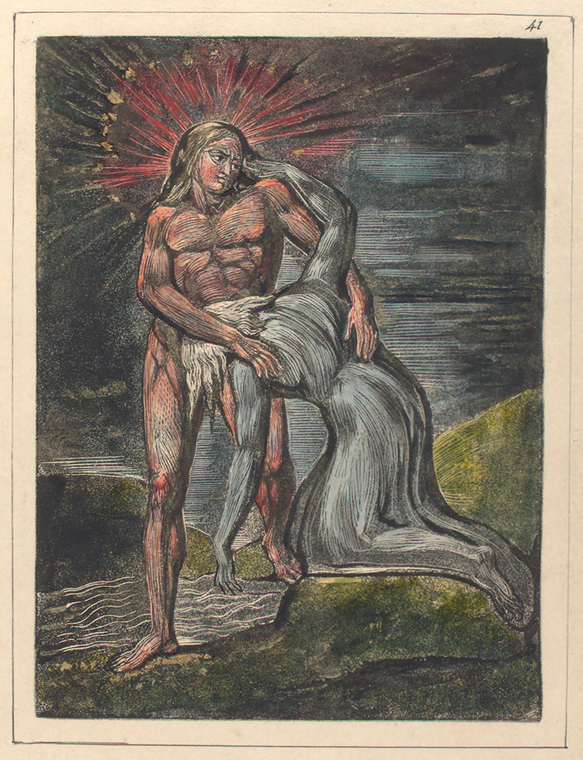
British Museum
Illustration's to Young's Night Thoughts

More basic to Blake's spiritual and psychological orientation was the sense in which it was applied in an earlier post: "the same dull round", applicable to the essentially meaningless lives that millions of people live.

They may or may not go to essentially meaningless churches (or taverns) in search of something made inaccessible to them by the deadening atmosphere of the schools they attended.

At the end of Chapter Three of Jerusalem (Plate 76; E230-31) Blake imagined the horrible reality of a return to the beginning of history at its end:

"For Los in Six Thousand Years walks up & down continually
That not one Moment of Time be lost & every revolution
Of Space he makes permanent in Bowlahoola & Cathedron.

And these the names of the Twenty-seven Heavens & their
Churches Adam, Seth, Enos, Cainan, Mahalaleel, Jared,
Enoch, Methuselah, Lamech; these are the Giants mighty,
Hermaphroditic Noah, Shem, Arphaxad, Cainan the Second,
Salah, Heber, Peleg, Reu, Serug, Nahor, Terah: these
are the Female Males: A Male within a Female hid as in
an Ark & Curtains. Abraham, Moses, Solomon, Paul,
Constantine, Charlemaine, Luther. these Seven are the
Male Females: the Dragon Forms The Female hid within a
Male: thus Rahab is reveald Mystery Babylon the Great:
the Abomination of Desolation
Religion hid in War: a Dragon red, & hidden Harlot

But Jesus breaking thro' the Central Zones of Death &
Hell Opens Eternity in Time & Space; triumphant in
Mercy

Thus are the Heavens formd by Los within the Mundane
Shell And where Luther ends Adam begins again in
Eternal Circle...."

"where Luther ends Adam begins" expresses the
fear that there will be only 'another dull round' of
history..

But Blake saw a happier outcome as you find portrayed at
the ends of The Four Zoas and Jerusalem.

Wednesday, August 28, 2013

LOVE & HARMONY

William Blake was not the sort of person who went unnoticed. He was too gifted and too confident of his exceptional abilities not to draw attention. As a young man he was invited to the homes of some of the prominent intelligentsia of London. Through these contacts his earliest poems gained publication in 1783 in a little volume called Poetical Sketches.

In the Commentary for The Complete Poetry and Prose of William Blake, Harold Bloom tells us that the volume can be 'viewed as a workshop of Blake's developing imaginative ambitions.' Bloom recognizes that these early works of the poet 'give definite form to the strong workings of imagination.' The pursuit of engraving and painting represented one thrust of Blake's lifelong ambition of giving form to imagination; Poetical Sketches demonstrates that the second thrust of communicating through poetry was well developed at an early age.

British Museum
Europe 
Copy D, Plate 11
Poetical Sketches, (E 413)
               "SONG.
Love and harmony combine,
And around our souls intwine,
While thy branches mix with mine,
And our roots together join.

Joys upon our branches sit,    
Chirping loud, and singing sweet;
Like gentle streams beneath our feet
Innocence and virtue meet.

Thou the golden fruit dost bear,
I am clad in flowers fair;    
Thy sweet boughs perfume the air,
And the turtle buildeth there.

There she sits and feeds her young,
Sweet I hear her mournful song;
And thy lovely leaves among,
There is love: I hear his tongue.

There his charming nest doth lay,
There he sleeps the night away;
There he sports along the day,
And doth among our branches play." 

Much that is developed in Blake's later poetry is present in these joyful verses. We are challenged to see that disparate items are not separable but 'combine' and 'intwine'. The state of innocence is portrayed in which the imagination is free to play because love and harmony reign.

Perhaps Blake had already formulated the desire that his poetry and illuminations would combine and intertwine as his imagination gained expression in multiple forms which harmonized.

Wednesday, June 26, 2013

CLOD & PEBBLE 2

Blake was saying far more with his little poem The Clod and the Pebble than is apparent with a superficial reading. The Clod is more than a lump of dirt; it is the  'dust of the ground' from which God formed man. 
 
Genesis 2

[6] But there went up a mist from the earth, and watered the whole face of the ground.
[7] And the LORD God formed man of the dust of the ground, and breathed into his nostrils the breath of life; and man became a living soul.
[8] And the LORD God planted a garden eastward in Eden; and there he put the man whom he had formed.
[9] And out of the ground made the LORD God to grow every tree that is pleasant to the sight, and good for food; the tree of life also in the midst of the garden, and the tree of knowledge of good and evil.


 In A Blake Dictionary, S. Foster Damon tells us on Page 88: "Clay is the living substance with which the creator works." He supports his statement with passages from Milton and Jerusalem
Milton, Plate 28 [30], (E 126)
"Antamon takes them into his beautiful flexible hands,
As the Sower takes the seed, or as the Artist his clay"     
 
New York Public Library
Milton 
Plate 41
Jerusalem, Plate 27, (E 173)
 "He witherd up the Human Form,
By laws of sacrifice for sin:
  Till it became a Mortal Worm:    
But O! translucent all within.

  The Divine Vision still was seen
Still was the Human Form, Divine
  Weeping in weak & mortal clay
O Jesus still the Form was thine.        
    
  And thine the Human Face & thine
The Human Hands & Feet & Breath
  Entering thro' the Gates of Birth
And passing thro' the Gates of Death"


In this passage in Milton we find the hard, unyielding, selfish pebble of our original poem as Urizen in the confrontation with Milton. Urizen attempts to subdue Milton with icy water poured on his brain. Milton replies by molding a human form of flesh for Urizen from the red clay of Succoth

Milton, Plate 19 [21], (E 112)
"Urizen emerged from his Rocky Form & from his Snows,
PLATE 19 [21]
And he also darkend his brows: freezing dark rocks between
The footsteps. and infixing deep the feet in marble beds:
That Milton labourd with his journey, & his feet bled sore
Upon the clay now chang'd to marble; also Urizen rose,
And met him on the shores of Arnon; & by the streams of the brooks    

Silent they met, and silent strove among the streams, of Arnon
Even to Mahanaim, when with cold hand Urizen stoop'd down
And took up water from the river Jordan: pouring on
To Miltons brain the icy fluid from his broad cold palm.
But Milton took of the red clay of Succoth, moulding it with care
Between his palms: and filling up the furrows of many years
Beginning at the feet of Urizen, and on the bones
Creating new flesh on the Demon cold, and building him,
As with new clay a Human form in the Valley of Beth Peor." 
Genesis 1
[26] And God said, Let us make man in our image, after our likeness: and let them have dominion over the fish of the sea, and over the fowl of the air, and over the cattle, and over all the earth, and over every creeping thing that creepeth upon the earth.
[27] So God created man in his own image, in the image of God created he him; male and female created he them.

Monday, June 24, 2013

CLOD & PEBBLE

Matthew 20
[25] But Jesus called them unto him, and said, Ye know that the princes of the Gentiles exercise dominion over them, and they that are great exercise authority upon them.
[26] But it shall not be so among you: but whosoever will be great among you, let him be your minister;
[27] And whosoever will be chief among you, let him be your servant:
[28] Even as the Son of man came not to be ministered unto, but to minister, and to give his life a ransom for many.
[29] And as they departed from Jericho, a great multitude followed him.

Luke 14
[8] When thou art bidden of any man to a wedding, sit not down in the highest room; lest a more honourable man than thou be bidden of him;
[9] And he that bade thee and him come and say to thee, Give this man place; and thou begin with shame to take the lowest room.
[10] But when thou art bidden, go and sit down in the lowest room; that when he that bade thee cometh, he may say unto thee, Friend, go up higher: then shalt thou have worship in the presence of them that sit at meat with thee.
[11] For whosoever exalteth himself shall be abased; and he that humbleth himself shall be exalted.
[12] Then said he also to him that bade him, When thou makest a dinner or a supper, call not thy friends, nor thy brethren, neither thy kinsmen, nor thy rich neighbours; lest they also bid thee again, and a recompence be made thee.
[13] But when thou makest a feast, call the poor, the maimed, the lame, the blind:
[14] And thou shalt be blessed; for they cannot recompense thee: for thou shalt be recompensed at the resurrection of the just.


British Museum         
Songs of Innocence & of Experience
Plate 34
Copy A
 
 
Songs of Innocence & of Experience, Song 32, (E 19)  
 
"The CLOD & the PEBBLE  

Love seeketh not Itself to please,
Nor for itself hath any care;
But for another gives its ease,
And builds a Heaven in Hells despair.

     So sang a little Clod of Clay,
     Trodden with the cattles feet:
     But a Pebble of the brook,
     Warbled out these metres meet.

Love seeketh only Self to please,
To bind another to Its delight:
Joys in anothers loss of ease,
And builds a Hell in Heavens despite." 


The states of Innocence and of Experience are dramatically contrasted within a single poem in The Clod and the Pebble. In the first verse Love as a Divine attribute is expressed in the fully human man who becomes like the God whom he beholds. Jesus epitomizes the caring, sacrificing, constructive vision of love described here by Blake.


When Love becomes distorted through the inhumane treatment which is perpetrated and endured because men are unable to see the image of God in the 'little ones', the result is the perversion of love described in the third verse.

Jerusalem, Plate 17,(E 161) 
"Vala would never have sought & loved Albion
If she had not sought to destroy Jerusalem; such is that false   
And Generating Love: a pretence of love to destroy love:

Cruel hipocrisy unlike the lovely delusions of Beulah:
And cruel forms, unlike the merciful  forms of Beulahs Night

They know not why they love nor wherefore they sicken & die
Calling that Holy Love: which is Envy Revenge & Cruelty          
Which separated the stars from the mountains: the mountains from Man
And left Man, a little grovelling Root, outside of Himself."

Jerusalem, Plate 42, (E 189)
But when Man sleeps in Beulah, the Saviour in mercy takes
Contractions Limit, and of the Limit he forms Woman: That
Himself may in process of time be born Man to redeem
But there is no Limit of Expansion! there is no Limit of Translucence.   
In the bosom of Man for ever from eternity to eternity.
Therefore I break thy bonds of righteousness; I crush thy messengers!
That they may not crush me and mine: do thou be righteous,
And I will return it; otherwise I defy thy worst revenge:

Consider me as thine enemy: on me turn all thy fury              
But destroy not these little ones, nor mock the Lords anointed:
Destroy not by Moral Virtue, the little ones whom he hath chosen!
The little ones whom he hath chosen in preference to thee.
He hath cast thee off for ever; the little ones he hath anointed!
Thy Selfhood is for ever accursed from the Divine presence    

So Los spoke: then turn'd his face & wept for Albion."

Saturday, June 22, 2013

INNOCENCE & EXPERIENCE 13

British Museum
Songs of Innocence & of Experience
Plate 18
Copy A
Songs of Innocence & of Experience
Song 18, (E 12) 
"The Divine Image.

To Mercy Pity Peace and Love,
All pray in their distress:
And to these virtues of delight
Return their thankfulness.

For Mercy Pity Peace and Love,  
Is God our father dear:
And Mercy Pity Peace and Love,
Is Man his child and care.

For Mercy has a human heart
Pity, a human face: 
And Love, the human form divine,
And Peace, the human dress.

Then every man of every clime,
That prays in his distress,
Prays to the human form divine   
Love Mercy Pity Peace.

And all must love the human form,
In heathen, turk or jew.
Where Mercy, Love & Pity dwell, 
There God is dwelling too" 
The Divine Image presents the idea that the gifts of the spirit are a reflection of qualities which can be found in God. Mercy, Pity, Peace & Love in their pure and innocent forms, are attributes of the God to whom man turns for the care and guidance so characteristic of man's relationship to God in Songs of Innocence. The individual who knows inwardly that he receives benevolence from God, adopts benevolence as his means of relating in the outer world with his brothers. 
British Museum
Songs of Innocence & of Experience
Plate 41
Copy A
 
Songs of Innocence & of Experience
Song 47, (E 27) 
"The Human Abstract.                     
 
Pity would be no more,                  
If we did not make somebody Poor:       
And Mercy no more could be,
If all were as happy as we;

And mutual fear brings peace;
Till the selfish loves increase.
Then Cruelty knits a snare,
And spreads his baits with care.        

He sits down with holy fears,
And waters the ground with tears:
Then Humility takes its root
Underneath his foot.

Soon spreads the dismal shade
Of Mystery over his head;
And the Catterpiller and Fly,
Feed on the Mystery.

And it bears the fruit of Deceit,
Ruddy and sweet to eat; 
And the Raven his nest has made
In its thickest shade.

The Gods of the earth and sea,
Sought thro' Nature to find this Tree
But their search was all in vain:
There grows one in the Human Brain"

The misunderstandings and distortions about the nature of God are attributable to false assumptions and unfounded conclusions as man builds the paradigm of reasoning which controls behavior. Mercy, Pity, Peace and Love when understood to be weapons which justify the Selfhood's promotion of poverty, unhappiness, fear and cruelty begin a chain reaction.

When man looks at the society in which he lives he is inclined to ask what is the source of the suffering, hatred and ignorance which surrounds him. Blake's response to such a question is that we build our world with our own errors. Mystery is the labyrinth of accumulated incorrect decisions in the lives of individuals which are added and multiplied and raised to the nth power as multiple individuals contribute their mistakes. The solutions to the pain and suffering of the world lie in the Human Brain. The knots and nets which hold the head of man trapped in Mystery grew from the false reasoning which failed to assimilate the God of Mercy, Pity, Peace and Love dwelling within.

The answer to The Human Abstract lies in the The Divine Image:
"And all must love the human form,
In heathen, turk or jew.
Where Mercy, Love & Pity dwell,
There God is dwelling too"


Blake's advice is to trust in Love, not in Reason. To extract himself from the labyrinth created by the complexities of experience into which man enters, he must initiate a spiritual journey of return to the Source: he must annihilate the Spectre through embracing him in forgiveness.  

Book of Urizen, Plate 3, (E 86)
3: For when Urizen shrunk away                          
From Eternals, he sat on a rock
Barren; a rock which himself
From redounding fancies had petrified
Many tears fell on the rock,
Many sparks of vegetation;                             
Soon shot the pained root
Of Mystery, under his heel:
It grew a thick tree; he wrote
In silence his book of iron:

Till the horrid plant bending its boughs    
Grew to roots when it felt the earth
And again sprung to many a tree.

4: Amaz'd started Urizen! when
He  beheld  himself compassed round
And high roofed over with trees             
He arose but the stems stood so thick
He with difficulty and great pain
Brought his Books, all but the Book

PLATE 4
Of iron, from the dismal shade

5: The Tree still grows over the Void
Enrooting itself all around
An endless labyrinth of woe!

6: The corse of his first begotten          
On the accursed Tree of MYSTERY:
On the topmost stem of this Tree
Urizen nail'd Fuzons corse."

Jerusalem, Plate 2, (E 96)
"Come into my hand    
By your mild power; descending down the Nerves of my right arm
From out the Portals of my Brain, where by your ministry
The Eternal Great Humanity Divine. planted his Paradise,
And in it caus'd the Spectres of the Dead to take sweet forms
In likeness of himself. Tell also of the False Tongue! vegetated
Beneath your land of shadows: of its sacrifices. and
Its offerings; even till Jesus, the image of the Invisible God
Became its prey; a curec, an offering, and an atonement,
For Death Eternal in the heavens of Albion, & before the Gates
Of Jerusalem his Emanation, in the heavens beneath Beulah" 
 

Thursday, June 20, 2013

INNOCENCE & EXPERIENCE 12

Hebrews 1
[1] God, who at sundry times and in divers manners spake in time past unto the fathers by the prophets,
[2] Hath in these last days spoken unto us by his Son, whom he hath appointed heir of all things, by whom also he made the worlds;
[3] Who being the brightness of his glory, and the express image of his person, and upholding all things by the word of his power, when he had by himself purged our sins, sat down on the right hand of the Majesty on high;
[10] And, Thou, Lord, in the beginning hast laid the foundation of the earth; and the heavens are the works of thine hands:
[11] They shall perish; but thou remainest; and they all shall wax old as doth a garment;
[12] And as a vesture shalt thou fold them up, and they shall be changed: but thou art the same, and thy years shall not fail.
[13] But to which of the angels said he at any time, Sit on my right hand, until I make thine enemies thy footstool?
[14] Are they not all ministering spirits, sent forth to minister for them who shall be heirs of salvation? 


British Museum
Songs of Innocence & of Experience
Plate 23
Copy A
Songs of Innocence & of Experience, Song 8, (E 8)  
"The Lamb

  Little Lamb who made thee
  Dost thou know who made thee
Gave thee life & bid thee feed.
By the stream & o'er the mead;
Gave thee clothing of delight,       
Softest clothing wooly bright;
Gave thee such a tender voice,
Making all the vales  rejoice!
  Little Lamb who made thee
  Dost thou know who made thee    

  Little Lamb I'll tell thee,
  Little Lamb I'll tell thee!
He is called by thy name,
For he calls himself a Lamb:
He is meek & he is mild,        
He became a little child:
I a child & thou a lamb,
We are called by his name.
  Little Lamb God bless thee.
  Little Lamb God bless thee."      

As much as any of the Songs of Innocence, The Lamb portrays the gentle, protecting, nurturing side of God. The lamb is cuddly and dependent and yet it is equated with the Lord who was present at the creation of all things.

The lamb is asked the two questions: 'Little Lamb who made thee' and 'Dost thou know who made thee.' The child provides the answer without explicitly naming Jesus. The child, the lamb and the Lord share the same name and nature. The incarnation is the image of the union of God and man taking place through the birth of God in man.

As a state of consciousness Innocence represents the undifferentiated psyche before there was a division between self and other. Blake postulated that in Eternity there is fluidity which allows the simultaneous presence of all things. For those for whom the wars of Eternity are too stressful Beulah was provided as R&R until they could return to the frontlines. 


Milton, PLATE 31 [34], (E 130)
"Into this pleasant Shadow all the weak & weary
Like Women & Children were taken away as on wings
Of dovelike softness, & shadowy habitations prepared for them
But every Man returnd & went still going forward thro'
The Bosom of the Father in Eternity on Eternity                  
Neither did any lack or fall into Error without
A Shadow to repose in all the Days of happy Eternity"  

Visions of Daughters of Albion, Plate 5, (E 49)
"Does not the worm erect a pillar in the mouldering church yard?
Plate 6
And a palace of eternity in the jaws of the hungry grave
Over his porch these words are written. Take thy bliss O Man!
And sweet shall be thy taste & sweet thy infant joys renew!

Infancy, fearless, lustful, happy! nestling for delight
In laps of pleasure; Innocence! honest, open, seeking         
The vigorous joys of morning light; open to virgin bliss.
Who taught thee modesty, subtil modesty! child of night & sleep
When thou awakest, wilt thou dissemble all thy secret joys
Or wert thou not awake when all this mystery was disclos'd!"  


British Museum
Songs of Innocence & of Experience

Plate 37
Copy A
Songs of Innocence & of Experience, Song 42, (E 24) 
"The Tyger.                            

Tyger Tyger, burning bright,
In the forests of the night;
What immortal hand or eye,           
Could frame thy fearful symmetry?    

In what distant deeps or skies.      
Burnt the fire of thine eyes?        
On what wings dare he aspire?     
What the hand, dare sieze the fire?

And what shoulder, & what art,
Could twist the sinews of thy heart?
And when thy heart began to beat,
What dread hand? & what dread feet?
 
What the hammer? what the chain, 
In what furnace was thy brain?
What the anvil? what dread grasp,   
Dare its deadly terrors clasp! 
Then the stars threw down their spears
And water'd heaven with their tears:
Did he smile his work to see?         
Did he who made the Lamb make thee?   

Tyger Tyger burning bright,
In the forests of the night:          
What immortal hand or eye,             
Dare frame thy fearful symmetry?"  

The Tyger is commonly considered to be the companion poem to The Lamb particularly since one of the final questions in the poem asks 'Did he who made the Lamb make thee?' 

The subject of the poem is not the Tyger itself but the act of creating the Tyger and in the Tyger mankind. As the Lamb, man is made an Innocent held close to the bosom of God; as a Tyger, he is made in the furnace of experience undergoing the manipulations which will prepare him for his return to Eternity. Such is the paradox of the nature of man as he is related to the Divine.

Milton, Plate 13 [14], (E 107)
"The Sin was begun in Eternity, and will not rest to Eternity     
Till two Eternitys meet together, Ah! lost! lost! lost! for ever!

So Leutha spoke. But when she saw that Enitharmon had
Created a New Space to protect Satan from punishment;
She fled to Enitharmons Tent & hid herself. Loud raging
Thundered the Assembly dark & clouded, and they ratify'd         
The kind decision of Enitharmon & gave a Time to the Space,
Even Six Thousand years; and sent Lucifer for its Guard.
But Lucifer refus'd to die & in pride he forsook his charge
And they elected Molech, and when Molech was impatient
The Divine hand found the Two Limits: first of Opacity, then of Contraction
Opacity was named Satan, Contraction was named Adam.
Triple Elohim came: Elohim wearied fainted: they elected Shaddai.
Shaddai angry, Pahad descended: Pahad terrified, they sent Jehovah
And Jehovah was leprous; loud he call'd, stretching his hand to Eternity
For then the Body of Death was perfected in hypocritic holiness, 

Around the Lamb, a Female Tabernacle woven in Cathedrons Looms
He died as a Reprobate. he was Punish'd as a Transgressor!
Glory! Glory! Glory! to the Holy Lamb of God
I touch the heavens as an instrument to glorify the Lord!

The Elect shall meet the Redeem'd. on Albions rocks they shall meet      
Astonish'd at the Transgressor, in him beholding the Saviour."

Marriage of Heaven & Hell, Plate 8, (E 36)
"The roaring of lions, the howling of wolves, the raging of the
    stormy sea,    and the destructive sword. are portions of
    eternity too great for the eye of man."
Isaiah 48
[10] Behold, I have refined thee, but not with silver; I have chosen thee in the furnace of affliction.
[11] For mine own sake, even for mine own sake, will I do it: for how should my name be polluted? and I will not give my glory unto another.
[12] Hearken unto me, O Jacob and Israel, my called; I am he; I am the first, I also am the last.
[13] Mine hand also hath laid the foundation of the earth, and my right hand hath spanned the heavens: when I call unto them, they stand up together.
[14] All ye, assemble yourselves, and hear; which among them hath declared these things?

Tuesday, June 18, 2013

INNOCENCE & EXPERIENCE 11

Matthew 26
[26] And as they were eating, Jesus took bread, and blessed it, and brake it, and gave it to the disciples, and said, Take, eat; this is my body.
[27] And he took the cup, and gave thanks, and gave it to them, saying, Drink ye all of it;
[28] For this is my blood of the new testament, which is shed for many for the remission of sins.
[29] But I say unto you, I will not drink henceforth of this fruit of the vine, until that day when I drink it new with you in my Father's kingdom.
[30] And when they had sung an hymn, they went out into the mount of Olives.
[31] Then saith Jesus unto them, All ye shall be offended because of me this night: for it is written, I will smite the shepherd, and the sheep of the flock shall be scattered abroad.

Acts 2
[1] And when the day of Pentecost was fully come, they were all with one accord in one place.
[2] And suddenly there came a sound from heaven as of a rushing mighty wind, and it filled all the house where they were sitting.
[3] And there appeared unto them cloven tongues like as of fire, and it sat upon each of them


British Museum
Songs of Innocence & of Experience
Plate 20
Copy A
Songs of Innocence & of Experience, Song 19, (E 13) 
"HOLY THURSDAY 
Twas on a Holy Thursday their innocent faces clean 
The children walking two & two in red & blue & green 
Grey headed beadles walkd before with wands as white as snow 
Till into the high dome of Pauls they like Thames waters flow 

O what a multitude they seemd these flowers of London town 
Seated in companies they sit with radiance all their own 
The hum of multitudes was there but multitudes of lambs 
Thousands of little boys & girls raising their innocent hands 

Now like a mighty wind they raise to heaven the voice of song 
Or like harmonious thunderings the seats of heaven among 
Beneath them sit the aged men wise guardians of the poor 
Then cherish pity, lest you drive an angel from your door"

  
There is historical precedent for the event marked in Blake's Holy Thursday poems. The charity school children were annually paraded to St. Paul's Cathedral to commemorate their gratitude to their benefactors. The event however did not take place on Holy Thursday. Blake choose the title to associate the poems with Jesus' last supper with his disciples when he invited them to partake of his body and blood. The quote from Matthew mentions the scattering of the sheep and Blake writes of 'multitudes of lambs Thousands of little boys & girls raising their innocent hands'. The mighty wind recalls the day of Pentecost.

Blake presents the charity school children as they appear in the sight of God. It is they who sit at the Lord's table and upon them appear the cloven tongues of fire. The public and their benefactors may see them as needy or troubled but vision transforms them into angels.

British Museum
Songs of Innocence & of Experience
Plate 49
Copy A
Songs of Innocence & of Experience, Song 33, (E 19) 
"HOLY THURSDAY 
Is this a holy thing to see, 
In a rich and fruitful land, 
Babes reduced to misery, 
Fed with cold and usurous hand? 

Is that trembling cry a song? 
Can it be a song of joy? 
And so many children poor? 
It is a land of poverty! 

And their sun does never shine. 
And their fields are bleak & bare. 
And their ways are fill'd with thorns. 
It is eternal winter there.

For where-e'er the sun does shine, 
And where-e'er the rain does fall: 
Babe can never hunger there, 
Nor poverty the mind appall."


Opinions differed on the charity schools. Some saw that the children of the poor were taught to read the Bible and indoctrinated in moral virtue. Some saw that they were clothed and housed and fed through the generosity of the religious community. Others saw that the children were ill fed, poorly clothed and suffered brutal treatment.


Blake saw that the innocent children observed singing and marching in their colorful uniforms in our first poem were not as joyful as they may first appear. The wealthy society into which they were born was for them a land of poverty in which they experienced eternal winter. It was a society in which consciousness of the light of God's mercy and the waters of his love did not reach into every mind and heart. But Blake saw that change was possible; that the lessons of experienced could be learned. The sun can shine, the rain can fall: destroying every vestige of hunger and poverty. 


Milton, Plate 11 [12], (E 105)
"And therefore the Class of Satan shall be calld the Elect, & those
Of Rintrah. the Reprobate, & those of Palamabron the Redeem'd
For he is redeem'd from Satans Law, the wrath falling on Rintrah,"

Milton, Plate 25 [27], (E 122)  
"The Elect is one Class: You
Shall bind them separate: they cannot Believe in Eternal Life
Except by Miracle & a New Birth. The other two Classes;
The Reprobate who never cease to Believe, and the Redeemd,       
Who live in doubts & fears perpetually tormented by the Elect"

Sunday, June 16, 2013

INNOCENCE & EXPERIENCE 10

In Blake's Poetry and Designs edited by Mary Lynn Johnson and John E Grant, Robert F Gleckner contributed an essay titled Point of View  and Context in Blake's Songs. This statement explains that the two voices of innocence and experience intermingle in the poems:

"Often it is unobtrusive, but many times upon a correct determination of speaker and perspective depends a faithful interpretation of the poem. Blake himself suggests this by his organization of the songs into series, Innocence introduced and sung by the piper, Experience by the Bard. Superficially there seems to be little to distinguish one from the other since the piper clearly exhibits imaginative vision and the Bard 'Present, Past, & Future sees.' Yet for each, the past, present, and future are different: for the piper the past can only be the primal unity, for the present is innocence and the future is experience; for the Bard the past is innocence, the present is experience, and the future is a higher innocence. It is natural, then, that the piper's point of view is prevailingly happy; he is conscious of the child's essential divinity and assured of his present protection. But into that joyous context the elements of experience constantly insinuate themselves so that the note of sorrow is never completely absent from the piper's pipe. In experience, on the other hand, the Bard' voice is solemn and more deeply resonant, for the high pitched joy of innocence is now only a memory." (Page 536)   
 
This poem would fit the category of those in Innocence in which 'elements of experience ... insinuate themselves."

British Museum
Songs of Innocence & of Experience
Plate 19
Copy A
Songs of Innocence & of Experience, Song 12, (E 10)  
"The Chimney Sweeper 

When my mother died I was very young,
And my father sold me while yet my tongue,
Could scarcely cry weep weep weep weep.          
So your chimneys I sweep & in soot I sleep,
 
Theres little Tom Dacre, who cried when his head        
That curl'd like a lambs back, was shav'd, so I said.
Hush Tom never mind it, for when your head's bare,
You know that the soot cannot spoil your white hair.
 
And so he was quiet, & that very night,
As Tom was a sleeping he had such a sight,    
That thousands of sweepers Dick, Joe, Ned & Jack
Were all of them lock'd up in coffins of black,

And by came an Angel who had a bright key,
And he open'd the coffins & set them all free.
Then down a green plain leaping laughing they run      
And wash in a river and shine in the Sun.
 
Then naked & white, all their bags left behind,
They rise upon clouds, and sport in the wind.
And the Angel told Tom if he'd be a good boy,
He'd have God for his father & never want joy.

And so Tom awoke and we rose in the dark
And got with our bags & our brushes to work.
Tho' the morning was cold, Tom was happy & warm,
So if all do their duty, they need not fear harm."

There is no doubt that Blake was outraged by the abuse of children epitomized by the practice of sending young children up chimneys to clean them. But his two poems about chimney sweeps are touching on more than the plight of these children.

The Chimney Sweeper of Songs of Innocence introduces death on the very first line. The dream state that the child enters in the third stanza gives us the image of children 'lock'd up in coffins of black.' The release of the 'thousands of sweepers' by the angel conveys the idea that death delivers man from the woe of life. However the children, after their sojourn in the joys of innocence provided by the angel in the dream, awake in the same captivity in which they went to sleep. 

The dream shows the sweep what the life of an unblemished, beloved, protected child would be. The difference in his status when he awake is that he is happy in the knowledge that there is a reward from God for good behavior.
 
It is impossible to classify the children who are chimney sweeps as innocents because they have been treated as the rubbish of society: being bought and sold, coerced, neglected and exploited. If they can return to a state of innocence in spite of their experience it can only be through developing a consciousness in which their only reality is alien to what ordinary consciousness reports. Psychologically their condition may be labeled dissociation.

British Museum
Songs of Innocence & of Experience
Plate 36
Copy A
 
Songs of Innocence & of Experience, Song 37, (E 22) 
"THE Chimney Sweeper       

A little black thing among the snow:
Crying weep, weep, in notes of woe!  
Where are thy father & mother? say?
They are both gone up to the church to pray.

Because I was happy upon the heath, 
And smil'd among the winter's snow:  
They clothed me in the clothes of death,
And taught me to sing the notes of woe.

And because I am happy, & dance & sing,
They think they have done me no injury:
And are gone to praise God & his Priest & King
Who make up a heaven of our misery."  


The chimney sweeper of experience is wiser in the ways of the world. He knows the damage done when children are not nurtured and protected. He has access to the joys of innocence but he knows too that it is 'God & his Priest & King Who make up a heaven of our misery.' The adults, the father & mother, are complicit in causing the suffering of the child by adhering to the established mores of the society instead of responding to the child's needs.

The two lines:
"They clothed me in the clothes of death,
And taught me to sing the notes of woe.",
imply that the parents knowingly comply with the sentence which the life of a sweep entails for their son.

Friday, June 14, 2013

INNOCENCE & EXPERIENCE 9

British Museum
Songs of Innocence & of Experience

Plate 24
Copy A
Songs of Innocence & of Experience, Song 5, (E 7)  
"The Shepherd.

How sweet is the Shepherds sweet lot,
From the morn to the evening he strays:
He shall follow his sheep all the day
And his tongue shall be filled with praise.

For he hears the lambs innocent call,
And he hears the ewes tender reply,
He is watchful while they are in peace,
For they know when their Shepherd is nigh."


The Shepherd from Songs of Innocence portrays an exaggerated image of the idyllic role of the shepherd and sheep. Tending sheep tends to require more attention than is provided by this, straying, listening, praising shepherd. His flock is so peaceful that he has become detached in his watching. Knowing the presence of the shepherd is enough to keep the sheep at peace. Only in a state of complete innocent somnambulance could a shepherd be so nonchalant about the sheep under his care.

Blake may be emphasizing that the state of Innocence is transitory: that it may be visited and appreciated but it can't or shouldn't be sustained. The sheep will not always be peaceful and the shepherd has other duties besides praise.

Blake would have been familiar with this passage from Ezekiel in which it is the shepherd who selfishly neglects the flock who causes the sheep to suffer. Whether he is talking about a flock of sheep or the people of Israel, Ezekiel condemns the shepherd for failing to care for those for whom he is responsible. 

Ezekiel 34
[1] And the word of the LORD came unto me, saying,
[2] Son of man, prophesy against the shepherds of Israel, prophesy, and say unto them, Thus saith the Lord GOD unto the shepherds; Woe be to the shepherds of Israel that do feed themselves! should not the shepherds feed the flocks?
[3] Ye eat the fat, and ye clothe you with the wool, ye kill them that are fed: but ye feed not the flock.
[4] The diseased have ye not strengthened, neither have ye healed that which was sick, neither have ye bound up that which was broken, neither have ye brought again that which was driven away, neither have ye sought that which was lost; but with force and with cruelty have ye ruled them.
[5] And they were scattered, because there is no shepherd: and they became meat to all the beasts of the field, when they were scattered.
[6] My sheep wandered through all the mountains, and upon every high hill: yea, my flock was scattered upon all the face of the earth, and none did search or seek after them.

Here is a shepherd actively caring for his sheep.


British Museum
Songs of Innocence & of Experience

Plate 47
Copy A
Songs of Innocence & of Experience, Song 46, (E 26) 
"LONDON                                    

I wander thro' each charter'd street,     
Near where the charter'd Thames does flow.
And mark in every face I meet             
Marks of weakness, marks of woe.

In every cry of every Man, 
In every Infants cry of fear, 
In every voice: in every ban, 
The mind-forg'd manacles I hear 

How the Chimney-sweepers cry
Every blackning Church appalls,  
And the hapless Soldiers sigh
Runs in blood down Palace walls

But most thro' midnight streets I hear
How the youthful Harlots curse
Blasts the new-born Infants tear 
And blights with plagues the Marriage hearse" 
 
 
In the poem London from Songs of Experience Blake assumes the role of the observer seeing the consequences of the failure of the authorities - the government, the church, the parents - to provide men, women and children with care and protection. The powerful create the conditions under which the powerless suffer. The manacles are forged by the desperation created by poverty, by the law, by war and by disease. But it is those who exploit the institutions for their own benefit who bear the burden of guilt for creating the conditions in which the manacles are forged.  

Milton O Percival in William Blake's Circle of Destiny tells us of man's decline as he loses consciousness of Eternity. Degradation follows degradation until he turns away, and his heart, mind and eyes are opened to a new life. 


"In Blake's myth the consequences of error are inescapable. Albion cuts himself off from the living God and descends at once into the Hell of Ulro. So too with the individual. He may, if lucky escape the condemnation of his fellow men; he cannot escape the Ulro of his own spiritual poverty. All whose hearts are given over to malice, hatred and vengeance traverse the wheel of Ulro. It may be escaped only in true Gnostic fashion, by the birth of Christ in the soul. The doctrine of states is witness to such a birth. It is itself nothing less than a changed interpretation of spiritual experience. It is in that sense the immediate avenue of escape, but the real escape is in the regeneration by which a change in outlook is made possible." (Page 236)

Wednesday, June 12, 2013

INNOCENCE & EXPERIENCE 8

Matthew 18
[2] And Jesus called a little child unto him, and set him in the midst of them,
[3] And said, Verily I say unto you, Except ye be converted, and become as little children, ye shall not enter into the kingdom of heaven.
[4] Whosoever therefore shall humble himself as this little child, the same is greatest in the kingdom of heaven.
[5] And whoso shall receive one such little child in my name receiveth me. 


Blake's God was the immanent presence who provided him comfort and guidance as well as the vision which illumined his imagination. To lose sight of the Heavenly Father, to feel that the vision was being withdrawn would be a desperate feeling. In The Little Boy lost the obscuring mist was dispelled by the boy's weeping which represented his consciousness of his condition of being lost.

British Museum
Songs of Innocence & of Experience
Plate 10
Copy A
Songs of Innocence & Of Experience, Song 13, (E 11) 
"The Little Boy lost          

Father, father, where are you going
O do not walk so fast.
Speak father, speak to your little boy
Or else I shall be lost,

The night was dark no father was there   
The child was wet with dew,
The mire was deep, & the child did weep
And away the vapour flew."


As a follow-up to The Little Boy lost Blake wrote another of the Songs of Innocence, The Little Boy Found. Although the second poem may be transitioning to symbols more appropriate for Songs of Experience, it shares  the theme of protection and guidance prevalent in Songs of Innocence.
In the state of Innocence the providential elements which allow the boy to be found include the light, God, Father and Mother.  

British Museum
Songs of Innocence & of Experience
Plate 22
Copy A
Songs of Innocence & Of Experience, Song 14, (E 11) 
"The Little Boy Found 

The little boy lost in the lonely fen,
Led by the wand'ring light,
Began to cry, but God ever nigh,
Appeard like his father in white.

He kissed the child & by the hand led  
And to his mother brought,
Who in sorrow pale, thro' the lonely dale
Her little boy weeping sought."


This boy in Songs of Experience is lost to conventional religious teaching. He knows the limitations of his ability to love and understand. He makes the mistake of being overheard by a religious authority. The weeping of the child and parents is powerless against the intrenched establishment. This child is lost, not through the failure of his own vision, but through the failure of his culture to value and protect its children and the freedom to think independently.
Blake made an extreme statement in this poem to express his extreme feelings about the failure of the Christian Church. That an institution which grew out of the teachings of love and forgiveness of Jesus, could become cruel, cold and oppressive raised his ire. 


British Museum
Songs of Innocence & of Experience
Plate 49
Copy T

Songs of Innocence & Of Experience, Song 50, (E 28)
"A Little BOY Lost            

Nought loves another as itself
Nor venerates another so.
Nor is it possible to Thought
A greater than itself to know:

And Father, how can I love you, 
Or any of my brothers more?     
I love you like the little bird 
That picks up crumbs around the door.

The Priest sat by and heard the child.
In trembling zeal he siez'd his hair: 
He led him by his little coat:        
And all admir'd the Priestly care.    

And standing on the altar high,       
Lo what a fiend is here! said he:
One who sets reason up for judge 
Of our most holy Mystery.

The weeping child could not be heard.
The weeping parents wept in vain:
They strip'd him to his little shirt. 
And bound him in an iron chain.
And burn'd him in a holy place,
Where many had been burn'd before:
The weeping parents wept in vain.
Are such things done on Albions shore."
  
The comparison of the states of Innocence and Experience in these poems indicates that the resources which were available in Innocence had disappeared in Experience. The child's calls for help in Innocence are readily answered; in Experience they draw no response. The connection with God which in Innocence is always available, in Experience has been replaced by institutional religion which makes a priest with his doctrines and rituals the intermediary between God and man.    
 
Marriage of Heaven & Hell, Plate 9, (E 37)
"As the catterpiller chooses the fairest leaves to lay her eggs
     on, so the priest lays his curse on the fairest joys."   

Milton, Plate 38 [43], (E 139)
"Thy purpose & the purpose of thy Priests & of thy Churches
Is to impress on men the fear of death; to teach
Trembling & fear, terror, constriction; abject selfishness
Mine is to teach Men to despise death & to go on            
In fearless majesty annihilating Self, laughing to scorn
Thy Laws & terrors, shaking down thy Synagogues as webs
I come to discover before Heavn & Hell the Self righteousness
In all its Hypocritic turpitude, opening to every eye
These wonders of Satans holiness shewing to the Earth     
The Idol Virtues of the Natural Heart, & Satans Seat"  

Monday, June 10, 2013

INNOCENCE & EXPERIENCE 7

Songs of Innocence & of Experience does not come with an instruction manual. The arrangement of the poems in the two sections was not firmly decided by Blake but varies among copies. Obviously various poems are related as continuations, complements or contrasts to others. But the reader is meant to explore to find the order of reading that awakens his imagination. 

In the previous post concerning the Nurses Songs the laughter and shouting took place on the green and was echoed by the hills. Another poem of Innocence which resumes the events taking place in Nurse's Song is the 'Ecchoing Green'. From Songs of Experience The Garden of Love will serve as a comparison plate.

This poem which is spread over two plates begins at sunrise and ends as the green is darkening. On the first plate there are an older and a younger generation enjoying the activities on the green. The adults sit around the tree with children clustered around. Older boys and an indistinct couple surround the tree. On the borders of the poem we note the ripened grapes and the circle of the hoop. The ripened grapes were prominent too in NURSES Song from Songs of Experience.

British Museum
Songs of Innocence & of Experience
Plate 7
Copy A 
Songs of Innocence & of Experience, Song 6, (E 8)  
"The Ecchoing Green

The Sun does arise,
And make happy the skies.
The merry bells ring
To welcome the Spring.
The sky-lark and thrush, 
The birds of the bush,
Sing louder around,
To the bells chearful sound.
While our sports shall be seen
On the Ecchoing Green.
  
Old John with white hair
Does laugh away care,
Sitting under the oak,
Among the old folk,"


Late in the day the younger children are ready to go home with their mothers. The adolescents, however, are aware of those of the opposite sex. They may be ready to taste the ripened grapes which they are already picking and sharing. The older man seems to be pointing them toward the kite which he may be offering as an alternative to the grapes. Blake intimates that the sport unseen may continue among the youthful boys & girls when the green has darkened.
British Museum
Songs of Innocence & of Experience
Plate 7
Copy A 
"Song 7   
They laugh at our play,    
And soon they all say.
Such such were the joys.
When we all girls & boys,
In our youth-time were seen,
On the Ecchoing Green.

Till the little ones weary
No more can be merry
The sun does descend,
And our sports have an end:
Round the laps of their mothers,   
Many sisters and brothers,
Like birds in their nest,
Are ready for rest;
And sport no more seen,
On the darkening Green."


The green upon which the children habitually played is no longer present in The GARDEN of LOVE from Songs of Experience, but in its place are a chapel and a graveyard. The intimation is that the aroused sexuality of the young people has come under the censorship of the church which has erected prohibitions and punishments to suppress the joys and desires of youth. 
British Museum
Songs of Innocence & of Experience
Plate 45
Copy A
  
Songs of Innocence & of Experience, Song 44, (E 26) 
"The GARDEN of LOVE                

I went to the Garden of Love,
And saw what I never had seen:    
A Chapel was built in the midst,  
Where I used to play on the green.

And the gates of this Chapel were shut,
And Thou shalt not. writ over the door;
So I turn'd to the Garden of Love,     
That so many sweet flowers bore.

And I saw it was filled with graves,
And tomb-stones where flowers should be: And 
Priests in black gowns, were walking their rounds,
And binding with briars, my joys & desires."


Jerusalem, Plate 20, (E 165)
"Wherefore hast thou shut me into the winter of human life   
And clos'd up the sweet regions of youth and virgin innocence:
Where we live, forgetting error, not pondering on evil:
Among my lambs & brooks of water, among my warbling birds:
Where we delight in innocence before the face of the Lamb:
Going in and out before him in his love and sweet affection."  

Saturday, June 08, 2013

INNOCENCE & EXPERIENCE 6


Several of the poems in Songs on Innocence bear the same or similar names to poems in Songs of Experience. Two poems are named Nurse's Song with different spellings. These two poems open with the same line but move in different directions.

There are three voices in Nurse's Song of Innocence: the narrator, the nurse, and the children. The narrator observes the play of the children and responds with a sense of peace and security. The nurse predicts the coming of night and calls the children home. She relents and lets play continue until night falls. The children, thoughtless of the approach of night, enjoy their play and plead that it continue.

Childhood is a stage of development; it serves its purpose and comes to an end. The child does not disappear when the stage is complete; his qualities of energy, exuberance and security may go to sleep but retain an influence.

The nurse sets the rules for the child. However she allows the childish play to continue in response to the children's request. The innocent play of the children penetrates the scene, influencing the observer, the nurse and the whole environment.   

In the state of Innocence there is light and laughter, no thought of night disturbs the consciousness.

British Museum
Songs of Innocence & of Experience
Plate 14
Copy A
Songs of Innocence & of Experience, Song 24, (E 15)
"Nurse's Song            

When the voices of children are heard on the green
And laughing is heard on the hill, 
My heart is at rest within my breast
And every thing else is still

Then come home my children, the sun is gone down    
And the dews of night arise
Come come leave off play, and let us away
Till the morning appears in the skies

No no let us play, for it is yet day
And we cannot go to sleep           
Besides in the sky, the little birds fly   
And the hills are all coverd with sheep

Well well go & play till the light fades away
And then go home to bed
The little ones leaped & shouted & laugh'd  
And all the hills ecchoed" 


Luke 12 
[22] And he said unto his disciples, Therefore I say unto you, Take no thought for your life, what ye shall eat; neither for the body, what ye shall put on. 
[23] The life is more than meat, and the body is more than raiment. 
[24] Consider the ravens: for they neither sow nor reap; which neither have storehouse nor barn; and God feedeth them: how much more are ye better than the fowls? 
[25] And which of you with taking thought can add to his stature one cubit? 
[26] If ye then be not able to do that thing which is least, why take ye thought for the rest?
[27] Consider the lilies how they grow: they toil not, they spin not; and yet I say unto you, that Solomon in all his glory was not arrayed like one of these. 
[28] If then God so clothe the grass, which is today in the field, and tomorrow is cast into the oven; how much more will he clothe you, O ye of little faith? 
[29] And seek not ye what ye shall eat, or what ye shall drink, neither be ye of doubtful mind. 
[30] For all these things do the nations of the world seek after: and your Father knoweth that ye have need of these things.

The voices of the children are not alone in NURSES Song of Experience. Other darker voices arise in the mind reminding the speaker of regrets or fears. Perhaps the nurse is transferring her own anxiety to the children. The period of Innocence is seen to be wasted time. From the perspective of Experience, Innocence has been lost; now Experience must be the teacher.
British Museum
Songs of Innocence & of Experience
Plate 40
Copy A

Songs of Innocence & of Experience, Song 38, (E 23) 
"NURSES Song 

When the voices of children, are heard on the green 
And whisprings are in the dale: 
The days of my youth rise fresh in my mind, 
My face turns green and pale. 

Then come home my children, the sun is gone down 
And the dews of night arise 
Your spring & your day, are wasted in play 
And your winter and night in disguise."


Four Zoas, Night II, Page 34-35, (E 324)
"Thus Enion wails from the dark deep, the golden heavens tremble

I am made to sow the thistle for wheat; the nettle for a nourishing dainty
I have planted a false oath in the earth, it has brought forth a poison tree
I have chosen the serpent for a councellor & the dog 
For a schoolmaster to my children
I have blotted out from light & living the dove & nightingale    
And I have caused the earth worm to beg from door to door
I have taught the thief a secret path into the house of the just
I have taught pale artifice to spread his nets upon the morning
My heavens are brass my earth is iron my moon a clod of clay
My sun a pestilence burning at noon & a vapour of death in night 

What is the price of Experience do men buy it for a song
Or wisdom for a dance in the street? No it is bought with the price
Of all that a man hath his house his wife his children
Wisdom is sold in the desolate market where none come to buy
And in the witherd field where the farmer plows for bread in vain"