Showing posts with label sources. Show all posts

Friday, February 28, 2025

Fearful Symmetry Again

First posted August 2011 

Yale Center for British Art
Songs of Innocence and of Experience
Copy F, Plate 42

It was Northrup Frye who began to make William Blake's poetry popular and available to serious students. He was studying for the ministry at the University of Toronto, but went to Oxford for graduate work and published Fearful Symmetry, which made him famous. Although he maintained an ecclesiastic relationship, he became the epoch's foremost critic of English literature.

In a recent post Ellie cited a Quote from Fearful Symmetry:

"the business of the visionary [is] to proclaim the Word of God to a
society under the domination of Satan; and ... the visionary's
social position is typically that of an isolated voice crying in
the wilderness against the injustice and hypocrisy of the society
from which he sprung." (Page 336)


Out of his study of Blake's system, Frye generated a system of his own, delineated in the 1957 volume,
Anatomy of Criticism, to provide "a more intelligible account of...'myths we live by'."

Frye's last and greatest (two volume) work is: The Great Code and Words with Power which go into systems and sources exhaustively. It's very enlightening for anyone serious about learning Blake's system.

Steven Marx, a professor at Cal Poly has written a thorough study of Northup Frye, starting with a thumbnail biography, and continuing with "the sources of Blake's Vision" It's embodied in a description of Frye's extensive writing:

"A lineage of mythographers including Vico, James Frazer, Carl Jung,
and Joseph Campbell all share the view that literature evolves from mythology
and that both embody a society's central values and beliefs--about the gods
and about secular matters like work, play, action, identity, family, love and
death."

(From the 'thorough study' cited above)

The 'thorough study' essentially described and interpreted Words with Power.


Saturday, March 04, 2023

HERACLITUS & BLAKE

Columbia.edu
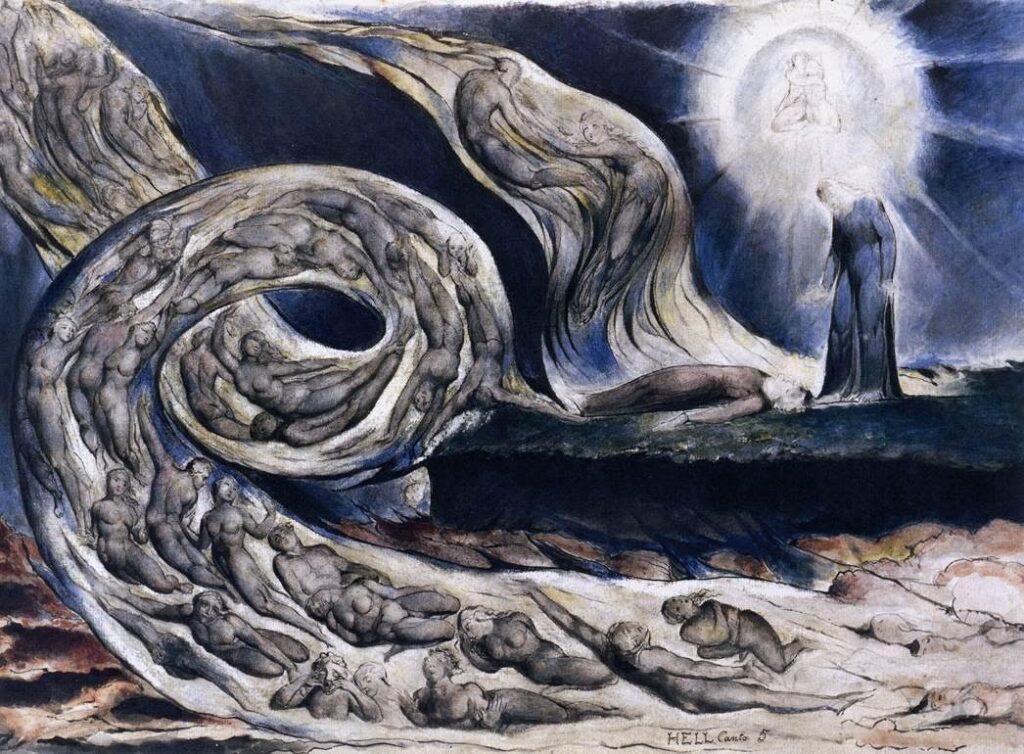
Illustrations to Dante
The Whirlwind of Lovers
 
 Words of Power, Northrop Frye
Page 166, Quote from Hericlitus
"Immortals become mortals, mortals become immortal: they live in each other's death and die in each other's life."

The thought of Hericlitus, an obscure  Greek philosopher of the 6th century BC, had an influence on William Blake. 

Rex Warner included on his website some of the content of Hericlitus' philosophy. Below each of Hericlitus' quotes is a passage from Blake which expresses similar or related sentiments.

Warner writes:

"The following quotations are again from Burnet and I have kept his numbering:

1. It is wise to hearken, not to me, but to my Word, and to confess that all things are one. 

ALL RELIGIONS ARE ONE, (E 2) 
"PRINCIPLE 7th As all men are alike (tho' infinitely various) So
all Religions & as all similars have one source 
The true Man is the source he being the Poetic Genius"

4. Eyes and ears are bad witnesses to men if they have souls that understand not their language.

THERE is NO NATURAL RELIGION [b], (E 2)

 "I  Mans perceptions are not bounded by organs of perception. he
percieves more than sense (tho' ever so acute) can discover."

 Letters, To Trusler, (E 702)

 "Some Scarce see Nature at all But to the Eyes
of the Man of Imagination Nature is Imagination itself.  As a man
is So he Sees.  As the Eye is formed such are its Powers You
certainly Mistake when you say that the Visions of Fancy are not
be found in This World.  To Me This World is all One continued
Vision of Fancy or Imagination & I feel Flatterd when I am told
So."  

7. If you do not expect the unexpected, you will not find it; for it is hard to be sought out and difficult. 

 THERE is NO NATURAL RELIGION [b], (E 2)

 "PRINCIPLE 4. As none by traveling over known lands can find out
the unknown.  So from already acquired knowledge Man could not
acquire more. therefore an universal Poetic Genius exists"

16. The learning of many things teacheth not understanding, else would it have taught Hesiod and Pythagoras, and again Xenophanes and Hekataios. 

Vision of Last Judgment, (E 560) 
"General
Knowledge is Remote Knowledge it is in Particulars that Wisdom
consists & Happiness too."

46. It is the opposite which is good for us.

Milton, Plate 40 [46], (E 12)

"There is a Negation, & there is a Contrary
The Negation must be destroyd to redeem the Contraries
The Negation is the Spectre; the Reasoning Power in Man
This is a false Body: an Incrustation over my Immortal           
Spirit; a Selfhood, which must be put off & annihilated alway
To cleanse the Face of my Spirit by Self-examination."

61. To God all things are fair and good and right, but men hold some things wrong and some right. 

Vision of Last Judgment, (E 554)

 "The Last Judgment when all those are Cast away who trouble
Religion with Questions concerning Good & Evil or Eating of the
Tree of those Knowledges or Reasonings which hinder the Vision of
God turning all into a Consuming fire   Imaginative Art &
Science & all Intellectual Gifts all the Gifts of the Holy Ghost
are lookd upon as of no use & only Contention
remains to Man then the Last Judgment begins & its Vision is seen
by the [Imaginative Eye] of Every one according to the
situation he holds"

71. You will not find the boundaries of soul by travelling in any direction, so deep is the measure of it. 

There is No Natural Religion, [b], (E 3)

  VII The desire of Man being Infinite the possession is Infinite
& himself Infinite

 80. I have sought for myself. 

Jerusalem, Plate 10, (E 153)

"I must Create a System, or be enslav'd by another Mans           
I will not Reason & Compare: my business is to Create"

91a. Thought is common to all. 

All Religions Are One, (E 1) 
"PRINCIPLE. 5. The Religions of all Nations are derived from
each Nations different reception of the Poetic Genius which is
every where call'd the Spirit of Prophecy."

 91b. Those who speak with understanding must hold fast to what is common to all as a city holds fast to its law, and even more strongly. For all human laws are fed by the one divine law. It prevails as much as it will, and suffices for all things with something to spare. 

All Religions Are One, (E 1)
 "PRINCIPLE 2d  As all men are alike in outward form, So (and
with the same infinite variety) all are alike in the Poetic
Genius"

95. The waking have one common world, but the sleeping turn aside each into a world of his own. 

Milton, Plate 27 [29], (E 125) 
"But in Eternity the Four Arts: Poetry, Painting, Music,          
And Architecture which is Science: are the Four Faces of Man.
Not so in Time & Space: there Three are shut out, and only
Science remains thro Mercy: & by means of Science, the Three
Become apparent in time & space, in the Three Professions

Poetry in Religion: Music, Law: Painting, in Physic & Surgery:" 
__________ 
Songs and Ballads, (E 501)
"You dont believe I wont attempt to make ye
You are asleep I wont attempt to wake ye
Sleep on Sleep on while in your pleasant dreams
Of Reason you may drink of Lifes clear streams
Reason and Newton they are quite two things         
For so the Swallow & the Sparrow sings
Reason says Miracle. Newton says Doubt
Aye thats the way to make all Nature out       
Doubt Doubt & dont believe without experiment
That is the very thing that Jesus meant       
When he said Only Believe Believe & try    
Try Try & never mind the Reason why"

"Heraclitus stresses that the message is not his own invention, but a timeless truth available to any who attend to the way the world itself is. 'Although this Word is common,' he warns, 'the many live as if they had a private understanding' (B2). The Word (account, message) exists apart from Heraclitus’ teaching, but he tries to convey that message to his audience." 


Saturday, June 25, 2022

Sources

 Posted Feb 2014

British Museum
Illustrations to Young's Night Thoughts

Although he was many other things, Blake might well be considered a "man of books". His reading was omnivorous. He might also be considered a Renaissance man if such a thing were possible in the 19th Century.

In The Sacred Wood T.S.Eliot wrote an essay on Blake. He found him lacking in the poetic tradition. Kenneth Rexroth wrote more extensively about Eliot's relation to Blake; he referred to Blake's sources as "the tradition of organized heterodoxy." 
 
And this from a lecture given by Kathleen Raine:
"Blake's sources and reading proved to be not 'odds and ends' as T.S. Eliot had rather rashly described them. On the contrary, Blake's sources proved to be the mainstream of human wisdom. It was the culture of his age that was provincial, whereas Blake had access to the 'perennial philosophy', an excluded knowledge in the modern West in its pursuit of the natural sciences in the light of a materialist philosophy."

Blake was not 'unlettered'! Quite the contrary he was a modern throwback to medievalism when 'it all' could be known; he knew all of which Eliot knew nothing. Bacon, Newton (and presumably Eliot) cared little for these cultures, but Blake included them in his 'library' of acquaintance. He despised Bacon and Newton as shallow materialists.

In a Letter to Flaxman Blake wrote:
"Now my lot in the Heavens is this; Milton lovd me in childhood & shewd me his face, Ezra came with Isaiah the Prophet, but Shakespeare in riper years gave me his hand; Paracelsus & Behmen appeard to me."

His "nodding acquaintance" was actually much, much broader. Here are some of the disciplines with which Blake had at least a nodding acquaintance.

Some of Blake's Sources:

Swedenborg


 To Tirzah (K 220) was a concise summary of Swedenborg's teaching (Golgonooza page 96.)
 
A Vision of the Last Judgment, page 84:
"Around the Throne Heaven is opend & the Nature of Eternal Things Displayd All Springing from the Divine Humanity"
 
Although Blake owed much to Michaelangelo, his Vision of the Last Judgment was more closely related to Swedenborg's; Michaelangelo' picture had an exoteric orientation, while that of Swedenborg and Blake had a mystical one. To put it otherwise the great Italian painter suggested a material event some time in the future, while the other two concerned spiritual rather than material realities. Swedenborg and Blake, but not Michaelangelo, perceived the Last Judgment as an end and a beginning, or a death and rebirth (of individuals, nations, and the world).

Swedenborg has another very significant contribution to the thought forms of Blake in what they both referred to as states. A state is a condition through which a person travels in his journey through life.

Swedenborg taught that there had been 27 churches, those of Adam, Noah, Abraham, Solomon...Paul, Constantine,Charlemayne and Luther. Blake substantially agreed with that:
 
"Distinguish therefore States from Individuals in those States.
States Change: but Individual Identities never change nor cease:
You cannot go to Eternal Death in that which can never Die.
Satan & Adam are States Created into Twenty-seven Churches."
(Milton 32:22-25 Erdman 321) 
The first ones were Adam, Seth..., and the last one as I recall was Luther. After which the same old round began again to repeat itself in the Great Year, a depressing form of church history. Neither Blake nor Swedenborg thought much of the organized church. The latter thought that it had passed out, to be replaced by a new church in the New Age. He dated it at 1757, the year of Blake's birth as it happened.

According to Raine it was "Swedenborg whose leading doctrine Blake was summarized in the Everlasting Gospel." But this is a very difficult poem; not really a poem but intermittent snatches of poetic thought. Very hard to understand because Blake's mood and tone modulates continually, sometimes ironic, sometimes not. It's a source book for whatever gems speak to you. It does indicate rather clearly Blake's (and Swedenborg's) view about the organized church and conventional theology.

Homer 


The primary source of the Cave of the Nymphs is certainly Homer's Odyssey, while the Myth of Persephone stems of course from the Iliad..
 
(from a lecture in India of Kathleen Raine re her initial search for Blake's sources)
"Then I came upon a marvellous clue in the works of Thomas Taylor the platonist, whose translations of the complete works of Plato, most of Plotinus, Proclus and the other Neoplatonic writings of the third century A.D were appearing contemporaneously with Blake's works."
  Taylor and Blake were almost the same age. Taylor, with his translations of Greek philosophy turned Blake's interest in this direction and led to his use of many of them in his search for symbolic material.

Plato


Blake also used a great variety of 'spiritual' documents beginning before Plato and stretching down to his own day. Some of the writings were:

Plato's Myth of the Cave can be seen as the locale of Visions of the Daughters of Albion. 


Plotinus


Plotinus, Platonism, neoPlatonism - Blake may have thought more of the latter than the former. He used Thomas Taylor's translations extensively in his myth making.  Blake in particular depended heavily upon Taylor's Dissertation on the Eleusinian and Bacchic Mysteries.


Hermes


Hermes Trismegistus: Wikipedia offers a useful introduction to this mythic figure.

Blake included the Hermetic writings in his library and made use of them in his own creations. The Divine Poemander was perhaps the most important of many works. In Jerusalem plate 91 Blake mentioned the Smaragdine Table of Hermes as the baleful influence on one of his failing characters. 
He endorsed Proposition 2:
"What is below is like that which is above, and what is above is like that which is below, to accomplish the miracles of the one thing." but felt that Hermes was a magician trying to pass as a mystic. (Magicians try to pull the beyond down to the material, while mystics have visions of the Beyond.)


Paracelsus


Paracelsus introduced Blake to the rich symbolic language of astrology.


Boehme


Boehme's Divine Vision not only figured largely in Blake's works, but expressed most aptly his personal approach to creativity.

Boehme provided one of many sources for Blake's doctrine of the descent (or fall) of Albion (man): "The one only element fell into a division of four.. and that is the heavy fall of Adam...for the principle of the outward world passeth away and goeth into ether and the four elements into one again, and God is manifested. Blake expressed "the division of four" of course with the Four Zoas. (Percival p 19). The divided four represent the principalities against which Paul wrestled (as he wrote in Ephesians 6:12).


Dante


Blake illustrated Dante's Divine Comedy. 


Shakespeare, Milton, Michaelangelo,
Bacon, Newton, Locke, Berkeley, The Bible


SWEDENBORG

Library of Congress
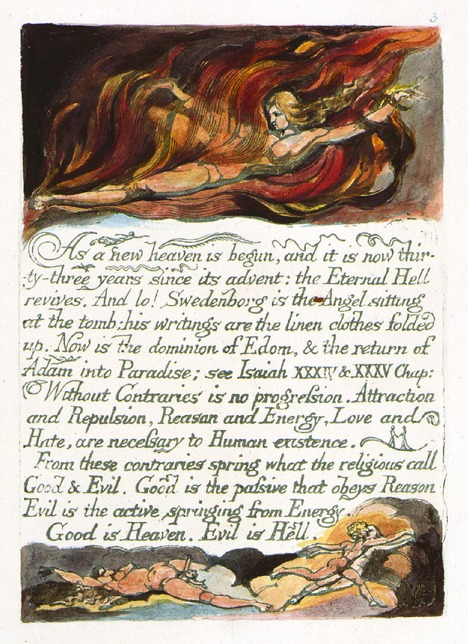
Marriage of Heaven and Hell
Plate 3

 Quote from an earlier post by Larry:

"In the 18th century Emmanuel Swedenborg, the Swedish scientist, philosopher and religionist, had a very high reputation. In London a 'new church' sprang up espousing his values. William Blake's parents were members of the New Church. That probably explains several interesting things about Blake's early life. For example his father appeared to be about as permissive as the average modern father in our culture today, but very atypical for his generation.

Blake was imbued with a great many of the famous man's values, particularly his esoteric religious ones. As a young adult Blake found many of the same ideas among the great thinkers of the ages. He thus became less dependent on Swedenborg's thought forms. With MHH Plates 21 and 22 he declared his independence of his childhood teacher.

Marriage of Heaven and Hell, (E 42)

"Plate 21
  I have always found that Angels have the vanity to speak of
themselves as the only wise; this they do with a confident
insolence sprouting from systematic reasoning:
  Thus Swedenborg boasts that what he writes is new; tho' it
is only the Contents or Index of already publish'd books"
Plate 22
 "Now hear a plain fact: Swedenborg has not written one new
truth: Now hear another: he has written all the old falshoods.
  And now hear the reason.  He conversed with Angels who are
all religious, & conversed not with Devils who all hate religion,
for he was incapable thro' his conceited notions.
  Thus Swedenborgs writings are a recapitulation of all
superficial opinions, and an analysis of the more sublime, but no
further."

Perhaps the chief objection of the mature Blake was that Swedenborg had a positive demeanor re the established church. But one of the things that stayed with Blake was Swedenborg's concept of the Divine Humanity." 

____________________


Here is a section of An Interview Conducted with Kathleen Raine on July 12, 1993 by Donald E. Stanford:

interview 

"Stanford: Why did he leave the Church of the New Jerusalem? 

Raine: Ah, that’s a good question. He wasn’t a churchman really. But he remained to the end of his life a Swedenborgian. This is this much-disputed Blake system. The scholars all scratch their heads about this; but it’s no problem. If you read the “Everlasting Gospel,” which is one of his latest works, it is in fact a point-by-point summary of the five leading beliefs of the Swedenborgian Church of the New Jerusalem, and in his interviews with Crabb Robinson, Robinson asked him about Swedenborg, and Blake said that he was a sent and inspired man, and then added, “but sometimes inspired men go beyond their commission from God.” He followed the Swedenborgian teaching. In fact, we’re all deeply familiar with the phrase “Divine Humanity,” but this phrase is not Blake’s invention; this is Swedenborg. And the Grand Man of the heavens, the one in many, and many in one, of all human souls — this is Swedenborg, and Blake uses this concept in a very beautiful passage in the Four Zoas in which he talks about man contracting our exalted senses with the multitude and expanding what we hold as one, as one man, all the universal family. Swedenborg’s greatest idea, I think, was this of the one in many, and many in one, and the divine presence in man. It was a really very wonderful idea because for him, the Divine Humanity was the eternal Christ, not the historical Christ. That was the Divine Humanity of whom Blake speaks and writes and speaks of as “Jesus the Imagination.” This is purely Swedenborgian. He disagreed with Swedenborg only in one respect: He said Swedenborg put all the good in heaven and the sinners in hell and didn’t realize that both the good and the evil are included in the Divine Humanity who transcends good and evil. That is what The Marriage of Heaven and Hell is about. Point-by-point, it’s quite a funny book. It takes up Swedenborg and his memorable experiences—it’s a running discussion with Swedenborg in semi-satirical terms, but although he poked fun at Swedenborg in certain respects, nevertheless, his system is pure Swedenborgian. I’m sure the only reason why everyone doesn’t know this is that the works of Swedenborg are so boring to read that none of the academics have read them, and I don’t blame them."

Descriptive Catalogue,(E 544)
   "Reasons and opinions concerning acts, are not
history.  Acts themselves alone are history, and these are
neither the exclusive property of Hume, Gibbon nor Voltaire,
Echard, Rapin, Plutarch, nor Herodotus.  Tell me the Acts, O
historian, and leave me to reason upon them as I please; away
with your reasoning and your rubbish.  All that is not action is
not [P 45] worth reading.  Tell me the What; I do not want you to
tell me the Why, and the How; I can find that out myself, as well
as you can, and I will not be fooled by you into opinions, that
you please to impose, to disbelieve what you think improbable or
impossible.  His opinions, who does not see spiritual agency, is
not worth any man's reading; he who rejects a fact because it is
improbable, must reject all History and retain doubts only."
Annotations to Reynolds,(E 658) 
 "The Ancients did not mean to Impose when they  affirmd 
their  belief  in Vision & Revelation  Plato was in Earnest. 
Milton was in Earnest.  They believd that God did Visit Man
Really & Truly & not as Reynolds pretends" 
Marriage of Heaven and Hell, Plate 3, (E 34)
  "As a new heaven is begun, and it is now thirty-three years
since its advent: the Eternal Hell revives. And lo! Swedenborg is
the Angel sitting at the tomb; his writings are the linen clothes folded up. 
Now is the dominion of Edom, & the return of Adam into
Paradise; see Isaiah XXXIV & XXXV Chap:
  Without Contraries is no progression.  Attraction and
Repulsion, Reason and Energy, Love and Hate, are necessary to
Human existence.
  From these contraries spring what the religious call Good &
Evil. Good is the passive that obeys Reason[.] Evil is the active
springing from Energy.
  Good is Heaven. Evil is Hell." 
Milton, Plate 22 [24], (E 117)
"O Swedenborg! strongest of men, the Samson shorn by the Churches!
Shewing the Transgresors in Hell, the proud Warriors in Heaven:
Heaven as a Punisher & Hell as One under Punishment:
With Laws from Plato & his Greeks to renew the Trojan Gods,
In Albion; & to deny the value of the Saviours blood.
But then I rais'd up Whitefield, Palamabron raisd up Westley,    

And these are the cries of the Churches before the two Witnesses' 
Faith in God  the dear Saviour who took on the likeness of men:
Becoming obedient to death, even the death of the Cross
The Witnesses lie dead in the Street of the Great City
No Faith is in all the Earth: the Book of God is trodden under Foot:       
He sent his two Servants Whitefield & Westley; were they Prophets
Or were they Idiots or Madmen? shew us Miracles!
Plate 23 [25]
Can you have greater Miracles than these? Men who devote
Their lifes whole comfort to intire scorn & injury & death
Awake thou sleeper on the Rock of Eternity Albion awake
The trumpet of Judgment hath twice sounded: all Nations are awake
But thou art still heavy and dull: Awake Albion awake!" 
Descriptive Catalogue, (E 546) 
 "The spiritual Preceptor, an experiment Picture.

THIS subject is taken from the visions of Emanuel Swedenborg.
Universal Theology, [P 53] No. 623.  The Learned, who strive to
ascend into Heaven by means of learning, appear to Children like
dead horses, when repelled by the celestial spheres.  The works
of this visionary are well worthy the attention of Painters and 
Poets; they are foundations for grand things; the reason they 
have not been more attended to, is, because corporeal demons 
have gained a predominance; who the leaders of these are, will 
be shewn below.  Unworthy Men who gain fame among Men, 
continue to govern mankind after death, and in their spiritual 
bodies, oppose the spirits of those, who worthily are famous; 
and as Swedenborg observes, by entering into disease and 
excrement, drunkenness and concupiscence, they possess
themselves of the bodies of mortal men, and shut the doors of
mind and of thought, by placing Learning above Inspiration, O
Artist! you may disbelieve all this, but it shall be at your own
peril."
Wednesday, June 22, 2022

BLAKE & TRADITION

First posted March 2015

Kathleen Raine became immersed in the study of William Blake when she was a student at Cambridge University. When, at the age of 85, she was interviewed by Donald Stanford, she was asked about the roots of Blake's sources which had formed the foundation of her masterwork Blake and Tradition, published in 1969, forty years after she received her masters degree from Cambridge. The following interview is available on the blog, Explorations: The Twentieth Century. 
 
An Interview Conducted with Kathleen Raine on July 12, 1993
Donald E. Stanford

"The audio tape of the interview that follows with Kathleen Raine is housed among the Donald E. Stanford Papers in the Louisiana and Lower Mississippi Valley Collections of the Louisiana State University Libraries, in Baton Rouge, Louisiana. Some of the questions that Donald Stanford posed in the interview, which took place, in London, in Kathleen Raine’s flat on July 12, 1993, were submitted by Herbert V. Fackler (January 23, 1942 – December 18, 1999) and Joseph Riehl, both members of the faculty of English at the University of Louisiana, Lafayette. Kathleen Raine had celebrated her 85th birthday on June 14."
...

"Stanford: Would you say a little more about this excluded tradition?

Raine: We know that he had read Swedenborg and Paracelsus, because he tells us so in the Marriage of Heaven and Hell. The first important source I discovered was the new Platonic writings translated into English during Blake’s lifetime by Thomas Taylor the Platonist, whom Blake knew at one time. He was a friend of Blake’s friend Flaxman. Blake had certainly read many of the Neo-Platonic writings in the translations of Taylor, and Neo-Platonism is one important source. He had also read the Bhagavad-GÄ«tÄ«. This we know because he had made a painting, since lost, of Mr. Wilkins translating the Bhagavad-GÄ«tÄ«. He had read a great deal of the mythologies, all the traditions that were accessible to him. He knew the Greek myths, the Norse, a certain amount about the American Indian myths. He’d read the Koran. In fact, he was working within a tradition which holds the prime element of life to be mind and not matter, which, of course, is the normal view of the perennial philosophy throughout the world and throughout all civilizations prior to our own, which takes matter to be the basic substance within the universe. And Blake’s great contribution, his great battle cry, was to open the eyes of men into the inner worlds, into the worlds of thought. He was challenging the materialism of his time. He challenged the thought of Newton, Bacon, Locke, the whole movement of the Royal Society, and the whole Western trend which was at that time towards materialism. Blake went on affirming the primacy of mind, spirit, imagination, and in order to do so he had a great tradition to draw on. In fact, when it comes to Jung, they both had read many of the same works, which accounts to a great extent for their undoubted similarities
...
     Sanford: Kathleen, could you please tell us a little more about your procedures in researching your volumes of
Blake and the Tradition?


Raine: Well, it was a life’s work. It was enormous fun, I must say. I started, as I have said, with Ruthven Todd and the sources that he had already pointed to, and then it was just that one thing led to another. One just went on winding in the golden thread and far from its being just a few odd books, like Bryant’s mythology and antiquities and so on, it proved that this golden thread wound in the works of Plato, the works of Plotinus, and the works of Jacob Boehme (of course one knows from Blake that these were his sources) and the works of Paracelsus. I spent weeks and months and years reading dusty volumes in the North Library of the British Museum, and my eyes were opened. I simply had no idea of the richness of the tradition which modern academia and our civilization as a whole, based as it is on material process, had exploded. It was virtually the wisdom of the world that Blake had drawn on. My most important contribution, I suppose, at that time was finding the importance of Thomas Taylor, the Platonist. Blake did not read Greek. Shelley of course did, and Coleridge, but Blake read only English and French. And his acquaintance with Thomas Taylor has since been verified by scholarship in a reference to Blake and [George] Cumberland. There is a description by a member of Cumberland’s family of visiting Thomas Taylor and finding him sitting talking with William Blake and expounding to him the theorem of Pythagoras and Blake saying, “Never mind the proofs, I can see it with my own eyes,” which is very characteristic of both, because Taylor, of course, was a mathematician and Blake was not. Well, I discovered quite early on that the Arlington Court tempera is an illustration of Porphyry’s work De antro nympharum and Keynes of course accepted that, but no other professional Blake scholars have done so hitherto, but it is just a plain fact that it is, every detail. Blake would have read it in Taylor’s “Essay on the Restoration of the Greek Theology by the Late Platonists” which was known to Blake. If two people live next door to one another the critics won’t accept that as evidence, it has to be in writing. And it is known that, for example, Taylor gave six lectures on Platonic theology at the house of Flaxman. It is known that Flaxman and Blake were close friends from youth, but “Oh, no,” they say; “this is no proof that Blake knew anything about Taylor,” you see. This is the sort of blinkered mentality of those who will only accept the evidence of written text. If people see each other every day, they don’t tend to write one another letters. On the whole, one writes letters to people one does not see every day.
...
British Museum
after Michelangelo
Copy of engraving by Adamo Ghisi
c. 1785

   Raine: What I’ve been trying to do all my life is to challenge and reverse the premises of modern Western materialism. That is what Blake was attempting. That is why the hippies had a sort of feeling for him—they felt there was something there—and that is what Yeats was trying to do and that is why I was taking up the torch in very frail hands myself, I don’t compare myself with Blake or Shelley or Yeats, but nevertheless that is what my life’s work has also been trying to do."


 Marriage of Heaven & Hell, Plate 21, (E 42)
  "I have always found that Angels have the vanity to speak of
themselves as the only wise; this they do with a confident
insolence sprouting from systematic reasoning:
  Thus Swedenborg boasts that what he writes is new; tho' it
is only the Contents or Index of already publish'd books
  A man carried a monkey about for a shew, & because he was a
little wiser than the monkey, grew vain, and conciev'd himself as
much
wiser than seven men.  It is so with Swedenborg; he shews the
folly of churches & exposes hypocrites, till he imagines that all
are religious. & himself the single 
Plate 22
One on earth that ever broke a net.
  Now hear a plain fact: Swedenborg has not written one new
truth: Now hear another: he has written all the old falshoods.
  And now hear the reason.  He conversed with Angels who are
all religious, & conversed not with Devils who all hate religion,
for he was incapable thro' his conceited notions.
  Thus Swedenborgs writings are a recapitulation of all
superficial opinions, and an analysis of the more sublime, but no
further.
  Have now another plain fact: Any man of mechanical talents
may from the writings of Paracelsus or Jacob Behmen, produce ten
thousand volumes of equal value with Swedenborg's.
and from those of Dante or Shakespear, an infinite number.
  But when he has done this, let him not say that he knows
better than his master, for he only holds a candle in sunshine."

Wednesday, July 18, 2018

Aphorisms on Man by Lavater

First posted May 2011.

We're told that Blake found impressive this book by Johann Kaspar Lavater. From Blake's annotations we observe that he a had a strong positive opinion of it. Blake's Annotations on this Lavater's Aphorisms on Man are available in Erdman's The Complete Poetry and Prose of William Blake in the section called Marginalia beginning on page 583. For the Blake student it's well worth reading.

You may find evidence of many of these aphorisms as sources for Blake's writings from beginning to end; here are three of them.

Look at aphorism 3: As in looking upward each beholder thinks himself the centre of the sky; so Nature formed her individuals, that each must see himself the centre of being.

Blake said,
(Milton Plate 29; Erdman 127)
 "The Sky is an immortal tent built by the Sons of Los
And every Space that a Man views around his dwelling-place:

Standing on his own roof, or in his garden on a mount
Of twenty-five cubits in height, such space is his Universe;

And on its verge the Sun rises & sets. the Clouds bow
To meet the flat Earth & the Sea in such an orderd Space:

The Starry heavens reach no further but here bend and set On all sides & the two Poles turn on their valves of gold:
And if he move his dwelling-place, his heavens also move."

Aphorism 13. joy and grief decide character. What exalts prosperity? what imbitters grief? what leaves us indifferent? what interests us? As the interest of man, so his God--as his God, so he.

Blake's comment - ALL GOLD

Blake said, 
Songs and Ballads, Auguries of Innocence, (E 491)

"Man was made for Joy & Woe
And when this we rightly know
Thro the World we safely go
Joy & Woe are woven fineA Clothing for the soul divine
Under every grief & pine
Runs a joy with silken twine"


Aphorism 40. Who, under pressing temptations to lie, adheres to truth, nor to the profane betrays aught of a sacred trust, is near the summit of wisdom and virtue.

Blake's comment - Excellent!

Larry - Under the temptation of the Main Chance Blake, at the critical moment, acted exactly as Lavater suggests here.

Although some of these aphorisms appear to serve as source material for Blake's poetic thought, the true worth of 'Lavater' to Blake was more in the moral values that the two men shared. Very negative in his feelings about clergymen in general, Blake obviously had much admiration for Lavater.

At the end of his Annotations Blake gave his honest evaluation of Lavater:

Annotations to Lavater, (E 600)
"I hope no one will call what I have written cavilling because he may think my remarks of small consequence For I write from the warmth of my heart. & cannot resist the impulse I feel to rectify what I think false in a book I love so much. & approve so generally:
Man is bad or good. as he unites himself with bad or good spirits. tell me with whom you go & Ill tell you what you do
As we cannot experience pleasure but by means of others who experience either pleasure or pain thro us. And as all of us on earth are united in thought, for it is impossible to think without images of somewhat on earth--So it is impossible to know God or heavenly things without conjunction with those who know God & heavenly things. therefore, all who converse in the spirit, converse with spirits. [& these are either Good or Evil]
For these reasons I say that this Book is written by consultation with Good Spirits because it is Good. & that the name Lavater. is the amulet of those who purify the heart of man.
There is a strong objection to Lavaters principles (as I understand them) & that is He makes every thing originate in its accident he makes the
vicious propensity a leading feature of the man but the Stamina on which all his virtues grow. But as I understand Vice it is a Negative--It does not signify what the laws of Kings & Priests have calld Vice we who are philosophers ought not to call the Staminal Virtues of Humanity by the same name that we call the omissions of intellect springing from poverty
Every mans propensity ought to be calld his leading Virtue & his good Angel But the Philosophy of Causes & Consequences misled Lavater as it has all his cotemporaries. Each thing is its own cause & its own effect Accident is the omission of act in self & the hindering of act in another, This is Vice but all Act [from Individual propensity] is Virtue. To hinder another is not an act it is the contrary it is a restraint on action both in ourselves & in the person hinderd. for he who hinders another omits his own duty. at the time
   Murder is Hindering Another, 
   Theft is Hindering Another, 
   Backbiting. Undermining Circumventing & whatever is Negative is Vice.
But the or[i]gin of this mistake in Lavater & his cotemporaries, is, They suppose that Womans Love is Sin. in consequence all the Loves & Graces with them are Sin"


Wikipedia Commons

"Blake sculpt./Rev. John Caspar Lavater of Zurich. Born 1741. Died 1801."


Blake makes a sharp distinction between Womans Love and Female Love; they are two entirely different things.

A Drawing for Blake to Engrave

Blake was connected to Lavater through his friend Henry Fuseli who had been influenced by Lavater in his youth.


Friday, March 20, 2015

TROJAN WAR

Blake had come too close to war in his own times to glorify it by making it the subject of his poetry. Warriors and Kings were not his heroes. That role was reserved for Artists and Prophets and mental revolutionaries. To him the suitable war in which men may engage was an intellectual war through which ideas may form, grow into systems, mature, and engender new ideas which would replace them. Blake chose the Greeks to symbolize a culture which had lost its soul by engaging in and glorifying physical not mental wars.
 
The Trojan War developed out of rivalries, jealousies, possessiveness, abduction and bitterness. Cities, families, armies, navies and cultures were destroyed as a result of the manipulation of individuals by the Gods on whom they projected their psyches.

In 1811-12 Blake painted for Butts two images drawing on the Trojan War: one to represent the origin of the war, the other showing the turning point which led to its resolution. A post from 2010 titled GREEK INFLUENCE commented on Blake's Judgement of Paris which shows the incident which began the trouble.


British Museum
Judgement of Paris
Milton, Plate i, (E 95)
"                                 Preface.
The Stolen and Perverted Writings of Homer & Ovid: of Plato &
Cicero. which all Men ought to contemn: are set up by artifice
against the Sublime of the Bible. but when the New Age is at
leisure to Pronounce; all will be set right: & those Grand Works
of the more ancient & consciously & professedly Inspired Men,
will hold their proper rank, & the Daughters of Memory shall
become the Daughters of Inspiration. Shakspeare & Milton were
both curbd by the general malady & infection from the silly Greek
& Latin slaves of the Sword.

     Rouze up O Young Men of the New Age! set your foreheads
against the ignorant Hirelings! For we have Hirelings in the
Camp, the Court, & the University: who would if they could, for
ever depress Mental & prolong Corporeal War. Painters! on you I
call! Sculptors! Architects! Suffer not the fash[i]onable Fools
to depress your powers by the prices they pretend to give for
contemptible works or the expensive advertizing boasts that they
make of such works; believe Christ & his Apostles that there is a
Class of Men whose whole delight is in Destroying. We do not 
want either Greek or Roman Models if we are but just & true to
our own Imaginations, those Worlds of Eternity in which we shall
live for ever; in Jesus our Lord."

Jerusalem, Plate 8, (E 151)
"All the infant Loves & Graces were lost, for the mighty Hand
Plate 9
Condens'd his Emanations into hard opake substances;
And his infant thoughts & desires, into cold, dark, cliffs of death.
His hammer of gold he siezd; and his anvil of adamant.
He siez'd the bars of condens'd thoughts, to forge them:
Into the sword of war: into the bow and arrow:                   
Into the thundering cannon and into the murdering gun
I saw the limbs form'd for exercise, contemn'd: & the beauty of
Eternity, look'd upon as deformity & loveliness as a dry tree:
I saw disease forming a Body of Death around the Lamb
Of God, to destroy Jerusalem, & to devour the body of Albion     
By war and stratagem to win the labour of the husbandman:
Awkwardness arm'd in steel: folly in a helmet of gold:
Weakness with horns & talons: ignorance with a rav'ning beak!
Every Emanative joy forbidden as a Crime:
And the Emanations buried alive in the earth with pomp of religion:          
Inspiration deny'd; Genius forbidden by laws of punishment:"

Monday, October 06, 2014

Blake's Style

       Throughout the 19th Century the works of William Blake suffered almost total neglect. His message simply surpassed contemporary currents of thought. A voracious reader, Blake mastered (and used) the symbology of the Bible, Plato, the Neoplatonists, Greek mythology, Paracelsus, Boehme, and God knows what else. 

       During the 20th century his reputation as a poet and thinker steadily grew. His most popular collection of poems, 'Songs of Innocence and Experience', has won general recognition as a classic.
       Blake's three largest works, called the major prophecies, still offer technical difficulties that may defeat the casual reader. Once they were thought to represent the eccentric vagaries of an unbalanced mind; many people considered Blake insane. Intensive Blake scholarship over the past eighty years has slowly deciphered the cryptograms and clarified (at least some of) the mysteries.

       What had seemed the most insane passages often proved on closer examination to be the most rational and meaningful. A growing body of translation and interpretation has made the major prophecies accessible and rewarding to the reader willing to take reasonable pains with them. They are now about as accessible to the general reader as is the Bible.

       A systematic acquaintance with Blake's literary peculiarities will enhance the reader's enjoyment of his poetry. This chapter introduces a few guiding principles of his thought processes and literary and artistic style. First of all we should note that Blake combined word and picture in a unique synthesis.

       Although he wrote unadorned poems and painted wordless pictures, his primary mode of expression was the illuminated manuscript, an intimate blend of graphic and verbal art. To provide a full exposition of this unique double form is beyond the modest goal of this book. At this point the illuminated form is simply mentioned as a most distinctive facet of Blake's art.

       One simple clue to reading Blake concerns his use of dialogue; he spoke with many voices. He exercised this freedom especially with the larger prophecies, the three major works. These on first reading may seem to present insuperable difficulties, but the reader who pays close attention to the identity of the speaker at each point will thereby break down the forest into manageable groves of trees. In his three long poems Blake gave titles to various elements or speeches; they became units, landmarks or guideposts, casting light on what at first seemed general confusion.

       In Night i of 'The Four Zoas' for example we find Enitharmon's Song of Death (FZ1-10.9; E305), the "Nuptial Song" of the "demons of the deep" (FZ1-13.20; E308), and the message of the Daughters of Beulah, which they call the "Wars of Death Eternal"(FZ1-21.13; E311). These three songs comprise three of the many selves of the human psyche; needless to say their ideas and attitudes vary immensely. They all describe the same event, but they see it, oh, so differently. They use the same words with different meanings. For example consider that what the daughters call "Death Eternal" the demons call marriage. In this way Blake challenges the reader and stretches his mind and immensely rewards whoever will accept the challenge. He gives us the end of a golden string.

Sunday, July 06, 2014

Sources Boehme 5

The 'Fall' in terms of Urizen's controversy with
Ahania, is found in Night Three of the Four Zoas;

"His visage changd to darkness & his strong right hand came forth 
To cast Ahania to the Earth he siezd her by the hair
And threw her from the steps of ice that froze around 
his throne
Saying Art thou also become like Vala. thus I cast thee out      
Shall the feminine indolent bliss. the indulgent self of
weariness
The passive idle sleep the enormous night & darkness of Death
Set herself up to give her laws to the active masculine virtue
Thou little diminutive portion that darst be a counterpart
Thy passivity thy laws of obedience & insincerity
Are my abhorrence. Wherefore hast thou taken that fair form
Whence is this power given to thee! once thou wast in my breast
A sluggish current of dim waters. on whose verdant margin
A cavern shaggd with horrid shades. dark cool & deadly. where
I laid my head in the hot noon after the broken clods
Had wearied me. there I laid my plow & there my horses fed
And thou hast risen with thy moist locks into a watry image
Reflecting all my indolence my weakness & my death
To weigh me down beneath the grave into non Entity
Where Luvah strives scorned by Vala age after age wandering 
Shrinking & shrinking from her Lord & calling him the Tempter
And art thou also become like Vala thus I cast thee out.
So loud in thunders spoke the King folded in dark despair
And threw Ahania from his bosom obdurate She fell like lightning
Then fled the sons of Urizen from his thunderous throne petrific
They fled to East & West & left the North & South of Heaven
A crash ran thro the immense The bounds of Destiny were broken
The bounds of Destiny crashd direful & the swelling Sea
Burst from its bonds in whirlpools fierce roaring with Human
voice
Triumphing even to the Stars at bright Ahanias fall
Down from the dismal North the Prince in thunders & thick clouds

As when the thunderbolt down falleth on the appointed place
Fell down down rushing ruining thundering shuddering
Into the Caverns of the Grave & places of Human Seed
Where the impressions of Despair & Hope enroot forever
A world of Darkness. Ahania fell far into Non Entity
(Erdman 328-330)

Blake acted on scriptural grounds for this story, ie the Flood.  We are told
that God's wrath was invoked because the Nephilim found the daughters
of men fair and violence filled the land.

In Percival 180-83 continues to discuss the Fall:
"In Paradise, says Boehme, Adam lived in an inward principle, and so
living he had control  over the four elements, but when he moved outward
into the "external humanity", the four elements got control of him."

At the bottom lies Urizen 'in a stonied stupor', helpless before the
hugh inpouring of sense impressions... in the fact of casting out Ahania,
Urizen's visage changed to darkness...he became a blind and impotent
figure.

Adam became corrupt and weary, and fell into a sleep.  Here he was
undone and if the mercy of God had not help and made a women out
of him, he would still be asleep.....the earlier monism was replaced by
duality.

There are many sources outside Scripture; the void or abyss into which
the Zoas fall is of the same nature as the abyss in  Boehme, where it's
the world of God the Father in separation from the Son, the dark
fire-source in separation from the light, the first principle alone, without
manifestation; it's the world into which Lucifer and his cohorts fall.
(Boehme, Threefold Life, viz Mysterium magnum)


Notice how this compares with Blake's drawing on Plate 36 of The Book of Milton: