Showing posts with label Joy. Show all posts

Tuesday, July 10, 2012

OOTHOON'S LAMENT


Blake's reputation as an advocate of free love comes, to a large extent, from his work Visions of the Daughters of Albion from 1793.

Oothoon was not shy, she was in love with Theotormon and had a sexual relationship with him. Perhaps they intended to be wed. Unfortunately Bromion forced her into a sexual encounter with him. Theotormon became enraged not only at Bromion, but at Oothoon as well.

Oothoon's defense is that love should be a free and joyous experience entered into for mutual pleasure. Love does not convey a right to possess or control the beloved. Jealousy and false modesty should not enter into a relationship of love. Taking away another's freedom and self respect are not characteristics of love. Love that restricts freedom and happiness is self-love. If a man who enjoys his pleasure with a woman, seeks to chain her through laws or morality, propriety and social convention, he is a hypocrite.  
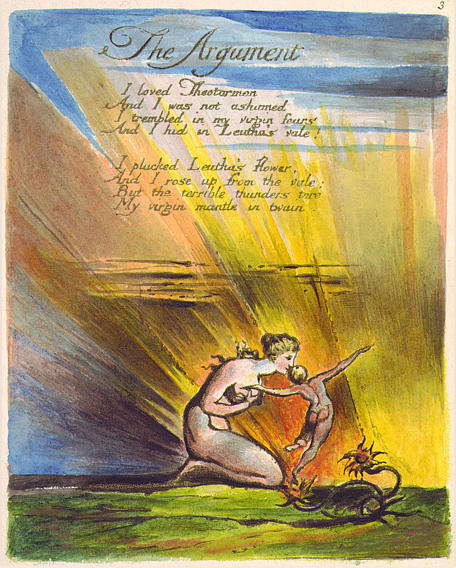
Visions of Daughters of Albion
Plate 3, Copy G, 1795
Courtesy of Wikimedia
Original in Houghton Library
Visions of the Daughters of Albion, Plate 3, (E 46)
"The Argument

I loved Theotormon
And I was not ashamed
I trembled in my virgin fears
And I hid in Leutha's vale!

I plucked Leutha's flower,                          
And I rose up from the vale;
But the terrible thunders tore
My virgin mantle in twain." 


Visions of the Daughters of Albion, Plate 6, (E 49)
"And does my Theotormon seek this hypocrite modesty!
This knowing, artful, secret, fearful, cautious, trembling hypocrite.

Then is Oothoon a whore indeed! and all the virgin joys
Of life are harlots: and Theotormon is a sick mans dream
And Oothoon is the crafty slave of selfish holiness.             

But Oothoon is not so, a virgin fill'd with virgin fancies
Open to joy and to delight where ever beauty appears
If in the morning sun I find it: there my eyes are fix'd
Plate 7
In happy copulation; if in evening mild. wearied with work;
Sit on a bank and draw the pleasures of this free born joy.

The moment of desire! the moment of desire! The virgin
That pines for man; shall awaken her womb to enormous joys
In the secret shadows of her chamber; the youth shut up from     
The lustful joy. shall forget to generate. & create an amorous image
In the shadows of his curtains and in the folds of his silent pillow.
Are not these the places of religion? the rewards of continence?
The self enjoyings of self denial? Why dost thou seek religion?
Is it because acts are not lovely, that thou seekest solitude,   
Where the horrible darkness is impressed with reflections of desire.

Father of jealousy. be thou accursed from the earth!
Why hast thou taught my Theotormon this accursed thing?
Till beauty fades from off my shoulders darken'd and cast out,
A solitary shadow wailing on the margin of non-entity.           

I cry, Love! Love! Love! happy happy Love! free as the mountain wind!
Can that be Love, that drinks another as a sponge drinks water?
That clouds with jealousy his nights, with weepings all the day:
To spin a web of age around him. grey and hoary! dark!
Till his eyes sicken at the fruit that hangs before his sight.   
Such is self-love that envies all! a creeping skeleton
With lamplike eyes watching around the frozen marriage bed."

Monday, June 27, 2011

IS ALL JOY FORBIDDEN


Written on a sketch by Blake in the British Museum is the legend 'is all joy forbidden.' The image catches the sorrow of being closed off from all sources of joy. John Middleton Murry, author of William Blake, directs us to the causes of man's deepest sorrow in this fallen world:

"Man is already punished in that they 'know naught of sweet eternity'. To take from them the possibility of that knowledge is a crime against the Manhood.
In the Christianity we know, and which we have inherited, it was not so. Once let Eternity become a condition into which men enter after death, and Christianity may not merely condone War, as it does, but it may employ War, as it did. The life of the body is indifferent: the immortal soul fares on, unhindered to its appointed place. But if Eternity is here and now, the case is altered. The soul fares as the body, and to kill a body is to kill a soul.
Such was Blake's doctrine, and such was the doctrine of Jesus before him. Eternity is here and now. And for Blake the cause of the corruption of the true Religion is, first of all, to have told the Human Race that Woman's love is Sin, and, second , to have told it

'That an Eternal life awaits the worm of sixty winters
In an allegorical abode where existence has never come'

These illusions propagated by false Religion are not separate from one another. The Moral Law which 'Forbids all Joy' in life, and forbids most vehemently the deepest joy of all, must needs offer its victims the promise of happiness to come. But happiness is here and now, like Eternity. And Eternity is happiness in the here and now; nor is there any other." (Page 313)

In this account the fall of Albion leads to his forgetting his origin until 'Nought he knew Of sweet Eternity.'

Four Zoas, Night VII, Page 83, (E 358)
"Among the Flowers of Beulah walkd the Eternal Man & Saw
Vala the lilly of the desart. melting in high noon
Upon her bosom in sweet bliss he fainted Wonder siezd
All heaven they saw him dark. they built a golden wall
Round Beulah There he reveld in delight among the Flowers
Vala was pregnant & brought forth Urizen Prince of Light
First born of Generation. Then behold a wonder to the Eyes
Of the now fallen Man a double form Vala appeard. A Male
And female shuddring pale the Fallen Man recoild
From the Enormity & calld them Luvah & Vala. turning down
The vales to find his way back into Heaven but found none
For his frail eyes were faded & his ears heavy & dull

Urizen grew up in the plains of Beulah Many Sons
And many daughters flourishd round the holy Tent of Man
Till he forgot Eternity delighted in his sweet joy
Among his family his flocks & herds & tents & pastures

But Luvah close conferrd with Urizen in darksom night
To bind the father & enslave the brethren Nought he knew
Of sweet Eternity"

The ideas that ' Womans love is Sin' and that Eternal life is only experienced after death are associated in this passage with the forbidding of joy.

Europe, PLATE 5, (E 62)
"Now comes the night of Enitharmons joy!
Who shall I call? Who shall I send?
That Woman, lovely Woman! may have dominion?
Arise O Rintrah thee I call! & Palamabron thee!
Go! tell the human race that Womans love is Sin!
That an Eternal life awaits the worms of sixty winters
In an allegorical abode where existence hath never come:
Forbid all joy, & from her childhood shall the little female
Spread nets in every secret path.

My weary eyelids draw towards the evening, my bliss is yet but new."

Friday, December 24, 2010

BLAKEAN CHRISTMAS CARD

This is Our Blakean Christmas Card.
The picture was inspired by one of Blake's images in the Small Book of Designs which is in the collection of the British Museum.

Read about Tharmas and this image in this post on our blog.

Northrop Frye has this to say about Tharmas on page 354 of Northrop Frye on Milton and Blake:
"The passage from death to rebirth is represented in Blake's symbolism by Tharmas, the power of renewing life. The ability of the individual to renew his life in resurrection is a break with the cycle, but in ordinary life such a renewal takes place only in the group or species, and within the cycle. Tharmas is symbolized by the sea, the end and beginning of life."


Picture after Blake’s Small Book of Designs in British Museum

William Blake: Vision of the Last Judgment
"There Exist in that Eternal
World the Permanent Realities of Every Thing which we
see are reflected in this Vegetable Glass of Nature All
Things are comprehended in their Eternal Forms in the
Divine body of the Saviour the True Vine of Eternity
The Human Imagination who appeard to Me as Coming to
Judgment. among his Saints & throwing off the Temporal
that the Eternal might be Establishd."

Luke 2:28-32
Then took he him up in his arms, and blessed God, and said, Lord,
now lettest thou thy servant depart in peace, according to thy word:
For mine eyes have seen thy salvation,
Which thou hast prepared before the face of all people;
A light to lighten the Gentiles, and the glory of thy people Israel.

Wednesday, August 25, 2010

CONTEMPLATION

One of Blake's very early poems which appeared in Poetical Sketches, soars to the height of affirmation and plunges to the depths of depression. Although this is one of the group of poems which were actually published in conventional book form by some of Blake's friends in his youth, Blake was not pleased enough with them to want them circulated. The value to us in reading them, is in noticing the intimations of the themes and symbolism which he would develop with greater depth and complexity in his later work. Contemplation also can be enjoyed for its imagery which is reminiscent of other romantics. The poem ends abruptly as if the author had not reached a point in his life where he could find any reconciliation between the joys and sorrows of life.

Poetical Sketches, (E 442)
CONTEMPLATION.

"Who is this, that with unerring step dares tempt the wilds, where
only Nature's foot hath trod? 'Tis Contemplation, daughter of the
grey Morning! Majestical she steppeth, and with her pure quill on
every flower writeth Wisdom's name. Now lowly bending, whispers
in mine ear, "O man, how great, how little thou! O man, slave of
each moment, lord of eternity! seest thou where Mirth sits on the
painted cheek? doth it not seem ashamed of such a place, and grow
immoderate to brave it out? O what an humble garb true joy puts
on! Those who want Happiness must stoop to find it; it is a
flower that grows in every vale. Vain foolish man, that roams on
lofty rocks! where, 'cause his garments are swoln with wind, he
fancies he is grown into a giant! Lo then, Humility, take it, and
wear it in thine heart; lord of thyself, thou then art lord of
all. Clamour brawls along the streets, and destruction hovers in
the city's smoak; but on these plains, and in these silent woods,
true joys descend: here build thy nest; here fix thy staff;
delights blossom around; numberless beauties blow; the green
grass springs in joy, and the nimble air kisses the leaves; the
brook stretches its arms along the velvet meadow, its silver
inhabitants sport and play; the youthful sun joys like a hunter
rouzed to the chace: he rushes up the sky, and lays hold on the
immortal coursers of day; the sky glitters with the jingling
trappings! Like a triumph, season follows season, while the airy
music fills the world with joyful sounds." I answered, "Heavenly
goddess! I am wrapped in mortality, my flesh is a prison, my
bones the bars of death, Misery builds over our cottage roofs,
and Discontent runs like a brook. Even in childhood, Sorrow
slept with me in my cradle; he followed me up and down in the
house when I grew up; he was my school-fellow: thus he was in my
steps and in my play, till he became to me as my brother. I
walked through dreary places with him, and in church-yards; and I
oft found myself sitting by Sorrow on a tomb-stone!"

Monday, July 19, 2010

OLOLON

In Plate 31 of Milton, a contrast is seen between the way things appear in the fallen world and in the unfallen world. The first paragraph quoted below concerns Satan and Rahab, Generation, Kingdoms of the Earth, War and Strife. All of the Living Creatures of the Four Elements are wailing in bitter lament. They weep because "they see the Lord coming in the Clouds of Ololon with Power & Great Glory!"

Beulah is said to weep also, but the lamentation of Beulah is seen as a vision the greatest beauty, joy and hope. The eyes of vision see the loveliest things of the natural world as expressing the culmination which will result from Ololon's sacrificial descent following Milton in his return to the world of matter.

The world of suffering, war, and strife should welcome the prospect of the Lord's arrival, for it will initiate the world of love, and peace and brotherhood. But it is not so. First an open mind, a receptive heart, a gentle hand, and an intuitive soul must grow in man. The vision cannot appear until we have prepared ourselves for it.


Milton, Plate 31 [34], (E 130)
"And all the Living Creatures of the Four Elements, wail'd
With bitter wailing: these in the aggregate are named Satan
And Rahab: they know not of Regeneration, but only of Generation
The Fairies, Nymphs, Gnomes & Genii of the Four Elements
Unforgiving & unalterable: these cannot be Regenerated
But must be Created, for they know only of Generation
These are the Gods of the Kingdoms of the Earth: in contrarious
And cruel opposition: Element against Element, opposed in War
Not Mental, as the Wars of Eternity, but a Corporeal Strife
In Los's Halls continual labouring in the Furnaces of Golgonooza
Orc howls on the Atlantic: Enitharmon trembles: All Beulah weeps

Thou hearest the Nightingale begin the Song of Spring;
The Lark sitting upon his earthy bed: just as the morn
Appears; listens silent; then springing from the waving
Corn-field! loud
He leads the Choir of Day! trill, trill, trill, trill,
Mounting upon the wings of light into the Great Expanse:
Reecchoing against the lovely blue & shining heavenly Shell:
His little throat labours with inspiration; every feather
On throat & breast & wings vibrates with the effluence Divine
All Nature listens silent to him & the awful Sun
Stands still upon the Mountain looking on this little Bird

With eyes of soft humility, & wonder love & awe.
Then loud from their green covert all the Birds begin their Song
The Thrush, the Linnet & the Goldfinch, Robin & the Wren
Awake the Sun from his sweet reverie upon the Mountain:
The Nightingale again assays his song, & thro the day,
And thro the night warbles luxuriant; every Bird of Song
Attending his loud harmony with admiration & love.
This is a Vision of the lamentation of Beulah over Ololon!

Thou percievest the Flowers put forth their precious Odours!
And none can tell how from so small a center comes such sweets
Forgetting that within that Center Eternity expands
Its ever during doors, that Og & Anak fiercely guard[.]
First eer the morning breaks joy opens in the flowery bosoms
Joy even to tears, which the Sun rising dries; first the Wild Thyme
And Meadow-sweet downy & soft waving among the reeds.
Light springing on the air lead the sweet Dance: they wake
The Honeysuckle sleeping on the Oak: the flaunting beauty
Revels along upon the wind; the White-thorn lovely May
Opens her many lovely eyes: listening the Rose still sleeps
None dare to wake her. soon she bursts her crimson curtaind bed
And comes forth in the majesty of beauty; every Flower:
The Pink, the Jessamine, the Wall-flower, the Carnation
The Jonquil, the mild Lilly opes her heavens! every Tree,
And Flower & Herb soon fill the air with an innumerable Dance
Yet all in order sweet & lovely, Men are sick with Love!
Such is a Vision of the lamentation of Beulah over Ololon"

Advice from the apostle Paul:
Philippians
4:6-7 - Don't worry over anything whatever; tell God every detail of your needs in earnest and thankful prayer, and the peace of God which transcends human understanding, will keep constant guard over your hearts and minds as they rest in Christ Jesus.
4:8-9 - Here is a last piece of advice. If you believe in goodness and if you value the approval of God, fix your minds on the things which are holy and right and pure and beautiful and good. Model your conduct on what you have learned from me, on what I have told you and shown you, and you will find the God of peace will be with you.

J. B. Phillips translation of the New Testament

Sunday, July 04, 2010

Job Picture 14

Picture 14:
We're still in Job 38; Edinger wrote on page 53 "At first Yahweh had appeared as an undifferentiated energy-phenomenon, the whirlwind; in this picture a structured universe is revealed in an image of totality."

I would say 13 was intensely awesome and 14 intensely creative--and beautiful. He said "out of the ordeal a world is born".

Following seven stars above the picture Blake wrote: "Canst thou bind the sweet influences of the Pleiades or loose the bands of Orion (Job 38:31).

Note the quotes on the Creation from Genesis 1 in the margins, on the left:
"Let there be light",
"Let there be a firmament"
"Let the waters be gathered
together in one place, and let the dry land appear"

And on the right:
"And God made two great lights"
"Let the waters bring forth abundantly"
"Let the earth bring forth cattle, and creeping thing, and beast" (These are all verses from Genesis 1.)

Underneath the picture Blake wrote: "When the morning Stars sang together, and all the Sons of God shouted for joy" (Job 38:7)

This is the dawn after the darkness; we might consider it a mark of Job's rebirth. As gruesome as Job's test appeared, good things happen from now on (Picture 15 appears pretty awful, but it's something that Job and his wife watch rather than suffer.) Hereafter the Illustrations for The Book of Job get increasingly sunny!

Thursday, May 20, 2010

JOY & WOE

Auguries of Innocence (E491)
...
"It is right it should be so
Man was made for Joy & Woe
And when this we rightly know
Thro the World we safely go
Joy & Woe are woven fine
A Clothing for the soul divine
Under every grief & pine
Runs a joy with silken twine
The Babe is more than swadling Bands
Throughout all these Human Lands"

In these few line Blake tells us a lot about his system: his means of organizing or giving meaning to life as it has come to him. He recognizes that our minds operate through dualistic processing. It is right that we experience and understand things by splitting them into opposites. But here is a danger in identifying an aspect of the divided world as 'the good' and another as the 'not good'. The opposites should be woven together and recognized as not the reality itself, but as the garment that clothes the Identity which is Eternal. In this world we are inclined to see the outer woes and miss the inner joys which are hidden beneath them. Within each us of is a 'Babe' prepared to develop its spiritual nature which allows one to live Eternally even when bound in the clothes of time and matter.

....................Contraries......................
Joy________ Woe
Imagination__ Reason and Emotion
Eternity_____ This World
Innocence___ Experience


The 'Babe' is neither joy nor woe, but 'that of God in everyone' (Quaker), 'Christ in you' (Paul), the 'Divine Humanity' (Blake) or the 'Divine Child' (Jung).


God Becomes as We Are

There is No Natural Religion (E 3)

Tuesday, May 04, 2010

GENESIS II

Continuation of Genesis

In spite of Enitharmon's fears, Los and Enitharmon will create habitations for the Spectres of the dead.

Four Zoas, Night VII, Page 98, (E 370)

"Enitharmon spread her beaming locks upon the wind & said
O Lovely terrible Los wonder of Eternity O Los my defence &
guide
Thy works are all my joy. & in thy fires my soul delights
If mild they burn in just proportion & in secret night
And silence build their day in shadow of soft clouds & dews
Then I can sigh forth on the winds of Golgonooza piteous forms
That vanish again into my bosom but if thou my Los
Wilt in sweet moderated fury. fabricate forms sublime
Such as the piteous spectres may assimilate themselves into
They shall be ransoms for our Souls that we may live

So Enitharmon spoke & Los his hands divine inspired began
To modulate his fires studious the loud roaring flames
He vanquishd with the strength of Art bending their iron points
And drawing them forth delighted upon the winds of Golgonooza
From out the ranks of Urizens war & from the fiery lake
Of Orc bending down as the binder of the Sheaves follows
The reaper in both arms embracing the furious raging flames
Los drew them forth out of the deeps planting his right foot firm
Upon the Iron crag of Urizen thence springing up aloft
Into the heavens of Enitharmon in a mighty circle

And first he drew a line upon the walls of shining heaven
And Enitharmon tincturd it with beams of blushing love
It remaind permanent a lovely form inspird divinely human
Dividing into just proportions Los unwearied labourd
The immortal lines upon the heavens till with sighs of love
Sweet Enitharmon mild Entrancd breathd forth upon the wind
The spectrous dead Weeping the Spectres viewd the immortal works
Of Los Assimilating to those forms Embodied & Lovely
In youth & beauty in the arms of Enitharmon mild reposing

First Rintrah & then Palamabron drawn from out the ranks of war
In infant innocence reposd on Enitharmons bosom
Orc was comforted in the deeps his soul revivd in them
As the Eldest brother is the fathers image So Orc became
As Los a father to his brethren & he joyd in the dark lake
Tho bound with chains of Jealousy & in scales of iron & brass

But Los loved them & refusd to Sacrifice their infant limbs
And Enitharmons smiles & tears prevaild over self protection
They rather chose to meet Eternal death than to destroy
The offspring of their Care & Pity Urthonas spectre was comforted
But Tharmas most rejoicd in hope of Enions return
For he beheld new Female forms born forth upon the air
Who wove soft silken veils of covering in sweet rapturd trance
Mortal & not as Enitharmon without a covering veil

First his immortal spirit drew Urizen[s] Shadow away
>From out the ranks of war separating him in sunder
Leaving his Spectrous form which could not be drawn away
Then he divided Thiriel the Eldest of Urizens sons
Urizen became Rintrah Thiriel became Palamabron
Thus dividing the powers of Every Warrior
Startled was Los he found his Enemy Urizen now
In his hands. he wonderd that he felt love & not hate
His whole soul loved him he beheld him an infant
Lovely breathd from Enitharmon he trembled within himself"

End of The Seventh Night
__________________________________________
In spite of Enitharmon's fear of the longterm consequences of the sin of eating the fruit, she focuses her attention on Los in his best light as her defense and guide, and as a creative producer. She recognizes that she and Los (as space and time) have different gifts. She wants him to work with her but sees that his unmoderated fury would blow her away. She is reacting as her own pity to his wrath.

As space without time, Enitharmon can produce forms but they have no extensions in time, disappearing as soon as they are formed. The two of them together could produce lasting forms which could be occupied by the Spectres of the dead. They begin by Los drawing a line upon the walls of shining heaven and 'Enitharmon tincturd it with beams of blushing love.' These activities remind us of the art which William and Catherine cooperated in producing. They are both delighted with their offspring which they see as infant innocence whom they love.

Unexpected benefits result from these activities. The sons of Los (Rintrah, Palamabron, and Orc) are drawn into the orbit of Los's creative benevolence. The Spectre of Urthona, Tharmas and Urizen himself become part of a circle of love which has been created.

Repeating the last phrase from the quote:
"His whole soul loved him he beheld him an infant
Lovely breathd from Enitharmon he trembled within himself"

A transformation has taken place. By giving bodies to those in need of them, Los and Enitharmon have changed the way they see the world. They have become Adam and Eve, the first parents. They have become William and Catherine whose imaginations can build Golgonooza. They have begun the process of reassembling the fractured psyche with themselves; Los and Enitharmon, as the first two pieces which have been fit together.
Huntington Museum
Illustrations to Paradise Lost
Illustration 10

'So Judged He Man'
Click on Picture for detail, CTRL key and (-) key will reduce size after enlarged.

Blake called generation a mercy. This passage suggests that it has been undertaken willingly and with joy.

Thursday, April 29, 2010

Gates of Paradise Picture 7


The inscription reads: What are these? 

Alas! the Female Martyr 

Yale Center for British Art
Gates of Paradise
Plate 7

Is She also the Divine Image

Pretty tricky text! In this picture like many others single vision will tell us virtually nothing about Blake's thoughts and intentions here.

Here is the text which Blake associated with this picture:
"7. One dies! Alas! the Living and Dead!
One is slain! and One is fled!"

(The inscription on the picture, shown above, tells us more.)

The picture shows three figures: the large young man emanating joy, and two smaller ones: one dead and the other fleeing into the skies. All three are attributes of Blake (and you and me!).

Summarizing Digby (37-39) the picture shows our attitude toward the "grains of sand", the "Wild Flower" the "golden wings" of the last post. Digby cited another poem:
"He who binds to himself a joy
Doth the winged life destroy.
He who kisses the joy as it flies,
Lives in eternity's sunrise."

I can cite the same idea from my own experience with Henry Wieman's Source of Human Good : Wieman, a naturalistic theologian (a school to which I belong!) pointed out two basic realities: the creative good and the creative event. You should be able to judge 'which was which' in the picture above.

Quoting Digby (37): "This is the art of life to which so few have found the secret. Either we miss what the moment offers, and it flies away forever; or, by trying to bend it to our will and purpose, we destroy it."

Choosing the Creative Event we may go through life enjoying it (called Living Eternally); or we may allow the Selfhood to rob us of it.

But there is a "deeper problem" (p.38) expressed in the inscription: " What are these? Alas! the Female Martyr
Is She also the Divine Image?"

The Divine Image represents the union of the two contraries: the answer to the above question is YES: the female (emanation) gives herself willing, and the male likewise, exemplified in Milton's return from Paradise "to redeem the female shade" (plate 36) while "the happy female joy is only actualized in self-sacrifice (Digby 38). For this principle Jerusalem Plate 96 is well worth reading carefully. It is the Moment of redemption, salvation, of union of the two into one and collectively the Brotherhood, for which Jesus prayed in John 17. Here is the text of Plate 96 :

"[Jesus said to Albion] if God dieth not for Man & giveth not himself Eternally for Man Man could not exist. for Man is Love: As God is Love: every kindness to another is a little Death In the Divine Image nor can Man exist but by Brotherhood".

Sunday, March 28, 2010

The Tree and the Serpent

Here is something I wrote 25 years ago in Chapter One of an earlier work:

"In Night vii of 4Z Urizen, the ice man, the great opposer of change, effects the metamorphosis of "fierce Orc" (Erdman page 382), personification of change, into a serpent who crawls up the Tree of Mystery. An earlier prophet had written about a serpent and a tree at the dawn of history, and since that day the two figures have served as the basic symbols of the Fall. But Moses had used the same combined image to symbolize healing, and Jesus harked back to it in predicting his own impending exit from the world and its purpose.

Knowledge of the full weight of meaning carried by serpent and tree alerts us to an impending climax in Blake's story. Back in Night i Los, the spirit of prophecy, the personification of creativity, was estranged from his emanation, Enitharmon. In Night v she gave birth to Orc, but Los chained him to earth with the Chain of Jealousy, a sort of reverse Oedipus myth. This left the creative selves a sorry shambles. But now in Night vii Enitharmon's shadow meets and unites with Los' spectre, and their issue is twofold, the Whore and the Lamb. The Whore will burn, and the Lamb will find a spotless bride."

There's no way anyone can fully appreciate the joy of this moment without having participated deeply in the agony and travail which preceded it. This is but a way of saying that there's no way anyone can appreciate the salvation of the world without having first quenched the cup of the fallenness of the world. Long ago a book appeared entitled No Cross, No Crown, suggesting that we don't appreciate what God has done simply because we refuse the cup. Jesus accepted it on our behalf, and Blake did too in his way, as does every artist or prophet or saint who follows the narrow path.

Sunday, March 14, 2010

Infant Joy

'I have no name;
I am but two days old.'
What shall I call thee?
'I happy am,
Joy is my name.'
Sweet joy befall thee!

Pretty joy!
Sweet joy, but two days old.
Sweet joy I call thee:
Thou dost smile,
I sing the while;
Sweet joy befall thee!

Blake must have been thinking about a passage in Spenser's The Faerie Queen when he wrote this. If you click this link, you come up with a google copy of Blake and Tradition by Kathleen Raine (Amazon offers this book for $50, but you have to persevere in your search for that). However google seems to offer a lot of access to this book, one of the first and best Blake books I found.

In Spencer's story there were thousand thousands of these infants, and the "keeper of the northern bar" admits them one by one. Raine sees here Urthona/Los. Relate this passage in Spencer to The Arlington Tempera, and you get a glimpse of Blake's total myth: the unborn coming down the northern passage, where the babe is clothed with flesh and mortality for a sojourn in the Sea of Time and Space; at the conclusion of mortality one arrives back on terra firma prepared to ascend the southern passage to the realm of Eternity.

Thursday, January 28, 2010

GOLGONOOZA

This account of the building of Golgonooza demonstrates the nature of its structure. Here Golgonooza is described as the elements of the life lived according to the Eternal principles of brotherhood and integrity.

Those who build their lives as expressions of the 13th Chapter of First Corinthians are the 'golden builders'; they are 'becoming a building' - carefully built just as Blake's illuminated poetry was produced with 'well wrought blandishments' and 'well contrived words.' The structure of Golgonooza is the principles and attitudes through which we build our character, the furnishings are the way we behave to one another: 'curtains woven tears and sighs, woven into lovely forms.' The outcome is the 'joy' of losing the 'self'' by knowing the love in which we abide, and which abides in us.


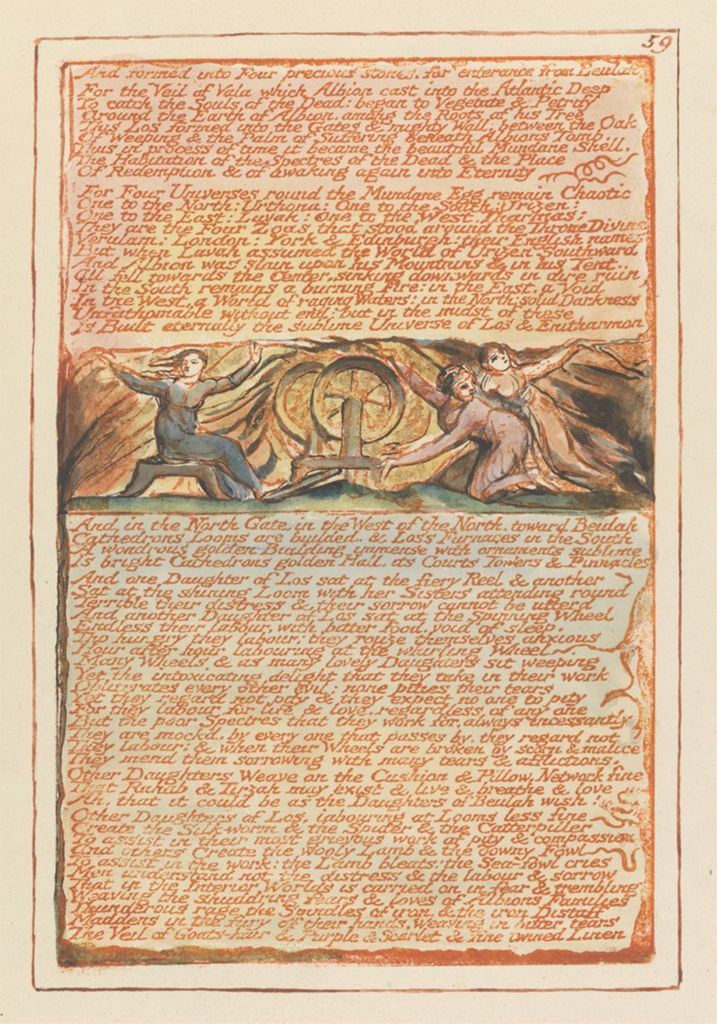
Jerusalem, Plate 59
'For they labor for life & love'


Jerusalem, Plate 12, (E 154)
"What are those golden builders doing?...

Becoming a building of pity and compassion? Lo!
The stones are pity, and the bricks, well wrought affections:
Enameld with love & kindness, & the tiles engraven gold
Labour of merciful hands: the beams & rafters are forgiveness:
The mortar & cement of the work, tears of honesty: the nails,
And the screws & iron braces, are well wrought blandishments,
And well contrived words, firm fixing, never forgotten,
Always comforting the remembrance: the floors, humility,
The cielings, devotion: the hearths, thanksgiving:
Prepare the furniture O Lambeth in thy pitying looms!
The curtains, woven tears & sighs, wrought into lovely forms
For comfort. there the secret furniture of Jerusalems chamber
Is wrought: Lambeth! the Bride the Lambs Wife loveth thee:
Thou art one with her & knowest not of self in thy supreme joy.
Go on, builders in hope: tho Jerusalem wanders far away,
Without the gate of Los: among the dark Satanic wheels."

Monday, September 07, 2009

JOB, BLAKE & JUNG

William Blake, Carl Jung and the author of the Book of Job, seem to agree that the experience of Job represented a change in the relationship of man and God. Job struggles against the perceived injustice of God and the suffering it brings upon him. Job receives a direct intervention from God in the shape of God speaking to him from the whirlwind. Because Job was truthful with God and confronted God with the human point of view, he received an answer demonstrating God's power, wisdom and mystery. 

After his trials Job's fortunes are restored and he receives God's favor. The role that Satan (the personification of evil) plays in the story is pivotal. Satan is allowed by God to test Job because of Job's reputation for righteousness. This perhaps is the hinge of the story because Satan, not God is in charge of testing Job. In the end Job's demands convince God to relate to him directly.  

Satan before the Throne of God, Illustrations to the Book of Job (Linnell Set) 

Here is a quote from Jung in a letter to Morton Kelsey (from CARL JUNG: WOUNDED HEALER OF THE SOUL by Claire Dunne): 

 "This is what happens in Job: The creator sees himself through the eyes of man's consciousness and this is the reason why God has to become man, and why man is progressively gifted with the dangerous prerogative of the divine "mind." You have it in Christ's saying: "Ye are gods" and man has not even begun to know himself." 

Edward Edinger, in ENCOUNTER WITH THE SELF: A JUNGIAN COMMENTARY ON WILLIAM BLAKE'S ILLUSTRATIONS OF THE BOOK OF JOB describes the encounter of Job with God as "a divine encounter by which the ego is rewarded with some insight into the transpersonal psyche." And he further says "The ego, by holding fast to its integrity, is granted a realization of the Self." 

 Blake's book, ILLUSTRATIONS TO THE BOOK OF JOB, consists of 21 plates which tell Job's story in a few words and in highly symbolic pictures. Plate 13 represents the encounter of Job with God in the whirlwind which is the intimate experience of a man directly with the numinous. The next plate, number 14, depicts a rebirth of consciousness. The central picture is surrounded with images and words from the creation story in Genesis. The text includes "When the morning Stars sang together & all the sons of God shouted for joy." (Job 38:7) The central image depicts at the top four angels among the stars rejoicing. In the center is kneeling God with outstretched arms and a bright sun-like halo. Beside him are Apollo with the sun, and Artemis with the moon. At the lowest level are Job his wife and the three comfronters, who are allowed to witness the celebration of the this new stage of creation. The next seven plates illustrate the changed relationship between Job and God. 

Damon in A BLAKE DICTIONARY explains the process Job underwent in terms to going through stages represented by the Seven Eyes of God. In the end "His manhood purged of all error, is now complete." Each one of us is searching for images to represent indescribable experience. 

For links to Blake's illustrations consult the post: Blake's Pictures for Job

.

Friday, August 28, 2009

IMMORTAL GAIN

From a letter of consolation which Blake wrote to his
friend Hayley we read:

"good many other softenings to the whole--I know that
our deceased friends are more really with us than when
they were apparent to our mortal part. Thirteen years
ago. I lost a brother & with his spirit I converse daily &
hourly in the Spirit. & See him in my remembrance in
the regions of my Imagination. I hear his advice & even
now write from his Dictate--Forgive me for expressing
to you my Enthusiasm which I wish all to partake of
Since it is to me a Source of Immortal Joy even in this
world by it I am the companion of Angels. May you
continue to be so more & more & to be more & more
perswaded. that every Mortal loss is an Immortal Gain.
The Ruins of Time builds Mansions in Eternity."

Blake's brother Robert as shown in the poem Milton.

Larry expressed the sentiment that, "every Mortal loss
is an Immortal Gain," at our Quaker Meeting recently.
Or perhaps he used this similar quote, "I verily believe
it Every Death is an improvement of the State of the
Departed." What a comfort to be confident as Blake was
that our loved ones have gone on to better things when
they leave us.

The Ascension
.