Showing posts with label Friends. Show all posts

Tuesday, May 11, 2021

BLAKE'S DESIGNS

Wikipedia Commons
Illustrations to Blair's The Grave
 

Heavens Portals Wide Expand to Let Him In

The Grave
At the end of the text of the 1803 edition of The Grave are unsigned comments. It is likely that a sympathetic friend wrote the comments in conjunction with Blake's explanations. Since Fuseli wrote a statement for the introduction, he may have been the author of the final remarks as well. The congruence of the arrangement and analysis of the designs with Blake's thinking makes it likely that it was written by Fuseli with the assistance of Blake.


Click on the ROMAN NUMERAL to see Blake's watercolor for the specific design for the description of the image.
"OF THE DESIGNS"

"By the arrangement here made, the regular progression of Man, from his first descent into the Vale of Death, to his last admission into Life eternal, is exhibited. These Designs, detached from the Work they embellish, form of themselves a most interesting Poem.

I. THE DESCENT OF CHRIST INTO THE GRAVE.

“ Eternal King, whose potent arm sustains
The keys of Death and Hell ! ”

II. THE DESCENT OF MAN INTO THE VALE OF DEATH.

The pious daughter weeping and conducting her sire onward; age, creeping carefully on hands and knees; an elder, without friend or kindred; a miser ; a bachelor, blindly proceeding, no one knows where, ready to drop into the dark abyss ; frantic youth rashly devoted to vice and passion, rushing past the diseased and old, who totters on crutches; the wan declining virgin ; the miserable and distracted widow; the hale country youth ; and the mother and her numerous progeny, already arrived in this valley, are among speak irresistibly to the feelings.

III. DEATH'S DOOR.
The Door opening, that seems to make utter darkness visible; age, on crutches, hurried by a tempest into it.Above is the renovated man seated in light and glory.
IV. THE STRONG AND WICKED

MAN DYING. Extent of limb, a broad capacious chest, heaving in agony, and prodigious muscular force, so exerted as to pourtray the excruciating torments of mind and body, all contribute to give a fearful picture of the Strong and Wicked Man in the pangs of Death. His masculine soul is hurried through the casement in flame, while his daughter hides her face with horror not to be resisted, and his frantic wife rushes forward, as if resolved to share his fate.

V. THE GOOD OLD MAN DYING.

Never perhaps were two subjects more happily conceived, and beautifully contrasted, than this and the former. In that all is confusion, hurry, and terror ; in this are perfect repose, beatic hope, and heavenly consolation.

Peace in his countenance, his hand on the gospel, his soul devoutly ascending to eternal bliss, his affectionate children, some in prayer, others believing, or at least anxiously hoping, that he still lives; all denote how great is the happiness of the Good Man in the Hour of Death.

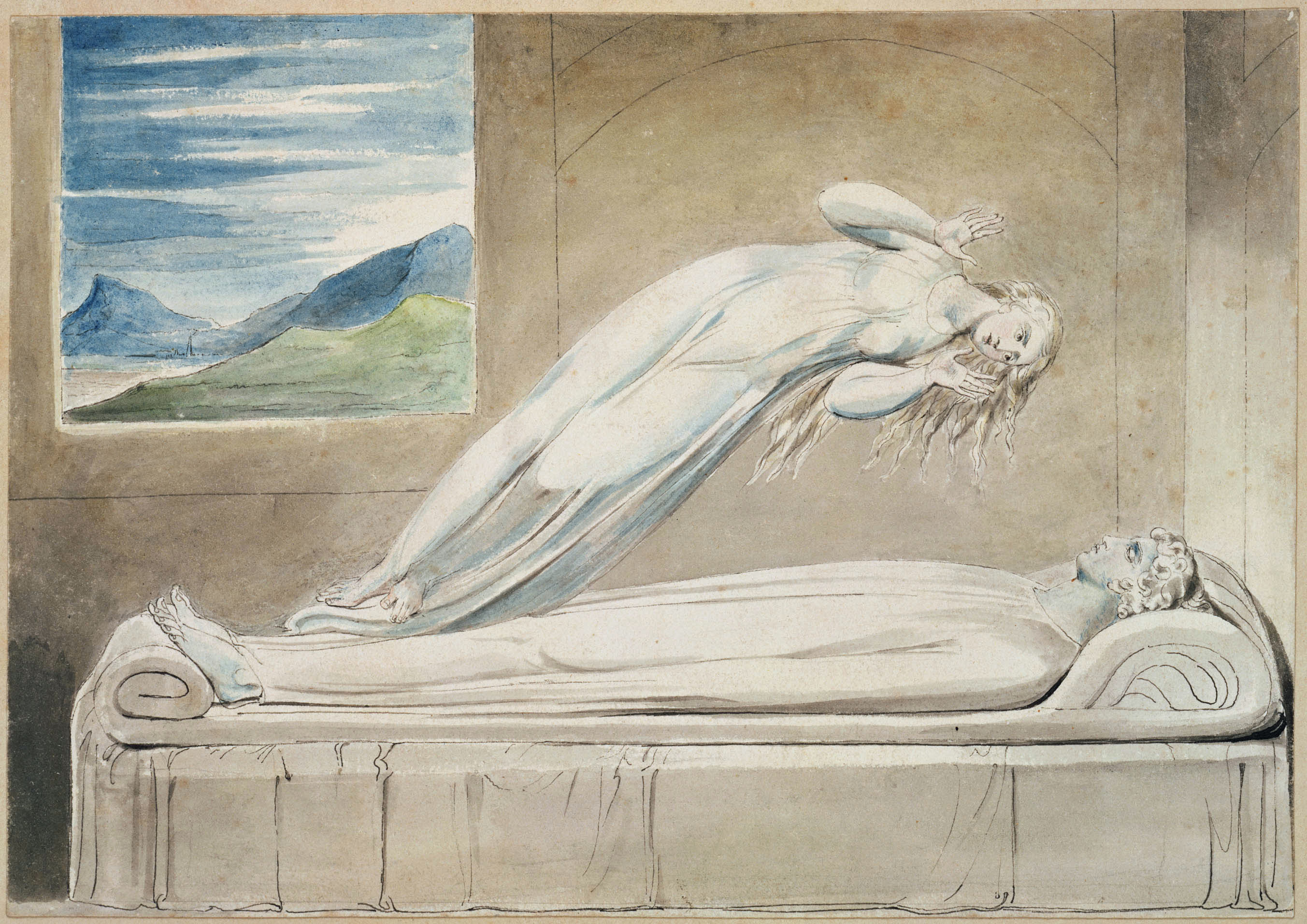
VI. THE SOUL HOVERING OVER THE BODY.

How wishfully she looks On all she's leaving, now no longer her’s !”

VII. THE SOUL EXPLORING THE RECESSES OF THE GRAVE.

The Soul, prior to the dissolution of the Body, exploring through and beyond the tomb, and there discovering the emblems of mortality and of immortality,

VIII. THE COUNSELLOR, KING, WARRIOR, MOTHER, AND CHILD.

All are equal in the Grave. Wisdom, Power, Valour, Beauty, and Innocence, at the hour of death, alike are impotent and unavailing.

IX. THE SKELETON RE-ANIMATED.

When the dread trumpet sounds, the slumb’ring dust, Not unattentive to the call, awakes”; while the world in flames typifies the renovation of all things, the end of Time, and the beginning of Eternity.

X. THE RE-UNION OF SOUL AND BODY.
The Body springs from the grave, the Soul descends from an opening cloud ; they rush together with inconceivable energy; they meet, never again to part !
XI. A FAMILY MEETING IN HEAVEN.
The sweet felicity, the endearing tenderness, the ineffable affection, that are here depicted, are sufficiently obvious. The Husband clasps the Wife; the Children embrace; the Boy recognises and eagerly springs to his Father.
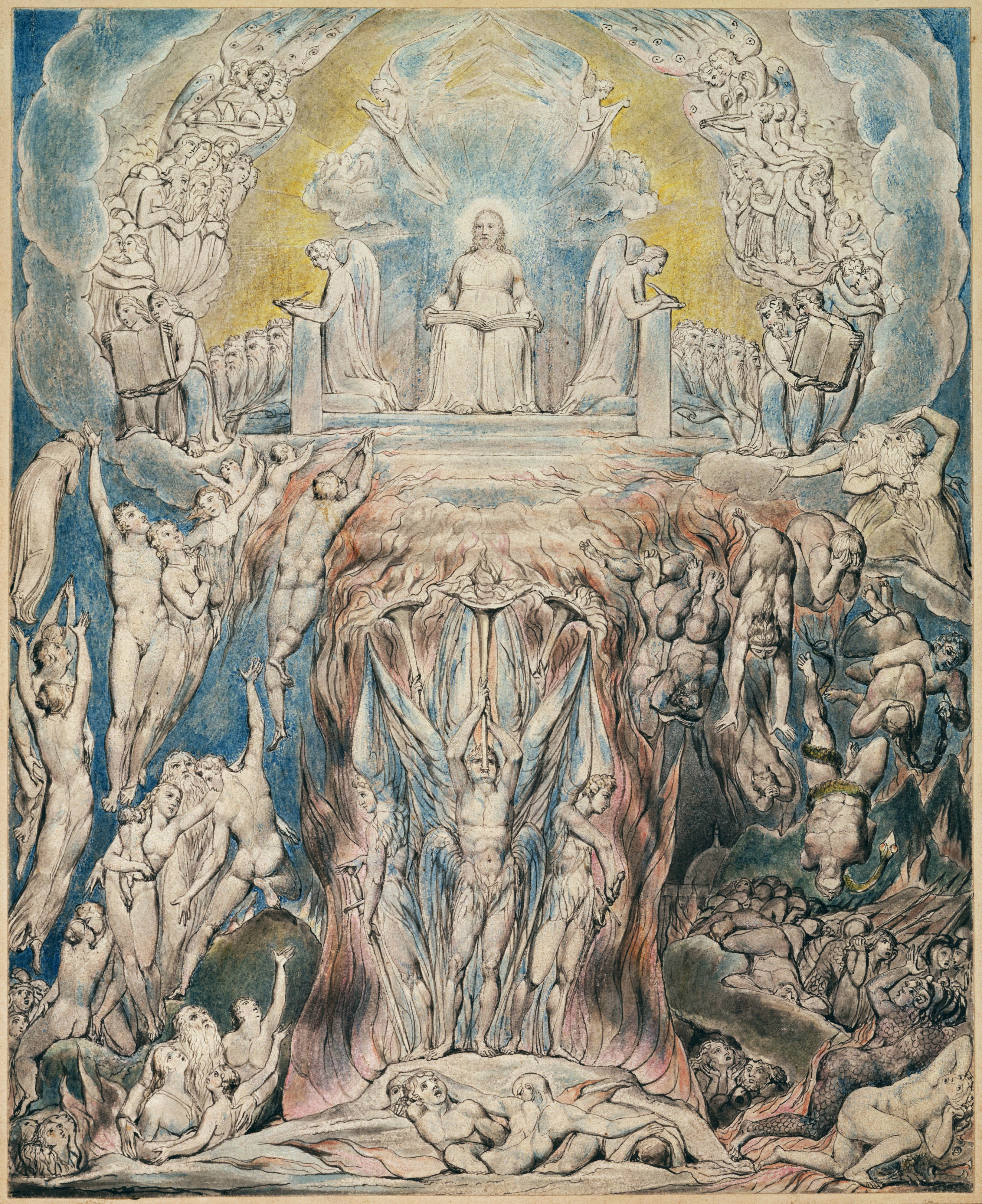
XII. THE LAST JUDGMENT.

Christ coming to judgment in the clouds of heaven, with the “ Thrones set, and the Books opened.” On his knees lies the Book of Life. The Recording Angels kneel on each side of his throne, and the Elders are also seated on each side of Him to judge the world. Surrounding the throne are the blessed, entering into their joy; and arising from these, on each hand, are two clouds of figures: one with the insignia of Baptism; the other with the insignia of the Lord's Supper, inclosing a glorification of angels, with harps. Beneath, on the right hand of Christ, are the blessed, rising in the air to judgment; on the left hand are the cursed: Some are precipitating themselves from the face of Him that sitteth on the Throne (among them is Satan, wound round with the Serpent), others are pleading their own righteousness, and others, beneath, fleeing with banners and spears among the rocks, crying to the “rocks to cover them."

Beneath these are represented the harlot's mystery, and the dragon, who fee before the face of the Judge.

In the centre, standing on the midst of the earth, is the angel with the last trumpet. On each side of him is an angel : that on the left is drawing his sword on the wicked; that on the right is sheathing his sword on the just, who are rising in various groups, with joy and affection, family by family. The angel with the trumpet, and his accompanying ministers of judgment, are surrounded by a column of flame, which spreads itself in various directions over the earth, from which the dead are bursting forth, some in terror, some in joy. On the opening cloud, on each hand of Christ, are two figures, supporting the books of remembrance: that over the just is beheld with humiliation; that over the wicked with arrogance. A sea of fire issues from beneath the throne of Christ, destructive to the wicked, but salutary to the righteous. Before the sea of Fire the clouds are rolled back, and the heavens 'are rolled together as a scroll.'”

Monday, May 10, 2021

DEFENDING FRIENDS

Wikipedia Commons
Illustrations to Blair's The Grave
Reunion of Soul and Body

William Blake and Henry Fuseli shared the trait of being misunderstood by many of their contemporaries. Each felt compelled to defend the other when he felt his friend was under attack by someone who was incapable of appreciating the level of insight the other had reached.

Blake wrote this letter for publication in the Monthly Magazine. Blake was reacting to criticism in the article published in the Bell's Weekly Messenger which found fault with Fuseli's portrayal of the physical and mental suffering of Count Ugolino when he and his children were imprisoned in Pisa.

Letters, (E 768)
To the Editor of the Monthly Magazine.
[In the Monthly Magazine, XXI (July 1, 1806)]

"SIR,
     My indignation was exceedingly moved at reading a criticism
in Bell's Weekly Messenger (25th May) on the picture of Count
Ugolino, by Mr. Fuseli, in the Royal Academy exhibition; and your
Magazine being as extensive in its circulation as that Paper, as
it also must from its nature be more permanent, I take the
advantageous opportunity to counteract the widely-diffused malice
which has for many years, under the pretence of admiration of the
arts, been assiduously sown and planted among the English public
against true art, such as it existed in the days of Michael
Angelo and Raphael.  Under pretence of fair criticism and
candour, the most wretched taste ever produced has been upheld
for many, very many years: but now, I say, now its end is come.
Such an artist as Fuseli is invulnerable, he needs not my
defence; but I should be ashamed not to set my hand and shoulder,
and whole strength, against those wretches who, under pretence of
criticism, use the dagger and the poison.
     My criticism on this picture is as follows:

     Mr. Fuseli's Count Ugolino is the father of sons of feeling
and dignity, who would not sit looking in their parent's face in
the moment of his agony, but would rather retire and die in
secret, while they suffer him to indulge his passionate and
innocent grief, his innocent and venerable madness, and insanity,
and fury, and whatever paltry cold hearted critics cannot,
because they dare not, look upon.  Fuseli's Count Ugolino is a
man of wonder and admiration, of resentment against man and
devil, and of humilitation before God; prayer and parental
affection fills the figure from head to foot.  The child in his
arms, whether boy or girl signifies not, (but the critic must be
a fool who has not read Dante, and who does not know a boy from a
girl); I say, the child is as beautifully drawn as it is
coloured--in both, inimitable! and the effect of the whole is
truly sublime, on account of that very colouring which our critic
calls black and heavy.  The German flute colour, which was used
by the Flemings, (they call it burnt bone), has possessed the eye
of certain connoisseurs, that they cannot see appropriate
colouring, and are blind to the gloom of a real terror.

     The taste of English amateurs has been too much formed upon
pictures imported from Flanders and Holland; consequently our
countrymen are easily brow-beat on the subject of painting; and
hence it is so common to hear a man say, "I am no judge of
pictures:" but, O Englishmen! know that every man ought to be a
judge of pictures, and every man is so who has not been
connoisseured out of his senses.
     
 A gentleman who visited me the other day, said, "I am very
much surprised
at the dislike that some connoisseurs shew on viewing the
pictures of Mr. Fuseli; but the truth is, he is a hundred years
beyond the present generation." Though I am startled at such
an assertion, I hope the contemporary taste will shorten the
hundred years into as many hours; for I am sure that any
person consulting his own eyes must prefer what is so
supereminent; and I am as sure that any person consulting
his own reputation, or the reputation of his country, will
refrain from disgracing either by such ill-judged criticisms in
future.
Yours,
WM. BLAKE. 
_____________ 
Fuseli's support of Blake was provided when the publisher Cromek reneged on his promise to have Blake engrave his own designs for a new issue of Blair's The Grave. When Cromek engaged Schiavonetti to do the engravings, depriving Blake of the income, Fuselli contributed remarks in support of Blake's designs in the introduction to the publication.

The recognition of Blake's designs by Fuseli may have eased the sting of rejection, but it did not allieviate the harm which Blake had endured. Fuseli could defend Blake attempts to make perceptible the spiritual world in imagery which was accessible to the public, but he couldn't overcome common man's taste for the predictable and conventional.

The Grave

London, July 1808.

Cromek wrote:

"To the elegant and classical taste of Mr. FUSELI he is indebted for excellent remarks on the moral worth and picturesque dignity of the Designs that accompany this Poem. Mr. Philips is entitled to his kindest thanks, for the capitally painted Portrait of Mr. William Blake, which is here presented to the Subscribers; and to Mr. SCHIAVONETTI he is under still greater obligations for a ETCHINGS which, it is not too much praise to say, no other artist could have executed so ably."

Fuseli wrote:

"The moral series here submitted to the Public, from its object and method of execution, has a double claim on general attention.

In an age of equal refinement and corruption of manners, when systems of education and seduction go hand in hand; when religion itself compounds with fashion; when in the pursuit of present enjoyment, all consideration of futurity vanishes, and the real object of life is lost—in such an age, every exertion confers a benefit on society which tends to impress man with his destiny, to hold the mirror up to life, less indeed to discriminate its characters, than those situations which show what all are born for, what all ought to act for, and what all must inevitably come to.

The importance of this object has been so well understood at every period of time, from the earliest and most innocent, to the latest and most depraved, that reason and fancy have exhausted their stores of argument and imagery, to impress it on the mind : animate and inanimate nature, the seasons, the forest and the field, the bee and ant, the larva, chrysalis and moth, have lent their real or supposed analogies with the origin, pursuits, and end of the human race, so often to emblematic purposes, that instruction is become stale, and attention callous. The serpent with its tail in its mouth, from a type of eternity, is become an infant's bauble ; even the nobler idea of Hercules pausing between virtue and vice, or the varied imagery of Death leading his patients to the grave, owe their effect upon us more to technic excellence than allegoric utility.

Aware of this, but conscious that affectation of originality and trite repetition would equally impede the author of the moral series before us, has endeavoured to wake sensibility by touching our sympathies with nearer, less ambiguous, and less ludicrous imagery, than what mythology, Gothic superstition, or symbols as far-fetched as inadequate, could supply. His invention has been chiefly employed to spread a familiar and domestic atmosphere round the most important of all subjects, to connect the visible and the invisible world, without provoking probability, and to lead the eye from the milder light of time to the radiations of eternity.

Such is the plan and the moral part of the author's invention; the technic part, and the execution of the artist, though to be examined by other principles, and addressed to a narrower circle, equally claim approbation, sometimes excite our wonder, and not seldom our fears, when we see him play on the very verge of legitimate invention; but wildness so picturesque in itself, so often redeemed by taste, simplicity, and elegance, what child of fancy, what artist would wish to discharge? The groups and single figures on their own basis, abstracted from the general composition, and considered without attention to the plan, frequently exhibit those genuine and unaffected attitudes, those simple graces which nature and the heart alone can dictate, and only an eye inspired by both, discover. Every class of artists, in every stage of their progress or attainments, from the student to the finished master, and from the contriver of ornament, to the painter of history, will find here materials of art and hints of improvement !"
HENRY FUSELI.


Saturday, October 03, 2020

FIRST VISION OF LIGHT

Wikipedia Commons
Illustrations to Milton's Paradise Lost
Thomas Set


From Larry Clayton's Ram Horn'd with Gold.


The prophetic poems which Blake wrote prior to 1800 concern his efforts to know, describe and deal with the old, jealous, wrathful, creator image; he finally dismissed it as a 'shadow of his wearied intellect' (FZ3-40.3). The later, major prophecies, Milton and Jerusalem, also contain this theme, happily outweighed by the new vision. Prior to the 'Felpham Moment' Blake had worshiped his own visionary endowment, his Pot on the Mantle; he called it the Poetic Genius and later the Imagination. The evolving figure of Los building Golgonooza personified what we might call a pre-Christian God. When grace fell upon Blake, he came to see the true embodiment of God in Jesus.


In a letter to his friend and patron, Thomas Butts, he described the experience of redemption that had come to him:

       "And now let me finish with assuring you that tho I have been very unhappy I am so no longer I am again Emerged into the light of Day I still & shall to Eternity Embrace Christianity and Adore him who is the Express image of God..."


At this point we look again at the lovely poem Blake wrote to Butts in October, 1800 reporting on an early appearance of Jesus to him, perhaps the first - when he was 43. He aptly called it "My first Vision of Light":

Letters, (E 712)
"Recieve from me a return of verses such as Felpham produces by me tho not
such as she produces by her Eldest Son. however such as they
are.  I cannot resist the temptation to send them to you

     To my Friend Butts I write
     My first Vision of Light
     On the yellow sands sitting
     The Sun was Emitting
     His Glorious beams
     From Heavens high Streams
     Over Sea over Land
     My Eyes did Expand
     Into regions of air
     Away from all Care
     Into regions of fire
     Remote from Desire
     The Light of the Morning
     Heavens Mountains adorning
     In particles bright
     The jewels of Light
     Distinct shone & clear--
     Amazd & in fear
     I each particle gazed
     Astonishd Amazed
     For each was a Man
     Human formd.  Swift I ran
     For they beckond to me
     Remote by the Sea
     Saying.  Each grain of Sand
     Every Stone on the Land
     Each rock & each hill
     Each fountain & rill
     Each herb & each tree
     Mountain hill Earth & Sea
     Cloud Meteor & Star
     Are Men Seen Afar
     I stood in the Streams
     Of Heavens bright beams
     And Saw Felpham sweet
     Beneath my bright feet
     In soft Female charms
     And in her fair arms
     My Shadow I knew
     And my wifes shadow too
     And My Sister & Friend.
     We like Infants descend
     In our Shadows on Earth
     Like a weak mortal birth
     My Eyes more & more
     Like a Sea without shore
     Continue Expanding
     The Heavens commanding
     Till the jewels of Light
     Heavenly Men beaming bright
     Appeard as One Man
     Who Complacent began
     My limbs to infold
     In his beams of bright gold
     Like dross purgd away
     All my mire & my clay
     Soft consumd in delight
     In his bosom sun bright
     I remaind.  Soft he smild
     And I heard his voice Mild
     Saying This is My Fold
     O thou Ram hornd with gold
     Who awakest from sleep
     On the sides of the Deep
     On the Mountains around
     The roarings resound
     Of the lion & wolf
     The loud sea & deep gulf
     These are guards of My Fold
     O thou Ram hornd with gold
     And the voice faded mild
     I remaind as a Child
     All I ever had known
     Before me bright Shone
     I saw you & your wife
     By the fountains of Life
     Such the Vision to me
     Appeard on the Sea"


 Following John and Paul quite literally Blake believed that all things belong to Jesus. He is in them (us) and they (we) are in him. All his life Blake had kept a firm grip on the oneness of humanity and its identity with God. At the Moment of Grace he came to see all as One Man and his own forgiven and accepted place in that Man's bosom. In the poem the Man refers to the All as "My Fold" and names the awakened Blake as his herald: "Thou Ram horn'd with gold".


John 14

[26] But the Comforter, which is the Holy Ghost, whom the Father will send in my name, he shall teach you all things, and bring all things to your remembrance, whatsoever I have said unto you.


Monday, August 31, 2020

MALEVOLENCE

MALEVOLENCE

Blake's friend George Cumberland recommended him to Rev John Trusler an ordained minister who also engaged in pursuits such as teaching, writing, practicing medicine, and promoting various schemes. Blake was to design and execute several paintings illustrating subjects of Trusler's choosing. However Blake felt constrained by Trusler's contrary view of creating images. Apparently Trusler would only be satisfied by an image which faithfully reproduced something which he observed in the world as he experienced it, or was oversimplified as a caricature. 

Blake observed the outer physical world, but his art had been processed in his mind before it was transferred to a representation in graphic form. Blake took the opportunity of his correspondence with Trusler and Cumberland to explain his ideas about the purpose and methods of art. As Blake saw it Trusler would have found Michelangelo's art as unacceptable as his own because the master was not portraying what he saw externally but what his mind conceived.    

The movie Field of Dreams best captures for me the dichotomy of seeing only what the sense is capable of discerning and the expanded capability of perceiving a vision. The transition between the two capabilities is dramatically illustrated by the players being physical and visible on the ball field, and being invisible and without substance when they step into the corn field. It was not about the nature of the two realities but about one's ability to switch between the two modes of experience.  Blake attempted to make the vision which he discerned perceptible to Trusler who seemed to be blind to the reality which expresses itself through imagination.
  
Letters, (E 701)
"To The Revd Dr Trusler
Hercules Build* Lambeth Aug* 16. 1799
Revd Sir
     I find more & more that my Style of Designing is a Species
by itself. & in this which I send you have been compelld by my
Genius or Angel to follow where he led if I were to act otherwise
it would not fulfill the purpose for which alone I live. which is
in conjunction with such men as my friend Cumberland to renew the
lost Art of the Greeks
     I attempted every morning for a fortnight together to follow
your Dictate. but when I found my attempts were in vain. resolvd
to shew an independence which I know will please an Author better
than slavishly following the track of another however admirable
that track may be At any rate my Excuse must be: I could not do
otherwise, it was out of my power!
     I know I begged of you to give me your Ideas & promised to
build on them here I counted without my host   I now find my
mistake
     The Design I have Sent.  Is
     A Father taking leave of his Wife & Child.  Is watchd by Two
Fiends incarnate. with intention that when his back is turned
they will murder the mother & her infant--If this is not
Malevolence with a vengeance I have never seen it on Earth. & if
you approve of this I have no doubt of giving you Benevolence
with Equal Vigor. as also Pride & Humility. but cannot previ-
ously describe in words what I mean to Design for fear I should
Evaporate some of the Spirit of my Invention.  But I
hope that none of my Designs will be destitute of Infinite
Particulars which will present themselves to the Contemplator. 
And tho I call them Mine   I know that they are not Mine being of
the same opinion with Milton when he says That the Muse visits
his Slumbers & awakes & governs his Song when Morn purples The
East. & being also in the predicament of that prophet who says  I
cannot go beyond the command of the Lord to speak good or bad
     If you approve of my Manner & it is agreeable to you.  I
would rather Paint Pictures in oil of the same dimensions   than
make Drawings. & on the same terms. by this means you will have a
number of Cabinet pictures. which I flatter myself will not be
unworthy of a Scholar of Rembrant & Teniers. whom I have Studied
no less than Rafael & Michael angelo--Please to send me your
orders respecting this & In my next Effort I promise more
Expedition 
I am Revd Sir 
Your very humble servt 
WILLm BLAKE"
 
Letters, (E 702)
"Revd Dr Trusler, Englefield Green, Egham, Surrey
13 Hercules Buildings,.Lambeth, August 23, 1799
Revd Sir
     I really am sorry that you are falln out with the Spiritual
World Especially if I should have to answer for it I feel very
sorry that your Ideas & Mine on Moral Painting differ so much as
to have made you angry with my method of Study.  If I am wrong I
am wrong in good company.  I had hoped your plan comprehended All
Species of this Art & Especially that you would not reject that
Species which gives Existence to Every other. namely Visions of
Eternity You say that I want somebody to Elucidate my Ideas.  But
you ought to know that What is Grand is necessarily obscure to
Weak men.  That which can be made Explicit to the Idiot is not
worth my care.  The wisest of the Ancients considerd what is not
too Explicit as the fittest for Instruction because it rouzes the
faculties to act.  I name Moses Solomon Esop Homer Plato
     But as you have favord me with your remarks on my Design
permit me in return to defend it against a mistaken one, which
is.  That I have supposed Malevolence without a Cause.--Is not
Merit in one a Cause of Envy in another & Serenity & Happiness &
Beauty a Cause of Malevolence.  But Want of Money & the Distress
of A Thief can never be alledged as the Cause of his Thievery.
for many honest people endure greater hard ships with Fortitude
We must therefore seek the Cause elsewhere than in want of Money
for that is the Misers passion, not the Thiefs
     I have therefore proved your Reasonings Ill proportiond
which you can never prove my figures to be.  They are those of
Michael Angelo Rafael & the Antique & of the best living Models.
I percieve that your Eye[s] is perverted by Caricature
Prints, which ought not to abound so much as they do.  Fun I love
but too much Fun is of all things the most loathsom.  Mirth is
better than Fun & Happiness is better than Mirth--I feel that a
Man may be happy in This World.  And I know that This World Is a
World of Imagination & Vision I see Every thing I paint In This
World, but Every body does not see alike.  To the Eyes of a Miser
a Guinea is more beautiful than the Sun & a bag worn with the use
of Money has more beautiful proportions than a Vine filled with
Grapes. The tree which moves some to tears of joy is in the Eyes
of others only a Green thing that stands in the way.  Some See
Nature all Ridicule & Deformity & by these I shall not regulate
my proportions, & Some Scarce see Nature at all But to the Eyes
of the Man of Imagination Nature is Imagination itself.  As a man
is So he Sees.  As the Eye is formed such are its Powers You
certainly Mistake when you say that the Visions of Fancy are not
be found in This World.  To Me This World is all One continued
Vision of Fancy or Imagination & I feel Flatterd when I am told
So.  What is it sets Homer Virgil & Milton in so high a rank of
Art.  Why is the Bible more
Entertaining & Instructive than any other book.  Is it not
because they are addressed to the Imagination which is Spiritual
Sensation & but mediately to the Understanding or Reason Such is
True Painting and such was alone valued by the Greeks & the
best modern Artists.  Consider what Lord Bacon says "Sense sends
over to Imagination before Reason have judged & Reason sends over
to Imagination before the Decree can be acted."   See Advancemt of
Learning Part 2 P 47 of first Edition
     But I am happy to find a Great Majority of Fellow Mortals
who can Elucidate My Visions & Particularly they have been
Elucidated by Children who have taken a greater delight in
contemplating my Pictures than I even hoped.  Neither Youth nor
Childhood is Folly or Incapacity Some Children are Fools
& so are some Old Men.  But There is a vast Majority on the
side of Imagination or Spiritual Sensation
     To Engrave after another Painter is infinitely more
laborious than to Engrave ones own Inventions.  And of the Size
you require my price has been Thirty Guineas & I cannot afford to
do it for less.  I had Twelve for the Head I sent you as a
Specimen, but after my own designs I could do at least Six times
the quantity of labour in the same time which will account for
the difference of price as also that Chalk Engraving is at least
six times as laborious as Aqua tinta.  I have no objection to
Engraving after another Artist.  Engraving is the profession I
was apprenticed to, & should never have attempted to live by any
thing else If orders had not come in for my Designs & Paintings,
which I have the pleasure to tell you are Increasing Every Day.
Thus If I am a Painter it is not to be attributed to Seeking
after.  But I am contented whether I live by Painting or
Engraving
     I am Revd Sir Your very obedient servant
WILLIAM BLAKE"
Letters, (E 703)
"Mr [George] Cumberland, Bishopsgate,
Windsor Great Park
Hercules Buildings, Lambeth. Augst 26. 1799
Dear Cumberland
     I ought long ago to have written to you to thank you for
your kind recommendation to Dr Trusler which tho it has faild of
success is not the less to be rememberd by me with Gratitude--
     I have made him a Drawing in my best manner he has sent it
back with a Letter full of Criticisms in which he says it accords
not with his Intentions which are to Reject all Fancy from his
Work.  How far he Expects to please I cannot tell.  But as I
cannot paint Dirty rags & old Shoes where I ought to place Naked
Beauty or simple ornament.  I despair of Ever pleasing one Class
of Men--Unfortunately our authors of books are among this Class
how soon we Shall have a change for the better I cannot Prophecy.
Dr Trusler says 
"Your Fancy from what I have seen of it. & I have seen
variety at Mr Cumberlands seems to be in the other world or the
World of Spirits. which accords not with my Intentions. which
whilst living in This World Wish to follow the Nature of
it" I could not help Smiling at the difference between the
doctrines of Dr Trusler & those of Christ.  But however for his
own sake   I am sorry that a Man should be so enamourd of
Rowlandsons caricatures as to call them copies from life &
manners or fit Things for a Clergyman to write upon
     Pray let me intreat you to persevere in your Designing it is
the only source of Pleasure   all your other pleasures depend
upon It.  It is the Tree Your Pleasures are the Fruit.  Your
Inventions of Intellectual Visions are the Stamina of every thing
you value.  Go on if not for your own sake yet for ours who love
& admire your works. but above all For the Sake of the Arts.  Do
not throw aside for any long time the honour intended you by
Nature to revive the Greek workmanship.  I study your outlines as
usual just as if they were antiques.
     As to Myself about whom you are so kindly Interested.  I
live by Miracle.  I am Painting small Pictures from the Bible.
For as to Engraving in which art I cannot reproach myself with
any neglect yet I am laid by in a corner as if I did not Exist &
Since my Youngs Night Thoughts have been publishd Even Johnson &
Fuseli have discarded my Graver.  But as I know that He who Works
& has his health cannot starve.  I laugh at Fortune & Go on &
on.  I think I foresee better Things than I have ever seen.  My
Work pleases my employer & I have an order for Fifty small
Pictures at One Guinea each which is Something better than mere
copying after another artist.  But above all I feel myself happy
& contented   let what will come having passed now near twenty
years in ups & downs I am used to them & perhaps a little
practise in them may turn out to benefit.  It is now Exactly
Twenty years since I was upon the ocean of business & Tho I laugh
at Fortune I am perswaded that She Alone is the Governor of
Worldly Riches. & when it is Fit She will call on me till then I
wait with Patience in hopes that She is busied among my Friends.
     With Mine & My Wifes best compliments to Mr Cumberland
I remain
Yours sincerely
WILLm BLAKE" 


This is for those who may be confused by Blake's use of the word 'Fancy.'
https://www.dictionary.com/browse/fancy

synonym study for fancy

9. Fancy, fantasy, imagination refer to qualities in literature or other artistic composition. The creations of fancy are casual, whimsical, and often amusing, being at once less profound and less moving or inspiring than those of imagination: letting one's fancy play freely on a subject; an impish fancy. Fantasy now usually suggests an unrestrained or extravagant fancy, often resulting in caprice: The use of fantasy in art creates interesting results. The term and concept of creative imagination are less than two hundred years old; previously only the reproductive aspect had been recognized, hardly to be distinguished from memory. “Creative imagination” suggests that the memories of actual sights and experiences may so blend in the mind of the writer or artist as to produce something that has never existed before—often a hitherto unperceived vision of reality: to use imagination in portraying character and action.

https://en.wiktionary.org/wiki/fancy

An image or representation of anything formed in the mind. Synonyms: conception, thought, idea


Wednesday, October 11, 2017

MY MORTAL PART

Death of the Virgin
 

The pair of watercolors which Blake painted for Butts depicting the deaths of the parents of Jesus, like all of Blake's images, are meant to be read symbolically. Joseph was an earthly human, his death was the death of a natural man. When his body died his spirit was released to rejoin the Communion of Saints who cast off the Temporal to be Established in the Eternal.

The mother of Jesus was a somewhat different case. The physical nature of the Incarnate Christ had come to Jesus through her. Blake had Jesus address her as 'mother of my mortal part.' Jesus predeceased his mother when he was crucified on Golgotha. In Blake's image Death of the Virgin, Jesus stands with her. No earthly beings attend her; four angels minister at the head and feet to the body in repose.
 

Perhaps Blake's implication is that Mary's Natural Body had already been raised as her Spiritual Body: by becoming the mother of the mortal part of Christ her Spiritual Body was expressed in a unique way. In Blake's Milton he used the virgin Ololon as a symbol of the material, feminine part of man's nature which became integrated in the Unified, Redeemed Body of the complete Man.

Matthew 1
[18] Now the birth of Jesus Christ was on this wise: When as his mother Mary was espoused to Joseph, before they came together, she was found with child of the Holy Ghost.
[19] Then Joseph her husband, being a just man, and not willing to make her a publick example, was minded to put her away privily.
[20] But while he thought on these things, behold, the angel of the Lord appeared unto him in a dream, saying, Joseph, thou son of David, fear not to take unto thee Mary thy wife: for that which is conceived in her is of the Holy Ghost.
[21] And she shall bring forth a son, and thou shalt call his name JESUS: for he shall save his people from their sins.
[22] Now all this was done, that it might be fulfilled which was spoken of the Lord by the prophet, saying,
[23] Behold, a virgin shall be with child, and shall bring forth a son, and they shall call his name Emmanuel, which being interpreted is, God with us.

Isaiah 7
[14] Therefore the Lord himself shall give you a sign; Behold, a virgin shall conceive, and bear a son, and shall call his name Immanuel.


John 2 
[1] And the third day there was a marriage in Cana of Galilee; and the mother of Jesus was there: 
[2] And both Jesus was called, and his disciples, to the marriage. 
[3] And when they wanted wine, the mother of Jesus saith unto him, They have no wine. 
[4] Jesus saith unto her, Woman, what have I to do with thee? mine hour is not yet come.

Songs of Innocence & of Experience, Song 52, (E 30)
"To Tirzah             

Whate'er is Born of Mortal Birth,
Must be consumed with the Earth
To rise from Generation free;
Then what have I to do with thee?

The Sexes sprung from Shame & Pride
Blow'd in the morn: in evening died
But Mercy changd Death into Sleep;
The Sexes rose to work & weep.

Thou Mother of my Mortal part.
With cruelty didst mould my Heart. 
And with false self-decieving tears,
Didst bind my Nostrils Eyes & Ears.

Didst close my Tongue in senseless clay
And me to Mortal Life betray:
The Death of Jesus set me free, 
Then what have I to do with thee?

[text on illustration:] It is Raised a Spiritual Body"
 
Four Zoas, Night VIII, PAGE 104 (SECOND PORTION), (E 377)
"He stood in fair Jerusalem to awake up into Eden
The fallen Man but first to Give his vegetated body    
To be cut off & separated that the Spiritual body may be Reveald"
 
Annotations to Berkley's Siris, (E 664)
"The Natural Body is an Obstruction to the Soul or Spiritual Body"


Wednesday, March 30, 2016

BLAKE'S DISCIPLES


Blake's Disciples was first posted by Larry on January 12, 2011.

British Museum  
Illustrations to Young's Night Thoughts
People or groups show that they are disciples of someone by attempting to express that person's values. We cite four occurrences of individuals or groups becoming Blake's disciples:
 

1.
The first instance of disciples becoming attached to Blake was a group of younger men who were attracted by his skills as an artist. The son of George Cumberland who was a fellow artist and one of Blake's best friends, brought another young artist John Linnell to see Blake's work. From there the word spread among the group of aspiring artists with an interest in infusing their art with spiritual values. Blake was pleased to share his insight into using his art as a vehicle for communicating his deepest feelings and his understanding of human lineaments. 


Calling themselves the Shoreham Ancients they were "a group of English artists who were brought together by their attraction to archaism in art and admiration for the work of William Blake."

Four Zoas, Night VIII, PAGE 104 (FIRST PORTION), (E 376) 
"And Enitharmon namd the Female Jerusalem the holy
Wondring she saw the Lamb of God within Jerusalems Veil
The divine Vision seen within the inmost deep recess
Of fair Jerusalems bosom in a gently beaming fire

Then sang the Sons of Eden round the Lamb of God & said 
Glory Glory Glory to the holy Lamb of God
Who now beginneth to put off the dark Satanic body
Now we behold redemption Now we know that life Eternal
Depends alone upon the Universal hand & not in us" 
2. 
The Flower Children: In terms of two of Blake's most sacred values, the Sixties represented perhaps the first generation of Blakeans; they epitomized the antiwar movement and sexual liberty. The promiscuity of a few of the flower children represented the most excessive expression of Blake's witness to sexual freedom. In the long term it led to a healthier level of association between men and women.

Although the San Francisco area the sixties saw the first generation of true Blakeans or people who patterned their lives after Blake's tenants; the seventies brought recession and many  lapsed into the materialistic proclivities of their elders.
 

Visions of Daughters of Albion, Plate 5, (E 49 
"With what sense does the parson claim the labour of the farmer?
What are his nets & gins & traps. & how does he surround him
With cold floods of abstraction, and with forests of solitude,
To build him castles and high spires. where kings & priests may dwell.    
Till she who burns with youth. and knows no fixed lot; is bound
In spells of law to one she loaths: and must she drag the chain
Of life, in weary lust! must chilling murderous thoughts. obscure
The clear heaven of her eternal spring? to bear the wintry rage
Of a harsh terror driv'n to madness, bound to hold a rod     
Over her shrinking shoulders all the day; & all the night
To turn the wheel of false desire: and longings that wake her womb
To the abhorred birth of cherubs in the human form
That live a pestilence & die a meteor & are no more.
Till the child dwell with one he hates. and do the deed he loaths
And the impure scourge force his seed into its unripe birth
E'er yet his eyelids can behold the arrows of the day."
3.
The anti-war fever that broke out in the late sixties was an eloquent witness to one of Blake's primary values. Since "Whitefield & Westley" a handful of our fellow men have witnessed to the destructive futility of War (chief among them are the Quakers). Hence they might be thought of as the third group among Blake's disciples.

Re the Peace Witness one might more properly say that Blake was a disciple of the Quakers, although strangely enough he never saw fit to mention them, and few Quakers of my acquaintance today see fit to mention him. Blake's pacifism may have had its roots in with the Moravians, another pacifist group with whom his mother had been associated. Blake would have appreciated the fact that the younger generation was openly demonstrating their anti-war sentiments against a war supported by their elders. They like Blake knew that there were no winners in war - only losers.


America, Plate 14, (E 56)
"Fury! rage! madness! in a wind swept through America             
And the red flames of Orc that folded roaring fierce around
The angry shores, and the fierce rushing of th'inhabitants together:
The citizens of New-York close their books & lock their chests;
The mariners of Boston drop their anchors and unlade;
The scribe of Pensylvania casts his pen upon the earth;          
The builder of Virginia throws his hammer down in fear.

Then had America been lost, o'erwhelm'd by the Atlantic,
And Earth had lost another portion of the infinite,
But all rush together in the night in wrath and raging fire
The red fires rag'd! the plagues recoil'd! then rolld they back with fury 
PLATE 15
On Albions Angels; then the Pestilence began in streaks of red
Across the limbs of Albions Guardian, the spotted plague smote Bristols
And the Leprosy Londons Spirit, sickening all their bands:
The millions sent up a howl of anguish and threw off their hammerd mail,
And cast their swords & spears to earth, & stood a naked multitude." 
4. 
Finally there are a growing number in contemporary society who just love Blake. We love his values; we love his courage at a critical time in his life to choose Art over materialistic desires. The overt evidence of that came when he went back to London after his 'three years' on the coast. He had the same courage that Albert Schweitzer had when he gave up fame and fortune to give help to the most needy in darkest Africa.

Blake's determination to nurture his spiritual development in spite of the economic cost inspires loyalty among his disciples.


Laocoon, (E 274)
"Prayer is the Study of Art
Praise is the Practise of Art
Fasting &c. all relate to Art
The outward Ceremony is Antichrist
Without Unceasing Practise nothing can be done 

Practise is Art     If you leave off you are Lost

A Poet a Painter a Musician an Architect: the Man 
Or Woman who is not one of these is not a Christian 
You must leave Fathers & Mothers & Houses & Lands 
     if they stand in the way of ART

The unproductive Man is not a Christian much less the Destroyer"
Mark 10
[29] And Jesus answered and said, Verily I say unto you, There is no man that hath left house, or brethren, or sisters, or father, or mother, or wife, or children, or lands, for my sake, and the gospel's,
[30] But he shall receive an hundredfold now in this time, houses, and brethren, and sisters, and mothers, and children, and lands, with persecutions; and in the world to come eternal life.
[31] But many that are first shall be last; and the last first.

Monday, March 14, 2016

COMPANY OF DISSENTERS


Wikipedia Commons
Marriage of Heaven & Hell
Plate 24
In any society there are those who ascribe to the system, and those who disagree with the prevailing ethos. In England the system of government was the monarchy supported by an aristocratic class. There was a state church - the Church of England - which was the required form of worship. Those who would not accept the government or church were dissenters. The government enacted laws to restrict the freedom of dissenters to associate with one another, or disseminate anti-authoritarian information, or to fully participate in their system. In spite of attempts by the government to prevent people from practicing religion as they chose, numerous sects arose among the populace. 


Blake was born into a family of dissenters. Although he was baptised as an infant in an authorized church, the family dissented from established religion. As an adult Blake also dissented from supporting the system of government which led to the oppression of the masses by the ruling authorities. His opposition to the established government and the established church became a prevailing theme in his poetry. If his poetry had been read and understood by those in authority he would have been subject to sanctions as were George Fox, John Bunyan and Thomas Paine for their activities and writings. As it was, Blake was very nearly convicted of treason after expelling a enraged soldier from his garden.


Although dissenters were opposed to the dominant motifs of their society, they were usually, with some exceptions, not outside of the structure which prevailed. If they maintained a low profile, or avoided direct confrontations, they formed threads in the economic, political and social fabric of life. Although they could not be educated in establishment schools, be buried in Church of England churchyards, publish their ideas publicly, assemble in large groups, or hold public office, their influence was felt in religion, business, art and social improvement for the underclass.


Since one of the sanctions against dissenters was that they were no eligible for burial in churchyards, alternative burial grounds were developed, of which Bunhill Fields in London was one. The influence which dissenters had on their culture is apparent in the names of people buried in Bunhill Fields. Like many dissenters buried in Bunhill Fields Blake chose to have a Church of England funeral service which would have included prayer, readings from the Old and New Testaments and singing of hymns led by a clergyman of the Church of England. Several of William's family members including his parents and his brother Robert had previously been buried in Bunhill Fields, and his wife too would subsequently rest there among a long line of dissenters.


Not just in death but in life, Blake had joined a company who had set themselves apart not to exclude those whose work maintained a system based on exclusion, but to maintain solidarity with the universality of humanity.


Songs of Experience, The Chimney Sweeper, (E 22)

"Because I was happy upon the heath, 

And smil'd among the winter's snow: 

They clothed me in the clothes of death, 
And taught me to sing the notes of woe.

And because I am happy, & dance & sing,
They think they have done me no injury:
And are gone to praise God & his Priest & King
Who make up a heaven of our misery."

Annotations to Watson, (E 615)
 "The Bible or  ^Peculiar^ Word of God, Exclusive of Conscience
or the Word of God Universal, is that Abomination which like the
Jewish ceremonies is for ever removed & henceforth every man may
converse with God & be a King & Priest in his own house"


Letters, To Cumberland, April 1827, (E 784) 
 "Flaxman is Gone & we must All soon follow every one to his
Own Eternal House Leaving the Delusive Goddess Nature & her Laws
to get into Freedom from all Law of the Members into The Mind in
which every one is King & Priest in his own House God Send it so
on Earth as it is in Heaven
I am Dear Sir Yours Affectionately
WILLIAM BLAKE" 
1ST Corinthians 15
[53] For this perishable nature must put on the imperishable, and this mortal nature must put on immortality.
[54] When the perishable puts on the imperishable, and the mortal puts on immortality, then shall come to pass the saying that is written: "Death is swallowed up in victory."

Friday, March 13, 2015

Blake's Friends

Blake's Friends

       To the best of our knowledge Blake belonged to no organized church. We do know of two groups which might generically qualify as churches, using the word in its broadest possible sense. The first gathered around the radical publisher, Joseph Johnson, Blake's primary employer and the friend of Mary Wollstonecraft, Joseph Priestly, Richard Price, Thomas Paine and other radical intellectuals. While the conventional church exists as a primary bulwark of the status quo, Joseph Johnson's group by and large conceived of Christ as a revolutionary. Dissenters of a variety of persuasions, they were united by their awareness of the need for social and political change. They considered this the primary agenda of any truly spiritual communion.
       Blake was in accord with these ideas. The Johnson group nurtured him and provided the communal support which we generally associate with church groups. The second group gathered around Blake in his last decade. It was made up of young artists, some of them devout. They looked to Blake for aesthetic and spiritual guidance and provided him the communal support that lent grace to his last years.
       After Blake's Moment of Grace around 1800 he might have joined a church if he could have found one whose primary doctrine was the forgiveness of sins. But like Milton before him and Lincoln after him he never discovered a church that met his qualifications.
       Anyone who loves Blake and has had a happier experience of the church could wish for him more in the way of community. Alienated from the worshiping community by its partial theology and partial practice, he was confined to his own visions and the nurture he could find at the outer fringes of the church. In addition he learned from the Christian classics of the ages, particularly the off beat ones. St. Teresa was a favorite.
       We know little or nothing of the social agency by which the Ranter tradition came down to him. All of these are elements of the Universal Church upon which Blake drew and to which he belonged. Blessed with a worshiping fellowship beyond that of his wife, his lot might have been happier and his witness plainer to others.
       Even so the church is fortunate to have his contribution. Isaiah and Jeremiah, not to mention Jesus, also suffered alienation from their communities. At the deepest level none of the four men rejected the church, but rather the church rejected them. Blake was too deeply attached to the priesthood of the believer to be able to submit to any spiritual authority politically assigned: Let every man be "King and Priest in his own house". In the words of Foster Damon "The Church Universal was the only church that Blake recognized. Its doctrine is the Everlasting Gospel, its congregation the Brotherhood of Man, its symbol the Woman in the Wilderness, its architecture Gothic (p.82)."

ii

What he Said

       In 'Songs of Experience' Blake expressed some biting truths about the place of the church in the lives of ordinary people:
    A little black thing among the snow, Crying "'weep! 'weep!" in notes of woe! "Where are thy father & mother? Say?" "They are both gone up to the church to pray."Because I was happy upon the heath, "And smil'd among the winter's snow, "They clothed me in the clothes of death, "And taught me to sing the notes of woe.
    "And because I am happy & dance & sing, "They think they have done me no injury, "And are gone to praise God & his Priest & King, "Who make up a heaven of our misery."
          (The Chimney Sweeper; Songs of Experience)
       Surely the church has become more human since Blake's day, when it could condone the employment of five year olds as chimney sweepers and in fact their legal sale by their parents for such a purpose. Even more bald in its ecclesiastical implications is "The Little Vagabond", which sounds very much like a Ranter's song:
    Dear Mother, dear Mother, the Church is cold,
    But the Ale-house is healthy & pleasant & warm;
    Besides I can tell where I am used well,
    Such usage in heaven will never do well.But if at the Church they would give us some Ale,
    And a pleasant fire our souls to regale,
    We'd sing and we'd pray all the live-long day,
    Nor ever once wish from the Church to stray.
    Then the Parson might preach, & drink, & sing,
    And we'd be as happy as birds in the spring;
    And modest dame Lurch, who is always at Church,
    Would not have bandy children, nor fasting, nor birch.
    And God, like a father rejoicing to see
    His children as pleasant and happy as he,
    Would have no more quarrel with the Devil or the Barrel,
    But kiss him, & give him both drink and apparel.
          (The Little Vagabond)
       In 'Europe' , written about the same time, Blake recounts the degradation of the church with the cult of chivalry and the Queen of Heaven:
    Now comes the night of Enitharmon's joy!
    Who shall I call? Who shall I send,
    That Woman, lovely Woman, may have dominion?
    Arise, O Rintrah, thee I call! & Palambron, thee!
    Go! tell the Human race that Woman's love is Sin;
    That an Eternal life awaits the worms of sixty winters
    In an allegorical abode where existence hath never come.
    Forbid all Joy, & from her childhood shall the little female
    Spread nets in every secret path.
          (Europe 5:1ff, Erdman 62)